
By The RX Index Editorial Team · Last verified: March 28, 2026 · Pricing checked against ro.co and noom.com · Updated monthly · Our methodology
GLP-1 PROGRAM COMPARISON — 2026
Ro vs Noom: Which GLP-1 Program Is Actually Better in 2026?
If you're comparing Ro vs Noom for GLP-1 weight loss, here's the short answer: Ro is the better choice for most people. It gives you a cleaner path to FDA-approved medications like Wegovy and Zepbound, dedicated insurance support that fights for coverage on your behalf, and straightforward month-to-month billing you can cancel anytime.
Noom is the better choice if you specifically want psychology-based coaching layered onto your GLP-1 treatment — especially the Microdose or medication-included paths. Just know that Noom's medication-included plans bill in 12-week blocks ($597–$837 upfront), while its branded-meds plan bills monthly.
But here's what makes this comparison genuinely confusing, and why most “Ro vs Noom” pages get it wrong: Ro is one core program with multiple medication paths. Noom currently markets multiple distinct GLP-1 paths — each with different pricing, different medications, and different billing structures. Most comparison pages treat “Noom” as a single thing. It isn't. And that's exactly where people get burned.
Check your eligibility and current pricing on Ro first — it takes 5 minutes and there's no commitment until you're ready.
Check Eligibility on Ro →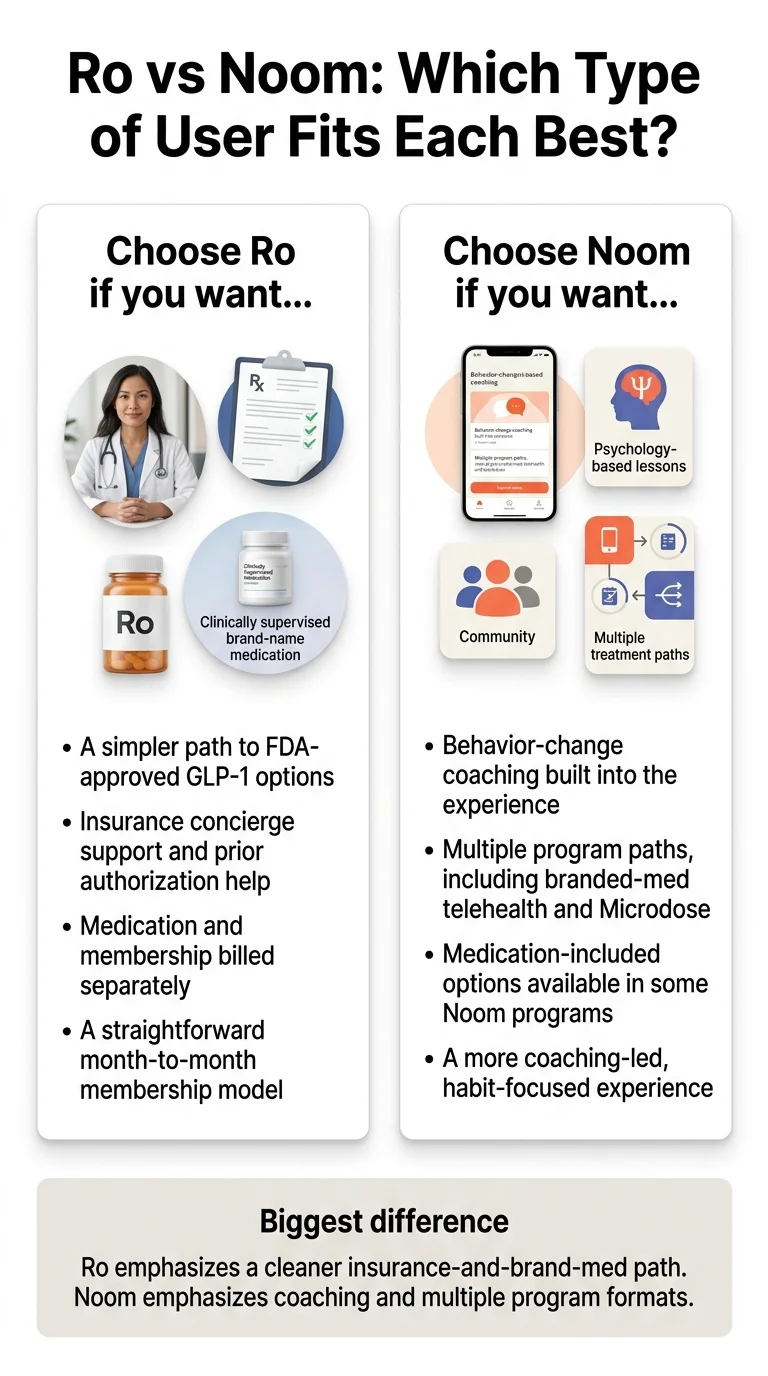
The biggest difference: Ro emphasizes the insurance-and-brand-med path. Noom emphasizes coaching and multiple program formats. Source: The RX Index, 2026.
At a Glance: Ro vs Noom (The Real Comparison Table)
We split Noom into its real program paths because lumping them together is how people end up surprised by their credit card statement.
| Ro Body Program | Noom Telehealth (Branded Meds) | Noom GLP-1Rx (Full Dose) | Noom Microdose | |
|---|---|---|---|---|
| Best for | Insurance-first, FDA meds, simple billing | Branded meds + coaching, insured | Cash-pay, meds included | Gentle start, side-effect sensitive |
| First charge | $45 | $69 | Varies — verify at checkout | $99 |
| Ongoing cost | $145/mo (meds separate) | $99/mo (meds separate) | $279/mo ($837/12 wks, meds included) | $199/mo ($597/12 wks, meds included) |
| Medication included? | No | No | Yes (compounded semaglutide) | Yes (compounded semaglutide) |
| FDA-approved meds? | ✅ Yes — Wegovy, Zepbound | ✅ Yes — Wegovy, Zepbound | ❌ Compounded only | ❌ Compounded only |
| Insurance help | ✅ Dedicated concierge + prior auth + appeals | ✅ Care coordinators assist | N/A (cash-pay) | N/A (cash-pay) |
| Billing | Month-to-month | Month-to-month | Quarterly ($837 every 12 weeks) | Quarterly ($597 every 12 weeks) |
| Cancel anytime? | ✅ Yes | ✅ Yes | ⚠️ Yes, but no mid-cycle refund | ⚠️ Yes, but no mid-cycle refund |
| State availability | All 50 states + D.C. | Most states (not AL or VA) | Not all states | Not all states |
Sources: Ro pricing page, Noom cost page. All prices checked March 28, 2026. Prices change frequently — we check monthly. Always verify at checkout before enrolling.
Affiliate disclosure: The RX Index may earn a commission if you sign up through links on this page. This does not affect our editorial recommendations — our methodology is published and our provider ratings are not influenced by commission rates.
Wait — Why Does This Say “Noom” Four Times?
This is the single most important thing to understand before you spend a dollar. When someone says “I'm thinking about Noom,” they could mean any of several completely different products with different prices, different medications, and different billing cycles. Most comparison pages don't acknowledge this, which is why people end up confused — or worse, locked into a quarterly billing cycle they didn't fully understand.
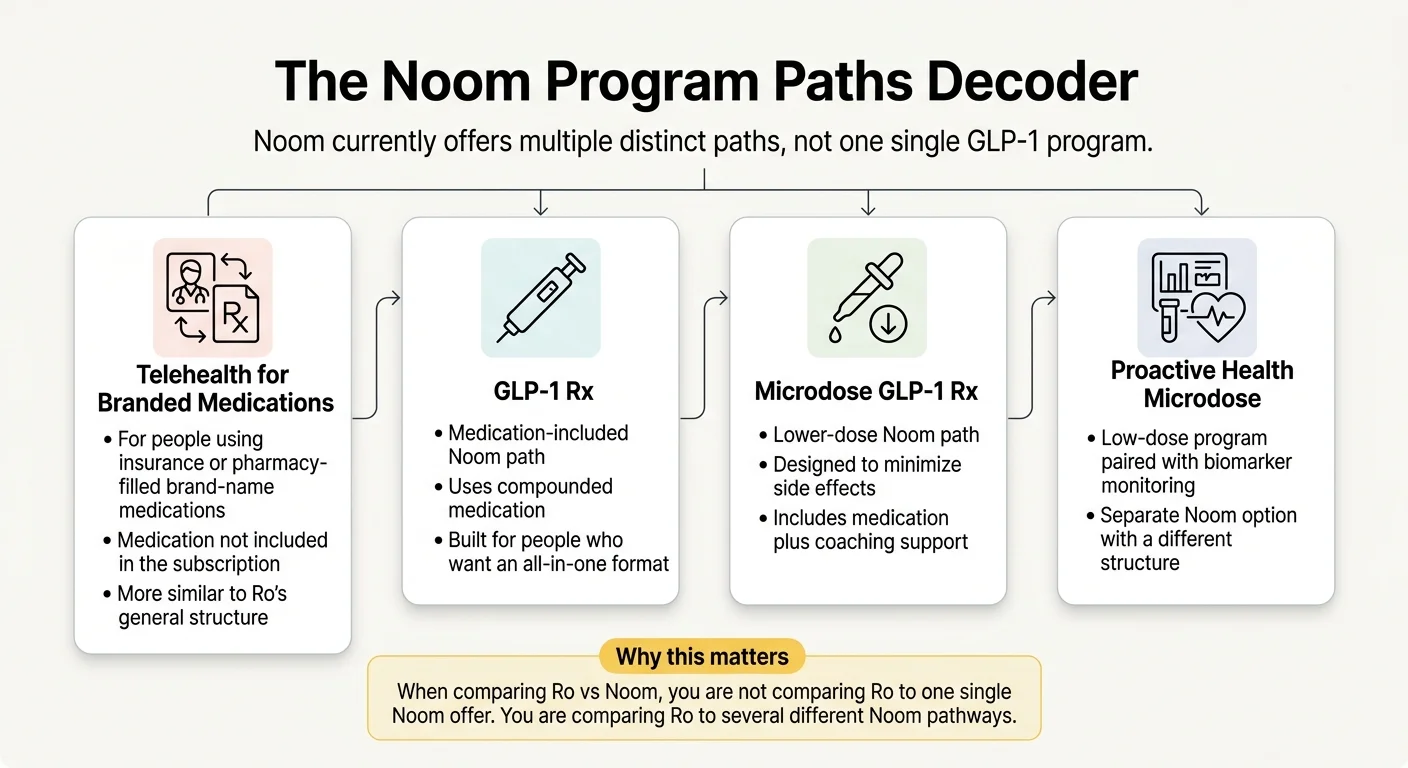
When comparing Ro vs Noom, you are not comparing Ro to one single Noom offer. You are comparing Ro to several different Noom pathways. Source: The RX Index, 2026.
Noom Telehealth for Branded Meds ($69 → $99/mo)
Insurance-friendlyThis is Noom’s insurance-friendly path. You pay $69 the first month, then $99/month ongoing. That covers access to clinicians, coaching, the full Noom app, and care coordination. Medication is NOT included — you get a prescription for brand-name drugs like Wegovy or Zepbound and fill it through your pharmacy. This path is the closest comparison to Ro’s Body Program.
Noom GLP-1Rx Full Dose ($129 → $279/mo)
Medication included — compoundedYour subscription covers compounded semaglutide shipped to your door, plus the full Noom app experience. After the intro period, you’re billed $837 every 12 weeks ($279/month equivalent). The medication in this program is compounded — it is not FDA-approved. Not available in all states.
Noom GLP-1Rx Plus
Compounded tirzepatideA newer path that includes compounded tirzepatide (the active ingredient in branded Zepbound and Mounjaro). Similar structure to the GLP-1Rx program. Check Noom’s site for current pricing and availability, as this is still rolling out.
Noom Microdose GLP-1Rx ($99 → $199/mo)
Gentler startDesigned for people who want a gentler start with lower doses. Medication (compounded semaglutide) is included. After the intro, you’re billed $597 every 12 weeks ($199/month equivalent). A real selling point for anyone who’s heard about GLP-1 nausea and wants the least aggressive entry.
Noom Proactive Health Microdose ($149/mo)
Biomarker monitoringA 4-month subscription plan that combines microdose GLP-1 medication with at-home biomarker testing. Different commitment structure than the other paths.
Why this matters: When you see “Noom starts at $69/month” and “Noom costs $279/month,” they're both technically true — but they describe completely different products. Know which path you're comparing before you compare.
Who Should Choose Ro (And Why We Recommend It for Most People)
For the majority of people comparing Ro and Noom in 2026, Ro is the stronger pick. Here's why.
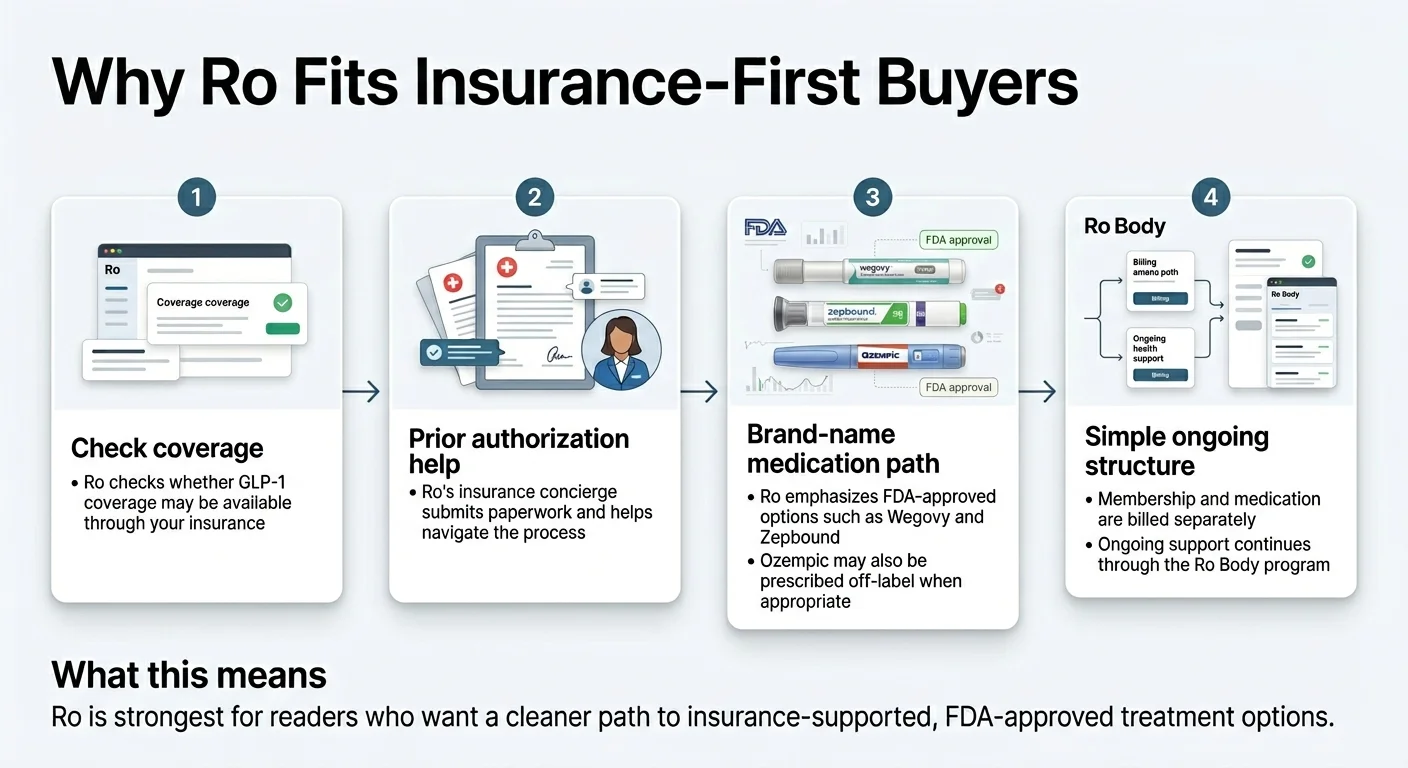
Ro is strongest for readers who want a cleaner path to insurance-supported, FDA-approved treatment options. Source: The RX Index, 2026.
Ro wins if you want FDA-approved medications
Ro’s program is built around getting you access to brand-name GLP-1 medications — Wegovy and Zepbound are both FDA-approved specifically for weight loss, and Ozempic may be prescribed off-label when appropriate. These are the medications backed by large clinical trials showing 15–20% body weight reduction. You’re not wondering about sourcing or regulatory status.
Ro wins if you want real insurance help
This is Ro’s single biggest advantage. Ro has a dedicated insurance concierge team that handles prior authorizations, verifies your coverage, submits paperwork, and coordinates with your pharmacy. This isn’t a form you fill out and hope for the best — it’s a team actively working your case. Half of Ro’s members with insurance coverage pay $50/month or less for their GLP-1 medication.
Ro wins if you want simple, predictable billing
Ro charges $45 for your first month, then $145/month ongoing. Month-to-month. Cancel before your next billing cycle and you’re done. No quarterly commitments. No $597 or $837 lump charges. Medication is billed separately based on your insurance or cash-pay situation — but you can see exactly what you owe before you commit.
Ro wins if you want a faster, cleaner start
Ro’s process: complete an online health questionnaire, get evaluated by a provider within about 2 days, get labs ordered if needed (free at Quest), receive your prescription, and start treatment. If you’re paying cash, medication can arrive within days. If you’re using insurance, Ro’s concierge starts working your coverage immediately.
“My experience with Ro has been so very positive. The process was super easy. The doctors are nice and informative.” — Ro member via Trustpilot
“At first I was unsure of the monthly subscription fee and was looking at other less expensive options. However, after I realized that I would be receiving genuine medication I decided on Ro.” — Ro member via Trustpilot
The honest trade-off with Ro
Ro does not bundle medication into the membership fee. That $145/month gets you provider access, coaching, labs, insurance concierge, and the app — but medication is an additional cost. For someone paying cash without insurance, your total monthly cost could be $294–$594/month depending on your medication and dose. If insurance isn't helping and budget is your #1 concern, Ro may not be your ideal fit.
See if your insurance covers GLP-1s through Ro's concierge — half of insured members pay $50/month or less for medication.
Check Your Eligibility on Ro →Who Should Choose Noom (The Specific Situations Where It Wins)
Noom doesn't win across the board. But for certain people, it wins decisively.
Noom wins if coaching is your top priority
No other GLP-1 platform wraps this much behavioral support around the medication. Noom was a psychology-based weight loss app for over 15 years before it added prescriptions. That heritage shows up in daily CBT-based lessons, food logging, community groups, 1:1 coaching, a GLP-1 Companion program with protein tracking and Muscle Defense workouts, and side-effect management guides. Noom’s own data claims users who actively engage alongside medication lose 48% more weight in six months compared to those taking GLP-1s without Noom’s behavioral support.
Noom wins if you want a microdose option
Noom explicitly offers a microdose GLP-1 program designed for slower, gentler titration. This matters if you’re concerned about nausea and GI side effects, or if you want a more gradual approach. Ro does not currently offer a dedicated microdose program. Noom’s Microdose starts at $99 for the first month, including medication — their most affordable entry point for medication-included GLP-1 treatment.
Noom wins if you want medication included in one price
On the GLP-1Rx and Microdose paths, your compounded semaglutide is included in the subscription. You don’t deal with insurance, pharmacy coordination, or separate medication billing. One charge covers everything. The critical caveat: these use compounded semaglutide, which is not FDA-approved.
“Noom doesn't just give you the GLP-1 medication and forget about you. They have a doctor monitoring your progress, a coach who checks in regularly, and tracking tools.” — Noom member via Trustpilot
“I have tried GLP-1s through other online websites and even a local business. I was paying more for the medication and the privilege of doing business with them. I did not receive support about diet or exercise. Noom is different.” — Noom member via Trustpilot
The honest trade-off with Noom
Noom's medication-included programs (GLP-1Rx and Microdose) bill in 12-week blocks — $837 or $597 at once — with no monthly option. Multiple independent reviewers have flagged this billing structure as a pain point. The cancellation flow includes multiple discount offers and confirmation screens before processing. It works, but it's not a one-click process.
Skip Both If This Sounds Like You
We'd rather lose the click than waste your time. Ro and Noom are both solid platforms, but they're not optimal for everyone.
You already have a doctor who will prescribe GLP-1s
If your PCP or endocrinologist prescribes Wegovy or Zepbound and your insurance covers it, you probably don’t need a telehealth membership at all. Use your existing relationship.
You want the lowest possible cash-pay price for compounded medication
If insurance isn’t in the picture and budget is your #1 concern, providers that specialize in cash-pay compounded GLP-1s typically offer flat-rate pricing with no separate membership fee — often lower total cost than either Ro or Noom.
You have government insurance (Medicare/Medicaid)
Ro’s insurance concierge cannot coordinate GLP-1 medication coverage for government plans. The insurance support advantage — Ro’s biggest selling point — won’t apply. Medicaid members cannot join Ro Body at all.
You need diabetes-specific management beyond weight loss
Both programs are designed around weight management. If you need comprehensive type 2 diabetes care, an endocrinologist or diabetes-focused telehealth service may serve you better.
Not sure which GLP-1 path fits you?
Take our free 60-second matching quiz — personalized recommendation, no email required.
Take the 60-Second GLP-1 Quiz →Ro vs Noom Cost: What You'll Actually Pay After the Intro Offer
Intro pricing is marketing. What matters is what you're paying by month 3. We built this scenario breakdown using publicly listed pricing from both platforms as of March 28, 2026.
Scenario 1: You have commercial insurance that might cover GLP-1s
This is where the comparison isn't even close.
With Ro:
- Month 1: $45 (membership)
- Month 2+: $145/mo + medication copay
- With coverage: most members pay $50/mo or less for meds
- Estimated total: ~$170–$195/month
With Noom (Telehealth for Branded Meds):
- Month 1: $69 (membership)
- Month 2+: $99/mo + medication via insurance
- Less hands-on insurance support
- Estimated total: ~$124–$149/month
Verdict: Ro wins — the insurance concierge quality matters more than the $46/month membership difference.
Scenario 2: No insurance, paying cash for FDA-approved meds
With Ro:
- Membership: $145/mo
- Wegovy pill: $149/mo (promotional)
- Zepbound vial: $299–$449/mo
- Total: $294–$594/month
With Noom (Telehealth for Branded Meds):
- Membership: $99/mo
- Brand-name meds at pharmacy: $349+/mo
- Total: $448+/month
Verdict: Ro wins — lower total cost through manufacturer partnerships.
Scenario 3: No insurance, want the cheapest medication-included option
This is where Noom gets its best case.
With Noom Microdose:
- Month 1: $99 (medication included)
- Month 2+: $199/mo ($597 per 12-week block)
- All-in monthly equivalent: $199/mo
With Ro (membership + medication):
- Membership: $145/mo
- Medication: additional cost (varies)
- Total: $344+/month
Verdict: Noom Microdose wins within this comparison — but availability is limited by state, and billing is quarterly. Dedicated compounded providers like MEDVi often offer lower total pricing.
Scenario 4: You want the most coaching support per dollar
Noom (any plan) includes the full behavioral app at no extra charge — daily psychology lessons, food logging, 1:1 coaching, community, GLP-1 Companion tools. Ro includes health coaching and curriculum, but it's lighter.
Verdict: Noom wins — this is their core strength.
The 90-Day and 180-Day Cost Summary
| Scenario | Ro (90 days) | Noom Best Path (90 days) | Ro (180 days) | Noom Best Path (180 days) |
|---|---|---|---|---|
| Insured, brand-name | ~$535 | ~$432 (Telehealth) | ~$1,025 | ~$843 |
| Cash, FDA-approved | ~$882–$1,332 | ~$1,344+ | ~$1,764–$2,664 | ~$2,688+ |
| Cash, compounded all-in | ~$1,032 | ~$597 (Microdose) | ~$2,064 | ~$1,194 |
| Max coaching priority | ~$535 + meds | ~$432 + meds (Telehealth) | ~$1,025 + meds | ~$843 + meds |
All figures use March 2026 listed pricing. Actual costs may vary by dose, promotional timing, and individual insurance coverage.
Medication Options: FDA-Approved, Compounded, Microdose, and Oral
What Ro prescribes
- Wegovy (semaglutide) — FDA-approved for weight loss. Available as injection pen or oral pill. Lower doses from $149/month.
- Zepbound (tirzepatide) — FDA-approved for weight loss. Dual GLP-1/GIP agonist. Vials from $299/month.
- Ozempic — FDA-approved for type 2 diabetes; prescribed off-label for weight loss when appropriate.
- Compounded semaglutide — cash-pay fallback option in most states (not FDA-approved).
What Noom prescribes
Through Telehealth (pharmacy-filled):
Wegovy, Zepbound, Ozempic, Mounjaro, Contrave, metformin, topiramate, Wegovy pill
Through GLP-1Rx (included in sub):
Compounded semaglutide (GLP-1Rx, Microdose) — NOT FDA-approved
Compounded tirzepatide (GLP-1Rx Plus)
Quick Decision Tree: Which Medication Path?
Want the strongest clinical evidence + insurance potential?
Wegovy or Zepbound (FDA-approved) through Ro or Noom Telehealth
Want a non-injectable option?
Wegovy pill through Ro or Noom, or oral medications through Noom
Want a dual-hormone approach?
Zepbound through Ro (FDA-approved) or Noom GLP-1Rx Plus (compounded tirzepatide)
Want the gentlest entry with lowest side-effect risk?
Noom Microdose with compounded semaglutide
Comfortable with compounded and want lowest cost?
Noom Microdose ($199/mo, meds included) or a dedicated compounded provider like MEDVi
The FDA distinction you need to understand
Compounded GLP-1 medications are NOT FDA-approved. The FDA does not evaluate compounded medications for safety, efficacy, or quality the same way it evaluates brand-name drugs like Wegovy and Zepbound. The FDA has specifically warned telehealth companies against marketing compounded GLP-1s in ways that suggest equivalence with FDA-approved products. Both Ro and Noom state they use USP-compliant compounding pharmacies with third-party testing — but the regulatory framework is different.
Insurance: Who Actually Helps When Prior Authorization Gets Complicated?
Getting a GLP-1 prescription is one thing. Getting your insurance to actually cover it is a completely different battle. The difference between “your insurance might cover it” and “we'll handle the paperwork” is the difference between paying $50/month and $500+/month.
How Ro handles insurance
- ✅ Dedicated insurance concierge
- ✅ Verifies your specific benefits
- ✅ Submits prior authorization paperwork
- ✅ Handles appeals on denials
- ✅ Coordinates with pharmacy once approved
- ✅ Half of insured members pay $50/mo or less
- ⚠️ Cannot help with Medicare/Medicaid/TRICARE
How Noom handles insurance
- ✅ Telehealth plan: care coordinators assist
- ✅ Prior authorizations and prescription management
- ⚠️ Less centralized than Ro\u2019s dedicated concierge
- ❌ GLP-1Rx/Microdose: cash-pay only (compounded)
- ℹ️ Insurance is simply off the table for medication-included paths
The bottom line on insurance: If getting insurance to cover your GLP-1 medication is your primary financial strategy, Ro is the stronger platform. Their concierge is more established, more frequently cited in positive user reviews, and more deeply integrated into the enrollment process.
Coaching and Support: Medication-First vs Behavior-First
This is the area where Noom has a genuine, difficult-to-replicate advantage — and the main reason some readers should choose Noom despite the billing trade-offs.
Ro: Medical-first support
- 1:1 health coaching
- Monthly provider check-ins
- Unlimited messaging with care team
- Side-effect guidance
- Educational curriculum and app tracking
- Connected smart scale (weight, body fat, muscle)
- Coaching is a support layer; the primary relationship is clinical
Noom: Behavioral change ecosystem
- Daily CBT-based lessons (5–10 min)
- Food logging with color-coded system
- 1:1 coaching with behavior specialists
- Community groups by demographics
- GLP-1 Companion: protein tracking, Muscle Defense workouts
- Side-effect management guides
- Clinician unlimited messaging
- Taper-off guarantee (12-month program)
Honest Framework: Which Coaching Level Is Right for You?
Choose Ro if:
- • Your main barrier is access to medication + insurance
- • You've maintained weight loss before without intensive support
- • You prefer a simpler program with less daily engagement
- • You plan to add your own coaching or nutrition guidance
Choose Noom if:
- • You've lost and regained weight repeatedly
- • Emotional or stress eating is a core issue
- • You want to build habits for tapering off medication
- • You thrive with daily engagement and community accountability
- • You accept quarterly billing for the most comprehensive support
Getting Started: Speed, Onboarding, and What the First Month Looks Like
Ro onboarding timeline
Noom onboarding timeline
“The food noise has completely silenced, and that's definitely the one aspect that I really enjoy, because I could just focus on a bunch of other things that is not food.” — Whittnie B., Ro member
“Cravings and food noise are gone. I finally feel confident in the healthy habits I've built to last.” — Jessica S., Noom member
That's not a Ro thing or a Noom thing. It's a GLP-1 thing. Both platforms give you access to it. The question is just which wrapper fits your life better.
Side Effects and Titration: What If You're Worried About Nausea?
GI side effects (nausea, constipation, sometimes vomiting) are the most common complaint with GLP-1 medications, especially during the early weeks. How each platform handles this matters.
Noom's microdose advantage
Noom explicitly designed its Microdose GLP-1Rx Program for people who want a slower, gentler titration. Lower starting doses, gradual increases, clinical monitoring tuned for minimizing side effects. Because GI side effects tend to be dose-dependent, the logic is straightforward: lower dose → less nausea. If you're anxious about side effects, Noom's Microdose path is designed exactly for that.
How Ro handles titration
Ro uses standard FDA-recommended titration schedules for brand-name medications. Your provider manages dose adjustments based on your response, with monthly check-ins and unlimited messaging for side-effect concerns. Most brand-name GLP-1s have built-in gradual titration — Wegovy starts at 0.25mg and steps up over 16–20 weeks.
For most people, standard titration with proper medical oversight (available on both platforms) is sufficient. The microdose path is a genuine differentiator for the subset of users who are particularly side-effect sensitive.
Cancellation, Refunds, and Billing: The Fine Print That Actually Matters
This is the #1 source of complaints for both platforms. Understanding the details before you start saves you the most frustration.
| Ro | Noom Telehealth | Noom GLP-1Rx / Microdose | |
|---|---|---|---|
| Billing cycle | Monthly | Monthly | Every 12 weeks |
| Lump charge risk | No | No | Yes ($597 or $837) |
| Refundable? | No (once charged) | No (once visit occurs) | No (once Rx written) |
| Cancel method | Dashboard/email | App/portal/app store | App/portal/app store |
| Cancellation friction | Low — straightforward | Low | Multiple retention screens |
Canceling Ro
- Cancel through dashboard or email support
- Cancel at least 48 hours before next billing cycle
- Month-to-month billing — risk is max $145
- Main friction point: some slow customer service response times
Canceling Noom GLP-1Rx
- Cancel in app, portal, or app store
- No mid-cycle refund once Rx written
- Quarterly commitment — risk is up to $837
- Multiple retention screens before processing
Our honest take: If you have any doubt about whether you'll continue past the first month, Ro's month-to-month billing is safer. You risk $145, not $597 or $837. If you're confident you'll stick with it for at least 3 months, Noom's quarterly structure won't bother you.
The Long Game: What Happens After 6 Months (and When You Stop)
Here's a fact neither Ro nor Noom puts in their ads: research shows that most people regain a significant portion of lost weight after discontinuing GLP-1 medications. This isn't a failure — it's biology. GLP-1s work by affecting appetite hormones. When you stop the medication, those signals gradually return to pre-treatment baseline.
This is actually the strongest argument for Noom's behavioral coaching approach. If you've spent 6–12 months building genuine habit changes — understanding your eating triggers, restructuring your food environment, developing an exercise routine — you have a better foundation for maintaining results after discontinuing medication. Noom specifically addresses this with their taper-off guarantee.
If you view GLP-1s as a long-term or indefinite medication
The behavior-change debate matters less. Both Ro and Noom provide ongoing clinical support for continuous treatment.
If you want to eventually taper off and maintain results
Noom’s behavioral platform is purpose-built for that transition. Ro provides lifestyle guidance, but the depth isn’t comparable.
If you’re unsure about the long-term plan
That’s normal. Both platforms allow you to continue indefinitely or stop when ready. Start, see how your body responds, and have the long-term conversation with your provider when you get there.
How We Verified This Comparison
We checked: Ro pricing page, Ro terms of use, Ro insurance page, Noom cost page, Noom vs Ro page, Ro Trustpilot, Noom Trustpilot, and FDA press announcements regarding compounded GLP-1 marketing.
We have no business relationship with Ro or Noom that influences our editorial recommendations. We may earn affiliate commissions if you sign up through our links. Our recommendations are based on our published editorial methodology.
Medical disclaimer: This content is for informational purposes only. Always consult a licensed healthcare provider before starting any medication. Compounded medications are not FDA-approved and are not evaluated for safety, efficacy, or quality by the FDA.
Frequently Asked Questions: Ro vs Noom
Is Ro or Noom cheaper in 2026?
It depends on your insurance situation. With insurance covering medication, Ro's total cost is roughly $170–$195/month. Noom’s Telehealth plan can be slightly lower at $124–$149/month with insurance, but with less hands-on insurance support. For cash-pay with compounded medication included, Noom’s Microdose at $199/month is cheaper than Ro’s combined $344+/month.
Which is better if my insurance covers Wegovy or Zepbound?
Ro. Their insurance concierge is purpose-built for this exact situation — they handle prior authorizations, coordinate with your pharmacy, and fight for coverage. It’s Ro’s strongest advantage. Half of Ro’s insured members pay $50/month or less for their GLP-1 medication.
Which is better without insurance?
Neither is optimal for uninsured, cash-pay buyers. Noom’s Microdose ($199/month with medication included) is the cheapest option within this comparison, but dedicated compounded providers like MEDVi often offer lower total pricing without a separate membership fee.
Does Noom offer microdose GLP-1s?
Yes. Noom’s Microdose GLP-1Rx Program is specifically designed for lower-dose, gentler titration using compounded semaglutide, starting at $99 for the first month including medication. It’s designed for people concerned about nausea and GI side effects.
Are Noom’s medication-included GLP-1s FDA-approved?
No. Noom’s GLP-1Rx and Microdose programs use compounded semaglutide, which is not FDA-approved and is not evaluated for safety, efficacy, or quality by the FDA. Noom states they use USP-compliant compounding pharmacies with third-party testing. Their Telehealth for Branded Meds plan provides access to FDA-approved medications.
Does Ro offer a microdose option?
Not as a dedicated program. Ro’s providers manage titration within standard FDA-recommended dosing schedules, adjusting based on your response and monthly check-ins. If you specifically want a structured microdose path, Noom is the only one of the two that offers it explicitly.
Which is easier to cancel?
Ro. It’s month-to-month with a dashboard cancellation option — cancel at least 48 hours before your next billing cycle and you’re done. Noom’s GLP-1Rx and Microdose plans bill in 12-week blocks with no mid-cycle refund, and the cancellation flow includes multiple retention screens.
Does Noom have quarterly billing?
Yes — on their GLP-1Rx and Microdose plans. After the intro period, you’re billed $837 (Full Dose) or $597 (Microdose) every 12 weeks. Their Telehealth for Branded Meds plan bills monthly like Ro.
Can Ro help with prior authorization?
Yes. Ro’s insurance concierge handles prior authorization submission, follow-up, and appeals as part of the $145/month membership. They also coordinate with your pharmacy once approved.
Which is better for coaching and habit change?
Noom, without question. Their 15+ years of behavioral psychology expertise shows up in daily CBT-based lessons, food logging, 1:1 coaching, community groups, and GLP-1 Companion tools. Ro provides solid clinical support and health coaching, but it is a lighter touch compared to Noom’s full behavioral platform.
Which is better if I’m worried about side effects?
Noom’s Microdose program is specifically designed for side-effect-sensitive users with lower starting doses and gradual titration. Ro manages side effects within standard FDA-recommended titration with ongoing provider support and unlimited messaging. Both provide medical oversight.
What if I already have a doctor who will prescribe?
Skip both. If your PCP or specialist will prescribe a GLP-1 and your insurance covers it, use that existing relationship. You don’t need a telehealth membership.
Is Noom available in every state?
No. Noom’s Telehealth for Branded Meds is available in most states except Alabama and Virginia. Noom’s medication-included GLP-1Rx programs are not available in all states — check Noom’s site for current availability. Ro’s Body Program is available in all 50 states plus D.C. for brand-name medications.
What if neither Ro nor Noom feels right?
Take our free 60-second GLP-1 matching quiz to see which provider fits your insurance status, budget, and preferences. Or check our full GLP-1 provider comparison for other options including MEDVi (best for cash-pay compounded), SkinnyRX, TrimRX, and others.
The Bottom Line: Our Recommendation
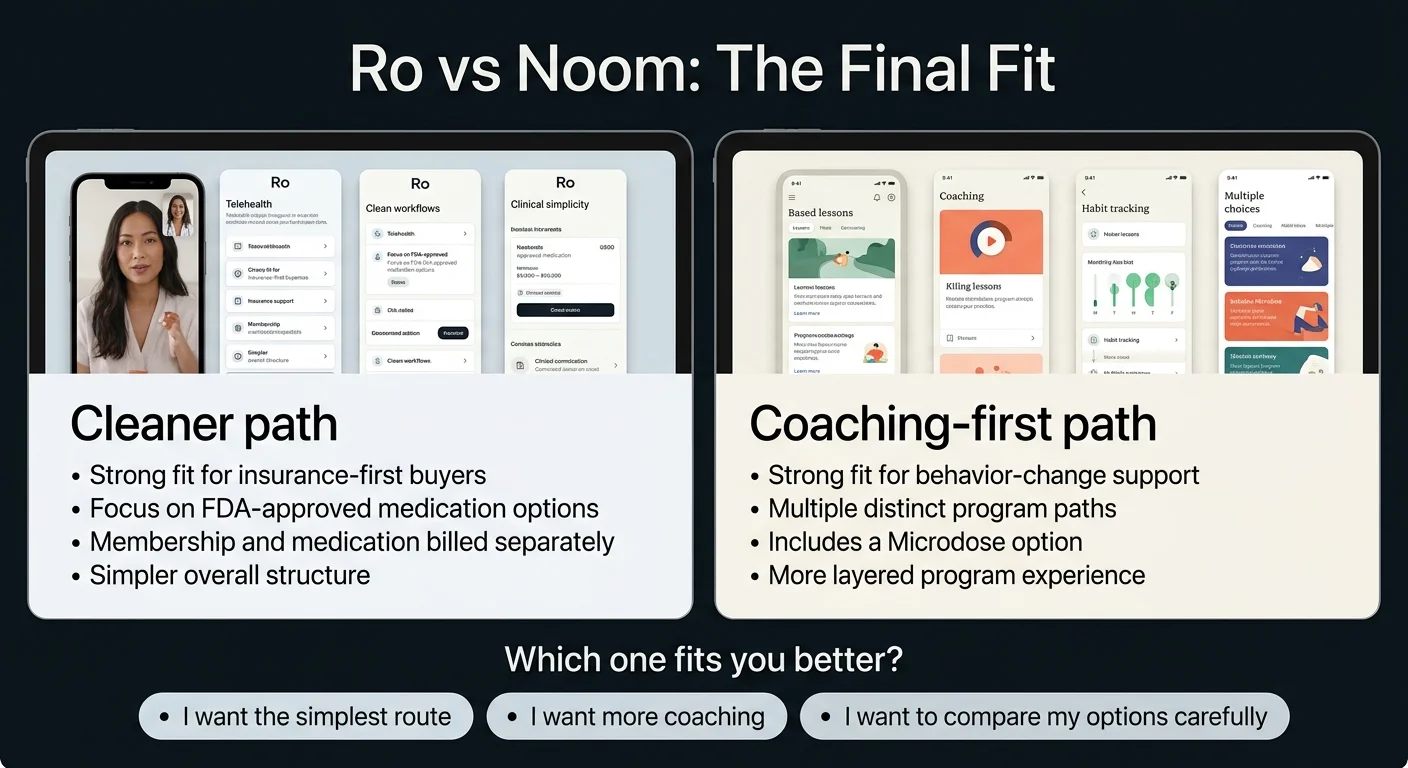
Ro: cleaner path for insurance-first buyers. Noom: coaching-first path for behavioral change. Source: The RX Index, 2026.
Here's what we'd tell a friend who texted us “Ro or Noom?”
For most people: Ro is the better pick.
Cleaner billing, stronger insurance support, FDA-approved medications, and a simpler overall experience. If you have commercial insurance or want the most straightforward path to a brand-name GLP-1, start with Ro. Half of their insured members pay $50/month or less for medication — and their concierge team does the insurance fighting for you.
Check Your Eligibility on Ro →Noom earns the recommendation for a specific reader.
Someone who values daily behavioral coaching, wants the medication-included convenience of their GLP-1Rx plans, or specifically needs the gentle start of their Microdose program. Noom delivers something no one else in this space really matches. Just go in with eyes open on the quarterly billing structure.
See Noom's GLP-1 Program Options →And if neither fits:
Cash-pay buyers wanting the lowest compounded price should look at MEDVi — flat-rate pricing, no membership fee, medication included. Anyone unsure should start with our matching quiz.
The bigger picture: Clinical trials consistently show 15–20% body weight reduction with GLP-1 medications when combined with lifestyle changes. Real users describe it as the first time something actually worked — after years or decades of trying. Both Ro and Noom are legitimate, clinically supervised platforms backed by real medical teams. The hardest part isn't choosing between them. It's deciding to start.
Still not sure which GLP-1 program is right for you?
Take our free 60-second matching quiz. Answer a few quick questions about your insurance, budget, and preferences, and we'll tell you exactly which provider fits your situation — no email required.
Take the Free GLP-1 Matching Quiz →Affiliate disclosure: The RX Index may earn a commission if you sign up through links on this page. This does not affect our editorial recommendations — our methodology is published and our provider ratings are not influenced by commission rates. Read our full editorial policy.
Medical disclaimer: This content is for informational purposes only and does not constitute medical advice. Always consult a licensed healthcare provider before starting any medication. GLP-1 medications may have serious side effects. Compounded medications are not FDA-approved and should not be considered equivalent to FDA-approved brand-name medications.
By The RX Index Editorial Team · Last updated March 28, 2026 · More GLP-1 comparisons →
Related Comparisons & Guides