
Ro vs WeightWatchers — April 10, 2026 Verified
Ro vs WeightWatchers for GLP-1s in 2026: Ro Body or WW Clinic?
Verified April 2026 pricing, all four WW plan tiers modeled, insurance concierge compared, cancellation risk explained, and an original cost matrix that no other comparison page has built. The first-year membership gap is ~$14. The real question is whether WW’s lock-in is worth it.
The Bottom Line
Ro is the better choice for most people. Both programs charge similar membership fees, neither includes GLP-1 medication in that fee, and both now offer the same Novo Nordisk Wegovy subscription pricing and Zepbound KwikPen/vials through LillyDirect.
But Ro gives you a cleaner exit — no 12-month commitment required — a dedicated insurance concierge with a documented fallback if coverage fails, and access to compounded semaglutide during national shortages.
WeightWatchers wins for coaching-first readers who will actively use the Points system, dietitians, workshops, and community — and whose insurance covers the medication cost.
| Ro | WeightWatchers | |
|---|---|---|
| Best for | Most shoppers; insurance-first; lower-regret default | Coaching-first readers who’ll actually use the Points system and workshops |
| Not for | People who need intensive accountability and community structure | People who hate long commitments or want compounded GLP-1 access |
| Membership start | $39 first month | $25 first month (12-mo plan); $49 first month (all other plans) |
| GLP-1 included? | No — billed separately | No — billed separately |
| Commitment | Monthly ($149/mo) or annual (as low as $74/mo) — cancel before renewal | 4 tiers: month-to-month $149, 3-mo $99, 6-mo $84, 12-mo $74 — multi-month locks you in for the full term |
| Insurance help | Dedicated insurance concierge + documented fallback if denied | Insurance coordination team; limited to commercial insurance plans |
| Compounded GLP-1 | Yes — during national shortages, cash-pay, select states | No compounded GLP-1s |
Sources: ro.co/weight-loss/pricing, weightwatchers.com/us/plans/clinic, wwclinic.zendesk.com. Verified April 10, 2026.
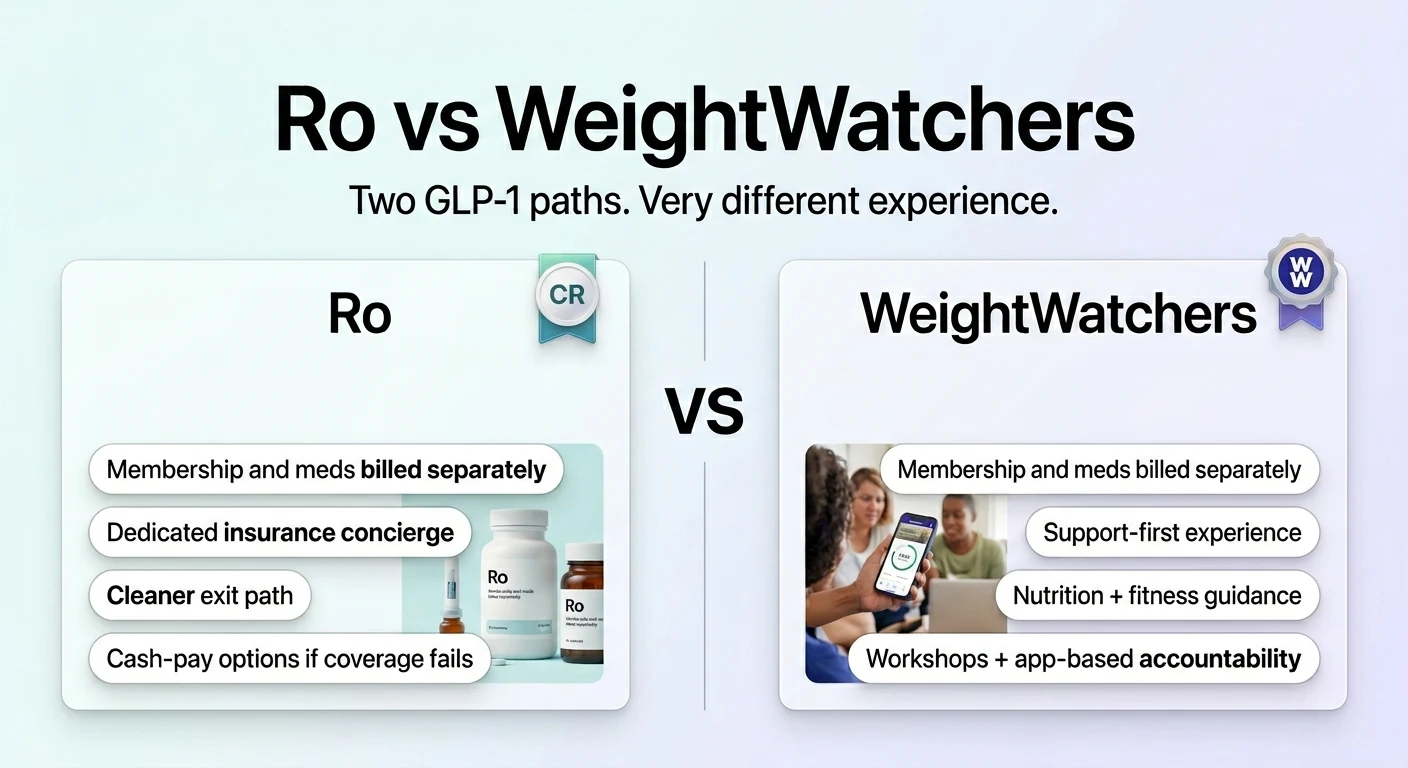
Ro vs WeightWatchers: Which Is Actually Cheaper?
WeightWatchers looks cheaper on the surface. Once you model the actual first-year membership math from both providers’ current public pricing pages, the gap shrinks dramatically — and the real tradeoff becomes flexibility versus lock-in, not price versus price.
Month 1: What You’ll Actually See at Checkout
On both platforms, the first month is discounted and medication is billed separately.
| Ro | WeightWatchers | |
|---|---|---|
| First-month membership | $39 | $25 (12-month plan) or $49 (3/6-month & month-to-month) |
| GLP-1 medication included? | No | No |
| Lowest visible Wegovy pill add-on | ~$149/mo (1.5 mg, new patient pricing) | ~$149/mo (same Novo Nordisk pricing) |
| Lowest visible Wegovy pen add-on | ~$199/mo (intro through June 30, 2026) | ~$199/mo (same intro pricing through CenterWell) |
| Est. month-1 total (pill path) | ~$188 | ~$174 (12-mo plan) or ~$198 (other plans) |
| Est. month-1 total (pen path) | ~$238 | ~$224 (12-mo plan) or ~$248 (other plans) |
Medication pricing from ro.co and weightwatchers.com/us/weight-loss-medication/wegovy, April 2026. Promo terms change — verify before signing up. On the 12-month path, the month-1 gap comes entirely from the membership delta; medication pricing is the same underlying Novo Nordisk offer.
On the cheapest WW path, the month-1 gap is $14. On every other WW plan tier, Ro is actually cheaper in month one.
All Four WW Med+ Plan Tiers vs Ro — Year-1 Membership Math
This is the number that matters. This is the original cost-and-commitment matrix built from both providers’ current official pricing pages.
| Plan | Monthly rate | First month | Year-1 membership | Commitment |
|---|---|---|---|---|
| Ro — annual | As low as $74/mo | $39 | ~$853 | Annual; cancel before renewal to avoid next charge |
| Ro — monthly | $149/mo | $39 | ~$1,678 | None — cancel anytime with 48-hr notice |
| WW — 12-month | $74/mo | $25 | ~$839 | 12 months — charged through full term even if you cancel early |
| WW — 6-month | $84/mo | $49 | ~$1,013 (first 6 mo) | 6 months; auto-renews into another 6-month term |
| WW — 3-month | $99/mo | $49 | ~$1,138 (first year) | 3 months; auto-renews into another 3-month term |
| WW — month-to-month | $149/mo | $49 | ~$1,688 | None — cancel anytime |
Ro year-1: $39 first month + $74 × 11 months (annual rate) = ~$853. WW 12-month: $25 + $74 × 11 months = ~$839. WW 6-month: two cycles. All medications excluded — costs vary by insurance, drug, and dose.
What this original dataset proves:
- The first-year membership gap between Ro’s cheapest path and WW’s cheapest path is approximately $14. That’s the entire difference.
- On WW’s 6-month plan ($84/mo), year-1 cost is $160 more than Ro annual. On the 3-month plan ($99/mo), it’s $285 more.
- If you want month-to-month flexibility (no lock-in), Ro is $10 cheaper in the first year ($1,678 vs $1,688) — and Ro’s first month is $10 less.
- WW earns its $14 annual advantage by requiring a 12-month commitment you can’t exit early. Ro’s annual plan also commits you for a year, but Ro’s cancellation stops future renewal rather than locking you into a term you pay through regardless.
“WW is cheaper for the appointment part (meds are same price).” — Reddit user comparing the two programs
That user nailed it. The membership difference is marginal. And the medication pricing is identical because both platforms access the same Novo Nordisk and Eli Lilly manufacturer programs for Wegovy and Zepbound.
What If You’re Paying Cash for Medication With No Insurance?
Both Ro and WeightWatchers now offer access to Novo Nordisk’s Wegovy subscription program, launched April 2026:
| Wegovy subscription tier | Monthly price | Annual savings |
|---|---|---|
| Injection — 12-month subscription | $249/mo | Up to $1,200/year |
| Injection — 6-month subscription | $299/mo | Up to $600/year |
| Injection — 3-month subscription | $329/mo | Up to $240/year |
| Pill — 1.5 mg and 4 mg | $149/mo (4 mg promo through Aug 31, 2026, then $199/mo) | — |
| Pill — 9 mg and 25 mg | $249–$289/mo | Up to $600/year |
Source: Novo Nordisk press release, April 2026; reported by Fierce Healthcare and Quartz. The 7.2 mg injection dose will be added later. Both Ro and WeightWatchers also offer Zepbound KwikPen/vials through LillyDirect starting at $299/month cash-pay only.
Because the medication pricing is functionally the same across both platforms for these manufacturer-backed offers, your total cash-pay cost is determined by the membership difference — which, on the cheapest paths, is $14 per year. If that $14 isn’t going to change your life, but the ability to walk away at any time might — you already know which direction to lean.
See Ro’s current pricing and medication options
Ro matches LillyDirect, NovoCare, and manufacturer subscription pricing directly. No commitment required to check.
See Ro current pricing & medication options ↗Does Ro or WeightWatchers Include the GLP-1 Medication in the Monthly Fee?
Neither one does. This is the single most common source of confusion in this entire comparison — and it trips people up on both platforms.
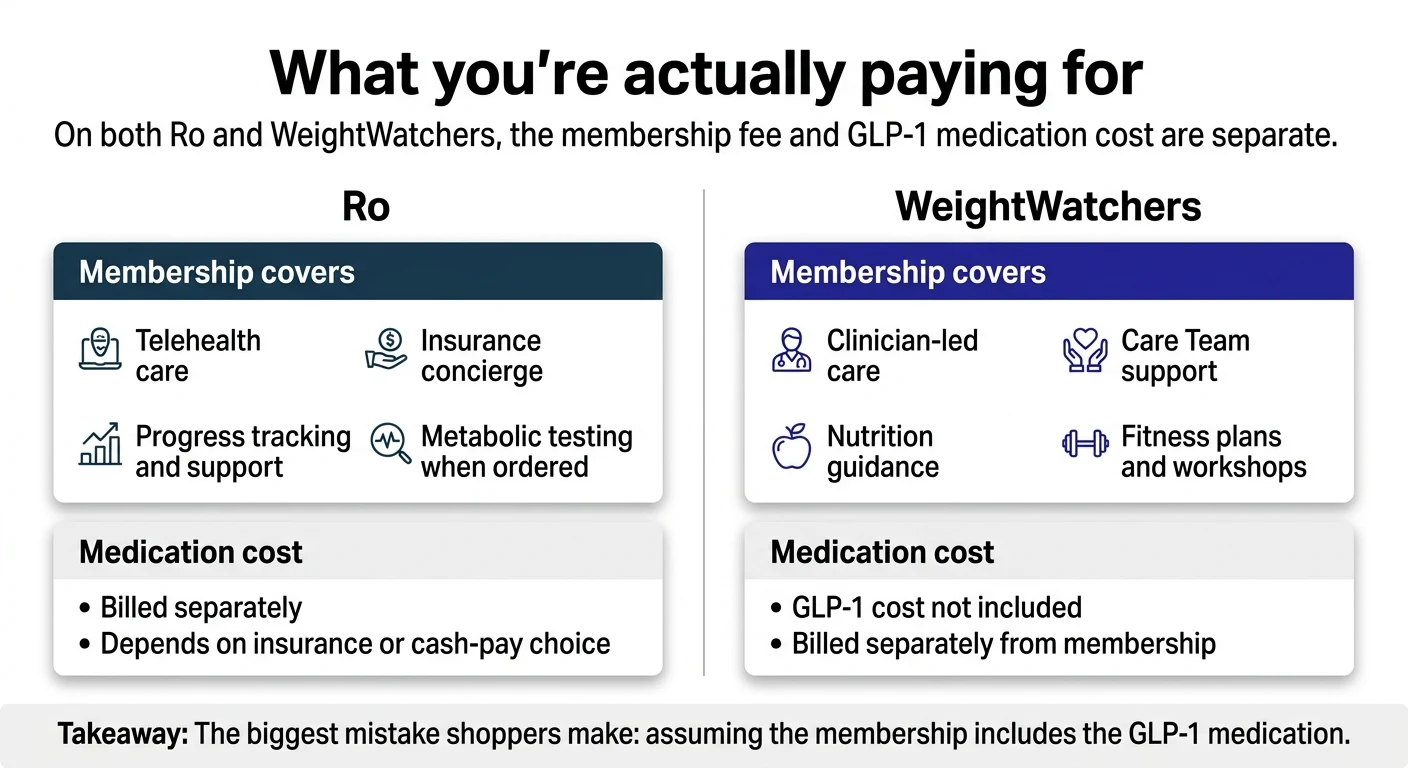
What Ro’s membership covers
- Telehealth consultation & provider access
- Dedicated insurance concierge
- Coaching & education curriculum
- Metabolic lab testing (when ordered)
- App-based care & progress tracking
- Up to 24 medical consultations per year
Medication: billed separately based on insurance or cash-pay choice.
What WW’s membership covers
- Board-certified obesity specialist consultations
- Registered dietitian access
- Personal fitness coaching
- Virtual workshops & community groups
- Points system, recipes, app ecosystem
- 24/7 app-based care team access
GLP-1 medication: billed separately. Non-GLP-1 meds (metformin, Contrave) included via Carepoint pharmacy.
“I’m confused… I was aware the price didn’t include meds…” — Reddit user navigating WW pricing
When you see “$25 first month” on either platform, it’s the platform fee — not the treatment cost. Think of both memberships as paying for a clinical team and support system. The medication is a separate line item that can range from a $25 insurance copay to $349+/month cash-pay depending on your coverage and the drug prescribed.
See if your insurance covers GLP-1 medication through Ro
Ro’s insurance concierge checks your coverage, handles prior auth, and tells you exactly what you’d pay.
Check insurance coverage through Ro ↗Which One Is Better If You Have Insurance?
Ro is stronger for most insurance-focused readers. Its dedicated insurance concierge is explicitly marketed as fighting for prior authorization approval, handling all paperwork, and providing a documented fallback path if coverage is denied. WeightWatchers also offers an insurance coordination team, but WW’s public medication pages state that coordination is limited to commercial insurance plans.
How insurance works at Ro
You join the membership ($39 first month). Your provider determines the right GLP-1. Ro’s insurance concierge contacts your insurer, handles prior authorization, and works to get your medication covered. If your commercial insurance approves it, you may pay only your copay. If coverage is denied, Ro explicitly offers cash-pay medication alternatives or the option to cancel the membership entirely. Ro also notes that members with Medicare, Medicare supplement plans, or TRICARE can join and use cash-pay options. Federal employees (FEHB) are specifically mentioned as eligible.
How insurance works at WeightWatchers
You join Med+ ($25 first month on the 12-month plan). Your clinician prescribes a GLP-1. WW’s insurance coordination team works with your commercial insurance to get coverage. If your plan covers it, you pay your copay. WW’s public pages state that members with government-sponsored insurance, Kaiser plans, or no insurance will need to either pay out-of-pocket for a GLP-1 or use one of the membership-included non-GLP-1 medications.
Insurance Decision Matrix
| Your insurance situation | Better choice | Why |
|---|---|---|
| Commercial insurance that covers GLP-1s | Either works; edge to WW if you’ll use coaching | Both handle prior auth; WW’s membership is $14/year cheaper on 12-mo plan |
| Commercial insurance, coverage uncertain | Ro | Explicit concierge + documented fallback (cash-pay or cancel) if denied |
| FEHB (Federal Employee Health Benefits) | Ro | Ro specifically notes FEHB eligibility for membership + insurance concierge |
| Medicare / Medicare supplement / TRICARE | Ro (limited) | Ro allows membership + cash-pay medication options; WW’s pages are less specific |
| Medicaid or government-funded | Neither through these platforms | Ro explicitly states Medicaid members cannot join. WW routes to non-GLP-1 alternatives or cash-pay |
| Kaiser | Cash-pay path only at either | Both exclude Kaiser from insurance coordination; you could join either and pay cash |
| No insurance | Ro | Cleaner cancellation if cash-pay costs don’t work; compounded semaglutide as potential fallback during shortages |
Sources: ro.co/weight-loss/insurance, ro.co/weight-loss/how-it-works, weightwatchers.com/us/weight-loss-medication/zepbound, weightwatchers.com/us/weight-loss-medication. Verified April 10, 2026.
“I signed up & they got the PA approved & I picked up my first prescription all within a couple days.” — Reddit user describing their Ro insurance experience
If prior authorization is your biggest anxiety, Ro’s concierge model is built around exactly that workflow. The peace of mind of knowing someone is actively fighting for your coverage, and that you have a clear path forward if they can’t get it approved, is worth more than a $14 annual membership difference.
What Happens If Insurance Denies the Medication — or It’s Out of Stock?
This is the section most comparison pages skip, and it’s the section that matters most after you’ve already joined. Because the question isn’t just “which one is cheaper to start?” It’s “which one surprises me less after I’ve committed?”
Ro’s documented fallback path
Ro’s public pages are direct: if your insurance doesn’t cover the medication, you can choose a cash-pay medication option or cancel the membership. During national manufacturer shortages, Ro’s terms also allow for compounded semaglutide as a potential alternative (cash-pay only, not available in all states, not FDA-approved). You’re not stuck paying a membership fee for a program that can’t deliver medication.
WW’s shortage and refund language
WeightWatchers’ clinic terms and conditions include language stating that payment does not guarantee medication availability and that members generally are not refunded if medication is unavailable. Combined with the multi-month commitment on plans below $149/month, this creates a scenario where you could be paying $74–$99/month for a membership while waiting for a medication that may or may not become available — without the option to exit early.
We’re not trying to scare anyone away from WW. Most members don’t hit this scenario. But when you’re choosing between two programs with nearly identical pricing, the tiebreaker is risk management. Ro’s fallback path — try cash-pay options, try compounded alternatives during shortages, or cancel — is documented on their public pages. WW’s commitment structure means your options are more limited if things don’t go as planned.
Start with Ro — no long-term commitment required
If you’re the kind of person who needs to know the exit before you enter, Ro’s documented fallback path is worth the $14 annual membership premium over WW’s cheapest tier.
Start with Ro — no long-term commitment ↗Which One Is Easier to Cancel If You Change Your Mind?
Ro is easier to exit on the monthly plan. This is the single biggest practical difference between these two programs — bigger than the $14 membership gap, bigger than the support features, bigger than the app interface.
Ro’s cancellation terms
Ro operates on a monthly or annual membership basis. On the monthly plan ($149/mo), you can cancel with at least 48 hours’ notice before your next renewal to avoid future charges. On the annual plan, you’re prepaid for the term — cancellation stops future renewal but does not unwind the prepaid period. Already-paid membership fees are non-refundable on either plan.
WeightWatchers’ cancellation terms
WW Med+ offers four commitment tiers. On any multi-month plan (3-month, 6-month, or 12-month), you are financially responsible for the full commitment period. If you cancel during the term, cancellation takes effect at the end of that commitment — not immediately. Plans auto-renew into the same commitment length unless you cancel before the renewal date.
“You can cancel but don’t get refunds.” — Reddit user on WeightWatchers Clinic
The Ro vs WW Cancellation Comparison
| Ro (monthly) | Ro (annual) | WW (multi-month) | WW (month-to-month) | |
|---|---|---|---|---|
| Can cancel? | Yes | Yes | Yes | Yes |
| When cancellation takes effect | Before next monthly renewal (48-hr notice) | Stops future annual renewal; prepaid term continues | End of commitment period (3/6/12 months) | Before next monthly renewal |
| Refund on unused time? | No | No | No | No |
| Auto-renew? | Monthly | Annual | Same commitment length | Monthly |
| How to cancel | Ro account | Ro account | Online, phone, or chat | Online, phone, or chat |
Sources: ro.co/terms-of-use, weightwatchers.com cancellation help page, wwclinic.zendesk.com. Verified April 10, 2026.
Neither platform gives refunds on paid time. The difference is how much time you’re committing to. On Ro’s monthly plan, your maximum risk is one month. On WW’s 12-month plan, your maximum risk is twelve months.
What Medications Can You Actually Get Through Ro vs WeightWatchers?
Both platforms prescribe FDA-approved brand-name GLP-1 medications, and both now offer Zepbound vials and KwikPens through LillyDirect. The meaningful differentiator is not brand-name breadth — it’s what happens when brand-name options don’t work out.
| Medication | Available through Ro | Available through WW |
|---|---|---|
| Wegovy (semaglutide) — injection pen | ✅ | ✅ |
| Wegovy (semaglutide) — pill | ✅ | ✅ |
| Zepbound (tirzepatide) — single-dose pen | ✅ | ✅ |
| Zepbound (tirzepatide) — single-dose vial (cash-pay via LillyDirect) | ✅ | ✅ |
| Zepbound (tirzepatide) — KwikPen (cash-pay via LillyDirect) | ✅ | ✅ |
| Ozempic (semaglutide) — off-label | ✅ | ✅ |
| Mounjaro (tirzepatide) — off-label | Listed on some pages | ✅ |
| Saxenda (liraglutide) — daily injectable | ✅ | ✅ |
| Foundayo (orforglipron) — oral, newly approved | ✅ | ✅ |
| Compounded semaglutide (national shortages, cash-pay, select states) | ✅ (select states) | ❌ |
| Non-GLP-1 options (metformin, Contrave) in membership | ❌ | ✅ (through Carepoint pharmacy) |
Sources: ro.co/weight-loss/pricing, weightwatchers.com/us/weight-loss-medication, weightwatchers.com/us/weight-loss-medication/zepbound. Availability varies by state, insurance, and clinical eligibility. Compounded medications are not FDA-approved.
The real difference: the safety net
The brand-name menus are nearly identical. The real differentiator is what happens when brand-name options don’t work out. Ro’s terms allow for compounded semaglutide during national manufacturer shortages — a cash-pay-only option that is not FDA-approved and not available in all states, but that gives you one more fallback. WW does not offer any compounded GLP-1 option. WW does include non-GLP-1 medications (metformin, Contrave) at no extra cost through Carepoint, which is a genuine advantage if your clinician recommends starting there — but these typically produce more modest weight loss.
Looking for compounded GLP-1s specifically?
If your priority is the lowest possible monthly cost for a compounded semaglutide or tirzepatide program, neither Ro nor WeightWatchers is built for that. Compounded providers like MEDVi offer dedicated compounded GLP-1 programs at significantly lower price points with no separate membership fee. Compounded medications are not FDA-approved.
Compare compounded GLP-1 providers on The RX Index →What Support Do You Get Beyond the Medication?
WeightWatchers wins the support category. This is the one area where WW clearly outperforms Ro — and it’s the reason WW exists as a viable recommendation for a specific type of person.
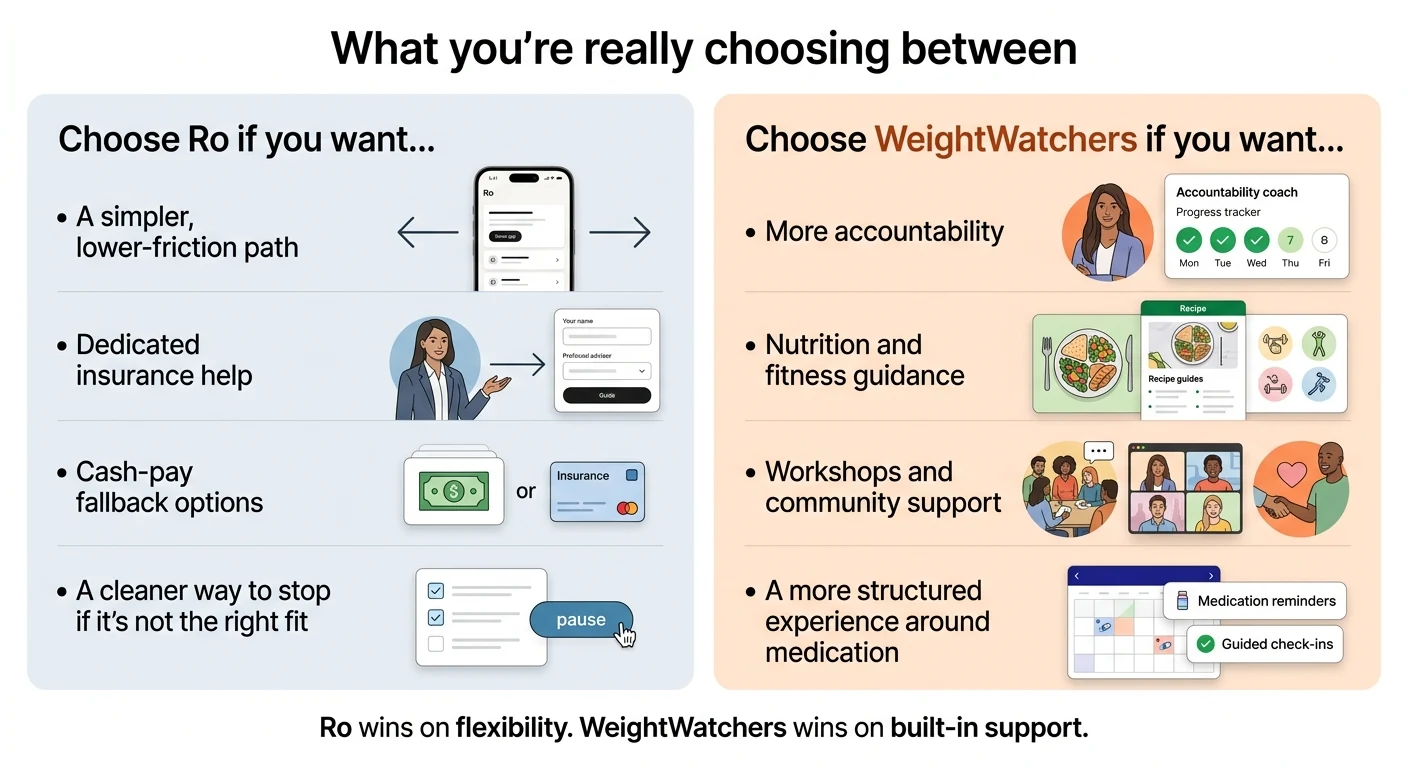
Ro’s support model
- Regular check-ins with a licensed provider
- On-demand provider messaging through the app
- Coaching & education (nutrition, sleep, exercise)
- Metabolic lab testing at Quest Diagnostics (included when ordered; at-home kit $75 or free without Quest access)
- Insurance concierge at no extra charge
- Up to 24 medical consultations per year
Source: ro.co/weight-loss/how-it-works. Clinical-first model.
WeightWatchers’ support model
- Board-certified obesity specialist consultations
- Registered dietitian access
- Personal fitness coaching
- Virtual workshops and community groups
- The Points system for food tracking
- Thousands of healthy recipes
- 24/7 app-based care team access
- Connect community features
- Insurance coordination + lab work through Quest
Source: weightwatchers.com/us/compare-memberships. 60-year behavior-change ecosystem.
Who actually benefits from the extra support?
WeightWatchers’ membership only adds value if you actively participate — if you track Points, attend workshops, use the recipes, and engage with your care team beyond just medication management. WW’s own observational data shows that Med+ members who added the WW Points program lost 8% more weight than those who didn’t.
Be honest with yourself. If you know you’ll use the workshops, track your food, and lean on the community — WW could be the difference between losing the weight and keeping it off. If you won’t use those features, you’re paying for overhead you’ll never touch.
Pick Ro if… Pick WeightWatchers if… Pick Neither if…
Your situation determines the winner. Here’s the shortcut based on every scenario we found in forums, official pages, and user threads.
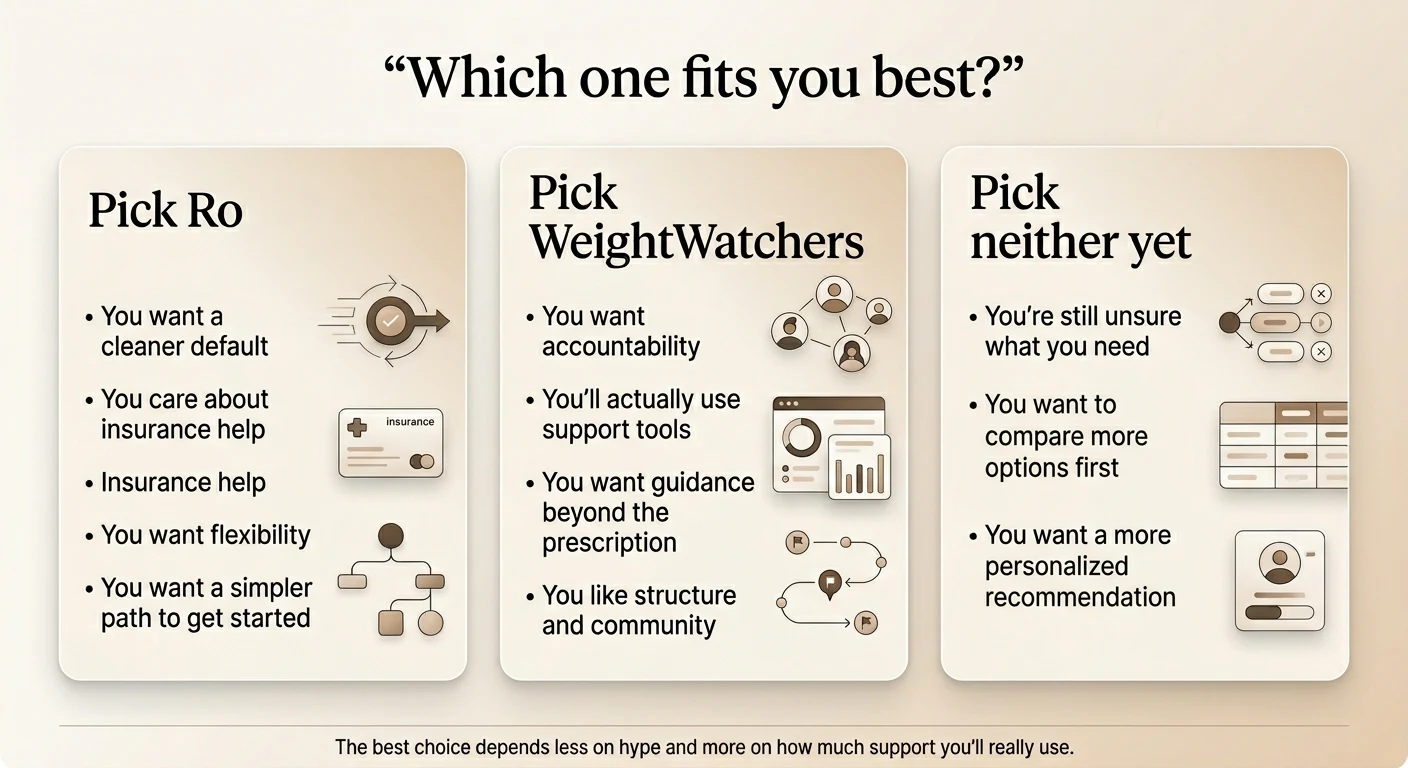
Pick Ro if:
- You want the lower-regret default. Clearer pricing, documented insurance fallback, easier exit.
- You’re insurance-first. Ro’s concierge model is built around fighting for prior authorization approval.
- You want month-to-month flexibility. $149/mo, no commitment, cancel before your next billing cycle with 48 hours’ notice.
- You want a fallback if brand-name supply gets disrupted. Ro’s terms allow compounded semaglutide during national shortages (cash-pay only, select states, not FDA-approved).
- You’ve already tried structured diet programs and just need the medication managed well. Ro won’t add overhead you won’t use.
Pick WeightWatchers if:
- You know you need accountability to stay consistent. If you’ve tried medication-only approaches and fallen off track, WW’s structure could be the difference.
- You’ll actually use the Points system, workshops, and dietitian access. This is real value — but only if you engage with it.
- Your commercial insurance covers GLP-1 medication. With insurance handling the med cost, WW’s $74/mo membership buys you a comprehensive lifestyle program.
- You want non-GLP-1 medication options included in your membership. Metformin and Contrave are covered through WW’s Carepoint pharmacy at no extra medication cost.
Pick neither if:
- You want compounded GLP-1 medication at the lowest possible monthly cost. Neither Ro nor WW is optimized for compounded access. Providers like MEDVi start significantly lower with no separate membership fee. → Compare compounded GLP-1 providers
- You already have a local prescriber managing your GLP-1. You don’t need a telehealth membership.
- You have Medicaid. Ro explicitly excludes Medicaid from membership. WW routes government-plan members to non-GLP-1 alternatives or cash-pay.
- You’re not sure you want GLP-1 medication yet. If you’re still in the “should I even try this?” phase, take our 60-second quiz to see what options make sense before committing to either platform.
Ro Review: Where It Wins and Where It Doesn’t
Ro’s strongest case is clarity and flexibility. The pricing is transparent. The insurance concierge path is documented — including what happens when coverage fails. Metabolic lab testing is included when your provider orders it. And you can leave the monthly plan without a contract fight.
Best reasons to choose Ro
- Insurance concierge at no extra charge. They fight for prior authorization, handle paperwork, and navigate your coverage. If coverage fails, you get explicit options — cash-pay alternatives or cancel.
- No lock-in required on the monthly plan. $149/month, cancel before your next billing cycle with 48-hour notice.
- Documented shortage fallback. Compounded semaglutide available during national manufacturer shortages (cash-pay only, select states, not FDA-approved).
- Labs included. Quest Diagnostics testing covered when your provider orders it; at-home kit available for $75 (or free in states without Quest access).
- Manufacturer-level cash-pay pricing. Ro matches LillyDirect, NovoCare, and manufacturer subscription pricing directly.
The honest tradeoff
Ro does NOT give you WeightWatchers’ coaching and community layer. If structured accountability — workshops, dietitians, Points tracking, community support — is what will keep you consistent on your GLP-1, WW is the better fit for that specific need. But because Ro skips that extra layer, the pricing is cleaner, the insurance path is stronger, and the exit risk is lower.
In clinical trials for the medications Ro prescribes — Wegovy (semaglutide) and Zepbound (tirzepatide) — study participants lost an average of 15–20% of their body weight over 12 months when paired with diet and exercise. Those are the medications’ clinical trial results, not a guarantee of individual outcomes. But the medication works. And Ro makes accessing it simpler than most alternatives.
Check Ro pricing & see if you qualify
No long-term commitment required. Insurance concierge included. See your options before you decide.
Check Ro pricing & see if you qualify ↗WeightWatchers Clinic Review: Where It Wins and Where It Doesn’t
WW’s strongest case is support depth. No other telehealth GLP-1 platform wraps medication access inside a behavior-change ecosystem this comprehensive. WW reports that its clinic members prescribed a GLP-1 lost an average of 21% of their body weight at 12 months, based on internal data from 3,250 patients.
Best reasons to choose WeightWatchers
- 60 years of behavior-change science. The Points system, nutrition tracking, and workshop model have decades of evidence behind them.
- Registered dietitians and fitness coaches. Not just a prescriber — a full care team addressing nutrition, exercise, and behavioral patterns.
- Community and workshops. Virtual support groups and live coaching that many members credit with long-term consistency.
- Non-GLP-1 medications included. Metformin and Contrave are covered through Carepoint pharmacy at no extra medication cost — a real option if your clinician recommends starting with a non-GLP-1 approach.
- Points program boost. WW’s observational data shows Med+ members who added the Points program lost 8% more weight than those who didn’t.
The honest tradeoff
WeightWatchers does NOT have the cleanest low-commitment path. If you hate being locked into multi-month contracts, Ro is better. WW’s cheapest pricing requires a 12-month commitment, cancellation takes effect at the end of that period, and auto-renewal into another 12-month term catches some members off guard. But if accountability is the reason you’ll actually succeed this time, that commitment might work for you.
Both Now Offer the Wegovy Subscription — What Does That Change?
As of April 2026, Novo Nordisk launched a multi-month subscription program for Wegovy, available through both Ro and WeightWatchers (plus LifeMD, with Hims & Hers and Sesame joining soon). This is the first manufacturer-direct subscription pricing for any GLP-1 medication.
What the Wegovy subscription launch means for the Ro vs WW decision
With Wegovy subscription pricing now identical across both platforms, the medication cost variable is neutralized for Wegovy users. The entire decision comes down to:
- Membership cost — nearly identical ($14/year gap on cheapest paths)
- Contract flexibility — Ro is cleaner to exit
- Insurance support — Ro’s concierge is more explicitly documented with a clearer fallback
- Support features — WW is more comprehensive
- Shortage fallback — Ro offers compounded semaglutide during national shortages; WW does not
The subscription launch actually strengthens Ro’s position as the default recommendation — because with medication pricing standardized, the differentiators that favor Ro (flexibility, insurance fallback, shortage coverage) carry more weight than ever.
Provider-Stated Claims vs What We Verified
We believe transparency earns trust. Here’s what each provider says on their public pages vs. what we were able to confirm.
| Claim | Ro states | Verified | WW states | Verified |
|---|---|---|---|---|
| Membership start | $39 first month, as low as $74/mo annual | ✅ | $25 first month (12-mo plan), $49 (other plans) | ✅ |
| GLP-1 in membership? | No | ✅ | No | ✅ |
| Insurance coordination | Dedicated concierge for commercial + FEHB | ✅ | Coordination team; commercial insurance only | ✅ |
| Fallback if denied | Cash-pay options or cancel | ✅ | Non-GLP-1 alternatives included; cash-pay GLP-1 option | ✅ |
| Compounded GLP-1 | During national shortages, cash-pay only, select states | ✅ | Not offered — FDA-approved meds only | ✅ |
| Cancellation | 48-hr notice before renewal; prepaid fees non-refundable | ✅ | Multi-month: cancellation at end of commitment; auto-renews same term | ✅ |
| Zepbound KwikPen/vials via LillyDirect | Starting at $299/mo, cash-pay only | ✅ | Starting at $299/mo, cash-pay only | ✅ |
| Average weight loss | Cites clinical trial averages: 15–20% body weight over 12 months | ✅ (medication trial results, not Ro-specific) | Clinic members: 21% avg body weight at 12 months (n=3,250) | ⚠️ Internal WW study; not independently replicated |
All sources checked April 10, 2026. See full source list in methodology section below.
How We Verified This Ro vs WeightWatchers Comparison
Sources checked (April 10, 2026)
- Ro pricing: https://ro.co/weight-loss/pricing/
- Ro insurance: https://ro.co/weight-loss/insurance/
- Ro how it works: https://ro.co/weight-loss/how-it-works/
- Ro terms of use: https://ro.co/terms-of-use/
- WW Med+ pricing: https://www.weightwatchers.com/us/plans/clinic
- WW Med+ membership cost: https://wwclinic.zendesk.com/hc/en-us/articles/34056107056027-WW-Med-Membership-Cost
- WW medication page: https://www.weightwatchers.com/us/weight-loss-medication
- WW Zepbound page: https://www.weightwatchers.com/us/weight-loss-medication/zepbound
- WW clinic terms: https://www.weightwatchers.com/us/termsandconditions/ww-clinic
- Novo Nordisk Wegovy subscription: Fierce Healthcare, Axios, Quartz — April 2026
How we calculated year-1 totals
We modeled first-year membership costs using each provider’s publicly listed pricing tiers. Ro annual: $39 first month + $74/month × 11 months = ~$853. WW 12-month: $25 + $74 × 11 = ~$839. WW 6-month: two cycles. Month-to-month calculations use published rates for 12 months.
Medication costs were excluded from year-1 membership calculations because they vary dramatically by insurance, drug, and dose.
What we could not verify
- Whether Ro’s $39 first-month offer stacks identically before the annual rate in every checkout flow
- WeightWatchers’ complete state-by-state availability from public pages alone
- Real provider response times without conducting a fresh test signup at each platform
- Ro’s specific state list for compounded semaglutide availability during shortages
We marked every unverified element. If we couldn’t confirm it from a public official page, we said so.
Ro vs WeightWatchers FAQ
Is Ro cheaper than WeightWatchers?+
Does WeightWatchers include the GLP-1 medication in the monthly fee?+
Is Ro month to month?+
Can you cancel WeightWatchers Med+ early?+
Which one is better for insurance help?+
What happens if the medication is unavailable?+
Does Ro serve all 50 states?+
What if I want compounded GLP-1s instead?+
What is the new Wegovy subscription?+
Does WeightWatchers offer compounded GLP-1s?+
Still not sure which GLP-1 program is right for you?
If you’ve read this far and you’re still deciding, that’s a good sign — it means you’re going to make a thoughtful choice. Take our free 60-second matching quiz. It factors in your insurance situation, budget, medication preferences, and what kind of support you actually need — and gives you a personalized recommendation. No commitment, no email required.
Get my personalized GLP-1 action plan ↗Related Comparisons & Guides
- Ro vs Noom for GLP-1 — 9 Real Differences in 2026
- Ro vs Eden for GLP-1 — Honest Comparison With Actual 2026 Prices
- Ro vs MEDVi — Full 2026 Comparison
- MEDVi vs Found — Real Pricing & 2026 Verdict
- Best GLP-1 Providers That Accept Insurance (2026)
- How to Get Wegovy Cheap — Real Paths to Lower Prices
- Compare All GLP-1 Providers →
Sources & Disclosure
The RX Index is an independent comparison resource for GLP-1 telehealth providers. Some links on this page are affiliate links — we may earn a commission if you sign up through them at no extra cost to you. This does not influence our editorial recommendations. Our methodology, source list, and provider-stated vs. verified table are published above so you can check every claim independently.
GLP-1 medications may have serious side effects including possible thyroid tumors. Do not use if you or your family have a history of medullary thyroid carcinoma (MTC) or Multiple Endocrine Neoplasia syndrome type 2 (MEN 2). Consult a licensed healthcare provider before starting any weight loss medication.
Last verified: . Pricing, terms, and availability are subject to change — always verify current offers directly with each provider before signing up.