
Last updated: March 2026 · Pricing verified: March 27, 2026 · Sources: FDA, NEJM, CMS, Cleveland Clinic, AAMC, UNC Chapel Hill · Editorial standards · Updated monthly
GLP-1 FOR SENIORS — 2026 COMPLETE GUIDE
Best GLP-1 for Seniors: Which Option Is Safest and Most Affordable After 60?
The best GLP-1 for seniors is not the strongest one — it's the one that matches your coverage, your body, and your medical history.
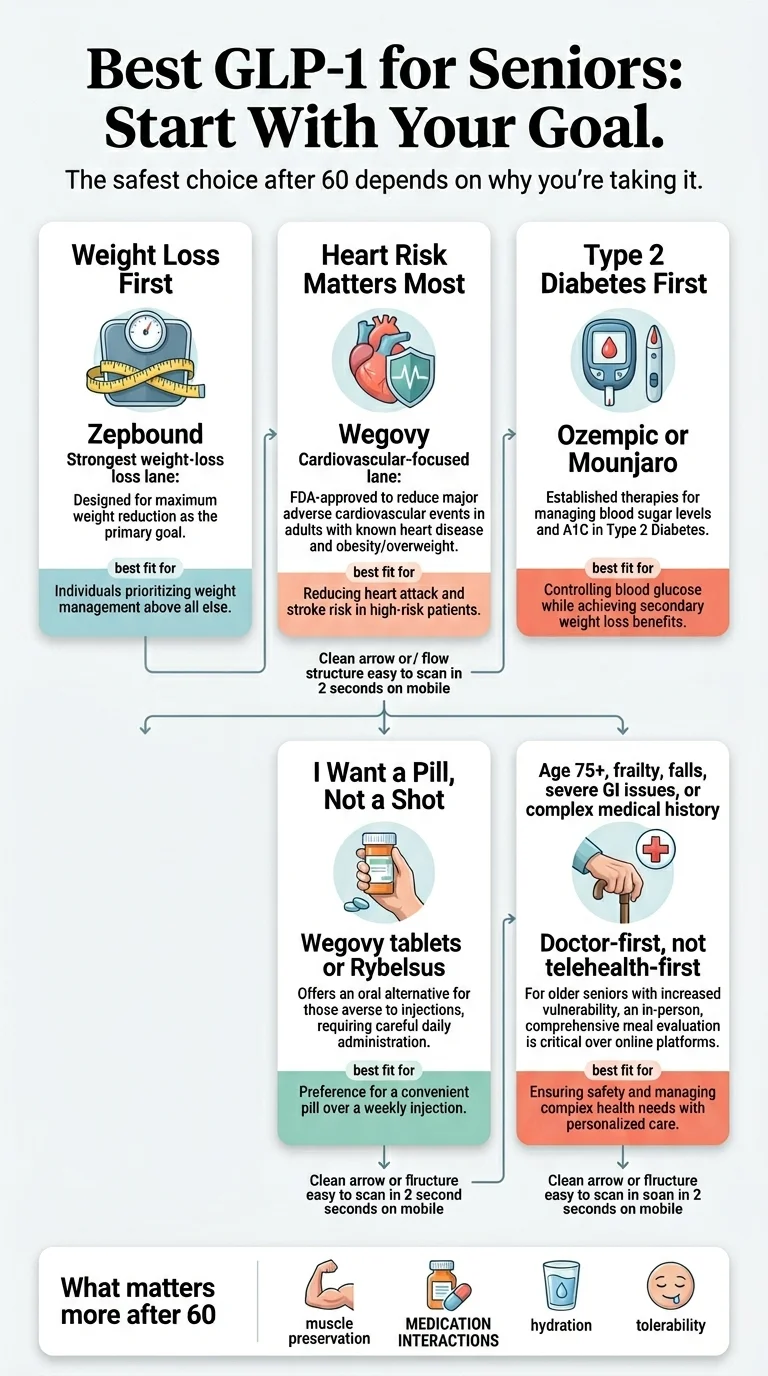
Zepbound (tirzepatide) delivers the most weight loss in clinical trials. Wegovy (semaglutide) is the standout for heart protection — and it's now available as a daily pill. Ozempic or Mounjaro make more sense when type 2 diabetes is the primary driver. And if you're on Medicare without a diabetes diagnosis, the Medicare GLP-1 Bridge launching July 1, 2026 may open a $50/month path that didn't exist before.
But here's what most pages won't tell you: the right GLP-1 after 60 depends on whether you're managing diabetes, protecting your heart, navigating Medicare, or paying cash. We compared all seven options through the lens of what actually matters after 60 — safety, coverage, cost, and the muscle-loss question every senior needs answered before starting.
By The RX Index Research Team · Updated: March 28, 2026 · Pricing verified March 27, 2026
Disclosure: Some links on this page are affiliate links. If you purchase through these links, we may earn a commission at no extra cost to you.
GLP-1 Medications Compared: Quick-Reference Table for Adults 60+
Every medication, filtered for what actually matters after 60. All prices are drug-only cash-pay costs. Verify current pricing on provider sites — these change frequently.
| Medication | FDA-Approved For | Avg. Weight Loss | Heart/Kidney Benefit | Format | Medicare Part D Now? | Medicare Bridge (July 2026)? | Self-Pay Starting Price (Drug Only) |
|---|---|---|---|---|---|---|---|
| Wegovy injectionsemaglutide 2.4 mg | Weight loss, CV risk reduction, MASH | ~15% | ✅ 20% reduction in major CV events (SELECT trial) | Weekly shot | May be covered for CV risk reduction | ✅ $50/mo if eligible | $199/mo intro (0.25–0.5mg); $349/mo+ higher doses via NovoCare |
| Wegovy pillsemaglutide 25mg | Weight loss, CV risk reduction | ~13.6% | ✅ Same CV indication as injection | Daily pill | Same as injection | ✅ $50/mo if eligible | $149/mo (1.5–4mg); $299/mo (9–25mg) via NovoCare |
| Zepboundtirzepatide | Weight loss, obstructive sleep apnea | ~20% | Emerging CV data | Weekly shot | May be covered for OSA | ✅ $50/mo if eligible | Vials: $299/mo (2.5mg); $399 (5mg); $449 (7.5mg+) via LillyDirect |
| Ozempicsemaglutide | Type 2 diabetes, CV risk reduction, CKD risk reduction | ~10–14% (off-label weight loss) | ✅ Proven CV + kidney benefit | Weekly shot | ✅ Covered for diabetes/CV/CKD | N/A | ~$900+/mo retail |
| Mounjarotirzepatide | Type 2 diabetes | ~15–20% | Emerging CV data | Weekly shot | ✅ Covered for diabetes | N/A | ~$900+/mo retail |
| Rybelsussemaglutide 7–14mg | Type 2 diabetes, CV risk reduction | ~5–8% | ✅ CV benefit | Daily pill | ✅ Covered for diabetes | N/A | ~$900+/mo retail |
| Compounded semaglutideNot FDA-approved | Not FDA-approved | Varies | Not studied | Shot or oral | ❌ | ❌ | ~$179–$299/mo (provider-dependent) |
Ozempic is FDA-approved for type 2 diabetes and related conditions, not for weight loss. The FDA-approved semaglutide product for weight management is Wegovy.
Important: Compounded GLP-1s are not FDA-approved and have not been evaluated by the FDA for safety, efficacy, or quality. They are not generic versions of brand-name products. We include them because cost is the #1 barrier for seniors, and for some, a compounded option is the most accessible path while waiting for Medicare coverage. More below.
Which GLP-1 Is Best for Seniors Overall?
There is no single best GLP-1 for every adult over 60. Any page that tells you otherwise is oversimplifying a medical decision that depends on your diagnosis, your insurance, and your body.
What there is: a best path for your specific situation. It comes down to four filters.
Filter 1: What's your primary health goal?
Weight loss, diabetes control, heart protection, or some combination. The right medication changes based on the answer.
Filter 2: What's your age band?
60–64 is different from 65–74, which is very different from 75+. Not because there's an age cutoff — there isn't — but because frailty risk, muscle loss, medication load, and insurance status all shift at these thresholds.
Filter 3: What's your coverage situation?
Medicare changes the entire decision tree. Commercial insurance opens different doors. Cash-pay has its own lane.
Filter 4: How's your overall health?
If you're dealing with frailty, recent falls, severe GI issues, unintentional weight loss, or a complex medication list — start with your own doctor, not a telehealth checkout page.
| Your Situation | Best Medication Lane | Best Next Step |
|---|---|---|
| Medicare + type 2 diabetes | Ozempic or Mounjaro (likely covered by Part D now) | Talk to your doctor about your Part D formulary |
| Medicare + obesity + qualifying condition | Wegovy or Zepbound through Medicare GLP-1 Bridge ($50/mo from July 2026) | Check Bridge eligibility criteria below |
| Medicare + heart disease + obesity | Wegovy (proven CV benefit, may be covered now under Part D) | Talk to your doctor about current Part D coverage |
| Age 60–64, commercial insurance | Wegovy or Zepbound through insurance | Check insurance coverage through Ro |
| Cash-pay, want FDA-approved | Wegovy pill ($149/mo starting) or Zepbound vial ($299/mo) | See FDA-approved cash-pay options through Ro |
| Cash-pay, need most affordable option | Compounded semaglutide (not FDA-approved) | Check pricing on MEDVi |
| Prefer a pill over injections | Wegovy pill or Rybelsus | See pill options below |
| Age 75+, frail, or complex medical history | Doctor-guided, not telehealth-first | Schedule with your doctor or geriatrician |
Is It Safe for Seniors to Take GLP-1 Medications?
Yes — with caveats that matter more after 60 than at 35.
There is no upper age limit for any FDA-approved GLP-1 medication. Geriatricians at Cleveland Clinic, UNC Chapel Hill, Baylor College of Medicine, and Yale prescribe them to patients well into their 60s and 70s.
Dr. Chitra Ganta, a geriatrician at the Cleveland Clinic, reported in a 2025 AAMC feature that GLP-1 medications “truly helped so many patients with metabolic disorders, especially diabetes and obesity, become healthier and improved the quality of their lives.”
Nearly 40% of adults age 60 and older qualify as obese, according to the CDC. Almost 30% of adults 65+ have type 2 diabetes. The medical community is behind you — with conditions.
Why 75+ Is Different from 60–64
The current Wegovy prescribing label includes a specific geriatric note: in the SELECT cardiovascular outcomes trial, there was a higher rate of hip and pelvic fractures and serious adverse reactions in participants aged 75 and older. Less than 3% of participants in major GLP-1 trials were over 75.
This doesn't mean 75-year-olds can't use GLP-1s. It means the approach should be more conservative: lower starting doses, slower titration, closer monitoring, and ideally, guidance from a geriatrician rather than a telehealth-first route.
Start with your own doctor — not an online signup — if any of these apply:
- You are 75 or older
- You have had recent falls or balance issues
- You are losing weight unintentionally
- You have severe constipation or a history of gastroparesis
- You take 5+ medications daily
- You have a history of pancreatitis or gallbladder issues
- You are dealing with frailty or difficulty with daily tasks
The Muscle-Loss Reality — and Exactly What to Do About It
This is the concern geriatricians take most seriously, and it's worth understanding before you start.
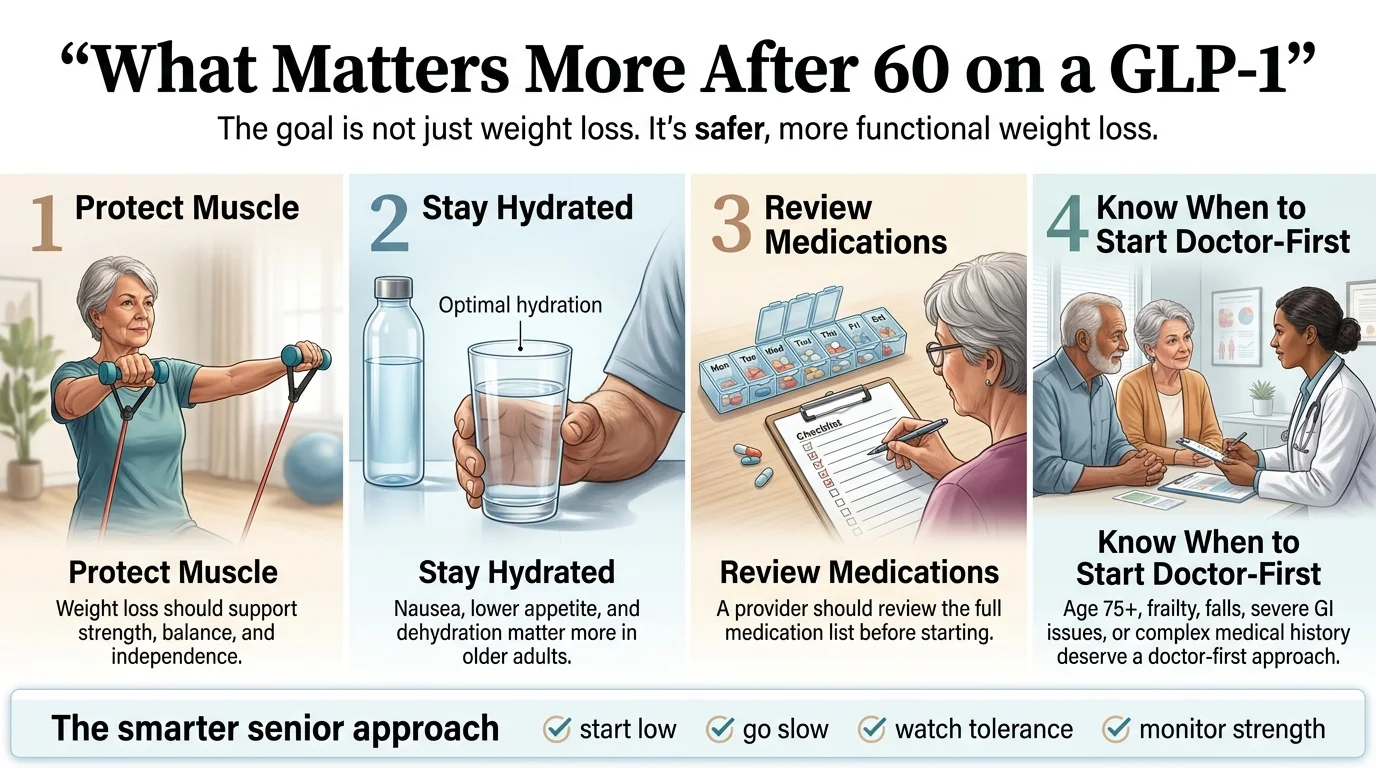
Studies have found that roughly 35–45% of weight lost on GLP-1 medications is lean mass — muscle and bone — not fat. For younger adults with muscle to spare, that's manageable. For adults over 60 who already lose 3–5% of muscle mass per decade, it's a real concern. Muscle loss increases fall risk, reduces mobility, and accelerates frailty.
Dr. John Batsis, a geriatrician at UNC Chapel Hill who studies obesity and physical function in older adults, has been clear: GLP-1s can benefit older adults, but only when paired with resistance exercise and adequate protein intake.
The medication handles the metabolic side. You handle the muscle side. That partnership is what works.
In practice, that means:
Resistance training 2–3 times per week
Even chair squats, wall pushups, and resistance band exercises count. The goal is loading your muscles regularly — not powerlifting.
Protein at every meal
Many geriatricians recommend 25–30 grams per meal for older adults on GLP-1s. That's roughly 4 oz of chicken, a cup of Greek yogurt with nuts, or 3 eggs with cheese.
Hydration
GLP-1s reduce appetite and can suppress thirst cues. Dehydration in older adults leads to dizziness, which leads to falls — a cascade you can break by drinking water intentionally throughout the day.
"Start low, go slow"
Begin at the lowest dose, titrate up over weeks or months, and adjust based on how you feel — not based on a generic schedule.
Which GLP-1 Is Best if You Have Type 2 Diabetes?
If diabetes is your primary driver, two things work in your favor right now.
First, GLP-1s were originally developed for diabetes — this is where the clinical evidence is deepest. Second, Medicare Part D already covers several GLP-1 medications for type 2 diabetes. You may not need to wait for any new program or pay out of pocket.
For blood sugar control and weight loss
Ozempic (weekly injection) and Mounjaro (weekly injection) are the two leading options. In head-to-head trials, Mounjaro showed slightly better A1C reduction and greater weight loss. If your formulary covers both, Mounjaro is often the stronger pick for dual benefit.
For kidney protection
Ozempic is now FDA-approved for reducing the risk of sustained eGFR decline, end-stage kidney disease, and cardiovascular death in adults with type 2 diabetes and chronic kidney disease. If kidney disease is part of your picture, discuss this specifically with your doctor.
If you prefer a pill
Rybelsus (oral semaglutide 7mg or 14mg) is covered by many Part D plans for type 2 diabetes and cardiovascular risk reduction. Weight loss is more modest (~5–8%), but the convenience of a pill matters when managing a full medication schedule. Note: Rybelsus must be taken on an empty stomach with a small sip of water, then wait 30 minutes before eating or taking other medications.
If you already take insulin or a sulfonylurea
Adding a GLP-1 increases the risk of low blood sugar. Your doctor will likely need to adjust your existing diabetes medications before starting.
Your Part D costs are now capped
In 2026, Medicare Part D limits total out-of-pocket spending on covered prescriptions to $2,100 per year. If you're prescribed Ozempic or Mounjaro for diabetes, you'll likely hit that cap within the first few months — and then pay nothing for covered drugs the rest of the year.
If diabetes is your path, your next step is your doctor and your Part D formulary — not a telehealth program. The coverage is there. Use it. See our full diabetes-first GLP-1 guide →
Which GLP-1 Is Best for Heart Disease, Stroke History, or Sleep Apnea?
For many adults over 60, this is the real reason to consider a GLP-1 — and it opens coverage doors that “weight loss” alone does not.
For cardiovascular protection
Wegovy is the clear leader. In the SELECT trial, Wegovy reduced the risk of major cardiac events — heart attack, stroke, and cardiovascular death — by 20% in adults with established heart disease and overweight or obesity. Trulicity (dulaglutide) also has proven cardiovascular benefits for adults with type 2 diabetes. Medicare Part D now covers Wegovy when prescribed for cardiovascular risk reduction in adults with established CVD plus overweight or obesity. If that describes you, you may already qualify.
For sleep apnea
Zepbound received FDA approval for treating obstructive sleep apnea in adults with obesity. If OSA is part of your picture, this creates a separate coverage pathway worth exploring. See our complete sleep apnea guide →
If you're over 60 with heart disease, sleep apnea, or kidney issues alongside excess weight, a GLP-1 isn't just a weight loss tool — it may be a meaningful part of your disease management. That reframing can change both the medical conversation and the coverage conversation with your plan.
Medicare and GLP-1s in 2026: What's Actually Covered
This section alone could save you thousands of dollars.
Medicare coverage for GLP-1s is changing faster than most people realize.
What Medicare Covers Right Now (March 2026)
Part D covers GLP-1s for type 2 diabetes
Ozempic, Mounjaro, Trulicity, and Rybelsus are on many Part D formularies when prescribed for diabetes. Prior authorization is usually required.
Wegovy may be covered for cardiovascular risk reduction
For adults with established CVD plus obesity or overweight — this is a Part D-covered use, not weight-loss coverage.
Zepbound may be covered for obstructive sleep apnea
Through some Part D plans for qualifying patients.
Part D does NOT cover GLP-1s solely for weight loss
This restriction has been in place since 2003 — but it's changing (see the Bridge below).
Part D out-of-pocket costs capped at $2,100/year
For all covered prescriptions in 2026.
Key point: If your GLP-1 use is already coverable under standard Part D — such as Wegovy for cardiovascular risk or Ozempic for diabetes — go through your Part D plan, not the Bridge program described below.
The Medicare GLP-1 Bridge: $50/Month Starting July 1, 2026
On December 23, 2025, CMS announced the Medicare GLP-1 Bridge — a nationwide short-term demonstration giving eligible Medicare beneficiaries access to GLP-1 weight-management medications at a $50/month copay.
| Covered medications | Wegovy (injection and tablets) and Zepbound |
| Copay | $50/month |
| Duration | July 1 – December 31, 2026 (bridge to the longer-term BALANCE Model) |
Eligibility criteria (per CMS):
- BMI ≥35 at GLP-1 initiation, or
- BMI ≥30 plus one of: heart failure with preserved ejection fraction (HFpEF), uncontrolled hypertension despite 2+ antihypertensive medications, or chronic kidney disease stage 3a or above, or
- BMI ≥27 plus one of: prediabetes, previous heart attack, previous stroke, or symptomatic peripheral artery disease
How the Bridge works
The Bridge operates outside the standard Part D payment flow. CMS runs a central processor for prior authorization, claims, and pharmacy payment — your Part D plan does not opt in or out. This also means the $50 copay does not count toward your Part D deductible or $2,100 out-of-pocket cap.
What Changes in January 2027: The BALANCE Model
Starting January 2027, Part D plans can voluntarily participate in the BALANCE Model, which will provide ongoing GLP-1 coverage for weight management through standard Part D channels.
How to Prepare Right Now
- Confirm you're enrolled in a Part D plan (standalone PDP or MA-PD). You need Part D enrollment to access the Bridge.
- Get your BMI and qualifying conditions documented. Ask your doctor to note your BMI, plus qualifying conditions like HFpEF, uncontrolled hypertension, CKD stage 3a+, prediabetes, previous MI, previous stroke, or symptomatic PAD.
- Ask your prescriber whether your situation fits the Bridge criteria or whether standard Part D coverage is the better route.
- For 2027 BALANCE planning: Watch for announcements during open enrollment (October 15 – December 7, 2026) about which Part D plans will participate.
What if you can't wait until July? If you want to start treatment now and don't have current Part D coverage, you have cash-pay options. The costs and tradeoffs are different from the Medicare path — and you should understand them clearly.
Best Online GLP-1 Programs for Seniors
Evaluated through what matters after 60: provider quality, medication interaction review, insurance navigation, pricing transparency, and access to a real clinician.
Best FDA-Approved Telehealth Route (Without Government Healthcare Coverage): Ro
Best for: Adults under 65 with commercial/employer insurance, or any adult paying cash for brand-name medications
Important eligibility note: Ro cannot coordinate insurance coverage for government healthcare plans, including Medicare, Medicaid, and TRICARE. If you have Medicare, the doctor-and-Part-D path or the upcoming Medicare GLP-1 Bridge is your better first move.
Ro offers the most integrated telehealth platform for GLP-1 treatment in the commercial-insurance lane. You get an online provider visit where a licensed clinician reviews your health history and current medications. If you have commercial insurance, Ro's insurance concierge handles prior authorization — and if your plan covers a GLP-1, your cost drops to a copay. Ro offers all major FDA-approved options: Wegovy (injection and pill), Zepbound, and Ozempic.
| Medication (drug cost only, separate from membership) | Monthly Drug Cost |
|---|---|
| Wegovy pill (1.5–4mg doses) | $149/mo |
| Wegovy pill (9–25mg doses) | $299/mo |
| Wegovy injection (intro 0.25–0.5mg, limited time) | $199/mo |
| Wegovy injection (higher doses) | $349/mo+ |
| Zepbound vial (2.5mg) | $299/mo |
| Zepbound vial (5mg) | $399/mo |
| Zepbound vial (7.5mg+) | $449/mo |
| Commercial insurance covers it | Copay only |
Ro Body membership: $45 first month, then $145/month — covers clinical care, dose adjustments, and ongoing support (separate from drug cost). Prices verified March 2026.
Have commercial insurance, or want FDA-approved brand-name medication?
Check Insurance Coverage or Cash-Pay Options on Ro →Lower-Cost Compounded Cash-Pay Option: MEDVi
Best for: Adults paying cash who need the lowest monthly cost and understand compounded medications are not FDA-approved
For adults on a fixed income without GLP-1 insurance coverage, MEDVi provides one of the most accessible entry points. Compounded semaglutide injections start at $179 for the first month and $299/month for refills. They also offer compounded oral semaglutide. No long-term contracts — billing is month-to-month. Prescriptions go through licensed clinicians and medications are dispensed from licensed U.S. pharmacies.
What you need to understand clearly
MEDVi's GLP-1 medications are compounded. They are not FDA-approved. They have not been evaluated by the FDA for safety, efficacy, or quality. They are not the same as Wegovy, Ozempic, or any brand-name product. If you can access an FDA-approved GLP-1 through insurance or the upcoming Medicare Bridge, that should be your first choice.
MEDVi makes sense for cash-pay adults who have explored insurance and Medicare paths and found they don't have coverage — and who want to start treatment now rather than wait. Many people have used compounded GLP-1 programs as a bridge while waiting for insurance access or Medicare coverage to begin.
Explored insurance and Medicare — still need an affordable option?
Review MEDVi Pricing, Pharmacy Details & Eligibility →The Path Most Seniors Should Start With: Your Doctor + Medicare
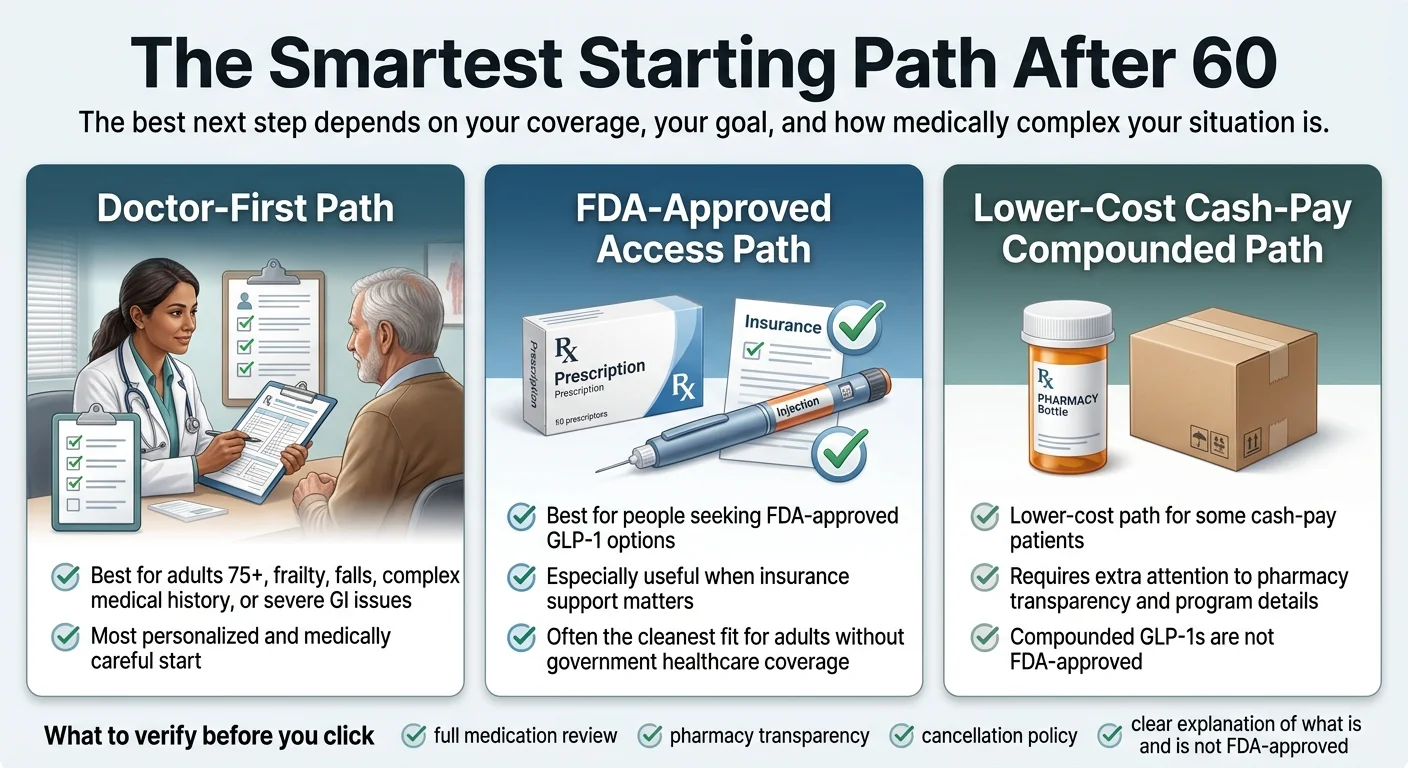
For the majority of adults 65+ on Medicare, the smartest first move isn't an online program. It's this:
- Schedule with your doctor, endocrinologist, or obesity medicine specialist. They can prescribe FDA-approved GLP-1s and account for your full medication list and health history.
- Check your Part D formulary. If you have diabetes, heart disease, kidney disease, or sleep apnea, a GLP-1 may already be covered.
- Prepare for the Medicare GLP-1 Bridge (July 2026) if your goal is weight management and you meet the eligibility criteria.
- Only look at cash-pay options if you've explored the paths above and need to start sooner.
GLP-1 Pills vs. Shots: What Seniors Need to Know
If the idea of weekly injections makes you hesitate, you now have real alternatives.
Wegovy Pill (Oral Semaglutide 25mg) — The Biggest GLP-1 Development of 2025
In December 2025, the FDA approved the Wegovy pill — the first oral GLP-1 for weight management. It launched in U.S. pharmacies in January 2026.
The clinical results: In the OASIS 4 trial, Wegovy tablets produced a 13.6% mean body-weight reduction at week 64, and 27.9% of participants achieved at least 20% weight loss. Among participants who fully adhered to treatment, weight loss was even higher — comparable to the injectable version.
For seniors, the pill has practical advantages. No needles. No refrigeration. No injection-site reactions. And the self-pay price starts at $149/month for the starting dose — one of the most affordable FDA-approved GLP-1 entry points available.
The tradeoff
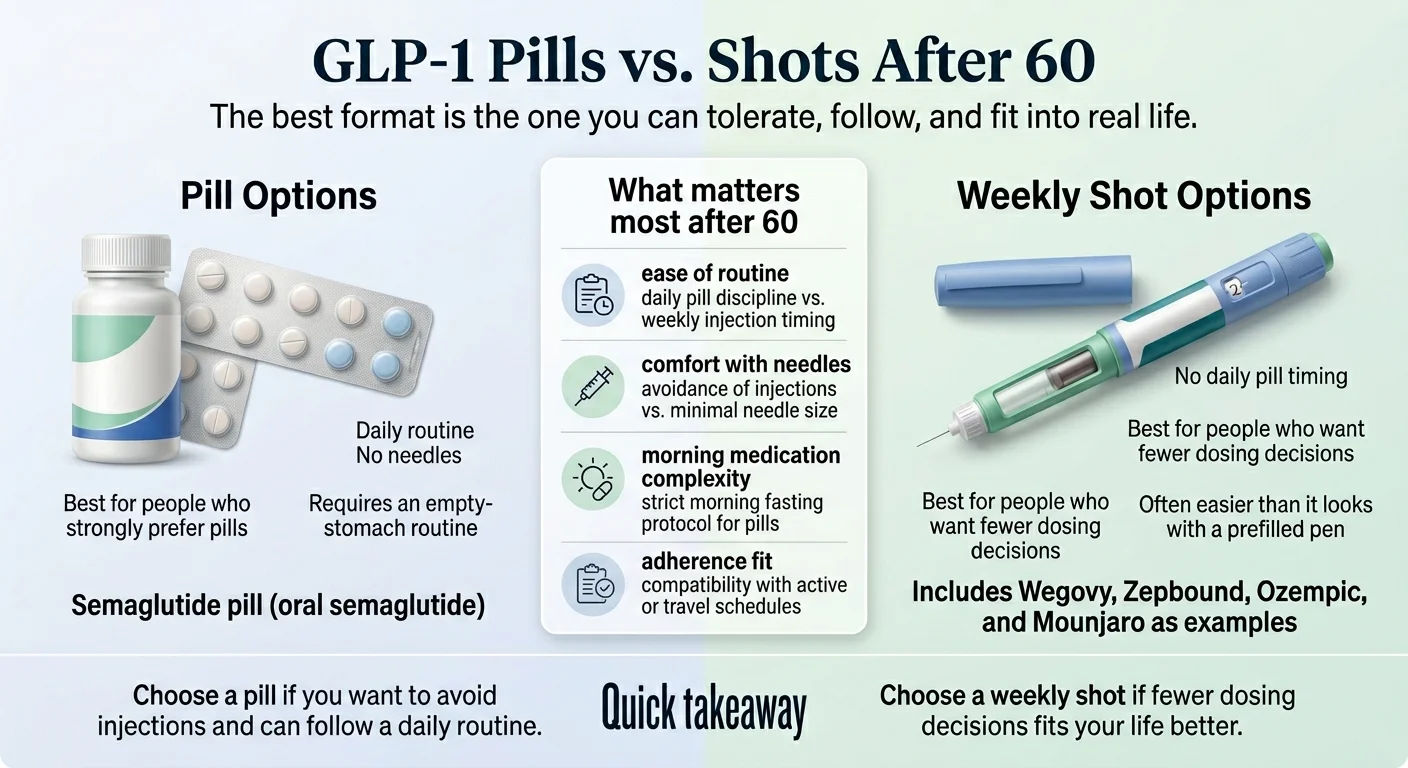
You take it daily (not weekly), on an empty stomach with a small sip of water, then wait 30 minutes before eating, drinking, or taking other oral medications. For seniors managing a full morning pill routine, that timing requirement takes coordination.
Rybelsus (Oral Semaglutide 7–14mg) — For Diabetes + Some Weight Loss
If your primary goal is diabetes management, Rybelsus has been available as an oral GLP-1 since 2019. It's covered by many Part D plans for type 2 diabetes and cardiovascular risk reduction. Weight loss is more modest than the Wegovy pill (which uses a higher dose), but for seniors who want diabetes control plus some weight loss in pill form, it's a proven option.
When the Weekly Shot Is Still the Better Choice
Injectable GLP-1s (Wegovy injection, Zepbound, Ozempic, Mounjaro) remain the go-to for many providers. Weekly dosing means better adherence for many people — one shot per week is easier to remember than a daily pill with a 30-minute fasting window. For seniors with swallowing difficulties, complex morning medication schedules, or anyone who finds weekly simpler than daily — the injection is often the better fit.
Side Effects That Matter More After 60
GLP-1 side effects are well-documented, but certain ones carry more weight when you're older.
Nausea and vomiting
Most common at any age. In older adults, they can lead to dehydration — and dehydration leads to dizziness, which leads to falls. The mitigation: start at the lowest dose, titrate slowly, stay hydrated, eat small meals.
Muscle and bone loss
Real and manageable — see the muscle-loss section above. Requires resistance training and adequate protein.
Drug interactions
GLP-1s slow digestion, changing how your body absorbs other medications — particularly those with narrow therapeutic windows like warfarin or levothyroxine. The Wegovy tablet label specifically notes a 33% increase in levothyroxine exposure. Your provider should review your full medication list before prescribing.
Orthostatic hypotension
A sudden blood pressure drop when standing can worsen with weight loss in older adults. If you already experience lightheadedness when getting up, mention this to your provider.
Constipation and bowel issues
Common with GLP-1s and particularly impactful for seniors who may already have slower digestion. In rare cases, gastroparesis or bowel obstruction has been reported.
Low blood sugar (hypoglycemia)
Primarily a risk for seniors already taking insulin or sulfonylureas for diabetes. Your doctor will likely adjust those medications before starting a GLP-1.
When to call your doctor immediately:
- Persistent nausea or vomiting beyond the first few weeks
- Severe abdominal pain (possible pancreatitis or gallbladder issue)
- Noticeable weakness or difficulty with daily activities
- Dizziness, lightheadedness, or a fall
- Signs of dehydration: dark urine, confusion, dry mouth
How Much Do GLP-1s Actually Cost for Seniors in 2026?
Cost is a common reason patients discontinue GLP-1s. In a Cleveland Clinic obesity cohort study, 47.6% of patients who stopped cited financial reasons. Understanding the real numbers — all-in, no surprises — is the first step to staying on treatment long enough to see results.
| Route | Drug Cost (Monthly) | Program/Membership | All-In (Starting) | Best For |
|---|---|---|---|---|
| Wegovy pill via Ro/NovoCare | $149/mo (1.5–4mg) | $145/mo Ro membership ($45 first month) | ~$194 first mo, ~$294 ongoing | FDA-approved oral, commercial insurance or cash |
| Wegovy injection via Ro/NovoCare | $199/mo intro (limited time) | $145/mo Ro membership ($45 first month) | ~$244 first mo, ~$494+ ongoing | FDA-approved injectable, insurance support |
| Zepbound vial via Ro/LillyDirect | $299/mo (2.5mg) | $145/mo Ro membership ($45 first month) | ~$344 first mo, ~$444+ ongoing | Strongest weight loss, cash-pay |
| MEDVi compounded semaglutide | $179 first mo; $299/mo refills | None | $179 first mo, $299 ongoing | Budget-conscious, no insurance (not FDA-approved) |
| Medicare Part D (diabetes/CV) | Copay varies by plan | None | Subject to $2,100/yr OOP cap | Seniors with covered diagnosis |
| Medicare GLP-1 Bridge (July 2026) | $50/mo | None | $50/mo | Eligible Medicare beneficiaries |
Prices based on manufacturer/provider sites as of March 2026. Government-insurance patients (Medicare, Medicaid, TRICARE) are not eligible for manufacturer savings programs. Always verify current pricing directly.
Are Compounded GLP-1s Safe? What You Need to Know
Compounded GLP-1 medications became widely available during the 2022–2024 drug shortages. In 2025, the FDA declared the semaglutide shortage resolved, which changed the legal landscape.
Compounded GLP-1s are not FDA-approved
They haven't been tested in clinical trials for safety, efficacy, or quality. They are not generic versions of Wegovy or Ozempic. The FDA has explicitly warned against claims that compounded semaglutide is “the same” as brand-name products.
The FDA has issued warning letters
To several companies for false or misleading claims about compounded GLP-1s — including misleading equivalence language and labeling issues. This matters especially for seniors, who are more sensitive to dosing variations and rely on consistent medication quality.
Compounded medications are legal when done right
When prescribed by a licensed provider and dispensed by a licensed pharmacy, compounded medications are legal — particularly when a provider determines a compounded formulation is medically appropriate for a specific patient.
Red Flags Before You Pay
Be cautious of any company that:
- Claims their compounded semaglutide is “the same as” Wegovy or Ozempic
- Provides no clear information about which pharmacy compounds the medication
- Skips a physician or provider review before prescribing
- Offers unusually low pricing with no explanation
- Has no clear cancellation or refund policy
How We Evaluated GLP-1 Options for Seniors
FDA-approved indications and geriatric label notes
We reviewed current prescribing information for every medication listed, including geriatric-specific safety data from the SELECT, OASIS 4, STEP, and SURMOUNT programs.
Medicare coverage status
Verified via CMS.gov, including the GLP-1 Bridge FAQ and BALANCE Model announcement pages.
Provider program features
Clinical support model, insurance navigation, dose titration, medication interaction review.
Pricing verification
Confirmed directly on NovoCare, LillyDirect, Ro, and MEDVi as of March 2026.
Clinical evidence
Peer-reviewed literature from AAMC, Yale School of Medicine, UNC Chapel Hill, Cleveland Clinic, Baylor, and KFF Health News.
We did not accept payment from any provider to influence our recommendations. We earn affiliate commissions from some providers when you click through and sign up. Our recommendations are based on independent evaluation.
Frequently Asked Questions
Can a 70-year-old take Ozempic for weight loss?
A clinician may prescribe Ozempic off-label for weight loss at their discretion, but Ozempic is FDA-approved for type 2 diabetes, cardiovascular risk reduction, and chronic kidney disease — not for weight loss. The FDA-approved semaglutide product for weight management is Wegovy. Many adults in their 70s use GLP-1s successfully under medical supervision. Key considerations: kidney function, medication interactions, muscle preservation, and starting at a low dose with gradual increases.
Is GLP-1 safe for seniors over 65?
GLP-1 medications are generally considered safe for adults over 65 when prescribed with appropriate monitoring. Older adults may experience GI side effects more frequently and should be monitored for dehydration, muscle loss, and drug interactions. Adults 75+ should exercise extra caution, ideally under the care of a geriatrician, given limited long-term data in that age group.
Does Medicare cover GLP-1 medications for weight loss?
Not under standard Part D rules — but that is changing. Starting July 1, 2026, the Medicare GLP-1 Bridge will cover Wegovy and Zepbound at a $50/month copay for eligible beneficiaries who meet specific clinical criteria. Medicare Part D already covers GLP-1s for type 2 diabetes and, in some cases, cardiovascular risk reduction and obstructive sleep apnea. The full BALANCE Model will integrate weight-management coverage into participating Part D plans starting January 2027.
What is the cheapest GLP-1 for seniors?
Among FDA-approved options, the Wegovy pill starts at $149/month for the starting dose through NovoCare. The Medicare GLP-1 Bridge, launching July 2026, will offer $50/month for qualifying beneficiaries. For compounded (non-FDA-approved) options, MEDVi starts at $179/month.
Which GLP-1 is best for weight loss over 60?
Zepbound (tirzepatide) produces the greatest average weight loss in trials — around 20% of body weight. However, Wegovy (semaglutide) may be the more balanced choice for seniors because of its proven cardiovascular benefits and availability as a pill. The strongest option is not always the best for older adults — safety profile, coverage, and tolerability matter as much as raw efficacy.
Which GLP-1 is best if I have heart disease?
Wegovy has the strongest cardiovascular evidence. In the SELECT trial, it reduced major adverse cardiac events by 20%. Trulicity also has proven cardiovascular benefits for adults with type 2 diabetes. If heart protection is your priority, Wegovy is the leading choice — and it may already be covered under your Part D plan for cardiovascular risk reduction.
Are there GLP-1 pills instead of shots?
Yes. The Wegovy pill (oral semaglutide 25mg) was FDA-approved in late 2025 and launched in January 2026 for weight management and cardiovascular risk reduction. Rybelsus (oral semaglutide 7–14mg) has been available since 2019 for type 2 diabetes. All oral options are taken daily on an empty stomach with a 30-minute wait before eating or taking other medications.
What happens if I stop taking a GLP-1 after 65?
Weight regain is common — appetite and metabolic adaptations return when the medication stops. For seniors, weight cycling may lead to disproportionate muscle loss with fat regain in its place. If you need to stop, work with your provider on a gradual taper and a plan to maintain progress through diet and exercise.
How do I avoid losing muscle on a GLP-1?
Combine GLP-1 treatment with resistance training 2–3 times per week and protein at every meal (aim for 25–30 grams per meal). Start at the lowest dose and increase gradually. Monitor strength and daily function, not just the scale. If you notice weakness, talk to your provider about adjusting.
What is the difference between compounded and FDA-approved GLP-1s?
FDA-approved GLP-1s (Wegovy, Ozempic, Zepbound, Mounjaro) have been tested in large clinical trials and evaluated by the FDA for safety, efficacy, and manufacturing quality. Compounded versions are prepared by pharmacies but have not undergone FDA evaluation. They are not generic equivalents. The FDA has warned consumers about false equivalence claims and quality issues with some compounded products.
Is there an over-the-counter GLP-1 for seniors?
No. All GLP-1 medications — FDA-approved and compounded — require a prescription from a licensed healthcare provider.
Still Not Sure Which GLP-1 Program Is Right for You?
You've read this far — which means you're serious about making a change. The fact that you're being careful and doing your research? That's exactly the right approach.
Take our free 60-second matching quiz. Answer a few quick questions about your age, health conditions, insurance, and goals — and we'll show you the safest, most affordable path for your specific situation.
Or, if you already know your path:
Related guides:
The information on this page is for educational purposes only and is not a substitute for professional medical advice. Always consult your doctor or a qualified healthcare provider before starting any medication. GLP-1 medications require a prescription and may not be appropriate for everyone. Compounded medications are not FDA-approved. Last updated: March 28, 2026.
Affiliate disclosure: The RX Index earns commissions from Ro, MEDVi, and other providers featured on this page. This does not affect our rankings or recommendations. Full editorial standards at therxindex.com/editorial-standards/.