
Best GLP-1 for Weight Loss in 2026: Which Medication Actually Fits You?
The best GLP-1 for weight loss depends on what matters most to you — maximum results, a pill instead of a needle, heart health benefits, or the lowest cost. We compared every FDA-approved option using clinical trial data, current prescribing information, and verified 2026 pricing so you don't have to guess.
Here's the short answer:
- Best for maximum weight loss: Zepbound (tirzepatide) — up to 22.5% average body weight lost in clinical trials, the strongest result among currently FDA-approved anti-obesity medications. (FDA label)
- Best overall value and versatility: Wegovy (semaglutide) — about 14.9% average weight loss with the injection and 13.6% with the 25 mg tablet in pivotal trials, plus the only FDA-approved cardiovascular risk reduction indication among GLP-1 weight loss drugs. Now available as a daily pill from $149/month.
- Best if you're afraid of needles: Wegovy tablet — FDA-approved December 22, 2025, broadly available since January 2026. First GLP-1 weight loss pill.
- Talk to a clinician first if: Your BMI is below 27 without a weight-related condition, you have a personal or family history of medullary thyroid cancer or MEN2, or you're pregnant.
No email required · 5 questions · Personalized recommendation
The rest of this guide walks through every medication head-to-head, breaks down real pricing (including the fees most sites hide), and shows you exactly how to get started safely — whether you have insurance or not. We also cover the 2026 changes that reshuffled the entire landscape, including oral Wegovy, Wegovy HD, new FDA guidance on compounded GLP-1s, and the providers worth your trust.
At a Glance: FDA-Approved GLP-1 Weight Loss Medications Compared
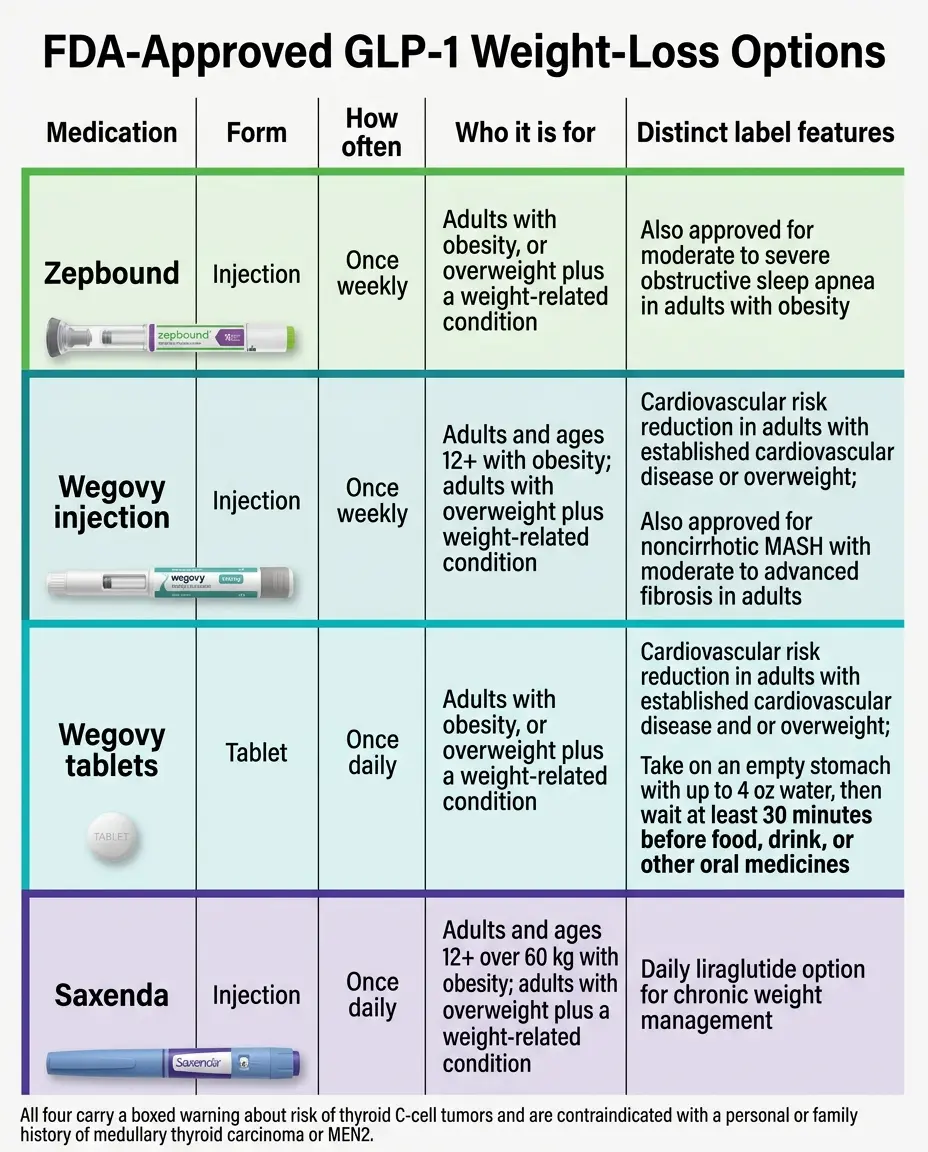
This table covers the products actually FDA-approved for weight management. Bookmark it — this is the comparison you'll come back to.
| Product | Avg. Weight Loss | Form / Frequency | Key Extra Benefits | Cash Price (2026) |
|---|---|---|---|---|
| Zepbound (tirzepatide) | 20–22.5% body weight | Injection · Once weekly | Also approved for obesity-related sleep apnea | Vials from $299/mo; pens ~$1,086/mo |
| Wegovy injection (semaglutide) | ~14.9% body weight | Injection · Once weekly | Cardiovascular risk reduction; MASH; approved for teens 12+ | $199/mo intro, $349/mo ongoing |
| Wegovy tablet (semaglutide) | ~13.6% body weight (25 mg) | Pill · Once daily | Adults only; same active ingredient as injection | $149–$299/mo depending on dose |
| Wegovy HD (higher-dose semaglutide) | 20.7% body weight (STEP UP trial) | Injection · Once weekly | Higher ceiling for patients who plateau on standard Wegovy | Not yet publicly posted (March 2026) |
| Saxenda (liraglutide) | 5–8% body weight | Injection · Daily | Approved for teens 12+ (over 60 kg); generic now available | ~$400–700/mo (generic pricing) |
Sources: FDA prescribing information for Zepbound, Wegovy injection, Wegovy tablet. Cash prices from manufacturer programs. Prices verified March 2026.
What about Ozempic, Mounjaro, and other GLP-1s? Ozempic, Mounjaro, Trulicity, Victoza, Rybelsus, Byetta, and Bydureon BCise are not FDA-approved for weight loss. Doctors can prescribe them off-label, and some do produce meaningful weight loss. But this guide focuses on the products actually labeled for weight management — because that distinction matters for insurance coverage, safety data, and knowing what you're signing up for. Note: the new Wegovy pill is distinct from Rybelsus — despite both being oral semaglutide, only the Wegovy pill is approved for weight loss.
Best GLP-1 by Situation: Find Yours in 30 Seconds
Not everyone needs the same drug. Here's where the decision actually starts.
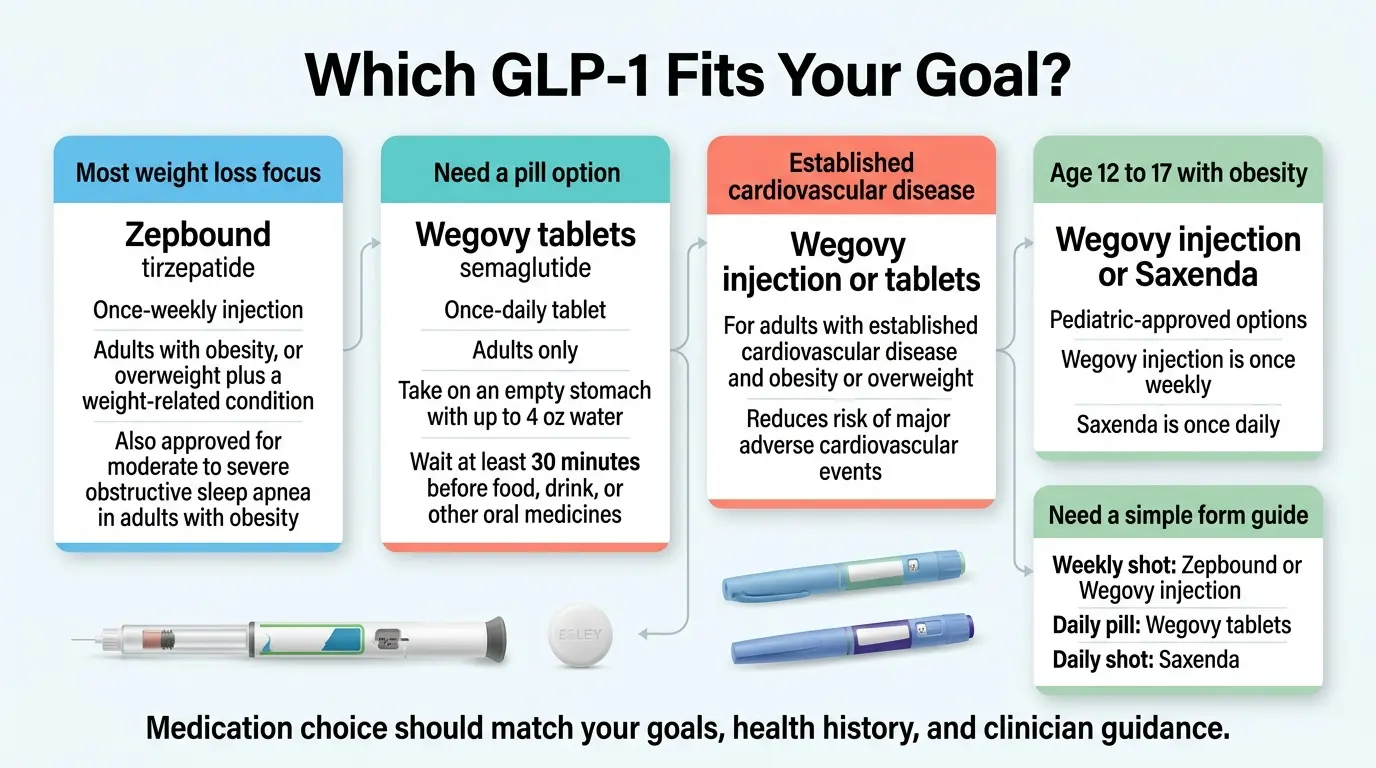
Want the most weight loss possible? → Zepbound (tirzepatide)
Tirzepatide works through two pathways (GLP-1 and GIP) instead of one. In a 72-week head-to-head trial against semaglutide, tirzepatide produced significantly greater reductions in body weight and waist circumference at the 10 mg and 15 mg doses compared to semaglutide at its highest approved doses. (PubMed)
In the SURMOUNT-1 trial, patients on the highest dose of tirzepatide lost an average of 22.5% of their body weight. That's roughly 50–60 pounds for someone starting at 250 lbs.
Zepbound is the most effective FDA-approved weight loss medication available in 2026. If pure results are your priority and you don't mind a weekly injection, this is the top pick.
Want a pill, not a needle? → Wegovy tablet (oral semaglutide)
FDA-approved on December 22, 2025 and broadly available since January 2026, the Wegovy tablet is the first GLP-1 weight loss pill. It uses the same active ingredient as the Wegovy injection but in a once-daily oral dose.
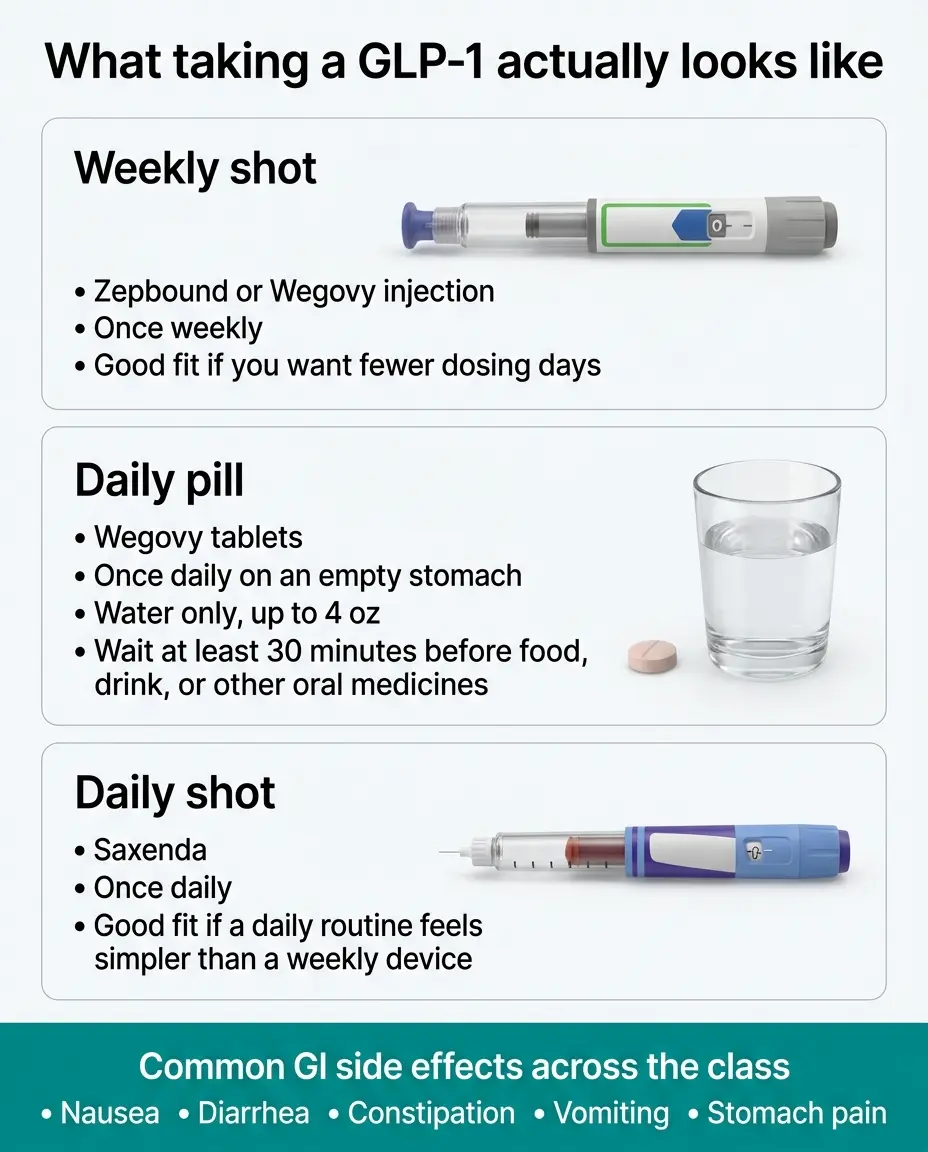
You take it first thing in the morning on an empty stomach with no more than 4 oz of plain water, then wait 30 minutes before eating or drinking anything else. For a lot of people, it beats a weekly injection.
Cash price through Ro and NovoCare: $149/month for the 1.5 mg starting dose and $149/month for 4 mg (through April 15, 2026, then $199/month for 4 mg). The 9 mg and 25 mg doses are $299/month. (Wegovy.com)
Have cardiovascular disease? → Wegovy injection
Wegovy injection is the only GLP-1 weight loss medication with FDA-approved labeling for reducing the risk of major cardiovascular events (heart attack, stroke, cardiovascular death) in adults with established heart disease and obesity or overweight. This came from the SELECT trial — a large-scale, multi-year study that demonstrated a 20% reduction in major cardiac events.
If you have heart disease and qualify for a GLP-1, this is the one your cardiologist is most likely to recommend.
Have obesity-related sleep apnea? → Zepbound
Zepbound carries a separate FDA approval for moderate-to-severe obstructive sleep apnea (OSA) in adults with obesity. If you're using a CPAP and want a medical path that might reduce or eliminate that need, Zepbound has the label to support that conversation with your doctor.
Age 12–17? → Wegovy injection or Saxenda
Wegovy injection is approved for pediatric patients 12 and older with obesity. Saxenda is approved for the same age group with a body weight above 60 kg (about 132 lbs). These are the only two FDA-approved GLP-1 weight loss options for adolescents. The Wegovy tablet is approved for adults only.
No email required · 5 questions · Personalized recommendation
What Changed in 2026 (and Why It Matters for Your Decision)
The GLP-1 landscape shifted more in the last six months than in the previous two years. If you're using information from 2024 or early 2025 to make your decision, you're working with an outdated map.
Oral Wegovy is now part of the decision
The FDA approved oral Wegovy on December 22, 2025, and it became broadly available across the U.S. in January 2026. (Novo Nordisk) For the first time, there's an FDA-approved GLP-1 weight loss pill. The tablet is approved for adults only and has its own dose-escalation schedule.
Wegovy HD raised the ceiling
In March 2026, the FDA approved Wegovy HD — a higher-dose semaglutide injection — under the national priority voucher program. (FDA announcement) In the STEP UP trial, participants on Wegovy HD lost an average of 20.7% of body weight — narrowing the gap with tirzepatide. Manufacturer pricing was not yet publicly posted as of this writing.
The FDA announced action against mass-marketed compounded GLP-1s
In February 2026, the FDA announced its intent to take action against non-FDA-approved GLP-1 drugs, specifically targeting misleading mass marketing of compounded products. (FDA statement) The FDA had previously resolved the national semaglutide injection shortage in early 2025 and the tirzepatide shortage in late 2024. With shortages resolved, the legal basis for widespread compounding access has narrowed.
What this means for you: if you go the compounded route, provider transparency matters more than ever. We cover how to evaluate providers in the section below.
The FDA removed the suicidal behavior warning
The FDA requested removal of suicidal behavior and ideation warning language from GLP-1 receptor agonist labels after reviewing the available data. (FDA announcement) One less concern for people weighing the decision.
Brand-name cash-pay access expanded
NovoCare now offers Wegovy pills starting at $149/month and Wegovy injection at $199/month for the first two months of starting doses. LillyDirect offers Zepbound vials from $299/month. These are the lowest brand-name prices in the history of GLP-1 weight loss medications.
Zepbound (Tirzepatide): The Most Effective GLP-1 for Weight Loss
The bottom line
Zepbound produces more weight loss than any other FDA-approved anti-obesity medication on the market. It's the only dual GLP-1/GIP receptor agonist approved for chronic weight management, and in the head-to-head trial against semaglutide, it produced significantly greater weight loss.
Who Zepbound is best for
People who want the strongest possible results, have a BMI of 30+ (or 27+ with a comorbidity), don't mind a weekly injection, and either have insurance coverage or can budget $299+/month for the vial option. Also the leading choice if you have obesity-related obstructive sleep apnea.
What the clinical data shows
In the SURMOUNT-1 trial (adults with obesity, no diabetes), participants lost an average of:
- 15 mg dose: 22.5% of body weight (~52 lbs for someone at 230 lbs)
- 10 mg dose: 21.4% of body weight
- 5 mg dose: 16.0% of body weight
For context, the placebo group lost 2.4%. And in the 2025 head-to-head trial, tirzepatide 10 mg and 15 mg produced significantly greater weight loss and waist circumference reduction than semaglutide 2.4 mg over 72 weeks. (PubMed)
Side effects
The same GI side effects as other GLP-1s — nausea, diarrhea, constipation, and stomach pain, mostly during the first month and after dose increases. The discontinuation rate due to side effects in SURMOUNT-1 was about 6%.
The biggest downside
Cost. Zepbound pens carry a list price of about $1,086/month. The vials (which you draw yourself with a syringe) are available from $299/month through LillyDirect and providers like Ro — but that's still more expensive than semaglutide options. Note: the $449/month pricing for the 7.5–15 mg vial doses is tied to a manufacturer offer with a refill-timing requirement; otherwise the price increases. (Zepbound savings) There's also no pill version yet.
Don't choose Zepbound if… You're on a tight budget without insurance, you strongly prefer a pill, or you need the proven cardiovascular benefit that Wegovy carries. If cost is your primary concern, Wegovy's pill at $149/month may serve you better — with slightly less weight loss but significantly less financial strain.
How to get it
The most straightforward FDA-approved path is through Ro's Body Program. Ro offers Zepbound vials at LillyDirect's self-pay pricing ($299–$449/month depending on dose) and provides an insurance concierge that handles prior authorization paperwork if you want to try the insurance route first. Ro's program also includes provider visits, coaching, labs at Quest (included), and ongoing support.
Start Zepbound through Ro — from $299/mo for vials
Insurance concierge, labs included, provider visits, and ongoing coaching. Most affordable FDA-approved Zepbound access.
Check Zepbound eligibility and current pricing on Ro →Wegovy (Semaglutide): The Best GLP-1 for Most People
The bottom line
Wegovy is the most-studied GLP-1 for weight loss, the only one with an FDA-approved cardiovascular risk reduction indication for weight management, and now the most versatile — available as both a weekly injection and a daily pill. Not the absolute strongest for raw weight loss (tirzepatide wins that), but the best overall package for the widest range of people.
Who Wegovy is best for
Most adults looking for a GLP-1 for weight loss, especially if you:
- Want the option of a pill instead of injections
- Have cardiovascular disease or risk factors
- Have noncirrhotic MASH with moderate-to-advanced fibrosis (injection only)
- Are a teenager (12+) with obesity (injection only)
- Want the most affordable brand-name entry point ($149/month for the pill)
What the clinical data shows
In the STEP 1 trial, adults on Wegovy 2.4 mg injection lost an average of 14.9% of body weight over 68 weeks — about 5 times more than the placebo group. The SELECT trial demonstrated a 20% reduction in major cardiovascular events.
In a 2026 Johns Hopkins meta-analysis of GLP-1 receptor agonist trials (64 trials, tens of thousands of patients), women lost more weight on average than men — 10.88% vs 6.78% — a statistically significant difference, though both are clinically meaningful. (Johns Hopkins)
Side effects
Nausea, diarrhea, vomiting, constipation, and stomach pain — mostly in the first 4–8 weeks and during dose escalation. Providers start you at the lowest dose and increase monthly to minimize this. Most people find the side effects manageable — they're not pleasant, but they typically fade. If they don't, your provider can slow the titration, adjust the dose, or switch medications.
The biggest downside
It's not as powerful as tirzepatide for pure weight loss. If you're looking for the absolute maximum result and cost isn't a constraint, Zepbound will likely produce more weight loss at the highest doses.
How to get it
Wegovy pill (cash-pay through NovoCare): $149/month for 1.5 mg and 4 mg doses (4 mg rises to $199/month after April 15, 2026); $299/month for 9 mg and 25 mg doses. (Wegovy.com)
Wegovy injection (cash-pay through NovoCare): $199/month for the first two months (0.25 mg and 0.5 mg doses only, through March 31, 2026), then $349/month for ongoing doses.
With insurance: If your commercial insurance covers Wegovy, manufacturer savings cards can bring the cost down to as low as $0–$25/month. This is worth checking before you pay cash.
Ro's Body Program is our recommended access path — they offer both the pill and injection at NovoCare's self-pay pricing, handle insurance paperwork, and provide the support structure that keeps people on track long-term. Ro's $45 first-month / $145 ongoing membership is separate from medication cost and includes provider visits, coaching, and labs.
Check your insurance coverage for Wegovy — free on Ro
If insurance covers your medication, your total could be $145/mo (membership) + $0–$25 (copay). Ro fights for coverage on your behalf.
Check your insurance coverage on Ro →Saxenda (Liraglutide): When This Older GLP-1 Still Makes Sense
The bottom line
Saxenda isn't the strongest GLP-1 for weight loss — average weight loss in trials is 5–8% of body weight, compared to ~15% with semaglutide and 20%+ with tirzepatide. But it still has a role.
Who Saxenda is right for
- Adolescents ages 12–17 with obesity (over 60 kg body weight) — one of only two GLP-1s approved for this group
- Adults who can't tolerate semaglutide or tirzepatide
- People who want a generic option — generic liraglutide is now available, significantly reducing cost
The trade-off
Daily injections instead of weekly. That's a real lifestyle difference. And the weight loss is more modest. For most adults, semaglutide or tirzepatide is the better choice.
Don't choose Saxenda if… You have access to Wegovy or Zepbound and can tolerate them. Saxenda is a backup, not a first-line choice for most adults in 2026.
The Honest Truth Most GLP-1 Pages Won't Tell You
Here's where we need to be straight with you.
The clinical trial numbers — 15%, 20%, 22% body weight loss — are real. They come from well-designed, peer-reviewed studies. But clinical trials have something most real-world patients don't: consistent follow-up, strict protocols, and zero cost barriers.
Real-world outcomes are often lower than trial averages, and discontinuation is common within the first year. About half of patients who start a GLP-1 medication stop within a year, often because of cost, side effects, or lack of follow-up. (Yale Medicine) That gap between trial results and everyday results is real — and it's driven primarily by people stopping treatment, not by the medication failing.
Why we're telling you this: Because which provider you choose matters as much as which medication you choose. A $149/month prescription without any support is less valuable than a $294/month program that includes coaching, lab monitoring, and a provider who adjusts your dose before you get frustrated and quit.
The people who get results closest to the clinical trial numbers are the ones who stay on treatment, manage side effects proactively, and have a provider keeping them on track. That's not marketing — it's what the adherence data consistently shows.
This is exactly why our top recommendation for most people includes a structured support program, not just a prescription.
How Much Do GLP-1s Actually Cost in 2026?
Let's cut through the confusion. There are three numbers that matter: the list price (what the drug company charges pharmacies), the self-pay price (what cash-pay patients actually pay through manufacturer programs), and the total monthly cost including provider fees (the number most sites hide).
Manufacturer Self-Pay Pricing (No Insurance, No Provider Fees)
| Product | Dose | Monthly Self-Pay | Source |
|---|---|---|---|
| Wegovy pill | 1.5 mg | $149 | NovoCare |
| Wegovy pill | 4 mg | $149 (through Apr 15; $199 after) | NovoCare |
| Wegovy pill | 9 mg, 25 mg | $299 | NovoCare |
| Wegovy injection | 0.25 mg, 0.5 mg (intro) | $199 (first 2 months, through Mar 31, 2026) | NovoCare |
| Wegovy injection | Ongoing doses | $349 | NovoCare |
| Zepbound vial | 2.5 mg | $299 | LillyDirect |
| Zepbound vial | 5 mg | $399 | LillyDirect |
| Zepbound vial | 7.5–15 mg | $449 (refill within 45 days required) | LillyDirect |
Estimated Total Through Ro Body Program (Medication + Membership)
| Path | Medication Cost | Ro Membership | Est. Total |
|---|---|---|---|
| Wegovy pill (starting) | $149/mo | $145/mo ($45 first month) | ~$294/mo |
| Wegovy pill (maintenance) | $299/mo | $145/mo | ~$444/mo |
| Wegovy injection (intro) | $199/mo | $145/mo | ~$344/mo |
| Zepbound vial (starting) | $299/mo | $145/mo | ~$444/mo |
| Zepbound vial (maintenance) | $449/mo | $145/mo | ~$594/mo |
Sources: Ro pricing page, Wegovy.com, Zepbound savings. Verified March 2026.
With Insurance
If your commercial insurance covers Wegovy or Zepbound, manufacturer savings cards can bring the cost to $0–$25/month. That's not a typo. The catch: you have to actually get the prior authorization approved, which can take 2–3 weeks of paperwork.
Ro's insurance concierge handles this entire process — submitting prior authorizations, appealing denials, and finding the lowest-cost path for your specific plan. If you're denied for one medication, they'll work with your provider to try alternatives.
Worth checking before you pay cash
Ro's free insurance checker takes 60 seconds. If your plan covers it, you could pay as little as $0–$25/month for medication.
Use Ro's free GLP-1 insurance checker →Medicare
New in 2026: CMS's Medicare GLP-1 Bridge begins July 1, 2026. Eligible Medicare Part D beneficiaries will be able to access Wegovy (injection and tablets) and Zepbound for weight management with a $50 monthly copay. The program runs through December 31, 2026, after which the broader BALANCE Model is expected to launch in January 2027. (CMS — Medicare GLP-1 Bridge)
If you have Medicare and are considering a GLP-1, this is a significant development worth discussing with your provider.
Medicaid
Medicaid coverage for GLP-1 weight management varies by state. Under the BALANCE Model, state Medicaid agencies can begin opting in as early as May 2026. Check with your state Medicaid program for current coverage.
HSA and FSA
HSA and FSA eligibility varies by medication, provider, and plan. NovoCare accepts FSA/HSA payments for cash-pay Wegovy purchases. Ro does not currently accept HSA/FSA cards directly for membership fees, though you may be able to submit receipts to your plan for reimbursement.
Where to Get GLP-1 Medications Online: Our Top Providers
Medication choice and provider choice are separate decisions. Pick the drug first. Then pick the provider that gives you the safest, most affordable access to that drug with the support to actually stay on it.
Best FDA-Approved Online Path We Verified: Ro
Best for
Most people. FDA-approved brand-name medications, insurance navigation, comprehensive support.
Ro offers FDA-approved brand-name GLP-1s (Wegovy pill, Wegovy injection, Zepbound, Ozempic) at manufacturer self-pay pricing through its partnerships with NovoCare and LillyDirect, plus an insurance concierge that fights for coverage on your behalf.
What you get:
- Access to Wegovy (pill and injection), Zepbound, Ozempic — FDA-approved, brand-name
- Insurance concierge that handles prior authorizations and appeals
- Self-pay pricing aligned with NovoCare and LillyDirect
- Provider visits, coaching, and ongoing support built into the membership
- Metabolic lab testing at Quest locations (included)
- 24/7 messaging with your care team
What it costs:
- Membership: $45 first month, $145/month ongoing (separate from medication cost)
- Medication: billed separately at self-pay or insurance rates
- If insurance covers your medication, your total monthly cost could be as low as $145 (membership) + $0–$25 (medication copay)
Ro does NOT offer compounded GLP-1s. Ro has committed to an FDA-approved-only formulary — and that commitment is precisely why they can offer insurance navigation, manufacturer partnerships, and the most transparent regulatory footing in the space. In company-published outcomes data, Ro reported 15.8% average weight loss over 12 months among Body members treated with a GLP-1. (Ro press release) That's close to clinical trial results — and speaks to the value of having a program around your prescription, not just the prescription itself.
Check your eligibility and see current pricing on Ro
FDA-approved Wegovy and Zepbound. Insurance concierge. Labs included. Provider visits and coaching. From ~$294/month all-in.
Check eligibility on Ro →Compounded Option With Transparent Pricing: MEDVi
Best for
Cash-pay patients who want affordable GLP-1 access with provider support and no membership fees.
We want to be transparent: compounded GLP-1 medications are not FDA-approved. They are prepared by licensed compounding pharmacies under state and federal regulations, but they have not been reviewed by the FDA for safety, effectiveness, or manufacturing quality in the same way brand-name products have.
With that said — for patients who can't access or afford brand-name options, MEDVi stands out.
What MEDVi offers (provider-stated):
- First month starts at $179; refills at $299/month
- No membership fees, no consultation fees
- Board-certified providers create personalized dosing plans
- 24/7 provider and care team support
- Cancel anytime with 72 hours notice before billing date
For people paying out of pocket without insurance who want a provider that includes clinical oversight — not just a prescription mill — MEDVi is the compounded provider we'd point you toward. Verify current pricing and program details directly on their site before enrolling.
Check eligibility on MEDVi — from $179/month, no membership fees
Compounded GLP-1. Board-certified providers. No membership, no consultation fees. Cancel anytime with 72-hour notice. (Not FDA-approved.)
Check eligibility on MEDVi →Other Providers Worth Knowing About
The table below reflects provider-stated information. Verify pricing and terms directly on each provider's current website before enrolling. Last reviewed: March 2026.
| Provider | Type | Starting Price | Best For |
|---|---|---|---|
| Eden Health | Compounded | ~$199/mo | Predictable pricing at every dose level |
| TrimRx | Compounded | ~$179/mo | Straightforward, affordable access |
| Willow | Compounded | ~$299+/mo all-in | All-inclusive plan with oral + injectable options |
| Hims / Hers | Brand-name + compounded | ~$299+/mo | Self-directed users who want simplicity |
| Yucca Health | Compounded | ~$199/mo | Basic telehealth access |
| SkinnyRX | Compounded | ~$149–199/mo | Budget-conscious (leaner support) |
A note on Hims and Hers: In March 2026, Hims & Hers announced plans to add Ozempic injections and Wegovy pills/injections to their platform. (Hims Newsroom) If you go this route, verify on their current website exactly what you're being prescribed — brand-name or compounded — because the distinction matters for regulatory protection and insurance eligibility.
FDA-Approved vs. Compounded GLP-1s: What You Need to Know
This is the section most comparison pages blur. We won't.
What “FDA-approved” means
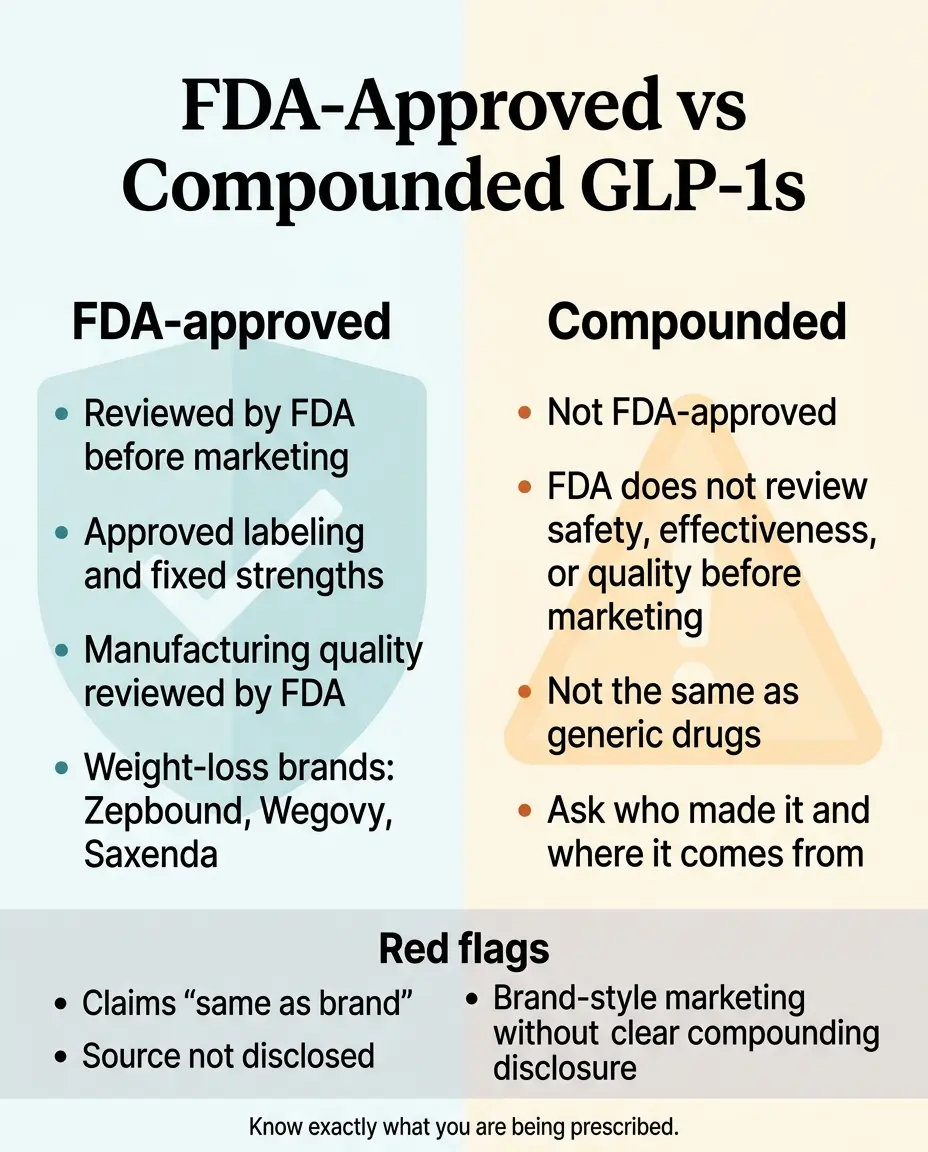
Wegovy, Zepbound, and Saxenda went through full FDA review — years of clinical trials, manufacturing inspections, and ongoing post-market surveillance. When you take Wegovy, you're getting a product manufactured by Novo Nordisk under strict FDA-regulated conditions with documented potency, purity, and consistency.
What “compounded” means
Compounded GLP-1s are prepared by licensed compounding pharmacies. They are legally available and regulated by state pharmacy boards. But they are not FDA-approved — the FDA has not evaluated their safety, effectiveness, or manufacturing quality through the standard drug approval process. (FDA — Understanding Risks of Compounded Drugs)
Why this matters more in 2026
The FDA resolved the national semaglutide injection shortage in early 2025 and the tirzepatide shortage in late 2024. With shortages resolved, the FDA announced its intent to take action against misleading mass marketing of non-FDA-approved GLP-1 drugs. The enforcement has focused on marketing claims — specifically, companies implying their compounded products were equivalent to FDA-approved medications.
Our take: FDA-approved brand-name medications are the gold standard. If you can access them — through insurance or cash-pay programs like NovoCare or LillyDirect — that's the path we recommend first. If brand-name options are genuinely out of reach financially, compounded from a transparent, well-reviewed provider is a reasonable alternative. But go in with eyes open about the regulatory distinction.
Red flags that should make you leave a provider's page immediately
- Describing compounded products as “the same as” or “equivalent to” FDA-approved medications
- No disclosure of whether the medication is FDA-approved or compounded
- Won't name the compounding pharmacy
- No licensed clinicians reviewing your case
- Pricing that seems impossibly low with no explanation
- No clear cancellation policy
How to Tell if an Online GLP-1 Provider Is Legit
Before you hand over your credit card, run through this checklist:
Clearly states whether the medication is FDA-approved or compounded — no vague language like 'pharmacy-grade' without specifying
Names or identifies the pharmacy fulfilling prescriptions — you should know where your medication comes from
Licensed clinicians review your medical history — not just a questionnaire with no human review
Explains the dose-escalation process — good providers start low and increase gradually
Transparent, all-in pricing — you should know your total monthly cost before you sign up, including all fees
Clear cancellation terms — how to cancel, how much notice, and what happens to pending orders
Responsive support — can you actually reach someone if you have a side effect concern?
Doesn't promise specific weight loss numbers — any provider 'guaranteeing' you'll lose 20% is selling, not treating
Side Effects: What to Actually Expect
Every GLP-1 medication causes some gastrointestinal side effects. This is the mechanism working — the drug slows your digestion and changes how your brain processes hunger signals. Your body needs time to adjust.
The most common side effects (in order of frequency)
- Nausea — most common, especially in weeks 1–4 and after dose increases
- Diarrhea
- Constipation
- Vomiting
- Stomach pain / bloating
- Decreased appetite (this is the drug working)
- Headache
- Fatigue
What most people actually experience
Weeks 1–2: Some nausea, reduced appetite, maybe some stomach discomfort. Manageable for most. Weeks 3–8: Side effects typically stabilize or improve. Your body adjusts. After dose increases: Side effects may briefly return, then settle again. Most people report them becoming background noise by month 2–3.
Serious but rare side effects
These are uncommon but important to know:
- Pancreatitis — seek care immediately for severe, persistent abdominal pain
- Gallbladder problems — rapid weight loss increases gallstone risk regardless of the method
- Thyroid tumors — seen in animal studies; human relevance is undetermined, but GLP-1s are contraindicated if you have a personal or family history of medullary thyroid cancer (MTC) or MEN2 syndrome
- Kidney injury — usually related to dehydration from GI effects; stay hydrated
How to minimize side effects
Your provider will start you at the lowest dose and increase monthly — this is called titration, and it exists specifically to let your body adapt gradually. Beyond that: eat smaller meals, stay hydrated, avoid high-fat foods in the first few weeks, and communicate with your provider about any issues. A good provider adjusts your dose or switches your medication before you get to the point of wanting to quit.
Which GLP-1 Has the Least Side Effects?
This is one of the most-searched questions in this space, so let's answer it directly.
There is no single “safest” GLP-1. All of them cause GI side effects. The differences between medications are smaller than the differences between individual patients.
What matters more than the drug name:
- Titration speed — starting low and going slow reduces side effects dramatically
- Dose — lower maintenance doses = fewer GI effects
- Your individual GI sensitivity — some people tolerate semaglutide better, some tolerate tirzepatide better; there's no reliable way to predict this in advance
- Provider follow-up quality — having someone to call when you feel terrible makes the difference between adjusting the dose and abandoning treatment
If side effects are your primary concern, start with the lowest available dose of whatever medication your provider recommends, titrate slowly, and communicate openly. That protocol matters more than which specific drug you pick.
Best GLP-1 for Specific Health Conditions
This is where generic “top 10” listicles fall short. The FDA approvals aren't interchangeable — different GLP-1s carry different label indications that matter for your specific health picture.
| Your Situation | Best GLP-1 | Why |
|---|---|---|
| Maximum weight loss (no other conditions) | Zepbound | Strongest weight loss in trials; dual GLP-1/GIP mechanism |
| Cardiovascular disease + obesity | Wegovy injection | Only GLP-1 weight loss drug with FDA-approved cardiovascular benefit |
| Obesity-related sleep apnea | Zepbound | Carries specific FDA approval for moderate-to-severe OSA |
| Noncirrhotic MASH with moderate-to-advanced fibrosis | Wegovy injection | FDA label includes this indication |
| Needle-averse adult | Wegovy tablet | Only FDA-approved GLP-1 weight loss pill |
| Teenager (12–17) with obesity | Wegovy injection or Saxenda | Only FDA-approved options for adolescents |
| Type 2 diabetes + weight loss | Mounjaro or Ozempic (off-label for weight) | Insurance more likely to cover for diabetes; strong weight loss as a benefit |
Zepbound vs. Wegovy: The Head-to-Head Breakdown
This is the comparison most readers are really here for. Both are excellent. Here's how to choose.
| Factor | Zepbound (Tirzepatide) | Wegovy (Semaglutide) |
|---|---|---|
| Average weight loss | 20–22.5% of body weight | ~14.9% injection / ~13.6% tablet |
| Mechanism | Dual GLP-1 + GIP | GLP-1 only |
| Pill option? | No (injection only) | Yes (daily pill, launched 2026) |
| Cardiovascular benefit | Not yet FDA-approved for CVD | Yes — 20% reduction in major cardiac events |
| Sleep apnea approval | Yes | No |
| Teen approval | No | Yes (injection, ages 12+) |
| Lowest cash price | $299/mo (vial via LillyDirect/Ro) | $149/mo (pill via NovoCare/Ro) |
| Long-term safety data | Shorter track record (approved 2023) | Most extensive (SELECT trial, 4+ years) |
If you want the most weight loss possible and injections don't bother you:
Choose Zepbound.
If you want a pill, have heart disease, need a teen option, or want the lowest entry price:
Choose Wegovy.
If you truly can't decide: Zepbound for effectiveness, Wegovy for versatility and value. You can't go wrong with either.
No email required · 5 questions · Personalized recommendation
What Happens After You Start: A Realistic Timeline
Month 1 (Lowest dose)
You'll likely notice reduced appetite within the first week or two. Some nausea is normal. Weight loss is usually gradual during this phase — this month is about letting your body adjust, not chasing numbers.
Months 2–3 (Dose escalation)
Your provider increases the dose, usually monthly. Appetite suppression becomes more noticeable. Weight loss accelerates. Side effects may briefly return with each increase, then settle. Exact timing varies by dose, adherence, and starting weight.
Months 4–6 (Finding your maintenance dose)
This is where the real transformation happens. You're at or near your target dose. The “food noise” — that constant background hum of thinking about food — is significantly quieter. Energy improves. Clothes fit differently. The scale is moving consistently.
Months 6–12 and beyond
Weight loss continues but gradually slows as you approach a new equilibrium. This is normal, not a plateau that means the drug stopped working. Long-term, most patients settle into a maintenance phase where they maintain their loss while staying on the medication.
What happens if you stop?
We'll be direct: most people regain a significant portion of lost weight after stopping. In the SURMOUNT-4 trial, people switched from tirzepatide to placebo regained 14.0 percentage points of body weight over 52 weeks, while those who continued treatment maintained their loss. (PMC)
GLP-1 medications are designed for long-term use — similar to blood pressure or cholesterol medication. “Needing to stay on it” isn't a failure. It's how chronic disease management works.
When a GLP-1 Is Not the Right Answer
We want the right readers to feel certain. That means we also need to tell the wrong readers to stop here.
GLP-1s are probably not right for you if:
- You want to lose 10–15 pounds for an event. These are serious medications designed for clinical obesity. They require ongoing use, cost hundreds per month, and carry real side effects. If you're at a healthy weight and want to drop a size for summer, a GLP-1 is a sledgehammer for a finishing nail. Talk to a dietitian instead.
- You're not willing to stay on medication long-term. GLP-1s are not a short course. Most patients who stop regain the weight. If you're looking for a 3-month fix, you'll be disappointed and out of pocket.
- You have a history of eating disorders. GLP-1s dramatically suppress appetite. For someone with a history of restriction or disordered eating, this can trigger dangerous patterns. An eating-disorder-informed physician should be part of the conversation before you start.
- You have unmanaged depression or anxiety about food. Weight loss medication works best alongside psychological readiness. If emotional eating is the core driver, medication alone won't solve the underlying pattern.
- You're looking for a supplement, not a prescription. If you're not comfortable with a prescription medication, medical monitoring, and monthly costs, GLP-1s aren't the right fit right now. That's okay.
For everyone else: you're in the right place. Keep reading.
GLP-1s for Women Over 40, During Menopause, and for Men
These are among the most-searched variations of “best GLP-1 for weight loss,” so let's address them directly.
Women over 40 and menopause
Menopause brings hormonal shifts that make losing weight — especially around the midsection — genuinely harder. It's not a willpower problem. It's biology. There is no separate menopause-specific GLP-1. The current subgroup data did not show meaningful differences across age groups, and in a 2026 Johns Hopkins GLP-1 receptor agonist meta-analysis, women lost somewhat more weight than men on average (10.88% vs. 6.78%). (Johns Hopkins)
There is no special “menopause GLP-1.” Zepbound and Wegovy work the same way for a 52-year-old woman as they do for a 35-year-old. The choice comes down to the same factors: desired weight loss, pill vs. injection preference, comorbidities, and budget.
Men
Same medications, same decision framework. Men may see slightly lower percentage weight loss on average compared to women, but the absolute loss is still clinically significant — and the metabolic benefits (improved blood sugar, blood pressure, cholesterol) are comparable. No gender-specific GLP-1 exists or is needed.
The bottom line for both
Don't let age, gender, or menopause be the factor that delays your decision. The data says these medications work across demographics. The real variable is whether you start and whether you stay on treatment.
Are GLP-1 Supplements and OTC Products Legit?
No.
If you searched “best GLP-1 for weight loss on Amazon” or “best GLP-1 supplements,” we need to save you some money. Products marketed as “GLP-1 activators,” “natural GLP-1 boosters,” or “GLP-1 support supplements” do not contain actual GLP-1 medication. They have no regulated clinical data showing meaningful weight loss. The FDA has repeatedly warned against products making unauthorized GLP-1 claims.
There is no over-the-counter GLP-1 for weight loss. These are prescription medications that require medical oversight, dose titration, and monitoring. If something on Amazon promises GLP-1-like results for $39.99, it is not delivering GLP-1-like results.
If you're not ready for a prescription GLP-1, the honest answer is that no supplement replicates what these drugs do. Talk to your doctor about whether you're a candidate.
Am I Eligible for GLP-1 Weight Loss Medication?
You may qualify if:
- BMI of 30 or higher (obesity), OR
- BMI of 27 or higher with at least one weight-related health condition: type 2 diabetes, high blood pressure, high cholesterol, PCOS, sleep apnea, fatty liver disease, or heart disease
- Age 18+ for most options. Wegovy injection and Saxenda are approved for adolescents 12+ with obesity.
Talk to a clinician first if:
- Personal or family history of medullary thyroid carcinoma (MTC) or MEN2 syndrome
- History of pancreatitis or severe gastrointestinal conditions such as gastroparesis
- Pregnant or planning pregnancy (GLP-1s are not recommended during pregnancy for weight management)
- Breastfeeding: guidance is product-specific — Wegovy tablets are not recommended during breastfeeding, while injection and tirzepatide labeling advises discussing risk with a clinician
Only a licensed healthcare provider can determine if a GLP-1 is appropriate for you. Every provider in this guide requires a medical evaluation before prescribing.
Check your eligibility in 2 minutes
Ro's intake takes about 5 minutes. A licensed provider reviews your case within 24–48 hours for cash-pay patients. No commitment required.
Check your GLP-1 eligibility on Ro →How We Evaluated Medications and Providers
We don't accept payment for placement, and we don't rank providers based on commission. Here's exactly how this guide was built.
Medication rankings are based on:
- FDA-approved prescribing information (primary source)
- Published peer-reviewed clinical trials: SURMOUNT (tirzepatide), STEP (semaglutide), SELECT (cardiovascular outcomes), STEP UP (Wegovy HD)
- 2025 head-to-head tirzepatide vs. semaglutide trial (PubMed)
- Johns Hopkins 2026 meta-analysis on demographic subgroups (Johns Hopkins)
Provider rankings are based on:
- Medication type (FDA-approved vs. compounded — clearly labeled)
- Total monthly cost including all fees
- Support structure (coaching, provider access, labs)
- Pricing transparency
- Cancellation terms and flexibility
What “verified” and “provider-stated” mean on this page: When we say “verified,” we checked the information directly on the provider's website or the manufacturer's official pricing page. When we say “provider-stated,” the claim comes from the provider's own marketing and we have not independently confirmed it. Verification dates are noted throughout.
Affiliate disclosure: The RX Index earns commissions from some providers linked in this guide. This does not influence our rankings. Our top recommendation (Ro) is not the highest-paying affiliate partner. We recommend it because of its FDA-approved medication access, insurance concierge, and structured support — not because of commission rates. If we removed every affiliate link from this page, the recommendations would not change.
Frequently Asked Questions
What is the most effective GLP-1 for weight loss?↓
Is there a GLP-1 weight loss pill?↓
Which GLP-1 is approved for weight loss by the FDA?↓
Is tirzepatide better than semaglutide for weight loss?↓
What is the best GLP-1 for weight loss without insurance?↓
Can you buy GLP-1 medications on Amazon?↓
Are GLP-1 supplements or OTC alternatives effective?↓
Which GLP-1 has the least side effects?↓
What's the difference between Ozempic and Wegovy?↓
What's the difference between Zepbound and Mounjaro?↓
How long do you have to take GLP-1s?↓
Is compounded semaglutide the same as Wegovy?↓
Do GLP-1s work differently for men vs. women?↓
What about GLP-1s and menopause or women over 40?↓
Can teens take GLP-1s?↓
Does Medicare cover GLP-1s for weight loss?↓
Still Not Sure? Here's Your Next Step.
You've read the data. You know which medications work best and for whom. The only question left is which path fits your situation.
Not sure which GLP-1 or provider is right for you?
We'll ask about your health goals, budget, insurance status, and preferences — and give you a personalized recommendation in 60 seconds.
Take our free 60-second GLP-1 matching quiz →Ready to check whether insurance covers your GLP-1?
No commitment. Takes 60 seconds. If your plan covers it, you could pay $0–$25/month for medication.
Use Ro's free insurance checker →Want the most affordable path to get started now?
Compounded GLP-1. Starts at $179/month. No membership fees. Board-certified providers. Not FDA-approved.
Check eligibility on MEDVi →The clinical evidence behind GLP-1 medications is the strongest of any weight loss intervention short of surgery. The 2026 pricing landscape is the most accessible it's ever been. And with the Medicare GLP-1 Bridge launching in July, access is only getting wider.
The hardest part isn't choosing the right drug — it's deciding to stop researching and start. You already have all the information you need.
Sources
- FDA Prescribing Information — Zepbound (tirzepatide). accessdata.fda.gov
- FDA Prescribing Information — Wegovy injection (semaglutide). accessdata.fda.gov
- FDA Prescribing Information — Wegovy tablet (semaglutide). accessdata.fda.gov
- FDA Prescribing Information — Saxenda (liraglutide). accessdata.fda.gov
- FDA Approval — Wegovy HD (higher-dose semaglutide). fda.gov
- FDA Statement — Intent to Take Action Against Non-FDA-Approved GLP-1 Drugs. fda.gov
- FDA — Understanding Risks of Compounded Drugs. fda.gov
- FDA — Clarification on Compounding Policies as GLP-1 Supply Stabilizes. fda.gov
- FDA — Removal of Suicidal Behavior/Ideation Warning from GLP-1 Labels. fda.gov
- Tirzepatide vs. Semaglutide Head-to-Head Trial (2025). PubMed
- GLP-1 Weight-Loss Drugs Comparably Effective Across Demographic Subgroups — Johns Hopkins (2026). publichealth.jhu.edu
- SURMOUNT-4 — Tirzepatide Discontinuation and Weight Regain. PMC
- Novo Nordisk — Wegovy Pill Availability Announcement. PR Newswire
- CMS — Medicare GLP-1 Bridge FAQ. cms.gov
- Ro Body Program — Pricing. ro.co
- Ro Body Program — 12-Month Outcomes. ro.co
- Wegovy Self-Pay Pricing. wegovy.com
- Zepbound Savings and Pricing. zepbound.lilly.com
- Hims & Hers — Branded GLP-1 Expansion Announcement. news.hims.com
- Yale Medicine — GLP-1 Medications for Weight Loss. yalemedicine.org
- Eli Lilly Orforglipron Timeline. Reuters
Medical Disclaimer: This content is for informational purposes only and does not constitute medical advice, diagnosis, or treatment. Always consult a qualified healthcare provider before starting any medication. GLP-1 medications carry important safety information — review the full prescribing information for any medication you are considering.
Related Guides
- How to Get Semaglutide Online (2026): 3 Safe Paths
- How to Get Tirzepatide Online (2026): 5 Safe, Legit Paths
- Best Online Tirzepatide Providers for Weight Loss (2026): 8 Ranked
- How to Get GLP-1 Online (2026): Compare the 3 Legit Paths
- How to Get the Wegovy Pill Online (2026) — Verified Providers & Real Cost
- Wegovy vs. Zepbound vs. Saxenda: How These Medications Compare
- How to Get Semaglutide Covered by Insurance (2026): 7 Paths
- GLP-1 Absolute Disqualifiers: The FDA-Labeled Hard Contraindications