
Safety Guide · Verified April 2026 · FDA, NABP, LegitScript, JAMA, FBI IC3
How to Avoid Fake GLP-1 Medications Online: 7 Checks Before You Pay
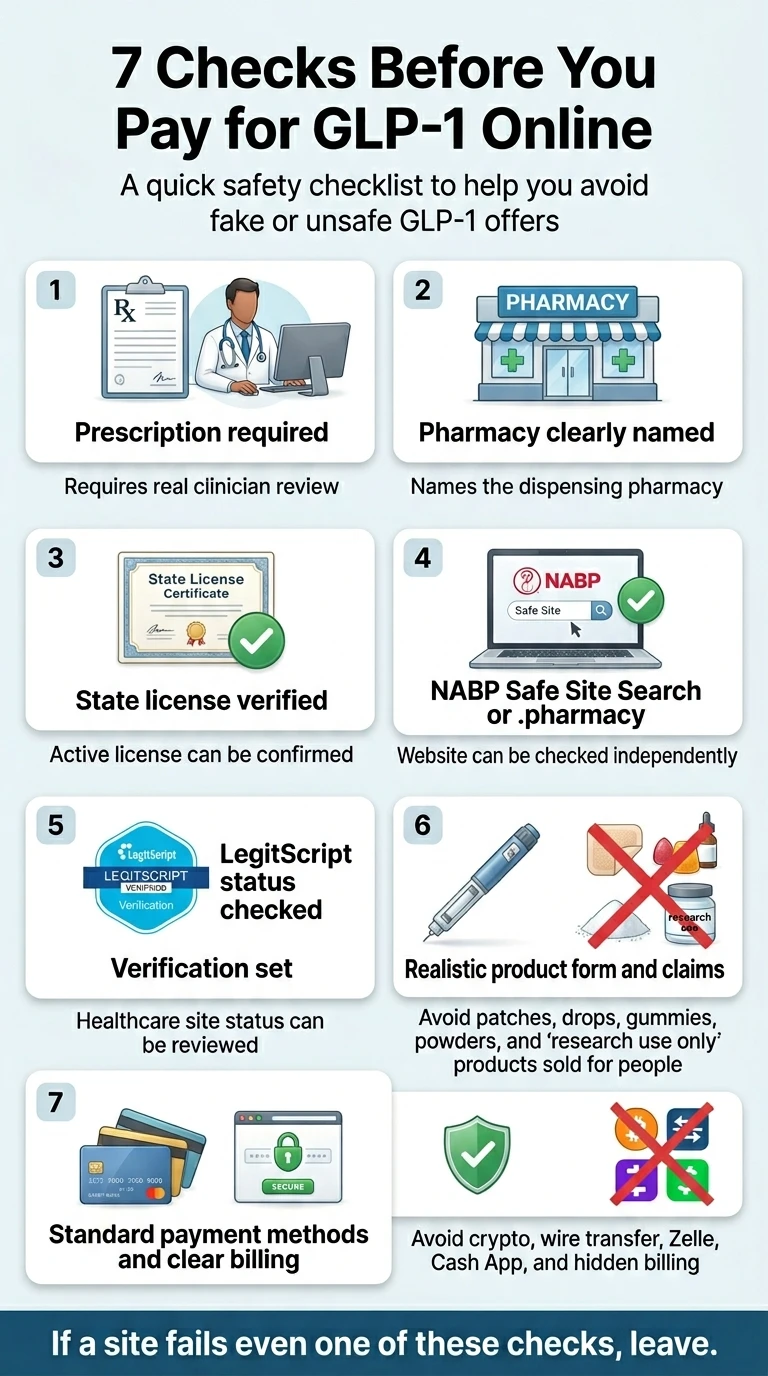
Knowing how to avoid fake GLP-1 medications online starts with two dealbreakers: never buy from a seller that skips a real prescription, and never pay a site that won't clearly name the pharmacy filling your medication. A 2024 JAMA Network Open study of semaglutide search results found that 134 of 317 online-pharmacy links (42.27%) belonged to illegal pharmacy operations. In six test purchases from illegal sites, purity levels were 7–14% versus the advertised 99%.
This guide walks you through 7 verification checks any legitimate GLP-1 seller will pass — and any dangerous one will fail. The entire process takes about five minutes and requires no special knowledge.
By The RX Index Editorial Team · Last verified April 2026 · Affiliate disclosure · Editorial standards
Who this guide is for
For you: Anyone checking an unfamiliar online GLP-1 site, ad, text, or offer before paying.
Skip to: If you're filling a known prescription at a trusted local pharmacy, go directly to how to verify the medication itself after you receive it →
The 7 Checks Before You Pay: Quick Reference
Run these before spending a dollar on any online GLP-1 provider. One failure = leave.
| Check | ✅ Safe Sign | 🚩 Red Flag | Where to Verify |
|---|---|---|---|
| 1. Prescription | Medical evaluation required before prescribing | "No prescription needed" or instant approval | Ask the provider directly |
| 2. Pharmacy named | Specific pharmacy identified on the site | "Fulfilled by our partner" with no name | Check the site's FAQ or terms |
| 3. State license | Pharmacy holds active state license | No license info, or license expired/suspended | Your state board of pharmacy |
| 4. NABP / .pharmacy | Listed on NABP Safe Site Search or uses .pharmacy domain | Not found or flagged as "Not Recommended" | safe.pharmacy |
| 5. LegitScript | Certified or approved status | Rogue, unapproved, or not found | legitscript.com/search |
| 6. Product form | Injectable pen, vial from named pharmacy, or FDA-approved oral tablet | Powders, patches, drops, gummies, "same as Ozempic" claims | FDA.gov product listings |
| 7. Payment | Credit card, HSA/FSA, transparent pricing and cancellation | Crypto, wire, Zelle, CashApp, prepaid cards, hidden subscriptions | Read the terms before paying |
Sources: FDA BeSafeRx, NABP Safe Site Search, LegitScript GLP-1 findings, JAMA Network Open (2024). Verified April 2026.
What Are the 7 Checks That Help You Avoid Fake GLP-1 Medications?
Most fake GLP-1 offers fail at least one of these checks. Any single failure is enough reason to walk away. The entire process takes about five minutes and could save you hundreds of dollars and a trip to the ER.
Does the site require a real prescription?
This is the fastest filter and the most important one. Every FDA-approved GLP-1 medication — Ozempic, Wegovy, Mounjaro, Zepbound, Rybelsus, Foundayo — requires a valid prescription from a licensed healthcare provider. No exceptions.
A legitimate telehealth platform will ask about your medical history, current medications, health conditions, and weight-loss goals before a licensed clinician decides whether GLP-1 medication is appropriate for you. That evaluation might happen via video visit or a detailed online questionnaire reviewed by a physician or nurse practitioner — but it happens before you get medication, not after.
The red flag: The ability to obtain prescription GLP-1 medication without clinician review. If you can, that site is either operating illegally or planning to send you something that isn't what it claims to be. Possibly both.
What to look for: A clear intake process. A named clinician type (MD, DO, NP, PA). A medical questionnaire that asks real health questions — not just your shipping address. Source: FDA BeSafeRx guidance
Does it name the exact pharmacy?
This one catches more scam sites than people expect. A legitimate GLP-1 provider will tell you which pharmacy is compounding or dispensing your medication — a specific name. It might be a well-known retail pharmacy, a licensed 503A compounding pharmacy, or a 503B outsourcing facility. But you should be able to find a name.
The red flag: Vague language like “fulfilled by our pharmacy partner” or “shipped from our licensed facility” without naming it. You can't verify what you can't name.
What to look for: A specific pharmacy name, ideally with a location. Bonus: some providers list the pharmacy's license number directly on their site.
Can you verify the pharmacy's state license?
Every legitimate pharmacy operating in the United States holds a license from the state board of pharmacy where it operates. These licenses are public record, and every state board maintains a searchable database. Once you have the pharmacy name from Check 2, search for it on the relevant state board's website. Confirm the license is active — not expired, suspended, or revoked. This takes about 90 seconds.
Where to verify: Search “[state name] board of pharmacy license lookup” to find the right database. The NABP boards of pharmacy directory links to every state board.
Does NABP Safe Site Search back it up?
The National Association of Boards of Pharmacy (NABP) runs a tool called Safe Site Search at safe.pharmacy. This tool checks whether an online pharmacy meets U.S. pharmacy laws and practice standards.
The uncomfortable reality
The FDA estimates roughly 35,000 online pharmacies are active at any given time, and only about 5% meet U.S. standards. NABP has flagged over 40,000 online pharmacies as operating illegally or in ways they don't recommend.
What to look for: Domains with the .pharmacy verified top-level domain have been vetted by NABP. Otherwise, search the website URL on safe.pharmacy and check the result.
What does LegitScript say?
LegitScript is an independent verification service that classifies healthcare websites. It's used by Google, Facebook, and other platforms to screen pharmacy advertisers. Their classifications range from “Certified” and “Legitimate” down to “Unapproved” and “Rogue.”
LegitScript reported a roughly 1,200% increase in violative GLP-1-related ads between 2022 and the first half of 2024. The scam ecosystem isn't shrinking — it's growing.
Where to verify: legitscript.com/search
Are the product form and claims medically normal?
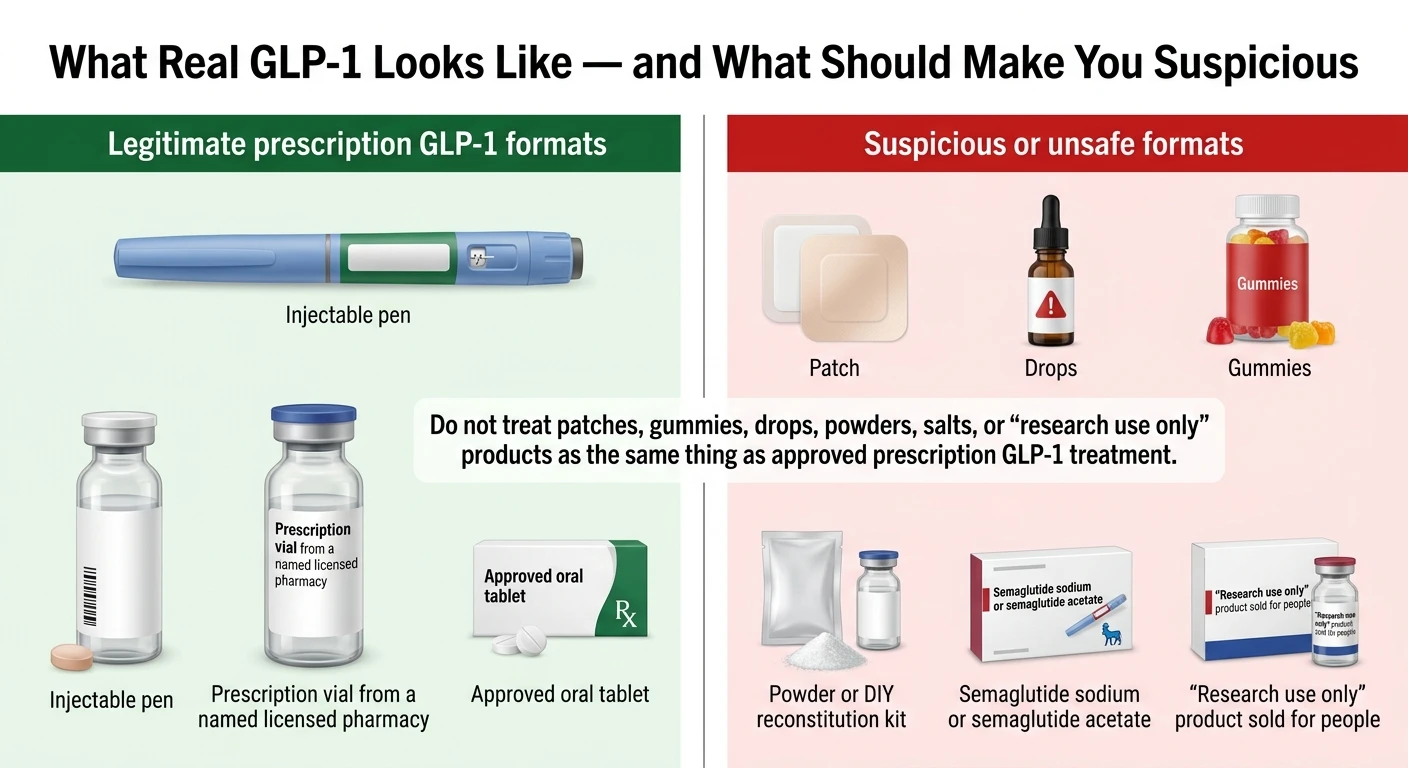
FDA-approved GLP-1 medications come in specific forms only:
✅ Legitimate forms
- • Ozempic (semaglutide) — injectable pen
- • Wegovy (semaglutide) — injectable pen or oral tablet
- • Mounjaro (tirzepatide) — injectable pen
- • Zepbound (tirzepatide) — injectable pen or vial
- • Rybelsus (semaglutide) — oral tablet for T2D
- • Foundayo (orforglipron) — oral tablet, approved April 2026
- • Compounded semaglutide/tirzepatide — injectable vial from a named licensed pharmacy
🚩 Suspicious forms — leave
- • Patches, transdermal
- • Drops or oral liquid
- • Gummies or chews
- • Nasal sprays
- • Powder / DIY reconstitution kits
- • Semaglutide sodium or acetate
- • “Research use only” sold for weight loss
- • “Natural GLP-1 booster” supplements
Also watch for: Products labeled “semaglutide sodium” or “semaglutide acetate.” The FDA has stated these are different active ingredients from the semaglutide in approved products, with no known lawful basis for compounding.
Are the payment and billing terms normal?
Legitimate pharmacies and telehealth platforms use standard, traceable payment methods — credit cards, health insurance, HSA/FSA, or clearly structured self-pay programs. They post pricing before you enter payment information. They have clear cancellation and refund policies. They don't charge you repeatedly without authorization.
Instant dealbreakers: Zelle, CashApp, Venmo, cryptocurrency, wire transfer, or prepaid debit cards. These payment methods are nearly impossible to reverse once sent. Legitimate pharmacies don't use them.
Important note on cash-pay providers
Some legitimate GLP-1 programs are cash-pay or self-pay and may not accept insurance. That alone is not a scam signal — many official manufacturer programs and telehealth providers operate on a cash-pay model. The real red flags are irreversible payment methods, hidden subscriptions, and unclear cancellation terms.
What to look for: BBB Scam Tracker reports include multiple cases of consumers who paid a small “membership fee” only to discover repeated unauthorized charges of $600+. Read the terms before paying.
Verification Tool Box: Bookmark These
| Tool | What It Does | Link |
|---|---|---|
| NABP Safe Site Search | Verifies if an online pharmacy meets U.S. standards | safe.pharmacy |
| FDA BeSafeRx | Tips and tools for buying medicine online safely | fda.gov/besaferx |
| LegitScript | Independent website verification for healthcare sites | legitscript.com/search |
| State Board of Pharmacy | Confirms pharmacy licenses by state | NABP directory |
| Eli Lilly Real Medicine Tool | Verify if Mounjaro/Zepbound product is genuine | lilly.com/real-medicine |
| FDA MedWatch | Report unsafe products | fda.gov/medwatch |
| FBI IC3 | Report internet fraud | ic3.gov |
| BBB Scam Tracker | Report and search scam patterns | bbb.org/scamtracker |
Not sure if the site you found is safe? Instead of guessing, get a verified next step based on your insurance status, budget, and medical needs.
Take the Free 60-Second GLP-1 Matching Quiz →What Are the Red Flags That Mean You Should Leave Immediately?
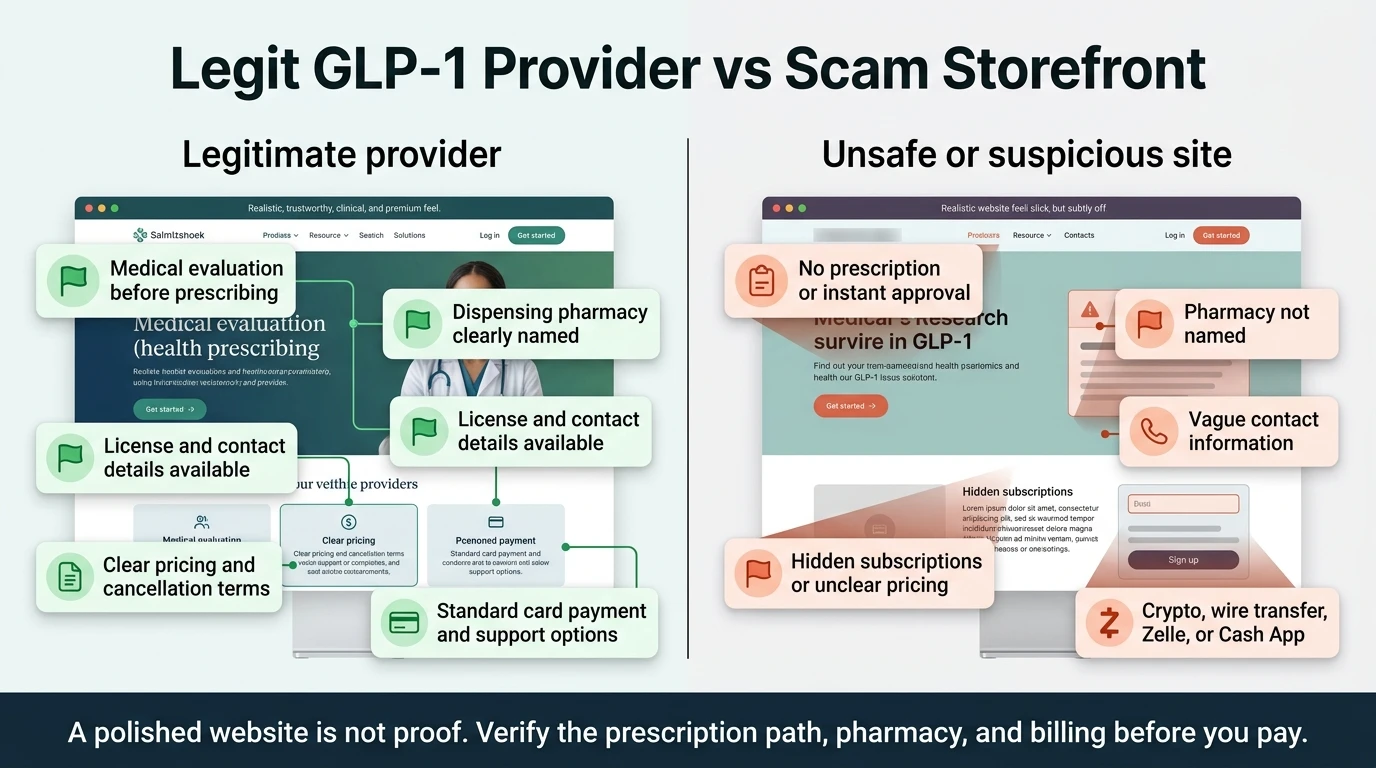
A professional-looking GLP-1 website can still be unsafe. Clean design, stock photos of doctors, and a polished checkout flow prove nothing about who is actually prescribing, compounding, or shipping your medication. Here are the instant dealbreakers.
🚩 “No prescription needed”
This is the single biggest red flag. Every legitimate GLP-1 medication requires a prescription. Any site that lets you obtain GLP-1 medication without clinician review and a valid prescription is breaking the law, and the product — if you receive anything at all — has no medical oversight behind it.
🚩 “Research use only” or “not for human consumption”
Some sellers label products this way to dodge FDA enforcement while clearly marketing them for weight loss. The FDA has issued explicit warnings about this practice. If the product page talks about weight loss but the label says “not for human consumption,” the labeling is designed to protect the seller, not you.
🚩 Powder, DIY vials, or reconstitution kits
In the JAMA study, three out of six illegal pharmacies sold lyophilized (powder) semaglutide vials meant to be reconstituted by the consumer. The purity levels were 7–14% versus the advertised 99%. Mixing your own injectable medication from a powder is not how any licensed medical provider would structure your care.
🚩 Patches, drops, gummies, nasal sprays, or “natural GLP-1”
No FDA-approved GLP-1 medication exists in any of these forms. If it's not an injectable pen, a prescription vial from a named pharmacy, or an FDA-approved prescription oral tablet, it is not a legitimate GLP-1 product.
🚩 Prices dramatically below market rate
Official manufacturer cash-pay programs are now significantly lower than list price — Wegovy self-pay from $149–$199 for certain doses, Zepbound from $299–$449. Compounded alternatives from legitimate pharmacies typically start around $150–$300 per month. If someone is offering “semaglutide” for $49 with no prescription and overnight shipping, the math doesn't work.
🚩 Celebrity endorsements selling GLP-1 directly
The BBB has documented hundreds of complaints about deepfake celebrity endorsement ads, including AI-generated videos of Oprah Winfrey promoting fake weight-loss products. Over 170 consumers reported losing $300+ each to a single fake product promoted through fabricated endorsements.
🚩 Unsolicited texts or calls saying you're “approved”
You didn't apply for GLP-1 medication and get approved out of nowhere. BBB reports include cases of texts from fake wellness companies claiming a doctor cleared a GLP-1 prescription, and calls threatening $800 collection charges for subscriptions the consumer never signed up for. These are phishing attempts designed to harvest your personal and financial information.
How Do You Tell If a GLP-1 Website Is Actually Legitimate?
Legitimate online GLP-1 care exists — and for many people it's the most accessible path to treatment. The key is that real telehealth behaves like medical care, not like gray-market e-commerce.
✅ Real medical intake before prescribing
A genuine provider evaluates your health history, current medications, BMI, and relevant conditions before deciding whether GLP-1 medication is appropriate. Some require lab work. All require a clinical decision by a licensed prescriber — not an algorithm that approves everyone.
✅ Licensed clinicians you can verify
The provider should name the type of clinician evaluating you (MD, DO, NP, PA) and those clinicians should hold licenses you can check through the relevant state medical board. If the site won't tell you who's prescribing, that's a problem.
✅ A named pharmacy — not mystery fulfillment
You should know exactly which pharmacy is filling your prescription. If it's compounded medication, you should know which compounding pharmacy is producing it and whether that pharmacy is a 503A or 503B facility.
✅ A physical U.S. address and working phone number
Verify the address exists. Call the phone number. If customer service is chat-only with vague or scripted responses and no way to reach a real person, proceed with extreme caution.
✅ Clear pricing before you pay
The cost of the consultation, the medication, shipping, and any subscription or membership fees should all be visible before you enter payment information. No surprises.
✅ Transparent distinction between FDA-approved and compounded medication
A trustworthy provider tells you exactly what you're getting. FDA-approved brand-name medication (Wegovy, Ozempic, Mounjaro, Zepbound) is different from compounded semaglutide or tirzepatide. Both can be legitimate — but they're not the same thing, and any provider who blurs that line is either confused or deliberately misleading you.
✅ Medical follow-up after prescribing
GLP-1 medications require dose titration, side-effect monitoring, and ongoing clinical check-ins. A provider that writes a prescription and disappears isn't offering healthcare — they're offering a transaction.
FDA enforcement action — March 3, 2026
The FDA issued 30 warning letters to telehealth companies for misleading GLP-1 marketing — including claims that implied compounded products were equivalent to FDA-approved medications. This is exactly the kind of language you should watch for.
| What Legit Telehealth Looks Like | What Fake Storefronts Do |
|---|---|
| Medical evaluation before prescribing | Instant checkout, no health questions |
| Named, licensed clinicians | "Our medical team" with no names |
| Specific pharmacy identified | "Shipped from our fulfillment center" |
| U.S. address, working phone, email support | Chat-only, or no contact info at all |
| Standard traceable payment methods | Zelle, crypto, wire, prepaid cards |
| Clear pricing upfront | Hidden fees, surprise subscriptions |
| Realistic outcome discussions | "Lose 30 lbs in 2 weeks" |
| FDA-approved vs. compounded clearly labeled | "Same as Wegovy/Ozempic" for compounded |
| Ongoing check-ins and dose adjustments | No follow-up after purchase |
| Easy-to-find cancellation policy | Vague terms, bounced refund emails |
How Can You Tell If the Medication Itself Is Counterfeit?
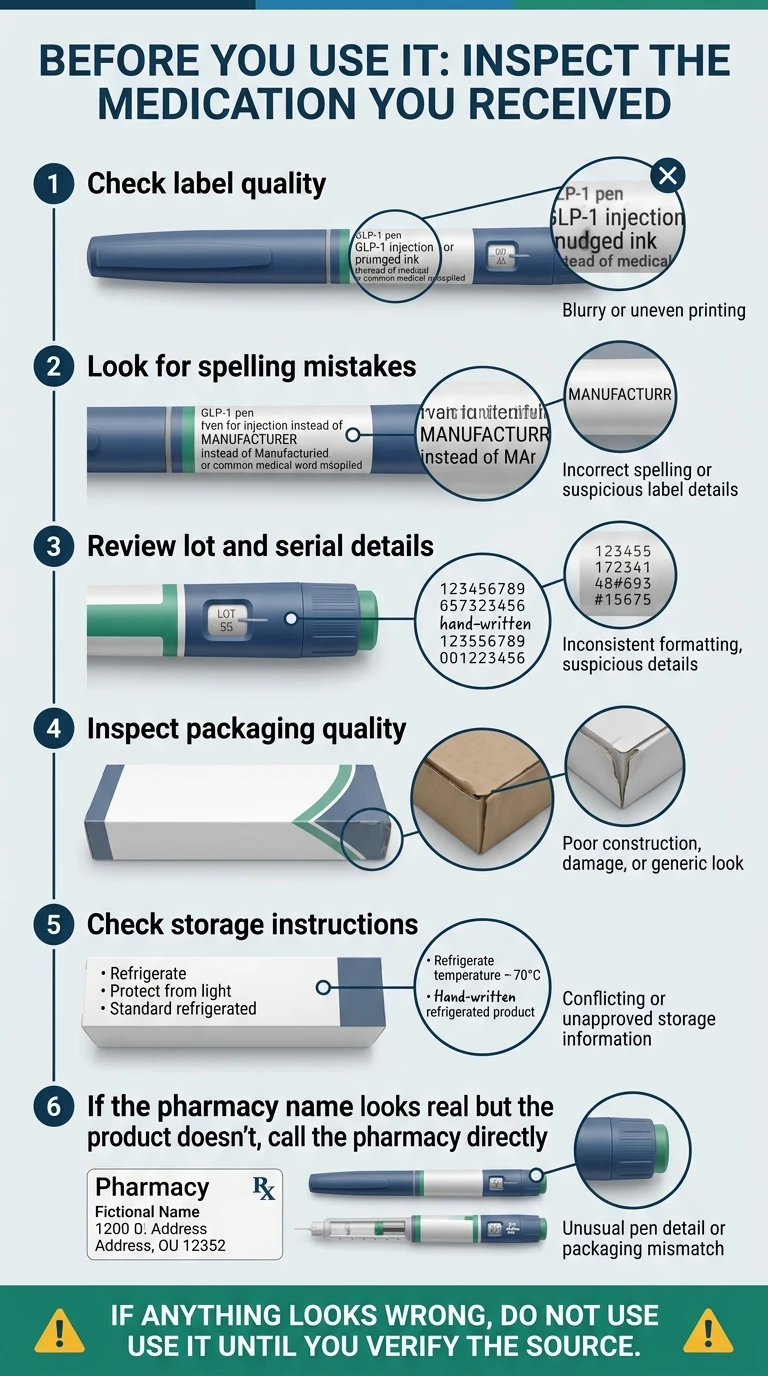
Some warnings only surface after the package arrives. Even if you used a legitimate provider, inspect your medication when it arrives. If you bought from a source you're now second-guessing, check the product before you use it.
Verifying brand-name Ozempic or Wegovy pens
The FDA has issued multiple alerts about counterfeit Ozempic entering the U.S. supply chain.
| Date | Counterfeit Lot # | Key Visual Clue |
|---|---|---|
| Dec 2025 | PAR1229 | EXP/LOT text positioned on left side of label details |
| Apr 2025 | PAR0362 (serial starts 51746517) | Packaging discrepancies |
| Dec 2023 | NAR0074 (serial 430834149057) | Counterfeit needles included, pen appearance differences |
Last checked: April 2026. Always verify against the current FDA counterfeit Ozempic alert page, which is updated as new counterfeits are found.
What to inspect on any pen
- • Label quality: Genuine Ozempic labels are clean, sharp, and well-adhered. Blurry printing, spelling mistakes, or labels that peel easily are warning signs.
- • Language: Legitimate U.S. product labels are in English. Foreign-language labels were not intended for the U.S. market.
- • Lot and serial numbers: Check them against the FDA counterfeit alert page.
- • Pen behavior: The WHO notes counterfeit pens may have a scale extending from the pen body when setting a dose — genuine Ozempic pens do not.
- • Needles and inserts: Counterfeit kits have included fake needles. Compare packaging against Novo Nordisk's official images.
For Mounjaro or Zepbound, Eli Lilly provides a verification tool at lilly.com/real-medicine.
Verifying compounded semaglutide or tirzepatide
Confirm the pharmacy name on the label is real
The FDA has found fraudulent compounded products with pharmacy names from facilities that didn't actually produce them. Call the pharmacy directly and ask.
Ask for a Certificate of Analysis (COA)
Legitimate compounding pharmacies — especially 503B outsourcing facilities — can provide third-party testing results confirming potency, sterility, and purity.
Verify the pharmacy's state license
Use the state board of pharmacy database. Confirm active status.
Check storage instructions
Properly compounded semaglutide should include clear storage and handling instructions. If it arrived warm, improperly packed, or with no instructions, contact the pharmacy before using it.
Which GLP-1 Products or Formats Should Make You Extra Suspicious?
Not all fake GLP-1 products pretend to be Ozempic pens. Many dangerous products don't look like counterfeits — they look like convenient or affordable alternatives. But they've never been proven safe or effective in those forms.
🚩 Semaglutide powder and DIY reconstitution kits
The JAMA study that tested products from illegal online pharmacies found that these vials had extremely low purity and dangerously inaccurate concentrations — 7–14% of the advertised 99%.
🚩 "Research use only" products with human dosing guides
A known enforcement-evasion tactic. Sellers label products as research chemicals to avoid pharmaceutical regulations, then market them for weight loss and include human dosing instructions. The FDA and NABP have both issued warnings about this practice.
🚩 Semaglutide sodium and semaglutide acetate
The FDA has explicitly stated that these salt forms are different active ingredients from the semaglutide used in Ozempic and Wegovy. They have no regulatory basis for use in compounded medications and have not been found safe and effective for any condition.
🚩 GLP-1 patches, drops, gummies, and "boosters"
No FDA-approved GLP-1 medication exists in any of these forms. Don't treat them as equivalent to prescription GLP-1 treatment.
ℹ️ The oral semaglutide confusion
There ARE real FDA-approved oral GLP-1 options: Rybelsus (semaglutide, for T2D), Wegovy pill (semaglutide, for weight loss), and Foundayo (orforglipron, approved April 2026, for weight loss). All require a prescription. They are NOT the "oral semaglutide drops" or liquid formulations sold on social media.
What About Compounded GLP-1 Medications — Are They All Fake?
No — and this distinction matters, because confusing “compounded” with “counterfeit” leaves millions of people with no viable path to treatment.
The honest picture
Legitimate compounded semaglutide and tirzepatide exist. They're legally produced by licensed compounding pharmacies, prescribed by licensed clinicians, and used by patients who either can't access or can't afford brand-name FDA-approved products. Compounding has a long, regulated history in U.S. pharmacy practice.
But the compounding space is also where most GLP-1 fraud hides. The FBI's IC3 issued a public service announcement in February 2025 warning about noncompliant healthcare providers selling fraudulently compounded weight-loss drugs — including pharmacies using “animal grade” semaglutide, products that contained no semaglutide at all, and mixtures with unknown impurities. Some required hospitalization.
The real question: how do you tell a legitimate compounder from a dangerous one?
503A Compounding Pharmacies
Compound medications on a per-prescription basis. Regulated primarily by state boards of pharmacy. The traditional model — your local compounding pharmacy is likely 503A.
503B Outsourcing Facilities
Register with the FDA, subject to cGMP requirements, and may be inspected by FDA. However, FDA registration alone does not mean the agency has found the facility compliant. Drugs from 503B facilities are still not FDA-approved.
How to verify a compounding pharmacy
- Get the pharmacy name from your provider
- Confirm the pharmacy's state license is active
- Check whether it's registered as a 503B facility with the FDA (the FDA maintains a public list of registered outsourcing facilities)
- Ask where the pharmacy sources its active pharmaceutical ingredients (APIs)
- Ask for a Certificate of Analysis (COA) showing third-party testing of potency and sterility
Honest note: Compounded GLP-1 medications are not FDA-approved. They do not undergo the same safety, effectiveness, and quality review as brand-name products. For anyone who can access and afford FDA-approved GLP-1 medications, that is the safest path. But for those who can't, a legitimately compounded medication from a verified pharmacy with a real prescription is categorically different from a counterfeit product off a rogue website. We maintain an updated guide on compounded GLP-1 availability →
What Should You Do If You Already Paid for Suspicious GLP-1 Medication?
If you've already paid and you're now second-guessing the source, your priority shifts from prevention to damage control. Don't panic, but move quickly.
In the next 30 minutes:
| Step | Action | Why It Matters |
|---|---|---|
| 1 | Stop. Do not use the medication. | You can dispute a charge. You can't un-inject something. |
| 2 | Screenshot everything — website, order confirmation, receipts, emails, product listing. | Scam sites disappear fast. Evidence disappears with them. |
| 3 | Contact your bank or credit card issuer. Request a chargeback and flag the merchant. | Credit card chargebacks are your best recovery tool. Zelle, wire, and crypto are essentially unrecoverable. |
| 4 | Check for recurring charges. Look at pending authorizations and subscriptions. | BBB complaints describe hidden subscription models that charge $600+ repeatedly. |
| 5 | Email the seller requesting a refund and cancellation. Keep the sent email. | Creates a paper trail even if they don't respond — and they often won't. |
Within the next week:
Report the seller to all of the following:
- • FDA MedWatch — for unsafe products
- • FBI IC3 (ic3.gov) — for internet fraud
- • BBB Scam Tracker
- • FTC (reportfraud.ftc.gov)
- • Your state board of pharmacy
Keep the product and all packaging — don't throw anything away until you've finished documenting it.
What Should You Do If You Already Injected or Took It?
Stop using the product immediately. Do not take another dose.
Contact your prescriber or go to urgent care. Tell them exactly what you used, how much, when, and what symptoms you're experiencing. Bring the product and packaging if possible.
Watch for these symptoms that need immediate medical attention:
- • Severe nausea, vomiting, or diarrhea beyond what's typical for GLP-1 side effects
- • Signs of low blood sugar (shakiness, sweating, confusion, rapid heartbeat) — counterfeit Ozempic pens have been found containing insulin, which can cause dangerous hypoglycemia
- • Unusual injection site reactions (significant swelling, redness, warmth, or signs of infection)
- • Dizziness or fainting
- • Any symptom that feels different from what your provider described as expected
Report to FDA MedWatch. Your report helps the FDA identify and act on emerging threats. Contact the manufacturer if you believe you received a counterfeit of their product — Novo Nordisk confirmed one counterfeit pen found in the U.S. supply chain contained insulin rather than semaglutide. The consumer who used it was hospitalized.
Why Are Fake GLP-1 Medications Everywhere Right Now?
Understanding why this is happening helps you stay alert — this isn't temporary, and it isn't going away.
Demand is unprecedented
As of March 2026, KFF reports that about 1 in 5 U.S. adults have ever taken a GLP-1 medication, including 12% who currently take one. Nearly 1 in 5 GLP-1 users got their prescription from a source other than their primary care physician — including 11% from online providers or websites.
The scam infrastructure is massive and industrialized
McAfee's threat research documented a 183% increase in GLP-1 phishing attempts in early 2024, along with 449 risky website URLs and over 176,000 scam messages. Check Point Security found an estimated 500+ new fraudulent pharmacy pages being created every single day.
Counterfeits have gone global
The Partnership for Safe Medicines has documented counterfeit Ozempic in at least 16 countries. U.S. Customs and Border Protection regularly seizes illegal GLP-1 products at ports of entry. U.S. poison control centers have seen a 1,500% increase in semaglutide-related calls.
Confusion around compounding fueled the problem
During GLP-1 drug shortages, compounding was a legal and necessary option for many patients. The rapid growth of the compounding market — combined with unclear regulatory boundaries — created cover for fraudulent operations that either sold untested products or didn't exist at all.
Can You Buy GLP-1 Medications Online Safely at All?
Yes. The safe answer isn't “never buy GLP-1 online.” It's “never buy from a seller you can't independently verify like a medical business.”
Safest path: local clinician + retail pharmacy
If you have a primary care physician or endocrinologist willing to prescribe, and your insurance covers the medication, filling at your local retail pharmacy is the lowest-risk option. The pharmacist is someone you can speak to face-to-face, the supply chain is established, and the product is FDA-approved.
Safe online path: licensed telehealth + named pharmacy
Not everyone has that option. If you're going through an online provider, verify it using the 7 checks above. The provider should require a medical evaluation, name the pharmacy, and provide ongoing clinical support.
Ro specializes in connecting patients with FDA-approved GLP-1 options and can help navigate insurance coverage, manufacturer savings programs, and pharmacy selection. They require a physician-supervised medical evaluation, use licensed U.S. pharmacies, and include ongoing clinical support.
When cost is the main barrier
MEDVi offers both FDA-approved GLP-1 medications and compounded alternatives, prescribed through licensed providers and dispensed by state-licensed U.S. pharmacies. They do not require insurance and offer transparent monthly pricing.
Honest note: Compounded GLP-1 medications do NOT undergo FDA review for safety, effectiveness, or manufacturing quality. The difference between “safe” and “dangerous” compounded options comes down entirely to whether the pharmacy is verified, licensed, and transparent.
How We Verified This Page
Transparency isn't decoration — it's why you should trust this page over a random blog post.
Sources checked for this guide:
✓FDA BeSafeRx safety guidance and online pharmacy statistics
✓FDA counterfeit Ozempic alerts (Dec 2023, Apr 2025, Dec 2025)
✓FDA warnings on compounded GLP-1 products and semaglutide salt forms
✓JAMA Network Open study on online semaglutide purchases (2024)
✓FBI IC3 public service announcement on fraudulent compounding (Feb 2025)
✓LegitScript GLP-1 ad violation data (2024)
✓NABP Safe Site Search and RogueRx Activity Report
✓BBB Scam Alert: Weight Loss and GLP-1 Scams
Update frequency: Counterfeit alert table and provider verification status reviewed monthly or whenever new FDA alerts are issued. Full article reviewed quarterly.
Provider verification: We use the same 7-check framework described in this article. Every provider mentioned here has been independently checked against NABP, state board records, and LegitScript.
Editorial standards: We distinguish FDA-approved from compounded products in every instance. We do not use misleading structured data — no fake reviews, no star ratings without real reviews.
Frequently Asked Questions
Can you buy GLP-1 medication online safely?
Yes, but only through a licensed telehealth provider that requires a medical evaluation, uses a named state-licensed pharmacy, provides a valid prescription, and offers ongoing medical follow-up. Use NABP Safe Site Search, your state board of pharmacy, and LegitScript to independently verify any provider before paying.
How can you tell if semaglutide is fake?
For brand-name pens, check the lot number against FDA counterfeit alerts, inspect label quality and language, verify pen behavior matches manufacturer specs, and confirm the pharmacy source. For compounded semaglutide, verify the pharmacy's state license, ask for a Certificate of Analysis, and confirm the pharmacy actually produced your specific product.
Can you buy semaglutide without a prescription?
Not legally. Semaglutide is a prescription medication in all forms — injectable (Ozempic, Wegovy) and oral tablets (Rybelsus, Wegovy pill). Any website selling semaglutide without a prescription is operating illegally, and the product may be counterfeit, contaminated, or nonexistent.
Are GLP-1 patches, gummies, or drops real?
No FDA-approved GLP-1 medication comes in patch, gummy, or drop form. Products marketed this way are not legitimate GLP-1 medications and have not been shown to be safe or effective.
Is compounded semaglutide the same as Ozempic or Wegovy?
No. Compounded semaglutide is not FDA-approved and is not manufactured by Novo Nordisk. It is not a generic. Legitimate compounded versions can be prescribed by licensed providers through licensed pharmacies, but they are categorically different from FDA-approved products. Any seller claiming compounded semaglutide is 'the same as' Ozempic or Wegovy is misleading you.
Are semaglutide sodium and semaglutide acetate legitimate?
The FDA has stated that these salt forms are different active ingredients from the semaglutide in approved products. They have no known lawful basis for compounding and have not been found safe and effective for any condition. Avoid products containing these forms.
What does 'research use only' mean on a semaglutide product?
It means the product is not approved for human use. Sellers use this label to evade pharmaceutical regulations while still marketing to consumers. If a product says 'research use only' but the website talks about weight loss — leave.
What should you do if you already bought suspicious GLP-1 medication?
Stop using the product immediately. Screenshot everything — the website, order confirmation, receipts, emails. Contact your bank to dispute the charge. Check for recurring charges. Report the seller to FDA MedWatch, FBI IC3, BBB Scam Tracker, and your state board of pharmacy. If you have already injected the product, contact your doctor or seek urgent care.
What if the package arrived warm or badly packed?
Semaglutide and tirzepatide are temperature-sensitive and should be stored refrigerated. If your package arrived warm, without cold packs, or with no storage instructions, contact the pharmacy before using it. Improper storage can degrade the medication.
How do I report a GLP-1 scam?
File reports with: FDA MedWatch at fda.gov/medwatch for unsafe products, FBI IC3 at ic3.gov for internet fraud, BBB Scam Tracker at bbb.org/scamtracker, FTC at reportfraud.ftc.gov, and your state board of pharmacy. Keep all documentation including packaging, receipts, and correspondence.
What does a legitimate online GLP-1 provider cost?
FDA-approved brand-name medications range from $0 (with insurance) to $149–$299/month through official cash-pay programs. Legitimate telehealth programs offering compounded alternatives typically run $150–$350/month including consultation and medication. Be suspicious of prices dramatically below these ranges.
Bottom line
The GLP-1 scam landscape is massive — but so is your defense.
42% of online pharmacies selling semaglutide are illegal operations. 500+ new fraudulent pages are created daily. Counterfeit products have been found in at least 16 countries. But protecting yourself isn't complicated: seven checks, five minutes, and the willingness to walk away when something doesn't verify.
Every time you encounter an unfamiliar GLP-1 offer, run the 7 checks. If it passes, you can proceed with confidence. If it fails, close the tab and move on. You haven't lost anything.
Related guides
This page is part of The RX Index's GLP-1 resource center. For provider reviews, pricing comparisons, and coverage guides, visit our GLP-1 guide hub.
The RX Index maintains affiliate relationships with some providers mentioned on this site. This means we may earn a commission when you use our links — at no additional cost to you. Affiliate relationships never influence our verification results, editorial ratings, or recommendations. Every provider recommended on this site has passed our 7-check verification framework independently. Full disclosure policy here.
Last verified: April 2026 · Reviewed against FDA, NABP, LegitScript, JAMA, FBI IC3 data
Related guides
- How to Get GLP-1 Without Insurance in 2026: Real Prices [Verified]
- Zepbound vs Wegovy for Weight Loss (2026): Real Prices + Verdict
- How to Switch From Semaglutide to Mounjaro (2026): Timing, Doses, Cost
- How to Switch From Semaglutide to Zepbound: 5 Steps, Doses & Real Cost (2026)
- How to Switch From Compounded Semaglutide to Tirzepatide (2026)