
How to Get an FDA‑Approved GLP‑1 Safely Online or In Person
Includes today's FDA approval of Wegovy HD (semaglutide 7.2 mg injection).
Disclosure: Some links on this page are affiliate links. If you purchase through these links, we may earn a commission at no extra cost to you.
Updated March 19, 2026 · Prices last verified March 19, 2026 · Sources: FDA prescribing information, official provider websites, CMS.gov, NEJM clinical trials
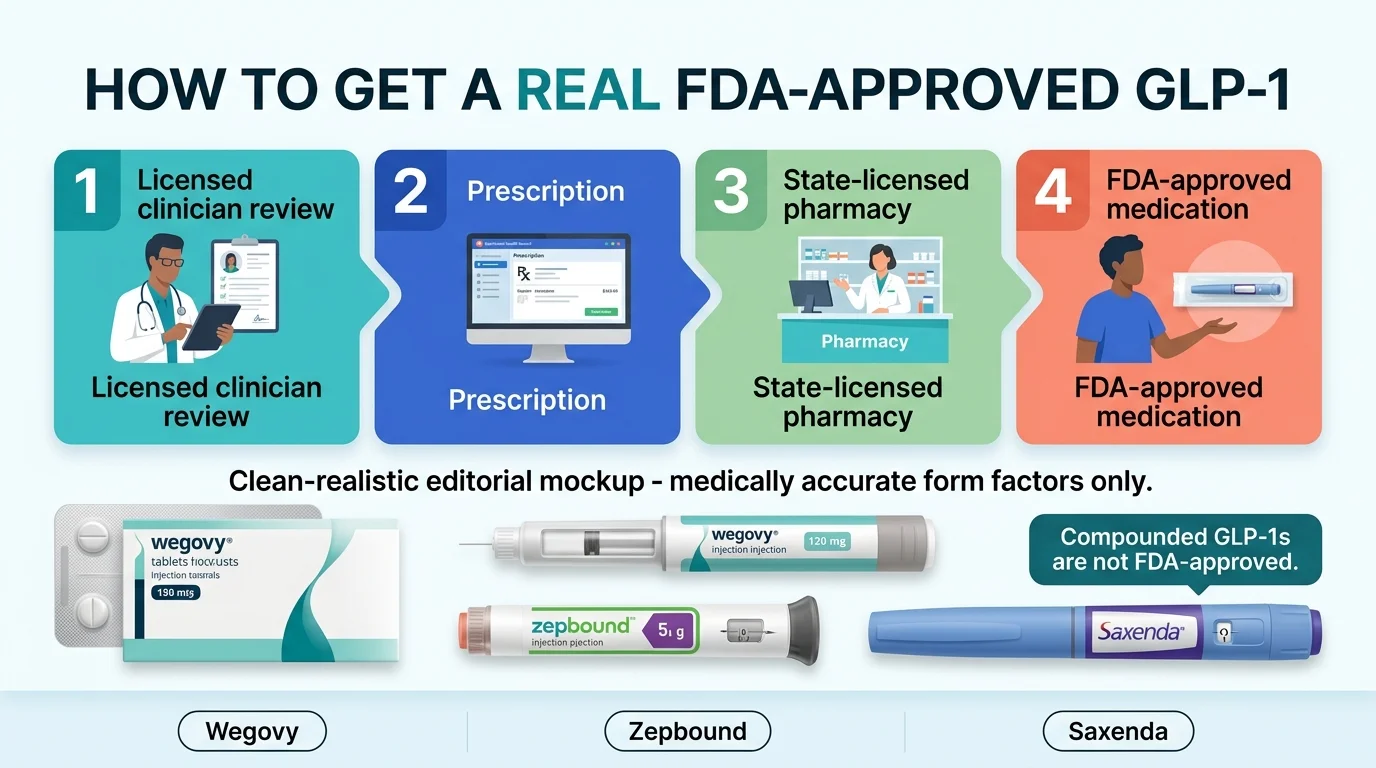
The legitimate path is simpler than most people think. You need a licensed clinician, a valid prescription, and a state-licensed pharmacy that fills an actual FDA-approved medication. That's it. No grey-market workarounds, no mystery vials, no guessing whether what you're injecting is real.
Here's the bottom line if you're short on time:
Three GLP-1 medications are FDA-approved specifically for weight loss right now: Wegovy (semaglutide — injection and a brand-new daily pill), Zepbound (tirzepatide — injection), and Saxenda (liraglutide — injection, with a generic now available). Everything else you see online — Ozempic, Mounjaro, Rybelsus — those are approved for type 2 diabetes. Doctors sometimes prescribe them off-label for weight loss, but that's a different conversation with different insurance implications.
The biggest change in 2026: Wegovy now comes as an FDA-approved daily tablet, so some eligible adults have a needle-free option for the first time. The Wegovy pill launched in January 2026 — it's the first oral GLP-1 approved for weight loss, starting at $149/month cash pay. And just today (March 19, 2026), the FDA approved Wegovy HD, a higher-dose 7.2 mg injection that showed approximately 21% average weight loss in clinical trials. The options are expanding fast.
For most people reading this, the fastest legitimate path is a telehealth provider that handles the insurance paperwork and prescribes FDA-approved medications. We reviewed the major platforms against a consistent set of criteria, and Ro stood out for one specific reason: they offer a free insurance eligibility check, a dedicated concierge team that fights for prior authorization on your behalf, and FDA-approved cash-pay options through manufacturer-linked pricing channels (NovoCare, LillyDirect) — often significantly lower than retail. Medication through Ro currently starts at $149/month for certain Wegovy pill doses. The Ro Body membership is separate: $45 for month one, then $145/month.
5-minute assessment. Insurance support included. No charge if you don't qualify.
One thing we won't do on this page: blur the line between FDA-approved and compounded. The FDA has been cracking down on compounded GLP-1s since 2025, and for good reason. If you specifically want to understand how to get a real, FDA-approved GLP-1 — this is the guide. We wrote it because nothing else we found answered every question in one place.
Which GLP-1s Are Actually FDA-Approved for Weight Loss?
This is where most of the confusion lives. People hear “GLP-1” and assume every brand name does the same thing for the same reason. They don't.
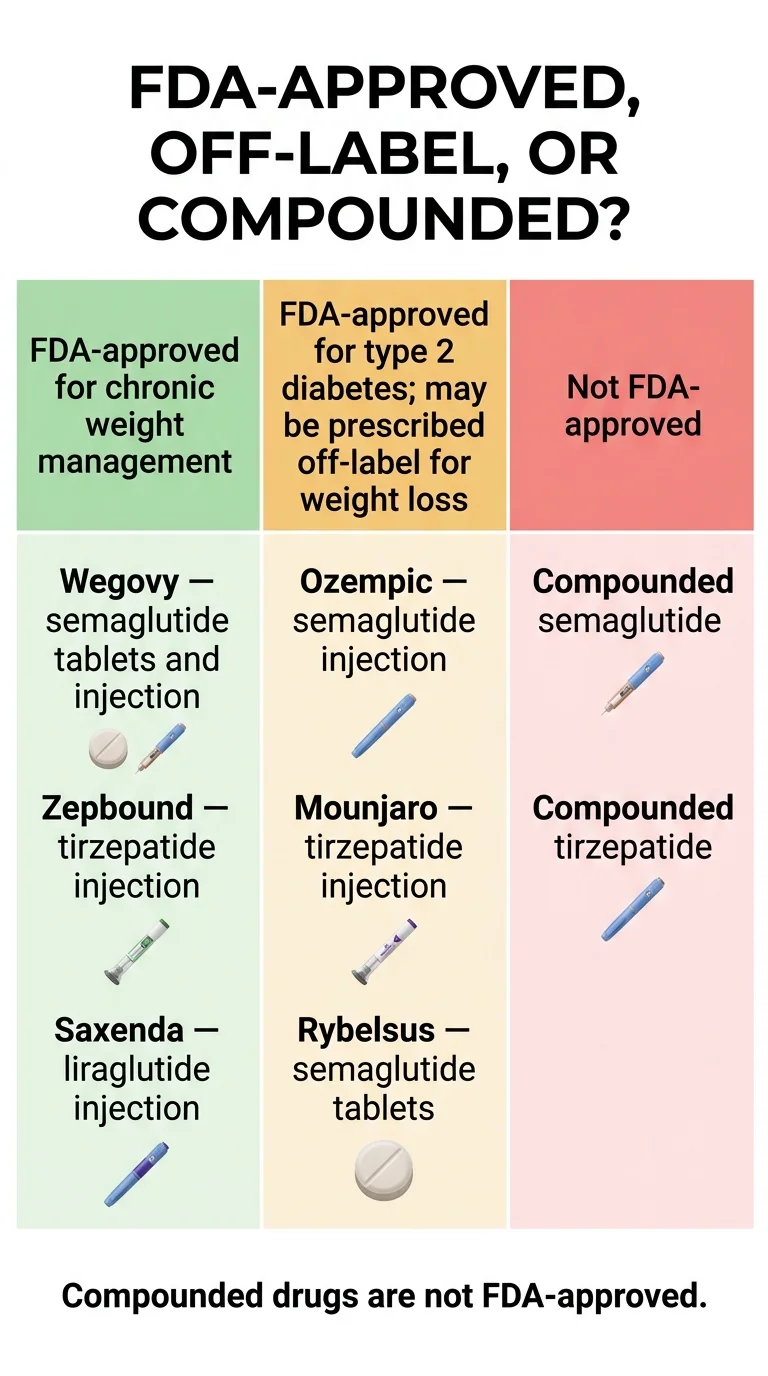
Multiple GLP-1 medications are FDA-approved in the United States, but only a few are specifically approved for chronic weight management. The rest are approved for type 2 diabetes. Here's the complete picture:
FDA-Approved for Weight Loss
| Medication | Active Ingredient | Form | Approved For | Cash Price (Mar 2026) |
|---|---|---|---|---|
| Wegovy tablets (semaglutide 1.5–25 mg) | Semaglutide | Daily oral tablet | Weight loss + CV risk reduction | $149–$299/mo |
| Wegovy injection (semaglutide 2.4 mg) | Semaglutide | Weekly injection | Weight loss + CV risk reduction + MASH | $199–$349/mo |
| Wegovy HD (semaglutide 7.2 mg) | Semaglutide | Weekly injection | Weight loss (adults who tolerated 2.4 mg). Approved March 19, 2026. Launch expected April 2026. | Pricing TBD |
| Zepbound (tirzepatide) | Tirzepatide | Weekly injection | Weight loss + sleep apnea | $299–$449/mo (vials) |
| Saxenda / Generic (liraglutide) | Liraglutide | Daily injection | Weight loss (adults + adolescents 12+) | Varies (generic since Aug 2025) |
FDA-Approved for Type 2 Diabetes (Not Weight Loss)
| Medication | Active Ingredient | Form | Note |
|---|---|---|---|
| Ozempic | Semaglutide | Weekly injection | Same ingredient as Wegovy, different approval. Often prescribed off-label for weight loss. |
| Mounjaro | Tirzepatide | Weekly injection | Same ingredient as Zepbound, different approval. Off-label weight loss use is common. |
| Rybelsus | Semaglutide 7/14 mg | Daily oral tablet | Approved for diabetes + CV risk. Lower dose than Wegovy pill. |
| Trulicity | Dulaglutide | Weekly injection | Type 2 diabetes + CV risk reduction |
| Victoza | Liraglutide | Daily injection | Type 2 diabetes |
| Byetta / Generic | Exenatide | Twice-daily injection | Type 2 diabetes (generic available) |
| Bydureon BCise | Exenatide ER | Weekly injection | Type 2 diabetes |
Source: FDA prescribing information for each medication. Pricing verified via manufacturer websites, Ro, and major pharmacy platforms as of March 2026.
Why this matters: If your goal is weight loss and you want insurance to cover it, you're far more likely to get approved for a medication that actually carries the weight-loss indication — Wegovy, Zepbound, or Saxenda. Getting insurance to cover Ozempic for weight loss is a harder fight because it's technically off-label.
What “FDA-Approved” Actually Means — and What It Doesn't
We use this phrase constantly, but most people haven't stopped to think about what it really means in practice.
FDA-Approved for Weight Loss
This means the manufacturer ran large-scale clinical trials — thousands of patients, over a year or more — specifically testing the drug for weight management. The FDA reviewed all that data and said: “This works, the benefits outweigh the risks, and we're putting our name on it for this purpose.”
Wegovy's clinical trials (the STEP and OASIS programs) showed 13–17% average body weight loss depending on formulation and study. Zepbound's SURMOUNT trials showed 15–21% weight loss. These aren't marketing numbers — they're published in peer-reviewed journals like The New England Journal of Medicine.
FDA-Approved for Diabetes, Used Off-Label for Weight Loss
Ozempic and Mounjaro contain the same active ingredients as Wegovy and Zepbound respectively. Doctors often prescribe them for weight loss because the clinical data supports it. That's legal and common — it's called off-label prescribing. But it means your insurance may not cover it for weight loss, and you're navigating a greyer area.
Compounded GLP-1s Are Not FDA-Approved
This is the part that trips people up. Compounded medications are mixed by compounding pharmacies. They are not reviewed by the FDA for safety, effectiveness, or manufacturing quality. The FDA has been explicit about this — and in 2025, after the national semaglutide and tirzepatide shortages were resolved, the agency moved to restrict compounding of these drugs.
We're not going to tell you compounded options are dangerous or worthless. But this page is about the FDA-approved path. If that's what you searched for — if you want to know you're getting exactly what a clinical trial tested, made in an FDA-inspected facility, filled at a state-licensed pharmacy — then you're in the right place. Compounded GLP-1s are a separate conversation for a separate page.
Do You Qualify? Here's How Eligibility Actually Works
Before you spend time comparing providers or prices, the first question is whether you're likely eligible. The good news: the criteria are straightforward.
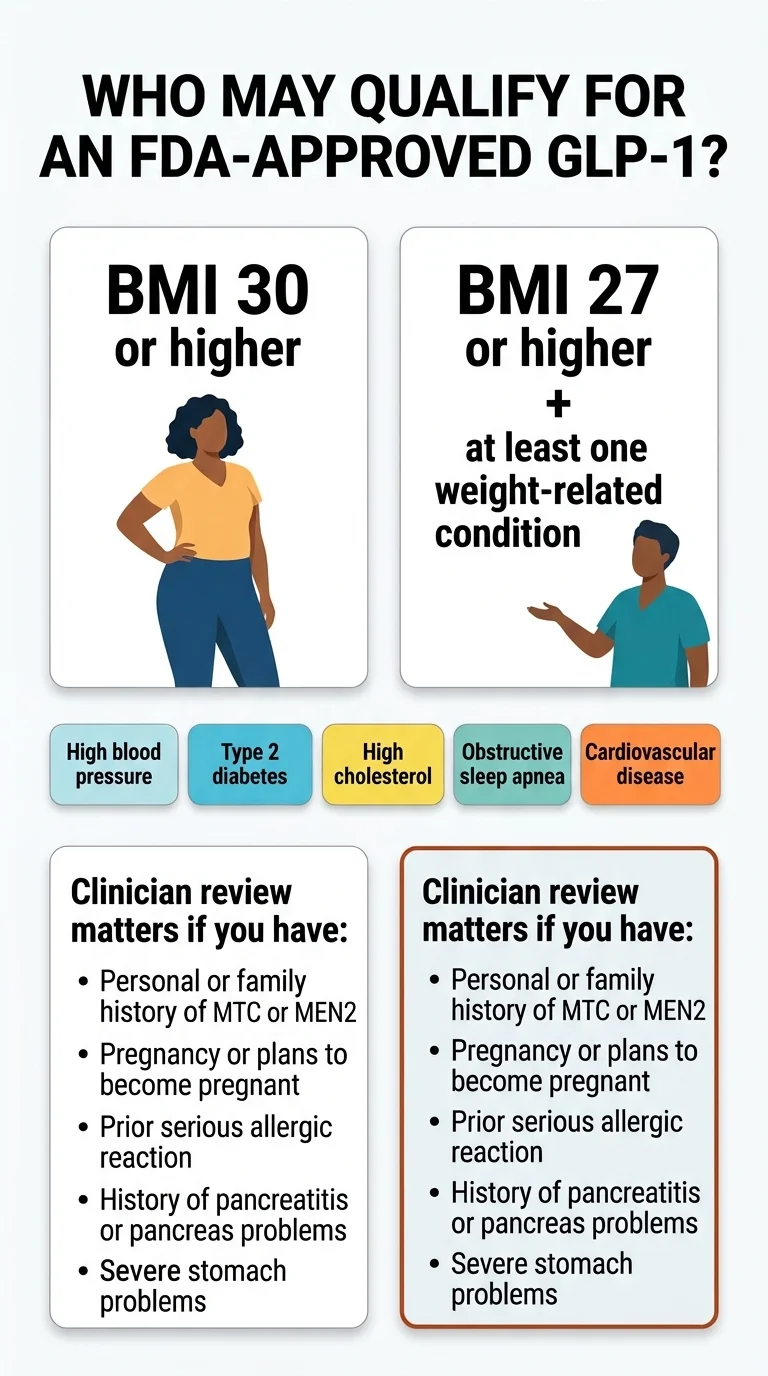
Standard Adult Eligibility (Wegovy, Zepbound, Saxenda)
You likely qualify if you have:
- BMI of 30 or higher (obesity), OR
- BMI of 27 or higher with at least one weight-related health condition
Weight-related conditions that count include type 2 diabetes, high blood pressure, high cholesterol, obstructive sleep apnea, cardiovascular disease, and certain liver conditions. Most adults carrying significant extra weight have at least one of these.
Wegovy (injection) and Saxenda are also approved for adolescents ages 12 and up with obesity.
Who Should Not Take a GLP-1
Your provider will screen for all of this, but you should know the basics going in.
Do not use (contraindications per FDA labeling):
- Personal or family history of medullary thyroid carcinoma (MTC) or Multiple Endocrine Neoplasia syndrome type 2 (MEN2)
- Known serious hypersensitivity to semaglutide, tirzepatide, liraglutide, or any ingredient in the specific medication
Needs clinician review / extra caution:
- History of pancreatitis or pancreas problems
- Severe gastrointestinal conditions (e.g., gastroparesis)
- Kidney problems
- Diabetic retinopathy
- Pregnancy, plans to become pregnant, or breastfeeding
This isn't meant to scare you — it's meant to reinforce why getting a real prescription from a licensed clinician matters. They screen for these things so you don't have to guess. That screening is the entire point. Read more in our full GLP-1 contraindications guide.
The Insurance vs. Clinical Qualification Gap
Here's something nobody tells you upfront: qualifying medically and getting your insurance to approve it are two different battles. You might meet every clinical criterion and still face a prior authorization process that takes days or weeks. Some insurers require documentation of previous weight-loss attempts. Others want lab work.
This is exactly why working with a provider that handles insurance paperwork makes such a practical difference. More on that below.
How to Actually Get an FDA-Approved GLP-1: Three Paths
You have three real options. All are legitimate. The best one depends on your situation.
Path 1: Telehealth Provider (Fastest for Most People)
This is how the majority of new GLP-1 patients start in 2026. Here's the typical process:
- Complete an online health assessment — takes 5–10 minutes. You'll answer questions about your weight, health history, current medications, and goals.
- Licensed provider reviews your information — usually within 24–48 hours. Some platforms don't require a video visit; others schedule one if clinically needed.
- If eligible, you get a personalized prescription — for the FDA-approved GLP-1 that fits your health profile and budget.
- Insurance check or cash-pay setup — the provider's team determines whether your insurance covers it and handles prior authorization if needed.
- Medication ships to your door or goes to your pharmacy — depending on whether you're using insurance or paying cash.
- Ongoing care — dose adjustments, side effect management, check-ins. All online.
With Ro specifically, a provider determines eligibility within about 2 days. If paying cash, you can have your first dose in less than a week. If using insurance, the coverage and prior-authorization process typically takes about 2–3 weeks.
Path 2: Your Primary Care Doctor or an Obesity Specialist
Best for people who already have a physician they trust, or who have a complex medical history that warrants in-person care. The process is the same — evaluation, prescription, pharmacy — but scheduling can take longer, and not every PCP is experienced with GLP-1 prescribing. If yours isn't, ask for a referral to a board-certified obesity medicine (ABOM) physician.
Path 3: Retail Pharmacy Clinic or Walk-In Program
Walgreens, CVS, and similar retail chains now offer weight management programs with GLP-1 prescribing. Walgreens' program starts at $49 per clinical visit, with medication cost separate. These work well if you prefer a local, no-subscription approach and want to pick up medication in person.
Best Provider for Most People: Why We Recommend Ro
Before recommending any provider, we check four things: (1) Do they prescribe FDA-approved medications through state-licensed pharmacies? (2) Do they use clinicians licensed in your state? (3) Is pricing transparent — including what's separate from medication cost? (4) Do they offer real ongoing clinical support? (We expand this into a full 10-point legitimacy checklist later in this guide.)
We reviewed the major telehealth GLP-1 providers — Ro, Hims, Hers, Calibrate, WeightWatchers Clinic, Noom Med, and several smaller platforms — against these criteria.
Ro stood out, and here's specifically why.
What makes Ro different from most telehealth weight-loss platforms:
- Insurance concierge included in the membership. This isn't a checkbox feature. Ro has a dedicated team that contacts your insurer, submits prior authorization paperwork, and fights for coverage — at no additional charge. For most people, this alone saves hours of frustration and potentially hundreds of dollars per month.
- Manufacturer-linked cash-pay pricing. Ro is integrated directly with NovoCare (Novo Nordisk's pharmacy) and LillyDirect (Eli Lilly's pharmacy), offering cash-pay prices that are often significantly lower than retail pharmacy pricing.
- FDA-approved medication focus. Ro's current weight-loss program emphasizes FDA-approved GLP-1s — Wegovy (pill and injection), Zepbound, and Ozempic — prescribed through licensed providers.
- Available in all 50 states with licensed providers.
- Transparent pricing. The Ro Body membership costs $45 for the first month, then $145/month. Medication cost is separate and depends on your insurance coverage and which drug is prescribed.
What Ro members say (provider-published paid testimonials from ro.co):
“Ro has been an extremely integral part of my weight loss journey. The open communication and personalized care and support they provide are crucial aspects in one's success.” — Stephanie T., Ro member
The honest tradeoff: The membership fee adds $145/month on top of medication cost. That's real money. And if you're going the insurance route, the prior-authorization process can take 2–3 weeks before you start treatment. We know that feels slow when you've already made the decision to start.
But here's how to think about it: those 2–3 weeks are the difference between paying cash out of pocket ($149–$449/month depending on the medication) and potentially paying $25/month with insurance coverage and a manufacturer savings card. Ro's concierge handles all the paperwork. You don't call your insurance company. You don't fill out prior-auth forms. They do.
For most people — especially if you have any form of private insurance — this is the single best starting point.
If you don't qualify for treatment, you won't be charged the membership fee.
Quick Comparison: Best Starting Routes for FDA-Approved GLP-1s
| Route | Best For | Insurance Help? | Monthly Program Cost | Medication Starts At |
|---|---|---|---|---|
| Ro | Most people — especially if navigating insurance | Yes — full concierge | $45 first month, $145 after | $149/mo (Wegovy pill, cash) |
| Hims / Hers | Women-focused care, pill-curious readers | Limited | Varies by plan | Varies by medication and plan |
| Walgreens Clinic | Local pickup, no subscription wanted | No | $49 per visit | $149/mo (Wegovy pill, cash) |
| Your PCP | Complex medical history, existing relationship | Through your insurance directly | Office visit copay | Depends on insurance |
Verified March 2026. Medication costs are separate from program/membership fees in all cases.
Other Legitimate Options Worth Knowing
Hims / Hers — Hims & Hers announced a collaboration with Novo Nordisk to bring Ozempic injections and Wegovy pills and injections to the platform, with pricing starting as low as $149/month. Hims says it currently offers access to branded options including Ozempic, Wegovy, Mounjaro, and Zepbound, with availability varying by state and eligibility. Hers offers a women-focused experience. Solid option if you're already in their ecosystem or prefer a women-specific platform.
Walgreens Weight Management — $49 per clinical visit, no subscription required. Medication cost is separate. Works well if you prefer local pharmacy pickup and don't want a monthly membership commitment.
Your own doctor — Always a valid path. If you have a PCP you trust, bring this up at your next appointment. Many primary care physicians are now comfortable prescribing GLP-1s for weight management. The main downside is scheduling — it may take weeks to get an appointment, and not every PCP has deep experience with GLP-1 titration and side-effect management. Our guide on how to talk to your doctor about GLP-1s can help you prepare.
What It Actually Costs: 2026 Pricing Breakdown
Let's kill the ambiguity. Here's what you're looking at depending on your situation.
If You're Paying Cash (No Insurance)
Prices below are program-specific self-pay prices available through Ro or manufacturer self-pay offers, not universal retail prices. The Ro Body membership ($45 first month, $145/month after) is separate from medication cost.
| Medication | Monthly Cash Price | Where to Get It |
|---|---|---|
| Wegovy pill (1.5 mg or 4 mg starting dose) | $149/mo | Ro, NovoCare, CVS, Costco |
| Wegovy pill (9 mg or 25 mg maintenance) | $299/mo | Same |
| Wegovy injection (first 2 months, 0.25–0.5 mg) | $199/mo (promo ends 3/31/2026) | Ro, NovoCare |
| Wegovy injection (maintenance doses) | $349/mo | Same |
| Zepbound vials (2.5 mg) | $299/mo | Ro, LillyDirect |
| Zepbound vials (5 mg) | $399/mo | Same |
| Zepbound vials (7.5–15 mg) | $449/mo (with current self-pay offer) | Same |
| Generic liraglutide (Saxenda generic) | Varies by pharmacy | Retail pharmacies |
Promotional pricing has expiration dates noted. Source: Ro published pricing page, NovoCare, LillyDirect as of March 2026.
If You Have Private / Commercial Insurance
This is where the math changes dramatically:
- With the Wegovy Savings Offer: as low as $25/month if your insurance covers Wegovy
- With the Zepbound Savings Card: as low as $25/month with coverage
- Without coverage but with a savings card: Wegovy runs approximately $650/month with the savings offer; Zepbound varies
The catch: many insurance plans require prior authorization. That means your provider submits documentation to your insurer proving you meet the criteria. Some plans approve it in days. Others require appeals. This is where having a team like Ro's insurance concierge makes a measurable difference — they handle the entire process and don't stop at the first denial.
If You Have Medicare
This is changing fast — and the details matter.
The Medicare GLP-1 Bridge (starting July 1, 2026): CMS announced a short-term demonstration program that will provide eligible Medicare Part D beneficiaries with access to GLP-1 medications for weight loss. Here's what we know from CMS's published FAQ:
- Eligible medications: Wegovy (injection and tablets) and Zepbound — these are the weight-loss products CMS specifically names for the Bridge.
- Beneficiary cost: $50 per month for eligible medications.
- Duration: July 1, 2026 through December 31, 2026.
- Eligibility criteria: BMI ≥ 30 with specific qualifying conditions (heart failure with preserved ejection fraction, uncontrolled hypertension on two medications, or chronic kidney disease stage 3a+), among other requirements. Not all Medicare beneficiaries will qualify.
- This is not broad Medicare anti-obesity drug coverage. It's a targeted demonstration that operates outside the standard Part D benefit.
After the Bridge: The BALANCE Model is expected to launch for Medicare Part D plans in January 2027, providing longer-term access. Beneficiaries who want to continue will need to enroll in a Part D plan that participates in BALANCE.
Important: Ro currently says it cannot help coordinate GLP-1 medication coverage for government insurance plans (Medicare, Medicaid), except for those with Federal Employee Health Benefits (FEHB). Medicare beneficiaries should work with their prescribing provider and Part D plan directly for Bridge access.
The HSA/FSA Angle
HSA and FSA eligibility for weight-loss medications depends on the medical reason for treatment and your plan's specific rules. The IRS says weight-loss program expenses are payable or reimbursable only when they treat a specific disease diagnosed by a physician. If your GLP-1 is prescribed to treat obesity as a diagnosed condition, it may qualify — but confirm with your benefits administrator before relying on HSA/FSA reimbursement.
How to Tell If an Online GLP-1 Provider Is Legitimate
This might be the most important section on this page. The GLP-1 space is flooded with providers — some excellent, some sketchy, some outright dangerous. Here's how to tell the difference in about 60 seconds.
The Legitimacy Checklist
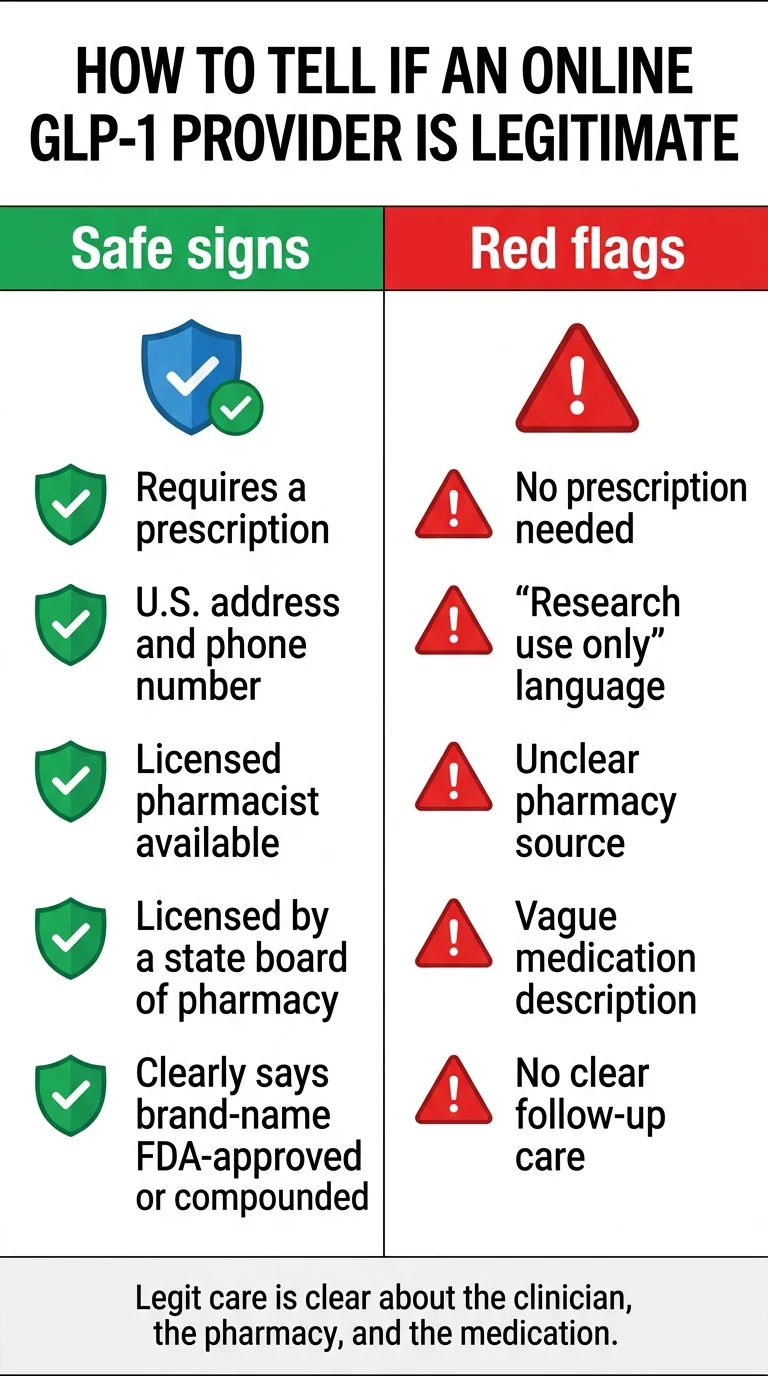
Before you hand over your credit card or health information, verify these ten things:
- Requires a real prescription — If a site sells you GLP-1 medication without a medical evaluation, leave immediately.
- Prescribing clinician is licensed in your state — Ask if you're unsure. Legitimate platforms use providers licensed in every state they operate in.
- Medication is filled through a state-licensed pharmacy — Not shipped from an overseas facility. Not from an unidentifiable source.
- Clearly states whether the medication is brand-name FDA-approved or compounded — If the site is vague about this, that's a red flag.
- Shows the exact drug name and formulation you'll receive — “Semaglutide injection” is not specific enough. You should know whether you're getting Wegovy, Ozempic, or a compounded product.
- Has a clear follow-up and dose-adjustment process — GLP-1s require titration (gradual dose increases). A provider that writes one prescription and disappears is not providing adequate care.
- Pricing is transparent — You should know the membership cost, medication cost, and any additional fees before you start.
- Cancellation policy is clear and accessible — Not buried in terms of service.
- Explains insurance and prior authorization — Even if they don't accept insurance directly, they should be upfront about it.
- Verifiable contact information and support — A real U.S. address, phone number or chat support, and responsive customer service.
Red Flags That Should Make You Close the Tab
- “No prescription needed”
- Pricing that seems impossibly low with no explanation
- “Research use only” language anywhere on the site
- No mention of which pharmacy fills the prescription
- Vague references to “pharmaceutical-grade” ingredients without naming the exact product
- No follow-up care or provider access after the initial prescription
The FDA's BeSafeRx program offers resources for verifying whether an online pharmacy is safe. If something feels off, trust that instinct. See also our hidden fees guide for what to look for in pricing.
Which FDA-Approved GLP-1 Is Right for You?
This is the decision framework. Find your situation, get your answer.
“I want the cheapest FDA-approved option and I'm paying cash.”
Wegovy pill, starting dose: $149/month. This is the lowest entry point for any FDA-approved weight-loss GLP-1 in 2026. The OASIS 4 clinical trial showed approximately 13.6% mean body weight loss at 64 weeks. Start a free check through Ro to see if you're eligible.
“I hate needles. Is there a pill?”
Yes — the Wegovy pill. Launched January 2026. Once daily, no injection, no pen. Same active ingredient (semaglutide) that's been studied in thousands of patients. Available through Ro and most major pharmacies. Read our full Wegovy pill guide.
“I want the maximum weight loss possible.”
Zepbound (tirzepatide). It's a dual-action medication targeting both GLP-1 and GIP receptors. Clinical trials showed 15–21% body weight loss. It's the strongest FDA-approved option for weight loss on the market right now. Available in vials (more affordable for cash pay) or pens (more convenient, usually insurance). See our best tirzepatide guide.
“I have type 2 diabetes AND want to lose weight.”
Mounjaro (tirzepatide) or Ozempic (semaglutide). Both are FDA-approved for diabetes with significant weight-loss effects. Insurance is more likely to cover them under a diabetes indication. Check your Part D plan for coverage and copay details.
“I have private insurance that covers weight-loss medication.”
Wegovy injection or Zepbound pens with manufacturer savings cards. Your out-of-pocket could be as low as $25/month. Use a provider like Ro that checks your coverage and handles prior authorization for you.
“I'm on Medicare.”
Starting July 1, 2026, the Medicare GLP-1 Bridge will offer eligible Part D beneficiaries access to Wegovy and Zepbound for weight loss at a $50/month copay. Eligibility requires BMI ≥ 30 with specific qualifying conditions. Talk to your prescribing provider about whether you meet the Bridge criteria. For diabetes-indicated GLP-1s (Ozempic, Mounjaro), check your existing Part D coverage.
“I just want someone to tell me what to do.”
Start with Ro's free eligibility check. A licensed provider reviews your health profile, goals, and budget — then recommends the FDA-approved GLP-1 that fits your situation. You don't need to have it all figured out before you start.
What to Expect After You Start
Knowing what's coming makes the first few weeks easier. Here's the honest timeline.
Weeks 1–4: The Adjustment Period
You'll start on a low dose. This is called titration — your provider gradually increases the dose over several weeks to minimize side effects. Most people experience some combination of:
- Nausea — the most common side effect. Usually mild and improves as your body adjusts. Eating smaller meals and staying hydrated helps significantly.
- Reduced appetite — this is actually the medication working, not a side effect. The “food noise” that many people describe — the constant mental chatter about what to eat next — often quiets down within the first couple of weeks.
- Mild fatigue or headache — typically temporary.
Some people lose 2–5 pounds in the first month. Others don't see movement on the scale until doses increase. Both are normal.
Months 1–3: Momentum Builds
As your dose increases toward the maintenance level, appetite suppression becomes more pronounced. Early progress varies widely — some people see significant scale movement by month two, others need longer. Side effects tend to settle. Energy often improves. Clothes start fitting differently.
Months 3–12: The Transformation Window
This is where the clinical trial data comes alive in real life. Published studies show:
- Semaglutide (Wegovy): average 14–17% body weight loss over 12–16 months
- Tirzepatide (Zepbound): average 15–21% body weight loss over 18 months
- Liraglutide (Saxenda): average 5–8% body weight loss
For someone starting at 250 pounds, that translates to roughly 35–50+ pounds with semaglutide or tirzepatide based on trial averages. Individual results vary — your outcome will depend on dosing, consistency, diet, movement, and your individual biology.
The Part Nobody Loves Talking About
Most people regain weight if they stop GLP-1 therapy entirely. This is not a character flaw — it's biology. These medications work by modifying how your brain and gut communicate about hunger and satiety. When you remove the medication, those signals revert.
That's why the best providers treat this as long-term care, not a short-term fix. Your clinician should discuss maintenance strategies early — which might include a lower maintenance dose, sustained lifestyle changes, or continued treatment.
Think of it the way you'd think about blood pressure medication. Nobody considers it a failure to take a daily pill that keeps your blood pressure in a healthy range. Weight management is increasingly understood the same way.
The Honest Downsides of the FDA-Approved Path
We'd lose all credibility if we pretended this was frictionless. It isn't.
It costs real money. Even with the price drops in 2025–2026, you're looking at $149–$449/month depending on the medication and whether you have insurance. That's a serious monthly commitment.
Insurance can be maddening. Prior authorization is real. Some plans deny coverage on the first attempt. Appeals take time. It's frustrating — and it's one of the main reasons people drift toward cheaper, less-regulated alternatives.
Side effects are real. Nausea, GI discomfort, occasional fatigue. Most are manageable with proper titration, but they're not zero.
It's a long-term commitment. The evidence strongly suggests you need to stay on some form of treatment to maintain results. That's not everyone's preference.
But here's the flip side of every one of those points:
Cash-pay options are materially lower than historical list prices. A year ago, there was no FDA-approved GLP-1 weight-loss pill at any price. Today the Wegovy pill starts at $149/month. Insurance coverage is expanding — the Medicare GLP-1 Bridge launches in July 2026. Manufacturer savings cards can bring insured patients down to $25/month.
And the most important upside: you know exactly what you're getting. An FDA-approved medication that was tested in rigorous clinical trials, manufactured under strict quality control, prescribed by a licensed clinician, and filled at a real pharmacy.
That peace of mind has a value that's hard to put a price on — especially when the alternative is wondering whether the vial you received from an anonymous compounding pharmacy actually contains what the label says it does.
Free assessment. Insurance help included. If you don't qualify, you're not charged.
How Insurance Approval Usually Works
If you've never dealt with prior authorization before, here's what to expect.
What Prior Authorization Is
It's your insurance company's way of saying “prove to us this patient actually needs this medication before we'll pay for it.” Your provider submits documentation — your BMI, health conditions, sometimes evidence of previous weight-loss attempts — and the insurer reviews it.
What Insurers Typically Want to See
- Current BMI and weight
- Documented weight-related health conditions
- Sometimes: evidence of a previous structured weight-loss attempt (diet, exercise program)
- Prescriber's clinical rationale
How Long It Takes
Approval timelines vary by insurer and prior-authorization requirements. Ro's published process says the insurance workflow typically takes about 2–3 weeks. Some straightforward cases resolve faster; others require appeals that take longer.
Why Having Help Matters
This is where a platform like Ro earns its membership fee many times over. Their insurance concierge team knows which insurers require what documentation, how to structure appeals, and how to escalate when initial requests are denied. You don't make the phone calls. You don't fill out forms. They handle it.
If your insurance won't cover it after the full process, your Ro provider pivots you to FDA-approved cash-pay options through manufacturer-linked pricing — often significantly lower than retail pharmacy pricing.
Questions to Ask Before You Pay Any Provider
Print this list. Screenshot it. Use it before handing over your payment information to any GLP-1 provider — online or in person.
- Is this medication FDA-approved brand-name, or is it compounded?
- Which exact drug and formulation will I receive?
- Is the prescribing clinician licensed in my state?
- Which pharmacy fills the prescription? Is it state-licensed?
- Who handles prior authorization if my insurance requires it?
- What fees are separate from the medication cost?
- How do follow-up appointments and dose adjustments work?
- What's the cancellation process?
- What happens if I don't qualify for treatment?
- Can I see your affiliate disclosure and editorial policy?
Any provider worth your trust will answer these questions clearly and without hesitation. If they dodge, deflect, or get vague — that tells you everything you need to know.
How We Researched and Verified This Guide
We take this seriously because you're making a health decision, not picking a restaurant.
Clinical and regulatory claims are sourced from FDA prescribing information, FDA.gov official communications, published clinical trials (OASIS 4, STEP, SELECT, SURMOUNT), NIDDK, and CMS.gov.
Pricing data was confirmed from primary source materials: manufacturer websites (NovoCare, LillyDirect), Ro's published pricing page, and major pharmacy platforms as of March 2026. We note promotional end dates where applicable.
Provider evaluations are based on published service pages, publicly available terms, Trustpilot reviews, BBB records, and the 10-point legitimacy checklist in this article. We did not accept payment from any provider for placement. We do earn affiliate commissions from Ro when readers start treatment through our links — and we disclose that openly.
What we confirmed from primary sources:
- Ro's insurance concierge process (from their published service pages and user reviews)
- Wegovy pill launch date and pricing (from Novo Nordisk press release and Ro pricing page)
- Wegovy HD approval (from FDA press announcement, March 19, 2026)
- Medicare GLP-1 Bridge details (from CMS.gov published FAQ)
- Generic Saxenda availability (from FDA approval records, Teva launch announcement)
What we did not verify firsthand: Individual insurance approval timelines, which vary significantly by carrier and state. We report ranges based on provider-published statements and user experiences.
This page is reviewed and updated monthly or whenever significant pricing, regulatory, or approval changes occur.
Frequently Asked Questions
Do you need a prescription to get a GLP-1?
Yes, without exception. Every GLP-1 medication — whether FDA-approved or compounded — requires a prescription from a licensed healthcare provider. Any site that sells GLP-1 medication without a medical evaluation is operating outside the law. Online providers like Ro make the prescription process fast and entirely digital, but a real clinician still reviews your health information and makes the prescribing decision.
Can you get a GLP-1 online?
Yes. Multiple telehealth platforms — including Ro, Hims, Hers, and others — connect you with licensed providers who can evaluate your eligibility and prescribe FDA-approved GLP-1s online. Most don’t require a video visit for the initial consultation.
Can you get a GLP-1 without insurance?
Yes. Cash-pay options are available for all FDA-approved GLP-1s. The Wegovy pill starts at $149/month. Zepbound vials start at $299/month. These prices are available through Ro and directly through manufacturer pharmacy programs (NovoCare, LillyDirect). No insurance required.
Is there an FDA-approved GLP-1 pill?
Yes. Oral Wegovy (semaglutide tablets, available in 1.5 mg, 4 mg, 9 mg, and 25 mg doses) was FDA-approved in December 2025 and launched in January 2026. It’s the first and currently only GLP-1 pill approved for weight loss. Rybelsus is another oral semaglutide product, but it’s approved only for type 2 diabetes at lower doses. Eli Lilly’s orforglipron — another oral GLP-1 — is under FDA review with a decision expected by mid-2026.
Are compounded GLP-1s FDA-approved?
No. Compounded GLP-1 medications are not FDA-approved. They are not reviewed by the FDA for safety, effectiveness, or quality. The FDA declared the semaglutide shortage resolved in February 2025 and has been taking enforcement actions against compounders using unapproved salt forms and unauthorized marketing. If you specifically want an FDA-approved medication, compounded products are not that.
Is Ozempic FDA-approved for weight loss?
No. Ozempic is FDA-approved for type 2 diabetes management and cardiovascular risk reduction. It contains the same active ingredient (semaglutide) as Wegovy, but it’s a different product with a different FDA approval. Doctors can and do prescribe Ozempic off-label for weight loss, but insurance is less likely to cover it for that purpose.
Is Mounjaro FDA-approved for weight loss?
No. Mounjaro is FDA-approved for type 2 diabetes. Zepbound is the weight-loss version — same active ingredient (tirzepatide), different brand name and approval. Your insurance is more likely to cover Zepbound for weight loss and Mounjaro for diabetes.
Who qualifies for Wegovy or Zepbound?
Adults with a BMI of 30 or higher, or BMI of 27 or higher with at least one weight-related health condition (type 2 diabetes, high blood pressure, high cholesterol, sleep apnea, cardiovascular disease). Wegovy is also approved for adolescents ages 12 and up.
What disqualifies you from GLP-1 treatment?
The true contraindications per FDA labeling are: personal or family history of medullary thyroid carcinoma (MTC) or MEN2 syndrome, and known serious hypersensitivity to the medication’s ingredients. Other conditions — including history of pancreatitis, severe GI conditions, kidney problems, and pregnancy — require closer clinician review and may affect whether a GLP-1 is appropriate for you. Your provider screens for all of these during the consultation.
How long does insurance approval take?
Typically 48 hours to 3 weeks, depending on your insurer and whether an appeal is needed. Providers like Ro that include insurance concierge services handle the prior-authorization process on your behalf, which can significantly reduce the time and frustration involved.
What happens if I stop taking a GLP-1?
Most people experience some weight regain after stopping treatment. GLP-1 medications work by modifying appetite and satiety signals. When the medication is discontinued, those signals revert. This is why most providers recommend thinking of GLP-1 therapy as long-term treatment, similar to medications for blood pressure or cholesterol. Your clinician should discuss maintenance strategies — potentially including a lower maintenance dose — early in your treatment.
What changed most recently in the GLP-1 space?
On March 19, 2026, the FDA approved Wegovy HD (semaglutide 7.2 mg injection) — a higher dose for adults with obesity who have tolerated the 2.4 mg dose and need additional weight reduction. In the STEP UP clinical trial, Wegovy HD showed approximately 21% average weight loss at 72 weeks. Novo Nordisk expects to launch Wegovy HD in April 2026. Additionally, Eli Lilly’s orforglipron (an oral GLP-1 for weight loss) is under FDA review, with a decision expected mid-2026.
Are GLP-1 shortages still happening?
The national shortages of semaglutide and tirzepatide that defined 2023–2024 have been largely resolved. The FDA formally declared the semaglutide shortage resolved in February 2025. Local or temporary supply disruptions can still occur, but availability is dramatically better than it was a year ago. The launch of the Wegovy pill in January 2026 added an entirely new form factor to the supply, further easing pressure on injectable inventory.
What should I do if I don’t qualify for a GLP-1?
First: don’t assume you won’t qualify. The BMI criteria are broad enough that most adults who are significantly overweight with any related health condition will meet the threshold. If you genuinely don’t qualify, your provider may recommend other FDA-approved weight-management medications (like Contrave or Qsymia), a structured lifestyle intervention program, or referral to an obesity medicine specialist. With Ro, you’re not charged the ongoing membership fee if you don’t qualify for treatment.
What’s the safest way to start a GLP-1 online?
Choose a provider that prescribes FDA-approved medications, uses state-licensed pharmacies, employs licensed clinicians in your state, and is transparent about pricing and process. Use the 10-point legitimacy checklist in this guide. For most people, Ro offers the most complete package of clinical care, insurance support, and FDA-approved medication access.
Ready to Take the Next Step?
You've done the research. You know which GLP-1s are actually FDA-approved. You understand the eligibility criteria, the real costs, and the legitimate paths to get started. The only question left is which option fits your life right now.
If you want the fastest, most supported path to an FDA-approved GLP-1:
Ro's free eligibility assessment takes about 5 minutes. A licensed provider reviews your health profile, recommends the right medication, and — if you have insurance — their concierge team handles the coverage process from start to finish. If you're paying cash, they offer FDA-approved options through manufacturer-linked pricing channels.
Ro published observational data reporting average 15.8% body-weight loss over 12 months among Body members treated with a GLP-1. That's not willpower. That's medicine working the way it's supposed to.
No commitment. No charge unless you're eligible and choose to proceed.
If Ro isn't the right fit, talk to your doctor, visit a Walgreens clinic, or explore Hims/Hers for a women-focused or pill-first option. What matters most is that you take the FDA-approved path — with a real clinician, a real prescription, and a real pharmacy.
Answer a few quick questions about your insurance, budget, and preferences, and we'll match you to the program that fits.
Sources: FDA prescribing information (Wegovy, Wegovy HD, Zepbound, Ozempic, Mounjaro, Saxenda, Rybelsus), FDA press announcement on Wegovy HD (March 19, 2026), FDA.gov safety communications, NIDDK weight management guidelines, CMS Medicare GLP-1 Bridge FAQ, CMS BALANCE Model, published clinical trials (OASIS 4, STEP, STEP UP, SELECT, SURMOUNT), Novo Nordisk press releases, Eli Lilly press releases, Ro published pricing, Ro process page, Ro published outcomes data. All pricing confirmed from primary sources March 2026.
This content is for informational purposes only and does not constitute medical advice. Always consult a licensed healthcare provider before starting any medication. Individual results vary. GLP-1 medications carry risks including nausea, gastrointestinal effects, and rare but serious side effects — your provider will review these with you.