
Switching Guide · Last Verified April 7, 2026 · Mounjaro Prescribing Information · FDA
How to Switch From Compounded Tirzepatide to Mounjaro
If you're losing access to compounded tirzepatide, here's the fast answer: don't guess your dose, don't overlap products, and make sure Mounjaro is actually the right FDA-approved destination before you switch. This guide tells you exactly how — and when Zepbound is the better path.
By The RX Index Research Team · Last updated April 7, 2026 · Last verified April 7, 2026 · Affiliate disclosure · Editorial standards
⚡ Bottom Line
Often, yes — you can switch from compounded tirzepatide to Mounjaro, but only with a clinician-guided plan. No DIY dose guessing. No overlapping leftover compound with your new prescription. And here's the question most people skip: is Mounjaro even the right brand for you?
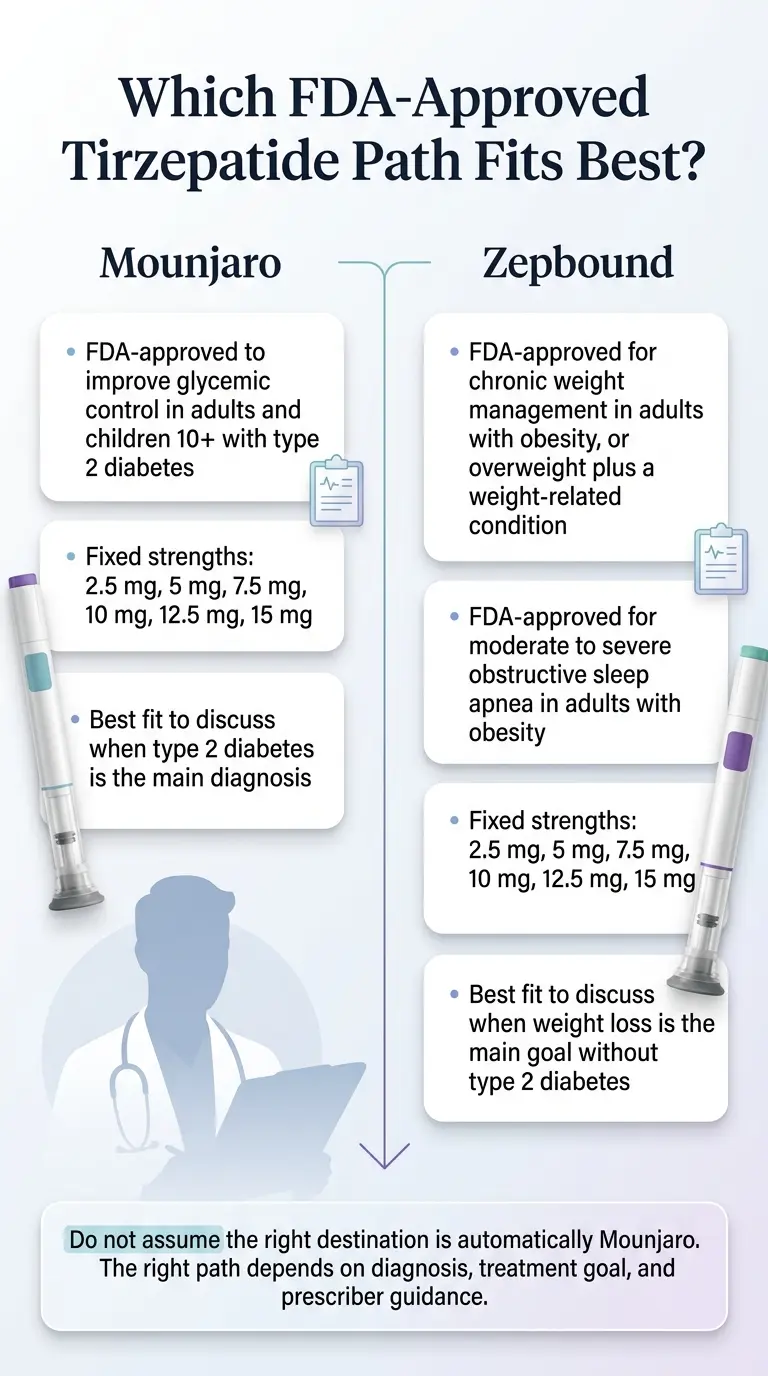
Mounjaro is FDA-approved to improve glycemic control in adults and pediatric patients 10 years and older with type 2 diabetes. Zepbound is the FDA-approved tirzepatide brand for chronic weight management and OSA in adults with obesity. If your primary goal is weight loss without a type 2 diabetes diagnosis, Zepbound is usually the cleaner FDA-approved path — and it comes with better self-pay pricing through LillyDirect.
Quick Reference: The Switch at a Glance
| Question | Fast Answer |
|---|---|
| Can you switch? | Often yes — with a clinician-guided plan |
| Do you restart at 2.5 mg? | Not always. Your prescriber needs your exact weekly mg and last dose date |
| Can you take both together? | No. Do not create a DIY overlap plan |
| Best fit for Mounjaro | Type 2 diabetes diagnosis or confirmed Mounjaro formulary coverage |
| Not the best fit for Mounjaro | Weight-loss-only readers without T2D — Zepbound is usually the better path |
| Real cost | $1,112.16 list; as low as $25 for eligible commercially insured patients |
Sources: Mounjaro prescribing information; Mounjaro FAQ; FDA compounding policy. All figures verified April 2026.
Not sure whether Mounjaro or Zepbound is your correct path?
60 seconds. Free. No email required.
Take the free GLP-1 match quiz →Should You Switch to Mounjaro or Zepbound?
This is the question the page needs to answer first, because most people searching "how to switch from compounded tirzepatide to Mounjaro" haven't thought about it yet. Mounjaro and Zepbound are both tirzepatide products made by Eli Lilly. They follow the same dosing schedule. But they carry different FDA approvals, different insurance pathways, and different self-pay pricing — and picking the wrong one creates unnecessary friction.
If You Have Type 2 Diabetes, Mounjaro Is Usually the Cleaner Path
Mounjaro is indicated, along with diet and exercise, to improve glycemic control in adults and pediatric patients 10 years of age and older with type 2 diabetes (prescribing information). That means:
- Insurance companies are far more likely to cover Mounjaro when you have a T2D diagnosis
- Prior authorization is more straightforward with supporting A1C labs
- The Mounjaro Savings Card can reduce your cost to as low as $25 for up to a 3-month prescription with qualifying commercial coverage
If your doctor originally prescribed compounded tirzepatide for diabetes management, moving to Mounjaro is the most natural transition. It's what the drug was approved for.
If Your Main Goal Is Weight Loss Without T2D, Zepbound Is Usually the Cleaner Path
Zepbound received FDA approval in November 2023 for chronic weight management in adults with a BMI of 30+ (or 27+ with at least one weight-related condition like high blood pressure, high cholesterol, or sleep apnea).
Zepbound also offers something Mounjaro doesn't: LillyDirect self-pay options. Under Lilly's current Self Pay Journey Program, Zepbound KwikPen and single-dose vials are priced at $299/month for 2.5 mg, $399/month for 5 mg, and $449/month for 7.5 mg through 15 mg. For cash-pay patients, that's dramatically cheaper than Mounjaro's $1,112 list price.
If weight loss is your primary goal and you don't have type 2 diabetes, trying to force a Mounjaro strategy often means fighting insurance denials for off-label use when an on-label Zepbound prescription would sail through.
Weight loss is your main goal?
Ro prescribes Zepbound — the FDA-approved tirzepatide for weight management — with online visits and no in-person appointment needed.
Check Zepbound eligibility on Ro →Disclosure: Some links on this page are affiliate links. If you purchase through these links, we may earn a commission at no extra cost to you.
If Insurance Covers One and Not the Other, Follow the Covered Path
This sounds obvious, but we see people fight this constantly. If your plan covers Mounjaro for diabetes but not Zepbound for weight loss, use Mounjaro. If your plan covers Zepbound but not Mounjaro, use Zepbound. Both are FDA-approved tirzepatide products at the same labeled dose strengths. Don't pay more to force the wrong label.
The Honest Truth: Mounjaro Is Not the Right Answer for Everyone
We're going to be direct about this throughout the page. If your real situation is weight loss without type 2 diabetes and without Mounjaro insurance coverage, the rest of this guide may not be your best next step. Our guide to switching from compounded tirzepatide to Zepbound covers the weight-loss-specific path, including LillyDirect self-pay pricing, Zepbound savings card details, and telehealth providers that prescribe it. We're telling you this now because every other page on this topic buries it or ignores it entirely. That costs you time and money chasing the wrong path.
Can You Switch From Compounded Tirzepatide to Mounjaro Without Starting Over?
Often yes — but the answer depends on your specific situation, not a universal rule. The Mounjaro prescribing information says new patients start at 2.5 mg once weekly, with 2.5 mg increases after at least 4 weeks at each dose. There is no official compounded-to-Mounjaro switch protocol in the labeling, so the starting-dose decision rests with your prescriber based on your exact recent mg, tolerance, and history.
Do not assume compounded tirzepatide and Mounjaro are interchangeable. Compounded tirzepatide is not FDA-approved, can differ in formulation and presentation, and the FDA has raised concerns about dosing variability with compounded GLP-1 products (FDA concerns). The switch timing and dose should be confirmed by your prescriber.
Do You Have to Restart at 2.5 mg?
Not necessarily. Many prescribers will transition patients at or near their current stable dose if they've been tolerating tirzepatide well. But several factors influence this:
- How long you've been on your current dose. Stable for months? Your prescriber has more confidence matching that dose. Just increased last week? They may want to confirm tolerance first.
- Whether you've had a gap in treatment. If you've gone more than a few weeks without tirzepatide, your prescriber may choose to re-titrate from a lower dose to reduce GI side effects.
- Your exact weekly mg. This is the critical number, and it's where most switches break down.
What "Weekly mg" Actually Means (And Why Units Aren't Enough)
This is the part that trips up the most people. If you've been using compounded tirzepatide from a vial, your label probably shows a concentration (like 10 mg/mL or 20 mg/mL) and you've been drawing a certain number of units on your syringe.
Your prescriber doesn't need to know "75 units" or "0.25 mL." They need your exact weekly dose in milligrams. The FDA has specifically flagged dosing errors as a concern with compounded tirzepatide, so getting this number right matters.
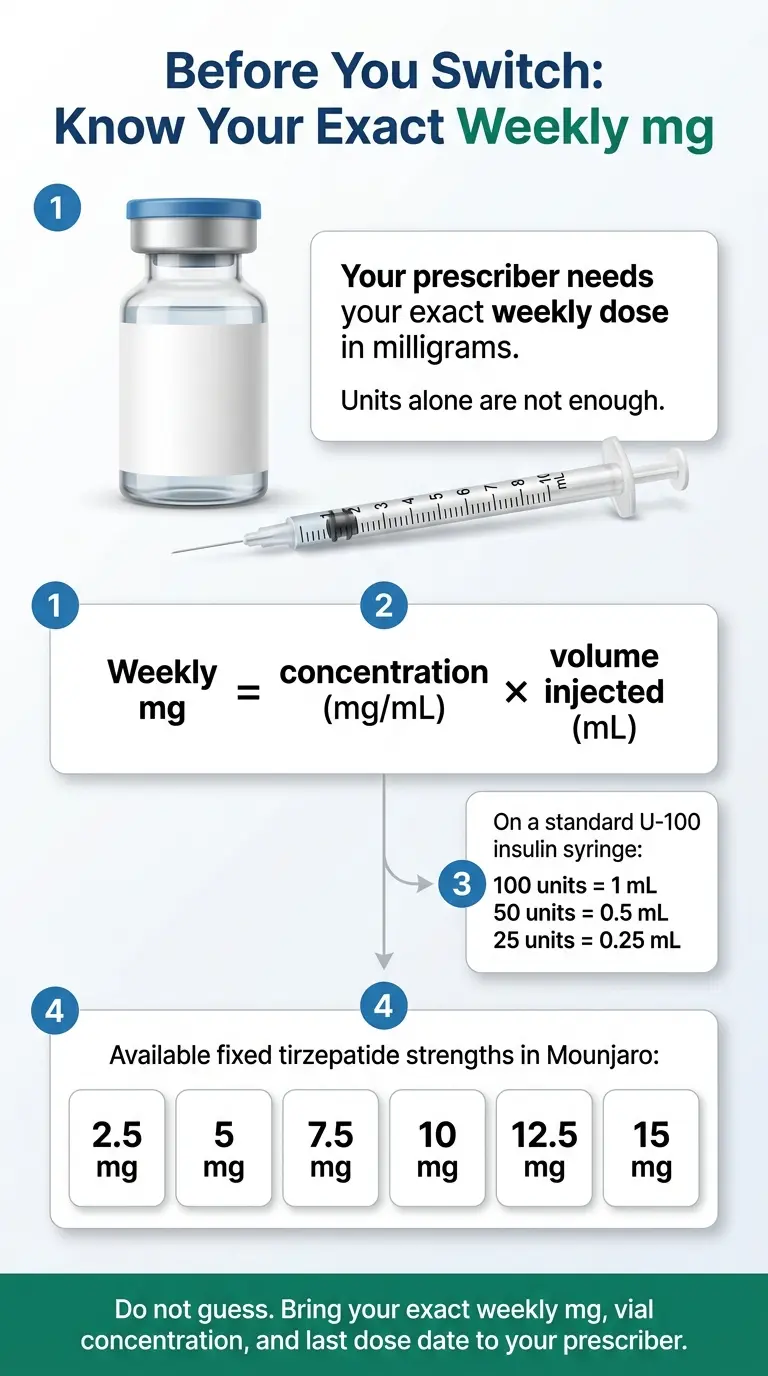
Here's the quick math:
Weekly mg = concentration (mg/mL) × volume injected (mL)
• If your vial is 10 mg/mL and you inject 0.5 mL → you're taking 5 mg/week
• If your vial is 20 mg/mL and you inject 0.5 mL → you're taking 10 mg/week
• If your vial is 30 mg/mL and you inject 0.25 mL → you're taking 7.5 mg/week
If your syringe measures in "units" rather than mL: 100 units = 1 mL on a standard insulin syringe. So 50 units = 0.5 mL. 25 units = 0.25 mL.
Mounjaro's labeled dose strengths are 2.5, 5, 7.5, 10, 12.5, and 15 mg. If your compounded dose lines up exactly with one of those strengths, the conversation with your prescriber is straightforward. If you've been on a custom in-between dose — say 3.5 mg or 8 mg — your prescriber will round to the nearest available strength and monitor how you respond.
If you've been on a compounded dose above 15 mg, that's an important conversation. Mounjaro's maximum FDA-approved dose is 15 mg weekly. The FDA has noted concerns about compounded tirzepatide doses higher than what the approved labeling supports.
Can You Take Leftover Compounded Tirzepatide and Mounjaro Together?
No. Do not create a DIY overlap plan. We see this question constantly in forums — people asking whether they can alternate doses or "bridge" between products to avoid wasting their remaining compound. The Zepbound prescribing information specifically states not to coadminister with other tirzepatide-containing products. This applies to mixing compounded tirzepatide with brand-name products as well.
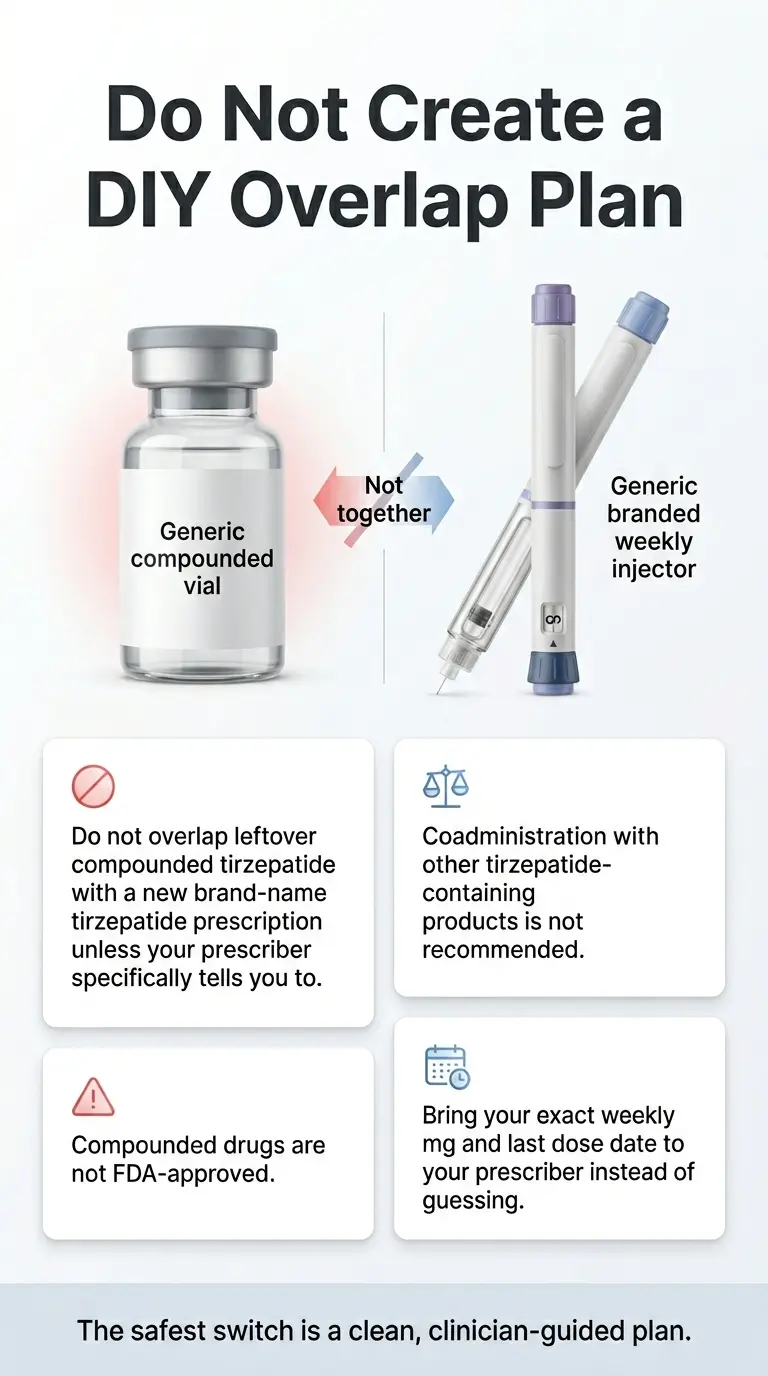
Do not overlap leftover compounded tirzepatide with a new brand-name tirzepatide prescription unless your prescriber specifically tells you to.
Doubling up or alternating tirzepatide products creates unpredictable dosing. You won't know your actual weekly exposure.
If you experience side effects, you and your prescriber won't know which product caused them.
The FDA has received adverse event reports associated with compounded tirzepatide, including dosing-related concerns.
Talk to your prescriber about leftover compound. In most cases, you'll stop the compounded product and your prescriber will confirm when to start Mounjaro based on your last dose date and the once-weekly dosing schedule.
What You Need Before Your Prescriber Visit
Most switches don't break at the medical step. They break at the paperwork step. The actual medication change is straightforward for your prescriber — but showing up without the right information means delays, extra appointments, and potentially a gap in treatment.
7 things to bring or have ready:
Your exact weekly dose in milligrams
Not units. Not 'the dose my provider set.' The actual mg number. Use the conversion math above.
Your vial concentration
The mg/mL number from your compounded tirzepatide label.
Your last dose date
When did you take your most recent injection? This matters for timing the switch.
Your side effect history on tirzepatide
Any nausea, vomiting, GI issues? How severe? Did they resolve? This helps your prescriber gauge whether to match your dose or step down slightly.
Your diagnosis and treatment goal
Type 2 diabetes? Weight management? Both? This determines whether Mounjaro or Zepbound is the right prescription.
Your insurance information
Policy number, pharmacy benefit details, and whether your plan has previously covered Mounjaro or Zepbound.
Your preferred pharmacy
Mounjaro is filled at standard retail pharmacies, unlike most compounded tirzepatide which came from specialty compounders.
Copy/Paste Message for Your Prescriber
If you're working with a telehealth provider or want to give your doctor a head start, here's a message template you can customize and send before your appointment:
"I've been taking compounded tirzepatide at [X mg/week] (concentration: [X mg/mL], injecting [X mL]) for [X months]. My last injection was [date]. I'm looking to transition to FDA-approved Mounjaro [or Zepbound] because [my compounding pharmacy is no longer filling / my insurance now covers brand-name / I want the consistency of an FDA-approved product]. My primary diagnosis/goal is [type 2 diabetes / weight management / both]. I'd like to discuss the appropriate starting dose and any prior authorization requirements."
How to Switch From Compounded Tirzepatide to Mounjaro: Step by Step
The medical part takes minutes. The insurance and pharmacy logistics take days. Start the paperwork before your compound runs out.
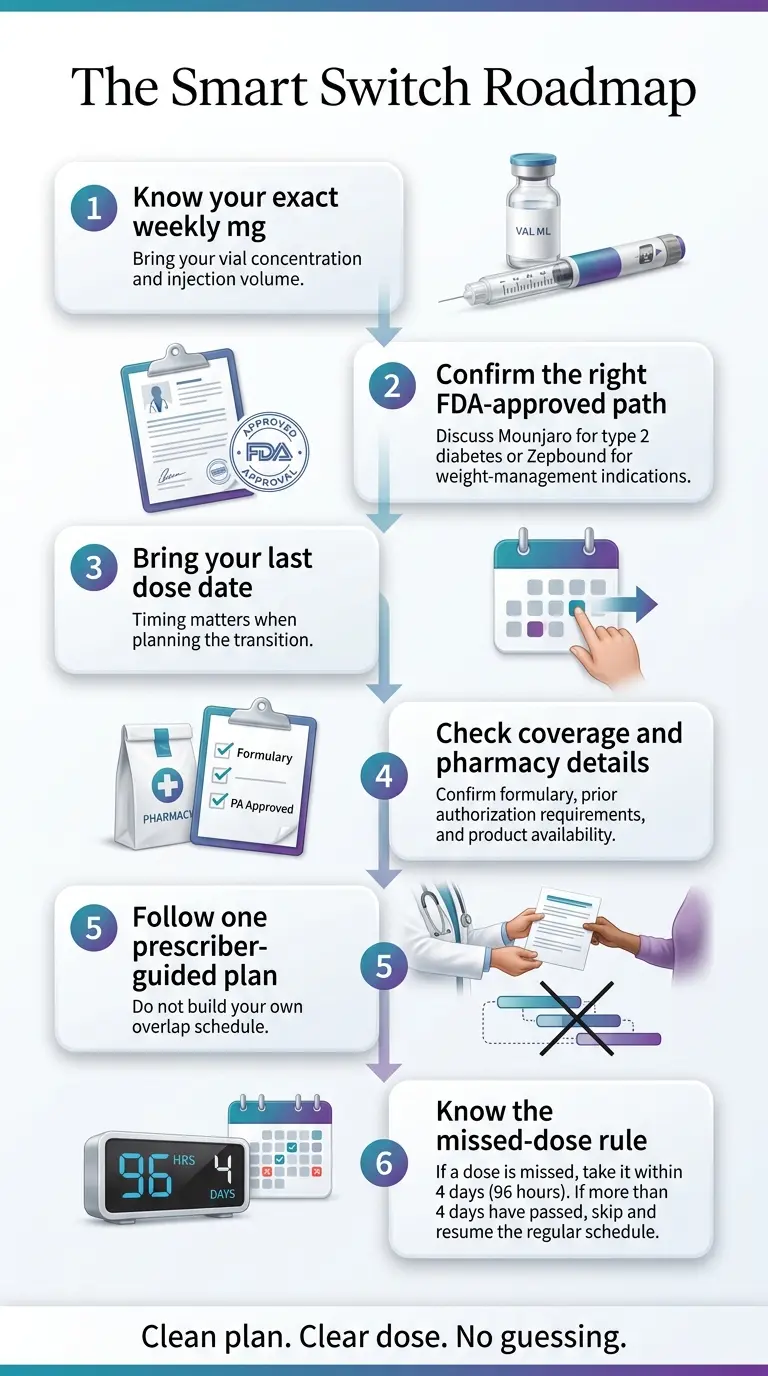
Step 1: Document Your Exact Weekly mg and Last Dose Date
Before anything else, calculate your weekly mg using the formula above. Write it down. You'll need it for the prescriber visit, the insurance prior authorization, and the pharmacy fill. This one number drives everything that follows.
Step 2: Confirm Mounjaro Is the Right Brand for Your Diagnosis
Review the routing section above. If you have type 2 diabetes, Mounjaro is usually the right call. If your goal is weight loss without T2D, Zepbound may be a smoother path. Don't guess — the wrong brand costs you time and money in denied prior authorizations.
Step 3: Schedule a Prescriber Visit and Discuss Your Transition Plan
This can be an in-person visit or a telehealth appointment. Your prescriber will: confirm the target Mounjaro dose strength based on your current mg; decide whether to match your dose or re-titrate from a lower strength; write the Mounjaro prescription; initiate prior authorization if required by your plan. Timing matters — schedule this visit well before your compounded supply runs out.
Step 4: Check Formulary and Prior Authorization
Call your insurance company or have your prescriber's office check: Is Mounjaro on your plan's formulary? Is prior authorization required? What documentation does the PA require (usually diagnosis codes, A1C labs for diabetes, BMI for weight management)?
Step 5: Activate the Mounjaro Savings Card (If Eligible)
Visit mounjaro.lilly.com/savings-resources and enroll. This takes about 5 minutes. Eligibility: U.S. resident 18+, valid Mounjaro prescription for an FDA-approved use, commercial (private) insurance — not Medicare, Medicaid, or TRICARE. If your commercial plan covers Mounjaro, the savings card can bring your cost to as low as $25 for up to a 3-month prescription. The card expires 12/31/2026 and savings are subject to an annual cap.
Step 6: Fill Your Prescription
Mounjaro is dispensed at standard retail pharmacies — CVS, Walgreens, Walmart, independent pharmacies. This is different from compounded tirzepatide, which usually came from specialty compounding pharmacies. Give your savings card details to the pharmacist when you pick up. They run your insurance first, then apply the savings card discount.
Step 7: Take Your First Mounjaro Dose as Directed by Your Prescriber
Your prescriber should confirm the timing based on your last compounded dose and the once-weekly dosing schedule. Mounjaro is administered once weekly on the same day each week. The official labeling provides a missed-dose rule: if a dose is missed, take it as soon as possible within 96 hours (4 days) of the missed dose. If more than 96 hours have passed, skip that dose and take the next one on the regular schedule.
Step 8: Know the Missed-Dose Rule During the Transition
If your timing slips during the transition due to insurance delays or pharmacy stock: the Mounjaro prescribing information says if a dose is missed, take it within 96 hours (4 days). If more than 96 hours have passed, skip and resume the regular schedule. Do not take two doses to make up for a missed one. If you expect a gap, contact your prescriber.
Need a provider to guide your Mounjaro or Zepbound transition?
MEDVi connects you with licensed prescribers for GLP-1 medications online.
Find a prescriber on MEDVi →Disclosure: Some links on this page are affiliate links. If you purchase through these links, we may earn a commission at no extra cost to you.
How Much Does Mounjaro Cost After You Switch?
This is the section that matters most to the majority of readers. The cost gap between compounded tirzepatide and Mounjaro's list price is the single biggest source of anxiety about switching. So let's break down what you'll actually pay.
| Your Situation | What Lilly Says | How to Access | Last Verified |
|---|---|---|---|
| Commercial insurance covers Mounjaro | As low as $25 for up to a 3-month prescription with savings card | mounjaro.lilly.com/savings-resources | April 2026 |
| Commercial insurance, Mounjaro not covered | Savings card may still reduce cost (terms vary) | Same savings card enrollment | April 2026 |
| No insurance, weight loss goal | Zepbound self-pay: $299 (2.5 mg), $399 (5 mg), $449 (7.5–15 mg) via LillyDirect | zepbound.lilly.com/savings | April 2026 |
| No insurance or coverage | Mounjaro list price: $1,112.16 for 28-day supply | Check Lilly's current affordability programs | April 2026 |
| Medicare Part D | Varies by plan; manufacturer savings card NOT eligible | Check your formulary | April 2026 |
| Medicaid | Coverage varies by state | Contact your state Medicaid office | April 2026 |
All figures from Mounjaro FAQ and Zepbound savings unless noted.
When to Pivot to Zepbound Instead of Fighting the Mounjaro Cost
If you don't have insurance coverage for Mounjaro and you're staring at the $1,112 list price, stop. Don't force this path. Zepbound KwikPen and single-dose vials through LillyDirect are $299–$449/month depending on dose under the Self Pay Journey Program (must refill within 45 days to maintain pricing). Both are FDA-approved tirzepatide products at the same labeled dose strengths.
The only reason to pursue Mounjaro specifically is if your insurance covers it or you have a type 2 diabetes diagnosis that makes the Mounjaro formulary pathway smoother.
Cash-pay and your goal is weight loss? Zepbound starts at $299/mo.
Ro prescribes Zepbound with FDA-approved, self-pay pricing through LillyDirect.
Check Zepbound eligibility on Ro →Disclosure: Some links on this page are affiliate links. If you purchase through these links, we may earn a commission at no extra cost to you.
Will Insurance Cover Mounjaro After Compounded Tirzepatide?
Coverage depends on your diagnosis, your specific plan, and whether your insurer requires prior authorization. There's no single answer, but there is a clear decision tree.
Fastest Path: Type 2 Diabetes + Commercial Insurance
If you have a type 2 diabetes diagnosis with supporting labs (A1C, fasting glucose), Mounjaro is one of the more commonly covered GLP-1 medications on commercial formularies. You'll likely need prior authorization, and payer and health-plan requirements vary.
If Your Plan Denies Mounjaro
Don't panic. There's a process:
- Ask for the denial reason in writing. Common reasons: prior auth not submitted, missing labs, step therapy required.
- Appeal with documentation. Your prescriber can submit supporting clinical information including labs, diagnosis history, and prior treatment response.
- Ask about exceptions. If you've been on tirzepatide (even compounded) and have documented results, that's clinical evidence your prescriber can reference.
When to Stop Fighting the Wrong Battle
If your plan covers Zepbound but not Mounjaro, switch to the covered product. We've seen patients spend weeks fighting a Mounjaro denial when their plan would have approved Zepbound the same day. Don't let brand preference cost you treatment time.
Prior Authorization Checklist
Diagnosis code (E11.x for type 2 diabetes; E66.x for obesity)
Recent A1C results (for T2D)
BMI measurement and weight-related comorbidities
Documentation of previous treatments tried
Clinical rationale for tirzepatide specifically
Your prescriber's NPI number
Does Mounjaro Feel Different Than Compounded Tirzepatide?
Community reports are mixed, and none of this is clinical evidence — but it's the question everyone asks. Some people notice zero difference. Others say brand-name Mounjaro "hits harder" or feels more potent. A few describe more intense GI side effects during the first couple of weeks after switching.
The FDA has raised concerns about dosing errors and other issues with compounded GLP-1 products, which means variability in compounded products is a documented possibility — not just speculation. If your compounded product was dosed differently than what the label stated, moving to a standardized FDA-approved product could genuinely feel different in practice.
What to Watch for in the First 2–3 Weeks
Increased nausea or GI effects
Common and usually temporary. Eat smaller meals, stay hydrated, avoid fatty foods.
Stronger appetite suppression
If it feels excessive, contact your prescriber — they may adjust your dose.
Injection site reactions
Minor redness or itching at the injection site is common and typically resolves.
If anything feels significantly off, call your prescriber. Don't try to self-adjust by skipping doses.
Side Effects and Safety Warnings Before You Switch
This section is intentionally concise — your prescriber will review the full safety profile with you. But you should know the headline items before your appointment.
Common Side Effects
The most frequently reported side effects of Mounjaro in clinical trials:
- Nausea
- Diarrhea
- Decreased appetite
- Vomiting
- Constipation
- Indigestion
- Abdominal pain
Contraindications and Boxed Warning
⚠ Boxed Warning
Mounjaro carries a boxed warning about thyroid C-cell tumors based on animal studies. It is contraindicated in patients with:
- Personal or family history of medullary thyroid carcinoma (MTC)
- Multiple Endocrine Neoplasia syndrome type 2 (MEN 2)
Mounjaro is also not recommended for patients with severe gastroparesis.
Pulmonary Aspiration Warning
Patients should inform their healthcare providers before any surgery or procedures involving anesthesia or deep sedation, as tirzepatide delays gastric emptying.
When to Contact Your Prescriber Before Switching
A history of pancreatitis
Severe kidney problems
A history of diabetic retinopathy
Any of the contraindications listed above
Current use of insulin or sulfonylureas (dose adjustments may be needed)
The 5 Mistakes That Cause the Biggest Switching Problems
Every switching problem we see in forums traces back to one of these five mistakes. Avoid them and the transition is straightforward.
Mistake #1: Guessing Your Dose Instead of Calculating It
"I think I'm on the medium dose" is not a dose. "75 units" is not a dose your prescriber can use without knowing your vial concentration. Calculate your weekly mg before the appointment.
Mistake #2: Trying to Use Leftover Compound and Mounjaro Together
Do not stack, alternate, or bridge tirzepatide products. One product. One dose. One schedule. Ask your prescriber how to handle leftover compound.
Mistake #3: Pushing for Mounjaro When Zepbound Is the Right Brand
If your diagnosis is weight loss without type 2 diabetes and your insurance doesn't cover Mounjaro, every day you spend fighting a Mounjaro denial is a day you could have been on Zepbound.
Mistake #4: Waiting Until Your Compound Runs Out to Start the Process
Prior authorization timelines and pharmacy stock vary. If you wait until your last compounded dose to start the switch, you risk a treatment gap.
Mistake #5: Assuming Compounded and Brand-Name Tirzepatide Are Interchangeable
Compounded tirzepatide is not FDA-approved, has not undergone FDA testing for safety or efficacy, and may differ in formulation and quality. The FDA has flagged misleading marketing claims that present compounded tirzepatide as equivalent to FDA-approved products.
Exact Scripts: What to Say to Your Doctor, Insurer, and Pharmacy
One of the easiest ways to end a search completely is to give you something you can copy and use today. Here are three scripts for the three conversations you'll need to have.
Message to Your Prescriber
"I've been on compounded tirzepatide at [X] mg per week for the past [X] months. My last injection was on [date]. I'm ready to transition to FDA-approved Mounjaro. My current concentration is [X] mg/mL, and I inject [X] mL weekly. I have [type 2 diabetes / a weight management goal / both]. My insurance is [carrier name], policy #[number]. Can we discuss the appropriate Mounjaro dose strength and initiate prior authorization?"
Questions for Your Insurance Company
"I need to verify coverage for Mounjaro, the brand name for tirzepatide. My diagnosis is [type 2 diabetes / obesity]. Is Mounjaro on my formulary? What tier? Is prior authorization required, and what clinical documentation is needed? What is my expected copay after the Lilly savings card is applied? Is there a step therapy requirement?"
Questions for Your Pharmacy
"I have a new Mounjaro prescription. Can you confirm the prior authorization is approved and on file? I have a Lilly savings card — here's the BIN, PCN, and Group number. Do you have the [X] mg dose in stock? What's my final out-of-pocket after insurance and the savings card?"
Is Compounded Tirzepatide Still Available in 2026?
For most people, access has significantly narrowed. The FDA determined that the tirzepatide shortage was resolved on October 2, 2024 (FDA compounding policy). The FDA's April 2026 update confirms that compounders must still meet the conditions of Sections 503A and 503B of the Federal Food, Drug, and Cosmetic Act, including rules against making products that are essentially copies of commercially available drugs.
Patients and prescribers may still see intermittent localized supply disruptions at local pharmacies, but the broad compounding window that existed during 2022–2024 has closed.
If you see a pharmacy still broadly advertising compounded tirzepatide, verify their legal basis carefully. The FDA has taken enforcement actions against compounders making false or misleading claims about their GLP-1 products.
This is precisely why the switch to brand-name matters now. The question isn't whether to switch — it's how to do it smoothly.
Will You Lose Your Weight Loss Progress During the Switch?
Not if you transition at an appropriate dose without a significant treatment gap. Both compounded tirzepatide and Mounjaro involve tirzepatide, and your prescriber can guide the dose matching to maintain continuity.
The real risk to your progress isn't the medication change — it's a gap in treatment. This is why we emphasize starting the insurance and pharmacy process early. Try to have your Mounjaro prescription filled and in hand before your last compounded dose.
How to Get a Mounjaro Prescription
For Mounjaro specifically (type 2 diabetes): Your existing primary care doctor or endocrinologist can prescribe Mounjaro. If you don't have an established relationship, telehealth platforms that focus on FDA-approved GLP-1 prescriptions can help. Note that some telehealth platforms focus on Zepbound rather than Mounjaro — verify that your chosen provider actually prescribes Mounjaro before booking your appointment.
For Zepbound (weight management): If you've determined that Zepbound is the better FDA-approved path for your situation, our Zepbound switch guide covers provider options, pricing, and the step-by-step process.
Zepbound (Weight Management)
Ro prescribes Zepbound for eligible patients. Online visit, no in-person appointment needed.
Start with Ro →Explore All GLP-1 Options
MEDVi connects patients with licensed prescribers for GLP-1 medications.
Explore MEDVi →Disclosure: Some links on this page are affiliate links. If you purchase through these links, we may earn a commission at no extra cost to you.
Want a personalized recommendation based on your diagnosis, insurance, and goals?
Free · 60 seconds · No email required.
Take the free GLP-1 action plan quiz →How We Verified This Guide
We believe the best way to earn trust is to show our work. Here's what we checked:
| Source | What We Verified | Last Checked |
|---|---|---|
| Mounjaro prescribing information | Indication, dosing, dose strengths, contraindications, missed-dose rule, pulmonary aspiration warning | April 2026 |
| Mounjaro FAQ | List price ($1,112.16), savings card eligibility, '9 out of 10' stat | April 2026 |
| Mounjaro savings & resources | Savings card terms, $25 tier, eligibility requirements, card expiry 12/31/2026 | April 2026 |
| Zepbound savings page | Self-pay pricing by dose, KwikPen/vial options, 45-day refill window | April 2026 |
| Zepbound prescribing information | Coadministration warning | April 2026 |
| FDA compounding policy | Shortage resolution date (Oct 2, 2024), 503A/503B rules, enforcement timeline | April 2026 |
| FDA GLP-1 concerns page | Dosing errors, adverse events, safety concerns with compounded GLP-1 | April 2026 |
Editorial team: The RX Index Research Team
Last full review: April 7, 2026
Next scheduled review: May 2026
Frequently Asked Questions
Can I switch from compounded tirzepatide to Mounjaro on the same week?
Often yes, but your prescriber should confirm the timing. The official Mounjaro labeling provides once-weekly dosing and a missed-dose rule, but it does not include an official compounded-to-Mounjaro conversion schedule. Do not overlap compounded tirzepatide and Mounjaro without your prescriber's guidance.
Do I have to restart at 2.5 mg?
Not always. The official starting dose for new patients is 2.5 mg, but your prescriber can use clinical judgment to start you at a dose that matches your current stable weekly mg. Factors include your current dose, how long you've been on it, any recent gaps in treatment, and your tolerance history.
Can I take leftover compounded tirzepatide after I start Mounjaro?
Do not create a DIY overlap plan. The Zepbound prescribing information specifically states not to coadminister with other tirzepatide-containing products. Ask your prescriber how to handle leftover medication.
What if my compounded label only shows units?
Convert to milligrams before your prescriber visit. Your weekly mg = concentration (mg/mL) × volume injected (mL). On a standard insulin syringe, 100 units = 1 mL. So if you inject 50 units from a 10 mg/mL vial, you're taking 5 mg weekly.
What does Mounjaro cost without insurance?
The current list price is $1,112.16 for a 28-day supply if you have no insurance or your drug is not covered. Eligible commercially insured patients with Mounjaro coverage can pay as little as $25 for up to a 3-month prescription with the savings card. For cash-pay patients focused on weight loss, Zepbound through LillyDirect ($299–$449/month by dose) is usually the more affordable tirzepatide path.
Will insurance cover Mounjaro if I don't have type 2 diabetes?
Coverage varies by plan. Some plans cover Mounjaro for off-label weight loss, but many do not. If your goal is weight management without T2D, Zepbound is the on-label FDA-approved option for that indication and may be more likely to be covered — or at least has better self-pay pricing.
Is Mounjaro stronger than compounded tirzepatide?
Not pharmacologically — both involve tirzepatide. However, some people report that Mounjaro 'feels' stronger, which may reflect dosing variability in compounded products versus the standardized dosing of an FDA-approved product. The FDA has documented dosing-related concerns with compounded tirzepatide.
Should I switch to Mounjaro or Zepbound?
If you have type 2 diabetes, Mounjaro is usually the cleaner insurance and formulary path. If your primary goal is weight loss without T2D, Zepbound is the FDA-approved option for that indication and offers better self-pay pricing through LillyDirect. Both are FDA-approved tirzepatide products at the same dose strengths.
What if I miss my first Mounjaro dose after switching?
The prescribing information says to take the missed dose within 96 hours (4 days). If more than 96 hours have passed, skip that dose and resume on your next regular schedule. Do not take two doses to make up for a missed one.
Does Ro prescribe Mounjaro?
As of April 2026, Ro focuses on Zepbound rather than Mounjaro for tirzepatide prescriptions. If you specifically need Mounjaro (e.g., for a type 2 diabetes indication), verify with your chosen provider that they prescribe it before booking.
Related Guides
Still not sure which GLP-1 program is right for you?
Take our free 60-second matching quiz to get a personalized recommendation based on your diagnosis, insurance, budget, and goals.
Take the Quiz →This page is for educational purposes only and does not constitute medical advice. Always consult with a licensed healthcare provider before making changes to your medication regimen. The RX Index maintains affiliate relationships with some providers mentioned on this site. This does not influence our editorial content or recommendations. For full details, see our Affiliate Disclosure.
Related guides
- How to Switch From Semaglutide to Mounjaro (2026): Timing, Doses, Cost
- How to Switch From Compounded Semaglutide to Tirzepatide (2026)
- How to Switch From Semaglutide to Zepbound: 5 Steps, Doses & Real Cost (2026)
- How to Switch from Semaglutide to Tirzepatide
- How to Get GLP-1 Without Insurance in 2026: Real Prices [Verified]