
How to Switch From Compounded Tirzepatide to Zepbound (2026 Guide)
By The RX Index Research Team · Last updated: April 1, 2026 · Pricing last verified: April 1, 2026
Bottom line
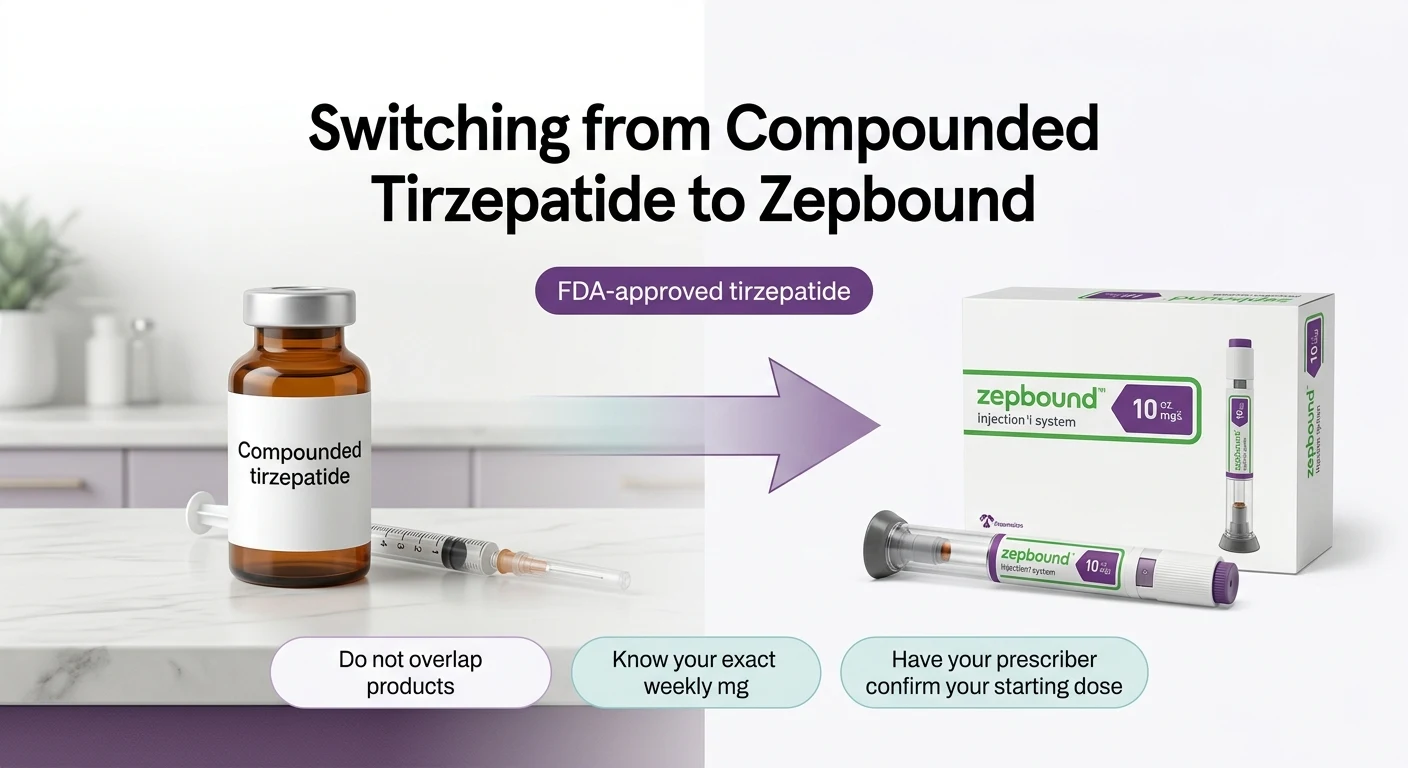
If you're looking for how to switch from compounded tirzepatide to Zepbound, here's what matters most: do not overlap products, do not guess your dose, and have your prescriber choose the starting Zepbound dose based on your actual recent milligrams, tolerance, and any gap in treatment. There is no FDA-approved compounded-to-Zepbound conversion chart — but that doesn't mean you have to start over. Your prescriber can individualize the starting dose based on your treatment history.
Official self-pay pricing through LillyDirect starts at $299/month for 2.5 mg and $449/month for 7.5–15 mg under Lilly's current refill terms. Eligible patients with commercial insurance coverage for the Zepbound single-dose pen may pay as low as $25/month with the Savings Card.
Quick Switch Reference
| Question | Short Answer |
|---|---|
| Can I switch? | Yes, with a clinician-guided plan. Do not overlap products. |
| Do I start over at 2.5 mg? | Not necessarily. No official conversion chart exists, but your prescriber can individualize the starting dose. |
| Can I switch without interruption? | Often yes — if the prescription, insurance, and pharmacy timing are lined up before your next dose window. |
| How much does Zepbound cost self-pay? | $299 (2.5 mg), $399 (5 mg), $449 (7.5–15 mg) via LillyDirect with 45-day refill. |
| What if insurance denies it? | Submit PA + letter of medical necessity + appeal if needed. Use LillyDirect self-pay in the meantime. |
| What should I save before I stop compounded? | Exact mg dose, concentration, last injection date, prescription records, weight lost, side effects. |
| Missed dose rule | Take it within 4 days (96 hours). If more than 4 days pass, skip it and resume on your regular day. |
What this page covers: Below, you'll find how to determine your Zepbound dose, how to avoid a gap in treatment, what Zepbound actually costs through every access path in 2026, how to handle insurance and prior authorization, what records to save, and when this switch might not be the right move.
If you've been on compounded tirzepatide and just found out your supply is ending, take a breath. You're not starting over. You're continuing — just through a different door.
Do You Have to Start Over at 2.5 mg When Switching to Zepbound?
Not necessarily. Zepbound's FDA-approved prescribing information lists 2.5 mg weekly for four weeks as the standard initiation dose — but that schedule is designed for patients who have never taken tirzepatide. If you've been on a stable compounded dose for weeks or months, your prescriber can individualize the starting dose based on your treatment history.
The critical point: there is no FDA-approved compounded-to-Zepbound conversion chart. Compounded products vary in concentration, formulation, and delivery method from one pharmacy to the next. What your prescriber needs from you is your actual weekly dose in milligrams — not units, not mL.
Zepbound is available in these fixed dose strengths:
| Zepbound Dose | Role | Available Forms |
|---|---|---|
| 2.5 mg | Initiation dose (not a maintenance dose) | Pen, Vial, KwikPen |
| 5 mg | Maintenance dose for weight reduction | Pen, Vial, KwikPen |
| 7.5 mg | Escalation step | Pen, Vial, KwikPen |
| 10 mg | Maintenance dose | Pen, Vial, KwikPen |
| 12.5 mg | Escalation step | Pen, Vial, KwikPen |
| 15 mg | Maintenance dose / maximum approved dose | Pen, Vial, KwikPen |
The recommended maintenance doses for weight reduction are 5 mg, 10 mg, or 15 mg. Source: Zepbound prescribing information, Eli Lilly.
If your compounded label only shows units or mL, you'll need to convert: dose in mg = concentration (mg/mL) × volume injected (mL). Check your prescription label or call your compounding pharmacy.
Two situations where your prescriber may restart you lower:
- You've been off tirzepatide for more than 2–4 weeks. A gap means your body has had time to lose its adjustment to the medication, and jumping back to a higher dose increases the risk of GI side effects.
- Your compounded product used a non-standard dose (like 3 mg, 6 mg, or 8 mg) that doesn't map cleanly to an available Zepbound strength. Your prescriber may round to the closest available dose based on their clinical judgment.
The bottom line: walk into your appointment with your exact mg dose, your last injection date, and your side-effect history. That gives your prescriber everything they need.
How to Switch From Compounded Tirzepatide to Zepbound Without an Interruption
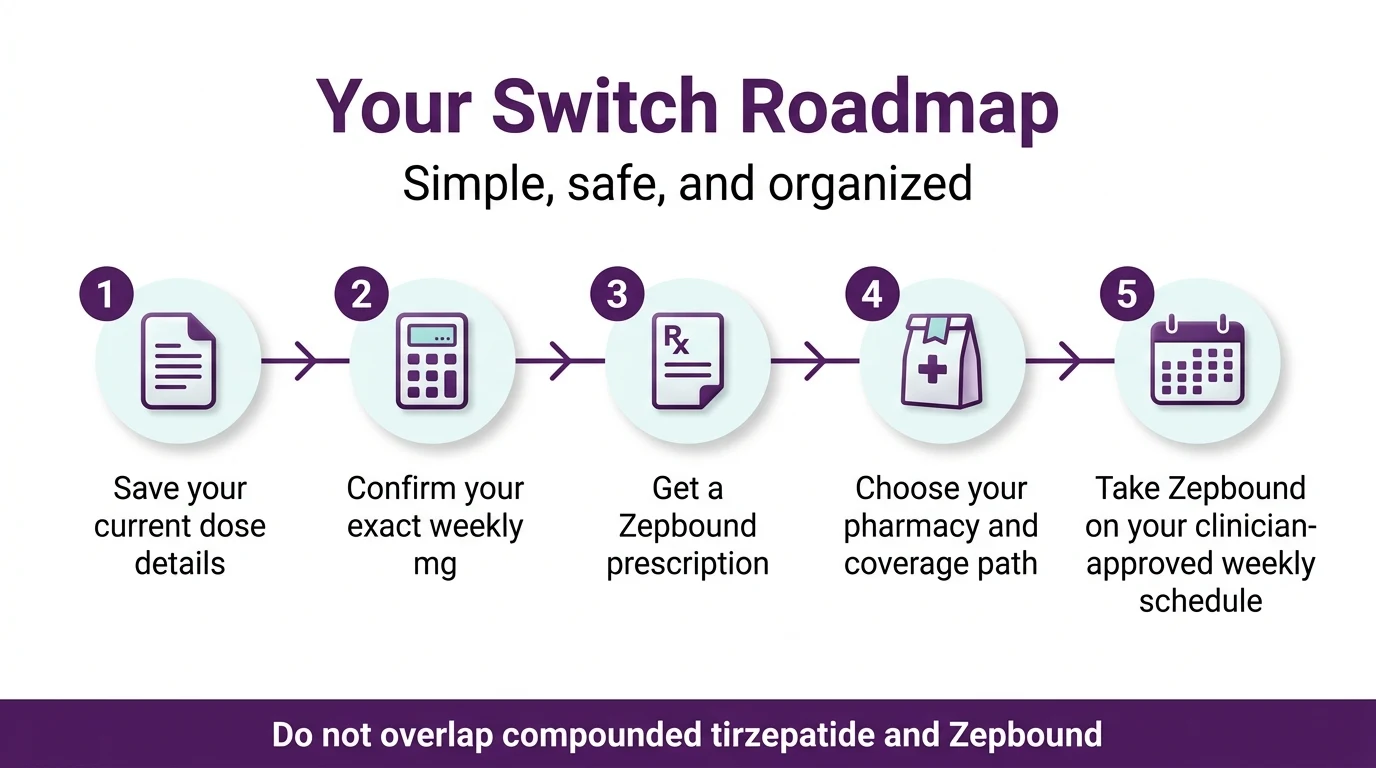
Plan the logistics, and the medical part takes care of itself. The drug transition is straightforward. The paperwork is where people get tripped up.
Document your current treatment
Write down your compounded dose (in mg), your concentration (mg/mL), your injection schedule, your last injection date, your total weight lost, and any side effects. Save screenshots of your prescription and pharmacy records. You'll need these for your prescriber visit and potentially for insurance prior authorization.
Get a Zepbound prescription
Your options: your current PCP or specialist, your current telehealth provider (if they now prescribe FDA-approved medications), or a telehealth platform like Ro that handles Zepbound prescriptions and prior authorization. Tell your prescriber: "I've been on compounded tirzepatide at [X] mg per week. I need to transition to Zepbound."
Check your insurance
Call the number on the back of your insurance card, or ask your prescriber's office to run a benefits check. Ask: does my plan cover Zepbound? Is prior authorization required? What's my copay tier?
Enroll in the Zepbound Savings Card
If you have commercial insurance (employer-sponsored or marketplace), enroll at zepbound.lilly.com/savings. Eligible patients with coverage for the single-dose pen may pay as low as $25/month. If your plan doesn't cover Zepbound, self-pay options start at $299/month through LillyDirect.
Choose your pharmacy path
Insurance patients: fill at your local retail pharmacy and present both cards. Self-pay patients: order through LillyDirect for home delivery or Walmart pickup.
Time the handoff
Have your first Zepbound fill in hand before your last compounded dose wears off. Don't risk a gap. Order early.
Take Zepbound on your regular schedule
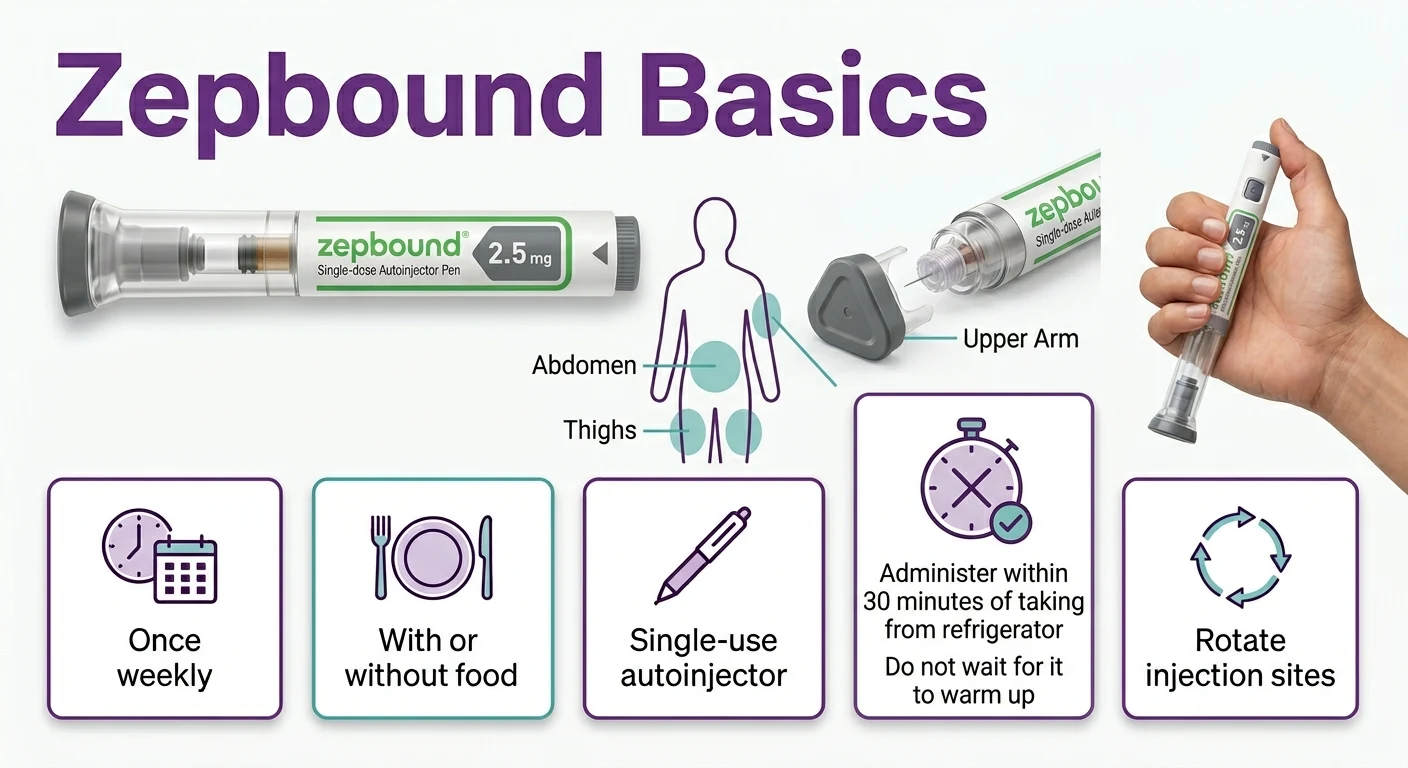
Your prescriber will confirm timing, but many clinicians time the first Zepbound dose for the next planned weekly injection day, replacing the compounded dose. Use the same approved injection areas — abdomen, thigh, or the back of the upper arm — and rotate sites with each dose. Do not take both products. Zepbound's prescribing information advises against coadministration with other tirzepatide-containing products.
If you miss a dose or the timing slips: Zepbound's label says to take a missed dose as soon as possible within 4 days (96 hours). If more than 4 days have passed, skip it and take the next dose on your regular day. If you need to change your weekly dose day, leave at least 72 hours between doses.
If your PA is still pending: Use LillyDirect self-pay to start immediately while the insurance process works in the background. If your insurance later approves coverage, switch to the insurance + savings card path.
How Much Does Zepbound Cost After You Switch?
This is where the anxiety lives — and where the reality has actually gotten better. Zepbound's list price is roughly $1,086/month, but Eli Lilly has rolled out multiple access programs that fundamentally changed the math.
| Your Situation | Access Path | Monthly Cost |
|---|---|---|
| Commercial insurance covers Zepbound single-dose pen | Insurance + Savings Card | As low as $25/mo |
| Commercial insurance does not cover Zepbound single-dose pen | Savings Card (uncovered commercial) | As low as $499/mo for a 1-month fill |
| No insurance / self-pay | LillyDirect Vial or KwikPen | $299 (2.5 mg), $399 (5 mg), $449 (7.5–15 mg) with 45-day refill |
| Medicare, Medicaid, or government insurance | Government program | Coverage varies by plan; manufacturer savings cards not available |
All pricing per Eli Lilly's published terms. Subject to change. Verified April 1, 2026.
The number most switchers need: If you're self-pay with no insurance, the realistic maintenance cost is $449/month for 7.5–15 mg through LillyDirect's Self Pay Journey Program, as long as you refill within 45 days of your previous delivery.
The detail people miss: the 45-day refill rule. LillyDirect's lowest self-pay pricing requires you to complete your refill purchase within 45 days of receiving your previous order. Miss that window and pricing resets to the standard tier. Set a calendar reminder.
HSA/FSA eligible? Yes. Zepbound is a prescription medication and qualifies for HSA/FSA reimbursement.
Pens vs. Vials vs. KwikPen: Which Format Do You Need?
Zepbound is available in fixed FDA-approved strengths across single-dose pens, single-dose vials, and KwikPen. Under Lilly's current self-pay program, vials and KwikPen share the same pricing tiers — the difference is format, not cost.
Single-Dose Pen
Prefilled, single-use autoinjector. Available in all dose strengths (2.5–15 mg). This is the standard product dispensed at retail pharmacies and the version most commonly covered by insurance. Remove the cap, press to skin, click. No measuring.
Single-Dose Vial
Available in all dose strengths through LillyDirect. You draw the medication using a syringe. This format will feel familiar if you've been using compounded vials.
KwikPen
A multi-dose pen containing 4 weekly doses in a single device. Available in all dose strengths through LillyDirect. Combines the convenience of a pen with multi-dose packaging.
The honest cost comparison. $299–$449/month is more than what most people paid for compounded tirzepatide, which typically ran $150–300/month. We won't pretend otherwise. But it's also dramatically lower than the $1,000+ sticker price that was the reality just two years ago. And if you have commercial insurance that covers Zepbound, the savings card can bring your cost to $25/month — which may actually be less than your compounded prescription was.
For readers where these price points are genuinely out of reach: explore our full GLP-1 cost comparison for alternative medications and access programs.
Does Zepbound Feel Different Than Compounded Tirzepatide?
This is the question nobody on page 1 answers directly. Community reports are genuinely mixed. Some people say brand-name Zepbound feels more consistent or slightly more potent than what they were getting compounded. Others say the experience is virtually the same. Both observations are valid.
Why some people notice a difference
Compounded tirzepatide products varied between pharmacies in concentration accuracy, inactive ingredients, and formulation. Zepbound is manufactured under FDA quality standards with standardized concentrations and verified potency. If a compounded product was inconsistently formulated, Zepbound at the “same” mg dose may feel different because the delivered dose is now more precise and consistent.
Why others notice no change
If a compounding pharmacy had strong quality control and accurate dosing, the transition can feel seamless.
What to expect in the first 2–3 weeks after switching:
- Appetite suppression and fullness signaling should feel similar to what you're used to
- Mild GI effects (nausea, bloating) may temporarily shift due to different inactive ingredients — this typically settles within a week or two
- The injection feels different if you're moving from a vial-and-syringe setup to a prefilled pen
- If your prescriber adjusted your dose during the transition, you may notice a corresponding change in appetite suppression or side effects
When to contact your prescriber:
Persistent nausea or vomiting that isn't resolving, signs of a hypersensitivity reaction (rash, swelling, difficulty breathing), or severe abdominal pain.
If This Sounds Like Your Situation, Here's Your Fastest Path
If your insurance just approved Zepbound
Enroll in the Savings Card immediately at zepbound.lilly.com/savings. Have your prescriber send the Rx to your pharmacy. You could have medication in hand within days.
If you're paying cash and need a prescription
Pair a telehealth provider like Ro with LillyDirect. Ro handles the prescription; LillyDirect ships vials or KwikPens to your door at $299–$449/month. Ro says cash-pay starts can happen in less than a week.
If your compounded label only shows units or mL
Do not guess your mg dose. Call your compounding pharmacy and ask for the concentration in mg/mL and the volume you injected. Calculate: dose (mg) = concentration (mg/mL) × volume (mL). Bring this to your prescriber.
If you've been off tirzepatide for more than 2–4 weeks
Your prescriber will likely restart you at a lower dose and re-titrate upward to manage GI side effects. This is standard practice, not a setback.
If you already struggle with nausea on tirzepatide
Tell your prescriber before they choose your starting dose. They may start one step below your previous compounded dose. Eating smaller meals, staying hydrated, and prioritizing protein all help during the adjustment.
Insurance, Prior Authorization, and Appeals for Zepbound
For many readers, insurance is the real switching barrier — not the medication. Here's how to navigate it.
Check coverage
Call your insurer or ask your prescriber's office to run a benefits check. You need to know: does my plan cover Zepbound? Is prior authorization required? What's my copay tier?
Understand prior authorization (PA)
Most commercial plans require PA before covering Zepbound. Your prescriber submits documentation explaining why Zepbound is medically necessary. Typical requirements: BMI ≥30 (or ≥27 with a weight-related condition like hypertension or sleep apnea), evidence that lifestyle modification alone hasn't been sufficient.
Submit a letter of medical necessity
Your prescriber's strongest tool. The letter documents your clinical history, current tirzepatide treatment, why continuity of treatment is essential, and why Zepbound is the right medication. Your documented history on compounded tirzepatide — weight lost, metabolic improvements, tolerability — strengthens this letter significantly.
If denied, appeal
Lilly's own coverage page states that multiple appeal submissions may sometimes be needed. Don't stop after one denial.
Use LillyDirect while you wait
Start Zepbound self-pay immediately ($299–$449/month) so you don't go without medication during the PA process. If insurance later approves, switch to the covered path.
Who cannot use the Zepbound Savings Card
Medicare, Medicaid, Tricare, VA, and other government insurance beneficiaries are excluded by federal law. This applies to all manufacturer savings programs, not just Lilly's.
Best Ways to Get Zepbound: Your Doctor vs. Ro vs. LillyDirect
Match your situation to the shortest path.
Your PCP or current specialist
Best if: You have an engaged doctor familiar with GLP-1 prescribing and don't need hand-holding on insurance.
How it works: Doctor writes the Rx, submits PA, sends it to your pharmacy. You bring the savings card.
Pros: Continuity of care, face-to-face relationship, integrated with your full medical history.
Trade-off: PA support varies widely by practice. Some PCPs aren't experienced with anti-obesity medication prescribing.
Ro
Best if: You need a prescriber who will also handle insurance, prior authorization, and ongoing dose management in one place.
How it works: Online medical evaluation → licensed clinician reviews your history → Zepbound Rx if appropriate → Ro handles benefits checks and PA paperwork → medication ships or goes to your pharmacy.
Timeline: Ro says eligibility is determined within 2 days. Insurance workflows typically take about 2–3 weeks. Cash-pay treatment can start in less than a week.
Pros: End-to-end service. Insurance navigation. Ongoing clinical support.
Trade-off: Ro charges a membership fee on top of medication cost. If you already have a supportive prescriber who manages PA, the membership adds expense you may not need. Ro does not make Zepbound itself cheaper than Lilly's official self-pay pricing — what it adds is the clinical service and insurance work.
If you lost your prescriber when your compounded telehealth provider stopped offering tirzepatide, and you need someone to manage the whole transition — prescription, insurance, dosing — that's exactly what Ro is built for.
LillyDirect
Best if: You already have a valid Zepbound prescription and want the simplest self-pay path.
How it works: Order vials or KwikPens directly through Lilly's platform. Free home delivery or Walmart pickup.
Pricing: $299/month (2.5 mg), $399/month (5 mg), $449/month (7.5–15 mg) with 45-day refill.
Pros: Cheapest verified self-pay pricing. No middleman.
Trade-off: You need an existing prescription. LillyDirect doesn't prescribe. No clinical support.
When to skip telehealth entirely
If you have an engaged PCP, a local pharmacy that stocks Zepbound, and insurance that covers it — the simplest path is your existing healthcare relationship. Save the membership fee.
What Changed With Compounded Tirzepatide Availability
If you're still hoping compounded tirzepatide will come back, here's the current status as of April 2026.
After the FDA determined the tirzepatide shortage was resolved, the temporary enforcement-discretion windows tied to the shortage ended on February 18, 2025 for 503A state-licensed pharmacies and March 19, 2025 for 503B outsourcing facilities.
Compounded drugs are not FDA-approved. The FDA says compounded drugs may be appropriate when a patient's medical needs cannot be met by an FDA-approved drug — for example, a documented allergy to an inactive ingredient. Cost, convenience, and preference are not qualifying reasons under current guidance.
Eli Lilly has also pursued legal action against compounding pharmacies and telehealth platforms that continued marketing compounded tirzepatide after the enforcement deadlines.
If you see a provider still advertising compounded tirzepatide broadly in 2026, proceed with caution. They may be operating outside current FDA guidance.
The encouraging reality: Zepbound's pricing has come down dramatically, insurance coverage has expanded, and Lilly's savings programs have made FDA-approved tirzepatide far more accessible than it was even a year ago. For many people, the cost gap between what they were paying for compounded and what they'd pay for Zepbound is smaller than they expect.
What Records to Save Before You Stop Compounded Tirzepatide
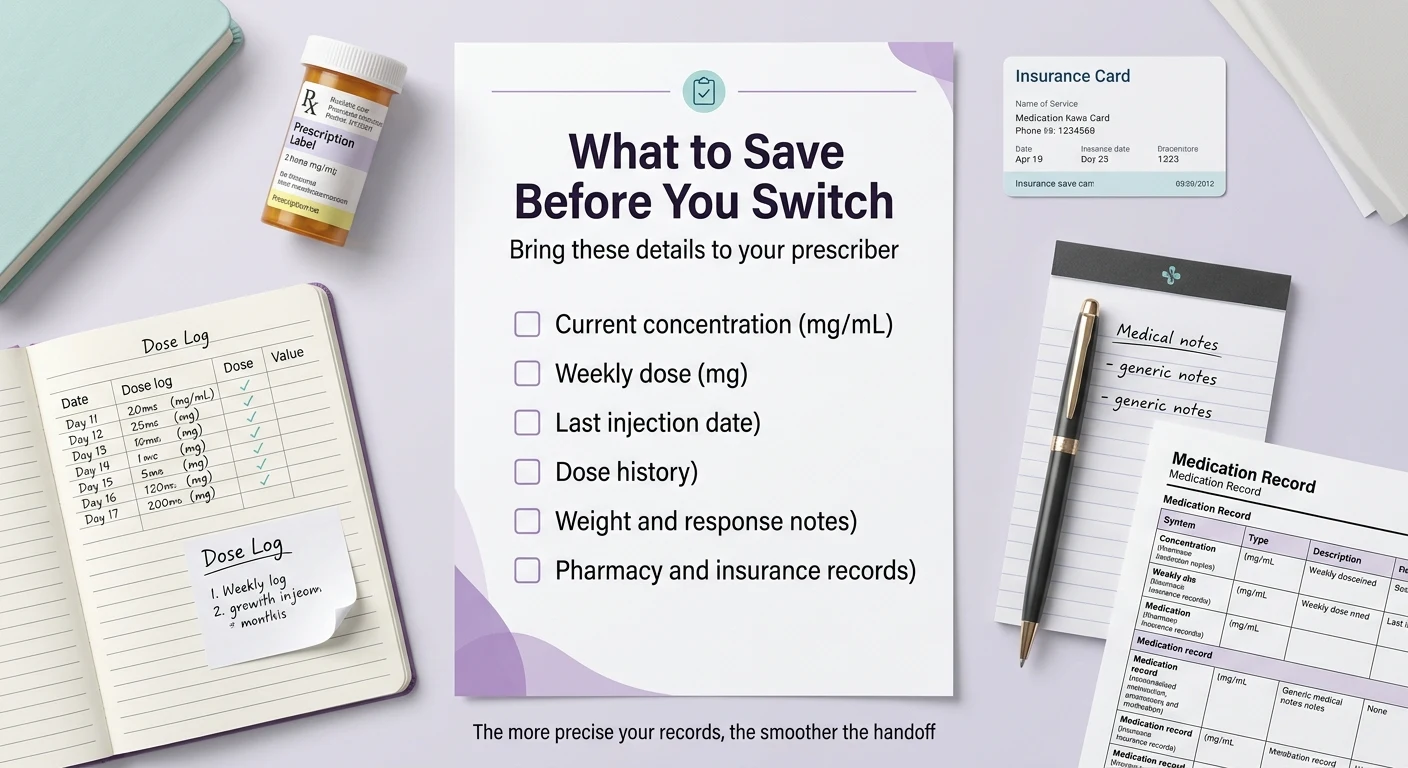
Before you take your last compounded dose, document everything. This protects you three ways: it helps your prescriber choose the right Zepbound starting dose, it strengthens your insurance prior authorization, and it gives you a medical record of your treatment history.
Medication details
- Concentration (mg/mL)
- Volume injected per dose (mL)
- Calculated weekly dose in mg
- Injection schedule
- Date of last injection
- Full dose escalation history
Health details
- Starting weight
- Current weight
- Metabolic improvements (BP, A1C, sleep)
- Side effects and management
- Related lab work
Administrative
- Prescription records
- Pharmacy receipts
- Treatment portal screenshots
- Insurance correspondence
Copy-paste message for your new prescriber:
“I've been on compounded tirzepatide for [X months] at [X mg/week]. My concentration was [X mg/mL] and I injected [X mL] once weekly. My last injection was [date]. I've lost [X pounds] since starting. I tolerated the medication [well / with the following side effects: ___]. I'd like to transition to Zepbound at a dose you determine is appropriate based on my history.”
Who Should Slow Down, Restart Lower, or Consider a Different Route
We'd rather send you to the right page than keep you on the wrong one.
If you had severe nausea or vomiting on compounded tirzepatide
Your prescriber should consider starting you at a lower Zepbound dose, even if you were on a higher compounded dose. A gentler start often leads to better long-term adherence.
If you are pregnant or become pregnant
Zepbound may cause fetal harm. When pregnancy is recognized, discontinue Zepbound. Discuss the timing and implications with your OB-GYN.
If you use oral hormonal contraceptives
Zepbound can reduce the effectiveness of oral birth control for 4 weeks after initiation and after each dose escalation, due to delayed gastric emptying. Your prescriber may recommend a non-oral contraceptive method or adding a barrier method during those windows.
If you need tirzepatide for type 2 diabetes
The diabetes-branded version is Mounjaro, not Zepbound. Both contain tirzepatide but have different FDA-approved indications and insurance coverage pathways. Mounjaro may be easier to get covered if diabetes is your primary diagnosis.
If Zepbound is genuinely unaffordable at any available price point
See our full GLP-1 affordability guide for alternatives, or take our 60-second matching quiz to find a program that fits.
What to Expect in Your First 30 Days on Zepbound
Frame the first month around stability, not transformation.
If you switched at a dose your prescriber matched to your compounded level with no gap, this should feel familiar. Appetite suppression, fullness, energy — all similar. The injection may feel different if you're going from a vial-and-syringe setup to the prefilled pen. Most people find the pen significantly easier.
Any mild GI adjustment from the formulation change should be settling. If you started at a lower dose and are titrating up, you may be approaching your first increase around week 4.
The transition should feel complete. Schedule a follow-up with your prescriber to discuss whether your dose is working and whether adjustment is needed.
What to track after each injection:
- Appetite changes (note intensity)
- Nausea or GI symptoms (severity and duration)
- Injection site reactions
- Hydration level
- Protein intake (GLP-1 medications suppress appetite, so getting adequate protein requires deliberate effort)
- Weekly weight (same day, same conditions)
A note about scale fluctuations: Minor weight shifts in the first week or two are common during any medication transition and typically reflect water and digestive adjustments, not fat regain. Weekly trends matter more than daily numbers.
How We Verified This Guide
- Zepbound prescribing information (Eli Lilly) — dosing, contraindications, safety, missed-dose rules
- Zepbound savings and coverage pages (Eli Lilly) — pricing, savings card terms, PA guidance. Pricing last verified April 1, 2026
- FDA compounding policy statements — regulatory timeline and enforcement status
- Ro provider information — telehealth access timelines and insurance support
- Zepbound access & coverage (Eli Lilly) — PA and appeals guidance
- GLP-1 community discussions (Reddit r/Zepbound, r/tirzepatide) — real-world switching experiences
What this page does not do: We do not prescribe medication, recommend specific doses, or provide a compounded-to-Zepbound dose conversion. All dosing decisions should be made by your licensed healthcare provider based on your individual medical history.
Frequently Asked Questions
Can you switch from compounded tirzepatide to Zepbound?
Yes. Many people can transition from compounded tirzepatide to FDA-approved Zepbound with a clinician-guided plan. The key rule: do not overlap products. Zepbound’s prescribing information advises against coadministration with other tirzepatide-containing products.
Is there a compounded tirzepatide to Zepbound conversion chart?
No official conversion chart exists. Compounded products vary in concentration and formulation. Your prescriber will choose your Zepbound starting dose based on your actual weekly mg dose, tolerability, and any gap in treatment.
Can I switch without any interruption in treatment?
Often yes — if you plan ahead. Have your Zepbound prescription, insurance or savings path, and pharmacy fill lined up before your last compounded dose wears off.
Can I take both compounded tirzepatide and Zepbound at the same time?
No. Zepbound’s prescribing information advises against coadministration with other tirzepatide-containing products.
Do you have to start over at 2.5 mg when switching to Zepbound?
Not necessarily. There is no FDA-approved compounded-to-Zepbound conversion chart. Your prescriber will choose your starting Zepbound dose based on the milligrams you were actually taking, how you tolerated them, and whether there has been a gap in treatment.
How much does Zepbound cost without insurance in 2026?
Through LillyDirect, Zepbound single-dose vials and KwikPens start at $299/month for 2.5 mg and $449/month for 7.5–15 mg under the Self Pay Journey Program with a 45-day refill requirement. Eligible patients with commercial insurance coverage for the single-dose pen may pay as low as $25/month with the Zepbound Savings Card.
What is the Zepbound Savings Card?
A manufacturer discount program from Eli Lilly. Eligible patients with commercial insurance coverage for the single-dose pen may pay as low as $25/month. Enroll free at zepbound.lilly.com/savings. Not available for government insurance programs.
What’s the 45-day refill rule?
LillyDirect’s lowest self-pay prices require you to refill within 45 days of your previous delivery. Miss that window and pricing resets to the standard tier.
What if my compounded label shows units instead of mg?
Call your compounding pharmacy. Ask for the concentration in mg/mL. Then calculate: dose (mg) = concentration (mg/mL) × volume injected (mL). Bring this to your prescriber.
What if my insurance denies Zepbound?
Ask your prescriber to submit a prior authorization with a letter of medical necessity, then appeal if denied. Lilly’s access page notes multiple submissions may sometimes be needed. Use LillyDirect self-pay in the meantime.
What if I’ve been off tirzepatide for 2–4 weeks or more?
Your prescriber will likely restart you at a lower dose and re-titrate upward to manage GI side effects. This is standard practice, not a setback.
What if I miss a dose after switching?
Take it as soon as possible within 4 days (96 hours). If more than 4 days have passed, skip it and take your next dose on the regular day. If you change your weekly dose day, allow at least 72 hours between doses.
Does Zepbound feel stronger than compounded tirzepatide?
Reports vary. Some people notice Zepbound feels more consistent or slightly more potent, possibly because standardized manufacturing ensures exact dosing. Others report no noticeable difference. Discuss any unexpected changes with your prescriber.
Should I switch to Mounjaro or Zepbound?
If your primary indication is weight management: Zepbound. If your primary indication is type 2 diabetes: Mounjaro. Both contain tirzepatide but have different FDA-approved indications and insurance pathways.
Who should NOT take Zepbound?
Zepbound is contraindicated in patients with a personal or family history of medullary thyroid carcinoma (MTC) or Multiple Endocrine Neoplasia syndrome type 2 (MEN2), and in patients with known serious hypersensitivity to tirzepatide or any of Zepbound’s excipients. Zepbound is not recommended in patients with severe gastroparesis. Zepbound may cause fetal harm; discontinue when pregnancy is recognized.
Is compounded tirzepatide still available in 2026?
Generally no. After the FDA determined the tirzepatide shortage was resolved, enforcement-discretion windows ended on February 18, 2025 for 503A pharmacies and March 19, 2025 for 503B outsourcing facilities. Compounding may still be permitted when a patient has a documented medical need that cannot be met by an FDA-approved formulation.
Still weighing what medication, provider, or cost path fits your life?
Get Your Personalized GLP-1 Action Plan →Related guides
The RX Index is an independent research platform. We may earn a commission from providers linked on this page. Our editorial recommendations are based on independent research, verified pricing, and clinical accuracy — not compensation. Full affiliate disclosure →
This content is for informational and educational purposes only and is not medical advice. All medication decisions should be made by a licensed clinician based on your individual health profile.