
Medical disclaimer: This article is for informational purposes only and is not medical advice. Zepbound (tirzepatide) is a prescription medication. Always work with a licensed healthcare provider before starting, stopping, or switching any medication.
How to Switch from Wegovy to Zepbound
By The RX Index Editorial Team · Medically reviewed by Dr. Jennifer Brown, MD, DABOM · Last verified: April 8, 2026
The usual clinician-guided approach is straightforward: stop Wegovy, avoid overlap, and start Zepbound at 2.5 mg once weekly on your next injection day — with your prescriber guiding timing and dose.
In the head-to-head SURMOUNT-5 trial, Zepbound produced an average of 20.2% body weight loss versus 13.7% for Wegovy over 72 weeks. But here is what most guides get wrong: there is no validated dose conversion chart between these two drugs, and one of the most common mistakes is starting Zepbound's lowest dose after being on maximum Wegovy — then experiencing weeks of increased hunger during the ramp-up.
This guide covers timing, dose, what to expect in the first 8 weeks, cost across every access path in 2026, and what changes if you are switching from the Wegovy oral tablet instead of the injection.
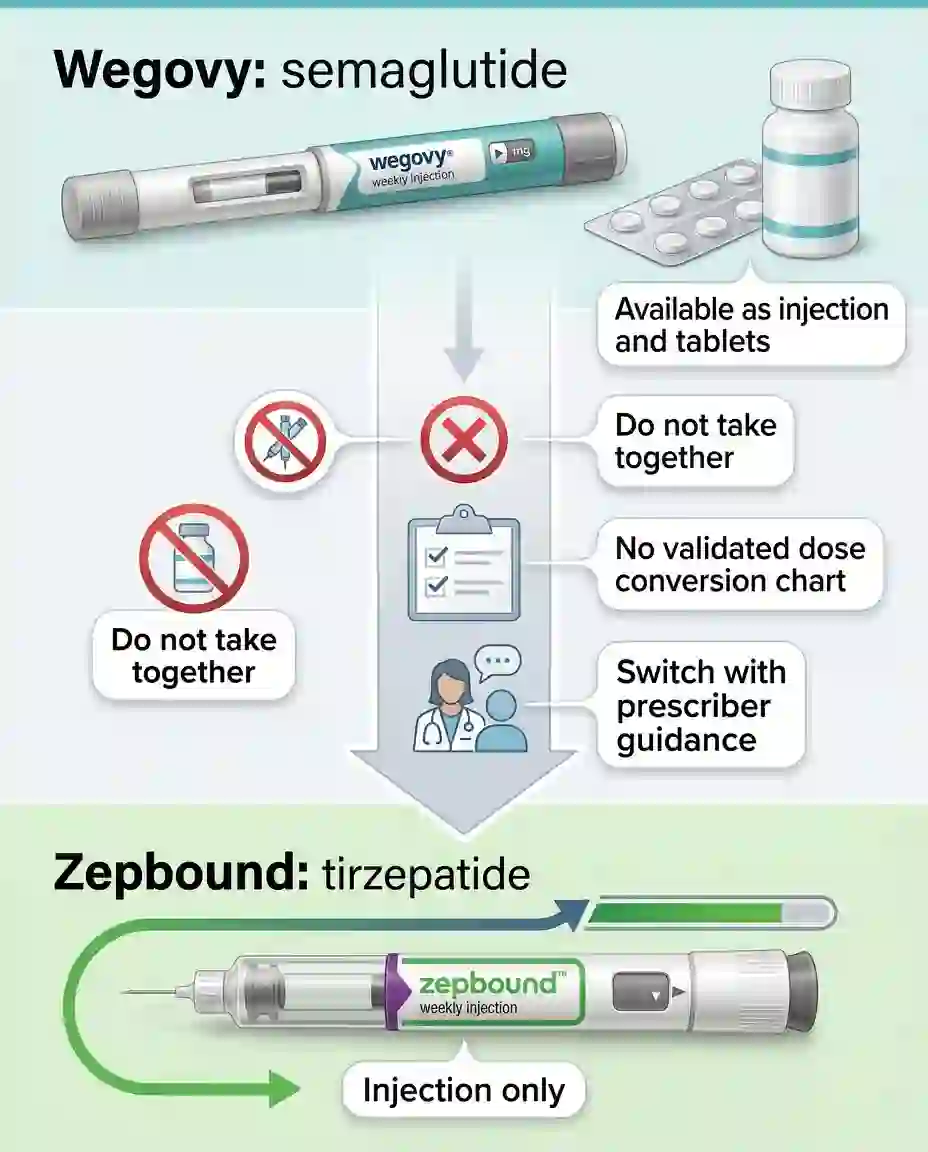
Wegovy is available as injection and tablet. Zepbound is injection only. Do not take both at the same time. Switch requires prescriber guidance.
Disclosure: Some links on this page are affiliate links. If you purchase through these links, we may earn a commission at no extra cost to you.
Quick Reference: Wegovy → Zepbound Switch
Pricing verified April 2026 via Eli Lilly official sources. Savings Card terms valid through December 31, 2026.
Eligibility confirmed within ~2 days. Prior authorization support included.
Who This Guide Is For
This page is specifically for people currently taking branded Wegovy — the FDA-approved semaglutide injection — who are considering a switch to Zepbound (tirzepatide).
If you are on compounded semaglutide (not brand-name Wegovy), your switch path is different. See: How to switch from compounded semaglutide to Zepbound →
If you are on Ozempic or Rybelsus (semaglutide for diabetes, not weight loss), see our broader guide: How to switch from semaglutide to tirzepatide →
Thinking about switching back? See: How to switch from Zepbound to Wegovy →
On the Wegovy oral tablet? Much of this guide still applies, but you are moving from a daily pill to a weekly injection. Tablet-specific considerations are flagged where relevant.
Wegovy vs. Zepbound: Key Differences
These are different drugs with different mechanisms. Understanding what changed matters both clinically and practically.
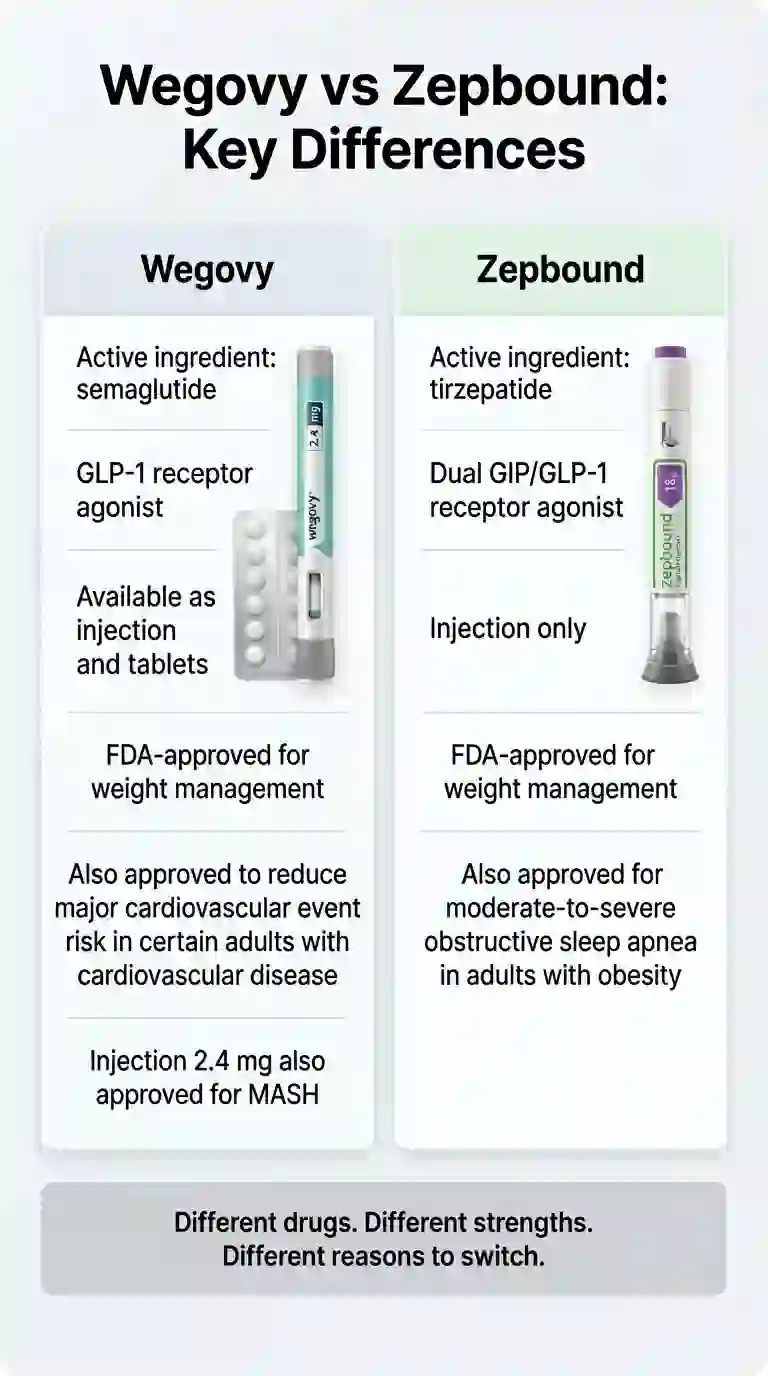
Different drugs. Different strengths. Different reasons to switch.
| Wegovy (injection) | Wegovy HD | Zepbound | |
|---|---|---|---|
| Active ingredient | Semaglutide | Semaglutide (higher dose) | Tirzepatide |
| Mechanism | GLP-1 receptor agonist (one pathway) | Same as Wegovy injection | Dual GLP-1/GIP receptor agonist (two pathways) |
| FDA-approved for | Weight management; CV risk reduction; MASH | Additional weight loss (after ≥4 weeks at 2.4 mg) | Weight management; moderate-to-severe OSA with obesity |
| Avg. weight loss (trials) | ~15% body weight (2.4 mg, 68 weeks) | ~20.7% body weight (7.2 mg, 72 weeks; STEP UP) | 16–22.5% body weight (72 weeks) |
| SURMOUNT-5 head-to-head | 13.7% body weight loss (1.7–2.4 mg) | Not studied | 20.2% body weight loss (10–15 mg) |
| Dosing range | 0.25 mg → 2.4 mg weekly | 7.2 mg weekly | 2.5 mg → 15 mg weekly |
| Available forms | Prefilled pen; oral tablet | Single-dose pen | Prefilled pen; KwikPen; single-dose vial |
| 2026 self-pay cost | $349/mo (most doses) | $399/mo | $299–$449/mo by dose |
| With insurance savings card | As low as $25/mo | As low as $25/mo | As low as $25/mo |
| Can you overlap? | No — not with Zepbound | N/A | No — not with Wegovy |
Sources: Zepbound and Wegovy prescribing information (FDA); SURMOUNT-5 (NEJM, 2025); STEP UP trial; Novo Nordisk and Lilly pricing pages. Verified April 2026.
Why Are People Switching from Wegovy to Zepbound?
Most branded Wegovy users considering a switch are doing it for one of four reasons. All four are legitimate medical conversations to have with your doctor.
Weight loss has plateaued
This is the most common trigger. You have been on Wegovy for months or longer. The scale moved, then stopped. A plateau at your current dose does not mean the medication "stopped working" — it may mean you have reached the ceiling of what semaglutide (a single-pathway GLP-1 agonist) can do.
Zepbound works on two hormone pathways — GLP-1 and GIP — instead of one. In the SURMOUNT-5 trial published in the New England Journal of Medicine in 2025, adults with obesity taking the highest tolerated dose of Zepbound lost an average of 20.2% of their starting body weight at 72 weeks, compared to 13.7% for those on the highest tolerated dose of Wegovy.
31.6% of Zepbound patients lost at least 25% of their body weight, compared to 16.1% on Wegovy.
Important as of April 2026: Wegovy HD
The FDA approved Wegovy HD (semaglutide 7.2 mg) on March 19, 2026, for adults with obesity who have tolerated the 2.4 mg dose for at least 4 weeks. In the STEP UP trial, Wegovy HD produced approximately 20.7% mean weight loss — which narrows the gap with Zepbound significantly. If you have plateaued on 2.4 mg Wegovy, asking about Wegovy HD first may be worth considering before switching drug classes.
Food noise came back
"Food noise" is the constant intrusive mental loop about eating — when to eat, what to eat, cravings that feel relentless. GLP-1 medications quiet that noise. But some Wegovy users report the noise returns over time, even at maximum doses.
Because Zepbound's dual mechanism influences both the gut and the brain's reward centers through different pathways, some patients report stronger food-noise suppression after switching. This is anecdotal — not proven in controlled trials — but it appears consistently in patient communities.
Insurance situation changed
Your employer changed formularies. Your insurer dropped Wegovy coverage mid-year. Or you found that Zepbound's savings card costs less than your Wegovy copay. Insurance dynamics — not just clinical preferences — drive many switches.
Wanting the additional Zepbound indications
Zepbound is also FDA-approved for moderate-to-severe obstructive sleep apnea in adults with obesity. If you have a documented OSA diagnosis, this may open a coverage path that bypasses weight-loss exclusions on your insurance plan.
The honest tradeoff, upfront
Zepbound does not have Wegovy's cardiovascular risk reduction indication. Wegovy (semaglutide 2.4 mg injection) is FDA-approved to reduce the risk of serious cardiovascular events in certain adults with established heart disease and obesity or overweight. Zepbound is not. If reducing cardiovascular risk is a primary reason you are on Wegovy, that matters — discuss this specifically with your prescriber before switching.
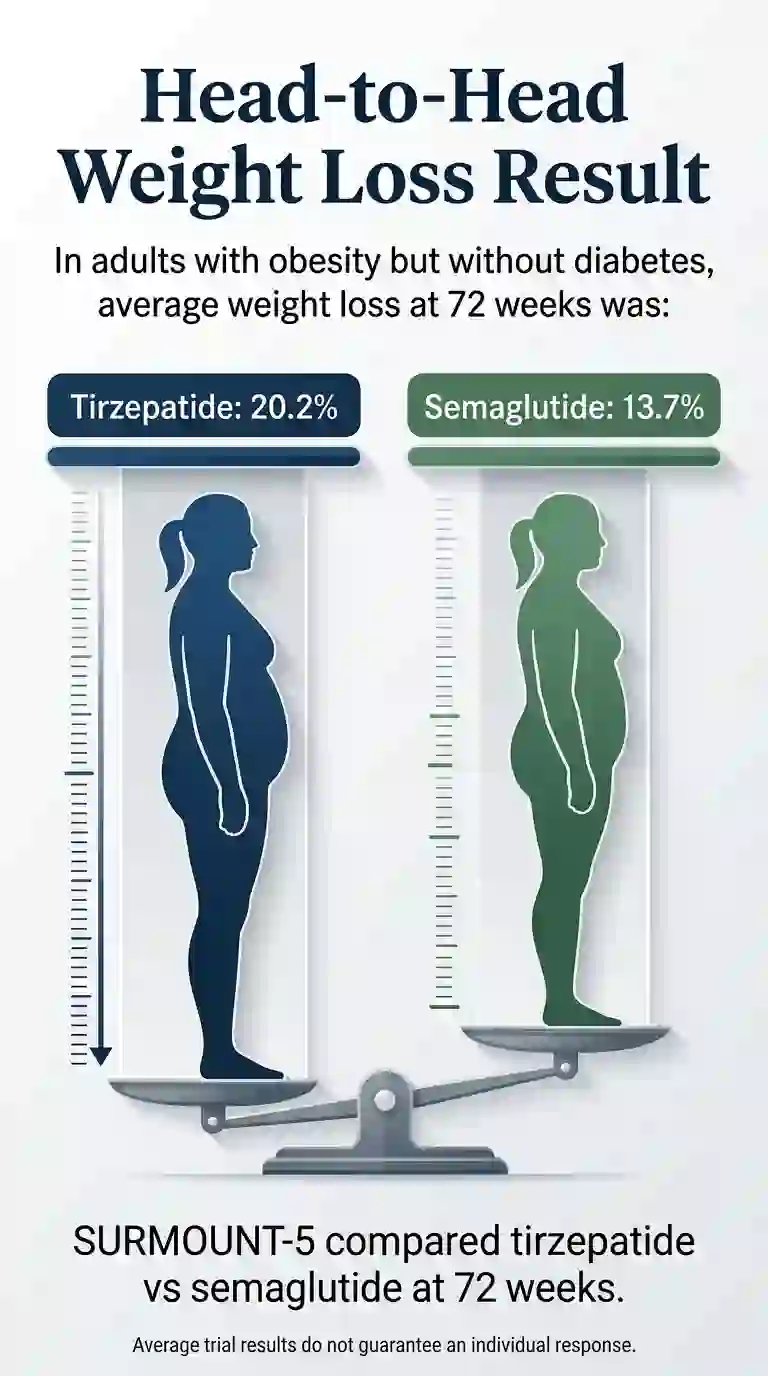
SURMOUNT-5 compared tirzepatide vs semaglutide at 72 weeks. Average trial results do not guarantee an individual response.
Plateaued on Wegovy?
Ro can start your switch to Zepbound, including prior authorization support.
How to Switch From Wegovy to Zepbound in 5 Steps
Switching is a structured but straightforward process. Most of the anxiety comes from conflicting information online — not from the actual switch being complicated.
Talk to Your Prescriber
This is not a disclaimer — it is the literal first step. Your prescriber needs to confirm Zepbound is appropriate for your indication, decide your starting dose, handle prior authorization if needed, and write the prescription. Telehealth providers like Ro can manage this over messaging without an in-person visit.
Take Your Last Wegovy Dose on Schedule
No taper required. Take your final Wegovy dose as planned and note the date. Semaglutide has a half-life of approximately 7 days, meaning it remains active in your system and declines gradually — that built-in buffer helps prevent sudden appetite return the day after your last injection.
Start Zepbound on Your Next Injection Day
Begin Zepbound approximately one week after your last Wegovy dose — on your next regular injection day. This keeps your weekly rhythm intact and prevents overlap of two GLP-1 medications. Zepbound's prescribing information states it should not be coadministered with another GLP-1 receptor agonist. Do not take both in the same week.
Begin at the Correct Starting Dose
Zepbound's labeled initiation dose is 2.5 mg once weekly for 4 weeks, then 5 mg. Your prescriber may start you at 5 mg if you tolerated max-dose Wegovy with minimal GI side effects. This is individualized clinical judgment — not something to self-prescribe based on any online chart.
Track Your First Month Closely
Keep a simple log of appetite changes, GI side effects, energy levels, and weight weekly. This gives your prescriber real data for your follow-up and helps calibrate your titration schedule. If something feels off — persistent vomiting, severe abdominal pain, or signs of dehydration — contact your prescriber. Do not push through warning signs.
What Dose of Zepbound Do You Start On?
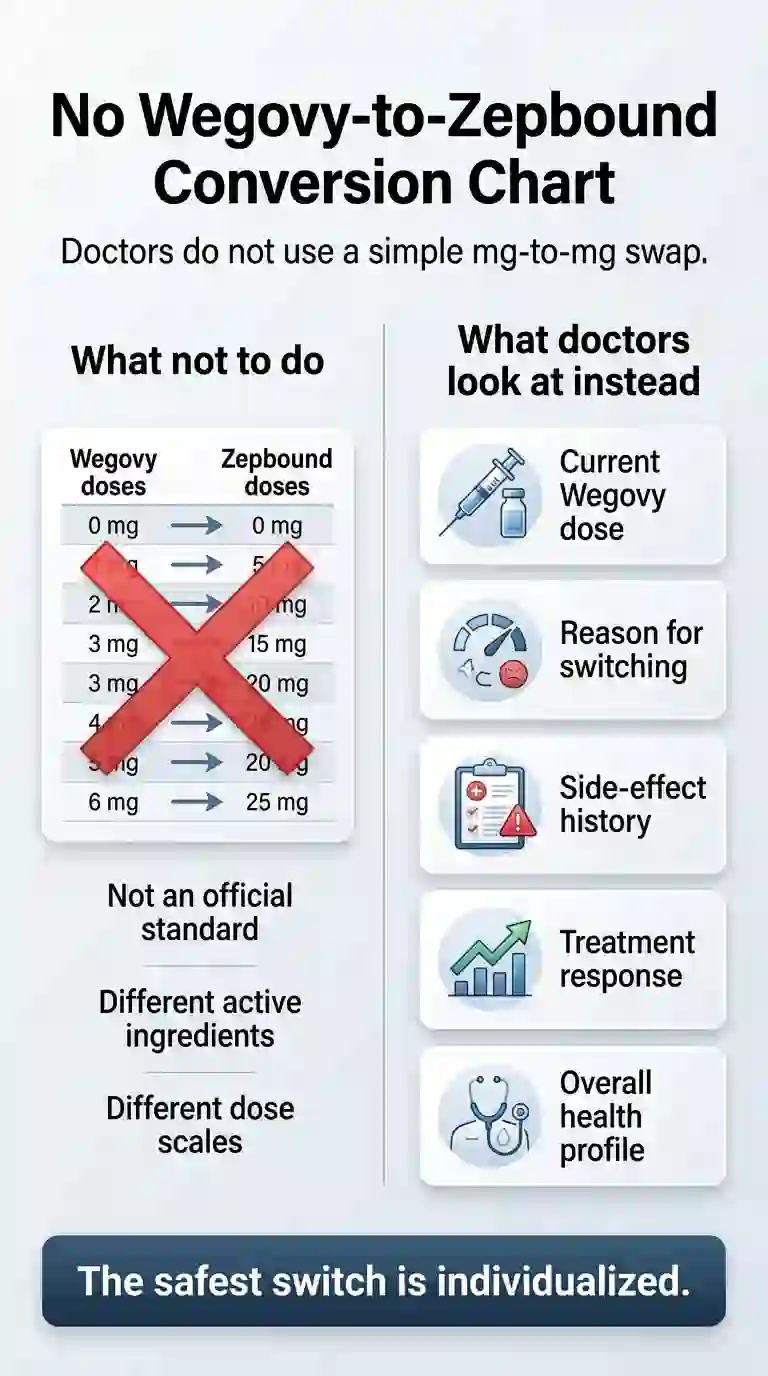
There is no official mg-for-mg conversion chart. The safest switch is individualized.
The labeled Zepbound initiation dose is 2.5 mg once weekly for 4 weeks, followed by an increase to 5 mg. From there, titration increases by 2.5 mg increments every 4+ weeks: 5 mg → 7.5 mg → 10 mg → 12.5 mg → 15 mg.
Some GLP-1–experienced patients — particularly those who tolerated max-dose Wegovy with minimal side effects — are started at 5 mg. This is within clinical practice norms, but it is not the default label recommendation.
Why 2.5 mg can feel "too low" after Wegovy 2.4 mg: If you were on 2.4 mg Wegovy, dropping to 2.5 mg Zepbound can feel like going backward. Appetite may temporarily feel less suppressed. This is normal and expected during the early titration weeks. Most patients who feel underwhelmed at 2.5 mg report meaningful improvement once they reach 5 mg or 7.5 mg.
| Your Situation | Starting Dose to Discuss | Why |
|---|---|---|
| Tolerated Wegovy well, minimal GI issues | Ask about 5 mg | Lower risk of restarting at the floor |
| Had significant nausea/GI on Wegovy | Lean toward 2.5 mg | Different drug but GI sensitivity may carry over |
| Anxious about the switch | 2.5 mg | Safer baseline, builds confidence |
| Coming off a lower Wegovy dose (<1.7 mg) | 2.5 mg | Standard initiation for lower tolerance baseline |
| Want the labeled, lowest-risk approach | 2.5 mg | What Lilly's prescribing information recommends |
Is There a Wegovy to Zepbound Dose Conversion Chart?
No official, validated milligram-for-milligram conversion chart exists between Wegovy and Zepbound. Several pages publish "suggested equivalent dosages" or "dose conversion tables" between semaglutide and tirzepatide. These are unofficial and not endorsed by Lilly or the FDA.
The reason no chart exists: semaglutide and tirzepatide work through fundamentally different mechanisms. Semaglutide activates one receptor (GLP-1). Tirzepatide activates two (GLP-1 and GIP). Their dose scales are also different — Wegovy's maximum is 2.4 mg; Zepbound's maximum is 15 mg. Comparing milligrams directly is clinically meaningless.
What doctors actually look at: your current Wegovy dose, your reason for switching, your side-effect history, your treatment response, and your overall health profile. The switch is individualized, not mapped.
What to Expect in the First 8 Weeks on Zepbound
| Weeks | What's Happening | What to Do |
|---|---|---|
| Week 1–2 | Zepbound is building in your system. Wegovy is clearing. Appetite suppression may feel weaker than your Wegovy peak. | Do not panic. This is normal dose-ramp pharmacology. Eat mindfully, stay hydrated. |
| Week 3–4 | 2.5 mg Zepbound is at steady state. Some patients feel it clearly; others feel less than at Wegovy peak. | Track how you feel. Prepare to escalate to 5 mg with your prescriber at week 4. |
| Week 5–8 | At 5 mg, most patients report meaningful appetite suppression comparable to or stronger than Wegovy. | Note any GI side effects to report. Weight movement typically resumes for most patients by week 6–8. |
Important context: no weight gain is expected if the switch is done properly
The biggest driver of temporary weight regain during a medication switch is a prolonged gap — days or weeks with no drug on board. With the "next injection day" approach, Wegovy is still declining as Zepbound begins building. The overlap in activity minimizes appetite return. Weight may be flat for 2–4 weeks during titration; significant regain is uncommon when the transition happens within the standard ~7-day window.
"Week 1 and 2 I was really hungry and gained 2 lbs. By week 6 (at 5 mg) I was back to losing. Now at 10 mg it's insane how not hungry I am." — Reddit user, r/Zepbound
What Does Zepbound Cost in 2026?
Cost varies significantly depending on whether you have commercial insurance, Medicare, or are paying out of pocket. Here is every legitimate path verified in April 2026.
| Access Path | Monthly Cost | Best For |
|---|---|---|
| Commercial insurance + Lilly Savings Card | As low as $25/fill (through Dec 2026) | Commercially insured patients with Zepbound coverage |
| LillyDirect self-pay (2.5 mg) | $299/mo | Uninsured or insurance won't cover weight loss drugs |
| LillyDirect self-pay (5 mg) | $399/mo | Moving off starter dose, no insurance coverage |
| LillyDirect self-pay (7.5–15 mg) | $449/mo | At higher doses, no insurance |
| Telehealth (Ro Body) | $45 first month, $145/mo ongoing (membership fee only) | Self-pay with telehealth support; medication priced separately |
| Medicare Part D + CMS Bridge (Jul–Dec 2026) | ~$50/month (KwikPen, eligible beneficiaries) | Traditional Medicare beneficiaries — limited window |
| Zepbound for OSA (documented diagnosis) | Varies by plan — may be covered separately from weight | Patients with diagnosed moderate-to-severe OSA |
Pricing verified April 2026 via LillyDirect and Zepbound savings page. Savings Card terms subject to change. LillyDirect pricing valid through Dec 31, 2026 program terms.
Check your Zepbound coverage now
Ro can verify insurance, handle prior authorization, and confirm your real monthly cost.
Another option: MEDVi
MEDVi also offers GLP-1 prescriptions including Zepbound — another licensed provider to compare.
How to Get Zepbound Covered by Insurance
Getting Zepbound covered after Wegovy is not automatic. Even if Wegovy was covered, Zepbound may sit in a different tier or require a separate prior authorization. Here is what tends to happen:
- Prior authorization: Most insurers require a new PA for Zepbound even if you had one for Wegovy. Your prescriber submits this — telehealth providers like Ro typically include PA support.
- Step therapy: Some plans require you to have failed Wegovy before approving Zepbound. If you are switching due to a plateau, documenting that failure is the key evidence your prescriber needs.
- Formulary check: Call your insurer or check your plan's formulary online to confirm Zepbound's tier and any restrictions before your prescriber submits the PA.
- Lilly Savings Card: If you have commercial insurance that covers Zepbound, you may be eligible for as low as $25 per fill through December 31, 2026. This is separate from LillyDirect's self-pay pricing.
- OSA indication: Zepbound is FDA-approved for moderate-to-severe OSA. If your plan excludes weight-loss drugs but you have a documented OSA diagnosis, your prescriber may be able to use that indication for a separate authorization.
Questions to Ask Your Prescriber Before You Switch
Walk into your prescriber conversation with these questions and you will get more useful answers:
- 1Based on my history with Wegovy, should I start Zepbound at 2.5 mg or 5 mg?
- 2Should I take my first Zepbound dose on my next scheduled injection day, or do you want a different gap?
- 3Should I try Wegovy HD (7.2 mg) first, or is switching drug classes the better move for my situation?
- 4Do I qualify for Zepbound coverage under the OSA indication if my plan excludes weight-loss drugs?
- 5What should I expect in weeks 1–4 so I don't panic if I feel less suppressed?
- 6Can you handle prior authorization, or do I need to work with my insurer directly?
- 7What is my cheapest legitimate access path — insurance, LillyDirect, or a telehealth provider?
Side Effects, Warning Signs, and When to Pause
Common GI side effects (usually mild, usually temporary):
- Nausea — most common in weeks 1–2, often milder than initial Wegovy startup for experienced GLP-1 users
- Diarrhea or constipation
- Stomach discomfort or bloating
- Decreased appetite — this is the intended effect, but it can feel intense early on
Practical management during the first month:
- Eat smaller meals during weeks 1–2
- Stay well-hydrated — dehydration amplifies nausea significantly
- Prioritize protein even when appetite is low — muscle preservation matters
- Avoid high-fat or greasy meals, which worsen GI effects
Red flags — contact your prescriber immediately:
- Vomiting severe enough to prevent any food or liquid intake for 24+ hours
- Severe or worsening abdominal pain (pancreatitis risk is rare but real)
- Signs of dehydration: very dark urine, dizziness when standing, rapid heartbeat
- Allergic reaction: rash, itching, swelling, difficulty breathing
- Any vision changes
Important safety information
- Pregnancy: The Zepbound label states the drug may cause fetal harm. Discontinue when pregnancy is recognized. Tirzepatide may also affect absorption of oral contraceptives — discuss with your prescriber.
- Thyroid / MEN2 warning: Zepbound carries a boxed warning about risk of thyroid C-cell tumors observed in animal studies. It is contraindicated in patients with a personal or family history of medullary thyroid carcinoma (MTC) or Multiple Endocrine Neoplasia syndrome type 2 (MEN2).
Who Should Probably Not Switch Right Now
Switching is not always the right move. These situations suggest staying on Wegovy may be better:
- You are doing well on Wegovy. If your weight loss is on track, side effects are manageable, and cost is not a barrier, switching introduces unnecessary risk and a titration period you don't need.
- Cardiovascular risk reduction is your primary reason for being on Wegovy. Zepbound does not have Wegovy's CV indication. If your cardiologist or internist put you on Wegovy specifically for this reason, do not switch without their input.
- You have not yet tried Wegovy HD. If you plateau at 2.4 mg and the FDA has approved 7.2 mg in March 2026, asking about Wegovy HD first stays in the same drug class and avoids a new titration curve.
- You are managing active GI symptoms on Wegovy. Starting a new GLP-1 medication while actively nauseated or dealing with GI side effects is poor timing.
- You are pregnant or planning pregnancy. Both drugs have pregnancy-related warnings. Do not switch or start any GLP-1 medication without discussing this specifically with your OB and prescriber.
How We Verified This Page
The RX Index is an independent editorial publisher covering GLP-1 medications and telehealth providers. We earn commissions from some providers linked on this page. Our editorial recommendations are based on independent research, verified pricing, and clinical accuracy — not compensation.
| Claim on This Page | Source | Verified |
|---|---|---|
| Starting dose: 2.5 mg weekly for 4 weeks | Zepbound prescribing information (FDA) | Apr 8, 2026 |
| Do not coadminister with another GLP-1 agonist | Zepbound prescribing information (FDA) | Apr 8, 2026 |
| No official Wegovy→Zepbound conversion chart | Lilly labeling / FDA — no such document exists | Apr 8, 2026 |
| SURMOUNT-5: 20.2% vs 13.7% weight loss at 72 weeks | NEJM, 2025 (DOI: 10.1056/NEJMoa2416394) | Apr 8, 2026 |
| Wegovy HD approved March 19, 2026 | FDA press announcement, March 2026 | Apr 8, 2026 |
| Wegovy HD: ~20.7% weight loss (STEP UP) | Novo Nordisk STEP UP trial data | Apr 8, 2026 |
| Self-pay: $299 / $399 / $449 by dose (Zepbound) | pricinginfo.lilly.com/zepbound | Apr 8, 2026 |
| Savings Card: as low as $25 per fill | zepbound.lilly.com/coverage-savings | Apr 8, 2026 |
| CMS Bridge: Jul 1–Dec 31, 2026; $50 copay | cms.gov demonstration program announcement | Apr 8, 2026 |
| Wegovy cardiovascular risk reduction indication | Wegovy prescribing information (FDA) | Apr 8, 2026 |
What can change: Pricing, Savings Card terms, insurance formularies, CMS demonstration program details, and Wegovy HD availability all shift regularly. We check this page monthly and update the "Last verified" timestamp every time we re-confirm. Last verified: April 8, 2026.
FAQ: Switching From Wegovy to Zepbound
Can you take Wegovy and Zepbound together?
No. Both Wegovy and Zepbound are incretin-based medications, and their labels advise against using them with another GLP-1 receptor agonist. You should stop Wegovy before starting Zepbound.
What dose of Zepbound do you start after Wegovy 2.4 mg?
The labeled starting dose of Zepbound is 2.5 mg once weekly for 4 weeks, then 5 mg once weekly for at least 4 weeks. Some clinicians may start experienced patients at 5 mg, but this is a prescriber decision, not a standard conversion.
How long should you wait after your last Wegovy dose before starting Zepbound?
Most people start Zepbound on their next scheduled injection day, roughly one week after their last Wegovy dose. Some prescribers prefer a 1–2 week gap depending on symptoms. There is no labeled Wegovy-to-Zepbound washout schedule.
Is there a Wegovy to Zepbound dose conversion chart?
There is no validated milligram-for-milligram conversion chart between Wegovy and Zepbound. The drugs have different active ingredients and mechanisms. Doctors base the switch on tolerance, symptoms, and treatment history rather than a direct dose equivalency.
Will I gain weight switching from Wegovy to Zepbound?
Some people experience a temporary increase in appetite during the first few weeks because Zepbound starts at a low dose. This is not permanent weight regain from the switch itself — it is part of the normal titration process. Appetite suppression typically strengthens as the dose increases.
Can I switch back to Wegovy if Zepbound doesn't work for me?
Yes. If Zepbound's side effects are intolerable or you respond better to semaglutide, your prescriber can transition you back to Wegovy using a similar gradual process.
Is Zepbound the same as Mounjaro?
Zepbound and Mounjaro contain the same active ingredient, tirzepatide, and are both made by Eli Lilly. Their dose strengths are similar, but they carry different FDA-approved indications: Zepbound is approved for weight management, while Mounjaro is approved for type 2 diabetes. Available device and form options may also differ.
Does Zepbound come in a pill form?
No. Zepbound is only available as a once-weekly injection (prefilled pen, KwikPen, or single-dose vial). Wegovy is currently the only weight-loss medication in this class available as both an injection and an oral tablet.
Should I try Wegovy HD (7.2 mg) before switching to Zepbound?
If you have plateaued on Wegovy 2.4 mg, this is worth discussing with your doctor. Wegovy HD was approved in March 2026 and showed approximately 20.7% body weight loss in the STEP UP trial — comparable to Zepbound's SURMOUNT-5 results. Staying on the same medication class avoids a new titration period.
What if my insurance covers Zepbound for sleep apnea but not weight loss?
Zepbound is FDA-approved for both weight management and moderate-to-severe obstructive sleep apnea (OSA) in adults with obesity. If you have a documented OSA diagnosis, your prescriber may be able to use that indication to obtain coverage even if your plan excludes weight-loss drugs.
Ready to get started?
Check Zepbound Eligibility on Ro →Explore Zepbound on MEDVi →Both are licensed telehealth providers. Medication cost is separate from membership fees.
Still weighing your options?
Not Sure Which GLP-1 Program Is Right for You?
Take our free 60-second GLP-1 matching quiz. We will ask about your current medication, insurance status, goals, and budget, then give you a personalized recommendation — not a generic list.
Get Your Personalized GLP-1 Action Plan →6 questions · 60 seconds · Free
Related Guides
What this page is: An independent editorial resource from The RX Index, covering GLP-1 medications and telehealth providers. We may earn a commission when you use links on this page — this never influences our editorial recommendations. Full affiliate disclosure →
What this page is not: A substitute for your doctor, a guarantee of results, or a sales pitch dressed up as medical information. Zepbound is a prescription medication. Always work with a licensed healthcare provider before switching any medication.
Related guides
- How to Switch From Zepbound to Wegovy in 2026 (Real Steps)
- How to Switch From Semaglutide to Zepbound: 5 Steps, Doses & Real Cost (2026)
- Zepbound vs Wegovy for Weight Loss (2026): Real Prices + Verdict
- How to Switch From Semaglutide to Mounjaro (2026): Timing, Doses, Cost
- How to Switch From Compounded Semaglutide to Tirzepatide (2026)