Generic Semaglutide Availability by Country (2026 Verified Tracker)
By The RX Index Editorial Team · The RX Index Research — an independent research and reference resource for source-graded prescription-medication data
Last verified: August 3, 2026 · Dataset version 1.0 · Next scheduled review: September 3, 2026
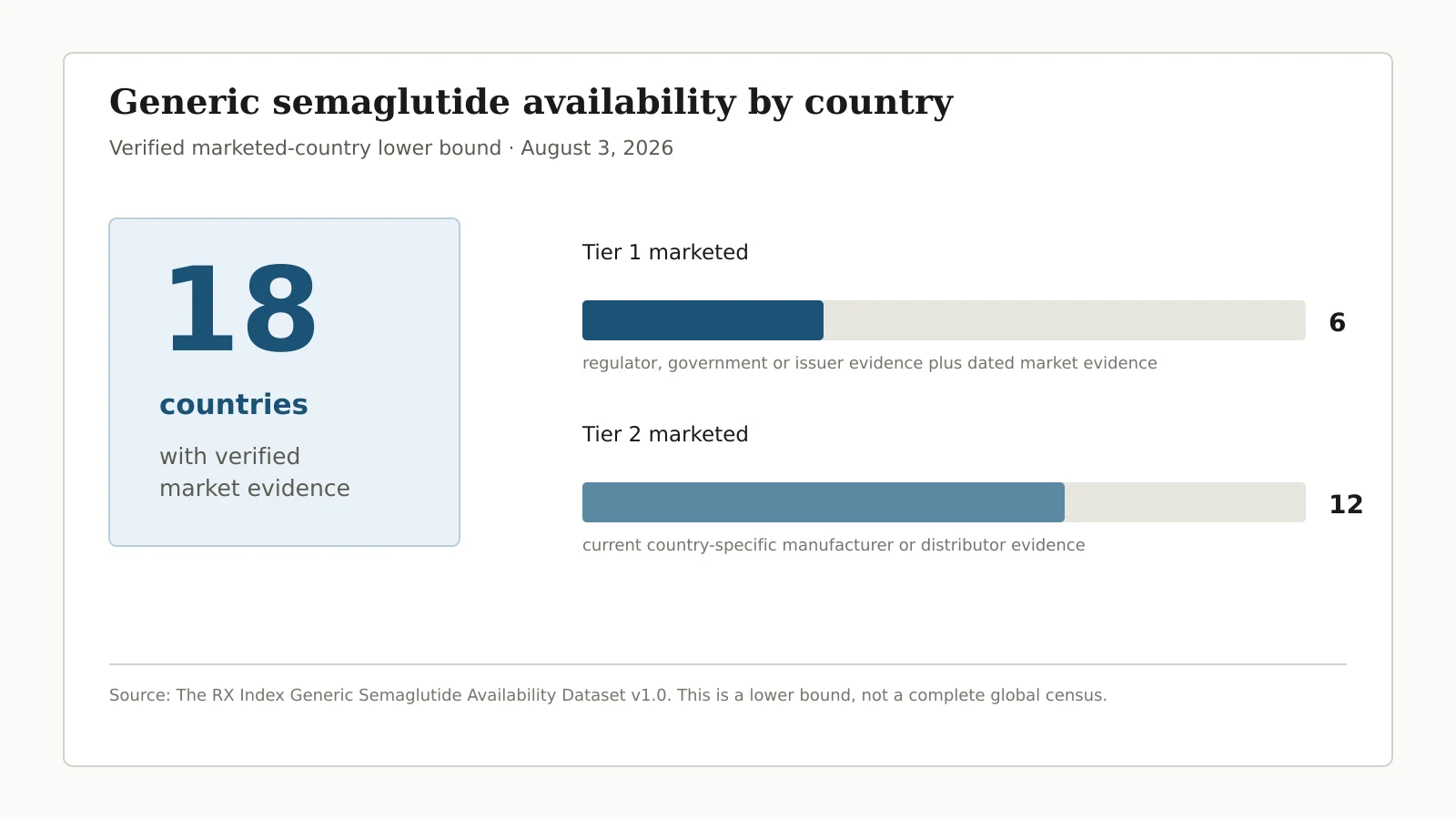
As of August 3, 2026, non-originator semaglutide had verified market evidence in at least 18 countries. No FDA-approved generic semaglutide was commercially marketed in the United States.
A 2026 peer-reviewed cost-plus analysis estimates that injectable semaglutide could be produced for $28–$140 per person per year, while the active ingredient contributes about $0.01–$0.12 per dose.
Generic semaglutide availability by country is no longer a simple patent-expiry story. We verified six countries with regulator, government or public-issuer approval evidence plus dated commercial evidence, and 12 more with current country-specific manufacturer or distributor evidence. That makes at least 18 marketed countries as of August 3, 2026.
The United States is not one of them. Apotex received the first US tentative approval for a generic Ozempic equivalent on April 10, 2026, but tentative approval does not permit ordinary commercial sale. Novo Nordisk's own 2025 annual report lists US active-ingredient patent expiry for Ozempic, Rybelsus, Wegovy injection and the Wegovy pill in 2032.
The molecule was never the expensive part in the cost model. The device, the regulatory route, the rights position, the approved price and the decision to launch are where the time and money pile up.
Evidence status at a glance
| Evidence status | Countries or products | Counted in the 18-country headline? |
|---|---|---|
| Marketed — Tier 1 | Brazil, Canada, India, Russia, Saudi Arabia, South Africa | Yes — 6 |
| Marketed — Tier 2 | Azerbaijan, Bangladesh, Belarus, Cambodia, Iran, Kazakhstan, Laos, Myanmar, Pakistan, Paraguay, Uzbekistan, Venezuela | Yes — 12 |
| Confirmation pending | Kenya; Tajikistan | No |
| Regulatory progress, not marketed | United States; China | No |
| Approved, launch not verified | Brazil: Owozy, Seemasun, Zempneo, Semavy and Orsema; Canada: Sevmia | No additional country count |
Source: The RX Index Generic Semaglutide Availability Dataset v1.0, verified August 3, 2026. Tier 1 requires regulator, government or public-issuer approval evidence plus dated commercial evidence. Tier 2 requires current, country-specific manufacturer or distributor evidence; a national regulator record was not independently retrieved.
Two phrases in that table are doing a lot of work.
“At least” means 18 is a verified lower bound, not a claim that this is a complete global census. We found additional registration, retail and press signals that did not meet the published evidence rule, and we left them out.
“Non-originator semaglutide” means a semaglutide product other than Novo Nordisk's Ozempic, Wegovy or Rybelsus. We use the everyday term “generic semaglutide” in headings because that is how the question is commonly asked. In the data, each country's own language stays visible. Brazil explicitly refuses to call Ozivy a generic. Russia uses terms such as analogue or reproduced medicine. India’s public company materials use both generic and biosimilar terminology depending on the product.
Generic semaglutide availability by country: where it is marketed
Answer capsule: As of August 3, 2026, non-originator semaglutide had verified market evidence in at least 18 countries. Six — Brazil, Canada, India, Russia, Saudi Arabia and South Africa — met the Tier 1 rule. Twelve more — Azerbaijan, Bangladesh, Belarus, Cambodia, Iran, Kazakhstan, Laos, Myanmar, Pakistan, Paraguay, Uzbekistan and Venezuela — met the Tier 2 rule.
| Country | Status | Evidence tier | Verified products or brands | Formulation and stated or approved use | First verified market evidence |
|---|---|---|---|---|---|
| Azerbaijan | Marketed | Tier 2 | Semavic | Injection; manufacturer states type 2 diabetes and obesity | November 25, 2025 |
| Bangladesh | Marketed | Tier 2 | Orsema; Fitaro | Injection; Orsema for type 2 diabetes, Fitaro for chronic weight management | Current manufacturer product pages; launch date not published |
| Belarus | Marketed | Tier 2 | Semavic | Injection; manufacturer states type 2 diabetes and obesity | June 9, 2026 |
| Brazil | Marketed | Tier 1 | Ozivy | Injection pen; approved for type 2 diabetes | June 15, 2026 |
| Cambodia | Marketed | Tier 2 | Truglyx | Injection; manufacturer describes a diabetes launch | May 2, 2026 |
| Canada | Marketed | Tier 1 | Dr. Reddy's Semaglutide Injection; Apo-Semaglutide Injection | Injection pens; marketed products approved for type 2 diabetes | May 6, 2026 |
| India | Marketed | Tier 1 | At least nine issuer-verified injection brands; Obeda tablets | Injection and oral; products approved across type 2 diabetes and chronic weight management | March 21, 2026 |
| Iran | Marketed | Tier 2 | Velorita | Injection; distributor describes obesity and diabetes use | 2026 company announcement; exact day not normalized |
| Kazakhstan | Marketed | Tier 2 | Semavic | Injection; company describes metabolic-disease use | Late November 2025 |
| Laos | Marketed | Tier 2 | L'Osem-14 | Oral 14 mg tablet; type 2 diabetes | Current registered product page; launch date not published |
| Myanmar | Marketed | Tier 2 | Orsema | Injection; manufacturer states diabetes and weight management | January 15, 2026 |
| Pakistan | Marketed | Tier 2 | Sem-P; Sem-O | Injection and oral tablets; type 2 diabetes | Current manufacturer product pages; launch date not published |
| Paraguay | Marketed | Tier 2 | Somero | Injection; manufacturer states type 2 diabetes and overweight/obesity | November 14, 2025 |
| Russia | Marketed | Tier 1 | Semavic; Semavic Next; Quincenta; Velgia; Semaltara | Injection and oral; products span type 2 diabetes and weight management | December 29, 2023 |
| Saudi Arabia | Marketed | Tier 1 | Tasylev | Injection; SFDA record identifies a generic/multisource semaglutide product | September 2025 current-use evidence; November 2025 procurement evidence |
| South Africa | Marketed | Tier 1 | Sun Pharma generic semaglutide; brand not stated in the primary release | Injection pen; approved for type 2 diabetes | July 21, 2026 |
| Uzbekistan | Marketed | Tier 2 | Semavic; Velgia; Quincenta | Injection; company materials describe type 2 diabetes and weight control | December 18, 2025 |
| Venezuela | Marketed | Tier 2 | Semavic | Injection; registered for type 2 diabetes, including patients with overweight or obesity | First shipment April 2026; in pharmacies by June 24, 2026 |
Source: The RX Index Generic Semaglutide Availability Dataset v1.0. Country evidence comes from Health Canada and its Drug and Health Products Portal; Anvisa; SFDA materials; public issuer filings; and country-specific manufacturer or distributor records listed in the Sources section. Verified August 3, 2026.
This table is the centerpiece of the dataset. It separates evidence strength from market status, and it does not turn a patent date, an application, an approval or a promised rollout into pharmacy availability.
| Jurisdiction or product | Status on August 3, 2026 | Why it is not counted |
|---|---|---|
| Kenya | Reported launch, confirmation pending | A credible local report describes a Truglyx launch, but we did not retrieve a national regulator record or a Kenya-specific first-party launch statement |
| Tajikistan | Registration and retail signals, confirmation pending | Secondary reporting says Semavic was registered, and a current Tajik pharmacy lists the product; we did not retrieve a regulator record or a first-party statement establishing completed market distribution |
| United States | Tentatively approved | FDA tentative approval is not final approval and does not permit ordinary sale |
| China | Applications under review | No marketed non-originator product was located; a listed company reported one application suspended over data-protection provisions |
| Brazil — Owozy, Seemasun, Zempneo, Semavy, Orsema | Approved, launch not verified | Anvisa registered all five on July 29, 2026; no completed market event was located |
| Canada — Sevmia | Approved, launch not verified | Health Canada approved Sevmia on June 29, 2026; the live product record still showed “Approved,” not “Marketed” |
Source: Apotex; Health Canada; Anvisa; Hangzhou Jiuyuan Gene Engineering's March 30, 2026 HKEX filing; GEROPHARM; and the provisional Kenya source described in the Sources section. Verified August 3, 2026.
Why did the 2026 patent window produce three different outcomes?
Answer capsule: India, Brazil and China all entered a major semaglutide loss-of-exclusivity window in 2026, but they did not enter the market together. Indian launches began March 21. Brazil's regulator says the relevant Ozempic patent expired March 20, then approved Ozivy May 26 and the product reached pharmacies June 15. China still had applications under review, including one the applicant said was suspended over data protection.
Patent expiry is a starting gun, not a finish line.
The primary record does not support one exact national expiry date for all three countries. It supports March 20 in Brazil. Indian issuer materials say their products launched upon patent expiry on March 21. Novo Nordisk's own table gives China an active-ingredient patent-expiry year of 2026, while the March 30 HKEX filing shows applications still pending.
| Measure | India | Brazil | China |
|---|---|---|---|
| Patent timing supported by the reviewed primary record | Issuers launched “upon patent expiry” on March 21, 2026 | Anvisa states the Ozempic patent expired March 20, 2026 | Novo Nordisk lists active-ingredient expiry in 2026 |
| First non-originator approval | Product approvals were in place before launch | Ozivy approved May 26, 2026 — 67 days after March 20 | Applications pending as of March 30, 2026 |
| First verified market evidence | March 21, 2026 | June 15, 2026 — 87 days after March 20 and 20 days after approval | Not reached by August 3, 2026 |
| Marketed brands verified | At least 9 injection brands, plus a later oral product | 1 | 0 located |
| Additional approved products | More products may exist beyond the issuer-verified minimum | 5 more approved July 29, launch not verified | Not applicable |
| Binding issue visible in the record | Manufacturers pre-staged approvals and launches | Regulatory review, then maximum-price approval, then launch | Regulatory review; one applicant reported a data-protection suspension |
Source: Sun Pharma, Alkem, Zydus and Dr. Reddy's public releases; Anvisa notices dated May 26 and July 29, 2026; Novo Nordisk Annual Report 2025; Hangzhou Jiuyuan Gene Engineering HKEX filing dated March 30, 2026. Date differences calculated by The RX Index.
The spread between India's first launch and Brazil's first sale was 86 days. That is not a measure of regulator quality. It is evidence that “the patent expired” does not answer “can a patient buy the product?”
Why is semaglutide a generic in one country and not in another?
Answer capsule: Regulators do not use one global legal category for non-originator semaglutide. The United States uses the ANDA generic pathway. Canada calls the products generics while describing them as complex synthetic products equivalent to a brand-name biologic. Brazil says Ozivy is not legally a generic and registered it as a new medicine — a synthetic analogue of a biological product.
Semaglutide sits in an awkward regulatory place. It is a peptide. It can be produced through biological or chemical routes. Different products can use different manufacturing methods, and regulators have not attached the same legal label to every copy.
| Jurisdiction | Language supported by the primary record | What that means in this tracker |
|---|---|---|
| United States | Generic drug submitted through an Abbreviated New Drug Application | Tentative ANDA approval is regulatory progress, not market availability |
| Canada | Generic drug submitted through an Abbreviated New Drug Submission; Health Canada calls these “complex synthetic products” pharmaceutically equivalent to a brand-name biologic | Counted only after the product record changes to Marketed or another dated commercial event is found |
| Brazil | New medicine; synthetic analogue of a biological product; explicitly not a generic under Brazilian regulation | The legal classification is preserved rather than overwritten with a US-style label |
| Saudi Arabia | Generic or multisource product in the SFDA record | Counted after dated current-use and procurement evidence |
| South Africa | Generic semaglutide in the approval and launch releases | The verified first product is a type 2 diabetes product, not a weight-management product |
| India | Product-specific DCGI/CDSCO approvals; issuer materials use generic or biosimilar terminology depending on product and formulation | We report the issuer's verified product, formulation, indication and approval statement without forcing one countrywide label |
| Russia | Analogue or reproduced medicine in company and local usage | The separate authorization history stays visible |
Source: FDA and Apotex ANDA materials; Health Canada news releases; Anvisa's May 26, 2026 registration notice; SFDA product materials; Sun Pharma's South Africa releases; Indian issuer filings; GEROPHARM and PROMOMED materials. Verified August 3, 2026.
Brazil gives the cleanest practical example. Anvisa says Ozivy is not a generic because Brazilian regulation does not provide a generic category for biological products. It registered Ozivy as a new medicine and a synthetic analogue of a biological product.
That legal distinction reaches the refrigerator. Anvisa says Ozivy must remain at 2–8°C before and after treatment begins. Ozempic requires refrigeration before first use but may then be stored at up to 30°C for up to six weeks. Same active ingredient name, different product and different storage rule. That can matter where reliable refrigeration is difficult.
What has to happen before a non-originator semaglutide product can be sold?
Answer capsule: Five gates can stand between a patent date and a pharmacy shelf: rights, data protection, regulatory approval, price approval where required, and commercial launch. A product is not marketed until every gate that applies in that jurisdiction has cleared.
Gate 1 — Rights
The relevant patent must expire, lapse, be held inapplicable, or be overridden through a lawful national mechanism. Brazil's Anvisa notice identifies March 20, 2026 as the patent-expiry date relevant to Ozivy. Indian issuers launched on March 21 and described the event as occurring upon patent expiry. Russia used a separate government-authorization route while relevant rights were still contested.
Gate 2 — Data protection
Patent status and regulatory data protection are different. A company can be free of one and still blocked by the other. Hangzhou Jiuyuan Gene Engineering told the Hong Kong Stock Exchange that review of its Jiyoutai application in China had been suspended because of data-protection provisions. GEROPHARM's July 2 statement says the Kazakhstan litigation centered on data exclusivity rather than whether the product existed.
Gate 3 — Approval
The product must be approved under the category the national regulator applies. That category can change the dossier, studies, review clock and product-specific evidence required.
Gate 4 — Price approval
Brazil adds a visible gate after Anvisa registration. Anvisa says a product may be sold only after the Drug Market Regulation Chamber, CMED, approves a maximum price. Registration alone does not put the product on sale.
Gate 5 — Launch
The authorization holder must manufacture, import, distribute and release the product. Canada makes the distinction machine-readable: Dr. Reddy's product changed to Marketed on May 6, Apo-Semaglutide on May 14, while Sevmia remained Approved as of the verification date. Brazil had the same split: Ozivy was marketed; five July 29 approvals were not.
Approval and availability are separate events. That is the most common error in coverage of this subject, and the easiest one to avoid.
Which Tier 1 countries have marketed non-originator semaglutide?
India — at least nine injection brands on the first verified market day
Status: Marketed, Tier 1 · First verified market date: March 21, 2026 · Last verified: August 3, 2026
India moved first in the 2026 wave because manufacturers had products ready to launch as the patent window opened. We verified at least nine injection brands from public issuer documents:
- Sun Pharma: Noveltreat for chronic weight management and Sematrinity for type 2 diabetes.
- Alkem Laboratories: Semasize, Obesema and Hepaglide, with DCGI approval covering type 2 diabetes and chronic weight management.
- Zydus Lifesciences: Semaglyn, Mashema and Alterme, supplied through a reusable pen with a 15 mg/3 mL cartridge.
- Dr. Reddy's Laboratories: Obeda injection for type 2 diabetes, in 2 mg and 4 mg pre-filled disposable pens.
Nine is a floor, not a ceiling. We did not add a brand merely because it appeared in launch-day reporting. It entered this minimum only when we could tie it to a public issuer release or filing.
Sun Pharma's two products are not interchangeable rows. Noveltreat is a chronic-weight-management product supplied in five strengths from 0.25 mg to 2.4 mg. Sematrinity is a type 2 diabetes product supplied in 2 mg/1.5 mL and 4 mg/3 mL presentations.
Dr. Reddy's later launched Obeda oral tablets on May 20, 2026. Those tablets are a separate product and a separate market event from the March 21 injection. They are available in 3 mg, 7 mg and 14 mg strengths and were announced at ₹99, ₹135 and ₹225 per tablet, respectively.
Russia — first verified market entry in December 2023
Status: Marketed, Tier 1 · First authorization: October 6, 2023 · First verified market date: December 29, 2023 · Last verified: August 3, 2026
Russia is the earliest market in this dataset. GEROPHARM announced that Semavic had reached the Russian market on December 29, 2023, after an October authorization. The route was not an ordinary post-expiry launch, so we preserve the local language and legal history instead of flattening it into a standard generic narrative.
Products verified in current first-party materials include Semavic and Semavic Next from GEROPHARM and Quincenta, Velgia and Semaltara from PROMOMED. PROMOMED describes Semaltara, launched in December 2025, as the first Russian oral semaglutide.
The Russian Supreme Court appeals ruling is dated July 29, 2025. It upheld a May 6 decision concerning the government's authority under Article 1360 in disputes involving separate 2024 government orders. That should not be collapsed into a claim that every Russian product followed one identical December 2023 licence.
Canada — first G7 approval, first verified sale May 6
Status: Marketed, Tier 1 · First approval: April 28, 2026 · First verified market date: May 6, 2026 · Last verified: August 3, 2026
Health Canada authorized the first G7 generic semaglutide on April 28, 2026. The product was filed by Dr. Reddy's Laboratories and approved for type 2 diabetes. Its live Drug and Health Products Portal record shows a Marketed status date of May 6, 2026.
May 14 was Apotex's commercial launch date, not Canada's first verified market date.
| Approval date | Product | Sponsor | Approved use | Commercial status on August 3, 2026 |
|---|---|---|---|---|
| April 28, 2026 | Semaglutide Injection | Dr. Reddy's Laboratories | Type 2 diabetes | Marketed May 6, 2026 |
| May 1, 2026 | Apo-Semaglutide Injection | Apotex | Type 2 diabetes | Marketed May 14, 2026 |
| June 29, 2026 | Sevmia | Apotex | Chronic weight management, age 12 and over under Health Canada's label | Approved; launch not verified |
Source: Health Canada news releases dated April 28, May 1 and June 29, 2026; Health Canada Drug and Health Products Portal records; Apotex launch release dated May 14, 2026. Verified August 3, 2026.
Health Canada spells the weight-management product Sevmia. Apotex styles it SEVMIA™. That is capitalization and trademark styling, not a spelling conflict.
The live Generic Submissions Under Review list creates another date-sensitive distinction. Health Canada's June 29 news release said six submissions remained under review. The list current as of June 30 contained seven semaglutide entries because a new Sandoz submission had entered the queue. The correct current count is seven, while six remains the historically accurate count stated in the June 29 release.
Brazil — approval May 26, sale June 15
Status: Marketed, Tier 1 · First approval: May 26, 2026 · First verified market date: June 15, 2026 · Last verified: August 3, 2026
Anvisa registered Ozivy, made by EMS, on May 26, 2026. The application had been filed in 2023 and was prioritized through Anvisa's GLP-1 review initiative. The product reached pharmacies on June 15 — 20 days after approval.
Ozivy is approved for adults with inadequately controlled type 2 diabetes as an adjunct to diet and exercise, either where metformin is inappropriate or in addition to other diabetes medicines. It is supplied as a 1.34 mg/mL solution in pre-filled multidose disposable pens and is subject to Brazil's retained two-copy prescription rule for GLP-1 products.
The R$287 figure needs a qualifier. EMS announced a price from R$452 per pen. Members of its Vida + Leve program were offered an average R$287 per month over the first three months; the fourth month was listed at R$498 per pen. R$287 is not the ordinary unqualified monthly launch price.
On July 29, Anvisa registered five more synthetic semaglutide pens: Owozy for Ávita Care, Seemasun for Sun Pharma, Zempneo for Brainfarma, Semavy for Cosmed and Orsema for Ranbaxy. All five are diabetes products. We found no completed launch for any of them, so they remain approved-only.
There is a naming collision worth preserving. Ranbaxy's Orsema in Brazil is not the same registration or market event as Incepta's Orsema in Bangladesh and Myanmar.
South Africa — approval to launch in six days
Status: Marketed, Tier 1 · Approval: July 15, 2026 · Launch: July 21, 2026 · Last verified: August 3, 2026
Sun Pharma announced SAHPRA approval on July 15 and commercial launch on July 21, a six-day interval. The company did not state a brand name in the primary releases, and none is supplied here.
The verified indication is adults with inadequately controlled type 2 diabetes as an adjunct to diet and exercise. It is not a verified chronic-weight-management approval. The product is supplied as a pre-filled multidose pen in 2 mg/1.5 mL and 4 mg/3 mL strengths.
Saudi Arabia — a 2025 market event hidden by the 2026 narrative
Status: Marketed, Tier 1 · Approval: February 1, 2025 · Current-use evidence: September 2025 · Procurement evidence: November 2025 · Last verified: August 3, 2026
The SFDA lists Tasylev as a generic or multisource semaglutide product, with Boston Oncology Arabia recorded as the marketing authorization holder. It appears in an SFDA-approved pharmacovigilance communication dated September 2, 2025 and in national procurement material published in November 2025.
We did not locate an exact retail launch day, so the table uses month-level current-use evidence rather than inventing a date. What is secure is the year: Saudi evidence predates the 2026 wave.
Which Tier 2 countries have current manufacturer or distributor evidence?
Answer capsule: Twelve countries meet the Tier 2 rule. Their evidence is specific enough to establish a current named product in that country, but we did not independently retrieve the national regulator's registration record. They count in the lower bound and remain visibly separated from Tier 1.
GEROPHARM's documented expansion outside Russia
GEROPHARM's own country-specific releases support six Tier 2 markets:
- Azerbaijan: Semavic was registered and described as already available in pharmacy chains on November 25, 2025, for type 2 diabetes and obesity.
- Belarus: Semavic was registered and described as already available to patients on June 9, 2026.
- Kazakhstan: the company says Semavic entered the market in late November 2025. A July 2, 2026 company statement says the registration remained valid after first-instance and appellate court decisions and that the product was lawfully in circulation.
- Paraguay: Somero completed registration and was being marketed nationally by November 14, 2025.
- Uzbekistan: Semavic was registered and described as available to patients on December 18, 2025. PROMOMED separately says Velgia and Quincenta were already available in Uzbek pharmacies in December 2025.
- Venezuela: the first Semavic shipment arrived in April 2026; the June 24 release says the product was in pharmacies, with regular exports to continue from July.
These are manufacturer statements, not national regulator records retrieved by The RX Index. That is why all six stay Tier 2 even where the company says registration was completed.
Bangladesh
Incepta Pharmaceuticals currently lists two distinct semaglutide products:
- Orsema: 0.25 mg and 0.50 mg pre-filled injections for type 2 diabetes and cardiovascular-risk reduction under the product page's stated label.
- Fitaro: pre-filled injections from 0.25 mg through 2.4 mg for chronic weight management.
The current product pages establish country-specific commercial evidence. A national DGDA registration record was not independently retrieved.
Cambodia
Hetero announced the launch of Truglyx, described as a generic semaglutide injection for diabetes care, in Cambodia on May 2, 2026. The country-specific launch event was organized by Camber Pharmaceuticals, a Hetero subsidiary.
Iran
Cobel Darou states that it placed Velorita, a Canadian-produced semaglutide product, on the Iranian pharmaceutical market for obesity and diabetes management. The company also said licensed local production had begun. The company post establishes a named product and country-specific market statement; a national regulator record was not independently retrieved.
Laos
Laos Alliance Pharmaceutical Group currently lists L'Osem-14, a 14 mg oral semaglutide tablet for adults with type 2 diabetes, with registration number 06 L 1121/24 and a linked registration certificate. The product page does not publish a launch date.
Myanmar
Incepta announced the first launch of semaglutide injections in Myanmar under the Orsema brand on January 15, 2026, with ABC International identified as the local partner. The announcement describes diabetes and weight-management use.
Pakistan
Getz Pharma currently lists both:
- Sem-P: 2 mg/1.5 mL and 4 mg/3 mL pre-filled injections for type 2 diabetes and cardiovascular-risk reduction under the product page's stated label.
- Sem-O: 3 mg, 7 mg and 14 mg oral tablets for type 2 diabetes.
The pages include prescribing-information links and an ordering function. A DRAP registration record was not independently retrieved.
Where is generic semaglutide tentatively approved or still under review?
United States
Answer capsule: No FDA-approved generic semaglutide was commercially marketed in the United States as of August 3, 2026. Apotex received the first FDA tentative approval for a generic Ozempic equivalent on April 10, but tentative approval is not final approval.
Apotex, working with Orbicular Pharmaceutical Technologies, announced the first tentative FDA approval for a semaglutide-injection ANDA on April 10, 2026. Tentative approval means the application has completed the substantive review needed for approval, but the product cannot receive final approval and enter ordinary commercial distribution while the blocking exclusivity remains.
Novo Nordisk's 2025 annual report lists active-ingredient patent expiry in the United States at 2032 for Ozempic, Rybelsus, Wegovy injection and the Wegovy pill. Novo also says process, formulation and use patents, as well as regulatory protection, may matter beyond the active-ingredient date.
Novo's same annual report states that its standard US self-pay price for Ozempic or Wegovy was lowered to $349 per month, following an introductory $199 per month offer for the first two doses that ran through March 31, 2026.
For patent-by-patent US detail, see GLP-1 patent expiration dates.
China
Hangzhou Jiuyuan Gene Engineering's March 30, 2026 filing identifies two semaglutide products pending approval: Jiyoutai for type 2 diabetes and Jikeqin for obesity. The company says review of Jiyoutai had been suspended because of data-protection provisions.
That statement comes from the applicant's filing, not a regulator policy statement. It is strong evidence for what happened to that application and should not be generalized beyond it.
| Product | United States | China | Japan | Europe |
|---|---|---|---|---|
| Ozempic | 2032 | 2026 | 2031 | 2031 |
| Rybelsus | 2032 | 2026 | 2031 | 2031 |
| Wegovy injection | 2032 | 2026 | 2031 | 2031 |
| Wegovy pill | 2032 | 2026 | 2031 | 2031 |
Source: Novo Nordisk Annual Report 2025, “Patent status for products with marketing authorisation.” The table covers active-ingredient patents and includes actual and estimated term extensions. The Europe figure is based on Germany; Novo says patent status varies by country. Other process, formulation and use patents may remain relevant.
That is the cleanest way to handle the 2031-versus-2032 discrepancy in secondary coverage. The patent holder's own active-ingredient schedule says 2032 for the United States. Other sources may be referring to different patents, assumptions or products in the portfolio.
Which products are approved but not yet verified as launched?
Answer capsule: Brazil has five newly approved semaglutide pens without a completed market event, and Canada's Sevmia was approved but not listed as marketed. Approval is not counted as availability.
Anvisa registered Owozy, Seemasun, Zempneo, Semavy and Orsema on July 29, 2026. Health Canada approved Sevmia on June 29. None had a verified completed launch by August 3 under this dataset's rule.
We promote a product from approved-only to marketed when we locate at least one of the following:
- a dated manufacturer launch announcement;
- a regulator product record showing a marketed status;
- dated pharmacy, distributor or wholesaler release evidence;
- procurement or current-use evidence; or
- a current country-specific manufacturer product page that establishes commercial availability.
An intended date, an application, an approval announcement saying “launch soon,” or an unnamed multinational rollout does not satisfy the market test.
What does generic semaglutide cost — and what does it cost to make?
Answer capsule: Observed launch prices and modeled production costs answer different questions. Verified or reported market prices include ₹1,290 per month for an Indian starter-dose vial, ₹1,800 per month for an Alkem pen and R$452 per Ozivy pen in Brazil. A peer-reviewed model estimates injectable production at $28–$140 per person per year.
Prices below come from different countries, doses, formats, treatment stages, taxes and access programs. They are not a like-for-like international price index.
| Country | Product or source | Format | Price as published | What the figure means |
|---|---|---|---|---|
| India | Eris/Natco Sundae, reported by Reuters | Multi-dose vial | ₹1,290 per month at the reported starter dose | Secondary launch-day report; dose-specific |
| India | Alkem Semasize/Obesema/Hepaglide | Disposable pen | From ₹1,800 per month | Company launch price |
| India | Zydus Semaglyn/Mashema/Alterme | Reusable pen and cartridge | About ₹2,200 per month | Company-reported average monthly cost |
| India | Dr. Reddy's Obeda injection | Disposable pen | ₹4,200 per month | Company launch price for 2 mg or 4 mg pen presentations |
| India | Sun Pharma Sematrinity | Pen | About ₹750–₹1,300 per week across dose escalation | Type 2 diabetes product; company range |
| India | Sun Pharma Noveltreat | Pen | About ₹900–₹2,000 per week across dose escalation | Weight-management product; company range |
| India | Dr. Reddy's Obeda tablets | Oral | ₹99, ₹135 and ₹225 per tablet for 3 mg, 7 mg and 14 mg | Strength-specific company prices |
| Brazil | EMS Ozivy | Pen | From R$452 per pen | Announced ordinary starting pen price |
| Brazil | EMS Vida + Leve program | Pen | Average R$287/month for first three months; R$498 for month four | Time-limited program terms, not an unqualified ongoing monthly price |
| United States | Novo Nordisk originator products, reference only | Pen | $349 per month standard self-pay | Originator reference, not a generic price |
Source: Sun Pharma, Alkem, Zydus and Dr. Reddy's primary launch materials; ABIQUIFI publication carrying the EMS Ozivy launch terms; Reuters for the Eris/Natco vial figure; Novo Nordisk Annual Report 2025. Verified August 3, 2026.
The device can cost more than the drug inside it
A 2026 analysis by Jacob Levi, Samuel Cross, Nydile Ramesh, Francois Venter and Andrew Hill, published in Obesity, applied a cost-plus method to 33 semaglutide active-pharmaceutical-ingredient shipment records to and from India between November 2024 and November 2025.
The published estimates are:
- Injectable semaglutide: $28–$140 per person per year.
- Oral semaglutide: $186–$380 per person per year.
- Active ingredient per injectable dose: about $0.01 at 0.25 mg and $0.12 at 2.4 mg.
- Disposable injection device: about $0.30–$2.50 per device.
- Device burden in the modeled single-use presentation: 52 devices per person per year.
The authors estimate that the injection device can cost 8 to 68 times more than the active ingredient plus the other modeled production inputs combined, depending on dose and device price.
India's launch prices are consistent with a device effect but do not prove that the device is the only cause of the price spread. The ₹1,290 figure is a vial from one commercial arrangement; the ₹1,800–₹4,200 figures are pens from different companies with different products, doses and pricing decisions. Cross-company launch prices cannot isolate one variable.
The useful sentence is narrower and stronger: once the compound patent stops being the main barrier, delivery-device cost can become a large share of the modeled production cost.
One study number to check before quoting it
The preprint and the published paper do not contain the same headline country totals.
| Version | Countries with 2026 patent expiry | Share of global obesity burden | Total countries potentially reachable by end of 2026 |
|---|---|---|---|
| medRxiv preprint abstract, March 4, 2026 | 10 | 48% | 160 |
| medRxiv preprint results section | 10 | 47% | 160 |
| Published version in Obesity | 12 | 47% | 162 |
Source: The RX Index comparison of the medRxiv preprint, DOI 10.64898/2026.03.04.26347508, with the published Obesity paper, DOI 10.1002/oby.70241. Verified August 3, 2026.
The published paper also reports that those 12 countries account for 49% of the global type 2 diabetes burden, that no semaglutide patent filings were identified in 150 additional countries, and that 162 potentially reachable countries contain 69% of global type 2 diabetes and 84% of clinical obesity.
“Potentially reachable” is not the same as approved or marketed. The paper models legal and production possibility. This tracker records observed country evidence.
The preprint says patent expiries begin “from April 2026.” Anvisa's own Brazil notice gives March 20, 2026. That is a date-precision difference worth preserving when the national event is being described.
Is generic semaglutide approved for weight loss in every country where it is available?
Answer capsule: No. Indications are product-specific. A product approved for type 2 diabetes must not be described as approved for chronic weight management merely because semaglutide can reduce body weight or because the product has a high-dose presentation.
South Africa is the clearest example. Sun Pharma's first SAHPRA-approved generic is a type 2 diabetes product. It is not a verified generic Wegovy launch.
Canada has both categories but not in the same market-status row. Dr. Reddy's and Apo-Semaglutide are marketed diabetes products. Sevmia is approved for chronic weight management in patients 12 and over, but launch was not verified.
India has products in both categories. Sun Pharma launched Sematrinity for type 2 diabetes and Noveltreat for chronic weight management on the same date. Alkem says its DCGI approval covers both type 2 diabetes and chronic weight management. Dr. Reddy's March injection and May oral launches are type 2 diabetes products.
Brazil's Ozivy and the five July 29 approvals are diabetes products.
Formulation and strength do not prove indication. The approved label or the product-specific source does.
Is oral generic semaglutide available?
Answer capsule: Yes. We verified oral non-originator semaglutide in at least four countries: India, Laos, Pakistan and Russia.
| Country | Product | Strengths | Verified use | Market evidence |
|---|---|---|---|---|
| India | Obeda tablets, Dr. Reddy's | 3 mg, 7 mg, 14 mg | Type 2 diabetes | Launched May 20, 2026 |
| Laos | L'Osem-14 | 14 mg | Type 2 diabetes | Current product page with registration number 06 L 1121/24 |
| Pakistan | Sem-O, Getz Pharma | 3 mg, 7 mg, 14 mg | Type 2 diabetes | Current product and prescribing-information page |
| Russia | Semaltara, PROMOMED | Oral tablet; strengths not normalized in this dataset | Type 2 diabetes and weight control in company material | Launched December 2025 |
Source: Dr. Reddy's May 20, 2026 release; Laos Alliance Pharmaceutical Group; Getz Pharma; PROMOMED corporate history. Verified August 3, 2026.
Oral products need their own rows. Dr. Reddy's Obeda injection and Obeda tablets launched two months apart, have different formulations and follow different product evidence. They are not one event.
The cost model also treats oral and injectable semaglutide separately. Oral dosing requires much more active ingredient, which is why the modeled annual oral cost of $186–$380 is higher than the injectable estimate of $28–$140.
Is compounded semaglutide the same as generic semaglutide?
Answer capsule: No. The FDA states that compounded drugs are not FDA-approved, and compounded drugs are not the same as generic drugs. Compounded products are excluded from every country count and product row in this tracker.
A generic or other non-originator product in this dataset has regulator approval evidence or current country-specific commercial evidence under the published tier rule. A compounded preparation is made by a pharmacy or outsourcing facility and is not an FDA-approved generic.
The following are excluded entirely:
- compounded semaglutide;
- counterfeit products and unauthorized “research peptide” products;
- personal-import listings and cross-border pharmacy shipping pages;
- an application or clinical trial without approval;
- tentative approval without final approval;
- patent expiry without a product event; and
- Novo Nordisk's originator products.
For the separate enforcement record, see the compounded GLP-1 enforcement tracker.
What is each regulator reviewing now?
Answer capsule: Canada had seven semaglutide generic submissions on its list current June 30. Anvisa had completed 11 of 24 prioritized semaglutide and liraglutide analyses by July 29, producing six semaglutide approvals. SAHPRA told Reuters it had 12 semaglutide applications under review when Sun launched. China had multiple company applications pending, including one reported suspended.
| Jurisdiction | Public pipeline signal | As-of date | Evidence note |
|---|---|---|---|
| Canada | 7 semaglutide generic submissions under review | June 30, 2026 | Live Health Canada GSUR list; one more than the June 29 news release because a new filing entered the list |
| Brazil | 11 of 24 prioritized semaglutide/liraglutide analyses completed; six semaglutide products approved | July 29, 2026 | Anvisa notice; the 24-product pool includes semaglutide and liraglutide processes |
| South Africa | 12 semaglutide applications under review | July 21, 2026 | Reuters report quoting SAHPRA; not independently reproduced from a SAHPRA database |
| China | Multiple applications; Jiyoutai review reported suspended | March 30, 2026 | Applicant's HKEX filing, not a regulator-wide policy statement |
Source: Health Canada Generic Submissions Under Review list; Anvisa July 29, 2026 notice; Reuters reporting on SAHPRA; Hangzhou Jiuyuan Gene Engineering HKEX filing. Verified August 3, 2026.
The Canadian count is a useful warning against freezing a queue number without its date. Eight submissions remained on April 28, seven on May 1, six were stated in the June 29 release, and seven appeared on the list current June 30 after a new submission entered. The sequence is not a simple countdown.
How we produced this tracker
Answer capsule: We collected regulator and government records, public issuer filings, manufacturer launch releases, current product pages, procurement material and carefully labeled press evidence. Every country was tested across four parts: rights context, regulatory status, commercial status and label scope, with formulation and indication recorded inside label scope. Only Tier 1 and Tier 2 market evidence enters the headline count.
Operational definition
We use generic semaglutide as the everyday term. The dataset records non-originator semaglutide: a semaglutide product other than Novo Nordisk's Ozempic, Wegovy or Rybelsus that meets one of the published evidence thresholds.
A country does not enter the market count because a product could legally launch there. It enters when we can document a named, country-specific product and a completed market signal.
The evidence ladder
| Level | Public status | Minimum evidence required |
|---|---|---|
| 1 | Marketed — Tier 1 | Regulator, government or public-issuer approval evidence plus a dated launch, marketed-status record, procurement event or current-use statement |
| 2 | Marketed — Tier 2 | Current country-specific manufacturer or distributor launch statement or product evidence; national regulator record not independently retrieved |
| 3 | Confirmation pending | Credible country report, registration statement or retail signal without enough regulator or first-party commercial confirmation to meet Levels 1 or 2 |
| 4 | Approved — launch not verified | Regulator approval with no completed commercial-entry evidence |
| 5 | Tentative approval or under review | Regulatory progress that does not permit or establish ordinary commercial sale |
| 6 | No approval located in reviewed materials | Bounded negative finding used only when the search scope is explicit; not proof of permanent absence |
| 7 | Review incomplete | Held out of the public status table rather than turned into a negative conclusion |
Source: The RX Index Generic Semaglutide Availability Dataset v1.0 methodology, August 3, 2026.
Included evidence
- National regulator approval notices and product records.
- Government authorization and procurement material.
- Public stock-exchange filings and issuer releases.
- Manufacturer launch releases and current product pages.
- Country-specific distributor statements.
- Regulator-approved pharmacovigilance communications.
- Dated marketed-status records.
- Press reporting only where it supplies a launch date, price or regulator statement unavailable in the reviewed primary record, and only when labeled as press evidence.
Excluded evidence
- Patent expiry by itself.
- Applications, trial results and planned launches without approval and sale.
- Tentative approval without final approval.
- Compounded, counterfeit or unauthorized products.
- Originator products.
- Cross-border shipping or personal-import availability.
- Pharmacy listings that do not establish lawful national availability.
- Corporate claims about rollout into a number of unnamed countries.
- Future dates stated as intentions rather than completed events.
One exclusion removed a large apparent number. Hetero announced a planned rollout across more than 75 countries, but did not name every country as a completed launch. Unnamed markets do not enter this dataset.
Date handling
When a source gives only a month, we keep a month-level date. Saudi Arabia's September 2025 current-use evidence and Kazakhstan's late-November 2025 launch are not converted into invented days.
When one source gives approval and another gives commercial status, both dates are recorded. Canada and Brazil show why.
When a live regulator list changes after a news release, both statements keep their dates. The June 29 Canadian release said six submissions; the June 30 live list contained seven.
Country-count rule
The headline is the number of countries with Level 1 or Level 2 evidence on the verification date. It is not the number of products, approvals, manufacturers or patent-expiry jurisdictions.
A second product in Canada or Brazil does not increase the country count. A newly verified product in a new country does.
What we could not verify
We did not independently retrieve national regulator registration records for the 12 Tier 2 countries. Their country-specific manufacturer or distributor evidence is current and specific enough to meet Level 2, and the missing regulator record is stated rather than hidden.
Kenya remains outside the count. A local report describes a Truglyx launch, but the country-specific primary confirmation required by this dataset was not retrieved.
Tajikistan also remains outside. Secondary reporting says Semavic had been registered there, and a current Tajik pharmacy lists the product. That combination is a strong signal, but it did not satisfy the final market-evidence rule used for the headline.
Japan is not presented as a negative finding. We did not retrieve a product-specific PMDA or MHLW result strong enough to publish. Its absence from the table is a review gap, not proof that no product exists.
The European Union/EEA, United Kingdom and Australia are also not turned into absolute negative claims. Searches of regulator materials did not produce a qualifying non-originator market event for this version, but a bounded search result is not the same as a permanent global fact.
What this data shows — and what it does not
This tracker shows documented country-level approval and market evidence as of a stated verification date.
It does not show:
- Daily pharmacy stock. A national launch does not mean a specific pharmacy has inventory today.
- Nationwide distribution. First distribution may be concentrated in major cities or selected chains.
- A complete global census. Eighteen is a floor.
- Insurance or public-system coverage. Registration and private sale do not establish reimbursement or public-program access.
- The price any one patient will pay. Dose escalation, taxes, retail margins, programs and reimbursement change the amount.
- Clinical interchangeability across every product. We report source-backed regulatory and commercial status, not a universal clinical-equivalence judgment.
- A treatment recommendation. This page does not advise anyone to start, stop, import or switch a prescription medicine.
This page does not replace a product's approved local prescribing information or care from a qualified healthcare professional. Treatment decisions belong with a qualified healthcare professional; questions about lawful availability belong with the national medicines regulator and licensed local pharmacy system.
Three limits deserve to stay visible:
- Tier 2 evidence comes from companies or distributors with a commercial interest. We use it because it is named, current and country-specific, and we label it so a stricter reader can exclude it.
- The China data-protection statement comes from the applicant. It establishes what the listed company reported about its application, not a general rule for every Chinese submission.
- Press evidence is not silently upgraded. Kenya remains pending, and the South African application count is attributed to Reuters quoting SAHPRA.
Why this matters now
Answer capsule: The observed 2026 story is not one global generic launch. It is at least 18 different national market events produced by different combinations of rights, data protection, regulatory classification, price control, device economics and commercial execution.
The strongest numbers now sit side by side:
- 18 countries with verified market evidence.
- 0 FDA-approved generic semaglutide products commercially marketed in the United States as of August 3, 2026.
- $28–$140 per person per year in modeled injectable production cost.
- $0.01–$0.12 per dose for the active ingredient in that model.
- 8–68 times as much for a disposable device as for the active ingredient and other modeled production inputs combined.
- 86 days between India's first verified launch and Brazil's first sale.
- Six days between South African approval and launch.
The patent matters. It just does not finish the job.
The next decisive variables are whether regulators can define a workable pathway, whether manufacturers can use lower-cost delivery systems, whether price approval is required, whether data protection remains, and whether an approved product actually ships.
Novo Nordisk's own annual report says it is responding to loss of exclusivity by launching second brands in lower-priced segments and fast-tracking differentiated devices. That means non-originator entry can change the originator market too. Every price in this page should be treated as a dated observation, not a permanent level.
Frequently asked questions
What countries currently have generic semaglutide?
As of August 3, 2026, we verified non-originator semaglutide market evidence in at least 18 countries: Azerbaijan, Bangladesh, Belarus, Brazil, Cambodia, Canada, India, Iran, Kazakhstan, Laos, Myanmar, Pakistan, Paraguay, Russia, Saudi Arabia, South Africa, Uzbekistan and Venezuela. Six meet the Tier 1 rule and 12 meet the Tier 2 rule. Kenya and Tajikistan remain outside the count pending stronger confirmation.
Is generic semaglutide available in the United States?
No FDA-approved generic semaglutide was commercially marketed in the United States as of August 3, 2026. Apotex received the first FDA tentative approval for a generic semaglutide injection on April 10, 2026, but tentative approval is not final approval and does not permit ordinary commercial sale. Novo Nordisk lists US active-ingredient patent expiry for its semaglutide products in 2032.
Which country was first to market a non-originator semaglutide product?
Russia is first in this dataset. GEROPHARM announced that Semavic reached the Russian market on December 29, 2023. The route involved government authorization rather than an ordinary post-expiry launch.
Which country was first in the 2026 patent-expiry wave?
India. Public issuer releases document multiple launches on March 21, 2026, including products from Sun Pharma, Alkem, Zydus and Dr. Reddy's.
Is generic semaglutide available for weight loss?
Yes, in some countries and for some products. India has products approved for chronic weight management, Bangladesh lists Fitaro for chronic weight management, and Canada has approved Sevmia for chronic weight management although its launch was not verified. South Africa's first product and Brazil's approved products are type 2 diabetes products. Indications are product-specific.
Is oral generic semaglutide available?
Yes. We verified oral non-originator semaglutide in at least four countries: India, Laos, Pakistan and Russia.
Is compounded semaglutide a generic?
No. The FDA says compounded drugs are not FDA-approved and are not the same as generic drugs. Compounded products are excluded from this tracker.
Does patent expiry mean a generic is available?
No. Rights, data protection, approval, price approval where applicable and commercial launch are separate gates. Brazil's first product reached pharmacies 87 days after the March 20 patent-expiry date stated by Anvisa. China had applications pending and no verified market entry in this review.
Why is semaglutide called a generic in Canada but not Brazil?
The countries apply different legal classifications. Health Canada authorizes generic semaglutide through its abbreviated generic-drug process and describes the products as complex synthetic products equivalent to a brand-name biologic. Anvisa says Ozivy is not a generic under Brazilian regulation and classified it as a new medicine and a synthetic analogue of a biological product.
How often is this tracker updated?
Country status is reviewed monthly and when a qualifying regulatory or launch event is found. The headline count is re-verified weekly for the first 90 days after publication. The verification date changes only after the underlying sources are re-checked. Historical version dates are not rewritten.
Change log
| Version | Verification date | Change |
|---|---|---|
| 1.0 | August 3, 2026 | Initial publication. At least 18 marketed countries counted: 6 Tier 1 and 12 Tier 2. Pending, approved-only and under-review jurisdictions separated from the headline. |
Source: The RX Index Generic Semaglutide Availability Dataset version history.
How to cite this page
The RX Index Editorial Team. “Generic Semaglutide Availability by Country (2026 Verified Tracker).” The RX Index Research, version 1.0. Last verified August 3, 2026. https://therxindex.com/research/generic-semaglutide-availability-by-country/
This reference identifies the publisher, title, dataset version and verification date so a specific edition can be distinguished after the tracker changes.
Sources
Regulators, government records and official product databases
- Health Canada — Canada becomes the first G7 country to approve a generic version of semaglutide, April 28, 2026
- Health Canada — Canada approves second generic semaglutide, May 1, 2026
- Health Canada — Canada approves first generic semaglutide for weight loss, June 29, 2026
- Health Canada — Generic Submissions Under Review
- Health Canada Drug and Health Products Portal — Dr. Reddy's Semaglutide Injection
- Health Canada Drug and Health Products Portal — Apo-Semaglutide Injection
- Health Canada Drug and Health Products Portal — Sevmia
- Anvisa — first synthetic semaglutide pen approval, May 26, 2026
- Anvisa — five new semaglutide pens registered, July 29, 2026
- US FDA — Compounding and the FDA: Questions and Answers
- Saudi Food and Drug Authority — Tasylev product record
- Saudi Food and Drug Authority — drug approvals listing, including Tasylev
- SFDA — GLP-1 receptor agonist pharmacovigilance communication, September 2025
- NUPCO — preliminary procurement result NPT0037/24, November 17, 2025
- Supreme Court of the Russian Federation — appeals ruling dated July 29, 2025
Public issuer filings and manufacturer launch records
- Apotex — first US tentative approval for generic Ozempic, April 10, 2026
- Apotex — Apo-Semaglutide commercial launch in Canada, May 14, 2026
- Apotex — Sevmia approval announcement, June 30, 2026
- Sun Pharma — India Noveltreat and Sematrinity launch, March 21, 2026
- Alkem Laboratories — India semaglutide launch, March 21, 2026
- Zydus Lifesciences — reusable multidose semaglutide launch, March 21, 2026
- Dr. Reddy's SEC filing — Obeda injection launch, March 21, 2026
- Dr. Reddy's — Obeda oral semaglutide launch, May 20, 2026
- Sun Pharma — South Africa approval, July 15, 2026
- Sun Pharma — South Africa launch, July 21, 2026
- GEROPHARM — Semavic authorization announced, October 6, 2023
- GEROPHARM — Semavic reaches the Russian market, December 29, 2023
- GEROPHARM — Semavic registration and pharmacy availability in Azerbaijan, November 25, 2025
- GEROPHARM — Semavic registration and availability in Belarus, June 9, 2026
- GEROPHARM — Kazakhstan registration and market-status statement, July 2, 2026
- GEROPHARM — Somero launch in Paraguay, November 14, 2025
- GEROPHARM — Semavic registration and availability in Uzbekistan, December 18, 2025
- GEROPHARM — Semavic launch in Venezuela, June 24, 2026
- PROMOMED — corporate history, including Semaltara and Uzbekistan entries
- Incepta Pharmaceuticals — Fitaro product page
- Incepta Pharmaceuticals — Orsema product page
- Incepta Pharmaceuticals — Myanmar Orsema launch, January 15, 2026
- Getz Pharma — Sem-P injection
- Getz Pharma — Sem-O tablets
- Laos Alliance Pharmaceutical Group — L'Osem-14
- Hetero — Truglyx Cambodia launch, May 2, 2026
- Cobel Darou — Velorita in the Iranian pharmaceutical market
- Hangzhou Jiuyuan Gene Engineering — HKEX filing, March 30, 2026
- Novo Nordisk Annual Report 2025 — commercial execution, pricing and patent status
Price, distribution and provisional-market evidence
- ABIQUIFI — Ozivy launch date and pricing terms
- Reuters — Indian launch pricing, March 23, 2026
- Reuters — SAHPRA reviewing 12 generic semaglutide applications, July 21, 2026
- Citizen Digital — Kenya Truglyx launch report, July 7, 2026
- UzDaily — report noting earlier Semavic registration in Tajikistan
- Nasrin pharmacy, Tajikistan — current Semavic product listing
Peer-reviewed and analytical literature
- Levi J, Cross S, Ramesh N, Venter F, Hill A. “How Low Could Semaglutide Prices Fall? An Analysis of Production Cost and Implications for Global Access.” Obesity. 2026. DOI: 10.1002/oby.70241
- Levi et al. medRxiv preprint, DOI: 10.64898/2026.03.04.26347508
- Medicines Patent Pool — MedsPaL patents and licences database