
Cheapest Zepbound Without Insurance: Real 2026 Prices and the Lowest Legit Path
By The RX Index Editorial Team · April 2, 2026 · Affiliate disclosure · Editorial standards
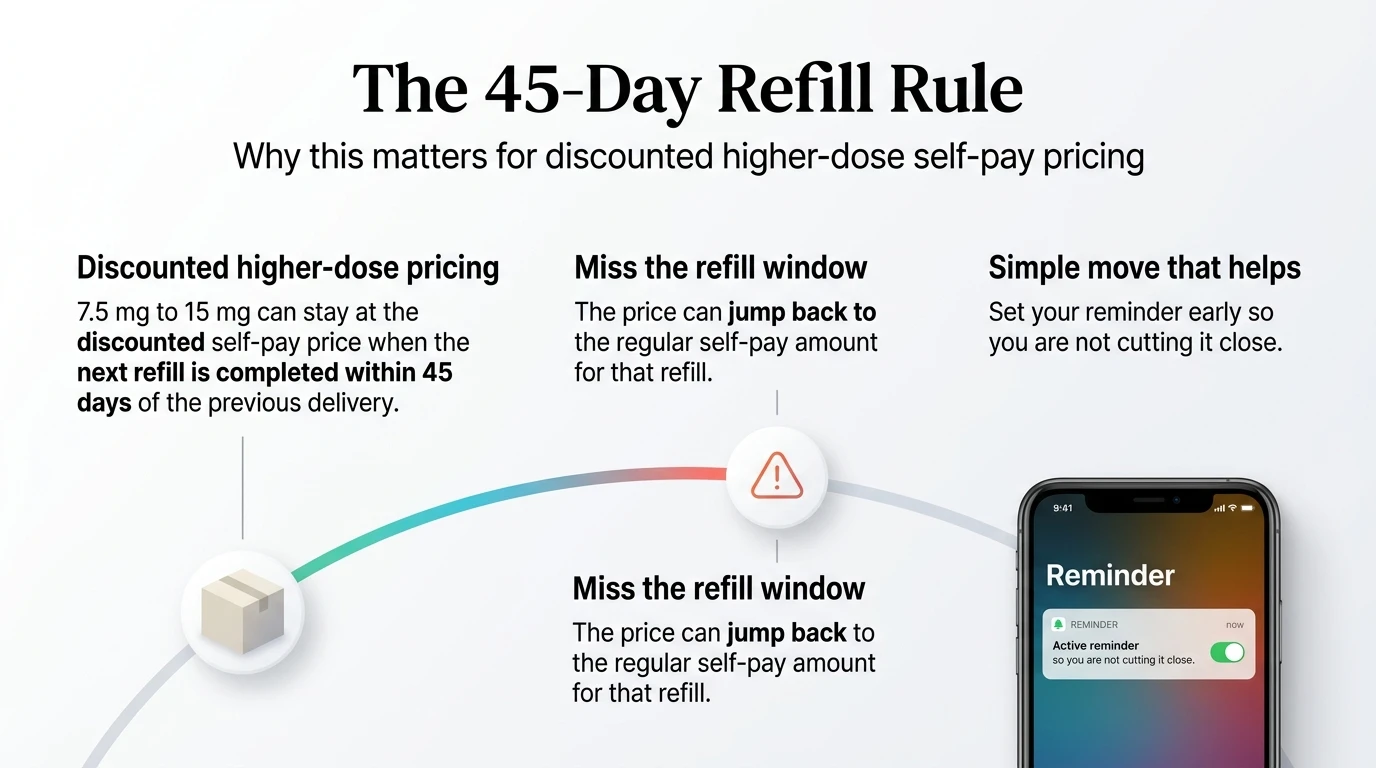
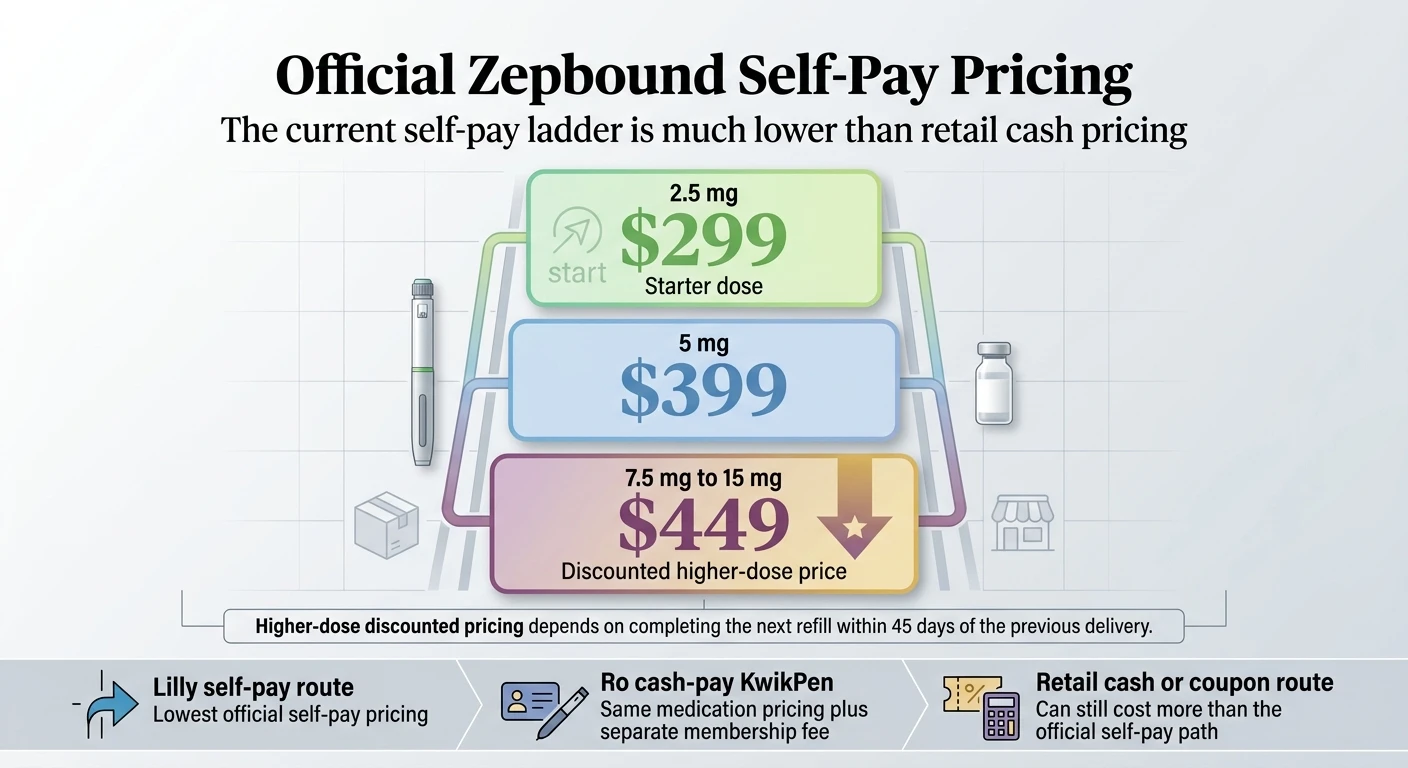
The cheapest Zepbound without insurance starts at $299/month through Lilly’s official self-pay pricing — not $1,086 at a retail pharmacy and not through a telehealth subscription you may not need. That $299 covers the 2.5 mg starter dose. Maintenance doses (7.5–15 mg) cost $449/month if you refill within 45 days. Miss that window and higher doses jump to $699.
That single detail — the 45-day refill rule — is the thing most pages bury and most readers discover the hard way.
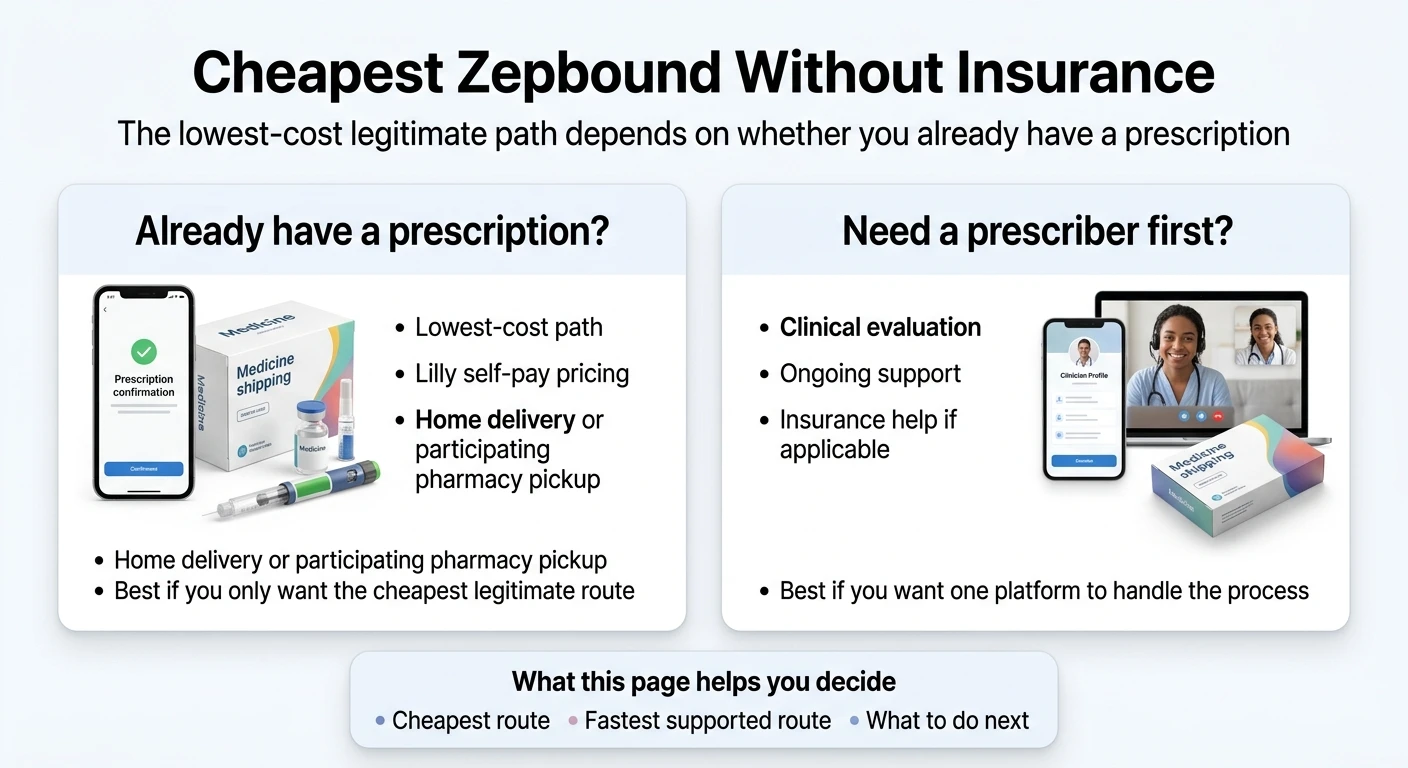
If you already have a doctor who will write the prescription, your cheapest all-in path is LillyDirect, Lilly’s direct-to-patient platform. If you don’t have a prescriber, Ro’s Body Program ($45 first month, then $145/month) gets you a licensed clinician, an insurance concierge, and Zepbound shipped to your door.
All prices reflect publicly available self-pay pricing as of April 2026. Medication requires a valid prescription. Individual costs may vary.
Who this page is for
Best for: Adults paying cash who want legitimate, FDA-approved brand-name Zepbound and need the absolute lowest price.
Not for: People who already have commercial insurance covering Zepbound (you may qualify for $25/month — see our coverage guide), or people specifically looking for compounded tirzepatide.
Cheapest route: Lilly’s self-pay pricing through LillyDirect or participating pharmacies — $299–$449/month depending on dose.
Biggest catch: Maintenance-dose pricing requires refilling within 45 days. One late refill can cost you $250 extra that month.
Quick-Look Pricing Table: Zepbound Self-Pay Cost by Dose (April 2026)
Before we go deeper, here is the pricing landscape in one view — what you will actually pay, by dose, through Lilly’s self-pay route versus retail.
| Dose | Lilly Self-Pay | Retail (no discount) |
|---|---|---|
| 2.5 mg (starter) | $299/mo | Often $900+ |
| 5 mg | $399/mo | Often $900+ |
| 7.5 mg* | $449/mo | Often $900+ |
| 10 mg* | $449/mo | Often $900+ |
| 12.5 mg* | $449/mo | Often $900+ |
| 15 mg* | $449/mo | Often $900+ |
*Journey Program price. Requires refill within 45 days of last delivery. Regular self-pay price without the program: $499 for 7.5 mg, $699 for 10–15 mg. List price (WAC) is $1,086/month for prefilled pens.
Source: Zepbound.lilly.com/savings. Prices verified April 2, 2026.
That is the core answer. Lilly’s self-pay pricing wins at every dose level. The rest of this page helps you act on it — how to get a prescription affordably, how to pick the right device, how to protect your discount, and what to do if even $449/month is a stretch.
Already have a prescription?
Fill through LillyDirect for the lowest all-in cost.
See LillyDirect Self-Pay Pricing →Need a prescription first?
Ro evaluates, prescribes, and ships Zepbound.
Check Ro Eligibility — $45 First Month →What Is the Cheapest Way to Get Zepbound Without Insurance?
The cheapest legitimate brand-name Zepbound route without insurance is Lilly’s Self Pay Journey Program, available through LillyDirect and participating pharmacy options. Starter dose runs $299/month, and maintenance doses hold at $449/month as long as you refill on schedule.
Here’s why this matters: when most people search “cheapest Zepbound without insurance,” they’ve already seen the $1,086 list price and assumed the medication is out of reach. That number is the wholesale acquisition cost — what Lilly charges distributors. It is not what cash-pay patients actually need to pay.
In late 2025 and early 2026, Lilly made three moves that changed the math:
September 2024 & December 2025
Launched single-dose vials through LillyDirect at roughly half the list price, then dropped prices further
February 2026
Introduced the multi-dose KwikPen with the same self-pay pricing as vials — easier to use, same cost
October 2025
Partnered with Walmart for in-store pickup at self-pay prices
The result: FDA-approved, authentic brand-name Zepbound now starts below $300/month for self-pay patients. That is a real price, directly from the manufacturer’s platform — not a coupon gimmick or a compounding workaround.
Why not just use a GoodRx coupon?
GoodRx coupons apply to the prefilled single-dose pen at retail pharmacies. Coupon prices vary by pharmacy and location and are typically still higher than Lilly’s self-pay pricing. GoodRx is a fine backup, but it should not be your first choice if you’re paying cash.
What about compounded tirzepatide?
The legal landscape shifted significantly in 2025. The FDA ended enforcement discretion for compounded tirzepatide after the national shortage resolved. As of 2026, compounding is limited to narrow medical exceptions. Lilly’s self-pay pricing ($299–$449/month) is now competitive with what many people were paying for compounded versions — and this is FDA-approved medication from the manufacturer with no regulatory uncertainty. If you’re transitioning from compounded tirzepatide, see our dedicated switch guide.
Which Route Is Cheapest for Your Situation?
Not everyone reading this page is in the same spot. The cheapest path depends on one question: do you already have a prescriber?
If you already have a doctor who will prescribe Zepbound
Your cheapest path: Lilly self-pay through LillyDirect.
Have your doctor send the prescription to LillyDirect’s partner pharmacy. You’ll pay $299–$449/month depending on dose. Medication ships to your door in temperature-controlled packaging, or you can pick it up at a participating Walmart pharmacy. There is no separate membership fee, consultation fee, or platform cost.
Total monthly cost: $299–$449 (medication only)
If you need a prescriber (most common scenario)
Your best support-inclusive path: Ro’s Body Program + Lilly-priced medication.
Most uninsured adults don’t have an established relationship with an obesity medicine specialist. That’s the real barrier — not just the drug price, but the prescription itself. Ro solves this in one workflow: evaluation, prescription, clinical support, and insurance concierge all-in-one.
First month total: $45 (membership) + $299 (2.5 mg medication) = $344
Ongoing monthly: $145 (membership) + $449 (maintenance dose) = $594/month
Ro membership: $45 first month, $145/mo after. Medication billed separately at Lilly self-pay pricing.
$45 first visit · No long-term commitment required
If your commercial insurance denied Zepbound
Appeal the denial
Many GLP-1 denials are reversed on appeal when your provider submits thorough clinical documentation. Worth trying before defaulting to cash pay.
Use the KwikPen Self-Pay Savings Card
If you have commercial insurance that doesn't cover Zepbound, this card brings the self-pay price to $299–$449/month at participating pharmacies.
Use LillyDirect self-pay as a fallback
While your appeal processes, you're not stuck paying full retail price.
Ro’s insurance concierge handles the prior authorization and appeal paperwork for you — one of the strongest reasons to use their platform if you think you might have coverage.
Need the full step-by-step appeal process?
Our dedicated guide walks through all 7 steps — decoding the denial type, building the documentation packet, the LOMN template, the CVS Caremark scenario, the OSA coverage pathway, and what to do if the appeal fails.
How to Appeal a Zepbound Denial: 7 Steps That Work (2026) →If you’re on Medicare
Medicare Part D does not currently cover Zepbound for weight management. However, some Medicare plans may cover Zepbound when prescribed for moderate-to-severe obstructive sleep apnea (OSA) with obesity — an FDA-approved indication since December 2024.
On the policy horizon, CMS has announced the Medicare GLP-1 Bridge program beginning July 1, 2026, with eligible beneficiaries paying $50/month. The broader BALANCE program is expected to begin in Medicare Part D in January 2027 for participating plans.
If you’re on Medicare and want Zepbound for weight management, Lilly’s self-pay route at $299–$449/month is currently your best option. Government beneficiaries are not eligible for the manufacturer savings card programs.
If you’re on Medicaid
Coverage varies by state. CMS has indicated the BALANCE program may launch in Medicaid as early as May 2026, but participation is voluntary for states. Do not assume universal Medicaid coverage — check with your state Medicaid program directly. In the meantime, Lilly’s self-pay pricing at $299–$449/month remains the most reliable fallback.
How to Get Zepbound for $299–$449/Month in 3 Steps
You cannot buy Zepbound without a prescription. But the process is faster and cheaper than most people expect.
Get a valid prescription
You have three options:
Telehealth — fastest for uninsured patients
Ro's Body Program: Complete an online health questionnaire, consult with a licensed provider, and get prescribed if eligible. First month is $45.
Your primary care doctor
Schedule a visit and ask about Zepbound. Bring documentation of your BMI, any weight-related conditions, and previous weight management attempts. Office visit without insurance: $150–$300.
Walgreens Weight Management
Walgreens offers online consultations for Zepbound KwikPen and vials. Cash-pay focused, no insurance navigation required.
Eligibility: Zepbound is FDA-approved for adults with a BMI ≥30, or BMI ≥27 with at least one weight-related condition (hypertension, sleep apnea, type 2 diabetes, high cholesterol). Your provider confirms eligibility during consultation.
Choose your fulfillment path
| Option | Price | Format | Delivery |
|---|---|---|---|
| LillyDirect (home delivery)✓ Recommended | $299–$449/mo | Vial or KwikPen | Shipped to your door |
| Walmart (via LillyDirect) | $299–$449/mo | Vial or KwikPen | In-store pickup |
| Participating pharmacy + KwikPen Card | $299–$449/mo | KwikPen | In-store pickup |
| Retail + coupon | Higher — varies | Prefilled pen | In-store pickup |
For most cash-pay patients, LillyDirect home delivery is the simplest and cheapest path.
Protect your discount — the 45-day refill rule
This is the detail that trips people up. Lilly’s Self Pay Journey Program offers $449/month pricing for 7.5–15 mg doses — but only if you complete your refill within 45 days of your previous delivery.
| Dose | Journey Price (within 45 days) | If you miss window |
|---|---|---|
| 7.5 mg | $449/mo | $499/mo (+$50) |
| 10 mg | $449/mo | $699/mo (+$250) |
| 12.5 mg | $449/mo | $699/mo (+$250) |
| 15 mg | $449/mo | $699/mo (+$250) |
Is LillyDirect Cheaper Than Ro or a Local Pharmacy?
For the medication itself, yes — Lilly’s self-pay pricing through LillyDirect is the cheapest route. But “cheapest medication” and “cheapest total cost” are not always the same thing.
| Cost Component | LillyDirect Only | Ro Body Program | Retail (no coupon) |
|---|---|---|---|
| Consultation/membership | $0 (bring your own Rx) | $45 first mo, $145/mo after | $0 |
| Medication (10 mg) | $449/mo | $449/mo (same Lilly pricing) | Often $900+ |
| Insurance help | No | Yes (concierge included) | No |
| Ongoing clinical support | No | Yes (care team, coaching) | No |
| Total month 1 | $449 | $494 | Varies |
| Total months 2–12 | $449/mo | $594/mo | Varies |
LillyDirect is cheaper if:
- ✓You already have a prescriber
- ✓You're comfortable managing dose changes yourself
- ✓You don't need insurance navigation help
Ro is worth the extra cost if:
- ✓You need a prescription and don't have a doctor
- ✓You want insurance paperwork handled for you
- ✓You want clinical oversight during dose escalation
- ✓You'd rather have one platform managing everything
Retail pharmacy is rarely the best option for cash-pay Zepbound unless you have a specific reason you can’t use the self-pay route.
Through Lilly’s partnership with Walmart (launched October 2025), you can pick up Zepbound vials and KwikPens at participating Walmart pharmacies for the same self-pay pricing. Same cost, but you get the convenience of a physical store visit instead of home delivery.
$45 first month · Medication billed separately at Lilly self-pay pricing
Vial vs. KwikPen vs. Prefilled Pen: Which Should You Choose?
All three contain the exact same FDA-approved tirzepatide. Your results will be identical regardless of device. The differences are cost, convenience, and how you inject.
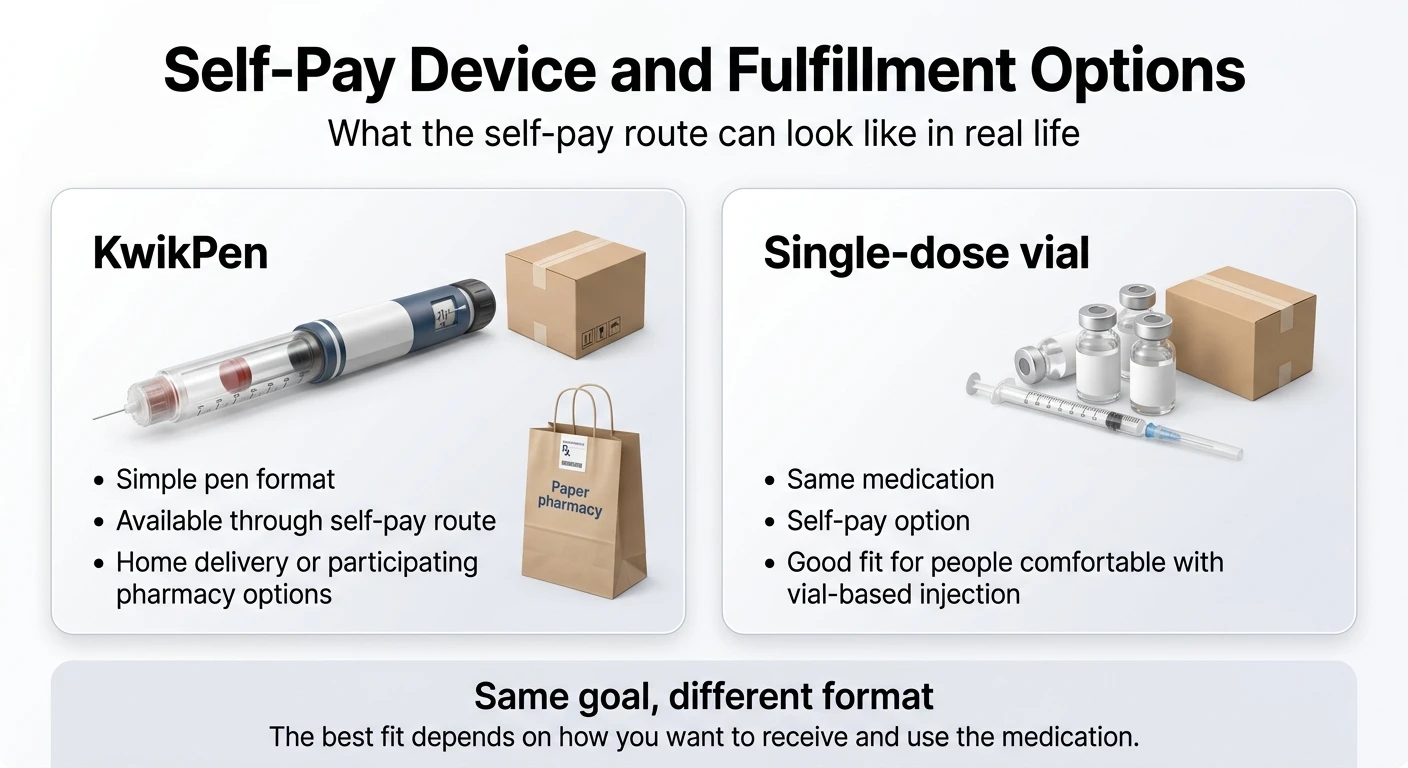
| Feature | Vial | KwikPen ★ Our Pick | Prefilled Pen |
|---|---|---|---|
| Self-pay price | $299–$449/mo | $299–$449/mo | $1,086/mo (list) |
| How you inject | Draw from vial with syringe | Dial dose on pen device | Auto-injects — push button |
| Doses per unit | 1 vial = 1 weekly dose | 1 pen = 4 weekly doses | 1 pen = 1 weekly dose |
| Available via LillyDirect? | Yes | Yes | No (pharmacy only) |
| Ease of use | Moderate — syringe comfort | Easy — simple pen dial | Easiest — push button |
| Best for | Budget-first, syringe-comfortable | Most self-pay patients | Insured patients |
What Does a Full Year on Zepbound Actually Cost?
Most Zepbound pricing pages only show monthly costs. But your dose increases over time, and your monthly bill changes with it. Here’s what a realistic first year looks like.
| Month | Typical Dose | Monthly Cost | Running Total |
|---|---|---|---|
| 1 | 2.5 mg (starter) | $299 | $299 |
| 2 | 5 mg | $399 | $698 |
| 3 | 7.5 mg | $449 | $1,147 |
| 4 | 10 mg | $449 | $1,596 |
| 5–12 | 10–15 mg (maintenance) | $449 × 8 mos | $5,188 |
| Year 1 Total | ~$5,188 | vs. $14,118 at list price | |
Self-pay saves approximately $8,930 in the first year compared to list price.
Is $449/Month Worth It? What the Evidence Actually Shows
We’re not going to pretend $449/month is pocket change. It’s a real financial commitment. But here’s what you’re actually buying.
Zepbound (tirzepatide) is the only dual GIP/GLP-1 receptor agonist FDA-approved for weight management. That dual mechanism targets two separate hormone pathways that regulate appetite and metabolism, where every other GLP-1 on the market targets only one.
In a 2025 head-to-head trial published in the New England Journal of Medicine, adults with obesity lost an average of 20.2% of body weight at 72 weeks on tirzepatide compared to 13.7% on semaglutide. In Lilly’s SURMOUNT-1 trial, Zepbound produced average weight loss of 16.0% to 22.5% across dose groups at 72 weeks.
For a 250-pound person, 20% weight loss is 50 pounds. That’s a different wardrobe, different energy level, different bloodwork, and for many people — a fundamentally different relationship with food.
What real patients say
Drugs.com: 8.7 out of 10 average rating from 616+ patient reviews, with 81% reporting positive experiences
WebMD: 4.2 out of 5 from 47 reviews, with approximately 83% reporting positive outcomes
“The shots don't bother me at all and no nausea. Down 30 lbs in 3 months.”
— Verified patient review, Drugs.com
“I can really tell the difference in my eating and cravings. This is the first thing that has actually worked.”
— Verified patient review, Drugs.com
“Appetite is now easy to control. I'm eating like a normal person for the first time in years.”
— Verified patient review, Drugs.com
These are third-party patient reviews from independent platforms, not guarantees of individual results. Outcomes vary by person.
Need a prescriber
Already have a prescription
What to Expect: Timeline, Side Effects, and Results
The dose escalation timeline
Everyone starts at 2.5 mg — a starter dose only. It exists to let your body adjust, not where meaningful weight loss happens.
| Timeframe | Dose | What to Expect | Monthly Cost |
|---|---|---|---|
| Weeks 1–4 | 2.5 mg | Body adjusting. Mild appetite changes. Some GI side effects possible. | $299 |
| Weeks 5–8 | 5 mg | Appetite suppression becomes noticeable. Early weight loss (5–10 lbs typical). | $399 |
| Weeks 9–16 | 7.5–10 mg | Steady weight loss. Most people find their effective dose here. | $449 |
| Months 4–12 | 10–15 mg | Maintenance phase. Consistent results. Average 15–21% body weight loss. | $449 |
Common side effects and what’s normal
Nausea
Most common, especially during dose increases. Usually mild to moderate. Tends to improve within 2–3 weeks at each new dose.
Diarrhea or constipation
Can go either direction. Staying hydrated and eating smaller meals helps.
Decreased appetite
Can feel more intense than expected early on. Eating regular small meals helps maintain energy.
Injection site reactions
Minor redness or itching. More common with vials/syringes than with pen devices.
FDA Boxed Warning
Zepbound carries an FDA boxed warning about thyroid C-cell tumors observed in animal studies. It should not be used by anyone with a personal or family history of medullary thyroid carcinoma (MTC) or Multiple Endocrine Neoplasia syndrome type 2 (MEN 2). Serious side effects also include pancreatitis, gallbladder issues, and severe allergic reactions. FDA label
When do results actually show up?
Some initial weight loss (3–5 lbs), partly water weight. The medication is starting to work but you're on the lowest dose.
Appetite suppression is more consistent. Weight loss picks up to roughly 1–2 lbs per week for most people.
Measurable results. Many patients report 10–15% body weight reduction. Clothes fit differently. Energy improves.
Continued steady loss toward the 15–21% average seen in clinical trials.
Maintenance phase. The medication is primarily about maintaining the weight lost and the habits built.
How the Telehealth Prescription Process Actually Works
If you’ve never used telehealth for a prescription medication, here’s what it looks like step by step using Ro as the example.
Online assessment (10–15 min)
You complete a health questionnaire covering your weight, height, medical history, current medications, previous weight loss attempts, and weight-related conditions. This is a real medical intake form reviewed by a licensed provider.
Provider review
A licensed clinician reviews your assessment. They may ask follow-up questions through the platform's messaging system. If lab work is needed (blood panel, A1C), they'll order it — many labs can be done at a nearby Quest or Labcorp location.
Prescription decision
If you meet eligibility criteria (BMI 30+, or BMI 27+ with a weight-related condition), the provider writes the prescription. Not everyone qualifies — and that's a feature, not a bug.
Medication ships
Zepbound ships through LillyDirect's partner pharmacy in insulated, temperature-controlled packaging. You take your first dose at home.
Monthly check-ins
Your care team monitors your progress, adjusts doses, manages side effects, and handles insurance paperwork if applicable.
First month total: $344.
$45 (Ro membership) + $299 (2.5 mg medication). Most people assume getting started on Zepbound without insurance is a $1,000+ problem. It’s a $344 first step.
Online assessment · Licensed provider review · Medication ships to your door
The Honest Trade-Off
Ro is not the cheapest way to get Zepbound if you already have a doctor who will prescribe it. The membership costs $145/month on top of the medication. If your only priority is the absolute lowest ongoing cost and you already have a prescriber, LillyDirect alone is the better path.
But here’s why Ro is the right fit for most readers of this page: if you’re searching “cheapest Zepbound without insurance,” there’s a good chance you don’t have an obesity medicine specialist on speed dial. You need someone to write the prescription, manage your dose escalation, monitor for side effects, and — if there’s any chance your insurance might cover it — pursue that coverage on your behalf.
If you DO have a prescriber
Skip Ro. Use LillyDirect. You’ll save $145/month and still get the same Lilly self-pay pricing. The membership cost buys you nothing if you already have a care team.
If you DON’T have a prescriber
Ro is worth the membership. The alternative is paying $200+ for an office visit, finding a pharmacy that does LillyDirect fulfillment, and managing everything yourself.
Can You Use the Zepbound Savings Card Without Insurance?
This is one of the most confusing parts of Zepbound pricing. There are multiple savings programs, and they each have different eligibility rules.
The $25/month Zepbound Savings Card
Requires commercial insurance that covers Zepbound. If your plan covers it, this card brings your copay down to $25 for up to a 3-month supply. Government insurance and uninsured patients do not qualify.
The $499/month Savings Card (insurance without coverage)
If you have commercial insurance but your plan doesn't cover Zepbound, this card can reduce the prefilled pen cost to approximately $499–$650/month. Still requires commercial insurance enrollment and excludes government plans.
The KwikPen Self-Pay Savings Card
Designed for cash-pay patients. Offers $299–$449/month pricing at participating pharmacies. Self-pay only — cannot be used with insurance. Same pricing as LillyDirect, available at local pharmacies.
The LillyDirect Self Pay Journey Program
No insurance required. No card required. You order directly and pay the self-pay price. The simplest path for completely uninsured patients.
What If Zepbound Is Still Too Expensive?
If $449/month isn’t realistic for your budget right now, there are legitimate alternatives that cost less — though none with Zepbound’s dual-action mechanism or its clinical results.
| Option | Approx. Self-Pay Cost | Key Trade-off |
|---|---|---|
| Wegovy injection (semaglutide) | ~$199 intro, then ~$349/mo via NovoCare | GLP-1 only (single mechanism), slightly lower avg weight loss |
| Wegovy pill (oral semaglutide) | ~$149–$299/mo via NovoCare | Same active ingredient, taken daily, newer option |
| Contrave (naltrexone/bupropion) | ~$99/mo via manufacturer program | Much lower avg weight loss (5–8%) |
| Qsymia (phentermine/topiramate) | ~$70–$89/mo via manufacturer offer | Lower avg weight loss (7–10%), some restrictions |
Self-pay pricing from manufacturer programs as of April 2026. Prices change — verify directly before purchasing.
If your real goal is “cheapest effective GLP-1” rather than “cheapest Zepbound specifically,” our complete GLP-1 cost comparison covers every option side by side. Or if Wegovy specifically interests you, see our Cheapest Wegovy guide.
Not sure which GLP-1 fits your budget?
Take our free 60-second matching quiz — we’ll map your budget, insurance status, and goals to the path that fits.
Take the Free GLP-1 Matching Quiz →No email required · 60 seconds · Personalized recommendation
How Long Do You Need to Take Zepbound?
Zepbound is designed as a long-term medication, not a short course. Clinical trial data shows that most participants who stopped tirzepatide regained a significant portion of the weight they lost. In the SURMOUNT-4 trial, participants who switched to placebo after 36 weeks regained roughly half of their lost weight over the following year.
That does not mean you’ll be on Zepbound forever — but planning for 12 months minimum is realistic, and many patients stay on a maintenance dose long-term.
Budget implication: Plan for a 12-month commitment at maintenance dose: $449/month = ~$5,200/year through Lilly self-pay. That’s roughly $14.30/day — less than a takeout lunch. For a medication that would have cost $14,000+ at list price two years ago and produces the highest average weight loss of any FDA-approved treatment available today, the value equation has changed dramatically.
Will Zepbound Get Cheaper in 2026–2027?
Probably yes for some patients, but not overnight. Here’s what we can verify:
Already happened
- ·September 2024: Lilly launched single-dose vials at roughly half the list price
- ·December 2025: Cash prices for vials dropped further through LillyDirect
- ·February 2026: KwikPen launched with the same self-pay pricing as vials
- ·October 2025: Walmart in-store pickup added at self-pay prices
Upcoming policy changes
- ·July 1, 2026: Medicare GLP-1 Bridge program begins at $50/month for eligible beneficiaries
- ·As early as May 2026: BALANCE program may launch in Medicaid (voluntary for states)
- ·January 2027: BALANCE expected to begin in Medicare Part D for participating plans
$45 first month · No long-term platform commitment
How We Verified Every Price on This Page
Eli Lilly official pricing
Self Pay Journey Program terms
Ro pricing
Clinical trial data
SURMOUNT-1 (NEJM, 2023), SURMOUNT-4 (JAMA, 2024), tirzepatide vs. semaglutide (NEJM, 2025)
FDA prescribing information
CMS policy
Patient review data
Update schedule: Prices are re-verified monthly. If Lilly announces a pricing change, we update within 48 hours. Last full audit: April 2, 2026. Next scheduled audit: May 1, 2026.
We do not accept payment from Eli Lilly or any pharmaceutical manufacturer. We do not blur compounded medications with FDA-approved products.
Frequently Asked Questions
How much does Zepbound cost without insurance per month?
Through Lilly's self-pay program, Zepbound costs $299/month for the 2.5 mg starter dose, $399/month for 5 mg, and $449/month for 7.5–15 mg maintenance doses when refilling within 45 days. The list price for prefilled pens is $1,086/month, but most self-pay patients pay significantly less through Lilly's direct programs.
What is the cheapest way to get Zepbound without insurance?
For most people, Lilly's Self Pay Journey Program through LillyDirect is the cheapest legitimate path. If you already have a prescriber, the all-in cost is just the medication price ($299–$449/month). If you need a prescriber, adding a telehealth service like Ro ($45 first month, $145/month ongoing) is typically cheaper than an in-person doctor visit without insurance.
Is LillyDirect cheaper than Ro for Zepbound?
For the medication itself, they use the same Lilly self-pay pricing. Ro charges a separate membership fee of $45 for the first month and $145/month after for clinical support and insurance concierge. If you already have a doctor, LillyDirect alone is cheaper. If you need a prescriber, Ro is the more complete solution.
Can I get Zepbound in a pen if I'm paying cash?
Yes. The Zepbound KwikPen (launched February 2026) is available at the same self-pay pricing as vials — $299–$449/month through LillyDirect. It holds four weekly doses and is our recommended format for most self-pay patients.
Do I need a prescription for LillyDirect?
Yes. Zepbound requires a valid prescription from a licensed healthcare provider. You can get one from your primary care doctor, an obesity specialist, or a telehealth provider like Ro.
What happens if I miss the 45-day refill window?
Your 7.5–15 mg dose reverts to regular self-pay pricing — $499 for 7.5 mg or $699 for 10–15 mg instead of $449. That is up to $250 more per month. Set a reminder for 30 days after each delivery.
Does the $25 Zepbound savings card work without insurance?
No. The $25 savings card requires commercial insurance that covers Zepbound. Uninsured patients should use the LillyDirect self-pay program or the KwikPen Self-Pay Savings Card at a participating pharmacy.
Can people on Medicare or Medicaid use LillyDirect self-pay pricing?
Yes. Lilly's self-pay vials and KwikPens are available regardless of insurance status at $299–$449/month. Government beneficiaries are not eligible for manufacturer savings cards but can use the self-pay route directly.
Is there a generic version of Zepbound?
No. There is no generic tirzepatide available. Zepbound's patent protection remains in effect and no generic is expected in the near term.
Is LillyDirect legitimate?
Yes. LillyDirect is Eli Lilly's official direct-to-patient platform, launched in January 2024. Prescriptions are fulfilled through licensed third-party pharmacy providers and medications ship in temperature-controlled packaging.
Can I use my HSA or FSA for Zepbound?
Zepbound is an FDA-approved prescription medication. HSA and FSA funds can generally be used for qualified prescription expenses, though the specific tax benefit depends on your account type and personal situation.
Still Deciding?
If you’ve read this far, you know more about Zepbound pricing than 95% of people who search for it. Here’s where to go from here.
You know Zepbound is right and have a doctor
Fill through LillyDirect for the lowest all-in cost. No membership fees.
Go to LillyDirect →You need a prescription and clinical support
Ro evaluates, prescribes, and ships. First visit $45.
Related guides
- Cheapest Tirzepatide Online Without Insurance: Every Option (2026)
- Best Way to Get Zepbound Online: Verified Providers (2026)
- Cheapest Wegovy Without Insurance in 2026: 7 Real Prices by Dose
- Cheapest GLP-1 Without Insurance: All Options Compared (2026)
- Does Medicare Cover Zepbound? 2026 Coverage Guide
- Wegovy vs. Zepbound vs. Saxenda: Full 2026 Comparison
- How to Switch from Compounded Tirzepatide to Zepbound
- Orforglipron vs. Zepbound: New Oral GLP-1 Compared (2026)
- GLP-1 Providers That Take FSA: 8 Verified Picks (2026)
- GLP-1 Providers That Take HSA: 7 Verified Picks (2026)
- Zepbound for Sleep Apnea: 7 Real Answers on Cost, Coverage & Access (2026)
Sources
- Zepbound.lilly.com — Self-Pay Savings
- LillyDirect — Zepbound Self-Pay Journey Program
- Lilly Self Pay Journey Program Full Terms
- Ro — Weight Loss Pricing
- Drugs.com — Zepbound Reviews
- WebMD — Zepbound Reviews
- FDA — Zepbound Prescribing Label 2026
- CMS — Medicare GLP-1 Bridge
- SURMOUNT-1 Trial (NEJM, 2023)
- SURMOUNT-4 (JAMA, 2024)
- Tirzepatide vs. Semaglutide Head-to-Head (NEJM, 2025)
Affiliate disclosure: This page contains affiliate links to telehealth providers. If you start treatment through one of our links, we may earn a commission at no additional cost to you. This does not influence our pricing data, comparison tables, or recommendations. Full disclosure →
Medical disclaimer: This page is for informational purposes only and is not medical advice. Consult a licensed healthcare provider before starting any medication. Zepbound is prescription-only. Zepbound® is a registered trademark of Eli Lilly and Company. The RX Index is an independent publication not affiliated with or endorsed by Eli Lilly.
Last updated: April 2, 2026 · By The RX Index Editorial Team
$45 first month · $145/mo after · Medication billed separately