Disclosure: Some links on this page are affiliate links. If you purchase through these links, we may earn a commission at no extra cost to you.
Sources: FDA, Eli Lilly, provider pricing pages, CMS · Pricing verified March 2026
You can get tirzepatide online through a licensed telehealth provider — often in under a week. But “online” doesn't mean unregulated. You still need a real prescription from a real clinician, filled at a real pharmacy. The difference is you can do all of it from your couch.
If you've been going back and forth for weeks — reading reviews, comparing prices, worrying about scams — this page is where that ends. We reviewed current provider pricing pages, medication-type disclosures, pharmacy partnerships, and FDA guidance as of March 2026, and cross-referenced what providers claim against what's actually verifiable.
What we found: most people are overthinking this. There are really only five paths worth considering, and the right one depends on three things — your insurance situation, your budget, and whether you want FDA-approved medication specifically. We'll help you figure out all three in the next few minutes.
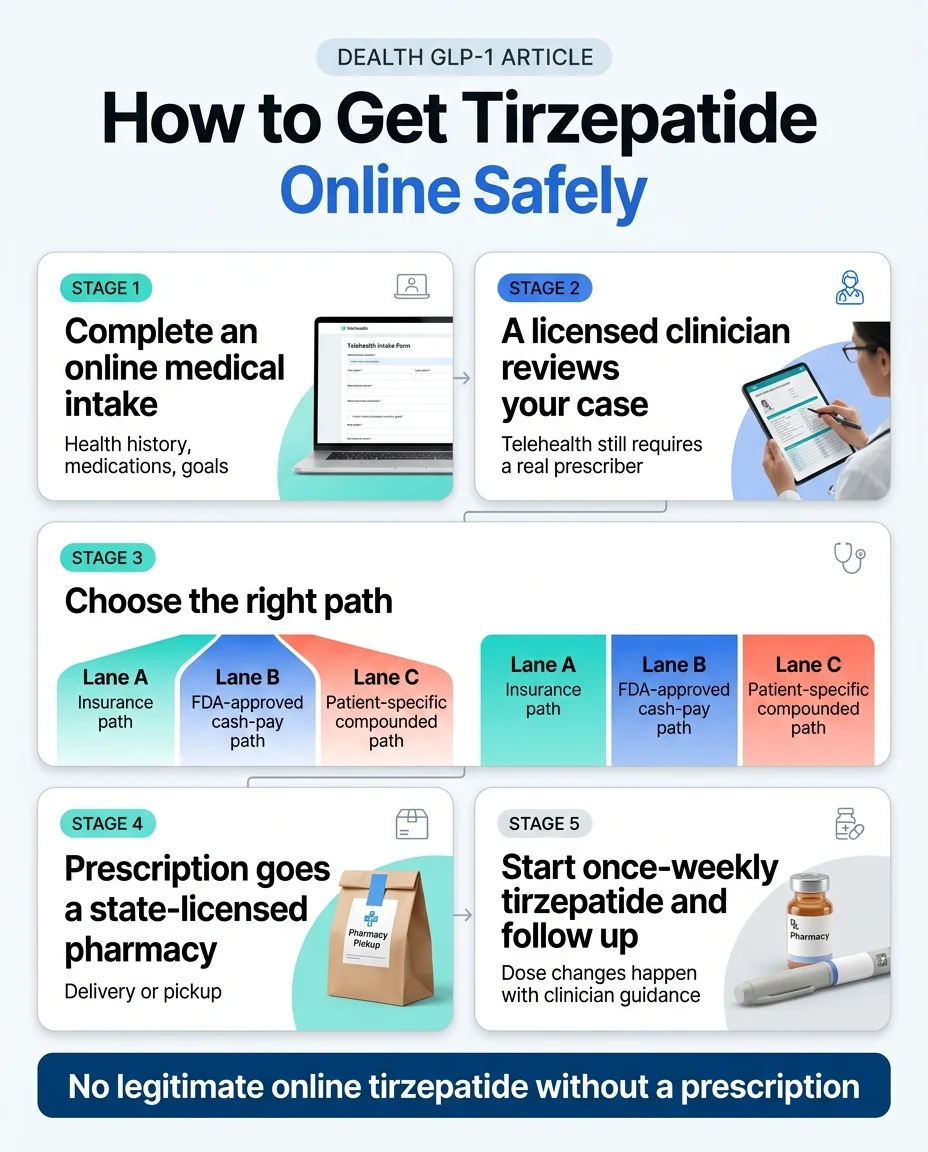
No legitimate online tirzepatide comes without a prescription. Every path requires a real clinician and a licensed pharmacy.
The 5 Paths at a Glance
Here's what each path looks like side by side:
Path
Best For
Med Cost
FDA-Approved?
Speed
1. Zepbound vials via Ro (cash)
No GLP-1 coverage, want FDA-approved
$299–$449/mo
✅ Yes
Under 1 week
2. Zepbound via Ro (insurance)
Commercial insurance + savings card
As low as $25/mo
✅ Yes
~2–3 weeks
3. Compounded (Eden, MEDVi)
Budget-conscious; patient-specific need
$249–$329/mo
❌ Not FDA-approved
3–7 days
4. Hims or Hers
Branded telehealth, polished app
Varies by plan
✅ FDA options
Varies
5. Your own doctor
Existing PCP + good insurance
$25–$1,086/mo
✅ Yes
Varies
Pricing per Ro and LillyDirect, verified March 2026. Membership fees additional for Ro ($45 first month, $145/month after).
Our honest recommendation
For most people, the safest and most straightforward first step is checking eligibility through Ro. They handle insurance paperwork, offer FDA-approved Zepbound at the lowest manufacturer cash price, and if your insurance covers GLP-1s, you could pay as little as $25/month. If an FDA-approved option is cost-prohibitive and a licensed clinician determines a compounded option is appropriate, providers like Eden and MEDVi offer transparent all-in pricing from $249/month.
No email required. 5 questions. Get your personalized recommendation.
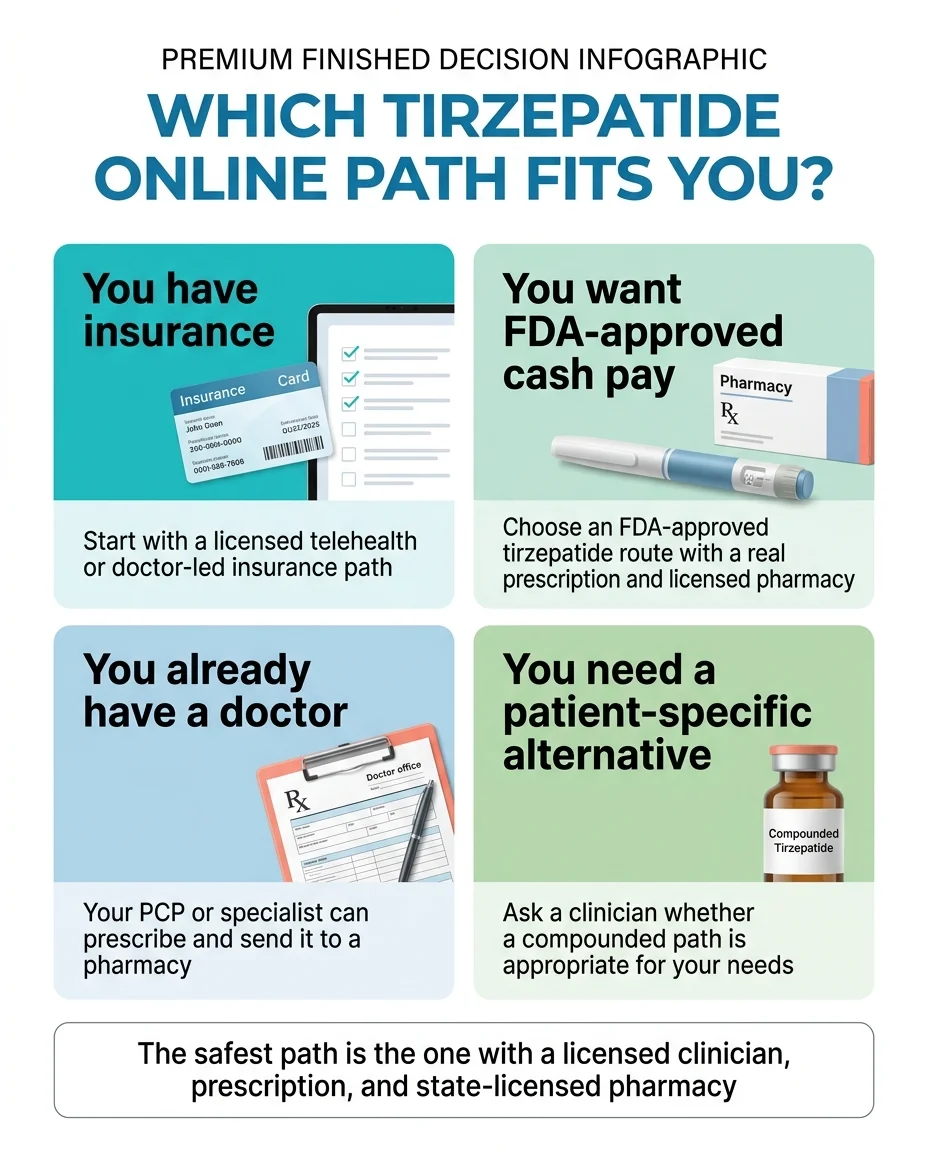
Which Tirzepatide Path Is Right for You?
Most of the confusion comes from not knowing which category you fall into. Once you know that, the rest is straightforward.
The safest path is always the one with a licensed clinician, a real prescription, and a state-licensed pharmacy.
You have commercial health insurance through work or the marketplace? Start with Path 2 — the insurance route through Ro. Their team handles prior authorization, which is the biggest headache in this process. If your plan covers Zepbound or Mounjaro, the manufacturer savings card can drop your cost to $25/month. If insurance doesn't work out, you can switch to cash-pay vials without starting over.
You don't have insurance, or your plan doesn't cover weight-loss medication? Path 1 is your cleanest option — Zepbound vials through Ro at $299/month to start. It's FDA-approved, ships from Eli Lilly's own pharmacy network, and you'll know exactly what you're getting. If $444/month total (medication + membership) stretches your budget, read the Path 3 section on compounded tirzepatide before deciding.
Your budget is under $350/month and every dollar counts? Path 3 — compounded tirzepatide through a vetted provider like Eden or MEDVi — may be worth discussing with a clinician. FDA guidance says compounded tirzepatide should only be considered when a licensed prescriber determines an FDA-approved option does not meet a patient-specific need. The monthly cost is lower than brand-name, but compounded medications are not FDA-approved — we explain exactly what that means below.
You have Medicare, Medicaid, or government insurance? Standard Medicare obesity-drug coverage remains limited, but CMS has announced a short-term Medicare GLP-1 Bridge beginning July 2026, ahead of the BALANCE Model launching January 1, 2027 (CMS). If you have government insurance today, your most realistic options are cash-pay paths (Path 1 or 3) or working with your own doctor (Path 5) to explore diabetes-specific coverage for Mounjaro if applicable.
You want a trusted mainstream brand you've heard of? Path 4 — Hims or Hers now offers FDA-approved GLP-1 options including branded tirzepatide. It's a polished experience with strong digital support.
You'd rather work with your own doctor? Path 5 is the traditional route. If you have a PCP who knows your history and your insurance covers GLP-1s with a low copay, this might be the simplest path of all.
Path 1: FDA-Approved Zepbound Vials — The Safest Cash-Pay Option
Who it's for
You don't have GLP-1 insurance coverage (or don't want to wait for the prior auth process), you want the peace of mind that comes with FDA-approved medication, and your budget can handle approximately $444–$594/month.
What you're actually getting
Zepbound single-dose vials — the exact same FDA-approved tirzepatide that comes in the $1,086/month pre-filled pens. Same manufacturer (Eli Lilly), same medication, same doses, same clinical results. The only difference is format: you draw the dose with a syringe instead of clicking a pen. That format difference saves you roughly $600–$800/month.
These vials ship via the LillyDirect partner pharmacy — Eli Lilly's direct-to-patient fulfillment channel. This isn't a third-party warehouse or a compounding operation.
What it costs
Dose
Vial Price/Month
+ Ro Membership
First Month Total
Ongoing Monthly
2.5 mg (starter)
$299
$45 first, $145/mo
$344
$444
5 mg
$399
$45 first, $145/mo
$444
$544
7.5–15 mg
$449 (45-day refill)
$45 first, $145/mo
$494
$594
Pricing per Ro and LillyDirect, verified March 2026.
Important: 45-day refill window
For doses 7.5 mg and above, LillyDirect holds the $449 price only if you refill within 45 days of your last delivery. Miss that window and the price jumps — $499 for 7.5 mg, $699 for 10–15 mg. Set a phone reminder now.
The Ro Body membership ($45 your first month, then $145/month) covers provider visits, insurance concierge, health coaching, and unlimited provider messaging. If insurance later covers your GLP-1, the concierge can help you transition to the pen format at potentially massive savings — without starting over.
How the process works
Complete Ro's online health assessment — takes about 10 minutes.
A licensed provider reviews your information — usually within 24–48 hours.
You may need a metabolic lab test — included in your membership, done at Quest or with an at-home kit.
Provider prescribes Zepbound if appropriate for your situation.
Vials ship from LillyDirect to your door — typically 1–4 business days.
Inject once weekly — Ro provides clear instructions. It's genuinely easier than most people expect.
Monthly check-ins with your provider for dose adjustments and side-effect management.
The honest tradeoff
Let's not pretend the Ro membership fee doesn't sting. Adding $145/month to your medication cost means you're paying more than the sticker price suggests. We get it.
But here's what changed our thinking: that $145 isn't just access to refills. It includes an insurance concierge that fights for coverage on your behalf — and if your insurance does cover GLP-1s, you could drop from $594/month down to $170/month ($25 medication + $145 membership). We've seen readers get coverage approved after initially being denied, saving thousands over the course of treatment.
It also includes something most people don't realize they need until they need it: a care team that actually responds. When you're on week two, the nausea has been rough, and you're wondering whether to push through or adjust your dose — having a provider you can message at 11 PM makes the difference between someone who sticks with it and someone who gives up.
Why Ro specifically?
They're one of the only platforms that gives you a genuine path forward regardless of your insurance situation. Insurance route? They handle it. Cash pay? Zepbound vials at LillyDirect pricing. Insurance denied? They file the appeal and switch you to vials seamlessly. No other provider covers all three scenarios without making you start over.
“With Ro, you actually get to talk to people. It just makes you feel supported and like you can do it.” — Ro member
“I can't even tell you the mindset and clarity this has given me. Yes, the weight came off quick, but there is so much more to it that I didn't even expect.” — Ro member
(Members were compensated for testimonials; results not independently verified)
Most Popular
Check eligibility for Zepbound through Ro
FDA-approved Zepbound vials from $299/mo. Ro handles insurance, prior auth, and appeals. Membership includes labs, health coaching, and unlimited messaging.
Path 2: Get Tirzepatide Covered by Insurance (As Low as $25/Month)
Who it's for
You have commercial health insurance through an employer or marketplace plan, and you're willing to spend 2–3 weeks on the prior authorization process in exchange for potentially massive savings.
Why this path exists
Most people don't realize how much insurance can reduce the cost — or they assume their plan won't cover it and never check. That's a potentially expensive assumption. If your commercial plan covers Zepbound or Mounjaro and you pair it with the manufacturer savings card, your out-of-pocket cost can drop to $25 per month for a one- to three-month supply. That turns a $12,000/year medication into roughly $300/year.
The problem is that most plans require prior authorization — paperwork from your provider proving medical necessity. Ro's insurance concierge handles the entire process: checking your formulary, submitting the PA, monitoring the status, and filing appeals if you're initially denied. You don't touch any of the paperwork.
How to find out if you're covered
Easiest: Sign up for Ro and let their team check for you. Included in the membership.
Medium: Look up your plan's drug formulary online and search for “tirzepatide,” “Zepbound,” or “Mounjaro.”
Direct: Call the number on your insurance card and ask: “Is Zepbound or Mounjaro on my formulary? Does it require prior authorization?”
What the Zepbound Savings Card does
The savings card from Eli Lilly is free and available to anyone with commercial insurance. If your plan covers Zepbound, it reduces your copay to as low as $25/month for a one- to three-month supply. Even without coverage, eligible commercially insured patients may pay as low as $499 for a 1-month supply (Lilly).
Who can't use it: Medicare, Medicaid, TRICARE, VA, and other government insurance enrollees are not eligible. Where to enroll: Free at zepbound.lilly.com or by calling 1-800-545-6962.
If your insurance says no
Don't stop there. Ro's concierge files appeals — and appeals succeed more often than people think. If the appeal doesn't work, you can seamlessly switch to Path 1 (cash-pay vials) using the same Ro membership. Your provider relationship, medical records, and care plan all carry over.
Ro's insurance concierge checks your formulary, submits prior authorization, and files appeals — all included in the membership. If covered + savings card: as low as $25/mo.
Path 3: Compounded Tirzepatide — Lower Cost, Real Tradeoffs
Who it's for
An FDA-approved option is cost-prohibitive for your budget, and a licensed clinician has determined that an FDA-approved product does not meet your specific medical needs. FDA guidance says compounded GLP-1 medications should only be used in that scenario.
What “compounded” actually means
A compounding pharmacy prepares tirzepatide on a per-patient basis using pharmaceutical-grade ingredients. Compounding has been a legal, regulated part of U.S. healthcare for decades — it's how pharmacies customize medications for patients with specific needs.
The key distinction
Compounded tirzepatide has not gone through the FDA's review process for safety, effectiveness, or manufacturing quality as a finished product. It's prepared under state pharmacy board oversight and must meet sterile compounding standards — but it doesn't carry the same regulatory stamp as Zepbound or Mounjaro.
The regulatory picture in 2026
During 2022–2024, tirzepatide was on the FDA's drug shortage list, and compounding pharmacies had broad permission to produce it. In late 2024, the FDA declared the shortage resolved. By early 2025, the FDA ended its broad enforcement discretion — meaning compounding is now only permitted when a prescriber documents a patient-specific clinical need that can't be met by an FDA-approved product.
Providers who still offer compounded tirzepatide do so by having their clinicians evaluate each patient individually and document why an FDA-approved product doesn't meet that specific patient's needs. That's the legal framework under Section 503A of the Federal Food, Drug, and Cosmetic Act.
MEDVi — flat-rate pricing, responsive support
If your provider determines a compounded option is appropriate for your specific needs, MEDVi is worth evaluating for three reasons: transparent flat-rate pricing, responsive clinical support, and a straightforward patient experience.
Compounded tirzepatide starting at $299/month
All-inclusive pricing — consultation, medication, supplies, and shipping included
Flat-rate at every dose level — your cost doesn't spike as your dose increases
Licensed providers review every case individually
Partnered with licensed compounding pharmacies
The GLP-1 telehealth market is full of providers who lure you in with a low starting price and then increase costs at every dose level. MEDVi doesn't do that. Over a year of treatment, that flat-rate structure can save you hundreds compared to providers with tiered pricing.
Who this is perfect for: You want the simplest, most affordable entry point into tirzepatide. You've weighed the compounded tradeoffs and you're comfortable with them. You want one flat price with no surprises as your treatment progresses.
Best Flat-Rate
MEDVi — $299/month flat at every dose
No membership fees, no tiered pricing. Consultation, medication, supplies, and shipping all included. Licensed providers review every case. Compounded — not FDA-approved.
Eden is another solid compounded option, especially if you want the lowest possible entry point. Their compounded tirzepatide starts at $249 for the first month, then $329/month ongoing — same price at every dose level. No membership fees, no hidden charges.
What stands out about Eden is their transparency. They're upfront about what compounded means, they don't overclaim, and their 24/7 care team access is a genuine differentiator — available around the clock, not just 9-to-5. Their ongoing price ($329/month) is slightly higher than MEDVi's $299/month, but the lower entry point and Eden's particular support model make it a strong choice.
Eden — Start for $249 the first month
$249 first month, $329/month ongoing at all dose levels. 24/7 care team. Transparent about compounded status. No membership fees. Compounded — not FDA-approved.
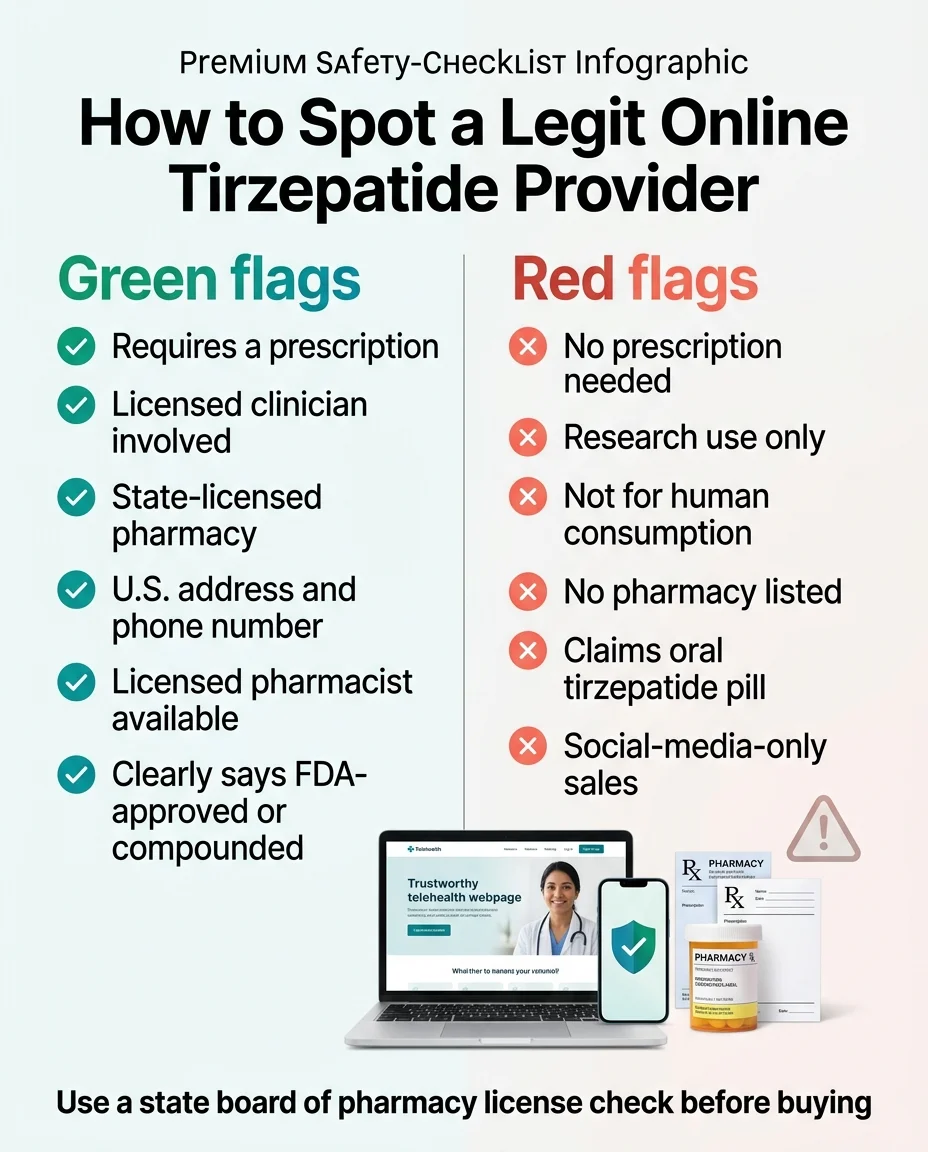
Before you sign up with anyone — including our recommendations — run through this checklist:
Green Flags ✅
✅ Requires a full medical evaluation before prescribing
✅ Names their pharmacy partners — or tells you when asked
✅ Transparent about FDA-approved vs. compounded — never blurs the line
✅ Clear, written refund and cancellation policy
✅ Real U.S. address and contact phone number
✅ Positive reviews on Trustpilot, BBB, Reddit
✅ Licensed providers with verifiable credentials
Red Flags 🚩
🚩 No prescription required — that's illegal in the U.S.
🚩 Prices impossibly low with zero explanation
🚩 Products labeled “for research use only”
🚩 “Oral tirzepatide pills” — no such FDA-approved product exists
🚩 No verifiable business address or phone number
🚩 Payment only via crypto or wire transfer
🚩 Social media sales only — no website, no pharmacy info
Path 4: Hims or Hers — Branded GLP-1s With Strong Digital Support
Who it's for
You want a mainstream, recognizable telehealth brand with a polished digital experience and strong messaging support, and you prefer FDA-approved medication.
What's changed in 2026
Hims & Hers made a significant strategic shift in early 2026: they're moving their weight-loss business toward FDA-approved GLP-1 medications and will no longer actively advertise compounded GLP-1 offerings. They now offer branded tirzepatide (Mounjaro and Zepbound) alongside other FDA-approved options like Wegovy and Ozempic.
This is a signal worth paying attention to. When one of the largest telehealth companies in the country pivots toward FDA-approved products, it tells you something about where the industry — and the regulatory environment — is heading.
What you get
Access to branded tirzepatide (Zepbound/Mounjaro) through their platform
24/7 messaging with your care team
In some states, evaluation can be completed without a video visit
Clean digital experience — their app is one of the best in the space
Insurance not required for enrollment
When Hims/Hers beats Ro
If you value a polished app experience and unlimited digital messaging support — and you're less concerned about having an insurance concierge handle prior auth — Hims or Hers is a strong choice. Their platform is built for ongoing engagement, not just getting you a prescription.
Hims — GLP-1 for Men
FDA-approved options including branded tirzepatide. Polished app, 24/7 messaging.
You already have a PCP who knows your medical history, your insurance covers GLP-1s with a reasonable copay, and you prefer an in-person relationship with your prescriber.
How it works
Schedule an appointment with your primary care doctor or an endocrinologist. Discuss your goals, medical history, and whether tirzepatide is appropriate. If they write a prescription, fill it at your local pharmacy — CVS, Walgreens, or wherever you usually go.
When this makes sense
You have strong insurance coverage and an existing doctor relationship
Your PCP is comfortable prescribing GLP-1 medications
You have other health conditions that benefit from coordinated care
You want someone who already knows you managing your treatment
When it doesn't
Getting an appointment takes weeks or months
Your doctor isn't experienced with or willing to prescribe GLP-1s
Your insurance doesn't cover the medication, leaving you with a $1,086/month retail bill
You want speed and convenience — telehealth is typically faster
The insurance math
Without any discounts, Zepbound pens cost roughly $1,086/month at retail. Mounjaro is similar. But if your plan covers either medication AND you use the manufacturer savings card, you could pay as little as $25/month. Ask your doctor's office to help you apply.
Don't Want Injections? There's a Pill Option Now
In late 2025, the FDA approved oral Wegovy — a daily semaglutide pill for chronic weight management. It's available through Ro starting at $149/month for the initial dose.
Wegovy isn't tirzepatide. It's semaglutide — a different medication in the same GLP-1 drug class. In clinical trials, tirzepatide produced slightly more average weight loss (15–21% vs. ~13.6% of body weight). But the Wegovy pill has a real advantage: no needles.
Tirzepatide (Zepbound)
Semaglutide (Wegovy Pill)
How it works
Dual GLP-1 + GIP
GLP-1 only
Average weight loss
15–21% body weight (SURMOUNT)
~13.6% at 64 weeks (NEJM)
How you take it
Weekly injection
Daily pill
Cash price via Ro
$299–$449/mo + membership
$149–$299/mo + membership
FDA-approved?
✅ Yes
✅ Yes — oral Wegovy tablets
Important: oral tirzepatide does not exist
Oral Wegovy is semaglutide, not tirzepatide. They are different medications. Eli Lilly has confirmed tirzepatide is not available in pill form. Any website selling “oral tirzepatide” is selling something the FDA has not reviewed.
If needles are genuinely preventing you from starting treatment, the Wegovy pill removes that barrier. Available through Ro with the same provider team, insurance concierge, and coaching support as the tirzepatide paths. See our guide on how to get the Wegovy pill online for full details.
FDA-approved oral semaglutide, starting at $149/month
What Getting Tirzepatide Online Actually Looks Like (Step by Step)
Whether you go with Ro, MEDVi, Hims, or any other provider on this list, the process follows roughly the same sequence.
Step 1 — Pick your path. Use the comparison table at the top of this page or take our 60-second quiz to narrow it down.
Step 2 — Complete an online health assessment. This takes 10–15 minutes and covers your medical history, current medications, weight and BMI, and goals. Be honest — this is how a real clinician decides whether tirzepatide is safe and appropriate for you.
Step 3 — A licensed provider reviews your case. Depending on the platform, this might be async (they review your form and message you) or a video consult. Either way, a licensed clinician is making the call — not an algorithm.
Step 4 — Lab work, if needed. Some providers (including Ro) require metabolic labs before prescribing. This is a good thing. It means they're actually checking whether this medication is safe for your specific biology.
Step 5 — Prescription issued. If your clinician determines tirzepatide is appropriate, they write the prescription.
Step 6 — Medication ships. For cash-pay options, expect delivery in 1–7 days. Insurance routes take longer due to prior authorization (typically 2–3 weeks).
Step 7 — Take your first dose. Everyone starts at 2.5 mg once weekly. This is a tolerability dose, not a treatment dose — it lets your body adjust before increasing.
Step 8 — Ongoing care. Your dose increases every 4 weeks until you reach a maintenance level (typically 5–15 mg). Monthly check-ins with your provider for adjustments and side-effect management.
A word about the injection
If you've never given yourself an injection, the idea probably sounds worse than it is. We hear this constantly: “I was terrified of the needle — and then it was nothing.”
With a pre-filled pen (Zepbound pens), you press the device against your skin and click a button. You barely feel it. With vials, you draw the medication into a small syringe and inject it into your abdomen, thigh, or upper arm. The needle is tiny — much smaller than a blood draw. Most people describe it as a brief pinch that lasts about two seconds. And it's once a week, not daily.
Do You Actually Qualify for Tirzepatide?
For Zepbound (weight loss) — FDA eligibility
BMI of 30+ (obesity), OR
BMI of 27+ with at least one weight-related condition (high blood pressure, type 2 diabetes, high cholesterol, sleep apnea)
Age 18+
For Mounjaro (type 2 diabetes)
Diagnosed with type 2 diabetes
Age 10+ (approved for pediatric patients with type 2 diabetes)
Who should NOT take tirzepatide (FDA contraindications)
Personal or family history of medullary thyroid carcinoma (MTC) or Multiple Endocrine Neoplasia syndrome type 2 (MEN2)
Known serious hypersensitivity to tirzepatide or any of its excipients
Talk to your clinician before starting if you have
History of pancreatitis or severe gastrointestinal disease
If you're close to the BMI threshold but not quite there, it's still worth completing an assessment. A clinician evaluates your full health picture — not just a single number. Also see our guide on GLP-1 absolute disqualifiers for a full breakdown of who should not take these medications.
The Full Cost Picture — No Surprises
One of the biggest complaints we hear: “I signed up and the price was different than advertised.” That usually happens because providers separate medication cost from membership fees, consultation charges, or shipping. Here's the honest breakdown for each path:
Yes. Tirzepatide prescriptions — whether brand-name or compounded — are generally HSA/FSA eligible. That effectively gives you 20–30% in tax savings on top of the listed price. Confirm with your specific HSA/FSA administrator.
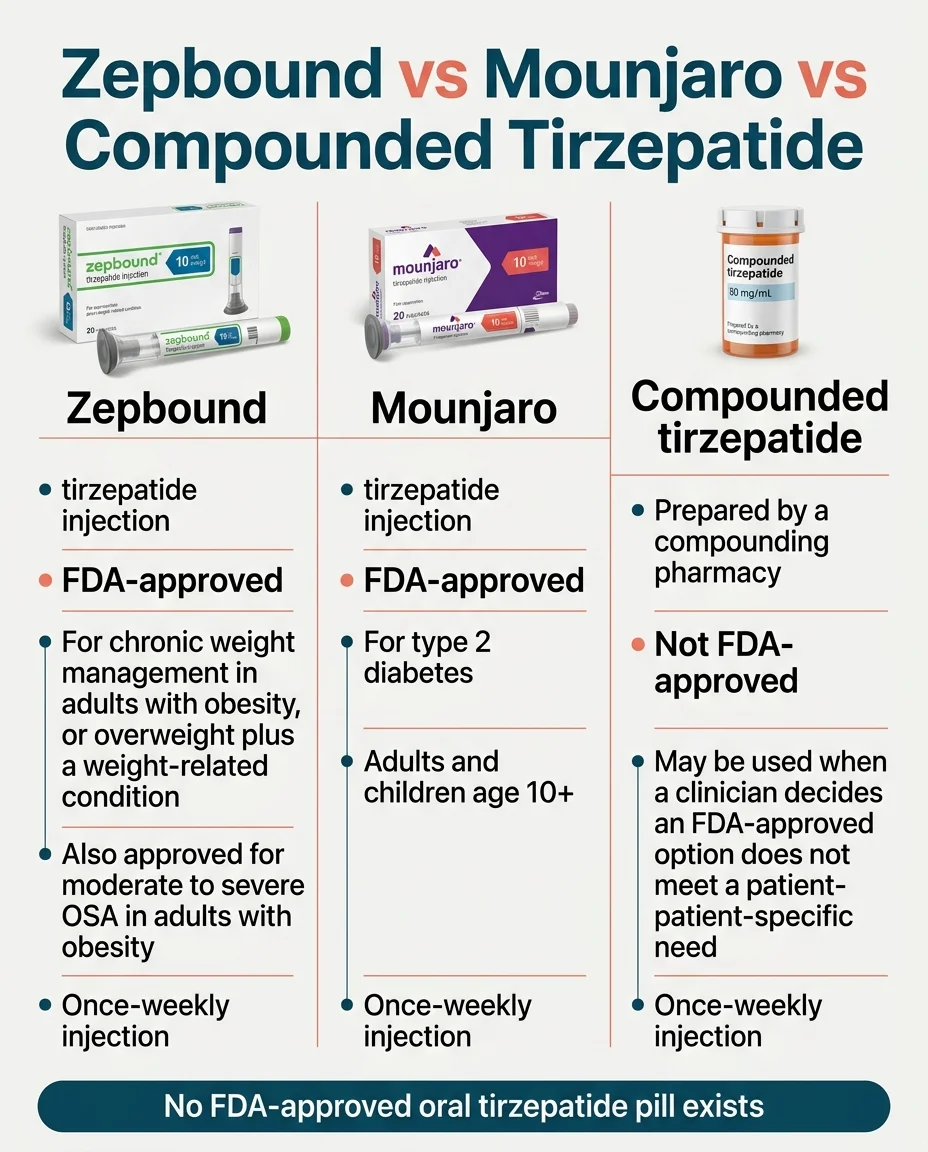
Zepbound, Mounjaro, or Compounded — What's the Difference?
If you've been researching tirzepatide online, you've seen all three terms. Here's the clean version:
No FDA-approved oral tirzepatide pill exists. Any claims otherwise are not FDA-reviewed.
Zepbound — FDA-approved tirzepatide for chronic weight management in adults with obesity (BMI 30+) or overweight (BMI 27+) with a weight-related condition. Also approved for moderate-to-severe obstructive sleep apnea in adults with obesity. Made by Eli Lilly.
Mounjaro — FDA-approved tirzepatide for type 2 diabetes in adults and pediatric patients 10+. Same active ingredient, same manufacturer, different approved use. Your doctor may prescribe Mounjaro off-label for weight loss if they determine it's appropriate.
Compounded tirzepatide — Prepared by licensed compounding pharmacies using pharmaceutical-grade tirzepatide. Not FDA-approved as a finished product. May be prescribed when a clinician determines an FDA-approved product doesn't meet a patient's specific needs.
How tirzepatide compares to semaglutide (Ozempic/Wegovy)
Both are GLP-1 medications used for weight loss. The key difference: tirzepatide targets two hormone receptors (GLP-1 and GIP), while semaglutide targets only one (GLP-1). That dual mechanism appears to produce greater average weight loss.
In head-to-head data, tirzepatide produced statistically greater weight loss. The SURMOUNT trials showed 15–21% body weight loss vs. semaglutide's STEP trial results of 12–17%. That said, semaglutide has been on the market longer, has a broader evidence base, and is now available in pill form (Wegovy oral). For a full comparison, see our guide on best semaglutide online providers.
Both are legitimate, effective, well-studied medications. Your clinician can help you decide which fits your goals, medical history, and budget.
Does Tirzepatide Actually Work? (What the Clinical Data Shows)
Here's what the actual research says — and why clinicians are calling this a turning point.
In the SURMOUNT clinical trial program — the studies that led to Zepbound's FDA approval — participants taking tirzepatide alongside diet and exercise lost an average of 15–21% of their body weight over 72 weeks, depending on the dose. For a group averaging about 230 pounds at the start, that translates to roughly 35–52 pounds lost.
At the highest dose (15 mg weekly), more than one in three participants lost over 25% of their body weight. The placebo group with diet and exercise alone? About 5 pounds on average.
The clinical bottom line
People on Zepbound in clinical trials lost roughly four times more weight than those on diet and exercise alone. Beyond weight loss, the data showed improvements in blood pressure, cholesterol, blood sugar, and waist circumference. In a separate three-year trial, tirzepatide reduced the risk of progressing from prediabetes to type 2 diabetes by 94%.
These aren't cherry-picked transformation photos. These are randomized, controlled clinical trials with thousands of participants, published in peer-reviewed journals including the New England Journal of Medicine.
Tirzepatide is the most effective weight-loss medication with published clinical data right now. Whether the results apply to your specific situation depends on factors your clinician will evaluate — but the statistical probability of meaningful weight loss on tirzepatide is higher than any GLP-1 medication before it.
Side Effects: What to Actually Expect
The first few weeks on tirzepatide are an adjustment. But knowing what's coming makes it significantly more manageable — and the vast majority of people find the side effects temporary and worth it.
Common (especially in the first few weeks and after each dose increase)
Nausea — the most reported side effect. Usually peaks in the first 2–3 weeks and fades significantly. For most people, it's more “I'm not that hungry” than “I'm going to be sick.”
Reduced appetite — this is partly how the medication works. The “food noise” quiets down.
Constipation or diarrhea — GI adjustment is normal as your body adapts
Stomach discomfort, gas, or bloating
Fatigue — usually temporary during dose transitions
Injection site reactions — mild redness or irritation, typically fades within a day
What actually helps (from real users)
Start your first dose on a Friday or Saturday — the first 48 hours tend to be the roughest
Eat smaller, more frequent meals instead of three large ones
Stay hydrated — more than you think you need; dehydration worsens nausea
Avoid greasy, fried, or super-rich foods during the first few weeks
Ginger tea, ginger candies, or supplements genuinely help with nausea
When to contact your provider immediately
Severe abdominal pain that won't go away — could indicate pancreatitis
A lump or swelling in your neck — thyroid concern (tirzepatide carries an FDA boxed warning about thyroid C-cell tumors observed in animal studies; not confirmed in humans)
Signs of allergic reaction — hives, difficulty breathing, facial swelling
Vision changes, especially if you have diabetes — could indicate retinopathy changes
Severe vomiting or diarrhea leading to dehydration
The realistic timeline: Most people report side effects are strongest during weeks 1–4 and for a few days after each dose increase. By the time you've been on a stable maintenance dose for about a month, the majority describe side effects as mild, manageable, or completely gone. That's why tirzepatide starts at a low 2.5 mg dose and increases gradually — giving your system time to adjust.
What Happens If You Stop Taking Tirzepatide?
Here's the one thing we wish more providers were upfront about: most people regain weight after stopping GLP-1 medications.
Research published in 2024 found that within a year of stopping tirzepatide, participants regained a significant portion of lost weight, their appetites returned, and improvements in blood pressure and cholesterol reversed. Obesity is increasingly recognized as a chronic condition — not a character flaw, not a temporary problem.
Think of it this way: if someone with high blood pressure stops taking their medication, their blood pressure goes back up. Nobody calls that a “failure” of the medication. The same logic applies here.
The real question to ask yourself
Six months from now, do you want to be 30–50 pounds lighter, sleeping better, moving easier, and figuring out your next step from a position of strength — or do you want to still be reading comparison pages? The hardest part isn't the injections, the side effects, or the cost. It's making the decision to start.
What to Have Ready Before You Sign Up
This will save you time regardless of which path you choose. Before you click any intake form, gather:
Insurance card (front and back) — even if you're planning to pay cash, useful to have
Current medications list — including dosages and supplements
Your weight and height — for BMI calculation
Medical history summary — diagnoses, surgeries, allergies; especially diabetes, thyroid conditions, or GI issues
Recent lab work — if you've had bloodwork in the last 6–12 months, results handy can speed things up
Your monthly budget — knowing your ceiling helps the provider recommend the right path
Whether you're open to injections — if not, your provider can discuss the Wegovy pill or other options
Having everything ready typically cuts the intake process from 20 minutes to under 10 — and gets you from “still researching” to “first dose in hand” faster.
Ready to Start?
Check your eligibility now
Ro covers every scenario — cash-pay vials, insurance, and appeals. Start your assessment in 10 minutes. FDA-approved Zepbound from $299/mo.
Yes. A licensed telehealth provider can prescribe tirzepatide after evaluating your health — just like any other prescription medication. The prescription is filled by a licensed pharmacy and shipped to you. The safe version of 'online' means using a telehealth platform with real clinicians, not bypassing the prescription requirement.
Can you get tirzepatide without insurance?+
Yes. Cash-pay options include Zepbound vials via Ro/LillyDirect starting at $299/month for medication, or compounded tirzepatide through providers like MEDVi at $299/month all-in or Eden starting at $249 for the first month. No insurance is required for any of these paths.
What's the cheapest way to get tirzepatide online?+
With insurance: potentially $25/month using the Zepbound Savings Card with a commercial plan. Without insurance: compounded tirzepatide from Eden ($249 first month, $329/month ongoing) or MEDVi ($299/month flat). The cheapest FDA-approved cash option is Zepbound vials at $299/month through Ro or LillyDirect.
How fast can I start tirzepatide online?+
Cash-pay paths are the fastest — typically under one week from signup to first dose. Insurance paths take 2–3 weeks due to prior authorization processing. Compounded providers like MEDVi and Eden typically ship within 3–7 days after your clinician approves your case.
Is compounded tirzepatide safe?+
Compounded tirzepatide is prepared by licensed pharmacies under state regulation and must meet sterile compounding standards. It has not undergone FDA review as a finished product. Safety depends heavily on the pharmacy producing it — which is why vetting your provider matters. The FDA has reported adverse events linked to compounded GLP-1 products and recommends FDA-approved medications where possible.
What's the difference between Zepbound and Mounjaro?+
Both are FDA-approved tirzepatide from Eli Lilly — same active ingredient, same manufacturer, different approved uses. Zepbound is approved for chronic weight management in adults with obesity or overweight with a weight-related condition. Mounjaro is approved for type 2 diabetes in adults and children 10+. Your doctor may prescribe Mounjaro off-label for weight loss if clinically appropriate.
Can telehealth providers prescribe Zepbound or Mounjaro?+
Yes. Licensed telehealth providers can prescribe any FDA-approved medication including Zepbound and Mounjaro if they determine it's clinically appropriate after evaluating your health. Ro, Hims, Hers, and others all offer tirzepatide prescribing through their platforms.
Is there an oral tirzepatide pill?+
No. As of 2026, there is no FDA-approved oral tirzepatide in any form. Eli Lilly has confirmed tirzepatide is not available as a pill. If avoiding injections is your priority, the FDA-approved Wegovy pill (semaglutide, a different GLP-1) is available starting at $149/month through Ro.
Do I need lab work to get tirzepatide online?+
It depends on your provider and health history. Ro includes metabolic labs through Quest Diagnostics in their membership. Most compounded providers don't require labs for otherwise healthy patients, though your clinician may order them based on your health profile. Lab requirements exist to protect you — they verify the medication is safe for your specific biology.
What happens if I stop taking tirzepatide?+
Most people regain a significant portion of lost weight within a year of stopping tirzepatide. Appetite returns, and improvements in blood pressure and cholesterol reverse along with the weight. This is expected — obesity is a chronic condition. Many clinicians recommend long-term maintenance, often at a lower dose, to sustain results.
Can I use HSA or FSA funds for tirzepatide?+
Yes. Tirzepatide prescriptions — whether brand-name or compounded — are generally HSA/FSA eligible medical expenses. This effectively gives you 20–30% in tax savings on top of the listed price. Confirm with your specific HSA/FSA administrator and save receipts.
Who qualifies for Zepbound?+
FDA eligibility for Zepbound (weight loss): BMI of 30+ (obesity), OR BMI of 27+ with at least one weight-related condition (high blood pressure, type 2 diabetes, high cholesterol, sleep apnea). Must be 18+. If you're close to the BMI threshold but not quite there, it's still worth completing an assessment — clinicians evaluate your full health picture.
What if my insurance denies coverage?+
Your provider can file an appeal — and appeals are approved more often than people expect. Through Ro, their insurance concierge handles appeals automatically. If the appeal fails, you can switch to cash-pay vials without starting over. Your provider relationship, medical records, and care plan all carry over.
Do I need a video visit to get tirzepatide online?+
It depends on the provider and your state. Some platforms can evaluate you without a video visit. Others require one. Either way, a licensed clinician makes the prescribing decision — not an algorithm.
What happens after the intro price ends?+
It varies by provider. Ro's membership stays at $145/month after the first month; medication cost depends on dose. MEDVi's pricing stays flat at $299/month. Eden goes from $249 to $329/month after the first month. Always confirm the ongoing price before you sign up.
What if a clinician says I'm not eligible for tirzepatide?+
If you don't meet the criteria for tirzepatide, your provider may suggest an alternative — semaglutide (Wegovy, Ozempic), liraglutide, or other options. Many GLP-1 programs evaluate you for the best fit, not just a single medication. Not qualifying for one medication doesn't mean you have no options.
How We Evaluated These Providers
We don't publish a comparison table and call it a day. Here's what we actually checked:
Regulatory posture: Does the provider clearly distinguish between FDA-approved and compounded options? Do they make overclaims about compounded medications?
Pharmacy verification: Are their pharmacy partners licensed? Can you confirm this independently?
Pricing transparency: Is the total monthly cost clear before you sign up — including all fees, not just the medication sticker price?
Insurance support: Do they help with prior authorization, or leave you to figure it out alone?
Clinical oversight: Is a real, licensed provider making the prescribing decision — or is the evaluation just a rubber stamp?
Speed and support: How fast do you get from signup to first dose? Can you reach a real person when something goes wrong?
Independent reviews: What do people on Trustpilot, Reddit, and BBB say — not what the provider's own testimonial carousel shows?
We last verified pricing and policies for every provider on this page in March 2026. If you find something that's changed, email us and we'll update within 48 hours.
Bottom Line
The research is clear. The paths are real. The only step left is starting.
For most people, checking eligibility through Ro takes 10 minutes and covers every scenario — insurance, cash-pay, appeals. For budget-conscious options, MEDVi and Eden offer transparent flat-rate compounded pricing from $249/month when clinically appropriate.
Affiliate disclosure: We earn a commission on provider clicks, at no cost to you. Our rankings are independent. See our affiliate disclosure and methodology.
Medical Disclaimer: This content is for informational purposes only and does not constitute medical advice. Tirzepatide is a prescription medication — always consult a licensed healthcare provider before starting treatment. Individual results vary. GLP-1 medications should be used alongside a reduced-calorie diet and increased physical activity.
Sources: FDA prescribing information for Zepbound and Mounjaro, FDA BeSafeRx guidance, FDA compounding policy updates (2024–2025), Eli Lilly/LillyDirect pricing pages, provider websites (Ro, MEDVi, Eden, Hims, Hers) verified March 2026, SURMOUNT clinical trial data, National Association of Boards of Pharmacy.