Quick safety notice
If you have severe or persistent upper abdominal pain right now — especially pain radiating to your back, with or without nausea or vomiting — stop your next dose and contact a clinician or go to an emergency department. The rest of this page can wait. Your evaluation can't.
GLP-1 Pancreatitis Risk: What the Evidence Actually Shows in 2026
By The RX Index Editorial Team · Last verified: · FDA/DailyMed, Wen et al. 2025, Cleveland Clinic 2025
Editorial Standards · Affiliate Disclosure · Methodology
The bottom line on GLP-1 pancreatitis risk
GLP-1 pancreatitis risk is real, but rare. Across current FDA prescribing labels, pancreatitis rates in pivotal clinical trials are generally low — most reported as fractions of a percent or under 0.5 cases per 100 patient-years — and were similar to placebo in most studies. A 2025 systematic review and meta-analysis covering 62 randomized trials and 66,232 patients found a small pooled increase in pancreatitis risk with GLP-1 receptor agonists, but the association was not statistically significant when stratified by background medication use. The same meta-analysis found no significant association with pancreatic cancer.
But “rare” only takes you so far when it could be you. The actual question this page answers is bigger:
- What symptoms mean stop the medication and call someone
- What the FDA prescribing labels actually say for your specific drug
- What your personal risk factors do to the baseline number
- And what to do with all of it — whether you're starting, continuing, or recovering from a prior episode
What to do right now: a 60-second triage table
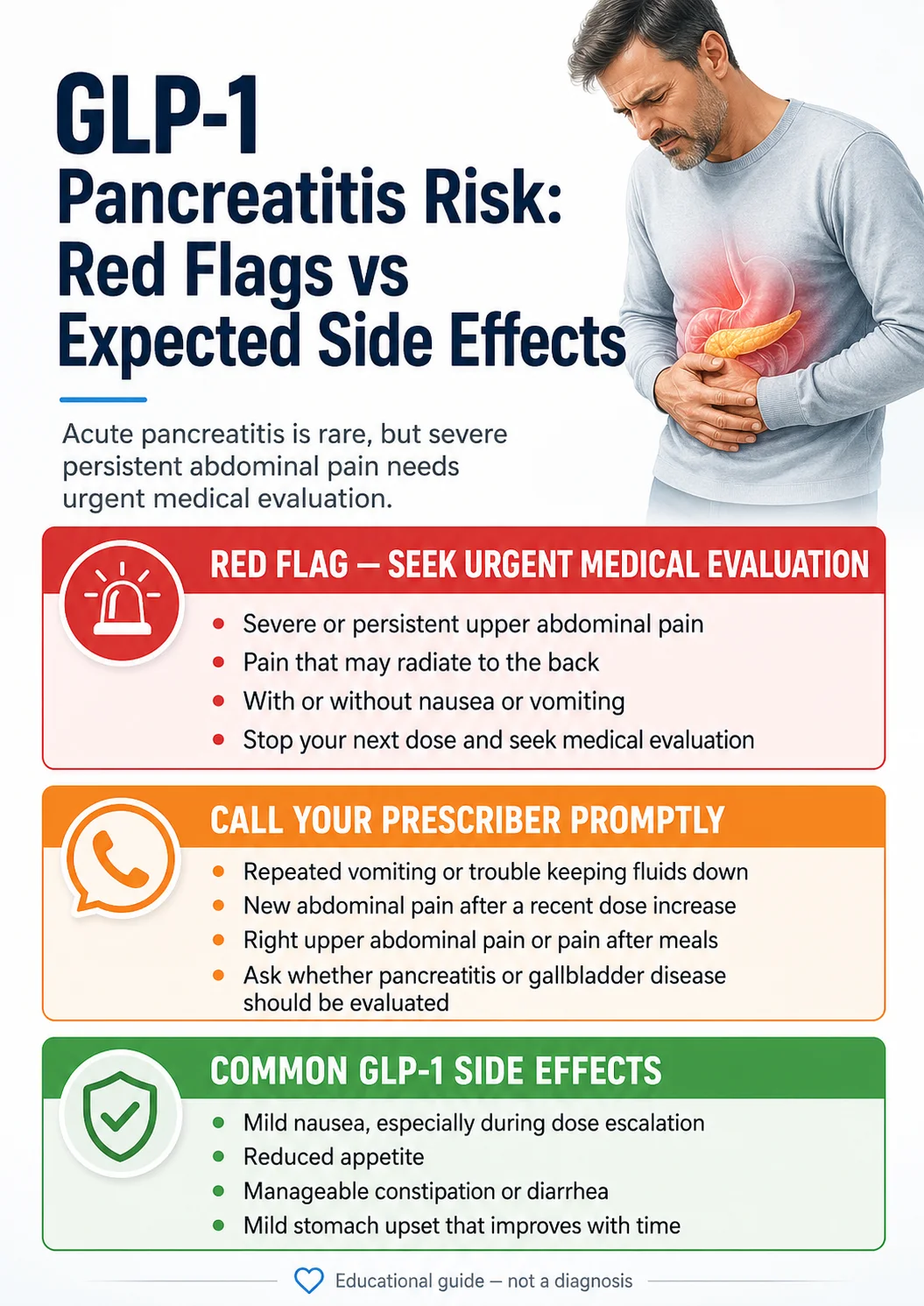
If you're reading this with abdominal pain or a recent symptom, start here. Symptom patterns sorted into three buckets based on what the major FDA prescribing labels for GLP-1 medications actually instruct, plus how acute pancreatitis is described in MedlinePlus and the AAFP.
| Color | What you're experiencing | What to do | Source logic |
|---|---|---|---|
| 🔴 RED — Stop and seek care now | Severe upper abdominal pain that won't ease · Pain radiating to your back · Severe pain with persistent vomiting · Inability to keep fluids down · Fever or rapid pulse with the pain | Stop your next GLP-1 dose. Go to an emergency department or call 911 if the pain is severe. Bring your medication name and current dose. Don't wait for office hours. | Matches pancreatitis warning language across FDA prescribing labels for Wegovy, Ozempic, Zepbound, Mounjaro, Foundayo, Rybelsus, and Saxenda |
| 🟡 AMBER — Call your prescriber today | Recurrent upper abdominal discomfort · Pain after meals (especially fatty meals) · Right upper quadrant pain · New pain after a recent dose increase · Pale stools · Ongoing vomiting or signs of dehydration | Don't take your next dose until you've talked to your prescriber. Ask whether you should be evaluated for pancreatitis or gallbladder disease, and whether lipase, amylase, or imaging is appropriate. | Right upper quadrant pain and fatty-meal pattern are gallbladder warning signs; gallstones are a leading direct cause of acute pancreatitis and are reported across GLP-1 labels |
| 🟢 GREEN — Monitor, don't ignore | Mild nausea after a dose · Constipation or diarrhea that's manageable · Reduced appetite (the drug is doing what it's supposed to) · Mild stomach discomfort that improves between doses | Hydrate, follow your titration schedule, and message your prescriber if symptoms persist beyond a couple of weeks or worsen. | Common GI side effects across the class; labels note these often occur during dose escalation and decrease over time |
This table is educational triage, not a diagnosis. When the labels for Wegovy, Ozempic, Zepbound, and Foundayo say “discontinue if pancreatitis is suspected,” they don't say “if confirmed.” Suspected is the trigger for action.
Not in the red zone?
Take our free 60-second GLP-1 path quiz to build a clinician question list based on your medication, dose, and personal risk factors. You'll walk into your next appointment with a one-page summary that actually moves the conversation forward.
Take the 60-second quiz →If you are in the red zone, skip the quiz. Get evaluated first.
Can GLP-1 medications cause pancreatitis?
Short answer: Yes, acute pancreatitis has been observed in people taking GLP-1 medications, and the major GLP-1 receptor agonists carry a pancreatitis warning on their FDA prescribing labels. But the best current evidence does not show a clear class-wide increase in risk for most users compared to placebo or other diabetes medications. The relationship is real enough to take seriously — it's just not the simple cause-and-effect headlines sometimes suggest.
What the FDA prescribing labels say
Every major GLP-1 receptor agonist sold in the United States — semaglutide (Ozempic, Wegovy, Rybelsus), tirzepatide (Mounjaro, Zepbound), liraglutide (Saxenda), and orforglipron (Foundayo) — has pancreatitis warning language in its FDA prescribing information. The language tracks the class-wide regulatory standard set after a 2013 FDA review of post-marketing pancreatitis reports.
What the labels consistently instruct:
- Discontinue the medication if pancreatitis is suspected and initiate appropriate management. This is the unanimous action language across the labels we reviewed.
- Watch for the symptom pattern: persistent severe abdominal pain, often radiating to the back, with or without nausea and vomiting.
- Saxenda's label adds an explicit non-restart instruction: per the Saxenda prescribing information, Saxenda should not be restarted if pancreatitis is confirmed. For other GLP-1 products, restart decisions follow the current product label and clinician judgment.
What the broader evidence shows
- The 2025 Wen et al. systematic review and meta-analysis of 62 randomized controlled trials covering 66,232 patients found a small pooled pancreatitis increase (relative risk 1.44, 95% CI 1.09–1.89), but the association was not statistically significant when stratified by background medication use. The same analysis found no significant overall association with pancreatic cancer (Wen et al., 2025).
- A 2025 narrative review in the Cleveland Clinic Journal of Medicine concluded that “recent large meta-analyses of clinical trial data do not support a class-wide risk” and that automatic exclusion of patients with prior pancreatitis from GLP-1 therapy is no longer well-supported by the evidence (Cleveland Clinic Journal of Medicine, 2025).
- A propensity score-matched analysis of 969,240 type 2 diabetes patients in the U.S. found no increased pancreatitis risk in a comorbidity-free GLP-1 RA subgroup (Ayoub et al., 2025).
Where the uncertainty still lives
Pharmacovigilance databases have flagged pancreatitis reports in GLP-1 users. Two examples worth knowing about:
- In January 2026, the UK MHRA updated its guidance for GLP-1 prescribers and patients noting “a small risk of severe acute pancreatitis” with GLP-1 medicines. The same update reaffirmed that GLP-1 medications are generally considered safe and effective for their authorized uses.
- In June 2025, the MHRA and Genomics England launched the Yellow Card Biobank study — a research project investigating whether genetic factors predispose certain people to acute pancreatitis on GLP-1 therapy. Recruitment is ongoing.
How common is pancreatitis on Ozempic, Wegovy, Mounjaro, Zepbound, Rybelsus, Saxenda, and Foundayo?
Short answer: Label-reported pancreatitis rates in pivotal FDA trials are generally low — usually under 1% of patients or under 0.5 cases per 100 patient-years — and were similar to placebo in most weight-management trials. These numbers should not be used to rank drugs head-to-head because the trials enrolled different patient populations for different indications.
This is the part of the page that doesn't exist anywhere else: every major GLP-1 medication's actual FDA label data on pancreatitis, in one table, with the current label setid for each so you can verify it.
| Medication | Class | Trial pancreatitis rate (label-reported) | Vs. placebo / comparator | Gallbladder events in label | Source |
|---|---|---|---|---|---|
| Wegovy | Semaglutide, GLP-1 RA | 4 patients = 0.2 cases per 100 patient-years (adult weight-reduction trials) | 1 placebo patient = <0.1 per 100 patient-years | Cholelithiasis 1.6% vs. 0.7% (injection); 2.5% vs. 1% (tablet); cholecystitis 0.6% vs. 0.2% | Wegovy DailyMed |
| Ozempic | Semaglutide, GLP-1 RA | 7 patients = 0.3 cases per 100 patient-years (glycemic trials) | 3 comparator patients = 0.2 per 100 patient-years | Cholelithiasis 1.5% (0.5 mg) and 0.4% (1 mg); not reported in placebo | Ozempic DailyMed |
| Rybelsus | Oral semaglutide, GLP-1 RA | 6 serious pancreatitis events = 0.1 events per 100 patient-years | 1 comparator = <0.1 per 100 | Cholelithiasis reported in trials | Rybelsus DailyMed |
| Zepbound | Tirzepatide, dual GIP/GLP-1 RA | 0.2% of patients = 0.14 per 100 patient-years (weight-loss trials); 0.84 per 100 patient-years in OSA studies | 0.2% placebo = 0.15 per 100 patient-years (weight-loss); 0 in OSA placebo | Cholelithiasis 1.1% vs. 1%; cholecystitis 0.7% vs. 0.2%; cholecystectomy 0.2% vs. 0% | Zepbound DailyMed |
| Mounjaro | Tirzepatide, dual GIP/GLP-1 RA | 14 events in 13 patients = 0.23 per 100 patient-years (diabetes trials) | 3 comparator events = 0.11 per 100 patient-years | Acute gallbladder disease in 0.6% of Mounjaro patients vs. 0% placebo | Mounjaro DailyMed |
| Foundayo™ | Oral GLP-1 RA (orforglipron) | 6 events in 6 patients = 0.14 per 100 patient-years | 2 events in 1 placebo patient = 0.04 per 100 patient-years | Cholelithiasis 1% vs. 0.7%; acute cholecystitis 0.4% vs. 0.3% | Foundayo DailyMed |
| Saxenda | Liraglutide, GLP-1 RA | Adult: 9 of 3,291 = 0.3% (adjudicated); additional cases occurred after withdrawal. Pediatric: 1 patient = 0.8% (not independently adjudicated) | Adult: 0.3% vs. 0.1% placebo | Gallbladder-related events including cholelithiasis and cholecystitis reported in adult trials | Saxenda DailyMed |
Translating “0.2 cases per 100 patient-years” into plain English
Most labels report rates this way, and most readers find it confusing. Here's the translation: “0.2 cases per 100 patient-years” means that if 100 people each took the medication for a year, you'd expect roughly 0.2 pancreatitis cases — or about 2 cases for every 1,000 person-years of use. That's not your personal risk percentage. It's an exposure-adjusted way to express how often the event happened across a trial.
Which GLP-1 has the lowest pancreatitis risk?
Current label data does not support ranking GLP-1 medications by pancreatitis safety. The clinical trials behind these labels enrolled different populations and used different denominators. Any page that publishes a confident “lowest pancreatitis risk” ranking from this data is overclaiming. Choose your GLP-1 based on indication, your personal risk factors, your prescriber's input, and your insurance/cost reality.
Why the gallbladder column matters
Gallstones are one of the most common direct causes of acute pancreatitis, and rapid weight loss — exactly what GLP-1s are designed to produce — is itself a known trigger for new gallstone formation. When you see “GLP-1 pancreatitis” in a real-world report, the actual causal pathway is sometimes “GLP-1 → rapid weight loss → gallstones → biliary pancreatitis” rather than a direct toxic effect on the pancreas.
Want to take a personalized version of this label data to your next appointment?
Use the 60-second quiz to generate a one-page summary based on your specific medication, dose, and risk factors.
Generate my clinician summary →What are GLP-1 pancreatitis symptoms vs. normal GLP-1 side effects?
Short answer: Common GLP-1 side effects — nausea, vomiting, mild stomach discomfort, constipation, diarrhea — are usually mild to moderate, fluctuate, and ease between doses or as your body adjusts. Pancreatitis presents as a different pattern: persistent severe upper abdominal pain that often radiates to the back, frequently accompanied by nausea or vomiting, and not relieved by typical GI-symptom remedies.
Pancreatitis red flags
- Pain location: upper abdomen
- Pain character: severe, persistent, often described as “the worst pain I've ever had”
- Radiation: sometimes radiates to the back
- Duration: persists for hours rather than coming and going
- Associated symptoms: persistent nausea, vomiting that won't stop, sometimes fever, sometimes rapid pulse
- What helps: typically not over-the-counter remedies — the pain doesn't ease with antacids the way reflux does
What's normal-ish on a GLP-1
- Mild to moderate nausea, particularly in the first few days after a dose or after titrating up
- Constipation or diarrhea
- Reduced appetite (literally the point)
- Occasional vomiting after a fatty or large meal
- Mild stomach discomfort that improves with hydration and small meals
What separates “expected” from “concerning” is severity, persistence, and the pain pattern. Mild nausea that improves between doses is different from severe persistent upper-abdominal pain that lasts for hours and radiates to the back.
Gallbladder symptoms can mimic — or contribute to — pancreatitis
- Pain in the right upper abdomen, especially after fatty meals
- Pale or clay-colored stools
- Pain that builds within 30 minutes of eating and lasts for hours
- Recurrent episodes of similar pain over weeks
The lipase/amylase warning
If you've had blood work and you're staring at a slightly elevated lipase result, don't panic-diagnose yourself. The Zepbound and Foundayo labels both explicitly state that the “clinical significance of amylase/lipase elevations is unknown in the absence of other signs and symptoms of pancreatitis.” The actual diagnostic standard for acute pancreatitis is the revised Atlanta criteria: at least two of (1) characteristic upper abdominal pain, (2) lipase or amylase more than three times the upper limit of normal, or (3) characteristic findings on imaging (AAFP, 2022). A single mildly elevated enzyme without symptoms is generally not diagnostic on its own.
What raises your personal pancreatitis risk on a GLP-1?
Short answer: Personal pancreatitis risk on a GLP-1 is not uniform. The four factors that meaningfully change your individual risk are: prior pancreatitis history, active risk conditions (high triglycerides, untreated gallstones, heavy alcohol use, advanced kidney disease, current tobacco use), speed of weight loss, and underlying conditions like type 2 diabetes — which independently raises baseline pancreatitis risk roughly 2–3× regardless of GLP-1 use.
Factor 1: Prior pancreatitis history
A prior episode of acute pancreatitis is the single most-asked risk question. The short version: prior pancreatitis with a reversible cause that's been corrected (gallstones removed, triglycerides controlled, alcohol stopped) — recent guidance suggests GLP-1 therapy may still be reasonable with informed consent and monitoring. Prior pancreatitis with an unresolved cause — specialist evaluation is warranted before starting. We expand on this in the prior pancreatitis section below.
Factor 2: Active risk conditions
These conditions raise baseline pancreatitis risk regardless of GLP-1 use — the GLP-1 is layered on top of them, not the sole cause.
| Condition | What raises your risk | What lowers it |
|---|---|---|
| Triglycerides | ≥500 mg/dL is the established threshold where pancreatitis risk begins to rise; ≥1,000 mg/dL is the high-risk zone | Triglycerides controlled (<150 mg/dL ideal, <500 acceptable) |
| Gallstones / gallbladder disease | Untreated cholelithiasis, biliary sludge, recent gallbladder symptoms | Gallbladder removed via cholecystectomy, no current gallstone disease |
| Heavy alcohol use | Heavy drinking is a leading independent pancreatitis cause; heavy use plus a GLP-1 stacks risk | Abstinent or moderate use (≤1 drink/day for women, ≤2 for men) |
| Advanced kidney disease (CKD stage 3+) | Identified as elevated-risk factor in the Postlethwaite obesity-cohort analysis | Normal kidney function |
| Current tobacco use | Identified as elevated-risk factor in the same cohort | Non-smoker or former smoker |
If two or more of these apply to you, that's the conversation to have with a clinician before starting — not an automatic disqualifier, but a real reason to slow down, get baseline labs, and have a clear monitoring plan.
Factor 3: Speed of weight loss
This is the underrated risk factor, and it matters specifically because it's tied to the gallstone pathway. Rapid weight loss — more than about 1.5 kg per week sustained, or excessive total reduction approaching 25% of body weight — increases new gallstone formation, and gallstones can trigger pancreatitis.
- Sticking to the recommended dose-titration schedule isn't just about minimizing nausea. It's about pacing weight loss so your gallbladder isn't shocked.
- If you're losing weight much faster than your titration schedule predicted, flag it to your prescriber.
- Some clinicians consider ursodeoxycholic acid in patients with rapid weight loss to reduce gallstone formation. That's a discussion to have with your provider.
Factor 4: Underlying conditions
- Type 2 diabetes independently raises pancreatitis risk; patients with type 2 diabetes are roughly three times more predisposed to pancreatitis compared to non-diabetic counterparts (Frontiers in Pharmacology, 2024).
- Obesity independently raises pancreatitis incidence and severity, with visceral fat a particularly strong contributor.
- Hypercalcemia and certain inherited conditions are rarer contributors worth flagging if relevant to your history.
Putting it together: your personal risk profile
- If you have none of the above and you're starting a GLP-1 for weight management with a careful titration plan, your absolute pancreatitis risk on a GLP-1 is genuinely low — well under 1% over a year of use.
- If you have two or more of these factors, your baseline pancreatitis risk is elevated regardless of GLP-1 use, and the question becomes whether GLP-1 therapy plus active risk-factor management is the right path.
- If you have prior pancreatitis, this is a specialist-grade conversation. A 90-second telehealth intake form is not the right level of screening for someone with this history.
Higher-risk profiles deserve a program that does real intake →
Use the 60-second quiz to compare GLP-1 paths based on your medical history, medication preference, insurance, and budget. The quiz routes higher-risk profiles toward programs that ask the questions actually worth asking before prescribing.
Compare GLP-1 paths by risk profile →Why might GLP-1s trigger pancreatitis? The mechanism question
Short answer: There's no single proven mechanism by which GLP-1 medications directly cause pancreatitis. The leading proposed pathways are indirect: rapid weight loss promotes gallstone formation, gallstones can trigger acute pancreatitis, and slowed gastric emptying may affect biliary motility. A UK regulatory study is currently investigating whether genetic factors predispose certain individuals to GLP-1–related pancreatitis.
The gallstone pathway
This is the most accepted indirect mechanism. The chain looks like this:
- GLP-1s produce significant weight loss, often relatively quickly at higher doses.
- Rapid weight loss alters bile composition and biliary motility, increasing the likelihood of new gallstones forming.
- New gallstones can lodge in the bile duct and trigger acute biliary pancreatitis.
This pathway is supported by every prescribing label that lists both pancreatitis warnings and gallbladder events in the same trials. It's also why gallbladder disease shows up consistently across the GLP-1 class — it's tied to the weight-loss success more than the molecule itself.
Direct pancreatic effects (less established)
Earlier hypotheses proposed direct effects on the exocrine pancreas — duct hyperplasia, increased enzyme secretion. These came from animal studies and isolated case reports. The randomized trial data and large meta-analyses haven't supported these as a class-wide problem, though they remain on the radar in the published literature (Frontiers in Pharmacology, 2024).
The genetic question (active investigation)
In June 2025, the UK's MHRA launched the Yellow Card Biobank study in partnership with Genomics England, specifically to investigate whether certain people are genetically predisposed to acute pancreatitis on GLP-1 therapy. Patients hospitalized with suspected GLP-1-related pancreatitis are being recruited to provide saliva samples for whole-genome sequencing. Results aren't expected for some time.
The mechanism is probably not “GLP-1s are toxic to the pancreas.” It's probably more like “GLP-1s create conditions (rapid weight loss, slowed biliary motility, possibly genetic susceptibility in certain people) that can occasionally trigger pancreatitis through known pathways.” That's why personal risk factors and symptom awareness matter more than picking a particular brand.
Can you take a GLP-1 if you've had pancreatitis before?
Short answer: Maybe — and the answer depends almost entirely on the cause of your prior pancreatitis. If the original cause was a reversible factor that has been corrected (gallstones removed, triglycerides now controlled, heavy alcohol use stopped), recent clinical guidance argues that automatic exclusion is no longer well-supported and GLP-1 therapy may be reasonable with informed consent and monitoring. If the prior cause is unresolved or unknown, you should not start a GLP-1 without specialist evaluation.
Cause-based decision framework
| If your prior pancreatitis was caused by… | The decision tends to lean… | Why |
|---|---|---|
| Gallstones — and you've since had a cholecystectomy | Toward 'yes, may be reasonable' | The original cause is anatomically removed; baseline risk is much lower |
| Hypertriglyceridemia — now well-controlled (<150 mg/dL) | Toward 'yes, may be reasonable' | The trigger has been mitigated |
| Medication-induced (different drug) — that drug is no longer in your regimen | Toward 'yes, may be reasonable' | The trigger is gone |
| Heavy alcohol use — and you're now sober | Toward 'individualized; may be reasonable with monitoring' | Trigger removed; recurrence risk depends on continued sobriety |
| Idiopathic (no identified cause) | Toward 'specialist evaluation first' | If you don't know what triggered it last time, you can't predict what would trigger it again |
| Recurrent pancreatitis history | Toward 'specialist evaluation first' | More than one episode is a different risk picture entirely |
| Severe prior episode (necrosis, pseudocyst, ICU) | Toward 'specialist evaluation first' | Past severity raises future stakes |
| Genetic or chronic pancreatitis | Toward 'no, or specialist clearance only' | Underlying disease, not a one-time event |
| Active alcohol use disorder, untreated gallbladder disease, or uncontrolled triglycerides | Toward 'address the underlying issue first' | Stacking GLP-1 on top of an active trigger is the wrong sequence |
The hard rule that doesn't change
If pancreatitis develops while you're on a GLP-1, current FDA prescribing labels are unanimous that the medication should be discontinued and appropriate management initiated. Saxenda's label specifically instructs that Saxenda should not be restarted if pancreatitis is confirmed; for other products, restart decisions follow the current product label and clinician judgment.
If you have a prior pancreatitis history and you're shopping for a GLP-1 program, the single most important thing is that the program does a real medical-history intake — not just a checkbox on a form. A program that processes you in 90 seconds without asking about prior cause, current triglycerides, gallbladder status, or alcohol use isn't the right fit for someone with this history.
If you have prior pancreatitis, the right next step is a program that actually reads your history →
Take the 60-second quiz and we'll route you toward GLP-1 paths suited to a more cautious profile — including clinician-first options when that's the better call.
Route me to the right path →Do compounded GLP-1 medications change the pancreatitis risk conversation?
Short answer: There isn't enough evidence to claim compounded GLP-1 medications categorically cause more pancreatitis than FDA-approved products. But the FDA has issued specific safety warnings about compounded GLP-1s — dosing errors, semaglutide salt forms (which are not the same active ingredient as the FDA-approved drugs), counterfeit products, and underreporting of adverse events. Trial-grade safety data from FDA-approved products does not transfer to compounded preparations.
What the FDA has actually said about compounded GLP-1 safety
The FDA's safety communication on unapproved GLP-1 drugs used for weight loss raises several concerns:
- Dosing errors with compounded injectable semaglutide, including patients self-measuring incorrect doses and sometimes ending up hospitalized with adverse events that included nausea, vomiting, diarrhea, abdominal pain, and constipation.
- Semaglutide salt forms (semaglutide sodium or acetate) used in some compounded products — these are not the same active ingredient as FDA-approved semaglutide.
- Counterfeit products mimicking name-brand GLP-1s.
- Adverse event underreporting from compounding pharmacies compared to branded-drug manufacturers.
What does this mean for pancreatitis specifically?
Dosing errors that lead to nausea, vomiting, and abdominal pain events in compounded GLP-1 patients may reflect a mix of expected GI side effects at higher-than-intended doses and genuine pancreatitis events that are harder to adjudicate. The FDA panel-reported numbers for compounded products simply don't exist in equivalent form to the branded data above. Ask any compounded program what monitoring protocols they use.
Telehealth platforms that carry FDA-approved branded GLP-1s exist; Ro (sponsored affiliate link, opens in a new tab) is one example, currently listing Foundayo (orforglipron), Wegovy pill, Wegovy pen, Zepbound pen, and Zepbound KwikPen, with insurance concierge support and a free GLP-1 Insurance Coverage Checker. Ro Body membership is $39 for the first month, then $149/month ongoing, or as low as $74/month with annual prepay — this is the membership cost only; GLP-1 medication cost is separate and depends on the medication, dose, insurance coverage, and cash-pay option you choose. We're mentioning Ro as a factual example of the FDA-approved access path, not as a “best provider” call on a YMYL safety page. Your fit depends on your insurance, your state, your medical history, and which medication is right for your indication.
Not sure whether the FDA-approved brand-name route, a compounded route, or a clinician-first route fits your medical history?
Take our free 60-second quiz. We'll route you based on your actual medical picture, not a default ranking.
Find the right path for my history →What to ask your clinician before starting or continuing a GLP-1
The difference between a productive 15-minute appointment and a wasted one is usually preparation. Here's what to bring.
Pre-start checklist (before you fill the first prescription)
Tell your clinician about all of these, even if they don't ask:
- Any history of pancreatitis (and the cause, if known)
- Any history of gallstones, gallbladder disease, or cholecystectomy
- Most recent triglyceride level (if you don't have one, ask for a baseline lipid panel)
- Alcohol intake (be honest about this — heavy drinking is a real factor)
- Smoking status
- Kidney function / any history of kidney disease
- Family history of pancreatitis or pancreatic cancer
- Severe gastroparesis or other GI motility disorders
- Any pregnancy plans
- Complete current medication list (some drugs interact with GLP-1 effects)
If you're already on a GLP-1 and symptoms appeared
These are the data points your clinician needs to evaluate quickly:
- The medication name and your current dose
- Whether you recently increased dose (and how recently)
- Date and time of your most recent dose
- Exactly where the pain is (point to it on yourself)
- Whether the pain radiates anywhere, especially to your back
- Severity 0–10
- Duration in hours
- Whether it's constant or fluctuating
- Whether you can keep fluids down
- Any vomiting, fever, or rapid pulse
- Anything in the last 48 hours: new medication, recent fatty meal, alcohol, recent rapid weight loss
Tests they may order
Don't run these yourself. But knowing what's standard helps you understand the visit:
- Lipase (the most useful single blood test for acute pancreatitis; values 3× the upper limit of normal are part of the diagnostic criteria, per AAFP, 2022)
- Amylase (still used; less specific than lipase)
- Liver enzymes / bilirubin (to assess for biliary obstruction)
- Triglycerides (to evaluate hypertriglyceridemia as a cause)
- Abdominal ultrasound (to check for gallstones)
- CT or MRI (in selected cases for severity grading or complication assessment)
A copyable message template
If you're using a patient portal or messaging your prescriber, here's a starter you can adapt:
“I'm taking [medication name] at [current dose]. My last dose was [date]. I'm having [pain description], located [where], starting [when], with [nausea / vomiting / fever / other]. I have a history of [gallstones / pancreatitis / high triglycerides / alcohol use / none known relevant]. Should I hold my next dose and be evaluated for pancreatitis or gallbladder disease?”
That message gives your clinician everything they need to triage you. The vague “I have stomach pain on Ozempic, what should I do” is much less useful.
What we actually verified for this page
Most pages don't include this box. We do.
FDA prescribing labels (DailyMed):
- Wegovy — pancreatitis warnings, trial incidence rates, gallbladder events
- Ozempic (updated October 2025) — pancreatitis warnings, trial incidence, cholelithiasis rates
- Rybelsus — oral semaglutide pancreatitis data
- Zepbound — weight-loss and OSA trial pancreatitis rates, lipase/amylase language
- Mounjaro — diabetes trial pancreatitis events, gallbladder data
- Foundayo — orforglipron pancreatitis events
- Saxenda — adult and pediatric trial pancreatitis data, restart language
Peer-reviewed evidence:
- Wen et al., systematic review and meta-analysis of 62 RCTs (66,232 patients), 2025 — class-wide pancreatitis risk, pancreatic cancer association
- Ayoub et al., propensity score-matched analysis of 969,240 T2D patients, 2025 — comorbidity-free subgroup analysis
- Cleveland Clinic Journal of Medicine narrative review, 2025 — clinical synthesis on GLP-1s and pancreatitis
- Frontiers in Pharmacology, 2024 — pharmacovigilance and mechanism review
- Cleveland Clinic Consult QD, 2025 — clinical commentary
Regulatory and consumer-health authority:
- FDA's Concerns with Unapproved GLP-1 Drugs Used for Weight Loss
- MHRA updated GLP-1 prescriber and patient guidance, January 2026
- MHRA and Genomics England Yellow Card Biobank announcement, June 2025
- American Academy of Family Physicians acute pancreatitis review, 2022 — diagnostic criteria
- MedlinePlus pancreatitis overview
- Cleveland Clinic pancreatitis patient information
What we did not verify:
- Individual provider medical screening quality (programs vary; our quiz routes you toward fit, not toward a verified screening guarantee)
- Pharmacy-by-pharmacy compounded medication quality
- Individual patient outcomes
- A “safest GLP-1” ranking — and we explained above why we won't publish one
Update cadence: We re-verify FDA labels quarterly, FDA compounded GLP-1 safety communications monthly, peer-reviewed evidence quarterly, and the MHRA Yellow Card investigation status quarterly. Last full verification: . Next scheduled re-verification: .
The RX Index is a pricing intelligence and comparison resource for GLP-1 telehealth providers. We are not your clinician. Nothing on this page is medical advice.
Frequently asked questions about GLP-1 pancreatitis risk
Does Ozempic cause pancreatitis?
Acute pancreatitis has been observed in patients taking Ozempic, and the FDA prescribing information includes a pancreatitis warning. In glycemic-control trials, the rate was approximately 0.3 cases per 100 patient-years on Ozempic versus 0.2 on comparator. The rates are low and similar to placebo, but pancreatitis is serious — if it's suspected, the medication should be discontinued and appropriate management initiated, per the Ozempic prescribing information.
What are the first signs of pancreatitis on Wegovy?
The classic warning pattern in the Wegovy prescribing information is persistent severe upper abdominal pain, often radiating to the back, with or without nausea or vomiting. The pain typically persists for hours rather than fluctuating and is not relieved by typical over-the-counter remedies. If that pattern develops, stop the medication and seek medical evaluation.
Should I stop my GLP-1 if I have stomach pain?
Mild, brief nausea or stomach upset — especially during the first few days after a dose or after a dose increase — is a common GLP-1 GI side effect that usually doesn't require stopping. Severe or persistent upper-abdominal pain, pain radiating to the back, or pain accompanied by repeated vomiting is different — that's the pancreatitis warning pattern across major GLP-1 labels, and the consistent instruction is to stop the medication and seek evaluation. When in doubt, message your prescriber and hold the next dose until you've talked.
Can you reverse GLP-1 pancreatitis?
Acute pancreatitis is treatable, and most cases resolve with supportive care — IV fluids, pain control, and bowel rest, sometimes hospitalization. If the GLP-1 is the suspected cause, stopping the medication is essential per FDA prescribing information across the class. Saxenda's label specifically instructs that Saxenda should not be restarted if pancreatitis is confirmed; for other products, restart decisions follow the current label and clinician judgment. Severe acute pancreatitis can have complications and longer recoveries; mild cases often resolve in days.
Does GLP-1 cause pancreatic cancer?
The available evidence does not support an increased risk of pancreatic cancer with GLP-1 use. The 2025 Wen et al. meta-analysis of 62 RCTs found no significant overall association between GLP-1 RA use and pancreatic cancer. Earlier observational concerns from 2011 have not held up under more rigorous trial-data analysis.
Is pancreatitis more common on Mounjaro vs. Ozempic?
Label-reported rates are similar in absolute terms — 0.23 per 100 patient-years for Mounjaro in diabetes trials and 0.3 per 100 patient-years for Ozempic in glycemic trials. The trials enrolled different populations with different baseline risk, so a head-to-head ranking from these numbers isn’t reliable. Both drugs carry pancreatitis warning language. For most users, the choice between the two should be driven by indication, efficacy goals, side-effect tolerance, and insurance coverage.
Are compounded semaglutide and pancreatitis risk the same as Wegovy?
There isn’t enough trial-grade evidence to make that comparison. Compounded GLP-1 medications have not been evaluated in the same FDA-reviewed pivotal trials that produced the safety data for Wegovy and Ozempic, so trial-grade pancreatitis incidence numbers for compounded products don’t exist in equivalent form. The FDA has issued specific warnings about unapproved compounded GLP-1 products regarding dosing errors, salt forms, and adverse-event underreporting that you should weigh independently.
Is the FDA or MHRA banning Ozempic over pancreatitis?
No. The MHRA is investigating, not banning. The June 2025 Yellow Card Biobank study is a genetic-susceptibility research project. The MHRA’s updated guidance in January 2026 reaffirmed that GLP-1 medications are generally considered safe and effective for their authorized uses, while reminding patients to be aware of severe pancreatitis warning symptoms.
Can alcohol increase pancreatitis risk while taking a GLP-1?
Heavy alcohol use is one of the most common independent causes of acute pancreatitis. Whether moderate alcohol use meaningfully changes pancreatitis risk on a GLP-1 specifically isn’t well-quantified, but layering heavy drinking on top of any GLP-1 isn’t a smart risk profile. If you have a history of heavy alcohol use, discuss this with your clinician explicitly before starting.
Does high lipase mean I have pancreatitis?
Not by itself. The Zepbound and Foundayo prescribing labels explicitly note that the clinical significance of amylase or lipase elevations is unknown in the absence of other signs and symptoms of pancreatitis. The revised Atlanta diagnostic criteria for acute pancreatitis require at least two of: characteristic upper abdominal pain, lipase or amylase >3× upper limit of normal, and characteristic imaging findings. A single mildly elevated enzyme without symptoms is not diagnostic on its own.
Is prior pancreatitis an automatic disqualifier from GLP-1 therapy?
Not always. The 2025 Cleveland Clinic Journal of Medicine review specifically argues that automatic exclusion is no longer well-supported by evidence when the original cause was reversible and has been corrected. The decision depends on the cause, severity, recency, and whether the trigger has been mitigated. If you have a prior pancreatitis history, this is a specialist-grade conversation, not a quick-intake checkbox.
Can I take an oral GLP-1 instead to reduce pancreatitis risk?
Oral GLP-1s — Rybelsus (oral semaglutide) and Foundayo (orforglipron) — still carry the same pancreatitis warning class language in their FDA prescribing information. There’s no clean evidence that the oral route specifically reduces pancreatitis risk relative to injectable formulations. If you have a strong preference for an oral route for other reasons (needle aversion, lifestyle), that’s a legitimate choice — but don’t make it primarily as a pancreatitis-avoidance strategy.
When you're ready for a next step
⚠️ Important: If you have severe or persistent upper abdominal pain right now, pain radiating to your back, repeated vomiting, fever, or signs of dehydration — do not use a quiz as your next step. Stop your GLP-1, contact a clinician, or seek urgent care. Your evaluation matters more than any provider match.
For everyone else — readers who came here for real information about GLP-1 pancreatitis risk before starting, while you're on therapy, or after a prior episode — here's the next step that actually moves you forward.
Still not sure which GLP-1 path fits your medical history?
Take our free 60-second quiz. It builds a personalized clinician question list based on your medication, dose, and risk factors — and it routes you toward GLP-1 paths suited to your profile, including FDA-approved brand-name access, compounded options, or clinician-first care when that's the better call.
Take the 60-second matching quiz →