
Safety Guide · April 25, 2026
Is GLP-1 Safe? The Honest 2026 Safety Guide
Published:
By The RX Index Editorial Team · Last verified: April 25, 2026
The RX Index is a pricing intelligence and comparison resource for GLP-1 telehealth providers. We may earn a commission if you choose a partnered provider — but no provider paid to be included or excluded from this safety page. Our job here is to tell you the truth, not sell you a subscription.
FDA prescribing information reviewed · FDA safety communications reviewed · EU EMA PRAC conclusion reviewed · MDL court records reviewed · Peer-reviewed clinical trial data reviewed
The honest answer in one paragraph
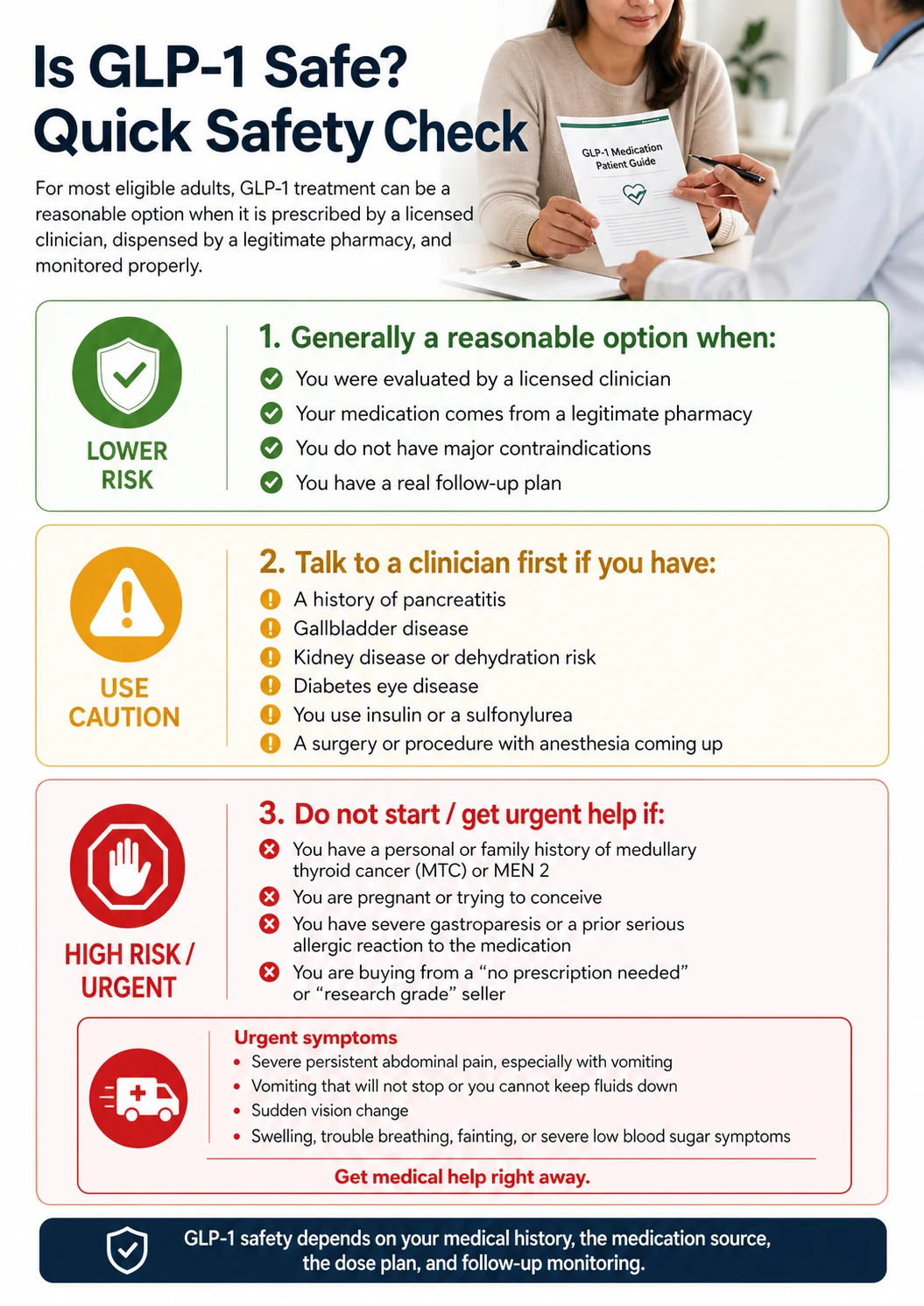
Yes — GLP-1 medications like Ozempic, Wegovy, Mounjaro, Zepbound, and the new pill Foundayo are generally safe for eligible adults when they're prescribed by a licensed clinician, dispensed through a legitimate pharmacy, and monitored properly. But “is GLP-1 safe?” doesn't have a one-size answer, because GLP-1 is not safe for everyone. The honest answer depends on four things: your medical history, the medication source, the dose plan, and whether someone is actually watching. Scroll to the 16-Check Safety Triage Matrix below — it's the table we built so you can find your situation in one glance.
What we actually verified
We're a comparison site, not a hospital, so we tell you exactly what we checked. For this page we reviewed:
- The current FDA prescribing information for Wegovy, Wegovy tablet, Ozempic, Mounjaro, Zepbound, Saxenda, Rybelsus, and Foundayo (orforglipron, FDA-approved April 1, 2026).
- The FDA's postmarket safety communications on unapproved and compounded GLP-1 drugs (most recently February 4, 2026).
- The FDA's January 13, 2026 Drug Safety Communication on suicidal behavior and ideation warnings — current on FDA.gov as of April 3, 2026 — which requested removal of that warning language from Saxenda, Wegovy, and Zepbound labels.
- The European Medicines Agency's June 2025 PRAC conclusion adding NAION as a “very rare” side effect on semaglutide medicines specifically — Ozempic, Rybelsus, and Wegovy.
- Court records on MDL 3094 (gastrointestinal injuries) and MDL 3163 (vision loss/NAION), both in the Eastern District of Pennsylvania.
- Major peer-reviewed evidence: the SELECT trial, the Vilsbøll et al. 2026 thyroid cancer meta-analysis (101,732 participants), the 2024 Lancet Diabetes & Endocrinology meta-analysis, and the April 2026 FAERS analysis covered in Medscape.
- The National Academy of Medicine's October 8, 2025 panel “Regulating a ‘Miracle Drug’: GLP-1 Costs, Access, & Safety.”
Where a claim depends on a specific source, we name it. Where evidence is conflicting or product-specific, we tell you that too.
Is GLP-1 safe for weight loss? A 60-second snapshot
For eligible adults — BMI ≥30, or BMI ≥27 with at least one weight-related condition — prescribed an FDA-approved GLP-1 by a licensed clinician and dispensed through a legitimate pharmacy, GLP-1 medications have a favorable benefit-risk profile, with cardiovascular benefit demonstrated in the SELECT trial. They are not appropriate for everyone. Find your situation:
| Your situation | The bottom line |
|---|---|
| Eligible adult, evaluated by a licensed clinician, prescribed an FDA-approved GLP-1, no major contraindications, real follow-up plan | A GLP-1 is likely a reasonable option to discuss. Side effects exist but are usually manageable. |
| Personal or family history of medullary thyroid cancer (MTC) or MEN 2 | Do not start. This is a label-level Section 4 contraindication on the major FDA-approved weight-management GLP-1s. |
| Pregnant, or pregnancy recognized while on the medication | Stop and contact your prescriber. Wegovy advises stopping at least 2 months before trying to conceive. Zepbound advises discontinuing when pregnancy is recognized. |
| Currently breastfeeding | Limited human data. Discuss with your clinician before starting — shared decision-making, not a universal “no.” |
| Severe gastroparesis history | Avoid unless specifically cleared by a specialist. The Ozempic label was updated January 2025 to state it is “not recommended in patients with severe gastroparesis.” |
| Currently using insulin or a sulfonylurea (glipizide, glyburide) | Not disqualifying, but your prescriber needs to adjust your other medications to prevent low blood sugar. |
| On the pill and starting tirzepatide (Zepbound, Mounjaro) or Foundayo | Use non-oral contraception or a backup barrier method during initiation and after each dose increase. See the women's section below for exact windows. |
| Considering a “no prescription needed” or “research grade” online product | Stop. The FDA has documented counterfeits, wrong active ingredients, dosing errors causing hospitalization, and unsafe manufacturing in this category. |
| Sudden severe abdominal pain, persistent vomiting, sudden vision change, swelling/trouble breathing, or fainting on a GLP-1 right now | Stop reading articles. Get medical attention. These are urgent symptoms, not internet questions. |
The GLP-1 Safety Triage Matrix: 16 checks before you start
This is the table no other page on the internet has put together in one place. We built it from the FDA labels, FDA safety communications, current peer-reviewed evidence, and the most common safety concerns we see in GLP-1 forums and reader questions. Walk down the left column. Find your situation in green, yellow, or red.
| # | Safety check | GREENLower-risk signal | YELLOWAsk a clinician first | REDDo not proceed / seek urgent care |
|---|---|---|---|---|
| 1 | Medication source | FDA-approved drug, licensed prescriber, state-licensed pharmacy | Compounded with clear pharmacy ID, real prescription, written dosing instructions | "No prescription needed," "research use only," counterfeit-looking product, or unverifiable seller |
| 2 | FDA-approved vs compounded | Wegovy, Wegovy tablet, Zepbound, Saxenda, Foundayo (weight management); Ozempic, Mounjaro, Rybelsus (diabetes) — drugs that went through FDA review for their labeled indication | Compounded only when your medical need cannot be met by an FDA-approved drug, with documentation when required | Any seller claiming compounded GLP-1 is "the same as" Wegovy/Ozempic, "FDA-approved generic," or "clinically proven equivalent" |
| 3 | Thyroid C-cell tumor warning (boxed) | No personal or family history of MTC or MEN 2 | Family history unclear or thyroid nodules never evaluated | Confirmed personal or family history of medullary thyroid carcinoma or MEN 2 |
| 4 | Allergy history | No prior reaction to the medication or its ingredients | Reaction to a different GLP-1 in the past | Prior serious hypersensitivity (anaphylaxis, angioedema) to a GLP-1 |
| 5 | Pregnancy / conception | Not pregnant, no plans to conceive in the next ~2 months | Planning pregnancy soon, or unsure of pregnancy status | Pregnant now, or pregnancy discovered while on the drug |
| 6 | Breastfeeding | Not breastfeeding | Breastfeeding now, considering starting | (No universal red — discuss individually with your clinician) |
| 7 | Oral birth control + tirzepatide or Foundayo | Using non-oral contraception | Using oral pill, starting one of these soon | Relying on oral pill alone during initiation or dose escalation without a backup method |
| 8 | GI history / gastroparesis | No significant GI disease | Chronic constipation, IBS, IBD, reflux, or delayed gastric emptying | Severe gastroparesis history without specialist sign-off |
| 9 | Pancreatitis history | None | Prior episode, currently asymptomatic | Severe persistent abdominal pain on therapy (especially with vomiting) |
| 10 | Gallbladder | No active symptoms | History of gallstones or cholecystectomy | Right upper abdominal pain, fever, or jaundice on therapy |
| 11 | Kidney / dehydration | Hydration plan, monitoring if needed | On diuretics, has CKD, vomiting/diarrhea episodes | Persistent vomiting, can't keep fluids down, signs of acute kidney injury |
| 12 | Diabetes meds (insulin / sulfonylureas) | Not on insulin or sulfonylureas, or dose adjustment plan in place | Currently on either, prescriber adjusting | Severe hypoglycemia symptoms (confusion, fainting, seizure) |
| 13 | Diabetic retinopathy | No diabetes, or eyes baseline-evaluated | Existing diabetic retinopathy | Sudden vision change at any point — get to ophthalmology immediately |
| 14 | Surgery / anesthesia | No procedures planned | Surgery, endoscopy, or sedation scheduled | About to undergo anesthesia and the team doesn't know you're on a GLP-1 |
| 15 | Dosing format | Pre-filled pen with mg dosing | Vial with clear mg/mL labeling and written training | Units-only instructions, unclear concentration, or self-converting from mg to 'units' |
| 16 | Long-term plan | Treats GLP-1 as part of a real plan (nutrition, strength training, follow-up) | Wants short-term use without a maintenance plan | Plans to self-dose, escalate fast, or stop abruptly without clinician guidance |
Sources: FDA prescribing information for Wegovy, Wegovy tablet, Ozempic, Zepbound, Mounjaro, Saxenda, Rybelsus, and Foundayo (rows 2–4, 7–13, 15); FDA postmarket page on unapproved GLP-1 drugs, updated February 4, 2026 (rows 1–2); Ozempic label update January 2025 on severe gastroparesis (row 8); ASA and joint society guidance on GLP-1 use before anesthesia (row 14); STEP 1 trial extension and NAM October 2025 panel (row 16).
Want a personalized version of this table?
Take our free 60-second GLP-1 safety check. It walks you through the same 16 questions and outputs a tailored doctor-question list and red-flag summary for your situation — not a sales pitch.
Run my GLP-1 safety check →You're not the only one asking this
These are the kinds of questions people post in the GLP-1 communities on Reddit when they're starting out. We're including these only as examples of genuine questions, not as medical evidence.
“I'm receiving my prescription today and I'm excited to get started but I tend to overthink things. Is this stuff actually safe?”
“I haven't taken my first dose yet because I'm so scared of the side effects.”
“Is it cheating? Is it safe? I've heard of gastroparesis that never goes away, kidney issues, all of it.”
If any of those sound like you — same brain. The fear is normal, especially when the information out there is a mix of TV ads, lawsuit commercials, miracle stories, and forum horror threads. The point of the rest of this page is to replace that fear with specifics so you can decide.
Who should not take a GLP-1?
Some people should not take a GLP-1 at all, and others should only take one with specific clinician oversight. The clearest “do not take” list comes straight off the FDA labels.
The hard contraindications (Section 4 of the label)
- Personal or family history of medullary thyroid carcinoma (MTC). A rare but specific thyroid cancer.
- Multiple Endocrine Neoplasia syndrome type 2 (MEN 2). A genetic condition that raises MTC risk.
- Prior serious hypersensitivity to the active drug or its ingredients (anaphylaxis, angioedema).
If any of these apply to you, the right next step is not a different GLP-1 — it's a different conversation with your doctor about non-GLP-1 options.
Pregnancy, conception, and breastfeeding
Pregnancy is not Section 4 contraindicated the same way as MTC/MEN 2, but it's a serious label issue for weight-management use.
- Wegovy advises stopping at least 2 months before trying to conceive.
- Zepbound advises discontinuing when pregnancy is recognized.
- Animal studies have shown potential fetal risk; human pregnancy data is limited.
- If you become pregnant on a GLP-1, contact your prescriber the same day to discuss stopping safely.
- Breastfeeding has limited human data. The FDA recommends shared decision-making between you and your clinician — not a universal “do not use.”
The strong precautions (only with clinician planning)
You're not automatically out, but you need a real conversation, not a 7-minute telehealth screen.
- Severe gastroparesis (delayed stomach emptying). GLP-1 medications work in part by slowing gastric emptying. The Ozempic label was updated in January 2025 to state it is “not recommended in patients with severe gastroparesis.”
- History of pancreatitis. Acute pancreatitis is listed on every GLP-1 label as a risk; a prior episode raises the threshold for proceeding.
- Severe diabetic retinopathy. Rapid improvement in blood sugar can transiently worsen retinopathy. People with severe pre-existing retinopathy need an ophthalmology baseline before starting.
- Active eating disorder. Not a universal hard contraindication on labels, but appetite-suppressing medication can destabilize someone with a restrictive eating history. Mental health professionals should be looped in before starting.
- Type 1 diabetes. GLP-1s for type 1 are off-label and require endocrinology oversight; this is not a telehealth-friendly path.
- Severe gallbladder disease history. Rapid weight loss raises gallstone risk independent of the drug; with GLP-1s the combined risk is higher.
Drug interactions worth flagging out loud
- Insulin or sulfonylureas (glipizide, glyburide, glimepiride): A GLP-1 alone has low hypoglycemia risk, but combined with insulin or a sulfonylurea, hypoglycemia risk rises. Your prescriber should adjust those medications, not just add the GLP-1 on top.
- Oral medications with narrow absorption windows: Slowed gastric emptying can affect timing-sensitive oral drugs. Tell your prescriber every medication and supplement you take.
- Oral contraceptives + tirzepatide or Foundayo: These two specifically have label-level backup contraception requirements during initiation and dose escalation. See the women's section below for exact windows.
Special populations
Older adults. Generally appropriate for the right candidate, but the National Academy of Medicine's October 8, 2025 expert panel was specific: frailty, low baseline muscle mass, fall risk, and nutritional adequacy all matter more than they would in a 35-year-old. “Wraparound care” (nutrition, strength training, social support) is what makes the difference. See our GLP-1 for seniors guide.
Adolescents. Wegovy is approved for ages 12 and up. Zepbound is approved for adults only. Foundayo's label states safety in children has not been established.
Not sure which category you fall into?
The 60-second safety check turns these red flags into a written list of questions for your prescriber — built around your specific medical history, not generic advice.
Get my doctor-question checklist →What are the most common GLP-1 side effects — and which symptoms are dangerous?
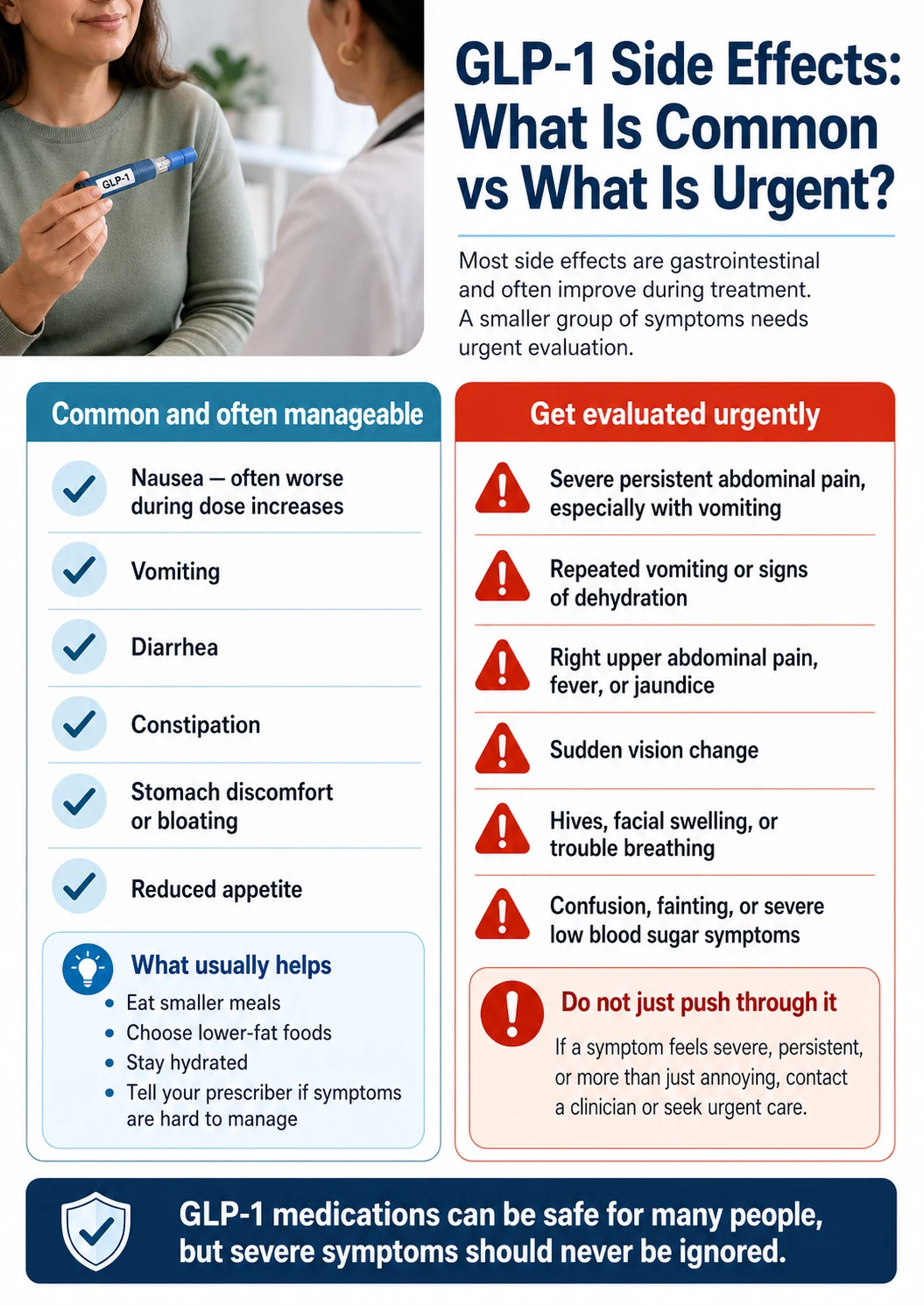
Most GLP-1 side effects are gastrointestinal: nausea, vomiting, diarrhea, constipation, bloating, and reduced appetite. Most are mild to moderate, are often worse during dose escalation, and improve as the body stabilizes on a dose. A smaller set of side effects is rare but serious and means stop reading articles and get evaluated.
Common or label-listed side effects (often transient)
- Nausea — the most common one. Worst during dose escalation; usually improves once you stabilize on a dose.
- Vomiting
- Diarrhea
- Constipation
- Abdominal pain or discomfort
- Indigestion / heartburn / belching
- Reduced appetite (this is the mechanism, not just a side effect)
- Headache, fatigue, hair loss — listed on some labels (notably Foundayo) but vary by drug and dose. Hair loss is often related to rapid weight loss rather than the drug itself.
- Injection-site reactions (for the injectable forms only)
The way to make these more bearable: smaller meals, lower-fat meals, hydration, protein, slow titration as instructed, and telling your prescriber if symptoms are serious enough to keep you from working or eating. Don't muscle through severe symptoms — that's how dehydration becomes acute kidney injury.
Rare but serious — when “I'll just push through it” becomes “I'm in the ER”
Print this table.
| Symptom | What it could mean | What to do |
|---|---|---|
| Severe persistent abdominal pain (especially radiating to the back, with vomiting) | Acute pancreatitis | Stop the drug. Call your prescriber or get to urgent care today. |
| Right upper abdominal pain, fever, jaundice (yellowing of skin or eyes) | Acute gallbladder disease (cholecystitis) | Urgent evaluation. |
| Vomiting that won't stop, can't keep fluids down, dizzy on standing | Dehydration → acute kidney injury risk | Call your prescriber. May need IV fluids. |
| Sudden, painless vision loss in one eye (or “shadow” or altitudinal defect) | Possible NAION — added to EU labels for semaglutide products June 2025 | Get to ophthalmology the same day. European regulators say semaglutide should be stopped if NAION occurs. |
| Hives, swelling of face/lips/tongue, trouble breathing | Serious allergic reaction | Call 911. |
| Confusion, shaking, sweating, fast heartbeat (especially if on insulin or a sulfonylurea) | Severe hypoglycemia | Treat low blood sugar; if not improving fast, call for help. |
| Severe constipation with no bowel movement, no gas passing, vomiting | Possible ileus (bowel becomes paralyzed). FDA added ileus warning to Ozempic September 2023. | Urgent evaluation. |
| New or worsening vision changes if you have diabetes | Diabetic retinopathy progression | Contact your prescriber and ophthalmologist. |
The pattern most people miss: severity matters more than the symptom itself. Mild nausea on day 4 is normal. Vomiting that lasts 5 days and you can't drink water is not. A grumbly stomach is normal. Severe constant abdominal pain that wakes you up is not. If something feels worse than “annoying,” err on the side of calling.
A note on the cancer warnings
Two get asked about constantly: thyroid cancer and pancreatic cancer.
Thyroid C-cell tumors are listed in a boxed warning on most major GLP-1 medications — Wegovy, Ozempic, Zepbound, Mounjaro, Saxenda, Foundayo, Rybelsus, Trulicity, and Bydureon. The boxed warning is based on rodent studies. Human data has been more reassuring: a 2026 meta-analysis by Vilsbøll and colleagues, pooling clinical trial data across 101,732 participants, concluded that “the totality of data analysed did not suggest an association between liraglutide or semaglutide use and thyroid cancer risk in adults.” The boxed warning still stands and means people with personal or family MTC/MEN 2 history should not take these drugs. For everyone else, it is a precaution based on a rodent signal that has not been confirmed in humans through 2026.
Pancreatic cancer has been raised as a long-running concern. Through April 2026, large randomized trial datasets and post-marketing analyses have not confirmed an increased rate of pancreatic cancer — though long-term observational data continues to accumulate.
Are GLP-1s safe long-term?
For type 2 diabetes, GLP-1 medications have approximately 20 years of post-marketing data — long enough to detect rare adverse events that wouldn't appear in short trials. For non-diabetic weight management, the longest robust dataset is the SELECT trial (semaglutide in 17,604 adults with overweight/obesity and cardiovascular disease, mean follow-up 39.8 months). The long-term picture has three honest parts.
- The diabetes track record is genuinely long. Exenatide was FDA-approved in 2005. Liraglutide in 2010. Semaglutide in 2017. Over those years, large cardiovascular outcome trials (LEADER, SUSTAIN-6, REWIND) have run with thousands of patients followed for years. The class survived that scrutiny.
- The non-diabetic obesity record is shorter but real. SELECT showed a 20% reduction in major adverse cardiovascular events versus placebo over a mean 39.8 months — not just a “no harm” finding, but a meaningful benefit. Subsequent trials (STEP, SURMOUNT, FLOW, STEP-HFpEF) have added kidney outcomes, sleep apnea outcomes, and heart failure outcomes.
- What we don't yet have. Robust 10+ year data for non-diabetic adults on continuous high-dose obesity therapy. Robust pediatric long-term data. Pregnancy outcomes. What happens when someone takes it for 15 years and stops. These are real unknowns.
Do you have to stay on it forever?
The blunt answer: for most people who lose meaningful weight on a GLP-1 and then stop, weight regain is the rule, not the exception. The STEP 1 trial extension showed substantial regain after semaglutide withdrawal. The National Academy of Medicine's October 2025 expert panel summarized real-world data showing roughly two-thirds of lost weight returns within about a year of stopping Wegovy.
That's not a flaw in the medication. That's the nature of obesity as a chronic condition — the same logic as blood pressure medication. If your goal is long-term management of a chronic condition, that's the use case the drug was designed for.
Muscle and bone
Rapid weight loss of any kind — surgery, dieting, GLP-1 — causes lean muscle loss alongside fat loss, and to a lesser extent some bone density loss. The way to mitigate it: enough protein (often 1.2–1.6 g per kg of goal body weight), resistance training, and slow rather than crash weight loss.
Mental health: the January 2026 update
In a Drug Safety Communication issued January 13, 2026 (current on FDA.gov as of April 3, 2026), the FDA requested removal of the suicidal behavior and ideation warning language from the GLP-1 labels that currently included it — specifically Saxenda, Wegovy, and Zepbound. The agency concluded the available evidence did not support a causal link. That doesn't mean nobody experiences mood changes on a GLP-1 — life changes when your appetite, energy, eating patterns, and body change rapidly. It means the population-level data didn't show an increase in suicidal thoughts versus people not on the medication. If your mood changes on a GLP-1, tell your prescriber.
Is GLP-1 safe if you don't have diabetes?
Yes, for adults who meet FDA-approved eligibility criteria for chronic weight management — BMI ≥30, or BMI ≥27 with at least one weight-related comorbidity — and who clear the contraindication checklist. The largest non-diabetic safety dataset is the SELECT trial, which followed 17,604 adults with overweight/obesity and pre-existing cardiovascular disease (no diabetes) for a mean of 39.8 months and showed both a meaningful cardiovascular benefit and a safety profile consistent with diabetes trials.
“Cosmetic” or microdose use without medical eligibility is not the population studied. If your BMI is 24 and you want to lose 8 pounds before a wedding, the risk-benefit math is different from the population in SELECT. That's not a moral judgment — it's a science statement.
Off-label use through gray-market channels stacks two risks — the drug's risk profile and the supply chain's risk profile. We cover that in the compounded section below.
Are GLP-1 pills safer than GLP-1 injections?
Pills are not automatically safer than injections. Safety depends on the specific medication, dose, label warnings, absorption rules, and whether the product is FDA-approved or compounded. As of April 2026, FDA-approved oral GLP-1 options include Rybelsus (oral semaglutide, for type 2 diabetes), the Wegovy tablet (oral semaglutide for chronic weight management, FDA-approved December 2025), and Foundayo (orforglipron, FDA-approved April 1, 2026 for chronic weight management).
Pill-specific considerations:
- Some oral GLP-1s have absorption rules (Rybelsus must be taken on an empty stomach). Foundayo's label states it can be taken any time of day without food or water restrictions.
- GI side effects still happen on pills.
- Slowed gastric emptying can affect timing of other oral medications, regardless of GLP-1 format.
Injection-specific considerations:
- Injection-site reactions, needle anxiety, refrigerated storage, pen vs vial dosing.
- Pre-filled pens with pre-set mg dosing have lower dosing-error risk than vials.
Compounded oral / sublingual caution
A “compounded oral semaglutide” or sublingual GLP-1 sold by a telehealth platform is not the same regulatory category as Rybelsus or oral Wegovy. The compounded form is not FDA-approved as a finished drug product. We cover compounded safety in the next section — don't conflate the two just because they're both oral.
Is compounded GLP-1 safe?
Compounded GLP-1 medications are not FDA-approved finished drug products. The FDA does not review them for safety, effectiveness, or quality before they're marketed, the way it reviews FDA-approved drugs. On top of that, the FDA has documented specific quality issues in the compounded GLP-1 supply chain.
| Safety dimension | FDA-approved (Wegovy, Ozempic, Zepbound, Mounjaro, Foundayo, Rybelsus, Saxenda) | Compounded GLP-1 (mass-marketed) |
|---|---|---|
| FDA review of safety, efficacy, quality before marketing | Yes | No — compounded drugs are not FDA-approved |
| CGMP manufacturing oversight | Yes | Varies; depends on whether it's a 503A or 503B pharmacy |
| Active ingredient identity verified | Yes — semaglutide, tirzepatide, etc. | The FDA has reported some compounded products use semaglutide sodium or acetate — salt forms the FDA says are different active ingredients from those in approved drugs |
| Cold-chain integrity | Manufacturer-controlled | The FDA has documented compounded shipments arriving warm; advises do not use those products |
| Dosing accuracy | Pre-filled pen with calibrated dosing | The FDA has received hospitalization reports tied to compounded vial dosing errors — including patients self-administering 5 to 20 times the intended dose |
| Counterfeit risk | Low (manufacturer + pharmacy chain of custody) | The FDA has documented falsified pharmacy labels and counterfeit products |
| Marketing equivalence claims | Manufacturer follows FDA advertising rules | The FDA has stated compounders cannot legally claim their compounded GLP-1 is “generic,” “the same as,” or “clinically proven equivalent” to FDA-approved drugs |
Compounding has a legitimate role. It's how a pharmacy makes a medication for a patient when the patient's medical need cannot be met by an FDA-approved drug. The mass-marketed compounded GLP-1 industry that exploded during the 2022–2024 shortages is a different beast.
If you've already used or are currently using a compounded product and are worried, see our compounded GLP-1 verification guide for the practical checklist.
Are online “research grade” or “no-prescription” GLP-1s safe?
No. This is the highest-risk category. The FDA has been explicit: products sold without a prescription, marketed as “research use only,” or sold through unverifiable online sellers may be counterfeit, may contain wrong or harmful ingredients, may contain too much or too little active ingredient, and may be sold by people facing no regulatory consequences for harm caused.
The red flags, in plain language:
- “No prescription needed”
- “Research grade” or “research peptide”
- “Not for human consumption”
- “Generic Ozempic” or “the same as Wegovy”
- No pharmacy name on the package
- No state license you can verify
- Suspiciously low prices versus everywhere else
- Ships internationally with vague customs handling
- Paid in cryptocurrency or wire transfer
If you've already bought one and haven't used it yet: don't inject it. Save the packaging. Talk to a pharmacist or your prescriber. You can report suspected counterfeit or adverse events to the FDA's MedWatch program.
Is GLP-1 safe with diabetes, kidney disease, heart disease, or high blood pressure?
Yes for many people in these categories — and in some cases, GLP-1 medications offer documented benefits beyond weight loss for these specific conditions. But each of these situations needs individualized clinician planning because the risk profile shifts.
Type 2 diabetes
GLP-1s were originally developed for type 2 diabetes and remain a foundational class for it. Most of the long-term data lives here. The two things to coordinate: blood sugar monitoring during dose changes, and adjustments to insulin or sulfonylurea doses to prevent hypoglycemia.
Heart disease
This is where the SELECT trial mattered most. Among adults with overweight/obesity and pre-existing cardiovascular disease but no diabetes, semaglutide reduced major adverse cardiovascular events (heart attack, stroke, cardiovascular death) by roughly 20% over a mean 39.8 months. For some people with high cardiovascular risk, a GLP-1 isn't just “safe enough” — it's actively preventive.
Kidney disease
GLP-1 medications have shown kidney benefits in trials of people with type 2 diabetes and chronic kidney disease (FLOW trial; the 2024 Lancet Diabetes & Endocrinology meta-analysis showed a composite kidney outcome HR of 0.81). The flip side: persistent vomiting and dehydration on a GLP-1 can cause acute kidney injury. People with existing kidney disease, on diuretics, or with low fluid intake need a closer eye during dose escalation.
High blood pressure
Not a contraindication. GLP-1-driven weight loss often improves blood pressure. The thing to watch: dizziness or fainting if you're on blood pressure medication and your weight drops fast — your blood pressure meds may need to come down. Tell your prescriber.
Is GLP-1 safe for women — pregnancy, birth control, PCOS?
For women, GLP-1 safety hangs on a few specific points the labels are clear about: don't use during pregnancy or active conception attempts, plan a washout period before trying to conceive, and if you're on tirzepatide (Zepbound or Mounjaro) or Foundayo and use oral birth control, you need a backup contraception plan during initiation and dose changes.
Birth control: the windows that get missed
This one gets missed constantly in fast telehealth visits.
| Medication | Backup contraception window |
|---|---|
| Tirzepatide (Zepbound, Mounjaro) | Switch to non-oral contraception or add a barrier method (condom) for 4 weeks after starting and 4 weeks after each dose escalation |
| Foundayo (orforglipron) | Switch to non-oral contraception or add a barrier method for 30 days after initiation and 30 days after each dose escalation |
| Semaglutide (Wegovy, Ozempic, Rybelsus) | Not a label-level backup contraception requirement, but discuss your contraception plan with your prescriber |
If you're on the pill and a telehealth provider prescribes Zepbound, Mounjaro, or Foundayo without raising backup contraception with you, that's a red flag for the visit quality.
PCOS
GLP-1 medications are sometimes used off-label in PCOS for metabolic management. See our GLP-1 for PCOS guide. Safety overlay: improved metabolic health and weight loss can restore fertility you may not be expecting. If you're on a GLP-1 for PCOS and don't want to become pregnant, contraception is non-optional.
Menopause and post-menopause
Not a hard contraindication. Bone density and muscle preservation matter more here, so the protein and resistance training plan isn't optional.
Is GLP-1 safe before surgery or anesthesia?
Tell your surgeon and anesthesiologist that you're on a GLP-1 — every time, even for a colonoscopy or a dental procedure with sedation. GLP-1 medications can delay gastric emptying, which raises the risk of pulmonary aspiration during general anesthesia or deep sedation. The FDA labels now include this warning, and major anesthesiology societies have published guidance.
- As soon as a procedure is scheduled, list every medication you're on, including the GLP-1 with its name, dose, and last injection date.
- Ask explicitly: “Should I hold this medication, and for how long?”
- Don't rely on internet protocols. Holding times depend on the medication, the procedure type, the anesthesia plan, and your medical context. A clinician decides.
- For emergency surgery: tell the team immediately. They will manage it.
This is one of the more under-communicated parts of GLP-1 use. People go in for a routine colonoscopy and forget to mention a once-weekly injection that becomes the most important detail on the chart.
What about the lawsuits — gastroparesis, NAION, vision loss?
As of the JPML April 1, 2026 statistics report, MDL 3094 (gastrointestinal injuries — gastroparesis, ileus, bowel obstruction) listed 3,546 pending actions in the Eastern District of Pennsylvania. MDL 3163 (vision injuries / NAION), established December 2025, is a separate consolidated docket in the same district. The lawsuits center on “failure to warn” allegations. These cases are in early discovery; we did not find a global settlement in the official court materials reviewed as of April 25, 2026.
Two things can be true at the same time. The injuries are real for the people who experienced them. And the existence of MDL litigation does not, by itself, prove the drug caused the injuries population-wide. Many widely used FDA-approved drugs have MDLs. MDLs exist as a procedural tool to handle large numbers of similar cases efficiently, not as a regulatory finding of harm.
What MDL 3094 (gastroparesis and GI injuries) covers
Severe gastroparesis (stomach paralysis), ileus (paralyzed bowel), and bowel obstructions across multiple GLP-1 manufacturers. The Ozempic label was updated in January 2025 to state it is “not recommended in patients with severe gastroparesis.” The FDA added an ileus warning to Ozempic in September 2023.
What MDL 3163 (NAION) covers
Non-Arteritic Anterior Ischemic Optic Neuropathy — a rare, usually painless vision loss thought to result from reduced blood flow to the optic nerve. In June 2025, the European Medicines Agency's PRAC concluded that NAION is a “very rare” side effect of semaglutide medicines specifically — Ozempic, Rybelsus, and Wegovy — and added it to those product labels. This is a semaglutide-specific regulatory finding, not a confirmed class-wide GLP-1 finding.
What this means for you, practically
- If you're considering starting a GLP-1, the existence of these lawsuits doesn't change the basic safety calculation: most of these adverse events are rare in the population, the drug class has 20+ years of post-marketing data, and the cardiovascular benefit shown in SELECT is also real.
- If you experience sudden vision change at any point on a GLP-1: don't wait, get to ophthalmology the same day. EMA's guidance is to stop the semaglutide medicine if NAION occurs.
- If you experience severe persistent vomiting, abdominal pain, or constipation on a GLP-1: don't push through, don't ignore it, contact your prescriber.
What to ask your doctor before starting
The best way to walk into a prescribing visit is with a written list. If you have a 10-minute appointment, you don't have time to wing it. Below are the questions we'd take in.
- Am I an appropriate candidate for a GLP-1, given my medical history and goals?
- Which FDA-approved indication applies to me — type 2 diabetes, weight management, both?
- Do I have any contraindications I should know about? Specifically: any concern about MTC, MEN 2, prior pancreatitis, severe gastroparesis, or pregnancy?
- Is there anything in my family history that should change the conversation?
- Do my current medications interact with a GLP-1? Specifically: insulin, sulfonylureas, oral birth control if I'm starting tirzepatide or Foundayo, oral medications with timing requirements?
- Should I have any baseline labs or imaging before I start? An eye exam if I have diabetes?
- Which medication and dose are you starting me at, and what's the escalation plan?
- What side effects should make me call you, and what's the threshold between “annoying” and “stop the drug and get evaluated”?
- What do I do if I have surgery, a colonoscopy, or any procedure with sedation while I'm on this?
- What's the long-term plan — how long do I stay on it, what does maintenance look like, what happens if I stop?
We turned this list into a printable doctor-visit checklist
Answer the 16 safety triage questions and we output a checklist tailored to your specific medical history. Bring it to your appointment.
Get my doctor-visit checklist →What to do if you already started and you're worried
If symptoms are mild and you're just spooked: contact your prescriber, describe what you're feeling, and follow their plan. They've seen what you're describing.
If symptoms are severe
Sudden vision change, severe persistent abdominal pain, can't keep fluids down, signs of an allergic reaction, severe low blood sugar — stop reading internet articles and get medical help.
“I think I have gastroparesis.”
Severe persistent vomiting, bloating, or feeling full after a few bites that lasts more than a couple of weeks beyond a dose deserves a real evaluation. Don't self-diagnose from a forum.
“I felt depressed after starting.”
Tell your prescriber. The FDA's January 2026 review didn't find a population-level causal link, but individual response varies and your prescriber needs the data point.
“I'm pregnant and didn't know.”
Contact your prescriber today. Don't keep injecting and don't panic — they'll guide you through stopping safely and what to do next.
“I bought a compounded product and now I'm scared.”
Don't inject anything you can't verify. Save the packaging. Talk to a pharmacist or your prescriber. If it's already in your body and you're having symptoms, get evaluated — and bring the packaging with you.
How to choose a safer GLP-1 telehealth provider
If you've cleared the safety triage and you're going to use telehealth, the source matters. Here's the 12-point checklist we use when we evaluate providers for our comparison guides.
A safer GLP-1 telehealth provider:
- Requires a real medical intake — not a 90-second BMI calculator.
- Uses licensed clinicians (not a “wellness coach”) and you can verify the prescriber's license.
- Discloses the medication source clearly — FDA-approved or compounded — without blurring them.
- Doesn't claim compounded medications are “the same as,” “generic versions of,” or “clinically proven equivalents to” FDA-approved drugs.
- Identifies the dispensing pharmacy.
- Provides dosing instructions in clear units (mg, mg/mL) — not just “X units” with an unclear concentration.
- Has accessible side-effect support between appointments.
- Requires labs when clinically appropriate.
- Has clear cancellation and refund terms — readable, not buried.
- Shows state availability transparently.
- Provides emergency guidance: “If X happens, go here / call this.”
- Doesn't pressure you to “act now” or “secure your slot.”
Red flags that would make us walk away regardless of price:
- “No prescription needed.”
- Star ratings or testimonials that can't be linked to a real source.
- Pricing only revealed after you enter a credit card.
- “Same as Ozempic” or “research grade” language.
- Inability to identify the pharmacy.
- Units-only dosing instructions for an injectable.
- No way to reach support after you pay.
For our full analysis of which telehealth providers pass this checklist, see our GLP-1 telehealth provider comparison. (Affiliate disclosure: we may earn a commission from partnered providers we feature on the comparison page; no provider paid for inclusion on this safety page.)
Frequently asked questions about GLP-1 safety
Is GLP-1 safe for weight loss?
For eligible adults (BMI ≥30, or ≥27 with at least one weight-related comorbidity) prescribed an FDA-approved GLP-1 by a licensed clinician and dispensed through a legitimate pharmacy, GLP-1 medications have a favorable benefit-risk profile, with cardiovascular benefit demonstrated in the SELECT trial. They are not appropriate for everyone — contraindications include medullary thyroid cancer or MEN 2 history and prior serious hypersensitivity, with pregnancy and severe gastroparesis as separate label-level avoid situations.
Are GLP-1 drugs safe long-term?
Twenty-plus years of post-marketing data exist for type 2 diabetes use. Non-diabetic obesity-only use has shorter follow-up; the SELECT trial (39.8-month mean follow-up, 17,604 participants) is the largest dataset to date and showed cardiovascular benefit alongside the known side effect profile. Stopping the medication typically results in weight regain because the underlying condition is chronic.
Who should not take a GLP-1?
People with a personal or family history of medullary thyroid carcinoma or MEN 2, or prior serious hypersensitivity to a GLP-1 ingredient. People who are pregnant or planning pregnancy soon should not start weight-loss treatment with a GLP-1, and should stop and contact their prescriber if pregnancy is recognized. Severe gastroparesis and active eating disorder are separate strong precautions.
Can GLP-1 cause thyroid cancer?
Most major GLP-1 medications carry a boxed warning for thyroid C-cell tumors based on rodent studies. Large human studies, including a 2026 meta-analysis pooling 101,732 participants by Vilsbøll and colleagues, did not find a statistically significant association in humans. The boxed warning still applies as a precaution and means people with personal or family history of medullary thyroid carcinoma or MEN 2 must avoid these drugs entirely.
Can GLP-1 cause vision loss?
The European Medicines Agency added NAION (Non-Arteritic Anterior Ischemic Optic Neuropathy) as a very rare side effect on the labels for semaglutide medicines specifically — Ozempic, Rybelsus, and Wegovy — in June 2025. It is the basis of MDL 3163 litigation. Sudden vision change on a GLP-1 should be evaluated by ophthalmology the same day.
Are compounded GLP-1s safe?
Compounded GLP-1s are not FDA-approved finished drug products and are not reviewed by the FDA for safety, effectiveness, or quality. The FDA has documented specific concerns including cold-chain failures, salt-form active ingredients the FDA says are different from those used in approved drugs, dosing errors causing hospitalization, and counterfeits. Compounding has a legitimate role in patient-specific situations; mass-marketed compounded GLP-1 products carry additional risks that FDA-approved drugs do not.
Can GLP-1 cause pancreatitis?
Acute pancreatitis is listed as a risk on every major GLP-1 label. Severe persistent abdominal pain — especially radiating to the back, with vomiting — should prompt stopping the drug and seeking urgent evaluation.
Can GLP-1 cause kidney problems?
Direct kidney harm is not the typical pathway. Acute kidney injury can occur as a consequence of severe dehydration from persistent vomiting or diarrhea. People on diuretics, with chronic kidney disease, or with low fluid intake need closer monitoring during dose escalation. Some GLP-1 medications also have documented kidney benefits in adults with type 2 diabetes and CKD.
Can GLP-1 cause gastroparesis?
GLP-1 medications slow gastric emptying as part of their mechanism. Severe persistent gastroparesis is a documented but rare adverse event and is the basis of MDL 3094 lawsuits. The Ozempic label was updated in January 2025 to state it is "not recommended in patients with severe gastroparesis."
Can GLP-1 cause depression or suicidal thoughts?
In a Drug Safety Communication issued January 13, 2026, the FDA requested removal of the suicidal behavior and ideation warning language from the GLP-1 labels that currently included it (Saxenda, Wegovy, and Zepbound), concluding the available evidence did not support a causal link. Any mood change on a GLP-1 should still be discussed with your prescriber.
Are GLP-1s safe for seniors?
Generally yes for the right candidate, with extra attention to nutritional adequacy, lean mass preservation, and fall risk. The National Academy of Medicine's October 2025 panel emphasized integrated wraparound care for older adults on GLP-1s.
Are GLP-1 lawsuits going to result in the drugs being pulled off the market?
There is no current indication that any FDA-approved GLP-1 will be withdrawn. MDL litigation centers on failure-to-warn claims, which typically result in label updates and/or financial settlements when plaintiffs prevail — not market withdrawal. The drugs remain widely prescribed and recommended by major medical societies.
How do I know if a GLP-1 provider is legit?
Apply the 12-point checklist: real medical intake, licensed clinicians, identified pharmacy, clear distinction between FDA-approved and compounded, transparent dosing, accessible side-effect support, clear cancellation terms, visible state availability, and explicit emergency guidance. Walk away from any seller using "no prescription needed," "research grade," or "same as Wegovy/Ozempic" language.
Still not sure which GLP-1 program is right for you?
Take our free 60-second matching quiz. Answer a few safety and access questions and we'll output a practical next-step path — an FDA-approved route, an insurance-supported route, a clinician-first route, or a “pause and ask your doctor first” plan based on your medical history. It's a way to walk into that doctor's visit already prepared, with the right questions and red flags identified.
Not medical advice. A way to walk into your doctor's visit prepared.
A final word
GLP-1 medications are some of the most studied, most prescribed, and most actively monitored drugs in the country right now. That doesn't make them risk-free. It does mean the safety question has actual answers — not a “we just don't know” shrug.
For most eligible adults, with a real prescriber and a legitimate pharmacy, a GLP-1 is a reasonable medical option. For some specific people, it's not — and that's worth knowing up front, not after the first dose.
We update this page on a quarterly basis or whenever the FDA issues a meaningful safety communication. The “last verified” date at the top of the page is real — when it changes, something has changed.
Sources
- FDA prescribing information: Wegovy, Wegovy tablet, Ozempic, Mounjaro, Zepbound, Saxenda, Rybelsus, Foundayo (Drugs@FDA, accessed April 2026).
- FDA. FDA's Concerns with Unapproved GLP-1 Drugs Used for Weight Loss. Updated February 4, 2026.
- FDA. FDA alerts health care providers, compounders and patients of dosing errors associated with compounded injectable semaglutide products.
- FDA. FDA Requests Removal of Suicidal Behavior and Ideation Warning from GLP-1 RA Medications (Drug Safety Communication January 13, 2026; current April 3, 2026).
- Eli Lilly. FDA approves Lilly's Foundayo™ (orforglipron). April 1, 2026.
- European Medicines Agency, PRAC. PRAC concludes eye condition NAION is a very rare side effect of semaglutide medicines. June 2025.
- Vilsbøll T et al. Assessment of thyroid cancer risk associated with GLP-1 receptor agonist use. Diabetes, Obesity and Metabolism 2026. (101,732 participants)
- Lancet Diabetes & Endocrinology. Effects of GLP-1 receptor agonists on kidney and cardiovascular disease outcomes: a meta-analysis of randomised controlled trials. November 2024.
- New England Journal of Medicine. SELECT trial publication, 2023.
- Medscape. FDA Data Reveal Different Risks for GLP-1s. April 2, 2026.
- National Academy of Medicine. Regulating a “Miracle Drug”: GLP-1 Costs, Access, & Safety (panel October 8, 2025; related NAM article January 2026).
- JPML Pending MDL Statistics Report, April 1, 2026 (MDL 3094 case count).
- U.S. District Court for the Eastern District of Pennsylvania, MDL 3094 and MDL 3163 docket pages.
Last verified: April 25, 2026 · Next scheduled review: July 25, 2026 (or sooner if the FDA issues a new safety communication).
The RX Index is a pricing intelligence and comparison resource for GLP-1 telehealth providers. This page does not provide medical advice. Always speak with a qualified clinician before starting, stopping, or changing any medication.
Related guides
Your situation changes the answer
Find My GLP-1 Path
The right GLP-1 provider isn't the same for everyone. It depends on your state, your insurance and formulary, whether you want an FDA-approved or compounded medication, your preferred route (injection or oral), and your budget. Because a general answer can't resolve those for you, use The RX Index's Find My GLP-1 Path tool to get a personalized provider match with source-verified pricing before you choose.
- What it asks: your state, insurance situation, medication preference, budget, and support needs
- What you get: a personalized shortlist of GLP-1 providers matched to your situation, with verified pricing and the right questions to ask
- Cost: free · about 2 minutes · no signup