
· FDA label, CMS Medicare Bridge, Lilly, Ro, and Sesame pricing confirmed
Eligibility Guide · April 2026
Who Qualifies for Foundayo? BMI Rules, Red Flags & the Access Paths That Actually Work (2026)
By The RX Index Editorial Team — a pricing intelligence and comparison resource for GLP-1 telehealth providers.
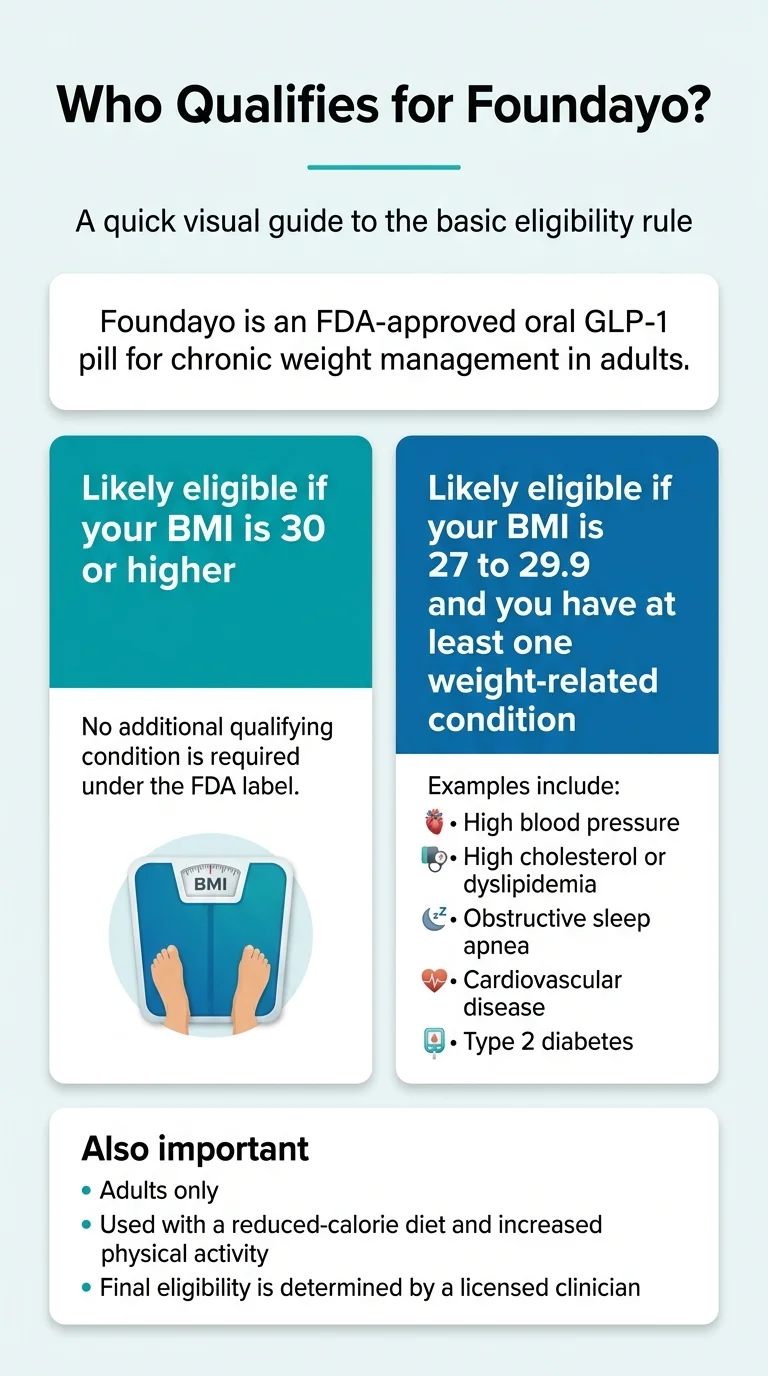
Who qualifies for Foundayo (orforglipron)? Adults 18 and older with a BMI of 30 or higher, or a BMI between 27 and 29.9 with at least one weight-related medical condition — most often hypertension, dyslipidemia, obstructive sleep apnea, cardiovascular disease, or type 2 diabetes. That's the FDA-approved indication, and it's the rule every legitimate prescriber starts from.
But that's only gate one. Qualifying for Foundayo has three gates, and most pages stop at the first one:
- The FDA label — the BMI + condition rule above.
- Clinician safety screening — thyroid cancer history, MEN 2, pregnancy, another GLP-1, severe gastroparesis, and specific drug interactions can stop the prescription even if your BMI qualifies.
- Payment access — commercial insurance, self-pay, and the Medicare GLP-1 Bridge each have their own rules. Medicare's criteria are stricter than the FDA's.
If any one of those three gates closes, Foundayo stops — no matter how well you clear the other two. Below we walk through each gate, show you the Foundayo Qualification & Access Matrix, and route you to the right next step.
Not sure if Foundayo fits your situation? Our free 60-second GLP-1 matching quiz uses your BMI, diagnoses, current medications, and insurance situation to tell you whether Foundayo is likely a fit and which access path is right for you.
→ Take the free 60-second GLP-1 quizQuick orientation — where do you land right now?
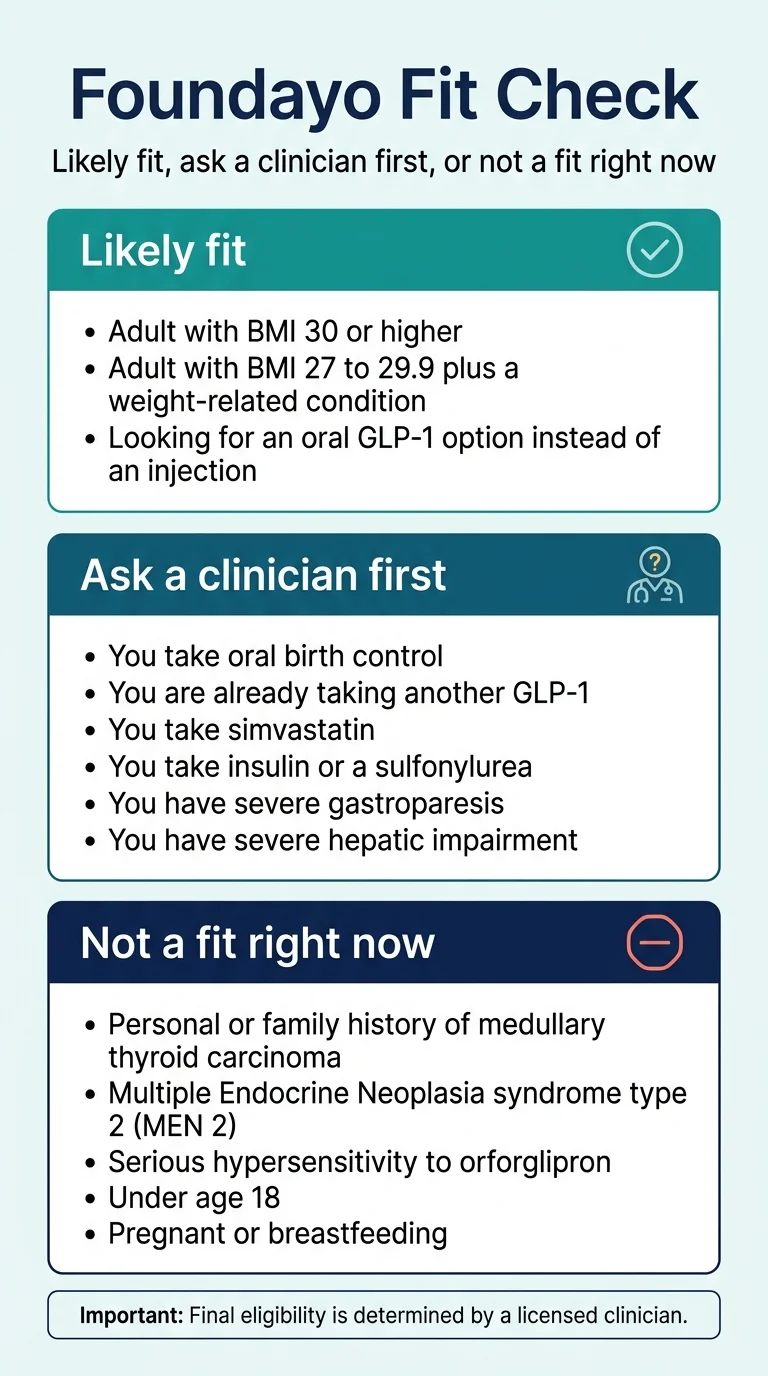
| You're likely a fit | Ask a clinician first | Likely not a fit (today) |
|---|---|---|
| Adult, BMI 30+ with no red flags | On oral birth control | Personal or family history of medullary thyroid carcinoma |
| Adult, BMI 27+ with hypertension, dyslipidemia, OSA, CV disease, or type 2 diabetes | On simvastatin >20 mg/day or a strong CYP3A4 inhibitor | Multiple Endocrine Neoplasia syndrome type 2 (MEN 2) |
| Medicare-eligible and meet one of three Bridge tiers | Severe gastroparesis or severe hepatic impairment | Prior serious hypersensitivity to orforglipron |
| Already on another GLP-1 (needs a transition plan) | Pregnant or trying to conceive; under 18 |
What we actually verified for this page
Claim category Source What we verified FDA indication, contraindications, drug interactions Foundayo U.S. Prescribing Information (Eli Lilly, 2026) BMI + condition rule; contraindications; boxed warning; OC protocol; simvastatin 20 mg cap; CYP3A4/OATP1B dose cap Self-pay pricing and Journey Program rules LillyDirect Foundayo page and full terms Dose-by-dose cash pricing, 45-day refill window Medicare GLP-1 Bridge criteria, drugs, copay, dates CMS.gov Medicare GLP-1 Bridge guidance (last modified March 10, 2026) Three-tier eligibility rule; $50 copay; Bridge July 1, 2026–Dec 31, 2027 (18 months); BALANCE not launching Medicare Part D 2027 Ro Foundayo access and pricing Ro Foundayo product and cost pages Medication pricing, Ro Body membership structure, insurance concierge workflow Sesame Care Foundayo access Sesame Care weight loss program page Program fee structure, provider-booked workflow, PA assistance Re-checked monthly through the Foundayo launch window.
The FDA label: Foundayo's actual eligibility rule (gate one)
Foundayo is FDA-approved for adults with obesity (BMI ≥30) or adults who are overweight (BMI 27–29.9) with at least one weight-related medical condition, when used with a reduced-calorie diet and increased physical activity. That's the full eligibility rule on the public label — nothing about documented failed diet attempts, and nothing about a minimum duration of weight struggle.
Some pages add requirements that aren't in the label. “Documented previous weight-loss attempts” as a primary qualification is a payer requirement some insurance plans add during prior authorization — not an FDA rule. Mixing them up makes readers think they're disqualified when they're not.
Adults with a BMI of 30 or higher
If your BMI is 30 or higher, you meet the obesity criterion of the Foundayo indication. You don't need a comorbidity to qualify under the FDA label. The phase 3 ATTAIN-1 trial enrolled adults with obesity (BMI ≥30) or overweight (BMI 27 to <30) with at least one weight-related comorbid condition, and mean baseline BMI in that trial was 37 kg/m².
Adults with a BMI between 27 and 29.9 plus a weight-related condition
If your BMI is in the 27–29.9 range, the FDA label requires at least one weight-related comorbid condition. The pivotal trial populations that supported approval specifically enrolled people with hypertension, dyslipidemia, obstructive sleep apnea, cardiovascular disease (ATTAIN-1) and type 2 diabetes (ATTAIN-2). Those five are the cleanest examples of qualifying conditions. Other conditions — PCOS, metabolic syndrome, fatty liver, prediabetes — are commonly accepted by clinicians as weight-related in daily practice, but are not explicitly named in the label text. Bring your full medical record to the consult; your prescriber decides based on current clinical practice.
Quick BMI check
BMI math: weight (lb) ÷ height (in)² × 703. Here's where common height/weight pairs land:
| Height | BMI 27 — overweight threshold (with a condition) | BMI 30 — obesity threshold (no condition required) |
|---|---|---|
| 5′0″ | 138 lb | 153 lb |
| 5′3″ | 152 lb | 169 lb |
| 5′6″ | 167 lb | 186 lb |
| 5′9″ | 182 lb | 203 lb |
| 6′0″ | 199 lb | 221 lb |
| 6′3″ | 216 lb | 240 lb |
Under a BMI of 27? Foundayo isn't FDA-indicated for you.
If your BMI is below 27, Foundayo is not FDA-indicated for weight management. Off-label weight-loss prescribing below the indicated BMI is not standard practice and won't be covered by any insurer.
If your BMI is under 27, our free 60-second matching quiz will route you to options that actually fit your situation — including non-medication paths and FDA-approved alternatives.
→ Take the free 60-second matching quizFDA-label eligibility vs. payer prior-auth rules (the distinction most pages get wrong)
The FDA label tells a prescriber when Foundayo can be prescribed. Your insurance plan's prior authorization criteria tell them when it will be covered. These are different things. You can fully qualify under the FDA label and still have your plan require:
- A minimum BMI higher than 30 (some plans set the floor at 35 or 40)
- Documentation of specific comorbidities with specific lab values
- Evidence of a structured lifestyle-modification attempt (“failed diet” language)
- Step therapy — trying a cheaper drug first
The conditions that count as “weight-related” for Foundayo
Foundayo's label requires at least one weight-related comorbid condition at BMI 27–29.9 but doesn't publish a consumer-facing exhaustive list. The conditions with the strongest support come from the pivotal ATTAIN-1 and ATTAIN-2 trials: hypertension, dyslipidemia, obstructive sleep apnea, cardiovascular disease, and type 2 diabetes.
The five conditions with the strongest label and trial support
| Weight-related condition | What typically counts clinically | What reviewers want in the chart |
|---|---|---|
| Hypertension | High blood pressure per AHA/ACC guidance (≥130/80 mm Hg on multiple readings) or current antihypertensive therapy | ICD-10 code (I10), recent BP readings, any current BP medication |
| Dyslipidemia | LDL-C, triglycerides, or non-HDL cholesterol outside target, or current lipid-lowering therapy | Recent lipid panel, ICD-10 (E78.x), any current statin or fibrate |
| Obstructive sleep apnea (OSA) | AHI ≥5 on polysomnography or home sleep test | Sleep study report, CPAP records |
| Cardiovascular disease | History of MI, stroke, CAD, angina, PAD, or heart failure | Discharge summaries, cardiology notes, imaging |
| Type 2 diabetes | HbA1c ≥6.5%, fasting glucose ≥126 mg/dL, or active antidiabetic therapy | Recent HbA1c or glucose, ICD-10 (E11.x), diabetes meds list |
Conditions that sometimes count, depending on your prescriber and insurer
- ○Prediabetes — Not explicitly on Foundayo's named trial populations, but it is one of the qualifying conditions for the Medicare GLP-1 Bridge (when combined with BMI ≥27). If you have prediabetes and Medicare, this matters more than most pages flag.
- ○PCOS — Commonly accepted by clinicians as metabolically relevant and frequently listed in patient-facing eligibility explainers, but not in the label text. Bring records; let the prescriber decide.
- ○Fatty liver / MASLD — Clinically relevant, not explicitly label-named. Same category as PCOS.
- ○Metabolic syndrome — More a cluster diagnosis than a single condition; the components (hypertension, dyslipidemia, elevated fasting glucose) each stand on their own.
What to bring to the consult
- Your current height and weight (or a recent doctor-recorded BMI)
- A list of your diagnosed conditions with approximate dates
- Your current medication list (include hormonal contraceptives, statins, and any GLP-1 you're already on)
- Recent labs if you have them — HbA1c, lipid panel, basic metabolic panel
- Recent BP readings if hypertension is your qualifying condition
- Personal and family history of thyroid cancer
- Your insurance card (or a note that you're planning self-pay)
Who should not take Foundayo? Hard contraindications and stop-signs (gate two)
Foundayo's FDA label lists three formal contraindications: a personal or family history of medullary thyroid carcinoma (MTC), Multiple Endocrine Neoplasia syndrome type 2 (MEN 2), and a prior serious hypersensitivity reaction to orforglipron or any of its ingredients. The label also treats concomitant use with another GLP-1 as “not recommended,” and instructs discontinuation if pregnancy is confirmed.
Formal contraindications (hard stops on the FDA label)
Personal or family history of medullary thyroid carcinoma (MTC)
Foundayo carries a boxed warning for thyroid C-cell tumor risk — the same class warning every GLP-1 carries. Orforglipron, unlike peptide GLP-1s, didn't produce tumors in rodent studies because rodents aren't pharmacologically responsive to the drug. The human relevance hasn't been fully resolved, so the class warning stays.
Multiple Endocrine Neoplasia syndrome type 2 (MEN 2)
MEN 2 is a hereditary cancer syndrome strongly linked to medullary thyroid carcinoma, so the same hard stop applies.
Prior serious hypersensitivity reaction to orforglipron
Rare, but a hard contraindication if it applies to you.
Other stop-signs that aren't formal contraindications but will likely stop a prescription
- ⚠Already taking another GLP-1 — Wegovy, Zepbound, Ozempic, Mounjaro, Rybelsus, Saxenda, or compounded semaglutide/tirzepatide. Concomitant use is not recommended. This is a switch-planning conversation with your current prescriber.
- ⚠Pregnant, trying to conceive, or breastfeeding — Foundayo must be discontinued when pregnancy is confirmed. Breastfeeding during treatment is not recommended.
- ⚠Under 18 — Safety and effectiveness have not been established in pediatric patients.
If any of the stop-signs above apply to you, Foundayo isn't your path. See our guides to FDA-approved GLP-1 alternatives or take the quiz to find what fits your situation.
→ Find GLP-1 alternatives for your situationWhat can change the answer even if you qualify on paper
You can meet the BMI rule, clear the hard contraindications, and still be told Foundayo isn't your best first move because of a specific medication interaction or real-world fit issue. The biggest friction points are oral birth control, simvastatin above 20 mg, strong CYP3A4 inhibitors, severe gastroparesis or severe hepatic impairment, and daily-pill adherence.
Oral birth control pills
Foundayo delays gastric emptying, which can reduce the absorption of oral medications. The label recommends that patients on oral hormonal contraceptives switch to a non-oral method (IUD, implant, patch, ring, injection) or add a barrier method for 30 days after starting Foundayo and for 30 days after each dose increase. This isn't a contraindication — it's a protocol. Talk to your prescriber before starting.
Simvastatin — 20 mg daily cap
Foundayo inhibits OATP1B transporters, which increases simvastatin exposure and myopathy risk. The label caps simvastatin at 20 mg per day when co-administered with Foundayo. If you're on a higher dose — 40 or 80 mg is common — your prescriber may reduce your dose or switch you to a different statin before starting Foundayo.
Strong CYP3A4 inhibitors that also inhibit OATP1B
Certain medications (including some antifungals, HIV medications, and other drugs) inhibit both CYP3A4 and OATP1B pathways. The Foundayo label caps the maximum dose at 9 mg when these inhibitors are co-administered. A full medication review before starting is essential.
Severe gastroparesis
All GLP-1 medications slow gastric emptying. If you have severe gastroparesis (not mild or moderate — severe), GLP-1 therapy can worsen symptoms and is generally not recommended.
Severe hepatic impairment
Foundayo is not recommended in patients with severe hepatic impairment. Mild or moderate hepatic impairment doesn't carry the same restriction — this is a specialist-level conversation if severe liver disease is part of your history.
Insulin and sulfonylureas (hypoglycemia risk)
Foundayo can increase the hypoglycemia risk when combined with insulin or a sulfonylurea. Your prescriber may lower your insulin or sulfonylurea dose when starting Foundayo to manage the combined glucose-lowering effect.
Daily-pill adherence vs. a weekly injection
This isn't a medical contraindication — it's a fit question. Foundayo is a once-daily pill. Wegovy and Zepbound are once-weekly injections. If a daily pill is your preference because you hate needles, Foundayo is a strong match. If you know you'd forget a daily pill half the time, a weekly injection may fit your life better.
Not sure whether Foundayo or another FDA-approved GLP-1 fits your situation better? Our free 60-second matching quiz accounts for your BMI, medications, insurance, and daily-routine preferences.
→ Take the free matching quizThe Foundayo Qualification & Access Matrix
This matrix combines FDA-label eligibility, safety contraindications, Medicare GLP-1 Bridge criteria, and commercial/self-pay pricing into a single scenario map. Last verified .
| Access path | BMI requirement | Required condition | Monthly cost | Live as of |
|---|---|---|---|---|
| FDA label (baseline) | ≥30 or 27–29.9 with ≥1 weight-related comorbidity | Hypertension, dyslipidemia, OSA, CV disease, or type 2 diabetes | Depends on access path | April 1, 2026 |
| Commercial insurance + savings card | FDA-label rule; plan may set stricter floor | Plan-specific PA; may require documented lifestyle attempt | As low as $25/month with savings card (commercial only; up to 10 fills/year) | Live |
| LillyDirect self-pay | FDA-label rule | FDA-label rule | $149 (0.8 mg) · $199 (2.5 mg) · $299 (5.5/9 mg) · $299–$349 (14.5/17.2 mg) | Live |
| Ro (telehealth) self-pay | FDA-label rule | FDA-label rule | Medication $149–$349 + Ro Body membership ($39 first month, $149/month ongoing or $74/month annual) | Live |
| Medicare GLP-1 Bridge (stricter than FDA label) | Three-tier rule — see Medicare section | Bridge-specific tier-linked conditions | $50 flat copay for eligible Medicare Part D beneficiaries | Bridge: July 1, 2026–Dec 31, 2027 (18 months; BALANCE not launching Medicare Part D 2027) |
How to read it: find your access path first, then confirm your clinical profile fits that path's rules. Most readers focus on whether they meet the FDA label and are surprised later by a payer rule. The matrix puts both in view at once.
The honest gap table: who looks eligible but hits friction
| If you are… | Here's what gets complicated | The practical move |
|---|---|---|
| BMI 27–29 with no documented comorbidity | Meets overweight threshold but fails the comorbidity requirement | Ask about undiagnosed conditions (uncontrolled BP, prediabetes) that may warrant workup |
| On a commercial plan that excludes weight-management GLP-1s | PA will be denied regardless of BMI | Pursue self-pay with the Foundayo savings card, or use Ro's insurance concierge to file and appeal |
| Medicare enrollee who doesn't meet any Bridge tier | FDA-eligible, fails the stricter Bridge criteria | Self-pay while you wait for a confirmed post-2027 Medicare pathway, or check whether regular Part D applies for a non-weight-loss indication. BALANCE will not launch for Medicare Part D in 2027. |
| On oral hormonal contraceptives and unwilling to change method | 30-day barrier protocol required after initiation and each dose bump | Discuss non-oral contraceptive options with your prescriber before starting |
| On simvastatin >20 mg daily | Dose cap when co-administered with Foundayo | Dose reduction or statin switch before starting |
| On a strong CYP3A4 + OATP1B inhibitor | Foundayo max dose capped at 9 mg | Full medication review; titration ceiling may apply |
| Personal or family history of MTC or MEN 2 | Hard contraindication | Not Foundayo — talk to an obesity medicine specialist about non-GLP-1 options |
| Currently on another GLP-1 | Concomitant use not recommended | Transition planning with current prescriber before switching |
| Pregnant or planning pregnancy | Discontinue when pregnancy is confirmed | Defer; revisit after pregnancy and breastfeeding |
| Severe gastroparesis or severe hepatic impairment | Not recommended | Specialist-level conversation; different class of medication may apply |
If you pass gate one and gate two, gate three is where most of the real decisions happen. Before you book any consult, it's worth knowing your likely lane.
→ See your likely Foundayo lane (60 seconds)Why qualifying medically isn't the same as getting a prescription or coverage
You can meet the FDA indication exactly and still hear “not the right fit” from a clinician or “not covered” from an insurer. Medical eligibility, clinician approval, and payment access are three separate decisions with different rules and different decision-makers.
Gate one: FDA-label eligibility
The FDA sets the baseline clinical rule. Meet the BMI + condition criteria and you're indication-eligible. This is the rule the prescriber starts from, but it's not the rule they end on.
Gate two: clinician safety and suitability screening
Your prescriber adds the safety screen — thyroid history, medication interactions, pregnancy status, prior GLP-1 use, gastroparesis, liver function, and a judgment call about whether Foundayo is the best first choice for you. This is where “I qualify on paper but she said Zepbound would be a better fit for me” happens. That's clinical judgment.
Gate three: payment access
- Commercial insurance: does the plan cover weight-management GLP-1s at all? The savings card may bring eligible patients to as low as $25/month, but only if the plan covers Foundayo.
- Self-pay: starts at $149/month for the starter dose through LillyDirect or Ro, scales by dose. Lilly's Journey Program requires a 45-day refill window to keep the $299 price on the highest two doses.
- Medicare: the GLP-1 Bridge runs July 1, 2026 through December 31, 2027 (18 months), charges a $50 flat copay for eligible beneficiaries, and uses three Bridge-specific tiers that are stricter than the FDA label. BALANCE did not launch for Medicare Part D in 2027.
If the payment gate is where you're stuck:
- → Does insurance cover Foundayo? — coverage patterns across major commercial plans
- → Insurance denied weight-loss medication? — how to appeal and what self-pay costs
Does Medicare cover Foundayo? (The Bridge rules are stricter than the FDA label.)
The CMS Medicare GLP-1 Bridge runs July 1, 2026 through December 31, 2026, and charges a $50 flat copay per monthly supply for eligible Medicare Part D beneficiaries. The Bridge uses a three-tier initiation-time BMI and condition rule that's stricter than the FDA label. The BALANCE Model launches January 1, 2027 as a broader Part D coverage pathway.
You qualify for the Medicare GLP-1 Bridge if you're at least 18 and you meet any one of these three tiers at the time you initiated GLP-1 therapy:
Tier 1 — BMI ≥35 at initiation
No comorbidity required.
Tier 2 — BMI ≥30 at initiation plus one of:
- Heart failure with preserved ejection fraction (HFpEF)
- Uncontrolled hypertension (systolic >140 mm Hg or diastolic >90 mm Hg despite treatment with two antihypertensive medications)
- Chronic kidney disease stage 3a or above
Tier 3 — BMI ≥27 at initiation plus one of:
- Prediabetes per ADA criteria
- Previous myocardial infarction
- Previous stroke
- Symptomatic peripheral artery disease
Three more things Medicare readers should know:
- It's the BMI at initiation that counts — not your BMI on the day you file for the Bridge.
- The Bridge uses a central prior authorization processor, not your Part D plan directly. Your doctor files the PA with the central processor; pharmacies bill through a Bridge-specific BIN/PCN.
- Manufacturer savings cards don't apply to Medicare. Federal anti-kickback rules exclude government-insurance beneficiaries from commercial manufacturer coupons.
Is Foundayo on the Bridge drug list?
CMS added Foundayo to the Bridge drug list on April 6, 2026. The Bridge covers Foundayo, Wegovy injection/tablets, and Zepbound KwikPen only for eligible weight-management use. Zepbound single-dose vials and single-dose pens are not Bridge-covered. The Bridge runs July 1, 2026 through December 31, 2027. BALANCE will not launch for Medicare Part D in 2027; CMS extended the Bridge instead.
Why we're not routing Medicare readers to a commercial telehealth provider here
Most telehealth platforms that prescribe Foundayo — including Ro — do not currently coordinate coverage through Medicare or other government insurance programs. That's a standard limitation for commercial platforms. It's just the wrong first step for a Medicare-eligible reader.
If you're on Medicare Part D, your first stop is our Medicare GLP-1 Bridge guide — the three tiers in detail, the $50 copay mechanics, what to ask your doctor, and how to check whether your specific Part D plan works with the Bridge.
→ See the Medicare GLP-1 Bridge guideThe best way to get Foundayo online if you likely qualify
For commercially insured and self-pay adults who clearly qualify for Foundayo and want a streamlined FDA-approved-brand path, Ro is our primary recommendation, with Sesame Care as a strong secondary option for self-pay readers who want provider choice over integrated program support. Both carry Foundayo (orforglipron).
Why we put Ro first for Foundayo specifically
Ro is a U.S. telehealth platform that offers FDA-approved GLP-1 medications — including Foundayo, the Wegovy pill, the Wegovy pen, the Zepbound pen, and the Zepbound KwikPen — matches LillyDirect pricing on the medication itself, and runs an insurance concierge that submits prior authorization paperwork on your behalf.
- ○You submit your medical history, height/weight, and goals. A Ro-affiliated provider reviews your file and decides whether Foundayo is clinically appropriate. If you're using insurance, Ro's insurance concierge checks your benefits and files the PA for you. Ro states this process typically takes about 2–3 weeks end-to-end when insurance is involved.
- ○If insurance is denied, your Ro provider can suggest an FDA-approved cash-pay alternative rather than leaving you stranded.
- ○If you're paying cash, Ro states medication ships to your door and you can take your first dose in under a week.
Foundayo on Ro — current pricing
Foundayo starts at $149/month at the 0.8 mg starter dose and scales by dose (matching LillyDirect). Ro Body membership is $39 for the first month, then $149/month ongoing, or as low as $74/month with an annual plan paid upfront.
→ Check your Foundayo eligibility on Ro (sponsored affiliate link, opens in a new tab)The honest note on Ro pricing: Ro does not have the lowest all-in monthly cost for a self-pay reader who just wants a pill and a pharmacy. A pure price-shopper paying cash will find LillyDirect direct-to-consumer slightly cheaper on the starter dose. But because Ro includes the insurance concierge, ongoing provider support, and integrated care, Ro is the stronger default for the reader who actually wants this to work — commercial-insurance readers who don't want to fight their plan alone, first-time GLP-1 patients who want support through titration.
When Sesame Care is actually the better pick
Sesame Care is a telehealth marketplace where you book a licensed clinician directly, pay for the visit, and get a Foundayo prescription sent to the pharmacy of your choice. It's strong for:
- ○Self-pay readers who want the lowest program fee
- ○Readers who want to choose their own clinician rather than being auto-matched
- ○Readers comparing multiple FDA-approved GLP-1s (Foundayo, Wegovy, Zepbound, Ozempic, Mounjaro, Saxenda) in a single marketplace
Sesame's program fee starts at $59/month with an annual subscription or $99/month month-to-month, plus the Foundayo medication priced to match LillyDirect. All-in on the starter dose with an annual Sesame plan: roughly $208/month; on the 5.5 mg dose: roughly $358/month. Individual providers can assist with insurance PA paperwork, but there's no centralized Ro-style insurance concierge — your support level depends on the clinician you book.
→ See current Foundayo availability on Sesame Care (sponsored affiliate link, opens in a new tab)The comparison at a glance
| What matters to you | Ro | Sesame Care |
|---|---|---|
| Foundayo medication price | $149–$349 by dose (matches LillyDirect) | $149–$349 by dose (matches LillyDirect) |
| Program / membership fee | $39 first month, then $149/month or $74/month annual | $59/month annual or $99/month month-to-month |
| Insurance concierge for PA | Yes — centralized concierge files paperwork on your behalf | Varies by provider — no centralized concierge |
| Provider choice | Auto-matched Ro clinician | Browse and book your own clinician |
| FDA-approved GLP-1 options | Foundayo, Wegovy (pill + pen), Zepbound (pen + KwikPen) | Foundayo, Wegovy, Zepbound, Ozempic, Mounjaro, Saxenda |
| Government insurance | Not coordinated | Not coordinated |
| Best for | Commercially insured, first-time GLP-1 patients, support-heavy needs | Self-pay readers, price-shoppers, provider choice |
“The communication has been excellent… The negative is the monthly cost of the 'membership'.”
“Doc was very thorough and yet very efficient.”
These are third-party customer-service reviews about the booking and communication experience. They are not statements about medical outcomes. The RX Index may earn a commission when readers start a telehealth visit with a linked provider.
What Foundayo actually costs after you qualify
Foundayo's cash price is $149/month at the 0.8 mg starter dose and scales up to $349/month at the highest doses — unless you stay in the 45-day refill window of Lilly's Journey Program, which keeps the 14.5 mg and 17.2 mg doses at $299. Eligible commercially insured patients can pay as low as $25/month with the Foundayo savings card. Eligible Medicare Part D beneficiaries will pay a $50 flat copay starting July 1, 2026.
LillyDirect cash-pay pricing by dose
| Foundayo dose | Monthly cost (self-pay via LillyDirect) |
|---|---|
| 0.8 mg (starter) | $149 |
| 2.5 mg | $199 |
| 5.5 mg | $299 |
| 9 mg | $299 |
| 14.5 mg | $299 with Journey Program (refill within 45 days) / $349 if window missed |
| 17.2 mg | $299 with Journey Program (refill within 45 days) / $349 if window missed |
The Journey Program: if you miss the 45-day refill window on the two highest doses, you lose the $299 price and pay $349 the following month.
Commercial insurance with the Foundayo savings card
If your commercial plan covers Foundayo, the Foundayo Savings Card brings your copay as low as $25/month for eligible patients — up to $100 off a one-month fill, $200 off a two-month fill, or $300 off a three-month fill, up to 10 fills per calendar year. Commercial insurance only — government insurance beneficiaries are excluded from the savings card per federal anti-kickback rules.
Ro's total monthly cost
- ○Medication: $149–$349 by dose
- ○Ro Body membership: $39 first month, then $149/month ongoing, or $74/month annual plan
- ○First-time user at 0.8 mg starter: about $188 all-in
- ○Ongoing at 5.5 mg on annual plan: about $373 all-in
Sesame Care's total monthly cost
- ○Program fee: $59/month annual or $99/month month-to-month
- ○Starter dose on annual plan: about $208/month all-in
- ○At 5.5 mg on annual plan: about $358/month all-in
Medicare GLP-1 Bridge copay
$50 flat copay per monthly supply for eligible Medicare Part D beneficiaries — confirmed by CMS for the Bridge's operating period of July 1, 2026 through December 31, 2027 (18 months; BALANCE not launching Medicare Part D 2027). This copay does not change by dose. CMS added Foundayo to the Bridge drug list on April 6, 2026, so Foundayo is covered under the Bridge alongside Wegovy and Zepbound KwikPen for eligible beneficiaries.
Cost is where most real decisions break down. Before you book any consult:
- → Read our Foundayo prior authorization guide if you have commercial insurance
- → Read our HSA/FSA guide if you're paying cash
Frequently asked questions about qualifying for Foundayo
Can you get Foundayo with a BMI under 27?+
Foundayo is FDA-indicated for adults with a BMI of 27 or higher (and only at BMI 27–29.9 with a weight-related condition). Off-label prescribing below a drug's indicated BMI is not standard practice for weight management and won't be covered by insurance.
Do you need type 2 diabetes to qualify for Foundayo?+
No. Type 2 diabetes is one of several qualifying weight-related conditions at BMI 27–29.9, but it's not required. Hypertension, dyslipidemia, obstructive sleep apnea, or cardiovascular disease each qualify you on their own at BMI 27–29.9. At BMI 30+, no comorbidity is required.
Does PCOS count as a qualifying condition for Foundayo?+
PCOS is commonly accepted by clinicians as metabolically relevant but isn't explicitly named in the FDA label's trial populations. Whether it qualifies you for Foundayo at BMI 27–29.9 is a prescriber judgment call. Bring your PCOS diagnosis records and let the clinician decide.
Can you take Foundayo if you're already on Wegovy, Ozempic, or Zepbound?+
Not at the same time. The Foundayo label says concomitant use with another GLP-1 receptor agonist is not recommended. Talk to your current prescriber about a transition plan before switching.
Can you take Foundayo with birth control?+
If you're on an oral hormonal contraceptive, Foundayo's delayed gastric emptying may reduce absorption. The label recommends switching to a non-oral method or adding a barrier method for 30 days after starting Foundayo and for 30 days after each dose escalation. Discuss with your prescriber before starting.
Do you need documented failed diet attempts to qualify for Foundayo?+
Not under the FDA label. The label indicates Foundayo for adults with obesity or overweight plus a comorbidity — it doesn't require prior lifestyle-modification documentation. Some commercial insurance plans require this for prior authorization, but that's a payer rule, not an FDA rule.
Can Medicare patients get Foundayo?+
Eligible Medicare Part D beneficiaries pay a $50 flat copay through the CMS Medicare GLP-1 Bridge, which runs July 1, 2026 through December 31, 2027 (18 months). Bridge criteria use three tiers stricter than the FDA label. CMS added Foundayo to the Bridge drug list on April 6, 2026 — it is covered alongside Wegovy and Zepbound KwikPen. BALANCE did not launch for Medicare Part D in 2027 — CMS extended the Bridge instead.
Does qualifying medically mean insurance will cover Foundayo?+
No. Medical eligibility (FDA label), clinician approval, and insurance coverage are three separate gates. Many commercial plans exclude weight-management GLP-1s entirely. If your plan does cover Foundayo, expect a prior authorization process.
How long does it take to get Foundayo online?+
Through Ro, self-pay orders typically ship in under a week after prescriber approval; insurance-based orders that require prior authorization typically take 2–3 weeks end-to-end through Ro's insurance concierge workflow.
Is Foundayo the right choice if you hate injections?+
Foundayo is a once-daily oral pill, so yes — that's its structural advantage over injectable GLP-1s. It's a strong match for reliably daily-med takers who don't want weekly shots. If you know you'd forget a daily pill, a once-weekly injection may fit your life better.
Is Foundayo HSA/FSA eligible?+
Foundayo is an FDA-approved prescription medication for a diagnosed condition (obesity or overweight with a weight-related condition). Per IRS Publication 502, prescribed medications for diagnosed conditions are generally qualified medical expenses. Confirm with your specific plan administrator.
Is Foundayo approved for children or teenagers?+
No. Foundayo's safety and effectiveness have not been established in pediatric patients. It's approved only for adults 18 and older.
Still not sure which GLP-1 program is right for you?
Foundayo is one of several legitimate FDA-approved GLP-1 options. The right answer depends on your BMI, diagnoses, current medications, insurance situation, and how you actually live. Take our free 60-second matching quiz and get a personalized GLP-1 action plan.
→ Take the free 60-second GLP-1 quizEditorial & Verification Notes
Author: The RX Index Editorial Team. Last verified: . Next scheduled review: May 2026 (monthly cadence through launch window; immediate refresh on any FDA, CMS, or provider change).
How we built this page: We read the FDA-approved prescribing information and approval letter for Foundayo in full; verified pricing and terms against Eli Lilly's LillyDirect pages; verified the three-tier Medicare GLP-1 Bridge criteria, the $50 flat copay, and the July 1, 2026–December 31, 2027 (18-month) Bridge operating period against current CMS guidance; and verified current Foundayo access, pricing, and workflow against Ro's and Sesame Care's live pages.
Sources: FDA Approval Letter for Foundayo (NDA 220934), April 1, 2026 · Foundayo U.S. Prescribing Information (Eli Lilly, 2026) · CMS Medicare GLP-1 Bridge guidance (last modified March 10, 2026) · LillyDirect Foundayo terms · Ro and Sesame Care product pages.
This is an editorial page. It is not medical advice, and your prescriber makes the final clinical determination. If anything on this page conflicts with the current FDA-approved Foundayo prescribing information, the prescribing information is authoritative.
Related guide: who qualifies for retatrutide
Your situation changes the answer
Find My GLP-1 Path
The right GLP-1 provider isn't the same for everyone. It depends on whether you'll use insurance or pay cash, whether you want an FDA-approved or compounded medication, your preferred route (injection or oral), and your budget. Answer a few questions in The RX Index's Find My GLP-1 Path tool to see a suggested provider route and pricing to review before you choose. It does not check your plan's coverage or copay; confirm those in your insurer's member portal or with the pharmacy-benefits number on your card.
- What it asks: your goals, how you plan to pay, and your treatment preferences
- What you get: a suggested provider route and pricing information to review
- Cost: free · about 2 minutes · no signup