
Medicare GLP-1 Bridge Program Explained: Who Qualifies, What It Costs, and How to Get It
Published: · Last updated:
| Your situation | What the current CMS rule means |
|---|---|
| Any GLP-1 was paid for through Part D during calendar year 2026 | Not eligible for the Bridge under current 2026 guidance. Continue through Part D. |
| You have type 2 diabetes, moderate-to-severe OSA, or noncirrhotic MASH with moderate-to-advanced fibrosis | Not Bridge-eligible. Use the Part D pathway. |
| Wegovy is prescribed for cardiovascular risk reduction, or Zepbound is prescribed for moderate-to-severe OSA | Use Part D, even if the drug is not on your plan formulary. Ask about the coverage-determination or formulary-exception process. |
| You paid cash for a GLP-1, but Part D did not pay for it | Cash payment alone does not automatically disqualify you. Continue through the remaining criteria. PA approval is not guaranteed. |
| No hard exclusion applies and BMI is 35 or more | You may meet the clinical criteria. All other rules and PA approval still apply. |
| No hard exclusion applies and BMI 30–34.99 plus one of the seven listed conditions | You may meet the clinical criteria. All other rules and PA approval still apply. |
| No hard exclusion applies and BMI 27–29.99 plus prediabetes, prior MI, prior stroke, or symptomatic PAD | You may meet the clinical criteria. All other rules and PA approval still apply. |
| Under age 18, BMI below 27, no qualifying clinical path, or no eligible Medicare drug coverage | Not eligible under the current criteria. |
What Is the Medicare GLP-1 Bridge Program?
The Medicare GLP-1 Bridge is a temporary demonstration program run by the Centers for Medicare & Medicaid Services (CMS). It provides eligible Medicare Part D beneficiaries with access to FDA-approved GLP-1 weight loss medications at a $50 monthly copay.
Here's the essential context: federal law has prohibited Medicare from covering medications prescribed solely for weight loss since 2003. That means for over two decades, Medicare generally did not cover GLP-1s when prescribed only for weight management — so beneficiaries who wanted Wegovy or Zepbound for weight loss alone usually needed a cash-pay path outside of Medicare. At list prices above $1,000 per month, that put treatment out of reach for most people on a fixed income.
The Bridge changes that — temporarily.
CMS announced the program on December 23, 2025, and released the detailed FAQ on March 3, 2026. It uses a special legal authority (Section 402 of the Social Security Amendments) to operate outside the normal Part D system. That's important because it means:
- Your Part D plan does not need to “opt in.” The Bridge is administered directly by CMS through a central processor.
- Your Part D plan is not directly involved in Bridge claims or payment. Bridge prior authorizations go to CMS's central processor, not your plan. Standard Part D coverage decisions still go through your plan as usual.
- Pharmacies do not need to opt in to the Bridge. The Bridge uses a pharmacy-first process: the prescriber sends the prescription to the pharmacy, the pharmacy submits the Bridge claim, and the prescriber completes the PA after the pharmacy claim is processed.
The Bridge runs from July 1, 2026 through December 31, 2027 — 18 months. CMS extended the Bridge after confirming the BALANCE Model's participation threshold for Medicare Part D was not met. The Bridge is the primary Medicare weight-loss GLP-1 coverage path through the end of 2027.
Could You Be Eligible for the Medicare GLP-1 Bridge?
CMS published specific eligibility criteria in the March 2026 FAQ. Eligibility is more involved than BMI alone — there are hard exclusions that must be checked first, baseline plan-type and use requirements, and then three distinct clinical pathways based on BMI and diagnosis.
Baseline Requirements That Apply to Everyone
- Enrolled in an eligible Medicare Part D plan type for 2026 — standalone Prescription Drug Plan (PDP), Medicare Advantage plan with drug coverage (MA-PD), Special Needs Plan (SNP), employer/union group waiver plan (EGWP), or LI NET.
- Not eligible plan types: private fee-for-service plans, Section 1876 cost contract plans, Section 1833 health care prepayment plans, PACE organizations, fallback plans, and religious fraternal benefit plans — unless you're also enrolled in a standalone PDP.
- The medication must be prescribed for weight management — specifically, to reduce excess body weight and maintain weight reduction in combination with current and ongoing lifestyle modification including structured nutrition and physical activity (unless physical activity is not clinically appropriate).
- Age 18 or older at the time of GLP-1 initiation.
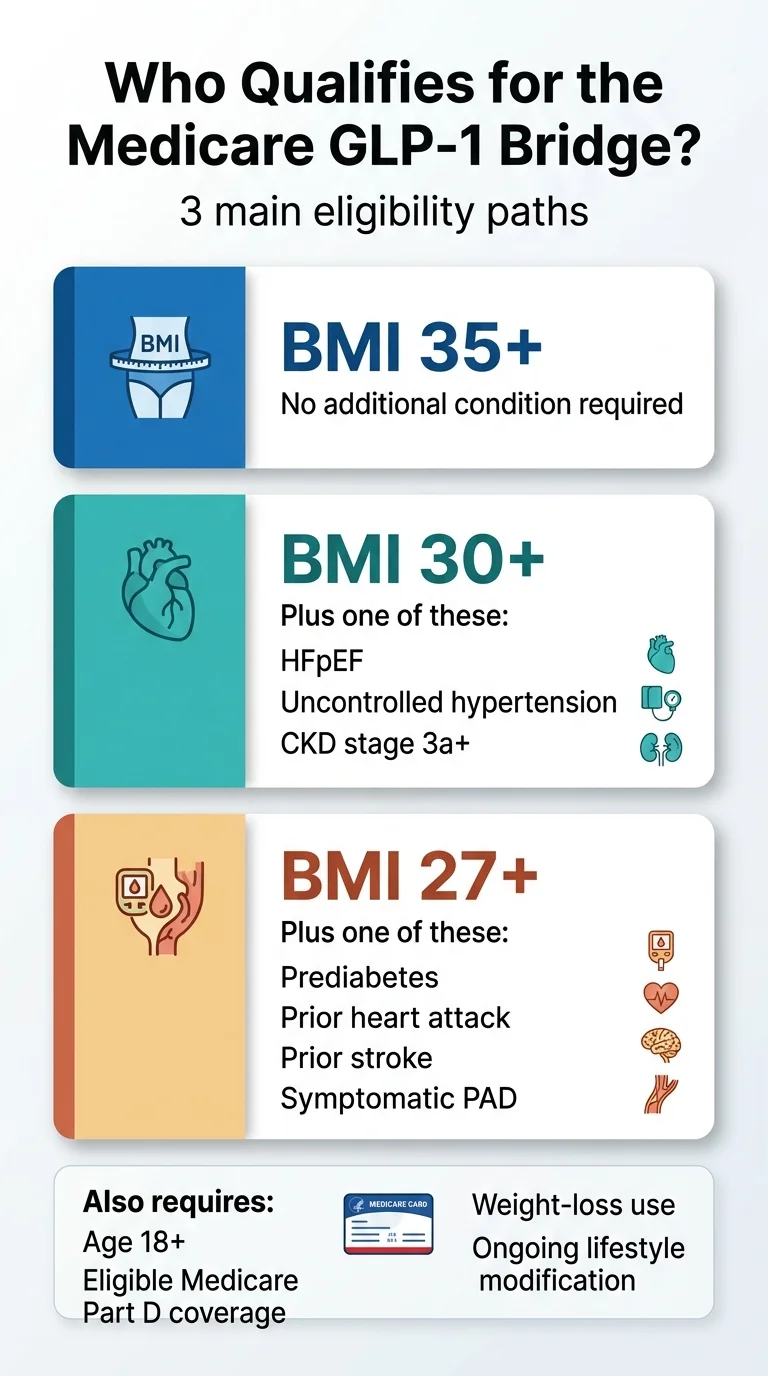
Clinical Path 1: BMI of 35 or Higher
This is the simplest path. If your Body Mass Index is 35 or above at the time you initiate GLP-1 therapy, you meet this clinical threshold — no additional diagnosis is required. All other eligibility rules and prior-authorization approval still apply.
For reference: a person who is 5'6“ and weighs 217 pounds has a BMI of approximately 35. A person who is 5'10“ and weighs 244 pounds has a BMI of approximately 35.
Clinical Path 2: BMI of 30–34.99 Plus at Least One Qualifying Condition
If your BMI is 30 or above at the time of GLP-1 initiation, you may qualify with one or more of the following:
- Heart failure with preserved ejection fraction (HFpEF)
- Uncontrolled hypertension — defined as systolic BP above 140 mm Hg or diastolic above 90 mm Hg while on two or more antihypertensive medications
- Chronic kidney disease (CKD) stage 3a or above
- Prediabetes (per ADA guidelines)
- Previous myocardial infarction (heart attack)
- Previous stroke
- Symptomatic peripheral artery disease
Clinical Path 3: BMI of 27–29.99 Plus at Least One Qualifying Condition
If your BMI is 27 or above at the time of GLP-1 initiation, you may qualify with one or more of the following:
- Prediabetes (per ADA guidelines)
- Previous myocardial infarction (heart attack)
- Previous stroke
- Symptomatic peripheral artery disease
Quick BMI Reference
| Height | BMI 27 (Path 3) | BMI 30 (Path 2) | BMI 35 (Path 1) |
|---|---|---|---|
| 5'2" | ~148 lbs | ~164 lbs | ~191 lbs |
| 5'4" | ~157 lbs | ~174 lbs | ~204 lbs |
| 5'6" | ~167 lbs | ~186 lbs | ~217 lbs |
| 5'8" | ~177 lbs | ~197 lbs | ~230 lbs |
| 5'10" | ~188 lbs | ~209 lbs | ~244 lbs |
| 6'0" | ~199 lbs | ~221 lbs | ~258 lbs |
BMI is measured at the time of initiating GLP-1 therapy, not at your all-time highest weight. Meeting a BMI threshold does not by itself establish eligibility — the hard exclusions and all other requirements still apply.
What GLP-1 Medications Are Covered Under the Bridge?
This is simpler than you might expect — and also more limited.
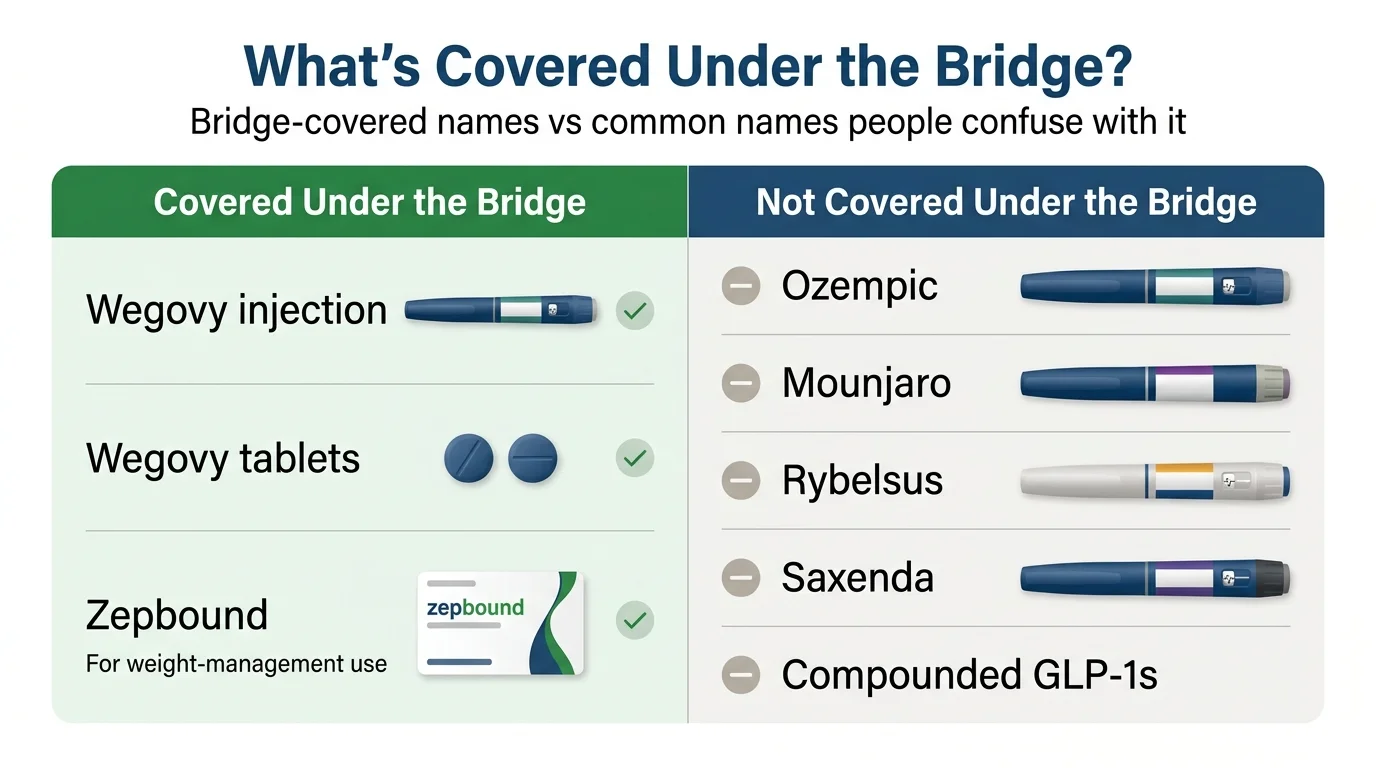
Covered Under the Bridge
| Medication | Active Ingredient | Form |
|---|---|---|
| Wegovy ✓ | Semaglutide | Injection |
| Wegovy ✓ | Semaglutide | Oral tablet |
| Zepbound KwikPen ✓ | Tirzepatide | KwikPen injection (not vials or single-dose pens) |
| Foundayo ✓ | Orforglipron | Oral tablet |
Three brands, four covered product forms — all FDA-approved specifically for weight management. Zepbound coverage is limited to the KwikPen device only. Vials and single-dose pens are not covered under the Bridge.
NOT Covered Under the Bridge
| Medication | Why Not? |
|---|---|
| ✗ Ozempic (semaglutide) | FDA-approved for type 2 diabetes, not weight management |
| ✗ Mounjaro (tirzepatide) | FDA-approved for type 2 diabetes, not weight management |
| ✗ Rybelsus (oral semaglutide) | FDA-approved for type 2 diabetes, not weight management |
| ✗ Saxenda (liraglutide) | Not included in Bridge-eligible products |
| ✗ Zepbound vials and single-dose pens | Only the KwikPen form is covered under the Bridge |
| ✗ Compounded semaglutide or tirzepatide | Not FDA-approved products |
The Ozempic Question
We know this comes up constantly: “Ozempic and Wegovy are the same active ingredient — can I get Ozempic through the Bridge?” No. Despite containing the same active ingredient (semaglutide), Ozempic and Wegovy are different FDA-approved products with different approved indications. Ozempic is approved for type 2 diabetes. Wegovy is approved for weight management. The Bridge only covers medications prescribed for weight management, and only covers the specific products listed above.
The Indication Matters More Than the Drug Name
The same medication can be covered through different pathways depending on why it's prescribed.
- Wegovy for weight management → Medicare GLP-1 Bridge (July 2026–December 2027), subject to all eligibility requirements
- Wegovy for cardiovascular risk reduction in adults with established CV disease → regular Medicare Part D (if your plan covers it)
- Zepbound KwikPen for weight management → Medicare GLP-1 Bridge (KwikPen only), subject to all eligibility requirements
- Zepbound for obstructive sleep apnea in adults with obesity → regular Medicare Part D (if your plan covers it)
- Foundayo for weight management → Medicare GLP-1 Bridge (July 2026–December 2027), subject to all eligibility requirements
How Much Does the Medicare GLP-1 Bridge Really Cost?
The headline number is $50 per month. Eligible beneficiaries pay a flat $50 copay at the pharmacy, regardless of the medication or dose — no tiered pricing, no coinsurance percentage, no deductible to meet first. This applies to each 28- or 30-day fill.
But the financial picture is more nuanced than one number.
What the $50 does
- Gives you a 28- or 30-day supply of the covered medication
- Is the same flat amount regardless of which phase of Part D coverage you're in
- Applies equally whether you're getting the lowest or highest dose
What the $50 does NOT do
- Does not count toward your Part D deductible. Bridge payments exist in a separate financial track from your regular drug costs.
- Does not count toward your $2,100 annual Part D out-of-pocket spending cap (TrOOP). If you rely on reaching that cap for catastrophic coverage on other expensive medications, Bridge payments will not help you get there.
- Low-Income Subsidy (Extra Help) does not apply. Even if you currently pay $0 for your other Part D medications, you'll still owe the full $50 per month under the Bridge. Over 18 months, that is $900.
How to Get the Medicare GLP-1 Bridge: Step by Step
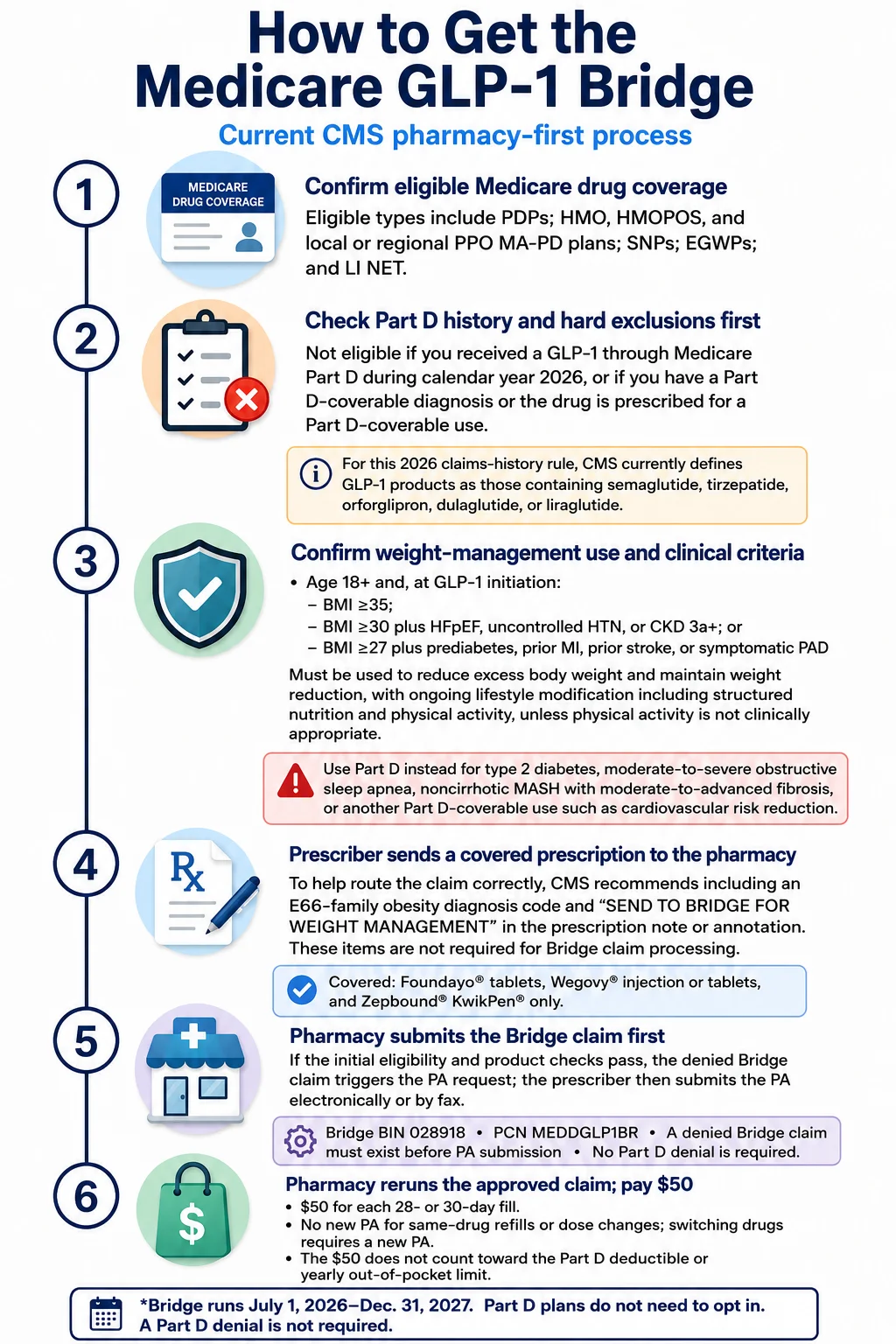
The Bridge uses a pharmacy-first process that is different from a normal Part D prior authorization. Your insurance company is not involved. Understanding the correct sequence puts you ahead of most beneficiaries.
Confirm Your Medicare Drug Coverage Type
Check whether your 2026 plan qualifies. Eligible types: Standalone PDP, HMO, HMOPOS, local or regional PPO MA-PD plans, SNPs, EGWPs, LI NET. Not eligible: PACE, private fee-for-service (unless also in a standalone PDP), Section 1876 cost contracts, Section 1833 health care prepayment plans, fallback plans, religious fraternal benefit plans. If you are unsure what type of plan you have, call 1-800-MEDICARE (1-800-633-4227) or check your plan documents at Medicare.gov.
Check Your Part D History and Hard Exclusions First
You are not eligible for the Bridge if any of these apply:
- A GLP-1 was paid for through your Medicare Part D coverage during calendar year 2026.
- You have type 2 diabetes, moderate-to-severe obstructive sleep apnea, or noncirrhotic MASH with moderate-to-advanced liver fibrosis.
- The requested GLP-1 is prescribed for a use coverable under Part D, such as Wegovy for cardiovascular risk reduction.
CMS defines GLP-1 products for the CY2026 claims-history rule as those containing semaglutide, tirzepatide, orforglipron, dulaglutide, or liraglutide.
Confirm Weight-Management Use and Clinical Criteria
- Age 18 or older at the time of GLP-1 initiation.
- BMI of 35 or more (no additional condition required); or BMI 30–34.99 plus HFpEF, uncontrolled hypertension, CKD stage 3a+, prediabetes, prior MI, prior stroke, or symptomatic PAD; or BMI 27–29.99 plus prediabetes, prior MI, prior stroke, or symptomatic PAD.
- Medication prescribed for weight management with ongoing lifestyle modification including structured nutrition and physical activity (unless physical activity is not clinically appropriate).
- Documentation of qualifying conditions for your prescriber to include in the prior authorization.
Prescriber Sends the Covered Prescription to the Pharmacy
Your prescriber sends the prescription directly to the pharmacy. CMS recommends including an E66-family obesity diagnosis code and the annotation “SEND TO BRIDGE FOR WEIGHT MANAGEMENT” in the prescription note to help the pharmacy route the claim correctly. These items are recommended but are not required for Bridge claim processing. Covered products: Foundayo tablets, Wegovy injection or tablets, and Zepbound KwikPen only.
Pharmacy Submits the Bridge Claim First
The pharmacy submits the Bridge claim using BIN: 028918 and PCN: MEDDGLP1BR. If the initial eligibility and product checks pass, the claim will be denied at this stage — that denial triggers the prior authorization request. The prescriber then submits the PA electronically or by fax to the Bridge processor.
Important: a denied Bridge pharmacy claim must exist before PA submission. A Part D denial is NOT required.
Pharmacy Reruns the Approved Claim — You Pay $50
- Once the PA is approved, the pharmacy reruns the claim and you pay $50 for each 28- or 30-day fill.
- No new PA is required for same-drug refills or dose changes. Switching to a different covered drug requires a new PA.
- The $50 does not count toward your Part D deductible or your annual out-of-pocket limit.
- The Bridge runs through December 31, 2027 — no plan switch required to maintain access through that date.
What Comes After December 2027? Planning for Long-Term Coverage
The Bridge runs through December 31, 2027. CMS extended it after confirming the BALANCE Model's participation threshold for Medicare Part D was not met. You have 18 months of coverage through the Bridge — no plan switch needed during that window.
After December 2027, your continued access will depend on whether CMS launches a follow-on coverage mechanism for Medicare — including whether BALANCE launches for Medicare Part D in 2028 or beyond, or whether CMS pursues other options. Watch for announcements during the fall 2027 Annual Enrollment Period.
The BALANCE Model: What We Currently Know
Why Staying on a GLP-1 Matters Medically
In the STEP 1 extension study, participants who stopped semaglutide regained about two-thirds of prior weight loss within one year. GLP-1 medications work while you're taking them; the benefits do not persist once you stop. Staying on through the full 18-month Bridge and having a plan for post-2027 coverage is the right approach medically.
Your 18-Month Bridge Timeline
July 2026
Start the Bridge program. Begin treatment, manage side effects, and settle into your dose.
Fall 2026
No plan switch needed for 2027. Your Bridge coverage continues regardless of BALANCE.
Throughout 2027
Continue Bridge coverage through December 31, 2027. Monitor CMS announcements about post-2027 Medicare GLP-1 coverage.
Fall 2027 (Open Enrollment)
Check what Part D options are available for 2028 in case BALANCE or another mechanism launches.
January 2028 and beyond
Transition to whatever CMS announces for 2028, or activate a backup plan. Watch for official guidance.
The beneficiaries who maintain their progress will be the ones who plan ahead — not the ones who scramble in December.
Medicare GLP-1 Bridge vs. Standard Part D
One of the biggest sources of confusion is the relationship between the Bridge and regular Part D. They are not the same thing, and the wrong path could cost you time, money, or access to coverage you already have.
| Feature | Standard Part D (Today) | GLP-1 Bridge (2026–2027) |
|---|---|---|
| When | Available now | July 1, 2026–Dec. 31, 2027 |
| Covers weight-management GLP-1s? | ❌ No (prohibited by law) | ✅ Yes (Wegovy, Zepbound KwikPen, Foundayo) — subject to all eligibility requirements |
| Covers diabetes/CV/OSA GLP-1s? | ✅ Yes (if on formulary) | ❌ No — use Part D instead |
| Who processes claims? | Your Part D plan | CMS central processor (Humana as processor) |
| Plan must opt in? | N/A | ❌ No |
| Monthly copay | Varies by plan/tier | $50 flat per 28- or 30-day fill |
| Counts toward Part D OOP cap? | ✅ Yes | ❌ No |
| Extra Help/LIS applies? | ✅ Yes | ❌ No |
| Prior authorization? | Through your Part D plan | Pharmacy-first: pharmacy submits claim, denied claim triggers PA to central processor |
| Duration | Ongoing | 18 months (July 2026–Dec. 2027) |
Note: BALANCE did not launch for Medicare Part D in 2027. Any future BALANCE timeline for Medicare Part D has not been confirmed by CMS.
Which Lane Are You In?
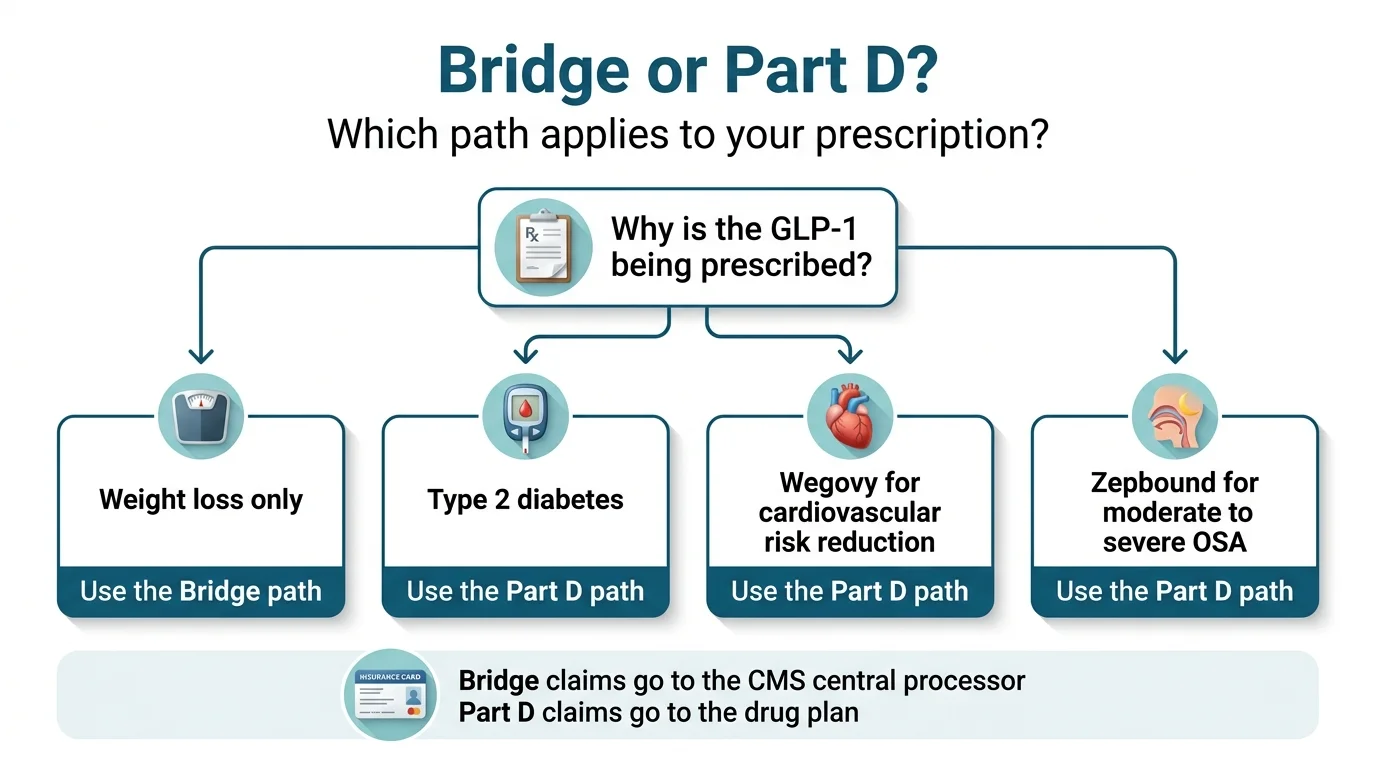
- Weight management only, no hard exclusions: The Bridge (July 2026–Dec. 2027) is the pathway to explore. Complete the eligibility check with your prescriber.
- Type 2 diabetes: Your regular Part D plan may already cover Ozempic, Mounjaro, or Rybelsus. Check your plan's formulary. You are not eligible for the Bridge.
- Cardiovascular disease and overweight or obese: Wegovy is FDA-approved for cardiovascular risk reduction. Your Part D plan may cover it for this indication — and Part D payments count toward your out-of-pocket cap and Extra Help applies, making it potentially a better financial deal than the Bridge.
- Obstructive sleep apnea and obesity: Zepbound is FDA-approved for moderate to severe OSA. Part D coverage for the sleep apnea indication may be a better financial deal. You are not eligible for the Bridge if OSA is the prescribed use.
Biggest Misunderstandings About the $50 Medicare GLP-1 Program
These are the most common misunderstandings — each one can lead to wasted time, wrong decisions, or missed coverage you already have.
"My Part D plan has to opt in for me to use the Bridge."
Wrong. The Bridge operates entirely outside of Part D. CMS runs the whole thing through a central processor. Your Part D plan doesn't need to opt in, doesn't process Bridge claims, and doesn't bear any financial risk. You just need to be enrolled in an eligible Part D plan type.
"The Bridge is the same thing as the BALANCE Model."
Wrong. The Bridge is an 18-month Section 402 demonstration (July 2026–December 2027) that CMS runs directly through a central processor. BALANCE is a separate longer-term model that requires Part D plans to voluntarily participate — and CMS confirmed BALANCE will not launch for Medicare Part D in 2027. They are separate programs with separate rules.
"The Bridge covers all GLP-1 medications."
Wrong. Only Wegovy (injection and oral tablet), Zepbound KwikPen, and Foundayo are covered. Ozempic, Mounjaro, Rybelsus, Saxenda, Zepbound vials and single-dose pens, and compounded formulations are not covered.
"The $50 copay will count toward my Part D spending cap."
Wrong. Because the Bridge runs outside of Part D, the $50 does not count toward your Part D deductible, gross covered prescription drug costs, or true out-of-pocket costs (TrOOP). It's financially separate.
"Extra Help will reduce my Bridge copay."
Wrong. The Low-Income Subsidy (Extra Help) does not apply to Bridge prescriptions. Even if you pay $0 for most medications, you'll pay the full $50 under the Bridge.
"If my doctor already prescribes me Zepbound for sleep apnea, I can switch it to the Bridge and save money."
Not how it works. CMS has explicitly stated that if a GLP-1 is prescribed for a use that’s coverable under the Part D benefit — regardless of whether your plan actually covers it — you cannot use the Bridge for that drug. CMS says they will monitor plans to prevent coverage shifting.
"This is permanent Medicare GLP-1 coverage."
The Bridge runs through December 31, 2027. CMS extended it after confirming the BALANCE Model's participation threshold for Medicare Part D was not met. Your coverage continues through the Bridge through end of 2027 — no plan switch required. What comes after December 2027 has not been confirmed by CMS.
What Medicare Already Covers Without the Bridge
Before you pursue the Bridge, it's worth checking whether you already have a GLP-1 coverage pathway you might not know about. Many Medicare beneficiaries do — and the regular Part D pathway can actually be better than the Bridge because it counts toward your out-of-pocket cap and Extra Help applies.
GLP-1s for Type 2 Diabetes
If you have type 2 diabetes, your Part D plan may cover Ozempic (semaglutide injection), Mounjaro (tirzepatide injection), or Rybelsus (oral semaglutide). Coverage depends on your plan's formulary and may require prior authorization or step therapy — but the coverage exists and has existed for years.
Wegovy for Cardiovascular Risk Reduction
Wegovy is FDA-approved to reduce the risk of major adverse cardiovascular events in adults with established cardiovascular disease who are also overweight or obese. If you meet that description, your Part D plan may cover Wegovy for the cardiovascular indication. This has nothing to do with the Bridge, and if you qualify for this Part D pathway, you are not eligible for the Bridge for that prescription.
Zepbound for Obstructive Sleep Apnea
Zepbound has FDA approval for treating moderate to severe obstructive sleep apnea in adults with obesity. If you have OSA, your Part D plan may cover Zepbound for that indication. See our full guide on Medicare coverage for Zepbound.
What Beneficiaries Are Actually Asking Right Now
We monitor forums, Medicare communities, and reader questions to understand what real beneficiaries are confused about. Here are the themes that keep coming up.
"I'm confused about what 'meet the criteria' and 'eligible beneficiaries' actually means."
This comes up in nearly every Medicare forum thread about the Bridge. It means checking the hard exclusions first (Part D GLP-1 history in 2026, T2D, OSA, MASH, Part D-coverable use) and then confirming you meet one of the three BMI and diagnosis pathways. Your doctor attests to the criteria in the prior authorization — but the exclusions are checked before BMI.
"Can I get a GLP-1 covered for prediabetes through the Bridge?"
Yes, if you have a BMI of 27 or higher, no hard exclusions apply, and you meet all other requirements. Prediabetes qualifies under both the BMI 27–29.99 and the BMI 30–34.99 clinical pathways.
"I'm already paying over $1,000/month out of pocket for Wegovy. Can I switch to $50 through the Bridge?"
Possibly — but only if Part D did not pay for your GLP-1 during calendar year 2026. If you were paying 100% out of pocket (no Part D payment), that alone does not automatically disqualify you. Work with your prescriber to confirm all eligibility criteria and submit the Bridge PA through the pharmacy-first process. Approval is not guaranteed.
"My doctor prescribed Zepbound for sleep apnea. Can I use the Bridge instead since it's cheaper?"
No. If Zepbound is prescribed for sleep apnea — which is a Part D-coverable indication — CMS says you cannot use the Bridge for that drug. You would need to continue through your Part D plan.
What If You Don't Qualify for the Medicare GLP-1 Bridge?
Not everyone will qualify — and that's the reality we need to address honestly. Maybe your BMI doesn't meet the thresholds. Maybe you're in a plan type that's excluded. Maybe a hard exclusion applies. Whatever the reason, you are not out of options.
Option 1: Check Whether Regular Part D Already Covers Your GLP-1
If you have type 2 diabetes, cardiovascular disease, or obstructive sleep apnea, your Part D plan may already cover a GLP-1 for that condition. This is the first thing to check because it costs you nothing to investigate and uses the coverage you're already paying for. Call the number on the back of your Part D card and ask: “Does my plan cover [Ozempic / Wegovy / Zepbound] for [your condition]? What's the prior authorization process?”
Option 2: FDA-Approved GLP-1 Through a Telehealth Provider
If regular Part D doesn't apply and the Bridge doesn't either, you can still access FDA-approved Wegovy and Zepbound through telehealth medical programs — on a cash-pay basis, without waiting for any government program.
Ro is the most comprehensive option we've evaluated for this. Their Body program pairs you with a licensed physician who evaluates your health, prescribes FDA-approved GLP-1 medication if appropriate, and provides ongoing clinical support including dose management and side-effect guidance. The membership starts at $39 for the first month and $149/month after that, with medication billed separately. Cash-pay medication options start at $149/month for lower doses.
FDA-Approved Wegovy & Zepbound — Cash-Pay Path
See if you qualify for FDA-approved GLP-1 treatment through Ro
Licensed physicians, FDA-approved medication, no long-term commitment. Month-to-month cash-pay path only; Ro cannot coordinate GLP-1 coverage for government insurance plans.
Check eligibility on Ro \u2192 (sponsored affiliate link, opens in a new tab)Self-pay path only. Ro cannot coordinate GLP-1 coverage for government insurance plans.
Option 3: Compounded GLP-1 Programs
For beneficiaries on tighter budgets where brand-name medication pricing isn't feasible, compounded GLP-1 programs offer a lower entry point.
We want to be clear about what this means: compounded GLP-1 products are not FDA-approved finished drugs. The FDA does not review them for safety, effectiveness, or quality before they are marketed, and the agency has raised concerns about dosing inconsistencies and misleading promotional claims in this category. This is not the same as saying they are dangerous — but you should understand the distinction before deciding.
MEDVi is the strongest option we've evaluated in this category. They offer compounded semaglutide and tirzepatide starting at $179 per month with no membership fees, no contracts, and month-to-month billing. Treatment is overseen by licensed physicians, and medications ship from licensed U.S. compounding pharmacies.
Most Affordable GLP-1 Option
See current MEDVi pricing — compounded GLP-1 from $179/mo
Licensed physicians, U.S. compounding pharmacies, no membership fees, no contracts. Compounded semaglutide and tirzepatide. Not FDA-approved finished drugs — understand the distinction before deciding.
See MEDVi pricing → (sponsored affiliate link, opens in a new tab)Option 4: TrumpRx Self-Pay Pricing
TrumpRx.gov is a government-backed platform offering reduced self-pay prices on brand-name GLP-1 medications. Check TrumpRx.gov directly for current figures, as they update periodically. Note that patients covered by government insurance programs like Medicare and Medicaid may face eligibility restrictions on certain discount programs offered through the platform.
Choosing Your Path
| Your Situation | Best Next Step |
|---|---|
| You have a Part D-coverable condition (diabetes, CV disease, OSA) | Call your Part D plan — regular coverage may be your best deal |
| You want FDA-approved medication and can invest in clinical support | Check eligibility on Ro (cash-pay path) |
| You need the most affordable starting point possible | See pricing on MEDVi |
| You want FDA-approved medication while working through Bridge eligibility | Compare cash-pay alternatives; note that switching to Bridge coverage requires completing the pharmacy-first PA process |
Cash-Pay and Regular Part D Backup Paths
The Bridge is open, but it still will not fit everyone. If you have a Part D-coverable condition (diabetes, cardiovascular disease, sleep apnea), your regular Part D plan may already be the better path. And if neither fits, FDA-approved GLP-1 treatment is available on a cash-pay basis.
Some people begin on a cash-pay telehealth program while working through Bridge eligibility. If the Bridge PA is later approved, you would transition to Bridge coverage — but note that the pharmacy-first PA process must still be completed, and a new PA would be required since you are switching to a different payment pathway.
About GLP-1 Dose Titration
GLP-1 medications use a dose titration schedule. Wegovy begins at 0.25 mg weekly and gradually increases over roughly 16–20 weeks to the maintenance dose of 2.4 mg. Zepbound starts at 2.5 mg and titrates up to 15 mg over a similar period. During early weeks, side effects like nausea, constipation, or decreased appetite are most common and typically diminish as the body adjusts.
A General Cash-Pay Timeline
Today or this week
Complete a telehealth evaluation through a provider like Ro (FDA-approved) or MEDVi (compounded).
Weeks 1–4
Begin at the starting dose. Manage any initial side effects with your provider's guidance.
Ongoing
Continue titration per your prescriber's schedule. Individual responses vary.
While treating
Talk to your prescriber about whether Bridge eligibility applies to your situation and what the pharmacy-first PA process involves.
If Bridge PA is approved
Work with your pharmacy to transition to the Bridge payment pathway. A new PA is required through the pharmacy-first process.
Weighing Your Options
Cash-pay costs more per month than the Bridge. Some people find that starting treatment while they sort out coverage makes sense given the health benefits of GLP-1 therapy, while others prefer to resolve coverage first. Discuss your situation with your prescriber and consider your budget and timeline.
Cash-Pay Option — Not the Medicare Bridge
Start a free GLP-1 medical evaluation on Ro
FDA-approved Wegovy and Zepbound with licensed physicians, ongoing clinical support, and home delivery. Month-to-month cash-pay path only.
Start free GLP-1 evaluation on Ro \u2192 (sponsored affiliate link, opens in a new tab)Self-pay path. Ro cannot coordinate GLP-1 coverage for government insurance plans.
What These Medications Actually Do
The Bridge launched July 1, 2026. The medications it covers — Wegovy, Zepbound, and Foundayo — have been studied extensively, and the clinical evidence for the established products is strong.
- In the pivotal STEP trials, patients taking semaglutide (the active ingredient in Wegovy) lost an average of approximately 15% of their body weight over 68 weeks when combined with diet and exercise, compared to about 2.4% with diet and exercise alone.
- In trials of tirzepatide (the active ingredient in Zepbound), patients lost an average of approximately 18–21% of body weight depending on the dose, compared to about 3% with placebo.
- The SELECT cardiovascular outcomes trial demonstrated that semaglutide reduced the risk of major adverse cardiovascular events by 20% in adults with established heart disease and overweight or obesity.
These aren't miracle drugs. They work best alongside real changes in nutrition and physical activity. Side effects — particularly gastrointestinal symptoms — are common, especially during dose titration, and not everyone responds the same way. But for people who have struggled with weight for years despite genuine effort, GLP-1 medications represent the most effective pharmacological tool currently available.
Frequently Asked Questions
Is the Medicare GLP-1 Bridge Program real?
Yes. It was announced by CMS on December 23, 2025, with detailed FAQs published March 3, 2026. It runs from July 1, 2026 through December 31, 2027 — an 18-month program.
When does the Medicare GLP-1 Bridge start?
July 1, 2026. The program was extended through December 31, 2027 — an 18-month window. Humana serves as the central processor for Bridge claims (BIN 028918 / PCN MEDDGLP1BR).
Does Medicare cover Ozempic through the Bridge?
No. Ozempic is FDA-approved for type 2 diabetes, not weight loss. The Bridge covers Wegovy (injection and oral tablets), Zepbound KwikPen (not vials or single-dose pens), and Foundayo (orforglipron). If you have diabetes, Ozempic may be covered through your regular Part D plan.
Does Medicare cover Mounjaro through the Bridge?
No. Mounjaro is approved for type 2 diabetes. Zepbound, which contains the same active ingredient (tirzepatide) but is approved for weight loss, is covered.
Does Medicare cover GLP-1 for prediabetes through the Bridge?
Yes — if you also have a BMI of 27 or higher and meet all other eligibility requirements, including not having received a GLP-1 through Part D during calendar year 2026. Prediabetes is a qualifying condition under both the BMI 27–29.99 and BMI 30–34.99 clinical pathways.
Does my Part D plan need to opt in for the Bridge?
No. The Bridge is administered by CMS through a central processor, entirely outside of Part D. Your plan does not need to opt in, and your plan is not directly involved in Bridge claims.
Does the $50 copay count toward my Part D out-of-pocket cap?
No. The Bridge operates outside Part D, so the $50 does not count toward your Part D deductible or your $2,100 annual out-of-pocket spending cap (TrOOP).
Can Extra Help reduce the $50 copay?
No. Low-Income Subsidy (Extra Help) cost-sharing does not apply to Bridge prescriptions. You'll pay the full $50 regardless of your LIS status.
Is the Wegovy pill (oral tablet) covered under the Bridge?
Yes. CMS has confirmed that Wegovy tablets are covered along with Wegovy injection and Zepbound KwikPen.
I already use Wegovy for heart disease risk reduction through Part D. Can I switch to the Bridge?
No. If your GLP-1 is prescribed for a use that's coverable under Part D — even if your specific plan doesn't cover it — you cannot use the Bridge for that drug. You must use the Part D pathway.
What if my doctor already prescribes me Zepbound for sleep apnea?
You'll continue through your Part D plan. The Bridge only covers prescriptions written specifically for weight loss. CMS has stated they will monitor to ensure plans don't shift coverage from Part D to the Bridge.
Can my doctor appeal a Bridge prior authorization denial?
CMS has published a prior authorization form and submission guidance for the Bridge. For questions about the appeal or redetermination process, contact the Bridge central processor through CMS's published contact information, or call 1-800-MEDICARE (1-800-633-4227) for assistance.
What happens if fewer than 80% of Part D plans join the BALANCE Model?
CMS confirmed the 80% participation threshold was not met, so BALANCE will not launch for Medicare Part D in 2027. In response, CMS extended the Bridge through December 31, 2027, so eligible beneficiaries will maintain access at $50/month through the Bridge rather than transitioning to BALANCE.
Can a telehealth provider help with the Medicare Bridge?
The Bridge uses a pharmacy-first process: the prescriber sends the prescription to the pharmacy, the pharmacy submits the Bridge claim to CMS's central processor, and the prescriber then completes the prior authorization after the pharmacy claim is processed. Any licensed medical provider who can prescribe Wegovy, Zepbound KwikPen, or Foundayo may participate. Contact your prescriber or telehealth provider to confirm they are familiar with the Bridge PA submission process.
I'm on Medicaid, not Medicare. Does this apply to me?
The Bridge is Medicare-only. Medicaid coverage for GLP-1 weight loss medications is being addressed separately through the BALANCE Model for participating states. Contact your state Medicaid office for current details.
Is this the same as Medicare drug price negotiation?
No. Medicare drug price negotiation (under the Inflation Reduction Act) is a separate program. Semaglutide was selected for negotiation in 2025, with negotiated prices taking effect in 2027. The Bridge is a CMS demonstration using different legal authority.
Our Sources and How We Keep This Updated
Every eligibility criterion, every cost figure, every program date on this page is verified against official CMS documentation. We don't rely on secondary reporting for core facts.
What we verified ourselves:
- The pharmacy-first process: prescription goes to pharmacy, pharmacy submits Bridge claim, denied claim triggers PA submission — a Part D denial is not required
- The hard exclusions: prior CY2026 Part D-paid GLP-1, T2D, moderate-to-severe OSA, noncirrhotic MASH, Part D-coverable prescribed use
- The three clinical pathways and qualifying conditions for each BMI band, including that prediabetes, prior MI, prior stroke, and PAD qualify under the BMI 30–34.99 pathway (not only BMI 27–29.99)
- That SNP, EGWP, and LI NET beneficiaries are eligible
- That Part D plans do not need to opt in
- The covered products: Wegovy (injection and oral tablet), Zepbound KwikPen only (not vials or single-dose pens), and Foundayo (orforglipron)
- The $50 copay structure and its exclusion from Part D TrOOP and deductible calculations
- The BIN (028918) and PCN (MEDDGLP1BR) for pharmacy claims processing
- The July 1, 2026–December 31, 2027 program dates
Primary sources:
- CMS Medicare GLP-1 Bridge FAQ page — last verified July 10, 2026
- CMS BALANCE Model overview
- CMS press release, December 23, 2025
- KFF analysis of the Bridge and BALANCE Model
- FDA compounding enforcement guidance
- STEP 1 extension study (semaglutide weight regain)
This page is updated whenever CMS releases new guidance about the Bridge. Key dates: July 1, 2026 (Bridge launch), December 31, 2027 (Bridge ends). Humana processes Bridge claims (BIN 028918 / PCN MEDDGLP1BR). See our corrections log for documented changes to this guide.
Still Not Sure Which GLP-1 Program Is Right for You?
The Medicare GLP-1 Bridge is a significant development — the first time in over 20 years that Medicare beneficiaries can access weight-management medications at an affordable price. But it's not the only path, and it's not the right fit for everyone.
Whether you qualify for the Bridge, need to use regular Part D for a covered indication, or need a telehealth option that starts today — the right program depends on your BMI, your health conditions, your Part D claims history, your budget, and your timeline.
Take our free 60-second quiz to check which Medicare GLP-1 pathway may apply
We'll ask you a few quick questions to help orient you toward the right coverage category. This is a general screening tool — final eligibility requires confirmation from your prescriber and the Bridge central processor.
Take the free GLP-1 path quiz →Related Guides
This guide is for informational purposes only and does not constitute medical advice. Always consult with your healthcare provider before starting any medication. The RX Index may receive compensation from providers mentioned on this page. This does not influence our coverage — we recommend based on program quality, pricing, and patient fit.
Last updated: July 10, 2026 · Verified against CMS.gov: July 10, 2026. Bridge launched July 1, 2026 and runs through December 31, 2027. BALANCE has not launched for Medicare Part D and its future timeline has not been confirmed by CMS.