
Sources verified against CMS.gov, FDA.gov, Medicare.gov, and Novo Nordisk prescribing information.
Does Medicare Cover Wegovy for Weight Loss? What Changed in 2026
Published: · Last updated:
If you have established heart disease, your Part D plan may already cover Wegovy today under a cardiovascular indication. The Medicare GLP-1 Bridge is available as of July 1, 2026 with a flat $50/month copay for eligible beneficiaries. And if neither Medicare path works, FDA-approved Wegovy is now available self-pay starting at $149/month — a price that didn't exist a year ago.
The rest of this guide walks through each path so you can figure out which one actually fits your situation. We built it because we were tired of seeing Medicare beneficiaries get a flat “no” and give up — when some of them actually have options they don't know about.
“After weeks of intermittent searching I have found NO useful information from any source.” — AARP community member discussing Medicare and semaglutide
That stops here.

Wegovy + Medicare at a Glance: Today vs. July 2026 vs. 2027
Before we get into the details, here's the entire coverage picture in one table. Every price was verified against CMS and Novo Nordisk sources this month.
| Your Situation | Covered? | Which Path? | What You Pay | What to Do |
|---|---|---|---|---|
| Weight loss only (today) | ❌ Usually not covered | Standard Part D exclusion | Cash-pay outside Medicare may be an option | See Path 3 below |
| Heart disease + overweight/obesity (today) | ✅ May be covered | Part D (CV risk indication) | Varies by plan; $2,100/yr OOP cap | Ask your doctor about the CV indication |
| GLP-1 Bridge (July 2026–Dec 2027) | ✅ Covered for weight loss | New CMS demonstration | $50/month flat | Ask your prescriber about Bridge eligibility and the current CMS prior-authorization process |
| BALANCE Model (not launching for Medicare Part D in 2027) | ⚠️ Future — date TBD | Participating Part D plans (voluntary, if CMS relaunches) | TBD — plan dependent | Watch for 2028 BALANCE announcements during fall 2027 open enrollment |
| Cash-pay / outside Medicare | N/A | Outside Medicare | Wegovy pill from $149/mo at some providers | Check eligibility through a provider |
Sources: CMS Medicare GLP-1 Bridge FAQ (March 2026), CMS BALANCE Model announcement (December 2025), FDA Wegovy prescribing information, Novo Nordisk pricing (January 2026).
Why You Keep Seeing Different Answers Online
If you've been searching “does Medicare cover Wegovy” for more than five minutes, you've probably noticed something maddening: every website seems to say something different. One says “no, never.” Another says “yes, starting in 2026.” A third says “only if you have heart disease.” They're all partially right and all incomplete — and here's why.
The coverage landscape shifted four separate times in 18 months:
- March 2024: The FDA expanded Wegovy's approved uses to include reducing the risk of major cardiovascular events in adults with established heart disease who are overweight or obese. This created a real Part D coverage pathway for the first time — but only for that specific group.
- November 2025: The Trump administration announced pricing deals with Novo Nordisk and Eli Lilly, and CMS unveiled the BALANCE Model. Suddenly, headlines read “Medicare to cover weight loss drugs.”
- December 2025–January 2026: The FDA approved the Wegovy pill (oral semaglutide), and Novo Nordisk slashed self-pay prices. The lowest dose of the pill launched at $149/month.
- March 2026: CMS released detailed FAQ documents for the Medicare GLP-1 Bridge, confirming eligibility criteria, the $50/month copay, and the July 1 start date.
So when one article says “no” and another says “yes, in 2026,” they're not contradicting each other. They're just snapshots from different moments in a fast-moving story. This page reflects everything through July 3, 2026 — and we update it when things change.
Path 1: Medicare May Cover Wegovy Right Now — If You Have Heart Disease
This is the path most people don't know about.
In March 2024, the FDA approved Wegovy for a second use: reducing the risk of serious cardiovascular events in adults with established cardiovascular disease who are overweight or obese. That approval was based on the landmark SELECT trial, which followed over 17,600 adults for more than three years and showed a 20% reduction in major adverse cardiovascular events.
Because this indication isn't “weight loss” — it's cardiovascular risk reduction — it doesn't trigger the federal exclusion. That means Medicare Part D can cover it.
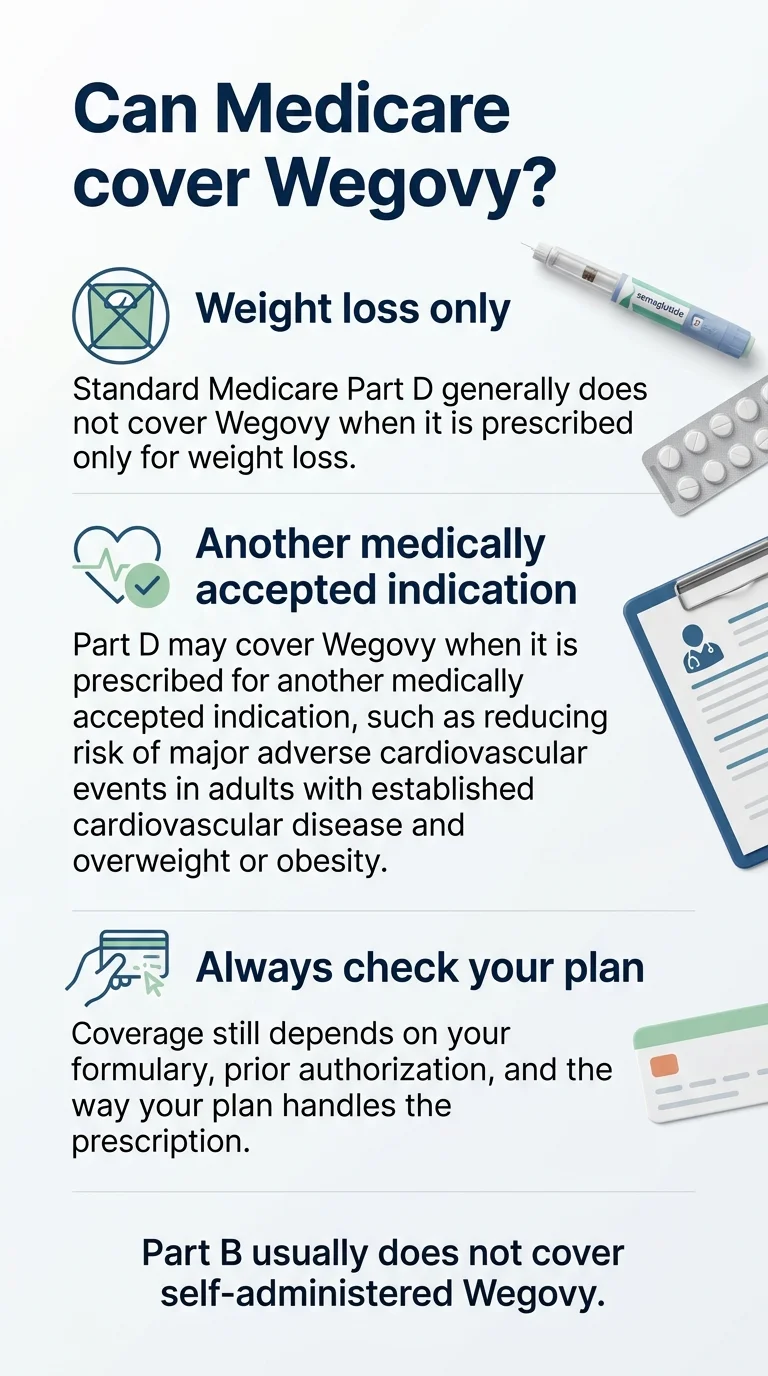
Who qualifies for the CV indication?
You may be eligible if you meet all of these:
- You have established cardiovascular disease — meaning a history of heart attack, stroke, or documented heart disease
- You are overweight or obese (BMI of 27 or higher)
- Your doctor prescribes Wegovy specifically to reduce cardiovascular risk, not for weight loss
- Wegovy is on your Part D plan's formulary, or you successfully request an exception
What will it cost under Part D?
| Phase | What You Pay | When It Kicks In |
|---|---|---|
| Deductible | Up to $615 out of pocket | You pay 100% of covered drug costs until the deductible is met |
| Initial coverage | Copay or coinsurance (varies by plan and tier) | After deductible, until you reach the OOP cap |
| Catastrophic | $0 | After $2,100 total out-of-pocket spending for the year |
The key number: $2,100. That's the maximum you'll spend out of pocket for all covered Part D drugs in 2026. Once you hit it, Medicare pays 100% for the rest of the year. And with the Medicare Prescription Payment Plan (MPPP), you can spread those costs into predictable monthly installments.
How to get started on Path 1
- Talk to your doctor about whether you qualify based on your cardiovascular history
- Ask your doctor to prescribe Wegovy specifically for cardiovascular risk reduction (not for weight loss)
- Check your plan's formulary at Medicare.gov Plan Compare — search for “Wegovy” or “semaglutide”
- Expect prior authorization — your doctor will need to submit documentation of your cardiovascular disease and BMI
- If Wegovy isn't on your formulary, request a non-formulary medical exception through your plan
- If denied, appeal — you have five levels of appeal, starting with a Redetermination within 120 days
This path won't apply to everyone. Most people searching this question want Wegovy for weight loss, not heart disease. And that's exactly who the next path was built for.
Path 2: The Medicare GLP-1 Bridge — $50/Month Starting July 1, 2026
This is the big one.
This is real, it's confirmed by CMS, and it has published eligibility criteria. It is not a rumor and it is not “pending legislation.” CMS released detailed FAQ documents in March 2026 outlining exactly how it works. But it does have limits — and you need to understand them before you plan around it.
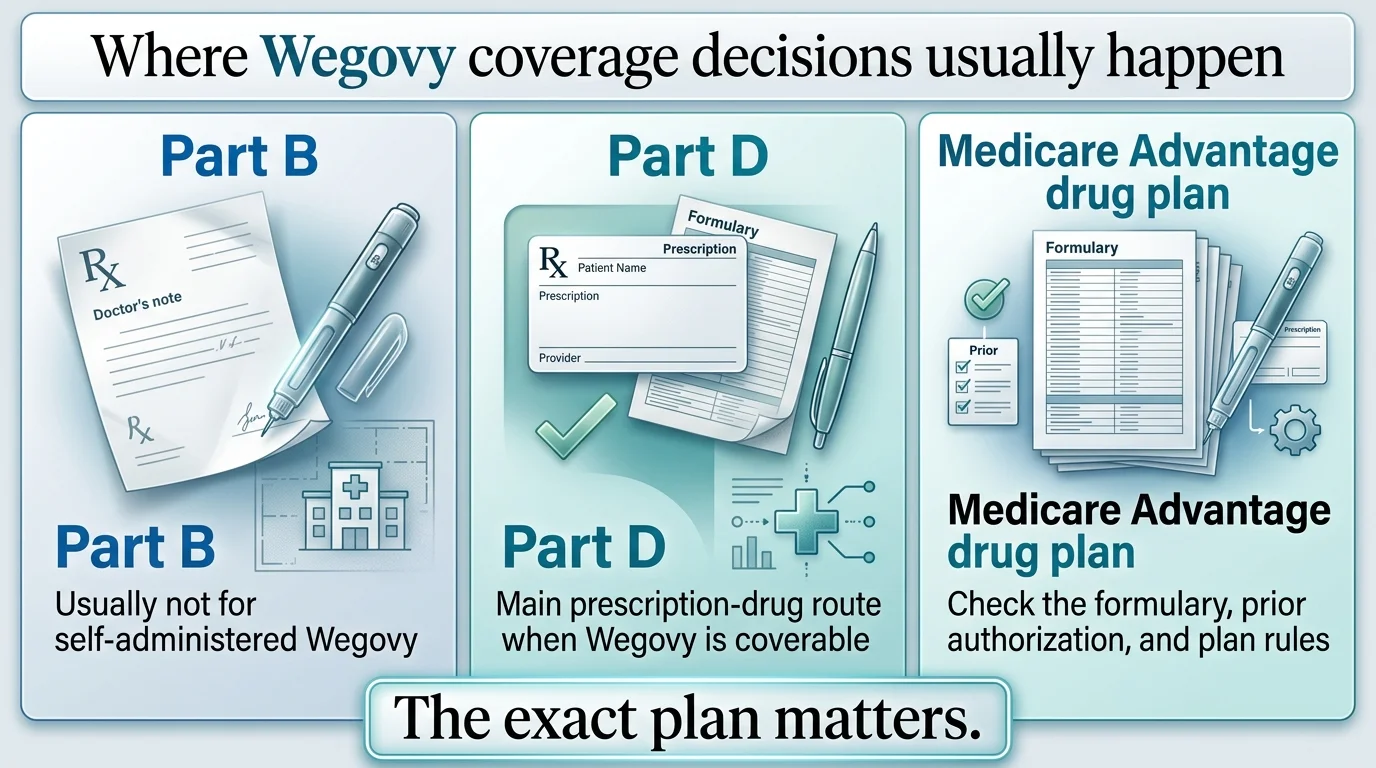
Who qualifies for the GLP-1 Bridge?
To qualify, your doctor must submit a prior authorization attesting that you meet all of these:
1. You must be enrolled in a qualifying Part D plan for 2026 — either a standalone Prescription Drug Plan (PDP) or a Medicare Advantage plan with drug coverage (MA-PD). Special Needs Plans (SNPs) and employer group waiver plans (EGWPs) with Part D are also eligible. Private Fee-For-Service (PFFS) and PACE plans are not eligible unless you're also enrolled in a standalone PDP.
2. The prescription must be for weight reduction — specifically, “to reduce excess body weight and maintain weight reduction in combination with current and ongoing lifestyle modification including structured nutrition and physical activity.”
3. You must meet one of these clinical criteria:
| BMI Threshold | Additional Conditions Required |
|---|---|
| BMI ≥ 35 | None — BMI alone qualifies |
| BMI ≥ 30 | Plus at least one: heart failure with preserved ejection fraction (HFpEF), uncontrolled hypertension (BP above 140/90 on two medications), OR chronic kidney disease stage 3a or higher |
| BMI ≥ 27 | Plus at least one: prediabetes (per ADA guidelines), prior heart attack, prior stroke, OR symptomatic peripheral artery disease |
4. The covered drugs are Wegovy (injection and tablets) and Zepbound. That's it — no other GLP-1s are eligible under the Bridge.
What the GLP-1 Bridge is NOT
This is where people get tripped up, so let's be direct:
- The $50 copay does NOT count toward your Part D deductible. The Bridge operates completely outside your regular Part D benefit.
- It does NOT count toward your $2,100 out-of-pocket cap. You'll pay the $50 on top of whatever else you're spending on medications.
- Extra Help / Low-Income Subsidy does NOT apply. Even if you normally pay little to nothing for your medications, you'll owe the full $50 monthly under the Bridge.
- It runs 18 months. The Bridge runs July 1, 2026 through December 31, 2027. BALANCE will not launch for Medicare Part D in 2027 — CMS extended the Bridge instead. Plan your coverage strategy for after December 2027.
- If your Wegovy prescription is already coverable under standard Part D — such as for cardiovascular risk reduction — you would not qualify for that same drug under the Bridge.
The honest trade-off
$50/month for a drug that lists at $1,350 is an extraordinary deal. But $300 over six months — with no contribution to your Part D OOP cap, no Extra Help discount, and no guarantee of continued coverage in 2027 — is still real money for people living on Social Security.
The transition to 2027 is genuinely uncertain. The BALANCE Model is voluntary for Part D plans. According to a Kaiser Family Foundation analysis, CMS has indicated that if Part D sponsor participation falls below an 80% threshold, it may not launch the model in Medicare for 2027. If your current plan doesn't opt in, you'd need to switch plans during open enrollment — which could affect your costs for other medications too.
That said: for most people who qualify, the Bridge is still the best path to affordable Wegovy through Medicare. A $50 monthly copay is a fraction of what you'd pay self-pay, and six months of treatment can produce meaningful, life-changing weight loss.
How to prepare for the GLP-1 Bridge right now
The Bridge doesn't start until July, but the smart move is to start preparing today:
- Confirm you're enrolled in a qualifying Part D plan for 2026 (standalone PDP or MA-PD)
- Know your BMI — ask your doctor for your most recent measurement, or request one at your next visit
- Identify which qualifying condition you have, if any (check the table above)
- Talk to your doctor about whether GLP-1 treatment is clinically appropriate for you
- Watch CMS.gov this spring for detailed prior authorization instructions — CMS has promised additional guidance
- Consider starting treatment now with self-pay and transitioning to the Bridge in July. Your medical history and established treatment will already be in place.
How to Check If Your Specific Plan Covers Wegovy: 5 Steps
Before exploring options outside Medicare, check what your own plan actually covers. “Medicare” isn't one monolithic plan — it's thousands of Part D and Medicare Advantage plans, each with its own formulary and rules. Here's exactly how to check yours.
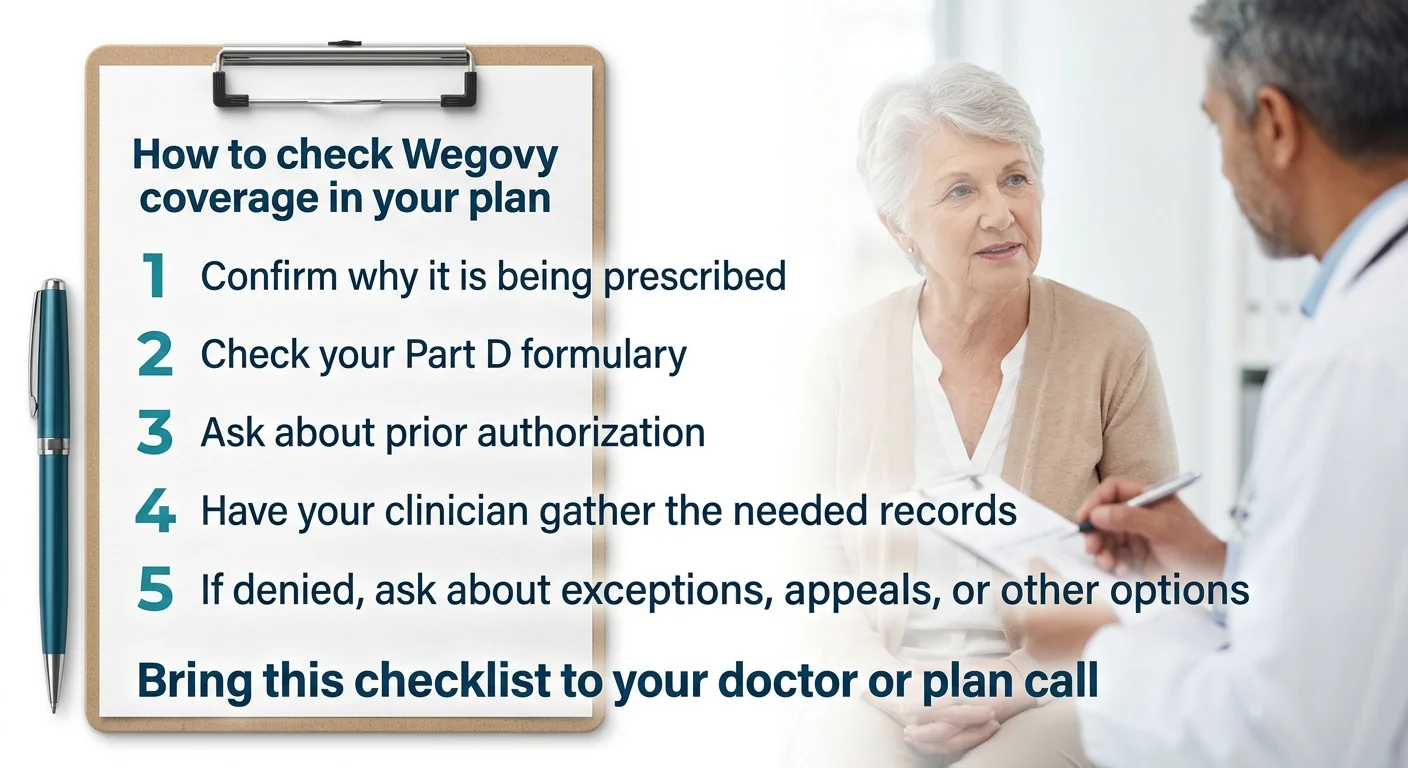
- Identify the reason for the prescription. This is the single most important thing. Coverage depends entirely on why Wegovy is being prescribed. Cardiovascular risk reduction? Weight loss? The clinical indication determines everything.
- Look up your plan's formulary. Go to Medicare.gov Plan Compare, enter your ZIP code, find your plan, and search for “Wegovy” or “semaglutide.” The tool will show whether it's covered, which tier it's on, and whether there are restrictions.
- Ask about prior authorization. Almost every plan that covers Wegovy will require prior authorization. This means your doctor must submit paperwork documenting your diagnosis, BMI, and other qualifying criteria before the plan will pay.
- Determine which pathway applies to you. Cardiovascular risk reduction → standard Part D. Weight loss → GLP-1 Bridge (available as of July 1, 2026). Neither → check whether a formulary exception might apply. These are different claims with different cost structures.
- If denied, know your options. You can appeal a Part D coverage denial through five levels, starting with a Redetermination. You can also request a formulary exception for off-formulary drugs, or a tiering exception to get a lower cost.
What to Ask Your Doctor (Print This and Bring It)
We've seen too many people walk into their doctor's office with a vague “can I get Wegovy?” and walk out with a vague answer. Here's a script that gets you a real one.
- “What diagnosis would you use for this prescription — cardiovascular risk reduction, weight management, or something else?”
- “Based on my health history, would I potentially qualify under the Part D cardiovascular indication, the GLP-1 Bridge starting in July, or both?”
- “What prior authorization documentation do you need from my chart — BMI records, cardiovascular history, lab work?”
- “If my plan denies coverage, would you support an appeal? What additional documentation would strengthen it?”
- “If Medicare won't cover this for me right now, what's the safest FDA-approved self-pay option you'd recommend?”
- “Can you make sure the prescription documentation reflects the medically appropriate indication and includes whatever records are needed for prior authorization or an exception request?”
Path 3: Start Wegovy Today Without Medicare — Cash-Pay From $149/Month
If you don't qualify for the CV indication, don't qualify for the Bridge, or simply want to get started now — you have a third option that didn't exist a year ago.
In late 2025 and early 2026, Novo Nordisk dramatically lowered what people pay out of pocket for Wegovy. The Wegovy pill launched in January 2026 at $149/month for the starting dose. Injection prices dropped to $199/month for new patients. These are cash-pay prices — not insurance prices.
What does Wegovy actually cost without insurance in 2026?
| Form | Dose | Monthly Cost | Notes |
|---|---|---|---|
| Wegovy Pill | 1.5 mg (starting) | $149/mo | Via participating providers; terms vary |
| Wegovy Pill | 4 mg | $149/mo through Aug 31, 2026 → $199 after | Limited-time pricing |
| Wegovy Pill | 9 mg | $299/mo | Maintenance dose |
| Wegovy Pill | 25 mg | $299/mo | Full maintenance dose |
| Wegovy Injection | 0.25 mg (starting) | $199/mo | New-patient intro price; first 2 fills through Mar 31, 2026 |
| Wegovy Injection | 0.5 mg | $199/mo | Same intro offer |
| Wegovy Injection | 1 mg and above | $349/mo | Standard cash-pay price |
Pricing shown is from NovoCare Pharmacy and participating providers as of June 2026. Government beneficiaries are not eligible for certain manufacturer savings offers. Availability and eligibility vary — confirm with your specific provider before enrolling.
Wegovy pill vs. injection: which makes more sense?
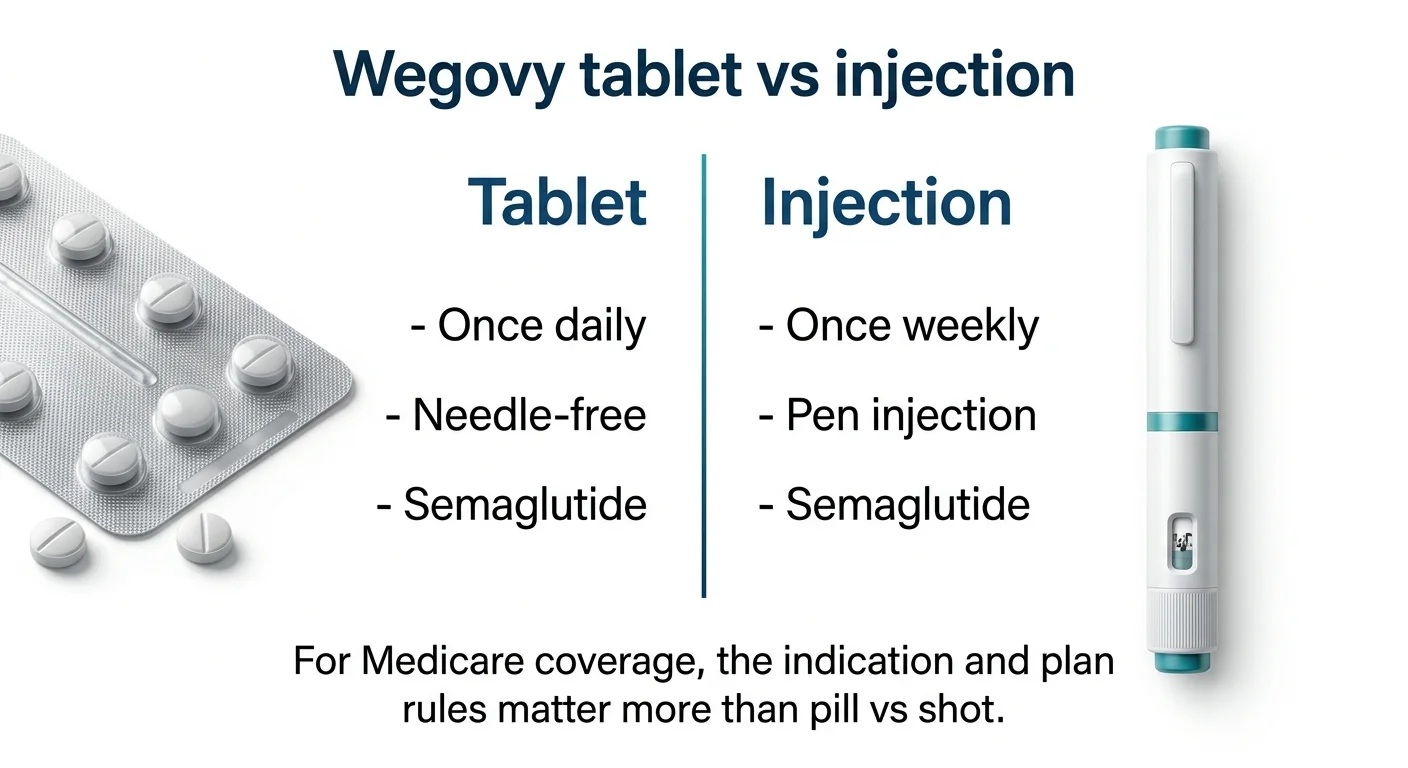
| Wegovy Pill | Wegovy Injection | |
|---|---|---|
| How you take it | One pill daily, empty stomach, 30 min before food/drink | One weekly injection with pre-filled pen |
| Starting price | $149/month | $199/month (intro) → $349/month |
| Weight loss in trials | ~14% average body weight (OASIS 4 trial) | ~15–17% average body weight |
| Common side effects | Nausea, diarrhea (may pass faster with pill) | Nausea, diarrhea (may last longer per episode) |
| Best for | Budget-conscious, needle-averse, prefer daily routine | Prefer once-weekly simplicity, don't mind injections |
For most Medicare beneficiaries watching their budget, the pill is the stronger starting point. It's $200/month cheaper than the injection at maintenance doses, and you avoid needles entirely.
Where to get cash-pay Wegovy
If you're going the cash-pay route, you want a legitimate provider with real medical oversight and the lowest available pricing.
For FDA-approved Wegovy outside Medicare: Ro
Ro offers both the Wegovy pill and injection through a telehealth platform with a direct NovoCare Pharmacy partnership. Medicare members can join Ro and pay cash for Wegovy — this runs entirely outside your Medicare benefit.
- Licensed provider consultation and ongoing medical support
- Wegovy pill from $149/month for medication, plus the Ro Body membership ($39 first month, then $149/month)
- Wegovy injection from $199/month for medication (limited-time intro), plus membership
- Home delivery through NovoCare Pharmacy
If you qualify for Path 1 or Path 2, start there — those are better deals financially. But if neither Medicare path works for you today and you're ready to start losing weight, Ro gives you the shortest distance between “I want Wegovy” and “my first dose is on the way.” The medication is FDA-approved, the medical oversight is real, and your treatment history will already be established if you later transition to the Bridge or BALANCE.
FDA-Approved Self-Pay — Available Now
Check your eligibility on Ro
FDA-approved Wegovy (pill + injection) with licensed physician oversight and home delivery. Medicare members can pay cash, separate from their Medicare benefit.
Check eligibility on Ro → (sponsored affiliate link, opens in a new tab)Wegovy pill from $149/mo medication + $39 first month membership. Ongoing membership $149/mo. Ro does not coordinate GLP-1 coverage for government insurance plans.
Also worth considering:
- GoodRx for Weight Loss — $39–$119/month subscription + medication costs; good if you prefer picking up at a local pharmacy
- NovoCare Pharmacy — order direct from Novo Nordisk's own pharmacy; no membership required but no provider support included
- Walgreens Weight Management — in-person option if you want face-to-face care alongside your medication
An important tax note
If you pay out of pocket for Wegovy prescribed for a medical condition (obesity or a weight-related health issue), the cost may qualify as a tax-deductible medical expense. You'd need to itemize deductions, and only the portion of total medical expenses exceeding 7.5% of your adjusted gross income is deductible. Talk to a tax advisor about your specific situation.
Does Medicare Part D Cover Wegovy?
This question deserves its own clear answer because it's one of the most-searched variants.
- For weight loss only: No, not under standard Part D. The federal statutory exclusion blocks it.
- For cardiovascular risk reduction: Potentially yes — if Wegovy is on your plan's formulary for the CV indication, and you meet the clinical criteria, and you get prior authorization approved. Coverage varies by plan.
- Under the GLP-1 Bridge (July 2026–Dec 2027): The Bridge operates outside the normal Part D benefit. Your Part D plan doesn't process the claim, CMS does. But you must be enrolled in a Part D plan to qualify.
- Under BALANCE (2028+ if launched): BALANCE did not launch for Medicare Part D in 2027 — the 80% plan participation threshold was not met. If CMS runs a new BALANCE participation round for 2028, Part D plans that opt in will be able to cover Wegovy for weight loss. Watch for announcements during fall 2027 open enrollment (October 15–December 7, 2027).
Does Medicare Advantage Cover Wegovy?
There's no honest yes-or-no answer here, and anyone who gives you one is oversimplifying.
Medicare Advantage plans follow the same federal exclusion rules as Original Medicare — they cannot cover Wegovy for weight loss alone. But many MA plans include Part D drug coverage (MA-PD plans), and these plans can:
- Cover Wegovy for the cardiovascular indication if it's on their formulary
- Participate in the GLP-1 Bridge (eligible MA-PD plan types qualify)
- Offer supplemental benefits like nutrition counseling, gym memberships, or weight management programs
What about specific carriers?
Does Aetna Medicare cover Wegovy for weight loss? Same rules as every other Medicare plan. Aetna's MA-PD plans cannot cover it for weight loss alone but may cover it under the CV indication if it's on their specific formulary.
Does Humana Medicare cover Wegovy for weight loss? Same answer. Check your specific Humana plan's formulary and prior authorization requirements.
Does UnitedHealthcare Medicare cover Wegovy for weight loss? Same answer. UHC offers dozens of different MA-PD plans with different formularies. You need to check your plan, not just the carrier.
The only reliable way to know is to check your specific plan's formulary and call member services. General carrier-level claims aren't trustworthy because they vary plan by plan and state by state.
Is Wegovy Covered by Medicare Part B?
No, and here's why. Part B covers drugs that are administered by a healthcare provider — infusions at a clinic, injections at a doctor's office. Wegovy is self-administered at home, whether you're using the injection pen or the pill. That makes it a Part D drug, not a Part B drug.
Part A (hospital coverage) and Medigap (supplemental) don't cover outpatient prescription drugs either. If you want Medicare to help pay for Wegovy, the pathway runs through Part D — either the standard benefit, the GLP-1 Bridge, or the BALANCE Model.
Does Medicare Cover the Wegovy Pill?
The same Medicare coverage logic applies to the Wegovy tablet as to the injection: weight-loss-only use is generally excluded under standard Part D, the cardiovascular indication may be coverable through Part D, and the Medicare GLP-1 Bridge lists both Wegovy injection and tablets as eligible drugs for weight reduction. Many older articles online don't mention the pill because it only launched in January 2026.
For coverage purposes, the form doesn't matter. What matters is the indication:
- Wegovy pill for cardiovascular risk reduction → Part D pathway (same as injection)
- Wegovy pill for weight loss → GLP-1 Bridge (both injection and tablets are listed as eligible drugs)
- Wegovy pill self-pay → $149/month for starting dose, $299/month for maintenance doses
The pill is actually a significant development for Medicare beneficiaries specifically. Many seniors prefer a daily pill over a weekly injection, and the starting price is $50/month cheaper than the injection. If you're going the self-pay route, the pill is the most affordable entry point.
How Much Will Wegovy Actually Cost You on Medicare in 2026?
Let's put real numbers on each scenario so you can plan.
| Your Path | Monthly Cost | Annual Cost | Key Detail |
|---|---|---|---|
| CV indication (Part D) | Varies by plan deductible, tier, and coinsurance | All covered drugs subject to $2,100/yr OOP cap | Counts toward OOP cap; MPPP available |
| GLP-1 Bridge (Jul 2026–Dec 2027) | $50/month flat | $900 for 18 months | Does NOT count toward Part D deductible or OOP cap |
| Cash-pay, pill | $149–$299/month (+ provider fees) | Varies | No Medicare coordination; may be tax-deductible |
| Cash-pay, injection | $199–$349/month (+ provider fees) | Varies | Same as above |
What about 2027?
There's promising news on the horizon. Semaglutide products (Wegovy/Ozempic/Rybelsus) were selected for Medicare drug price negotiation under the Inflation Reduction Act. CMS has published negotiated prices effective January 1, 2027 — significantly below current list prices. The exact impact on what you'll pay at the pharmacy will depend on your Part D plan and whether it participates in BALANCE, but the direction is clear: Medicare is paying less for these medications, which makes expanded coverage more sustainable.
What Happens After the Bridge Ends: BALANCE Did Not Launch in 2027
The GLP-1 Bridge was originally designed as a six-month window before BALANCE took over — but BALANCE did not launch for Medicare Part D in 2027, so CMS extended the Bridge through December 2027 (18 months total).
BALANCE did not launch for Medicare Part D in 2027 — the 80% Part D sponsor participation threshold was not met by April 30, 2026. CMS extended the Bridge through December 2027. When and if CMS runs a new BALANCE participation round for Medicare Part D, it would apply to 2028 or later. The model is still voluntary for plans, manufacturers, and states (for Medicaid).
Here's what we know so far about BALANCE eligibility. Patients must have a provider confirm they meet criteria similar to the Bridge, including:
- Age 18+ with BMI ≥ 35, or
- Age 18+ with BMI ≥ 30 plus qualifying conditions (including type 2 diabetes, MASH with liver fibrosis, obstructive sleep apnea), or
- Criteria still being finalized for lower BMI thresholds with additional risk factors
Every beneficiary receiving GLP-1s through BALANCE will also get access to a lifestyle support program — including nutrition and physical activity education — provided by the manufacturer at no cost.
What to Do If Medicare Says No
Let's be real: for many people reading this, none of the Medicare paths will work right now. You might not have heart disease. You might have a BMI of 32 with no qualifying conditions for the Bridge. You might not be enrolled in a Part D plan for 2026. That doesn't mean you're stuck.
Option 1: Appeal the denial
If you believe you qualify under the CV indication and got denied, you have five levels of Medicare appeals:
- Redetermination — your plan must respond within 7 days (72 hours if expedited)
- Reconsideration by an Independent Review Entity
- Administrative Law Judge hearing
- Medicare Appeals Council
- Federal court
Start by having your doctor submit detailed documentation and the correct diagnosis codes. Many initial denials are overturned on appeal when the right paperwork is submitted.
Option 2: Explore other Medicare-covered weight management resources
Medicare does cover some weight-related services:
- Obesity behavioral therapy — covered under Part B for beneficiaries with BMI ≥ 30, provided by a primary care provider
- Bariatric surgery — covered under Part A if you have BMI ≥ 35 with a weight-related condition and documented prior attempts at supervised weight loss
- Nutrition therapy — covered in some circumstances, particularly for diabetes or kidney disease
Option 3: Start with an FDA-approved self-pay provider
A year ago, Wegovy cost $1,350/month out of pocket. Today, the pill starts at $149/month. That's a 90% price drop. For many Medicare beneficiaries, that makes self-pay treatment possible for the first time.
Ro is the provider we recommend for this path. They offer FDA-approved Wegovy (both pill and injection) through a direct partnership with Novo Nordisk and NovoCare Pharmacy, with licensed providers, home delivery, and ongoing medical support.
Why Ro specifically? Three reasons. First, the prices are as low as they get — Ro offers the same NovoCare Pharmacy pricing that Novo Nordisk publishes directly. Second, the medical oversight is real. You get a licensed provider who manages your dosing, monitors for side effects, and adjusts your treatment plan as needed. Third, the experience is seamless — from the initial consultation to the prescription to home delivery, everything happens through one platform.
If you qualify for Path 1 or Path 2, start there — those are better deals financially. But if neither works for you today and you're ready to start losing weight, Ro gives you the shortest distance between “I want Wegovy” and “my first dose is on the way.”
If Medicare Won't Cover It — Start Here
See current Wegovy pricing and check your eligibility on Ro
FDA-approved Wegovy pill from $149/mo. Injection from $199/mo. Licensed physician oversight, home delivery, no insurance required. Medicare members can pay cash.
Check eligibility on Ro → (sponsored affiliate link, opens in a new tab)Ro is a cash-pay path, not a Medicare workaround. Costs do not count toward your Part D benefit.
Option 4: Take our matching quiz
If you're not sure which path fits — Medicare coverage, the Bridge, self-pay, or something else entirely — we built a free tool that walks you through it in 60 seconds.
Is Wegovy Safe? What Medicare Beneficiaries Should Know
Wegovy has been studied in thousands of adults across age groups. The SELECT trial alone followed over 17,600 adults (average age 62) for more than three years. In clinical trials, the medication was generally well-tolerated, with the most common side effects being gastrointestinal — nausea, diarrhea, vomiting, and constipation. These tend to be most noticeable when starting the medication or increasing the dose, and they typically improve as your body adjusts.
For Medicare beneficiaries specifically: Talk to your doctor about how Wegovy interacts with your other medications, the importance of staying hydrated (especially if GI side effects are an issue), and a gradual dose-titration schedule to minimize side effects. You don't jump straight to the full dose — you work up to it over several months.
Source: FDA prescribing information for Wegovy (semaglutide) injection and tablets. See also our full guide on GLP-1 hard contraindications.
What About Ozempic, Zepbound, and Other GLP-1 Medications on Medicare?
Wegovy isn't the only GLP-1 medication out there, and Medicare's rules are different for each one. Here's a comparison so you're not searching five more times.
| Medication | FDA-Approved For | Medicare Part D Coverage (2026) | GLP-1 Bridge Eligible? |
|---|---|---|---|
| Wegovy (semaglutide) | Weight loss, CV risk reduction, MASH (injection only) | CV risk reduction: Yes (plan-dependent) · Weight loss: No | ✅ Yes (injection + pill) |
| Ozempic (semaglutide) | Type 2 diabetes, CV risk, CKD | Type 2 diabetes: Yes · Weight loss: No | ❌ No |
| Zepbound (tirzepatide) | Weight loss, sleep apnea | Sleep apnea: Yes (plan-dependent) · Weight loss: No | ✅ Yes |
| Mounjaro (tirzepatide) | Type 2 diabetes | Type 2 diabetes: Yes | ❌ No |
| Rybelsus (oral semaglutide) | Type 2 diabetes | Type 2 diabetes: Yes | ❌ No |
Can I get Ozempic on Medicare instead of Wegovy?
If you have Type 2 diabetes, yes — Medicare Part D covers Ozempic for blood sugar management. Ozempic contains the same active ingredient as Wegovy (semaglutide) at lower doses, and weight loss is a well-documented effect. Many doctors prescribe it for diabetes knowing the patient will also benefit from weight loss.
But Ozempic is not FDA-approved for weight loss. Prescribing it solely for that purpose could result in a denial. The diagnosis code on the prescription must support a diabetes indication. And you can't switch from an Ozempic prescription for diabetes to the GLP-1 Bridge for weight loss — CMS has specifically addressed this.
What about Zepbound?
Zepbound (tirzepatide) is the other medication eligible for the Medicare GLP-1 Bridge, alongside Wegovy. It works on both GLP-1 and GIP receptors. In clinical trials, Zepbound showed average weight loss of 18–22% of body weight — among the highest of any approved weight-loss medication. If your doctor recommends it over Wegovy, both are covered at the same $50/month copay under the Bridge.
What about compounded semaglutide?
For a Medicare coverage guide, we focus exclusively on FDA-approved medications with published clinical trial data and established coverage pathways. The FDA resolved the semaglutide shortage in February 2025 and has since moved to restrict compounded versions. Some providers continue offering “personalized” compounded versions, but their long-term availability is genuinely uncertain. For more context, see our GLP-1 telehealth comparison.
Real Scenarios: Which Path Works for You?
Coverage rules can feel abstract until you see them applied to real situations. Here are three scenarios based on the most common situations we see.
Scenario 1: Margaret, age 68 — has heart disease and obesity
Margaret had a heart attack two years ago. Her BMI is 33. Her cardiologist mentioned Wegovy but she assumed Medicare wouldn't cover it.
Her best path: Path 1 — CV Indication (available now)
Margaret's cardiologist can prescribe Wegovy specifically for cardiovascular risk reduction. Because she has established heart disease and a BMI over 27, she meets the criteria for the FDA-approved CV indication. Her doctor submits prior authorization with the appropriate diagnosis code.
Her cost: After meeting her Part D deductible ($615), she pays 25% coinsurance on the medication. Once her total out-of-pocket drug spending hits $2,100 for the year, Medicare covers 100%. She also enrolls in the Medicare Prescription Payment Plan to spread those costs into even monthly installments.
What Margaret should do today: Call her cardiologist's office and ask specifically about prescribing Wegovy for cardiovascular risk reduction, not weight loss.
Scenario 2: Robert, age 72 — BMI 36, no heart disease
Robert weighs 245 pounds at 5'9". His BMI is 36. He has mild hypertension managed with one medication, but no heart disease, no diabetes, and no other qualifying conditions beyond his weight.
His best path: Path 2 — GLP-1 Bridge (available as of July 1, 2026)
Robert's BMI of 36 exceeds the Bridge's threshold of BMI ≥ 35, which qualifies him without any additional conditions. His doctor can now submit a prior authorization through the Bridge, and Robert pays $50/month for Wegovy.
Robert could also start on self-pay Wegovy while the Bridge prior authorization is being processed. The pill starts at $149/month, and transitioning to the $50/month Bridge rate once approved is straightforward.
What Robert should do today: Confirm his Part D enrollment, have his doctor document his BMI, and submit the Bridge prior authorization to CMS's central processor.
Scenario 3: Linda, age 64 — BMI 31, prediabetes, on Medicare disability
Linda has been on Medicare disability for three years. Her BMI is 31 and she was recently diagnosed with prediabetes. She's heard about Wegovy but assumed she couldn't afford it.
Her best path: Path 2 — GLP-1 Bridge (available as of July 1, 2026), with a backup plan
Linda qualifies for the Bridge under the BMI ≥ 27 with prediabetes criteria. As of July 1, 2026, she can pay $50/month. One thing she should know: even though she qualifies for Extra Help (Low-Income Subsidy) on her other medications, the LIS discount does not apply to Bridge copays. She'll owe the full $50.
At $149/month self-pay, the Bridge is actually cheaper by nearly $100/month. For Linda, the smartest financial move is to apply for the Bridge and start at the $50/month rate.
What Linda should do today: Talk to her doctor about documenting her prediabetes diagnosis (per ADA guidelines) and her BMI, so the Bridge prior authorization can be submitted to CMS's central processor.
The Complete Medicare Wegovy Timeline
If you want the full picture of how we got here and where this is going, here's the complete timeline in one place.
Who Is Wegovy Actually For? (And Who Should Look Elsewhere)
Wegovy isn't the right fit for everyone, and we'd be doing you a disservice not to say that clearly.
Wegovy is FDA-approved for:
- Adults with obesity (BMI ≥ 30)
- Adults with overweight (BMI ≥ 27) plus at least one weight-related condition (high blood pressure, type 2 diabetes, high cholesterol)
- Adults with established heart disease and overweight/obesity (for cardiovascular risk reduction)
- Children 12+ with obesity (injection only)
- Adults with MASH and moderate-to-advanced liver fibrosis (injection only)
Wegovy is probably not for you if:
- You want to lose a few vanity pounds. This is a serious medication for a serious medical condition. The side effects are real and the commitment is long-term.
- You have a personal or family history of medullary thyroid carcinoma or MEN 2 syndrome. These are absolute contraindications.
- You have a history of pancreatitis or other pancreatic issues. Talk with your doctor before starting Wegovy.
- You're pregnant, planning to become pregnant, or breastfeeding. Wegovy should be stopped at least 2 months before a planned pregnancy.
If Wegovy isn't right for you, that doesn't mean you're out of options. Medicare covers obesity behavioral therapy, nutrition counseling, and bariatric surgery for qualifying beneficiaries. And Zepbound, which works differently, may be better for some people. Our quiz tool can help with that.
Frequently Asked Questions
Does Medicare cover Wegovy for weight loss for seniors?
Standard Medicare does not cover Wegovy when prescribed only for weight loss, regardless of age. However, the Medicare GLP-1 Bridge, available as of July 1, 2026, covers Wegovy for weight loss for eligible beneficiaries who meet BMI and health criteria. Medicare Part D may also cover Wegovy right now if it's prescribed for cardiovascular risk reduction in adults with established heart disease.
Will Medicare cover Wegovy for weight loss in 2026?
Yes — through the GLP-1 Bridge program running July 1, 2026 through December 31, 2027 (18 months). Eligible beneficiaries will pay $50/month. You must be enrolled in a Part D plan and meet specific BMI and clinical criteria. The BALANCE Model will not launch for Medicare Part D in 2027 — CMS extended the Bridge instead.
How much does Wegovy cost with Medicare?
Under the CV indication (Part D): deductible plus coinsurance, capped at $2,100/year for all drugs. Under the GLP-1 Bridge: $50/month flat (does not count toward Part D OOP cap). Self-pay without Medicare: $149–$349/month depending on form and dose.
Is Wegovy covered by Medicare Part B?
No. Part B covers drugs administered by healthcare providers. Wegovy is self-administered (injection or pill), so coverage comes through Part D, the GLP-1 Bridge, or self-pay.
Does Medicaid cover Wegovy?
Medicaid coverage varies significantly by state. Under the BALANCE Model, Medicaid participation can begin as early as May 2026 for states that choose to join. Check with your state Medicaid program for current coverage rules.
Can I use the Wegovy savings card with Medicare?
No. Novo Nordisk's Wegovy Savings Offer ($25/month for commercially insured patients) explicitly excludes government insurance beneficiaries. You can still access the reduced self-pay pricing through NovoCare, Ro, or GoodRx — you just can't use the savings card.
What is the Medicare GLP-1 Bridge?
An 18-month CMS demonstration running July 1, 2026–December 31, 2027. It covers Wegovy (injection and tablets), Zepbound KwikPen, and Foundayo for eligible Medicare beneficiaries at $50/month for weight loss. It operates outside the normal Part D benefit structure, and costs don't count toward your deductible or out-of-pocket cap. Humana is the central processor (BIN 028918 / PCN MEDDGLP1BR). BALANCE is not launching for Medicare Part D in 2027.
Does Medicare cover the Wegovy pill?
Same coverage rules as the injection. The pill is eligible under the CV indication (Part D), the GLP-1 Bridge, and self-pay. Starting dose is $149/month cash-pay.
What happens when the GLP-1 Bridge ends in December 2027?
The Bridge has been extended through December 31, 2027 because the BALANCE Model did not meet its 80% Part D plan participation threshold for 2027. After December 2027, coverage will depend on whether CMS launches BALANCE for Medicare Part D in 2028 or pursues other mechanisms. Watch for announcements during fall 2027 open enrollment.
Can I appeal if Medicare denies Wegovy?
Yes. You have five levels of appeal. The first is a Redetermination — your plan must respond within 7 days. Success depends on having the right diagnosis codes and documentation. Many initial denials are overturned on appeal.
Does Medicare cover Ozempic for weight loss?
Not for weight loss specifically. Medicare Part D covers Ozempic for Type 2 diabetes. If your doctor prescribes it for diabetes and you also lose weight, that's a beneficial side effect — but the prescription and diagnosis code must support a diabetes indication.
When will Medicare fully cover weight loss drugs?
That depends on Congress. The 2003 statutory exclusion still stands. The GLP-1 Bridge and BALANCE Model are demonstration programs that work around the law using special authority. Full, permanent Part D coverage of weight loss drugs would require legislation. There is bipartisan interest in changing the law, but no bill has passed as of June 11, 2026.
Does Medicare cover Wegovy for sleep apnea?
Wegovy is not FDA-approved for sleep apnea. However, Zepbound (tirzepatide) is FDA-approved for moderate to severe obstructive sleep apnea in adults with obesity, and some Part D plans cover it for that indication. Additionally, Zepbound is eligible under the GLP-1 Bridge alongside Wegovy.
What is TrumpRx and can I use it with Medicare?
TrumpRx is a government-supported portal offering reduced-price medications including GLP-1s. However, the terms for some TrumpRx offers — including the Wegovy pill coupon — state that users must not be enrolled in Medicare or other government insurance programs. If you're a Medicare beneficiary, the GLP-1 Bridge ($50/month, available as of July 1, 2026) or a cash-pay provider like Ro may be a better fit.
How We Verified This Page
Every factual claim on this page was checked against primary sources:
- CMS Medicare GLP-1 Bridge FAQ — Published March 3, 2026 (cms.gov)
- CMS BALANCE Model announcement — Published December 23, 2025 (cms.gov)
- CMS Contract Year 2026 Final Rule — Published April 2025 (cms.gov)
- FDA Wegovy prescribing information — Injection and tablets (accessdata.fda.gov)
- FDA expanded indication approval — March 8, 2024 (fda.gov)
- Novo Nordisk self-pay pricing — NovoCare.com and press releases (November 2025–January 2026)
- Medicare.gov Plan Compare — Formulary and plan-check tools
- Kaiser Family Foundation (KFF) analysis — GLP-1 Bridge and BALANCE coverage, March 2026
- SELECT trial results — Published in the New England Journal of Medicine
We did not rely on secondary news coverage for any core factual claims about coverage rules, eligibility, or pricing. This page is reviewed and updated when material changes occur — new CMS guidance, pricing changes, program launches.
Still Not Sure Which GLP-1 Path Is Right for You?
We get it — there's a lot here. Medicare coverage, Bridge programs, self-pay pricing, pills vs. injections. It's a lot to process when all you really want is a clear answer.
That's why we built a free tool that asks you a few simple questions about your situation and gives you a personalized recommendation in under 60 seconds. No email required, no sales pitch — just a straight answer.
Or if you're ready to start Wegovy on self-pay today:
Start Today — FDA-Approved Wegovy
Check your eligibility on Ro
FDA-approved Wegovy pill from $149/mo. Licensed physicians, home delivery, no Medicare coordination required. Know if you qualify in about 2 days.
Check eligibility on Ro → (sponsored affiliate link, opens in a new tab)Wegovy pill from $149/mo medication + $39 first month membership. Ongoing $149/mo. Cash-pay path — separate from your Medicare benefit.
This guide is for informational purposes only and does not constitute medical or legal advice. Always consult with your healthcare provider and your Medicare plan before making treatment decisions. Medicare coverage rules, provider pricing, and program details are subject to change.
Sources verified against CMS.gov, FDA.gov, Medicare.gov, Novo Nordisk prescribing information, and Kaiser Family Foundation analysis. Last updated: July 3, 2026. Next scheduled review: September 2026.