Cigna Medicare Advantage GLP-1 Coverage: What HealthSpring Covers and the $50 Bridge
Cigna Medicare Advantage GLP-1 coverage now runs through HealthSpring. Its 2026 rules list Ozempic and Mounjaro with prior authorization for FDA-approved uses such as type 2 diabetes; your exact plan controls coverage. Basic Part D excludes weight loss alone. The separate Medicare GLP-1 Bridge can pay: $50 per 28- or 30-day supply if you qualify.
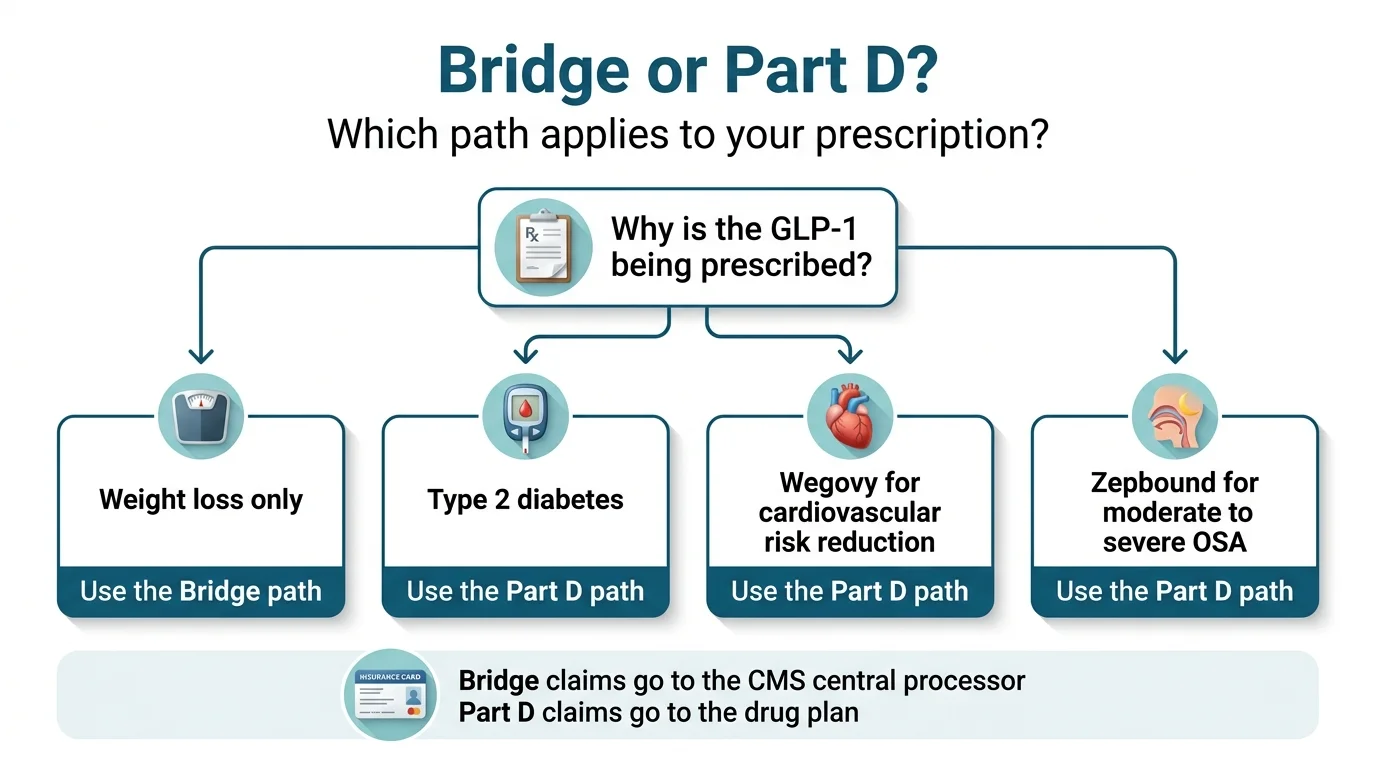
Three things decide your answer: why the drug is prescribed, what kind of plan your card shows, and whether a Medicare drug plan already paid for a GLP-1 in 2026. The table below shows where to start. That last one is the catch to check before you count on $50.
RX Index Decision Verdict: Check your HealthSpring benefit and the reason on your prescription before you pay anyone for anything.
Best for: current or former Cigna Medicare Advantage members, and family helping them, who want a GLP-1 covered.
Not ideal for: Cigna through a job or the Marketplace. Our Cigna coverage guide fits you better.
The factor that matters most: why the drug is prescribed. That fact tells you which rules to check first.
We can't see your plan, and no website can promise you an approval. What we can do is show you which door to knock on, what to bring, and what to say when you get there.
Start with the prescription's purpose, plan type, exact product form, and prior paid claims before counting on either coverage path.id="cigna-medicare-advantage-glp-1-coverage-which-door">Cigna Medicare Advantage GLP-1 coverage: which door?
For a HealthSpring member with drug coverage, there are two systems to check. A GLP-1 prescribed for an eligible medical use—such as type 2 diabetes, heart-risk reduction, moderate-to-severe obstructive sleep apnea, or noncirrhotic MASH with F2–F3 scarring—belongs with HealthSpring Part D. Weight management alone may go through the federal $50 Medicare GLP-1 Bridge, which HealthSpring doesn't run.
Before you read the table, find three things: the plan name on your card, the exact drug and form on the prescription, and the reason your clinician wrote it. If you have those, you're ready.
A few quick definitions. Part D is Medicare drug coverage. If your Medicare Advantage plan covers prescriptions, Part D is built into it. Prior authorization is a permission slip: the plan or program has to OK the drug before it pays for it. A copay is a fixed amount you pay; coinsurance is a percentage of the cost.
Cigna Medicare Advantage GLP-1 coverage: which door?
If your card and prescription look like this
Your door
Who decides
What you pay
Your first move
HealthSpring Medicare Advantage with drug coverage. Ozempic, Mounjaro, Rybelsus, or Trulicity for type 2 diabetes.
HealthSpring Part D
HealthSpring
Your copay or coinsurance. These four sit on Tier 3 of HealthSpring's Standard 5-Tier list.
Confirm the drug on your exact plan; your prescriber sends the prior authorization with your diagnosis.
Wegovy (shot or pill) to lower heart attack and stroke risk in an adult with established cardiovascular disease and overweight or obesity
HealthSpring Part D
HealthSpring
Your copay or coinsurance, if covered
Check your drug list. If it's not listed, ask for an exception.
Wegovy injection for MASH in an adult with moderate-to-advanced liver scarring (F2–F3) and no cirrhosis. The pill doesn't carry this use.
HealthSpring Part D
HealthSpring
Your copay or coinsurance, if covered
Same as above. Have your liver-stage results ready.
Zepbound for moderate-to-severe obstructive sleep apnea in an adult with obesity
HealthSpring Part D
HealthSpring
Your copay or coinsurance, if covered
Same as above. Have your sleep study ready.
Weight management only, with no type 2 diabetes, moderate-to-severe obstructive sleep apnea, or noncirrhotic MASH with F2–F3 scarring. Drug is Foundayo, Wegovy (shot or pill), or Zepbound KwikPen.
Medicare GLP-1 Bridge
CMS, through its processor (Humana in 2026). Not HealthSpring.
$50 per approved 28- or 30-day supply, if all Bridge rules are met
Pharmacy sends the Bridge claim first. You don't need a HealthSpring denial first.
Zepbound vial or single-dose pen for weight management
Not a Bridge product
—
No $50 price
Ask your prescriber whether the KwikPen fits. Don't swap products on your own.
A Medicare drug plan already paid for Zepbound, Mounjaro, Foundayo, Rybelsus, Ozempic, Wegovy, Saxenda, Victoza, or Trulicity in 2026
Bridge closed for 2026
CMS checks the claims
Your plan's quoted cost; no Bridge price in 2026
Check your 2026 Explanation of Benefits before anyone promises you $50. Use your plan's coverage or exception process.
HealthSpring group retiree plan (from a former employer or union)
HealthSpring drug coverage; an eligible group Part D plan can also open the Bridge
HealthSpring, or CMS for the Bridge
Depends on your group plan
Ask whether your group plan covers weight-loss drugs as an extra benefit. A 2026 GLP-1 fill paid that way closes the Bridge for 2026.
HealthSpring Medicare Supplement only, or Medicare Advantage without drug coverage
No drug door through that coverage
—
—
Call 1-800-MEDICARE before you change any plan.
Cigna through a job or the Marketplace (not Medicare)
MASH means metabolic dysfunction-associated steatohepatitis: a liver disease involving fat buildup and inflammation. The coverage use above is for adults with F2–F3 fibrosis, meaning moderate-to-advanced scarring without cirrhosis. CMS is the Centers for Medicare & Medicaid Services, the federal agency running the Bridge.
What we actually verifiedChecked September 24, 2026: HealthSpring's 2026 Medicare Advantage prior-authorization criteria, Standard 5-Tier guide, and two public formularies; its drug list, plan document, coverage decision, appeal, and annual-change pages; its notices about the switch from Cigna; Cigna's SEC filing and HCSC's sale announcement; CMS's Bridge pages for plans, prescribers, and pharmacies, prescriber fact sheet, and pharmacy reject-code guide; Medicare.gov's drug-cost, weight-loss drug, enrollment, contact, and drug-appeal pages; current Wegovy, Zepbound, Mounjaro, Ozempic, Rybelsus, and Trulicity prescribing information; the FDA's Foundayo approval announcement and compounding guidance; and manufacturer savings terms. How to read it: HealthSpring's rules are the plan's own published policy. Drug uses come from FDA labels. The door table is our synthesis. What we couldn't confirm: your plan's copay and tier, whether your exact plan covers Wegovy or Zepbound for an eligible heart, sleep, or liver use, your 2027 benefits, or your pharmacy's stock. We found 2026 documents on the public HealthSpring pages we checked; that does not establish whether your own 2027 documents are available. What we didn't do: submit a claim, call HealthSpring as a member, or get a coverage decision for anyone. No clinician reviewed this page. It explains coverage rules, not medical care. The RX Index is the independent GLP-1 decision resource that scores telehealth providers and treatment paths on clinical legitimacy, care quality, transparency, access, and cost, so readers can choose the path that fits their situation. Here's how we check our work.
Your Medicare coverage comes first. But if the table leaves you with more than one road, the right GLP-1 path isn't the same for everyone. It depends on your state, your plan and its drug list, FDA-approved or compounded medication, a shot or a pill, and your budget. Compounded drugs are not FDA-approved and are not Bridge products. The RX Index's Find My GLP-1 Path tool asks a few quick questions, then shows the GLP-1 paths and providers that fit your goals, budget, insurance, and situation. It's free, takes about 2 minutes, and needs no signup. It doesn't decide Medicare coverage. It helps you compare what's left.
Cigna sold its Medicare Advantage, Medicare Part D, and Medicare supplement businesses to Health Care Service Corporation (HCSC), and the sale closed March 19, 2025. Starting January 2026, former Cigna Medicare Advantage members moved into HealthSpring plans with new HealthSpring ID cards. Cigna's pharmacy company, Evernorth, still provides pharmacy benefit services to these plans for an agreed period.
Why does a name change matter for your drugs? Because the wrong rulebook leads to the wrong answer.
If you search "Cigna GLP-1 coverage," you'll find long Cigna policy PDFs with BMI rules and lifestyle requirements. Those policies say they apply to plans run by Cigna companies, like employer plans. Your Medicare plan isn't run by Cigna anymore. Your rules are HealthSpring's Medicare rules plus federal Medicare rules.
You'll still see one familiar name: Express Scripts. HealthSpring's drug coverage requests and drug appeals are mailed to Express Scripts, and HealthSpring uses Express Scripts Pharmacy for home delivery. That's normal. It doesn't mean Cigna's employer rules apply to you.
If your drug card names a former employer, ask that plan's administrator which rules apply. Group plans can have their own drug lists.
What HealthSpring's 2026 drug rules say about GLP-1s
HealthSpring's 2026 Medicare Advantage prior-authorization rules list Ozempic, Mounjaro, Rybelsus, and Trulicity in one GLP-1 entry. That entry asks for your diagnosis, lists all FDA-approved indications, gives a one-year authorization period, and doesn't require trying another drug first. The entry doesn't include Wegovy, Zepbound, or Foundayo.
Here's what HealthSpring's own documents show, in plain English:
What HealthSpring's 2026 drug rules say about GLP-1s
Drug (FDA-approved brand)
In HealthSpring's 2026 GLP-1 prior-authorization entry?
Tier on HealthSpring's 2026 Standard 5-Tier list
What the approval asks for
Can it go through the $50 Bridge?
Ozempic
Yes
Tier 3, prior authorization
Your diagnosis. Approval lasts 1 year. No other drug required first.
No
Mounjaro
Yes
Tier 3, prior authorization
Same
No
Rybelsus
Yes
Tier 3, prior authorization
Same
No
Trulicity
Yes
Tier 3, prior authorization
Same
No
Wegovy (shot, pill, HD)
Not in this entry
Not in the guide's diabetes section
Check your plan for heart-risk use; MASH is an injection-only use, not a tablet use. Wegovy HD is the adult weight-management option.
Yes, for weight management, if you qualify
Zepbound
Not in this entry
Not in the guide's diabetes section
Check your plan's list for moderate-to-severe obstructive sleep apnea in an adult with obesity
KwikPen only, for weight management, if you qualify
Foundayo
Not in this entry
Not in the guide
FDA-approved for weight management only, so basic Part D can't cover it
Yes, for weight management, if you qualify
Compounded products, separately: Compounded semaglutide and tirzepatide are not FDA-approved, are not listed in the HealthSpring drug lists we checked, and are not Bridge products. FDA explains the approval distinction.
Two cautions. First, your plan may use a different HealthSpring drug list than the Standard 5-Tier one, so your tier could differ. Second, "not in this entry" doesn't mean "not covered." It means you need to check your own plan's list. We also searched the public Primary formulary and Total Care/Total Care Plus formulary we reviewed: neither contained Wegovy or Zepbound. Those two lists do not establish coverage for every HealthSpring plan.
Our read of the diagnosis requirement: it's how the plan confirms the drug is for an approved use, like type 2 diabetes, and not weight loss alone.
Say you're 72, on a HealthSpring HMO, with type 2 diabetes. A friend lost weight on Zepbound, and you want it too. Diabetes closes the $50 Bridge door for you. But Mounjaro, which contains tirzepatide like Zepbound and is approved for type 2 diabetes, is on the Standard 5-Tier list with prior authorization. Ask your clinician whether it fits you. Which drug is right, and whether any GLP-1 is safe for you, is your clinician's call. Mounjaro prescribing information; Zepbound prescribing information.
How to check your exact plan
Find your contract number on your HealthSpring ID card.
Open HealthSpring's Plan Document Search. No contract number? Pick the "I don't know" option and search for your plan. You don't have to buy anything to see your documents.
Open your plan's drug list (also called a formulary) and your Evidence of Coverage, the booklet that explains what you pay for each tier.
Use the Medicare Advantage drug list, not the one for HealthSpring's standalone drug plans. They're different lists.
Search the exact brand and form, like "Wegovy tablet" or "Zepbound KwikPen," not just "semaglutide."
Use your exact plan before you count on a tier or a price.
Can you get the $50 Medicare GLP-1 Bridge with a HealthSpring plan?
Yes, if you qualify. The Medicare GLP-1 Bridge is a federal program that runs July 1, 2026 through December 31, 2027, and drug plans don't have to sign up for their members to use it. HealthSpring Medicare Advantage plans with drug coverage are an eligible plan type, but the prescription must be for weight management and you must meet Medicare's health rules.
This comes straight from CMS's rules for drug plans. The Bridge sits outside your plan's normal drug coverage. So HealthSpring doesn't approve it, pay for it, or get a vote.
Step 1: Confirm your plan type
Step 1: Confirm your plan type
What you have
Can it open the Bridge?
HealthSpring Medicare Advantage HMO, HMO-POS, or PPO with drug coverage
Yes, it's an eligible plan type
HealthSpring Special Needs Plan with drug coverage
Yes, it's an eligible plan type
HealthSpring standalone drug plan (with Original Medicare)
Yes, it's an eligible plan type
Employer or union Medicare group retiree plan with Part D (EGWP)
Yes, it's an eligible plan type
Medicare and Medicaid together (dual eligible), in an eligible plan type
Yes. Having both doesn't block you.
Medicare Advantage without drug coverage, or a Medicare Supplement only
Not through that coverage
Private fee-for-service, cost plans, PACE, and a few other rare plan types
No, unless you also have an eligible standalone drug plan
Source: CMS pharmacy guidance, updated Aug. 17, 2026. Please don't add or drop a plan to chase the Bridge without advice. Some changes can end your Medicare Advantage enrollment. Call 1-800-MEDICARE first.
Step 2: Check the drug and its exact form
The Bridge covers three brands, and the form matters:
Foundayo (orforglipron) tablets
Wegovy, both the shot and the tablets
Zepbound KwikPen only. Not Zepbound vials. Not Zepbound single-dose pens.
Ozempic, Mounjaro, and Rybelsus aren't Bridge drugs. Neither is any compounded product.
Step 3: Check your starting BMI
BMI (body mass index) is a number based on your height and weight. Medicare uses your BMI when you started GLP-1 treatment, not today's. You must also be 18 or older, and the prescription has to be for weight management with ongoing structured nutrition and physical activity consistent with the drug label.
Meet any one row:
Step 3: Check your starting BMI
BMI when GLP-1 treatment started
You also need at least one of these
35 or higher
No additional condition from this table. All other Bridge requirements still apply.
30 or higher
Heart failure with preserved ejection fraction; systolic (top number) blood pressure above 140 mm Hg or diastolic (bottom number) above 90 mm Hg despite taking two blood pressure medicines at the same time; or chronic kidney disease stage 3a or higher
27 or higher
Prediabetes as defined by American Diabetes Association guidelines; a past heart attack; a past stroke; or peripheral artery disease that causes symptoms
Source: CMS clinical criteria on its drug plan page. Checked Sept. 24, 2026.
The rows overlap. A starting BMI of 32 plus prediabetes meets the "27 or higher" row. You don't also need something from the "30 or higher" row. That's how the rows work, not a promise you'll be approved.
Lost weight already? Good news: CMS looks at your BMI when you started. Ask your clinician's office for the weight or BMI recorded when you began any GLP-1. If you've never taken one, your BMI when you start is the one that counts.
Step 4: Check what closes the Bridge door
Hitting a BMI row isn't the whole test. Four things can send you somewhere else:
Type 2 diabetes, moderate-to-severe obstructive sleep apnea, or noncirrhotic MASH with moderate-to-advanced scarring (F2–F3 fibrosis). CMS says these go through your HealthSpring drug plan, even if HealthSpring doesn't cover a GLP-1 for that condition.
A prescription written to lower heart attack or stroke risk. Heart disease by itself doesn't close the door. But if the drug is prescribed to reduce major heart events, CMS routes it to your plan, even if weight loss is also a goal. Your clinician states the real reason.
A 2026 GLP-1 fill paid by a Medicare drug plan. If any Medicare drug plan paid for Zepbound, Mounjaro, Foundayo, Rybelsus, Ozempic, Wegovy, Saxenda, Victoza, or Trulicity in 2026, you can't use the Bridge in 2026. That includes a fill paid through a group plan's extra weight-loss benefit. CMS hasn't set the 2027 rule yet as of our Sept. 24, 2026 check.
Later changes. If you're approved and a Medicare drug plan later pays for a GLP-1, or you move to an ineligible plan type, your Bridge access ends.
Say you're 66 and had a heart attack two years ago. In May, HealthSpring paid for Wegovy to lower your heart risk. Now you've heard about the $50 program. That May fill closes the Bridge for the rest of 2026, and a heart-risk prescription belongs with your plan anyway. You didn't do anything wrong. You're just already in the other lane.
Paying cash for a GLP-1 isn't the same as a drug plan paying for it. CMS's rule is about fills covered by a Medicare drug plan.
Medicare's own page walks through a few questions to see if the Bridge might fit you. It's a starting point, not an approval.
Wegovy for heart risk, Zepbound for sleep apnea, Wegovy for MASH: why these stay with HealthSpring
CMS treats major heart-event risk reduction, moderate-to-severe obstructive sleep apnea, and noncirrhotic MASH with F2–F3 scarring as uses Medicare drug plans can cover with the appropriate drug. A prescription for one of these goes to HealthSpring, not the Bridge, even if the drug isn't on HealthSpring's list. HealthSpring must use its normal exception process, and CMS says it's watching for plans that push these requests onto the Bridge.
That's in CMS's guidance for drug plans. This trips people up, because the natural thought is "My plan said no, so I'll use the $50 program." For these three uses, that doesn't work. The fix is inside HealthSpring.
Here's the path:
Check your 2026 drug list for the exact drug and form.
If it's listed and requires prior authorization, your prescriber sends that request with your records.
If it's not listed, ask for a formulary exception. That's a request to cover a drug that isn't on the list. Your prescriber writes a statement about why you need it.
If HealthSpring says no in writing, you can appeal. The steps are further down.
What to have ready: relevant records such as a sleep study for sleep apnea, liver-stage results for MASH, or records of established cardiovascular disease for heart risk. Your exact plan decides which records it requires. The Wegovy MASH indication is under accelerated approval; continued approval may depend on confirmation of clinical benefit in a trial. Wegovy label.
One honest rule: never ask a clinician to change the reason on a prescription to get a cheaper door. Your prescriber signs the Bridge form, and CMS can check it. The real reason is the only safe reason.
What will you pay, and what isn't included?
The Bridge's $50 is a drug copay for one approved 28- or 30-day supply, not a bill for all your care. What you pay through HealthSpring depends on your plan, tier, and pharmacy. The two systems also count differently toward Medicare's yearly drug cap.
What will you pay, and what isn't included?
Cost question
HealthSpring Part D (covered basic Part D use)
Medicare GLP-1 Bridge
What you pay for the drug
Your copay or coinsurance for that tier. Ask for a quote for your exact drug, dose, and pharmacy.
$50 per approved 28- or 30-day supply
Deductible
May apply. No Medicare drug plan can charge more than $615 in 2026 or $700 in 2027.
Doesn't apply
Counts toward Medicare's yearly drug cap ($2,100 in 2026; $2,400 in 2027)
Yes
No
Extra Help lowers it
Yes, if you qualify
No
Coupons or copay cards
Commercial-insurance copay offers exclude Medicare. Separate cash-only offers have their own rules (Wegovy terms; Zepbound terms).
Not allowed
60- or 90-day fills
Depends on your plan
No. Monthly only.
Pen needles for the Zepbound KwikPen
Ask your plan
Not covered. Buy them separately; do not bill Bridge-use needles to Part D.
Doctor visits and lab work
Billed separately under your medical benefits
Not included in the $50
Pay cash now, get paid back later
HealthSpring has a process for some cases, like a covered drug bought at an out-of-network pharmacy
The math on $50. Some supplies are 28 days, like a 28-day billing cycle that doesn't line up with calendar months. So:
4 fills of 28 days = $200 for 112 days
12 fills of 28 days = $600 for 336 days, which is short of a full year
13 fills of 28 days = $650 for 364 days
That's arithmetic, not a dosing schedule. Visits, tests, and needles are outside this drug-only total. Check their actual cost; an unknown cost isn't zero.
The cap catch. Once qualifying out-of-pocket spending on covered Part D drugs hits the yearly cap, those drugs cost $0 for the rest of the year, per Medicare.gov. Bridge copays don't count toward that cap. Say your qualifying spending on several other brand-name drugs reaches the 2026 limit of $2,100. After that, a GLP-1 your plan covers could cost $0, while a Bridge fill still costs $50. That's not a reason to change why a drug is prescribed. Your clinician decides that honestly. It's just how the money works. More detail: Bridge out-of-pocket costs.
How to get it done: who does what
Your plan, your prescriber, and your pharmacy each have a different job. For a HealthSpring drug request, your prescriber usually starts it. For the Bridge, the pharmacy claim comes first and the paperwork second.
HealthSpring Part D: ask for a coverage decision
A coverage decision is HealthSpring's formal answer about a drug. A pharmacy rejection isn't always the final word. It may just mean more information is needed.
You, your prescriber, or someone you name can ask. Your prescriber's written statement explains the medical reason.
Phone: 1-877-813-5595 (TTY 711), 8 a.m. to 2 a.m. Monday to Friday, 8 a.m. to 8 p.m. Saturday
Fax: 1-866-845-7267
Online: HealthSpring's coverage decision page links to an online request form through Express Scripts.
Timing for a coverage request: a standard decision comes within 72 hours after HealthSpring receives the request. A fast decision comes within 24 hours when your health requires it. For an exception, the clock starts when HealthSpring gets your prescriber's statement. Source: HealthSpring, checked Sept. 24, 2026.
The $50 Bridge: pharmacy claim first, paperwork second
Order matters here. Get it backward and the system says "patient not found," which looks like a denial but isn't one. That comes from CMS's prescriber guidance.
Your clinician decides the Bridge fits and sends the prescription to your pharmacy. CMS recommends they note the Bridge and a diagnosis code on the prescription. It isn't required, but it helps the pharmacy route it.
The pharmacy sends the claim to the Bridge, not to HealthSpring, using your Medicare number.
If the enrollment and product checks pass, the system answers "prior authorization required." That's normal. It's a step, not a no.
The pharmacy sends the request to your prescriber, usually within 24 to 72 hours, per CMS's prescriber fact sheet.
Your prescriber submits the Bridge form. The decision is mailed to you and sent to your prescriber through the electronic portal or by fax within 72 hours of submission.
If the pharmacy has sent the Bridge claim but your prescriber still has no authorization request after 72 hours, CMS says the prescriber can download the fax form from its provider instructions and submit it. That avoids waiting on a request that has not arrived.
After approval, your authorization is good through December 31, 2027. Refills and dose changes don't need a new approval unless you switch to a different GLP-1. Source: CMS pharmacy guidance.
After your clinician has checked that the Bridge fits, say this at the pharmacy counter: "Can you send this to the Medicare GLP-1 Bridge instead of my HealthSpring plan? Here's my Medicare card. The BIN is 028918 and the PCN is MEDDGLP1BR."
A decision in 72 hours isn't a promise your pharmacy has the drug on the shelf. Ask about stock when you drop off the prescription.
Your call worksheet
A missing fact can stall a call. This worksheet keeps the facts and next steps together. Print it, fill it in by hand, and bring it to every call. Don't send any of this to us. Share it only with your plan, clinician, or pharmacy.
Your call worksheet
Print this page and fill it in by hand. It stores nothing, sends nothing, and does not decide coverage. Keep unknown answers blank until your plan, clinician, or pharmacy confirms them.
1. Current plan name (from ID card)Not yet confirmed
2. Plan yearNot yet confirmed
3. Contract and plan number (from ID card)Not yet confirmed
4. Does the plan include drug (Part D) coverage? Yes / NoNot yet confirmed
5. Drug, form, and strength (for example, Wegovy tablet 1.5 mg)Not yet confirmed
6. Reason the clinician wrote it (diabetes / heart risk / sleep apnea / MASH / weight management)Not yet confirmed
7. Is the drug on my plan's drug list? Tier?Not yet confirmed
8. Prior authorization, step therapy, or quantity rulesNot yet confirmed
9. Did a Medicare drug plan pay for a GLP-1 in 2026? Yes / No / CheckingNot yet confirmed
10. BMI when GLP-1 treatment started, and dateNot yet confirmed
11. Pharmacy name and phoneNot yet confirmed
12. Quoted drug cost ($) and days suppliedNot yet confirmed
13. Which system got the claim? HealthSpring / BridgeNot yet confirmed
14. Full rejection message or code (if any)Not yet confirmed
15. Reference number, name of person, date and time of callNot yet confirmed
16. Who acts next, and by whenNot yet confirmed
Checked against HealthSpring and CMS documents on Sept. 24, 2026. Your plan's documents and your clinician's judgment come first.
Three scripts to use with the worksheet:
To HealthSpring (number on your ID card): "I'm checking a GLP-1 prescription under my current HealthSpring plan. Is [drug and form] on my [year] drug list for my clinician's stated reason? What prior authorization, step therapy, or quantity rules apply? What would a [28- or 30-day] supply cost at [pharmacy]? Please give me a reference number for this call."
To your clinician: "Could you check which system fits my prescription, my HealthSpring drug plan or the Medicare GLP-1 Bridge? If it's the Bridge, please check my starting BMI records and my 2026 Medicare drug claims, and follow the Bridge steps with my pharmacy."
To your pharmacy: "Was this claim sent to HealthSpring or to the Medicare GLP-1 Bridge? What's the full rejection message? Has the approval request reached my prescriber, and who needs to act next?"
These scripts help you collect facts. They don't diagnose anything or ask a clinician to change the reason for a prescription.
Who to call for what
Who to call for what
Your question
Who to call
Notes
Your plan, benefits, drug list, or a price quote
The member services number on the back of your HealthSpring ID card
Not a sales line
A HealthSpring drug coverage decision or exception
First figure out who said no and why. A pharmacy message, a Bridge decision, and a written HealthSpring denial are three different things with three different fixes. HealthSpring denials come with appeal rights. Bridge denials don't have a formal appeal, but your prescriber can fix and resubmit.
Ask the pharmacy for the whole rejection message, not just "not covered." A short code can hide several problems.
What if the pharmacy or HealthSpring says no?
What you heard
What it usually means
The fix
Bridge code 75: prior authorization required
The normal next step
Pharmacy sends the request to your prescriber; prescriber submits the form
Bridge code 70: product not covered
That exact product (like a Zepbound vial) isn't a Bridge product
The prescription needs to be rewritten for an eligible product, if your clinician agrees
Bridge code 65: patient not covered
Several possible reasons, such as a problem with your Medicare record or not showing Part D coverage on the fill date
Ask for the full message; call 1-800-MEDICARE
A quantity or days-supply reject
The days supplied or quantity may not match Bridge limits or the product's package size
Pharmacy reads the full message and checks the billed quantity and 28- or 30-day supply
"Patient not found" on the Bridge form
This can happen when the form goes in before the pharmacy claim
Pharmacy sends the claim first, then prescriber resubmits
Bridge approval denied
A Bridge decision
Prescriber corrects or adds information (like the starting BMI) and resubmits
HealthSpring says criteria not met
A plan decision
Coverage decision, then appeal if needed
HealthSpring says the drug isn't on the list
A drug list issue
Formulary exception with your prescriber's statement (how)
HealthSpring appeals. If HealthSpring denies a drug in writing, you have 65 days from the date of that coverage decision to file the first appeal. A standard drug benefits appeal gets an answer within 7 calendar days after the plan receives it. A standard payment appeal for a drug already purchased has a 14-day decision period, per Medicare.gov. A fast appeal, when waiting could seriously harm your health, gets an answer within 72 hours. You, your representative, or your prescriber can file. Source: HealthSpring appeals, checked Sept. 24, 2026.
If HealthSpring says no again, the notice explains the next level. Our appeal letter template can help you put your case in writing.
For a written HealthSpring drug denial, use the plan's appeal instructions—not the Bridge form.
Bridge denials. There's no formal Bridge appeal. Your prescriber can resubmit with corrected, updated, or added information. If the starting BMI was entered incorrectly, that is one fact your prescriber can correct. CMS explains resubmission.
Should you switch plans at 2027 open enrollment to get a GLP-1?
Probably not for the Bridge alone. Drug plans don't sign up for the Bridge, so moving between eligible plan types doesn't change the Bridge's eligibility rules, and moving to an ineligible type can end your access. Medicare's version of the BALANCE program isn't launching in 2027.
Open enrollment runs October 15 to December 7, 2026, for coverage starting January 1, 2027. The separate Medicare Advantage Open Enrollment Period, January 1 to March 31, lets people already in Medicare Advantage make a permitted change; it is not a new enrollment window for everyone. Medicare explains the enrollment periods. Your Annual Notice of Change, the letter listing next year's changes, comes each fall. HealthSpring posts it on its ANOC page.
Before you switch for one drug, check all of this:
Is your exact drug and form on the new plan's 2027 list, for your reason?
Are your doctors, hospital, and pharmacy in the network?
What happens to every other prescription you take?
Is the new plan an eligible Bridge plan type?
What we could not confirm as of Sept. 24, 2026:
Your HealthSpring plan's 2027 drug list. We found 2026 lists on the public pages we checked; ask HealthSpring or your group plan administrator for your own 2027 documents.
Switching plans to chase one drug and losing your cardiologist isn't a win. For free, unbiased help, call 1-800-MEDICARE and ask about your State Health Insurance Assistance Program (SHIP), or find your local SHIP through Medicare. They don't sell insurance. If you're actively comparing plans, see how to compare Medicare Advantage plans for GLP-1s.
If none of the doors open
If the Bridge rules don't fit and HealthSpring has no covered use for your prescription, you have fewer options, but not zero. Start with your clinician and the drug makers' own programs. Cash-only manufacturer offers used outside your drug benefit do not count toward the Part D drug cap.
Here's the honest order:
Talk with your clinician. Ask whether another covered drug or treatment fits your health.
Recheck your routing. A missing or incorrect medical record, a wrong starting BMI, or the wrong Zepbound form can change the answer. Use the worksheet above to check the facts with your clinician and pharmacy.
Check the drug makers' self-pay programs.Lilly's self-pay options and NovoCare's self-pay options offer cash pricing. TrumpRx lists offers and links to pharmacies or manufacturers; it does not sell drugs itself, as Medicare.gov explains. Read each program's rules for Medicare members first. Commercial-insurance copay offers are different from cash-only offers, including some called self-pay savings cards. Cash-only purchases under those offers cannot be reimbursed by Medicare or applied to its drug cap. We compare these treatment paths in Medicare GLP-1 Bridge vs TrumpRx.
Revisit at open enrollment, after the full check in the section above.
Why we don't point Medicare readers to compounded GLP-1s here. Compounded drugs aren't FDA-approved. The FDA says it doesn't review them for safety, effectiveness, or quality before they're sold, and they aren't part of the Bridge. If you may qualify for a $50 FDA-approved treatment path, check that first.
A safety line. Coverage isn't medical clearance. If you're under 18, pregnant or planning to be, have type 1 diabetes, have a history of an eating disorder, or have a condition the prescribed drug's label lists as a reason not to take it, talk with your clinician before anything else.
Questions about Cigna, HealthSpring, and GLP-1 coverage
Does HealthSpring have to sign up for the $50 Bridge?
No. CMS says drug plans don't have to opt in for their members to use the Bridge. You still need an eligible plan type and must meet the program's other rules. Source.
Do I need a HealthSpring denial before I try the Bridge?
No. CMS says a Part D denial isn't required. If your clinician thinks you may qualify, the pharmacy can send the claim straight to the Bridge. Source.
Can I qualify if I already take a GLP-1 and my BMI is lower now?
Possibly. CMS uses your BMI from when GLP-1 treatment started, so ask your clinician for those records. A GLP-1 that a Medicare drug plan paid for in 2026 is a separate issue that can block you this year. Source.
Are pills included in the Bridge, or only shots?
Pills are included. Foundayo tablets and Wegovy tablets are Bridge drugs, along with the Wegovy shot and the Zepbound KwikPen. Rybelsus isn't. Source.
I have Medicare and Medicaid. Can I use the Bridge?
Yes, if you're in an eligible plan type and meet the other rules. Having both doesn't block you. Extra Help doesn't lower the $50 copay, though. Source.
Do I need a new Bridge approval for every refill?
No. An approval is good through December 31, 2027, including refills and dose changes, unless you switch to a different GLP-1. It doesn't guarantee your pharmacy has stock. Source.
Can I appeal a Bridge denial?
There's no formal Bridge appeal. Your prescriber can resubmit with corrected, updated, or added information. HealthSpring denials are different and do come with appeal rights. Source.
Is Cigna Medicare now HealthSpring?
Yes. Health Care Service Corporation bought Cigna's Medicare business in March 2025. Former Cigna Medicare Advantage members got HealthSpring plans and new ID cards starting January 2026. Source.
Does Cigna Medicare Advantage cover Wegovy?
Cigna's Medicare plans are now HealthSpring. A HealthSpring drug plan can cover Wegovy for major cardiovascular-event risk reduction in adults with established cardiovascular disease and overweight or obesity, if its rules are met. Wegovy injection—not the tablet—also has an adult indication for noncirrhotic MASH with F2–F3 fibrosis; your plan must list the product or approve an exception. For weight loss alone, the $50 Bridge is a treatment path if you qualify. Wegovy label; CMS rules.
Does Cigna Medicare Advantage cover Zepbound?
A HealthSpring drug plan can cover Zepbound for moderate-to-severe obstructive sleep apnea in adults with obesity, depending on your plan's list and rules. For weight management, the Bridge covers the Zepbound KwikPen only, and you must qualify for the program. Zepbound label; CMS rules.
Does Cigna Medicare cover Ozempic for weight loss?
Basic Part D does not cover Ozempic for weight loss alone. HealthSpring's 2026 GLP-1 policy lists Ozempic with prior authorization for its FDA-approved uses, like type 2 diabetes; your exact plan's drug list still matters. Ozempic isn't a Bridge drug. HealthSpring policy; CMS rules.
Do I have to switch to a Humana plan to use the Bridge?
No. CMS uses Humana to process Bridge claims in 2026. That's a back-office job, not a plan you have to join. Source.
Can I use a Wegovy or Zepbound savings card with my HealthSpring plan?
Not with a HealthSpring Part D or Bridge claim. Commercial-insurance copay offers exclude Medicare, and coupons cannot reduce the Bridge copay. Separate cash-only offers have their own terms, including some called self-pay savings cards; they do not pay your Medicare copay or count toward the Part D cap. Read the Wegovy terms and Zepbound terms for the specific offer.
Sources
All checked September 24, 2026. Dates in parentheses are each source's own update date.
Still not sure which GLP-1 path fits you? Take The RX Index's free Find My GLP-1 Path quiz — about 2 minutes, no signup.
Your situation changes the answer
Find My GLP-1 Path
The right GLP-1 provider isn't the same for everyone. It depends on your state, your insurance and formulary, whether you want an FDA-approved or compounded medication, your preferred route (injection or oral), and your budget. Because a general answer can't resolve those for you, use The RX Index's Find My GLP-1 Path tool to get a personalized provider match with source-verified pricing before you choose.
•What it asks: your state, insurance situation, medication preference, budget, and support needs
•What you get: a personalized shortlist of GLP-1 providers matched to your situation, with verified pricing and the right questions to ask