
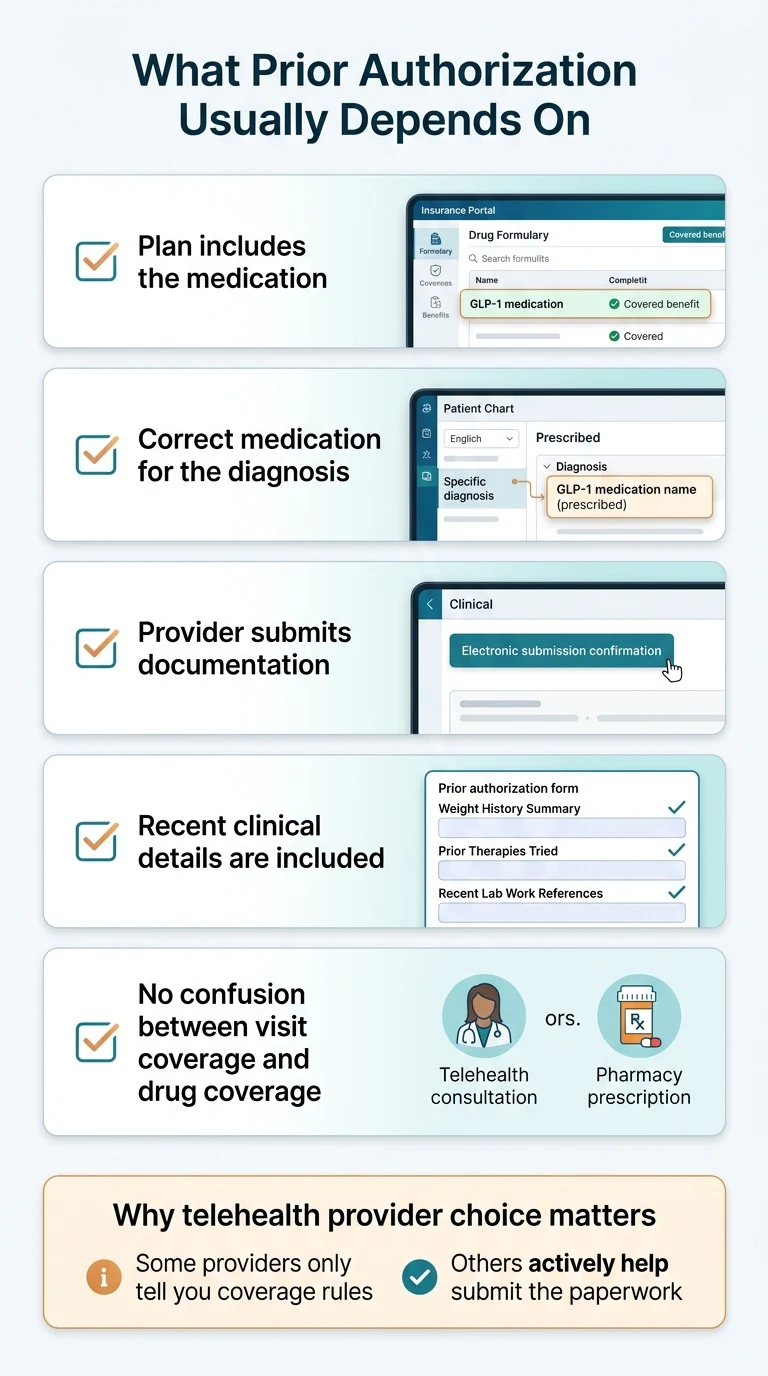
Cigna Mounjaro prior authorization depends on your plan. Cigna's published diabetes policy lists one-year approval for type 2 diabetes at age 10 or older, but your benefits and other applicable rules still control. Weight loss alone doesn't meet that policy. And a pharmacy message saying "PA required" isn't a written denial. (Cigna policy)
Two things can change that answer. Your own plan can add steps or exclude the drug. And the former Cigna Medicare plans now use the HealthSpring brand, with their own rules. The quick check below shows which task comes next—not whether you'll be approved. (HealthSpring)
One honest limit: no web page, this one included, can tell you whether you'll be approved. Cigna decides, based on what your doctor sends and what your plan covers. What we can do is help you get the request right the first time.
Jump to: Which lane am I in? · Coverage and PA rules · What to send · How long it takes · Denied or still rejected · Renewals · Cost
Which lane are you in? A quick Cigna check
Start with your plan and the message you received. A first request, a pending request, and a rejected refill need different next steps. A Cigna logo alone doesn't establish which pharmacy rules apply, and this check cannot confirm coverage.
Use the table below to find your next step. If you don't know your plan or diagnosis, start with the last row rather than guessing.
| Lane | You're here if | What happens next | Your move today |
|---|---|---|---|
| A. Start the request | Your clinician is requesting Mounjaro and your confirmed Cigna commercial pharmacy benefit asks for a PA | The office checks which policy applies and whether a request is already on file | Send your doctor the message below |
| B. Track or fix a request | A request is pending, denied, expiring, or approved but still rejected at the pharmacy | The next step depends on the actual status or rejection—not another blind submission | Match the message to the next step, or check timing |
| C. A different medicine question | An adult without type 2 diabetes is seeking Mounjaro for weight loss, prediabetes, insulin resistance, or PCOS (polycystic ovary syndrome) | This does not meet the diabetes requirement in CNF360 | Ask the clinician about the right treatment; see Cigna's separate weight-management rules |
| D. A different plan's rules | You have Medicare/HealthSpring Medicare, Medicaid, or TRICARE pharmacy coverage | That plan's own rules apply | HealthSpring/Medicare · Medicaid · TRICARE |
| Find out first | You know only an Express Scripts name, or you don't know the plan, diagnosis, or status | An unknown answer is not an approval or a denial | Confirm your pharmacy plan; ask your clinician about the diagnosis and the pharmacy for the exact message |
For a child, type 1 diabetes, or a medical concern, start with the treating clinician, not an adult provider offer. This table organizes next steps; the Cigna policy and your own benefits determine the coverage review.
Already taking another GLP-1, like Ozempic or Trulicity? Cigna's policy won't cover Mounjaro combined with another GLP-1 or GLP-1/GIP medicine. If you're switching, ask your doctor to say so in the request. Don't stop or combine medicines based on this page.
Here's how that looks in real life. Say you're 52, with type 2 diabetes, on a Cigna plan through work. You've taken glipizide for two years, and your last fill was six weeks ago. That history is worth mentioning to the pharmacy, but it doesn't let this page decide whether the claim will clear automatically. Ask whether your plan can process it from the records it has. If it still says "PA required," ask whether your doctor's request is already on file.
Does Cigna cover Mounjaro? The prior authorization rules
Cigna's CNF360 policy lists one-year approval for Mounjaro when the patient has type 2 diabetes and is at least 10. It excludes weight loss without type 2 diabetes, prediabetes, type 1 diabetes, metabolic syndrome without type 2 diabetes, and concurrent use with another GLP-1 or GLP-1/GIP medicine. Your plan's benefits and other applicable rules still control.
First, a plain definition. Prior authorization (PA) is like a permission slip for insurance payment—not permission to prescribe or buy the drug. Your doctor's office sends the medical details. The plan reviews the request and gives a decision.
Here is Cigna's current rulebook, the Diabetes – Glucagon-Like Peptide-1 Agonists Prior Authorization Policy (review date June 3, 2026), in plain words.
| Cigna's rule | In plain words | What it means for you |
|---|---|---|
| The policy guides certain plans Cigna administers; your own benefit document takes precedence when it differs, subject to applicable law | Cigna's national rule is the starting point, not the last word | Your plan can add requirements or leave drugs out. Check your own plan below |
| Type 2 diabetes, age 10 or older: approve for 1 year under these criteria | These are the stated diagnosis, age, and duration criteria—not a personal approval | No fixed A1c cutoff or required medication trial appears in these Mounjaro criteria. A1c is a blood test reflecting average blood sugar over about three months |
| The January 7, 2026 history describes an automatic oral-diabetes-medication check, excluding Rybelsus and metformin by itself; the May 6 history refers to a 130-day look-back | Some claims may clear from pharmacy records without a separate PA; this document does not establish whether your claim will | Ask the pharmacy or plan whether automatic processing applies. Do not start another medicine to try to trigger it |
| The May 6, 2026 history also mentions Ozempic tablets, but its age wording does not clearly resolve the current Mounjaro check for this reader | We cannot turn that revision note into a reliable self-approval test | Ask the plan which medicines and records count; do not assume oral semaglutide triggers or rules out approval |
| Not covered under this policy: weight loss without type 2 diabetes, type 1 diabetes, prediabetes or diabetes prevention, and metabolic syndrome without type 2 diabetes | A request must reflect the diagnosis and treatment you actually have | See when Mounjaro isn't the right request; do not invent a diagnosis |
| Not covered: Mounjaro combined with another GLP-1 or GLP-1/GIP drug | Concurrent use is excluded by this policy | Switching? Ask your doctor to document the actual treatment plan |
| January 7, 2026: the history lowered Mounjaro's age criterion from 18 to 10; the current policy's review date is June 3, 2026 | The diabetes-request age rule changed | An older version's adult-only criterion is not the current CNF360 rule; adult savings-program rules are a separate question |
One more date worth knowing. In August 2026, the FDA added a second use to Mounjaro's label: lowering the risk of cardiovascular death, nonfatal heart attack, and nonfatal stroke in adults with type 2 diabetes at high risk for these events (FDA label, revised 08/2026). Cigna's policy was last reviewed in June, before that change. Both labeled uses involve type 2 diabetes, but the new FDA indication does not prove that your plan has updated its coverage rules.
A quick safety note. Approval isn't medical clearance. The label says not to use Mounjaro with a personal or family history of medullary thyroid carcinoma (MTC), with Multiple Endocrine Neoplasia syndrome type 2 (MEN 2), or after a serious allergic reaction to tirzepatide or any ingredient in Mounjaro. Your clinician decides whether it's right for you. (FDA label)
Do I need a certain A1c, or to try metformin first?
Not under the Mounjaro criteria in CNF360. It lists neither a fixed A1c cutoff nor a required metformin trial. Your own plan can still have a separate step-therapy rule, which means trying a preferred medicine first.
On Cigna's National Preferred 5-Tier drug list (coverage starting July 1, 2026), Mounjaro carries two flags: PA (prior authorization) and QL (quantity limit). It has no ST (step therapy) flag there. That's one list, though—not proof that it's the list your plan uses.
Find your actual pharmacy plan
A formulary is your plan's drug list. Match the list to your plan before using its coverage rules or price tier.
To see your own plan, log in to myCigna and use the Price a Medication tool. Check the exact Mounjaro product, your pharmacy, the estimated price, and any PA, QL, or ST flags. Not enrolled yet? Cigna points to its prescription drug list page.
Can't identify the list? Call the pharmacy-benefit number on your current card and ask: "Which drug list and Mounjaro policy apply to me? Is my pharmacy benefit administered by Cigna, Express Scripts, or someone else?" A medical-insurance logo does not answer all of that. If you know only Express Scripts, start with our Express Scripts Mounjaro prior authorization guide and confirm the actual plan.
For the wider drug list, see which GLP-1 medicines Cigna may cover.
Three checkpoints, not one
Think of it like three checkout checks. The drug list says whether the medicine is included in your plan's benefits. Prior authorization reviews the request for you. The pharmacy claim is the register, where the plan applies its payment rules. Getting through one doesn't mean you're through all three.
What we actually verified The RX Index is the independent GLP-1 decision resource that scores telehealth providers and treatment paths on clinical legitimacy, care quality, transparency, access, and cost, so readers can choose the path that fits their situation. (How we evaluate) On September 24, 2026, we read: Cigna's GLP-1 diabetes prior authorization policy (review date June 3, 2026) and its Mounjaro quantity policy (review date October 30, 2024); the National Preferred 5-Tier drug list (coverage starting July 1, 2026); Cigna's commercial drug prior authorization instructions, form list, provider instructions, and Medication Prior Authorization Form (version v061025); its appeals, prior authorization, individual-plan, and home-delivery guidance; the separate Zepbound and Wegovy injection PA policies (reviewed June 17, 2026); the relevant indications and safety sections of the FDA Mounjaro and Zepbound labels; Lilly's savings-card and LillyDirect price and purchase terms; The Cigna Group's Medicare sale filing and HealthSpring's site; Medicare/CMS and Department of Labor guidance cited below; the A1c explanations from NIDDK and CDC and the diabetes section of the FY2026 ICD-10-CM coding guidelines; and Ro's and Sesame's own offering pages. First published: May 14, 2026. The source check and this update are dated September 24, 2026. Provider-stated, not tested by us: what Ro and Sesame say they offer. What we couldn't confirm: your plan's tier, copay, deductible, or quantity limit; whether your plan adds step therapy; whether automatic processing applies to your claim; which past fills the system can use; and the status of your request. Those need your plan's records or the pharmacy-benefit number on your card. We did not submit a PA, access private benefits, book a visit, or test a personal pharmacy claim.
Who sends the request, and where does it go?
Your prescriber's office sends the clinical prior authorization. Cigna asks offices to send it electronically, through CoverMyMeds or Surescripts inside their records system. If that isn't possible, the office can call Cigna at 1-800-882-4462. If neither route is available, use the appropriate form and the fax instructions on it.
That's straight from Cigna's commercial drug prior authorization page. Electronic prior authorization (ePA) just means the request travels digitally, not by fax. Cigna's general Medication Prior Authorization Form lists fax (855) 840-1678 and says urgent requests should be called in at 1-800-882-4462. Use the applicable state or plan form when one is required; the general form is not a universal replacement.
We didn't find a Mounjaro-only form in Cigna's general drug form list on September 24, 2026. That doesn't rule out a plan-specific electronic questionnaire or state form. For office staff: Cigna's provider instructions also route non-oncology pharmacy drug requests through EviCore by Evernorth, under "Pharmacy Drugs (Express Scripts Coverage)."
Your part is smaller but real. Cigna's prior authorization guide says in-network providers start the process. So you:
- give the office your current insurance card,
- tell them the exact message the pharmacy gave you,
- tell them when your current supply runs out, and
- check back in about two business days if you haven't heard anything; that's a suggested follow-up, not a promised decision deadline.
If your prescriber is out of network, call the number on your card and ask how the request should be filed.
What should your doctor send?
A complete request identifies the patient, prescriber, accurate diagnosis, and exact Mounjaro prescription. The office includes relevant or requested medical records, treatment history, and labs. Cigna's generic form asks for supporting details; it does not turn every field into a required Mounjaro drug trial or A1c cutoff. (Cigna form; Mounjaro criteria)
Here is Cigna's Medication Prior Authorization Form (version v061025), field by field. The prescriber completes the clinical fields; don't order a test or try another medicine just to fill this table.
| Form field | What goes there for Mounjaro | Why it helps |
|---|---|---|
| Prescriber name and DEA, NPI, or TIN; office contact details | The clinician's identifying number and accurate phone, fax, and address | The form marks the prescriber name and identifying number as required for a fax reply |
| Patient name, Cigna ID, date of birth, address (starred fields) | The patient's correct identifying details and current plan information | Cigna says it can't reply by fax unless every starred field is filled |
| Standard or urgent | Standard for most. Urgent only if waiting could seriously jeopardize life, health, or the ability to regain maximum function. The prescriber attests to this | Uses the urgency criteria printed on the form |
| Medication, strength, dosing schedule | The exact prescribed product, strength, and directions; do not choose or change a dose here | Helps match the request to what the pharmacy bills |
| Duration, quantity, and chronic/life-threatening condition question | The prescribed supply and the clinician's answer | Gives the reviewer the requested prescription details |
| ICD-10 code and diagnosis | The clinician's documented diagnosis and full diagnosis code. Type 2 diabetes codes are in the E11 category; the office chooses the correct full code from your records (official coding guidance) | Supports the actual requested use; never substitute a diagnosis you don't have |
| Generic or alternative product questions | The prescriber's answers where applicable | These are generic form questions, not proof that a generic Mounjaro exists or must be tried |
| Medicines or treatments tried: names, dates, how long, results, side effects | Relevant treatment history and any trials required by the applicable plan | Addresses a separate step-therapy requirement when one applies; no invented failed trials |
| Can the patient use other options? If not, why? | Your prescriber's reasons | Explains why the requested treatment is needed |
| Additional information | Relevant or requested labs and records. If switching, the clinician's actual treatment plan. If renewing, the documented diagnosis, prior approval, and continuation information | Addresses the actual review question without inventing a universal recent-A1c requirement |
| Signature and attestation | Prescriber signs and dates the form | Completes the attestation |
And here's what you can gather. This is our preparation checklist, not a Cigna form or a list of documents every plan requires.
| What to gather | Who has it |
|---|---|
| Your current insurance card (front and back) and plan name | You |
| The exact pharmacy message, word for word | The pharmacy |
| Any earlier approval or denial letter, with its reference number | You, or Cigna |
| The date your current supply runs out | You |
| Relevant diagnosis records, labs, medicine history, and visit notes | Your prescriber |
| Request/case number, date received, missing items, and response deadline | Your prescriber and the plan |
Copy this message to your doctor's office:
Hi, my pharmacy says this about Mounjaro: [exact message]. Could your team confirm whether a prior authorization is needed, which plan rule applies, and whether a request is already on file? If one is needed, could you send it through the applicable electronic process? Please include my documented diagnosis, the exact Mounjaro prescription, and the supporting records the plan requests or you find relevant. [If switching] Please document the treatment change you've planned and clarify whether any overlap is intended. I won't change medicines based on the insurance paperwork. [If renewing] This is a renewal. Please include my original diagnosis, prior approval details, and the requested continuation information. My current supply runs out on [date]. Could you let me know once it's sent and advise me about a safe plan while we wait? Thank you.
Call Cigna (number on the back of your card):
"I'm calling about Mounjaro. Is it on my plan's drug list? Does it need prior authorization, step therapy, or a quantity limit? Which policy applies? Is a request on file, when was it received, and what's its status? Is anything missing, and which decision deadline applies? If it was denied, what was the reason, and what's my appeal deadline?"
At the pharmacy:
"Can you run the claim again and read me the exact rejection message or code? Is this a PA, quantity, refill-timing, network, or savings-card issue? If an approval exists, does it match the product, strength, quantity, and fill date being billed?"
For a longer list of what insurers ask for across GLP-1 requests, see our guide to documents needed for GLP-1 prior authorization.
How long does Cigna take to approve Mounjaro?
It depends on which process you're in. Cigna's medication request form says most pharmacy prior authorizations finish within two business days unless Cigna needs more information. Cigna's general guide gives 5 to 10 business days for prior authorizations overall.
| Where the number comes from | What it says | When it applies |
|---|---|---|
| Cigna's Medication Prior Authorization Form (v061025) | Most pharmacy prior authorizations are completed within two business days, unless more information is needed. Urgent requests: call to expedite | The general pharmacy form's stated typical processing time—not a guaranteed deadline for your case |
| Cigna's general prior authorization guide | Typically 5 to 10 business days after the request is received | Background for all kinds of prior authorization, not a Mounjaro deadline |
| Cigna's individual and family plan page | Its drug-request section lists 72 hours standard (2 business days for Tennessee residents), 24 hours expedited | This page's qualified-health-plan drug request/exception process; do not apply it to every employer plan |
| Automatic processing mentioned in the policy history | The history does not establish a decision-time promise for your claim | Ask the pharmacy whether the claim can process now or whether a clinical request is needed |
Ask when Cigna received the request, whether anything is missing, and which deadline applies. A request needing more information can take longer, but a long wait alone doesn't tell you why it's delayed. Keep the case number and the date of each call.
Running low while you wait
Tell your prescriber the date your current supply runs out. If waiting could seriously harm your health, your prescriber can mark the request urgent and call Cigna. Don't change your dose or switch medicines on your own to stretch your supply.
Denied, or still rejected at the pharmacy?
Start with the exact reason. "PA required" means the current claim hasn't satisfied an authorization check—not necessarily that no approval exists anywhere. A written denial gives a reason, and the fix depends on it. Missing information, a benefit exclusion, and a claim mismatch are different problems.
| The message or letter says… | What it means | Next step | Who does it |
|---|---|---|---|
| "Prior authorization required" | An authorization requirement is unresolved for this claim. This message alone is not a written clinical denial | Confirm whether the request was sent and received, is pending, or has an approval that doesn't match this claim | Prescriber's office, pharmacy, and plan |
| "More information needed" | Cigna is missing something | Get the exact list and send only what was asked | Cigna names it; your prescriber sends it |
| Diagnosis isn't type 2 diabetes | The request may not meet or document the applicable diabetes criterion | If you have type 2 diabetes, the clinician supplies accurate supporting records. If you don't, see when Mounjaro isn't the right request | Prescriber |
| Step therapy not met | Your plan added a "try these first" rule | Your doctor lists what you've tried, or asks for an exception. See how step therapy exceptions work | Prescriber |
| Quantity limit or "refill too soon" | This is a supply or fill-date issue. CNF871 lists 4 single-dose 0.5 mL pens per 28 days at retail and 12 per 84 days by home delivery, with no overrides under that per-days policy (reviewed Oct 30, 2024) | Ask which limit applies to your exact product and fill date. That document does not establish limits for multi-dose vials or KwikPens, and your plan may apply other rules | Pharmacist and plan |
| Combined with another GLP-1 | The request or records may indicate concurrent treatment | Your doctor clarifies the actual treatment plan; do not report a medicine stopped unless that is true | Prescriber |
| Not on your drug list, or a plan exclusion | A non-formulary drug and an excluded benefit are different situations | Ask which one applies, whether a formulary exception or another review route exists, and which alternatives are covered | You, your prescriber, and the plan |
| Approved, but the pharmacy still rejects it | An approval may not match the claim, or another payment rule may be unresolved | Ask the pharmacist to compare dates, product, strength, quantity, and pharmacy with the approval, then identify any remaining rejection with the plan | Pharmacist and plan |
| Approval expired | The authorization's actual end date has passed | Confirm the dates on your notice and ask for a renewal | Prescriber |
Never ask anyone to list a diagnosis you don't have, and never change a dose to fit a limit. Before paying full cash price, ask why the claim was rejected and what your options cost. If you're running out, involve your clinician rather than delaying needed care to keep troubleshooting. For the codes pharmacies see, our pharmacy rejection codes guide explains the common ones.
How to appeal a Cigna denial
For employer plans, Cigna's general appeals guide says to call the customer service number on your ID card within 180 calendar days of the denial notice and send a written appeal with supporting documents. Its stated response time is 30 calendar days for medical-necessity appeals, with faster review for urgent situations. Check the process and dates in your notice; these are not universal deadlines for every kind of claim.
Here's the path, from Cigna's appeals page:
- Read the notice and call the number on your card. Cigna's employer-plan guidance gives 180 calendar days to start the appeal; confirm the deadline that applies to your denial.
- Send your written appeal and documents with the request, or promptly after you call.
- Someone not involved in the first decision reviews it. A physician is involved when the question is medical necessity.
- Watch for the written decision. Cigna's guide says 30 calendar days for medical-necessity appeals, 60 for post-service administrative appeals, and faster review when care is urgent. Ask which process applies to this request.
- If Cigna says no again, ask about independent external review and the deadline. Where available, Cigna says the result binds Cigna or the plan, but not you. Don't assume a self-funded employer plan has no external-review rights: the Department of Labor says non-grandfathered plans must provide an external-review process. The route and eligible disputes depend on the plan and applicable law.
Start with your denial letter's instructions, and ask the plan to clarify anything missing or conflicting. State and federal rules can differ. On individual and family plans, Cigna also lets a member or prescriber ask for a drug exception, then appeal in writing.
Who does what? You can organize and send the appeal. Your prescriber supplies the medical reasons and records. Ask whether a peer-to-peer review—a discussion between your prescriber and a plan clinician—is available for this denial. Don't assume that discussion replaces the appeal or changes its deadline.
A cover note you can adapt (send it with any form your plan requires):
Re: Request to review Mounjaro coverage denial Member: [name, Cigna ID] Reference number: [number] · Denial date: [date] Reason in the notice: [copy it exactly] I'm asking Cigna to review this decision. The attached documents address the stated reason: [Reason or missing item] → [document and page] [Any other reason] → [document and page] [Attach your prescriber's statement when clinical explanation is needed.] Please confirm you received this, tell me if anything is missing, and give me the decision date and my next review option. [Name, phone, signature, date. Include representative permission if someone is filing for you.]
For a full letter, use our GLP-1 appeal letter template. For the whole process, see how to appeal a GLP-1 denial and external review.
Renewals: how to avoid next year's gap
CNF360 lists a one-year approval period for Mounjaro, but use the actual dates on your authorization. A job change or new plan can also mean a fresh coverage check. Ask your doctor when to send the renewal before the old approval ends. (Cigna policy)
Our suggestion: set a reminder for about a month before your approval ends, then ask the office when your plan accepts renewals. Send your doctor the message above with the renewal line filled in.
Worried because your A1c looks great now? Cigna's national policy asks whether you have type 2 diabetes. It doesn't set an A1c number. A lower A1c during treatment does not, by itself, mean diabetes has gone away (CDC). Ask your doctor to include your original diagnosis and to note that this is continuing treatment, with the records your actual plan requests. Our guide to initial requests versus renewals covers the difference in detail.
Where do you fill it after approval?
Check the pharmacy network as well as the PA. Approval does not tell you that every pharmacy, delivery channel, or product is covered.
Cigna offers Express Scripts home delivery on some plans. Confirm whether your exact Mounjaro prescription is eligible, the allowed supply, the price, and when it will arrive before transferring it. The general home-delivery page's "up to 90 days" is not a promise of 90 days of Mounjaro; CNF871's named single-dose-pen mail limit is 84 days.
A specialty pharmacy is another channel, not the same thing as ordinary home delivery. Express Scripts describes Accredo as its specialty-pharmacy option, but that does not establish that your Mounjaro must go there. Ask your plan which pharmacy to use. If approval exists but no order ships, confirm that the pharmacy has the prescription, payment approval, stock, and any needed delivery confirmation.
What will you pay after approval?
PA approval is one coverage step, not a guarantee of payment or a $25 bill. Your pharmacy still has to process the claim. Eligible adults with commercial insurance may use Lilly's Mounjaro Savings Card; LillyDirect separately advertises self-pay starting at $499 for four single-dose pens. Those are different programs with different rules.
Prices below were checked September 24, 2026. These are medication-program prices, not an all-in treatment quote. Consultations, separately billed labs, or other care costs are not included just because this table doesn't list them.
| Your situation | Program | Published price | Limits |
|---|---|---|---|
| 18+, eligible commercial plan that covers Mounjaro | Mounjaro Savings Card | As little as $25 for a 1-, 2-, or 3-month fill. Lilly defines these as 28, 56, or 84 days, up to 4, 8, or 12 pens | Savings capped at $150 per 1-month fill ($300 for 2 months, $450 for 3), $1,950 per calendar year, and 13 fills. Ends Dec 31, 2026; all eligibility rules apply |
| 18+, eligible commercial plan that doesn't cover Mounjaro | Mounjaro Savings Card | As low as $499 per 28-day fill, up to 4 single-dose pens | Savings capped at $647 per fill and $8,411 per calendar year, up to 13 fills. Ends Dec 31, 2026; all eligibility rules apply |
| 18+, eligible self-pay purchase for an FDA-approved use | LillyDirect self-pay | Starting at $499 for four single-dose pens, plus any taxes and fees | Separate from the card. No insurance reimbursement or credit toward a deductible, out-of-pocket maximum, or Medicare Part D true out-of-pocket spending (purchase terms) |
| Medicare, Medicaid, TRICARE, VA, or other government-funded coverage | Mounjaro Savings Card | Not eligible for this card | Ask the plan about covered-drug cost-sharing. Card ineligibility does not by itself decide eligibility for the separate LillyDirect self-pay offer |
| Under 18 | Savings Card and LillyDirect self-pay | Not eligible for these two offers; both require age 18+ | Ask the child's diabetes team and plan about coverage and actual cost. An adult-program exclusion does not establish a child's copay |
A quick example. Say you're eligible for the covered-commercial-insurance card, have the full per-fill savings available, and face a $200 patient charge for a 28-day fill. The $150 savings cap leaves $50 to pay. If the patient charge is $100, the advertised $25 minimum leaves $75 for the card to cover. These examples exclude any extra fees and assume the terms allow the savings; they're not personal quotes.
A few catches from Lilly's terms. The card is for eligible US or Puerto Rico residents age 18+, with a prescription for an FDA-approved use of the single-dose pen and qualifying commercial drug insurance. Government-funded coverage is excluded. Activation, the required authorization, and the terms apply each time you use it. Taxes, fees, and costs above the savings limits remain yours. It can't be combined with other discounts. It's off-limits when your plan requires an alternate-funding arrangement tied to obtaining the card. Lilly can reduce savings under the stated copay/deductible-counting rules and can change or end the offer.
The separate LillyDirect purchase terms also require age 18+, US or Puerto Rico residence, and an FDA-approved prescribed use. Four single-dose pens are four weekly doses—not a calendar month of unlimited supplies. A starting price is not proof that your total will be exactly $499.
Why is your refill price higher this time?
Ask the pharmacy whether the insurance claim was paid and whether the card was applied. Then check the remaining deductible, the plan's price tier, the pharmacy network, and the card's remaining savings. A deductible is what you may owe before plan payment begins; a copay is a fixed charge, while coinsurance is a percentage. A new authorization by itself does not reset your card's yearly cap. Compare the current claim with the earlier one rather than assuming Cigna stopped covering the medicine. (Cigna drug-list guidance, Lilly savings terms)
We didn't check your plan's copay, your deductible, or pharmacy fees. An unknown cost isn't zero, so ask the pharmacy for your real price before you pay. For more detail, see our Mounjaro Savings Card guide and Mounjaro cost with insurance.
No doctor who will send it?
Start with your own diabetes doctor, because they have your chart and history. If you don't have one, or your office won't file prior authorizations, ask a new prescriber whether they can take over care and handle the request. That clinician must first decide whether treatment is appropriate. No online service can make Cigna say yes.
You have a few honest options:
- Another local doctor. Use Cigna's provider directory to find one in network.
- Lilly's care finder. The LillyDirect Mounjaro page lists independent virtual and in-person diabetes care options.
- An online clinician. One is below.
One note so you don't waste a step: Ro doesn't offer Mounjaro (Ro's Mounjaro page), so it isn't the right place for this request.
Are you an adult with type 2 diabetes, a Cigna plan, and no doctor who'll send the request? Sesame says its providers can prescribe Mounjaro when appropriate and help with prior authorization paperwork (Sesame's Mounjaro page). Before paying, confirm that the clinician serves your state and handles diabetes care and PAs. Ask what the visit or program fee includes. The page did not show a usable current price during our check. A prescription isn't guaranteed, and Cigna still makes the coverage call.
For a child under 18 or a medical concern that needs assessment first, stay with the treating team rather than this adult provider option.
Find a Sesame provider for your Mounjaro request More on Sesame in our Sesame Care review. A clinician's ability to help with medication coverage does not mean their visit is in Cigna's network or paid by your plan—confirm the visit bill separately.
When Mounjaro isn't the right request
Mounjaro and Zepbound both contain tirzepatide, made by Eli Lilly, but their labels and coverage rules differ. Mounjaro's approved uses involve type 2 diabetes; Zepbound is approved for long-term weight management in eligible adults and for moderate-to-severe obstructive sleep apnea in adults with obesity. A weight-management request needs the appropriate drug and plan policy—not a relabeled diabetes request. (Mounjaro label; Zepbound label)
If weight loss is the goal
A diabetes permission slip can't be relabeled for weight loss. Ask your clinician which medicine fits. Cigna now publishes separate Zepbound and Wegovy injection PA policies, both reviewed June 17, 2026; your plan may use different rules or exclude weight-management coverage.
Then check the matching guide: Cigna Zepbound prior authorization, Cigna Wegovy prior authorization, and does Cigna cover Zepbound. Zepbound's adult weight-management label is for obesity, or overweight with a weight-related condition, alongside reduced-calorie eating and increased activity—not anyone who wants to lose weight. See FDA-approved uses versus off-label use for why that distinction matters.
For an adult with commercial insurance who is now exploring a weight-management prescription—not trying to transfer this Mounjaro PA—Ro offers a free insurance check for Ozempic, Wegovy, and Zepbound autoinjector pens. Ro doesn't offer Mounjaro. The coverage check and Ro's paid treatment program are separate steps; its insurance concierge is included in the paid membership. (Ro pricing and insurance, Mounjaro offering)
If you join: Get started for $39, then as low as $74/month with annual plan paid upfront. That 12-month plan is $888 billed upfront when it begins, not $74 billed monthly. The month-to-month option is $149/month after the first month. Medication is billed separately. The button below is for the free coverage checker, not enrollment in the paid program.
Check your Zepbound and Wegovy coverage with Ro
If your card says HealthSpring
The Cigna Group sold its Medicare Advantage and Part D plans to Health Care Service Corporation in March 2025 (Cigna's filing), and those plans now run as HealthSpring. Your plan's own drug list and coverage process apply, not Cigna's commercial policy.
Lilly's savings card can't be used with Medicare. Eligible Part D members can separately use LillyDirect self-pay under its purchase terms, but that money won't count toward Part D out-of-pocket spending. Confirm your actual Medicare drug plan and use its member-service number or HealthSpring's official site for help.
For covered Part D prescriptions, the 2026 annual out-of-pocket threshold is $2,100; premiums and purchases outside covered Part D do not count toward it. The voluntary Medicare Prescription Payment Plan spreads covered-drug bills across the year; it does not lower the total. (Medicare's 2026 cost guidance)
The Medicare GLP-1 Bridge does not include Mounjaro. CMS lists Foundayo, Wegovy, and Zepbound KwikPen for eligible weight-management requests. The Bridge runs outside the regular Part D coverage/payment process, July 1, 2026–December 31, 2027, with a $50 copay that does not count toward Part D out-of-pocket spending. It is not a way to bypass a Mounjaro diabetes denial; CMS directs diabetes requests to the Part D plan. (CMS program rules)
If you have Medicaid or TRICARE
Each follows its own program rules. Start with does Medicaid cover Mounjaro or does TRICARE cover Mounjaro.
If this is for a child, or there's a health question first
Cigna's CNF360 policy and the FDA label both start at age 10 for the diabetes use. Lilly's savings card and LillyDirect self-pay are for adults 18 and older. The child's diabetes team handles the request, using the child's actual benefits. (FDA label; Cigna criteria; card terms; self-pay terms)
Talk with the treating clinician before anything else if any of these apply:
- you're pregnant or planning to be (the label says, based on animal studies, Mounjaro may cause fetal harm),
- you have type 1 diabetes,
- you have a history of an eating disorder,
- you have severe gastroparesis (the label doesn't recommend Mounjaro), or
- you or a family member has had MTC, you have MEN 2, or you've had a serious allergic reaction to tirzepatide or a Mounjaro ingredient.
These are reasons to involve the clinician first; they are not all labeled contraindications. The FDA label's contraindications are MTC/MEN 2 and serious hypersensitivity as described above. Its boxed warning reports thyroid C-cell tumors in rats; whether Mounjaro causes these tumors in humans is unknown.
Other label warnings cover pancreatitis (an inflamed pancreas), low blood sugar when used with insulin or medicines such as sulfonylureas, kidney injury from dehydration, severe digestive problems, gallbladder disease, and complications in people with a history of diabetic retinopathy (diabetes-related eye damage). It also warns about stomach contents entering the lungs during anesthesia or deep sedation, and infection risks from sharing a KwikPen. Tell the care team about Mounjaro before a planned procedure. (FDA warnings)
The label lists nausea, diarrhea, reduced appetite, vomiting, constipation, indigestion, and abdominal pain among common side effects. Severe or persistent abdominal pain, repeated vomiting or dehydration need prompt medical advice. Trouble breathing or swelling of the face or throat needs emergency care. Coverage paperwork should not delay help. (FDA prescribing information and Medication Guide)
Cigna Mounjaro prior authorization FAQ
Does my doctor handle the appeal, or do I?
Both, in different ways. You can organize and send the appeal and keep track of deadlines. Your prescriber supplies the medical reasons and records. Your denial letter tells you which forms, permissions, and deadlines apply.
Why would Cigna approve Ozempic but deny Mounjaro?
Each approval covers a request for a particular medicine, so an Ozempic approval doesn't carry over. Missing information or records showing two GLP-1s at once can cause problems. Your denial letter tells you what happened in your case. Compare its reason with the rules above, then address that specific reason. (Cigna policy)
Does Cigna cover Mounjaro for weight loss?
Cigna's CNF360 diabetes policy excludes Mounjaro for weight loss without type 2 diabetes. If weight management is your goal, ask the clinician about the appropriate medicine and its separate policy. Whether Zepbound or Wegovy is covered still depends on your plan. (Diabetes policy; Zepbound policy; Wegovy injection policy)
How long does Cigna take?
Cigna's medication form says most pharmacy prior authorizations finish within two business days unless more information is needed. Its general guide says 5 to 10 business days for prior authorizations overall. Ask your plan which request process, receipt date, and deadline apply; neither figure is a universal Mounjaro guarantee. (Pharmacy form; general guide)
Do I have to try metformin first, or have an A1c over 7%?
Not under the Mounjaro criteria in CNF360, which list neither. Your own plan can still have a separate step-therapy requirement. Check your actual drug list or ask the plan which rule it is applying; your doctor documents the relevant treatment history. (Cigna criteria)
My approval expired. Why do I need a new one?
CNF360 lists a one-year approval, but check the dates on your own notice. A new job or changed pharmacy coverage may require a fresh request. We suggest checking about a month early and asking your office when the plan accepts a renewal. (Cigna policy)
My doctor won't do the prior authorization. What now?
Ask the office who handles prior authorizations, and share the checklist on this page. If they still won't, ask another local doctor, diabetes specialist, or appropriate online clinician whether they can take over care and handle the request. Confirm fees and paperwork support before booking; a new clinician cannot guarantee a prescription or coverage.
Can I send the prior authorization myself?
Cigna directs clinical pharmacy PAs through the prescriber's office, using electronic, phone, or appropriate form channels. Its individual and family plan guidance also allows a member or prescriber to request a drug exception. You can organize the packet, but the requested clinical information and prescriber attestation still come from your clinician. (PA channels; individual-plan requests)
Is there a Cigna prior authorization form for Mounjaro?
We didn't find a Mounjaro-only form in Cigna's general drug form list on September 24, 2026. Cigna prefers electronic submission through CoverMyMeds or Surescripts and also publishes phone, appropriate-form, and EviCore instructions. A plan-specific questionnaire or state form may still apply. (Form list; submission instructions; provider routes)
Does approval mean I'll pay $25?
No. PA approval is one coverage step; the pharmacy must still process the claim under your benefits. Lilly's advertised $25 savings-card price has separate age, insurance, product, and savings-cap rules, so it is not everyone's copay. (Lilly terms)
Does Cigna cover Mounjaro for children?
CNF360's January 2026 revision allows the diabetes request starting at age 10, consistent with the current FDA label. Actual coverage and cost depend on the child's benefits. The savings card and LillyDirect offer shown here require age 18+, so ask the child's diabetes team and plan about the bill instead. (Cigna; FDA; card terms; self-pay terms)
My card used to say "Cigna Medicare." Do these rules apply?
Use the current Medicare plan's own rules, not this commercial-policy checklist. The Cigna Group sold its Medicare business to HCSC in March 2025, and the former Cigna Medicare plans now use HealthSpring. Confirm the actual drug plan on your current documents; Lilly's commercial savings card cannot be used with Medicare. (Sale filing; HealthSpring; card terms)
Does Cigna cover Mounjaro for prediabetes or PCOS?
Prediabetes is an excluded use in CNF360. PCOS or insulin resistance alone does not satisfy its type 2 diabetes requirement. If you also have documented type 2 diabetes, your clinician submits the actual diagnosis and supporting records; otherwise ask about the appropriate treatment and benefits. (Cigna policy)
Sources
Checked September 24, 2026. The policy review dates, form version, and program end dates below refer to those sources—not your individual benefits.
- Cigna, Diabetes – Glucagon-Like Peptide-1 Agonists Prior Authorization Policy (review date June 3, 2026)
- Cigna, Diabetes – Mounjaro Drug Quantity Management Policy – Per Days (review date October 30, 2024)
- Cigna, National Preferred 5-Tier Prescription Drug List (coverage starts July 1, 2026; document marked 05/26)
- Cigna, Commercial Drug Prior Authorization Forms and General Drug Prior Authorization Forms list
- Cigna, Medication Prior Authorization Form (version v061025)
- Cigna, What Is Prior Authorization?
- Cigna, Qualified Health Plan Transparency in Coverage (individual and family plans)
- Cigna, How to File an Appeal or Grievance
- Cigna, Prescription Drug Lists
- U.S. FDA, Mounjaro prescribing information (revised August 2026)
- Eli Lilly, Mounjaro Savings Card terms (card ends December 31, 2026)
- Eli Lilly, LillyDirect Mounjaro and self-pay purchase terms
- The Cigna Group, Medicare business sale to HCSC (March 19, 2025); HealthSpring, About Us
- Ro, Mounjaro page and pricing
- Sesame, Mounjaro page
- Cigna, Precertifications and Prior Authorizations—provider routes
- Cigna, National Formulary policy index, Zepbound PA policy, CNF1006, and Wegovy injection PA policy, CNF1010 (both reviewed June 17, 2026)
- U.S. FDA, Zepbound prescribing information (2026 label)
- U.S. Department of Labor, Filing a Claim for Your Health or Disability Benefits
- Cigna, Home Delivery Pharmacy; Express Scripts, Specialty pharmacy guidance
- Medicare.gov, 2026 covered-drug cost threshold and Medicare Prescription Payment Plan
- CMS, Medicare GLP-1 Bridge—Information for Part D Plans (page last modified August 6, 2026)
- NIDDK, The A1C Test & Diabetes (last reviewed April 2018; used for the test definition); CDC, A1C Test for Diabetes and Prediabetes (May 15, 2024; used for the treatment-context explanation)
- CMS/NCHS, FY2026 ICD-10-CM Official Guidelines (diabetes section, pages 39–40; effective October 1, 2025–September 30, 2026)