
GLP-1 Comparison
By The RX Index Editorial Team
Last verified: · FDA prescribing information for Foundayo and Mounjaro verified · Pricing confirmed at LillyDirect, Ro, and Sesame Care · Next scheduled verification: May 2026
Foundayo vs Mounjaro: The Real ComparisonAnd Why Zepbound Is Probably the Comparison You Actually Want
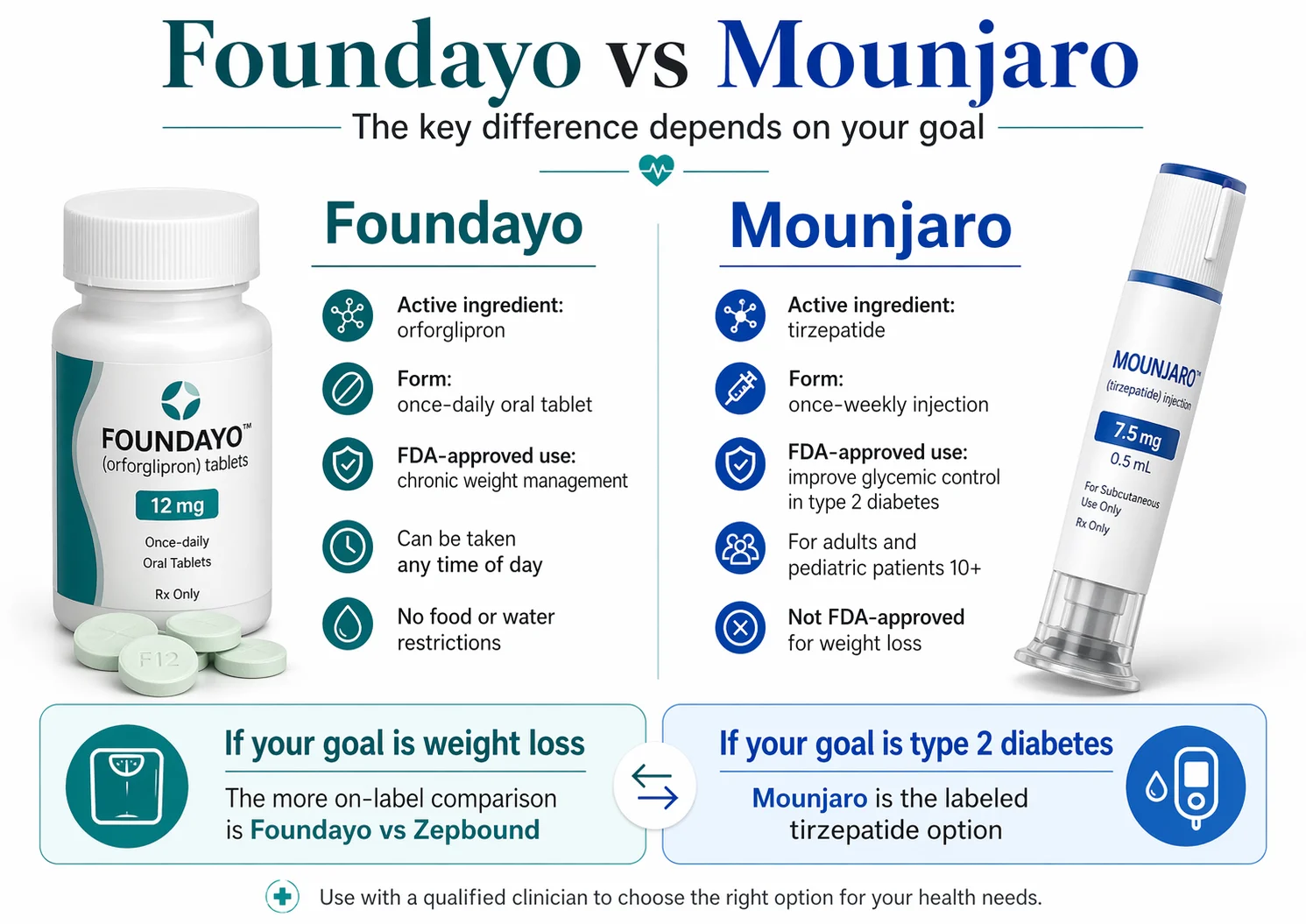
Foundayo vs Mounjaro isn’t a clean pill-vs-shot choice. Foundayo (orforglipron) is Eli Lilly’s once-daily oral GLP-1 pill, FDA-approved on April 1, 2026 for chronic weight management in adults. Mounjaro (tirzepatide) is Lilly’s once-weekly injection, FDA-approved only to improve blood sugar in adults and pediatric patients 10 years and older with type 2 diabetes. They share a manufacturer, they both activate the GLP-1 receptor, and they are otherwise very different medications.
Quick verdict before you read further:
- Cheapest brand-name weight-loss pill, self-pay: Foundayo, starting at $149/month through LillyDirect.
- Most effective tirzepatide product for weight loss: Zepbound (not Mounjaro — same molecule, different label).
- Most insurance-covered option for T2D: Mounjaro, with prior authorization on most commercial plans.
- Best provider path for Foundayo or Zepbound: Ro — start for $39, then as low as $74/month with annual plan paid upfront.
- Best provider path to discuss Mounjaro: Sesame Care (Ro does not currently offer Mounjaro).
Foundayo vs Mounjaro at a Glance
Before unpacking the decision, here’s exactly what you’re comparing:
| Foundayo (orforglipron) | Mounjaro (tirzepatide) | |
|---|---|---|
| FDA-approved for | Obesity; overweight + weight-related condition (adults) | Type 2 diabetes only (adults + pediatric patients 10+) |
| Approved | April 1, 2026 | May 13, 2022 |
| Form | Daily oral tablet | Once-weekly subcutaneous injection |
| Take with food? | Any time, with or without food or water | Any time of day, with or without meals |
| Mechanism | Oral small-molecule GLP-1 receptor agonist | Dual GIP + GLP-1 receptor agonist (peptide) |
| Weight-loss trial data | ~11.1% avg body weight reduction at 72 wk on 17.2 mg (ATTAIN-1 ITT) | Not labeled for weight loss; Zepbound (same molecule) reaches −20.9% mean change at 15 mg in SURMOUNT-1 |
| Starting dose | 0.8 mg once daily | 2.5 mg once weekly |
| Maintenance dose range | 5.5 – 17.2 mg | 5 – 15 mg |
| Self-pay entry price | $149/month (0.8 mg via LillyDirect) | ~$1,112 list price per fill; no equivalent self-pay weight-loss program |
| Commercial insurance + savings card | As low as $25/month for eligible covered patients | As low as $25 for up to a 3-month fill for eligible covered patients |
| Medicare | Eligible under Medicare GLP-1 Bridge at $50/month starting July 1, 2026 | Covered under Part D for T2D only (standard rules); savings card excludes government beneficiaries |
| Boxed warning | Thyroid C-cell tumors | Thyroid C-cell tumors |
| Manufacturer | Eli Lilly | Eli Lilly |
Educational information only. Prescription decisions belong with a qualified clinician.
→ Check eligibility for Foundayo or Zepbound through Ro — Ro’s free GLP-1 Insurance Coverage Checker tells you before you commit whether your plan will pay. If you specifically need Mounjaro for type 2 diabetes, use the Sesame path further down this page.
Check Foundayo / Zepbound eligibility through Ro → (sponsored affiliate link, opens in a new tab)Are Foundayo and Mounjaro Approved for the Same Thing?No — and that’s the whole story.
Short answer: No. Foundayo is FDA-approved for chronic weight management in adults with obesity or overweight plus at least one weight-related condition. Mounjaro is FDA-approved only to improve blood sugar in adults and pediatric patients 10 years and older with type 2 diabetes. Same manufacturer, both activate GLP-1 receptors — not interchangeable, not treating the same condition.
When the FDA approved Foundayo on April 1, 2026, it cleared it for adults with obesity (BMI ≥30) or adults with overweight (BMI ≥27) in the presence of at least one weight-related comorbid condition, used with a reduced-calorie diet and increased physical activity. Orforglipron, the active ingredient, is a once-daily oral GLP-1 receptor agonist — a pill you swallow with or without food, no waiting period, no empty-stomach routine.
Mounjaro, first approved in May 2022, is a completely different drug. Tirzepatide is a dual GIP and GLP-1 receptor agonist injected once a week. Its label is narrow: type 2 diabetes. The label was updated in December 2025 to include pediatric patients 10 years and older. Lilly’s Mounjaro site plainly states Mounjaro is not a weight-loss drug.
That’s not a legal technicality. It changes what insurance will cover, what a doctor will prescribe, and what you should be asking for.
So why do people search “Foundayo vs Mounjaro” instead of “Foundayo vs Zepbound”?
Because Mounjaro got famous. Most searchers don’t realize Lilly split tirzepatide into two brand names — Mounjaro for diabetes and Zepbound for obesity. Here’s the corrected mental model:
- Goal is weight loss: the FDA-approved comparison is Foundayo (pill) vs Zepbound (injection). Mounjaro doesn’t belong in that conversation on-label. See our Foundayo vs Zepbound comparison for that decision.
- Goal is type 2 diabetes control: Foundayo vs Mounjaro is a real comparison — but Foundayo isn’t labeled for diabetes yet (Lilly plans to submit by end of Q2 2026). Today, Mounjaro is the labeled diabetes choice.
- Goal is both (T2D + weight loss): that’s the scenario where the choice gets genuinely interesting — the diabetes section below breaks it down.
→ See which Lilly GLP-1 matches your goal — Ro’s free GLP-1 Insurance Coverage Checker works for Foundayo, Zepbound, Wegovy pill, and Wegovy pen. For Mounjaro-specific coverage questions, use the Sesame path below.
Start Ro’s free GLP-1 Insurance Coverage Check → (sponsored affiliate link, opens in a new tab)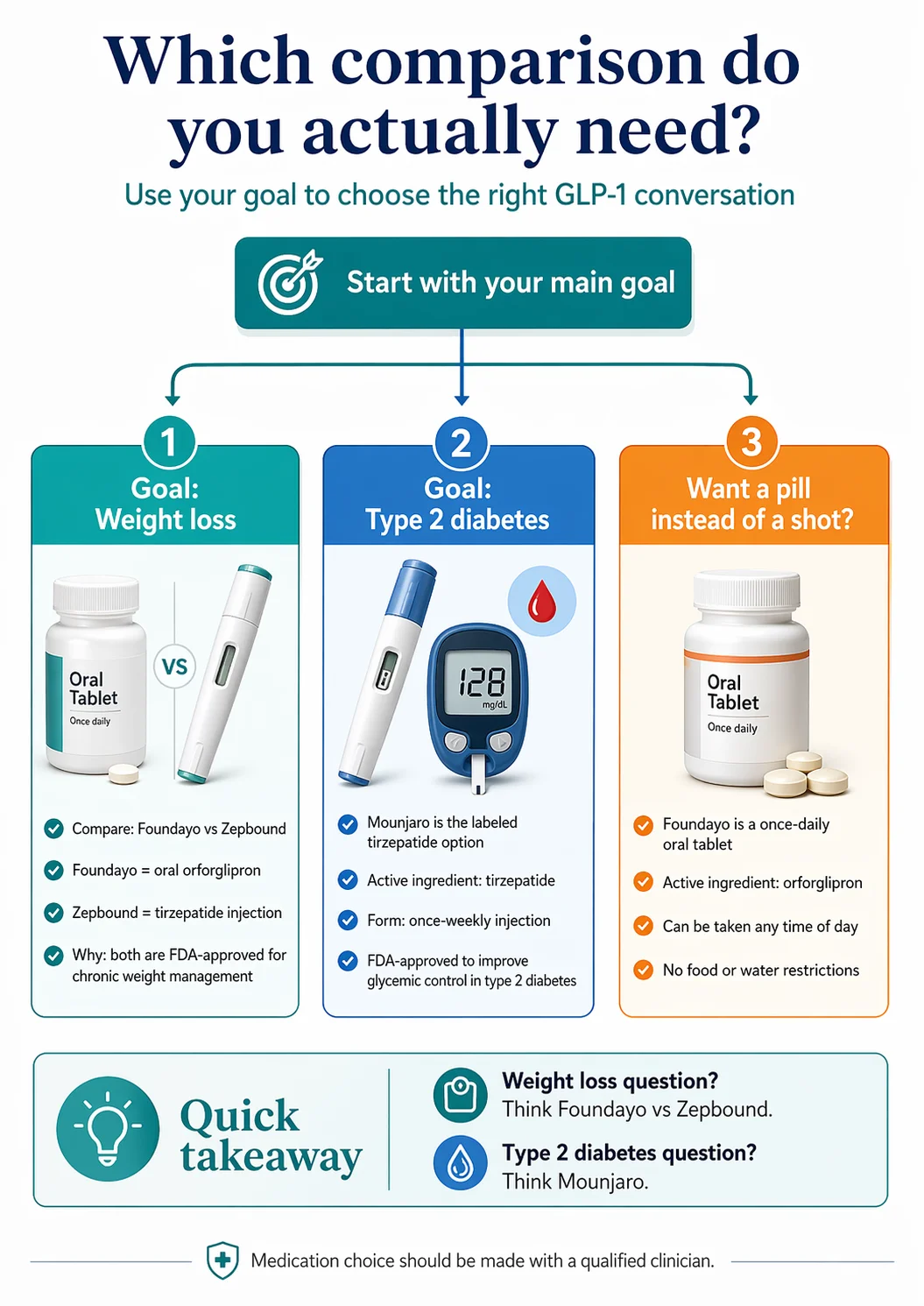
What Foundayo Actually Is
Foundayo is a pill because of chemistry, not just convenience. Most GLP-1 drugs — Ozempic, Wegovy, Mounjaro, Zepbound — are peptides: fragile protein-based molecules destroyed by digestive enzymes. That’s why they’re injected. Orforglipron is different: it’s a small-molecule, non-peptide GLP-1 receptor agonist. The molecule survives your stomach, gets absorbed, activates GLP-1 receptors in your brain, gut, and pancreas, and does the same appetite-reducing, satiety-increasing work as the injectable GLP-1s — without a needle.
What makes Foundayo meaningfully different from the other oral GLP-1 — the Wegovy pill (oral semaglutide) — is the timing rules. Oral semaglutide requires you to take it first thing in the morning on an empty stomach, with no more than 4 oz of water, then wait 30 minutes before eating anything. Foundayo has none of that. Take it with breakfast, at lunch, at bedtime. Take it with coffee. The drug doesn’t care.
That’s the real pill advantage. Not just “no needles” — the lack of a fasting ritual is what makes it stickable in real life.
What Mounjaro Actually Is (And Why There’s No Mounjaro Pill)
Mounjaro is tirzepatide — a 39-amino-acid peptide that activates two receptors instead of one: GIP (glucose-dependent insulinotropic polypeptide) and GLP-1. That dual-agonist mechanism is why tirzepatide produces the largest average weight loss of any GLP-1-class drug on the market. It’s also why tirzepatide is injected: the peptide structure gets destroyed in digestion. There is no FDA-approved pill form of Mounjaro.
Mounjaro comes in six doses (2.5 mg, 5 mg, 7.5 mg, 10 mg, 12.5 mg, 15 mg) delivered in a pre-filled auto-injector pen with a hidden needle — once weekly, any time of day. In Lilly’s SURPASS trials, 15 mg Mounjaro reduced A1C by around 2% on average — one of the largest A1C drops of any injectable diabetes medication studied to date.
Which Is Better for Weight Loss: Foundayo or Mounjaro?
Short answer: Mounjaro is not FDA-approved for weight loss, so the honest comparison is Foundayo vs Zepbound. Zepbound (same tirzepatide as Mounjaro, obesity label) produces greater average weight loss than Foundayo — −20.9% body weight at the 15 mg dose versus Foundayo’s −11.1% at the highest approved tablet dose of 17.2 mg, both at 72 weeks. Foundayo’s advantages are format (pill), lower self-pay pricing, and no cold-chain storage.
The real weight-loss picture across all three Lilly options
| Foundayo 17.2 mg | Zepbound 15 mg | Mounjaro 15 mg (off-label) | |
|---|---|---|---|
| Trial | ATTAIN-1 (72 wk, obesity, no diabetes) | SURMOUNT-1 Study 1 (72 wk, obesity, no diabetes) | SURPASS-5 (40 wk, T2D on basal insulin) |
| Average weight change | −11.1% (ITT) | −20.9% | ~−9% (19 lb on 210 lb baseline) |
| FDA-approved for weight loss? | Yes | Yes | No |
| Format | Daily pill | Weekly injection | Weekly injection |
| Self-pay entry | $149/month | $299/month (vial, 2.5 mg starter) | Not offered as self-pay weight-loss program |
Important caveat: these are different trials with different populations. ATTAIN-1 and SURMOUNT-1 both studied 72 weeks in adults with obesity without diabetes — so the cross-trial comparison is closer than most — but they are still separate studies. A true head-to-head trial does not exist yet.
The honest admission
Foundayo does not match Zepbound’s weight-loss numbers. If maximum efficacy is the only thing you care about and nothing else matters — not cost, not needles, not storage — Zepbound is the more effective weight-loss drug. At 72 weeks, Zepbound at 15 mg reduced body weight by roughly double what Foundayo did at its highest approved dose.
But. Foundayo isn’t trying to beat Zepbound on raw efficacy. It’s trying to beat Zepbound on the things that determine whether treatment works in real life: adherence, cost, and access. For the person whose real barrier is needle aversion, cost, or flexibility — Foundayo is a legitimate, FDA-approved choice.
If pure efficacy is your priority, you’re fine with injections, and you have insurance that covers Zepbound — see our Foundayo vs Zepbound comparison for that decision.
What the ATTAIN-MAINTAIN data actually shows
One of the more interesting findings from Lilly’s program came from ATTAIN-MAINTAIN, a Phase 3 trial testing a “lose on a shot, maintain on a pill” model. Participants from the SURMOUNT-5 trial — who had already plateaued on injectable Wegovy (semaglutide) or Zepbound (tirzepatide) — were re-randomized to receive oral orforglipron or placebo for 52 weeks.
| Switching scenario | Average weight difference at 52 weeks (orforglipron vs placebo) |
|---|---|
| Wegovy → orforglipron switchers | 0.9 kg difference — maintained weight loss nearly flat |
| Zepbound → orforglipron switchers | 5.0 kg difference — maintained most weight but larger give-back |
Note: ATTAIN-MAINTAIN studied Wegovy and Zepbound switchers, not Mounjaro switchers. If you’re on Mounjaro for T2D, this isn’t direct evidence for your situation.
The practical translation: Foundayo may make the most sense not as a replacement for tirzepatide on day one, but as a maintenance medication after you’ve hit your goal weight on injectable therapy — with maintenance holding more cleanly after Wegovy than after Zepbound.
Which Is Better for Type 2 Diabetes: Foundayo or Mounjaro?
Short answer: Mounjaro is the labeled choice for type 2 diabetes. Foundayo is not approved for T2D today, though Lilly has said it will submit orforglipron for the diabetes indication by end of Q2 2026 following the ACHIEVE trial program. For a diabetes patient today, Mounjaro is the FDA-approved option with established insurance coverage pathways.
If you have type 2 diabetes, insurance coverage is the single biggest factor shaping your choice. Here’s how commercial insurance typically plays out (confirm with your own plan — formulary rules are plan- and state-specific):
- Cigna national formulary policy: Mounjaro requires prior authorization with a documented T2D diagnosis. Mounjaro is not covered for metabolic syndrome alone or for weight loss.
- Aetna: Mounjaro is a preferred brand-name drug on 2025 Standard and Advanced Control plans, but requires prior authorization with proof of T2D diagnosis.
- Blue Cross Blue Shield: BCBS is a collection of independent plans, so specifics vary by state and employer. BCBS-Arizona, for example, requires PA with T2D diagnosis and may add step therapy — you may need to have tried another GLP-1 first. Mounjaro is not covered solely for weight loss on most BCBS plans.
The pattern across payers
Mounjaro gets covered for T2D with prior authorization. Mounjaro for weight loss alone? Rarely covered by any commercial plan — Zepbound is the labeled obesity option from the same manufacturer and is covered more consistently for that indication.
Medicare: the Bridge program, explained
Medicare is a separate story and it just changed. Current federal law doesn’t allow Medicare to cover drugs prescribed solely for weight loss. CMS created the Medicare GLP-1 Bridge — a short-term demonstration — to fill that gap, running July 1, 2026 through December 31, 2027.
Under the Bridge, eligible Medicare Part D beneficiaries can access covered GLP-1 drugs for weight reduction at a $50/month copay. As of April 6, 2026, covered products include all formulations of Foundayo, all formulations of Wegovy, and the KwikPen formulation of Zepbound. Mounjaro is not in the Bridge — because Mounjaro is a T2D drug, not a weight-loss drug. Medicare Part D continues to cover Mounjaro for T2D under the standard benefit. The $50 copay does not count toward the Part D $2,100 annual out-of-pocket cap.
Lilly’s Mounjaro Savings Card cannot be combined with any government insurance — Medicare, Medicaid, or TRICARE.
→ See if you qualify for the Medicare GLP-1 Bridge through Ro — Ro’s insurance concierge can help Medicare beneficiaries navigate BMI criteria, prior authorization paperwork, and get prescriptions routed for the July 2026 launch.
Check Medicare Bridge eligibility through Ro → (sponsored affiliate link, opens in a new tab)Already on Mounjaro for T2D and wondering about switching?
Do not self-switch from Mounjaro to Foundayo. If Mounjaro is controlling your A1C, that’s clinical information your endocrinologist is watching closely. Questions worth raising at your next appointment:
- Is Foundayo appropriate for me given my diabetes status and current control?
- How would A1C management change if we adjusted medications?
- What does my insurance cover for each option?
- Does the ACHIEVE trial data affect your thinking about orforglipron in diabetes?
If you need to discuss Mounjaro specifically — get it through insurance, handle prior authorization, talk to a T2D-focused provider — Ro is not the right route. Ro publicly states Mounjaro is not currently available through its platform. That’s where Sesame Care comes in.
Sesame offers provider choice and upfront visit pricing. Ongoing care from $59/month with an annual subscription; medication costs are separate.
Foundayo vs Mounjaro Cost in 2026: Every Dose, Every Scenario
Last updated: . All numbers verified from manufacturer or CMS sources.
Short answer: Foundayo self-pay runs $149–$349/month depending on dose through LillyDirect. Mounjaro has no equivalent uninsured self-pay program — its list price is about $1,112 per fill. With commercial insurance plus a savings card, both can drop to as low as $25/month. For weight-loss shoppers, Foundayo is the cheaper brand-name entry point by a wide margin.
Foundayo LillyDirect self-pay pricing (all six doses)
| Foundayo dose | Self-pay price | Notes |
|---|---|---|
| 0.8 mg | $149 / 30-day supply | Starting dose |
| 2.5 mg | $199 / 30-day supply | Titration |
| 5.5 mg | $299 / 30-day supply | Maintenance |
| 9 mg | $299 / 30-day supply | Maintenance |
| 14.5 mg | $299 with 45-day refill / $349 without | Self Pay Journey Program |
| 17.2 mg | $299 with 45-day refill / $349 without | Self Pay Journey Program |
Mounjaro cash and insured pricing
| Mounjaro scenario | Monthly cost |
|---|---|
| Manufacturer list price | $1,112.16 per fill |
| Cash price at most pharmacies | ~$995 – $1,200 |
| GoodRx coupon | ~$995 – $1,096 |
| Commercial insurance covering Mounjaro + Savings Card | As low as $25 for up to 3-month fill (max $1,950/year savings) |
| Commercial insurance NOT covering Mounjaro + Savings Card | As low as $499/month (max $8,411/year savings) |
| Medicare Part D (T2D only) | Plan-dependent; Savings Card cannot be used with government insurance |
Key context: Lilly has deliberately routed its self-pay weight-loss customers to Zepbound vials ($299–$449/month) rather than cutting Mounjaro’s cash price. If you don’t have T2D and you’re thinking about Mounjaro for weight loss, you are the exact customer Lilly designed that structure to redirect.
First-year cost under six realistic scenarios
| Scenario | Year 1 total | The math |
|---|---|---|
| 1. Commercial insurance covers Foundayo for obesity (savings card eligible) | ~$300 | $25 × 12 (subject to savings cap) |
| 2. Self-pay Foundayo, titrates to 17.2 mg, refills on time | ~$3,338 | $149 + $199 + $299 + $299 + $299 + ($299 × 7) |
| 3. Self-pay Foundayo, misses 45-day refill windows at top dose | ~$3,688 | Same titration, but $349 × 7 at top dose |
| 4. Medicare GLP-1 Bridge eligible (starting July 2026) | ~$600 | $50 × 12 (program runs through 12/31/2027) |
| 5. Commercial insurance covers Mounjaro for T2D (savings card eligible) | ~$300 | $25 × 12 (subject to $1,950 annual savings cap) |
| 6. Commercial insurance that doesn't cover Mounjaro + Savings Card | ~$5,988 | $499 × 12 |
| 7. Fully uninsured Mounjaro (list price) | ~$13,346 | $1,112.16 × 12 fills |
The punchline: for a self-pay weight-loss shopper, Foundayo costs roughly one-quarter of uninsured Mounjaro in year one. For a T2D patient with good commercial coverage, the two drugs land at the same copay. Insurance is the variable that dominates everything else.
→ Run a free GLP-1 insurance coverage check through Ro in under 2 minutes — no prescription required. Checks coverage for Foundayo, Zepbound, Wegovy pill, and Wegovy pen across your specific plan. For Mounjaro-specific coverage questions, use the Sesame path below.
Run a free GLP-1 coverage check through Ro → (sponsored affiliate link, opens in a new tab)Foundayo vs Mounjaro: Which Should I Pick?
Short answer: Foundayo fits adults with obesity or overweight plus a weight-related condition who want an oral daily pill, lower self-pay pricing, or who’ve struggled with injection adherence. Mounjaro fits adults and pediatric patients 10+ with type 2 diabetes whose insurance covers the drug and who need strong A1C reduction.
| Your primary goal | Weight loss | Type 2 diabetes |
|---|---|---|
| Insured + in-network coverage | Foundayo (if plan covers) or Zepbound (strongest efficacy). Skip Mounjaro — not labeled for weight loss. | Mounjaro — labeled choice, well-established coverage with PA. |
| Self-pay / no coverage | Foundayo at $149–$349/month. Cheapest brand-name weight-loss pill available. | Neither is practical uninsured. Talk to your doctor about metformin first, then semaglutide (Ozempic) or Mounjaro depending on A1C targets. |
Pick Foundayo if:
- BMI ≥30 or BMI ≥27 with a weight-related condition
- You want a pill format, not an injection
- Paying self-pay and cost matters ($149/month entry)
- You plateaued on an injectable and want oral maintenance
- You need flexible dosing timing (no empty-stomach rule)
Ask about Mounjaro if:
- You have type 2 diabetes and need A1C reduction
- Your commercial insurance covers it under T2D
- You’ve tried step-therapy GLP-1s your insurer required
- You’re already on it and it’s working
Ask about Zepbound if:
- You want tirzepatide for weight loss (that’s what Zepbound is)
- You’re fine with injections and want the highest efficacy
- Insurance covers it, or you’ll pay $299–$449/month self-pay
Take our matching quiz if:
- You don’t know whether your goal is weight loss, diabetes, or both
- You’re not sure what your insurance actually covers
- You’ve read this whole page and you’re still not sure which drug to ask for
Who shouldn’t take either
Both Foundayo and Mounjaro carry a boxed warning for thyroid C-cell tumors based on rodent studies, and both are contraindicated in people with a personal or family history of medullary thyroid carcinoma (MTC) or Multiple Endocrine Neoplasia syndrome type 2 (MEN 2). Neither drug is an option in those cases. Talk to your endocrinologist about alternatives like metformin, SGLT2 inhibitors, or other non-GLP-1 medications.
Pill vs Shot: Which Is Actually Easier to Live With?
A pill sounds easier than a shot. It isn’t always.
Foundayo (daily pill)
Requires you to take a tablet every single day — 365 decisions per year. For people who already take daily medications, that’s fine. For people who forget vitamins after two weeks, that’s a real problem.
Label note: if you miss 7 or more consecutive doses, the label instructs patients to restart dosage escalation at a lower dose.
Mounjaro (weekly injection)
Requires a weekly injection — 52 decisions per year. The pen has a hidden needle. What trips people up is the refill logistics and keeping it refrigerated (Mounjaro can sit at room temperature for up to 21 days; default storage is refrigerated).
Once most people do the injection a few times, they report the injection itself isn’t the issue.
The honest question to ask yourself: do you forget daily medications, or do you miss weekly appointments with yourself? That’s usually a better predictor than “do I hate needles?”
Foundayo vs Mounjaro Side Effects and Safety
Short answer: Both drugs share the GLP-1 side effect profile: nausea, diarrhea, constipation, vomiting, abdominal pain, fatigue. Gastrointestinal adverse reactions occurred in 60–69% of Foundayo-treated patients in pooled trials versus 37% with placebo. Both carry boxed warnings for thyroid C-cell tumors and are contraindicated in people with a personal or family history of medullary thyroid carcinoma (MTC) or MEN 2.
Common side effects (both drugs)
- Nausea — most common, peaks during titration
- Diarrhea
- Constipation
- Vomiting
- Abdominal pain
- Indigestion / heartburn
- Decreased appetite (partly why the drugs work)
- Fatigue
- Hair loss (listed in Foundayo label)
Serious warnings (both drugs)
- Boxed warning: thyroid C-cell tumors. Based on rodent studies. Neither drug if you have a personal or family history of MTC or MEN 2. Note: orforglipron is not pharmacologically active in rodents, so Foundayo’s boxed warning is classwide precautionary.
- Pancreatitis — stop the drug immediately for severe, persistent abdominal pain.
- Gallbladder disease — cholelithiasis has occurred in clinical trials.
- Acute kidney injury from dehydration caused by severe GI symptoms — stay hydrated.
- Hypoglycemia — higher risk if taken with insulin or sulfonylureas.
- Diabetic retinopathy — monitor if you have T2D with existing eye disease.
- Anesthesia aspiration risk — both drugs slow gastric emptying, so food can remain in your stomach beyond standard pre-surgery fasting. Tell your surgical and anesthesia team before any planned procedure and follow their instructions on timing.
Oral contraceptive warnings (both drugs)
Both Foundayo and Mounjaro delay gastric emptying, which can reduce absorption of oral hormonal contraceptives. Backup contraception is required:
| Drug | At initiation | At each dose escalation |
|---|---|---|
| Foundayo | Switch to non-oral method or add barrier for 30 days | 30 days after each escalation |
| Mounjaro | Switch to non-oral method or add barrier for 4 weeks | 4 weeks after each escalation |
Foundayo-specific drug interactions
Orforglipron is metabolized through the CYP3A4 enzyme pathway. Practical flags from the Foundayo label:
- Strong CYP3A4 inducers (like rifampin): avoid concomitant use.
- Moderate CYP3A4 inducers: monitor effectiveness; dose escalation may be needed.
- Simvastatin: do not exceed simvastatin 20 mg once daily with Foundayo.
Bring your complete medication list to your prescriber.
Can You Switch from Mounjaro to Foundayo?
Short answer: Under a doctor’s guidance, yes — but it’s not a simple 1:1 conversion, and the switching research is strongest for people who were on Wegovy or Zepbound for weight loss, not Mounjaro for type 2 diabetes.
If you’re on Mounjaro off-label for weight loss
This is the cleaner switch case. You’re paying for a medication for an unlabeled use, and Foundayo gives you the on-label, typically cheaper, pill-format alternative. The likely trajectory:
- Your doctor pauses Mounjaro
- You start Foundayo at 0.8 mg (the starting dose, not a conversion-equivalent)
- You titrate up monthly: 0.8 → 2.5 → 5.5 → 9 → 14.5 → 17.2 mg as tolerated
- Expect some appetite rebound in weeks 2–4 as tirzepatide clears
- Your maintenance dose will land where your doctor decides based on results
Do not expect Foundayo to match Mounjaro on hunger suppression day-for-day at first. Many people report a hunger rebound in the first month because they’re losing tirzepatide’s GIP-receptor activation.
If you’re on Mounjaro for type 2 diabetes
Don’t switch without your endocrinologist. Foundayo isn’t labeled for T2D. Your A1C is the primary control variable your doctor is watching, not your weight. The conversation to have is “is Foundayo a reasonable option for me right now?” — not “I’m switching to Foundayo.”
What the ATTAIN-MAINTAIN evidence supports
ATTAIN-MAINTAIN was a 52-week Phase 3 trial that enrolled 376 participants from the earlier SURMOUNT-5 study — specifically people who had reached a weight plateau on injectable Wegovy or Zepbound. Participants were re-randomized 3:2 to oral orforglipron (maximum tolerated dose) or placebo for 52 weeks.
- Wegovy → orforglipron switchers: maintained weight loss with an average 0.9 kg difference from placebo — nearly flat.
- Zepbound → orforglipron switchers: maintained weight loss with an average 5.0 kg difference — real but larger regain.
The ATTAIN-MAINTAIN evidence supports a “lose with a shot, maintain with the pill” strategy for people coming off Wegovy cleanly. For people coming off Zepbound, expect a partial maintenance effect. The trial did not include Mounjaro-for-T2D switchers, so it doesn’t directly speak to that scenario.
How to Actually Get Foundayo or Mounjaro in 2026
Short answer: Foundayo is available through LillyDirect (as of April 6, 2026) and through FDA-approved telehealth providers including Ro. Mounjaro requires a type 2 diabetes diagnosis and is available at most retail pharmacies; Ro does not currently offer Mounjaro, so Sesame Care is the strongest telehealth route for Mounjaro-specific consultations.
Path 1: Ro — best for Foundayo, Zepbound, and insurance-concierge support
Ro is our primary recommendation for anyone pursuing Foundayo or Zepbound. Ro currently offers Foundayo, Wegovy pill, Wegovy pen, Zepbound pen, and Zepbound KwikPen — a wide FDA-approved GLP-1 formulary for weight management on one telehealth platform. Ro also has a dedicated insurance concierge that handles prior authorization on your behalf, plus a free GLP-1 Insurance Coverage Checker.
Ro Body pricing: $39 for the first month, then $149/month ongoing — or as low as $74/month with annual plan paid upfront. Medication costs are separate and reflect LillyDirect or insurance-adjudicated pricing.
Then as low as $74/month with annual plan paid upfront.
Path 2: Sesame Care — best for Mounjaro and T2D-specific consultations
Sesame Care is a provider-choice marketplace where you book visits with clinicians. Its weight-loss and GLP-1 program lists ongoing care as low as $59/month with an annual subscription, with medication costs separate. For Mounjaro specifically, Sesame can help you navigate the T2D coverage conversation and route prescriptions to a pharmacy that will bill your insurance.
Use Sesame when:
- You need to discuss Mounjaro specifically — because you have T2D, because it’s working for you, or because you want to explore insurance coverage.
- You want provider choice rather than one packaged program.
Path 3: LillyDirect — the manufacturer-direct option
LillyDirect is Lilly’s direct-to-consumer pharmacy platform — where you get verified self-pay pricing on Foundayo ($149–$349/month) and where Lilly publishes authoritative information. LillyDirect isn’t a telehealth provider — it doesn’t give you a prescription. You need a prescription from your own doctor or a telehealth provider like Ro, sent to LillyDirect Pharmacy for fulfillment. Use LillyDirect as your pricing benchmark and as a fulfillment option.
What not to use
- Unregulated sellers of “oral Mounjaro” or “oral tirzepatide” — these don’t exist legitimately. Tirzepatide is a peptide; any oral product claiming to contain it is unregulated.
- Compounded versions of orforglipron marketed as equivalent to Foundayo — compounded drugs are not FDA-reviewed for safety, effectiveness, or quality.
- Any platform that won’t disclose the prescriber, pharmacy, or medication source. GLP-1s are high-stakes medications. Transparency matters.
What We Actually Verified for This Page
Produced by: The RX Index, a pricing intelligence and comparison resource for GLP-1 telehealth providers. Last verified: . Next scheduled verification: May 2026.
Sources verified for this update:
- FDA approval announcement for Foundayo (orforglipron), April 1, 2026
- Foundayo prescribing information and label (FDA, 220934Orig1s000lbl.pdf; foundayo.lilly.com)
- Foundayo full terms and pricing on LillyDirect
- Mounjaro FDA label (215866s039lbl.pdf, including December 2025 pediatric indication update)
- Mounjaro Savings Card terms ($25 / $499 tier structure)
- Mounjaro manufacturer list price ($1,112.16 per fill, pricinginfo.lilly.com)
- Mounjaro homepage language stating it is not a weight loss drug
- Zepbound LillyDirect self-pay pricing ($299 / $399 / $449, updated December 2025)
- Ro’s current Foundayo, Zepbound, and Wegovy formulary and pricing (ro.co)
- Ro’s statement that Mounjaro is not currently available (ro.co/weight-loss/mounjaro)
- Sesame Care’s weight-loss program pricing and structure (sesamecare.com)
- ATTAIN-1 trial results (Lilly investor release; FDA approval docs)
- ATTAIN-MAINTAIN trial topline results (Lilly December 18, 2025 press release)
- SURMOUNT-1 Study 1 results for Zepbound (FDA Zepbound label, Week 72)
- Medicare GLP-1 Bridge program details (CMS, including April 6, 2026 update adding Foundayo and April 21, 2026 extension through December 31, 2027)
- Commercial insurance prior authorization policy samples (Cigna national formulary, Aetna 2025, BCBS-Arizona)
This page is educational and does not replace medical advice. The RX Index is not a prescriber or pharmacy.
Foundayo vs Mounjaro FAQs
Is Foundayo the same as Mounjaro?
No. Foundayo contains orforglipron, a once-daily oral small-molecule GLP-1 receptor agonist. Mounjaro contains tirzepatide, a once-weekly injectable dual GIP and GLP-1 receptor agonist. They are different drugs with different FDA-approved uses.
Is there a Mounjaro pill?
No FDA-approved pill form of Mounjaro exists. Tirzepatide is a peptide that gets broken down in the digestive tract, so it must be injected. The closest oral GLP-1 alternative from Eli Lilly is Foundayo, which contains a different molecule (orforglipron).
Is Foundayo oral tirzepatide?
No. Foundayo contains orforglipron, not tirzepatide. They work on the same GLP-1 receptor but are entirely different molecules. Orforglipron is a small-molecule non-peptide; tirzepatide is a synthetic peptide. There is no FDA-approved oral tirzepatide product.
Is Foundayo cheaper than Mounjaro?
For self-pay, yes — significantly. Foundayo runs $149 to $349 per month through LillyDirect depending on dose. Mounjaro's manufacturer list price is about $1,112 per fill with no equivalent self-pay weight-loss program. With commercial insurance and a savings card, both can drop to as low as $25 per month when the diagnosis matches the FDA-approved label.
Can you take Mounjaro for weight loss?
Mounjaro is FDA-approved only for type 2 diabetes. Lilly's Mounjaro website states it is not a weight-loss drug. The FDA-approved tirzepatide product for weight loss is Zepbound, which contains the same active ingredient (tirzepatide) but carries the obesity label.
Can you switch from Mounjaro to Foundayo?
Under a doctor's supervision, yes — but it's not a simple 1:1 conversion. The strongest switching evidence comes from Lilly's ATTAIN-MAINTAIN trial, which studied patients coming off Wegovy or Zepbound (not Mounjaro). If you're on Mounjaro for type 2 diabetes, do not switch without your endocrinologist.
Is Mounjaro available on Ro?
No. Ro does not currently offer Mounjaro on its platform. Ro focuses on FDA-approved weight-management GLP-1s including Foundayo, Zepbound, and Wegovy pill and pen. For Mounjaro specifically, use a provider-choice platform like Sesame Care or work with your primary care physician.
Does Medicare cover Foundayo?
Eligible Medicare Part D beneficiaries can access Foundayo at a $50 per month copay through the Medicare GLP-1 Bridge program starting July 1, 2026. Eligibility requires a provider-submitted prior authorization and meeting specific BMI and clinical criteria. The program runs through December 31, 2027.
Related comparisons and guides:
- Foundayo vs Zepbound: Pill vs Shot — which one actually fits you? →
- Foundayo vs Ozempic: Daily pill vs weekly shot for weight loss →
- Does insurance cover Foundayo? Coverage, prior auth, and appeals →
- Foundayo savings card: who qualifies and how to use it →
- All GLP-1 provider and medication comparisons →
Your situation changes the answer
Find My GLP-1 Path
The right GLP-1 provider isn't the same for everyone. It depends on your state, your insurance and formulary, whether you want an FDA-approved or compounded medication, your preferred route (injection or oral), and your budget. Because a general answer can't resolve those for you, use The RX Index's Find My GLP-1 Path tool to get a personalized provider match with source-verified pricing before you choose.
- What it asks: your state, insurance situation, medication preference, budget, and support needs
- What you get: a personalized shortlist of GLP-1 providers matched to your situation, with verified pricing and the right questions to ask
- Cost: free · about 2 minutes · no signup