
By The RX Index Editorial Team · Sources: FDA-approved Foundayo prescribing information, ATTAIN-1 & ATTAIN-2, FDA approval letter NDA 220934
Last verified: · Label, pricing & availability re-checked April 29, 2026
Editorial Standards · Affiliate Disclosure
FOUNDAYO SAFETY — 2026 COMPLETE GUIDE
Is Foundayo Safe? The Plain-English 2026 Guide
Published:
The short, honest answer
For most adults who medically qualify and take it under licensed clinician supervision, Foundayo (orforglipron) is FDA-approved and considered safe to use as labeled. It is the first oral, non-peptide GLP-1 for weight management, approved by the FDA on April 1, 2026 for adults with obesity (BMI ≥30) or overweight (BMI ≥27) with at least one weight-related condition, used along with diet and exercise.
Foundayo carries a boxed warning for thyroid C-cell tumors (the same boxed warning all GLP-1s carry), is contraindicated in people with a personal or family history of medullary thyroid carcinoma (MTC) or MEN 2, and has clinically meaningful warnings on pancreatitis, gallbladder disease, kidney injury, hypoglycemia (especially with insulin or sulfonylureas), drug interactions, anesthesia precautions, and reduced effectiveness of oral birth control.
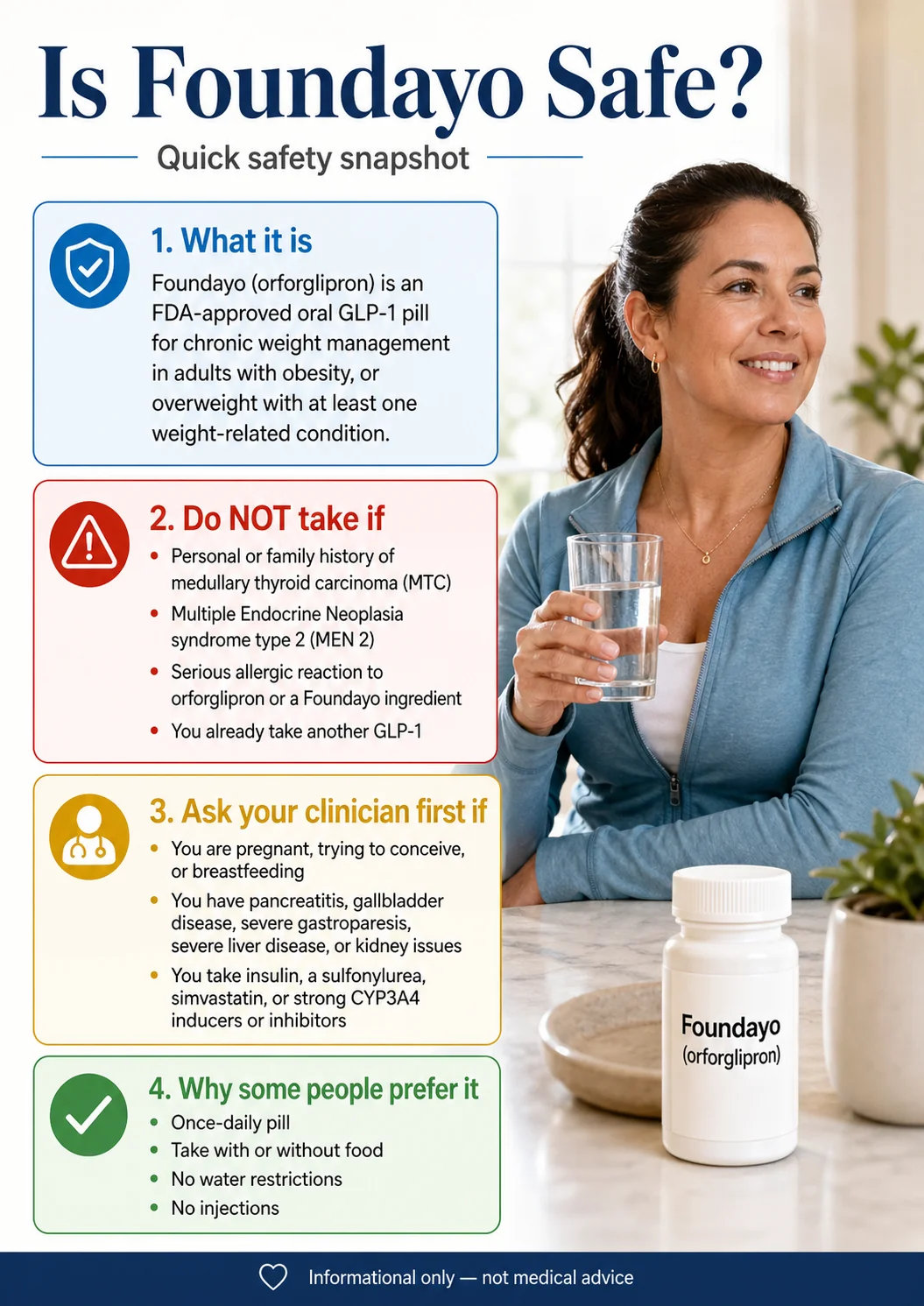
What does “FDA-approved” actually mean for Foundayo?
FDA approval means the agency reviewed Foundayo’s clinical trial data and concluded that, for adults who meet the labeled indication, the benefits outweigh the risks when the medication is used as directed. It does not mean Foundayo has zero side effects, that everyone can take it, or that long-term real-world data is already complete. Approval is a green light — it’s not a guarantee.
The FDA approved Foundayo (the brand name for orforglipron) on April 1, 2026 for adults with obesity (BMI ≥30) or overweight (BMI ≥27) plus at least one weight-related condition (such as type 2 diabetes, hypertension, dyslipidemia, or obstructive sleep apnea), used along with a reduced-calorie diet and increased physical activity. It is the first new molecular entity approved under the FDA’s Commissioner’s National Priority Voucher pilot program.
Foundayo is also the first oral, non-peptide GLP-1 receptor agonist on the U.S. market for weight management. That’s the genuinely new thing about it — and it’s the reason many readers are asking whether the safety profile is the same as the injectable GLP-1s they already know.
The boxed warning, in plain English
Foundayo carries a boxed warning for thyroid C-cell tumors. The exact same boxed warning appears on Wegovy, Ozempic, Zepbound, Mounjaro, Saxenda, and Rybelsus. The warning is class-wide, not Foundayo-specific.
| GLP-1 medication | Active ingredient | Boxed thyroid warning? | Form |
|---|---|---|---|
| Foundayo | Orforglipron | Yes | Oral pill |
| Wegovy | Semaglutide | Yes | Injection / oral pill |
| Ozempic | Semaglutide | Yes | Injection |
| Zepbound | Tirzepatide | Yes | Injection |
| Mounjaro | Tirzepatide | Yes | Injection |
| Saxenda | Liraglutide | Yes | Injection |
| Rybelsus | Semaglutide | Yes | Oral pill |
The warning exists because, in rodent studies of injectable GLP-1s, sustained activation of the GLP-1 receptor on rat and mouse thyroid C-cells caused tumors. The human relevance of that rodent finding has not been determined. Out of caution, the FDA requires the warning across the class.
Two things specific to Foundayo are worth knowing.
One: The Foundayo prescribing information specifically notes that orforglipron is not pharmacologically active at rat or mouse GLP-1 receptors and that no thyroid C-cell tumors were observed in 2-year carcinogenicity studies in rodents. In other words, the rodent signal that drives the class warning was not produced by Foundayo’s own preclinical work. The FDA still requires the warning because the human relevance question remains open and because regulatory consistency across the class matters.
Two: No medullary thyroid cancer (MTC) cases were observed in the ATTAIN-1 or ATTAIN-2 Phase 3 trials in 4,500+ adult participants. FDA-required postmarketing surveillance for the MTC signal will continue for years.
Hard contraindications: who absolutely should not take Foundayo
Per the FDA-approved label, Foundayo is contraindicated (you cannot take it; this is non-negotiable) in:
- People with a personal or family history of medullary thyroid carcinoma (MTC).
- People with Multiple Endocrine Neoplasia syndrome type 2 (MEN 2).
- People with a known serious hypersensitivity to orforglipron or any Foundayo ingredient.
Two related cautions sit one notch below contraindications:
- People who have had a serious hypersensitivity reaction to any other GLP-1 medication should generally not take Foundayo. Discuss this with your prescriber explicitly.
- People currently using another GLP-1 (Wegovy, Ozempic, Zepbound, Mounjaro, Saxenda, Rybelsus, or any compounded GLP-1) should not start Foundayo on top of it. Foundayo should be a switch, not a stack — and the switch needs prescriber supervision.
Beyond those, two specific populations require additional attention: pregnancy/breastfeeding (Foundayo is not recommended; discontinue when pregnancy is recognized), and severe hepatic (liver) impairment (also not recommended). We cover both in detail below.
Foundayo safety self-check (do this before you spend a dollar)
If any of the items in this self-check apply to you, do not start a paid Foundayo intake until you’ve cleared them with a licensed clinician. A Ro consultation costs $149 the first month — there’s no reason to start one if you already know a hard contraindication will rule you out, or if a yellow-flag item needs an in-person workup first.
This is the single most useful thing on this page. Take 60 seconds.
🔴 Hard stops — Foundayo is not for you
- You or a biological family member has had medullary thyroid carcinoma (MTC).
- You have Multiple Endocrine Neoplasia syndrome type 2 (MEN 2).
- You’ve had a serious allergic reaction to orforglipron or any Foundayo ingredient.
- You’ve had a serious allergic reaction to any other GLP-1 medication.
- You are currently pregnant, planning to become pregnant in the next month, or breastfeeding.
- You are under 18 (Foundayo is not approved for pediatric use; safety and effectiveness in pediatric patients have not been established).
- You are currently on another GLP-1 (Wegovy, Ozempic, Zepbound, Mounjaro, Saxenda, Rybelsus, or a compounded version) and are not switching under prescriber supervision.
If any of these apply, stop here. The fastest, safest next step is a 60-second screen of GLP-1 paths that may fit your situation:
➡️ Take our 60-second GLP-1 matching quiz →
🟠 Yellow flags — discuss with your prescriber before starting
- You have type 1 diabetes (Foundayo isn’t approved for type 1).
- You have a history of pancreatitis.
- You have gallbladder disease, recurrent gallstones, or are at high risk for gallbladder events.
- You have severe gastroparesis or other significant motility disorders.
- You have severe hepatic (liver) impairment — Foundayo is not recommended in this group.
- You have a history of severe diabetic retinopathy (the label flags worsening retinopathy in patients with type 2 diabetes).
- You take insulin or a sulfonylurea (glipizide, glyburide) — hypoglycemia risk increases; doses likely need adjustment.
- You take simvastatin (specific dose interaction; max 20 mg/day with Foundayo).
- You take a strong CYP3A4 inhibitor (ketoconazole, itraconazole, ritonavir, clarithromycin) — Foundayo dose is capped at 9 mg.
- You take a strong or moderate CYP3A4 inducer (rifampin, carbamazepine, phenytoin, St. John’s Wort) — concomitant use should be avoided per the label.
- You take blood-pressure medication (Foundayo can lower BP and slightly raise heart rate).
- You take oral hormonal birth control pills (Foundayo can reduce their effectiveness; backup contraception is required for 30 days after each dose escalation).
- You have surgery scheduled — Foundayo can slow gastric emptying, which raises aspiration risk during anesthesia. Tell your surgical team.
- You have a history of suicidal thoughts or active mental health concerns — discuss safety monitoring with your prescriber.
🟢 Green light — Foundayo may be appropriate (still requires prescriber sign-off)
- You meet the labeled indication: BMI ≥30, or BMI ≥27 with at least one weight-related condition.
- None of the 🔴 contraindications apply to you.
- Any 🟠 yellow flags have been disclosed to your prescriber and accounted for in your treatment plan.
- You’re committed to taking Foundayo with diet and physical activity (the FDA label says “along with” — this isn’t marketing fluff).
- You can afford the medication consistently, including dose escalation. Cost-driven inconsistency is itself a safety issue (see the missed-dose rule below).
All green? You’re ready for the licensed-clinician conversation.
Start your Ro consultation — Foundayo from $149/mo → (sponsored affiliate link, opens in a new tab)
Ro’s licensed-clinician review covers your medical history, current medications, and any contraindications on the Foundayo label. If Foundayo isn’t appropriate, your provider will tell you and can discuss FDA-approved alternatives like Wegovy or Zepbound on the same intake.
If you flagged any 🔴 red or strong 🟠 yellow above, finish reading this page before you click any provider link. The point of getting this right is not paying $149 to find out your situation rules Foundayo out.
Common Foundayo side effects (with actual rates by dose)
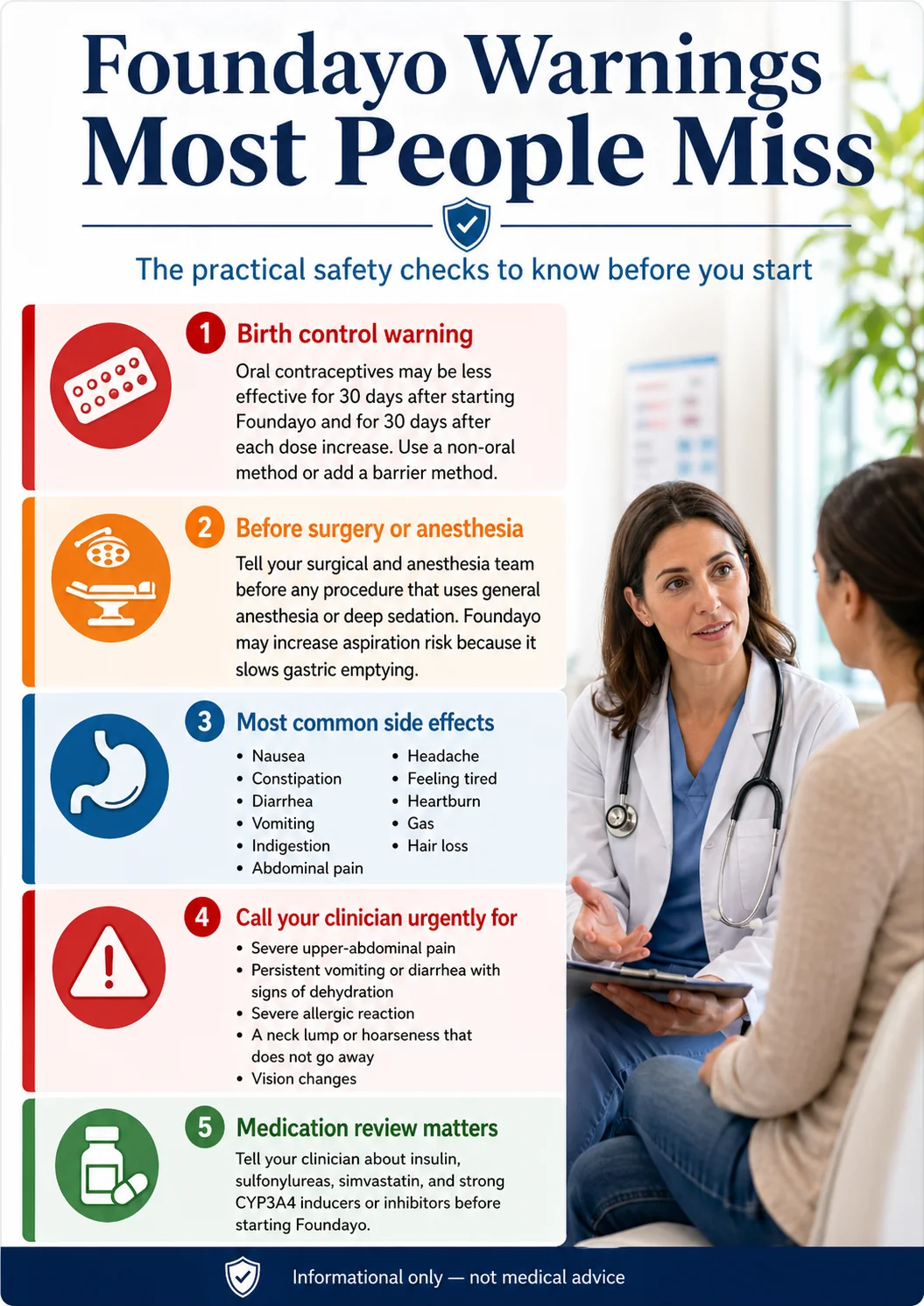
The most common Foundayo side effects are gastrointestinal: nausea, constipation, diarrhea, vomiting, indigestion, abdominal pain, abdominal distension, headache, fatigue, GERD, eructation (belching), flatulence, and hair loss. Most are mild to moderate, peak during dose escalation, and improve as the body adjusts. A 2025 meta-analysis of 12 GLP-1 drugs found that orforglipron had higher rates of nausea, constipation, and diarrhea than several injectable GLP-1s — likely related to oral absorption kinetics.
This table is from the FDA-approved Foundayo prescribing information. These are real numbers from the pivotal trials, not estimates.
| Side effect | Placebo | 5.5 mg | 9 mg | 17.2 mg |
|---|---|---|---|---|
| Nausea | 10% | 26% | 34% | 35% |
| Constipation | 9% | 20% | 27% | 24% |
| Diarrhea | 11% | 21% | 23% | 25% |
| Vomiting | 4% | 13% | 21% | 24% |
| Indigestion (dyspepsia) | 4% | 12% | 16% | 13% |
| Abdominal pain | 7% | 13% | 14% | 14% |
| Headache | 7% | 8% | 9% | 9% |
| Fatigue | 4% | 6% | 7% | 9% |
| GERD | 2% | 6% | 6% | 7% |
| Hair loss | 2% | 4% | 4% | 5% |
The label adverse-reaction table also includes abdominal distension, eructation (belching), and flatulence at lower frequencies than those above.
- Total GI adverse reactions: 60% on 5.5 mg, 68% on 9 mg, 69% on 17.2 mg vs. 37% on placebo.
- GI-related discontinuation: 3% on 5.5 mg, 6% on 9 mg, 6% on 17.2 mg vs. 0.7% on placebo.
- Overall permanent discontinuation due to adverse reactions: approximately 10% on 17.2 mg vs. 3% on placebo, with most Foundayo discontinuations driven by GI events.
What this actually tells you
A few things, in order of importance:
Most people will experience some GI side effects. That’s why the dose schedule starts at 0.8 mg for a month and steps up gradually — slow titration is the proven way to minimize nausea and vomiting.
The numbers above are over the full trial period, not “right now.” Nausea is most common in the first 4–8 weeks and during each dose increase. It usually improves substantially after that. Roughly 6% of patients on the maintenance doses discontinued because of GI side effects in the trial — meaning 94% kept going.
“Common” is not the same as “dangerous.” Persistent vomiting, severe pain, dehydration, or symptoms that don’t improve with dose adjustment require medical attention. Routine first-month nausea is expected.
Hair loss is real and worth understanding. It affected up to 5% of trial participants on the highest dose. The FDA label associates hair-loss adverse reactions with weight reduction — not with a direct drug mechanism on the hair follicle. It’s typically temporary; if shedding feels significant or persistent, talk to your prescriber about nutrition and any underlying causes.
Practical management
These tactics show up consistently in the prescribing information and clinical guidance:
- Smaller, more frequent meals rather than three large ones.
- Avoid heavy, greasy, or spicy foods during dose escalation.
- Eat slowly and stop when you feel full (Foundayo makes you feel full sooner — listen to it).
- Sip fluids throughout the day rather than chugging large amounts at once (this reduces nausea and helps prevent dehydration).
- Don’t pause or restart on your own. If you miss 7 or more consecutive doses, the FDA label specifically says dose escalation should restart at a lower dose to reduce GI risk. Always call your prescriber before pausing or restarting.
- Call your prescriber for severe symptoms, persistent vomiting, dehydration signs, or pain that doesn’t fit “expected adjustment.”
For a deeper symptom-by-symptom triage guide with specific call-your-prescriber thresholds, see our Foundayo Side Effects: Rates & Triage guide.
Serious Foundayo side effects (rare but important)
Rare but serious side effects of Foundayo include acute pancreatitis, gallbladder disease (gallstones, cholecystitis), kidney injury (usually from severe dehydration), low blood sugar (especially when combined with insulin or sulfonylureas), serious allergic reactions, worsening diabetic retinopathy in patients with type 2 diabetes, hypotension, increased heart rate, and pulmonary aspiration during anesthesia. These are uncommon but important enough that the FDA requires the prescribing information to call them out.
The following table uses incidence data from the pooled ATTAIN-1 and ATTAIN-2 trials (3,155 Foundayo-treated patients, treated up to 72 weeks).
| Serious side effect | Foundayo rate | Placebo rate | What it feels like / when to call |
|---|---|---|---|
| Acute pancreatitis | 6 events in 6 patients (0.14 per 100 patient-years) | 2 events in 1 patient (0.04 per 100 patient-years) | Severe upper-abdominal pain, often radiating to the back, with or without vomiting. Stop Foundayo and seek medical care. |
| Acute kidney injury | 0.2% | 0.05% | Usually downstream of severe vomiting/diarrhea causing dehydration. Watch for low urine output, confusion, severe fatigue. |
| Cholelithiasis (gallstones) | 1% | 0.7% | Sharp upper-right abdominal pain after fatty meals, sometimes with fever. |
| Cholecystitis (gallbladder inflammation) | 0.4% | 0.3% | Severe upper-right abdominal pain, fever, nausea. Same-day medical care. |
| Hypoglycemia (glucose <54 mg/dL, Trial 2) | 2% (Foundayo); 7% in patients also on a sulfonylurea | 0.2% placebo; 0.5% in non-sulfonylurea Foundayo patients | Shakiness, sweating, confusion, racing heart, hunger. Treat with fast-acting carbs (juice, glucose tablets). |
| Tachycardia | 3% | 0.9% | Mean resting heart-rate increase: 4–5 bpm vs. 0.5 bpm placebo. Discuss with prescriber if symptomatic. |
| Hypotension | More frequent on Foundayo, especially with antihypertensives | Baseline | Dizziness, lightheadedness on standing. Tell your prescriber if you’re on BP medication. |
| Serious allergic reaction | Rare | — | Swelling of face/throat, trouble breathing, severe rash. Call 911. |
| Worsening diabetic retinopathy | Rare; specific to T2D patients | Rare | Vision changes. Tell your eye doctor and prescriber. |
| Pulmonary aspiration during anesthesia | Rare | Rare | Tell your surgical team you take Foundayo before any procedure. |
The point of listing these isn’t to scare you — it’s so that if you experience one, you recognize it and act fast.
Can Foundayo affect birth control pills, surgery, or other medicines?
Yes — and three of these matter more than the average reader realizes. Foundayo can reduce the effectiveness of oral hormonal contraceptive pills, can increase aspiration risk during anesthesia, and has specific drug interactions with strong CYP3A4 inhibitors, strong/moderate CYP3A4 inducers, simvastatin, insulin, and sulfonylureas. Two of these — the birth-control rule and the surgery precaution — are buried in most articles but show up directly on the FDA label.
The birth-control warning (this is the one most pages bury)
Foundayo slows gastric emptying. Because of how oral contraceptives are absorbed, that slowing can make the pill less effective. The FDA-approved label specifically advises:
Females using oral hormonal contraceptives should switch to a non-oral contraceptive method or add a barrier method of contraception for 30 days after initiation of Foundayo and for 30 days after each dose escalation.
Read what that means practically: if you go through the full titration schedule (0.8 → 2.5 → 5.5 → 9 → 14.5 → 17.2 mg, one month minimum at each step), you have six 30-day windows where oral birth control alone may not be reliable. That’s five months of needing a backup method beyond your starting month.
| Titration step | Dose | Contraception window |
|---|---|---|
| Month 1 (start) | 0.8 mg | 30 days of backup contraception |
| Month 2 (escalation) | 2.5 mg | 30 days of backup contraception |
| Month 3 (escalation) | 5.5 mg | 30 days of backup contraception |
| Month 4 (escalation, if titrated up) | 9 mg | 30 days of backup contraception |
| Month 5 (escalation, if titrated up) | 14.5 mg | 30 days of backup contraception |
| Month 6 (escalation, if titrated up) | 17.2 mg | 30 days of backup contraception |
If you and your partner are relying on the pill as your primary method and you’re not interested in pregnancy, this is not a footnote. It’s a real adjustment.
What counts as a non-oral method or a barrier:
- An IUD (copper or hormonal)
- A hormonal implant
- The patch, ring, or shot (these are non-oral hormonal methods)
- Condoms (added as a barrier — not a replacement for hormonal birth control, but a real protective layer for the 30-day windows)
Talk to your prescriber about what fits your situation.
The surgery/anesthesia warning
Because Foundayo slows gastric emptying, food can remain in your stomach longer than expected. During general anesthesia or deep sedation, that residual stomach content can be aspirated into the lungs — a serious complication.
The label requires you to tell every surgical or anesthesia team you take Foundayo before any procedure. They will decide whether to proceed, pause Foundayo, or use specific anesthesia precautions.
Don’t hide the medication. Don’t assume “it’ll be fine for a quick procedure.” Don’t rely on the surgical team checking your med list — they often don’t. Tell them directly.
The FDA also required Lilly to conduct a postmarketing study specifically on retained gastric contents in Foundayo users undergoing anesthesia. Real-world data on that question is still being collected.
Drug interactions you need to flag
Specific interactions appear on the Foundayo label:
| Interacting medication or class | Practical effect |
|---|---|
| Strong CYP3A4 inhibitors (ketoconazole, itraconazole, ritonavir, clarithromycin) | Maximum Foundayo dose with these drugs is 9 mg (you cannot titrate above that). |
| Strong or moderate CYP3A4 inducers (rifampin, carbamazepine, phenytoin, St. John’s Wort) | Avoid concomitant use with Foundayo — these can reduce Foundayo’s effectiveness. |
| Simvastatin (Zocor, generic) | Do not exceed 20 mg/day simvastatin while on Foundayo. Higher doses increase muscle-injury risk. Other statins are not affected by the same dose cap. |
| Insulin or sulfonylurea (glipizide, glyburide) | Hypoglycemia risk increases. Diabetes meds typically need to be reviewed and adjusted at the start. |
| Oral medications generally | Slowed gastric emptying may affect absorption. Tell your prescriber every drug you take. |
A complete medication review is part of any responsible Foundayo prescription. If your provider doesn’t ask, that’s a flag.
Ready for the prescriber conversation?
Start your Ro consultation → (sponsored affiliate link, opens in a new tab)
Ro’s intake reviews your medications and medical history, and a Ro-affiliated healthcare provider determines whether Foundayo is appropriate. If they identify a conflict, they tell you and either work around it or recommend an alternative GLP-1.
ATTAIN clinical trial safety data (what 4,500+ people showed)
Foundayo’s FDA approval was based on the ATTAIN Phase 3 program, which enrolled more than 4,500 adults across two pivotal trials. ATTAIN-1 (NCT05869903) randomized 3,127 non-diabetic adults with obesity or overweight to receive Foundayo or placebo for 72 weeks. ATTAIN-2 included 1,613 adults with type 2 diabetes (per the FDA label trial table). The pooled safety analysis included 3,155 Foundayo-treated patients. Six pancreatitis events in six Foundayo patients vs. two events in one placebo patient; no MTC cases. Most adverse events were gastrointestinal, mild-to-moderate, and concentrated in the dose-escalation phase.
We list this data because — for a YMYL safety question — what the trials showed in actual humans matters more than any expert quote.
Trial design — and what each trial answers
| Detail | ATTAIN-1 | ATTAIN-2 | What it answers for safety-anxious readers |
|---|---|---|---|
| ClinicalTrials.gov ID | NCT05869903 | NCT05872620 | — |
| Population | Adults with obesity or overweight + ≥1 weight-related condition (no diabetes) | Adults with obesity or overweight + type 2 diabetes | Whether the safety profile differs by underlying condition |
| N participants | 3,127 | 1,613 | Trial-population scale |
| Duration | 72 weeks + 2-week off-drug follow-up | 72 weeks | What “long-term safety” means in current data |
| Design | Phase 3, randomized, double-blind, placebo-controlled | Phase 3, randomized, double-blind, placebo-controlled | Strength of evidence |
| Primary endpoint | Mean body-weight change from baseline at 72 weeks | Mean body-weight change at 72 weeks | Efficacy |
| Geographic spread | U.S., Brazil, China, India, Japan, South Korea, Puerto Rico, Slovakia, Spain, Taiwan | Multinational | Generalizability |
Efficacy headline (for context)
In the FDA label’s Trial 1 intent-to-treat (ITT) analysis, Foundayo 17.2 mg showed a −11.1% mean body-weight change vs. −2.1% on placebo, and 71.5% of participants achieved at least 5% weight loss vs. 26.8% on placebo at 72 weeks. (Lilly has separately reported a 12.4% mean weight loss using an “efficacy estimand” that represents results for participants who stayed on treatment; the FDA-label ITT figures above are the primary reference for safety/efficacy disclosure.)
Weight loss was accompanied by improvements in waist circumference, non-HDL cholesterol, triglycerides, and systolic blood pressure across all doses. Some participants experienced an increase in resting heart rate.
Safety headline
- No medullary thyroid cancer cases observed in the ATTAIN program.
- Six acute pancreatitis events in six Foundayo patients in the pooled trials, vs. two events in one placebo patient. All Foundayo cases were classified in the mild range.
- GI adverse reactions were the dominant side-effect category, mostly mild to moderate, peaking during dose escalation.
- Permanent discontinuation due to adverse reactions was approximately 10% on Foundayo 17.2 mg vs. 3% on placebo, with most Foundayo discontinuations driven by GI events.
In April 2026, Lilly announced positive topline results from ACHIEVE-4, currently the longest Phase 3 study of orforglipron, in adults with type 2 diabetes and elevated cardiovascular risk. Lilly’s announcement reaffirmed Foundayo’s cardiovascular and overall safety profile, with consistent improvements across cardiometabolic measures. (This is a Lilly topline announcement; full peer-reviewed publication is pending.)
Does FDA requiring more studies mean Foundayo is unsafe?
No. FDA approval and FDA-required postmarketing studies coexist on most recently approved chronic-use drugs. Foundayo’s approval letter required Lilly to conduct studies on the medullary thyroid cancer signal, cardiovascular outcomes, drug-induced liver injury, retained gastric contents during anesthesia, pregnancy and lactation exposure, and pediatric long-term safety. The fact that these are required does not mean these problems were observed in the trials — it means the FDA’s spontaneous reporting and active surveillance systems were not sufficient on their own to assess these specific long-term and rare risks.
This is the question we see most often on Reddit and forums, phrased as some version of “if it was really safe, why did the FDA ask for more studies?” It’s a fair question and it deserves a real answer.
What the approval letter actually requires (with due dates)
Per the FDA approval letter for Foundayo (NDA 220934), Lilly is required to complete the following postmarketing studies. The due dates on some of these are striking — and worth knowing about:
| Postmarketing requirement | Final report due | What it means in plain English |
|---|---|---|
| MTC signal assessment registry | August 2043 | Long-term active surveillance for thyroid cancer signal in real-world Foundayo users — running for nearly two decades. |
| Pregnancy exposure registry | June 2038 | Tracking outcomes if pregnancy occurs while on Foundayo. |
| Additional pregnancy study | September 2035 | Supplementary pregnancy-exposure data. |
| Major adverse cardiovascular events (MACE) | ACHIEVE-4 final reports | Cardiovascular outcomes data — Lilly’s topline announcement was April 2026. |
| Drug-induced liver injury (DILI) monitoring | Per approval letter | Active surveillance for liver-related adverse events. |
| Retained gastric contents study | Per approval letter | Specific data on aspiration risk during anesthesia in Foundayo users. |
| Lactation study | Per approval letter | Whether and how much orforglipron appears in human breast milk. |
| Pediatric registry / long-term pediatric safety | Per approval letter | Long-term data in adolescents (a pediatric efficacy trial is also planned). |
These long timelines reflect the seriousness of the questions, not the answers. A 2043 final report doesn’t mean “we’re worried about thyroid cancer for 17 years” — it means a real, structured, multi-year cohort of Foundayo users will be monitored, and that data will exist on the public record by then.
Why postmarketing studies are common
Postmarketing requirements are common for newly approved chronic-use medications. They exist because:
- Trials are limited in duration. A 72-week trial can’t tell you what happens at year five.
- Trials are limited in population size. A 3,000-person trial can detect side effects that happen in roughly 1 in 1,000 people. Side effects that happen in 1 in 50,000 are caught only after broader use.
- Specific subpopulations need specific studies. Pregnant women, children, and people with rare conditions are typically excluded from initial trials for safety reasons. Postmarketing studies fill those gaps.
Saying “the FDA required postmarketing studies” is roughly like saying “the building inspector wants to come back and check the foundation in five years.” It’s prudent, expected, and not a sign that anything is currently wrong.
Our one damaging admission
Here is the single most honest thing we can tell you about Foundayo safety, and it’s the place where a lot of marketing pages quietly look the other way:
Foundayo is new. It does not have the long real-world safety history of injectable semaglutide (FDA-approved as Ozempic in 2017, Wegovy in 2021) or tirzepatide (Mounjaro 2022, Zepbound 2023). Every approved GLP-1 has post-approval surveillance and label updates, and Foundayo will too. If your single most important priority is the longest real-world safety record, the honest answer is that an injectable GLP-1 like Wegovy or Zepbound currently has more years of real-world data behind it than Foundayo does.
Now the pivot, because this isn’t a dealbreaker for most readers — it’s a tradeoff most readers will make willingly:
Foundayo does not require an injection, does not require fasting, does not require a refrigerator, and does not require timing a pill 30 minutes before food and water. The Wegovy pill exists, but it has the fasting and water-timing requirements; injectable Wegovy and Zepbound work, but they require a weekly injection. For a meaningful share of the people who never started a GLP-1 because of needles or food-timing rules, Foundayo’s tradeoff — newer molecule, class-typical safety profile, much easier daily fit — is a winning trade.
If you want the longest real-world record, Wegovy or Zepbound make sense. If avoiding an injection is the difference between actually using a GLP-1 consistently and not using one at all, Foundayo’s FDA-approved oral pathway with the ATTAIN trial data behind it is a reasonable next step. Both are legitimate decisions. Neither is wrong.
Want the FDA-approved oral GLP-1 pathway?
See if you qualify for Foundayo on Ro → (sponsored affiliate link, opens in a new tab)
Ro lists Foundayo at $149/month cash for the starting dose, matching LillyDirect, and includes an insurance concierge to help apply the Lilly Savings Card. If your provider determines another GLP-1 is a better fit for you, Ro carries Wegovy and Zepbound on the same intake.
Want the longer real-world safety record instead? Read our Wegovy vs. Zepbound comparison or find your GLP-1 path with our 60-second quiz.
Foundayo vs. Wegovy pill: oral GLP-1 safety head-to-head
Foundayo (orforglipron) and the Wegovy pill (oral semaglutide) are the only two FDA-approved oral GLP-1 medications for weight management on the U.S. market as of April 2026. Both carry the same boxed thyroid warning. The most meaningful safety-relevant differences are the molecule type, the rodent-receptor preclinical context, the dosing convenience, and the real-world experience to date.
This is the comparison most people want when they search “is Foundayo safe” — and almost no page on the open web puts it in a single safety-focused table. So we built it.
| Safety dimension | Foundayo (orforglipron) | Wegovy pill (oral semaglutide) | Decision criterion |
|---|---|---|---|
| FDA approval for weight management | April 1, 2026 | December 2025 | Real-world record |
| Manufacturer | Eli Lilly | Novo Nordisk | — |
| Molecule type | Small molecule, non-peptide | Peptide | Preclinical context |
| Boxed warning | Thyroid C-cell tumors | Thyroid C-cell tumors | — |
| Hard contraindications | MTC personal/family history; MEN 2; serious hypersensitivity to orforglipron/excipients | Per current Wegovy pill label | Identical contraindication categories at the class level |
| Rodent thyroid tumor signal in own preclinical work | No — orforglipron not active in rodent receptors; no tumors observed | Class-consistent rodent finding for semaglutide | Preclinical context (does not change clinical risk) |
| Dominant side effects | Nausea, constipation, diarrhea, vomiting, indigestion, abdominal pain | Nausea, diarrhea, vomiting, constipation, abdominal pain | Side-effect comparison |
| GI side-effect comparison | Higher incidence than several injectable GLP-1s (per 2025 meta-analysis) | Class-typical for semaglutide | Side-effect tolerance |
| Pancreatitis cases in pivotal trial | 6 events in 6 Foundayo patients vs. 2 events in 1 placebo patient (pooled) | Class-typical risk | Rare-event signal |
| Food and water restrictions | None — any time of day, with or without food, no water requirement | Yes — empty stomach, ≤4 oz water, wait 30 minutes before food/drink | Daily-fit / adherence |
| Dose titration | 6 doses over 5+ months | Step-up titration over weeks | Time to maintenance dose |
| Pregnancy/breastfeeding | Discontinue / not recommended | Discontinue / not recommended | — |
| Severe hepatic impairment | Not recommended | Refer to current Wegovy label | — |
| Long-term human cardiovascular outcomes data | ACHIEVE-4 topline supportive (April 2026); long-term real-world building | SELECT trial established CV-benefit signal for injectable semaglutide | Long-term outcomes data |
| Real-world experience | Marketed since April 2026 | Wegovy injectable since 2021; Wegovy pill since December 2025 | Real-world record |
| Cash starting price on Ro (April 2026) | $149/month | $149/month | — |
What this comparison tells you
They are more similar than they are different on the safety contract. Same boxed warning, similar GI side-effect categories, both require a licensed prescriber, both should be combined with diet and exercise, and both have post-approval surveillance ongoing.
Foundayo’s main practical safety advantage is daily fit: no fasting window, no water restriction, no need to remember to take it 30 minutes before breakfast. For people whose adherence problem is the daily ritual, that’s a real safety advantage — a medication you actually take is meaningfully better than one you don’t.
The Wegovy pill’s main practical safety advantage is real-world record: semaglutide (the same molecule as injectable Wegovy and Ozempic) has been in U.S. human use since 2017, which is more years of real-world data than orforglipron has.
There is no universally “safer” choice. The best option for you is the one your prescriber recommends after reviewing your specific medical history, current medications, lifestyle, and goals.
Both Foundayo and the Wegovy pill are listed on Ro.
Start an intake on Ro → (sponsored affiliate link, opens in a new tab) A licensed clinician will recommend the right path based on your history and goals.
Is Foundayo safe long term?
The longest publicly available Foundayo safety data is from the ATTAIN-1 trial (72 weeks) and Lilly’s April 2026 ACHIEVE-4 topline announcement, which Lilly describes as the longest Phase 3 study of orforglipron to date. Real-world long-term data beyond two years is still building. FDA-mandated postmarketing studies covering thyroid cancer signal, cardiovascular outcomes, liver injury, retained gastric contents, pregnancy and lactation exposure, and pediatric long-term safety are running on timelines that extend out to 2043 for the MTC registry final report.
We’re not going to pretend we know what we don’t. Here’s what we know, what we don’t, and how to think about both.
What we know
- 72-week pivotal trial data in 3,155 Foundayo-treated adults
- No MTC cases observed in the ATTAIN program
- Class-typical adverse-event profile — predominantly GI, manageable with titration
- Cardiovascular markers improved (blood pressure, triglycerides, non-HDL cholesterol, waist circumference)
- Pancreatitis incidence ≈ 0.14 per 100 patient-years in pooled trials
- ACHIEVE-4 topline (April 2026) reaffirmed cardiovascular and overall safety profile in longer follow-up
What we don’t yet know
- Multi-year cancer signal in real-world use (the MTC registry final report is due August 2043)
- Real-world pregnancy exposure outcomes (registry final reports due 2035 and 2038)
- Real-world breast-milk transfer to infants (lactation study required)
- Long-term pediatric safety (pediatric registry required)
- Weight-regain trajectory for people who discontinue Foundayo after multiple years
- Real-world rare adverse events that only become visible at population scale
How to think about a brand-new molecule
Three calibrating thoughts:
One: GLP-1s as a class have many years of real-world experience in humans. The class-level safety profile is well characterized. Foundayo is a new molecule within a well-understood class — not a brand-new mechanism with no precedent.
Two: FDA postmarketing surveillance is a real, working system. New safety signals get caught through FAERS (the FDA Adverse Event Reporting System), required postmarketing studies, and label updates. The system isn’t perfect, but it’s not nothing.
Three: If your personal threshold for “safe enough” is 10+ years of real-world data, Foundayo is genuinely too new for you right now. That’s a legitimate position. You’re not being paranoid; you’re being conservative. We’d rather you go with Wegovy or Zepbound and have a great experience than have you talk yourself into Foundayo because we said you should.
Your priority is the longest real-world safety record? Take our 60-second quiz to find a GLP-1 with a longer post-approval track record that fits your goals and budget.
Where is the safest place to get Foundayo online?
Two source-verified safe access paths to Foundayo as of April 2026 are LillyDirect (Eli Lilly’s pharmacy/access channel) and Ro (a leading direct-to-patient telehealth company that lists Foundayo on its weight-loss platform). Ro provides an online clinical visit reviewed by a Ro-affiliated healthcare provider; LillyDirect is Lilly’s pharmacy/access channel after a prescription, telling patients to start by talking to their doctor and offering connection to virtual or in-person care if they need help finding a clinician.
We’ll be specific about who fits each path and where they’re meaningfully different.
Provider-stated vs. verified access table
| Claim | Provider-stated detail | Source / verification | Caveat |
|---|---|---|---|
| Ro lists Foundayo on its weight-loss platform | Yes | ro.co/weight-loss/foundayo/ | Verified April 29, 2026 |
| Ro Foundayo cash starting price | $149/month at lowest dose; matches LillyDirect | ro.co/weight-loss/foundayo-cost/ | Verified April 29, 2026 |
| Ro provides licensed clinician review | A Ro-affiliated healthcare provider reviews the online visit and determines whether treatment may be appropriate | ro.co/weight-loss/pricing/ | Specific intake-question inventory not publicly disclosed |
| Ro Body membership terms | $39 first month; then $149/month, or as low as $74/month with annual prepay | Ro pricing page | Membership is separate from medication cost |
| Ro insurance concierge | Helps verify benefits and apply Lilly Savings Card; matches LillyDirect/NovoCare/TrumpRx pricing where Ro states so | Ro Foundayo cost page | Eligibility depends on plan |
| LillyDirect Foundayo access | Patient starts by talking to a doctor; pharmacy partner ships authentic Foundayo; LillyDirect can connect patients to virtual or in-person care if needed | lilly.com/lillydirect/medicines/foundayo | LillyDirect is a pharmacy/access channel, not a primary clinical evaluation platform |
| Sesame Foundayo availability | Listed among Sesame’s online weight-loss medication options; patient picks a Sesame provider, completes a video consult, may receive a prescription if appropriate | sesamecare.com/service/online-weight-loss-program | State availability and current formulary should be verified before use |
| Lilly Savings Card | Eligible commercially insured patients may pay as low as $25/month; up to 10 fills per year; government-funded plans (Medicare, Medicaid) excluded | Lilly savings card terms | Specific eligibility rules apply |
| Medicare Part D coverage | Lilly announced eligible Part D individuals may be able to get Foundayo for $50/month beginning as soon as July 1, 2026 | Lilly press release; Ro Foundayo cost page (states Medicare does not cover Foundayo at this time) | Re-verify before publish and after July 2026 |
Why Ro is our primary recommendation for this page
Three reasons specifically:
1. Ro lists Foundayo and matches LillyDirect cash pricing. Ro publicly added Foundayo to its weight-loss platform shortly after FDA approval, with cash starting price of $149/month at the lowest dose — the same as LillyDirect.
2. Ro provides licensed-clinician review. A Ro-affiliated healthcare provider reviews the intake and medical history and determines whether Foundayo (or another option) is appropriate. If something flags, the reviewer escalates rather than approves.
3. Ro’s insurance concierge handles prior authorization on your behalf. Foundayo is covered by some commercial plans, and the Lilly Savings Card can bring eligible patients’ monthly cost as low as $25. Ro’s team helps with the paperwork.
Ro pricing, transparently
| Cost component | Amount |
|---|---|
| Foundayo medication, Ro cash price | $149/month at 0.8 mg, $199 at 2.5 mg, $299 at 5.5–9 mg, $299 at 14.5 / 17.2 mg with 45-day on-time refill (otherwise $349) |
| Foundayo medication, with commercial insurance + Lilly Savings Card | As low as $25/month for eligible patients |
| Ro Body membership (separate) | $39 first month, then $149/month — or as low as $74/month with annual prepay |
The medication price and the membership fee are separate line items. We’re calling that out plainly because some pages skip it. If you’re a Ro Body member who pays the annual prepay rate, your effective Foundayo cost is roughly $149 medication + $74 membership = $223/month at the starting dose. For eligible patients with commercial insurance plus the Lilly Savings Card, that drops dramatically — to around $25 + $74 = $99/month.
No red flags from your self-check?
Ro Body membership is $39 for the first month, then $149/month — or as low as $74/month with annual prepay. Medication cost is separate.
Why we mention Sesame Care as a secondary path
Sesame Care lists Foundayo among its online weight-loss medication options. The model differs from Ro: you pick the specific clinician, schedule a video visit, and prescriptions go to the pharmacy of your choice. There’s no recurring membership in the Ro Body sense.
If you want a) a single provider you choose, b) no recurring platform membership, and c) the option to use your existing pharmacy — Sesame is reasonable. If you want a) a streamlined “click to start” path, b) integrated insurance support, c) a partner already listing Foundayo with cash pricing matching LillyDirect — Ro is the better fit.
State availability and current formulary status on Sesame should be verified before you commit; we list it as an alternative, not a primary recommendation for this page.
Why we don’t recommend buying Foundayo from a compounding pharmacy
Foundayo is FDA-approved brand-name medication. There is no FDA-approved compounded version of orforglipron. Anyone marketing “compounded Foundayo” or “compounded orforglipron” is selling something different from FDA-approved Foundayo, and we will not link to or recommend those sources. The FDA has specifically warned that compounded GLP-1 promotions cannot claim compounded products are generic versions, the same as FDA-approved drugs, use the same active ingredient as FDA-approved drugs, or are clinically proven to produce results.
This is non-negotiable for us — not because compounded GLP-1s are uniformly bad (they have legitimate use cases for other molecules and other situations), but because conflating a brand-name FDA-approved medication with a compounded version is a compliance and safety problem we will not participate in.
Safe-access checklist
Whether you go with Ro, Sesame, LillyDirect, or your local PCP, the same checklist applies:
| What to verify | Why |
|---|---|
| Licensed clinician review of your full medical history | Catches contraindications and drug interactions |
| The medication is FDA-approved Foundayo (not a compounded version) | Avoids regulatory and safety problems |
| Transparent dose-by-dose pricing | $149 is the starting dose, not the full year |
| Clear membership or visit fees | Total cost ≠ medication cost |
| Insurance and savings-card help (with government-plan caveat) | Can drop your cost from $149 to $25 for eligible commercially insured patients; Medicare/Medicaid not eligible for the savings card |
| Refill rules at top doses | The 45-day refill rule affects $299 vs. $349 pricing |
| Easy cancellation and support | You shouldn’t have to fight to leave |
If a provider can’t satisfy this checklist, walk away. For a deeper provider comparison, see our Best Foundayo Providers guide.
How much does Foundayo cost (because cost affects safety)
Foundayo’s cash price is $149/month for the 0.8 mg starting dose, $199/month for 2.5 mg, $299/month for 5.5 mg and 9 mg, and $299/month for 14.5 mg and 17.2 mg with a 45-day on-time refill (or $349/month otherwise) on Ro and LillyDirect. With commercial insurance and the Lilly Savings Card, eligible patients can pay as little as $25/month. Government-funded plans (Medicare, Medicaid) are not eligible for the Lilly Savings Card.
We’re including cost on a safety page because cost-driven inconsistency is itself a safety issue. If 7 or more consecutive Foundayo doses are missed, the FDA label specifically says dose escalation should restart at a lower dose to reduce GI risk. Affording the next month is part of taking the medication safely.
| Dose | Cash price (Ro / LillyDirect) | With commercial insurance + Lilly Savings Card |
|---|---|---|
| 0.8 mg | $149/month | As low as $25/month |
| 2.5 mg | $199/month | As low as $25/month |
| 5.5 mg | $299/month | As low as $25/month |
| 9 mg | $299/month | As low as $25/month |
| 14.5 mg | $299/month with 45-day refill, $349 otherwise | As low as $25/month |
| 17.2 mg | $299/month with 45-day refill, $349 otherwise | As low as $25/month |
What a full first-six-months looks like on cash-pay
If you titrate every 30 days through Ro or LillyDirect at cash prices, the first six months of medication look like this:
| Month | Dose | Cash medication price |
|---|---|---|
| 1 | 0.8 mg | $149 |
| 2 | 2.5 mg | $199 |
| 3 | 5.5 mg | $299 |
| 4 | 9 mg | $299 |
| 5 | 14.5 mg | $299 (with on-time refill) |
| 6 | 17.2 mg | $299 (with on-time refill) |
| Total medication, first 6 months | $1,544 | |
Add Ro Body membership ($39 first month + $149 × 5 = $784, or annual prepay $74 × 6 = $444) if you go through Ro. With commercial insurance plus the Lilly Savings Card, the medication portion can drop dramatically — to roughly $25/month × 6 = $150 total for eligible patients. The math is materially different depending on your insurance situation, which is why Ro’s free GLP-1 Insurance Coverage Checker is genuinely useful before you commit to a path.
A few things to keep in mind
The Lilly Savings Card is per-fill capped. It saves up to $100 off a 1-month fill, $200 off a 2-month fill, and $300 off a 3-month fill, with up to 10 fills per year. Without commercial insurance covering Foundayo, the savings card alone caps your cost at $149 / $199 / $299–$349 by dose. Eligibility excludes government-funded plans.
Medicare and Medicaid coverage for Foundayo is evolving. Lilly has announced eligible Medicare Part D individuals may be able to get Foundayo for $50/month beginning as soon as July 1, 2026; Ro currently states that Medicare does not cover Foundayo at this time. Medicaid coverage varies by state. Verify before publish and again in July.
Ro Body membership is not optional on Ro — it’s how the platform funds clinical review, insurance support, and shipping. The cheapest Ro path is the annual prepay at $74/month plus the medication price.
For a deeper cost breakdown including dose-by-dose calculations and how to maximize the savings card, see our Orforglipron Cost guide.
A real patient perspective on what changes with an oral GLP-1
We don’t manufacture testimonials. Foundayo only launched in April 2026, so credible long-term patient stories are still rare. Here’s one real, attributable account from an early user, used to illustrate one specific point: what an oral pill changes about the daily experience. We’re not citing it as evidence of safety or typical results.
Adam Salberg, ATTAIN clinical trial participant (Business Insider, April 2026):
“It was just very simple to add it.”
Salberg was a participant in the orforglipron clinical trial program and described to Business Insider what taking the medication was like in his daily life. The thing he highlighted wasn’t the weight loss number or the side-effect profile — those are characterized in the trial data above. It was the simplicity. He could add Foundayo to an existing morning medication routine without rearranging meals, water timing, or weekly injection schedules.
That’s the practical hinge of this medication. For people who failed at GLP-1 therapy not because of side effects but because of friction (forgotten injections, fasting windows that didn’t fit their life, refrigeration logistics on travel days), Foundayo is the version that finally fits.
We’re not implying Salberg’s clinical results are typical. Individual response varies; the FDA label’s Trial 1 ITT analysis showed average weight loss of 11.1% on the highest dose at 72 weeks, but that’s a statistical average. Your number depends on your starting weight, your titration speed, your diet/activity, and your individual response.
We’re using Salberg’s quote for the lifestyle-fit point only. Want to see what real patients are reporting at scale? Read our Foundayo Reviews roundup.
Your prescriber checklist (copy this into your visit notes)
Your prescriber’s job is to determine whether Foundayo is appropriate for your specific medical history. Your job is to give them the complete picture and ask the questions a thorough evaluation should answer. Copy this into your Ro intake notes or print it for your in-person visit.
Eligibility
- Do I meet the FDA-labeled indication (BMI ≥30, or BMI ≥27 with a weight-related condition)?
- Do my health history and medications create any label-based concerns?
Hard stops to confirm
- Do I have any personal or biological-family history of medullary thyroid carcinoma (MTC) or MEN 2?
- Have I had a serious allergic reaction to orforglipron specifically, or to any Foundayo ingredient?
- Have I had a serious allergic reaction to any other GLP-1?
- Am I currently on any other GLP-1 (including compounded versions)?
Yellow flags to discuss
- I’m planning to conceive / I’m breastfeeding — what’s the right timing?
- I take oral birth control pills — what’s the contraception plan during titration?
- I have a history of [pancreatitis / gallbladder disease / severe gastroparesis / liver disease] — does this change the recommendation?
- I take [insulin / sulfonylurea / simvastatin / specific CYP3A4 medication] — do my doses need to change?
- I’m on blood-pressure medication — should I monitor for hypotension or heart-rate changes?
- I have surgery planned in [date range] — should I pause Foundayo, and when?
Practical
- What dose should I start at, and what’s the titration schedule for me?
- What side-effect plan should I follow during dose escalation?
- What symptoms mean I should stop and call you (vs. wait it out)?
- If I miss 7+ consecutive doses, what’s the restart plan?
- If I respond well at a lower dose, can I stay there?
- What’s my realistic monthly cost after dose escalation?
- How will we monitor weight, side effects, and labs?
- What’s the plan if I need to stop?
For Ro / Sesame / LillyDirect specifically
- What state-specific restrictions apply to me?
- How do refills work?
- How does the Lilly Savings Card apply to my situation?
Foundayo Safety FAQ
These are the exact follow-up questions we see most often after the main “is Foundayo safe” search.
Is Foundayo FDA-approved?
Yes. FDA approved Foundayo (orforglipron) on April 1, 2026; the approval was granted to Eli Lilly. It's approved for adults with obesity (BMI ≥30) or overweight (BMI ≥27) plus at least one weight-related condition, used with diet and exercise. It was the first new molecular entity approved under the FDA's Commissioner's National Priority Voucher pilot program.
Does Foundayo cause thyroid cancer?
Foundayo carries a boxed warning for thyroid C-cell tumors. The same warning appears on Wegovy, Ozempic, Zepbound, Mounjaro, Saxenda, and Rybelsus. No medullary thyroid cancer cases were observed in the ATTAIN-1 or ATTAIN-2 trials. The FDA-approved Foundayo label notes that orforglipron is not pharmacologically active in rat or mouse GLP-1 receptors and did not produce tumors in rodents — but the human relevance of GLP-1 receptor-dependent rodent C-cell tumors has not been determined, so the warning is retained. People with a personal or family history of MTC or MEN 2 should not take Foundayo.
Who absolutely should not take Foundayo?
Anyone with a personal or family history of medullary thyroid carcinoma (MTC), Multiple Endocrine Neoplasia syndrome type 2 (MEN 2), or a known serious hypersensitivity to orforglipron or any Foundayo ingredient. Foundayo should not be combined with another GLP-1 (this is a do-not-combine rule and a switching question, not a formal contraindication). It is not recommended in pregnancy, breastfeeding, severe hepatic impairment, or in pediatric patients (under 18 — safety and effectiveness not established).
Can Foundayo cause pancreatitis?
Acute pancreatitis is a known but rare side effect of all GLP-1 medications, including Foundayo. In the pooled ATTAIN trials, six events of acute pancreatitis were confirmed in six Foundayo-treated patients (0.14 per 100 patient-years) vs. two events in one placebo-treated patient (0.04 per 100 patient-years). Severe upper-abdominal pain — especially radiating to the back — should be treated as urgent. Stop Foundayo and seek medical care.
Can Foundayo affect birth control pills?
Yes — and this is one of the most-overlooked Foundayo warnings. Slowed gastric emptying may reduce the effectiveness of oral hormonal contraceptives. The FDA-approved label advises switching to a non-oral method (IUD, implant, patch, ring, shot) or adding a barrier method (condoms) for 30 days after starting Foundayo and 30 days after each dose escalation. Across the full titration schedule, that means six 30-day windows where oral birth control alone may not be reliable.
Is Foundayo safe during pregnancy or breastfeeding?
No. Foundayo should be discontinued when pregnancy is recognized. Animal data suggest fetal harm, and weight loss has no benefit during pregnancy. Foundayo is not recommended while breastfeeding — animal studies showed orforglipron in breast milk at 3× plasma concentration, and human infant effects are unknown.
Can I take Foundayo with insulin or other diabetes medications?
The Foundayo label specifically flags insulin and insulin secretagogues such as sulfonylureas (glipizide, glyburide) for hypoglycemia-risk management. In Trial 2, glucose <54 mg/dL occurred in 2% of Foundayo-treated patients vs. 0.2% placebo; among Foundayo-treated patients also taking a sulfonylurea, 7% reported hypoglycemia vs. 0.5% of those not on a sulfonylurea. The prescriber should review all your diabetes medications and may adjust them when you start Foundayo.
Can I take Foundayo with simvastatin or other statins?
Simvastatin should not exceed 20 mg/day while on Foundayo. Other statins (atorvastatin, rosuvastatin, pravastatin) are not affected by the same dose cap. Discuss your statin with your prescriber when starting Foundayo.
What happens if I miss Foundayo doses?
If you miss a dose, the FDA-approved label and Medication Guide give specific guidance on resuming. If you miss 7 or more consecutive doses, dose escalation should restart at a lower dose to reduce the risk of GI adverse reactions. Always call your prescriber before pausing, restarting, or doubling up on doses.
What should I do before surgery if I take Foundayo?
Tell every surgical and anesthesia team you take Foundayo. Slowed gastric emptying may increase aspiration risk during general anesthesia or deep sedation. The team will decide whether to proceed, pause Foundayo, or use specific anesthesia precautions. Don't hide it; don't assume it's fine for just a quick procedure.
Is Foundayo safe long-term?
The longest publicly available Foundayo safety data is from the 72-week ATTAIN-1 trial and Lilly's April 2026 ACHIEVE-4 topline announcement. Real-world long-term data beyond two years is still building. FDA-required postmarketing studies — covering MTC signal, cardiovascular outcomes, liver injury, retained gastric contents, pregnancy and lactation exposure, and pediatric long-term safety — run on timelines that extend out to 2043 for the MTC registry final report. As of April 2026, the answer is approved for long-term use with active post-approval surveillance — not proven safe over decades.
Is Foundayo safer than Wegovy, Zepbound, or Ozempic?
No GLP-1 is universally safer. The boxed warnings and major contraindication categories are the same across the class. Foundayo has higher GI side-effect rates than several injectable GLP-1s in head-to-head meta-analyses. Wegovy and Ozempic have more years of real-world experience. Foundayo's main practical advantage is daily fit (no injection, no fasting, no water restriction). The right choice depends on your medical history and what makes you actually take the medication consistently.
Can I switch from Wegovy / Ozempic / Zepbound / Mounjaro to Foundayo?
Yes, only with prescriber supervision. You should not combine GLP-1s. Your prescriber determines the pause, washout, and restart timing. Foundayo's labeled starting dose is 0.8 mg once daily, and the label does not specify a universal switch protocol — that's a per-patient decision based on which GLP-1 you're on, your dose, and your reasons for switching.
Does FDA requiring more studies mean Foundayo is unsafe?
No. Postmarketing studies are common for newly approved chronic-use medications and don't indicate the FDA found anything unsafe at approval. FDA's approval letter for Foundayo specifically required studies because spontaneous and active surveillance systems were not sufficient on their own to assess specific long-term and rare risks. Approval still happened.
How was Foundayo approved so fast?
Foundayo was the fifth approval and the first new molecular entity under the FDA's Commissioner's National Priority Voucher pilot program, which expedites review — not trial generation. The ATTAIN Phase 3 program ran for years before approval. The 50-day filing-to-approval timeline is an administrative speed-up; the safety dossier was the same depth a standard NDA would require.
Where is the safest place to get Foundayo online?
Two source-verified paths as of April 2026: LillyDirect (Lilly's pharmacy/access channel — patients start by talking to a doctor, then a pharmacy partner ships authentic Foundayo) and Ro (a leading direct-to-patient telehealth company, which lists Foundayo on its weight-loss platform with cash pricing matching LillyDirect). Sesame Care lists Foundayo as a secondary option for patients who prefer to choose a specific provider without a recurring membership.
How much does Foundayo cost?
$149/month cash at the starting dose on Ro and LillyDirect, rising to $299/month at maintenance doses. With commercial insurance and the Lilly Savings Card, eligible patients can pay as little as $25/month. Government-funded plans (Medicare, Medicaid) are not eligible for the savings card. Ro Body membership is separate ($39 first month, then $149/month or $74/month with annual prepay).
Will Medicare or Medicaid cover Foundayo?
Lilly has announced eligible Medicare Part D individuals may be able to get Foundayo for $50/month beginning as soon as July 1, 2026. Ro currently states that Medicare does not cover Foundayo at this time. Medicaid coverage varies by state and plan; some states cover anti-obesity medications and others don't. If you have Medicare or Medicaid, ask your plan directly and use Ro's free GLP-1 Insurance Coverage Checker to verify benefits.
What should I do if I think I'm having a serious side effect?
Stop the medication and contact your prescriber for severe pain (especially upper abdomen radiating to back), persistent vomiting/diarrhea with dehydration signs, vision changes, severe rash or facial swelling, neck lumps or hoarseness, or any symptom that doesn't fit routine adjustment. For breathing difficulty, throat swelling, or anaphylaxis-type reactions, call 911.
Our methodology and what we actually verified
The RX Index is a pricing intelligence and comparison resource for GLP-1 telehealth providers. This page is editorial, not medical advice. We separate three types of claims, and we treat them differently.
| Claim type | Our standard |
|---|---|
| Verified commercial facts (pricing, availability, membership terms, refill rules, insurance support) | Cross-checked against the provider’s own current public-facing pages on the verification date. |
| Medical and regulatory facts (FDA status, boxed warning, contraindications, side-effect rates, drug interactions, postmarketing requirements) | Sourced from primary references: the FDA-approved Foundayo prescribing information, DailyMed, the FDA approval letter, the Foundayo Medication Guide, ATTAIN trial publications. |
| Editorial judgments (who Foundayo may fit best, when Ro is the better path vs. Sesame vs. LillyDirect, our damaging admission) | Explicitly framed as editorial conclusions based on the verified facts above. |
What we actually verified
| Item | Source | Status |
|---|---|---|
| FDA approval date, indication, and approval pathway | FDA press announcement, April 1, 2026; FDA approval letter NDA 220934 | ✅ Verified April 29, 2026 |
| Boxed warning, contraindications, warnings/precautions | FDA-approved Foundayo prescribing information; DailyMed | ✅ Verified April 29, 2026 |
| Side-effect rates by dose | Prescribing information adverse-reactions table | ✅ Verified April 29, 2026 |
| Pancreatitis, kidney injury, gallstone, cholecystitis incidence | Pooled ATTAIN trial data in prescribing information | ✅ Verified April 29, 2026 |
| Hypoglycemia, tachycardia, hypotension data | Prescribing information | ✅ Verified April 29, 2026 |
| ATTAIN-1 and ATTAIN-2 trial details | ClinicalTrials.gov (NCT05869903, NCT05872620); FDA label trial table | ✅ Verified April 29, 2026 |
| Drug interaction details (CYP3A4, simvastatin) | Prescribing information | ✅ Verified April 29, 2026 |
| Birth-control / oral-contraceptive guidance | Prescribing information section 8.3 | ✅ Verified April 29, 2026 |
| Surgery / anesthesia precaution | Prescribing information section 5.9 | ✅ Verified April 29, 2026 |
| Missed-dose restart rule (7+ consecutive doses) | Prescribing information / Medication Guide | ✅ Verified April 29, 2026 |
| Foundayo cash pricing on Ro | ro.co/weight-loss/foundayo-cost/ | ✅ Verified April 29, 2026 |
| Ro Body membership terms | Ro pricing page | ✅ Verified April 29, 2026 |
| Foundayo / LillyDirect pricing | lilly.com/lillydirect/medicines/foundayo; Lilly press releases April 1 and April 9, 2026 | ✅ Verified April 29, 2026 |
| Orforglipron rodent-receptor pharmacology | Prescribing information sections 5.1 and 13.1 | ✅ Verified April 29, 2026 |
| Adam Salberg quote and context | Business Insider, April 2026 | ✅ Verified April 29, 2026 |
| Sesame Care Foundayo listing | sesamecare.com/service/online-weight-loss-program | ⚠️ Listing verified; state availability and current formulary should be re-verified before publish |
| Medicare Part D Foundayo coverage | Lilly press release (announced for July 1, 2026); Ro Foundayo cost page | ⚠️ Re-verify before publish and again after July 2026 |
| Postmarketing study results | FDA approval letter (due dates listed); ongoing | ⚠️ Will be updated as data publishes |
Recency commitment
We update this page on a defined cadence and time-stamp every refresh. The “Last verified” date at the top of this page reflects the most recent full review.
| Element | Refresh cadence |
|---|---|
| FDA label and DailyMed warnings | Monthly through 2026, then quarterly |
| FDA postmarketing study results | Monthly through 2026, then quarterly |
| Pricing on Ro and LillyDirect | Monthly |
| Insurance / Lilly Savings Card terms | Monthly |
| Sesame Care availability and pricing | Monthly |
| Medicare and Medicaid coverage | Monthly through July 2026, then quarterly |
| Drug interactions | When the label updates |
| Side-effect rates | When the label updates |
| Internal links and CTAs | Quarterly |
Affiliate disclosure
The RX Index earns affiliate commissions when readers connect with Ro through our links. This does not change our editorial conclusions. We tell readers when Ro is not the right fit. We name competing providers when they’re the better answer. We disqualify wrong-fit readers and route them to internal alternatives or to other GLP-1 paths.
If we removed every affiliate link from this page, it would still be the most complete plain-English answer to “is Foundayo safe” we know how to write. That’s the standard we hold ourselves to. If we ever fall short of it, tell us.
How to flag an error
If you find an error on this page — factual, regulatory, pricing, or otherwise — email the editorial team at [email protected]. We act on errors within 48 hours and update the “Last verified” date when corrections go live.
Still not sure which GLP-1 program is right for you? Take our free 60-second matching quiz.
If you’ve gone through this page and you’re not certain Foundayo is the right starting point — maybe you want a longer real-world track record, maybe an injectable suits your life better, maybe you want an option with a different cost profile — that’s a reasonable place to be. Our quiz routes you to the FDA-approved GLP-1 path that fits your medical history, lifestyle, budget, and access preferences. It takes about 60 seconds.
Sources: FDA-approved Foundayo (orforglipron) prescribing information (pi.lilly.com/us/foundayo-uspi.pdf); DailyMed Foundayo label and Medication Guide (dailymed.nlm.nih.gov); FDA approval letter NDA 220934 (accessdata.fda.gov); FDA press announcement, April 1, 2026 (fda.gov); ATTAIN-1 (NCT05869903) and ATTAIN-2 (NCT05872620); Eli Lilly Foundayo press releases (April 1 and April 9, 2026); ACHIEVE-4 topline announcement (April 16, 2026); LillyDirect Foundayo page (lilly.com/lillydirect/medicines/foundayo); Ro Foundayo page (ro.co/weight-loss/foundayo/); Ro Foundayo cost page (ro.co/weight-loss/foundayo-cost/); Ro pricing page (ro.co/weight-loss/pricing/); Sesame Care online weight-loss program page (sesamecare.com (sponsored affiliate link, opens in a new tab)); Business Insider, “What it’s like to take Foundayo, the new weight-loss pill” (April 2026); 2025 GLP-1 meta-analysis on adverse-reaction comparison.
This page is informational and does not replace the judgment of a licensed clinician. Foundayo is a prescription medication. Always consult a licensed healthcare provider before starting, stopping, or adjusting any medication.
The RX Index is a pricing intelligence and comparison resource for GLP-1 telehealth providers.
Last verified: .