GLP-1 Clinical Trial Exclusion Criteria: 17 Pivotal Weight-Management Trials Compared
By The RX Index Editorial Team — The RX Index Research Last verified: August 3, 2026 · Dataset version 1.1
GLP-1 clinical trial exclusion criteria were substantially broader than the contraindications printed in current FDA labels. In our August 3, 2026 review of the 17 adult pivotal weight-management trials named in current U.S. prescribing information, every study documented a recent-weight-stability rule and exclusions involving recent weight-loss-drug use, prior or planned bariatric procedures or devices, pancreatitis history, and psychiatric eligibility. But the programs did not use the same numbers. Among trials that published a numeric calcitonin cutoff, the threshold ran from 20 ng/L to 100 ng/L — a fivefold spread on the same blood test.
That gap is the story. Not that these trials screened people out, which every trial does, but that four development programs looked at many of the same risks and drew the line in materially different places.
| Measure | Result |
|---|---|
| Pivotal adult weight-management trials | 17 |
| Drug programs | 4 |
| Normalized eligibility and exclusion domains | 15 |
| Domains documented in all 17 trials | 5 |
| Full sponsor protocols reviewed | 13 |
| Dataset version | 1.1 |
| Last verified | August 3, 2026 |
Source: The RX Index trial register and source register, version 1.1. The trial universe was defined from current U.S. prescribing information for Saxenda, Wegovy, Zepbound, and Foundayo.
The five eligibility domains documented in all 17 trials
| Eligibility domain | Trials | Share | Composition |
|---|---|---|---|
| Recent weight-stability rule / no change over about 5 kg | 17/17 | 100.0% | 3 inclusion requirements + 14 exclusion rules |
| Recent anti-obesity or weight-loss medication use | 17/17 | 100.0% | 17 explicit exclusions |
| Pancreatitis history | 17/17 | 100.0% | 17 explicit exclusions |
| Prior or planned bariatric procedure or device | 17/17 | 100.0% | 16 explicit + 1 FDA-described inherited exclusion |
| Psychiatric eligibility restriction | 17/17 | 100.0% | 16 explicit + 1 FDA-described inherited restriction |
Source: The RX Index review of full sponsor protocols, regulator clinical evaluations, FDA review documents, official registry records, and current FDA prescribing information. Counts apply to the public source versions reviewed and were last verified August 3, 2026.
One distinction controls the whole page: a clinical-trial exclusion criterion is an enrollment rule. It is not an FDA contraindication, and it is not evidence that a drug is unsafe or ineffective for everyone with that history.
What this dataset shows — and what it does not
Answer capsule: This dataset shows which eligibility restrictions and exclusion domains were written into the pivotal weight-management trials for four GLP-1-based drugs, what numeric thresholds and lookback periods each program used, and how consistently those rules recurred across 17 studies. It does not show how many real-world patients meet those rules, whether a rule was clinically justified, or whether an approved medication is appropriate for a given person.
It shows: the written trial rules, at criterion level, with the exact cutoff where one was published, traced to the specific document reviewed.
It does not show: real-world prevalence. The counts describe trials, not patients. Two published studies have estimated the patient-level consequence, and their results appear later on this page rather than being folded into our trial counts.
It also does not show absence. When a criterion was not visible in the public source reviewed, we coded it NR-P — “not reported in the public source reviewed.” NR-P never means the trial confirmed that the criterion did not exist.
Every frequency on this page is a minimum explicit count for the source versions reviewed. More complete source material can raise a count; a source correction, protocol-version change, or coding correction can raise or lower one. That is why the dataset carries a version number and changelog.
How many pivotal GLP-1 weight-management trials did we review?
Answer capsule: We reviewed 17 adult chronic-weight-management efficacy trials named in current U.S. prescribing information: three liraglutide SCALE trials, eight semaglutide STEP and OASIS trials, four tirzepatide SURMOUNT trials, and two orforglipron ATTAIN trials.
We did not pick these trials. The labels did. Defining the universe from current prescribing information makes the denominator reproducible: anyone can open the same four labels, read the Clinical Studies section, and arrive at the same 17 studies. “Every GLP-1 trial ever run” is not a denominator anybody can check.
The trial register
| Trial | NCT | Drug | Population | Primary eligibility source reviewed |
|---|---|---|---|---|
| SCALE Obesity and Prediabetes | NCT01272219 | Liraglutide | No T2D | Regulator clinical evaluation |
| SCALE Diabetes | NCT01272232 | Liraglutide | T2D | Full sponsor protocol + regulator evaluation |
| SCALE Maintenance | NCT00781937 | Liraglutide | No T2D; post-diet run-in | Regulator clinical evaluation |
| STEP 1 | NCT03548935 | Semaglutide injection | No T2D | Full protocol |
| STEP 2 | NCT03552757 | Semaglutide injection | T2D | Full protocol |
| STEP 3 | NCT03611582 | Semaglutide injection | No T2D; intensive behavioral therapy | Full protocol |
| STEP 4 | NCT03548987 | Semaglutide injection | No T2D; randomized withdrawal | Full protocol |
| STEP 6 | NCT03811574 | Semaglutide injection | East Asian; with or without T2D | Full protocol |
| OASIS 4 | NCT05564117 | Oral semaglutide 25 mg | No T2D | Full protocol |
| STEP UP | NCT05646706 | Semaglutide injection 7.2 mg | No T2D | Full protocol |
| STEP UP T2D | NCT05649137 | Semaglutide injection 7.2 mg | T2D | Full protocol |
| SURMOUNT-1 | NCT04184622 | Tirzepatide | No T2D | Full protocol |
| SURMOUNT-2 | NCT04657003 | Tirzepatide | T2D | Full protocol |
| SURMOUNT-3 | NCT04657016 | Tirzepatide | No T2D; lifestyle lead-in | Full protocol |
| SURMOUNT-4 | NCT04660643 | Tirzepatide | No T2D; randomized withdrawal | Full protocol |
| ATTAIN-1 | NCT05869903 | Orforglipron | No T2D | FDA review + official registry and sponsor records |
| ATTAIN-2 | NCT05872620 | Orforglipron | T2D | FDA review + official registry and sponsor records |
Source: The RX Index, built from the four current FDA labels and the trial documents listed in the primary source register. Last verified August 3, 2026.
Two notes on the register. NCT05564117 is OASIS 4, the 64-week study of oral semaglutide 25 mg. And tirzepatide is a dual GIP and GLP-1 receptor agonist, not a pure GLP-1 receptor agonist. It is included because “GLP-1” is the umbrella term people commonly use for this treatment category, not because the pharmacology is identical.
What we deliberately left out
Cardiovascular-outcomes trials. Obstructive-sleep-apnea trials. MASH trials. Pediatric trials. Diabetes-only studies that were not pivotal weight-management efficacy trials. Non-pivotal head-to-head comparisons. Trials of drugs outside the current labeled U.S. weight-management universe.
Those studies answer different questions and use different eligibility logic. A cardiovascular-outcomes trial may require established cardiovascular disease; a weight-management efficacy trial may exclude a recent cardiovascular event. Pooling them would produce a count that describes nothing.
How was this GLP-1 clinical trial exclusion-criteria dataset built?
Answer capsule: We defined the trial universe from current FDA labels, then read the most detailed public primary source available for each trial — a full sponsor protocol where one existed, otherwise a regulator clinical evaluation, FDA review document, or official registry or sponsor record. Each rule was preserved at source level, assigned to one of 15 normalized domains, and coded as explicitly reported, FDA-described as inherited, or not reported in the source reviewed.
Here is the procedure, in order.
1. Define the universe from the labels. We opened the current prescribing information for Saxenda, Wegovy, Zepbound, and Foundayo and took the adult chronic-weight-management efficacy studies named in each. That produced 17 trials.
2. Find the best public source per trial. The source hierarchy was: full public sponsor protocol; regulator clinical evaluation; FDA multidisciplinary review; official ClinicalTrials.gov record; official sponsor trial record.
Full protocols were available for 13 trials: the SCALE Diabetes protocol published as Supplement 2 to the trial report, all eight semaglutide protocols, and all four SURMOUNT protocols.
3. Read the eligibility sections and preserve the operational rule. We did not build the matrix from abstracts or news coverage. For example, the STEP 1 extraction came from Novo Nordisk protocol NN9536-4373, version 2.0, dated December 21, 2017. The SURMOUNT-1 extraction came from Eli Lilly protocol I8F-MC-GPHK(b), approved October 4, 2021. The SCALE Diabetes extraction came from Novo Nordisk protocol NN8022-1922, version 6.0, dated March 6, 2012.
4. Normalize the rules into 15 comparison domains. Normalization lets a rule written one way in an older protocol be compared with a differently worded rule in a newer one. The original wording and exact threshold remain in the working file.
5. Code each cell.
| Code | Meaning |
|---|---|
| Y — explicit | The eligibility rule or normalized domain was explicitly reported in the public primary source reviewed. |
| Y — inherited | FDA explicitly stated that the trial inherited another named trial’s general criteria. |
| NR-P | Not reported in the public source reviewed. Never treated as evidence of absence. |
6. Calculate minimum explicit frequencies. Only cells beginning with “Y” enter the numerator. NR-P does not.
7. Version every correction. A change to a source, a coded cell, or a derived frequency requires a new version, recalculated tables, regenerated chart, updated files, and a changelog entry. The verification date moves only when the sources are actually rechecked.
Source: Download the version 1.1 workbook, which contains the trial register, criteria matrix, formulas, threshold crosswalk, source register, claim ledger, and changelog.
Which GLP-1 clinical trial exclusion criteria were most common?
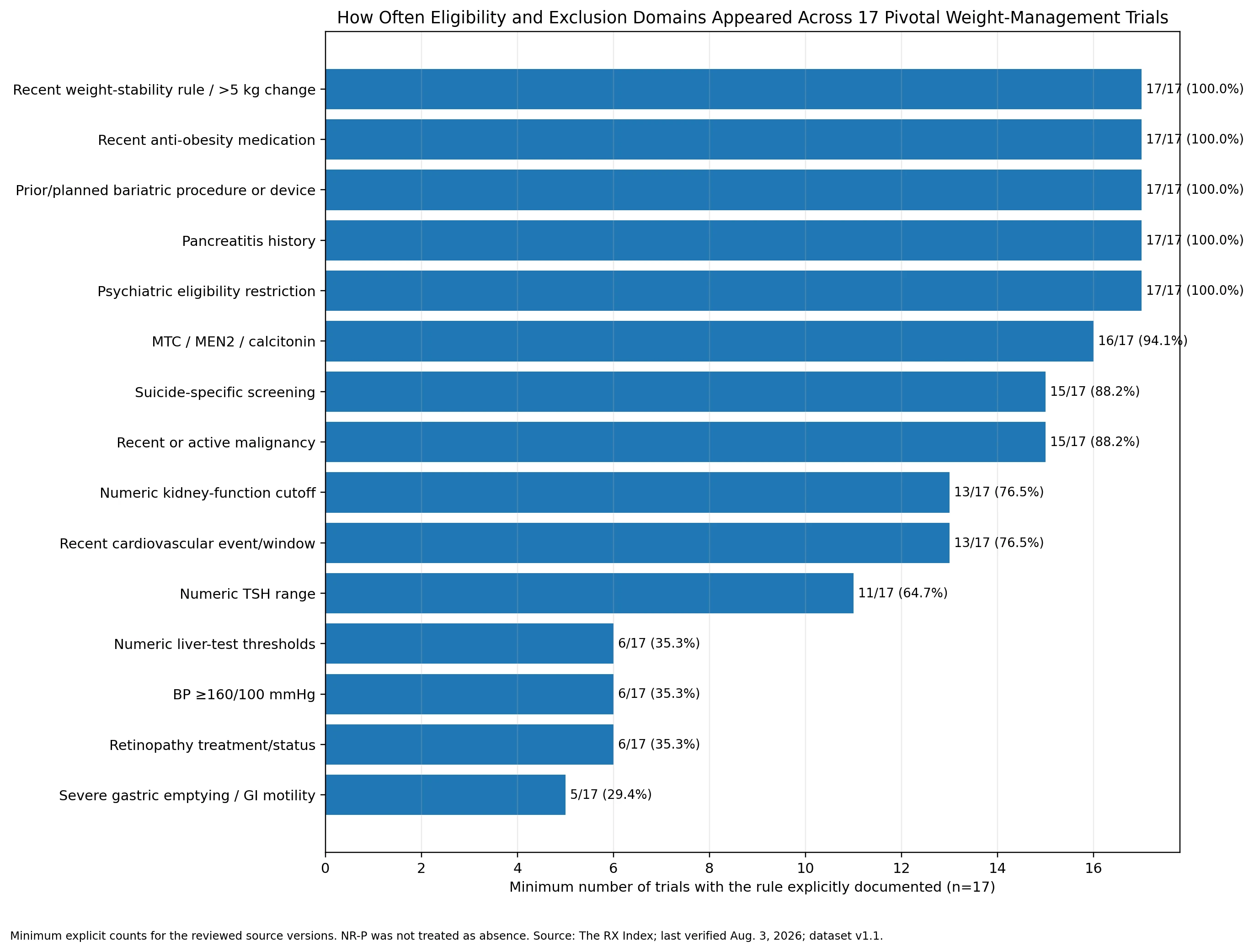
Answer capsule: Five eligibility domains were documented in all 17 trials: recent weight stability, recent weight-loss-drug use, prior or planned bariatric treatment, pancreatitis history, and psychiatric eligibility. Beyond those, MTC, MEN2, or calcitonin criteria appeared in at least 16 trials; suicide-specific screening and malignancy criteria in at least 15; numeric kidney cutoffs and recent cardiovascular-event windows in at least 13; and numeric TSH ranges in 11.
| Eligibility or exclusion domain | Minimum count | Share |
|---|---|---|
| Recent weight-stability rule / no change over about 5 kg | 17/17 | 100.0% |
| Recent anti-obesity medication use | 17/17 | 100.0% |
| Prior or planned bariatric procedure or device | 17/17 | 100.0% |
| Pancreatitis history | 17/17 | 100.0% |
| Psychiatric eligibility restriction | 17/17 | 100.0% |
| Medullary thyroid carcinoma, MEN2, or calcitonin | 16/17 | 94.1% |
| Suicide-specific screening | 15/17 | 88.2% |
| Recent or active malignancy | 15/17 | 88.2% |
| Numeric kidney-function cutoff | 13/17 | 76.5% |
| Specific recent cardiovascular-event window | 13/17 | 76.5% |
| Numeric TSH range | 11/17 | 64.7% |
| Numeric liver-test thresholds | 6/17 | 35.3% |
| Blood pressure at or above 160/100 mmHg | 6/17 | 35.3% |
| Diabetic-retinopathy treatment or status | 6/17 | 35.3% |
| Severe gastric-emptying or GI-motility condition | 5/17 | 29.4% |
Source: The RX Index review of 17 pivotal adult weight-management trials. Minimum explicit counts for the public source versions reviewed; NR-P was not treated as absence. Last verified August 3, 2026.
The universal five are not one kind of rule. Recent-weight stability, recent weight-loss drugs, and prior bariatric treatment reduce the chance that weight change already in motion will be mistaken for the study drug’s effect. Pancreatitis and psychiatric rules are safety and population-selection restrictions. Lumping all five together as “measurement protections” would be wrong.
The lower-frequency rows also need restraint. A rule documented in six trials may reflect population differences, sponsor choices, regulator feedback, study design, or simply the level of public source detail. The matrix shows where a rule was explicitly documented; it does not prove that every blank program rejected the rule.
How did the exclusion criteria differ by drug and trial?
Answer capsule: The broad domains recurred across programs, but the public record was uneven at trial level. SURMOUNT-2 was the only trial with all 15 normalized domains explicitly documented. ATTAIN-1 had the most NR-P cells, largely because its public evidence consisted of an FDA review and abbreviated official records rather than a full protocol.
The four tables below split the matrix by program so the rows remain readable. E = explicitly reported, I = FDA-described as inherited, and — = not reported in the public source reviewed.
Liraglutide — the SCALE program
| Eligibility domain | SCALE Obesity & Prediabetes | SCALE Diabetes | SCALE Maintenance |
|---|---|---|---|
| Recent weight-stability rule | E | E | E |
| Recent anti-obesity medication | E | E | E |
| Prior or planned bariatric procedure | E | E | E |
| Pancreatitis history | E | E | E |
| Psychiatric eligibility | E | E | E |
| Suicide-specific screening | E | E | E |
| MTC / MEN2 / calcitonin | E | E | — |
| Numeric kidney cutoff | — | — | — |
| Recent cardiovascular window | — | — | — |
| Numeric liver thresholds | — | — | — |
| BP ≥160/100 mmHg | E | E | — |
| Retinopathy status | — | E | — |
| Recent or active malignancy | — | E | E |
| Numeric TSH range | — | E | E |
| Gastric emptying / GI motility | — | — | — |
Semaglutide — the STEP and OASIS programs
| Eligibility domain | STEP 1 | STEP 2 | STEP 3 | STEP 4 | STEP 6 | OASIS 4 | STEP UP | STEP UP T2D |
|---|---|---|---|---|---|---|---|---|
| Recent weight-stability rule | E | E | E | E | E | E | E | E |
| Recent anti-obesity medication | E | E | E | E | E | E | E | E |
| Prior or planned bariatric procedure | E | E | E | E | E | E | E | E |
| Pancreatitis history | E | E | E | E | E | E | E | E |
| Psychiatric eligibility | E | E | E | E | E | E | E | E |
| Suicide-specific screening | E | E | E | E | E | E | E | E |
| MTC / MEN2 / calcitonin | E | E | E | E | E | E | E | E |
| Numeric kidney cutoff | E | E | E | E | E | E | E | E |
| Recent cardiovascular window | E | E | E | E | E | E | E | E |
| Numeric liver thresholds | — | — | — | — | — | — | — | — |
| BP ≥160/100 mmHg | — | — | — | — | — | — | — | — |
| Retinopathy status | — | E | — | — | E | — | — | E |
| Recent or active malignancy | E | E | E | E | E | E | E | E |
| Numeric TSH range | E | E | E | E | E | — | — | — |
| Gastric emptying / GI motility | — | — | — | — | — | — | — | — |
Source for Tables 6–9: The RX Index criteria matrix, version 1.1. Last verified August 3, 2026.
OASIS 4, STEP UP, and STEP UP T2D did contain a thyroid rule: each excluded uncontrolled thyroid disease at the investigator’s discretion. They are marked — in the numeric-TSH row because none of the three public protocols specified a numeric TSH range.
Tirzepatide — the SURMOUNT program
| Eligibility domain | SURMOUNT-1 | SURMOUNT-2 | SURMOUNT-3 | SURMOUNT-4 |
|---|---|---|---|---|
| Recent weight-stability rule | E | E | E | E |
| Recent anti-obesity medication | E | E | E | E |
| Prior or planned bariatric procedure | E | E | E | E |
| Pancreatitis history | E | E | E | E |
| Psychiatric eligibility | E | E | E | E |
| Suicide-specific screening | E | E | E | E |
| MTC / MEN2 / calcitonin | E | E | E | E |
| Numeric kidney cutoff | E | E | E | E |
| Recent cardiovascular window | E | E | E | E |
| Numeric liver thresholds | E | E | E | E |
| BP ≥160/100 mmHg | E | E | E | E |
| Retinopathy status | — | E | — | — |
| Recent or active malignancy | E | E | E | E |
| Numeric TSH range | E | E | E | E |
| Gastric emptying / GI motility | E | E | E | E |
Source for Tables 6–9: The RX Index criteria matrix, version 1.1. Last verified August 3, 2026.
Orforglipron — the ATTAIN program
| Eligibility domain | ATTAIN-1 | ATTAIN-2 |
|---|---|---|
| Recent weight-stability rule | E | E |
| Recent anti-obesity medication | E | E |
| Prior or planned bariatric procedure | E | I |
| Pancreatitis history | E | E |
| Psychiatric eligibility | E | I |
| Suicide-specific screening | — | — |
| MTC / MEN2 / calcitonin | E | E |
| Numeric kidney cutoff | — | E |
| Recent cardiovascular window | — | E |
| Numeric liver thresholds | E | E |
| BP ≥160/100 mmHg | — | — |
| Retinopathy status | — | E |
| Recent or active malignancy | — | E |
| Numeric TSH range | — | — |
| Gastric emptying / GI motility | — | E |
Source for Tables 6–9: The RX Index criteria matrix, version 1.1. Last verified August 3, 2026.
Source for Tables 6–9: The RX Index criteria matrix, version 1.1. E = explicitly reported in the public primary source reviewed; I = FDA explicitly described the criterion as inherited from ATTAIN-1; — = not reported in the reviewed source, not confirmed absent.
The ATTAIN entries should be read as a source-completeness snapshot. As more detailed public documentation appears, individual cells may change in either direction after re-review and versioning.
What exact thresholds changed across GLP-1 trial programs?
Answer capsule: Rules that sound identical at summary level used materially different numbers. Numeric calcitonin cutoffs ranged from 20 ng/L to 100 ng/L; kidney cutoffs split between eGFR below 15 and below 30 mL/min/1.73 m²; and recent cardiovascular-event lookbacks were commonly 60 days in the semaglutide program and about 90 days in the tirzepatide program and ATTAIN-2.
“GLP-1 trials excluded kidney disease” is true and nearly useless. Which threshold, in which trial, is the fact that can be checked.
| Domain | SCALE — liraglutide | STEP / OASIS — semaglutide | SURMOUNT — tirzepatide | ATTAIN — orforglipron |
|---|---|---|---|---|
| Recent weight change | Required weight stability within about 5 kg over the prior 3 months | Excluded change over 5 kg in the prior 90 days | Excluded change over 5 kg in the prior 3 months | Excluded change over 5 kg in the prior 90 days |
| Weight-loss-drug washout | Reviewed sources generally used a 3-month window | STEP 1 and STEP UP used 90 days for anti-obesity medication generally plus a separate 180-day window for prior GLP-1 receptor agonist use; OASIS 4 used a 90-day weight-management-drug window without a separate public 180-day criterion | Weight-loss drugs generally excluded within 3 months | Weight-loss drugs and alternative remedies excluded within 180 days |
| Kidney function | Renal impairment was described, but no consistent numeric eGFR cutoff was available across the reviewed sources | Non-T2D trials commonly used eGFR below 15; T2D trials commonly used below 30, with additional medication-linked restrictions | eGFR below 30 | ATTAIN-2 used eGFR below 15; an ATTAIN-1 numeric cutoff was NR-P |
| Recent cardiovascular events | SCALE Obesity and Diabetes used BP ≥160/100; SCALE Maintenance described broader cardiovascular exclusions without a normalized event window in the reviewed text | Recent MI, stroke or TIA, unstable angina, or related events commonly used a 60-day lookback; NYHA class IV heart failure was excluded | Recent MI, stroke, unstable angina, or heart-failure hospitalization commonly used a 3-month lookback; NYHA class IV was excluded | ATTAIN-2 identified specified cardiovascular conditions within 90 days; ATTAIN-1 window was NR-P |
| Liver laboratory thresholds | Impaired hepatic function was described in SCALE Maintenance; no normalized lab threshold was available in the reviewed summary | No numeric liver threshold was coded from the reviewed protocols | ALT >3× ULN, ALP >1.5× ULN, total bilirubin >1.2× ULN | ALT or AST ≥3× ULN, ALP ≥1.5× ULN, total bilirubin ≥1.5× ULN |
| Calcitonin / MTC / MEN2 | SCALE Obesity and Diabetes used calcitonin ≥50 ng/L; SCALE Maintenance numeric criterion was NR-P | Earlier STEP protocols commonly used calcitonin ≥100 ng/L. OASIS 4 and both STEP UP protocols listed MTC/MEN2 but no numeric calcitonin cutoff | Calcitonin ≥20 ng/L when eGFR was at least 60 or ≥35 ng/L when eGFR was below 60 | ATTAIN-2 used the kidney-stratified 20/35 ng/L cutoffs; ATTAIN-1 numeric value was NR-P |
| Thyroid-stimulating hormone | SCALE Diabetes and Maintenance used about 0.4–6.0 mIU/L; SCALE Obesity numeric range was NR-P | STEP 1, 2, 3, 4, and 6 used 0.4–6.0 mIU/L. OASIS 4 and both STEP UP trials used a nonnumeric uncontrolled-thyroid-disease rule | Outside 0.4–6.0 mIU/L | Numeric TSH range was NR-P |
| Uncontrolled blood pressure | SCALE Obesity and Diabetes used systolic ≥160 or diastolic ≥100 mmHg | The 160/100 rule was not coded from the reviewed STEP/OASIS protocols | Systolic ≥160 or diastolic ≥100 mmHg | Numeric threshold was NR-P |
Source: The RX Index exact-threshold crosswalk, version 1.1, normalized from the sponsor protocols, regulator evaluations, and FDA review documents listed below. ULN = upper limit of normal.
The calcitonin spread remains the sharpest number on the page. By calcitonin criterion alone, a screening value of 40 ng/L was below the 50 ng/L SCALE cutoff and the 100 ng/L STEP 1 cutoff, but above both SURMOUNT-1 cutoffs — 20 ng/L with eGFR at least 60 and 35 ng/L with eGFR below 60. Other eligibility rules could still change the result; this comparison isolates one laboratory criterion.
The semaglutide washout was not one universal number. STEP 1 and STEP UP each used two separate rules: 90 days for anti-obesity medication generally and 180 days for prior GLP-1 receptor agonist use. OASIS 4 used a 90-day weight-management-drug window and did not publish a separate 180-day GLP-1 criterion in the protocol reviewed.
Weight stability is where the programs came closest to convergence. The recurring operational rule was about 5 kg over about 90 days, although the three SCALE studies wrote stable weight as an inclusion requirement and the other 14 studies wrote recent weight change as an exclusion.
Why can a registry exclusion field miss part of the eligibility filter?
Answer capsule: In STEP 1, the exclusion list was not the final eligibility gate. The protocol applied four additional randomization criteria after screening, including a food-diary adherence requirement and repeat mental-health screens. A dataset built only from a registry’s exclusion field would miss those post-screen requirements.
The STEP 1 protocol separates eligibility into two stages. Its exclusion section contains the medical and treatment rules. A later randomization section adds four requirements between screening and randomization:
- A daily food-diary entry during the interval, with no more than two missed days
- PHQ-9 below 15 at randomization
- No suicidal behavior during the interval
- No C-SSRS type 4 or 5 suicidal ideation during the interval
A participant who passed the medical screen but failed one of those requirements was treated as a screen failure.
The food diary therefore operated as an adherence gate. It was not labeled an exclusion criterion, but it still shaped who entered the randomized efficacy population.
SURMOUNT-1 placed its repeated psychiatric checks inside the exclusion list instead: PHQ-9 was assessed at more than one visit, and suicide-severity screening could be applied across the screening sequence. The underlying practice was similar; the protocol architecture was not.
That difference matters for automated comparisons. A registry exclusion field can accurately reproduce the exclusion list and still omit post-screen randomization criteria. The direction of error depends on the protocol, so the answer is to read the full eligibility architecture rather than assume one field contains everything.
Both STEP 1 and SURMOUNT-1 generally barred routine rescreening after an eligibility failure. The SURMOUNT-1 protocol also contained an exceptional rescreening pathway tied to a prolonged pandemic-related interruption. “No rescreening” was therefore the rule, not an exception-free absolute.
Primary sources: STEP 1 protocol and SURMOUNT-1 protocol.
Were people with depression or a suicide history excluded from GLP-1 trials?
Answer capsule: Every one of the 17 trials used some form of psychiatric eligibility restriction, and suicide-specific screening was explicitly documented in at least 15. But the wording varied enough that the blanket claim “people with depression were excluded” is not accurate: STEP 1 excluded any major depressive disorder within two years, while SURMOUNT-1 allowed stable depression or generalized anxiety in some circumstances.
This is the most consequential wording difference in the matrix because major depressive disorder was the most common operationalized exclusion in the published U.S. generalizability study discussed below.
The same diagnosis, two different rules
| STEP 1 — semaglutide | SURMOUNT-1 — tirzepatide | |
|---|---|---|
| Two-year rule | Any history of major depressive disorder within 2 years excluded | Significant active or unstable major depressive disorder within 2 years excluded |
| Stable disease | No stable-disease carve-out in the criterion | Stable MDD or generalized anxiety could be considered if expected to remain stable and excluded medications were not being used |
| Practical effect of the written rule | Stable recent MDD still met the exclusion | Stable disease was not automatically disqualifying |
| Source | Protocol §6.2 | Protocol §5.2 |
Source: STEP 1 protocol and SURMOUNT-1 protocol, last verified August 3, 2026.
A third data point follows the SURMOUNT pattern. FDA’s Foundayo review describes ATTAIN-1 as excluding active or unstable major depression or another severe psychiatric disorder within two years and says that the conservative criterion could affect generalizability.
The psychiatric thresholds that recurred
Across the semaglutide and tirzepatide protocols, four screens recurred:
- PHQ-9 score of 15 or above
- Any lifetime history of a suicide attempt
- Recent C-SSRS type 4 or 5 suicidal ideation
- Recent suicidal behavior
The exact time window for the C-SSRS rules varied by protocol wording and visit schedule, but the structure was strikingly consistent.
Eleven named medication examples inside a broader SURMOUNT-1 rule
SURMOUNT-1 also excluded recent use of medications considered likely to cause significant weight gain. Its protocol gave 11 named examples — imipramine, amitriptyline, mirtazapine, paroxetine, phenelzine, chlorpromazine, thioridazine, clozapine, olanzapine, valproic acid or its derivatives, and lithium — while making clear that the list was not exhaustive. It separately stated that selective serotonin reuptake inhibitors other than paroxetine were permitted.
STEP 1 did not contain an equivalent named psychiatric-medication list in its eligibility section.
The written difference is narrower than “one trial allowed psychiatric medication and the other did not.” SURMOUNT-1 used a broader weight-gain-medication rule and supplied those 11 examples; STEP 1 handled psychiatric eligibility through diagnoses and symptom and suicide screens without that named list.
How the 2026 FDA suicidality review fits this evidence
On January 13, 2026, FDA reported that its comprehensive review found no increased risk of suicidal ideation or behavior with GLP-1 receptor agonists and requested removal of the related warning language from Saxenda, Wegovy, and Zepbound labeling.
The review combined:
- A meta-analysis of 91 placebo-controlled trials with 107,910 patients
- A Sentinel claims study of 2,243,138 new users, comparing GLP-1 receptor agonists with SGLT2 inhibitors
- Additional published observational and pooled studies
FDA reported no increased risk in either the trial meta-analysis or the Sentinel comparison.
The two evidence streams answer different weaknesses. The randomized trials offered controlled comparisons but came from protocols with psychiatric and suicide screens. The Sentinel analysis examined routine-care users who were not enrolled through those same protocols. FDA did not state that this was the reason for pairing the methods; it is the practical way the evidence sources complement each other.
Primary source: FDA Drug Safety Communication, January 13, 2026.
Were people with pancreatitis, kidney disease, or prior bariatric surgery excluded?
Answer capsule: Pancreatitis-history and bariatric-procedure or device exclusions were documented across all 17 trials, while numeric kidney-function cutoffs appeared in at least 13. The exact rules differed: STEP 1 limited its acute-pancreatitis exclusion to the prior 180 days, while SURMOUNT-1 excluded any history of acute or chronic pancreatitis.
Pancreatitis
The domain was universal; the wording was not.
- STEP 1 used two rules: acute pancreatitis within the prior 180 days, and any history or presence of chronic pancreatitis.
- SURMOUNT-1 excluded any history of acute or chronic pancreatitis without a stated lookback limit.
By the pancreatitis criterion alone, someone with one acute episode two years before screening would not have met STEP 1’s 180-day acute-pancreatitis exclusion but would have met SURMOUNT-1’s any-history exclusion.
Kidney function
Thirteen trials published a numeric estimated glomerular filtration rate cutoff.
- STEP 1: eGFR below 15 mL/min/1.73 m²
- SURMOUNT-1: eGFR below 30 mL/min/1.73 m²
- Semaglutide T2D trials: commonly below 30, with additional medication-linked restrictions
- ATTAIN-2: eGFR below 15
All else equal, SURMOUNT-1’s cutoff also excluded the 15–29 range that STEP 1’s cutoff did not. The protocols also specified different estimating equations, another detail that disappears in a yes-or-no summary.
Bariatric surgery and devices
The domain was universal, but the carve-outs differed.
STEP 1 excluded previous or planned obesity surgery or weight-loss devices, then permitted four situations after more than one year: liposuction or abdominoplasty; a removed gastric band; a removed intragastric balloon; and a removed duodenal-jejunal bypass sleeve.
SURMOUNT-1 carved out only liposuction or abdominoplasty more than one year earlier from its surgical rule. It separately excluded recent endoscopic or device-based obesity therapy and recent device removal within a six-month window.
Same domain, different clocks and different readmission paths.
Delayed gastric emptying and GI motility
A separately named severe gastric-emptying or GI-motility restriction appeared in five trials: all four SURMOUNT studies and ATTAIN-2.
SURMOUNT-1 excluded clinically significant gastric-emptying abnormalities, including severe gastroparesis or gastric-outlet obstruction, and chronic use of medications that directly affect gastrointestinal motility. No separately named equivalent was coded from the STEP 1 eligibility section.
That is a difference in the written protocols, not proof that one program ignored gastrointestinal risk. The current labels contain their own severe-GI and gastric-emptying language, which belongs to a different evidence layer than trial enrollment.
Primary sources: STEP 1 protocol, SURMOUNT-1 protocol, and Foundayo multidisciplinary review.
Which trial-design decisions shaped enrollment without appearing as exclusion criteria?
Answer capsule: Three provisions in the flagship protocols materially shaped the analyzed populations without appearing as ordinary exclusion criteria: a 70% cap on female enrollment in SURMOUNT-1, an investigator-run motivation interview in STEP 1 whose result was not entered into the case-report form, and a BMI ceiling applied only to STEP 1’s body-composition substudy.
These are ordinary pieces of trial conduct. They matter because “who was studied?” cannot always be reconstructed from the exclusion list alone.
1. SURMOUNT-1 capped female enrollment at 70%
The SURMOUNT-1 protocol imposed an upper limit of 70% female enrollment to ensure a sufficiently large sample of men.
That was a composition control, not an individual medical exclusion. It still constrained the final enrollment mix and belongs in any serious account of how the study population was assembled.
2. STEP 1 used a motivation interview that was not entered into the case-report form
STEP 1 required a barriers-and-motivation interview at screening to identify people who might be unable or unwilling to comply with the protocol. The investigator used the interview in judging eligibility, but the result was not entered into the case-report form.
The decision therefore existed in the screening process without becoming a structured trial variable in the ordinary participant record.
SURMOUNT-1 handled the same idea more visibly: an inclusion criterion required the investigator to judge the participant motivated, capable, and willing to self-inject, follow lifestyle advice, keep a diary, and complete questionnaires.
3. STEP 1’s body-composition substudy had a BMI ceiling that the main trial did not
The STEP 1 DEXA substudy required BMI at or below 40 kg/m² at screening. A participant above that threshold could enter the main trial but not the scan substudy.
Any result derived from that DEXA subgroup therefore describes a narrower BMI population than the full STEP 1 trial.
Primary sources: STEP 1 protocol and SURMOUNT-1 protocol.
Are GLP-1 trial exclusion criteria the same as FDA contraindications?
Answer capsule: No. An exclusion criterion decides who could enter a study. A contraindication is a labeling statement that a medication should not be used in a defined circumstance. The formal contraindication sections in the four current labels reviewed are far narrower than the trial eligibility rules and center on MTC or MEN2 history and prior serious hypersensitivity.
| Term | Who sets it | What it governs | What it means | What it does not mean |
|---|---|---|---|---|
| Exclusion criterion | Trial sponsor in the protocol | Who may enter one study | The person cannot enter that trial | The marketed drug is necessarily unsafe or ineffective for that person |
| Contraindication | FDA-approved labeling | Circumstances in which the drug should not be used | Use is contraindicated in the defined circumstance | Anything about the complete trial population |
| Warning or precaution | FDA-approved labeling | Risks requiring attention, monitoring, or action | A material risk must be considered | Use is automatically prohibited |
| Not recommended | FDA-approved labeling | A use FDA labeling advises against | The benefit-risk balance or evidence does not support routine use | A formal contraindication |
| Limitation of use | FDA-approved labeling | Boundary of the approved or established use | The indication does not extend beyond the stated boundary | Harm was necessarily demonstrated |
Source: Current U.S. prescribing information for Saxenda, Wegovy, Zepbound, and Foundayo, last verified August 3, 2026.
Many trial exclusions — pancreatitis history, recent cardiovascular events, psychiatric history, uncontrolled blood pressure, prior bariatric surgery, and laboratory thresholds — do not appear as formal contraindications in those labels. Some appear as warnings, precautions, monitoring instructions, or “not recommended” language. Others do not appear as an equivalent labeled restriction.
That gap is a question of evidence boundaries. It does not convert the trial’s exclusion into a prescribing prohibition, and it does not erase whatever warning or precaution the current product label does contain.
None of this is prescribing guidance. This page is a research reference about trial design. Decisions about starting, continuing, or stopping a medication belong with a qualified clinician working from the current official prescribing information for that product.
What do these exclusions show about how well the trials represent real patients?
Answer capsule: Our counts describe trials, not people. A U.S. NHANES analysis estimated that 28.1% of label-eligible adults met at least one liraglutide trial exclusion, 26.2% met at least one semaglutide exclusion, and 33.1% met at least one tirzepatide exclusion. A separate Medicare analysis estimated that 44.9% of beneficiaries aged 65 or older with obesity would have been excluded under a broad depression definition.
These are other researchers’ findings. They used population data and operational definitions that our trial-frequency dataset does not.
U.S. adults represented by NHANES
Bessette and Anderson analyzed 8,767 NHANES participants, weighted to represent 110.3 million U.S. adults with overweight or obesity. Among adults meeting the corresponding FDA label indication, the weighted share meeting at least one trial exclusion was:
- 28.1% for liraglutide — 95% CI, 26.4%–29.8%
- 26.2% for semaglutide — 95% CI, 24.6%–27.9%
- 33.1% for tirzepatide — 95% CI, 31.4%–34.8%
The most common operationalized criteria included major depressive disorder, malignant neoplasms, liver disease for tirzepatide, and uncontrolled hypertension. In a sensitivity analysis, 23.5% of tirzepatide-indicated adults reported using medications that may slow gastrointestinal motility.
Medicare beneficiaries aged 65 and older
Chen and colleagues applied pivotal-trial criteria to Medicare Current Beneficiary Survey and claims data. Under a broad definition of depression, 44.9% of older Medicare beneficiaries with obesity would have been excluded — 95% CI, 43.0%–46.8%.
Why the depression definition changes the answer
Both population analyses had to turn protocol language into variables available in survey or claims data. Our criterion-level review shows why that step matters: STEP 1 excluded any major depressive disorder within two years, while SURMOUNT-1 allowed some stable disease.
A population-level estimate has to choose how to operationalize “depression.” That choice can move the result. The published percentages are not wrong; they answer a different question under stated definitions.
Why does this dataset need continuing verification?
Answer capsule: The labeled evidence base changed in 2026, adding oral and higher-dose semaglutide studies and the ATTAIN program. Public protocol availability also differs sharply by program. A static article would eventually combine an outdated trial denominator with newer labels, which is why the dataset has a monthly label check, quarterly source review, and versioned releases.
The 2026 Wegovy label includes OASIS 4 and the two STEP UP studies. The Foundayo label adds ATTAIN-1 and ATTAIN-2. A review built from the earlier injectable programs alone no longer covers the current label-defined universe.
The source layer will change too. Thirteen full sponsor protocols were available in this review, but the ATTAIN rows still rely on FDA review, registry, and sponsor summaries. A later public protocol could expose a criterion that is currently NR-P or show that a normalized rule needs to be recoded.
The maintenance schedule is:
- FDA labels and label-defined trial universe: monthly and after relevant approvals or labeling changes
- Trial records, protocols, and source links: quarterly
- Derived counts, matrix, chart, and downloadable files: every time a source or coded cell changes
- Full editorial and methodology audit: annually
The visible verification date changes only after the source checks are completed.
Limitations
We would rather you know these than find them.
Scope. This review covers 17 adult pivotal chronic-weight-management efficacy trials named in current U.S. prescribing information. It is not every study ever conducted with a GLP-1 receptor agonist or related drug.
Eligibility is broader than an exclusion list. Three SCALE studies expressed recent weight stability as an inclusion requirement. STEP 1 also imposed post-screen randomization criteria. The matrix therefore compares normalized eligibility domains, while the page separately identifies which rule was an inclusion requirement, exclusion criterion, or later randomization gate.
Uneven source completeness. Full sponsor protocols were available for 13 trials. SCALE Obesity and Prediabetes and SCALE Maintenance rely primarily on a regulator clinical evaluation. ATTAIN-1 and ATTAIN-2 rely on an FDA multidisciplinary review and official registry and sponsor records. Those are authoritative sources, but they are less granular than full operational protocols.
NR-P is not absence. A cell marked not reported may reflect a rule that existed but was not visible in the source reviewed.
Protocol versions. Protocols carry amendments and can have country-specific versions. STEP 1’s reviewed document is version 2.0 dated December 21, 2017. SURMOUNT-1’s is amendment (b), approved October 4, 2021. SCALE Diabetes is version 6.0 dated March 6, 2012. Later versions can differ.
Normalization hides wording. Grouping differently worded rules into 15 domains makes comparison possible and necessarily conceals detail. Any claim about one trial should be checked against the exact threshold, notes, and linked source.
Counts are about trials, not patients. Fifteen of 17 trials documenting suicide-specific screening says something about trial design. It does not reveal how many screened people were affected.
We did not decide whether a rule was justified. Different programs can use different rules because of product-specific evidence, study population, regulator feedback, or design choices. This page reports those differences; it does not grade them clinically.
This is not a prescribing or trial-eligibility tool. Trial rules are not contraindications and should not be used to decide whether anyone should start, continue, stop, or avoid a medication.
Frequently asked questions
What are GLP-1 clinical trial exclusion criteria?
They are protocol rules that identify who cannot participate in a particular trial. They protect participant safety, define the study population, and reduce competing explanations for an outcome. They are not FDA contraindications and not individual prescribing rules.
Which trials are included in this dataset?
Seventeen adult pivotal chronic-weight-management efficacy trials named in current U.S. prescribing information: three SCALE trials, eight STEP and OASIS trials, four SURMOUNT trials, and two ATTAIN trials.
What were the most common GLP-1 trial eligibility restrictions?
Every trial documented a recent-weight-stability rule and exclusions involving recent weight-loss-drug use, prior or planned bariatric treatment, pancreatitis history, and psychiatric eligibility. MTC, MEN2, or calcitonin criteria appeared in at least 16 trials.
Did GLP-1 trials exclude people with depression?
All 17 trials used a psychiatric eligibility restriction, but the rules were not identical. STEP 1 excluded any major depressive disorder within two years. SURMOUNT-1 excluded significant active or unstable disease and allowed some stable depression or generalized anxiety.
Would any mental-health history have disqualified someone automatically?
No. The result depended on the trial, diagnosis, timing, symptom score, suicide history, and medication use. Recurring hard screens included PHQ-9 at or above 15, a lifetime suicide attempt, and recent severe suicidal ideation or behavior.
Did participants have to stop weight-loss medication before screening?
Yes, a recent weight-loss-drug exclusion appeared in all 17 trials. The common window was about 90 days, but STEP 1 and STEP UP used a separate 180-day rule for prior GLP-1 receptor agonist use, and ATTAIN used a 180-day general washout in the FDA review.
Why did the trials require stable weight before screening?
A recent-weight-stability rule reduces the chance that weight change already underway before enrollment will be mistaken for the study drug’s effect. The common operational boundary was about 5 kg over about 90 days.
Did prior bariatric surgery disqualify someone?
A prior or planned bariatric procedure or device rule appeared across all 17 trials, but the carve-outs differed. STEP 1 permitted several removed devices or cosmetic procedures after more than a year; SURMOUNT-1 used narrower surgical carve-outs and a separate six-month device window.
Did people with pancreatitis get excluded?
A pancreatitis-history rule appeared in all 17 trials. STEP 1 excluded acute pancreatitis within 180 days and any chronic pancreatitis; SURMOUNT-1 excluded any history of acute or chronic pancreatitis.
What kidney-function cutoffs did the trials use?
Numeric kidney cutoffs appeared in at least 13 trials. STEP 1 used eGFR below 15 mL/min/1.73 m²; SURMOUNT-1 used below 30; ATTAIN-2 used below 15.
Are trial exclusions the same as FDA contraindications?
No. Trial exclusions determine who entered one study. FDA contraindications define circumstances in which the approved label says the drug should not be used. The formal contraindication lists are much narrower than the trial eligibility rules.
How often is this dataset updated?
The four defining labels and trial universe are checked monthly and after relevant approvals or label changes. Protocols, registry records, and links are checked quarterly. Any data correction triggers recalculation, updated downloads, a new version, and a changelog entry.
Citation information
Suggested reference format
The RX Index Editorial Team. “GLP-1 Clinical Trial Exclusion Criteria: 17 Pivotal Weight-Management Trials Compared.” The RX Index Research. Version 1.1. Last verified August 3, 2026. https://therxindex.com/research/glp1-clinical-trial-exclusion-criteria/
For a cross-trial frequency or normalized comparison, this page is the originating dataset. For a statement about one individual trial, the corresponding protocol, regulator evaluation, or FDA review document is identified in the source register and should be checked directly.
Dataset downloads: CSV · JSON · Excel workbook
Primary source register
Every source below was checked on August 3, 2026.
| Source type | Document | How it was used |
|---|---|---|
| FDA prescribing information | Saxenda, revised 02/2026 | Liraglutide trial universe and current labeling |
| FDA prescribing information | Wegovy, revised 06/2026 | Semaglutide trial universe, including OASIS 4 and STEP UP studies, and current labeling |
| FDA prescribing information | Zepbound, revised 02/2026 | Tirzepatide weight-management trial universe and current labeling |
| FDA prescribing information | Foundayo, revised 04/2026 | Orforglipron trial universe and current labeling |
| Regulator clinical evaluation | TGA liraglutide clinical evaluation report | SCALE Obesity and Prediabetes, SCALE Diabetes cross-check, and SCALE Maintenance eligibility |
| Full sponsor protocol | SCALE Diabetes trial publication; protocol in Supplement 2 | Novo Nordisk NN8022-1922 v6.0 eligibility, randomization, psychiatric, retinopathy, malignancy, and TSH criteria |
| Full sponsor protocol | STEP 1 — NCT03548935 | Trial-level criteria, thresholds, randomization gates, motivation interview, and DEXA substudy |
| Full sponsor protocol | STEP 2 — NCT03552757 | Trial-level eligibility and thresholds |
| Full sponsor protocol | STEP 3 — NCT03611582 | Trial-level eligibility and thresholds |
| Full sponsor protocol | STEP 4 — NCT03548987 | Trial-level eligibility and thresholds |
| Full sponsor protocol | STEP 6 — NCT03811574 | Trial-level eligibility and thresholds |
| Full sponsor protocol | OASIS 4 — NCT05564117 | Oral-semaglutide eligibility, including nonnumeric thyroid rule |
| Full sponsor protocol | STEP UP — NCT05646706 | 7.2 mg semaglutide eligibility, two-tier drug washout, and nonnumeric thyroid rule |
| Full sponsor protocol | STEP UP T2D — NCT05649137 | T2D-specific eligibility and nonnumeric thyroid rule |
| Full sponsor protocol | SURMOUNT-1 — NCT04184622 | Trial-level thresholds, depression rule, medication examples, enrollment cap, and rescreening language |
| Full sponsor protocol | SURMOUNT-2 — NCT04657003 | Trial-level eligibility and thresholds |
| Full sponsor protocol | SURMOUNT-3 — NCT04657016 | Trial-level eligibility and thresholds |
| Full sponsor protocol | SURMOUNT-4 — NCT04660643 | Trial-level eligibility and thresholds |
| FDA multidisciplinary review | Foundayo NDA 220934 review | ATTAIN-1 and ATTAIN-2 eligibility assessment and thresholds |
| ClinicalTrials.gov | ATTAIN-1 — NCT05869903 | Trial identity and public eligibility criteria |
| ClinicalTrials.gov | ATTAIN-2 — NCT05872620 | Trial identity and public eligibility criteria |
| Official sponsor record | ATTAIN-1 | Official key requirements and exclusions |
| Official sponsor record | ATTAIN-2 | Official key requirements and exclusions |
| FDA safety communication | Removal of suicidal-ideation and behavior warning, January 13, 2026 | Current FDA conclusion and trial and Sentinel analysis sizes |
| Peer-reviewed literature | Bessette & Anderson, JAMA Internal Medicine | U.S. adult generalizability estimates |
| Peer-reviewed literature | Chen et al., Journal of General Internal Medicine | Medicare older-adult exclusion estimates |
Changelog
| Version | Date | Change |
|---|---|---|
| 1.0 | 2026-08-03 | Initial label-defined 17-trial register, 15-domain matrix, threshold crosswalk, source register, and claim ledger. |
| 1.1 | 2026-08-03 | Distinguished SCALE weight-stability inclusion requirements from exclusion criteria; corrected the numeric-TSH frequency from 14/17 to 11/17; recoded OASIS 4, STEP UP, and STEP UP T2D; added the full SCALE Diabetes protocol; updated the current Zepbound label URL; and narrowed interpretations that exceeded the source evidence. |
Source: The RX Index dataset changelog, version 1.1. Last verified August 3, 2026.
About this research
The RX Index is an independent research and reference resource tracking prices and access for prescription medications. This page is part of The RX Index /research library. It carries no advertising, affiliate links, sponsored placements, provider routing, or commercial recommendation.
The RX Index Editorial Team built this reference by reading current FDA prescribing information, sponsor protocols, regulator clinical evaluations, FDA review documents, and official trial records, then preserving the operational thresholds and documenting where public source detail stopped.
This page is educational research about clinical-trial design. It is not medical advice and not a prescribing or trial-eligibility tool.
Related research: GLP-1 Clinical Trial Demographics · GLP-1 Lean Mass Loss by Drug
How to cite this page
Publication: The RX Index Research
Title: GLP-1 Clinical Trial Exclusion Criteria: 17 Pivotal Weight-Management Trials Compared
URL: https://therxindex.com/research/glp1-clinical-trial-exclusion-criteria/
Last updated and verified: August 3, 2026 · Dataset version 1.1