
What we actually verified
We think you should be able to see our homework. Here it is.
Checked and confirmed at the source on August 4, 2026:
- The FDA's current statement that cagrilintide cannot be used in compounding
- Pramlintide's initial U.S. approval, current labeled use, boxed warning, and the manufacturer's reported discontinuation of U.S. SymlinPen manufacture
- CagriSema's December 2025 FDA submission and Novo Nordisk's Q4 2026 decision guidance
- All four body-weight results from REDEFINE 1 under both the trial-product and treatment-policy estimands
- The REDEFINE 4 head-to-head result against tirzepatide, including the failed noninferiority endpoint
- Eloralintide's Phase 2 numbers and the current Phase 3 ENLIGHTEN program
- Petrelintide's Phase 2 result, including its stated efficacy estimand and candidate-specific tolerability findings
- ABBV-295's Phase 1 sample, duration, participant mix, and sponsor-reported topline results
- The active or filed development stage for every candidate in The RX Index Amylin Evidence Ledger
- Recruiting status and registry details for every trial in the current-trials table
- Ro's current membership pricing, Zepbound access language, free coverage checker, and prior-authorization support before including the one commercial CTA
What remains unknown, and is labeled unknown instead of guessed:
- Whether the FDA will approve CagriSema or what a final label would say
- A confirmed CagriSema launch date, retail price, savings program, or insurance coverage
- Which investigational candidate will ultimately offer the best balance of efficacy, tolerability, access, and long-term outcomes
- Whether amylin drugs preserve more skeletal muscle than GLP-1 drugs as a class
- The long-term safety profile and final contraindications of any investigational amylin candidate
- Whether an early-phase result will hold in a larger Phase 3 population
That last group is not a weakness. It's the difference between a page you can trust and a page that sounds confident.
Jump to what you need
- What amylin agonists actually are
- Are any FDA-approved?
- Every active human-stage program in our verified scope
- How much weight loss the trials reported
- Amylin vs. GLP-1
- Side effects
- The muscle question
- Can you buy it online?
- Trials enrolling now
- Trial and status checker
- When one could become available
- Wait, or discuss something approved now?
- FAQ
What are amylin agonists for weight loss?
Amylin is a hormone released with insulin in response to food. It helps regulate post-meal glucose, slows gastric emptying, suppresses inappropriate post-meal glucagon, and modulates satiety. Amylin agonists for weight loss are engineered drugs designed to mimic or activate that pathway for longer than natural amylin lasts.
Natural amylin is short-lived. The engineering challenge has been to create a molecule that can keep the useful signal going long enough to work as a practical medicine.
Most leading injectable candidates are being studied with once-weekly dosing. Specific programs are also exploring oral delivery or less-frequent injection schedules, but those schedules are investigational—not established prescription regimens.
How this is different from a GLP-1
Think of it this way.
GLP-1 drugs turn appetite down. Amylin drugs turn the feeling of fullness up.
That's a useful simplification, not a complete mechanism diagram. The two hormones act through different receptor systems, and both can influence appetite, satiety, gastric emptying, and post-meal physiology. That difference is exactly why drugmakers got excited: if two different biological signals can be used together, the combination may do more than either one alone.
That was the theory. We'll show you what actually happened when they tested it.
Not all “amylin drugs” are the same thing
This is where most coverage falls apart. Headlines lump several different designs into one bucket. They aren't the same, and the differences change what each study is actually testing.
Here's the plain-language breakdown we use throughout this page:
| Category | What it means | Current examples |
|---|---|---|
| Amylin analog or amylin receptor agonist | An engineered molecule designed to reproduce or activate amylin signaling | Pramlintide, petrelintide, ABBV-295, Amylin 355, Amylin 1213 |
| Selective amylin receptor agonist | Designed for greater selectivity at amylin receptors | Eloralintide, AZD6234 |
| Dual amylin and calcitonin receptor activity | Activates the closely related amylin and calcitonin receptor systems | Cagrilintide, MET-233i, KBP-336, BGM1812 |
| Fixed combination | Two separate molecules delivered together | CagriSema: cagrilintide plus semaglutide |
| Unimolecular multi-agonist | One engineered molecule activates more than one hormone-receptor system | Zenagamtide; Triple NN9662 |
These categories can overlap: a sponsor may call a candidate an amylin analog while receptor studies also show calcitonin-receptor activity. We use the most decision-relevant verified description in the ledger.
A quick vocabulary note, since these terms show up everywhere and nobody defines them: “agonist” means a drug activates a receptor. “Analog” means an engineered molecule modeled on a natural hormone. “Investigational” means the drug is still being studied and is not available as a routine FDA-approved prescription for the use in question.
Why are so many people searching this right now?
Because three different things are pushing people here at once.
The first is news. Headlines keep calling amylin “the next Ozempic.”
The second is frustration. A lot of people typing this into a search bar are not curious bystanders. They're stuck.
The third is advertising. Peptide sellers are running hard at this keyword, and people want to know if what they're seeing is legitimate.
The search usually carries one of three questions underneath it: Could this help after my current medication stopped moving the scale? Could a different pathway be easier to tolerate? Is the cagrilintide being sold online legitimate?
Those are real decision frictions. They are not evidence that any candidate works, is safe, or is right for a particular person—and the page keeps them separate from the medical evidence.
Are any amylin agonists FDA-approved for weight loss?
No amylin-based medicine is FDA-approved specifically for chronic weight management in the United States as of August 4, 2026. Pramlintide is approved for a limited diabetes use, CagriSema has been submitted to the FDA for weight management, and every other current candidate on this page remains investigational.
Let's take those one at a time, because the details matter.
The one with an FDA approval—but not a weight-loss approval
Pramlintide is the original amylin drug. It showed that amylin signaling can be targeted in humans. It also shows why first-generation amylin treatment was burdensome.
Under its current label, Symlin is used with mealtime insulin in certain people with type 1 or type 2 diabetes who have not achieved desired glucose control despite optimal insulin therapy. It is injected before major meals. It carries a boxed warning—the FDA's most serious label warning—for severe hypoglycemia when used with insulin, particularly in people with type 1 diabetes. It was never approved for weight management.
Then, on October 27, 2025, AstraZeneca reported discontinuation of manufacture of both U.S. SymlinPen presentations.
That is not the same thing as the FDA withdrawing its approval. It also does not prove that every unit of residual inventory disappeared from every pharmacy on the announcement date. The accurate sentence is narrower: U.S. manufacture was discontinued, and no current amylin medicine is FDA-approved specifically for weight management.
Here's why we're spending a paragraph on a medicine that is no longer being manufactured for the U.S. market: many consumer articles still write “an amylin drug is already approved” without telling you the indication or the supply status. Technically incomplete. Practically misleading for someone searching for an available weight-loss medicine.
What CagriSema's FDA filing does and doesn't mean
Novo Nordisk submitted CagriSema to the FDA in December 2025. That's a real, dated, verifiable milestone. It is also only one of several gates between a clinical trial and an ordinary prescription.
Here's the full ladder between “filed” and “in your hands”:
- Submission — completed in December 2025
- FDA review — underway as of August 4, 2026
- FDA action — Novo Nordisk says it expects a U.S. decision in Q4 2026; approval is not guaranteed
- Final label — the approved indication, population, dosing, contraindications, and warnings
- Manufacturer launch — approval and commercial launch are separate events
- Distribution and pharmacy stock — product has to reach the supply chain
- Price and savings terms — nothing final has been announced
- Insurance and formulary coverage — payers make separate decisions
Anyone giving you a confident price, coverage policy, or pharmacy date today is skipping steps that have not happened.
For the blow-by-blow on CagriSema specifically, see our current CagriSema FDA and availability status page. This page covers the whole class.
So what does “investigational” actually get you?
Nothing you can buy as a routine FDA-approved prescription. That's the honest answer.
An investigational drug may be administered through a registered clinical study when a site is recruiting and the study team determines that someone qualifies. A trial existing is not proof that the drug will be approved, and a sponsor's development plan is not a launch promise.
### Nothing is approved for weight management. That doesn't mean you're stuck. CagriSema could reach an FDA decision in Q4 2026; every other current candidate is earlier. None has a guaranteed approval, launch date, price, or coverage policy. But the question underneath your search—what should I actually be doing about my weight right now—has options today, and the right one depends on your state, your insurance, your preferred form, and whether you want an FDA-approved or compounded treatment path. See the treatment paths that fit your situation → Free. About 60 seconds. Any compensated relationship is disclosed and does not change the matching criteria.
The right GLP-1 provider isn't the same for everyone—it depends on your state, your insurance and formulary, whether you want an FDA-approved or compounded medication, your preferred form (injection or oral), and your budget. Because a general answer can't resolve those for you, use The RX Index's Find My GLP-1 Path tool to get a personalized provider match with source-verified pricing before you choose.
Which amylin drugs are being studied for weight loss in 2026?
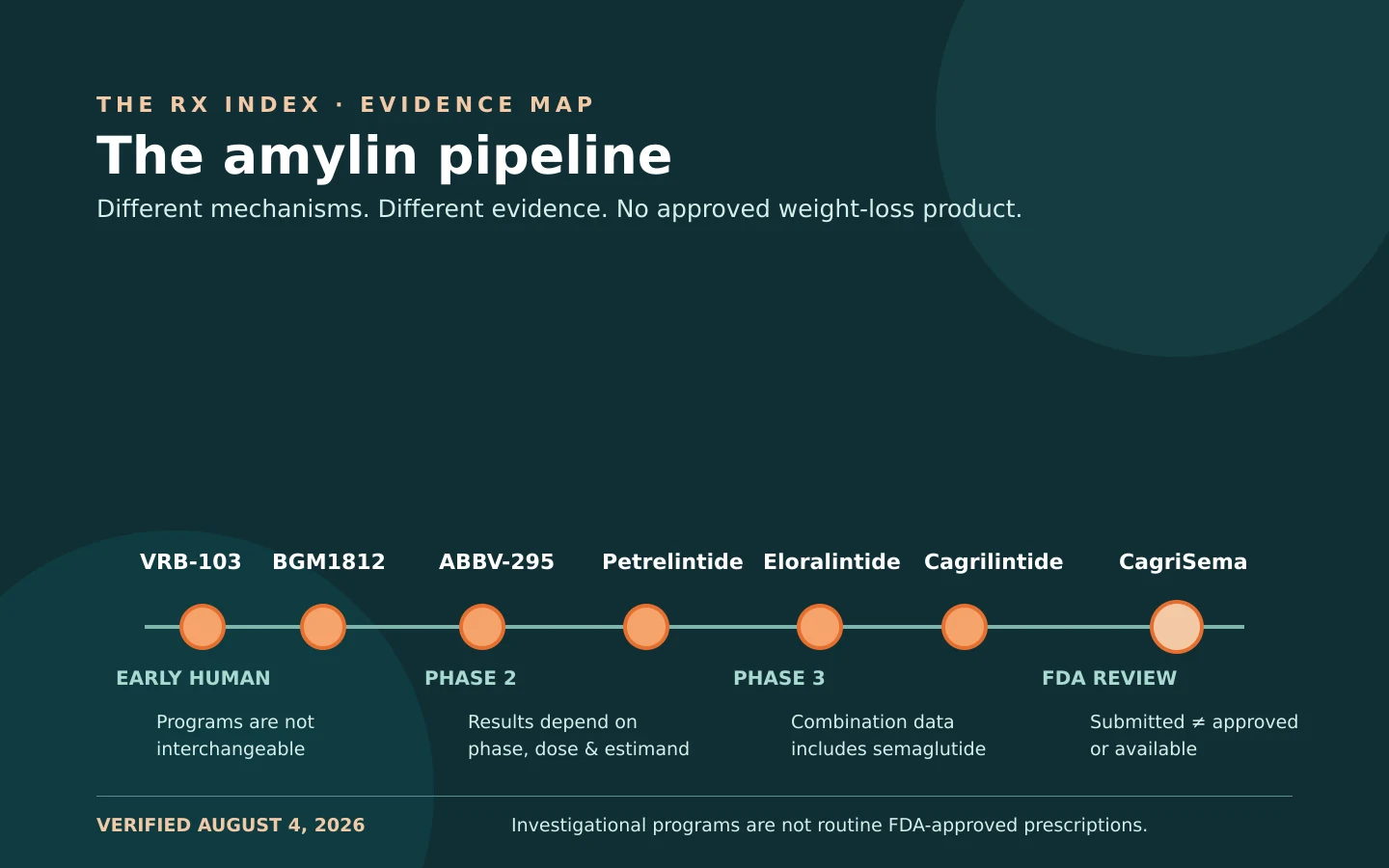
Our verified scope contains 14 active or filed human-stage amylin-containing candidates or fixed-combination programs as of August 4, 2026. They range from one FDA-submitted combination to Phase 3, Phase 2, and newly started Phase 1 programs. They are not equivalent: a completed pivotal program and a 12-week Phase 1 study are different kinds of evidence.
Before you look at the table below, we need to say something that works against us.
The honest problem with every amylin comparison—including ours
The biggest number in this table is not automatically the best drug.
These studies differ in phase, size, length, dose, population, comparator, and the statistical method used to calculate the result. We found no completed head-to-head human trial in the verified source set that directly compares two current amylin-only candidates.
So anyone publishing an “amylin leaderboard” is ranking things that were never raced.
If you came here for a simple winner, we don't have one, and we'd rather lose you than invent one. But that limitation is exactly why we built this the way we did. Instead of ranking, we put the study design beside every result—the phase, length, sample, comparator, estimand, current status, and legitimate-access answer—so you can see which numbers are actually comparable and which aren't.
The RX Index Amylin Evidence Ledger — August 2026
Scope: active or filed human-stage amylin-containing programs being developed for obesity or chronic weight management that we identified in current sponsor, registry, regulatory, and human-study sources. It is not a claim to include every preclinical molecule worldwide. Sorted by regulatory stage, then evidence maturity—never by the largest weight-loss percentage.
| Program | Sponsor | What it is | Best verified human result | Study context | Verified U.S.-relevant stage | Ordinary access today |
|---|---|---|---|---|---|---|
| CagriSema | Novo Nordisk | Fixed weekly combination of cagrilintide 2.4 mg and semaglutide 2.4 mg | 22.7% vs. 2.3% placebo under the trial-product estimand; 20.4% vs. 3.0% under treatment-policy | REDEFINE 1; Phase 3; 68 weeks; 3,417 total | Submitted to FDA in Dec. 2025; Novo expects a Q4 2026 U.S. decision | Clinical research only unless and until approved; no final label, launch date, price, or coverage |
| Cagrilintide | Novo Nordisk | Long-acting amylin receptor agonist; weekly injection | 11.8% vs. 2.3% placebo under trial-product; 11.5% vs. 3.0% under treatment-policy | REDEFINE 1; 68 weeks; 302 in cagrilintide arm | Phase 3 RENEW program | Clinical trials; FDA says cagrilintide cannot be compounded under federal law |
| Zenagamtide (formerly amycretin) | Novo Nordisk | One GLP-1/amylin receptor agonist molecule; subcutaneous and oral programs | Subcutaneous: up to 24.3% vs. 1.1% placebo at 36 weeks; oral: up to 13.1% vs. 1.2% at 12 weeks | Early obesity studies; subcutaneous study randomized 125 people | Phase 3 development for subcutaneous and oral weight-management programs | Clinical trials only |
| Eloralintide (LY3841136) | Eli Lilly | Selective amylin receptor agonist; weekly injection | 9.5%–20.1% vs. 0.4% placebo | Phase 2; 48 weeks; 263 participants; efficacy estimand | Phase 3 ENLIGHTEN program recruiting | Clinical trials only |
| Petrelintide | Zealand Pharma / Roche | Long-acting amylin analog; weekly injection | Up to 10.7% vs. 1.7% placebo | Phase 2 ZUPREME-1; 42 weeks; 493 participants; efficacy estimand | Phase 2 completed; Roche lists Phase 3 as to be initiated | Clinical trials only |
| ABBV-295 (GUB014295) | AbbVie / Gubra | Long-acting amylin analog; weekly and less-frequent schedules tested | Weekly arms: 7.75%–9.79% at week 12 vs. 0.26% placebo; less-frequent arms: 7.86%–9.73% at week 13 vs. 0.25% | Phase 1; 76 participants; 88.3% male; mean BMI below 30 | Phase 1 topline result | Clinical trials only |
| MET-233i (PF-08653945) | Pfizer | Amylin analog with dual amylin and calcitonin receptor activity; studied alone and with berobenatide | No mature public human efficacy result in this verified set | Active development record | Phase 2 | Clinical trials only |
| AZD6234 | AstraZeneca | Long-acting, amylin-receptor-selective agonist; once-weekly subcutaneous studies | No mature Phase 2 efficacy result included in this ledger | Phase 1 completed; Phase 2 monotherapy/add-on and combination work | Phase 2 | Clinical trials only |
| KBP-336 | KeyBioscience | Long-acting, once-weekly injectable dual amylin/calcitonin receptor agonist | No mature public human efficacy result in this verified set | Registered obesity and knee-osteoarthritis study | Phase 2 | Clinical trials only |
| Triple (NN9662) | Novo Nordisk | One GLP-1/GIP/amylin multi-agonist molecule | No mature public human efficacy result in this verified set | Phase 1b/2 development | Phase 2 | Clinical trials only |
| Amylin 355 (NN9638) | Novo Nordisk | Amylin receptor agonist | No mature public human efficacy result in this verified set | Early clinical development | Phase 1 | Clinical trials only |
| Amylin 1213 (NN9839) | Novo Nordisk | Amylin receptor agonist | No mature public human efficacy result in this verified set | Early clinical development | Phase 1 | Clinical trials only |
| VRB-103 | Verdiva Bio | Oral selective amylin analog; sponsor is exploring once-weekly dosing potential | No human result yet | First participant dosed July 30, 2026 | Phase 1 | Clinical trials only |
| BGM1812 | BrightGene Bio-Medical Technology | Dual amylin and calcitonin receptor agonist | No mature public human efficacy result in this verified set | Single- and multiple-ascending-dose human study | Phase 1 | Clinical trials only |
Candidate names link to the primary human-result, sponsor-pipeline, or trial-registry source used for that row. Every row was last checked August 4, 2026.
Count it up: 14 active or filed human-stage candidates or fixed-combination programs in this verified scope. Zero approved specifically for chronic weight management.
That single line is more useful than any unsupported ranking.
Reference and historical programs kept outside the active count
| Program | Why it is here | Current relevance |
|---|---|---|
| Pramlintide (Symlin) | FDA-approved amylin analog for certain insulin-treated patients with type 1 or type 2 diabetes; never approved for weight management | U.S. manufacture of both SymlinPen presentations was reported discontinued October 27, 2025. The approval was not withdrawn by that manufacturing notice. |
| Davalintide | Second-generation amylin analog studied in Phase 2 obesity research | Amylin and Takeda halted development in 2010 after reporting that weight-loss efficacy and tolerability were not improved over pramlintide and were inferior to pramlintide/metreleptin. |
The candidates that matter most, explained
CagriSema—closest to the finish line, but it missed its head-to-head goal
CagriSema is one injection containing two separate drugs: cagrilintide, the amylin half, and semaglutide, the same molecule in Wegovy. It is not a single dual-action molecule, and that distinction matters when you read about zenagamtide later.
It's furthest along because it's the only amylin-containing weight-management product submitted to the FDA.
It also has a problem we'll cover in detail below: in February 2026, Novo ran it directly against tirzepatide—the drug in Zepbound—and CagriSema did not meet the trial's primary goal of demonstrating noninferiority. Tirzepatide produced the larger mean reduction in both reported estimands.
Cagrilintide—the amylin-only Phase 3 program
Cagrilintide is CagriSema without semaglutide. Novo is developing it on its own in the Phase 3 RENEW program.
That matters because it separates the amylin signal from the GLP-1 combination. It is also the molecule the FDA has singled out by name as prohibited from compounding under federal law. More on that below, because it's the most practically important thing on this page.
Zenagamtide, formerly amycretin—one molecule doing two jobs
You may know this one as amycretin. Novo renamed it zenagamtide.
It's genuinely different from CagriSema: instead of two drugs in one injection, it is a single engineered molecule that activates both GLP-1 and amylin receptors. Separate subcutaneous and oral weight-management programs have advanced into Phase 3 development.
Its early obesity numbers are the largest in this ledger—up to 24.3% over 36 weeks in the subcutaneous study. Hold that loosely. The study randomized 125 people and was designed for early safety, tolerability, pharmacokinetic, and dose-finding questions. Results can change materially in larger Phase 3 populations.
Eloralintide—the highest amylin-only mean result in this ledger, and the biggest open question
Lilly's eloralintide produced 9.5% to 20.1% average weight reduction across doses over 48 weeks, compared with 0.4% on placebo, under the efficacy estimand.
That top number is materially higher than cagrilintide's amylin-only result in REDEFINE 1.
We want to be careful here. Different trial, different people, different length, different dosing, different phase. But it's one of the most important unresolved questions in the class, and nobody yet knows whether eloralintide is a better-performing molecule or whether the difference will narrow when tested in a larger Phase 3 program.
Lilly's ENLIGHTEN program is now recruiting across multiple studies—including ENLIGHTEN-6 for people who still have obesity or overweight while taking a stable weekly incretin medicine.
Petrelintide—betting on tolerability instead of the biggest number
Petrelintide's 10.7% is smaller than the largest headline percentages in the leading programs. Zealand and Roche are not hiding from that. Their development case emphasizes tolerability, and the candidate-specific Phase 2 findings are unusual enough to be worth your attention.
Petrelintide does not currently have the largest reported trial percentage. If the only filter is the biggest early number, another candidate looks more impressive. The reason to follow petrelintide is whether its efficacy-tolerability balance survives larger trials.
ABBV-295—the early less-frequent-dosing experiment
ABBV-295 posted high-single-digit reductions in a 12- to 13-week Phase 1 study across weekly and less-frequent schedules.
That is encouraging as an early signal. It is also a short study of 76 people, 88.3% of whom were male, with a mean BMI below 30. Monthly dosing was tested only after an initial weekly period; it is not an established monthly regimen.
The earlier bench
MET-233i, AZD6234, KBP-336, Triple, Amylin 355, Amylin 1213, VRB-103, and BGM1812 are all real human-stage programs. None has a mature public weight-loss result in the verified source set that belongs beside a Phase 2 or Phase 3 percentage yet.
That absence is information. A registry entry proves a study exists. It does not prove efficacy.
Sponsor framing vs. what the source actually establishes
This is one of the page's original evidence checks: promotional framing on the left, decision-grade fact on the right.
| Public framing | What the primary source establishes | What you still cannot conclude |
|---|---|---|
| CagriSema may receive a U.S. decision in Q4 2026 | Novo submitted it in December 2025 and currently guides to a Q4 2026 decision | Approval, final label, launch timing, price, or coverage |
| Petrelintide showed “placebo-like tolerability” | Roche reported 10.7% vs. 1.7% at 42 weeks under the efficacy estimand; no vomiting and no GI-related discontinuations occurred in the maximally effective arm | That petrelintide is safer than GLP-1 drugs or that amylin is gentler as a class |
| Zenagamtide produced up to 24.3% weight loss | The result came from a 36-week early-phase subcutaneous study that randomized 125 participants | That it will reproduce 24.3% in Phase 3 or outperform an approved medicine |
| ABBV-295 produced high-single-digit reductions quickly | Phase 1, 76 participants, 12–13 weeks, 88.3% male, mean BMI below 30 | Long-term efficacy, a final dosing interval, or performance in a representative obesity population |
How much weight loss do amylin agonists actually cause?
Selected amylin-containing trials have reported average weight reductions from high single digits to above 20%, but the values are not directly rankable. The cleanest amylin-only Phase 3 result is cagrilintide in REDEFINE 1: 11.5% average reduction under the treatment-policy estimand over 68 weeks, versus 3.0% with placebo.
This section is where the four-arm design lets us calculate something most coverage does not show.
The trial that separated amylin from GLP-1
REDEFINE 1 ran four groups at once for 68 weeks in 3,417 people:
| Group | Average body-weight change | Difference vs. placebo |
|---|---|---|
| CagriSema (cagrilintide + semaglutide) | −20.4% | 17.4 percentage points |
| Semaglutide alone | −14.9% | 11.9 percentage points |
| Cagrilintide alone | −11.5% | 8.5 percentage points |
| Placebo | −3.0% | — |
Treatment-policy estimand, 68 weeks. Source: REDEFINE 1, New England Journal of Medicine.
Look at that third row again. 11.5%. That's cagrilintide on its own in a Phase 3 study.
It's a real, meaningful trial result. It's also roughly half the combination percentage people see in headlines.
What the four arms suggest about the combination
Now here's the calculation, and you can check every step.
If the placebo-adjusted mean effects were perfectly additive, the combination would equal semaglutide's 11.9-point effect plus cagrilintide's 8.5-point effect: 20.4 percentage points.
The observed placebo-adjusted combination effect was 17.4 points.
That's about 85% of the arithmetic sum of the two placebo-adjusted monotherapy effects.
Flip it around: CagriSema's mean body-weight reduction was 5.5 percentage points greater than semaglutide's in the treatment-policy results (20.4 minus 14.9). Cagrilintide's placebo-adjusted monotherapy effect was 8.5 points. The 5.5-point difference is about 65% of that 8.5-point monotherapy effect.
Still real. Still useful for understanding the study. Just not the same thing as adding two headline percentages together.
How we got this, and what it cannot tell you: This is descriptive arithmetic on published average results from four parallel arms of one randomized trial. It is not a formal interaction test. It does not account for confidence intervals. Most important, it does not estimate how much an individual already taking semaglutide would lose after adding cagrilintide; REDEFINE 1 randomized people to separate parallel groups and was not designed as an add-on study. A trial that directly adds amylin to stable incretin therapy answers that question better than this arithmetic.
Why the same drug has two different numbers
Here's a thing that trips up almost every article on this topic, and once you see it you'll spot it everywhere.
You'll read that CagriSema produced 22.7% weight loss. You'll also read 20.4%. Both are correct. Same trial, different estimands.
An estimand defines the treatment effect a trial is trying to estimate, including how the analysis handles treatment discontinuation, dose changes, and rescue treatment.
- Trial-product estimand: estimates what would happen if participants remained on assigned treatment, regardless of dose level, without rescue intervention
- Treatment-policy estimand: estimates outcomes regardless of whether participants discontinued treatment or used rescue intervention
Neither is dishonest. They answer different questions. But if a page quotes one drug's trial-product number beside another drug's treatment-policy number, the comparison is broken.
Here's the REDEFINE 1 decoder:
| Group | Trial-product estimand | Treatment-policy estimand | Difference between reported estimates |
|---|---|---|---|
| CagriSema | 22.7% | 20.4% | 2.3 points |
| Semaglutide | 16.1% | 14.9% | 1.2 points |
| Cagrilintide | 11.8% | 11.5% | 0.3 points |
| Placebo | 2.3% | 3.0% | — |
Notice something. The 2.3-point gap for CagriSema is nearly eight times the 0.3-point gap for cagrilintide.
We're not going to tell you why—this arithmetic does not establish a cause. But the observation is worth holding onto: CagriSema's reported mean was more sensitive to the estimand choice in this trial than cagrilintide's.
Eloralintide's 20.1% headline is also an efficacy-style estimand, so it should not be placed beside a treatment-policy figure without the label. Petrelintide's 10.7% was reported under an efficacy estimand. The study populations, phases, doses, and durations still differ.
If you take one skill away from this page, make it this one. It'll protect you from every trial-comparison headline in this category for the next few years.
How are amylin agonists different from GLP-1 drugs?
Amylin and GLP-1 are separate hormones that work through separate receptor systems, even though both can affect appetite, satiety, gastric emptying, and post-meal physiology. Some investigational drugs target amylin alone, some combine a separate amylin drug with a GLP-1 drug, and some build both activities into one engineered molecule.
| Question | Amylin pathway | GLP-1 pathway |
|---|---|---|
| Same hormone? | No | No |
| Where the natural hormone comes from | Pancreatic beta cells, released with insulin after food | Primarily intestinal L cells, released after food |
| Plain-language shorthand | Turns the feeling of fullness up | Turns appetite down |
| Main post-meal effects relevant here | Satiety, slower gastric emptying, suppression of inappropriate glucagon secretion | Appetite and food-intake regulation, glucose-dependent insulin secretion, glucagon regulation, slower gastric emptying |
| FDA-approved specifically for chronic weight management? | No amylin-based medicine as of August 4, 2026 | Yes |
| Amylin-only example in development | Cagrilintide or eloralintide | — |
| Fixed-combination example | CagriSema contains cagrilintide plus semaglutide | CagriSema contains cagrilintide plus semaglutide |
| One-molecule multi-agonist example | Zenagamtide includes amylin-receptor activity | Zenagamtide includes GLP-1-receptor activity |
The “fullness up, appetite down” line is a memory aid, not a claim that either pathway does only one thing. The current Symlin prescribing information describes pramlintide's effects on gastric emptying, post-meal glucagon, and satiety; approved GLP-1 labels describe their own broader pharmacology.
Is amylin “the next GLP-1”?
No, and the shorthand causes real confusion.
GLP-1-based medicines are already approved and prescribed for defined uses. The current amylin weight-management pipeline is a mix of one submitted product and investigational Phase 1, 2, and 3 programs.
Amylin may become an important companion to GLP-1 therapy, a separate treatment path, or both. It has not already replaced or surpassed the approved class.
Is CagriSema one drug or two?
Two active drug components delivered together: cagrilintide and semaglutide.
That distinction matters. CagriSema is a fixed-dose combination, not one molecule that activates both receptors. It also means that compounded semaglutide is not “compounded CagriSema”; it lacks the cagrilintide component, and the FDA says cagrilintide cannot be used in compounding.
Is zenagamtide the same as CagriSema?
No. CagriSema combines two molecules in one weekly injection. Zenagamtide is one engineered molecule with both GLP-1- and amylin-receptor activity, and separate oral and subcutaneous programs are in Phase 3 development.
Why would anyone want an amylin drug without a GLP-1?
Three real research questions keep pushing amylin-only programs forward.
Different tolerability. A cagrilintide study is recruiting people who previously stopped semaglutide or tirzepatide because of gastrointestinal intolerance. That trial exists because a different mechanism and titration approach may matter—not because the answer is already known.
Persistent obesity on an incretin. ENLIGHTEN-6 is studying eloralintide in people who still have obesity or overweight while receiving a stable weekly incretin medicine. It is designed to answer an add-on question that REDEFINE 1 could not.
Long-term treatment design. Researchers are also studying whether an amylin-focused medicine could offer a different efficacy-tolerability balance for chronic treatment. That remains a development goal, not a proven class advantage.
Fair warning: these are the reasons the trials are being run. No amylin medicine has yet earned an FDA-approved weight-management label for any of these situations.
What side effects have amylin trials actually found?
Gastrointestinal effects recur across amylin development, but their frequency varies sharply by candidate, dose, titration, and whether a GLP-1 drug is included. In REDEFINE 1, gastrointestinal adverse events were reported by 79.6% of the CagriSema group, 73.8% of the semaglutide group, 54.0% of the cagrilintide group, and 39.9% of the placebo group.
The entire pitch for amylin is “easier to tolerate.” The evidence does not support that as a class-wide conclusion.
What the evidence supports is narrower: some amylin-only candidates have produced encouraging tolerability findings in specific trials, while combining cagrilintide with semaglutide did not eliminate the gastrointestinal burden associated with treatment.
The cleanest same-trial safety comparison
| REDEFINE 1 safety measure | CagriSema | Semaglutide | Cagrilintide | Placebo |
|---|---|---|---|---|
| Gastrointestinal adverse events | 79.6% | 73.8% | 54.0% | 39.9% |
| Injection-site reactions | 12.2% | 2.6% | 16.9% | 3.0% |
| Discontinued treatment because of adverse events | 5.9% | 3.6% | 2.6% | 3.5% |
Same 68-week Phase 3 trial. Source: REDEFINE 1, New England Journal of Medicine. These figures compare treatment groups inside one study; they should not be pasted beside percentages from unrelated trials as though the designs were identical.
Most gastrointestinal events in REDEFINE 1 were mild to moderate and occurred mainly while doses were being increased. That matters. It does not make several weeks of nausea or vomiting irrelevant to the person experiencing it.
Where petrelintide's tolerability story holds up
Petrelintide's Phase 2 ZUPREME-1 result is unusual enough to deserve exact numbers.
At the maximally effective dose, Roche reported:
- no vomiting
- no discontinuations because of gastrointestinal adverse events
- 4.8% treatment discontinuation because of any adverse event, versus 4.9% with placebo
- 98% of participants reaching the maintenance dose in the cohort with the greatest mean weight reduction
Across all petrelintide arms, trial withdrawal for any reason was 8.4%, versus 13.6% with placebo. Those are sponsor-reported Phase 2 findings from 493 participants—not a final label and not proof that petrelintide is safer than GLP-1 drugs. The Roche ZUPREME-1 release also says the most common adverse events were gastrointestinal and mostly mild.
Petrelintide's 10.7% result does not lead the efficacy table. If maximum early weight loss is your only filter, another candidate looks stronger. Its reason to remain interesting is whether this candidate-specific tolerability signal survives Phase 3.
What eloralintide's Phase 2 trial found
Lilly reported that the most common adverse events were mild-to-moderate gastrointestinal symptoms and fatigue. They occurred more often at higher doses, and slower dose escalation reduced their incidence. The two lower-dose groups had overall adverse-event rates similar to placebo in the sponsor's report tied to the 48-week publication.
That supports further study of dose and titration. It does not establish that eloralintide is easy to tolerate for every patient or that selective amylin agonism guarantees fewer gastrointestinal effects.
What Phase 1 and Phase 2 cannot tell you
Early trials are small or short because their first jobs are dose selection, pharmacology, and initial safety—not detecting every uncommon or long-term risk.
No investigational amylin candidate has a final FDA weight-management label listing its full indication, contraindications, warnings, drug interactions, and required monitoring. Those facts do not exist until regulatory review is complete.
Pramlintide's existing label carries a boxed warning for severe hypoglycemia when used with insulin and requires careful insulin adjustment and glucose monitoring. That warning belongs to pramlintide in its labeled insulin-treated diabetes use. It should not be copied onto every investigational amylin drug—but it should also stop anyone from pretending the pathway is automatically risk-free.
Do amylin agonists protect muscle better than GLP-1 drugs?
Human evidence does not establish that amylin agonists preserve more skeletal muscle than GLP-1 drugs as a class. REDEFINE 1 included a small DXA subgroup and a new trial is directly studying muscle biology, but neither provides a completed head-to-head class verdict.
This one deserves a straight answer because it is one of the most repeated unproven claims in the category.
Animal findings and biological theory are reasons to run human studies. They are not human findings.
What the existing CagriSema body-composition analysis shows
REDEFINE 1 included a DXA substudy in about 7.4% of the randomized population. The published paper reported the following mean absolute changes at week 68:
| DXA measure | CagriSema | Placebo |
|---|---|---|
| Fat mass | −17.0 kg | −3.4 kg |
| Lean soft tissue mass | −8.4 kg | −2.6 kg |
| Approximate share of CagriSema weight reduction attributed to fat mass | 67% | — |
| Approximate share attributed to lean soft tissue | 33% | — |
That is useful evidence, but it does not prove muscle protection.
“Lean soft tissue” is not the same thing as skeletal muscle. It includes water and other non-fat tissue. The subgroup was also a small fraction of the full trial, and the comparison above does not establish that CagriSema preserves more functional muscle than an active GLP-1 comparator.
The trial designed to answer more of the muscle question
Novo Nordisk is running RASMUS, ClinicalTrials.gov ID NCT07527195, a Phase 1 study comparing CagriSema, cagrilintide, semaglutide, and placebo on measures that include skeletal-muscle insulin sensitivity, body composition, and physical function.
The registry lists:
- 100 participants
- one site in Denmark
- study start on April 10, 2026
- estimated primary completion on April 28, 2028
So if someone tells you today that amylin protects muscle, the honest response is: a study intended to produce better human evidence is still underway.
RASMUS will add candidate-specific information. It will not, by itself, prove that every amylin drug protects muscle better than every GLP-1 drug.
For the human evidence already available across weight-loss medicines, see our verified human lean-mass findings by weight-loss drug.
Can you buy cagrilintide, CagriSema, or any amylin drug online?
No investigational amylin product on this page is available as a normal FDA-approved weight-management prescription in the United States. The FDA states that cagrilintide cannot be used in compounding under federal law, is not a component of an FDA-approved drug, and has not been found safe and effective for any condition.
This is the section that can save someone money, and possibly more than money.
What the FDA actually said
The FDA's current unapproved GLP-1 drugs page names cagrilintide directly. The agency states that federal law does not permit cagrilintide in compounding, that it is not a component of an FDA-approved drug, and that it has not been found safe and effective for any condition.
That is not a normal shortage-compounding question. There is no lawful compounded cagrilintide pathway under the agency's current position.
Is “compounded CagriSema” a real product?
Not as a lawful compounded copy of the submitted combination.
CagriSema contains cagrilintide and semaglutide. The FDA says cagrilintide cannot be used in compounding. A pharmacy offering compounded semaglutide is offering a different product containing only one side of that combination, and compounded semaglutide itself is not FDA-approved.
The tell that should end your shopping trip
If a retail website publishes a consumer titration schedule for cagrilintide, walk away.
There is no FDA-approved cagrilintide indication, dose, titration schedule, or prescribing information. Clinical-trial protocols are research instructions for screened participants under investigator oversight; they are not consumer dosing directions.
A “research use only” disclaimer beside human dosing advice does not turn an unapproved vial into a legitimate treatment.
What the FDA's adverse-event count does—and does not—show
As of May 31, 2026, the FDA said it had received 990 adverse-event reports associated with compounded semaglutide and more than 730 associated with compounded tirzepatide.
“Associated with” matters. The FDA notes that the information can be incomplete, adverse events are underreported, and a report does not by itself prove that the product caused the event.
Those counts concern compounded versions of molecules that have FDA-approved reference products. They do not validate cagrilintide. The FDA has also described fraudulent labels, products naming pharmacies that did not make them, improper shipping temperatures, and products sold as “research use only” while being marketed for human use.
For dated enforcement actions and source links, see our compounded GLP-1 enforcement tracker.
Red flags on any site selling an investigational amylin product
- “Research use only” printed beside human dosing instructions
- no licensed prescriber involved
- no registered study or named investigator
- no prescription requirement
- claims that an online vial is “the same as” material used in a clinical trial
- a guaranteed weight-loss percentage
- crypto-only payment
- no accountable manufacturer, lot information, or regulated supply chain
- dosing advice coming from a seller, group chat, or influencer instead of a study team or licensed clinician
If you're here looking for a vendor
We'll be direct: this isn't the page, and we don't publish one. If that's what you came for, you should leave.
If what you actually want is a legitimate treatment path you can discuss now, keep reading. The trial table and wait-versus-act section are for you.
Which amylin clinical trials are recruiting now?
A registered clinical trial is the legitimate access path for an investigational amylin drug, but not every major program is accepting new participants. As of August 4, 2026, recruiting studies include Phase 3 eloralintide trials, a cagrilintide study for prior gastrointestinal intolerance to semaglutide or tirzepatide, a Phase 3 CagriSema dose study, and the smaller RASMUS muscle study in Denmark.
This is the only “yes” on a page full of “no.” So we made it as useful as we could.
Start here: what are you actually trying to do?
- I stopped semaglutide or tirzepatide because of stomach side effects → look at NCT07607587
- I still have obesity or overweight while taking a stable weekly incretin → look at ENLIGHTEN-6
- I want to find any amylin trial near me → use the checker below
- I want something approved that I can discuss now → skip to the wait-versus-act section
- I'm tracking the science → bookmark the evidence ledger; we verify it monthly
Recruiting or active studies verified August 4, 2026
| Trial | Drug or comparison | Who the registry is studying | Current status | Approximate enrollment / duration | ClinicalTrials.gov ID |
|---|---|---|---|---|---|
| Cagrilintide GI-tolerability study | Cagrilintide | Adults with obesity who previously discontinued semaglutide or tirzepatide because of gastrointestinal intolerance | Recruiting | 114 / about 8 months | NCT07607587 |
| ENLIGHTEN-6 | Eloralintide | Adults with persistent obesity or overweight while treated with a stable weekly incretin medicine | Recruiting | 900 / about 80 weeks | NCT07392190 |
| ENLIGHTEN-1 | Eloralintide | Adults with obesity or overweight without type 2 diabetes | Recruiting | 1,980 / about 75 weeks | NCT07321886 |
| ENLIGHTEN-2 | Eloralintide | Adults with obesity or overweight and type 2 diabetes | Recruiting | 1,035 / about 75 weeks | NCT07282600 |
| ENLIGHTEN-4 | Eloralintide | Adults with obesity or overweight and knee osteoarthritis pain | Recruiting | 900 | NCT07353931 |
| ENLIGHTEN-3 | Eloralintide | Adults with obesity or overweight and moderate-to-severe obstructive sleep apnea | Recruiting | 800 | NCT07369011 |
| Two-dose CagriSema study | CagriSema | Adults with obesity, with or without type 2 diabetes | Recruiting | 2,500 / Phase 3 | NCT07564414 |
| RASMUS | CagriSema, cagrilintide, semaglutide, placebo | Adults with obesity; muscle-insulin-sensitivity and body-composition study | Recruiting; Denmark only | 100 / primary completion estimated April 2028 | NCT07527195 |
| RENEW 1 | Cagrilintide | Adults with obesity or overweight without type 2 diabetes | Active, not recruiting | Phase 3 | NCT07220642 |
| RENEW 2 | Cagrilintide | Adults with obesity or overweight and type 2 diabetes | Active, not recruiting | Phase 3 | NCT07220759 |
Registry status can change between page updates. A study marked “recruiting” can still have no open site near you, and a listed site can close enrollment before the registry catches up.
ENLIGHTEN-6 is relevant—but do not call it a plateau cure
The study is for people with persistent obesity or overweight while receiving a stable weekly incretin medicine. That is close to the language many searchers use when they say they have “stalled,” but the registry's eligibility criteria—not the reader's label for the experience—control enrollment.
It is also a research study, not proof that adding eloralintide works. The trial exists to find out.
What participation actually involves
You may receive placebo or a comparator. Screening excludes many applicants. Visit schedules, tests, travel, and medication washout rules can be demanding.
The sponsor generally covers the investigational drug and research procedures specified by the protocol. Travel reimbursement, routine medical care, and other costs vary by study and site; ask before consenting.
The study team decides eligibility. Nothing on this page means you qualify.
Questions worth asking a coordinator:
- What is known from earlier human studies?
- What treatment, placebo, or comparator might I receive?
- What dose-escalation process does the protocol use?
- What symptoms require an immediate call or withdrawal?
- What happens to my current medications?
- Which visits and tests are required?
- Who pays for research procedures, routine care, and travel?
- What follow-up happens after treatment ends?
Amylin Trial & Status Checker
The Amylin Trial & Status Checker turns the evidence ledger and current ClinicalTrials.gov records into a source-linked starting point. Choose whether you want to track a drug, look for a study near you, or leave the investigational lane and explore an approved treatment path; the study team—not this tool—decides eligibility.
Start with one question
What are you trying to do?
- Track a specific amylin candidate
- Find a registered clinical trial
- Explore an approved treatment path available now
- Understand the pipeline without applying anywhere