
Best FDA-Approved GLP-1 on Capital Rx Formulary (2026): What’s Covered, What Needs Prior Authorization, and How to Check Your Plan
Published: · Last reviewed:
By The RX Index Editorial Team
Affiliate disclosure: We may earn a commission if you start care through some links on this page, at no extra cost to you. It never changes what’s on the Capital Rx formulary or what we report about coverage.
Not medical advice. This is an informational guide. Your doctor and your plan’s rules decide whether a GLP-1 is right for you and whether it’s covered.
The quick answer. The best FDA-approved GLP-1 on Capital Rx formulary isn’t one single drug — it depends on why you’re taking it. For weight loss, Zepbound is usually the strongest first ask, with Wegovy (pen and pill) right behind it. For type 2 diabetes, the formulary points to Ozempic, Mounjaro, Rybelsus, or Trulicity. All of those sit at Tier 2 (preferred brand) on Capital Rx’s standard Liberty drug list, and every standalone GLP-1 requires prior authorization. Jump to the 5-minute check →
Quick answer: the best FDA-approved GLP-1 on Capital Rx formulary by situation
This maps your reason for wanting a GLP-1 to the drug that makes the most sense to ask about first, based on the Capital Rx Liberty Formulary and each drug’s FDA-approved use.
| Your situation | Best first ask | Why |
|---|---|---|
| Weekly weight-loss shot | Zepbound (tirzepatide) | On the formulary at Tier 2; FDA-approved for weight management |
| Weight loss + moderate-to-severe sleep apnea | Zepbound | The only GLP-1 FDA-approved for obstructive sleep apnea — a separate coverage lane to ask about |
| Want semaglutide, or prefer a pill for weight loss | Wegovy (pen or oral tablet) | Both forms on the formulary at Tier 2; Wegovy also has a heart-risk use |
| Lowest-cost weight-loss option | Generic liraglutide | Tier 1 (cheapest tier) — but a daily shot and an older option |
| Type 2 diabetes + want semaglutide | Ozempic or Rybelsus (pill) | Diabetes-lane GLP-1s at Tier 2 |
| Type 2 diabetes + want tirzepatide | Mounjaro | The diabetes version of tirzepatide (Zepbound is the weight version) |
| The new oral pill, Foundayo | Verify first | FDA-approved, but not found on the Capital Rx formulary we reviewed |
The truly best option is the one your plan covers at the lowest tier and your doctor agrees is right for your health. We can tell you what Capital Rx lists. Only your prescriber can tell you what’s right for your body.
See if your plan actually covers it — free
Before you guess, check. Ro’s free GLP-1 Insurance Coverage Checker contacts your insurer and sends back a written report: your drug, whether prior authorization is required, and your estimated copay. No prescription needed.
Check my Capital Rx GLP-1 coverage → (sponsored affiliate link, opens in a new tab)Prefer to verify yourself first? Log in at the Capital Rx member portal (mycapitalrx.judi.health) or call the number on your member ID card and ask: “Does my plan include weight-loss drug coverage?” That single answer changes everything below.
What we actually verified (June 16, 2026)
We don’t ask you to take our word for it. Here’s exactly what we checked — and what we couldn’t.
✓ Verified
- The Capital Rx Liberty Formulary (2026 edition) — GLP-1 tiers, PA and quantity rules, and category language
- Capital Rx’s rule that a listed drug may not be covered if your plan excludes that category
- That newly FDA-approved drugs aren’t covered until Capital Rx’s committee reviews them
- FDA approvals and labeled uses for Wegovy, Zepbound, Ozempic, Mounjaro, Rybelsus, and Foundayo
- Federal Medicare GLP-1 Bridge rules (CMS)
- Ro and Sesame program details and pricing as of June 16, 2026
⚠ You must confirm these yourself
- Your specific employer or plan’s coverage choices
- Your exact copay, deductible, or coinsurance
- Whether your diagnosis meets your plan’s prior-auth rules
- Whether Foundayo appears in your Capital Rx portal — not found in the public Liberty Formulary we reviewed
Prices and coverage change. We re-verify this page on the schedule in the Sources table at the end.
Which FDA-approved GLP-1s are actually on the Capital Rx formulary?
On the Capital Rx Liberty Formulary, the covered FDA-approved GLP-1s are Ozempic, Mounjaro, Rybelsus, and Trulicity for type 2 diabetes (all Tier 2), and Wegovy (shot and pill), Zepbound, and generic liraglutide for weight management. Every standalone GLP-1 requires prior authorization.
Quick definitions
- Formulary — the list of drugs your plan covers. Capital Rx’s standard list is the Liberty Formulary.
- Tier — your cost level. Tier 1 = generics (cheapest). Tier 2 = preferred brands (middle). Tier 3 = non-preferred brands (priciest).
- PA (prior authorization) — your doctor must get plan sign-off before you can fill it.
- QL (quantity limit) — a cap on how much you can get per fill or per month.
- QLC — a custom quantity limit, often used for low starter doses.
Capital Rx GLP-1 coverage — type 2 diabetes lane
| Drug (active ingredient) | Form | On Liberty Formulary? | Tier | Restrictions |
|---|---|---|---|---|
| Ozempic (semaglutide) | Weekly shot | ✓ Yes | Tier 2 | Prior auth; QL 3 mL / 28 days |
| Mounjaro (tirzepatide) | Weekly shot | ✓ Yes | Tier 2 | Prior auth; QL 2 / 28 days (2.5 mg starter: QLC 2 / 180 days) |
| Rybelsus (oral semaglutide) | Daily pill | ✓ Yes | Tier 2 | Prior auth; QL 30 / 30 days (3 mg starter: QLC 30 / 180 days) |
| Trulicity (dulaglutide) | Weekly shot | ✓ Yes | Tier 2 | Prior auth; QL 2 / 28 days |
| Bydureon BCise (exenatide) | Weekly shot | △ Yes, non-preferred | Tier 3 | Prior auth; QL 3.4 / 28 days |
| Byetta, Victoza, Adlyxin | Various | ✗ Not listed | — | Exception request only |
Also listed, but not standalone GLP-1s: Soliqua and Xultophy are insulin-incretin combination products (insulin paired with a GLP-1). On the Liberty Formulary they sit at Tier 2 with quantity limits only — no prior authorization on those rows. They aren’t a first ask for GLP-1 therapy; they’re for specific insulin-plus-GLP-1 situations your doctor would decide on.
Capital Rx GLP-1 coverage — weight-management lane
| Drug (active ingredient) | Form | On Liberty Formulary? | Tier | Restrictions |
|---|---|---|---|---|
| Zepbound (tirzepatide) | Weekly shot | ✓ Yes* | Tier 2 | Prior auth; QL 2 / 28 days (2.5 mg starter: QLC 2 / 180 days) |
| Wegovy (semaglutide shot) | Weekly shot | ✓ Yes* | Tier 2 | Prior auth; quantity limits by dose |
| Wegovy (oral tablets) | Daily pill | ✓ Yes* | Tier 2 | Prior auth; quantity limits by dose |
| Generic liraglutide (weight) | Daily shot | ✓ Yes* | Tier 1 | Prior auth; QL 15 / 30 days |
| Foundayo (orforglipron) | Daily pill | ✗ Not found | — | New FDA approval; not on the formulary we reviewed |
| Saxenda (brand liraglutide) | Daily shot | ✗ Not listed | — | Generic liraglutide is the covered version |
* The asterisk that decides everything
These weight-loss drugs are on the list — but they’re only covered for you if your specific plan includes the weight-loss (anti-obesity) drug category. Many employer plans leave it out to cut costs. Diabetes GLP-1s are usually a cleaner coverage lane — but your plan’s own formulary and prior-auth rules still control either way.
Source: Capital Rx Liberty Formulary, 2026 edition. Your plan can differ — confirm at mycapitalrx.judi.health or the number on your ID card.
Three things worth knowing right away
- No standalone GLP-1 skips prior authorization on Capital Rx. Not one. Plan for it.
- Bydureon BCise is the only one at Tier 3. That usually means a higher cost — so it’s rarely the smart first ask.
- Foundayo, the brand-new oral pill, wasn’t found on the formulary we reviewed — more on that below.
Why “on the list” doesn’t always mean “covered for you”
This is the single most expensive misunderstanding in GLP-1 coverage. Capital Rx is a pharmacy benefit manager (PBM) — the company that runs the prescription side of your plan. It publishes the Liberty Formulary as a standard template. But your employer (the “plan sponsor”) gets to customize it. They can change tiers, add rules, and — most importantly — leave out whole drug categories, like weight-loss drugs. So a drug can be printed right there on the formulary and still not be covered for you.
Capital Rx is explicit about this: its formulary says a listed drug “may not be covered if your plan does not include coverage of certain categories.” The only way to know for sure is to check your own plan.
Does Capital Rx cover GLP-1s for weight loss, or only diabetes?
The Capital Rx Liberty Formulary lists weight-loss GLP-1s (Wegovy, Zepbound, generic liraglutide) and diabetes GLP-1s (Ozempic, Mounjaro, Rybelsus, Trulicity). But coverage for the weight-loss ones depends on whether your employer chose to include the weight-loss drug category — and many don’t. Here’s the plain-English version:
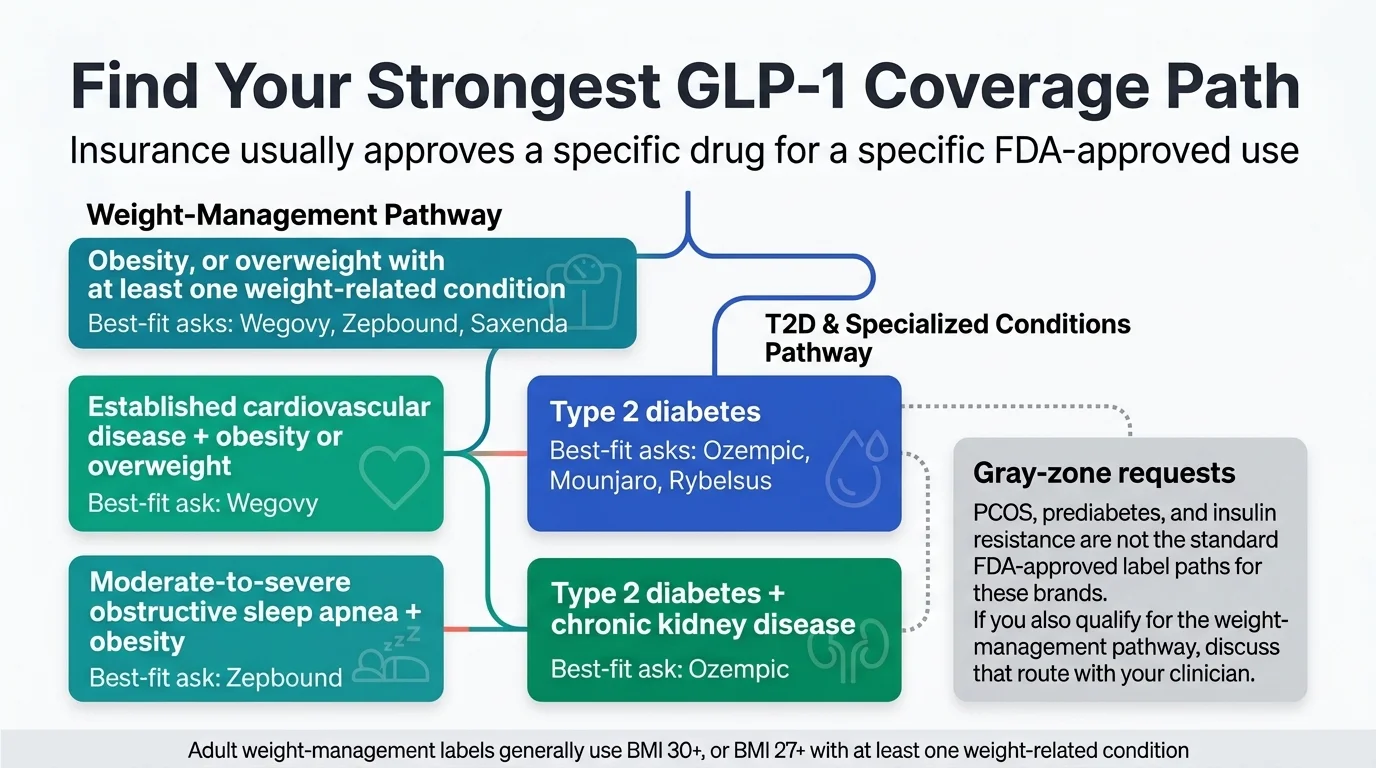
- Wegovy and Zepbound are the FDA-approved weight-loss brands. Coverage for them is the one most likely to be excluded.
- Ozempic, Mounjaro, Rybelsus, and Trulicity are diabetes brands. If you have type 2 diabetes, you’re usually in a stronger spot.
- Insurance generally follows the FDA-approved use and your plan’s rules — not what a friend got covered, and not off-label hopes.
A coverage lever most people miss — sleep apnea
If your plan excludes weight-loss drugs but you also have moderate-to-severe obstructive sleep apnea, pay attention: Zepbound is the only GLP-1 FDA-approved to treat obstructive sleep apnea in adults with obesity (approved December 2024, per FDA labeling and Eli Lilly). Wegovy is not approved for sleep apnea. That gives Zepbound a separate FDA-approved coverage lane — one your plan’s weight-loss exclusion doesn’t automatically block. It’s not an automatic workaround, but if it fits you, it’s worth raising with your doctor.
Zepbound vs. Wegovy on Capital Rx: which should you ask about first?
For weight loss, Zepbound is the strongest first ask if you and your doctor want tirzepatide and your plan covers weight-loss drugs — it’s also the only option with a sleep-apnea use. Wegovy is the better first ask if you want semaglutide, prefer a once-daily pill, or your doctor is focused on heart-risk reduction. Both are Tier 2 on Capital Rx and both need prior auth.
Ask about Zepbound first if…
- Your doctor thinks tirzepatide is right for you
- You’re treating obesity, or overweight plus a weight-related condition
- You also have moderate-to-severe sleep apnea with obesity (its unique FDA-approved use)
- You’re fine with a weekly shot
Ask about Wegovy first if…
- You want semaglutide instead of tirzepatide
- You’d rather take a daily pill (Wegovy now comes in an oral tablet, FDA-approved December 2025)
- Your doctor wants a drug also approved to lower the risk of major heart events in certain adults with known heart disease plus obesity or overweight
Ask about generic liraglutide if the lowest tier matters most
Generic liraglutide for weight management sits at Tier 1 on the Liberty Formulary — the cheapest tier. The trade-off: it’s a daily shot and an older medicine, so most people and doctors reach for the newer weekly options if those are covered.
Think Zepbound or Wegovy is your path? Confirm coverage first.
Don’t let your doctor’s office spend a week on a prior auth for a drug your plan never covered. A free coverage check tells you where you stand — in writing — before anyone files anything.
See if Zepbound or Wegovy is covered for me → (sponsored affiliate link, opens in a new tab)What about Ozempic or Mounjaro through Capital Rx?
Ozempic and Mounjaro are on the Capital Rx Liberty Formulary at Tier 2 with prior authorization — but in the diabetes section, not the weight-loss section. That matters.
Ozempic (semaglutide) is FDA-approved for type 2 diabetes blood-sugar control. Its label also includes lowering the risk of major heart events in adults with type 2 diabetes and known heart disease, and lowering kidney-related risks in adults with type 2 diabetes and chronic kidney disease. It is not FDA-approved for weight loss. On Capital Rx it’s Tier 2 with prior auth and a quantity limit of 3 mL per 28 days.
Mounjaro (tirzepatide) is FDA-approved as an add-on to diet and exercise to improve blood-sugar control in adults and children 10 years and older with type 2 diabetes (the pediatric use was added in late 2025). On Capital Rx it’s Tier 2 with prior auth (the 2.5 mg starter dose carries a custom quantity limit). If your goal is weight loss rather than diabetes, Zepbound is the tirzepatide brand to ask about, not Mounjaro.
The takeaway: if you have type 2 diabetes, the diabetes-lane GLP-1s are your most reliable covered path. If your goal is purely weight loss, asking for a diabetes brand off-label usually leads to a denial — the weight-loss brands are the cleaner route.
Is Foundayo (the new GLP-1 pill) on the Capital Rx formulary?
Foundayo is FDA-approved, but it was not found in the public Capital Rx Liberty Formulary we reviewed. That doesn’t prove your specific plan will never cover it — it means you shouldn’t assume it’s covered until you check your own portal.
Foundayo (orforglipron) is Eli Lilly’s once-daily oral GLP-1 pill. The FDA approved it on April 1, 2026 for chronic weight management in adults with obesity, or overweight plus a weight-related condition. Its big selling point: a pill you can take any time of day, with no food or water rules.
Two things to know before you count on Foundayo
- It’s brand-new, so coverage lags. The Liberty Formulary itself says drugs the FDA newly approves “will not be covered until the committee has been able to fully evaluate them.” New drugs commonly take a quarter or more to appear. Re-check your portal later in 2026.
- It carries real safety notes. Foundayo has a boxed warning for a risk of thyroid tumors, including thyroid cancer. And because it was approved under the FDA’s Commissioner’s National Priority Voucher pilot program, the approval letter required additional post-marketing work — including safety data on cardiovascular events and possible drug-induced liver injury. This isn’t a recall — but it belongs in the conversation with your doctor.
If you want an oral GLP-1 that’s on the formulary today, Rybelsus (for diabetes) or the oral Wegovy tablet (for weight) are the covered choices. If your plan doesn’t cover Foundayo, cash-pay routes start around $149/month for new patients on the lowest doses — but confirm before assuming.
PA, QL, and QLC: what these codes mean, and whether they’ll block you
PA (prior authorization) means the plan must approve the drug before it’s covered; your doctor submits the paperwork. QL (quantity limit) caps how much you can get per fill or per month. QLC is a custom version of that cap, common on low starter doses. Every standalone GLP-1 on Capital Rx has a PA, and most have a QL or QLC — knowing what they mean keeps you from getting blindsided at the pharmacy.
PA — prior authorization
Your prescriber sends documentation showing you meet the plan’s rules. Capital Rx says most prior-auth reviews are completed within two business days when the form and documents are complete and correct. The slow part is usually gathering the right paperwork — so help your doctor’s office get it right the first time.
QL — quantity limit
A cap on the amount covered. For example, Ozempic shows QL 3 mL / 28 days on the Liberty Formulary.
QLC — quantity limit, custom
A special cap, often used for starter doses. Example: Zepbound’s 2.5 mg starter shows QLC 2 / 180 days, while its maintenance strengths show QL 2 / 28 days. Translation: your starter month may be limited differently than your ongoing months — totally normal for these drugs.
Screenshot this before you call your plan or your doctor
- Drug name and strength
- The tier (1, 2, or 3)
- The exact PA / QL / QLC text
- Your reason for taking it (diagnosis)
- Your member ID and plan name
- Whether the drug shows under the diabetes or weight-loss category
- Any rejection message the pharmacy gave you
That little screenshot turns a confusing phone call into a five-minute one.
The Capital Rx GLP-1 Coverage Decoder
Staring at “Tier 2 · PA · QLC 2/180” and have no idea what it means for you? Use this quick decode while you have your portal open:
- Tier 1 → cheapest cost-share (generics, like liraglutide for weight). Tier 2 → preferred brand (most GLP-1s here). Tier 3 → priciest (Bydureon BCise).
- PA → your doctor must get approval first. Expect it on every standalone GLP-1. Ask your doctor’s office to submit complete documentation up front.
- QL / QLC → a quantity cap. A different starter-dose cap (QLC) is normal — it doesn’t mean you’re being denied.
- No PA but a QL → likely an insulin-incretin combo (Soliqua, Xultophy), not a standalone GLP-1.
- Drug not found in your portal → it may be excluded for your plan, non-formulary, or too new (like Foundayo). Ask about a covered alternative or an exception.
We’re building this as an interactive tool so you can type in your own row and get a personalized checklist. Until then, the decode list above does the job.
Rather not deal with the paperwork at all?
Start with Ro’s free coverage check. If you join Ro and a Ro-affiliated provider prescribes an insurance-eligible GLP-1 that needs prior auth, Ro’s insurance concierge verifies your benefits and submits the paperwork for you (commercial plans). The insurance route usually takes about 2–3 weeks.
Let Ro check my coverage and handle the prior auth → (sponsored affiliate link, opens in a new tab)What you’ll actually pay with Capital Rx
If your Capital Rx plan covers the GLP-1, you pay your plan’s tier cost-share — not the sticker price. In Ro’s own coverage data, half of covered patients paid $50 a month or less in copay. If your plan doesn’t cover it, brand-name cash prices now start around $149/month for the lowest-dose pills — a fraction of the $968 to $1,349 retail list price.
1. Covered (Tier 2 or Tier 1, prior auth approved)
You pay your copay or coinsurance — often modest. Ro reports that half of its insured members with coverage pay $50/month or less for medication. Your exact number depends on your plan’s design and deductible.
2. Cash-pay brand (your plan excludes it)
Through manufacturer channels — LillyDirect, NovoCare, and TrumpRx — and telehealth that matches those prices, the lowest-dose Wegovy pill or Foundayo pill start around $149/month for new patients. Costco members can get Wegovy or Ozempic shots around $349/month (new patients about $199/month for the first two months) and the Wegovy pill from about $149/month through the Costco Member Prescription Program with Sesame (sesamecare.com). Verify current pricing before relying on it.
3. Retail list price (the number to avoid)
Walk into a pharmacy with no coverage and no program, and brand GLP-1s list around $968/month for Ozempic and $1,349/month for Wegovy. That gap is exactly why coverage or a manufacturer channel matters so much.
Want to know what you’ll pay — not a range?
A free coverage check returns your estimated copay in writing, and shows your cash-pay price if your plan won’t cover it. One minute, no prescription.
See my estimated GLP-1 cost → (sponsored affiliate link, opens in a new tab)How to check your own Capital Rx coverage in about 5 minutes
Log in at the Capital Rx member portal (mycapitalrx.judi.health) and search your drug, or call the number on your ID card, or have your doctor’s office run an electronic benefits check. For a weight-loss GLP-1, ask whether your plan includes the weight-loss drug category — that single question changes everything.
Name your real goal
Weight loss? Type 2 diabetes? Sleep apnea with obesity? Heart-risk reduction? A pill instead of a shot? Your goal points to the right FDA-approved lane.
Match the goal to the right brand
Don't mix these up: Zepbound (weight) vs. Mounjaro (diabetes); Wegovy (weight) vs. Ozempic (diabetes); the Wegovy tablet (weight) vs. Rybelsus (diabetes).
Check the Capital Rx portal
Log in and search your exact drug and dose. Capital Rx says coverage and rules depend on your specific plan, so the portal is the source of truth.
Ask the right questions
See the 10-question list below — copy and paste them.
Decode the codes, then act
Use the decoder above to translate PA / QL / QLC text into your next move.
Ask these exact questions (copy and paste them)
- “Is this drug covered under my exact plan, for my diagnosis?”
- “Does my plan exclude weight-loss medications?”
- “Is prior authorization required?”
- “What does my doctor need to document for the prior auth?”
- “Is there step therapy?” (Step therapy means you try a cheaper drug first.)
- “What do the QL or QLC limits mean for this dose?”
- “What’s my copay or coinsurance after my deductible?”
- “Can I use a manufacturer savings card with this plan?”
- “If it’s denied, what covered alternative do you prefer?”
- “Can I get the guideline you used to make the decision?” (Capital Rx says prescribers can request the internal guideline used in a decision.)
Which provider should a Capital Rx member use for FDA-approved GLP-1s?
For this specific need — FDA-approved drugs plus insurance navigation — Ro is the best fit, because it pairs a free coverage checker with an insurance concierge that files your prior authorization (on commercial plans). Sesame Care is the strong second choice if you want to pick your own clinician or you’re a Costco member.

Best first path: Ro
Best for: Capital Rx members with a commercial or employer plan who want an FDA-approved GLP-1 and real help with coverage or prior authorization.
- A free GLP-1 Insurance Coverage Checker that contacts your insurer and returns a written report — your coverage, whether prior auth is needed, and your estimated copay. No prescription required.
- A dedicated insurance concierge that verifies your benefits and submits the prior-authorization paperwork for you, then follows up. The insurance route takes about 2–3 weeks.
- Through insurance, Ro’s concierge works to get coverage for brand-name GLP-1s — typically the Wegovy pen, Zepbound, and Ozempic.
- If your plan won’t cover it (or you’d rather pay cash), Ro offers FDA-approved cash-pay options — Wegovy pill, Foundayo pill, Zepbound KwikPen, Wegovy pen, and Ozempic — at prices matching LillyDirect, NovoCare, and TrumpRx.
- Pricing: $39 for the first month, then as low as $74/month with an annual plan paid upfront, or $149/month month-to-month. Medication is billed separately; HSA/FSA receipts can be submitted for reimbursement. Verify current pricing.
The one honest drawback — and who it doesn’t matter for
Ro’s insurance concierge is built for commercial and employer plans. It can’t help government plans — so if you have Medicare, Medicaid, TRICARE, or VA coverage, the concierge won’t win you coverage. (Ro says Medicare, Medicare Advantage, and TRICARE members may still join and pay cash for certain options; FEHB members can use the concierge; Medicaid and VA members aren’t eligible for Ro Body.) If you’re on an employer plan, this drawback simply doesn’t apply to you. If you’re on Medicare, jump to the Medicare section below.
And here’s the part most affiliate pages won’t say out loud: if your Capital Rx plan already covers your GLP-1, you don’t need a telehealth membership at all. Your own doctor plus your pharmacy benefit is the cheapest path, full stop. A concierge like Ro earns its keep when your plan excludes the drug (and you want a transparent cash price), or you’d rather not chase the prior-auth paperwork yourself. If neither is you, take this page to your doctor and skip the fee.
Two doors, depending on where you landed
Want the deeper breakdown first? Read our full Ro Body review.
Best second path: Sesame Care
Best for: people who want to choose their own clinician, or who are Costco members wanting Costco/Novo pricing on Wegovy or Ozempic.
- Sesame lets you browse provider profiles and pick your own clinician — most platforms just assign one.
- Costco members get Wegovy or Ozempic shots around $349/month (new patients about $199/month for the first two months) and the Wegovy pill from about $149/month through the Costco Member Prescription Program with Sesame.
- One of the broadest branded menus: Wegovy (shot and pill), Zepbound, Ozempic, Mounjaro, Foundayo, Rybelsus, and more.
- Subscription around $99 every 28 days (lower with annual plans or the Costco-linked plan); medication is billed separately. Verify current pricing.
Want to pick your own doctor, or use Costco pricing?
Compare Sesame’s FDA-approved GLP-1 options → (sponsored affiliate link, opens in a new tab)More detail: read our Sesame Care review.
Why we don’t rank compounded providers on this page
You searched for an FDA-approved GLP-1 on a formulary. Compounded GLP-1s are a different thing entirely. Compounded means a pharmacy mixes a custom version of the drug. The FDA warns that compounded GLP-1s do not go through FDA review for safety, effectiveness, or quality. They are not the same as the FDA-approved brands on this page, and they’re never what a formulary covers. Mixing them into a “best FDA-approved on Capital Rx” answer would be misleading — so we keep them out of this one.
Provider-stated vs. verified
| Ro | Sesame Care | |
|---|---|---|
| Best use on this page | FDA-approved GLP-1 + insurance/PA help | Pick your own clinician; Costco/Novo pricing |
| Insurance support | Concierge verifies benefits, files PA (commercial plans) | Providers can assist; you use your own pharmacy benefit |
| Insurance-eligible meds | Typically Wegovy pen, Zepbound, Ozempic | Use your plan at your pharmacy |
| Cash-pay options | Wegovy pill/pen, Foundayo pill, Zepbound KwikPen, Ozempic — matches LillyDirect/NovoCare/TrumpRx | Broad branded menu; Costco: shots ~$349/mo, Wegovy pill from ~$149/mo |
| Membership fee | $39 first month; then ~$74/mo (annual prepay) or $149/mo | ~$99 / 28 days (lower with annual/Costco plan) |
| Government-plan limit | No concierge for Medicare/TRICARE; Medicaid/VA not eligible | Self-pay or your own plan |
| Last verified | June 16, 2026 (ro.co) | June 16, 2026 (sesamecare.com) |
Prices and medication availability change; confirm on each provider’s site before you act.
A real, paid testimonial (and a balanced note)
Ro features member testimonials and discloses that members were paid for them. One member describes the experience: “I’m making informed decisions for my health and my body” — a paid Ro member. We share it for the experience of the process, not as a promise of results; weight-loss results vary by person. For balance: on third-party review sites, some users praise Ro’s insurance help while others complain about membership billing or cost. Read recent reviews before you commit.
What if Capital Rx denies your GLP-1?
A denial isn’t always the end. First find out why — missing paperwork, the wrong diagnosis lane, a plan exclusion, step therapy, a quantity-limit issue, or a brand-new drug not yet reviewed. Then ask about an appeal, a formulary exception, or a covered alternative. Many denials are fixable.
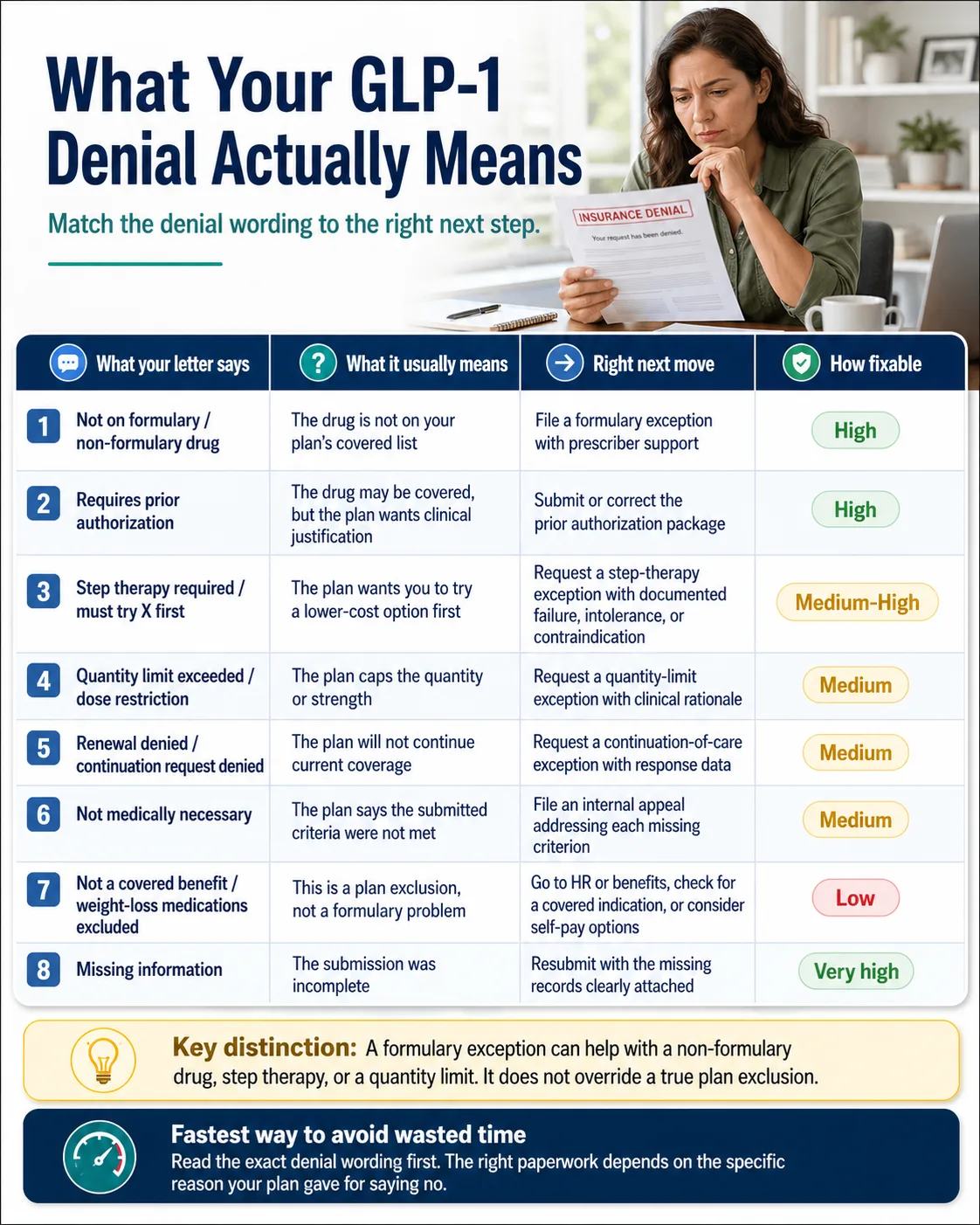
| What the denial says | Likely reason | What to ask your plan | What to ask your doctor |
|---|---|---|---|
| “Prior authorization required / not on file” | PA never submitted or incomplete | “What exactly is missing?” | “Can you resubmit with full documentation?” |
| “Not a covered benefit” / “excluded” | Plan dropped the weight-loss category | “Is there an exception process?” | “Does the sleep-apnea lane (Zepbound) fit me?” |
| “Step therapy required” | Plan wants a cheaper drug tried first | “Which drug must I try first?” | “Can we document why that’s not appropriate?” |
| “Quantity limit exceeded” | Dose/fill clashes with QL or QLC | “What quantity is allowed for this dose?” | “Can we adjust the prescription to fit?” |
| “Drug not covered” (new drug) | Too new for the formulary (e.g., Foundayo) | “What covered alternative do you prefer?” | “Can we switch to an on-formulary option?” |
A formulary exception is a request asking the plan to cover a drug it normally wouldn’t, backed by your doctor’s clinical notes. Capital Rx says a drug-exception request with clinical documentation can be submitted when your prescriber decides you need a drug that isn’t covered on the Liberty Formulary. It’s worth trying when the medical case is strong.
Denied — or worried you will be?
If your plan won’t cover it, see FDA-approved cash-pay routes before switching to anything compounded.
See FDA-approved cash-pay options → (sponsored affiliate link, opens in a new tab)What if you have Capital Rx through Medicare?
If your Capital Rx pharmacy benefit is a Medicare Part D plan, GLP-1s are covered for FDA-approved medical conditions like type 2 diabetes — but Medicare still excludes coverage for weight loss alone. Starting July 1, 2026, the new federal Medicare GLP-1 Bridge lets eligible members get Foundayo, Wegovy, or the Zepbound KwikPen for weight at a flat $50/month copay — if they qualify. In 2026, Part D also caps your out-of-pocket costs for covered Part D drugs at $2,100 for the year.
Medicare GLP-1 Bridge — not everyone qualifies (CMS)
To use the Bridge for a weight-loss GLP-1, all of these must be true:
- You’re in an eligible Part D plan type
- Your prescription is for weight reduction
- Your prescriber attests you meet CMS’s clinical criteria
If you’re being treated for type 2 diabetes, obstructive sleep apnea, or noncirrhotic MASH, those go through normal Part D coverage — not the Bridge.
The Bridge begins July 1, 2026. Eligible weight-loss drugs are Foundayo, all forms of Wegovy, and the Zepbound KwikPen when used to reduce excess body weight, at a flat $50/month copay; CMS covers the rest. Your doctor still has to submit a prior auth.
Important routing: Ro’s concierge does not handle government insurance. If you’re on Medicare, work through your own prescriber and the Bridge — don’t count on a telehealth concierge to coordinate it.
The honest downsides before you start
The biggest downside is that being on the Capital Rx formulary doesn’t guarantee your plan will pay. The others: prior auth can delay or block you, plans can exclude weight-loss drugs, starter-dose limits can surprise you, and a brand-new drug like Foundayo may not be covered yet.
- A listed drug isn’t a personal guarantee. Your employer can exclude categories. Verify your plan.
- Prior auth is required for every standalone GLP-1 here. Expect a short wait and some paperwork.
- Starter-dose quantity limits (QLC) can differ from your maintenance months. Normal, but plan for it.
- Even covered, the cost may not be tiny. Your deductible and tier decide your real out-of-pocket.
- FDA-approved doesn’t mean right for everyone. These drugs carry warnings and side effects, and shouldn’t be combined with other GLP-1s unless your doctor and the label support it. Your clinician decides if treatment is safe for you.
What to ask your doctor to put in the prior authorization
A strong prior auth matches the drug to its FDA-approved use and your plan’s rules. Your doctor controls the clinical submission, but you can speed it up by bringing your coverage details, diagnosis history, and the formulary screenshot.
Weight-loss lane (Zepbound, Wegovy, generic liraglutide)
- Current height and weight, BMI
- Any weight-related conditions and diagnosis codes
- Past weight-loss attempts and medicines tried
- Chosen drug and dose
- Capital Rx formulary screenshot showing Tier 2 (or Tier 1) row and its PA code
- If sleep apnea applies: the sleep-study report with your apnea-hypopnea index
Diabetes lane (Ozempic, Mounjaro, Rybelsus, Trulicity)
- Type 2 diabetes diagnosis
- Recent A1c
- Current and past diabetes medicines (and any step-therapy history)
- Any heart or kidney history
- Chosen drug and dose
A message you can send your doctor
“My Capital Rx plan lists [drug name] at Tier [X] with [PA / QL / QLC]. Can we talk about whether this FDA-approved medication fits my diagnosis — and if so, can your office submit the prior authorization with what Capital Rx requires?”
How we picked the best FDA-approved GLP-1s on Capital Rx
We ranked options by five things: their signal on the Capital Rx formulary, how well they match an FDA-approved use, how much prior-auth and quantity friction they carry, how confidently you can verify coverage, and what your fallback is if your plan says no. We deliberately did not rank compounded drugs — this page is about FDA-approved GLP-1s on a formulary.
| Factor | Weight | Why it matters |
|---|---|---|
| Capital Rx formulary signal (tier + listing) | 30% | You need a covered path, not just a popular drug |
| FDA-approved match (weight, diabetes, sleep apnea, heart) | 25% | The right lane is the difference between covered and denied |
| Prior auth / quantity friction | 15% | A listed drug can still be delayed or capped |
| Verification confidence | 15% | Plan customization can override the standard formulary |
| Practical access + fallback | 15% | Shot vs. pill, starter limits, and a cash-pay plan B all matter |
That’s why Zepbound and Wegovy lead for weight loss (FDA-approved weight brands in the formulary’s anti-obesity section), Ozempic and Mounjaro lead for diabetes (diabetes-labeled, in the diabetes section), and Foundayo gets a “verify first” flag (FDA-approved, but not found on the formulary we reviewed).
See also: Best GLP-1 Online Programs in 2026 | How Find My Path Works | Our Decision Methodology
Frequently asked questions
Does Capital Rx cover Zepbound?
Zepbound is on the Capital Rx Liberty Formulary in the anti-obesity GLP-1 section at Tier 2, with prior authorization and quantity limits. Whether it's covered for you depends on whether your specific plan includes the weight-loss drug category and whether you meet the prior-auth rules.
Does Capital Rx cover Wegovy?
The Liberty Formulary lists both the Wegovy shot and the Wegovy oral tablet at Tier 2 with prior authorization. Your actual coverage depends on your plan sponsor and the prior-auth criteria, since some employer plans exclude weight-loss drugs.
Does Capital Rx cover Ozempic for weight loss?
Ozempic is on the formulary in the diabetes section, but it is not FDA-approved for weight loss. If your goal is weight loss, ask your doctor about the FDA-approved weight brands — Wegovy or Zepbound — which are the cleaner coverage path.
Is Mounjaro or Zepbound better on Capital Rx?
They share the same ingredient (tirzepatide) but are not the same coverage conversation. Mounjaro is the diabetes-approved brand; Zepbound is the weight-loss and sleep-apnea brand. Your diagnosis and your plan's rules decide which one is appropriate.
What does PA mean on Capital Rx?
PA stands for prior authorization. It means your doctor must get the plan's approval before the drug is covered; without it, the plan may not pay. Every standalone GLP-1 on the Capital Rx formulary requires it.
What does QL mean on Capital Rx?
QL stands for quantity limit — a cap on how much of the drug is covered per fill or per time period. For example, Ozempic shows a limit of 3 mL per 28 days on the Liberty Formulary.
What does QLC mean on Capital Rx?
QLC stands for quantity limit, custom — a special cap often applied to starter doses. For instance, the Zepbound 2.5 mg starter dose shows a custom limit of 2 per 180 days, separate from its maintenance limit.
How long does Capital Rx prior authorization take?
Capital Rx says most prior-authorization reviews are completed within two business days when the form and required documents are complete and submitted correctly. The bigger delay is usually gathering the right paperwork.
Is Foundayo on the Capital Rx formulary?
Foundayo (orforglipron) is FDA-approved, but it was not found on the public Capital Rx Liberty Formulary we reviewed. Capital Rx generally doesn't cover newly approved drugs until its committee evaluates them, so check your member portal before assuming it's covered.
Can Ro check my Capital Rx coverage?
Ro's free GLP-1 Insurance Coverage Checker contacts your insurance plan, builds a personalized report, tells you whether prior authorization is required, and lets you share the report with your doctor. Its insurance concierge works on commercial plans, not government plans like Medicare, Medicaid, TRICARE, or VA.
Should I use a compounded GLP-1 if Capital Rx denies coverage?
Not as your default answer to this search. This page is about FDA-approved GLP-1s on a formulary; the FDA warns that compounded versions don't undergo FDA review for safety, effectiveness, or quality. If your plan denies you, look at FDA-approved cash-pay options first, and discuss anything else with a licensed clinician.
Still not sure which GLP-1 is right for you?
If your head is spinning a little, that’s normal. Answer a few quick questions and get a personalized GLP-1 action plan — which FDA-approved option to ask about, and the next step for your coverage.
Get my personalized GLP-1 plan →Takes 60 seconds · Free · No signup
About this guide
Written by The RX Index Editorial Team. The RX Index is a pricing intelligence and comparison resource for GLP-1 telehealth providers. We reviewed public Capital Rx / Judi Health member and prescriber resources, the Capital Rx Liberty Formulary (2026 edition), FDA labels for the medications named here, CMS Medicare guidance, and current provider pricing pages. We separated three things on purpose: formulary facts (what Capital Rx lists), FDA-approved uses (what each drug is approved for), and our editorial read (which option to ask about first) — so you can see what’s verified versus what you must confirm in your own plan. We do not employ a medical reviewer for this page.
See our editorial standards and decision methodology.
Sources and last-verified dates
| Source | What it supports | Checked |
|---|---|---|
| Capital Rx Liberty Formulary, 2026 edition | GLP-1 tiers, PA, quantity limits; category-exclusion and new-drug language | June 16, 2026 |
| Capital Rx member & prescriber resources | PA turnaround; exception requests; plan customization; member portal | June 16, 2026 |
| U.S. FDA labels & approval letters | Approved uses for Wegovy, Zepbound (incl. sleep apnea), Ozempic, Mounjaro (incl. pediatric 10+), Rybelsus, Foundayo (boxed warning; post-marketing requirements); compounded-drug guidance | June 16, 2026 |
| Eli Lilly / Novo Nordisk | Product approvals and indications | June 16, 2026 |
| CMS | Medicare GLP-1 Bridge (eligible drugs, $50 copay, July 1, 2026 start, eligibility); 2026 Part D $2,100 out-of-pocket cap | June 16, 2026 |
| Ro (ro.co) | Coverage checker, insurance concierge, lineup, pricing, testimonial disclosure, government-plan limits | June 16, 2026 |
| Sesame Care (sesamecare.com) | Costco Member Prescription Program pricing and branded menu | June 16, 2026 |
We re-check the formulary quarterly and provider pricing monthly, and update the date above. Pricing and medication availability can change between updates — confirm current figures before acting.
Your situation changes the answer
Find My GLP-1 Path
The right GLP-1 provider isn't the same for everyone. It depends on your state, your insurance and formulary, whether you want an FDA-approved or compounded medication, your preferred route (injection or oral), and your budget. Because a general answer can't resolve those for you, use The RX Index's Find My GLP-1 Path tool to get a personalized provider match with source-verified pricing before you choose.
- What it asks: your state, insurance situation, medication preference, budget, and support needs
- What you get: a personalized shortlist of GLP-1 providers matched to your situation, with verified pricing and the right questions to ask
- Cost: free · about 2 minutes · no signup