
How to Appeal a Wegovy Denial
The fastest way to know if your denial is fixable, what to send, and when a standard appeal is the wrong move.
By The RX Index Editorial Team · Last verified April 3, 2026 · Affiliate disclosure
Bottom line
If you’re trying to figure out how to appeal a Wegovy denial, the first thing you need to know is whether your denial is actually fixable — or whether you’re fighting the wrong fight.
If the denial says “not medically necessary,” cites missing paperwork, requires step therapy, or flags a non-formulary issue, this denial type is often fixable with better documentation. If your plan flat-out excludes weight-loss medications, a standard appeal usually won’t work — but you still have real options (employer/HR escalation, a covered-indication pathway, or self-pay access).
| This guide is for | Commercially insured adults denied Wegovy coverage — new starts, renewals, and prior authorization rejections |
| This guide is not for | People without any insurance (skip to self-pay options) |
| Key number | 180 days — your internal appeal filing window under most plans |
What Does Your Denial Actually Mean? (Find Your Type Below)
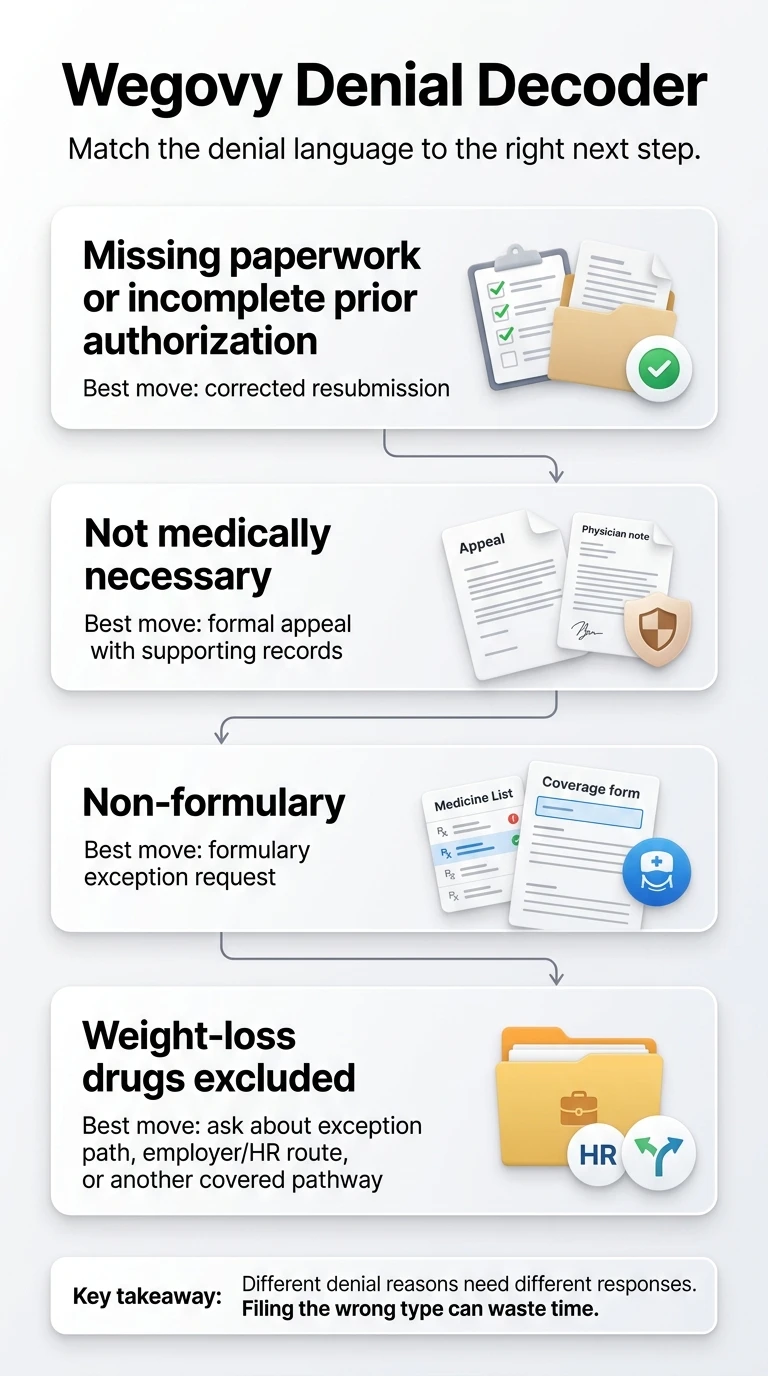
Every Wegovy denial falls into one of a few categories. Each one requires a completely different response. Grab your denial letter, find the language that matches, and look across the row.
| Your denial says… | What it really means | Your best move | How fixable? |
|---|---|---|---|
| "Not medically necessary" | Insurer's reviewer disagrees with your doctor — usually a documentation issue | Formal appeal + Letter of Medical Necessity + peer-to-peer review request | Often fixable with stronger documentation |
| "Prior auth incomplete" or "criteria not met" | Something was missing. A paperwork problem, not a medical one. | Corrected resubmission (faster than a formal appeal) | Often the fastest fix via corrected resubmission |
| "Step therapy required" | Insurer wants you to try cheaper options first | Appeal with documentation that alternatives failed or are contraindicated | Often fixable with the right documentation |
| "Non-formulary" or "not on preferred list" | Wegovy isn't in your plan's drug list — but may still be covered with an exception | Formulary exception request (not a standard appeal) | Plan-dependent — varies by insurer |
| "Continuation denied" or "reauthorization denied" | You were on Wegovy and coverage stopped, often because BMI dropped | Appeal using your original BMI at treatment start, not current BMI | Often fixable — the clinical argument is strong |
| "Weight-loss drugs excluded" or "not a covered benefit" | Your plan categorically doesn't cover anti-obesity medications | Employer/HR route → CV-indication pathway → self-pay | Standard appeal usually not the right route |
Sources: Novo Nordisk denial and appeals guide · HealthCare.gov · Obesity Action Coalition
Should You Appeal, Resubmit, or Do Something Else Entirely?
Most people assume every denial requires a formal appeal. That’s not true — and filing the wrong thing can waste weeks.
Here’s the distinction that matters: A corrected resubmission fixes a paperwork problem. A formal appeal challenges the insurer’s clinical judgment. A formulary exception requests coverage for a drug not on the plan’s preferred list. And a benefit exception tries to override a categorical exclusion. Each one goes to a different department, requires different documentation, and has a different timeline.
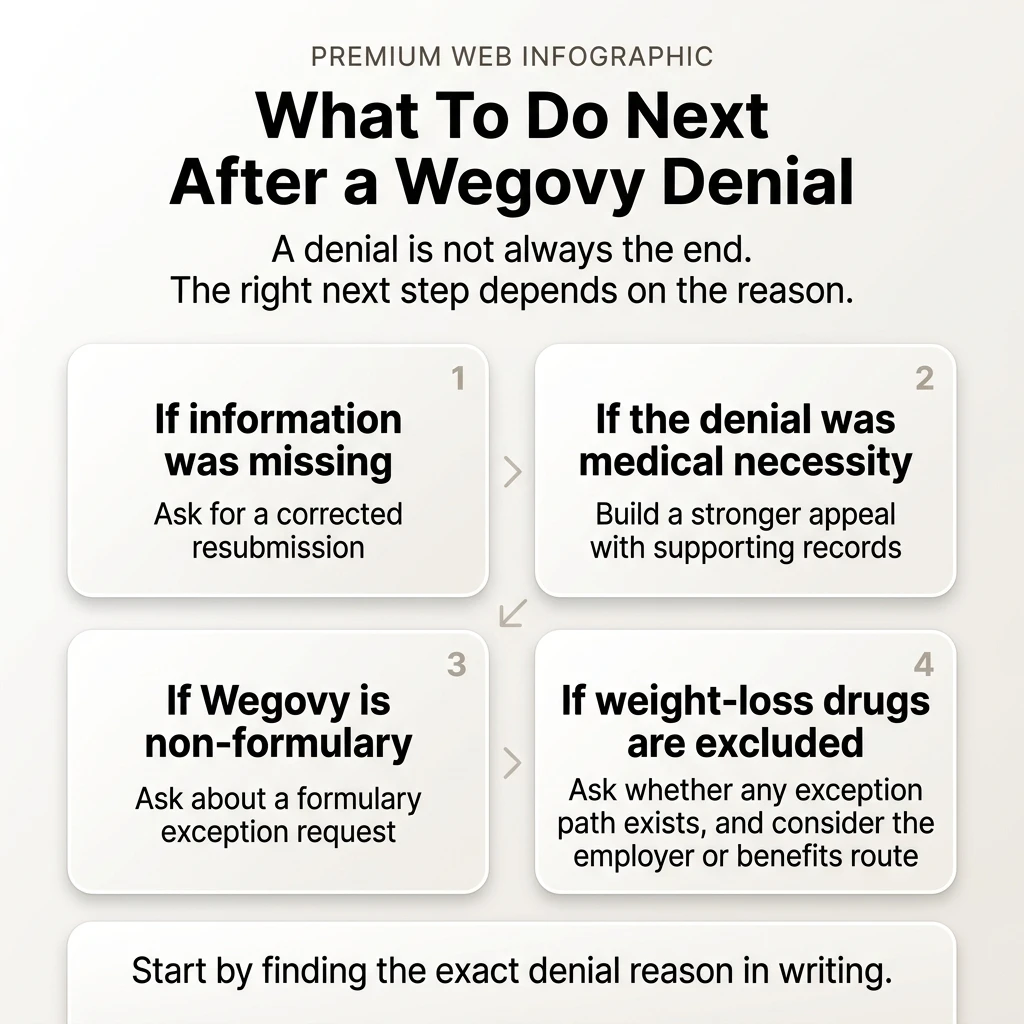
The five denial types that are usually worth fighting
"Not medically necessary"
The insurer's reviewer disagrees with your doctor's clinical judgment. This is an appeal — and it's the scenario where a peer-to-peer review has the most impact.
"Prior auth incomplete / criteria not met"
Something was literally missing from the paperwork. A corrected resubmission with the missing documentation is faster than a formal appeal and resolves many of these cases.
"Step therapy required"
The insurer wants evidence you tried cheaper alternatives first. If you have, document it. If those alternatives caused side effects or are medically inappropriate, document that instead.
"Non-formulary"
Wegovy isn't on the preferred drug list, but may be covered with a formulary exception. This is a different request from a standard appeal.
"Continuation / renewal denied"
You were on Wegovy, it was working, and coverage stopped. Often triggered because your BMI dropped below the qualifying threshold. The appeal argument here is strong: your starting BMI qualified you, and in the STEP 1 extension trial, participants regained about two-thirds of their prior weight loss within one year after stopping the medication.
The denial type where a standard appeal is usually the wrong move
“Weight-loss drugs excluded” or “not a covered benefit”
This means your plan was designed without anti-obesity medication coverage. A standard appeal almost never overrides a plan design decision. Novo Nordisk’s own denial guidance acknowledges that benefit exclusions typically do not have traditional appeal rights.
But that doesn’t mean there’s no path forward:
- Employer/HR route: If this is an employer plan, the employer chose the benefit design. They can add coverage — frame the conversation around downstream cost of untreated obesity.
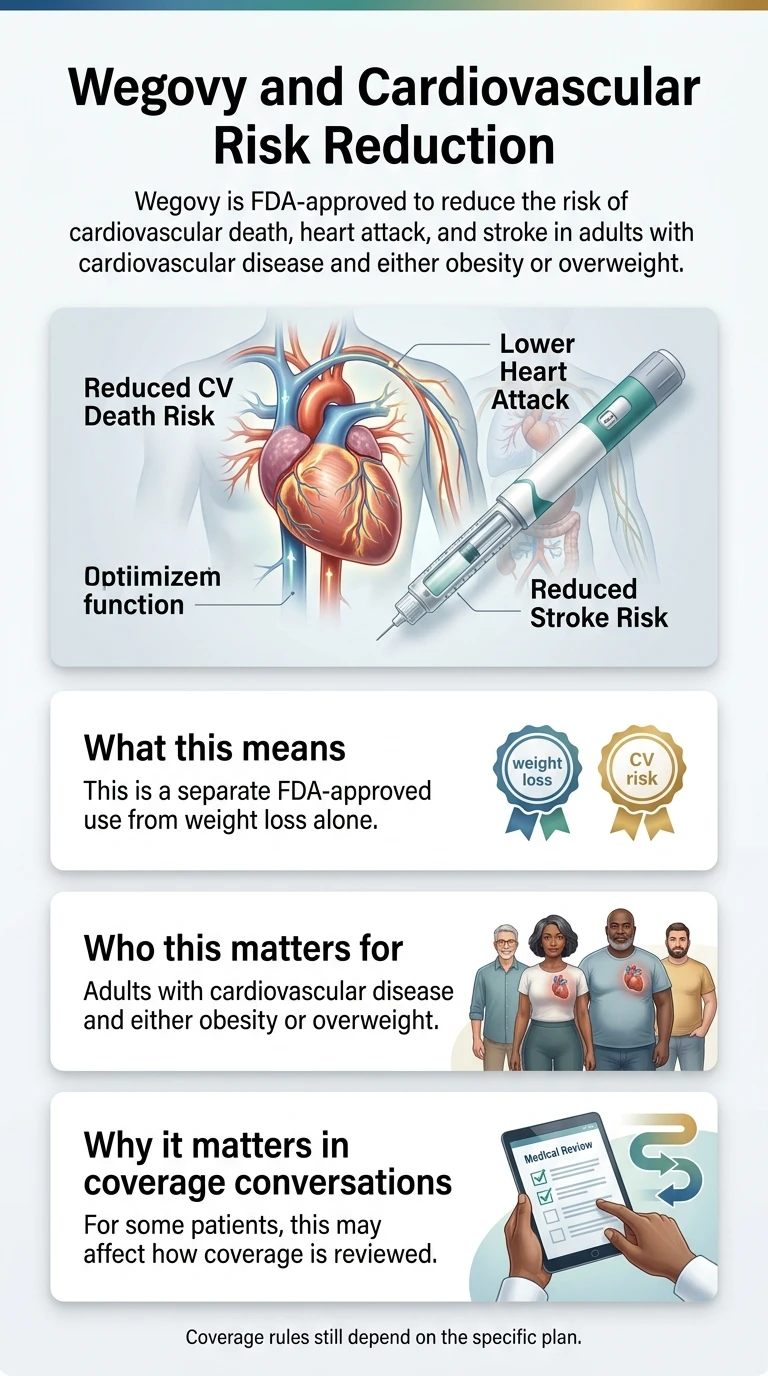
- Cardiovascular-indication pathway: Wegovy is FDA-approved to reduce the risk of cardiovascular death, heart attack, and stroke in adults with cardiovascular disease and either obesity or overweight. Some plans that exclude “weight-loss drugs” cover cardiovascular risk-reduction medications.
- Self-pay access: Brand-name Wegovy is available at reduced self-pay pricing through NovoCare and telehealth programs. See pricing below.
"Why was it denied? Makes a big difference."
— r/WegovyWeightLoss — Public forum anecdote, not verified by The RX Index
"It took me 3 appeals to finally get them to cover it."
— r/WegovyWeightLoss — Public forum anecdote, not verified by The RX Index
"I ended up submitting my own appeal once I knew the reason."
— r/WegovyWeightLoss — Public forum anecdote, not verified by The RX Index
Why Was My Wegovy Denied?
The denial letter is your roadmap — but insurance companies don’t always make the language easy to parse. Here’s what the most common denial reasons actually mean.
"Not medically necessary"
The most frustrating one. Your doctor prescribed Wegovy. The insurer says you don't need it. What they're really saying: the documentation submitted didn't convince their reviewer that this medication is clinically justified for your specific case. That's a statement about the paperwork — not your health. A Letter of Medical Necessity that directly addresses the insurer's specific criteria, paired with comprehensive clinical documentation, is usually the first thing to try.
"Prior authorization incomplete" or "criteria not met"
Good news disguised as bad news. This usually means something was literally missing: a date-stamped BMI measurement, documented comorbidity codes, proof of lifestyle modification attempts, or the correct prescriber information. Call your insurer, find out what's missing, and have your doctor resubmit a corrected prior authorization. A corrected resubmission is usually faster than a formal appeal.
"Step therapy required"
The insurer wants evidence you've tried cheaper weight-loss approaches first — typically a documented lifestyle program (diet and exercise for 3–6 months), and sometimes a first-line medication like phentermine or orlistat. If you've already done these, the fix is documentation. But there are exceptions: if prior medications caused documented side effects, if they're contraindicated for you, or if your clinical situation makes step therapy inappropriate, your doctor can argue for an exception.
"Non-formulary"
Wegovy isn't on your plan's approved drug list. This doesn't mean it's excluded from coverage entirely — it means your plan prefers other medications and needs a specific reason to cover Wegovy. The right move is a formulary exception request, not a standard appeal. Note for 2026: CVS Caremark moved Wegovy to preferred status on its largest commercial formularies as of July 2025. If your PBM is CVS Caremark, your formulary status may have improved since your denial.
"Continuation / renewal denied"
You were taking Wegovy, losing weight, and now your plan says you no longer qualify — usually because your BMI dropped below the threshold. The key: your appeal should reference your original BMI at treatment initiation, not your current BMI. The weight loss is evidence the treatment is working, not evidence you no longer need it. In the STEP 1 extension trial, participants regained about two-thirds of their prior weight loss within one year after stopping semaglutide.
"Weight-loss drugs excluded / not a covered benefit"
The toughest one. Your plan was built without anti-obesity medication coverage. Your options: employer/HR escalation, cardiovascular-indication pathway, or self-pay access. A standard appeal is usually not the right tool here.
What to Say When You Call Your Insurer (Phone Script)
One five-minute call can save you weeks of filing the wrong thing. Before you write a single word of an appeal letter, make this call.
Copy this script:
Script:
“I’m calling about a denial for Wegovy, reference number [your reference number from the denial letter]. I need to understand a few things:
- What is the exact reason for the denial?
- What clinical criteria did the reviewer use to make this decision?
- Is my next step a corrected prior authorization resubmission, a formulary exception request, or a formal appeal?
- What specific documentation do you need to approve this?
- What is my deadline to file, and where do I submit — portal, fax, or mail?
- Can you send me the clinical criteria in writing or direct me to where I can access them?
Thank you. Can I get your name and a reference number for this call?”
Write everything down
Date, time, representative's name, reference number. If they tell you something verbally, ask them to confirm it in writing. HealthCare.gov recommends keeping copies of all notices, documents, and notes from phone calls.
Ask for the PBM vs. insurer distinction
Your health insurance company and your pharmacy benefit manager (PBM) may be different entities. The denial may have come from the PBM (like CVS Caremark, Express Scripts, or OptumRx). Make sure you know who denied you and where the appeal needs to go.
Ask for the specific clinical policy bulletin
Under federal and state law, you're entitled to the criteria the insurer used to evaluate your request. If their criteria are more restrictive than Wegovy's FDA-approved indication, that discrepancy is a strong point in your appeal.
How to Appeal a Wegovy Denial: 7 Steps
Once you know your denial type and your best route, here’s the process. You can complete most of this within a week.
Get the denial letter and document everything (Today)
Pull up your denial letter — it’s usually in your Explanation of Benefits (EOB) or your insurer’s online portal. Write down:
- ·The exact denial reason (word for word)
- ·The reference or claim number
- ·The submission deadline for your appeal
- ·Where to send it (portal, fax number, mailing address)
- ·The name and phone number of the appeals department
Determine the right route — appeal, resubmit, or exception
| Denial type | Your route |
|---|---|
| Missing paperwork / criteria not met | Corrected PA resubmission |
| Not medically necessary | Formal internal appeal |
| Step therapy required | Appeal with step-therapy exception documentation |
| Non-formulary | Formulary exception request |
| Continuation denied | Appeal with original BMI and clinical response data |
| Benefit exclusion | Benefit exception → employer/HR → covered-indication pathway |
Filing the wrong type is one of the most common mistakes. It doesn’t just slow you down — it can use up an appeal level you might need later.
Gather your documentation
This is where most denials are won or lost. The appeal letter matters, but the documentation packet behind it matters more. Think of it like a case file: the letter is your argument, the documents are your evidence.
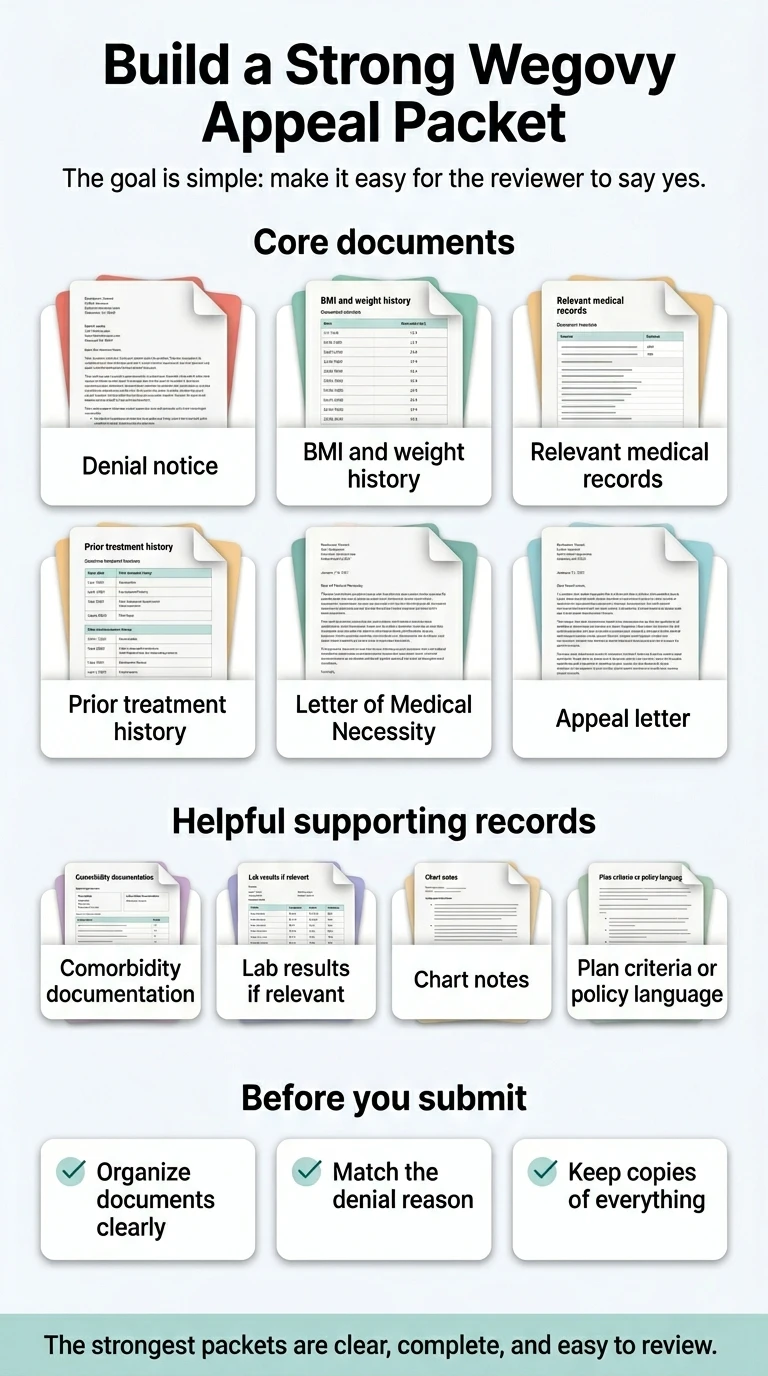
Your Wegovy appeal documentation checklist:
Denial letter / EOB with reference number
BMI documentation from clinical visits — date-stamped height and weight, include multiple visits to show a consistent pattern
Comorbidity documentation with ICD-10 codes — type 2 diabetes, hypertension, obstructive sleep apnea, cardiovascular disease, PCOS, NAFLD/MASH, dyslipidemia
Prior weight-loss attempt documentation — diet programs, exercise logs, dietitian visits, behavioral programs, prior medications tried and outcomes
Lab results — A1C, lipid panel, liver function tests, anything relevant to your comorbidities
The insurer's specific clinical criteria (obtained in your phone call)
Letter of Medical Necessity from your prescribing doctor (Step 4)
Your appeal letter (Step 5)
For continuation / renewal denials, also include:
· Original BMI at treatment start
· Treatment response documentation (weight loss, improved labs, reduced medication for comorbidities)
· Clinical evidence that discontinuation leads to regain (Wilding et al., STEP 1 extension, 2022)
For step therapy denials, also include:
· Records of each prior medication tried, duration, and outcome
· Documentation of side effects or contraindications
· Your doctor's statement on why Wegovy specifically is the appropriate next step
Get your doctor’s Letter of Medical Necessity
This is the single most important document in your appeal. A generic “I support this prescription” letter won’t work. The letter needs to match the insurer’s criteria point by point.
What the letter should include:
If your doctor won’t write the letter or keeps submitting incomplete paperwork:
· Ask your doctor directly if they're willing to do a peer-to-peer review with the insurer's medical director
· Ask for a copy of the original PA submission so you can see what was (and wasn't) included
· Consider a weight-loss specialist or obesity medicine physician who regularly handles Wegovy PAs
· File the appeal yourself with your doctor's chart notes attached and a clear patient statement
· Use a telehealth service with an insurance concierge team that handles the paperwork for you
Write your appeal letter
Your appeal letter should be short, organized, and structured around the insurer’s criteria — not a personal narrative. Think of the reviewer: they process hundreds of appeals. Make it easy for them to find “yes.”
Opening paragraph
Your name, policy number, denial reference number, the specific medication and dose denied, and a clear statement requesting reversal of the denial.
Denial reason and your response
State the denial reason they gave, then address it directly. If the denial says "not medically necessary," walk through each clinical criterion and show how you meet it with attached documentation.
Clinical evidence
Reference the STEP 1 trial and, if you have cardiovascular risk factors, the SELECT trial. Argue: "I meet the clinical criteria, and the evidence supports this treatment for patients in my situation."
Risk of delay
What specific health outcomes are worsening or at risk? Be concrete — not "my health will decline," but "my A1C has trended from 6.2 to 6.8 over the past year, and my blood pressure is 145/92 despite medication."
Closing
Request a written response and include your prescriber's contact information for peer-to-peer review.
Keep it to one page plus attachments. Organize attachments with a cover sheet or index so the reviewer can locate everything in 60 seconds.
Submit correctly and create a paper trail
Submit exactly where and how your insurer specified. If they accept portal submissions, use the portal AND send a backup via certified mail or fax with a confirmation page. Note the date, method, and any confirmation number.
If denied again — escalate
A second denial isn’t always the end. After an internal appeal, some plans offer a second internal review level, while others go straight to external review. Follow the appeal sequence stated in your denial notice.
External review
Uses an independent reviewer outside the insurance company. The decision is generally binding on the insurer. External review is generally available for denials involving medical judgment and must usually be requested within four months after the final internal denial.
Peer-to-peer review
Your doctor speaks directly with the insurer's medical director. This can happen during or alongside the appeal process and is often one of the highest-impact moves available — physician-to-physician conversation bypasses the form review that generated the denial.
ERISA plans (employer coverage)
Your plan may be governed by ERISA. ERISA group health plans generally must give claimants at least 180 days to appeal. Check the deadline and appeal path stated in your denial notice.
State insurance department
If you've exhausted all levels, contact your state insurance department's Consumer Assistance Program. They can review your case, help you understand remaining options, and sometimes intervene.
Free coverage check · Insurance concierge · Self-pay if insurance isn't an option
What Makes a Wegovy Appeal Stronger?
Not all appeals are equal. Here’s what moves cases versus what wastes space.
What works
✓ Mirror the insurer's language
The strongest appeals take the insurer's own criteria and respond to each point individually with evidence. If their criteria say "documented BMI ≥30 or ≥27 with comorbidity," your letter uses that exact phrasing with your numbers.
✓ Make the risk of delay concrete
Don't say "my health will get worse." Say "my A1C increased from 6.2 to 6.8 over the past year, my blood pressure is 145/92 despite medication."
✓ Use your initial BMI for continuation denials
Your appeal anchors on the BMI that qualified you for treatment in the first place, supported by the STEP 1 extension data.
✓ Request peer-to-peer review
Having your doctor speak directly with the insurer's medical director bypasses the form-review process. It's physician-to-physician — one of the highest-leverage moves.
What doesn’t help
✗ Emotional narratives without clinical evidence
Reviewers process hundreds of appeals. Your personal experience matters, but it should support clinical criteria — not replace them.
✗ Generic appeal templates used without customization
Templates can provide structure, but if your letter doesn't address the specific reason you were denied with specific evidence, you're wasting a filing.
When a Standard Wegovy Appeal Is Not Worth It
If your plan truly excludes anti-obesity medications as a benefit category, a standard appeal almost never overrides that exclusion. This isn’t a clinical judgment call — it’s a plan design decision. Novo Nordisk’s own denial guidance acknowledges that benefit exclusions typically don’t carry traditional appeal rights.
That doesn’t mean you’re stuck. It means the appeal process is the wrong tool for this specific problem.
1. Verify it’s really excluded
Call your insurer and ask for the exact plan language. Sometimes what looks like an exclusion is actually a non-formulary issue or a restriction that can be addressed with a formulary exception.
2. Talk to your employer’s HR or benefits department
If this is an employer plan, the employer chose the benefit design. They can change it. Novo Nordisk publishes a sample employer/HR coverage-request letter. The argument: the downstream cost of untreated obesity (diabetes, cardiovascular events, joint replacements) far exceeds the cost of medication.
3. Explore the cardiovascular-indication pathway
Wegovy is FDA-approved to reduce the risk of cardiovascular death, heart attack, and stroke in adults with cardiovascular disease and either obesity or overweight. Some plans that exclude "weight-loss drugs" cover cardiovascular risk-reduction medications.
4. Look into self-pay access
Brand-name Wegovy is available at reduced pricing through NovoCare and telehealth programs. Details below.
What to Do If Your Wegovy Appeal Fails (Or You Can’t Wait)
Here’s what we want you to know: the fact that you might need to pay out of pocket for a medication your doctor prescribed is a gap in insurance coverage — not a reflection of you. You made the decision to pursue treatment. Your doctor agreed it’s medically appropriate. The insurer’s paperwork shouldn’t be what stops you.
You don’t have to wait 30–60 days for an appeal decision to start treatment. Some patients begin Wegovy through self-pay programs while their appeal processes, then switch to insurance coverage if the appeal succeeds.
Current Wegovy Self-Pay Pricing (April 2026)
| Option | Monthly Cost | Key Terms |
|---|---|---|
| Wegovy injection — introductory (new patients) | $199/mo | First 2 fills of 0.25mg and 0.5mg doses only. Available through June 30, 2026. Via NovoCare. |
| Wegovy injection — ongoing | $349/mo | Standard self-pay through NovoCare |
| Wegovy 12-month subscription (NEW) | $249/mo | Launched March 31, 2026. Available through Ro, WeightWatchers, LifeMD. Saves up to $1,200/year. |
| Wegovy pill — 1.5mg and 4mg | $149/mo | Through NovoCare. Promotional pricing through August 31, 2026. |
| Wegovy pill — 9mg and 25mg | $299/mo | Through NovoCare |
| Wegovy with commercial insurance + savings card | As low as $25/mo | Subject to terms. If your plan covers Wegovy. Not valid for Medicare/Medicaid. |
Sources: NovoCare savings offer terms · Novo Nordisk subscription announcement · Confirm current pricing before enrolling — terms may change.
These are all FDA-approved, brand-name Wegovy — the same medication your doctor prescribed, from the same manufacturer.
How to Access Wegovy Without Waiting for Your Appeal
NovoCare direct
Eligible patients can access Wegovy through NovoCare Pharmacy at the self-pay prices above. You need a valid prescription. Enroll at novocare.com or call 1-888-809-3942.
Telehealth programs that handle everything — including the insurance fight
Ro addresses both sides of this problem at once. Ro offers a free GLP-1 Insurance Coverage Checker and an insurance concierge service that checks coverage, submits prior-authorization paperwork when needed, and helps navigate denials. So you’re not choosing between “fight the appeal” and “pay out of pocket” — Ro lets you start treatment while their team works the insurance angle on your behalf.
Free coverage check · PA handling · Self-pay available if insurance isn't an option
MEDVi — for patients who want flexibility
MEDVi offers both FDA-approved GLP-1 medications and compounded options through licensed prescribers — a strong choice for people who aren’t sure which format or medication will work best for their situation and budget.
FDA-approved and compounded options · Transparent pricing
Note: FDA-approved medications (like brand-name Wegovy) and compounded medications are different products with different regulatory status.
Specific Wegovy Denial Situations
These are the edge cases that send people back to search. We’re covering all of them so you can stay right here.
Wegovy denied for "not medically necessary" — specifically
Your doctor says you need it. Your insurer says you don't. The disconnect is almost always in the documentation. Request the insurer's clinical policy bulletin (you're entitled to it), identify exactly which criteria they say you don't meet, then have your doctor address each point individually in a revised Letter of Medical Necessity. Attach every supporting document. Request a peer-to-peer review.
Wegovy denied because I didn't complete a weight-loss program
Many insurers require 3–6 months of documented lifestyle modification before approving Wegovy. If you've done this — even informally — the issue is usually documentation. Get records from any dietitian visits, gym memberships, food-tracking apps, program enrollment, or doctor visits where weight management was discussed.
Wegovy denied because my BMI is "too low"
Some plans set their BMI threshold higher than the FDA-approved indication (BMI ≥30, or ≥27 with a weight-related comorbidity). If the insurer's criteria are stricter than the FDA label, document that discrepancy — it's a strong appeal point. Also make sure your BMI was measured at a clinical visit with date-stamped height and weight, not just a self-reported number.
Wegovy denied after I already lost weight (continuation/renewal denial)
One of the most frustrating situations: you're being penalized for the medication working. Appeal using your original BMI at treatment start. Include documentation of your treatment response and reference the STEP 1 extension data — participants regained about two-thirds of lost weight within a year of stopping (Wilding et al., 2022). Your doctor's letter should emphasize that ongoing treatment is preventing recurrence of the condition for which it was originally approved.
Wegovy denied by CVS Caremark or another PBM
Your PBM may have different criteria than your health insurance company. Make sure you know who denied you. CVS Caremark moved Wegovy to preferred status on its largest commercial formularies as of July 2025 — if your denial predates this change, a new submission may get a different result.
Wegovy denied under Medicare
See the full Medicare section below — there's a major new program launching in July 2026 that changes the picture significantly.
Go to Medicare section →Wegovy denied — and my doctor won't help with the appeal
Ask specifically for a peer-to-peer review (often easier for the doctor), request copies of your chart notes and submit the appeal yourself with those records attached, or consider switching to a provider experienced with GLP-1 prior authorizations.
Free check · PA support · Self-pay option if needed
How Long Does a Wegovy Appeal Take?
Timing matters. You’re worried about losing momentum or your health getting worse while the insurer deliberates. Here’s the realistic timeline:
| Stage | Typical Timeline | Notes |
|---|---|---|
| Corrected PA resubmission | Days to ~2 weeks | Fastest path for paperwork-fix denials |
| Standard internal appeal | 30–60 days | Most common timeline |
| Urgent / expedited review | Varies — ask your insurer | For medically urgent situations; check your denial notice |
| Peer-to-peer review | Often 1–2 weeks | Can happen during or alongside an appeal |
| External review | 30–45 days after final internal denial | Independent reviewer; generally binding on insurer |
| Filing deadline (internal) | 180 days from notice of denial | Per HealthCare.gov and DOL guidance; verify on your denial letter |
| Filing deadline (external) | ~4 months after final internal denial | Per HealthCare.gov external review guidance |
Timelines based on HealthCare.gov and DOL general guidance. Your plan's specific timelines may differ — verify on your denial notice.
What to do while you’re waiting
Start treatment at self-pay pricing
If your budget allows and your doctor supports it. Eligible new patients can access lower-dose Wegovy at introductory pricing through NovoCare. If your appeal succeeds, you can switch to insurance coverage going forward.
Keep all receipts
If your appeal succeeds retroactively, you may be able to submit for reimbursement (depending on your plan).
Continue documenting
Any worsening health metrics during the appeal period strengthen your case.
Does Medicare Cover Wegovy?
This section has genuinely good news for 2026.
The Medicare GLP-1 Bridge launches July 1, 2026
Starting July 1, 2026, the Medicare GLP-1 Bridge program will cover Wegovy (both injection and tablets) and Zepbound for eligible Medicare Part D beneficiaries at a $50 per month copay (CMS). This is the first time Medicare has covered prescription medications specifically for weight loss.
Cardiovascular indication (already available)
Wegovy can also be covered through Part D for its cardiovascular indication — reducing the risk of cardiovascular death, heart attack, and stroke in adults with established cardiovascular disease and either obesity or overweight. This coverage goes through your regular Part D plan, not the Bridge. If you have established heart disease, ask your doctor about this pathway now.
For the full Medicare Wegovy coverage breakdown, including the BALANCE Model and Medicaid state-by-state details, see our dedicated guide: Does Medicare Cover Wegovy for Weight Loss? →
How We Verified This Guide
Novo Nordisk denial and appeals guidance
NovoCare patient savings and self-pay program terms
HealthCare.gov internal appeals and external review guidance
DOL ERISA claims procedure guidance
CMS Medicare GLP-1 Bridge program FAQ
KFF employer health benefits and ACA claims data
FDA cardiovascular indication announcement (March 2024)
STEP 1 trial — Wilding et al., NEJM, 2021
STEP 1 extension — weight regain — Wilding et al., 2022
Two-thirds weight regain within one year after stopping semaglutide
SELECT trial — Lincoff et al., NEJM, 2023
Frequently Asked Questions
Can I appeal a Wegovy denial myself?
Yes. Patients can file their own internal appeal, often with a supporting clinician letter and medical records. Most plans do not require legal representation for internal appeals.
What's the difference between an appeal and a formulary exception?
An appeal challenges a clinical judgment like 'not medically necessary.' A formulary exception requests coverage for a drug not on your plan's preferred list. They go to different departments and require different documentation.
How long do I have to appeal a Wegovy denial?
Most commercial plans let you file an internal appeal within 180 days of receiving notice that your claim was denied. Check the deadline on your specific denial letter.
What if my plan excludes weight-loss drugs entirely?
A standard appeal usually cannot overturn a plan-design exclusion. Better options include employer or HR escalation, a cardiovascular-indication pathway if you have established heart disease, or self-pay access through NovoCare or telehealth programs.
Can I use my original BMI if Wegovy already lowered it?
Yes. Your appeal should reference your BMI at treatment initiation. In the STEP 1 extension trial, participants regained about two-thirds of their prior weight loss within one year after semaglutide was stopped, which supports the clinical argument for continued treatment.
Can I start Wegovy while my appeal is processing?
Yes. Eligible patients can access brand-name Wegovy through NovoCare Pharmacy or telehealth providers at self-pay pricing without insurance approval. Pricing depends on dose, format, eligibility, and current program terms.
What happens after my internal appeal is denied?
After an internal appeal, some plans offer a second internal review level, while others go straight to external review. External review uses an independent third party and the decision is generally binding on the insurer. Follow the appeal sequence stated in your denial notice.
Does Medicare cover Wegovy?
Starting July 1, 2026, the Medicare GLP-1 Bridge program covers Wegovy for eligible Part D beneficiaries at a $50 per month copay. Wegovy can also be covered through Part D for its cardiovascular indication in eligible patients with established cardiovascular disease.
Do I need a lawyer to appeal a Wegovy denial?
For most cases, no. The appeal process is designed for patients and their doctors. If you have exhausted all appeal levels or suspect the insurer acted improperly, consulting a health insurance attorney may be worthwhile.
What should be in a Wegovy appeal packet?
A strong packet includes the denial notice, date-stamped BMI documentation, comorbidity records with ICD-10 codes, prior weight-loss attempt documentation, relevant lab results, a Letter of Medical Necessity from your doctor, and your appeal letter organized criterion by criterion.
Related guides
- Cheapest Wegovy Without Insurance: Real 2026 Prices
- Does Insurance Cover Wegovy for Weight Loss? (2026)
- Does Medicare Cover Wegovy for Weight Loss? (2026)
- Best GLP-1 Providers That Accept Insurance (2026)
- Does Insurance Cover Zepbound for Weight Loss? (April 2026)
- Best Online Wegovy Provider: 7 Legit Options (2026)
- GLP-1 Providers That Take FSA: 8 Verified Picks (2026)
- GLP-1 Providers That Take HSA: 7 Verified Picks (2026)
- Cheapest GLP-1 Without Insurance: All Options Compared
- How to Get Tirzepatide Covered by Insurance Online (2026)
Sources
- Novo Nordisk Denials and Appeals Guide — novoMEDLINK
- NovoCare — Wegovy Savings Offer
- HealthCare.gov — Internal Appeals
- HealthCare.gov — External Review
- DOL — ERISA Claims Procedure Regulation
- CMS Medicare GLP-1 Bridge FAQ
- KFF — ACA Marketplace Claims and Appeals in 2024
- FDA — Wegovy Cardiovascular Indication Approval (March 2024)
- STEP 1 trial — Wilding et al., NEJM, 2021
- STEP 1 extension — Wilding et al., 2022
- SELECT trial — Lincoff et al., NEJM, 2023
- Obesity Action Coalition — Appealing a Denial
Affiliate disclosure: Some links on this page go to partner providers including Ro and MEDVi. We earn a commission if you use these services. This doesn’t change our analysis. If we removed every link from this page, we believe it would still be the most useful Wegovy denial resource on the internet — and that’s by design. Full disclosure →
Medical disclaimer: This guide is for informational purposes only and does not constitute medical or legal advice. Coverage rules vary by plan, state, and individual circumstances. Always review your plan documents and work with your licensed healthcare provider on clinical decisions.
Last verified: April 3, 2026 · By The RX Index Editorial Team
Free check · PA handling · Self-pay available if insurance doesn’t work out