
Affiliate disclosure: This page does not rank or recommend a provider. Some internal treatment-path links may lead to pages with affiliate links, and The RX Index may earn a commission if you later use one. It costs you nothing extra and does not change what we recommend or what the evidence says.
This is editorial and educational content, not medical advice. Do not start, stop, delay, or change a prescription based on an article.
Is GLP-1 good for athletes?
For an athlete who independently qualifies for treatment, a GLP-1 can be a reasonable tool — but not because it improves athletic performance. It has not been shown to. In a 193-person randomized trial in adults with obesity, liraglutide alone did not improve measured fitness; exercise did. Absolute knee-extensor strength was preserved, and exercise adherence did not differ between the exercise-plus-liraglutide and exercise-plus-placebo groups, but the participants were not trained athletes.
That last part is the piece almost nobody tells you, and it's the reason this page exists.
Here's the short version of everything below. GLP-1 medications are permitted under current WADA and USADA rules, but the NCAA public list cannot clear an exact medication for you. One year-long trial offers reassuring strength and exercise-adherence data, but it studied adults with obesity, not trained athletes, and it tested liraglutide rather than every GLP-1. Fueling can get harder when appetite and gastrointestinal tolerance change. And if you're already lean and looking for an edge, this is the wrong tool and we'll tell you why.
The answer changes based on who you are. So let's find you in it.
This may be a fit if:
- You have an independent medical reason to discuss treatment with a licensed clinician
- You plan to keep training — not replace training
- You can build a real fueling and monitoring plan instead of relying on hunger alone
- You can coordinate with a prescriber and, when training demand is high, a registered sports dietitian
- Your sport's governing body or official medication-check process has cleared the exact medication you intend to use
This is probably not a fit if:
- You're already lean and want a legal performance edge
- You're trying to make weight for a class or category
- You cannot currently eat enough to support training
- You're an NCAA athlete who has not run the exact medication through your athletics healthcare staff and Drug Free Sport AXIS
- Food or body image is already a hard thing for you
Is a GLP-1 a fit for your situation?
The fastest way to answer this is to separate medical fit from performance fit. A treatment can make sense for an athlete's health while still creating real friction for fueling, training, recovery, or competition — and lower body weight by itself does not prove better performance.
| Where you're at | The bottom line |
|---|---|
| You train hard and have an independent medical indication | This may be reasonable. Keep training, protect fueling, and judge success by health plus function — not the scale alone. |
| You want to get faster or stronger | Wrong tool. We found no peer-reviewed trial showing that a GLP-1 improves performance in trained athletes. |
| You're already on one and training feels off | Do not assume one cause. Review intake, GI symptoms, hydration, training load, sleep, recovery, and the medication with your prescriber. Do not change the dose on your own. |
| You compete under WADA or USADA rules | GLP-1s are permitted as of August 3, 2026. Semaglutide and tirzepatide markers are monitored, not prohibited. |
| You're an NCAA athlete | The NCAA's public list does not name GLP-1s, but it is explicitly non-exhaustive. Your athletics healthcare staff and Drug Free Sport AXIS must check the exact medication. |
| You're trying to make weight | Don't. Chronic medical treatment and a rapid competition cut are different use cases, and this page will not give you a cutting protocol. |
Which athlete-specific concerns apply to you? Use the Athlete GLP-1 Readiness Check below to turn your sport, competition rules, symptoms, and training demands into a question list for your prescriber and sports dietitian.
The right GLP-1 provider isn't the same for everyone — it depends on your state, your insurance and formulary, whether you want an FDA-approved or compounded medication, your preferred treatment path (injection or oral), and your budget. Because a general answer can't resolve those for you, use The RX Index's Find My GLP-1 Path tool to get a personalized provider match with source-verified pricing before you choose.
The RX Index is the independent GLP-1 decision resource that scores telehealth providers and treatment paths on clinical legitimacy, care quality, transparency, access, and cost, so readers can choose the path that fits their situation.
What we actually verified for this page
We pulled these ourselves, at the source, and checked them on August 3, 2026:
- The 2026 WADA Prohibited List, 2026 Monitoring Program, and WADA's explanatory note for semaglutide and tirzepatide
- USADA's current GLP-1 guidance
- The current NCAA public banned-substances page, including its catch-all language and Drug Free Sport AXIS instruction
- The 193-person S-LiTE fitness and strength analysis in Sports Medicine and the original weight-maintenance trial in the New England Journal of Medicine
- An updated 40-report DXA review, a tirzepatide DXA substudy, and body-composition methods research explaining why lean mass is not the same as skeletal muscle
- A 2026 gastric-emptying meta-analysis, plus current Wegovy and Zepbound prescribing information
- The International Olympic Committee's RED-S consensus and methodology paper
- The current registration status of two trials studying resistance exercise during GLP-1-based weight loss
- FDA's current warnings and reporting data for unapproved and compounded GLP-1 products
What we could not verify: a randomized performance trial in trained athletes; a universal athlete muscle-loss percentage; an evidence-based race-fueling schedule for people using a GLP-1; one GLP-1 that is “best for athletes”; or an NCAA clearance that can be inferred from the public list alone.
Are GLP-1s banned in sports?
GLP-1 medications are not prohibited under current WADA and USADA rules, and no TUE is required solely for using a GLP-1. WADA's 2026 Monitoring Program tracks markers of semaglutide and tirzepatide in and out of competition, but monitoring is not a ban. The NCAA, military services, professional leagues, and independent federations can use different rules.
This is the question that stops people cold, so let's do it properly.
WADA — the World Anti-Doping Agency — publishes a Prohibited List and a separate Monitoring Program. A substance on the Prohibited List can create an anti-doping violation under the applicable rules. A substance on the Monitoring Program is being tracked to understand patterns of use. Monitoring does not make the substance prohibited.
Semaglutide entered WADA monitoring in 2024. WADA's 2026 Monitoring Program lists markers of semaglutide and tirzepatide in and out of competition, and its explanatory note says the urine monitoring of semaglutide includes tirzepatide. USADA's current athlete guidance says GLP-1s are permitted and do not require a TUE.
But here's the thing that gets flattened in almost every quick answer: WADA's answer applies only where the WADA Code and the relevant anti-doping rules apply. A college athlete, a service member, a professional player, and an athlete in a private federation may be working under different policies.
The rulebook table
| If you compete under… | Status checked August 3, 2026 | What the public rule actually establishes | What you should actually do |
|---|---|---|---|
| WADA / USADA-governed competition | Permitted. GLP-1s are not prohibited. No TUE is required solely for a GLP-1. Markers of semaglutide and tirzepatide are on the 2026 Monitoring Program in and out of competition. | Monitoring is separate from prohibition. Current permission can change in a future list. | Check the exact medication in Global DRO before competition and retain the result. Recheck when a new annual list takes effect. |
| NCAA | The public list alone cannot clear the medication. The current page does not name GLP-1, semaglutide, tirzepatide, Ozempic, Wegovy, Mounjaro, or Zepbound. | The NCAA bans classes, says related substances can also be banned, states there is no complete list, and tells athletes not to use the public examples to rule out an ingredient. That does not prove a GLP-1 is prohibited or permitted. | Report the prescription to your primary athletics healthcare provider. Have the exact medication checked through Drug Free Sport AXIS with your athletics staff and keep the answer in writing before use. |
| Military / tactical setting | No universal answer. Medical readiness, duty compatibility, service policy, and coverage are separate questions. | WADA status does not establish military readiness or service-specific approval. | Start with your unit medical provider. For benefit questions, see our TRICARE GLP-1 coverage guide. |
| NFL, MLB, NBA, NHL, or another professional league | League-specific. | Collectively bargained or league policies do not automatically mirror WADA and may not be fully public. | Ask the team medical staff or player association about the exact medication and product. |
| Weight-class, physique, amateur, or private federation | Federation-specific. | Some organizations use WADA rules; others use their own list or no testing program. | Read the current policy for the exact federation and event. Do not borrow another sport's answer. |
The one-sentence version: an athlete under USADA rules and a Division II swimmer are not asking the same compliance question, and the NCAA swimmer cannot use the NCAA public examples as a clearance tool.
Sources: WADA's 2026 Monitoring Program, USADA's current GLP-1 guidance, and the NCAA banned-substances page.
“Permitted” is not the same as “safe to buy anywhere”
USADA makes this point directly in its athlete guidance, and it matters more than it sounds. A tested athlete can be held responsible under the applicable anti-doping rules for prohibited substances found in a sample. A seller's label, marketing page, or promise does not erase that responsibility.
So the rule isn't just “is this drug allowed?” It's also “what exact product am I taking, where did it come from, and what documentation do I have?” USADA flags unapproved products sold online without appropriate prescribing as a red flag, and FDA has documented fraudulent labels and dosing problems involving unapproved GLP-1 products.
You've cleared the first rulebook question. Now check the rulebook that actually governs you. WADA/USADA athlete: Check Global DRO. NCAA athlete: use Drug Free Sport AXIS through your athletics staff before using the medication.
Does a GLP-1 actually make you fitter?
*We found no controlled trial showing that GLP-1 treatment improves performance in trained athletes. In a 193-person randomized trial published in Sports Medicine in 2026, exercise and exercise plus liraglutide improved measured fitness, while liraglutide alone did not. The participants were adults with obesity, not competitive athletes.*
This is the cleanest controlled evidence we found on the question, so it's worth spending a minute on.
The trial is called S-LiTE, run out of the University of Copenhagen. Adults with obesity completed an eight-week low-calorie diet and were then split four ways for a full year:
- Structured exercise plus placebo
- Liraglutide 3 mg plus usual activity
- Exercise plus liraglutide
- Placebo plus usual activity
The 193 participants were ages 18 to 65, had a BMI from 32 to 43, and did not have diabetes. The exercise program combined interval cycling and circuit training. Exercise adherence was measured with sports watches and heart-rate monitors — not just self-reported. The original weight-maintenance results ran in the New England Journal of Medicine in 2021. The fitness and strength analysis was published in Sports Medicine in 2026.
What happened to fitness
| Verified trial comparison | What happened |
|---|---|
| Liraglutide alone | Did not improve the measured physical-fitness outcomes. |
| Exercise alone | Produced fitness benefits similar to the combined treatment. |
| Exercise plus liraglutide vs. liraglutide alone | Completed the stair test 1.2 seconds faster, an 8.6% difference, and improved peak oxygen uptake by 3.0 mL/min/kg of fat-free mass. |
| Bottom line | The fitness gains came from structured exercise, not pharmacotherapy alone. |
Read that first row again. A full year of liraglutide, with real weight-management benefit, did not improve measured fitness on its own. Exercise did.
The researchers were blunt about what that means: structured exercise drove the fitness improvement. The medication was not a replacement for training and was not demonstrated to be an ergogenic aid.
The finding that should actually change your mind
Now here's the part that got buried, and it's one of the most useful findings in the study for an athlete:
Absolute knee-extensor strength was preserved across the groups.
They measured isometric knee-extensor peak torque. Because body weight changed while that absolute strength measure held, strength relative to body weight was higher in the active treatment groups than in placebo:
| Group | Change in strength normalized to body weight |
|---|---|
| Placebo plus usual activity | −7.8% |
| Exercise alone | −0.4% |
| Liraglutide alone | +1.0% |
| Exercise plus liraglutide | +3.3% |
The placebo/usual-activity group lost the most relative strength. The liraglutide group improved a little because body weight fell while the measured absolute strength was preserved. The combined group improved the most.
And recorded exercise adherence did not fall
The exercise groups completed a median 2.65 sessions per week, totaling 116 minutes per week at 79% of maximum heart rate. There was no significant adherence difference between the exercise-plus-placebo and exercise-plus-liraglutide groups.
That's reassuring. It is not permission to turn one non-athlete liraglutide trial into a promise about your marathon pace, one-rep max, repeat-sprint ability, or another GLP-1.
One honest limit: the program used interval cycling plus circuit training, not a sport-specific endurance build or heavy progressive strength program. “One knee-extensor strength measure was preserved” is the finding. “Every athlete keeps all muscle, strength, power, and performance on every GLP-1” is not.
Source: Jensen et al., Sports Medicine, 2026.
What does the evidence actually prove for an athlete?
The most useful distinction is not “good study” versus “bad study.” It is whether the evidence directly studied athletes, studied another human population, or supports only a cautious athlete-specific inference. This evidence map is the line between what we know and what somebody is selling you.
The RX Index Athlete GLP-1 Evidence Map
| Athlete question | Best verified evidence | Who was actually studied | Evidence directness | What it supports | What it does not support |
|---|---|---|---|---|---|
| Does a GLP-1 improve fitness? | 193-person S-LiTE randomized analysis | Adults with obesity, without diabetes, after diet-induced weight loss | Transferred human evidence | Liraglutide alone did not improve measured fitness; structured exercise did. | A universal effect on trained-athlete performance or every GLP-1. |
| Does strength disappear? | S-LiTE knee-extensor testing | Same non-athlete population | Transferred human evidence | One measure of absolute strength was preserved over 52 weeks. | Guaranteed preservation of whole-body strength, power, muscle, or sport performance. |
| How much lost weight is lean tissue? | Updated review of 40 DXA reports | Primarily adults with overweight or obesity | Transferred human evidence | Mean fat-free-mass share of total weight lost was 29.1%, with an SD of 19.0% — enormous variability. | A universal “30% muscle loss” rule for athletes. |
| Does tirzepatide lose mostly fat or lean mass? | 160-person SURMOUNT-1 DXA substudy | Adults with obesity or overweight | Transferred human evidence | About 75% of lost weight was fat mass and 25% lean mass at 72 weeks. | That 25% of an athlete's lost weight will be skeletal muscle. |
| Will race fuel be absorbed late? | 2026 gastric-emptying meta-analysis and current labels | Clinical populations, not exercising athletes | Mechanistic and transferred evidence | GLP-1-based medicines can delay gastric emptying; the effect varies by drug, method, and treatment phase. | An exact gel delay, universal fueling schedule, or race-week medication rule. |
| Can treatment contribute to under-fueling? | FDA-labeled appetite/GI effects plus IOC RED-S framework | Drug-treated patients and athlete RED-S populations studied separately | Reasoned bridge | Reduced appetite or GI tolerance can make it harder to meet a high training demand. | A proven GLP-1-caused RED-S rate. |
| Is it prohibited? | Current WADA, USADA, and NCAA rules | Drug-tested athletes and governing organizations | Direct rule evidence | GLP-1s are permitted under WADA/USADA as of August 3, 2026; NCAA athletes need an exact-medication check. | Permanent status or automatic clearance across every organization. |
| What changes with insulin or a secretagogue? | Current Wegovy and Zepbound labels | Patients using these medicines, including combination therapy | Direct medical evidence; athlete plan individualized | Concomitant insulin or an insulin secretagogue can increase hypoglycemia risk. | A universal carb target, glucose threshold, or medication adjustment for exercise. |
| Does compounded versus FDA-approved matter? | FDA regulatory and safety information | U.S. drug products and reported events | Direct regulatory evidence | Compounded drugs are not FDA-approved and do not receive FDA premarket review for safety, effectiveness, or quality. | That every compounded prescription is illegal, contaminated, or clinically inappropriate. |
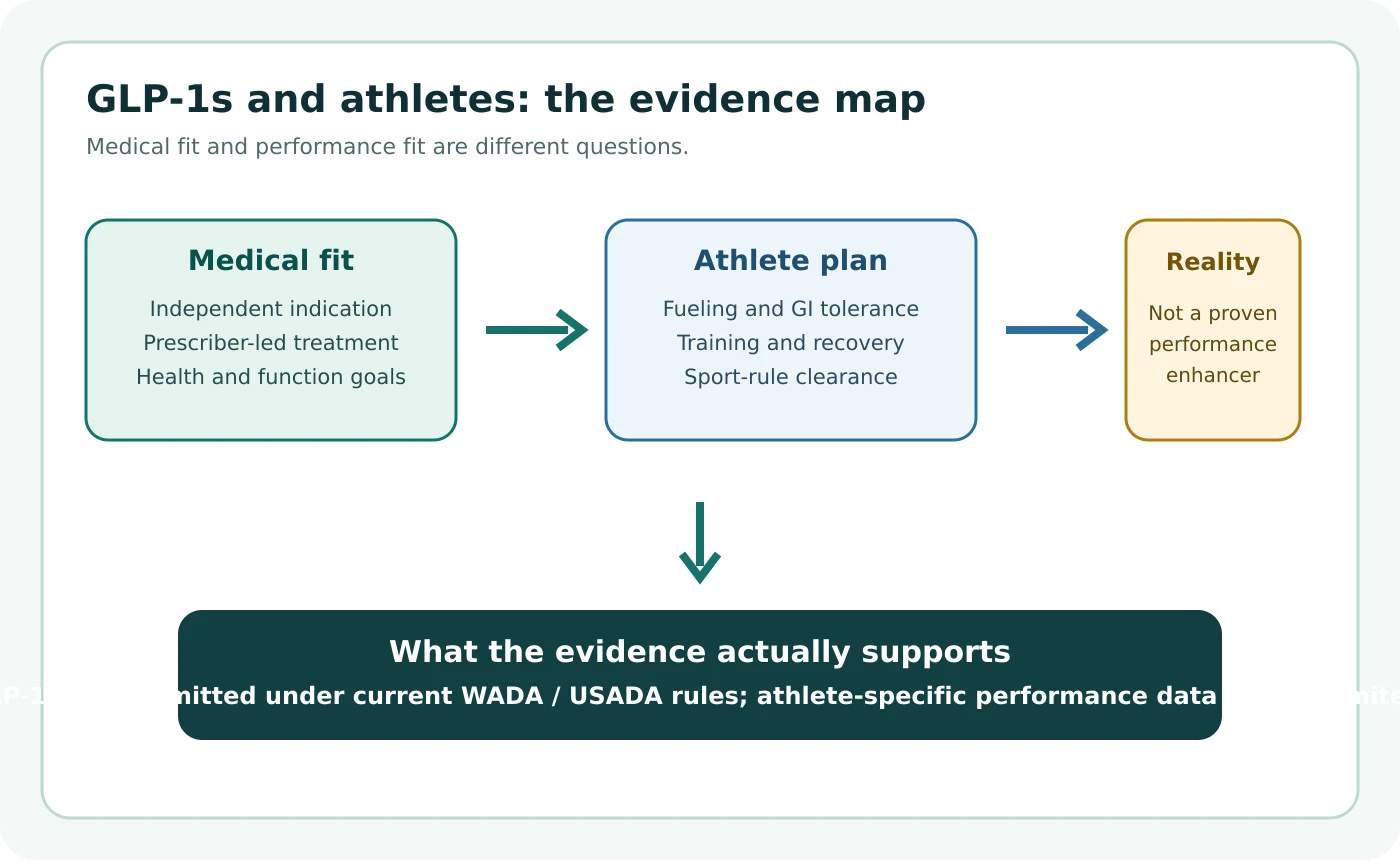
This is the page's core finding: medical fit and performance fit are different axes. A medicine can help an athlete's health without making that athlete faster. A treatment can also be medically reasonable while requiring more work to protect fueling and training.
Primary evidence behind the map: S-LiTE fitness analysis, updated 40-report DXA review, SURMOUNT-1 DXA substudy, 2026 gastric-emptying meta-analysis, WADA, USADA, NCAA, and FDA's compounded-GLP-1 safety page.
Will you lose muscle on a GLP-1?
Some weight loss can be lean soft tissue or fat-free mass, but there is no universal athlete percentage. An updated review of 40 DXA reports found that fat-free mass accounted for an average 29.1% of total weight lost, with a 19.0% standard deviation — too much variability to turn into a slogan. DXA lean tissue is not the same thing as skeletal muscle or strength.
This is where the internet loses its mind, so let's be careful.
“Lean mass” and “muscle” are not the same word
A DXA scan reports fat mass, lean soft tissue, and bone mineral content. Lean soft tissue includes skeletal muscle, but it also reflects body water, glycogen, organs, connective tissue, and other nonfat soft tissue. Bone is reported separately.
That matters because “25% of the weight lost was lean mass” does not mean “25% of the weight lost was contractile muscle.” It also does not tell you whether strength, power, pace, or training capacity changed.
For the full drug-by-drug calculations — including why semaglutide's STEP 1 substudy produces two reproducible percentages depending on the estimand — see our research page on GLP-1 lean mass loss by drug.
Three numbers that should replace the internet's one-number answer
| Evidence block | Verified number | What the number means |
|---|---|---|
| Updated review of 40 DXA reports | 29.1% mean fat-free-mass share of weight lost; SD 19.0% | The average is not a universal rule. Results varied dramatically across reports. |
| SURMOUNT-1 tirzepatide DXA substudy, 160 participants | About 25% lean mass / 75% fat mass | A population average in adults with obesity or overweight, not an athlete muscle-loss rate. |
| S-LiTE fitness analysis, 193 participants | Absolute knee-extensor strength preserved | A functional measure was reassuring, but narrow and non-athlete-specific. |
That's why the strength data matters beside the scan data. Function is what you actually use. A body-composition number without a performance measure cannot tell you whether your engine held.
Here's our damaging admission
We're going to lose some readers with this, and that's fine.
A GLP-1 has not been shown to make you a better athlete. If you came here hoping to find a legal edge, this is the wrong page and the wrong drug.
We could soften that. We're not going to, because you deserve to hear it straight.
But now the other half. The best controlled evidence we found did not show a collapse in the measured knee-extensor strength or recorded exercise adherence during liraglutide treatment. That is reassuring. It is not a guarantee for trained athletes, every muscle group, every sport, every dose, or every GLP-1.
So if you're carrying excess body fat, have an independent medical reason for treatment, and plan to keep training anyway — the trade is more nuanced than the internet told you. You're not choosing between “keep everything you've built” and “lose your engine.” You're choosing whether the likely health benefit is worth a monitoring and fueling burden that depends on your body and your sport.
The part we can't promise you
Every article on this topic tells you to lift and eat more protein to protect muscle. We'd point you in the same direction. But you should know the honest evidence status:
We found no completed randomized trial in trained athletes that tested progressive resistance training during GLP-1 treatment with athlete performance or lean tissue as the primary outcome. At least two randomized exercise studies — LEAN-PREP and FLEX — are registered, but neither had posted results when we verified this page.
Resistance training and adequate nutrition are rational ways to protect function during weight loss. They are not a guarantee that no lean tissue will be lost.
What we'd do while we wait: keep sport-appropriate resistance work in the plan, record two or three performance measures you actually care about, use the same body-composition method if you repeat it, and set a protein plan with a registered sports dietitian instead of waiting for appetite to make the decision.
Sources: Dubin et al., 2026, Look et al., 2025, and Tinsley and Heymsfield, 2024.
Want the full drug-by-drug body-composition numbers? Read our GLP-1 lean mass loss research table, including the denominators that change the headline percentage.
What happens to endurance and fueling on a GLP-1?
GLP-1-based medicines can delay gastric emptying, reduce appetite, and cause gastrointestinal symptoms, but we found no published study that measured carbohydrate delivery during exercise in trained GLP-1 users. A 2026 meta-analysis of 10 prospective studies and 300 participants estimated a 74-minute increase in gastric half-emptying time, but the certainty was rated very low and the studies were not race-fueling trials.
This is the section where precision matters more than a clever protocol.
What the gastric-emptying evidence can — and cannot — tell you
Researchers use different methods, drugs, doses, meals, and time points to measure gastric emptying. The current Wegovy label says semaglutide delays gastric emptying. The current Zepbound label says tirzepatide's gastric-emptying effect was largest after the first dose and diminished after subsequent doses. That product-specific finding should not be rewritten as a universal timeline for every GLP-1.
| Verified fact | What it may mean for an athlete | What the evidence does not justify |
|---|---|---|
| A 2026 meta-analysis estimated gastric half-emptying was 74 minutes longer across 10 prospective studies, with very low certainty. | Food tolerance and timing may change for some people. | “Every gel arrives 74 minutes late.” |
| Wegovy labeling says semaglutide delays gastric emptying. | Pre-training meals or oral medication timing may deserve discussion when symptoms occur. | A universal pre-race meal gap. |
| Zepbound labeling says the delay was largest after the first dose and diminished with subsequent doses. | Early treatment may be a higher-friction period for some tirzepatide users. | A blanket “first four to eight weeks” rule for every drug and athlete. |
| Nausea, vomiting, diarrhea, constipation, abdominal symptoms, and fatigue appear in current product labeling. | Symptoms can reduce intake, disrupt training, or contribute to volume depletion. | That the medicine directly dehydrates every athlete. |
| No study we found measured carbohydrate absorption during exercise in trained GLP-1 users. | Your real tolerance must be assessed in your own training plan with qualified help. | An evidence-based instruction to start fuel earlier, prefer one texture, or race only in a certain phase. |
Your question is completely different from the perioperative question most gastric-emptying studies were built to answer. You want to know: if I eat or drink during a hard session, can I tolerate it and use it well enough to finish the work?
The honest answer is that the trial literature cannot give you an exact minute. The useful answer is to treat tolerance as something you test, document, and discuss — not something a website guesses for you.
Sources: Chen et al., 2026, Wegovy prescribing information, and Zepbound prescribing information.
The bigger risk isn't a stopwatch. It's the quiet.
Reduced appetite is one intended effect of these medicines. It's also the thing most likely to create a hidden performance problem when training demand stays high.
Here's the trap. Your hunger goes quiet. Your training demand doesn't automatically change. And hunger was one of the systems telling you to eat.
Not being hungry is not evidence that you fueled. That sentence is the most important line in this section.
The practical fix is boring and useful: move from appetite-only decisions to a planned fueling routine. That may mean agreed meal and snack times, a rehearsed long-session plan, and a protein target set with a registered sports dietitian. The point is not to force down a generic internet protocol. It is to stop asking a muted appetite signal to carry the entire plan.
What to bring to a sports-dietitian appointment
- Your weekly training schedule and longest sessions
- What you could eat before, during, and after training before treatment
- What has changed since starting or changing treatment
- Nausea, fullness, reflux, vomiting, diarrhea, constipation, or abdominal pain
- Sessions you cut short and why
- Current body-weight trend and any rapid change
- Diabetes medications, if applicable
- The date of your next important competition
If the fueling picture sounds manageable, turn it into an actual plan. → Build my athlete-specific question list
Can a GLP-1 cause under-fueling or RED-S?
We found no study establishing that GLP-1 treatment causes Relative Energy Deficiency in Sport at a known rate. The credible concern is that reduced appetite, early fullness, or GI symptoms may make it easier for a high-volume athlete to consume less energy than training requires. The IOC does not diagnose RED-S with one universal energy-availability number.
The International Olympic Committee describes RED-S as impaired health and performance associated with exposure to problematic low energy availability. The consequences can involve bone health, reproductive function, endocrine function, immunity, mood, recovery, and performance.
There is no single number that defines “under-fueled”
The old internet shortcut is to present 30 kcal/kg of fat-free mass per day as a clean diagnostic cliff. The IOC's 2023 methodology paper says the evidence does not support one universal threshold that applies across people, sexes, sports, and situations.
That does not make low energy availability vague or harmless. It means the assessment needs context: symptoms, duration, training demand, body changes, performance, menstrual or hormonal function where relevant, bone stress, injury, illness, and clinical evaluation.
| What the evidence supports | What this page will not claim |
|---|---|
| Problematic low energy availability can impair athlete health and performance. | One calorie number diagnoses RED-S in every athlete. |
| Appetite suppression or GI intolerance may make adequate intake harder. | A GLP-1 causes RED-S at a known incidence. |
| Persistent fatigue, declining performance, recurrent illness or injury, menstrual changes where relevant, and inability to meet planned intake deserve assessment. | A checklist on this page can diagnose RED-S. |
| A coordinated clinician and sports-dietitian plan can address both treatment and fueling. | Every athlete can solve the problem by forcing down more food. |
A GLP-1 doesn't come with a switch labeled RED-S. Nobody has shown that, and we won't claim it. What it can do is quiet one of the signals an athlete uses to notice that intake is falling behind demand.
Not being hungry is not clearance to ignore the gap.
Sources: 2023 IOC RED-S consensus statement and IOC RED-S methodology paper.
Who should NOT take a GLP-1 for sport reasons?
An athlete without an independent medical indication should not treat a GLP-1 as a performance drug, cosmetic cut, or weigh-in tool. We found no peer-reviewed trial demonstrating an athletic-performance benefit in trained athletes, while appetite, GI, energy-availability, body-composition, and cost tradeoffs are real.
We'd rather lose you here than help you do something that costs you a season. So we're going to be direct.
If you're already lean and want an edge, this is the wrong tool
Not “be careful.” Wrong tool.
- We found no peer-reviewed trial demonstrating a performance benefit in trained athletes.
- The direct athlete evidence is missing.
- Reduced appetite and GI symptoms can make a high training demand harder to support.
- A legal substance can still be a bad physiological fit.
- Side effects and cost do not become worth it because the drug is currently permitted.
Making weight is a different question, and the answer is no
Chronic medical treatment and a rapid weigh-in cut are not the same use case. Rapid cuts already create pressure around hydration, recovery, energy availability, and performance. Adding appetite suppression and GI uncertainty on top is not a plan — it's a gamble with your season.
We're not going to write you a cutting protocol, and you should be suspicious of any page that will.
If food is already hard, start somewhere else
If you've dealt with disordered eating, if food rules already take up mental space, if body image is a heavy thing for you — talk to a clinician and a registered sports dietitian before you talk to a telehealth provider. Not as a formality. As the actual first step.
Clinical sports pharmacist Jessica Beal-Stahl has described both sides in her work with high school, collegiate, and masters athletes: meaningful benefits when treatment is medically indicated and monitored, and rapid weight loss, disrupted fueling, lean-tissue concerns, and psychological strain in already-lean athletes. That is expert experience, not a trial, but it identifies exactly why the starting point matters.
Athlete status does not cancel medical contraindications
For the two current obesity-treatment labels reviewed here, Wegovy and Zepbound are contraindicated in people with a personal or family history of medullary thyroid carcinoma, Multiple Endocrine Neoplasia syndrome type 2, or known hypersensitivity to the product or its ingredients. Both labels also contain pregnancy warnings and other product-specific precautions. A sport-specific fit cannot override a label-based medical review.
Sources: Wegovy prescribing information and Zepbound prescribing information.
If you're reading this because you want to be lighter for a weigh-in, a category, or a photo — close this page. If you have a real health reason, you train hard, and you want to know whether treatment can coexist with your sport, keep going. You're who this is for.
Does the answer change depending on your sport?
The medication may be the same. The constraints aren't. A strength athlete cares about absolute force and recovery; an endurance athlete cares about sustained intake and GI tolerance; a team-sport athlete cares about repeat efforts; a tested athlete also has a documentation problem to solve.
Find yourself here.
The RX Index Sport-Demand Matrix
| Athlete profile | Possible medical rationale | Main performance friction | What to track | Our evidence-led read |
|---|---|---|---|---|
| Strength / power | Independent obesity, diabetes, or other product-specific indication | Absolute force, training quality, recovery, lean-tissue change | Top sets, bar speed if available, session completion, recovery, intake | Potential fit when the health rationale is real and performance baselines are protected. Not a strength drug. |
| Endurance — run, bike, triathlon | Independent medical indication | Appetite, GI tolerance, sustained intake, volume depletion, recovery | Pace or watts at comparable effort, long-session completion, fuel tolerated, GI symptoms | Higher-friction fit. No evidence-based blanket ban, but no athlete fueling trial either. |
| Team / mixed-modal / CrossFit | Independent medical indication | Repeat efforts, power plus endurance, recovery between sessions | Repeat-sprint or interval output, top sets, session completion, recovery | Higher monitoring burden because several performance systems matter at once. |
| Masters / recreational | Independent medical indication with health or functional goals | Tolerability, preserving function, sustainable intake | Repeatable strength and aerobic benchmarks, symptoms, health outcomes | Can be a reasonable discussion. Age alone does not make someone the “best” candidate. |
| Tactical / military | Medical indication plus duty and readiness considerations | Service policy, austere settings, hydration, duty compatibility | Unit-specific standards, symptoms, duty performance, documentation | Unit medical provider first. WADA status does not answer readiness or coverage. |
| Physique / weight-class | Often performance or appearance-driven rather than chronic-disease treatment | Low energy availability, dehydration pressure, recovery, body-image strain | Requires specialist assessment rather than a website protocol | Poor performance-only fit. This page will not route a rapid-cut searcher into a provider offer. |
| Adolescent athlete | Only a product-specific pediatric indication after pediatric evaluation | Growth, development, fueling, body-image pressure, mental health | Pediatric clinical outcomes, training, intake, growth, symptoms | Specialist-led only. Never a performance shortcut. |
The useful decision is not “Which sport gets the drug?” It is:
- Do I have a legitimate medical reason?
- What does my sport require me to protect?
- Can I monitor that function instead of assuming scale loss equals progress?
- Which professional needs to be involved before I choose a provider?
What changes if you have type 2 diabetes?
Athletes taking insulin or an insulin secretagogue face increased hypoglycemia risk when certain GLP-1-based medicines are added — this is stated in current Wegovy and Zepbound labeling. Exercise changes glucose demand too. This combination needs an individualized plan from your diabetes team, not a plan from an article.
We're keeping this section short on purpose, because the honest answer is that this one isn't ours to solve.
If you have type 2 diabetes and you train, you're managing three moving parts at once: your medication, your training load, and your food. Adding a GLP-1-based medicine can change the plan around all three.
The specific thing to know: current labeling warns that concomitant insulin or an insulin secretagogue can increase hypoglycemia risk. Your full regimen, training type, duration, intensity, food intake, glucose history, and monitoring setup change what that means for you.
Bring these six questions to your diabetes team:
- How should I monitor around my usual training sessions?
- Does my current insulin or secretagogue regimen change my risk here?
- What symptoms mean I stop a session immediately?
- What should my training partner or coach know?
- What should I carry with me?
- How do we reassess if my intake or body weight changes a lot?
We're not going to publish carb amounts, medication adjustments, or glucose thresholds. Those depend on your regimen and your history, and getting them from a generic article is how people end up in trouble.
Sources: Wegovy prescribing information and Zepbound prescribing information.
Does FDA-approved vs. compounded matter more if you're an athlete?
Yes, especially if you are drug tested — but FDA approval and anti-doping status answer different questions. Compounded drugs are not FDA-approved, and FDA does not review the finished compounded product for safety, effectiveness, or quality before marketing. That adds product-source and documentation uncertainty; it does not mean every compounded prescription is illegal or contaminated.
Two different things get confused here constantly, so let's separate them.
Anti-doping status answers: is this substance or method allowed under my sport's rules? FDA approval answers: has this exact approved product been reviewed for its labeled safety, effectiveness, and quality?
A GLP-1 being permitted in sport tells you nothing about the second question.
| FDA-approved medication | Compounded medication |
|---|---|
| FDA reviewed the approved product for its labeled safety, effectiveness, and quality | The finished compounded drug is not FDA-approved and receives no FDA premarket review |
| Standardized approved labeling and presentation | Concentration, container, instructions, and presentation can vary |
| Approved for specific indication(s) | May be compounded only under applicable legal conditions and for an individual patient's needs |
| Exact medication still needs an anti-doping check | Exact medication still needs an anti-doping check, and product-source risk is a separate issue |
FDA says a compounded drug may be appropriate when a patient's medical need cannot be met by an FDA-approved drug or the approved drug is not commercially available. FDA also says compounded drugs should be obtained with a prescription and filled at a state-licensed pharmacy.
That is different from saying a compounded drug is FDA-approved, equivalent to an approved product, or automatically the right cash-pay substitute. We will not make those claims.
What FDA had actually received by May 31, 2026
FDA reported:
- 990 adverse-event reports associated with compounded semaglutide
- More than 730 adverse-event reports associated with compounded tirzepatide
Those are report counts, not incidence rates. FDA says it is not always possible to determine whether the drug caused a reported event, and some state-licensed pharmacies are not federally required to submit adverse-event reports, so the dataset is incomplete in both directions.
FDA has also warned about fraudulent products with false pharmacy information and dosing errors involving compounded injectable semaglutide, including some reports requiring hospitalization.
Source: FDA's Concerns with Unapproved GLP-1 Drugs Used for Weight Loss, updated June 15, 2026.
So which treatment path should a tested athlete discuss?
If you get drug tested: start with the exact governing-body check, keep the prescription and product documentation, and ask your prescriber whether an FDA-approved product is medically appropriate and available. Standardized labeling and an FDA-reviewed finished product remove one avoidable layer of uncertainty, but they do not replace the anti-doping check.
If you are not tested and cost or access is the real constraint: a clinician may determine that a compounded prescription is appropriate under the applicable rules and your medical circumstances. That decision still requires a prescription, a legitimate pharmacy, clear concentration and dosing instructions, and honest separation from FDA-approved products.
Not sure which lane you're in? That's genuinely the most common situation. The RX Index's Find My GLP-1 Path tool matches treatment paths based on your state, insurance, FDA-approved versus compounded preference, injection versus oral preference, and budget.
Does this sound like your situation? → See which treatment path fits you — personalized matching with source-verified pricing in about two minutes.
How do you use a GLP-1 without wrecking your training?
Set baselines, keep sport-appropriate resistance work in the plan, build a scheduled fueling strategy, and monitor function instead of only body weight. If an important competition is close, discuss treatment timing before you start; do not skip, delay, accelerate, or change a prescription around an event on your own.
Here's the practical version.
1. Get a baseline before you start
You cannot interpret a change you never measured. Before treatment, record what matters to your sport:
- Two or three strength or power measures you actually care about
- One aerobic or repeat-effort benchmark you can reproduce
- Weekly training load and session completion
- What you can tolerate before, during, and after long or hard sessions
- Current GI symptoms and recovery pattern
- A body-composition measure if it is clinically useful and you can repeat the same method
Write them down. In three months you'll want them.
2. Time the medical conversation to your calendar
There is no evidence-based rule that every athlete must start in the off-season or avoid treatment within exactly eight weeks of competition. There is a more defensible rule: do not discover your individual tolerance by accident during the event that matters most.
Bring the competition calendar to the prescriber before treatment begins or changes. Discuss likely adverse effects, the medication's dosing schedule and persistence, your fueling demands, and what the plan is if training deteriorates.
One thing we won't do: tell you to skip, delay, or stop a dose around a competition. That's a prescriber decision, not an internet decision.
3. Keep resistance work in, and make it specific to your sport
The S-LiTE exercise program included circuit work, not a full heavy progressive program. Its strength result is reassuring, but it does not define the ideal training prescription.
Keep the resistance work that protects the outputs your sport needs. For one athlete that may be maximal strength. For another it may be power, tendon capacity, or maintaining force late in a session. A qualified coach can structure the training; your prescriber decides whether the treatment remains medically appropriate.
4. Schedule protein instead of waiting for appetite
When appetite goes quiet, planned nutrition matters more.
A 2025 joint advisory on nutritional priorities with GLP-1 therapy says higher protein targets such as 1.2 to 1.6 grams per kilogram per day have been proposed during active weight reduction. That is not a universal athlete prescription. Actual body weight can overstate the target in some people, kidney health and total intake matter, and athletic recommendations can differ by training type and energy deficit.
Source: 2025 joint advisory on nutritional priorities with GLP-1 therapy.
Practical version: use a registered sports dietitian to set the number, distribution, and food strategy. Then put it on the calendar instead of asking whether you feel hungry enough.
5. Track the right things
Body weight may move. That tells you almost nothing about whether the athletic side is going well.
Track instead:
- Session completion
- Effort at a repeatable pace or wattage
- Top sets or power outputs
- Recovery between sessions
- GI tolerance
- Planned fuel versus what you actually consumed
- Recurrent illness or injury
- Menstrual or hormonal changes where relevant
- Clinician-directed glucose data when applicable
6. Know when to stop guessing and ask
If strength or endurance declines across repeated sessions, if you cannot complete planned training, if you repeatedly cannot meet the agreed intake, or if illness and injury are increasing — that's a prescriber conversation and probably a sports-dietitian conversation. Not a “push through it” situation.
Review the full picture: intake, GI symptoms, hydration, sleep, training load, recovery, other medications, and the treatment itself. Do not assume that every decline is “just fueling,” and do not assume the medication must be stopped without an evaluation.
You've got the framework. Now turn it into the questions that apply to your sport. → Use the Athlete GLP-1 Readiness Check
What warning signs need medical help?
Severe or persistent abdominal pain, repeated vomiting or inability to keep fluids down, signs of a serious allergic reaction, severe or persistent GI symptoms, or suspected hypoglycemia require medical attention rather than a training workaround. Follow the Medication Guide for the exact product and contact urgent or emergency care when that guide directs you to.
Severe symptoms are not proof that you are “adapting,” and they are not a test of toughness.
| What is happening | Why it matters | What to do |
|---|---|---|
| Severe or persistent abdominal pain, with or without vomiting | Can match labeled warning symptoms for pancreatitis or another serious abdominal problem | Stop treating it as training discomfort and seek prompt medical evaluation according to the product's Medication Guide |
| Repeated vomiting, diarrhea, or inability to keep fluids down | Can contribute to volume depletion and kidney injury | Contact the prescriber promptly; urgent evaluation may be needed depending on severity |
| Swelling, trouble breathing, or other signs of a serious allergic reaction | Can indicate a medical emergency | Seek emergency care |
| Confusion, shakiness, sweating, weakness, or other suspected low-glucose symptoms in a person at risk | Hypoglycemia can become dangerous, especially with insulin or an insulin secretagogue | Follow the individualized diabetes emergency plan and seek help as directed |
| Severe or persistent GI symptoms that are disrupting intake and training | Current labels warn about severe GI reactions | Contact the prescriber rather than forcing the plan |
Also tell the medical team before planned surgery or deep sedation. Current GLP-1-based product labels include warnings related to delayed gastric emptying and pulmonary aspiration during anesthesia or deep sedation.
Sources: Wegovy prescribing information and Zepbound prescribing information.
Athlete GLP-1 Readiness Check
This check does not diagnose you, clear you for treatment, clear a medication under your sport's rules, or tell you what dose to use. It identifies whether your next step is a prescriber conversation, a sports-dietitian plan, an anti-doping check, a broader treatment-path match, or a hard stop on a performance-only idea.
Step 1: Why are you considering a GLP-1?
Choose the closest answer:
- A clinician identified obesity, type 2 diabetes, or another product-specific medical indication
- Body weight is affecting my health, function, or sustainable participation
- I want to improve race time, power-to-weight ratio, or sport performance
- I need to make weight
- I want a cosmetic cut
- I already take one and training or fueling feels worse
- I'm not sure
Step 2: What kind of athlete are you?
- Recreational fitness
- Running or endurance
- Cycling or triathlon
- Strength or power
- CrossFit or mixed-modal
- Team sport
- Bodybuilding or physique
- Weight-class sport
- Tactical or military
- Adolescent athlete
- Other
Step 3: Which friction points are already present?
Check every one that applies:
- Important competition approaching
- Drug testing or unclear governing-body status
- Difficulty eating enough
- Nausea, vomiting, reflux, constipation, diarrhea, or abdominal pain
- Repeated fatigue or performance decline
- Insulin or an insulin secretagogue
- Recurrent illness or injury
- Menstrual or hormonal changes where relevant
- History of low energy availability, disordered eating, or an eating disorder
- Pressure from a coach, teammate, category, or social-media standard rather than a medical need
Step 4: Read your result
| Your pattern | What it means | Your next action |
|---|---|---|
| Real medical rationale, manageable training demands, no major red flags | Treatment may be worth discussing, but the athlete plan still needs to be built | Prescriber first; establish performance and fueling baselines; then use Find My GLP-1 Path if treatment remains appropriate |
| Real medical rationale plus endurance, high volume, GI symptoms, or intake difficulty | Medical fit may exist, but performance friction is elevated | Prescriber plus registered sports dietitian before choosing a provider |
| NCAA, professional, military, or other unclear competition status | The public WADA answer is not enough | Check the exact medication through the governing body's official process before use |
| Already taking one and repeated performance or intake problems are present | This is a treatment-tolerance review, not a shopping question | Contact the prescriber; document symptoms, intake, training changes, and other medications |
| Insulin or secretagogue use | Exercise and medication risk need one coordinated plan | Diabetes team before changing training, food, or medication |
| Performance-only, cosmetic-cut, or make-weight goal without a medical indication | The evidence does not support the risk-benefit case | Do not route yourself into a provider offer; start with sports medicine, sports nutrition, or another appropriate professional |
| Food, body image, or disordered eating is already hard | Appetite-suppressing treatment can interact with a vulnerable area | Clinician and eating-disorder-informed sports dietitian before a telehealth provider |
| Serious symptoms or inability to retain fluids | This is no longer a readiness question | Seek medical care according to the product's Medication Guide and symptom severity |
Your appointment checklist
Bring these questions:
- What medical problem are we treating, and what outcome would make treatment worth continuing?
- Which product-specific indication applies to me?
- What athlete-specific symptoms or performance changes should trigger reassessment?
- How should we handle my competition calendar without self-adjusting the prescription?
- Do my other medications change hypoglycemia, hydration, or absorption concerns?
- Should I involve a registered sports dietitian before treatment starts?
- What exact anti-doping or organizational check do I need?
- How will we separate health progress from scale loss and athletic function?
If your result says the medical path may fit, the next question is access — not whether a generic article can prescribe for you. → Get my personalized GLP-1 treatment path
What do sports professionals covering GLP-1 use actually say?
The consistent message is not “never” and it is not “performance hack.” Sports professionals distinguish medically indicated treatment from appearance- or performance-driven use, then focus on appetite, energy availability, body composition, GI tolerance, mental health, and the missing trained-athlete trial data.
We don't publish customer testimonials on this page. Weight-loss success stories don't answer “will I lose eligibility?” or “will my sport performance hold?” On a health page, they would read like sales copy.
Dr. Amy Eichner, Special Advisor to USADA, told TrueSport that GLP-1s are not currently prohibited and warned that young athletes face distinct concerns around under-fueling, RED-S, and unprescribed online products.
Brandon Welch, PharmD, President of SportPharm and founder of the Sports Pharmacy Network, told Pharmacy Times that appetite suppression in athletes can unintentionally drive low energy availability, increasing concern about injury, illness, recovery, and body-image pressure.
Jessica Beal-Stahl, PharmD, a clinical sports pharmacist, described meaningful medically indicated outcomes in some athletes and the other side in already-lean athletes: rapid weight loss, disrupted fueling, lean-tissue concerns, and psychological strain. She also stated that there were no peer-reviewed trials directly examining athletic performance in trained populations at the time of her March 2026 interview.
Notice what none of them said: that it's a performance enhancer. That's not a coincidence.
Sources: TrueSport interview with Dr. Amy Eichner; Brandon Welch in Pharmacy Times; Jessica Beal-Stahl in Pharmacy Times.
Frequently asked questions about GLP-1s and athletes
These are the narrow follow-ups that usually send athletes back to search. Each answer separates current rule status, measured human evidence, and athlete-specific uncertainty instead of pretending one study settled everything.
Is Ozempic banned in sports?
No under current WADA and USADA rules. Semaglutide is permitted as of August 3, 2026, and no TUE is required solely because it is a GLP-1. Markers of semaglutide and tirzepatide are on WADA's 2026 Monitoring Program, which is not the Prohibited List. Other organizations can use different policies.
What is the NCAA rule for Ozempic, Wegovy, Mounjaro, or Zepbound?
The NCAA's current public page does not name those products or GLP-1s, but the NCAA also says its public examples are not complete and cannot be used to rule out an ingredient. That means the public list alone cannot clear or ban the exact medication. Report it to your athletics healthcare provider and have it checked through Drug Free Sport AXIS.
Will I fail a drug test because of the GLP-1 itself?
Not under current WADA/USADA rules solely because the medicine is a GLP-1. But product contamination, another ingredient, or a different governing body's policy can create a separate problem. Check the exact medication and product through the official process that governs you.
Do I need a Therapeutic Use Exemption?
Not solely for a GLP-1 under current WADA/USADA rules because the class is not prohibited. A different medication, method, or governing body can change the answer, so do not treat this as universal clearance.
Can you build muscle on a GLP-1?
We found no trial establishing that a GLP-1 helps trained athletes build muscle. The S-LiTE trial found preserved absolute knee-extensor strength in adults with obesity, but it did not test a heavy hypertrophy program or trained athletes. Building muscle during meaningful weight loss is a different question from preserving one strength measure.
Does a GLP-1 lower VO₂ max?
There is no universal trained-athlete answer. In S-LiTE, liraglutide alone did not significantly improve the measured fitness outcomes, while the exercise groups improved. The trial does not prove that every GLP-1 raises, lowers, or preserves VO₂ max in trained athletes.
Can I train for a marathon while using a GLP-1?
A person with a legitimate medical indication may still train for endurance events, but this is a higher-friction combination because appetite, GI tolerance, planned carbohydrate intake, hydration, and recovery all matter. No trial gives a universal race-fueling or timing protocol. Build the plan with the prescriber and a registered sports dietitian, and rehearse what you intend to use during training.
Should I stop or skip my dose before a race?
Do not make that call from an article. These medicines have product-specific dosing schedules and persistence, and changing one dose does not create a universal “clean slate.” Discuss competition timing before treatment or a dose change, and do not self-adjust.
Is tirzepatide better than semaglutide for athletes?
No head-to-head trial has compared them in trained athletes on performance outcomes. Weight-loss differences in non-athlete trials do not establish an athlete winner.
How much protein should I eat?
A 2025 joint advisory says targets such as 1.2 to 1.6 g/kg/day have been proposed during active weight reduction, but that is not a universal athlete prescription. Body size, kidney health, total energy intake, training type, and the size of the energy deficit change the answer. Use a registered sports dietitian for the actual target.
What if my lifts or pace start dropping?
Do not assume one cause. Review intake, GI symptoms, hydration, sleep, training load, recovery, illness, other medications, and the treatment with your prescriber and sports dietitian. A repeated decline is a reason to reassess, not just push harder or change the prescription yourself.
Can I use a GLP-1 to make weight?
This page says no. Rapid weight cutting and chronic medical treatment are different use cases, and the direct athlete evidence does not justify stacking appetite suppression and GI uncertainty onto a cut. We will not provide a protocol for it.
Does a GLP-1 dehydrate you?
Not as a universal direct effect. Nausea, vomiting, or diarrhea can cause volume depletion, and current product labels warn about acute kidney injury related to volume depletion. Heat and long sessions can make an inability to replace fluids more consequential.
Can teen athletes take a GLP-1?
Product indications differ. Wegovy injection has an FDA-approved chronic-weight-management indication for qualifying adolescents ages 12 and older, while Zepbound's current labeling says pediatric safety and effectiveness have not been established. An adolescent athlete needs pediatric clinical assessment, attention to growth and fueling, and no performance-shortcut framing.
Is compounded the same as FDA-approved?
No. They're different regulatory categories. Compounded drugs are not FDA-approved and do not receive FDA premarket review for safety, effectiveness, or quality. Compounding can be appropriate in specific medical circumstances, but the finished product must never be marketed as FDA-approved or equivalent to an approved product.
Is lower body weight automatically better for performance?
No. The answer depends on what tissue was lost, whether absolute power or strength held, whether training quality and fueling remained adequate, and what the sport rewards. A better power-to-weight ratio is possible only if the numerator holds well enough; the scale alone cannot prove it.
How we made this page
We built this because the available sources answer different halves of the question. Anti-doping organizations explain current rules; FDA labels explain product risks; obesity trials measure body composition and fitness in non-athletes; athlete guidance explains energy availability. We assembled them into one evidence map and kept every athlete inference separate from what was directly measured.
What we did: Kaden Coziar researched and wrote this page for The RX Index. We reviewed the current WADA Prohibited List and Monitoring Program, USADA guidance, the NCAA public banned-substances page, the S-LiTE randomized trial reports, current FDA labels, an updated DXA review, gastric-emptying evidence, the IOC RED-S consensus and methodology paper, FDA's compounded-GLP-1 safety page, and the registration records for the two ongoing resistance-exercise trials.
We used athlete and sports-pharmacy commentary to identify practical questions and decision friction. We did not use anecdotes as proof of medical safety, efficacy, or typical performance outcomes.
How we label evidence on this page
- Direct rule evidence — the current governing document answers the rule question
- Transferred human evidence — real human data, but the participants were not trained athletes
- Mechanistic or label-based concern — the drug effect is established, while the athletic consequence is not directly measured
- Reasoned bridge — two established findings create a credible athlete question that has not been directly tested together
- Our judgment — The RX Index's conclusion based on the verified facts above
The S-LiTE fitness and strength numbers are transferred human evidence, not direct athlete evidence. The gastric-emptying-to-race-fueling concern is a reasoned bridge, not a measured race result. The sport-by-sport table is our judgment. WADA, USADA, NCAA, and FDA statements are direct rule or regulatory evidence.
What we're still watching
| Element | Recheck cadence | Immediate refresh trigger |
|---|---|---|
| WADA Prohibited List and Monitoring Program | Monthly scan; full annual review | New list, explanatory note, or monitoring change |
| NCAA banned-substances guidance | Quarterly | Public-list update, AXIS guidance change, or new medical-exception guidance |
| FDA labels and safety communications | Quarterly | New indication, label warning, safety communication, or compounding action |
| Trained-athlete performance studies | Quarterly literature search | First controlled trained-athlete performance study |
| Resistance-exercise trials | Quarterly | Posted results for LEAN-PREP, FLEX, or another relevant trial |
| RED-S guidance | Annual | New IOC consensus or clinical assessment update |
| Find My GLP-1 Path wording and timing | After every tool change | Material flow, duration, pricing-source, or eligibility change |
When one of those changes, this page changes. The “Last verified” date moves only after the consequential claims are actually rechecked.
A note on medical review: this page has not been reviewed by a physician, and we're not going to pretend otherwise by putting a name on it that did not read it. Nothing here is personalized medical advice. It's the evidence, organized, so you can have a better conversation with someone who can actually examine you.
For more on our sourcing and update process, see our Editorial Standards.
Still not sure which GLP-1 program is right for you?
Use The RX Index's Find My GLP-1 Path tool to get a personalized treatment-path match based on your state, insurance, FDA-approved versus compounded preference, preferred treatment form, and budget. It takes about two minutes.
Sources
- World Anti-Doping Agency. 2026 Prohibited List; 2026 Monitoring Program; 2026 explanatory note. Effective January 1, 2026.
- U.S. Anti-Doping Agency. Weight Loss Drugs: What Athletes Need to Know About GLP-1s. Accessed August 3, 2026.
- NCAA. NCAA Banned Substances. Accessed August 3, 2026.
- Jensen SBK, Fiorenza M, Juhl CR, et al. Physical Fitness with Exercise and GLP-1 Receptor Agonist Treatment Alone or Combined After Diet-Induced Weight Loss. Sports Medicine. 2026;56(7):1785-1800. doi:10.1007/s40279-025-02386-0.
- Lundgren JR, Janus C, Jensen SBK, et al. Healthy Weight Loss Maintenance with Exercise, Liraglutide, or Both Combined. New England Journal of Medicine. 2021;384(18):1719-1730.
- Dubin RL, Sanders TN, Schwab HM, Heymsfield SB, Greenway FL. Glucagon-Like Peptide-1 Receptor Agonist-Based Agents and Body Composition: Filling More Gaps. Obesity. 2026. doi:10.1002/oby.70212.
- Look M, Dunn JP, Kushner RF, et al. Body composition changes during weight reduction with tirzepatide in the SURMOUNT-1 study of adults with obesity or overweight. Diabetes, Obesity and Metabolism. 2025;27(5):2720-2729. doi:10.1111/dom.16275.
- Tinsley GM, Heymsfield SB. Fundamental body composition principles provide context for fat-free and skeletal muscle loss with GLP-1 RA treatments. Journal of the Endocrine Society. 2024;8(11):bvae164.
- Chen A, Zhao K, Ceban F, et al. Glucagon-like peptide-1 receptor agonists and gastric emptying time: a systematic review and meta-analysis of prospective studies. Canadian Journal of Anesthesia. 2026;73:345-356. doi:10.1007/s12630-026-03114-6.
- U.S. Food and Drug Administration. Wegovy prescribing information. 2026.
- U.S. Food and Drug Administration. Zepbound prescribing information. 2026.
- Mountjoy M, Ackerman KE, Bailey DM, et al. 2023 IOC consensus statement on Relative Energy Deficiency in Sport. British Journal of Sports Medicine. 2023;57(17):1073-1097.
- Ackerman KE, et al. Methodology for studying Relative Energy Deficiency in Sport. British Journal of Sports Medicine. 2023;57(17):1136-1147.
- Mozaffarian D, et al. Nutritional priorities to support GLP-1 therapy for obesity. Joint advisory. 2025.
- ClinicalTrials.gov. LEAN-PREP, NCT06885736; FLEX, NCT07457437. Accessed August 3, 2026.
- U.S. Food and Drug Administration. FDA's Concerns with Unapproved GLP-1 Drugs Used for Weight Loss. Updated June 15, 2026; accessed August 3, 2026.
- TrueSport. What Parents Need to Know About GLP-1 Medications for Young Athletes. January 1, 2026.
- Pharmacy Times. What the Growing Use of GLP-1 Medications Could Mean for Athletes at the Olympics. February 2026.
- Beal-Stahl J. Navigating GLP-1 Use in Athletes: Balancing Metabolic Benefits With Performance Risks. Pharmacy Times. March 24, 2026.