
By The RX Index Editorial Team · Last verified: April 1, 2026 · Sources: NEJM, The Lancet, Eli Lilly, FDA
Medication Guide · April 1, 2026
Orforglipron Side Effects: What to Expect, How Common They Are, and When to Worry
Published: · Last updated:
Based on Phase 3 data from ATTAIN-1, ATTAIN-2, ACHIEVE-1, and ACHIEVE-3
Bottom line:
Orforglipron side effects are real, mostly gastrointestinal, and more common than you probably expect from a pill. In Phase 3 trials, nausea hit up to 36% of participants, diarrhea up to 27%, and constipation up to 30%. Between 5% and 10.6% stopped taking it specifically because of side effects. In Lilly's own head-to-head ACHIEVE-3 trial, orforglipron caused more GI problems and more dropouts than oral semaglutide. Being a pill does not make it easier on your stomach.
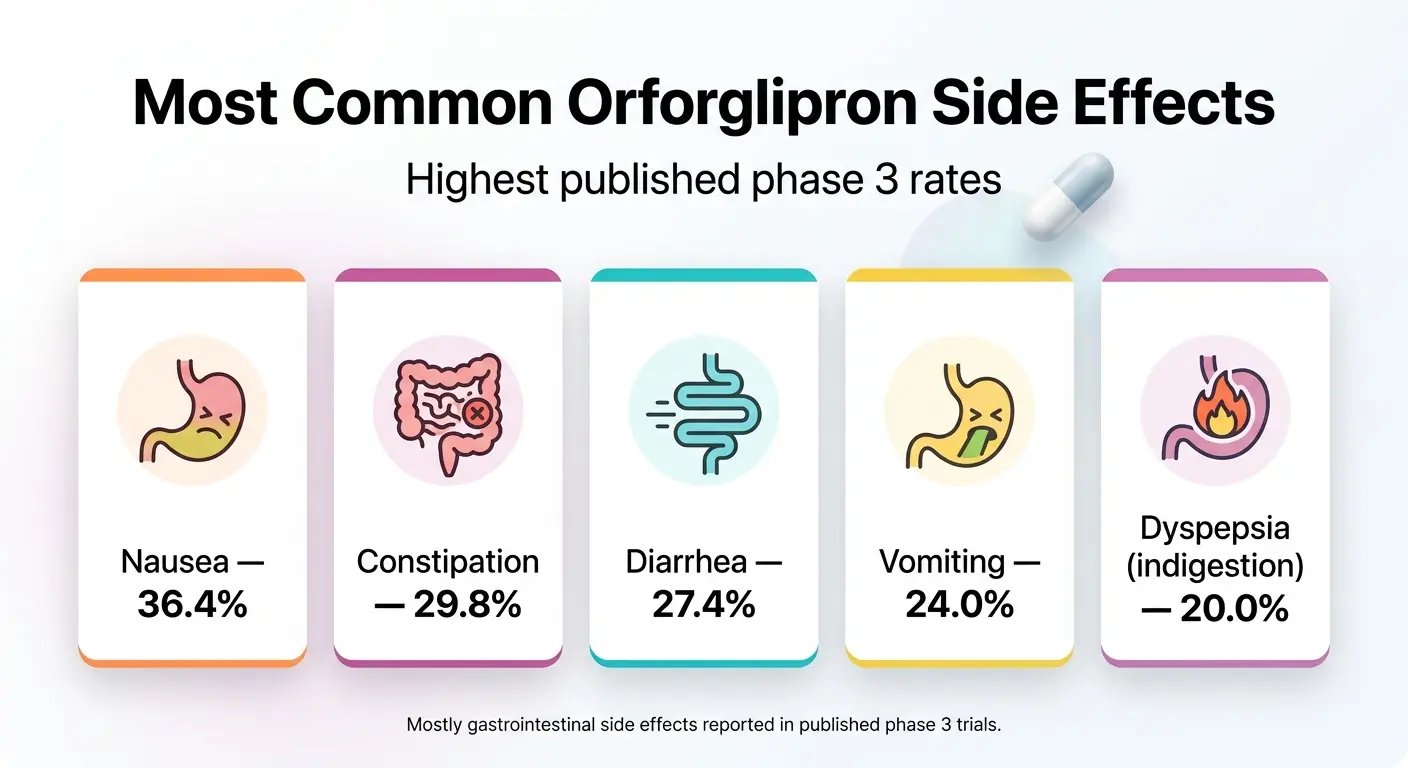
Quick Reference: Orforglipron Side Effects at a Glance
| Side effect | Highest Phase 3 rate | Placebo range |
|---|---|---|
| Nausea | 36.4% | 2.0–10.4% |
| Constipation | 29.8% | 4.0–9.3% |
| Diarrhea | 27.4% | 9.0–15.0% |
| Vomiting | 24.0% | 1.0–3.8% |
| Dyspepsia (indigestion) | 20.0% | 3.5–7.0% |
| Stopped due to side effects | 10.6% | 1.0–4.6% |
Highest published rates across ATTAIN-1, ATTAIN-2, and ACHIEVE-1. Lower doses produce lower rates. Sources: NEJM (Jun 2025, Sep 2025); The Lancet (Nov 2025).
1. What Are the Side Effects of Orforglipron?
Orforglipron side effects follow the same pattern as every other GLP-1 medication on the market. The drug works by mimicking the GLP-1 hormone, which slows your stomach emptying and changes appetite signaling in your brain. That mechanism drives weight loss — and it is also what causes the stomach issues.
The most commonly reported orforglipron side effects in clinical trials are:
Nausea
The one everybody asks about first. It can range from a vague queasiness to genuine misery, but in trials it was classified as mild to moderate for the vast majority of people. It tends to appear during dose escalation and then decrease.
Diarrhea
One of the most common orforglipron side effects. In some trials — particularly ACHIEVE-1 — diarrhea was reported more frequently than nausea, a notable distinction from injectable semaglutide where nausea usually tops the list. In ATTAIN-1 and ATTAIN-2, nausea led. The pattern depends on dose and population.
Constipation
Just as common as diarrhea. GLP-1 medications slow your entire digestive transit. For some people, things move too fast (diarrhea). For others, things slow down too much. Hydration and fiber make a real difference here.
Vomiting
Less common than nausea, but it happens — especially during dose escalation. In most trial participants who experienced it, vomiting resolved on its own without stopping the medication.
Dyspepsia (indigestion)
That heavy, uncomfortable feeling after eating. When your stomach is emptying more slowly, even a normal-sized meal can feel like too much. This responds best to changing how you eat, not just what.
Other reported effects:
Burping and eructation, acid reflux (GERD), decreased appetite, headache, fatigue, dizziness, and alopecia (hair thinning — reported at 4–5% in ATTAIN-1 versus 2.4% on placebo) were also noted.
A note worth making early: being a pill does not remove the GLP-1 mechanism. Orforglipron works through the same receptor targeted by semaglutide (Ozempic/Wegovy). The delivery method changed. The biology did not. If you are picturing the pill as the “gentle” version of GLP-1 therapy, this page exists to give you a more accurate picture.
2. How Common Are They? The Phase 3 Trial Data
Most other pages say “mild to moderate” and “similar to other GLP-1s” without showing you the numbers. Here is every dose, every trial, every rate — clearly labeled to its source.
ATTAIN-1: Obesity Without Diabetes (72 Weeks, 3,127 Participants)
Published in the New England Journal of Medicine, September 2025.
| Side effect | 6 mg | 12 mg | 36 mg | Placebo |
|---|---|---|---|---|
| Nausea | 28.9% | 35.9% | 33.7% | 10.4% |
| Constipation | 21.7% | 29.8% | 25.4% | 9.3% |
| Diarrhea | 21.0% | 22.8% | 23.1% | 9.6% |
| Vomiting | 13.0% | 21.4% | 24.0% | 3.5% |
| Dyspepsia | 13.1% | 16.2% | 14.1% | 5.0% |
| Discontinued (AEs) | 5.3% | 7.9% | 10.3% | 2.7% |
| Weight loss | −7.5% | −8.4% | −11.2% | −2.1% |
Source: Wharton et al., NEJM, September 2025; Lilly Medical ATTAIN-1 data.
ATTAIN-2: Obesity With Type 2 Diabetes (72 Weeks)
Published in The Lancet, November 2025. Contains the highest published nausea rate (36.4%) and highest adverse-event discontinuation rate (10.6%) in the Phase 3 program.
| Side effect | 6 mg | 12 mg | 36 mg | Placebo |
|---|---|---|---|---|
| Nausea | 20.1% | 31.1% | 36.4% | 8.4% |
| Vomiting | 12.8% | 20.2% | 23.1% | 3.8% |
| Diarrhea | 21.3% | 24.8% | 27.4% | 15.0% |
| Constipation | 17.7% | 21.1% | 22.4% | 7.8% |
| Dyspepsia | 9.1% | 15.4% | 10.9% | 3.5% |
| Discontinued (AEs) | 6.1% | 10.6% | 10.6% | 4.6% |
| Weight loss | −5.1% | −7.0% | −9.6% | −2.5% |
Source: The Lancet, November 2025; Eli Lilly ATTAIN-2 press release.
ACHIEVE-1: Early Type 2 Diabetes (40 Weeks, 559 Participants)
Published in the New England Journal of Medicine, June 2025. Gives the clearest low-to-high-dose comparison.
| Side effect | 3 mg | 12 mg | 36 mg | Placebo |
|---|---|---|---|---|
| Diarrhea | 19% | 21% | 26% | 9% |
| Nausea | 13% | 18% | 16% | 2% |
| Dyspepsia | 10% | 20% | 15% | 7% |
| Constipation | 8% | 17% | 14% | 4% |
| Vomiting | 5% | 7% | 14% | 1% |
| Discontinued (AEs) | 6% | 4% | 8% | 1% |
Source: Rosenstock et al., NEJM, June 2025; Eli Lilly ACHIEVE-1 press release.
3. When Do Orforglipron Side Effects Start?
In Phase 3 trials, gastrointestinal side effects occurred mainly during dose escalation and after dose increases, then generally decreased over time. Trials used four-week step-up schedules.
The Phase 2 trial data proved the escalation point decisively: the group with the fastest dose escalation (24 mg, with weekly increases) had the worst nausea of any group in the entire orforglipron development program. The groups with slower, four-week escalation had notably better tolerability.
The key pattern:
Side effects cluster at the start of each new dose level, then taper at maintenance. Most people who tolerate the escalation phase report manageable ongoing symptoms. The hardest stretch is typically the first 4–8 weeks of treatment.
4. Is Orforglipron Worse Than Other GLP-1s for Side Effects?
This is the trial that changes the conversation. ACHIEVE-3, published in The Lancet in February 2026, is the only Phase 3 study to directly compare orforglipron against another oral GLP-1 — oral semaglutide (Rybelsus).
| Metric | Orf 12 mg | Orf 36 mg | Sema 7 mg | Sema 14 mg |
|---|---|---|---|---|
| A1C reduction | −1.9% | −2.2% | −1.1% | −1.4% |
| Weight loss | −6.7% (−14.6 lbs) | −9.2% (−19.7 lbs) | −3.7% (−7.9 lbs) | −5.3% (−11.0 lbs) |
| GI side effects (any) | 58% | 59% | 37% | 45% |
| Stopped due to GI AEs | 7.0% | 9.7% | 2.0% | 4.9% |
| Refrigeration needed | No | No | No | No |
| Food/water timing rules | None | None | Yes | Yes |
Source: ACHIEVE-3, The Lancet, February 2026. Only direct head-to-head Phase 3 comparison available.
Important caveat:
ACHIEVE-3 used the lower semaglutide doses (7–14 mg), not the Wegovy obesity dose (25 mg). Orforglipron's efficacy advantage may narrow at higher semaglutide doses. This is the only head-to-head comparison we have.
If you've been waiting for the “gentler” GLP-1 pill — proven programs are available today.
Injectable options like Wegovy and Zepbound deliver 15–22% average weight loss in clinical trials — roughly double orforglipron — with years of real-world safety data.
Check eligibility on Ro → (sponsored affiliate link, opens in a new tab)FDA-approved Wegovy & Zepbound · telehealth · insurance accepted
5. Which Side Effects Are Normal — and Which Are Red Flags?
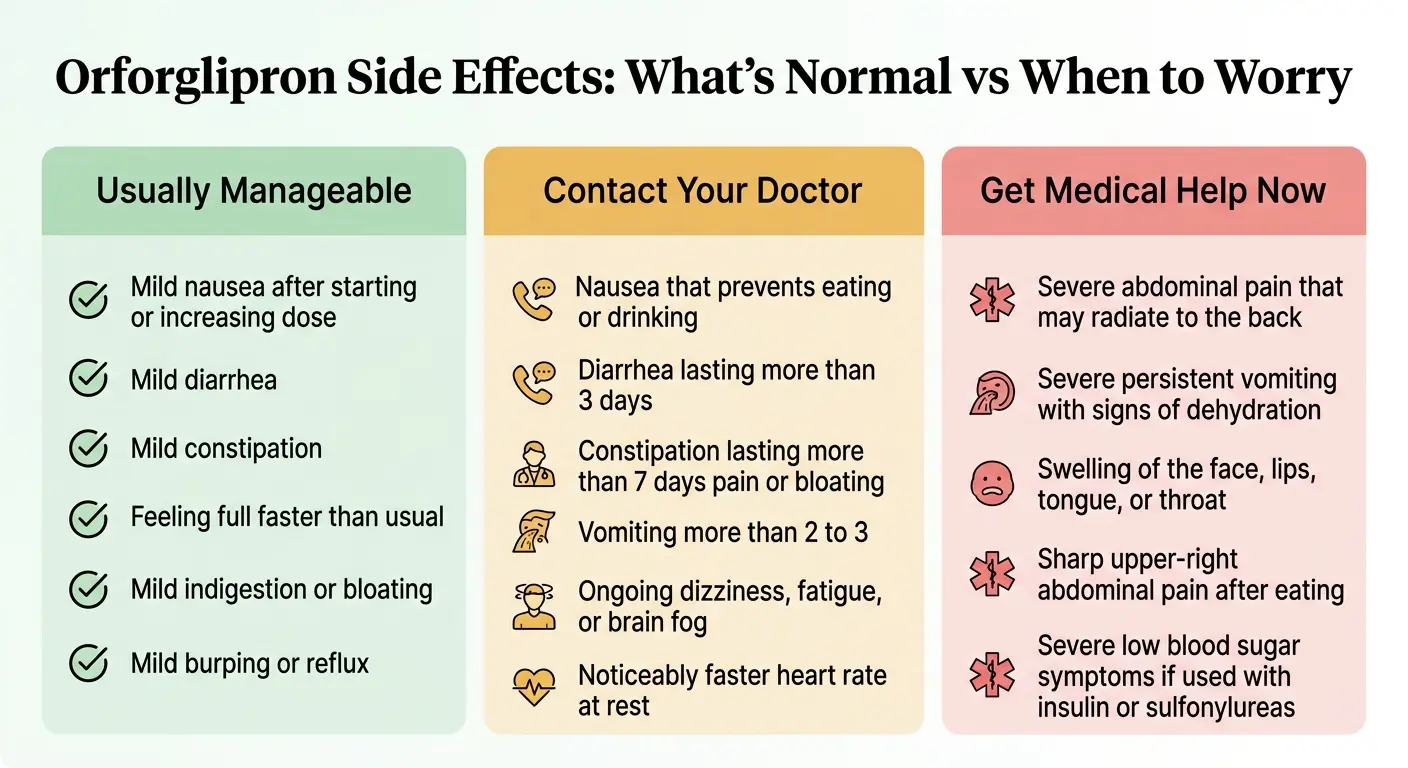
Green: Common and Usually Manageable
| What you feel | What it probably means | What to do |
|---|---|---|
| Mild nausea after starting or increasing dose | Body adjusting to GLP-1 signal | Eat smaller meals, avoid greasy food, sip cold water. Give it time. |
| Loose stools or mild diarrhea | GI motility changes during adjustment | Stay hydrated. Reduce fat intake. Usually resolves within days. |
| Mild constipation | Slower gastric transit | Increase water and fiber. Light movement helps. |
| Feeling full faster than usual | Medication working as designed | Eat smaller portions. Stop when satisfied, not full. |
| Mild indigestion or bloating | Delayed stomach emptying + normal meal sizes | Reduce meal size. Eat more slowly. Avoid carbonated drinks. |
| Mild burping or reflux | GI adjustment | Avoid lying down after eating. Reduce spicy and acidic foods. |
Yellow: Contact Your Doctor
⚠️Nausea that prevents you from eating or drinking for more than a day
⚠️Diarrhea lasting more than 3 days or more than 6 loose stools per day
⚠️Constipation lasting more than 7 days with pain or bloating
⚠️Vomiting more than 2 to 3 times
⚠️Ongoing dizziness, fatigue, or brain fog
⚠️Noticeably faster heart rate at rest
Red: Get Medical Help Now
🚨Severe abdominal pain that may radiate to the back (pancreatitis warning sign)
🚨Severe persistent vomiting with signs of dehydration
🚨Swelling of the face, lips, tongue, or throat (possible allergic reaction)
🚨Sharp upper-right abdominal pain after eating (possible gallbladder issue)
🚨Severe low blood sugar symptoms if used with insulin or sulfonylureas
6. Can Orforglipron Cause Pancreatitis, Liver Problems, or Thyroid Cancer?
Pancreatitis
In ATTAIN-1, five adjudication-confirmed mild pancreatitis cases were reported among orforglipron participants, with no reported complications. This is consistent with the broader GLP-1 class. The warning sign is severe abdominal pain that radiates to your back, especially accompanied by vomiting. If that happens, seek medical evaluation immediately.
Gallbladder issues
GLP-1 medications as a class carry a small risk of gallbladder-related events, including gallstones and cholecystitis. Part of this risk is related to rapid weight loss itself — losing weight quickly increases gallstone risk regardless of which medication causes the loss.
Liver safety (actually reassuring)
No hepatic safety signal was explicitly reported in Lilly's public Phase 3 materials for ATTAIN-1, ATTAIN-2, and ACHIEVE-1. This matters because Pfizer's competing oral GLP-1 candidate, danuglipron, was discontinued partly due to a possible liver-related side effect. Orforglipron did not show the same issue.
Thyroid cancer
All GLP-1 receptor agonists carry a class-wide boxed warning about thyroid C-cell tumors based on findings in rodent studies. This has not been confirmed in humans. People with a personal or family history of medullary thyroid carcinoma (MTC) or Multiple Endocrine Neoplasia syndrome type 2 (MEN2) should not take GLP-1 medications.
What is still unknown
Orforglipron's longest published trial data spans 72 weeks. We do not yet have multi-year safety data, post-marketing surveillance data, or a final FDA-approved prescribing label with its full risk language. Across more than 6,000 participants across ACHIEVE trials and 3,127 in ATTAIN-1 alone, no unexpected safety signals emerged.
7. Why Does Orforglipron Cause Stomach Side Effects If It Is a Pill?
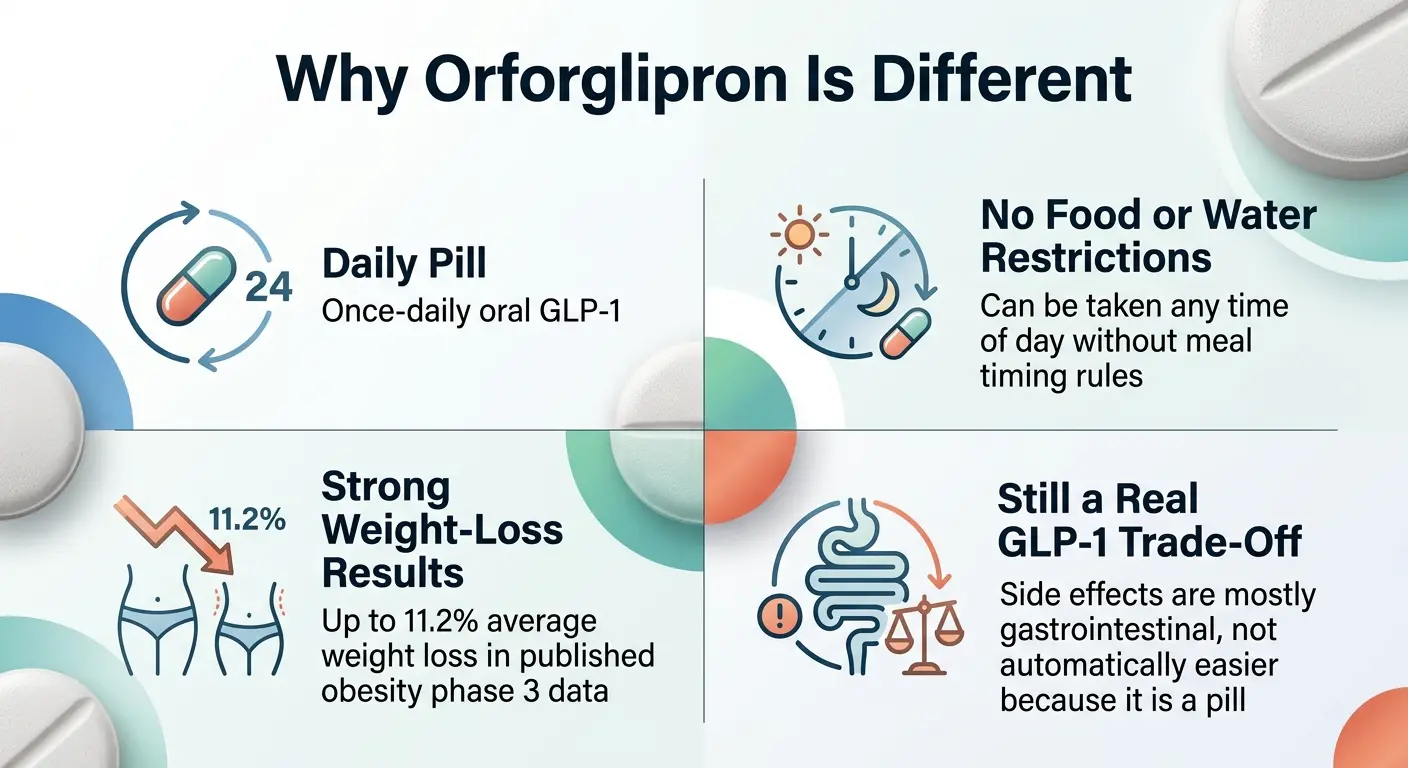
The side effects are caused by what the drug does, not how it gets into your body. Orforglipron activates GLP-1 receptors. When those receptors activate, three things happen:
Your stomach empties more slowly.
Food sits in your stomach longer — you feel full sooner and for longer. That is the weight-loss mechanism. But it also means a meal you used to handle fine may now feel heavy, too rich, or nauseating.
Your appetite signals change.
The brain pathways that drive hunger get dialed down. For most people this is the best part of GLP-1 therapy. But the transition can feel odd — some people describe it as their relationship with food suddenly changing.
Your intestinal motility shifts.
The speed at which food moves through your intestines changes, which explains both the diarrhea and the constipation. Different people's guts respond differently to the same signal.
One practical implication: overeating on orforglipron feels much worse than overeating normally. When your stomach is emptying slowly and you eat a large, fatty meal on top of that — nausea, vomiting, and intense discomfort are common results. The people who report the smoothest experience with GLP-1 medications are consistently the ones who adapt their eating before the side effects force them to.
8. How to Reduce Orforglipron Side Effects: What Actually Works
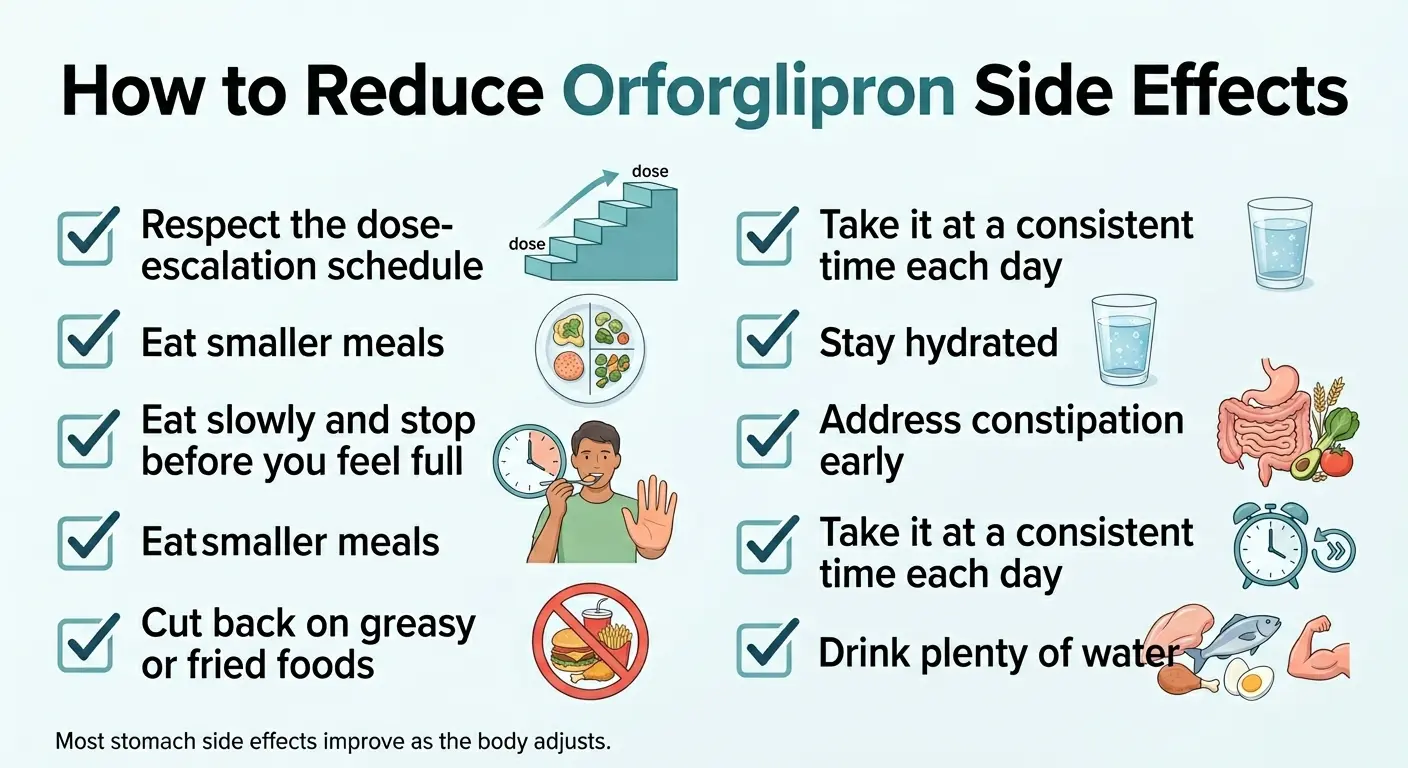
Respect the dose escalation schedule.
This is the single most impactful thing you can do. Phase 2 trial data proved it: the group with the fastest dose escalation had the worst nausea of any group in the entire orforglipron development program. Do not ask your doctor to move faster. Slow is how you get through.
Eat smaller meals, more often.
Five to six small meals instead of three large ones. Your stomach is emptying more slowly — give it less to work with at each sitting. This one change resolves or reduces nausea for a significant number of people.
Eat slowly. Stop when you feel satisfied — not full.
Your fullness signals have changed. When you feel satisfied, stop. What used to be a comfortable portion may now be too much.
Cut back on greasy, fried, and ultra-processed foods.
Fat slows gastric emptying on its own. Combine that with a drug that is already slowing your stomach, and you get nausea, bloating, and indigestion. Lean proteins, vegetables, and lighter preparations make a noticeable difference.
Stay hydrated — especially if you have diarrhea or vomiting.
Dehydration makes every GI symptom worse and adds fatigue, headache, and dizziness on top. Sip water throughout the day. If diarrhea is an issue, consider an oral rehydration solution.
Address constipation proactively.
Do not wait until it becomes a problem. Increase fiber intake, drink more water, and stay physically active. Fiber supplements and magnesium citrate are commonly used in GLP-1 prescribing protocols.
Time your dose consistently.
Orforglipron has no food or water restrictions — a genuine advantage over oral semaglutide. But consistency still helps. Taking it at roughly the same time each day lets your body build a predictable rhythm.
Talk to your doctor about anti-nausea support if needed.
Over-the-counter ginger supplements and Dramamine may take the edge off mild nausea. For more significant symptoms, prescription ondansetron (Zofran) is sometimes used during the dose-escalation phase of GLP-1 therapy. There is no medal for suffering through it in silence.
Keep a symptom diary for the first month.
Track what you eat, when you take your dose, and how you feel. Patterns emerge quickly. Many people discover that specific foods, meal sizes, or timing habits are the real trigger — not the medication in general.
Prioritize protein.
When your appetite drops significantly, it is easy to just eat less of everything. But muscle loss during rapid weight loss is a real concern with GLP-1 medications. Aim for at least 60–80 grams of protein per day — lean meats, eggs, Greek yogurt, cottage cheese, protein shakes — even if your total caloric intake drops. This protects muscle mass and may help reduce hair thinning.
Give it time — but know your limits.
If your side effects are worsening rather than improving, or if they prevent you from eating and drinking adequately, that is a signal to talk to your doctor about adjusting your dose — not a reason to quit cold turkey.
GLP-1 Side Effect Survival Checklist
9. Who Is Most Likely to Struggle With Orforglipron Side Effects?
Not everyone has the same experience. Based on trial data patterns and GLP-1 prescribing experience, here are the profiles that tend to have a harder time — and who may actually be especially well-suited.
Likely to struggle more:
- • Already sensitive to GLP-1 GI effects from semaglutide or tirzepatide
- • Expecting the pill to be dramatically easier (ACHIEVE-3 shows it is not)
- • Inconsistent eating habits — large, irregular meals trigger side effects
- • On insulin or sulfonylureas — increased hypoglycemia risk
May be especially well-suited:
- • Needles are your absolute dealbreaker — orforglipron removes that barrier entirely
- • Oral semaglutide's fasting rules don't fit your morning routine
- • Value simplicity: one pill, any time, no food rules, no refrigeration
- • Medicare beneficiary who can wait ($50/mo expected under Lilly agreement)
Expert perspective:
Dr. Marie Spreckley at the Science Media Centre noted that higher discontinuation due to GI adverse events matters for long-term outcomes, because the best medication in the world does not work if people stop taking it. Martin Whyte, Associate Professor of Metabolic Medicine at the University of Surrey, made a similar point: long-term adherence, shaped as much by tolerability as efficacy, is the critical differentiator in a competitive GLP-1 market.
10. Should You Wait for Orforglipron or Start an Available GLP-1 Now?
| Your situation | Best next move |
|---|---|
| “I refuse to do injections and I can wait.” | Orforglipron may be worth waiting for — track FDA decision timeline. |
| “I want the most effective GLP-1 available right now.” | Check eligibility for FDA-approved Wegovy or Zepbound through Ro. |
| “I want an affordable option I can start this week.” | See current GLP-1 pricing and program options at MEDVi. |
| “I'm on Medicare and want coverage.” | Wait for orforglipron ($50/mo potential) or check current Medicare GLP-1 coverage. |
| “I'm still not sure what's right for me.” | Take our free 60-second matching quiz for a personalized recommendation. |
Consider this: people who start GLP-1 therapy today are already losing weight, improving their metabolic markers, and building healthier habits. Lilly's own ATTAIN-MAINTAIN data showed that participants who switched from injectables to orforglipron maintained most of their weight loss — meaning there is no penalty for starting now and switching later.
Ready to move forward?
FDA-approved GLP-1 programs are available today through telehealth — no waiting for FDA decisions, no uncertainty about approval timelines.
Ro: FDA-approved Wegovy & Zepbound · telehealth · insurance accepted | MEDVi: dedicated GLP-1 clinical support
11. Is Orforglipron Available Right Now?
Yes. FDA-approved April 1, 2026 and available now via LillyDirect and participating pharmacies.
FDA status:
FDA-approved April 1, 2026 for chronic weight management in adults with obesity or overweight with at least one weight-related condition. Reviewed under the FDA Commissioner's National Priority Review Voucher pilot program (selected 2025).
Pricing:
Self-pay through LillyDirect starting at $149/month for the lowest dose, up to $399/month. Medicare beneficiaries pay no more than $50/month through the Medicare GLP-1 Bridge (July 2026–December 2027), as Foundayo is included in the Bridge drug list.
Brand name:
Foundayo (Eli Lilly).
Type 2 diabetes indication:
A separate FDA submission for type 2 diabetes is planned for later in 2026.
For our full tracking page with regulatory updates: Orforglipron Reviews: Real Data & FDA Status 2026 →
Orforglipron Side Effects FAQ
What are the most common orforglipron side effects?▾
The most common orforglipron side effects are gastrointestinal: nausea (up to 36%), diarrhea (up to 27%), constipation (up to 30%), vomiting (up to 24%), and dyspepsia or indigestion (up to 20%). These rates come from Eli Lilly's Phase 3 ATTAIN and ACHIEVE clinical trials. Most symptoms are mild to moderate and tend to improve after the first several weeks of treatment.
Are orforglipron pill side effects less severe than other GLP-1 medications?▾
Not based on current evidence. In the head-to-head ACHIEVE-3 trial against oral semaglutide, about 59% of people on orforglipron reported gastrointestinal side effects versus 37–45% on oral semaglutide, and more people stopped orforglipron due to side effects (up to 9.7% vs 4.9%). No direct Phase 3 head-to-head against injectable GLP-1s has been published. Being a pill does not remove the GLP-1 mechanism that causes stomach issues.
How many people stop taking orforglipron because of side effects?▾
Across Phase 3 trials, between 5% and 10.6% of participants stopped orforglipron specifically due to adverse events, compared to about 2.7–4.6% on placebo. Overall treatment discontinuation for any reason was higher — ranging from about 20–25% across ATTAIN-1 and ATTAIN-2, which is typical for long-duration clinical trials.
When do orforglipron side effects start?▾
In Phase 3 trials, gastrointestinal side effects occurred mainly during dose escalation and after dose increases, then generally decreased over time. Trials used four-week step-up schedules, so most adjustment occurs during the escalation phase.
Can orforglipron cause pancreatitis?▾
In ATTAIN-1, five adjudication-confirmed mild pancreatitis cases were reported among orforglipron participants, with no reported complications. This is consistent with the broader GLP-1 medication class. Severe abdominal pain radiating to the back is the primary warning sign and requires immediate medical evaluation.
Does orforglipron affect the liver?▾
No liver safety signal was explicitly reported in Lilly's public Phase 3 materials for ATTAIN-1, ATTAIN-2, and ACHIEVE-1. This is notable because Pfizer discontinued its competing oral GLP-1 candidate, danuglipron, partly due to a possible liver-related side effect.
Is orforglipron FDA-approved?▾
Yes. Foundayo (orforglipron) was FDA-approved on April 1, 2026 for chronic weight management in adults with obesity or overweight with at least one weight-related condition. Self-pay pricing through LillyDirect starts at $149/month for the lowest dose.
Should I wait for orforglipron or start a GLP-1 now?▾
It depends on your priorities. If you need a needle-free daily pill with no food restrictions and are comfortable waiting for FDA approval, orforglipron may be worth the wait. If you want to start losing weight now, several FDA-approved GLP-1 programs are available today through telehealth — and injectable options like tirzepatide deliver roughly twice the weight loss of orforglipron in clinical trials.
Does orforglipron cause hair loss?▾
Alopecia was reported in ATTAIN-1: 4.1% with 6 mg, 5.0% with 12 mg, and 5.4% with 36 mg, versus 2.4% with placebo. Whether this reflects the medication itself, weight loss, nutritional changes, or multiple factors is not yet established. Adequate protein intake may help reduce the risk.
Does orforglipron raise heart rate?▾
Some Phase 3 data showed a small increase in resting heart rate among orforglipron users compared to placebo. This is consistent with what has been observed with other GLP-1 medications. The clinical significance of this finding is still being evaluated.
Are orforglipron side effects dose-dependent?▾
Yes. Higher doses of orforglipron consistently produce higher rates of gastrointestinal side effects and higher discontinuation rates. The 36 mg dose showed the highest side effect rates in most trials, while the 3 mg and 6 mg starting doses showed the lowest.
Related GLP-1 Guides
How We Built This Page
We prioritized named primary sources and trial-level data, and label the specific study wherever possible.
·ACHIEVE-1: Rosenstock et al., New England Journal of Medicine, June 2025
·ATTAIN-1: Wharton et al., New England Journal of Medicine, September 2025; Lilly Medical ATTAIN-1 data
·ATTAIN-2: Published in The Lancet, November 2025; Eli Lilly ATTAIN-2 press release
·ACHIEVE-3: Rosenstock et al., The Lancet, February 2026
·Phase 2 (obesity): Wharton et al., New England Journal of Medicine, 2023
·Phase 2 (type 2 diabetes): Frias et al., The Lancet, 2023
·Eli Lilly investor press releases (ACHIEVE-1, ATTAIN-1, ATTAIN-2, ACHIEVE-3)
·Eli Lilly official FAQ: lilly.com/news/stories/what-to-know-about-orforglipron
·Meta-analysis: PMC systematic reviews (2024, 2026)
·Science Media Centre expert reactions (February 2026)
Last reviewed: April 1, 2026 · Next scheduled review: Within 48 hours of FDA action or new major trial data publication.
This page is for informational purposes only and is not medical advice. Orforglipron (sold as Foundayo) was FDA-approved on April 1, 2026 for chronic weight management in adults with obesity or overweight with at least one weight-related condition. Always consult a qualified healthcare provider before starting any medication. The RX Index is not affiliated with Eli Lilly or any pharmaceutical manufacturer. This page contains affiliate links to telehealth providers. Our editorial recommendations are based on independent research and are not influenced by affiliate compensation. See our full disclosure.
Your situation changes the answer
Find My GLP-1 Path
The right GLP-1 provider isn't the same for everyone. It depends on whether you'll use insurance or pay cash, whether you want an FDA-approved or compounded medication, your preferred route (injection or oral), and your budget. Answer a few questions in The RX Index's Find My GLP-1 Path tool to see a suggested provider route and pricing to review before you choose. It does not check your plan's coverage or copay; confirm those in your insurer's member portal or with the pharmacy-benefits number on your card.
- What it asks: your goals, how you plan to pay, and your treatment preferences
- What you get: a suggested provider route and pricing information to review
- Cost: free · about 2 minutes · no signup