
Does Aetna Cover Wegovy? 2026 Coverage Rules, Costs, and How to Get Approved
Published: · Last updated: · Last reviewed:
· Affiliate disclosureThe RX Index may earn a commission if you start care through some partner links. It does not change what your plan covers, the price you pay, or our analysis.
Does Aetna cover Wegovy? Often yes — but with one big “if.” Here’s the honest version: when an Aetna commercial plan covers weight-loss drugs, Wegovy is usually the GLP-1 it covers, because Wegovy sits in the preferred spot on CVS Caremark’s standard drug list. The catch is that many employer plans don’t cover weight-loss drugs at all. So the real question isn’t “does Aetna cover Wegovy” — it’s “does your Aetna plan include weight-loss drugs, and does your prior authorization match the rules.”
On a covered plan, eligible members can pay as little as $25 a month. Get it wrong, and you can walk out of the pharmacy staring at a $1,300 bill on a drug your plan supposedly “covers.” The gap between those two outcomes comes down to five things almost every other website blurs together. Let’s clear all five — fast.
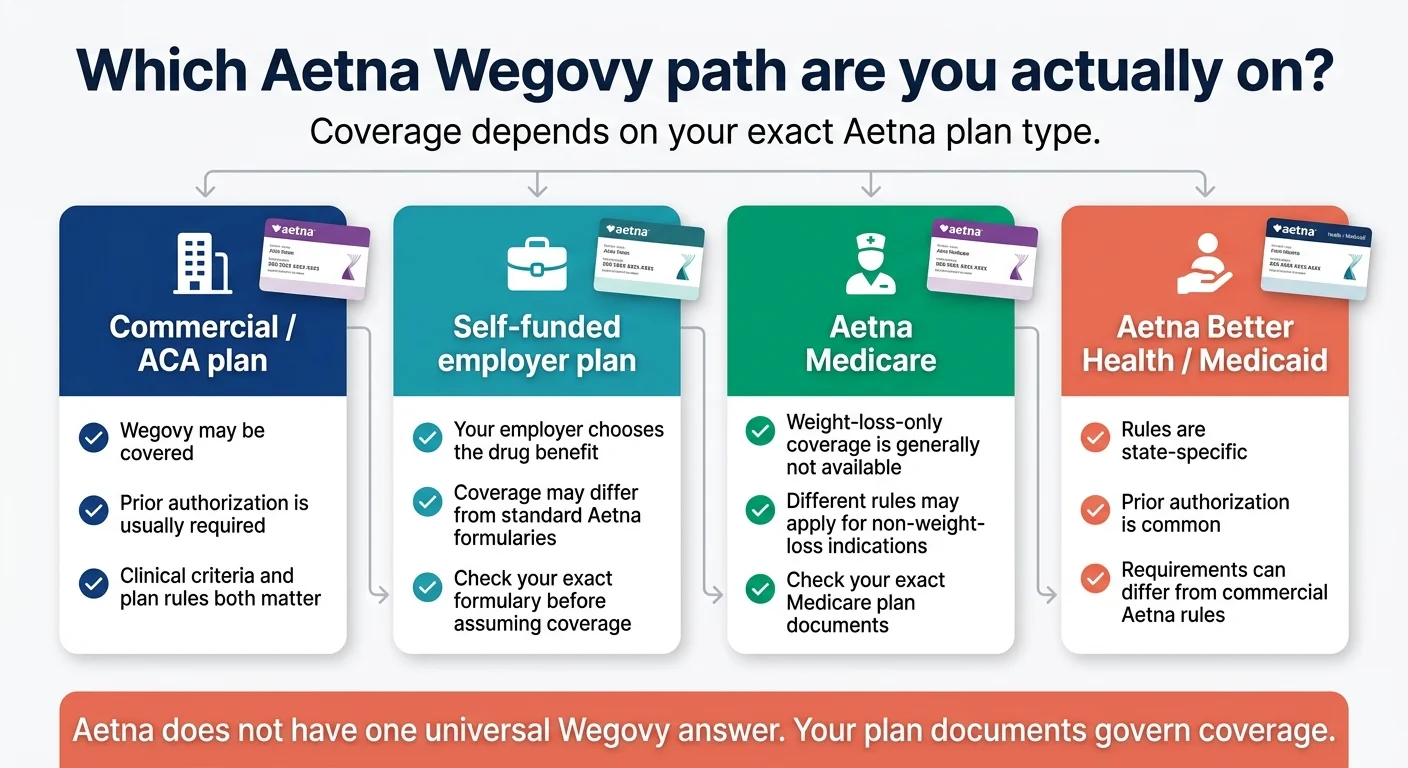
The 90-second answer (find your situation)
| Your Aetna situation | Short answer | Your first move |
|---|---|---|
| Commercial/employer plan + Wegovy for weight loss | Often covered, with prior authorization — if your plan includes weight-loss drugs | Confirm your plan covers the category; ask which PA policy applies |
| Plan that excludes weight-loss meds | No (for weight loss) | Get the exclusion in writing, then look at cash paths |
| Aetna Medicare drug plan (Part D or MA-PD) | Different rules — see the Medicare GLP-1 Bridge section below | Check if your plan type and BMI qualify (starts July 1, 2026) |
| Aetna Better Health (Medicaid) | State-by-state, and tightening | Check your state’s drug list |
| Approved, but pharmacy says $1,000+ | Not a denial — it’s cost-sharing | Ask: deductible, coinsurance, or cash price? |
| Denied even though you qualify | Often fixable | Find the exact denial reason first |
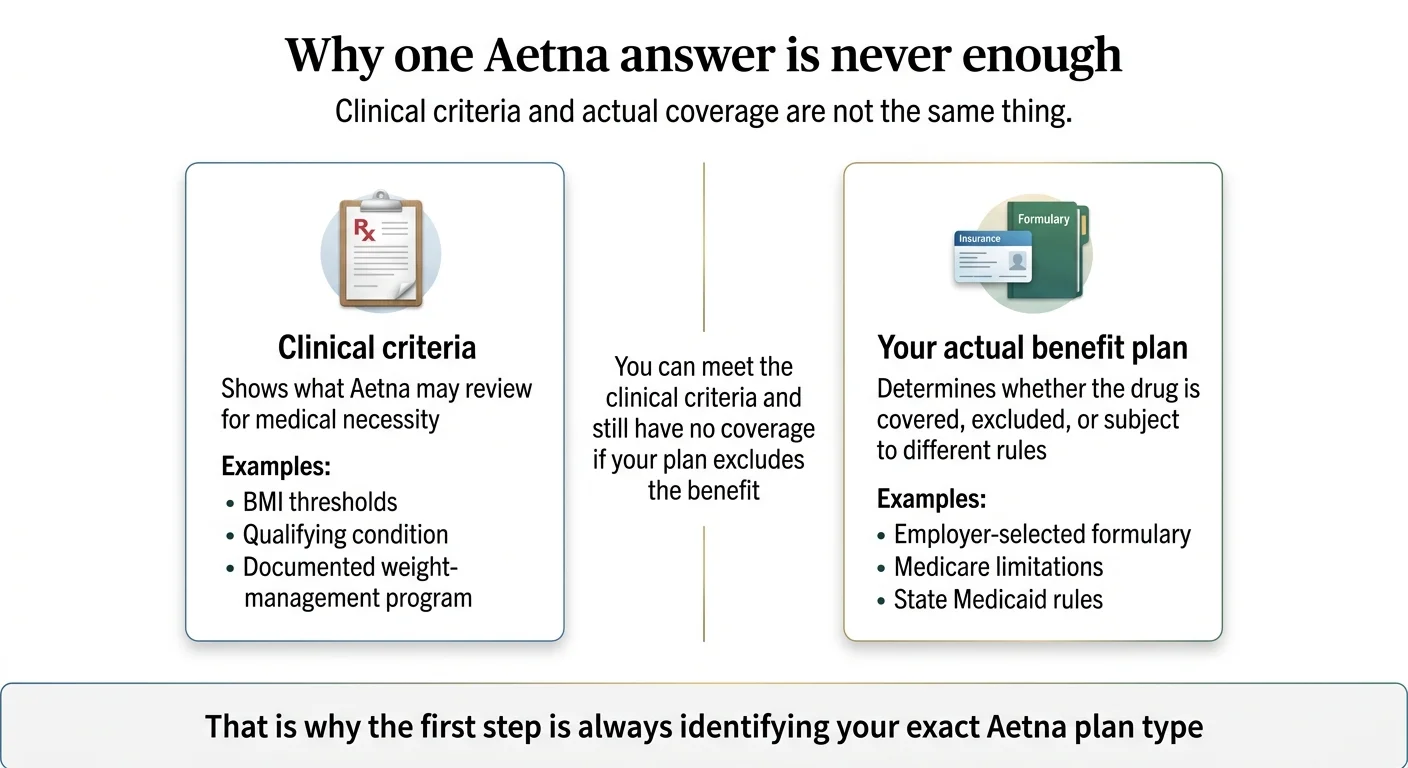
Before you spend a dime: A drug “appearing” on an Aetna list is not the same as your plan paying for it. The fastest way to get your real answer is to log in to your Aetna member account — or run a free coverage check that contacts your insurer for you.
No prescription required. Ro contacts your insurer and sends back a personalized coverage report.
Does Aetna cover Wegovy?
Aetna covers Wegovy on many commercial plans, but it is never automatic. When an Aetna plan covers weight-loss medication, Wegovy is usually the GLP-1 it covers, because Wegovy holds preferred status on CVS Caremark’s standard commercial drug list. The catch is that some employer plans exclude weight-loss drugs entirely, and even when Wegovy is covered, you’ll need prior authorization — your insurer’s sign-off before they’ll pay.
- →"Yes, probably" is not the same as "guaranteed."
- →"On the drug list" is not the same as "your plan pays for it."
- →"Covered" is not the same as "cheap."
- →"Needs prior authorization" is not the same as "denied."
Why so many Aetna plans cover Wegovy
Many Aetna pharmacy benefits run through a pharmacy benefit manager (PBM) — the company that builds the covered-drug list — and Aetna’s PBM is CVS Caremark.
In July 2025, CVS Caremark made Wegovy the preferred GLP-1 on its standard commercial drug list and dropped its rival, Zepbound, after a pricing deal with Wegovy’s maker, Novo Nordisk. That standard list covers roughly 25 million to 30 million Americans. So on plans that follow that standard list and cover weight-loss drugs, Wegovy became the GLP-1 your plan wants you on.
That’s why “does Aetna cover Wegovy” so often ends in “yes.” But “often” isn’t “always” — and here’s the part that decides your case.
The catch nobody puts in the headline
CVS Caremark sets a standard list, but your employer or union can customize it — or skip weight-loss coverage altogether. Preferred status only helps if your plan covers the category in the first place.
KFF’s 2025 Employer Health Benefits Survey found that only about 19% of large firms (200+ workers) cover GLP-1 drugs for weight loss, 57% don’t, and about 24% aren’t sure. Bigger companies are more generous — 43% of firms with 5,000+ workers cover them — but it’s far from a sure thing.
So the honest version: Aetna covers Wegovy on plans that include weight-loss drugs — and on those plans, Wegovy is usually the preferred pick. The variable is whether your specific plan covers the category at all.
The RX Index Aetna Wegovy Coverage Map (2026)
Last verified June 13, 2026. Aetna’s drug coverage runs largely through CVS Caremark; your employer’s plan design can override these defaults.
| Your Aetna situation | Likely answer | What actually decides it | Your first step | What to ask for as proof |
|---|---|---|---|---|
| Commercial/employer plan, Wegovy for weight loss | Often covered, PA required | Whether weight-loss drugs are included, plus meeting the BMI/documentation rules | Confirm the exclusion question, then start PA | Plan exclusion language + your PA policy ID |
| Plan that excludes weight-loss drugs | No (for weight loss) | A benefit exclusion — not your medical need | Get the exclusion in writing; compare cash paths | The exclusion in writing |
| Wegovy for established heart disease + overweight/obesity | Possible, separate pathway | Prior heart attack/stroke history, BMI ≥27, no type 2 diabetes | Ask your prescriber if the cardiovascular pathway fits | Which indication your PA was filed under |
| Wegovy injection for MASH (a serious liver disease) | Possible, strict rules | Liver specialist, fibrosis staging, injection only | Ask a GI/liver doctor about the MASH pathway | Fibrosis stage documentation |
| Aetna Medicare drug plan (Part D or MA-PD) | Different path | Federal law + the new Medicare GLP-1 Bridge | Check Bridge eligibility (starts July 1, 2026) | Your plan type + BMI/diagnosis |
| Aetna Better Health (Medicaid) | State-specific, often no | Your state’s Medicaid drug list | Check your state’s current rules | Your state’s PA criteria |
| Approved, but pharmacy quotes $1,000+ | Cost-sharing, not a denial | Deductible, tier, coinsurance, coupon eligibility | Ask which bucket the cost falls in | “Is this deductible, coinsurance, or copay?” |
Why the answer is so confusing: the 5 layers of Aetna coverage
Aetna coverage feels confusing because “Aetna” isn’t one rule — it’s at least five separate checkpoints, and a drug can pass one while failing another. A medication can appear on an Aetna drug list and still be excluded by your employer, or be “covered” but cost full price until your deductible is met. Knowing which layer is blocking you tells you whether to fight, switch, or pay smart.
Think of it as five doors. Wegovy has to clear all five to land in your hands at a price you like.
| Layer | The question it answers | Why it matters |
|---|---|---|
| 1. Benefit design | Does your plan cover weight-loss drugs at all? | A true exclusion blocks coverage no matter how sick you are. |
| 2. Formulary | Is Wegovy on your specific drug list? | Listed drugs can still need prior authorization. |
| 3. Prior authorization | Does your chart meet Aetna's rules? | Missing paperwork is the #1 fixable denial. |
| 4. Cost-sharing | What do you pay after coverage kicks in? | A high deductible can make "covered" feel like "not covered." |
| 5. Indication | Why is Wegovy being prescribed? | Weight loss, heart disease, and liver disease follow different rules. |
“Listed” is not “covered” (the trap that wastes the most time)
Aetna’s published drug guides say so themselves. Aetna’s standard drug list notes it isn’t all-inclusive, that it updates monthly, and that your specific plan may not cover a drug even when it appears in the document. People see “Wegovy” in a PDF, assume they’re set, and then get blindsided at the pharmacy.
The one honest catch, up front
If your employer’s plan flatly excludes weight-loss drugs, Aetna is probably the wrong path for a weight-loss prescription — and a stronger doctor’s letter won’t fix a benefit exclusion. Aetna’s own medical policy is blunt: many plans specifically exclude weight-reduction medications, and claims get denied under that exclusion no matter the medical need.
But that’s exactly why checking the exclusion first is the smartest five minutes you’ll spend. If the door’s closed, you stop wasting time on the wrong fight and pivot straight to the paths that still work — an appeal, an HR benefits request, the Medicare GLP-1 Bridge if you’re on Medicare, or a verified self-pay route.
What does Aetna require to approve Wegovy in 2026?
Aetna requires prior authorization for Wegovy, and the BMI bar depends on which policy your plan uses — so don’t guess it. Aetna’s Wegovy prior-authorization policy (4774-C) follows the FDA label: a starting BMI of 30 or higher, or 27 or higher with a weight-related condition like high blood pressure, type 2 diabetes, or high cholesterol. A separate 2026 Aetna policy titled “Weight Loss (BMI 35)” may apply a higher BMI ≥35 bar. Most weight-loss approvals also require documentation that you’ve tried a structured weight program for about six months.
Two BMI numbers — confirm which one is yours
This is where people trip. Aetna has more than one policy that can govern a Wegovy request, and they don’t all use the same BMI cutoff:
- Aetna’s Wegovy PA policy (4774-C) uses the FDA-label numbers: BMI ≥30, or ≥27 with a weight-related condition.
- A separate 2026 policy titled “Weight Loss (BMI 35)” points to a higher BMI ≥35 bar for approving GLP-1s for weight loss.
Both are real Aetna documents. Someone with a BMI of 32 could read a generic article, assume “I qualify,” and then get denied on a plan that requires 35. Don’t guess the rule — ask Aetna or CVS Caremark for the PA policy ID tied to your plan.
Which Aetna Wegovy policy applies to my plan?
Ask Aetna or CVS Caremark for the policy ID behind your Wegovy prior authorization, and don’t rely on a random Aetna PDF — different Aetna policies use different BMI thresholds and continuation rules. The crosswalk below lines them up.
Aetna Wegovy policy crosswalk (verified June 13, 2026)
| Policy / source | Covers | Starting BMI rule | ~6-month program? | Continuation rule | Formulation | What to ask Aetna |
|---|---|---|---|---|---|---|
| Wegovy PA 4774-C | Weight management | BMI ≥30, or ≥27 + a weight-related condition | Usually yes | ~3 months at a stable dose and ≥5% weight loss (or maintaining it) | Pen and tablets | “Is 4774-C the policy on my plan? What BMI does it require?” |
| “Weight Loss (BMI 35)” policy | Weight management (GLP-1/GIP class) | Appears to use BMI ≥35 | Likely yes | Per policy | Class-wide | “Does my plan use the BMI 35 policy?” |
| Wegovy CV policy 6410-C | Cardiovascular risk reduction | BMI ≥27 with established heart disease | Not the weight-loss program | Per policy | Pen/tablets | “Does my plan cover the cardiovascular indication?” |
| Medical policy CPB 0039 | Whether weight-loss drugs are covered at all | n/a | n/a | n/a | n/a | “Does my plan exclude weight-loss drugs?” |
| MASH pathway (within Wegovy policy) | Noncirrhotic MASH (F2–F3 fibrosis) | Not BMI-based | No — fibrosis-based | Per policy | Injection only | “Does my plan cover the MASH indication?” |
What Aetna’s weight-management criteria typically include
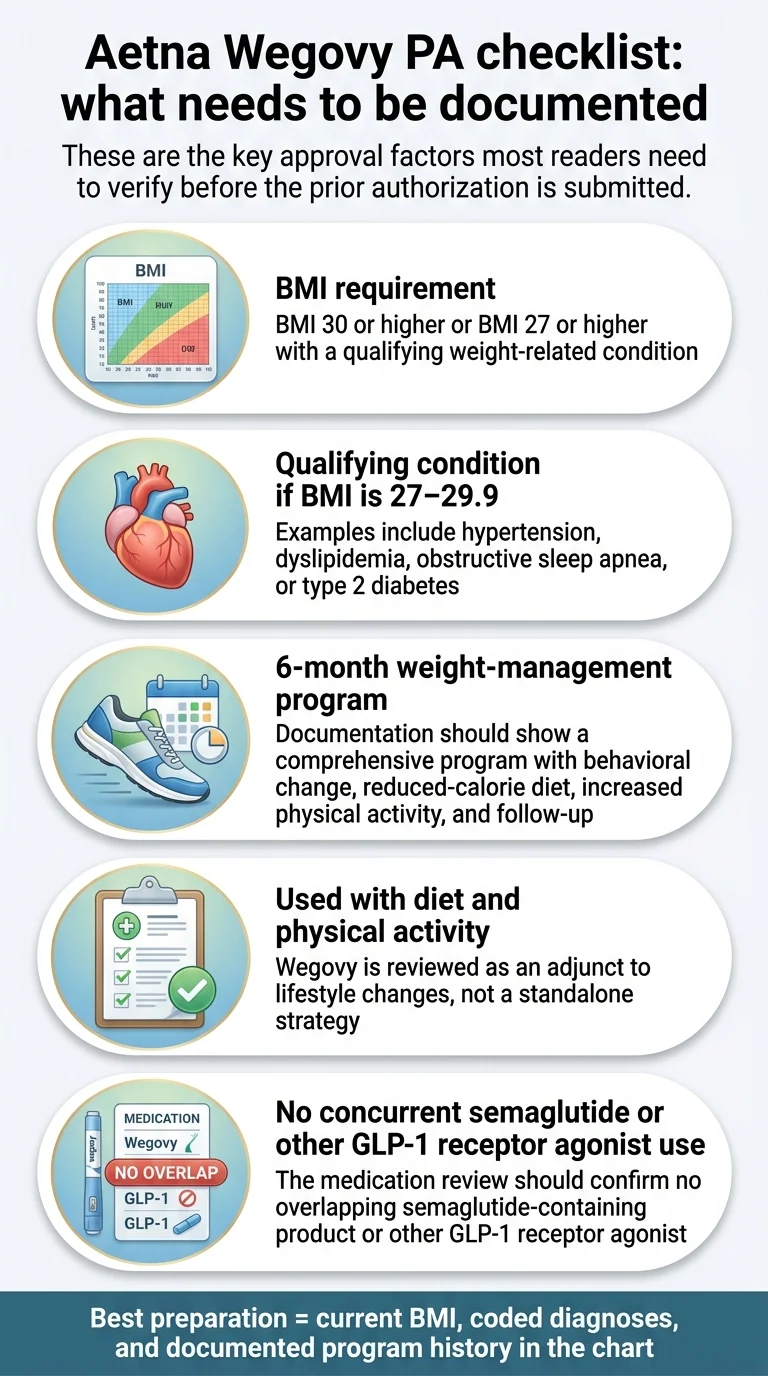
| Requirement | What Aetna may ask for | What to prepare |
|---|---|---|
| Age | 18 or older for the adult pathway | Date of birth |
| Starting BMI | Depends on your policy (≥30/≥27, or ≥35) | A chart note with height, weight, BMI, and date |
| Lifestyle effort | About 6 months in a comprehensive weight-management program (diet, activity, behavior change) | Visit notes, coaching logs, nutrition counseling, app data |
| Used with diet + activity | A reduced-calorie diet and more physical activity | A care plan written into your visit note |
| Documentation | Records attached, not just a diagnosis typed in | Ask your prescriber to attach the proof |
What happens at renewal
Getting approved once isn’t the finish line. Under Aetna’s Wegovy PA policy (4774-C), keeping coverage can require that you’ve been on a stable maintenance dose for at least 3 months and lost at least 5% of your starting body weight (or held that loss). Your plan may use different criteria, so confirm the policy ID — and keep your weigh-ins documented so your renewal sails through.
Does Aetna cover Wegovy for heart disease or other conditions?
Yes — Aetna may cover Wegovy under a separate cardiovascular pathway, and the rules differ from a weight-loss request. For adults with established heart disease plus overweight or obesity, Aetna can approve Wegovy to lower the risk of a major cardiovascular event — an FDA-approved use since March 2024. This pathway uses a BMI of 27+ with specific heart-history documentation, and it generally doesn’t require the 6-month weight program.
The cardiovascular pathway may fit if you have:
- A prior heart attack
- A prior stroke
- Symptomatic peripheral artery disease (poor blood flow in the legs)
- A history of a heart procedure like bypass, stent, or angioplasty
- A BMI of 27 or higher
- No type 2 diabetes (Aetna generally routes diabetes-plus-heart-disease patients to a different drug, like Ozempic)
If that’s your picture, ask your prescriber whether Wegovy should be requested for cardiovascular risk reduction rather than (or alongside) weight loss. It’s a real, FDA-approved indication — not a loophole — and it’s judged on its own merits.
Wegovy for MASH (serious liver disease)
Aetna’s policy also includes a pathway for Wegovy injection to treat non-cirrhotic MASH (metabolic dysfunction-associated steatohepatitis, a serious fatty-liver disease formerly called NASH) with moderate-to-advanced scarring (F2–F3 fibrosis). Two things to know:
- This MASH indication is approved under FDA “accelerated approval,” based on improvement of MASH and fibrosis — meaning continued approval may depend on a confirmatory trial.
- It’s the injection only (not the pill or Wegovy HD), it needs a liver or GI specialist involved, and it requires documented fibrosis staging.
A quick safety note before we go further
Wegovy is a prescription medication, and the decision to take it belongs with a licensed clinician — this page is a coverage and pricing guide, not medical advice. Wegovy’s FDA label carries a boxed warning for the risk of thyroid C-cell tumors, and it should not be used by people with a personal or family history of medullary thyroid carcinoma or Multiple Endocrine Neoplasia syndrome type 2 (MEN 2). Your prescriber will go over the warnings, side effects, and whether it’s right for you.
We’re including this not to scare you — millions of people use GLP-1s safely under medical care — but because a trustworthy guide tells you the whole picture, not just the price.
How do I check if MY exact Aetna plan covers Wegovy?
The fastest reliable answer comes from your own Aetna member account, your plan documents, or the number on your insurance card. Aetna lets members log in to see personalized coverage, drug tier, prior authorization rules, and pricing for their specific plan. The general drug guide on the public website isn’t enough, because it can’t see your plan’s exclusions.
The 5-minute Aetna lookup
- Log in to your Aetna member account (web or app).
- Go to Prescriptions or Pharmacy.
- Search “Wegovy” (and try “semaglutide,” the active ingredient).
- Check four things: Is it covered? What tier? Does it need prior authorization? Are there quantity limits or step therapy?
- Screenshot the result so you have it in writing.
The phone script (copy, paste, read it out loud)
Call the member-services number on your card and say:
“I’m checking coverage for Wegovy under my pharmacy benefit. Can you tell me: Is Wegovy covered on my plan? Does my plan exclude weight-loss medications? Is prior authorization required, and which policy or criteria apply? What tier is it, and are there quantity limits? And what would my estimated cost be — before and after my deductible?”
The HR script (for employer plans)
If you get insurance through work, email your benefits contact:
“Does our Aetna plan cover anti-obesity medications under the pharmacy benefit, or is there a weight-loss drug exclusion? If it’s excluded, is there an exception process or an upcoming benefits review?”
Don’t want to sit on hold? A free coverage checker can contact your insurer for you and send back a personalized report on whether Wegovy is covered and whether prior authorization is likely.
Check your Wegovy coverage free → (sponsored affiliate link, opens in a new tab)No prescription is submitted — it’s just a coverage answer.
How much does Wegovy cost with Aetna?
Wegovy’s cost with Aetna swings from a small copay to a four-figure bill, depending on coverage, your deductible, and savings-card eligibility. With commercial coverage, eligible patients can pay as little as $25 a month using Novo Nordisk’s savings card. Without coverage, Wegovy’s list price is about $1,349 a month, but Novo Nordisk’s own self-pay pharmacy charges far less.
Verified Wegovy prices (last checked June 13, 2026)
| Path | Who it’s for | Price | Notes |
|---|---|---|---|
| Savings card + commercial coverage | Insured, plan covers Wegovy | As little as $25/mo | Covers up to $100/mo; commercial plans only; government plans excluded |
| Plan copay (no card) | Insured, plan covers Wegovy | Your copay or coinsurance | Check your member portal or pharmacy estimate |
| NovoCare self-pay (pen) | Uninsured or excluded plan | $199/mo intro, then $349/mo | $199 covers first two fills of 0.25 mg & 0.5 mg through June 30, 2026; then $349/mo for 0.25–2.4 mg and $399/mo for Wegovy HD 7.2 mg |
| NovoCare self-pay (pill) | Uninsured or excluded plan | From $149/mo | $149 for 1.5 mg & 4 mg starting tablets; $149 on 4 mg through Aug 31, 2026, then $199; higher doses vary |
| TrumpRx | Uninsured | About $350/mo | Federal direct-pay site launched February 2026; routes to manufacturer self-pay price |
| Medicare GLP-1 Bridge | Eligible Medicare members | $50/mo | Runs July 1, 2026 – Dec 31, 2027 (details below) |
| Retail list price | Nobody should pay this | ~$1,349.02/mo | Use a program instead |
How the savings card works
If your commercial (non-government) Aetna plan covers Wegovy, Novo Nordisk’s savings card can drop your cost to as little as $25 a month, covering up to $100/month. You can’t use it if you’re on Medicare, Medicaid, or TRICARE — that’s federal law, not Aetna’s choice. Enroll at the NovoCare/Wegovy site once your prescription is approved.
HSA/FSA
Many people use HSA or FSA funds (tax-free health spending accounts) for Wegovy with a prescription. If you have one of those accounts, confirm eligibility with your plan administrator — it can effectively shave off whatever your tax rate is.
Why does Aetna say Wegovy is “covered” but the pharmacy wants $1,300?
Because “covered” and “affordable” are two different things. When a plan covers Wegovy but you haven’t met your deductible — or the drug sits on a high cost-sharing tier — you can be asked to pay the full or near-full price even though it’s technically covered. This is cost-sharing, not a denial, and the fix is different.
This is the most heartbreaking moment in the whole process: the PA gets approved, you celebrate, you walk into the pharmacy — and the register says $1,300. It usually isn’t a mistake. It’s one of these:
- Your deductible isn’t met yet. Until it is, you may pay the plan’s negotiated price.
- Coinsurance on a high list price. “20% coinsurance” of $1,349 is still a lot.
- Wegovy is on a non-preferred tier on your specific plan.
- The pharmacy is out of network.
- A coupon wasn’t applied, or you weren’t eligible for it.
The questions that decode the bill
| Ask the pharmacy or Aetna | Why it matters |
|---|---|
| "Is this my copay, coinsurance, or deductible?" | Tells you why it's high — and whether it drops later in the year |
| "Has my prior authorization actually been approved?" | A prescription alone isn't approval |
| "Is this pharmacy in network?" | Network can swing the price significantly |
| "Would mail order or a 90-day fill cost less?" | Some plans price these differently |
| "Can the Wegovy savings card be applied?" | Commercial plans only; worth up to $100/mo |
Why did Aetna deny my Wegovy — and how do I fix it?
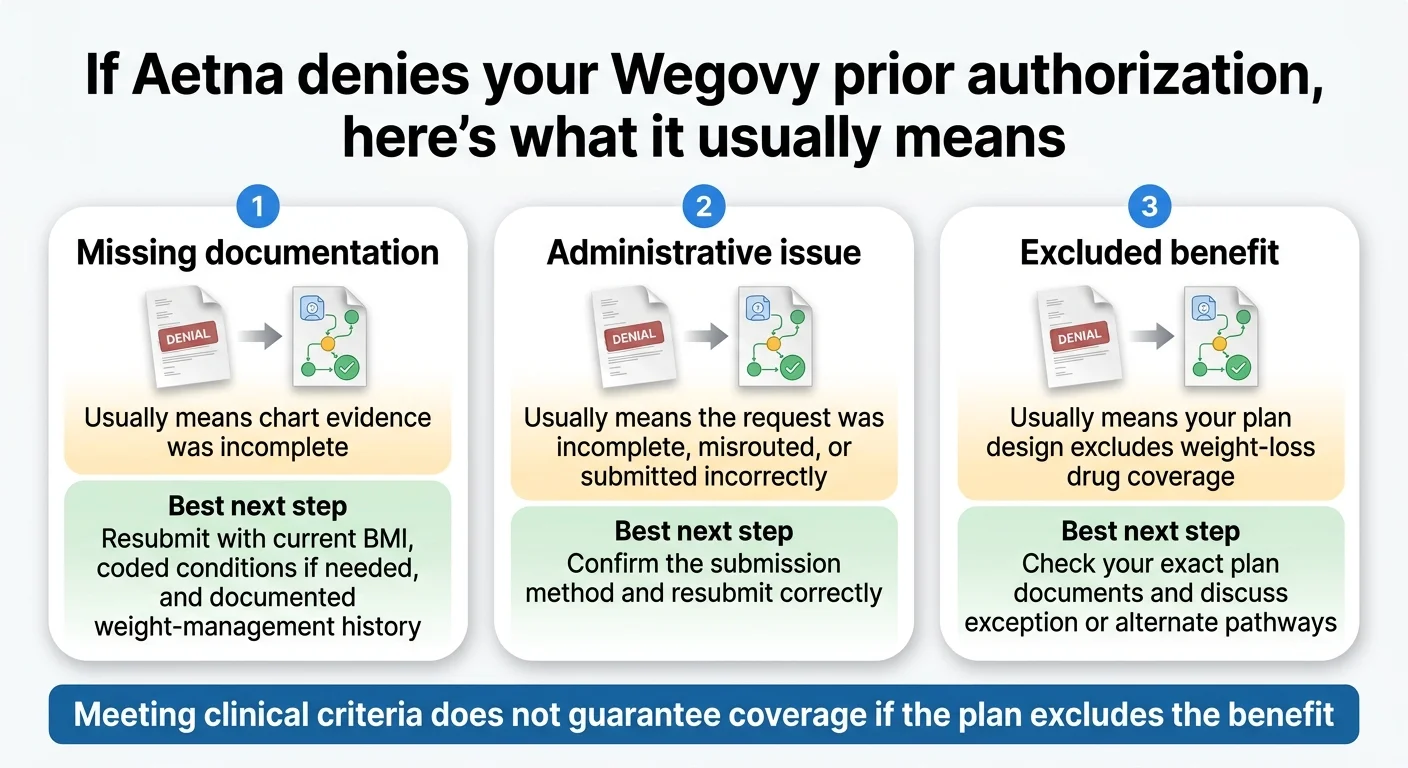
Most Aetna Wegovy denials fall into two buckets: fixable paperwork problems and hard plan exclusions. Missing BMI records, no proof of a 6-month weight program, the wrong indication, or an incomplete PA form are usually fixable on appeal. A true weight-loss drug exclusion is much harder to overturn — so the very first thing to do is read the denial and figure out which bucket you’re in.
The denial-letter decoder
| If your letter says… | It means… | Do this |
|---|---|---|
| "Not a covered benefit" / "excluded" | Your plan doesn't cover weight-loss drugs | Get the exclusion in writing; try an HR request or a cash path |
| "Does not meet clinical criteria" / mentions BMI | You didn't meet the plan's PA bar | Confirm your policy ID, then resubmit with BMI and records |
| "No weight-management program documented" | The PA was missing your lifestyle proof | Add coaching/diet/visit records and resubmit |
| "Step therapy required" | You must try another drug first | Ask about an exception, or try the required drug |
| "Quantity limit exceeded" | A dose or supply limit was hit | Adjust the dose/supply or request an override |
The 7-step denial action plan
- Get the denial letter (call and ask them to send it if you don’t have it).
- Highlight the exact reason for the denial.
- Ask: is this a benefit exclusion or a medical-necessity denial? (This decides everything.)
- Match the denial to Aetna’s criteria — which box did the PA miss?
- Gather the missing proof: BMI, weight history, conditions, your 6-month program records, and any heart/liver documentation.
- Have your prescriber appeal with the specific evidence Aetna asked for.
- If it’s a true exclusion, stop appealing and pivot — HR request, Medicare Bridge (if eligible), or a verified self-pay route.
What your doctor should put in the packet
Diagnosis and indication · height, weight, BMI with date · weight history · any conditions like high blood pressure or sleep apnea · proof of about 6 months in a weight-management program · prior treatments tried · heart or liver documentation if relevant · a line stating Wegovy is used with a reduced-calorie diet and more activity · your 5% weight-loss proof if it’s a renewal.
The honest part about getting help — and one trade-off. This is where a telehealth program with a built-in insurance concierge earns its keep: it checks your Aetna benefits and files the prior authorization for you, so the records go in right the first time. Our recommended option for FDA-approved brand-name Wegovy is Ro, whose concierge handles benefits checks and PA paperwork. Here’s the trade-off, plainly: Ro charges a separate membership fee on top of your medication, and no concierge can override a plan that excludes weight-loss drugs. If your plan has a true exclusion, Ro can’t change that — a flat-fee cash program would serve you better. But for Aetna members whose commercial plans do cover Wegovy, letting Ro handle the prior-authorization process takes the part most people get stuck on off your plate.
Commercial insurance only. Ro can’t coordinate Medicare, Medicaid, or TRICARE coverage.
See if Ro can check your coverage and handle the paperwork → (sponsored affiliate link, opens in a new tab)Does Aetna Medicare cover Wegovy?
Aetna Medicare is a different world from commercial Aetna. By federal law, regular Medicare Part D can’t cover GLP-1s for weight loss alone — but a temporary federal program, the Medicare GLP-1 Bridge, gives eligible Part D members Wegovy for a flat $50 monthly copay from July 1, 2026 through December 31, 2027. And if you have established heart disease, Wegovy may already be covered under Part D for that separate, FDA-approved cardiovascular use.
| Path | What it means | Wegovy result |
|---|---|---|
| Regular Part D | Can’t cover drugs used only for weight loss | Wegovy-for-weight-loss usually not covered |
| A covered medical use | Part D can cover Wegovy for established heart disease | Possible, under that indication |
| Medicare GLP-1 Bridge | A temporary CMS program outside Part D | Eligible members get covered GLP-1s for $50/mo |
What to know about the Bridge
Per CMS:
- It runs July 1, 2026 – December 31, 2027. Nothing is processed before July 1, 2026, and you don’t need to register now.
- It operates outside your Part D plan — a central system run by Medicare handles approvals, claims, and payments.
- Eligible plan types: a standalone Part D drug plan (PDP) or a Medicare Advantage coordinated-care plan with drug coverage (MA-PD), plus certain Special Needs Plans, employer/union group plans, and LI NET. Not every Medicare Advantage plan automatically qualifies.
- Eligible drugs (for weight loss): Foundayo, Wegovy (injection and tablets), and Zepbound KwikPen — the Zepbound single-dose vial and pen are not included.
- A flat $50 copay. The $50 doesn’t count toward your Part D deductible or your yearly out-of-pocket cap.
Who qualifies — you must be 18+ and meet one of three tiers:
- BMI ≥ 35 on its own, or
- BMI ≥ 30 with heart failure with preserved ejection fraction, uncontrolled high blood pressure, or chronic kidney disease stage 3a or above, or
- BMI ≥ 27 with prediabetes, a previous heart attack, a previous stroke, or symptomatic peripheral artery disease.
One more rule: if you already qualify for Wegovy under a Part D-covered use (heart disease), you get it through your plan — not the Bridge. And the Wegovy savings card does not work for anyone on Medicare or Medicaid (federal law). If you’re on Aetna Medicare, the Bridge is likely your cleanest weight-loss path starting this summer.
Does Aetna Better Health (Medicaid) cover Wegovy?
Medicaid coverage is set state by state — and in 2026, several states are cutting GLP-1 coverage for weight loss. Aetna Better Health plans follow each state’s Medicaid rules, so there’s no national yes-or-no.
- California (Medi-Cal): As of January 1, 2026, Wegovy, Zepbound, and Saxenda are no longer covered for weight loss. Wegovy can still be covered for MASH or cardiovascular disease; Zepbound for sleep apnea.
- Massachusetts (MassHealth): Effective July 1, 2026, the program stops covering anti-obesity drugs for weight loss. Coverage continues only for specific medically accepted conditions.
The takeaway: check your state’s current Medicaid drug list, because the rules are changing fast and differ in every state. Note — Ro and most telehealth concierges can’t coordinate Medicaid coverage, and Medicaid members generally can’t pay cash through Ro either.
What if Aetna won’t cover Wegovy, or the cost is too high?
If Aetna won’t cover Wegovy, first figure out why — exclusion, denial, deductible, or wrong pathway — because each has a different best move. Cash prices have dropped a lot — Novo Nordisk’s own pharmacy is $349/month for maintenance doses, far below the ~$1,349 retail price.
| Your situation | Better next step |
|---|---|
| Denied for missing paperwork | Appeal/resubmit the PA with the missing records |
| Wrong indication | Ask about the heart or liver pathway if it's medically true |
| True weight-loss exclusion | HR benefits request, or a verified self-pay route |
| High deductible quote | Ask about deductible, coupon, mail order, and dose pricing |
| On Aetna Medicare | Check the Medicare GLP-1 Bridge (above) |
| Not sure which path fits you | Take our matching quiz (below) |
The honest cash math
- NovoCare Pharmacy: $349/month for maintenance doses ($199/month intro through December 31, 2026). Same drug, shipped to your door.
- The Wegovy pill (oral): from $149/month for starting tablet doses via Novo’s self-pay.
- TrumpRx (federal direct-pay site, launched February 2026): about $350/month, no insurance needed.
If you want a provider’s help and a one-time visit
For readers who’d rather choose their own clinician or want a one-time video visit instead of a membership, Sesame is our secondary pick for FDA-approved brand-name GLP-1s. Success by Sesame starts as low as $59/month with an annual subscription, medication is separate, and it’s HSA/FSA-eligible.
Compare brand-name Wegovy visit prices on Sesame → (sponsored affiliate link, opens in a new tab)Best for self-pay shoppers who want provider choice and to see prices before booking.
One note on compounded GLP-1s
You’ll see ads for compounded semaglutide at low prices. Be clear-eyed: compounded semaglutide is not Wegovy and is not FDA-approved Wegovy — it’s a different, custom-mixed product that the FDA does not review for safety, effectiveness, or quality before it’s sold. If brand-name Wegovy truly isn’t workable and you want to weigh other routes with a licensed clinician, see our GLP-1 provider comparison.
Does Aetna cover the Wegovy pill (tablets)?
Maybe — and it depends on your plan and its prior authorization rules. Wegovy tablets are FDA-labeled for adult weight reduction and cardiovascular-risk reduction, and Aetna’s Wegovy policy includes the tablet form, but your specific commercial plan still decides coverage, the BMI/documentation rules, and your cost.
- The tablet may need its own prior authorization, separate from the injection — so ask about both.
- On the insurance route through some telehealth programs, the Wegovy pen is the version offered (the pill is often a cash-pay option). If you specifically want the covered pill, confirm that with your plan and your provider.
If your plan doesn’t cover the tablet, Novo Nordisk’s self-pay price for the Wegovy pill starts at $149/month for the starting doses.
Does Aetna cover Ozempic but not Wegovy?
Ozempic and Wegovy are separate coverage decisions, even though both contain semaglutide. Aetna generally evaluates Ozempic under type 2 diabetes (and heart disease) criteria, while Wegovy is evaluated under weight-management, cardiovascular, or liver-disease pathways. So your plan can absolutely cover one and not the other.
- Type 2 diabetes? Ask about Ozempic or Mounjaro.
- Weight management? Ask about Wegovy (and, after the 2026 changes, Zepbound or Foundayo).
- Established heart disease? Ask about Wegovy’s cardiovascular pathway — or Ozempic if you also have type 2 diabetes.
- MASH (liver disease)? Ask about Wegovy injection.
And again — never let anyone record a diagnosis you don’t have to force a “yes.” Match the request to the real you.
What changed in 2026 for Aetna + Wegovy coverage?
2026 brought real movement: CVS Caremark is expanding GLP-1 options, and Medicare is opening a temporary door. The headline changes: CVS Caremark removed its block on the new oral pill Foundayo on June 1, 2026, will add Zepbound back as a co-preferred option on October 1, 2026, and the Medicare GLP-1 Bridge launched July 1, 2026. Wegovy’s preferred status on the standard list continues.
- June 1, 2026 — Foundayo unblocked. CVS Caremark removed its new-to-market block on Foundayo (orforglipron). See our Aetna + Foundayo coverage page for the current read.
- October 1, 2026 — Zepbound returns. CVS Caremark will add Zepbound back to its standard commercial list as an additional preferred option, making Wegovy and Zepbound co-preferred. The catch is unchanged: employers can still opt out of weight-loss coverage.
- July 1, 2026 — Medicare GLP-1 Bridge. A flat $50/month copay for eligible Medicare members (details above).
- Oral Wegovy is now available. Beyond the familiar pen, there’s now a Wegovy pill, which changes some cash-pay and coverage conversations.
What we actually verified
We’d rather show our work than ask you to take our word for it.
| What we verified | What it proves | What it does not prove | Source |
|---|---|---|---|
| CVS Caremark made Wegovy its preferred GLP-1 (July 2025) | Why many standard Aetna plans cover Wegovy | That your employer plan covers it | CVS Health; managed-care reporting |
| CVS adds Zepbound back (Oct 1, 2026) and unblocked Foundayo (June 1, 2026) | The 2026 list is expanding | That every plan adopts these changes | CVS Health, May 28, 2026 |
| Aetna Wegovy PA policy 4774-C uses BMI ≥30 (or ≥27 + a condition) | The Wegovy-specific PA criteria | The exact policy your plan applies | Aetna pharmacy policy 4774-C |
| A 2026 Aetna policy titled "Weight Loss (BMI 35)" | A higher BMI ≥35 bar may apply on some plans | That it applies to your plan | Aetna pharmacy policy bulletins |
| Aetna covers Wegovy for cardiovascular risk (6410-C) | The heart-disease pathway is real and FDA-approved | That you personally qualify | Aetna pharmacy policy 6410-C |
| Aetna plans can exclude weight-loss drugs (CPB 0039) | Coverage is never guaranteed | Whether your plan excludes them | Aetna medical policy 0039 |
| Wegovy list price ~$1,349.02; self-pay $149–$349/mo; savings card as little as $25/mo | Real, current pricing | Your personal out-of-pocket after your plan | Novo Nordisk / NovoCare |
| Medicare GLP-1 Bridge: $50/mo, July 1–Dec 31, 2027, 3 BMI tiers | The dates, copay, products, and rules | That every Aetna Medicare member qualifies | CMS.gov |
| Only ~19% of large firms cover GLP-1s for weight loss (2025) | Exclusions are common | What your specific employer chose | KFF 2025 Employer Health Benefits Survey |
| Ro pricing + free coverage checker | Ro's current offer and tools | That Aetna will approve your coverage | Ro |
Frequently asked questions
Does Aetna cover Wegovy without prior authorization?
Usually no. If your Aetna plan covers Wegovy, prior authorization is almost always part of the process, with detailed criteria and quantity limits before they'll pay.
What BMI does Aetna require for Wegovy?
It depends on your plan's policy. Aetna's Wegovy PA policy (4774-C) uses a BMI of 30 or higher, or 27 with a weight-related condition. A separate 2026 Aetna policy titled "Weight Loss (BMI 35)" may apply a higher BMI ≥35 bar. Confirm which policy your plan uses before assuming you don't qualify.
Does Aetna require 6 months of weight management before Wegovy?
For weight-loss approval, generally yes. Aetna typically asks for documented participation in a comprehensive weight-management program — diet, activity, and behavior change — for about six months before starting the drug.
Does Aetna cover Wegovy if I have heart disease?
Possibly, under a separate pathway. Aetna can approve Wegovy to reduce cardiovascular events for adults with established heart disease and a BMI of 27 or higher, an FDA-approved use since March 2024.
Does Aetna cover Wegovy if I have type 2 diabetes?
For diabetes, the cleaner coverage question is usually Ozempic or Mounjaro. Aetna's Wegovy cardiovascular pathway expects no type 2 diabetes, so diabetes changes which drug is the easier approval.
Does Aetna cover the Wegovy pill (tablets)?
Maybe, depending on your plan and its prior authorization rules. Wegovy tablets are FDA-labeled for weight reduction and cardiovascular-risk reduction, but your specific plan decides coverage, and the tablet may need its own authorization.
Why does Aetna say Wegovy is covered but the pharmacy says $1,300?
Because covered and affordable aren't the same. You're likely seeing an unmet deductible, coinsurance on a high list price, a non-preferred tier, an out-of-network pharmacy, or an unapplied savings coupon.
What should I do if Aetna denies Wegovy?
Get the denial reason in writing first. If it's missing documentation, have your doctor resubmit with the exact records Aetna asked for. If it's a true weight-loss exclusion, pivot to an HR request, the Medicare Bridge (if eligible), or a self-pay route.
Does Aetna Medicare cover Wegovy?
Regular Part D doesn't cover weight-loss-only use, but the Medicare GLP-1 Bridge gives eligible Part D members Wegovy for a $50 monthly copay from July 1, 2026 through December 31, 2027. Wegovy may also be covered under Part D for established heart disease.
Can Ro guarantee Aetna coverage for Wegovy?
No. Ro can check your coverage and handle prior-authorization paperwork for commercially insured members, but no telehealth provider can guarantee Aetna approval — it depends on your specific plan.
Still deciding? Get a personalized plan.
There’s a lot here, and your situation is yours alone — your plan, your BMI, your budget, your reason for wanting Wegovy. If you’d rather not piece it together solo:
Still not sure which GLP-1 program is right for you? Take our free 60-second matching quiz and get a personalized action plan based on your insurance, budget, and goals.
Get my GLP-1 action plan →How this page was made
- Who
- The RX Index Editorial Team. The RX Index is a pricing intelligence and comparison resource for GLP-1 telehealth providers.
- How
- We read Aetna’s published pharmacy and medical policy bulletins, Aetna’s member drug-search guidance, Novo Nordisk’s NovoCare pricing pages, the FDA’s Wegovy label, CMS’s official Medicare GLP-1 Bridge documents, the KFF 2025 Employer Health Benefits Survey, CVS Health’s May 2026 formulary announcement, and current Ro coverage and pricing pages. We separated verified coverage facts from user anecdotes and from our own editorial recommendations, and we flag what we couldn’t confirm.
- Why
- So Aetna members can get a real answer on Wegovy coverage before wasting weeks on the wrong prior-authorization fight — or paying cash they didn’t need to.
- Disclaimer
- Not medical or legal advice, and not a coverage guarantee. Coverage decisions belong to Aetna and your plan; medication decisions belong to a licensed clinician. We did not have a clinician medically review this page.
Sources
- Aetna — Weight Reduction Programs and Devices, Clinical Policy Bulletin 0039
- Aetna — Wegovy PA policy 4774-C; Wegovy (Cardiovascular) PA policy 6410-C; Weight Loss (BMI 35) GLP-1/GIP PA policy 6450-C
- Aetna — Find a Medication / member drug search (aetna.com)
- Novo Nordisk / NovoCare — Wegovy cost, coverage, and savings
- U.S. FDA — Wegovy prescribing information, including Boxed Warning
- U.S. FDA — concerns about unapproved/compounded GLP-1s
- CMS — Medicare GLP-1 Bridge, information for beneficiaries
- KFF — 2025 Employer Health Benefits Survey (kff.org)
- CVS Health — GLP-1 weight-management coverage update, May 28, 2026
- Medi-Cal Rx GLP-1 Coverage Considerations
- MassHealth Pharmacy Facts #271 (March 2026)
- Ro — GLP-1 Insurance Coverage Checker, Weight Loss Insurance, and Coverage Checker Report (ro.co)
- Sesame — Success by Sesame weight-loss program (sesamecare.com)
Affiliate disclosure
Some links on this page (including to Ro and Sesame) are affiliate links. If you start a program through them, we may earn a commission at no extra cost to you. This never changes what we report: we point you to Aetna’s own tools first, and we route you to the path that fits your situation — including ones we don’t earn from, like NovoCare and the Medicare GLP-1 Bridge.
Last verified: June 13, 2026. Next scheduled review: July 13, 2026. We re-check this page monthly while Aetna, CMS, CVS Caremark, and Wegovy rules keep changing.
Your situation changes the answer
Find My GLP-1 Path
The right GLP-1 provider isn't the same for everyone. It depends on whether you'll use insurance or pay cash, whether you want an FDA-approved or compounded medication, your preferred route (injection or oral), and your budget. Answer a few questions in The RX Index's Find My GLP-1 Path tool to see a suggested provider route and pricing to review before you choose. It does not check your plan's coverage or copay; confirm those in your insurer's member portal or with the pharmacy-benefits number on your card.
- What it asks: your goals, how you plan to pay, and your treatment preferences
- What you get: a suggested provider route and pricing information to review
- Cost: free · about 2 minutes · no signup