
GLP-1 Comparison · May 2, 2026 · Prices Verified
Mounjaro vs Wegovy: 2026 Verdict, Real Costs & the Comparison Most People Get Wrong
Published:
Written by The RX Index Editorial Team
Last verified: · FDA labels checked via DailyMed · Affiliate disclosure
Bottom line — verified May 2, 2026
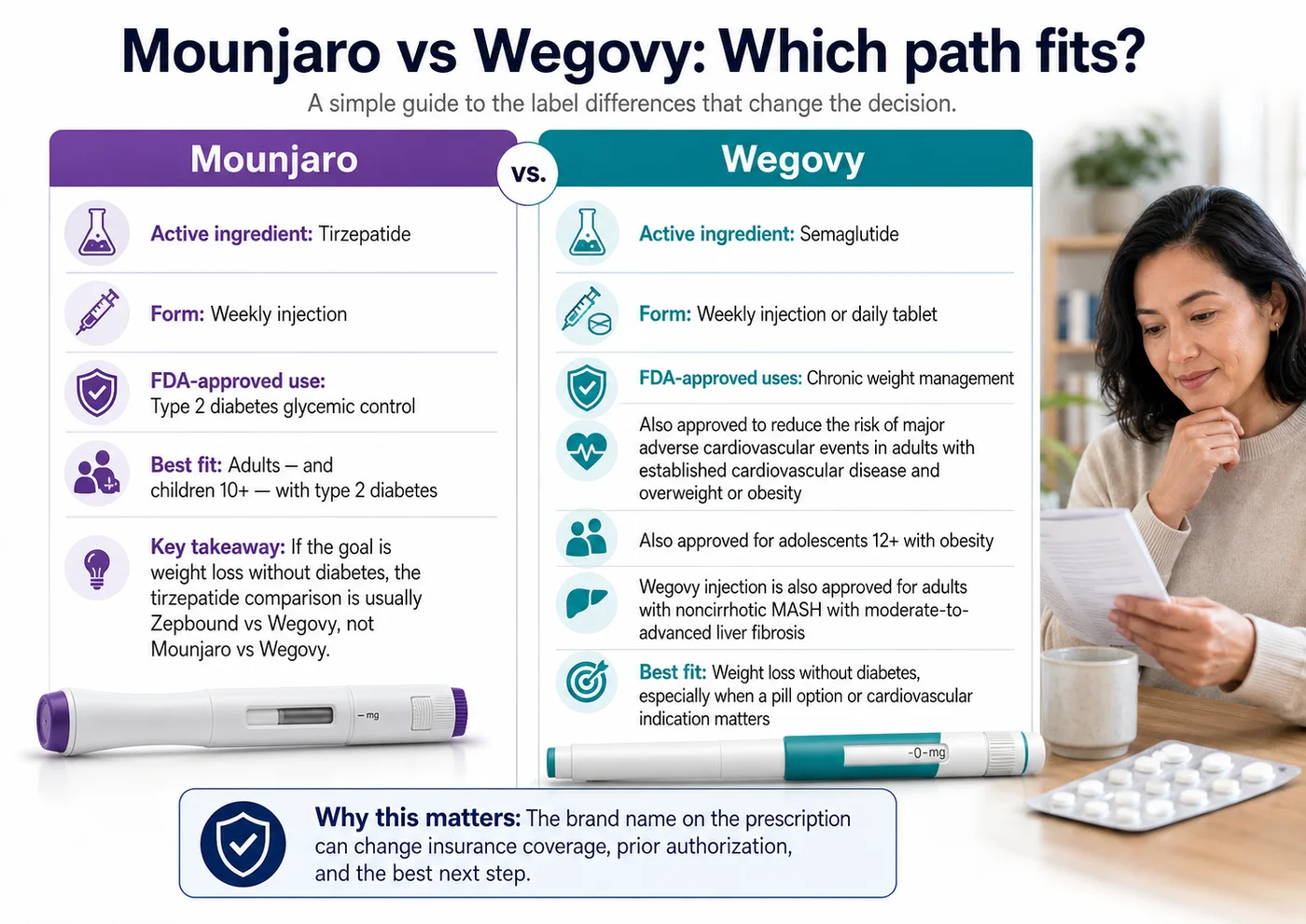
Mounjaro and Wegovy are both highly effective GLP-1 medications, but they’re not really competing for the same patient. Wegovy (semaglutide) is FDA-approved for chronic weight management; for reducing the risk of major adverse cardiovascular events in adults with established CVD and obesity or overweight; and — injection only — for noncirrhotic MASH with moderate-to-advanced liver fibrosis (accelerated approval). Mounjaro (tirzepatide) is FDA-approved for type 2 diabetes only.
In the SURMOUNT-5 head-to-head trial in adults with obesity (no diabetes), tirzepatide produced about 20.2% mean weight loss at 72 weeks vs 13.7% on Wegovy 2.4 mg. The newer Wegovy HD (7.2 mg) reached about 20.7% in the separate STEP UP trial — not a head-to-head, but meaningful context.
The RX Index is a pricing intelligence and comparison resource for GLP-1 telehealth providers. The RX Index may earn a commission if you use some provider links on this page. Our recommendations are based on FDA labeling, verified pricing, access, and reader fit.
Don’t pay cash before you check coverage. Ro prescribes Wegovy (pill and pen) and Zepbound at NovoCare and LillyDirect cash-pay prices, and their insurance concierge handles your prior-authorization paperwork at no extra cost. Ro Body membership is $39 for the first month, then as low as $74/month with annual prepay — GLP-1 medication cost is charged separately.
Check your GLP-1 coverage on Ro — free, ~5 minutes → (sponsored affiliate link, opens in a new tab)Quick verdict — the 30-second answer
| If this is your situation | The right path to check first | Why |
|---|---|---|
| You have type 2 diabetes | Mounjaro | It's FDA-approved for blood sugar control. Coverage is more plausible for FDA-approved diabetes use, but plans can still require prior authorization. |
| You want weight loss and don't have diabetes | Wegovy or Zepbound | These two are FDA-approved for weight loss. Mounjaro is not. |
| You heard tirzepatide gets bigger weight loss results | Zepbound vs Wegovy | Zepbound is the FDA-approved tirzepatide for weight loss, not Mounjaro. |
| You have heart disease + obesity | Wegovy | Only Wegovy is FDA-approved to reduce the risk of major adverse cardiovascular events in this group. |
| You want the lowest cash price for an FDA-approved option | Wegovy pill | $149/month for the 1.5 mg and 4 mg tablet doses through NovoCare in early 2026. |
Mounjaro vs Wegovy at a glance: the 2026 comparison that actually matters
Answer capsule
Mounjaro is FDA-approved for type 2 diabetes only. Wegovy is FDA-approved for chronic weight management, for reducing the risk of major adverse cardiovascular events in adults with established cardiovascular disease and obesity or overweight, and (injection only, accelerated approval) for noncirrhotic MASH with moderate-to-advanced liver fibrosis in adults. Tirzepatide produced more weight loss than semaglutide in the SURMOUNT-5 head-to-head trial (20.2% vs 13.7% over 72 weeks), but the new Wegovy HD 7.2 mg dose narrows that gap in a separate (non-head-to-head) trial.
We built this table by pulling the FDA prescribing information for both drugs from DailyMed, the SURMOUNT-5 trial data published in The New England Journal of Medicine, and current cash-pay pricing from NovoCare, LillyDirect, and the major telehealth platforms. We checked it the day this page was published. The next sections explain every row in plain English.
The Verified 2026 Mounjaro vs Wegovy Decision Matrix
| What you want to know | Mounjaro (tirzepatide) | Wegovy (semaglutide) |
|---|---|---|
| Active ingredient | Tirzepatide | Semaglutide |
| How it works | Mimics two gut hormones (GIP + GLP-1) | Mimics one gut hormone (GLP-1) |
| FDA-approved use | Type 2 diabetes (improve glycemic control) | Chronic weight management; reduce risk of major adverse cardiovascular events in adults with established CVD + obesity/overweight; injection only — noncirrhotic MASH with moderate-to-advanced liver fibrosis (accelerated approval) |
| Approved for kids? | Type 2 diabetes, ages 10+ | Obesity, ages 12+ |
| Form | Weekly injection only | Weekly injection (pen) or daily oral tablet |
| Highest labeled adult doses | 15 mg weekly (10 mg max for pediatric patients 10+) | Wegovy injection up to 7.2 mg weekly (Wegovy HD) for adults who tolerate 2.4 mg and need additional reduction; Wegovy tablet maintenance dose 25 mg daily |
| Average weight loss in head-to-head trial (SURMOUNT-5, 72 weeks) | 20.2% (about 50.3 lbs) | 13.7% on 2.4 mg dose (about 33.1 lbs); see below for Wegovy HD context |
| List price (without insurance) | $1,112.16 per 28-day fill (Lilly) | About $1,349/month (Novo Nordisk) |
| Lowest cash-pay route | No manufacturer cash-pay program currently — usually ~$1,000+/month, or as low as $25/month with commercial insurance and savings card if covered for FDA-approved use | Wegovy pill from $149/month (1.5 mg or 4 mg) or $349/month standard injection through NovoCare |
| Insurance coverage for weight loss | Rarely covered (off-label use) | Sometimes covered (FDA-approved use) |
| Trial discontinuation due to GI side effects (SURMOUNT-5) | 2.7% | 5.6% |
| Black Box Warning | Thyroid C-cell tumors (based on rat studies) | Thyroid C-cell tumors (based on rat studies) |
Sources: FDA prescribing information (Mounjaro, Wegovy injection, Wegovy tablet) via DailyMed; SURMOUNT-5 trial, NEJM, May 2025; STEP UP trial; NovoCare.com; LillyDirect.com; Lilly pricing info pages. Verified May 2, 2026.
Is Mounjaro FDA-approved for weight loss?
Answer capsule
No. Mounjaro is FDA-approved for type 2 diabetes glycemic control in adults and children 10 years and older. Tirzepatide is FDA-approved for chronic weight management under the Zepbound brand name, which is why most non-diabetic weight-loss searchers should be comparing Zepbound vs Wegovy rather than Mounjaro vs Wegovy.
This is the question that decides what you should actually ask your doctor for. Mounjaro and Zepbound contain the same active ingredient (tirzepatide) at the same doses, made by the same company (Eli Lilly). The only meaningful difference is the FDA label.
- Mounjaro: approved for type 2 diabetes
- Zepbound: approved for chronic weight management and obstructive sleep apnea in adults with obesity
If you ask a clinician for Mounjaro and you don’t have diabetes, two things tend to happen. Some clinicians will write the prescription off-label. Others won’t, because they know your insurance will deny it. Either way, you’ve created an avoidable problem. Asking for Zepbound puts the right brand name on the right label — and that’s often the difference between a $25 copay and a $1,000+ retail bill.
Why “Mounjaro vs Wegovy” is the wrong question for most weight-loss searchers
Answer capsule
Most people searching “Mounjaro vs Wegovy” want to know which one will help them lose more weight. But Mounjaro is not FDA-approved for weight loss — it’s approved for type 2 diabetes. The medication that compares head-to-head with Wegovy for weight loss is Zepbound, which contains the same active ingredient as Mounjaro but has the FDA approval Mounjaro doesn’t.
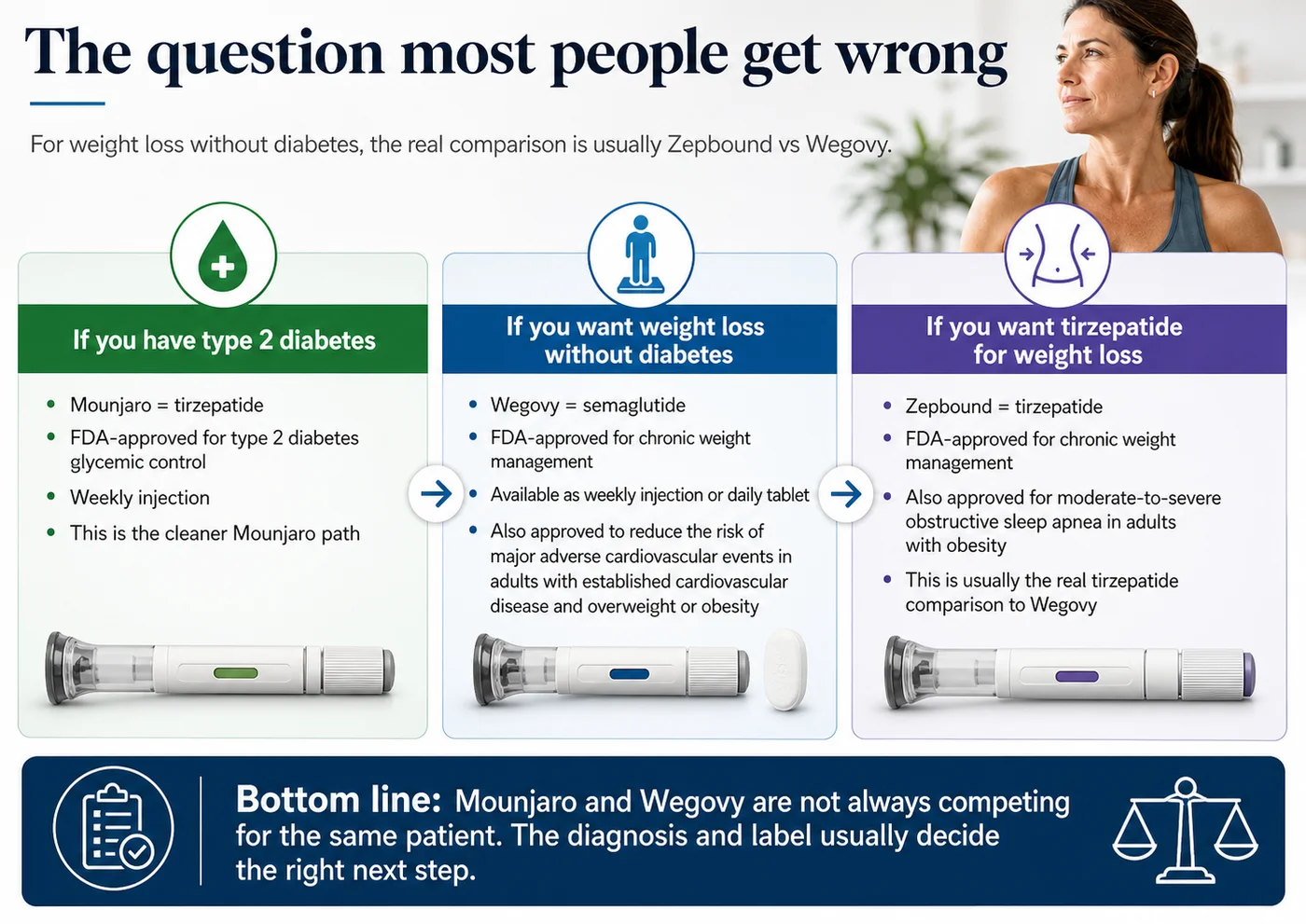
Here’s the trust-first thing we’ll say up front: the search term most people are typing is slightly off, and the top-ranking pages mostly don’t tell you that.
It’s not your fault. Mounjaro has the bigger brand name. It got famous first. The headlines you saw (“tirzepatide beats semaglutide for weight loss”) came from a study that technically tested Zepbound vs Wegovy — but the news called it “Mounjaro vs Wegovy” because more people recognize Mounjaro. So the wrong name stuck.
Here’s what’s actually going on:
- Tirzepatide is the chemical name. Eli Lilly sells it under two brand names: Mounjaro (for diabetes) and Zepbound (for weight loss).
- Semaglutide is the chemical name. Novo Nordisk sells it under two brand names: Ozempic (for diabetes) and Wegovy (for weight loss).
Same molecule, different brand name, different label. The label is what insurance pays attention to. If you ask for Mounjaro for weight loss without diabetes, your insurance almost certainly says no — because that’s “off-label” use. If you ask for Zepbound for weight loss, you have a real shot at coverage because that’s exactly what it’s approved for.
That’s why this matters: getting the right brand name on your prescription is often the difference between paying $25 a month and paying $1,000+ a month.
We’ll keep using “Mounjaro vs Wegovy” through the rest of this guide because that’s how the question gets asked. But every time you see “Mounjaro” in a weight-loss context, mentally swap in “Zepbound” — that’s the version with the right label. We have a separate page on Zepbound vs Wegovy if that’s the comparison you actually need.
Quick gut check: do you have type 2 diabetes?
- Yes → Mounjaro really might be your answer. Keep reading.
- No, I want weight loss → The medications you’re choosing between are Wegovy and Zepbound. We cover both below.
SURMOUNT-5: what the head-to-head trial actually showed
Answer capsule
SURMOUNT-5 was the first direct head-to-head trial comparing tirzepatide and semaglutide for weight loss, published in The New England Journal of Medicine in May 2025. Over 72 weeks, 751 adults with obesity but no diabetes lost an average of 20.2% of their body weight on tirzepatide versus 13.7% on the older 2.4 mg dose of semaglutide. SURMOUNT-5 used Wegovy’s older 2.4 mg dose and is not directly comparable to results from the separate STEP UP trial that evaluated Wegovy’s newer 7.2 mg HD dose.
Let’s actually look at the numbers, because this is where most articles either oversimplify or get it wrong.
What SURMOUNT-5 found
The trial randomly assigned 751 adults with obesity (and at least one weight-related condition like high blood pressure or sleep apnea) to either tirzepatide or semaglutide for 72 weeks. Nobody had type 2 diabetes. Patients took the maximum dose they could tolerate.
After 72 weeks:
- Tirzepatide group: average weight loss of 20.2% — about 50.3 pounds for a 250-pound person.
- Semaglutide group: average weight loss of 13.7% — about 33.1 pounds for a 250-pound person.
- Tirzepatide produced 47% more relative weight loss than semaglutide over the same time period.
- Almost 1 in 3 (31.6%) of the tirzepatide group lost 25% or more of their body weight, vs 16.1% of the semaglutide group.
People on semaglutide were about twice as likely to drop out of the trial because of GI side effects — 5.6% vs 2.7% for tirzepatide.
Source: Aronne et al., “Tirzepatide vs Semaglutide for Treatment of Obesity,” New England Journal of Medicine, May 2025.
Two huge caveats
We’re not going to bury these.
Caveat #1: The trial was funded and designed by Eli Lilly, the company that makes tirzepatide. It was peer-reviewed and published in a top journal, so the results are real. But Lilly chose the design — and the design tested Wegovy at 2.4 mg, the highest dose available when the trial started.
Caveat #2: The trial was open-label, meaning patients and doctors knew which drug they were getting. Open-label trials are common, but they can shift expectations and behavior in ways that affect outcomes.
Wegovy HD changes the picture — but doesn’t erase SURMOUNT-5
In March 2026, the FDA approved a higher 7.2 mg dose of Wegovy (called Wegovy HD) based on the separate STEP UP trial. The approval is for adults who have tolerated 2.4 mg for at least 4 weeks and need additional weight reduction.
- Wegovy HD (7.2 mg) in STEP UP: average weight loss of 20.7% at 72 weeks (treatment-policy estimand, Novo Nordisk publication).
- Wegovy 2.4 mg in STEP UP: about 17%.
That STEP UP result is much closer to what tirzepatide produced in SURMOUNT-5. But here’s the honest read: SURMOUNT-5 and STEP UP are different trials with different populations and different statistical methods. You can’t compare them like a head-to-head. Wegovy HD wasn’t tested against tirzepatide in any trial. So saying “Wegovy HD now equals tirzepatide” overstates what the data supports. Saying “Wegovy HD substantially closes the gap on the older comparison” is fair.
Cross-trial guardrail: what you can and can’t conclude
| Comparison | Trial | Same trial as the other arm? | What you can say | What you can’t say |
|---|---|---|---|---|
| Tirzepatide vs Wegovy 2.4 mg, 72 weeks | SURMOUNT-5 | Yes — head-to-head | Tirzepatide produced more weight loss than Wegovy 2.4 mg | Tirzepatide is "always" better |
| Wegovy HD 7.2 mg vs Wegovy 2.4 mg, 72 weeks | STEP UP | Yes — head-to-head within Wegovy doses | Wegovy HD produced more weight loss than Wegovy 2.4 mg | Wegovy HD beats tirzepatide |
| Wegovy HD vs tirzepatide | No direct trial | Cross-trial only | The numbers look similar at the top dose | "Equivalent" — they weren't tested together |
What real-world data shows
Trial data tells you what happens when patients are carefully selected and supported. Real-world data tells you what happens out in the wild.
A 2024 JAMA Internal Medicine cohort identified 41,222 adults and analyzed 18,386 propensity-score-matched patients initiating tirzepatide or semaglutide for type 2 diabetes. Patients on tirzepatide were more likely to hit 5%, 10%, and 15% weight-loss milestones than those on semaglutide. Discontinuation was common in both groups, and rates of GI side effects were similar.
Translation: in real life, both drugs work better than diet and exercise alone, both can be hard to stay on, and tirzepatide tends to produce somewhat better numbers when patients stick with it.
If maximum weight loss is your priority, ask your clinician about Zepbound (not Mounjaro). It’s the FDA-approved tirzepatide for weight loss. If cash pay is your route, vials and KwikPen start at $299/month through LillyDirect.
See if Zepbound is covered for you on Ro → (sponsored affiliate link, opens in a new tab)Mounjaro vs Wegovy for type 2 diabetes
Answer capsule
For type 2 diabetes, Mounjaro is the directly relevant medication — it’s FDA-approved to improve glycemic control in adults and children 10+ with type 2 diabetes. Wegovy is not FDA-approved for diabetes. If you have diabetes and weight is also a concern, Mounjaro often does both jobs in one prescription, and insurance is more likely to cover it.
If you’re searching this comparison because of diabetes (not weight loss), the answer flips.
Mounjaro is built for blood sugar. The trials behind it (the SURPASS program) showed it lowered A1C more than the diabetes-labeled version of semaglutide (Ozempic) at every dose tested. It’s also FDA-approved for kids 10 and older with type 2 diabetes — Wegovy is not.
If your doctor is choosing a GLP-1 to manage your diabetes:
- Mounjaro is one of the strongest options on the market for both glucose control and weight reduction.
- Wegovy is not the right comparison drug — the diabetes version of semaglutide is Ozempic. We have a separate guide on Mounjaro vs Ozempic if that’s the real question.
A note on hypoglycemia
Mounjaro alone rarely causes low blood sugar. But if you’re already on insulin or a medication called a sulfonylurea (like glipizide or glimepiride), adding Mounjaro can drive your blood sugar too low. The label specifically warns about this. Your doctor will likely lower your insulin dose when you start.
If you have diabetes, don’t make this decision based on a comparison article — including this one. Bring it to whoever manages your diabetes. The question to ask: “Given my A1C, weight, and other meds, is Mounjaro the right next step?”
How Mounjaro and Wegovy actually work
Answer capsule
Both medications mimic gut hormones that tell your brain you’re full and slow how fast your stomach empties. Wegovy (semaglutide) targets one hormone receptor (GLP-1). Mounjaro (tirzepatide) targets two (GLP-1 plus GIP), which is the mechanism most researchers credit for its slightly stronger weight-loss results.
Your gut releases hormones after you eat. Some of them tell your brain to stop eating. Others tell your pancreas to release insulin. GLP-1 (glucagon-like peptide-1) is one of those hormones. GIP (glucose-dependent insulinotropic polypeptide) is another.
GLP-1 medications copy what your body already does — but more strongly and for longer.
Wegovy is GLP-1 only
Wegovy mimics GLP-1. That hormone:
- Sends “I’m full” signals to your brain
- Slows how fast food leaves your stomach (so you stay full longer)
- Helps your pancreas release insulin when blood sugar rises
- Reduces “food noise” — the mental chatter about what to eat next
Mounjaro is GLP-1 + GIP (dual action)
Mounjaro mimics both GLP-1 and GIP. The GIP piece adds a second mechanism: it helps your body process insulin and may improve how fat tissue works. Most researchers think this is why tirzepatide tends to produce somewhat bigger weight-loss numbers in trials.
The honest summary: dual action sounds better on paper, and the trial data supports that. But mechanism doesn’t tell the whole story. Some people lose more weight on semaglutide than on tirzepatide. Some people tolerate one and not the other. The “stronger drug” isn’t always the right drug for you.
What you’ll actually pay in 2026: Mounjaro vs Wegovy real prices
Answer capsule
Without insurance, Wegovy is dramatically cheaper than Mounjaro in 2026. The Wegovy pill starts at $149/month for the 1.5 mg and 4 mg doses through NovoCare. The Wegovy injection is $349/month standard ($199/month introductory price for the two lowest doses, available through December 31, 2026). Wegovy HD 7.2 mg is $399/month. Mounjaro has no equivalent manufacturer cash-pay program — patients without coverage typically pay close to its $1,112.16 list price, though it can drop to as low as $25/month with commercial insurance and a savings card when covered for an FDA-approved use.
This is the section that surprises most readers. The cash-pay world for these drugs changed completely in late 2025 and early 2026.
Wegovy: the cheapest FDA-approved branded path right now
Novo Nordisk runs a direct-to-patient program called NovoCare Pharmacy. Through it (verified May 2, 2026):
- Wegovy pill 1.5 mg and 4 mg: $149/month — the 4 mg offer is listed through August 31, 2026, then $199/month
- Wegovy pill 9 mg and 25 mg: $299/month
- Wegovy injection 0.25 mg or 0.5 mg (intro for new patients): $199/month for the first two monthly fills, available through December 31, 2026
- Wegovy injection 0.25 mg, 0.5 mg, 1 mg, 1.7 mg, 2.4 mg: $349/month standard
- Wegovy HD 7.2 mg: $399/month
- Wegovy list price (full retail at a pharmacy): about $1,349/month
Source: NovoCare.com, verified May 2, 2026.
Mounjaro: no manufacturer cash-pay equivalent yet
Eli Lilly currently does not offer a NovoCare-style direct cash-pay program for Mounjaro. Lilly does run one for Zepbound (the weight-loss version of tirzepatide), but Mounjaro is still in the older pricing world.
What that looks like (verified May 2, 2026):
- Mounjaro list price: $1,112.16 per 28-day fill, before insurance, pharmacy charges, discounts, or savings-card eligibility
- Mounjaro with commercial insurance + Lilly Mounjaro Savings Card: as low as $25/month, but only with a prescription for an approved use consistent with FDA-approved labeling (i.e., type 2 diabetes)
- Mounjaro with commercial drug insurance that doesn’t cover Mounjaro + savings card: as low as $499 for a 1-month fill, again only with a prescription for an approved use consistent with FDA-approved labeling
- Mounjaro without commercial insurance: typically close to list price at retail pharmacies; the savings card does not work
Source: startlilly.com/mounjaro and pricinginfo.lilly.com, verified May 2, 2026.
Zepbound (the weight-loss version of tirzepatide) cash prices
If your real question is “I want tirzepatide and I can’t get insurance to cover Mounjaro,” Zepbound is your move. Eli Lilly sells Zepbound through a program called LillyDirect, and Ro carries Zepbound KwikPen at matching cash-pay prices:
- 2.5 mg starter dose: $299/month
- 5 mg dose: $399/month
- Zepbound KwikPen 7.5 mg, 10 mg, 12.5 mg, 15 mg: $449/month for eligible refills completed within 45 days
- Zepbound single-dose vials are available separately through LillyDirect with their own pricing terms
Source: LillyDirect.com and Ro Zepbound KwikPen announcement, verified May 2, 2026.
The $25 coupon trap (read this before you call your pharmacy)
The “Mounjaro for $25” headline you’ve probably seen comes with strings most articles don’t explain.
That $25 price applies only if all three of these are true:
- You have commercial drug insurance (not Medicare, Medicaid, TRICARE, or VA)
- Your insurance plan covers Mounjaro on its formulary
- Your prescription is for an FDA-approved use consistent with the Mounjaro label (type 2 diabetes — not weight loss)
If your commercial insurance doesn’t cover Mounjaro, the savings card may drop the price to as low as $499/month — but the same FDA-approved-use rule still applies. If you have Medicare or Medicaid, the savings card doesn’t work for you at all under federal anti-kickback rules. We have a full guide on Medicare GLP-1 coverage for that situation.
Provider-Stated vs Verified pricing (transparency table)
This is what we actually checked.
| Medication / route | Provider-stated price | What we verified | Date verified | Key restriction |
|---|---|---|---|---|
| Mounjaro list price | $1,112.16 / 28-day fill | Lilly pricing info page | May 2, 2026 | Before insurance, discounts, or savings |
| Mounjaro savings card ($25) | As low as $25/month | startlilly.com/mounjaro | May 2, 2026 | Commercial insurance + FDA-approved use; gov insurance excluded |
| Mounjaro savings card (uncovered) | As low as $499/month | startlilly.com/mounjaro | May 2, 2026 | Commercial insurance that doesn't cover Mounjaro + FDA-approved use |
| Wegovy list price | ~$1,349/month | wegovy.com | May 2, 2026 | Full retail before insurance |
| Wegovy injection 0.25/0.5 mg intro | $199/month, 2 fills | NovoCare.com | May 2, 2026 | Through December 31, 2026; new self-pay patients |
| Wegovy injection 0.25–2.4 mg standard | $349/month | NovoCare.com | May 2, 2026 | Self-pay through NovoCare |
| Wegovy HD 7.2 mg | $399/month | NovoCare.com | May 2, 2026 | Adults who tolerated 2.4 mg ≥4 weeks |
| Wegovy pill 1.5 mg and 4 mg | $149/month | NovoCare.com | May 2, 2026 | 4 mg listed through Aug 31, 2026 |
| Wegovy pill 9 mg and 25 mg | $299/month | NovoCare.com | May 2, 2026 | Self-pay through NovoCare |
| Zepbound KwikPen 2.5 mg | $299/month | LillyDirect / Ro | May 2, 2026 | Self-pay; refill timing rules |
| Zepbound KwikPen 5 mg | $399/month | LillyDirect / Ro | May 2, 2026 | Self-pay |
| Zepbound KwikPen 7.5–15 mg | $449/month | LillyDirect / Ro | May 2, 2026 | Refill within 45 days |
| Ro Body membership | $39 first month, $149/mo, $74/mo annual prepay | ro.co/weight-loss/pricing | May 2, 2026 | Medication cost charged separately |
| Sesame Care weight-loss program | Care from $59/month with annual subscription | sesamecare.com | May 2, 2026 | Medication cash-pay charged separately |
Want to know your actual price before committing? Ro’s free GLP-1 Insurance Coverage Checker verifies your benefits in minutes and shows you whether you’ll pay your copay or the cash price — for whichever medication fits you. They match the NovoCare and LillyDirect cash-pay prices if you don’t have coverage. Ro Body membership is $39 the first month, then as low as $74/month with annual prepay; medication is charged separately.
Check your coverage on Ro (free) → (sponsored affiliate link, opens in a new tab)Will my insurance cover Mounjaro or Wegovy?
Answer capsule
Wegovy is more likely to be covered than Mounjaro for weight loss because Wegovy is FDA-approved for that use. Mounjaro is covered by most commercial plans for type 2 diabetes (often with prior authorization), but rarely for weight loss because that’s off-label. Coverage rules also vary depending on whether you have heart disease (Wegovy has an FDA-approved cardiovascular indication), liver disease (Wegovy injection is approved for noncirrhotic MASH with moderate-to-advanced fibrosis), or other conditions.
Insurance coverage is where this comparison gets either really easy or really painful. The simple rule:
Insurance pays for medications used the way the FDA approved them. Off-label use is a fight.
The typical coverage picture
| Your situation | Mounjaro coverage odds | Wegovy coverage odds |
|---|---|---|
| Type 2 diabetes, commercial insurance | High — usually covered with prior authorization | Low — Wegovy isn't FDA-approved for diabetes |
| Obesity, no diabetes, commercial insurance | Low — off-label for weight loss | Medium — depends on your specific plan; many cover Wegovy for weight loss with prior auth |
| Established cardiovascular disease + obesity/overweight | Low | Medium-high — Wegovy is FDA-approved to reduce risk of major adverse cardiovascular events in this group |
| Noncirrhotic MASH with moderate-to-advanced fibrosis + obesity | Low — not FDA-approved for MASH | Medium — Wegovy injection received accelerated approval for this MASH indication in August 2025 |
| Medicare or Medicaid (most plans) | Low for weight loss; possible for diabetes (Part D) | The Medicare GLP-1 Bridge runs July 1, 2026 – December 31, 2027 for eligible beneficiaries (see below) |
What is “prior authorization” and how do you survive it?
Prior authorization (PA) is when your insurance plan says: “Before we’ll cover this drug, we want your doctor to prove you actually need it.”
A typical PA for Wegovy might require:
- A documented BMI of 30+ (or 27+ with a related condition)
- Notes that you’ve tried diet and exercise without success
- Lab work
- Sometimes documentation that you’ve tried other medications first (“step therapy”)
The paperwork is the worst part. Many prescribing doctors hate it. Some won’t fight a denial because their day is already full.
This is where telehealth platforms with insurance concierges shine. Ro has a dedicated team that handles your prior authorization paperwork at no extra cost — you don’t fill out any forms, you don’t fight your insurance, you don’t even pick up a phone. Ro says its insurance concierge works with insurers to determine GLP-1 coverage and shows you a coverage report including prior-authorization details before you commit.
Federal employees and unique plans
If you have Federal Employee Health Benefits (FEHB), Ro can still help coordinate coverage. If you have a high-deductible plan with HSA/FSA, both Mounjaro and Wegovy are eligible expenses (which gives you about a 20–30% effective savings depending on your tax bracket).
Medicare GLP-1 Bridge: what’s actually covered
The Medicare GLP-1 Bridge is a CMS demonstration program scheduled to run from July 1, 2026, through December 31, 2027. CMS currently lists these as eligible Bridge drugs when used to reduce excess body weight and maintain weight reduction:
- Foundayo
- Wegovy injection
- Wegovy tablets
- Zepbound KwikPen (the single-dose vial and single-dose pen are not included)
Mounjaro is not on the Bridge list because the program is for weight-loss use, and Mounjaro is FDA-approved for diabetes.
Eligible Medicare Part D beneficiaries who meet CMS prior-authorization criteria may pay a $50 copay for Bridge drugs. The $50 copay is not automatic for every Medicare beneficiary. We have a full Medicare GLP-1 Bridge guide with the eligibility checklist.
Mounjaro vs Wegovy side effects: what changes most
Answer capsule
Both Mounjaro and Wegovy share the same family of side effects — nausea, diarrhea, constipation, vomiting, and reduced appetite — because both work in the gut. In the SURMOUNT-5 head-to-head trial, side effects severe enough to make patients quit treatment were about twice as common with semaglutide (5.6%) than tirzepatide (2.7%). Both drugs carry a black box warning for thyroid C-cell tumors and shouldn’t be used by people with a personal or family history of medullary thyroid carcinoma or MEN 2.
Both drugs work by slowing your stomach down and changing your appetite signals. That means the side-effect profile is mostly about your digestive system.
Common side effects (both medications)
Most patients experience at least some of these, especially during the first 12 weeks while titrating up:
- Nausea (most common)
- Diarrhea
- Vomiting
- Constipation
- Stomach pain or discomfort
- Reduced appetite (which is, weirdly, the goal — but it can feel uncomfortable)
- Heartburn / acid reflux
- Burping
- Tiredness or fatigue
Most of these fade or become manageable after about 8–12 weeks. The strongest predictor of staying on the medication: starting at the lowest dose and titrating up slowly. Doctors who push patients up too fast lose more patients to side effects.
Where the two drugs differ on side effects
In the SURMOUNT-5 head-to-head trial, GI side effects severe enough to make patients drop out were about twice as common with semaglutide as with tirzepatide — 5.6% vs 2.7%. That’s not nothing. If you’ve had a hard time tolerating semaglutide in the past, tirzepatide may sit better with you.
That said, individual responses vary a lot. We’ve seen patients who couldn’t tolerate one and did fine on the other in either direction.
Serious warnings (both drugs)
Both Mounjaro and Wegovy carry a boxed warning — the FDA’s strongest — about thyroid C-cell tumors. The warning comes from rat studies. We don’t have evidence this happens in humans, but as a precaution, neither drug should be used by anyone with:
- A personal or family history of medullary thyroid carcinoma (MTC)
- Multiple Endocrine Neoplasia syndrome type 2 (MEN 2)
Other serious risks listed on both labels:
- Pancreatitis (inflammation of the pancreas — severe stomach pain that won’t go away)
- Gallbladder disease (more common with rapid weight loss)
- Severe GI reactions
- Acute kidney injury (usually from dehydration caused by vomiting/diarrhea)
- Diabetic retinopathy complications (specific to people who already have it)
- Hypersensitivity reactions
Side effect specific to Mounjaro: oral birth control
Mounjaro can make oral birth control less effective. This is in the label and most articles miss it. Because Mounjaro slows stomach emptying, it can change how your body absorbs oral hormonal contraceptives. The FDA label specifically advises:
Switch to a non-oral birth control method, or add a barrier method (like condoms) for 4 weeks after starting Mounjaro and for 4 weeks after every dose increase.
If you’re on the pill and considering Mounjaro, talk to your doctor about an IUD, implant, or shot before you start. This is genuinely important.
Side effects specific to Wegovy
Wegovy and pregnancy. The FDA label says Wegovy may cause fetal harm and should be discontinued when pregnancy is recognized. Because semaglutide stays in your body for weeks, the label recommends discontinuing at least 2 months before a planned pregnancy.
Vision concern (NAION). In June 2025, the European Medicines Agency’s PRAC committee concluded that non-arteritic anterior ischemic optic neuropathy (NAION) is a “very rare” side effect of semaglutide medicines, including Wegovy, Ozempic, and Rybelsus, recommending the product information be updated. WHO summarized the conclusion as potentially affecting up to 1 in 10,000 users. If you experience sudden vision changes on Wegovy, contact your doctor right away.
We cover all of this and more in our GLP-1 safety guide.
Dosing schedules: Mounjaro vs Wegovy week by week
Answer capsule
Both Mounjaro and Wegovy start at low doses and increase every 4 weeks to manage side effects. Wegovy injection has 5 standard dose levels (0.25 mg → 0.5 mg → 1 mg → 1.7 mg → 2.4 mg) plus the new high-dose 7.2 mg option approved in March 2026. Mounjaro has 6 dose levels (2.5 mg → 5 mg → 7.5 mg → 10 mg → 12.5 mg → 15 mg). Mounjaro’s adult maximum is 15 mg weekly; for pediatric patients aged 10+ with type 2 diabetes, the maximum is 10 mg weekly.
Both medications follow the same playbook: start low, go slow, increase monthly. Your stomach needs time to adjust. Skipping doses or jumping levels too fast is the #1 cause of nausea so bad people quit.
Mounjaro titration schedule
| Phase | Dose | Duration |
|---|---|---|
| Starter | 2.5 mg weekly | 4 weeks |
| Step 1 | 5 mg weekly | 4 weeks (this is the first "maintenance" option) |
| Step 2 | 7.5 mg weekly | 4 weeks |
| Step 3 | 10 mg weekly | Can be a maintenance dose; pediatric (10+) maximum |
| Step 4 | 12.5 mg weekly | 4 weeks |
| Step 5 | 15 mg weekly | Adult maximum |
A clinician can stop you at any maintenance dose (5, 10, or 15 mg) if you’re hitting your goals or side effects flare. You don’t have to escalate to 15 mg.
Wegovy injection titration schedule
| Phase | Dose | Duration |
|---|---|---|
| Starter | 0.25 mg weekly | 4 weeks |
| Step 1 | 0.5 mg weekly | 4 weeks |
| Step 2 | 1 mg weekly | 4 weeks |
| Step 3 | 1.7 mg weekly | 4 weeks |
| Maintenance | 2.4 mg weekly | Long-term |
| Wegovy HD (optional, approved March 2026) | 7.2 mg weekly | After 4+ weeks at 2.4 mg, for adults needing more weight reduction |
The Wegovy pill (oral semaglutide for weight loss) has a different schedule because it’s daily, not weekly, and titrates 1.5 mg → 4 mg → 9 mg → 25 mg. We cover that in our Wegovy pill vs injection guide.
What to expect during dose changes
The first 1–2 weeks after each dose increase tend to be the worst. Nausea picks up. Some people lose more weight that week. Then your body adjusts and you stabilize for the rest of the month.
Tips that help most patients:
- Inject the same day each week
- Eat smaller meals, especially right after dose increases
- Drink more water than feels normal (dehydration makes everything worse)
- Avoid greasy or sugary foods for the first day or two after a dose change
Wegovy pill vs Mounjaro injection: when does the pill win?
Answer capsule
Wegovy is the only FDA-approved GLP-1 in this comparison available as both an injection and a daily pill. The Wegovy pill, approved in December 2025, costs less than the injection ($149–$299/month vs $199–$399/month) and avoids needles. Mounjaro has no oral form. If avoiding injections is your dealbreaker, Wegovy pill is your only FDA-approved option among the two drugs in this comparison.
This is one of the cleanest decisions on this whole page.
If you genuinely cannot or will not inject yourself, you don’t really have a “Mounjaro vs Wegovy” decision at all. You have a “Wegovy pill vs nothing” decision. Mounjaro doesn’t make a pill.
The Wegovy pill, which launched in January 2026 after FDA approval in December 2025, has these advantages over the injection:
- No needles
- Cheaper cash price ($149–$299/month vs $199–$399/month)
- Stores at room temperature (the pen needs refrigeration)
- Easier for travel
And these tradeoffs:
- Strict timing rules. Take it on an empty stomach with no more than 4 ounces of plain water, then wait 30 minutes before eating, drinking, or taking other meds. If you skip the timing window, the pill doesn’t work right.
- Slightly less weight loss in trials at standard maintenance doses
- Daily, not weekly — you have to remember every morning
The pill also doesn’t have the higher 7.2 mg HD option that the injection has.
For most adults who don’t mind a weekly injection, the pen is the stronger overall pick. For people whose needle aversion is keeping them from starting at all, the pill is clearly the better choice — and it’s far better than not starting.
We have a complete breakdown in our Wegovy pill vs injection guide.
Ro prescribes both the Wegovy pill and pen at NovoCare’s cash-pay prices, plus Zepbound KwikPen and Foundayo. Ro Body membership is $39 the first month, then as low as $74/month with annual prepay; medication is charged separately.
Check eligibility for oral GLP-1 options on Ro → (sponsored affiliate link, opens in a new tab)Switching between Mounjaro and Wegovy
Answer capsule
Switching between Mounjaro and Wegovy is possible, but it requires a clinician’s guidance and a washout period before starting the new medication. There’s no simple one-to-one dose conversion because the two drugs have different active ingredients, different titration schedules, and different effects. The most common reasons people switch: insurance coverage changes, plateau on one drug, or moving from off-label Mounjaro to on-label Wegovy or Zepbound to get insurance coverage.
People search “switch from Mounjaro to Wegovy” for a few common reasons. Each has a different right answer.
Reason 1: “My insurance stopped covering Mounjaro”
This is by far the most common scenario. If you’re on Mounjaro for weight loss and your insurance reviews and denies coverage (because it was always off-label), you have three paths:
- Switch to Wegovy if your insurance covers it for weight loss
- Switch to Zepbound if your insurance covers tirzepatide-based weight loss specifically
- Pay cash for whichever fits — Wegovy pill is the cheapest FDA-approved cash-pay option right now
A coverage change is also a moment to ask your doctor whether the original Mounjaro prescription was the right one. If you don’t have diabetes, Zepbound was probably the right brand all along.
Reason 2: “I plateaued on one drug and want to try the other”
This happens. Bodies adapt. If you’ve been at maintenance dose for 6+ months and your weight stalled, your doctor might recommend switching mechanisms — from semaglutide (one hormone) to tirzepatide (two), or vice versa.
There’s no formal “switching protocol” between the two drugs because they’re chemically different. Most clinicians:
- Stop the first medication completely
- Wait at least 1–2 weeks (the washout)
- Start the new medication at its lowest dose
- Titrate up like a brand-new patient
Don’t try to “convert” doses on your own. There’s no clean equivalent — for example, 5 mg of tirzepatide isn’t the same strength as 0.5 mg of semaglutide. Your doctor will pick a starting dose based on side-effect history and goals.
Reason 3: “I want to try the ‘stronger’ drug”
If you’re on Wegovy and you’ve heard tirzepatide produces more weight loss, the conversation to have isn’t about Mounjaro — it’s about Zepbound. Asking for Mounjaro for weight loss puts you back in the off-label coverage problem. Zepbound has the same active ingredient and the right FDA label.
Most rational switches are Wegovy → Zepbound or Mounjaro → Zepbound, not Mounjaro → Wegovy. If insurance is the issue, Ro’s insurance concierge can run a coverage check on all three at once and tell you which one your plan actually pays for.
Run a free coverage check on Ro → (sponsored affiliate link, opens in a new tab)A safety note on combining
Don’t take Mounjaro and Wegovy at the same time. Wegovy’s labeling says concomitant use with other semaglutide-containing products or other GLP-1 receptor agonists is not recommended. Don’t combine GLP-1 medications unless a licensed clinician specifically directs it.
Mounjaro vs Wegovy vs Zepbound vs Ozempic: the full FDA-approved landscape
Answer capsule
There are really only two GLP-1 molecules in this comparison — semaglutide (sold as Wegovy for weight loss and Ozempic for diabetes) and tirzepatide (sold as Zepbound for weight loss and Mounjaro for diabetes). Each manufacturer makes one brand for each indication. The 2026 lineup also includes Foundayo (orforglipron), an FDA-approved daily GLP-1 pill approved April 1, 2026 — and the only oral GLP-1 for weight loss that doesn’t require empty-stomach dosing.
This table sorts out the four most-searched brand names — and the new fifth one.
| Brand | Active ingredient | Maker | FDA-approved use | Form | Where to access |
|---|---|---|---|---|---|
| Mounjaro | Tirzepatide | Eli Lilly | Type 2 diabetes (adults & kids 10+) | Weekly injection | Pharmacy with prescription |
| Zepbound | Tirzepatide | Eli Lilly | Chronic weight management; obstructive sleep apnea with obesity | Weekly injection (KwikPen + vials) | LillyDirect, telehealth, pharmacy |
| Wegovy | Semaglutide | Novo Nordisk | Chronic weight management; reduce risk of major adverse cardiovascular events with established CVD + overweight/obesity; injection only — noncirrhotic MASH with moderate-to-advanced fibrosis | Weekly injection or daily pill | NovoCare, telehealth, pharmacy |
| Ozempic | Semaglutide | Novo Nordisk | Type 2 diabetes; reduce CV events in T2D with CVD; reduce kidney decline in T2D | Weekly injection | Pharmacy with prescription |
| Foundayo | Orforglipron | Eli Lilly | Chronic weight management (FDA-approved April 1, 2026) | Daily pill (no empty-stomach requirement) | LillyDirect, telehealth |
The two simple rules
- For weight loss without diabetes: the FDA-approved options are Wegovy, Zepbound, and Foundayo. Mounjaro and Ozempic are off-label.
- For type 2 diabetes: Mounjaro and Ozempic are FDA-approved. Wegovy and Zepbound aren’t approved for diabetes (though Wegovy can be prescribed for cardiovascular risk and for the labeled MASH indication if those apply).
If your doctor is prescribing for two conditions at once (diabetes + obesity, or obesity + heart disease, or obesity + MASH), the picture gets more nuanced. That’s a conversation, not a comparison-article answer.
Who should choose Wegovy?
Answer capsule
Wegovy is the better path for adults with obesity who want an FDA-approved weight-loss medication, especially those with established cardiovascular disease, with noncirrhotic MASH and moderate-to-advanced liver fibrosis, with an adolescent (12+) in the family, or anyone who wants the lowest cash-pay FDA-approved branded GLP-1 starting price ($149/month for the Wegovy pill 1.5 mg or 4 mg as of May 2026). Wegovy is not the right pick for type 2 diabetes — Mounjaro or Ozempic is.
Wegovy makes sense as your first call when:
- You want weight loss and don’t have diabetes. It’s FDA-approved for this; Mounjaro isn’t.
- You have established cardiovascular disease + overweight or obesity. The SELECT trial data supports the FDA-approved indication to reduce risk of major adverse cardiovascular events in this group. No other GLP-1 in this comparison has this label.
- You have noncirrhotic MASH with moderate-to-advanced liver fibrosis. Wegovy injection received FDA accelerated approval for this indication in August 2025. We have a separate guide on the best GLP-1 for fatty liver.
- You’re an adolescent (12+) or have one in the family. Wegovy has a pediatric approval for obesity in this age group; Mounjaro doesn’t.
- You want a pill option. Wegovy is the only GLP-1 in this comparison available as a daily pill.
- You’re paying cash and want a low FDA-approved branded starting price. As of May 2, 2026, Wegovy pill 1.5 mg or 4 mg is $149/month through NovoCare.
Wegovy might NOT be your best fit if:
- You have type 2 diabetes (Mounjaro is the more relevant medication)
- You specifically want tirzepatide for weight loss (Zepbound is the FDA-approved match)
- You can’t tolerate semaglutide’s GI profile (consider switching to tirzepatide via Zepbound)
- You’re planning a pregnancy in the next 2–3 months
Most adults searching “Mounjaro vs Wegovy” for weight loss are actually shopping for Wegovy. Ro prescribes both Wegovy pill and Wegovy pen at the same prices Novo Nordisk charges through NovoCare. If you have insurance, their concierge handles your prior auth at no extra cost. Ro Body membership is $39 the first month, then as low as $74/month with annual prepay; GLP-1 medication is charged separately.
See if you qualify for Wegovy on Ro → (sponsored affiliate link, opens in a new tab)Who should ask about Mounjaro?
Answer capsule
Mounjaro is the right medication to ask about when type 2 diabetes is your primary diagnosis and your clinician is choosing a treatment to improve blood sugar control. It also produces meaningful weight loss as a side benefit. For non-diabetic adults seeking weight loss, Mounjaro is rarely the right access path — Zepbound (same active ingredient, FDA-approved for weight loss) is almost always the cleaner choice.
You’re a Mounjaro candidate if:
- You have type 2 diabetes
- Your doctor is choosing a GLP-1 to improve blood sugar
- Weight loss matters to you but isn’t the primary diagnosis
- Your insurance covers Mounjaro (most commercial plans do for diabetes, often with prior authorization)
- You qualify for the Lilly Mounjaro Savings Card (as low as $25/month with commercial coverage and a prescription for FDA-approved use)
You’re probably not a Mounjaro candidate if:
- You don’t have diabetes and the only reason you wanted Mounjaro is weight loss
- Your insurance won’t cover it (you’ll pay close to list price — $1,112.16 per fill)
- You’re a candidate for the new Medicare GLP-1 Bridge (which favors Wegovy and Zepbound)
If you’re in this second group, the redirect is simple: ask your prescriber about Zepbound if you wanted tirzepatide, or Wegovy if you’re open to either molecule.
Who should compare Zepbound instead?
Answer capsule
If the reason Mounjaro caught your attention was its weight-loss results — but you don’t have type 2 diabetes — Zepbound is almost always the cleaner comparison against Wegovy. Zepbound contains tirzepatide (same active ingredient as Mounjaro) but has FDA approval for chronic weight management and obstructive sleep apnea with obesity. That FDA label changes everything about insurance coverage, prior authorization, and savings card eligibility.
You should be reading “Zepbound vs Wegovy” instead of “Mounjaro vs Wegovy” if:
- You don’t have type 2 diabetes
- You want tirzepatide for weight loss specifically
- The SURMOUNT-5 numbers are why you’re here
- You have moderate-to-severe obstructive sleep apnea + obesity
- Your insurance won’t cover Mounjaro for weight loss but might cover Zepbound
The honest summary: for non-diabetic weight-loss seekers, the SURMOUNT-5 trial that everyone calls “Mounjaro vs Wegovy” is really “Zepbound’s molecule vs Wegovy.” The 20.2% vs 13.7% number applies to tirzepatide vs semaglutide as drugs — and the way you legally and affordably get tirzepatide for weight loss is through Zepbound.
We have a full Zepbound vs Wegovy comparison with the head-to-head data, current pricing, and which one tends to win for which kind of reader.
If you’re comparing these medications specifically for PCOS, use our Mounjaro vs Wegovy for PCOS guide instead — the decision factors are different.
What real searchers say (voice of customer)
Answer capsule
Patient-reported timing on these medications varies, but the clinical results that matter for this comparison are measured over months — Wegovy pill trials reported results at 64 weeks, and SURMOUNT-5 reported tirzepatide vs semaglutide results at 72 weeks. Individual results are not typical for everyone.
Below is real attributable language from public forums showing the most common frustration we see across “Mounjaro vs Wegovy” searches: insurance and coupons that don’t line up with diagnosis. We’re sharing this as voice-of-customer to show what readers are actually wrestling with — not as medical or pricing evidence.
“My insurance doesn’t cover Wegovy so it would cost me over $1,300 a month where Mounjaro would be $25. I don’t have diabetes.”
— Reddit user in r/Mounjaro, describing insurance/coupon confusion. Used here as voice-of-customer language, not medical or pricing evidence. Source: r/Mounjaro thread, “Approved for Wegovy but Mounjaro is affordable.”
That tension — the cheaper drug isn’t the on-label drug, the on-label drug isn’t covered — is the single most common pattern in this category. It’s why this entire page exists. The right answer for that reader is almost never “use the cheaper off-label option.” It’s “check whether Zepbound or Wegovy is actually covered, and use the on-label match.” That’s also why we lean toward routing readers to a free coverage check before they pay cash.
How to decide in 5 minutes: the Mounjaro vs Wegovy path finder
Answer capsule
For most adults, the right next step depends on five things: whether you have type 2 diabetes, whether you have established cardiovascular disease, your insurance situation, whether you’d accept a daily pill or only a weekly injection, and your weight-loss goals. The decision tree below sorts those five factors into a single recommended next action.
Use this as a rough guide. It doesn’t replace your clinician’s judgment.
Question 1: Do you have type 2 diabetes?
- Yes → Talk to your diabetes provider about Mounjaro. This is the right comparison for you.
- No → Continue.
Question 2: Do you have established cardiovascular disease + overweight or obesity?
- Yes → Wegovy is the strongest FDA-approved match. Ask your doctor about the cardiovascular indication for prior authorization. Check Wegovy coverage with Ro → (sponsored affiliate link, opens in a new tab)
- No → Continue.
Question 3: What does your insurance look like?
- Commercial insurance → Run a free coverage check before deciding. The cheapest path is whichever one your plan actually covers. Run a free coverage check on Ro → (sponsored affiliate link, opens in a new tab)
- Medicare or Medicaid → Check the Medicare GLP-1 Bridge Program guide. The Bridge covers Foundayo, Wegovy injection, Wegovy tablets, and Zepbound KwikPen — not Mounjaro.
- No insurance → The Wegovy pill ($149/month for 1.5 mg or 4 mg through NovoCare) is among the cheapest FDA-approved branded options as of May 2026.
Question 4: How do you feel about injections?
- Won’t inject → Wegovy pill or Foundayo (the new daily oral GLP-1). Check eligibility for oral GLP-1 options on Ro → (sponsored affiliate link, opens in a new tab)
- Open to weekly injection → Wegovy pen, Zepbound, or Mounjaro (if you have diabetes) all work.
Question 5: What’s your weight-loss goal?
- 15% or less → Wegovy pen or pill is highly likely to get you there.
- 20% or more → Lean toward tirzepatide-based treatment via Zepbound, or Wegovy HD (7.2 mg) for adults already on 2.4 mg. Check Zepbound coverage on Ro → (sponsored affiliate link, opens in a new tab)
If you’re still stuck after this, that’s exactly what our free 60-second GLP-1 path quiz is built for.
What we actually verified
This is the box every commercial page on this site has — what we checked, where, and when. If something is missing from this list, we couldn’t independently verify it.
| Fact verified | Source | Date verified |
|---|---|---|
| Mounjaro FDA-approved indication (type 2 diabetes, ages 10+) | DailyMed Mounjaro prescribing information | May 2, 2026 |
| Mounjaro pediatric maximum dose (10 mg) | DailyMed Mounjaro label | May 2, 2026 |
| Wegovy FDA-approved indications (chronic weight management; MACE risk reduction; noncirrhotic MASH with moderate-to-advanced fibrosis, accelerated approval, injection only) | DailyMed Wegovy prescribing information | May 2, 2026 |
| Mounjaro list price ($1,112.16 per 28-day fill) | pricinginfo.lilly.com | May 2, 2026 |
| Wegovy list price (~$1,349/mo) | wegovy.com | May 2, 2026 |
| NovoCare Wegovy cash-pay pricing (injection $199 intro / $349 standard / $399 HD; pill $149 / $299) | novocare.com | May 2, 2026 |
| LillyDirect / Ro Zepbound KwikPen cash-pay pricing ($299–$449/mo) | lillydirect.com / ro.co | May 2, 2026 |
| Mounjaro Savings Card terms (commercial insurance + FDA-approved use) | startlilly.com/mounjaro | May 2, 2026 |
| SURMOUNT-5 results (20.2% vs 13.7% weight loss at 72 weeks) | NEJM, Aronne et al., May 2025 | May 2, 2026 |
| STEP UP / Wegovy 7.2 mg results (~20.7% mean weight loss) | Novo Nordisk publication / Lancet Diabetes & Endocrinology | May 2, 2026 |
| SELECT trial CV outcomes (basis for Wegovy MACE indication) | NEJM, Lincoff et al., 2023 | May 2, 2026 |
| ESSENCE trial / Wegovy MASH accelerated approval (Aug 2025) | FDA approval announcement | May 2, 2026 |
| Wegovy pill FDA approval (December 2025) | FDA approval announcement | May 2, 2026 |
| Wegovy HD (7.2 mg) FDA approval (March 2026) | FDA approval announcement | May 2, 2026 |
| Foundayo (orforglipron) FDA approval (April 1, 2026) | FDA press release | May 2, 2026 |
| Ro Body membership pricing ($39 first month, $149/mo, $74/mo annual prepay; medication separate) | ro.co/weight-loss/pricing | May 2, 2026 |
| Sesame Care weight-loss program (care from $59/month with annual subscription) | sesamecare.com/service/online-weight-loss-program | May 2, 2026 |
| JAMA Internal Medicine real-world cohort (41,222 adults; 18,386 propensity-matched) | Rodriguez et al., JAMA Internal Medicine, 2024 | May 2, 2026 |
| Mounjaro oral contraceptive warning | DailyMed Mounjaro label | May 2, 2026 |
| EMA NAION conclusion for semaglutide (June 2025) | EMA PRAC monthly meeting summary | May 2, 2026 |
| Medicare GLP-1 Bridge (July 1, 2026 – December 31, 2027; Foundayo, Wegovy injection/tablets, Zepbound KwikPen) | CMS.gov | May 2, 2026 |
Frequently asked questions
Is Mounjaro better than Wegovy for weight loss?
In the SURMOUNT-5 head-to-head trial, tirzepatide (the active ingredient in Mounjaro) produced more weight loss than semaglutide (the active ingredient in Wegovy) over 72 weeks — 20.2% vs 13.7%. But Mounjaro is not FDA-approved for weight loss, so insurance rarely covers it for that purpose. The medication that actually delivers tirzepatide for FDA-approved weight loss is Zepbound. For non-diabetic adults seeking weight loss, the meaningful comparison is Zepbound vs Wegovy, not Mounjaro vs Wegovy. Wegovy's newer 7.2 mg HD dose, approved in March 2026, also produced about 20.7% mean weight loss in the separate STEP UP trial, though that wasn't a head-to-head against tirzepatide.
Is Mounjaro FDA-approved for weight loss?
No. Mounjaro is FDA-approved for type 2 diabetes glycemic control in adults and children 10 years and older. Tirzepatide is FDA-approved for chronic weight management under the brand name Zepbound — same drug, different label.
Is Wegovy FDA-approved for weight loss?
Yes. Wegovy is FDA-approved for chronic weight management in adults with obesity (BMI 30+) or with overweight (BMI 27+) plus at least one weight-related condition. It's also approved for adolescents 12+ with obesity, for reducing the risk of major adverse cardiovascular events in adults with established cardiovascular disease + overweight/obesity, and (Wegovy injection only, accelerated approval) for noncirrhotic MASH with moderate-to-advanced liver fibrosis in adults.
Why doesn't insurance cover Mounjaro for weight loss?
Most insurance plans only cover medications for their FDA-approved uses. Since Mounjaro is FDA-approved for type 2 diabetes — not weight loss — using it for weight loss is off-label, and most plans either deny those claims or require very specific documentation. If your goal is weight loss, ask your doctor about Wegovy or Zepbound, which are FDA-approved for that exact use.
Which costs more, Mounjaro or Wegovy?
It depends on whether you have insurance. With commercial insurance and a savings card for an FDA-approved use, both can drop to as low as $25/month. Without insurance, Wegovy is much cheaper — the Wegovy pill starts at $149/month for the 1.5 mg and 4 mg doses through NovoCare, the injection is $349/month standard ($199/month introductory price for the lowest doses through December 31, 2026), and Wegovy HD 7.2 mg is $399/month. Mounjaro currently has no manufacturer cash-pay program — it typically runs close to its $1,112.16 list price without coverage.
Can you switch from Mounjaro to Wegovy?
Yes, with a clinician's guidance. There's no simple one-to-one dose conversion because the two drugs have different active ingredients. Most clinicians stop the first medication, wait 1–2 weeks, then start the new one at its lowest dose and titrate up like a new patient. The most common reason to switch: insurance stopped covering Mounjaro for off-label weight loss.
Which has worse side effects, Mounjaro or Wegovy?
Both cause similar GI side effects (nausea, diarrhea, vomiting, constipation), and both carry a black box warning for thyroid C-cell tumors. In the SURMOUNT-5 head-to-head trial, side effects severe enough to make patients quit treatment were about twice as common with semaglutide (5.6%) than tirzepatide (2.7%). Mounjaro also carries a specific warning that it may reduce the effectiveness of oral hormonal contraceptives — patients on the pill should switch to a non-oral method or add a barrier method during dose escalation.
Does Wegovy come as a pill?
Yes. The FDA approved an oral semaglutide tablet for weight loss in December 2025, and it launched in January 2026. NovoCare cash-pay pricing starts at $149/month for the 1.5 mg and 4 mg doses (the 4 mg offer listed through August 31, 2026). Mounjaro does not come as a pill.
Should I ask for Mounjaro or Zepbound if I want tirzepatide for weight loss?
Ask for Zepbound. Both contain the same active ingredient (tirzepatide) at the same doses, but Zepbound is FDA-approved for chronic weight management while Mounjaro is FDA-approved for type 2 diabetes. The label affects insurance coverage and prior authorization. Asking for the right brand name on the prescription can be the difference between paying your copay and paying close to $1,112 a month.
Can you take Mounjaro and Wegovy together?
No. Wegovy's labeling says concomitant use with other semaglutide-containing products or other GLP-1 receptor agonists is not recommended. Don't combine GLP-1 medications unless a licensed clinician specifically directs it.
How quickly will I lose weight on either one?
The clinical results that matter for this comparison are measured over months: the Wegovy pill OASIS-4 trial reported results at 64 weeks, and SURMOUNT-5 reported tirzepatide vs semaglutide results at 72 weeks. Both medications need slow dose escalation over 4–5 months to reach maintenance dose. Patient experiences with timing of early appetite changes vary widely.
Is Mounjaro stronger than Wegovy?
In the head-to-head SURMOUNT-5 trial at the doses tested, yes — tirzepatide produced more weight loss than semaglutide 2.4 mg. The gap looks smaller compared with Wegovy HD (7.2 mg), but those are different trials and not a true head-to-head. Stronger isn't always better for you — it depends on your insurance, your tolerance, your goals, and whether you can stay on the medication long enough to get the full benefit.
What's the difference between Mounjaro and Zepbound?
They contain the same active ingredient (tirzepatide) at the same doses, made by the same company (Eli Lilly). Mounjaro is FDA-approved for type 2 diabetes. Zepbound is FDA-approved for chronic weight management and obstructive sleep apnea with obesity. Different labels, same medicine.
Will the Medicare GLP-1 Bridge Program cover Mounjaro or Wegovy?
The Medicare GLP-1 Bridge runs from July 1, 2026 through December 31, 2027. CMS currently lists Foundayo, Wegovy injection, Wegovy tablets, and Zepbound KwikPen as eligible Bridge drugs when used to reduce excess body weight and maintain weight reduction. Mounjaro is not on the list because the program is for weight-loss use. Eligible Medicare Part D beneficiaries who meet CMS prior-authorization criteria may pay a $50 copay.
Can I get Mounjaro or Wegovy through telehealth?
Yes for both, with a valid prescription from a licensed clinician. Ro lists Wegovy pill, Wegovy pen, Foundayo, Zepbound KwikPen, and Ozempic on its current pricing page, and Ro says its insurance concierge works with insurers to determine GLP-1 coverage. Sesame Care lists branded options including Wegovy pill, Wegovy pen, Zepbound KwikPen, Foundayo, Zepbound vial, and Ozempic on its current weight-loss program page.
Bottom line: the one-question test
Answer capsule
Ask yourself one question — “Do I have type 2 diabetes?” If yes, Mounjaro is the right medication to discuss with your doctor. If no and your goal is weight loss, you’re choosing between Wegovy and Zepbound, not between Mounjaro and Wegovy. The right access path almost always comes down to whichever one your insurance covers, with cash-pay routes through NovoCare, LillyDirect, or telehealth as the fallback.
We’ve covered a lot. Here’s the cleanest way to act on it.
If you have type 2 diabetes: ask your endocrinologist or primary care doctor about Mounjaro. Don’t make this decision from a comparison article.
If you don’t have diabetes and you want weight loss: the right medication is Wegovy or Zepbound — not Mounjaro. The right brand depends on your insurance, your tolerance, your needle preference, and whether you have any of the conditions Wegovy specifically addresses (cardiovascular disease, MASH, adolescent obesity).
If you’re paying cash and want a low FDA-approved branded starting price: Wegovy pill ($149/month for 1.5 mg or 4 mg) is among the cheapest as of May 2, 2026. Wegovy injection ($199 intro, then $349/month) is next. Zepbound KwikPen ($299–$449/month) comes after.
If insurance is the question: check coverage before paying cash. Ro’s free GLP-1 Insurance Coverage Checker takes about 5 minutes and tells you exactly what your plan will and won’t cover for Wegovy, Zepbound, and Ozempic. They’ll also handle prior authorization paperwork at no extra cost if you decide to move forward.
Ready to take the next step?
If your situation lines up with Wegovy (weight loss without diabetes, established cardiovascular disease + obesity, MASH, adolescent obesity, or you want a pill option), the easiest path is Ro. They prescribe both the Wegovy pill and pen at NovoCare’s cash-pay prices, and their insurance concierge fights for coverage including the cardiovascular indication if you have it. Get started for $39 the first month, then as low as $74/month with annual plan paid upfront — GLP-1 medication is charged separately.
Check Wegovy eligibility on Ro → (sponsored affiliate link, opens in a new tab)If your situation calls for tirzepatide (you wanted Mounjaro for weight loss but don’t have diabetes), the FDA-approved match is Zepbound. Ro carries Zepbound KwikPen with cash-pay pricing that starts at $299/month for 2.5 mg, $399/month for 5 mg, and $449/month for eligible 7.5 mg, 10 mg, 12.5 mg, and 15 mg refills completed within 45 days.
Check Zepbound eligibility on Ro → (sponsored affiliate link, opens in a new tab)If you’re paying cash and want another option to compare, Sesame Care lists branded options including Wegovy pill, Wegovy pen, Zepbound KwikPen, Foundayo, Zepbound vial, and Ozempic on its weight-loss program page, with care from $59/month with annual subscription. Sesame also says Costco members can access self-pay Ozempic and Wegovy injection pricing through Costco Pharmacy with an active prescription.
See Sesame’s branded GLP-1 prices → (sponsored affiliate link, opens in a new tab)Still not sure which GLP-1 program is right for you? Take our free 60-second matching quiz. We’ll ask 6 questions about your goal, insurance, and preferences, and send you a personalized action plan.
Take the free GLP-1 matching quiz →This page is editorial guidance from The RX Index, a pricing intelligence and comparison resource for GLP-1 telehealth providers. It is not medical advice and does not replace a licensed clinician’s judgment. We update commercial pricing monthly and full medical content quarterly. Last verified .
Sources
- DailyMed. “MOUNJARO (tirzepatide) injection prescribing information.” dailymed.nlm.nih.gov. FDA-approved indication: type 2 diabetes, ages 10+.
- DailyMed. “WEGOVY (semaglutide) injection prescribing information” and Wegovy tablet prescribing information. dailymed.nlm.nih.gov. Indications: chronic weight management; MACE risk reduction in CVD + obesity; noncirrhotic MASH with moderate-to-advanced fibrosis (injection only, accelerated approval).
- Aronne LJ et al. “Tirzepatide vs Semaglutide for Treatment of Obesity.” N Engl J Med, May 2025. SURMOUNT-5. 20.2% vs 13.7% mean weight loss at 72 weeks.
- Eli Lilly. “Mounjaro Cost Information.” pricinginfo.lilly.com/mounjaro. List price: $1,112.16 per 28-day fill.
- Lilly. Mounjaro Savings Card. startlilly.com/mounjaro. Terms: commercial insurance + FDA-approved use; $25 covered, $499 uncovered.
- NovoCare. Wegovy self-pay pricing. novocare.com. Wegovy pill $149/$299, injection $199 intro/$349 standard, Wegovy HD $399.
- LillyDirect. lilly.com/lillydirect. Zepbound KwikPen $299–$449/month.
- Lincoff AM et al. “Semaglutide and Cardiovascular Outcomes in Obesity without Diabetes” (SELECT). N Engl J Med, November 2023. nejm.org.
- Rodriguez PJ et al. “Semaglutide vs Tirzepatide for Weight Loss in Adults With Overweight or Obesity.” JAMA Internal Medicine, 2024.
- Centers for Medicare & Medicaid Services. Medicare GLP-1 Bridge guidance (effective July 1, 2026 – December 31, 2027). cms.gov. Foundayo, Wegovy injection, Wegovy tablets, Zepbound KwikPen eligible; Mounjaro not eligible.
- U.S. Food and Drug Administration. Wegovy MASH accelerated approval (Aug 2025); Wegovy pill approval (Dec 2025); Wegovy HD 7.2 mg approval (Mar 2026); Foundayo (orforglipron) approval (Apr 1, 2026). fda.gov.
- European Medicines Agency PRAC, June 2025. NAION conclusion for semaglutide medicines. ema.europa.eu.
- Ro. “Weight Loss Program Pricing.” ro.co/weight-loss/pricing (sponsored affiliate link, opens in a new tab). Ro Body $39 first month, $149/month, $74/month annual prepay.
- Ro. “GLP-1 Insurance Coverage Checker.” ro.co/weight-loss/glp1-insurance-checker (sponsored affiliate link, opens in a new tab).
- Sesame Care. “Online Weight Loss Program.” sesamecare.com/service/online-weight-loss-program (sponsored affiliate link, opens in a new tab). Branded GLP-1 options including Wegovy pill/pen, Zepbound KwikPen, Zepbound vial, Foundayo, Ozempic; care from $59/month with annual subscription.
- Reddit r/Mounjaro. Voice-of-customer thread on insurance/coupon confusion. reddit.com/r/Mounjaro. Used as voice-of-customer language only, not medical or pricing evidence.
Your situation changes the answer
Find My GLP-1 Path
The right GLP-1 provider isn't the same for everyone. It depends on your state, your insurance and formulary, whether you want an FDA-approved or compounded medication, your preferred route (injection or oral), and your budget. Because a general answer can't resolve those for you, use The RX Index's Find My GLP-1 Path tool to get a personalized provider match with source-verified pricing before you choose.
- What it asks: your state, insurance situation, medication preference, budget, and support needs
- What you get: a personalized shortlist of GLP-1 providers matched to your situation, with verified pricing and the right questions to ask
- Cost: free · about 2 minutes · no signup