
By The RX Index Editorial Team · · Educational content. Not medical advice.
Mounjaro vs Wegovy for PCOS: An Honest Comparison (2026)
The honest answer in 60 seconds
If you’re researching Mounjaro vs Wegovy for PCOS, here’s the part most pages bury: you’re probably comparing the wrong two drugs. Wegovy is FDA-approved for chronic weight management. Mounjaro is FDA-approved for type 2 diabetes — not weight loss. If you have PCOS without type 2 diabetes and you want tirzepatide for weight, the right comparison is Zepbound vs Wegovy, not Mounjaro vs Wegovy. Same molecule as Mounjaro, different brand name, different FDA label, dramatically different access path.
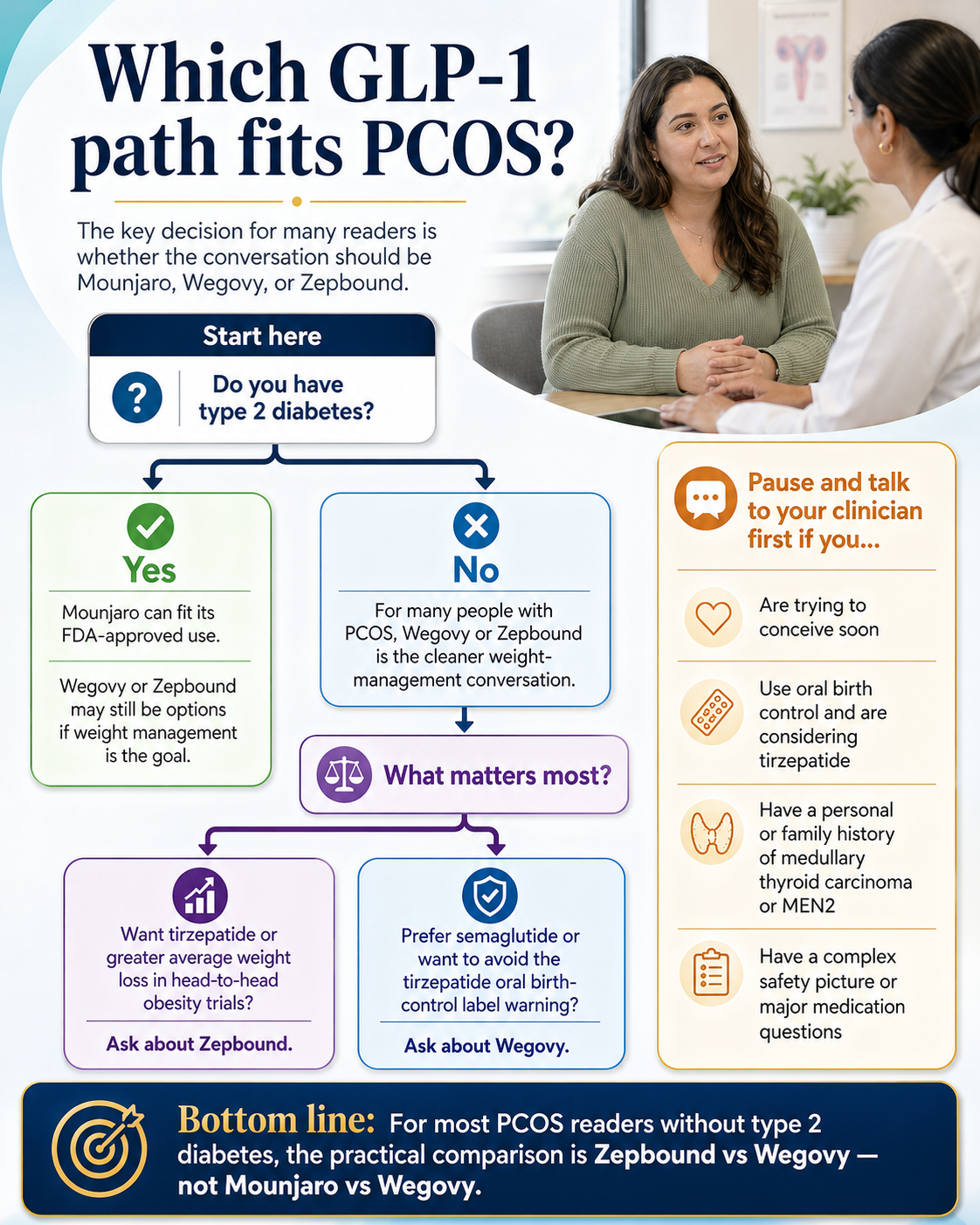
PCOS without type 2 diabetes? Wegovy or Zepbound is the cleaner conversation. Both are FDA-approved for weight management. Both have realistic cash-pay paths in 2026.
PCOS with type 2 diabetes? Mounjaro fits the labeled indication and your insurance is more likely to play along.
Maximum weight-loss potential? Tirzepatide (Zepbound, or Mounjaro if eligible) outperformed semaglutide in the SURMOUNT-5 head-to-head trial published in NEJM — average 20.2% body weight reduction vs 13.7% at 72 weeks.
Trying to conceive or relying on oral birth control? Pause before either. There are real label warnings here that most comparison pages skip. See the side-effects section below.
Neither drug is FDA-approved specifically for PCOS. Both are commonly prescribed off-label for PCOS, though a PCOS patient who also meets BMI criteria for obesity can be prescribed Wegovy or Zepbound on-label through the obesity indication.
Jump to what you need:
- At-a-glance comparison table (Mounjaro vs Wegovy vs Zepbound)
- Is Mounjaro the same as Zepbound for PCOS?
- 2026 real-cost matrix — 9 scenarios
- Insurance coverage for PCOS
- Side effects and the oral contraceptive issue
- Will it regulate my cycle or improve fertility?
- Which PCOS phenotype fits which drug?
- How to actually get a prescription
- Full FAQ
- Bottom line decision guide
Already know Wegovy fits — Ro Insurance Checker · Want Mounjaro (T2D) or provider choice — Sesame · Not sure — Free quiz
What we actually verified for this guide
We don’t ask you to take our word for it. Here’s the receipt.
What we didn’t verify: your specific insurance plan’s formulary, retail pharmacy prices in your zip code, or your individual prior-authorization timeline. Those vary too much for any article to nail down.
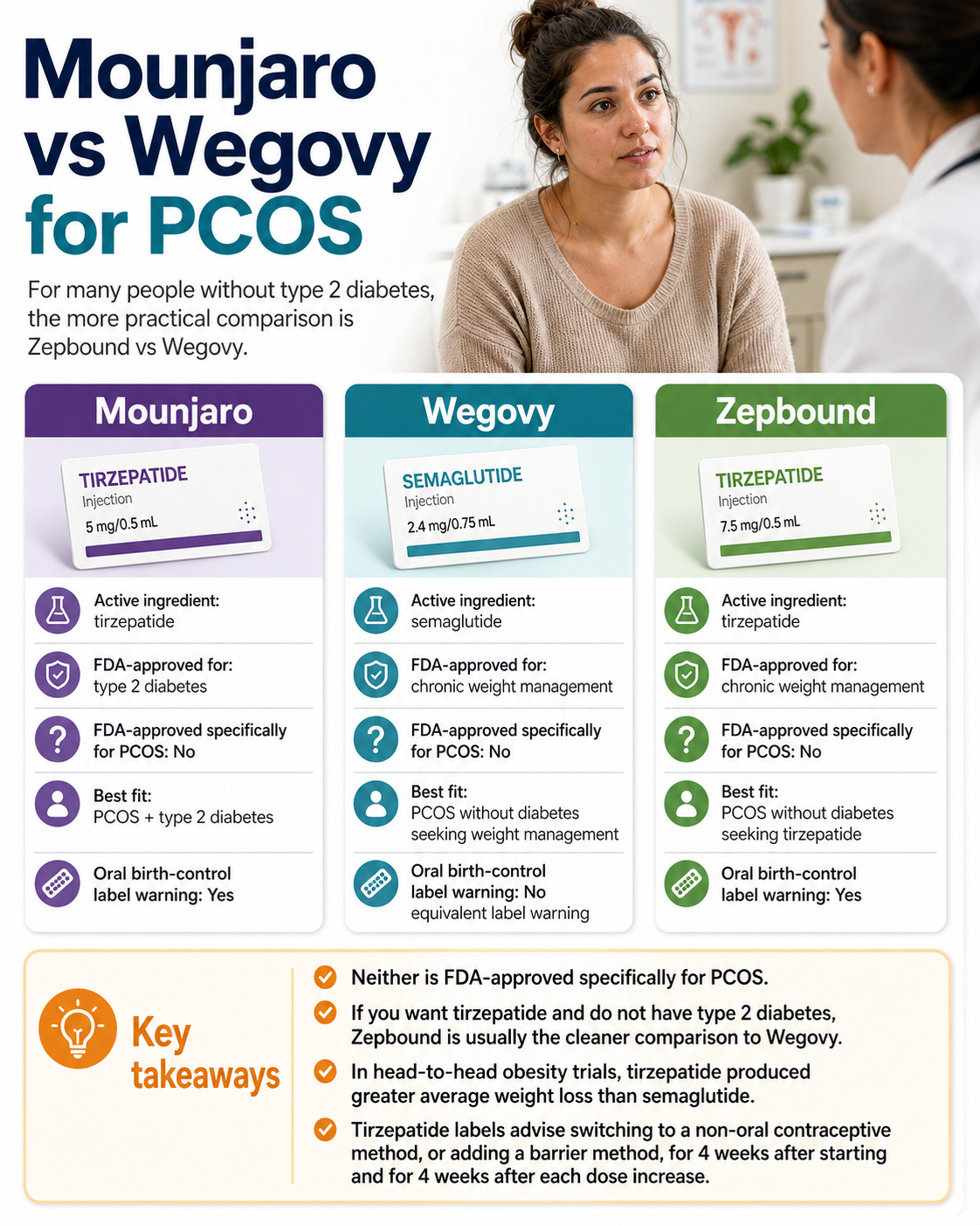
At a glance: Mounjaro vs Wegovy vs Zepbound for PCOS
Tap to take the free 60-second GLP-1 matching quiz →
| Mounjaro (tirzepatide) | Wegovy (semaglutide) | Zepbound (tirzepatide — same as Mounjaro) | |
|---|---|---|---|
| FDA-approved for | Glycemic control in adults and children 10+ with type 2 diabetes | Chronic weight management; cardiovascular risk reduction; noncirrhotic MASH with moderate-to-advanced fibrosis (injection only, accelerated approval) | Chronic weight management in adults; moderate-to-severe obstructive sleep apnea in adults with obesity |
| FDA-approved for PCOS? | No (off-label) | No (off-label) | No (off-label) |
| On-label path for PCOS patients | Only if T2D coexists | If BMI ≥30, or ≥27 + a weight-related comorbidity | If BMI ≥30, or ≥27 + comorbidity, or with documented OSA |
| Mechanism | Dual GLP-1 + GIP receptor agonist | GLP-1 receptor agonist | Dual GLP-1 + GIP receptor agonist |
| Strongest weight-loss data | SURMOUNT-5 (NEJM): 20.2% vs 13.7% at 72 weeks | SURMOUNT-5: 13.7%; STEP-1: ~15% at 68 weeks; up to 20.7% at 7.2 mg HD | Same data as Mounjaro (same molecule) |
| Strongest PCOS-specific data | ObesityWeek 2025 (conference): 18.81% mean weight loss at 10 months in 4,241 women with PCOS | Carmina 2023 (n=27): ~80% of responders saw more regular menstrual cycles on semaglutide | Same molecule as Mounjaro; PCOS data shared |
| Manufacturer list price | ~$1,112/month | $1,349.02/month | List price published by Lilly |
| Realistic cash-pay path | Limited — savings card requires labeled-use eligibility (T2D) | $199–$349/mo via NovoCare (pen); $149–$299/mo (pill) | $299–$449/mo via LillyDirect Self Pay Journey (45-day refill rule applies) |
| With covered commercial insurance | As low as $25/mo (T2D-aligned use; government beneficiaries excluded) | $0–$25/mo with Wegovy Savings Offer (government beneficiaries excluded) | $25/mo with Zepbound Savings Card (eligibility rules apply) |
| Oral birth-control warning | Yes — add barrier method or switch to non-oral for 4 weeks after start and 4 weeks after each dose increase | No equivalent label warning | Yes — same as Mounjaro |
| Pregnancy guidance per FDA | Available data insufficient; potential fetal risk per animal studies | Discontinue at least 2 months before planned pregnancy | Discontinue when pregnancy is recognized |
If your situation lines up with Wegovy or Zepbound
Ro carries both, matches LillyDirect/NovoCare pricing on the medication, and their insurance team handles prior-authorization paperwork on your behalf.
→ Check Wegovy and Zepbound coverage with Ro's free GLP-1 Insurance Checker (sponsored affiliate link, opens in a new tab)Free to check. Takes about 90 seconds. No commitment.
Is Mounjaro the same as Zepbound for PCOS?
Mounjaro and Zepbound contain the same active ingredient (tirzepatide), made by the same company (Eli Lilly), but are sold under two brand names with two different FDA approvals. Mounjaro is approved for type 2 diabetes; Zepbound is approved for chronic weight management and obstructive sleep apnea. For PCOS patients without diabetes, Zepbound is the right tirzepatide brand to ask about — not Mounjaro — because the labeled indication and savings programs are designed for the weight-management use case.
This matters because of how access actually works.
The Mounjaro Savings Card problem
The Mounjaro Savings Card — the program that gets people the famous “$25/month” Mounjaro — is restricted to commercially insured patients using Mounjaro for an FDA-approved indication, which is type 2 diabetes. When a PCOS patient with no diabetes diagnosis tries to use the card off-label, eligibility doesn’t apply, and they’re often staring at the full list price around $1,112/month.
The Zepbound Self Pay Journey (the real path)
Zepbound has a separate self-pay program through LillyDirect with prices starting at $299/month for the 2.5 mg dose. The 5 mg vial sits at $399/month. The 7.5–15 mg vials drop to $449/month if the prescription is refilled within 45 days of the previous fill. Miss the 45-day window and the higher doses revert to standard self-pay pricing ($499 for 7.5 mg, $699 for 10–15 mg). For sustained access, that timing rule actually matters.
What this means for your decision: if you’re researching “Mounjaro vs Wegovy for PCOS” because you read that tirzepatide produces more weight loss than semaglutide, you’re right about the science — but the practical comparison for most non-diabetic PCOS patients is Zepbound vs Wegovy, not Mounjaro vs Wegovy.
Are Mounjaro and Wegovy FDA-approved for PCOS?
No. Neither is FDA-approved specifically for PCOS.
Wegovy is FDA-approved for chronic weight management and cardiovascular risk reduction. Mounjaro is FDA-approved only for glycemic control in type 2 diabetes. A PCOS patient who also meets BMI criteria for obesity can be prescribed Wegovy or Zepbound on-label through the obesity indication; PCOS itself remains off-label for both medications.
The 2023 International Evidence-based PCOS Guideline — developed in partnership with ASRM, the Endocrine Society, ESHRE, and ESE across 71 countries — formally includes anti-obesity medications (specifically liraglutide and semaglutide) as options that “could be considered” alongside active lifestyle intervention for higher weight in adults with PCOS. Tirzepatide is mentioned more cautiously because PCOS-specific evidence is still being built.
What “off-label” actually means for PCOS patients
Off-label doesn’t mean illegal or unethical. It means the FDA hasn’t formally evaluated this specific use. For PCOS, the prescribing path generally works through one of two routes:
Route 1: Through the labeled obesity/weight-management indication
If you meet BMI criteria — ≥30, or ≥27 with at least one weight-related comorbidity — Wegovy or Zepbound can be prescribed on-label for obesity, with PCOS as part of your clinical picture. This is the cleaner path. The script is on-label; PCOS just happens to be one of the things that improves with treatment.
Route 2: Through the labeled diabetes indication
If you have type 2 diabetes alongside PCOS, Mounjaro is on-label for the diabetes piece, and the PCOS metabolic features tend to improve as a secondary effect of the metabolic treatment.
What you generally can’t do: get insurance to cover one of these drugs for PCOS alone, with no obesity or diabetes documentation. PCOS by itself is not on either drug’s label, and most plans require the labeled indication.
Which one actually works better for PCOS?
Tirzepatide (Mounjaro/Zepbound) consistently produces larger absolute weight loss than semaglutide (Wegovy) in head-to-head trial data — 20.2% vs 13.7% at 72 weeks in SURMOUNT-5. Semaglutide has the longer track record specifically for PCOS, including the Carmina 2023 study where roughly 80% of responders achieved more regular menstrual cycles. For most PCOS patients, the choice is less about which drug “works better” in the abstract and more about which one fits your situation, your insurance, and your reproductive plans.
What the head-to-head trial showed
SURMOUNT-5 (NEJM, 2025) — 751 adults with obesity, 72 weeks
Tirzepatide
20.2%
mean weight loss
Semaglutide 2.4 mg
13.7%
mean weight loss
Waist reduction — tirzepatide
18.4 cm
Waist reduction — semaglutide
13.0 cm
GI discontinuation — tirzepatide
2.7%
lower
GI discontinuation — semaglutide
5.6%
higher
SURMOUNT-5 was not a PCOS-specific trial, but it’s the cleanest controlled comparison between the two molecules. Tirzepatide was more likely to produce weight reductions of at least 10%, 15%, 20%, and 25%.
What the PCOS-specific evidence shows
Semaglutide (Wegovy) in PCOS
- Carmina 202327 women with PCOS and obesity. ~80% of responders saw more regular menstrual cycles. Average weight loss: ~7.6 kg at 3 months, ~11.5 kg at 6 months.
- 2026 EJE systematic reviewPeer-reviewed. Semaglutide showed reductions in BMI, total cholesterol, triglycerides, and LDL-C in women with PCOS. Reproductive and psychological outcomes: limited evidence, low certainty.
- 2023 PCOS GuidelineFormally lists semaglutide and liraglutide as options to consider for higher weight in adults with PCOS alongside active lifestyle intervention.
Tirzepatide (Mounjaro/Zepbound) in PCOS
- ObesityWeek 2025Conference-presented. 4,241 adult women with self-reported PCOS on tirzepatide. Mean weight loss: 18.81% at 10 months. 96.6% lost ≥5%; 90.8% lost ≥10%. Currently the largest tirzepatide-in-PCOS cohort, but conference-presented, not peer-reviewed.
- Eli Lilly statementThe company has confirmed it has not specifically studied tirzepatide for PCOS.
- NotePCOS cycle data not yet publicly reported from the tirzepatide cohort.
What this means for your decision
| What you’re trying to fix | Stronger case for tirzepatide (Mounjaro/Zepbound) | Stronger case for semaglutide (Wegovy) |
|---|---|---|
| Maximum weight loss in 10–12 months | Largest absolute reductions in both general (SURMOUNT-5) and PCOS-specific data | Strong but smaller absolute reductions in head-to-head data |
| Menstrual cycle regularity | Real-world PCOS data hasn't yet reported on cycles specifically | ~80% of responders saw more regular cycles in Carmina 2023 |
| Insulin resistance / glycemic control | Dual GLP-1 + GIP mechanism; tirzepatide is FDA-approved for T2D | Class effect documented in PCOS reviews; semaglutide approved for T2D as Ozempic |
| Lower GI-related discontinuation risk | 2.7% in SURMOUNT-5 | 5.6% in SURMOUNT-5 |
| Following the 2023 PCOS Guideline | Mentioned more cautiously due to limited PCOS-specific RCTs | Formally listed as an option to consider |
| Using oral birth control and don't want to switch | No advantage here — label warning applies | No equivalent oral contraceptive label warning |
We didn’t invent these numbers. They’re drawn from the cited primary sources. The synthesis is editorial judgment based on those sources, not medical advice. Every PCOS case is different.
How much do Mounjaro, Wegovy, and Zepbound cost for PCOS in 2026?
Cash-pay pricing dropped dramatically between mid-2025 and early 2026. Wegovy cash-pay through NovoCare is now $199/month for the first two months at starter doses, then $349/month. Zepbound through Lilly’s Self Pay Journey runs $299–$449/month with a 45-day refill timing rule. Mounjaro list price stays around $1,112/month for non-diabetic PCOS patients because the savings card requires labeled-use eligibility. With covered commercial insurance and savings-offer eligibility, all three may drop to $25/month or less.
The PCOS Real-Cost Matrix — April 2026
This is our proprietary asset. We built it because every other page on the topic was citing 2024 list prices that are no longer accurate.
| Your situation | Mounjaro (cash) | Wegovy (cash) | Zepbound (cash) | What’s actually accessible |
|---|---|---|---|---|
| PCOS, no diabetes, no insurance coverage | ~$1,112/mo list (savings card requires labeled-use eligibility) | $199/mo first 2 months at 0.25 or 0.5 mg through December 31, 2026; $349/mo ongoing (pens); Wegovy HD 7.2 mg $399/mo; pill: $149–$299/mo | $299/mo for 2.5 mg; $399/mo for 5 mg; $449/mo for 7.5–15 mg (45-day refill rule applies) | Wegovy or Zepbound is dramatically more accessible. Mounjaro is effectively unavailable at affordable cost. |
| PCOS, no diabetes, commercial insurance covers obesity meds (BMI ≥30, or ≥27 + comorbidity) | Same — labeled-use eligibility still required | $0–$25/mo with Wegovy Savings Offer (government beneficiaries excluded) | $25/mo with Zepbound Savings Card if covered | Wegovy or Zepbound. Mounjaro still off the table. |
| PCOS + type 2 diabetes, commercial insurance covers Mounjaro | $25/mo with Mounjaro Savings Card | $0–$25/mo if covered for obesity | $25/mo with Zepbound Savings Card if covered | All three genuinely accessible. The choice becomes clinical. |
| PCOS + type 2 diabetes, only diabetes covered (not obesity) | $25/mo with Mounjaro Savings Card | Likely full $349 NovoCare cash | $299–$449/mo cash via LillyDirect | Mounjaro wins on access here. |
| PCOS + Medicare Part D (Bridge available as of July 1, 2026) | Possibly covered for diabetes only via Part D; savings cards excluded for government beneficiaries | $50/mo flat copay under Medicare GLP-1 Bridge for eligible beneficiaries | $50/mo flat copay under Medicare GLP-1 Bridge for KwikPen formulation | Medicare GLP-1 Bridge is now live. Wegovy or Zepbound KwikPen at $50/mo for weight loss. Mounjaro is not on the Bridge formulary for weight loss. |
| PCOS + Medicaid | Coverage varies by state | Depends on state Medicaid program | Depends on state Medicaid program | Limited and state-specific. Discuss with your plan directly. |
| Insurance denied — appealing prior auth | Savings card still requires labeled-use eligibility; cash cost unchanged | Appeal usually rests on documented BMI + comorbidity | Similar appeal path to Wegovy | Wegovy and Zepbound are generally easier to appeal for obesity comorbidity than Mounjaro for off-label PCOS. |
| Lost weight on Wegovy and plateaued | Access still gated by diabetes diagnosis | Higher 7.2 mg HD pen now available at $399/mo cash | Most accessible tirzepatide path post-Wegovy | If plateau is real, Zepbound is the realistic next step unless you have T2D. |
| Want injection-free starting point | Injection only | Wegovy pill: $149/mo at 1.5 mg or 4 mg through Aug 31, 2026; then $199 for 4 mg; $299 for 9 mg or 25 mg | Injection only (KwikPen, vials, or single-dose pen) | Wegovy pill is the only oral semaglutide option for weight management in 2026. |
| Trying to conceive within 1–2 months | Potential fetal risk per labeling | Discontinue ≥2 months before planned pregnancy per FDA labeling | Discontinue when pregnancy is recognized per FDA labeling | None of these. Talk to your OB/GYN or reproductive endocrinologist first. |
Last verified: Promotional pricing changes frequently — confirm current rates with Ro, NovoCare, or LillyDirect before deciding.
Sources: Lilly Pricing Info · NovoCare Pharmacy · Wegovy Cost & Coverage · LillyDirect Zepbound Self Pay Terms · CMS Medicare GLP-1 Bridge details
The cost mistake to avoid
Don’t compare Mounjaro retail list price to Wegovy cash-pay program pricing. That’s not apples to apples. The right cash-pay comparison for a PCOS patient without diabetes is:
- Wegovy through NovoCare: $199–$349/month (pen); $149–$299/month (pill)
- vs. Zepbound through LillyDirect Self Pay Journey: $299–$449/month (45-day refill rule)
Decision point: now you know the cost. What does your insurance actually cover?
Ro carries Wegovy (pen and pill), Zepbound, Foundayo (orforglipron), and Ozempic. Their GLP-1 Insurance Coverage Checker is free and takes about 90 seconds. Ro Body membership is $39 for the first month, then $149/month — or as low as $74/month with annual plan paid upfront. Ro's insurance team handles prior-authorization paperwork on your behalf.
→ Check your coverage with Ro's free GLP-1 Insurance Checker (sponsored affiliate link, opens in a new tab)Free to check. No commitment.
Will insurance cover Mounjaro or Wegovy for PCOS?
Insurance generally won’t cover either drug for PCOS alone. Coverage depends on the labeled indication — type 2 diabetes (Mounjaro) or BMI-based obesity (Wegovy and Zepbound). When PCOS coexists with one of those, coverage becomes possible, but most plans still require prior authorization with BMI documentation, prior weight-loss attempts, and other plan-specific criteria. As of July 1, 2026, the Medicare GLP-1 Bridge provides eligible Part D beneficiaries with $50/month access to Wegovy and Zepbound KwikPen for weight loss.
More likely to be covered
- ✓Wegovy with documented BMI ≥30, or ≥27 + a weight-related comorbidity
- ✓Mounjaro with documented type 2 diabetes
- ✓Zepbound with documented BMI ≥30, or ≥27 + comorbidity, or with documented obstructive sleep apnea in adults with obesity
- ✓Wegovy or Zepbound KwikPen for eligible Medicare Part D beneficiaries via the Bridge (available as of July 1, 2026)
Less likely to be covered
- ✗Any of these drugs prescribed solely for PCOS with no obesity, diabetes, OSA, or other labeled indication documentation
- ✗Mounjaro prescribed off-label for weight management without type 2 diabetes
- ✗Mounjaro under the Medicare GLP-1 Bridge for weight loss (not on the Bridge formulary)
What to bring to your prescriber to maximize coverage odds
- •BMI calculation (height + weight)
- •A1C, fasting glucose, or — if you can get it — an oral glucose tolerance test (OGTT). The 2023 PCOS guideline specifically calls out OGTT as the most accurate test for assessing glycemic status in PCOS.
- •Blood pressure
- •Lipid panel
- •Documentation of prior weight-loss attempts (diet, exercise, metformin)
- •Sleep apnea status if relevant (Zepbound is FDA-approved for obstructive sleep apnea in adults with obesity)
- •Your insurance card and formulary information
Why prior authorization is winnable for Wegovy/Zepbound but harder for Mounjaro
Prior authorization for Wegovy or Zepbound usually rests on documented obesity — a clean, on-label conversation. Prior authorization for Mounjaro for off-label PCOS is much harder because it’s off-label by definition. Your prescriber is asking the plan to cover a medication for a use the FDA hasn’t approved. This is the practical reason most non-diabetic PCOS patients end up on Wegovy or Zepbound rather than Mounjaro — not because Mounjaro is medically inferior, but because the labeled-indication path is the path the system actually pays for.
If insurance coverage is a major factor
Ro's insurance team works with your plan to navigate prior authorization. The check is free and tells you what's covered before you commit to a path.
→ Run Ro's free GLP-1 coverage check (sponsored affiliate link, opens in a new tab)What side effects and birth-control issues matter most for PCOS?
Both medications share the GLP-1 class side-effect profile — nausea, vomiting, diarrhea, constipation, fatigue, and a boxed warning for thyroid C-cell tumors based on rodent studies. For PCOS patients specifically, two issues tend to get buried: tirzepatide can reduce the absorption of oral hormonal contraceptives during initiation and dose escalation, and FDA labeling provides distinct pregnancy guidance for each medication.
Standard GI side effects
The thyroid box warning (what it actually means)
Both drugs carry a boxed warning for medullary thyroid carcinoma (MTC) and Multiple Endocrine Neoplasia syndrome type 2 (MEN 2), based on tumors observed in rats during preclinical studies. It’s not known whether this risk translates to humans.
If you or a close family member has had medullary thyroid cancer or MEN 2, neither drug is appropriate for you. Outside of that history, the boxed warning is a “monitor and inform” warning, not a “do not take” warning.
The oral contraceptive interaction (Mounjaro/Zepbound only) — the one most pages bury
Tirzepatide labels explicitly advise patients using oral hormonal contraceptives to switch to a non-oral method (IUD, implant, injection) or add a barrier method (condoms, diaphragm) for 4 weeks after starting tirzepatide and 4 weeks after each dose escalation. Tirzepatide can delay gastric emptying significantly during initiation and titration, which can reduce the absorption of oral contraceptives.
Why this is a big deal for PCOS patients specifically:
- 1.Many PCOS patients use combined oral contraceptive pills as first-line treatment for cycle regularity and androgens. The 2023 International PCOS Guideline names them as first-line for menstrual irregularity and hyperandrogenism.
- 2.GLP-1 medications can improve ovulation in PCOS patients who lose weight — meaning your fertility may be increasing precisely when your contraception is becoming less reliable.
- 3.Wegovy doesn't carry this same explicit contraceptive warning in current labeling. So if you're committed to your oral contraceptive and don't want to add a barrier method, that's actually a meaningful argument for Wegovy over Zepbound/Mounjaro.
Pregnancy guidance differs between these drugs
| Drug | FDA pregnancy guidance |
|---|---|
| Wegovy (semaglutide) | Discontinue at least 2 months before a planned pregnancy |
| Zepbound (tirzepatide) | Discontinue when pregnancy is recognized |
| Mounjaro (tirzepatide) | Available human data insufficient; potential fetal risk per animal studies; use only if potential benefit justifies potential risk to fetus |
The eating-disorder consideration
GLP-1 medications can pose risk for patients with current or prior eating disorders. The National Eating Disorders Association has flagged concerns about misuse, the worsening of restrictive cognitive and behavioral patterns, and a lack of studies in people with eating-disorder history.
If you have an active eating disorder or a history of one, discuss it with your prescriber before starting any GLP-1 medication. PCOS itself can co-occur with disordered eating — this is a real safety issue that doesn’t get discussed enough in PCOS-focused content.
If you have a complex safety picture
Pregnancy planning soon, oral contraceptives you don’t want to swap, eating disorder history, severe GI history, or family thyroid cancer history — the right next step is your existing clinician, not a telehealth path.
Take our quiz to figure out which path makes sense for your situation →Will Mounjaro or Wegovy regulate my cycle or improve fertility?
When women with PCOS lose 5% or more of their body weight on a GLP-1 medication, menstrual cycle regularity often improves. In the Carmina 2023 study of 27 women with PCOS on semaglutide, about 80% of responders reported more regular cycles. These improvements appear to track weight loss and reduced insulin resistance, not a drug-specific reproductive effect.
About cycle regularity
Insulin resistance is a central driver of PCOS in many patients — one widely cited estimate puts the prevalence around 70% of women with PCOS demonstrating insulin resistance and compensatory hyperinsulinemia. When insulin levels normalize, ovaries can stop producing as much testosterone, which often allows ovulation to resume on a more regular schedule. The cycle improvements people report are real, but they're a downstream effect of weight loss and metabolic improvement, not a primary action of the drug.
About hirsutism and acne
Improvements appear in patient reports and small studies, but they tend to follow weight loss and androgen reduction over months, not weeks. Set expectations long: hair-growth cycles take time to visibly shift.
About fertility
GLP-1 medications can improve ovulation indirectly by improving the metabolic conditions that suppress ovulation in PCOS. They are not fertility drugs. There have been reports of unexpected pregnancies on GLP-1 medications — likely because women who weren't ovulating regularly started ovulating, while their oral contraceptive absorption was being affected (with tirzepatide) or while they assumed they couldn't get pregnant due to PCOS.
If pregnancy is in your 12–24 month plan
Both drugs can play a role in pre-conception weight loss — but you'll need a clear timeline with your OB/GYN to taper off, allow the labeled washout period (≥2 months for Wegovy; per-label guidance for tirzepatide), and then attempt conception. The 2023 PCOS guideline addresses this directly: if pregnancy is possible, contraception is required, because pregnancy safety data is lacking.
Which PCOS phenotype fits Mounjaro, Wegovy, or Zepbound best?
PCOS is not a single condition. GLP-1 medications are most useful for the metabolic phenotypes where weight, insulin resistance, and glucose dysregulation are dominant. They’re a less obvious fit for lean PCOS where weight isn’t the primary driver.
| Your dominant PCOS picture | Best-fit GLP-1 conversation | Why |
|---|---|---|
| Classic / metabolic PCOS — high BMI, insulin resistance, irregular cycles, often hirsutism/acne | Wegovy or Zepbound (Mounjaro if T2D coexists) | Strong evidence base; weight + insulin features both improve |
| Lean PCOS — normal-to-low BMI, cycle and androgen features dominant | Generally not a primary GLP-1 candidate | Labeled weight-management indication usually doesn't fit; talk to a PCOS-specialist endocrinologist |
| PCOS + type 2 diabetes | Mounjaro is on-label and often covered | Glycemic control + weight + cycles all benefit |
| PCOS + prediabetes (without T2D yet) | Wegovy or Zepbound, often through obesity indication | Tirzepatide has shown reduced progression to T2D in prediabetes data |
| Plateaued on semaglutide | Switch to tirzepatide (Zepbound or Mounjaro) is a recognized clinical step | SURMOUNT-5 demonstrated greater weight loss with tirzepatide head-to-head |
| PCOS preparing for pregnancy in 12–24 months | Either, with proper washout planning | Lose weight first, taper before TTC; coordinate with your reproductive team |
| PCOS with severe GI history | Slower titration of either; tirzepatide had lower GI-related discontinuation in SURMOUNT-5 | Provider judgment; titrate slowly |
| PCOS with active or prior eating disorder | Generally not a starting point | Discuss with mental health and PCOS care team first |
PCOS phenotype assessment requires a clinician familiar with the Rotterdam criteria. This table is decision-support, not a diagnosis tool. Both medications are off-label for PCOS regardless of phenotype.
How to actually get a prescription (FDA-approved paths only)
You have three legitimate paths: your existing PCP or endocrinologist, an in-person obesity-medicine specialist, or a telehealth platform that offers FDA-approved medications. We don’t recommend compounded GLP-1 providers for FDA-approved branded comparisons because compounded products are not FDA-approved through the same process as the brand-name medications.
This is the right path if you already have a relationship with a clinician who knows your PCOS history. Also the best path if your case is complex — pregnancy planning, eating disorder history, multiple medications, complicated insurance.
What to ask for:
- •A discussion of Wegovy vs Zepbound (and Mounjaro if you have T2D) for your specific situation
- •BMI documentation if you're going through the obesity indication
- •A1C, fasting glucose, OGTT if appropriate
- •A prior authorization plan if your insurance requires one
For most PCOS patients searching this comparison, telehealth is the realistic path because endocrinology wait times are months in most US markets, and telehealth platforms have built infrastructure specifically for BMI-based GLP-1 prescribing.
Ro — primary recommendation for Wegovy and Zepbound
Ro carries Wegovy (pill and pen), Zepbound, Foundayo (orforglipron), and Ozempic. Ro Body membership is $39 for the first month, then $149/month — or as low as $74/month with annual plan paid upfront. Medication priced separately; Ro matches LillyDirect/NovoCare pricing. Their GLP-1 Insurance Coverage Checker is free, takes about 90 seconds, and Ro’s insurance team handles prior-authorization paperwork on your behalf.
Note: Per Ro’s policy, Ro cannot coordinate GLP-1 coverage with government insurance plans. Medicare, Medicare Supplement, and TRICARE members may join Ro Body and pay cash-pay rates; Medicaid and other government-funded plan members cannot join Ro Body.
Check Wegovy & Zepbound coverage with Ro → (sponsored affiliate link, opens in a new tab)Sesame Care — secondary recommendation for provider choice or Mounjaro access
Sesame’s weight-loss program includes Wegovy (pill and pen), Zepbound (KwikPen), Ozempic, and Foundayo, with menu access to Mounjaro, Saxenda, and Rybelsus. If you specifically want Mounjaro and have a type 2 diabetes diagnosis to support it, Sesame is the better starting point because Ro doesn’t carry Mounjaro itself.
See providers and pricing on Sesame Care → (sponsored affiliate link, opens in a new tab)Why we don’t recommend compounded GLP-1 providers for this page
Compounded semaglutide and tirzepatide are not FDA-approved through the same process as Mounjaro, Wegovy, or Zepbound. Following the FDA’s 2025 confirmation that shortages are resolved, the legal pathway for compounded versions has narrowed significantly. With Wegovy now at $199–$349/month cash through NovoCare and Zepbound at $299–$449/month through LillyDirect, the cost gap that drove compounded use in 2024 has largely closed.
Decision point: ready to start an FDA-approved path?
What most “Mounjaro vs Wegovy for PCOS” pages get wrong
We’ve read the comparable pages on this query. Most have one or more of these problems.
Mistake 1: Treating “Mounjaro” as the weight-loss tirzepatide brand.
Mistake 2: Citing 2024 cash prices.
Mistake 3: Treating PCOS as monolithic.
Mistake 4: Burying the oral contraceptive issue.
Mistake 5: Quietly recommending compounded GLP-1s as if they're the same as the brand.
Mistake 6: Not telling the reader who shouldn't be on either drug.
What real PCOS patients are actually deciding
From public PCOS forums, used here to illustrate decision friction — not as medical evidence or efficacy claims.
“Costs are such a big factor.”
— r/PCOS user weighing Mounjaro vs higher-dose Wegovy
“I'm not too bothered about the weight loss as much as I am the insulin resistance element.”
— r/PCOS user discussing GLP-1 priorities
“Don't want to put anything in my body that might harm me in the long run.”
— r/PCOS user considering Mounjaro
Three concerns — cost, insulin resistance, long-term safety — match what we see across the full PCOS-GLP-1 conversation. Notice what’s not at the top of the list: weight loss for its own sake. Most women searching this aren’t looking for a quick fix.
Tap the decision tree to find your path →
Frequently asked questions
1.Is Mounjaro or Wegovy better for PCOS?
2.Can you take Mounjaro for PCOS without diabetes?
3.Does insurance cover Mounjaro or Wegovy for PCOS?
4.Will Wegovy regulate my period if I have PCOS?
5.Can I get pregnant on Mounjaro or Wegovy?
6.How much weight will I lose with Mounjaro vs Wegovy if I have PCOS?
7.How long before I see results?
8.What happens if I stop taking it?
9.Can I switch between Mounjaro and Wegovy?
10.Is compounded semaglutide or tirzepatide a legitimate substitute for PCOS?
11.Does either drug help with hirsutism or acne from PCOS?
12.What if I have a family history of thyroid cancer?
13.Should I try metformin before a GLP-1 for PCOS?
14.What is the difference between Mounjaro and Zepbound for PCOS?
15.Where can I get Wegovy or Mounjaro prescribed for PCOS?
Bottom line: Mounjaro vs Wegovy for PCOS
PCOS + type 2 diabetes
Mounjaro fits the labeled indication, and your insurance is more likely to play along. Sesame Care is the realistic telehealth path because Ro doesn't carry Mounjaro.
PCOS without diabetes, want maximum weight loss
Ask about Zepbound. Same molecule as Mounjaro, FDA-approved for weight management, available through Lilly's Self Pay Journey at $299–$449/month or via Ro with insurance coverage handling.
PCOS without diabetes, want strongest PCOS-specific evidence
Wegovy. Featured in the 2023 International PCOS Guideline, with Carmina 2023 PCOS-specific cycle data, available through NovoCare at $199–$349/month cash or via Ro for insurance coverage.
Use oral contraceptives and don't want to swap them
Wegovy. The tirzepatide oral-contraceptive interaction is real and inconvenient enough that for many women, the simpler answer is just to use semaglutide.
Trying to conceive in the next few months
Neither. Talk to your OB/GYN about a sequenced plan that may include weight management before TTC, with proper washout timing per each drug's label.
On Medicare Part D (Bridge available as of July 1, 2026)
Wegovy and Zepbound KwikPen become accessible at $50/month through the Medicare GLP-1 Bridge. See our full Bridge guide for eligibility rules.
Not sure where you fit
Take the quiz. We built it for exactly this moment.
Ro Body: $39 first month, then $149/month, or as low as $74/month with annual prepay. Medication priced separately; Ro matches LillyDirect/NovoCare pricing.
Compare Mounjaro, Wegovy, Zepbound, Ozempic & Foundayo on Sesame Care → (sponsored affiliate link, opens in a new tab)Best option if you specifically want Mounjaro or want provider choice across the broadest FDA-approved GLP-1 menu.
Take our free 60-second Find My GLP-1 Path quiz →Still not sure which GLP-1 program is right for you? No signup. No email. Just a clearer next step.
About this guide
The RX Index is a pricing intelligence and comparison resource for GLP-1 telehealth providers. We compare provider pricing pages, terms of service, FAQs, and primary medical documents to help readers see more than marketing claims. We disclose affiliate relationships, publish our methodology, and add clinical review labels only when a licensed reviewer has actually completed a review.
Last verified:
Next scheduled review: May 2026 pricing check; July 2026 full source review (coinciding with Medicare GLP-1 Bridge launch)
Primary sources
- •DailyMed — Mounjaro label
- •DailyMed — Wegovy label
- •DailyMed — Zepbound label
- •ASRM — 2023 International Evidence-based PCOS Guideline
- •NEJM — SURMOUNT-5: Tirzepatide vs Semaglutide for the Treatment of Obesity
- •European Journal of Endocrinology — 2026 systematic review of GLP-1 receptor agonists in PCOS
- •Eli Lilly — Mounjaro Pricing Info
- •Eli Lilly — Zepbound Self Pay Journey Program Terms
- •Novo Nordisk — NovoCare Pharmacy Pricing
- •Novo Nordisk — Wegovy Cost & Coverage
- •FDA — Concerns with Unapproved GLP-1 Drugs Used for Weight Loss
- •CMS — Medicare GLP-1 Bridge
- •National Eating Disorders Association — GLP-1s and Eating Disorders
Related guides
· By The RX Index Editorial Team · Next re-verification: May 2026. This page is not medical or legal advice. The RX Index may earn affiliate commissions when readers sign up with telehealth providers featured on this page, including Ro and Sesame Care. Affiliate relationships are disclosed at the top of this page. We don’t rank medications or providers when medical fit, FDA status, or safety considerations differ. Not affiliated with Eli Lilly, Novo Nordisk, CMS, or Medicare. If something is out of date, let us know and we’ll fix it within 48 hours.