
By The RX Index Team · · Not medical advice — switching prescription medications requires a conversation with a licensed healthcare provider who knows your history.
How to Switch From Mounjaro to Zepbound (2026): Step-by-Step
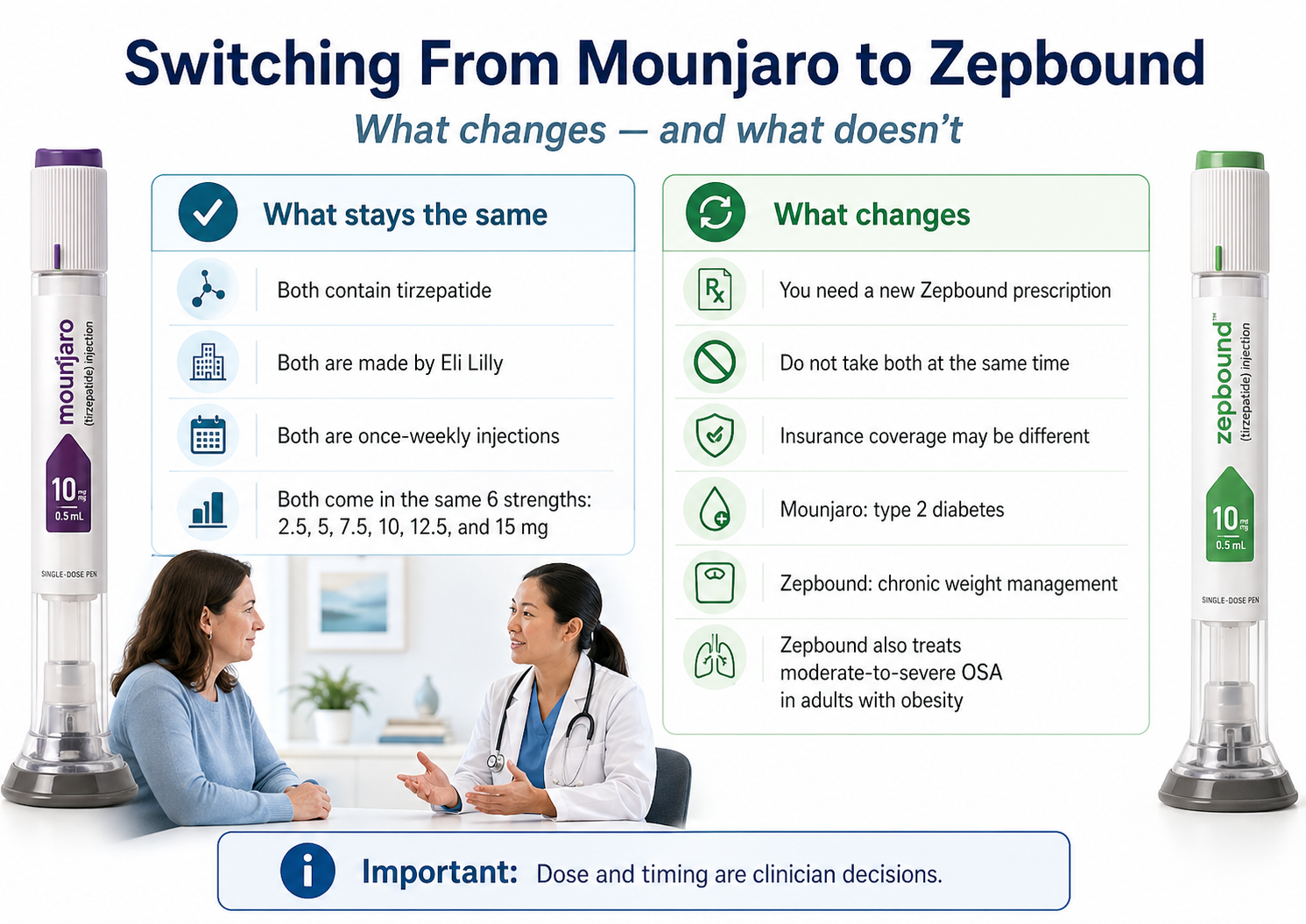
Yes — you can switch from Mounjaro to Zepbound with a new prescription, and many stable patients are prescribed the matching Zepbound strength. The dose isn’t automatic, though: your prescriber decides whether to continue at the matching strength, step down, or restart based on your current dose, side effects, treatment gap, diabetes status, and reason for switching. Both are tirzepatide, both are made by Eli Lilly, and both come in the same six labeled strengths. The biggest practical friction is not the molecule — it’s the insurance pathway, which doesn’t transfer between brands.
Jump to what you need:
- Quick answers
- What we verified
- Can you switch?
- Friction index (8 factors)
- New prescription required
- Dose restart question
- Timing after Mounjaro
- 5 reasons people switch
- Insurance & prior auth
- What it costs in 2026
- Medicare GLP-1 Bridge
- Step-by-step protocol
- Side effects after switch
- OSA coverage path
- $299–$449 self-pay path
- When NOT to switch
- How long will it take?
- Best path: Ro vs Sesame vs LillyDirect
- Pre-appointment checklist
- Full FAQ (13 questions)
Quick Answers
| Question | Bottom line |
|---|---|
| Can you switch? | Yes, with a new Zepbound prescription from a licensed provider. |
| Same dose? | Often, if you're stable and there's no gap. Your prescriber decides. |
| Same active ingredient? | Yes — both are tirzepatide. |
| Take both at once? | No. Never combine tirzepatide products or any GLP-1. |
| Will insurance follow you? | Not automatically. Different brands, different coverage rules. |
| Cheapest path in 2026? | As little as $25/month with Zepbound coverage; $299–$449/month via LillyDirect if not. |
Don't want to navigate prior authorization paperwork alone?
Start with Ro's free GLP-1 Insurance Coverage Checker. If you become a Ro patient and your plan requires prior authorization, Ro says its insurance concierge submits the paperwork on your behalf. Get started for $39, then as low as $74/month with annual plan paid upfront. Medication is billed separately.
→ Check your Zepbound coverage with Ro (free) (sponsored affiliate link, opens in a new tab)Free coverage check. No account required to see your results.
What We Actually Verified for This Guide
Verified April 27, 2026 — re-verified quarterly.
Most “switching” content online is hand-waving from older sources. We pulled current pricing, label language, savings-card terms, and FDA-approved indications from primary documents. Anything we couldn’t pin to a primary source is either flagged or excluded.
- ✓Mounjaro list price ($1,112.16/month) and savings card terms — pricinginfo.lilly.com/mounjaro and mounjaro.lilly.com/savings-resources
- ✓Zepbound list price, KwikPen pricing, Self Pay Journey Program terms — zepbound.lilly.com/savings and LillyDirect Zepbound page
- ✓FDA-approved indications and label language — DailyMed Zepbound and Mounjaro prescribing information
- ✓Medicare GLP-1 Bridge program — CMS Medicare GLP-1 Bridge demonstration page (cms.gov)
- ✓Ro Body pricing and insurance concierge service — ro.co/weight-loss/pricing and ro.co/weight-loss/glp1-insurance-checker
- ✓Sesame Care weight-loss program pricing — sesamecare.com/service/online-weight-loss-program
- ✓CVS Caremark formulary action on Zepbound — business.caremark.com formulary update for July 2025
- ✓GLP-1 switching timing principles — Washington Academy of Family Physicians clinical guidance
- ✓TrumpRx Zepbound launch pricing — White House fact sheet, February 5, 2026
Can You Switch From Mounjaro to Zepbound?
Yes. Mounjaro and Zepbound contain the same active ingredient (tirzepatide), are made by the same company (Eli Lilly), and come in identical labeled strengths. The switch requires a new prescription from a licensed prescriber — pharmacies cannot relabel a Mounjaro prescription — and many stable patients can continue at the matching strength when there’s no treatment gap, although the dose decision is always clinical.
Eli Lilly markets two brands of the same molecule because the FDA approved tirzepatide for two different conditions. Mounjaro got the green light first in 2022 for type 2 diabetes (in adults and pediatric patients 10 years and older). Zepbound followed in 2023 for chronic weight management and again in December 2024 for moderate-to-severe obstructive sleep apnea (OSA) in adults with obesity. Two brands, one drug, two completely different paths through the insurance system.
⚠️ The one rule that matters more than any other
Never take Mounjaro and Zepbound at the same time. The Zepbound prescribing information is explicit — it should not be used with any other tirzepatide product or any GLP-1 receptor agonist. Stacking these does not double the benefit; it raises your risk of serious side effects.
Who this guide IS for
- ✓Your insurer dropped or restricted Mounjaro for weight loss
- ✓You used Mounjaro off-label and want to move to the on-label brand
- ✓Your doctor recommended Zepbound for weight loss or OSA
- ✓You want access to LillyDirect's $299–$449/month self-pay vials
- ✓You want to walk in knowing the right questions to ask
The Mounjaro → Zepbound Switch Friction Index
Most pages treat the switch like a checklist. The reality is messier. Below we score the eight friction points that actually matter — 1 means essentially seamless, 5 means this can derail your switch if you don’t plan around it.
| Friction point | Score | What it means in practice | Primary source |
|---|---|---|---|
| Medication continuity | 1/5 | Same active ingredient at matching labeled strengths. From the body's perspective, switching brands is mainly prescription and coverage logistics. | Zepbound and Mounjaro labels (DailyMed) |
| New prescription required | 4/5 | Pharmacies cannot relabel Mounjaro as Zepbound. Your prescriber must write a brand-new prescription. Plan ahead so there's no gap. | Standard prescription/NDC rules |
| Dose decision | 3/5 | The labeled strengths line up. Stable patients with no gap may be prescribed the matching strength; gaps, intolerance, or dose escalation can change the plan. | Zepbound label (DailyMed); WAFP GLP-1 guidance |
| Do-not-overlap rule | 5/5 | Critical. Never take Mounjaro and Zepbound (or any GLP-1) together. Time the switch around your weekly injection day. | Zepbound prescribing information (DailyMed) |
| Indication and diagnosis fit | 4/5 | Mounjaro is labeled for type 2 diabetes. Zepbound is labeled for chronic weight management and OSA. The brand that matches your diagnosis is the one your insurance will defend. | FDA approval letters and current product labels |
| Insurance / prior authorization | 5/5 | This is where most switches stall. Coverage doesn't transfer between brands. Be ready to redo paperwork or use Ro's insurance concierge. | Lilly access page; Ro insurance concierge documentation |
| Cash-pay cost | 4/5 | Zepbound has LillyDirect Self Pay Journey at $299–$449/month for vials and KwikPens. Mounjaro has no equivalent direct-to-consumer self-pay vial program in 2026. | Lilly press release December 1, 2025 |
| Provider routing | 3/5 | Best path depends on whether you have a prescriber, need PA help, or want video visits and provider choice. We'll match you in the Best Path section below. | Ro pricing page; Sesame Care weight-loss program |
The two friction points that scored 5/5 are the ones to plan around: never overlap the medications, and don’t assume insurance will follow you between brands. Everything else is solvable.
Do You Need a New Prescription to Switch From Mounjaro to Zepbound?
Yes. A pharmacy cannot relabel a Mounjaro prescription as Zepbound — Zepbound is a separate prescription product with its own NDC (National Drug Code), savings card, and prior-authorization path. Your prescriber must write a brand-new prescription for Zepbound, and the diagnosis code, savings card enrollment, and pharmacy routing may all change at the same time.
The medical handoff can be simple. The administrative handoff can stop the switch cold if you don’t plan for it. Here’s what your prescriber’s office needs to write the new prescription cleanly:
Do I Have to Start Over at 2.5 mg?
Not necessarily. Because the labeled Zepbound strengths match Mounjaro’s (2.5, 5, 7.5, 10, 12.5, and 15 mg), your prescriber may continue you at the matching Zepbound strength if you’re stable and there’s no treatment gap. Restarting at a lower dose is more common after a treatment gap of several weeks, recurring side effects, or other clinical reasons.
Two questions drive your prescriber’s dose decision:
1. How well are you tolerating your current dose?
If you've been stable on 10 mg Mounjaro with no recurring nausea, vomiting, or other side effects, your prescriber may continue you on Zepbound at 10 mg.
2. Was there a gap between injections?
A clean handoff (last Mounjaro shot one week, first Zepbound shot the next, on prescriber direction) is different from a multi-week gap, which can prompt a step-down to 5 mg or 7.5 mg followed by re-escalation.
Questions to bring to your prescriber:
- •“Is there a clinical reason I shouldn't continue at my current dose?”
- •“If we're switching for side-effect reasons, would you prefer to step down first?”
- •“When should I take my first Zepbound dose relative to my last Mounjaro dose?”
- •“Will I need to titrate up again later, or is the goal to stay at this maintenance dose?”
Want a clinician to review your current dose and write the Zepbound prescription?
Start a Zepbound eligibility review with Ro. The medical visit covers your dose history, tolerability, and reason for switching — and Ro's insurance concierge handles prior authorization paperwork if your plan requires it.
→ Start a Zepbound eligibility review with Ro (sponsored affiliate link, opens in a new tab)Ongoing care as low as $59/month with annual plan. Medication separate.
Not sure which path fits your situation? Take the free 60-second quiz →
How Long After Mounjaro Can You Take Zepbound?
Do not overlap Mounjaro and Zepbound. In a clean weekly handoff, many prescribers plan around the next regular injection interval — last Mounjaro shot on your usual day, first Zepbound shot seven days later — but missed doses, side effects, dose changes, and your specific medical history can change the plan. This timing decision belongs to your prescriber.
You missed multiple Mounjaro doses
Prescribers often consider a step-down rather than picking up at the previous dose.
You had nausea, vomiting, diarrhea, or dehydration
Your prescriber may want symptoms to resolve before starting a new injection.
Your Zepbound prescription is delayed by prior authorization
Don't fill the gap by taking another GLP-1 you happen to have. Plan ahead so paperwork is finished before your last Mounjaro pen runs out.
Universal timing rule: Don’t double up to “catch up.” Doubling doses is one of the most reliable ways to trigger severe nausea or vomiting on the next injection.
5 Real Reasons People Switch From Mounjaro to Zepbound in 2026
How Insurance Handles the Switch (and How to Fight It)
Most commercial plans cover Mounjaro for type 2 diabetes but exclude or restrict Zepbound for weight loss. Zepbound’s December 2024 FDA approval for OSA opened a second coverage rationale that some plans approve more easily than the weight-loss indication. If your plan does not cover Zepbound under either pathway, the cash-pay path through LillyDirect ($299–$449/month) is usually cheaper than retail Mounjaro.
Track A — Diabetes (Mounjaro's home turf)
Most commercial plans and Medicare Part D cover Mounjaro for type 2 diabetes. Eligible commercially insured patients with covered plans may pay as little as $25/month with the Mounjaro Savings Card, subject to terms and maximums. Government insurance beneficiaries (Medicare, Medicaid, TRICARE) are excluded from manufacturer copay savings cards.
Track B — Weight loss (the harder track for Zepbound)
Coverage is mixed and shrinking. Eligible commercially insured patients with Zepbound coverage may pay as little as $25 for a one- or three-month supply with the Zepbound Savings Card. Medicare Part D doesn't cover any drug used solely for weight loss — that's a federal restriction.
Track C — Obstructive sleep apnea (the underrated path)
Zepbound's December 2024 OSA approval created a separate coverage rationale. Some plans that exclude Zepbound for weight loss will approve it for documented moderate-to-severe OSA. Medicare beneficiaries can pursue Zepbound for OSA through their Part D plan, though plan-specific cost-sharing applies.
What to Ask Insurance (Call Script)
Call the number on the back of your card and ask these in order:
The Prior Authorization Checklist
Rather hand the prior authorization paperwork to someone else?
Ro's insurance concierge does exactly that. Ro's free GLP-1 Insurance Coverage Checker contacts your insurer and sends you a personalized coverage report. If you become a Ro patient and prior authorization is required, Ro says its insurance concierge submits the paperwork on your behalf. Get started for $39, then as low as $74/month with annual plan paid upfront. Medication is billed separately.
→ Run the free Zepbound coverage check with Ro (sponsored affiliate link, opens in a new tab)Free check. No credit card required to see your results.
What It’ll Actually Cost in 2026 (Verified)
Your Zepbound cost depends on three things: whether you have commercial insurance, whether your plan covers Zepbound for weight loss or OSA, and which device you choose (single-dose pen, KwikPen, or single-dose vial). With covered commercial insurance and the Zepbound Savings Card, eligible patients pay as little as $25/month for the single-dose pen. Without coverage, the cheapest verified path is LillyDirect’s Self Pay Journey Program at $299–$449/month. Mounjaro does not have a comparable manufacturer self-pay program.
| Your situation | Mounjaro cost | Zepbound cost | Best path |
|---|---|---|---|
| Commercial insurance, covers Zepbound for weight loss with PA | ~$25/mo with MJ Savings Card | As little as $25/mo (single-dose pen, eligibility required) | Run the prior auth, use Zepbound Savings Card |
| Commercial insurance, covers Zepbound for OSA | n/a | As little as $25/mo (single-dose pen, eligibility required) | Pursue OSA pathway with sleep study documentation |
| Commercial insurance, doesn't cover Zepbound, want a KwikPen | $1,112.16/mo retail (or $25 if covered for T2D) | $299–$449/mo via non-covered savings card | Use KwikPen savings-card terms |
| Commercial insurance, doesn't cover Zepbound, want a single-dose pen | Same as above | As low as $499/mo via non-covered savings card | Use single-dose pen savings-card terms |
| Commercial insurance, doesn't cover Zepbound, want a vial | Same as above | $299–$449/mo via LillyDirect Self Pay Journey | LillyDirect Self Pay Journey Program |
| Uninsured / cash-pay | $400–$600/mo telehealth or $1,112.16 retail | $299–$449/mo via LillyDirect vials | LillyDirect — Mounjaro has no equivalent program |
| Medicare beneficiary, T2D diagnosis | Plan copay (often $50–$250/mo) | n/a (Part D excludes weight loss) | Stay on Mounjaro for T2D coverage |
| Medicare beneficiary, documented moderate-to-severe OSA | n/a | Plan-specific cost-sharing through Part D OSA pathway | Switch to Zepbound for OSA coverage |
| Medicare beneficiary, GLP-1 Bridge eligible (July 1, 2026 onward) | n/a | $50/mo copay for KwikPen via the Bridge demonstration | See Medicare GLP-1 Bridge section below |
Source citations: Mounjaro list price ($1,112.16/month — Lilly Mounjaro FAQ); Mounjaro savings card terms (mounjaro.lilly.com/savings-resources); Zepbound list price WAC ~$1,086.37/month and savings card terms (pricinginfo.lilly.com/zepbound, zepbound.lilly.com/savings); LillyDirect Self Pay Journey Program (Lilly Self Pay Journey full terms page); Medicare GLP-1 Bridge program details (CMS Medicare GLP-1 Bridge page). Prices verified April 27, 2026.
⏰ The 45-day refill rule that catches everyone
The $449/month price for Zepbound 7.5 mg, 10 mg, 12.5 mg, and 15 mg vials and KwikPens under the Self Pay Journey Program requires you to refill within 45 days of your previous delivery or receipt date. Miss the window and the price for that month reverts to the regular Lilly self-pay price (currently listed at $499 for 7.5 mg and $699 for 10 mg, 12.5 mg, and 15 mg). You can re-enroll on your next order to get back to $449/month.
Set a calendar reminder around day 30. This single reminder saves a meaningful number of switchers $50–$250/month.
The Medicare GLP-1 Bridge: What It Actually Is
The Medicare GLP-1 Bridge is a CMS demonstration program running July 1, 2026 through December 31, 2027. It operates outside the Part D benefit and gives eligible Medicare Part D beneficiaries access to certain GLP-1 medications for weight reduction at a $50/month copay. For Zepbound, only the KwikPen formulation is included — the single-dose pen and single-dose vial are not part of the Bridge.
Eligibility (per CMS) requires a provider-submitted prior authorization plus specific clinical criteria: BMI of 35 or higher, or BMI 30 or higher with HFpEF, uncontrolled hypertension, or chronic kidney disease stage 3a or higher, or BMI 27 or higher with prediabetes, previous heart attack, previous stroke, or symptomatic peripheral artery disease.
1. Bridge is for weight reduction, not OSA
If your Zepbound prescription is for moderate-to-severe OSA, the claim runs through your Part D plan's normal utilization management, not the Bridge. Part D OSA cost-sharing is plan-specific.
2. Only the KwikPen counts for the Bridge
Vials and single-dose pens don't qualify. If your prescriber writes for a vial under the Bridge, you'll need a new prescription for the KwikPen.
For the full breakdown, see our Medicare GLP-1 Bridge Program guide →
How to Switch From Mounjaro to Zepbound, Step by Step
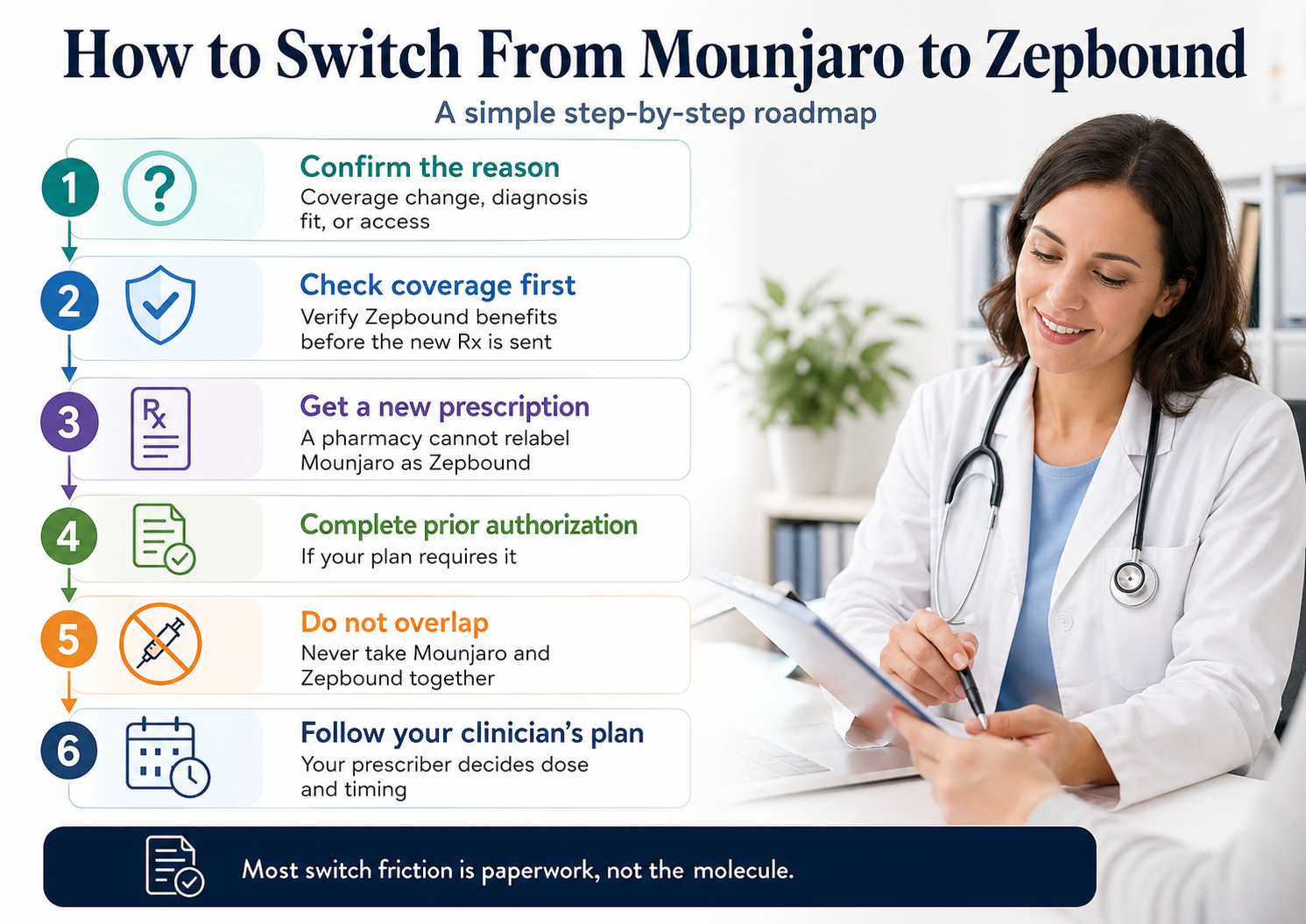
The cleanest version of the switch is six steps: confirm your reason, check your insurance for Zepbound coverage, get a new Zepbound prescription, handle the prior authorization, take your last Mounjaro injection on schedule, and start Zepbound on the day your prescriber recommends. Don’t try to invent your own protocol. Use the order below and the switch will feel boring — which is exactly what you want.
Confirm why you're switching
Insurance change? Indication change? OSA diagnosis? Cash-pay savings? Your reason determines which coverage pathway applies and what documentation your prescriber needs.
Check your Zepbound coverage before the new prescription gets sent
This is the step most people skip and the step that costs them the most. Use Ro's free GLP-1 Insurance Coverage Checker, or call your plan directly using the script above.
Get a new Zepbound prescription
Your existing Mounjaro prescription is closed. Your prescriber writes a brand-new one for Zepbound, ideally specifying the device (single-dose pen, KwikPen, or vial) that matches your access path.
Handle the prior authorization
Either your prescriber's office submits it, or — if you don't want to project-manage your own paperwork — a service like Ro's insurance concierge does it for you. Plan for two to three weeks for a clean PA; appeals add additional time.
Take your last Mounjaro injection on schedule
Don't skip it. Don't double up. Stay on schedule.
Start Zepbound on the day your prescriber recommends
In a clean handoff, that's often your next regular weekly injection day. Same site rotation, same technique. If your device changed (for example, vial instead of pen), get device-specific training before injecting.
 (sponsored affiliate link, opens in a new tab)
Step 2 is where most switches stall. Run a free Zepbound coverage check with Ro →
Will My Side Effects Get Worse?
Both Mounjaro and Zepbound contain tirzepatide, so the expected side effects overlap — nausea, diarrhea, constipation, decreased appetite, and injection-site reactions are the most common. If you experience worse side effects after the switch, the most common cause is a treatment gap or a device/dose change, not the brand itself.
Both medications carry the same FDA boxed warning: a risk of thyroid C-cell tumors observed in animal studies. Both are contraindicated in people with a personal or family history of medullary thyroid carcinoma (MTC) or multiple endocrine neoplasia syndrome type 2 (MEN2). Both should not be combined with another GLP-1 medication.
Logistical causes of worsened side effects (not the brand):
- •Missed doses, treatment gaps, restarting, and dose escalation
- •Doubling up to “catch up” — a reliable way to trigger severe GI symptoms
- •Dose change at the same time as the brand switch
- •Dehydration, especially in summer or after illness
Call your doctor promptly if you have:
- •Severe abdominal pain especially radiating to the back (possible pancreatitis)
- •Persistent vomiting
- •Signs of dehydration
- •Hypoglycemia symptoms (especially if on insulin or sulfonylurea)
- •Any allergic reaction symptoms
If you’re on oral hormonal contraceptives
The Zepbound label states that Zepbound may reduce the efficacy of oral hormonal contraceptives. The label advises switching to a non-oral contraceptive method or adding a barrier method of contraception for 4 weeks after starting Zepbound and for 4 weeks after each dose escalation. Ask your prescriber or pharmacist how this guidance applies to your specific situation.
The OSA Coverage Path Most Readers Don’t Know About
Zepbound received FDA approval in December 2024 for the treatment of moderate-to-severe obstructive sleep apnea (OSA) in adults with obesity. This indication created a coverage rationale separate from weight loss. Many commercial plans — and Medicare Part D — can cover Zepbound under the OSA indication when they would not cover it for weight loss alone, though approval and cost-sharing remain plan-specific.
What you need to access this path:
The $299–$449 Self-Pay Path Mounjaro Doesn’t Have
Eli Lilly sells Zepbound directly to patients through LillyDirect at $299/month for the 2.5 mg vial, $399/month for the 5 mg vial, and $449/month for 7.5–15 mg vials under the Self Pay Journey Program. Mounjaro does not have a comparable manufacturer self-pay vial program in 2026.
$299/month
2.5 mg vial or KwikPen
$399/month
5 mg vial or KwikPen
$449/month
7.5–15 mg vials or KwikPens*
*Requires refill within 45 days. Vial vs. KwikPen vs. single-dose pen pricing differs slightly. Verify at lilly.com before ordering.
Vial vs. KwikPen vs. single-dose pen
The single-dose vial is drawn into a syringe and injected — a brief technique your provider or pharmacist can show you. The KwikPen is a multi-dose autoinjector holding four weekly doses. The single-dose pen is a single-use autoinjector. The single-dose pen sits at the $499 tier through the non-covered commercial savings card. If your presentation changes, get device-specific training before injecting.
Walmart pickup is now an option
Per Lilly’s LillyDirect KwikPen announcement, you can choose free home delivery or in-store pickup at a local Walmart Pharmacy.
TrumpRx alternative
TrumpRx.gov launched February 5, 2026. Per the White House fact sheet, Zepbound through TrumpRx would average $346/month and be as low as $299 depending on dose. Verify the current per-dose checkout price before relying on it.
For the cash-pay reader
Want to start Zepbound at LillyDirect-matched pricing without setting up a separate LillyDirect account? Ro ships the Zepbound KwikPen at LillyDirect-matched pricing and includes the medical visit, prescription review, and ongoing care. The Ro Body membership is $39 the first month, then as low as $74/month with annual prepay. Medication is billed separately.
→ Start Zepbound through Ro at LillyDirect-matched pricing (sponsored affiliate link, opens in a new tab)When You Should NOT Switch From Mounjaro to Zepbound
Don’t switch if Mounjaro is still the on-label medication for your situation and your insurance covers it. If you have type 2 diabetes and your commercial plan or Medicare Part D covers Mounjaro at a low copay, switching to Zepbound usually costs more, not less, because Zepbound’s coverage is built around weight loss and OSA — not diabetes.
You have type 2 diabetes and Mounjaro is covered
Stay on Mounjaro. Switching to Zepbound usually means losing diabetes-based coverage and paying more.
You're stable, tolerating it well, and your monthly cost is manageable
“If it ain't broke” applies to medication too.
You're on insulin or a sulfonylurea and blood sugar control is dialed in
Switching brands during good glucose control adds risk without benefit.
You're hoping the brand change will overcome a weight-loss plateau
A brand switch alone is not a reliable plateau strategy. Talk to your prescriber about dose, adherence, nutrition, activity, sleep, and side effects.
If any of those apply to you, this isn’t the right page. We’d rather you stay informed than push you into a switch that costs you money or risks your diabetes control.
How Long Will the Switch Take?
If you’re paying cash through LillyDirect or a telehealth provider, you can typically have your first Zepbound dose in less than a week after the new prescription is written. If your plan requires prior authorization, expect about two to three weeks. Plan your last Mounjaro injection so the timing of your first Zepbound dose lands on the day your prescriber recommends.
| Path | Time to first Zepbound injection |
|---|---|
| Cash-pay through LillyDirect | About 5–7 days |
| Cash-pay through Ro or Sesame | About 5–7 days |
| Insurance with no prior authorization | 1–2 weeks |
| Insurance requiring prior authorization | About 2–3 weeks (Ro's stated timeline) |
| Insurance requiring appeal after denial | Additional 1–3 weeks depending on plan |
The single best way to avoid a treatment gap: start the coverage check the same week you finish your current Mounjaro pen — not the week after.
Best Path: Your Own Doctor, Ro, Sesame, or LillyDirect?
The best path depends on what you’re missing: a prescriber, insurance help, provider choice, or just fulfillment. For people who already have a cooperative prescriber and are paying cash, your own doctor + LillyDirect is the cheapest all-in route. For people who need insurance paperwork handled, Ro’s insurance concierge is the strongest fit. For people who want video visits and provider choice, Sesame Care lists ongoing care as low as $59/month with an annual subscription.
| Your situation | Best path | Why | Est. monthly cost |
|---|---|---|---|
| Already have a doctor, paying cash | Your doctor + LillyDirect or Walmart pickup | No added membership; lowest-friction; lowest cost | $299–$449 |
| Need a prescriber AND insurance paperwork handled | Ro Body | Insurance concierge submits PA when applicable; ships LillyDirect-matched KwikPen for cash pay | $39 first month + $74–$149/mo membership + medication |
| Want video visits and provider choice | Sesame Care | Marketplace of providers; clear cash-pay structure | As low as $59/mo with annual plan + medication |
| Have Medicare with T2D | Stay on Mounjaro | Part D covers it for diabetes; switching = more expensive | Plan copay |
| Have documented moderate-to-severe OSA on Medicare | Switch to Zepbound through Ro or your sleep clinician | OSA pathway through Part D; cost-sharing varies | Plan-specific |
| Have documented OSA, commercial insurance | Switch to Zepbound through Ro or Sesame | OSA pathway often unlocks Zepbound Savings Card eligibility | As little as $25/mo with covered plan + savings card |
| Uninsured, cheapest FDA-approved path | LillyDirect direct | No membership layer; vials at lowest manufacturer price | $299–$449/mo |
| Not sure which fits | Take our 60-second matching quiz | We route you to the path that fits your specific situation | Free |
The honest reality about Ro Body
Ro Body is not always the cheapest path. If you already have a cooperative doctor and you’re paying cash, your own doctor + LillyDirect saves you the $39 first-month and the $74–$149/month Ro Body membership fee. Why do we still recommend Ro for most switchers? Because the membership fee buys you the one thing that stops most switches dead: the insurance concierge that submits the prior authorization for you. If you’re switching for insurance reasons, you need someone to handle the paperwork — otherwise you’ll spend weeks faxing documents while your Mounjaro supply runs out. Ro absorbs that work into the membership.
Translation: cash-pay + existing prescriber → skip Ro and go direct to LillyDirect. Insurance coverage or OSA documentation → Ro’s membership fee buys peace of mind plus the paperwork service.
Video visits and provider choice. As low as $59/month with annual plan. Medication separate.
Pre-Appointment Checklist + Script (Print This)
The cleanest switch is the one where you walk into the appointment knowing exactly what to ask for. Below is the checklist your prescriber will appreciate and the script that gets the conversation moving.
Bring these to the visit:
Script — what to say to your doctor:
If your doctor pushes back, ask:
Frequently Asked Questions
1.Can I take Mounjaro and Zepbound together?
2.Do I have to start over at 2.5 mg if I switch from Mounjaro to Zepbound?
3.Do I need a new prescription to switch from Mounjaro to Zepbound?
4.Can I use my Mounjaro Savings Card for Zepbound?
5.What if my insurance also denies Zepbound?
6.Is the Zepbound KwikPen the same dose as the Mounjaro pen?
7.Can I switch back to Mounjaro later?
8.Will switching reset my weight loss progress?
9.Does the Zepbound Savings Card work with Medicare?
10.What happens if I miss the 45-day refill window on the LillyDirect $449 price?
11.Should I switch if Mounjaro is working and covered?
12.Can I get Zepbound prescribed online?
13.How will tirzepatide affect my oral birth control?
Still Not Sure Which Path Is Right for You?
Take our free 60-second GLP-1 matching quiz to get a personalized action plan based on your insurance, indication, and budget — no email gate, no sales call.
$39 first month if you become a patient, as low as $74/month with annual plan. Medication billed separately.
As low as $59/month with annual subscription. Medication separate.
How We Keep This Guide Accurate
GLP-1 pricing, savings card terms, FDA labels, and insurance coverage shift constantly. We re-verify every commercial claim on this page on a quarterly cadence — sooner when a triggering event happens (a Lilly press release, a CMS rule change, a major PBM formulary update). The “Last verified” date at the top of the page reflects the most recent full review. If something on this page no longer matches what you’re seeing in 2026, let us know and we’ll fix it.
Sources
- Zepbound prescribing information — DailyMed (NIH National Library of Medicine)
- Mounjaro prescribing information — DailyMed
- FDA approval announcement, Zepbound for chronic weight management (November 2023)
- FDA approval announcement, Zepbound for OSA (December 2024)
- Lilly Zepbound savings and self-pay pricing
- Lilly LillyDirect Zepbound page
- Lilly Self Pay Journey Program full terms
- Lilly press release, Zepbound vial price reduction (December 1, 2025)
- Lilly Mounjaro savings card terms
- Lilly Mounjaro FAQ (list price)
- Lilly Zepbound pricing information
- Lilly Mounjaro pricing information
- Ro Body weight-loss pricing (sponsored affiliate link, opens in a new tab)
- Ro Zepbound page (sponsored affiliate link, opens in a new tab)
- Ro GLP-1 Insurance Coverage Checker (sponsored affiliate link, opens in a new tab)
- Sesame Care online weight-loss program (sponsored affiliate link, opens in a new tab)
- CVS Caremark formulary update on GLP-1s
- CMS Medicare GLP-1 Bridge demonstration
- Washington Academy of Family Physicians, GLP-1 switching guidance
- White House fact sheet on TrumpRx.gov launch (February 2026)
Related guides
- How to Switch From Zepbound to Mounjaro: 2026 Checklist
- Mounjaro vs Wegovy for PCOS: An Honest Comparison (2026)
- Zepbound for Sleep Apnea: Coverage and Eligibility
- Cheapest Way to Get Zepbound Without Insurance (2026)
- Does Insurance Cover Zepbound for Weight Loss?
- Medicare GLP-1 Bridge Program: Full Eligibility Guide
- Zepbound Savings Card: Terms, Limits, and Eligibility
- Does Medicare Cover Zepbound in 2026?
· By The RX Index Team · Next re-verification: July 2026. This page is not medical or legal advice. The RX Index may earn affiliate commissions when readers sign up with telehealth providers featured on this page, including Ro and Sesame Care. Affiliate relationships are disclosed at the top of this page. Provider rankings are based on verified fit for the specific search intent on each page — not on Not affiliated with Eli Lilly, the FDA, or any government agency. Both Mounjaro and Zepbound are FDA-approved brand-name medications; that’s the lane this guide covers. If something is out of date, let us know and we’ll fix it within 48 hours.