
By The RX Index Editorial Team · · Pricing intelligence and comparison resource for GLP-1 telehealth providers.
How to Switch From Zepbound to Mounjaro: 2026 Step-by-Step Guide
If you’re trying to figure out how to switch from Zepbound to Mounjaro without losing progress, restarting at 2.5 mg, or paying $1,000 you didn’t budget for, you’re in the right place. Here’s the bottom line: both medications are tirzepatide, made by Eli Lilly, in the same six adult dose strengths (2.5 mg, 5 mg, 7.5 mg, 10 mg, 12.5 mg, 15 mg). For a stable adult patient with no missed doses, switching is usually a paperwork event that your prescriber can complete at the same milligram dose.
The hard part is rarely the medicine. The hard part is the insurance pathway, because Mounjaro and Zepbound have different FDA-approved indications and your plan will treat them differently. There’s also a very specific scenario — if you don’t have type 2 diabetes — where switching to Mounjaro is the wrong move and you’ll save thousands by staying on Zepbound through Lilly’s self-pay program. We’ll show you exactly which path is yours.
Jump to what you need:
- The answer at a glance (quick Q&A table)
- Are Zepbound and Mounjaro the same medication?
- Why 12 million people lost Zepbound coverage
- Do you restart at 2.5 mg or stay at your current dose?
- The 5-step switch protocol
- Will insurance cover Mounjaro?
- What switching actually costs in 2026
- Three cases when you should NOT switch
- What to ask your prescriber
- Three real risks of switching
- Full switching FAQ (15 questions)
The Answer at a Glance
| Question | Bottom line |
|---|---|
| Are Zepbound and Mounjaro the same drug? | Same molecule (tirzepatide), same manufacturer (Lilly), overlapping adult dose strengths. Different FDA-approved indications and insurance pathways. |
| Do I have to restart at 2.5 mg? | Usually no. Most stable patients with no missed doses continue at the same milligram dose with their prescriber's confirmation. |
| Do I need a new prescription? | Yes. Your prescriber writes Mounjaro; the pharmacy cannot substitute. |
| When do I take the first Mounjaro shot? | On your normal weekly day, after your last Zepbound dose, per your prescriber's instructions. Don't overlap. |
| Will my insurance cover Mounjaro? | Often yes for type 2 diabetes. Usually no for weight loss alone. |
| What will it cost? | As little as $25 for a 1-, 2-, or 3-month fill (covered commercial insurance + Mounjaro Savings Card). Mounjaro list price is $1,112.16 for a 28-day supply. Zepbound through Lilly's self-pay program is $299–$449/month. |
| Should I switch? | If you have type 2 diabetes: usually yes. If you don't: probably not — there's a cheaper Zepbound path most people miss. |
Answer 4 quick questions — get a checklist with exact prescriber and insurer language. Free, no email required.
What We Actually Verified for This Guide
Are Zepbound and Mounjaro the Same Medication?
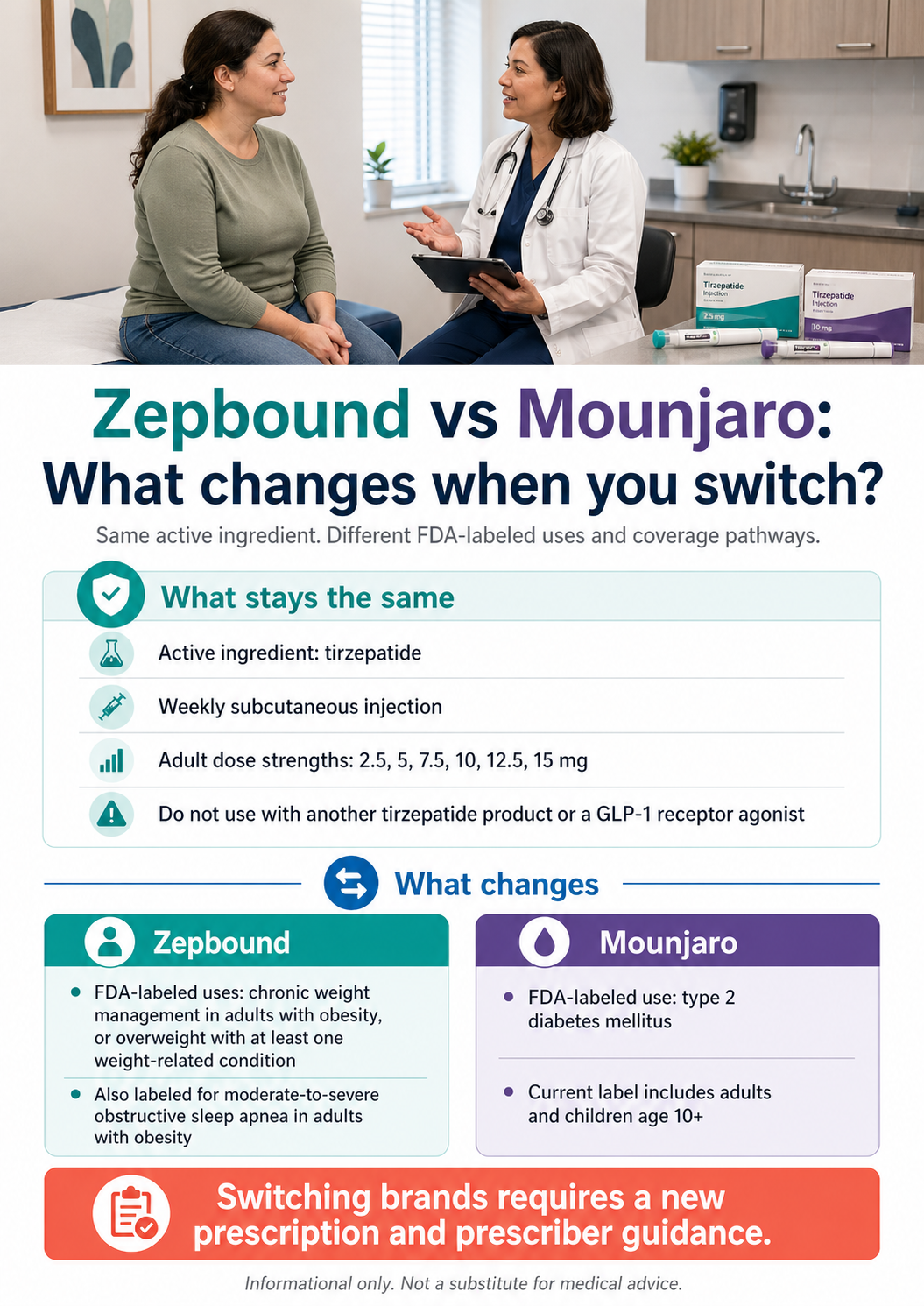
Yes — pharmacologically. Zepbound and Mounjaro both contain tirzepatide as the active ingredient and are manufactured by Eli Lilly. Both come in the same six adult dose strengths (2.5 mg, 5 mg, 7.5 mg, 10 mg, 12.5 mg, 15 mg). The practical difference for this switch is the FDA-approved indication and the insurance pathway, not the molecule.
Tirzepatide is a dual-agonist medication — it activates two gut-hormone receptors at once: glucose-dependent insulinotropic polypeptide (GIP) and glucagon-like peptide-1 (GLP-1). Both products work through the same receptors at the same dose strengths.
Lilly received its first FDA approval for tirzepatide in May 2022 to treat type 2 diabetes — that’s Mounjaro. In November 2023, the FDA approved tirzepatide for chronic weight management — that’s Zepbound. In December 2024, the FDA expanded Zepbound’s approval to include moderate-to-severe obstructive sleep apnea (OSA) in adults with obesity — a unique indication Mounjaro doesn’t have.
Not sure which path is right for you? Take the free 60-second quiz →
What stays the same after the switch
- ✓The active ingredient (tirzepatide)
- ✓The manufacturer (Eli Lilly)
- ✓The adult dose strengths (2.5–15 mg)
- ✓The weekly subcutaneous injection schedule
- ✓Most safety considerations
What can change
- →The brand name on the prescription
- →The FDA-approved indication being treated
- →The product presentation and storage for the pen or vial dispensed
- →Your insurance coverage and out-of-pocket cost
- →The savings card you're eligible for
Why So Many People Are Searching This Right Now
The trigger event was CVS Caremark removing Zepbound from its Standard, Advanced Control, and Value formularies effective July 1, 2025. CNN reported the change applied to a CVS Caremark template covering 25–30 million people. Across all PBMs combined, GoodRx estimates 12 million people lost Zepbound coverage between 2025 and 2026. Many of those patients want to stay on tirzepatide rather than switch to a different molecule — which is why this search exists.
CVS Caremark made Wegovy the preferred GLP-1
CVS Caremark removed Zepbound from its Standard, Advanced Control, and Value formularies effective July 1, 2025, and made Wegovy the preferred GLP-1 for chronic weight management. CVS Caremark's own client communication described this as a “formulary strategy” that uses competition to lower costs while maintaining clinically appropriate coverage.
The switch rate spiked 16x
An exclusive analysis by Truveta for CNN found that about 1 in 10 Zepbound users switched GLP-1 in July 2025 — roughly 16 times the typical rate. More than 8 in 10 of those switchers went to Wegovy.
A class-action lawsuit was filed
A class-action lawsuit was filed in September 2025 by patients who lost Zepbound coverage and felt the forced switch to Wegovy was clinically inappropriate. CVS Caremark has said its strategy “uses competition to drive lower costs while maintaining clinically appropriate coverage.”
Other PBMs followed
PSG Consults' 2026 formulary analysis confirmed CVS Caremark wouldn't change GLP-1 coverage for January 2026, but other plan-specific changes affecting Zepbound appeared across the 2026 plan year.
The reason “switch to Mounjaro” gets searched at scale is that Wegovy contains semaglutide — a different molecule than tirzepatide. Patients who responded well to tirzepatide and don’t want to start over on a different drug see Mounjaro — same molecule, different brand — as the obvious workaround. Sometimes it works. Sometimes it doesn’t. The rest of this page tells you which one you’re in.
Before you talk to anyone, run a free coverage check
Ro offers a free GLP-1 Insurance Coverage Checker — no account, no credit card, takes about 60 seconds. It tells you what your specific plan currently covers for FDA-approved GLP-1 medications, including Zepbound. That answer drives every other decision on this page.
→ Run my free coverage check (sponsored affiliate link, opens in a new tab)Free. No commitment. No email required.
Do You Restart at 2.5 mg or Stay at Your Current Dose?
Most stable patients with no missed doses continue at the same milligram dose. Because Zepbound and Mounjaro contain the same tirzepatide molecule at the same adult dose strengths, prescribers commonly write the new Mounjaro prescription at your current Zepbound dose. The decision still belongs to your prescriber — but the answer for a typical no-gap, well-tolerated switch is “same dose.”
Three real situations where a lower restart dose makes sense
Situation 1: You missed two or more weekly doses
Insurance delays, pharmacy supply gaps, and prior-authorization waits can stretch into multiple weeks. After a significant gap, restarting at a lower dose reduces the risk of severe gastrointestinal side effects.
Situation 2: You had intolerable side effects on your current Zepbound dose
If nausea, vomiting, or other GI symptoms were already a problem, a brand switch is a natural moment to drop down a step.
Situation 3: You're starting Mounjaro for a new indication
If you were on Zepbound for weight loss and you're now starting Mounjaro for newly diagnosed type 2 diabetes, your clinician may want to recalibrate alongside other diabetes medications.
What if your insurance starts you over at 2.5 mg?
Some plans automatically require step-therapy starting at the lowest dose for a new prescription, even when the patient has been stable on a higher dose of the same molecule. If that happens to you, ask your prescriber to submit a continuation-of-therapy request documenting your current dose, last injection date, and tolerability. Most insurers have a pathway for this — they just don’t volunteer it.
Dose Conversation Table — Bring This to Your Visit
| Your situation | What to ask your prescriber |
|---|---|
| Stable on current Zepbound dose, no missed doses | “Can the new Mounjaro prescription match my current milligram dose, or is there a reason to adjust?” |
| Due for a dose increase soon | “Should the Mounjaro prescription match my current dose, or move to the next planned step?” |
| Missed 2+ weeks due to insurance/supply | “Should I restart at a lower dose to reduce GI side effects?” |
| Had nausea/vomiting/dehydration on current dose | “Should we use the switch as a chance to drop down a step?” |
| Take insulin or sulfonylureas | “Do my diabetes medications need adjusting to prevent low blood sugar?” |
| Take oral contraceptives | “Do I need backup contraception if this is treated as a new start or includes a dose change?” |
| Insurance starting you at 2.5 mg | “Is this a clinical decision or an insurance step-therapy requirement? Can we file a continuation-of-therapy request?” |
Lilly’s safety information specifies that oral contraceptives may be less effective during the first 4 weeks of starting Mounjaro and after each dose increase. If a brand switch is being treated as a “new start,” the same backup-contraception window applies.
How Do You Switch From Zepbound to Mounjaro? The Five-Step Protocol
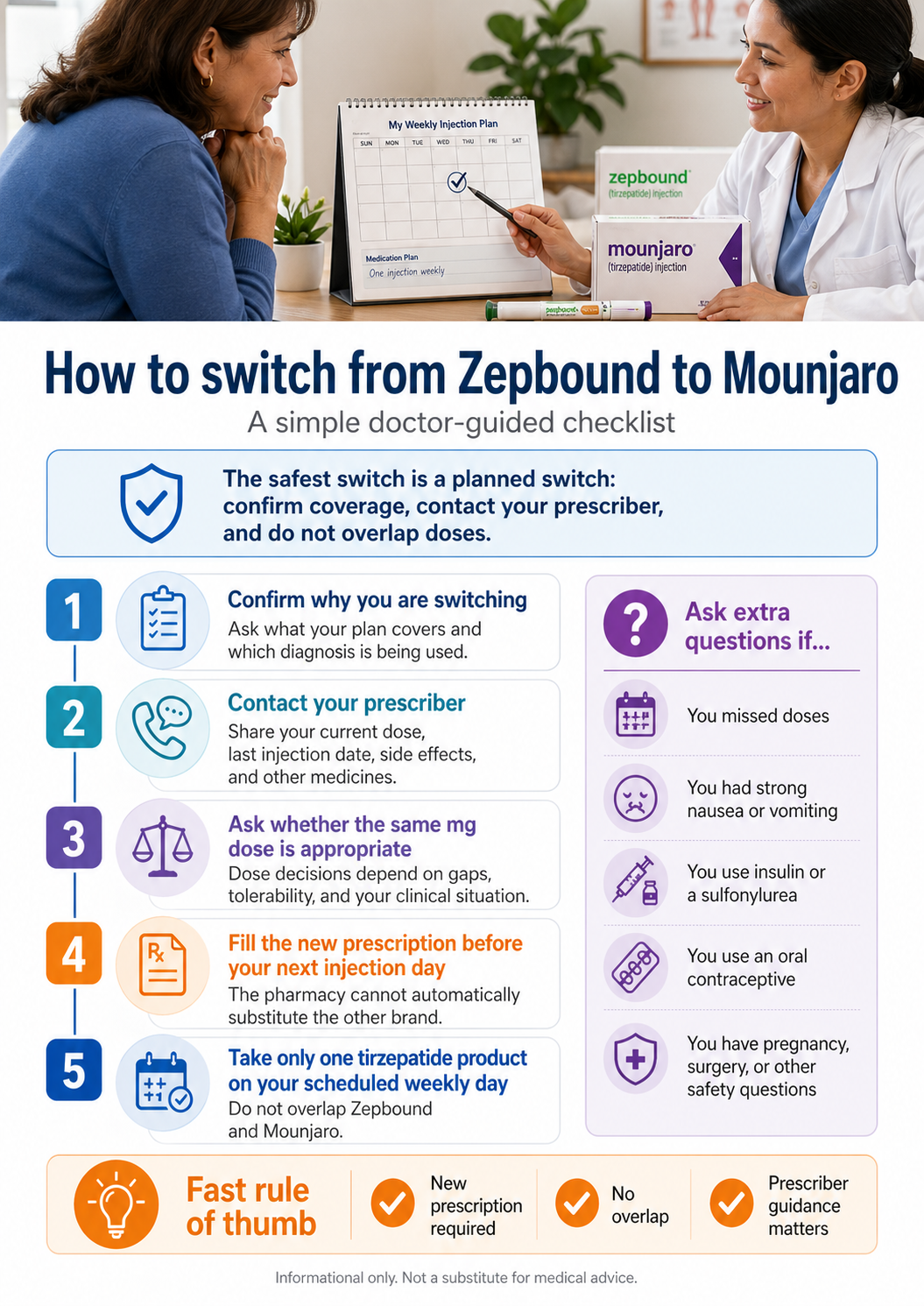
Five steps. (1) Verify your insurance coverage for Mounjaro on your specific indication. (2) Talk to your prescriber with the right script. (3) Have the new Mounjaro prescription written at your current Zepbound dose. (4) Fill it before your last Zepbound dose wears off — don’t overlap. (5) Inject Mounjaro on your normal weekly day per your prescriber’s direction. For stable patients with no gap, the body experience shouldn’t change just because the brand label did.
⚠️ Before you start: Tirzepatide safety essentials
Whether you’re on Zepbound or Mounjaro, the same active-ingredient safety rules apply:
- •Do not use with other tirzepatide-containing products or any GLP-1 receptor agonist medication. Don't overlap doses.
- •Do not use if you or any family member has had medullary thyroid carcinoma (MTC) or Multiple Endocrine Neoplasia syndrome type 2 (MEN 2).
- •Watch for signs of pancreatitis (severe abdominal pain), serious allergic reaction, gallbladder problems, dehydration, vision changes, and severe stomach problems.
- •Risk of low blood sugar is higher when used with insulin or sulfonylureas.
- •Tell every healthcare provider you take tirzepatide before any surgery or procedure involving anesthesia or deep sedation.
- •Oral contraceptive users may need backup contraception for 4 weeks after starting and after each dose increase.
- •Discuss with your prescriber before, during, and after pregnancy, planned pregnancy, or breastfeeding.
This is the short version. The full prescribing information for both products is on lilly.com.
Before you book the visit, confirm what your plan currently covers. Three options:
- •Run a free coverage checker. Ro's GLP-1 Insurance Coverage Checker is free, no account required.
- •Call your PBM directly. Use the Insurance Call Script in the insurance section below.
- •Pull up your formulary online. Most insurer portals let you search “Mounjaro” and “Zepbound” against your specific plan ID.
What you need to confirm:
- ✓Is Mounjaro on your formulary and what's the copay tier?
- ✓Is Zepbound on your formulary and what's its current status?
- ✓Is prior authorization required for either?
- ✓Is step therapy required?
- ✓What documentation will the PBM require?
Bring a script. Pick the one that matches your situation:
Script A — Forced switch from Zepbound
“My PBM removed Zepbound from the formulary effective [date]. I've been stable on [dose] mg with [percent or pounds] weight loss and no significant side effects. I'd like to discuss two options before letting them switch me to a different molecule: (1) a formulary exception request to keep Zepbound, and (2) a new prescription for Mounjaro at the same dose if my insurance will cover it for any of my conditions. Can we look at my chart together?”
Script B — New type 2 diabetes diagnosis
“I have a new diagnosis of type 2 diabetes confirmed by A1C of [value] on [date]. I'm currently on Zepbound [dose] mg. Since Mounjaro is FDA-approved for type 2 diabetes and contains the same tirzepatide molecule at the same dose, I'd like to switch to Mounjaro at my current dose to potentially get better insurance coverage.”
Script C — Documenting OSA to keep Zepbound
“I have moderate-to-severe obstructive sleep apnea documented by sleep study on [date], AHI of [value], BMI of [value]. Zepbound is FDA-approved for OSA in adults with obesity. I'd like to make sure my Zepbound prescription is correctly coded with both the obesity (E66.x) and OSA (G47.33) ICD-10 codes — that may change my insurance outcome. If we can't keep Zepbound covered, I'd like to discuss switching to Mounjaro at the same dose.”
When the new prescription goes to the pharmacy, confirm three things:
- 1.Dose strength matches what you've been taking (e.g., Mounjaro 10 mg if you've been on Zepbound 10 mg) — assuming your prescriber agrees.
- 2.Form factor. Mounjaro is currently dispensed as a pre-filled single-dose pen. Don't let the pharmacy auto-substitute a form factor your prescriber didn't authorize.
- 3.Quantity and refills. A 3-month fill is often allowed and unlocks the best Mounjaro Savings Card pricing tier.
Day 0
Take your last Zepbound injection on your normal weekly day. Don't skip it.
Days 1–6
Pick up Mounjaro from the pharmacy. Don't wait until the day-of.
Day 7
Take your first Mounjaro injection on the same weekly day. Same milligram dose. No overlap.
How long after Zepbound can you take Mounjaro? The standard prescriber-guided answer is “on your next scheduled weekly injection day, seven days after your last Zepbound dose.” If insurance approval gets delayed, ask your prescriber whether to bridge or wait — don’t decide on your own.
Continue your regular weekly cadence per your prescriber. For a same-dose, no-gap switch, your appetite, side-effect pattern, and weight-loss trajectory shouldn’t change just because the brand on the box did. If you do notice meaningful changes, check in with your clinician.
 (sponsored affiliate link, opens in a new tab)
Need a prescriber comfortable handling the switch? See providers on Sesame Care →
The 4-Date Switch Checklist
Write these down and bring them to every conversation — prescriber, pharmacy, insurance:
Need a prescriber who handles brand switches?
If your current prescriber isn't comfortable handling the switch — or you don't have one — Sesame Care has public Mounjaro and Zepbound pages and says its weight-loss program includes insurance paperwork support. Success by Sesame starts at $59/month with annual prepay or $99/month, separate from medication. Verify state availability and current pricing on Sesame's site before booking.
→ See Sesame Mounjaro pricing and providers (sponsored affiliate link, opens in a new tab)Verify state availability before booking.
Will My Insurance Cover Mounjaro?
Often yes for type 2 diabetes. Usually no for weight loss alone. Mounjaro is FDA-approved for type 2 diabetes only, so many commercial plans cover it for that indication. For weight loss without a T2D diagnosis, off-label coverage is uncommon and usually denied. There are documented exceptions — including some CVS Caremark patients receiving Mounjaro coverage without diabetes via formulary exception — but those are not guaranteed pathways.
The Tirzepatide Brand Switch Coverage Matrix (2026)
Verify against your specific plan documents before acting — formularies change quarterly. Items we couldn’t verify against published sources are marked.
| PBM / Insurer | Mounjaro for T2D | Mounjaro for weight loss (no T2D) | Zepbound for weight loss | Zepbound for OSA + obesity | Notes |
|---|---|---|---|---|---|
| CVS Caremark | Covered, Tier 2 | Generally not covered; some patients received approval via formulary exception when stable on tirzepatide (observed practice; not policy) | Removed from Standard, Advanced Control, Value formularies effective July 1, 2025; no GLP-1 changes for 2026 | Removed alongside weight loss; exception possible | Wegovy is the preferred GLP-1 for weight loss; exception process initiated by prescriber |
| OptumRx | Covered for T2D, plan-dependent | Generally not covered for weight loss only | Plan-dependent; broader templates than CVS Caremark in many cases [plan-specific verification needed] | Plan-dependent | Some plans require step therapy through Wegovy first |
| Express Scripts | Covered for T2D, plan-dependent | Generally not covered for weight loss only | Plan-dependent [plan-specific verification needed] | Plan-dependent | Self-funded employer plans vary widely |
| Aetna (CVS Health-owned) | Covered for T2D, plan-dependent | Generally not covered | Aligns with CVS Caremark in many cases | Aligns with CVS Caremark | Aetna formulary administered via CVS Caremark |
| Cigna | Covered for T2D, plan-dependent | Generally not covered | Plan-dependent [plan-specific verification needed] | Plan-dependent | Express Scripts is the PBM; formulary varies |
| UnitedHealthcare (OptumRx) | Covered for T2D, plan-dependent | Generally not covered | Plan-dependent | Plan-dependent | Confirm appeal-window timing in writing — published reports suggest it may be shorter than other major insurers |
| BCBS (varies by state) | Covered for T2D, plan-dependent | Generally not covered for weight loss alone | Highly plan-dependent | Plan-dependent | Federal Employee Program (FEP Blue) has made 2026 formulary changes affecting Zepbound — confirm your specific plan |
| Medicare Part D | Covered for T2D | Not covered (Part D excludes weight-loss-only indications) | Not covered for weight loss; potentially covered for the FDA-approved OSA indication with PA [plan-specific] | Potentially covered for OSA per Part D, plan-dependent | Mounjaro Savings Card cannot be used by Medicare patients; LillyDirect self-pay is allowed |
| Medicaid (varies by state) | Generally covered for T2D | Generally not covered | Highly state-dependent | State-dependent | Check your state Medicaid formulary directly |
Insurance Call Script
Don’t call your PBM and ask vague questions. Ask these in order:
“Hi, I’m calling about prescription coverage for two specific medications. My member ID is [number].
First — is Mounjaro on my formulary, and what’s the copay tier? Is prior authorization required? Is step therapy required?
Second — same questions for Zepbound. What’s its current status on my plan?
Third — if Zepbound was denied because it’s considered a weight-loss medication, would Mounjaro be reviewed under my diabetes drug benefit instead, with a type 2 diabetes diagnosis? What documentation would my prescriber need to submit?
Fourth — what are the standard and urgent prior authorization decision timelines for my plan?
Can you send me a written summary of this conversation, including any prior authorization criteria?”
Get it in writing. PBM phone reps can give different answers on different days. The written summary protects you.
Prior Authorization Document Checklist
Pull these together before the visit. Faster paperwork = faster approval.
What Switching Actually Costs in 2026
Mounjaro list price is $1,112.16 for a 28-day supply per Eli Lilly. With covered commercial insurance and the Mounjaro Savings Card, eligible patients can pay as little as $25 for a 1-, 2-, or 3-month fill. Without commercial insurance — including Medicare and Medicaid — the savings card is not available. If you’re staying on Zepbound, Lilly’s Self Pay Journey Program runs $299–$449/month — often the cheapest legitimate path for non-T2D patients who lost coverage.
The Six-Scenario Cost Truth Table
| Your situation | Brand to ask for | Path | Monthly cost (verify before acting) |
|---|---|---|---|
| Have T2D + commercial insurance covers Mounjaro | Mounjaro | Insurance + Mounjaro Savings Card | As low as $25 for a 1-, 2-, or 3-month fill |
| Have T2D + commercial insurance does NOT cover Mounjaro | Mounjaro | Mounjaro Savings Card alone | As low as $499 for 1-month fill |
| No T2D, weight loss only, insurance dropped Zepbound | Stay on Zepbound (often the cheapest path) | Zepbound Self Pay Journey Program (vials or KwikPen) | $299 (2.5 mg) / $399 (5 mg) / $449 (7.5–15 mg) |
| No T2D, weight loss, willing to pay cash for Mounjaro off-label | Mounjaro | Cash pay through telehealth (e.g., Sesame) | Approaches list price (~$1,112/month) plus subscription |
| Medicare or Medicaid + T2D | Mounjaro | Plan coverage | Plan copay; Mounjaro Savings Card not available |
| Medicare or Medicaid, no T2D | Zepbound (OSA pathway if applicable) or Lilly self-pay | Part D for OSA, or Lilly cash | OSA pathway plan copay; Self Pay Journey $299–$449 |
Mounjaro Savings Card — 2026 Terms
Commercial insurance that covers Mounjaro:
- •As low as $25 for a 1-, 2-, or 3-month single-dose pen fill
- •Max savings: $150/1-month fill; $300/2-month; $450/3-month
- •Annual maximum: $1,950 per calendar year
- •Up to 13 fills per calendar year
- •Card expires 12/31/2026
Commercial insurance that does NOT cover Mounjaro:
- •As low as $499 for a 1-month single-dose pen fill
- •Max monthly savings: up to $647
- •Annual maximum: $8,411 per calendar year
- •Up to 13 fills per calendar year
Not eligible: Medicare, Medicaid, TRICARE, DoD/VA, or any state pharmaceutical assistance program enrollees.
Zepbound Self Pay Journey — 2026 Terms
⚠️ 45-day refill rule: Refill must be completed within 45 days of previous delivery to maintain pricing on higher-dose tiers.
- ✓ New and existing patients eligible
- ✓ No insurance required
The most important cost insight on this page
If you’re searching this because your PBM dropped Zepbound and you don’t have type 2 diabetes, switching to Mounjaro is probably the wrong move. Mounjaro is unlikely to be covered for weight loss either. You’ll end up paying close to Mounjaro’s $1,112/month list price through telehealth (plus a subscription) instead of $449/month cash through Zepbound’s Self Pay Journey Program — for the exact same molecule.
The math: $1,112 minus $449 = $663/month, or roughly $7,958/year before any provider subscription fees. Skipping the brand switch and going to LillyDirect Zepbound saves it.
This is the damaging admission of the page. We’re saying it because it’s true, even though the affiliate revenue argument would push us the other way. Your real decision isn’t “Zepbound or Mounjaro.” It’s “covered insurance path” vs “best self-pay path.”
If you have T2D and want Mounjaro
Sesame Care has public Mounjaro pricing and prescribes via licensed providers in their network. Success by Sesame is $59/month with annual prepay or $99/month, separate from medication.
→ See current Mounjaro pricing on Sesame (sponsored affiliate link, opens in a new tab)Verify state availability and current pricing before booking.
If you don't have T2D and your insurance dropped Zepbound
Run a free coverage check first to confirm exactly where you stand on Zepbound coverage, then look at Lilly's Self Pay Journey Program.
→ Run my free coverage check (Ro) (sponsored affiliate link, opens in a new tab)Free. No commitment. Tells you what your plan actually covers.
When You Should NOT Switch — Three Honest Cases
This is where most affiliate sites lose your trust. They tell you to switch because switching converts. We’re going to tell you exactly when not to — because the readers we send to the wrong path don’t come back next month.
Case 1: You Have OSA + Obesity — Zepbound Has a Unique FDA Approval
Zepbound is FDA-approved for moderate-to-severe obstructive sleep apnea in adults with obesity. Mounjaro is not. This unique approval, added in December 2024, can change your coverage outcome. Some plans that dropped Zepbound for “weight loss” still cover it specifically for OSA when correctly coded — though this is plan-specific and not guaranteed. If you have a documented sleep study with an Apnea-Hypopnea Index qualifying you as moderate-to-severe OSA, ask your prescriber to add the G47.33 ICD-10 code to your Zepbound prescription. Switching to Mounjaro can never reach the OSA pathway.
Case 2: No T2D + Weight Loss Goal — LillyDirect Zepbound Is Cheaper
Run the math from the cost table above. Cash Mounjaro through telehealth: approaches $1,112/month list price + subscription. Lilly's Self Pay Journey Program for Zepbound: $299–$449/month with no insurance required. The difference is roughly $7,958/year for the same molecule. The only reason to chase Mounjaro in this scenario is if you believe you can find a sympathetic prescriber to document an off-label diagnosis. That's a strategy we don't recommend — it puts both you and the prescriber at compliance risk.
Case 3: Stable Zepbound Prior Authorization — Don't Break What's Working
If you currently have an active Zepbound prior authorization with refills remaining, breaking that to chase a Mounjaro PA can leave you uncovered for both. Prior authorizations don't always transfer cleanly between brands, and the gap between cancellation of one and approval of another can stretch into weeks. If your Zepbound is currently being filled with a working PA, the question isn't “should I switch to Mounjaro.” It's “what triggers a Zepbound coverage review on my plan, and how do I avoid that trigger.”
What to Ask Your Prescriber Before Switching
Ask operational questions, not just “can I switch.” Your prescriber needs your current dose, last injection date, side-effect history, diabetes medication list, insurance reason for switching, and whether there’s been any gap. Bring this list with you.
The 10-Question Prescriber Checklist
Prescriber Portal Message Template
Copy and paste, fill in the blanks:
“Hi Dr. [Name],
I’m currently on Zepbound [dose] mg weekly. My last injection was [date]. My insurance [stopped covering Zepbound effective [date] / now covers Mounjaro under my diabetes benefit / requires prior authorization].
I’d like to discuss switching to Mounjaro at the same dose. Can you confirm:
- Whether the switch is clinically appropriate for me
- What dose and timing you recommend
- What diagnosis or documentation you’d submit for coverage
If easier, I can come in for a visit. Otherwise, please send the new prescription to [pharmacy] when you’re able. Attached: my Zepbound denial letter, my current med list, and my last A1C.
Thank you,
[Name]”
What If Your Doctor Refuses the Switch?
Most prescribers will discuss the switch when you bring documentation. If yours declines, the path forward is either a second opinion within your existing practice or a telehealth provider comfortable handling brand-switching paperwork. You don’t have to keep paying out of pocket for a stand-off with your current prescriber.
Bring documentation
A specific request with your stable dose history, weight loss percentage, and insurance letter is harder to refuse than a vague ask.
Ask for a referral
If your PCP won't write it, ask for an endocrinology, obesity medicine, or weight management referral.
Get a second opinion in the same practice
Most multi-provider practices allow patient-initiated transfers between clinicians.
Use a telehealth platform
Sesame Care has public Mounjaro and Zepbound pages and says its weight-loss program includes insurance paperwork support.
If you need a prescriber comfortable handling the brand switch
Sesame Care lets you choose your provider, has public Mounjaro and Zepbound pricing, and says its program includes insurance paperwork support. Subscription is $59/month with annual prepay or $99/month, separate from medication. Verify state and provider availability before booking.
→ See Sesame providers (sponsored affiliate link, opens in a new tab)Verify state and provider availability before booking.
Three Real Risks of Switching No One Tells You
These aren’t dealbreakers. They’re things to plan around. Each has a one-line mitigation.
Mounjaro experienced supply constraints throughout 2022–2024 and intermittently afterward. Even with the FDA shortage list cleared, individual pharmacies can run out of specific dose strengths. If your prescription is for Mounjaro 10 mg and your pharmacy only has 7.5 mg in stock, you can lose a week.
If your insurance approved Zepbound through prior authorization and you cancel it to chase a Mounjaro PA, you can be uncovered for both during the transition. PA approvals don't always transfer cleanly, and the gap can stretch from days to weeks.
The Mounjaro Savings Card and the Zepbound Savings Card are separate programs with different terms. The Mounjaro card has its own annual maximum ($1,950 with covered commercial insurance; $8,411 with non-covering commercial insurance). Don't assume what worked on one will carry over.
Switching FAQ
1.Do I have to restart at 2.5 mg when switching from Zepbound to Mounjaro?
2.Can I switch back to Zepbound later?
3.Will my side effects get worse after the brand switch?
4.Do I need new bloodwork when switching brands?
5.Can you take Zepbound and Mounjaro at the same time?
6.What if my pharmacy is out of my Mounjaro dose?
7.Does the Mounjaro Savings Card work without commercial insurance?
8.Can Medicare patients use the Mounjaro Savings Card?
9.Can I use my unused Zepbound pens after starting Mounjaro?
10.How long does Mounjaro prior authorization usually take?
11.What if my insurance denies Mounjaro too?
12.Is compounded tirzepatide an option if both brands are denied?
13.Can my doctor write a 3-month supply at the new brand?
14.How is switching to Mounjaro different from switching to Wegovy?
15.Will switching from Zepbound to Mounjaro break my weight-loss plateau?
Sources We Verified
- •U.S. Food and Drug Administration. FDA Approves New Medication for Chronic Weight Management (Zepbound, November 2023).
- •U.S. Food and Drug Administration. FDA Approves First Medication for Obstructive Sleep Apnea (Zepbound, December 2024).
- •Eli Lilly and Company. Mounjaro prescribing information, indications, and savings card program.
- •Eli Lilly and Company. Zepbound prescribing information, savings options, and Self Pay Journey Program.
- •Eli Lilly and Company. Lilly and U.S. government agree to expand access to obesity medicines. November 2025.
- •CVS Caremark. Enabling wider access to effective weight management treatment. Business client publication, May 2025.
- •PSG Consults. 2026 Formulary Changes: CVS Caremark. December 2025.
- •GoodRx, cited by NPR. Patients struggle to pay for obesity drugs as insurance coverage slips. April 2026.
- •CNN with Truveta. CVS Caremark stopped covering a GLP-1 for obesity. Now there's a lawsuit. September 2025.
- •SingleCare. What to know about switching from Zepbound to Mounjaro. September 2025, with clinical pharmacist Jodie Pepin, Pharm.D.
- •Drugs.com. Zepbound vs Mounjaro: Comparison Guide. February 2026.
- •Sesame Care. Medication and weight-loss program pricing pages. (sponsored affiliate link, opens in a new tab)
- •Ro. Weight loss program pricing and tirzepatide page. (sponsored affiliate link, opens in a new tab)
Still Not Sure Which GLP-1 Path Is Right for You?
Take our free 60-second matching quiz. Answer a few questions about your current situation, insurance, and goals, and we’ll route you to the right starting point — including which brand to ask for, which prescribers to consider in your state, and your realistic out-of-pocket cost.
No signup. No email required. Free.
Check Zepbound and Wegovy coverage with Ro → (sponsored affiliate link, opens in a new tab)See Mounjaro providers and pricing on Sesame Care → (sponsored affiliate link, opens in a new tab)Related guides
- Mounjaro vs Wegovy for PCOS: 2026 Verdict
- Zepbound for Sleep Apnea: Coverage and Eligibility
- Cheapest Way to Get Zepbound Without Insurance (2026)
- How to Appeal a Zepbound Insurance Denial
- Does Insurance Cover Zepbound for Weight Loss?
- Zepbound Savings Card: Full Terms, Limits, and Eligibility
- CMS BALANCE Model GLP-1 Eligibility 2026
- GLP-1 FDA Approvals Timeline: Every Drug & Date (2005–2026)
· By The RX Index Editorial Team · Next re-verification: June 2026. This page is not medical or legal advice. The RX Index may earn affiliate commissions when readers sign up with telehealth providers featured on this page, including Ro and Sesame Care. Affiliate relationships are disclosed at the top of this page. Provider rankings are based on verified fit for the reader’s situation. Not affiliated with Eli Lilly, Novo Nordisk, CVS Caremark, or any PBM. If something is out of date, let us know and we’ll fix it within 48 hours.