
Does VA Cover GLP-1 Medications? VA Rules for Wegovy, Zepbound, Ozempic & Mounjaro (2026 Guide)
Does VA cover GLP-1 medications? Yes — under specific pathways. But “does VA cover GLP-1” is actually four different questions hiding inside one, and that's why veterans keep getting contradictory answers from their providers, the call center, and Reddit.
Through VA health care, Wegovy and Zepbound can be prescribed for chronic weight management when you meet the current Criteria for Use — documented MOVE! participation plus BMI of 30 or higher with at least one weight-related condition. Ozempic and Mounjaro have separate VA criteria for type 2 diabetes only — not weight loss. CHAMPVA, TRICARE Prime/Select, and TRICARE For Life follow entirely different rule sets.
The real reason most veterans get denied isn't lack of coverage. It's asking under the wrong pathway. We'll show you exactly which pathway you're on, the criteria your VA pharmacist actually reviews, and the message to send your VA primary care provider this week.
Find your situation in 30 seconds
| If this is you | Short answer | First step |
|---|---|---|
| VA-enrolled veteran wanting Wegovy or Zepbound for weight loss | Possible through a non-formulary request if you meet the CFU criteria | Document your BMI + comorbidity + MOVE! participation, then ask for a CFU review |
| VA-enrolled veteran wanting Ozempic or Mounjaro for weight loss | No — these are diabetes-only at the VA | Ask about Wegovy or Zepbound under the weight-management CFU instead |
| Spouse or dependent on CHAMPVA | Not for weight loss under current rules | Confirm your diagnosis matches CHAMPVA’s covered indications |
| Active duty or under-65 retiree on TRICARE Prime/Select | Yes, with prior auth and step therapy | Talk to your PCM about the formal PA process |
| 65+ retiree on TRICARE For Life | No longer covered for weight loss as of Aug 31, 2025 | Look at VA enrollment, the Medicare GLP-1 Bridge (July 2026), or cash-pay |
| Already have a private GLP-1 prescription | VA filling it is not automatic | Ask your VA PCP what documentation they need to continue or rewrite |
The quick answer: which GLP-1s does the VA actually cover, and how?
The VA distinguishes GLP-1s by FDA-approved indication, not by reputation. Wegovy and Zepbound are weight-management medications and require a non-formulary request with Criteria for Use review. Ozempic, Mounjaro, Trulicity, Victoza, and Rybelsus are diabetes medications — none of them are an approved VA pathway for weight loss alone.
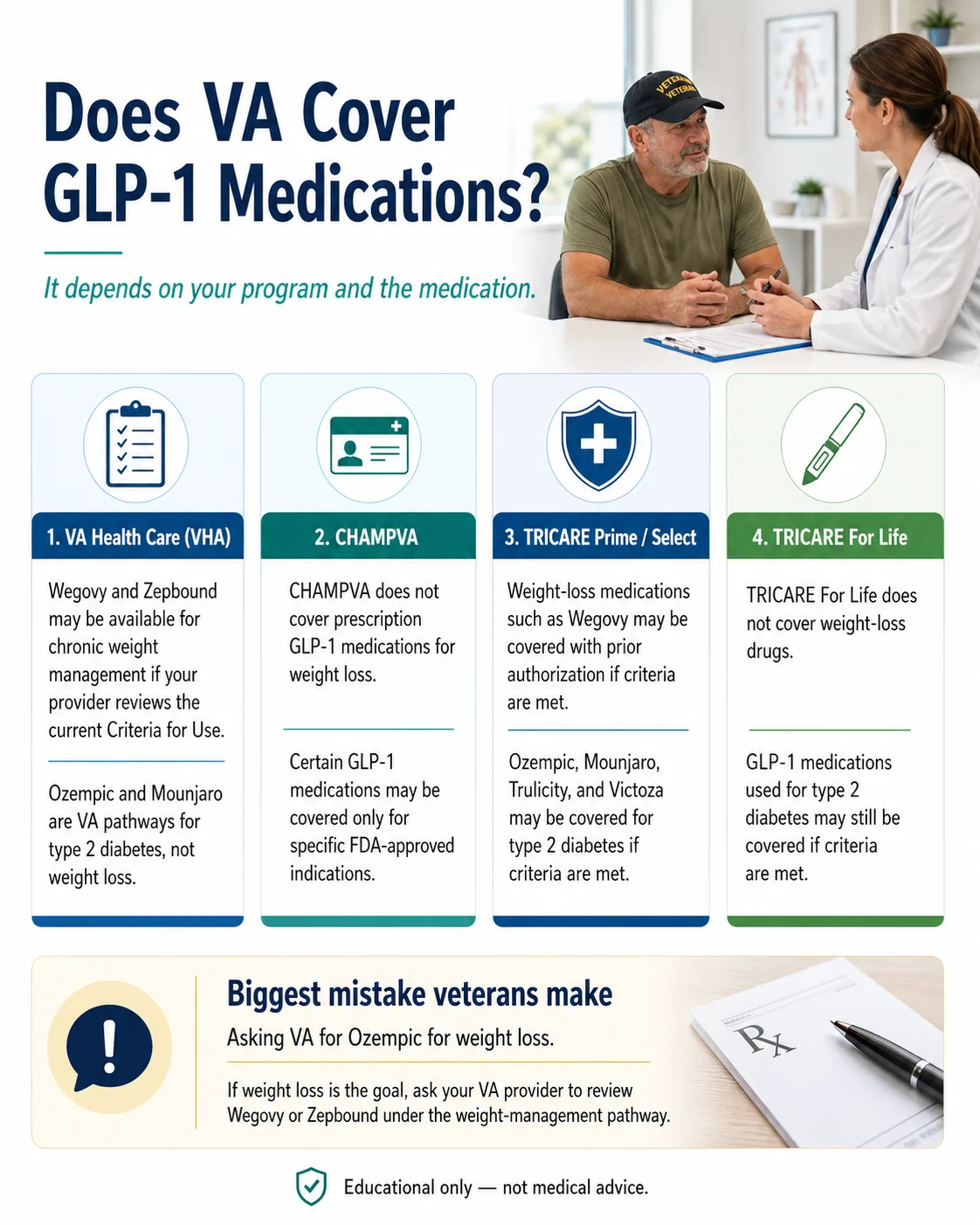
Four programs, four rule sets. Find your path →
The 2026 GLP-1 Coverage Matrix for Veterans
| Medication | VA Health Care (VHA) | CHAMPVA | TRICARE Prime/Select | TRICARE For Life |
|---|---|---|---|---|
| Wegovy (semaglutide) | Non-formulary; covered for chronic weight management with CFU review (CLI + BMI ≥30 with comorbidity) | Covered ONLY for MASH or prevention of major adverse cardiovascular events (MACE) | Covered with prior auth + step therapy | NOT covered as of Aug 31, 2025 |
| Zepbound (tirzepatide) | Non-formulary; covered for chronic weight management with CFU review (CLI + BMI ≥30 with comorbidity) | Covered ONLY for obstructive sleep apnea | Covered with prior auth + step therapy | NOT covered as of Aug 31, 2025 |
| Saxenda (liraglutide) | Non-formulary weight-management option | Verify directly with CHAMPVA — not in the listed GLP-1 indications | Covered with prior auth + step therapy | NOT covered as of Aug 31, 2025 |
| Ozempic (semaglutide) | Type 2 diabetes only under VA Ozempic CFU; requires T2D plus ASCVD/CKD or unmet glycemic goals after empagliflozin + metformin | Type 2 diabetes only | Type 2 diabetes only with prior auth | Continues for type 2 diabetes |
| Mounjaro (tirzepatide) | Type 2 diabetes only; stricter criteria — inadequate control on semaglutide injection + two or more glucose-lowering drugs for ≥6 months. Verify current VA Formulary Advisor status before requesting. | Type 2 diabetes only | Type 2 diabetes only with prior auth | Continues for type 2 diabetes |
| Trulicity (dulaglutide) | Type 2 diabetes only; current VA Formulary Advisor entry indicates non-formulary status requiring prior approval — verify before requesting | Type 2 diabetes only | Type 2 diabetes only with prior auth | Continues for type 2 diabetes |
| Victoza (liraglutide) | Type 2 diabetes only; current VA Formulary Advisor indicates non-formulary status requiring prior approval | Type 2 diabetes only | Type 2 diabetes only with prior auth | Continues for type 2 diabetes |
| Rybelsus (oral semaglutide) | Type 2 diabetes only; VA Ozempic CFU specifies oral semaglutide is non-formulary and reserved for patients physically unable to use injectable therapy after considering other oral formulary agents | Type 2 diabetes only | Type 2 diabetes only with prior auth | Continues for type 2 diabetes |
| Foundayo (orforglipron) | FDA-approved April 1, 2026 for chronic weight management; current VA Formulary status pending — check the VA Formulary Advisor before requesting | Not yet listed | Not yet listed | Not yet listed |
The most common mistake
A veteran with BMI 32, no diabetes, but with sleep apnea who asks “can I get Ozempic to lose weight?” will get denied because Ozempic at the VA is a diabetes drug. That same veteran asking “can I be evaluated under the Wegovy or Zepbound weight-management Criteria for Use?” gets a real review. That distinction is the entire game.
Why does VA cover GLP-1 for some people and not others?
Veterans benefits aren't one program. There are four separate systems with four different formularies and four different rule sets.
VA Health Care (VHA)
You're a veteran enrolled in VA health care, going to VA medical facilities or community-care providers through the VA. Read the Wegovy/Zepbound and MOVE! sections below.
CHAMPVA
You're the spouse, child, or surviving family member of a veteran rated permanently and totally disabled, and you have CHAMPVA. Your rules are different — skip to the CHAMPVA section.
TRICARE Prime / TRICARE Select
You're active duty, a recent retiree under 65, or a family member of one. Skip to the TRICARE section.
TRICARE For Life
You're 65 or older and have Medicare plus TRICARE For Life. There's been a major change (August 31, 2025) you need to know about — read the TRICARE For Life section below.
It's possible to qualify under more than one path. Some veterans have VA health care AND TRICARE. If that's you, you can pursue whichever path approves first — but you can't double-bill.
Wegovy and Zepbound through VA health care: the real criteria
Requirement 1: Documented CLI participation
A “comprehensive lifestyle intervention” is the VA's term for a structured weight-management program that targets all three aspects: what you eat, how you move, and how you think about food. The MOVE! Weight Management Program is the VA's flagship CLI.
Per VA PBM guidance, documentation of CLI participation within the past year on at least one occasion, as part of a course of intervention, makes a veteran eligible for consideration of a weight-management GLP-1. You don't need to complete a full year of MOVE! before requesting medication.
What counts
- MOVE! (in-person or VA Video Connect)
- TeleMOVE! (telephone-based)
- MOVE! Coach with Clinician Contact
- Another clinically supported program with standardized obesity-management curriculum
What generally doesn't count
- Routine PCP advice to “eat less and exercise more”
- App-only programs without clinician contact
- Self-directed dieting
Key: Make sure your MOVE! participation is in your VA chart with dates, modality, and clinician contact. If your provider's note doesn't reflect it, the VA Pharmacy Benefits Management committee won't see it.
Requirement 2: BMI of 30 or higher with at least one weight-related comorbidity
The CFU is specific. BMI must be 30 or higher (Class I obesity or above), AND you must have at least one weight-related condition from the following list:
- Hypertension (high blood pressure)
- Type 2 diabetes
- Dyslipidemia (high cholesterol or triglycerides)
- Metabolic syndrome
- Obstructive sleep apnea (OSA)
- Osteoarthritis
- Metabolic dysfunction-associated steatotic liver disease (MASLD/NAFLD)
“But I read BMI 27 with a comorbidity is enough” — here's the truth
The broader VA/DoD Clinical Practice Guideline for Adult Overweight and Obesity (2025) allows weight-management medications to be considered at BMI ≥27 with an obesity-associated condition. But the drug-specific CFUs for Wegovy and Zepbound — the document the VA Pharmacy Benefits Management committee actually applies — uses BMI ≥30 with at least one weight-related comorbidity. If your BMI is 27–29.9 with a comorbidity, ask your provider: “Which CFU or guideline are you applying when you submit my non-formulary request?”
Requirement 3: Exclusion criteria you can't have
The CFU lists exclusions that disqualify you regardless of BMI or CLI participation. These need to be addressed before the request is submitted:
- Known pregnancy or active breastfeeding
- Type 1 diabetes (with a clinical carve-out if managed by a specialist)
- Personal or family history of medullary thyroid carcinoma (MTC) or Multiple Endocrine Neoplasia syndrome type 2 (MEN2)
- Severe gastrointestinal dysmotility, including gastroparesis
- History of pancreatitis (with a carve-out if the cause is known and resolved — like gallstones removed with the gallbladder)
- Active proliferative diabetic retinopathy (PDR), severe non-proliferative diabetic retinopathy (NPDR), clinically significant macular edema, or diabetic macular edema — unless documented with risks/benefits and an eye specialist
For women of childbearing potential, there's an additional consideration: pregnancy must be excluded before starting tirzepatide, with contraceptive counseling and, if on oral contraceptives, advice to switch to a non-oral method or add a barrier method for 4 weeks after starting and after each dose escalation.
Why the VA won't cover Ozempic for weight loss (but will cover Wegovy)
If you have type 2 diabetes and you want Ozempic, that's the on-label path through the VA. The VA Ozempic CFU (March 2025) requires a T2D diagnosis plus specific diabetes-management criteria: ASCVD or CKD circumstances where empagliflozin is not appropriate, or unmet glycemic goals after a trial of empagliflozin and maximally tolerated metformin.
If you don't have type 2 diabetes and you want a GLP-1 for weight loss, Ozempic is not your path. Wegovy or Zepbound are. Frame your conversation accordingly.
The Mounjaro CFU is even stricter — it's for type 2 diabetes patients who haven't achieved adequate glycemic control on semaglutide injection plus two or more glucose-lowering medications for at least six months. Mounjaro at the VA is essentially a third-line diabetes drug.
Ask: “Can I be evaluated under the Wegovy or Zepbound weight-management Criteria for Use?”
The MOVE! program: what it is and how to use it
You don't need to complete a year of MOVE! before becoming eligible for medication. Per VA PBM guidance, documentation of CLI participation within the past year on at least one occasion (as part of a course of intervention) makes a veteran eligible for consideration. To enroll:
- Call your VA medical center and ask to be referred to MOVE!. Most facilities also let you self-schedule by calling the main appointment line.
- Or message your VA primary care provider through My HealtheVet asking for a MOVE! referral.
- Or check your VA medical center's website for a MOVE! coordinator's direct line.
If you live far from a VA facility, ask specifically about TeleMOVE! (telephone-based) or video MOVE! groups. These count for CFU purposes.
Note about MOVE! capacity at your facility
Some VA facilities have implemented “Scarce Resource Allocation Guidance” for weight-management medications because demand outstrips supply. If your VA tells you “we're not taking new starts right now,” that may be a local scarcity decision, not a denial of your eligibility. Ask whether the decision is based on the national CFU or a local resource allocation policy — both answers matter, but they have different appeal paths.
What you'll actually pay: VA GLP-1 copays in 2026
| Tier | What's in this tier | 1–30 day supply | 31–60 day supply | 61–90 day supply |
|---|---|---|---|---|
| Tier 0 | Selected medications (no copay) | $0 | $0 | $0 |
| Tier 1 | Preferred generics | $5 | $10 | $15 |
| Tier 2 | Non-preferred generics, certain OTC | $8 | $16 | $24 |
| Tier 3 | Brand-name medications (likely classification for Wegovy/Zepbound) | $11 | $22 | $33 |
Annual cap: $700. Once you've paid $700 in medication copays in a calendar year, you stop paying for the rest of the year. Source: VA Health Care Copay Rates page (2026 calendar year).
A veteran in Priority Group 6 on 90-day fills would pay roughly $33 per fill — about $132 a year for the GLP-1 alone. For Priority Group 1 veterans (rated 50%+ service-connected, individually unemployable, Medal of Honor recipients, or former POWs), the cost is $0 across all medications. Always verify the current tier classification for your specific medication with your VA pharmacist.
Not sure which priority group or copay tier applies to you?
See your estimated copay and eligibility →Does CHAMPVA cover GLP-1 medications?
| Diagnosis | Covered GLP-1 medications |
|---|---|
| Type 2 diabetes | Mounjaro, Ozempic, Rybelsus, Trulicity, Victoza |
| Obstructive sleep apnea | Zepbound |
| MASH or prevention of major adverse cardiovascular events (MACE) | Wegovy |
| Weight loss alone | Not covered |
Source: VA's CHAMPVA Meds by Mail covered medications page. When you call CHAMPVA, ask: “Can you confirm whether [drug name] is covered for [diagnosis] under CHAMPVA / Meds by Mail, and whether the strength I've been prescribed is currently available?”
What to do if you're on CHAMPVA and need a GLP-1 for weight loss
CHAMPVA is not your path for weight-loss GLP-1s. Options:
- Other primary insurance. CHAMPVA is often secondary to other coverage. If you have employer-based or Marketplace insurance with GLP-1 coverage, that's likely your better path.
- Manufacturer programs. LillyDirect (Zepbound) and NovoCare (Wegovy) offer cash-pay pricing direct from the manufacturer.
- Cash-pay through telehealth — a legitimate option covered in the bridge options section below.
TRICARE Prime, Select, and For Life: different rules, different coverage
TRICARE Prime / Select: covered with prior auth + step therapy
The current TRICARE prior-authorization form for Wegovy and Zepbound asks the prescriber to confirm:
- Diagnosis of obesity with BMI ≥30, or BMI ≥27 with a weight-related condition (hypertension, T2D, sleep apnea, dyslipidemia, etc.)
- At least 6 months of documented diet and exercise (with calorie reduction)
- A 3-month trial of generic phentermine, benzphetamine, diethylpropion, or phendimetrazine that failed to produce ≥5% baseline body weight loss — OR a contraindication, intolerance, or adverse reaction
- Ongoing commitment to reduced-calorie diet and increased physical activity during treatment
- Prescription from a TRICARE network provider
Initial therapy is approved for 12 months. Renewal requires at least 5% baseline body weight loss after full dose titration for adults; 4% BMI reduction for adolescents on Wegovy.
2026 TRICARE pharmacy costs
| Fill location | Drug type | Cost (2026) |
|---|---|---|
| Military pharmacy | Any | $0 (call ahead — may not stock every drug) |
| TRICARE Pharmacy Home Delivery (up to 90-day) | Brand-name formulary | $44 |
| Retail network pharmacy (up to 30-day) | Brand-name formulary | $48 |
| Home delivery or retail | Non-formulary drugs | $85 (up to 30 days) |
Source: Defense Health Agency 2026–2027 TRICARE pharmacy cost update, effective January 1, 2026.
TRICARE For Life: major change on August 31, 2025
Effective , TRICARE For Life beneficiaries — Medicare-eligible retirees 65 and older — are no longer covered for weight-loss GLP-1s including Wegovy, Zepbound, and Saxenda. The Defense Health Agency cited regulatory authority. The Military Officers Association of America (MOAA) and other advocacy groups have publicly contested this decision and are pushing for legislative review.
Note: this is a TRICARE For Life policy change, not a VA health care change. If you're on both TFL and VA health care, the August 2025 TFL cessation does not affect what VA can prescribe under its own CFU process.
If you're on TRICARE For Life and were on a weight-loss GLP-1, your options:
- Medicare Part D under the cardiovascular indication — Wegovy is FDA-approved for reducing cardiovascular events in adults with established heart disease and overweight or obesity. If you qualify under that indication, your Medicare Part D plan may cover it.
- Medicare GLP-1 Bridge starting July 1, 2026 — CMS announced the Bridge as a temporary demonstration running through . Eligible products: Foundayo, Wegovy formulations, and the Zepbound KwikPen only. Clinical eligibility: age 18+ plus BMI ≥35, or BMI ≥30 with HFpEF / uncontrolled hypertension / CKD stage 3a+, or BMI ≥27 with prediabetes / prior MI / prior stroke / symptomatic PAD. Pharmacy copay: $50.
- VA enrollment if you haven't already — many TFL beneficiaries are also eligible for VA health care and have never enrolled. VA enrollment doesn't affect your TRICARE benefits.
- Cash-pay alternatives — covered in the bridge options section below.
GLP-1s prescribed for type 2 diabetes (Ozempic, Mounjaro, Trulicity, Victoza, Rybelsus) continue to be covered under TFL.
Why are veterans getting different answers from different VA facilities?
Reason 1: National guidance vs. drug-specific CFU mismatch
Broader VA/DoD obesity guidance allows GLP-1 consideration at BMI ≥27 with a comorbidity. The drug-specific Wegovy and Zepbound CFUs require BMI ≥30 with a comorbidity. Different clinicians and pharmacists may apply different documents. Ask which they’re using.
Reason 2: Formulary vs. non-formulary handling
Wegovy, Zepbound, and Saxenda are non-formulary, which means they require an additional non-formulary request with clinical justification. Some providers know this process well. Some don’t. If yours doesn’t, ask politely if your case can be reviewed by a clinical pharmacist or your facility’s weight management team.
Reason 3: Local pharmacy and P&T committee policies
Each VA medical center has a Pharmacy and Therapeutics (P&T) committee that adjudicates non-formulary requests within their facility. Some have implemented scarce-resource tiers (BMI ≥40 first, etc.) due to demand. None of this is on the public-facing VA.gov page, and call-center reps often don’t know.
Reason 4: Documentation gaps (the biggest one)
The most common reason a non-formulary request gets denied isn’t that the criteria aren’t met — it’s that the chart doesn’t reflect that the criteria are met. MOVE! participation isn’t logged. BMI isn’t current. Comorbidity isn’t coded. The pharmacist reviewing the request can only see what’s in the record.
If you've been told no:
The first thing to do is not appeal blindly. Ask: “Which specific criterion was not met, and what document or guideline was applied?” The VA Pharmacy is required to provide this information when a non-formulary request is denied. The pharmacist is also required to provide information needed to support a future request. Use that.
How to ask your VA provider for a GLP-1 (without wasting months)
What to gather before the appointment
- Current weight, height, and BMI — date-stamped
- Comorbidities — hypertension, T2D, dyslipidemia, metabolic syndrome, sleep apnea, osteoarthritis, MASLD/NAFLD (with diagnosis code if available)
- MOVE! or CLI participation — dates, format, topics covered (nutrition, physical activity, behavior change), clinician's name
- Prior weight-management medication history — including orlistat, phentermine/topiramate, and naltrexone/bupropion
- Current medications (in case any are contributing to weight gain)
- Outside prescription documentation, if you've been on a private GLP-1
- Any safety flags — pregnancy/lactation status, MTC/MEN2 family history, gastroparesis, pancreatitis history, retinopathy
The six-step path
- Identify which benefit pathway you're on — VA health care, CHAMPVA, TRICARE, or private prescription. The first sentence of your conversation should reflect this.
- Match the drug to the indication. Wegovy and Zepbound are weight management. Ozempic, Mounjaro, Trulicity, Victoza, and Rybelsus are diabetes. Don't ask for a diabetes drug for weight loss.
- Document your BMI and comorbidities before the appointment.
- Document your MOVE! or CLI participation. If you haven't started MOVE! yet, ask for a referral in the same appointment so the clock starts.
- Ask for the specific review. Use the script below.
- If denied, ask for the exact missing criterion. Don't accept “the VA doesn't cover it” as a final answer. Ask: “Which specific criterion was not met, and was this based on the national CFU, a local facility policy, or a documentation gap?”
A message script you can copy
Suggested language to start the conversation through My HealtheVet's secure messaging or at your appointment. It's a frame for a real clinical discussion, not a script to recite.
Subject: Request for weight-management medication evaluation
Hi Dr. [Name],
I'd like to discuss whether I qualify for VA evaluation for a weight-management medication like Wegovy or Zepbound under the current Criteria for Use.
My current BMI is [BMI]. I have [list comorbidities — e.g., hypertension, type 2 diabetes, sleep apnea, dyslipidemia]. I have participated in [MOVE! / TeleMOVE! / MOVE Coach with clinician contact / other comprehensive lifestyle intervention] on [dates], covering nutrition, physical activity, and behavior changes.
Could you review whether I meet the current VA Wegovy or Zepbound Criteria for Use? If I don't, could you let me know which criterion is not met and whether there are VA-covered alternatives that may be appropriate for my situation?
Thank you,
[Your name]
This message names the specific medications, names the specific CFU pathway, lists your BMI and comorbidity, documents your MOVE! participation, and asks for both a yes-or-no and a fallback path. It puts your provider in a position to either approve, refer, or tell you exactly what's missing.
What to ask if your provider says “GLP-1s are only for diabetes”
That statement is correct for Ozempic and Mounjaro at the VA. It is incomplete for Wegovy, Zepbound, and Saxenda, which have separate weight-management Criteria for Use. The right follow-up:
“I understand Ozempic and Mounjaro are diabetes-only at the VA. Could you also evaluate me under the Wegovy or Zepbound chronic weight-management Criteria for Use, which is a separate pathway?”
Can VA fill a GLP-1 prescription from a private doctor?
If you have a private prescription for Wegovy, Zepbound, or another GLP-1 and want VA to take over, bring:
- The current prescription
- Your pharmacy fill records (showing dose history)
- Your starting weight and BMI
- The diagnosis your private doctor used
- Your comorbidities
- Documented response — weight loss, side effects, tolerability
- Any prior weight-loss program participation
- Your current medication list
Does the VA cover compounded GLP-1 medications?
Don't assume so. Compounded GLP-1 medications are not FDA-approved. The FDA has stated that unapproved versions of GLP-1 drugs do not undergo FDA review for safety, effectiveness, or quality, and the agency has issued warnings about counterfeit and unapproved products, dosing errors, salt forms, adverse event reports, and illegal online sales. VA's standard pharmacy pathway is FDA-approved medication via the National Formulary or non-formulary request.
If you're on a compounded GLP-1 from a private telehealth provider, the realistic answer is that VA will likely evaluate you for FDA-approved alternatives (Wegovy or Zepbound through the non-formulary CFU pathway) rather than continuing your compounded prescription.
What if the VA denies you? The real appeal and bridge playbook
The honest truth about VA timelines
We're going to say something most sites won't: the VA process is slow. Even when everything goes right, expect several weeks from your first MOVE! enrollment call to a Wegovy or Zepbound prescription in your hand. If your initial request is denied and you have to fix documentation and resubmit, that doubles.
The VA path is still the best path for most veterans who can wait — because $0 to $33 a month with a $700 annual cap is unbeatable, and the clinical care is integrated with your other VA medical care. Don't abandon it lightly.
⚠ Important first: who can use which bridge
- VA-enrolled veterans: Cannot become Ro Body members — Ro's policy explicitly excludes those enrolled in VA from membership. Your bridge options are Sesame Care for branded cash-pay, manufacturer programs (LillyDirect, NovoCare), or compounded telehealth (with FDA caveats).
- CHAMPVA beneficiaries (not enrolled in VA health care): Eligible for Ro, Sesame, manufacturer programs, and compounded telehealth.
- TRICARE Prime/Select/TFL beneficiaries: Eligible for Ro Body on a cash-pay basis, Sesame Care, manufacturer programs, and compounded telehealth.
- FEHB plan holders (federal employees with civilian insurance): Ro can use your FEHB insurance — this is the one government-adjacent insurance Ro coordinates with.
This restriction is real. Don't sign up for Ro as a VA-enrolled veteran — Ro will reject the membership. We'd rather tell you upfront than route you to a wall.
Your real options when VA isn't available (or you can't wait)
Option 1: Sesame Care for branded cash-pay — available to VA-enrolled veterans
If you want maximum branded options (Wegovy, Zepbound, Ozempic, Mounjaro, Foundayo, Saxenda) with provider choice and competitive cash-pay pricing, Sesame Care is a legitimate option for veterans without other coverage. This works for VA-enrolled veterans because Sesame is a direct cash-pay marketplace — you're not enrolling in a managed program that conflicts with VA.
See current cash-pay branded GLP-1 options on Sesame → (sponsored affiliate link, opens in a new tab)Option 2: Manufacturer programs
LillyDirect (Zepbound, Foundayo) and NovoCare (Wegovy) offer cash-pay pricing direct from the manufacturer, often with the most predictable monthly costs for branded medication. LillyDirect → · NovoCare →
Option 3: Ro Body — for CHAMPVA, TRICARE, TFL (cash-pay), or FEHB readers only
If you're on CHAMPVA, TRICARE Prime/Select, TFL (cash-pay only), or FEHB, Ro carries Zepbound (tirzepatide) and Foundayo (orforglipron). Ro's GLP-1 medication prices match LillyDirect, NovoCare, and TrumpRx pricing. The Ro Body membership is $39 for the first month, then $149/month ongoing or as low as $74/month with annual prepay; medication cost is separate. Ro has an insurance concierge for commercial and FEHB plans, but Ro cannot coordinate GLP-1 coverage for VA, Medicaid, traditional Medicare, Medicare Advantage, or TRICARE plans (FEHB is the noted exception).
Check Ro's FDA-approved GLP-1 pricing and FEHB/commercial insurance options → (sponsored affiliate link, opens in a new tab)For CHAMPVA, TRICARE, TFL (cash-pay), or FEHB readers only.
Option 4: Cash-pay compounded telehealth (only if the right fit)
Compounded GLP-1 medications are not FDA-approved. The FDA has stated that unapproved versions do not undergo FDA review for safety, effectiveness, or quality, and has issued warnings about counterfeit products, dosing errors, salt forms, adverse event reports, and illegal online sales.
For veterans who clearly will not qualify under VA criteria (BMI under 27, no comorbidities), or who face long delays they can't wait through, some compounded telehealth providers advertise lower entry pricing than branded options. Verify any provider's source pharmacy, prescriber credentials, pricing, and FDA risk disclosures before signing up. If this fits your situation, our matching quiz will point you to the right path for your details.
See options matched to your situation →What the VA's own research shows about GLP-1 outcomes for veterans
This is real-world VA data — actual veterans receiving care under VA protocols, enrolled in MOVE! or equivalent programs. Most GLP-1 efficacy data comes from pharmaceutical company clinical trials with carefully selected participants. The Rocky Mountain study followed actual veterans receiving care under VA protocols, with all the real-world complexity of veteran health.
Among the more than six million veterans using VA healthcare, more than 40% have obesity per VA Health Services Research data — substantially higher than the general U.S. adult population. The study suggests that when access barriers are navigated successfully, the medication works in this population at rates similar to clinical trials.
Individual results vary substantially. The 10% average weight loss in the study does not predict your specific outcome.
Frequently asked questions
Does the VA cover Wegovy?
Yes, potentially. Wegovy is non-formulary at the VA, meaning your provider must submit a non-formulary request. The current VA Wegovy Criteria for Use (Aug 2025 revision) requires documented participation in a comprehensive lifestyle intervention plus BMI ≥30 with at least one weight-related comorbidity, with no disqualifying exclusions like pregnancy, MTC/MEN2 history, gastroparesis, or active diabetic retinopathy.
Does the VA cover Ozempic for weight loss?
No. The VA Ozempic CFU is for type 2 diabetes only. Off-label Ozempic for weight loss isn’t approved through VA. If your goal is weight loss and you don’t have type 2 diabetes, ask about Wegovy or Zepbound under the weight-management CFU.
Does the VA cover Zepbound?
Yes, potentially, through the same non-formulary request + Criteria for Use process as Wegovy. The Zepbound CFU requires the same CLI documentation and BMI ≥30 with at least one weight-related comorbidity.
Does the VA cover Mounjaro for weight loss?
No. Mounjaro at the VA is for type 2 diabetes only, and the criteria are stricter than Ozempic — typically requiring inadequate glycemic control on semaglutide injection plus two or more glucose-lowering medications for at least six months.
Do I have to complete MOVE! to get a GLP-1 through the VA?
You don’t have to complete a full year of MOVE!, but documented participation in a comprehensive lifestyle intervention within the past year on at least one occasion is required by the current Wegovy and Zepbound CFUs. MOVE!, TeleMOVE!, MOVE! Coach with clinician contact, or an equivalent clinically supervised program all qualify.
What BMI do I need for VA Wegovy or Zepbound?
The current drug-specific CFUs require BMI ≥30 with at least one weight-related comorbidity. The broader VA/DoD obesity clinical practice guideline allows consideration at BMI ≥27 with an obesity-associated condition, but the standard CFU pathway uses ≥30. If your BMI is between 27 and 29.9 with a comorbidity, ask your provider whether they’ll apply the broader guideline.
Does CHAMPVA cover GLP-1s for weight loss?
No. CHAMPVA covers GLP-1s only for specific FDA-approved indications: type 2 diabetes (Ozempic, Mounjaro, Rybelsus, Trulicity, Victoza), obstructive sleep apnea (Zepbound), or MASH/MACE prevention (Wegovy). CHAMPVA does not cover any GLP-1 prescribed for weight loss alone.
How much will I pay for Wegovy or Zepbound through the VA?
If approved and classified as a Tier 3 brand-name medication in the VA copay file (verify with your VA pharmacist), Tier 3 costs $11 for 30-day, $22 for 60-day, or $33 for 90-day supply. Veterans in Priority Group 1 pay $0. Total annual medication copay is capped at $700.
How long does VA non-formulary approval take?
The VA Pharmacy is required to review non-formulary requests within 96 hours of submission. The bigger time variable is everything before the request — getting into MOVE!, attending sessions, getting documentation in your chart, getting your provider to draft and submit the request. Plan on several weeks total when everything goes right.
Can VA fill a GLP-1 prescription written by my private doctor?
Not automatically. VA filling a non-VA prescription depends on your local facility’s policies and the VA prescribing clinician’s review. Bring the prescription, the pharmacy record, your starting weight/BMI documentation, and a list of any side effects or response history. Your VA primary care provider may continue, rewrite, or replace the prescription based on what the chart supports.
Does the VA fill compounded GLP-1 prescriptions?
Don’t assume so. Compounded GLP-1 medications are not FDA-approved, and the FDA has stated that unapproved versions don’t undergo FDA review for safety, effectiveness, or quality. VA’s standard pathway is FDA-approved medication. If you’re on compounded medication from a private telehealth provider, expect VA to evaluate you for FDA-approved alternatives rather than continuing the compounded prescription.
Does my service-connected disability rating affect GLP-1 coverage?
Indirectly, in two ways. First, your priority group is partially determined by your service-connected rating, and your priority group determines your copay tier. Second, care related to a service-connected disability does not require a copay. Whether that determination applies to a weight-management medication specifically depends on your service-connected conditions and your provider’s clinical judgment — it’s not automatic.
What changed for TRICARE For Life on August 31, 2025?
TRICARE For Life beneficiaries (Medicare-eligible retirees age 65+) lost coverage for weight-loss GLP-1s including Wegovy, Zepbound, and Saxenda. GLP-1s prescribed for type 2 diabetes continue to be covered. The Defense Health Agency cited regulatory authority; veterans’ advocacy organizations have contested the decision. The Medicare GLP-1 Bridge launching July 1, 2026 may provide some affected beneficiaries with a Medicare Part D path.
What's going to change (and how we keep this guide current)
GLP-1 coverage rules have shifted multiple times in the last 18 months. The CHAMPVA changes, the TRICARE For Life cutoff, the Medicare GLP-1 Bridge launching , and ongoing revisions to VA Criteria for Use. This page is verified quarterly against:
- VA Formulary Advisor — for current CFU revisions and formulary status
- VA Pharmacy Benefits Management — Weight Management Medications Clinical Recommendations
- CHAMPVA Meds by Mail covered medications page
- TRICARE Pharmacy Program updates and the Express Scripts PA forms
- VA Health Care Copay Rates page
- CMS announcements on the Medicare GLP-1 Bridge
- FDA Drug Shortages database for semaglutide and tirzepatide supply status
Last verified: . We update the verification date and the page content whenever any of these primary sources changes a rule that affects what veterans pay or how they qualify.
Still not sure which GLP-1 path is right for you?
Take our free 60-second matching quiz. We'll route you based on your VA program, BMI, comorbidities, and timeline — to the right VA process, the right insurance path, or the right cash-pay option for your situation.