
Ozempic Savings Card 2026: $25 Eligibility, Real Cost, and What to Do If Yours Gets Rejected
Bottom line
The Ozempic Savings Card lets eligible patients with commercial insurance that covers Ozempic pay as little as $25 per fill, with a maximum savings of $100 for a 1-month, $200 for a 2-month, or $300 for a 3-month prescription, good for up to 48 months from activation. You are not eligible if you have Medicare, Medicaid, TRICARE, VA, DoD, or Medigap — even if you offer to pay cash.
If you're uninsured, the savings card doesn't apply, but you can buy Ozempic direct from NovoCare Pharmacy at $199/month for your first two starter-dose fills (through December 31, 2026), then $349–$499/month depending on dose.
Which path applies to you (quick decision)
| If this is you… | Your real path | Likely cost |
|---|---|---|
| Commercial insurance covers Ozempic | Use the Ozempic Savings Card | $25–$200/month |
| Commercial insurance, Ozempic not covered | Appeal the denial or go self-pay | $349–$499/month |
| Uninsured, lower income | Apply for the Patient Assistance Program | Possibly $0 |
| Uninsured, higher income | Buy direct from NovoCare Pharmacy | $199 intro, then $349–$499 |
| Medicare, Medicaid, TRICARE, VA | Use your plan + Medicare Extra Help / MPPP | $0–$2,100/year max |
| You actually want it for weight loss | Wegovy, Zepbound, or Foundayo (FDA-approved for that) | Varies — see below |
What the Ozempic Savings Card actually is (and isn't)
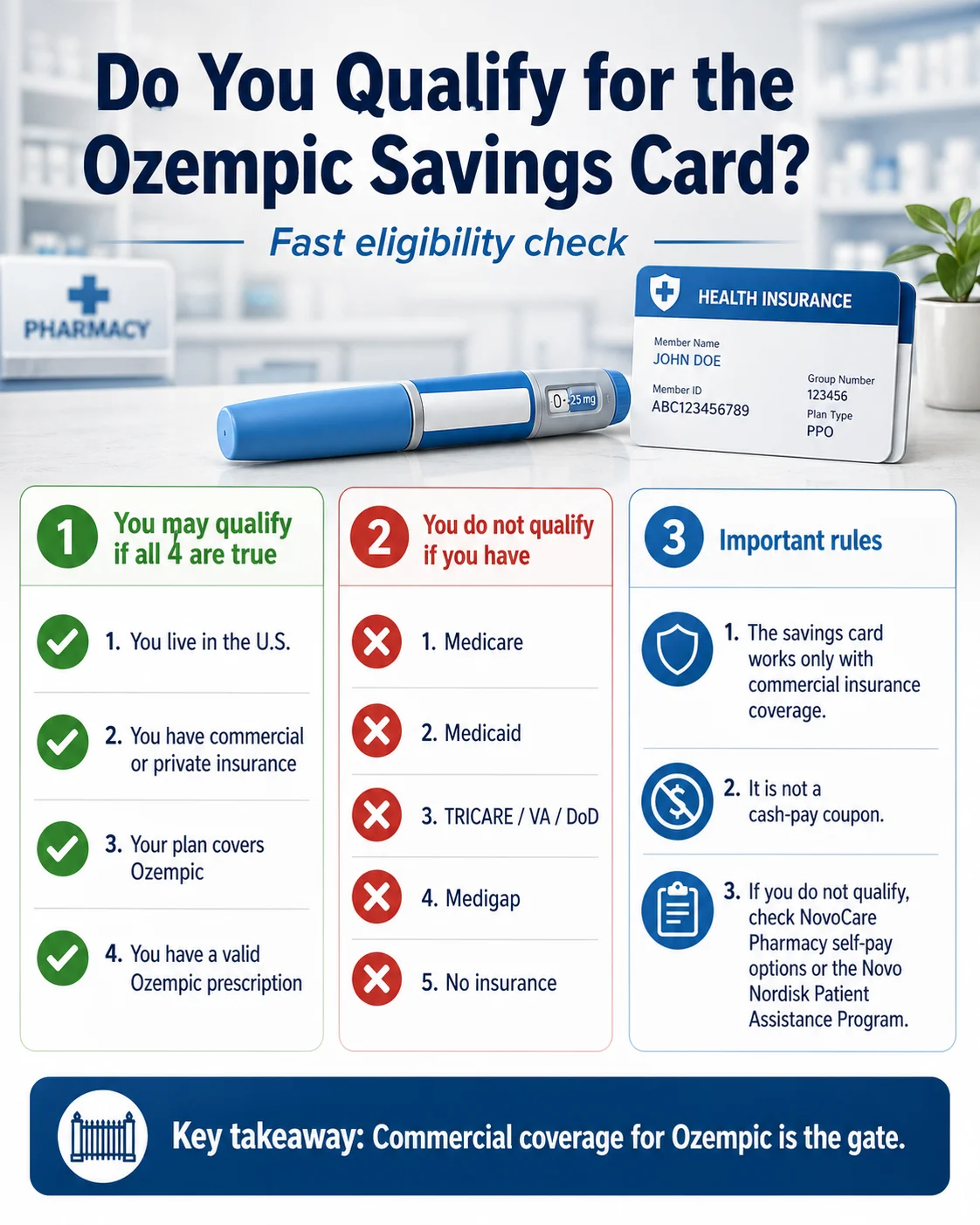
Commercial coverage for Ozempic is the gate. Source: Ozempic Savings Card eligibility terms.
A few things to anchor before we get into the specifics:
- The card lowers what you pay at the pharmacy counter. It does not lower the sticker price of Ozempic, which Novo Nordisk currently lists at $1,027.51 per pen before discounts or rebates. Most people with insurance never pay list price.
- Ozempic is FDA-approved for adults with type 2 diabetes — for blood sugar control, to reduce the risk of major cardiovascular events in adults with type 2 diabetes and known heart disease, and to reduce the risk of kidney disease worsening in adults with type 2 diabetes and chronic kidney disease.
- Ozempic is not FDA-approved for weight loss. The savings card requires your insurance to cover Ozempic for an FDA-approved indication. If you're trying to use it off-label and your plan refuses, the savings card cannot rescue that.
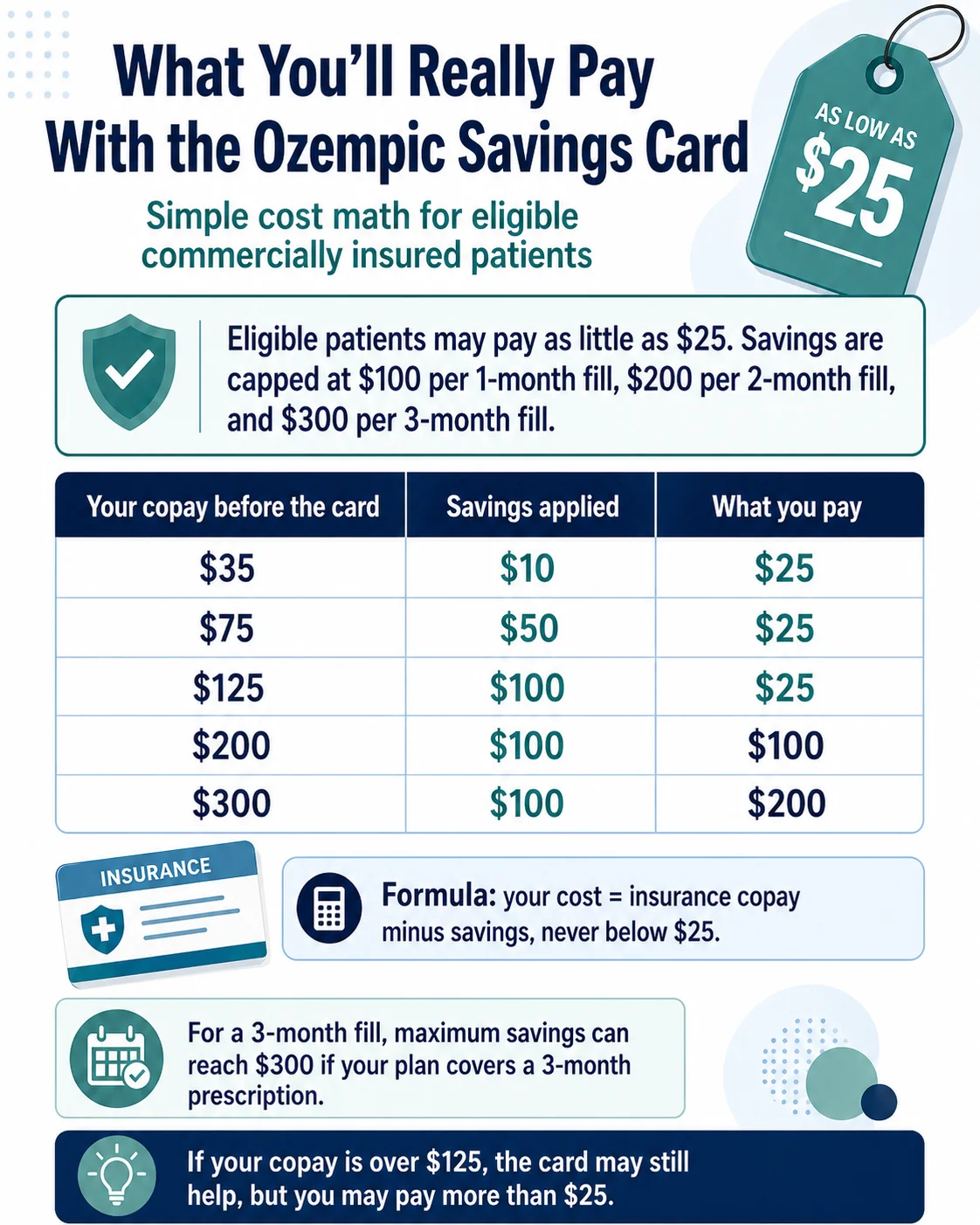
- The “$25” headline is the floor. Whether you actually reach $25 depends on your insurance copay and the $100/month savings cap. Your real cost is your copay minus up to $100, never below $25 per fill.
⚠ Before you chase the savings
Ozempic is a prescription medication. Don't use it if you or any family member has had medullary thyroid carcinoma (MTC) or if you have Multiple Endocrine Neoplasia syndrome type 2 (MEN 2). Talk to a clinician about pancreatitis risk, diabetic retinopathy, severe stomach problems, pregnancy plans, gallbladder symptoms, dehydration risk, hypoglycemia when used with insulin or sulfonylureas, and upcoming anesthesia. Full safety information is in the official prescribing information and Medication Guide.
How much you'll really pay each month
 (sponsored affiliate link, opens in a new tab)
Not sure if your plan covers Ozempic? Check coverage for free →
| Your insurance copay before the card | Maximum savings the card gives you | What you actually pay |
|---|---|---|
| $35 | $10 (down to the $25 floor) | $25 |
| $75 | $50 (down to the $25 floor) | $25 |
| $125 | $100 (the cap) | $25 |
| $200 | $100 (the cap) | $100 |
| $300 | $100 (the cap) | $200 |
| $500+ | $100 (the cap) | $400+ |
| Insurance doesn’t cover Ozempic | $0 (card doesn’t apply) | $349–$499 self-pay through NovoCare Pharmacy |
*Self-pay pricing through NovoCare Pharmacy: $349/month for 0.25 mg, 0.5 mg, or 1 mg pens; $499/month for the 2 mg pen. Eligible new patients can get $199/month for the first two fills of 0.25 mg or 0.5 mg through December 31, 2026.
The $25 number is real for people whose insurance copay is $125 or less.
Above that, every additional dollar of copay is your responsibility. For 2-month and 3-month fills, the savings cap scales: up to $200 off a 2-month supply and up to $300 off a 3-month supply.
If your copay is under $125, the card almost certainly gets you to $25.
✓ Activate your savings card at ozempic.com/savings →Who qualifies — the 30-second eligibility check
Walk through these four questions in order. The first “no” tells you the card isn't your path.
| Insurance type | Eligible for the $25 card? |
|---|---|
| Employer-sponsored / private commercial plan | ✅ Yes |
| ACA Marketplace plan | ✅ Yes (Novo Nordisk classifies ACA Health Exchange plans as commercial) |
| FEHB (Federal Employees Health Benefits) | ✅ Yes (treated as commercial for this offer) |
| State employee plan | ✅ Yes (treated as commercial; not an EGWP retiree drug plan) |
| Medicare (Part A, B, C/Advantage, D) | ❌ No |
| Medicare Supplement (Medigap) | ❌ No |
| Medicaid | ❌ No |
| TRICARE / VA / DoD | ❌ No |
| Employer-sponsored group waiver health plan (EGWP) for retirees | ❌ No |
| Uninsured / self-paying | ❌ No (different program — see no insurance section below) |
3. Does your commercial insurance plan cover Ozempic?
This is the question most people skip and then get burned by. “Having Ozempic on your formulary” means your plan agrees to pay for it under its prescription drug benefit. Call the number on the back of your insurance card and ask: “Is Ozempic covered on my formulary, what tier is it, and is prior authorization required?”
4. Is your prescription for an FDA-approved use?
Ozempic's label covers type 2 diabetes management and cardiovascular/renal risk reduction in patients with type 2 diabetes. If your prescription is for general weight loss without a type 2 diabetes diagnosis, your insurance is unlikely to cover it, and the savings card requires coverage to apply.
✓ All four boxes checked?
Activate your savings card at ozempic.com/savings →Takes about 5 minutes, no fee.
How to get and activate the Ozempic Savings Card
- Confirm eligibility using the four questions above. If anything's a “no,” skip to the relevant section below.
- Go to ozempic.com/savings and complete the activation form. Save the card details.
- Save the card to your phone and print a backup copy. You'll need the BIN, PCN, Group, and Member ID.
- Bring everything to the pharmacy: your prescription, your primary insurance card, the savings card, and a backup payment method.
- Ask the pharmacist to bill primary insurance first, then run the savings card as secondary. This sequence matters. If the pharmacist tries the card first or runs it as primary, the system won't apply the savings correctly.
- If the price isn't what you expected, ask: “Was my primary insurance billed first? What was the copay before the savings card was applied? Did the card hit a maximum savings limit?” For support, call 1-877-304-6855.
📌 What to keep in your wallet or phone
- Card ID, BIN, PCN, Group number
- Insurance card
- Pharmacy receipt with prescription number, date filled, NDC, and the price you paid
If your local pharmacy can't process the card or you fill by mail order, Novo Nordisk allows reimbursement by mail within 180 days of the fill. Send the original pharmacy receipt and a photocopy of your primary insurance card to: Novo Nordisk Savings Offer Claims Processing Dept., PO Box 2355, Morristown, NJ 07962. Reimbursement takes 6–8 weeks per official terms.
Why your Ozempic Savings Card was rejected (and how to fix it)
| What the pharmacist tells you | What it actually means | Your next step |
|---|---|---|
| “The card isn’t in our system” / BIN-PCN error | Pharmacy’s billing system hasn’t loaded the program, or the BIN-PCN-Group codes were entered wrong | Ask the pharmacist to reprocess with the correct BIN/PCN/Group from your card. If still stuck, call 1-877-304-6855. |
| “Patient ineligible — government program” | The system pulled a Medicare or Medicaid record from your profile | The card will not apply. Skip to the Medicare/Medicaid section below for your real best path. |
| “No coverage for Ozempic on this plan” | Your insurance doesn’t have Ozempic on its formulary, or prior authorization wasn’t completed | The $25 path doesn’t apply. Either (a) appeal/get prior auth done, or (b) switch to NovoCare Pharmacy self-pay. |
| “Card already activated under another plan” | A prior savings card enrollment is still attached to your profile from a previous insurance | Call 1-877-304-6855 to update the insurance on file before you try to fill again. |
| “Maximum benefit period reached” | You’ve hit the 48-month program ceiling | The current card is exhausted. Reapply if Novo Nordisk renews the program in a new cycle. |
| Price is far above $25 but the card “applied” | Your copay exceeded $125, so the card hit its $100 max savings cap | Working as designed. See the cost table above. If your copay seems wrong, ask whether you’re in your deductible phase or your plan has a copay accumulator program. |
| Mail order or specialty pharmacy can’t process | Some mail-order systems can’t run the card as a secondary claim | Pay full price, then submit the receipt for mail-in reimbursement within 180 days. |
Copay accumulator and maximizer programs
Some employer-sponsored insurance plans use these — they accept the manufacturer's copay assistance, but they don't credit the assistance dollars toward your deductible or out-of-pocket maximum. So you keep paying $25 at the pharmacy, but your deductible never moves. Novo Nordisk's terms specifically tell users not to use the savings card if their plan has an accumulator or maximizer program. If your deductible isn't shrinking despite your fills, call your insurance and ask: “Does my plan have a copay accumulator or copay maximizer program for specialty drugs?”
Still stuck after working with the pharmacy? Confirm whether your insurance actually covers Ozempic — that's the first issue to rule out.
Take the 60-second find-my-path quiz →If you have Medicare, Medicaid, TRICARE, or VA — here's what to do instead
If you have Medicare Part D
Use your plan, not the savings card. Most Medicare Part D plans cover Ozempic for type 2 diabetes with prior authorization. The 2026 Inflation Reduction Act provisions help significantly:
- Out-of-pocket cap: Once your out-of-pocket spending on covered Part D drugs reaches $2,100 in 2026, you enter catastrophic coverage and pay $0 for covered drugs the rest of the year.
- Maximum Part D deductible: $615 in 2026 (some plans have lower or zero deductibles).
- Medicare Prescription Payment Plan (MPPP): A free, opt-in program that spreads your annual drug costs into monthly payments instead of front-loading them. Sign up through your Part D plan or at Medicare.gov.
- Extra Help (Low-Income Subsidy): The 2026 income limits are $23,940 for an individual and $32,460 for a married couple, with resource limits of $18,090 individual / $36,100 married couple. Apply at SSA.gov.
Medicare GLP-1 Bridge — important update for 2026
Beginning , eligible Medicare Part D beneficiaries will have access to certain GLP-1 medications for weight loss through the Medicare GLP-1 Bridge at a $50 monthly copay. The drugs covered are Wegovy (injection and tablets), Zepbound (KwikPen formulation only), and Foundayo.
Ozempic is not covered under the GLP-1 Bridge — the program is specifically for weight management drugs.
If you have Medicaid
Medicaid coverage and copays vary by state. Use your Medicaid benefit directly and check your state formulary and prior-authorization rules. If your state's Medicaid program doesn't cover Ozempic, ask your prescriber about other GLP-1 options that may be on the state preferred drug list.
If you have TRICARE, VA, or DoD
TRICARE and VA both cover Ozempic for type 2 diabetes when prescribed for that indication, generally with prior authorization and medical necessity review. Prior authorization paperwork typically requires recent A1C levels and a documented diagnosis — your prescriber's office handles this.
On Medicare and not sure where to start? Open your Medicare Plan Finder at Medicare.gov to confirm Ozempic is on your plan's formulary, then ask your prescriber about prior authorization.
Take our find-my-path quiz for Medicare-specific resources →If you have no insurance — your real options
Option 1: Patient Assistance Program (PAP)
For Ozempic specifically, Novo Nordisk requires:
- U.S. residency
- Uninsured (no commercial, Medicare, or Medicaid coverage)
- Household income at or below 200% of the Federal Poverty Level for 2026 — $31,920 for one person, $43,280 for a household of two (48 contiguous states/DC). Ozempic uses the stricter 200% threshold; most other Novo Nordisk drugs use 400% FPL.
- Proof of Medicaid denial if your state's Medicaid threshold could apply to you
- A prescriber willing to complete the application
A complete application is processed within 2 business days, and if approved, medicine ships within 5 business days. Enrollment lasts 12 months.
Apply at novocare.com → or call 1-866-310-7549Option 2: NovoCare Pharmacy direct purchase
| Dose | Self-pay price (after intro) | Intro offer for new patients |
|---|---|---|
| Ozempic 0.25 mg | $349/month | $199/month for first 2 fills (through December 31, 2026) |
| Ozempic 0.5 mg | $349/month | $199/month for first 2 fills (through December 31, 2026) |
| Ozempic 1 mg | $349/month | Not eligible for $199 intro (intro is starter doses only) |
| Ozempic 2 mg | $499/month | Not eligible for $199 intro |
Self-pay pricing is processed outside your insurance and doesn't count toward any deductible or out-of-pocket maximum if you do have insurance and choose to self-pay. The $199 intro offer is for new patients only, capped at two monthly fills of starter doses, and expires December 31, 2026.
A note on GoodRx, SingleCare, and Optum Perks
As of late April 2026, GoodRx is showing Ozempic starting around $199 with their coupon at participating pharmacies — competitive with NovoCare Pharmacy's intro offer for new patients. Check live discount prices at your specific pharmacy and zip code before you fill, and compare against the NovoCare Pharmacy direct path. Whichever wins on the day you fill is the one to use.
Uninsured and not sure which route fits?
Take the 60-second find-my-path quiz →If your insurance refused to cover Ozempic — the appeal-or-self-pay decision
Why insurance denies Ozempic
- Off-label use. Most plans only cover Ozempic for type 2 diabetes. If your prescription is for general weight loss without a type 2 diabetes diagnosis, expect denial.
- Step therapy not completed. Some plans require you to fail metformin (or another first-line therapy) before they'll cover Ozempic.
- Prior authorization missing. Your prescriber's office needs to submit clinical documentation — recent A1C levels, diagnosis codes, prior medication trials.
| Your situation | Best move |
|---|---|
| Type 2 diabetes diagnosis + prior auth not yet submitted | Ask your prescriber’s office to submit a prior auth with the documentation your plan requires. |
| Type 2 diabetes diagnosis + prior auth denied | Appeal in writing using the denial reason, plan criteria, diagnosis codes, A1C history, and prior medication trials. |
| Off-label use (no T2D diagnosis) and you want this for weight loss | Skip to the weight-loss section below — Ozempic isn’t the right route. Wegovy, Zepbound, or Foundayo are. |
| You don’t want to wait for an appeal | Switch to NovoCare Pharmacy direct ($199 intro / $349–$499 ongoing). Note this won’t count toward your deductible. |
| Your prescriber suggests a different drug | Ask whether Mounjaro (tirzepatide, GLP-1 for T2D), Trulicity (dulaglutide), or Rybelsus (oral semaglutide) is on your formulary. |
“I want this for weight loss” — the honest reroute that probably saves you weeks
| Drug | FDA-approved use | Manufacturer savings program (verified) |
|---|---|---|
| Ozempic (semaglutide injection) | Type 2 diabetes (with cardiovascular and kidney risk reduction in T2D) | $25 with commercial coverage, max $100/$200/$300 for 1/2/3-month fills |
| Wegovy (semaglutide injection) | Chronic weight management; cardiovascular risk reduction in adults with established CV disease and obesity/overweight | Wegovy Savings Offer: as little as $25 with coverage, max $100/month savings |
| Zepbound (tirzepatide injection) | Chronic weight management; obstructive sleep apnea in adults with obesity | Zepbound Savings Card: max $100/$200/$300 for 1/2/3-month fills, with annual cap |
| Foundayo (orforglipron, oral) | Chronic weight management (FDA approved 2026) | Manufacturer programs evolving — check current Lilly terms |
Get a coverage check before you book a visit. Ro carries FDA-approved GLP-1 options including the Wegovy pill, Wegovy pen, Zepbound, and Foundayo, and offers a free GLP-1 Insurance Coverage Checker that tells you whether your plan covers these meds before you commit to anything. Their pricing for the weight-loss program: get started for $39 the first month, then $149/month, or as low as $74/month with the annual plan paid upfront (medication cost separate; matched to LillyDirect / NovoCare / TrumpRx pricing for those who pay cash).
Want to see if your insurance covers Wegovy, Zepbound, or Foundayo?
Check your coverage with Ro (free, no commitment) → (sponsored affiliate link, opens in a new tab)Not sure which weight-loss GLP-1 fits your situation, your insurance, and your goals?
Take our 60-second find-my-path quiz →A few honest things to know before you activate
- The $25 floor isn't a guarantee — your copay does the math. If your copay before the card is over $125/month, the card hits its $100 ceiling and your real cost will be higher than $25. Run the math (copay – $100 = your cost). If you're not happy with the result, an insurance appeal to move Ozempic to a lower formulary tier is sometimes worth pursuing.
- The card stops working at month 49 unless Novo Nordisk renews. The 48-month clock starts at activation, not first fill. Novo Nordisk has historically renewed the program in new cycles, but this isn't guaranteed.
- The card isn't automatically portable across insurance changes. If you switch insurance during the 48 months, you may need to call 1-877-304-6855 to update the insurance on file.
Even with those limits, the card is the single best deal available for commercial-insurance patients with Ozempic coverage. If you're in that group, activate it.
Is the Ozempic Savings Card worth it?
If you have commercial insurance that covers Ozempic and your copay is $125 or less, yes — the card almost certainly gets you to $25/month, the lowest legitimate price available outside of free programs. If your copay is higher than $125, you'll save $100 every fill but won't hit $25. The card costs nothing to activate. There's no membership fee. The only “cost” is 5 minutes to fill out the eligibility form.
Can I use the Ozempic Savings Card with HSA or FSA?
- HSA and FSA funds are pre-tax dollars set aside for qualified medical expenses, including prescription medications.
- Ozempic is a qualified medical expense.
- When you fill at the pharmacy, the savings card reduces the bill from your insurance copay to your final out-of-pocket cost. You then pay that final amount with HSA/FSA.
- If you self-pay through NovoCare Pharmacy ($199–$499/month), HSA and FSA still cover that — same logic, the savings card just isn't in the equation.
- Save your pharmacy receipts. Some HSA/FSA administrators ask for documentation if audited.
Tax planning nuance: if you receive copay assistance from the savings card, the savings card's discount is not a payment from your HSA/FSA — only what you actually paid out of pocket counts. You can't double-claim the savings as an HSA expense.
What if I don't have an Ozempic prescription yet?
Sesame Care offers online weight-loss and diabetes care with transparent program pricing and access to listed GLP-1 options including Ozempic, Wegovy, Zepbound, Mounjaro, Foundayo, and Saxenda. For type 2 diabetes specifically, an in-person endocrinologist visit can also be faster for documentation and prior authorization paperwork.
Compare GLP-1 options and programs on Sesame Care → (sponsored affiliate link, opens in a new tab)What real Ozempic patients are saying about the savings card
The following are short attributed quotes from public Reddit threads, used as patient cost experience references only — not as medical, efficacy, or safety claims.
“I’m hoping the price goes down to around the $25/mo that I keep seeing.”
“Usually it’s $97. Now it’s $247. I can’t afford 247.”
“Can people on Medicare use coupons too? I just paid nearly $700 for my first pen.”
The point isn't that the card is bad. It's that knowing the rules in advance saves a lot of pharmacy-counter heartbreak.
What we actually verified for this guide
Last verified: . Re-verification cadence: monthly for Novo Nordisk and NovoCare numbers; quarterly for Medicare and competitor manufacturer programs.
| Fact verified | Source |
|---|---|
| Ozempic Savings Card terms — $25 floor, $100/$200/$300 max savings, 48-month activation, government beneficiary exclusion | ozempic.com/savings-and-resources/save-on-ozempic.html |
| NovoCare self-pay pricing — $199 intro for first two fills of starter doses through December 31, 2026; $349 for 0.25–1 mg, $499 for 2 mg ongoing | novocare.com/diabetes/products/ozempic/savings-offer.html |
| Patient Assistance Program — 200% FPL eligibility, 12-month enrollment, 2-business-day review, 5-business-day shipping, Medicare Part D Ozempic exclusion in 2026 | novocare.com/diabetes/help-with-costs/pap.html |
| Ozempic manufacturer list price of $1,027.51 per pen | novocare.com/diabetes/products/ozempic/explaining-list-price.html |
| Medicare Part D 2026 OOP cap of $2,100, $615 max deductible, MPPP availability | CMS Final CY 2026 Part D Redesign Program Instructions |
| 2026 Extra Help income/resource limits ($23,940 individual / $32,460 couple) | Medicare.gov drug-cost help page |
| Medicare GLP-1 Bridge July 1, 2026 launch — $50 copay; Wegovy, Zepbound KwikPen, and Foundayo covered; Ozempic not included for weight management | CMS Medicare GLP-1 Bridge |
| 2026 HHS poverty guidelines ($31,920 individual / $43,280 household of 2) | Federal Register, HHS 2026 Poverty Guidelines |
| Ro pricing and free GLP-1 Insurance Checker | ro.co/weight-loss/pricing/ (sponsored affiliate link, opens in a new tab) |
Frequently asked questions
Who qualifies for the Ozempic Savings Card?
U.S. residents with commercial or private insurance (employer-sponsored plans, ACA Marketplace, FEHB, state employee plans) where the plan covers Ozempic on its formulary, and the prescription is for an FDA-approved use (type 2 diabetes). Government-program beneficiaries — Medicare, Medicaid, TRICARE, VA, DoD, Medigap, and EGWP retiree drug plans — are excluded.
How much does the Ozempic Savings Card actually save?
Up to $100 per 28-day fill, $200 per 2-month fill, or $300 per 3-month fill. Your real out-of-pocket cost is your insurance copay minus the savings, with a $25 minimum floor. If your copay is $125 or less, you’ll typically pay $25. If your copay is higher, you’ll pay copay minus $100.
Can I use the Ozempic Savings Card with Medicare?
No. Medicare beneficiaries — Part A, Part B, Part C/Medicare Advantage, Part D, and Medigap — are excluded by federal anti-kickback statutes. The exclusion applies even if you offer to pay cash and bypass Medicare. Use Medicare Extra Help, the Medicare Prescription Payment Plan, or the 2026 $2,100 annual out-of-pocket cap on Part D drugs instead. The Medicare GLP-1 Bridge starting July 1, 2026 covers Wegovy, Zepbound KwikPen, and Foundayo for weight management at a $50 copay — but does not include Ozempic.
Does the Ozempic Savings Card work without insurance?
No. The $25 card requires commercial insurance coverage for Ozempic. If you’re uninsured, look at Novo Nordisk’s Patient Assistance Program (potentially free Ozempic if your household income is at or below 200% of the Federal Poverty Level — about $31,920 for one person in 2026), or NovoCare Pharmacy direct purchase ($199 intro for first 2 fills of starter doses, then $349/month for 0.25–1 mg or $499/month for 2 mg).
How do I activate the Ozempic Savings Card?
Visit ozempic.com/savings and complete the eligibility form. If you’re issued a card, save the digital version to your phone or print it. Then bring the card, your insurance card, and your prescription to the pharmacy.
How long does the Ozempic Savings Card last?
Up to 48 months from the date of activation, assuming you remain eligible. The 48-month clock starts at activation, not first fill.
What do I do if my pharmacy rejects the Ozempic Savings Card?
Ask the pharmacist these three questions in order: "Was my primary insurance billed first? What was the copay before the savings card was applied? Did the card hit a maximum savings limit?" If you can’t resolve it at the counter, call 1-877-304-6855 for replacement cards or savings card support. The most common cause is a billing sequence error or a government insurance flag in your pharmacy profile.
Does the Ozempic Savings Card cover all Ozempic doses?
Yes. The card applies to all approved Ozempic doses — the 0.25/0.5 mg starter pen, the 1 mg pen, and the 2 mg pen. The $25 floor and $100/month savings cap are the same across all doses. NovoCare Pharmacy self-pay pricing differs by dose: $349 for 0.25–1 mg and $499 for 2 mg.
Can I use the Ozempic Savings Card for weight loss?
In practice, no. Ozempic is not FDA-approved for weight loss — its FDA-approved uses are tied to type 2 diabetes. Most plans don’t cover Ozempic for off-label weight-loss use, which means the savings card requirement (your insurance must cover Ozempic for the prescription) won’t be met. For FDA-approved weight management, the conversation usually belongs with Wegovy, Zepbound, or Foundayo — all of which have their own manufacturer savings programs.
Can I combine the Ozempic Savings Card with GoodRx or SingleCare?
No. Pharmacy discount cards (GoodRx, SingleCare, Optum Perks) work as cash-pay alternatives outside your insurance, while the Ozempic Savings Card runs as a secondary payer behind your insurance. They aren’t designed to stack. If you have commercial insurance with Ozempic coverage, the savings card almost always beats the discount card.
What’s the phone number for Ozempic Savings Card support?
1-877-304-6855 for replacement cards and savings card questions. For the Patient Assistance Program, call 1-866-310-7549.
Can I use the Ozempic Savings Card with an HSA or FSA?
Yes. The Ozempic Savings Card is copay assistance, not a substitute for payment. You pay your reduced copay using your HSA or FSA card at the pharmacy, and the savings card simply lowers what you owe before the HSA/FSA pays. It does not interfere with HSA/FSA eligibility for prescription medication.
Still not sure which GLP-1 program is right for you?
Take our free 60-second matching quiz. Tell us your insurance, your goals, and your situation — we'll point you to the exact program (manufacturer savings card, telehealth provider, PAP route, or Medicare path) that fits, with a real cost estimate.