
Is Mounjaro HSA/FSA Eligible? Yes — But 3 Things Change the Answer
By The RX Index Editorial Team · Last verified:
The RX Index is a pricing intelligence and comparison resource for GLP-1 telehealth providers.
Not tax, medical, or legal advice. Always confirm specifics with your plan administrator and a qualified tax professional.
Published:
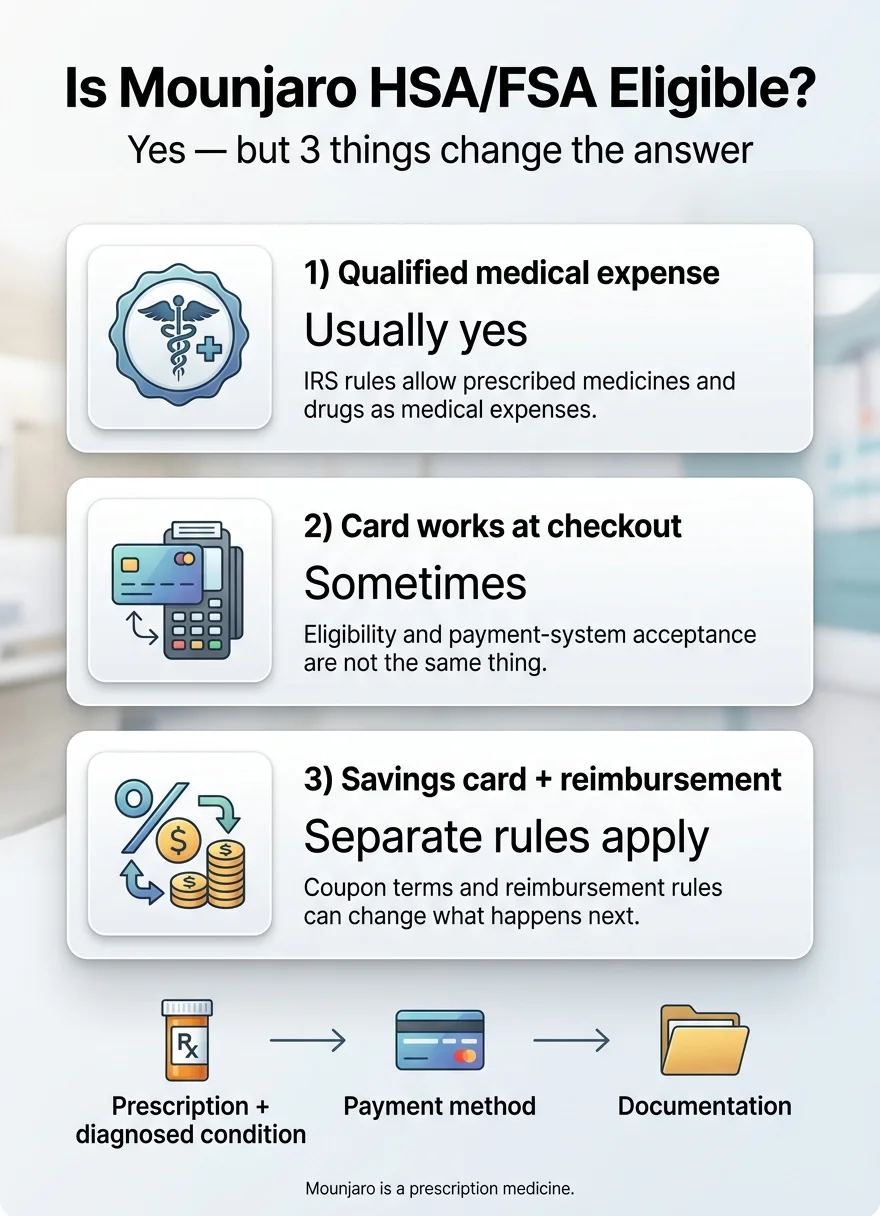
Is Mounjaro HSA/FSA eligible? Yes. The IRS treats prescribed medications as qualified medical expenses under Section 213, and Mounjaro is a prescribed medication. That’s the headline. But your search is really three questions:
| Question | Fast Answer | What Changes It |
|---|---|---|
| Is Mounjaro HSA/FSA eligible under IRS rules? | ✅ Usually yes | Prescription + a diagnosed medical condition |
| Will my HSA/FSA card work at checkout? | ⚠️ Sometimes | Whether the merchant uses an IRS-approved IIAS payment system |
| Can I stack HSA/FSA with the Mounjaro Savings Card? | ❌ Not for the savings amount | Lilly’s terms prohibit reimbursing the discounted portion from HSA/FSA |
We answer all three below, walk through the Savings Card rules most pages skip, and give you a step-by-step payment path for every scenario.
Still deciding between Mounjaro, Zepbound, or a different tirzepatide path? Take the free 60-second matching quiz →
Is Mounjaro HSA/FSA Eligible Under IRS Rules?
Yes, usually. IRS Publication 502 treats prescribed medicines as qualified medical expenses, and Mounjaro is a prescribed medicine. The condition being treated matters more than the brand name. Type 2 diabetes is the cleanest case, and weight-loss use qualifies when it treats a diagnosed disease such as obesity, overweight with comorbidity, or obstructive sleep apnea — not for cosmetic goals.
The IRS doesn’t maintain an approved-drug list. It has a principle: a medical expense is one you pay to “diagnose, cure, mitigate, treat, or prevent disease.” Prescribed drugs qualify. Mounjaro is a prescribed drug. That’s the core logic. What trips people up is that “Mounjaro is eligible” and “your claim will be approved” aren’t the same sentence. Three layers of reality sit between those two statements:
IRS tax eligibility
Whether the expense qualifies as a medical expense at all. This is the question Publication 502 answers.
Card acceptance at checkout
Whether the merchant’s payment system recognizes Mounjaro as HSA/FSA eligible in real time. This is a software-and-logistics question, not a tax question.
Reimbursement approval
Whether your plan administrator signs off when you submit for post-purchase reimbursement. This is a documentation question.
Most articles online answer only the first layer. That’s why the answer feels slippery — every one of those pages is technically correct and practically incomplete.
The FDA Indication Factor That Changes Everything
Mounjaro is FDA-approved for type 2 diabetes (adults and pediatric patients 10+). Weight loss was a secondary benefit observed in clinical trials — not an approved indication. When Eli Lilly wanted to market tirzepatide for weight management, they got it approved separately as Zepbound in November 2023. Same active ingredient, different FDA-approved label, different box.
Mounjaro
For type 2 diabetes = on-label
Documentation minimal. IRS lens is clean.
Mounjaro
For weight loss = off-label
Still eligible when tied to a diagnosis. Expect more paperwork on the FSA side.
Nobody makes you feel this distinction at the pharmacy counter. It surfaces later — in a claim denial, a documentation request, or an audit. See our Zepbound HSA/FSA guide for the weight-loss-labeled path.
Scenario 1: Mounjaro for Type 2 Diabetes (The Clean Case)
When Mounjaro is prescribed for type 2 diabetes, HSA and FSA eligibility is straightforward. Your prescription plus the diabetes diagnosis coded in your chart (typically ICD-10 codes in the E11 family) is the documentation trail the IRS expects. HSA/FSA card transactions at IIAS-certified pharmacies typically process without issue.
A few details worth knowing:
- The diagnosis code matters. A type 2 diabetes prescription coded E11.9 or E11.8 is clearly a disease treatment. Your prescriber handles this — but confirm the diagnosis is explicitly in your chart.
- Medicare is a special case. If you’re on Medicare and have an existing HSA, you can still spend those funds on Mounjaro — the HSA doesn’t evaporate when you enroll. You just can’t contribute new money. The Mounjaro Savings Card is not available to Medicare patients (federal anti-kickback rules prohibit it).
Scenario 2: Mounjaro Off-Label for Weight Loss (The Common Case)
Mounjaro prescribed off-label for weight loss is HSA/FSA eligible when it’s treating a specific diagnosed condition such as obesity (BMI 30+), overweight (BMI 27+) with a weight-related comorbidity, or obstructive sleep apnea. A Letter of Medical Necessity is strong documentation for HSA audit defense and commonly requested on FSA weight-loss submissions. Cosmetic weight-loss use without a diagnosed condition is not eligible.
IRS Revenue Ruling 2002-19 explicitly recognized obesity as a disease and established that expenses for obesity treatment can qualify as medical expenses. Off-label doesn’t mean ineligible — the IRS is indifferent to FDA labels.
Qualifying conditions
- ✓Obesity (BMI 30+) — ICD-10 E66 family
- ✓Overweight (BMI 27–29.9) + hypertension (I10)
- ✓Overweight + type 2 diabetes (E11)
- ✓Overweight + dyslipidemia (E78)
- ✓Obstructive sleep apnea (G47.33)
- ✓Overweight + cardiovascular disease
- ✓Non-alcoholic fatty liver disease
Does NOT qualify
- ✗Cosmetic weight loss (no diagnosis)
- ✗Wanting to lose weight for an event
- ✗General wellness or fitness use
- ✗Prescriptions without a documented qualifying condition
The Letter of Medical Necessity Playbook
An LMN is a short statement from your prescriber naming your diagnosis, explaining why Mounjaro is medically necessary, and confirming expected treatment duration. FSA administrators commonly request one for GLP-1 weight-loss claims; HSA holders rarely need to present one at checkout but should keep one on file as audit defense. Request it at your initial visit, not after a denial.
The four elements every good LMN contains:
Your diagnosis
Named in plain English and, ideally, with the ICD-10 code
Why the medication is medically necessary
What condition it treats, why alternatives were inadequate
Expected duration of treatment
Often “12 months, to be re-evaluated”
Prescriber signature, credentials, NPI, and date
All four fields required for FSA administrators
Mounjaro LMN Template (Copy and Hand to Your Provider)
Don’t have a prescriber yet?
Ro is a licensed telehealth service that prescribes Zepbound (tirzepatide) and Foundayo (orforglipron). Their providers handle the evaluation, the prescription, and can issue itemized receipts and prescription records suitable for HSA/FSA substantiation. Note: Ro does not accept HSA/FSA debit cards directly at checkout — you pay with a personal card, then submit the itemized receipt for reimbursement.
$39 first month, as low as $74/month with annual plan paid upfront (membership and medication billed separately).
Check eligibility for tirzepatide on Ro → (sponsored affiliate link, opens in a new tab)Will Your HSA/FSA Card Actually Work at Checkout?
Sometimes. At IIAS-certified pharmacies, Mounjaro is flagged as HSA/FSA eligible and cards typically swipe clean. At smaller merchants or some telehealth checkouts, your card may decline even though the expense is fully IRS-eligible — because the merchant’s payment system doesn’t recognize the SKU. A card decline is a merchant-system issue, not a tax verdict.
The IRS-approved IIAS (Inventory Information Approval System) is a merchant-side inventory database that tags individual SKUs as healthcare-eligible. Large pharmacies are IIAS-certified. Independent pharmacies sometimes aren’t. Telehealth checkouts sometimes aren’t, even when they sell fully eligible products.
Verified HSA/FSA Acceptance for Mounjaro (April 18, 2026)
| Provider / Retailer | HSA/FSA Marker? | Card Accepted Directly? | If Not Accepted |
|---|---|---|---|
| Amazon Pharmacy | Yes | Typically yes at checkout | N/A |
| Rite Aid | Yes | Typically yes at checkout | N/A |
| Embody (compounded tirzepatide alternative) | Advertised HSA/FSA eligible; confirm with plan | Cash-pay (no insurance) | Confirm HSA/FSA acceptance with your plan |
| SHED | Yes per SHED’s checkout | Yes | — |
| Ro | Itemized receipt provided; no direct card acceptance | No — reimbursement workflow only | Pay with personal card, submit itemized receipt |
What the receipt needs to show
An itemized pharmacy receipt for Mounjaro includes: pharmacy name and address, patient name, date of fill, drug name (Mounjaro or tirzepatide), quantity and dose, NDC when the pharmacy prints it, and price paid. A register-tape “Total: $1,094.00” may not be enough. Ask at the counter if yours didn’t print itemized.
Embody — Cash-pay compounded tirzepatide alternative
Cash-payIf branded Mounjaro is out of reach on cost or coverage, Embody is a cash-pay telehealth program offering compounded tirzepatide — the same active ingredient — as a weekly injection ($149 first month, then $399/month) or a needle-free GLP-1 gum ($199 first month, then $449/month). No insurance required. Embody advertises HSA/FSA eligibility, but confirm acceptance with your plan. Embody does not sell or ship branded Mounjaro; everything shipped is compounded.
Embody’s shipped compounded GLP-1 options are not FDA-approved finished drugs. A licensed provider determines whether treatment is medically appropriate. Prices, pharmacy availability, shipping timelines, and state eligibility can change and should be confirmed during intake. Check availability in your state during intake. Last verified June 11, 2026.
Cash-pay · No membership fee · Injection or needle-free GLP-1 gum · Check availability in your state during intake
The Mounjaro Savings Card: Two Tiers and the HSA/FSA Catch
Lilly’s Mounjaro Savings Card has two tiers in 2026. If your commercial insurance covers Mounjaro, you may pay as little as $25 for up to a 3-month single-dose pen prescription. If your commercial insurance doesn’t cover Mounjaro, you may pay as low as $499 for a 1-month single-dose pen prescription. Both tiers expire 12/31/2026. The catch: you cannot reimburse yourself from HSA/FSA for the discount itself.
The Two Current Savings Card Tiers
Commercial insurance covers Mounjaro
$25/mo
Up to a 3-month prescription. Max $150/month fill, $300/2-month, $450/3-month. Annual max savings: $1,950. Up to 13 fills per calendar year. Expires 12/31/2026.
Commercial insurance does NOT cover Mounjaro
$499/mo
1-month single-dose pen prescription. Max savings $647/fill. Annual max savings: $8,411. Requires a prescription consistent with FDA-approved labeling (type 2 diabetes). Expires 12/31/2026.
⚠️ The HSA/FSA Reimbursement Catch (Read This Twice)
“Lilly’s own Mounjaro Savings Card terms state you may not seek reimbursement from HSA, FSA, or other healthcare reimbursement accounts for any amount of savings received through the Card.”
✅ Allowed
Use Savings Card at pharmacy → out-of-pocket drops to $25 or $499 → pay that amount with HSA/FSA debit card. You’ve paid your actual cost with pre-tax dollars.
❌ Not Allowed
Using the Savings Card to reduce your cost to $25, then submitting the full $1,094 list price for HSA/FSA reimbursement. You cannot reimburse yourself for the discounted portion.
The 2026 Funding Math: How Much of Your HSA/FSA Will Mounjaro Consume?
At Lilly’s current list price of approximately $1,094 per fill, one month of brand Mounjaro consumes roughly 32% of the 2026 Health FSA cap ($3,400), 25% of the self-only HSA cap ($4,400), and 12.5% of the family HSA cap ($8,750). Three fills nearly exhausts a year’s FSA. Four fills exceeds the self-only HSA cap. Planning matters more for Mounjaro than for almost any other prescription you’ll ever reimburse.
At list price ($1,094/fill) — no Savings Card applied
| Planned fills | Cost at list price | 2026 impact |
|---|---|---|
| 1 fill | $1,094 | ~32% of FSA cap; ~25% of self-only HSA cap |
| 3 fills | $3,282 | ~96.5% of the 2026 Health FSA cap |
| 4 fills | $4,376 | ~99% of the self-only HSA cap |
| 6 fills | $6,564 | ~75% of the family HSA cap |
| 8 fills | $8,752 | Exceeds the 2026 family HSA cap |
| 12 fills | $13,128 | Far above either annual tax-advantaged cap |
2026 reference caps
| Account | 2026 Limit | Key Rule |
|---|---|---|
| Health FSA (salary-reduction cap) | $3,400 | Use-it-or-lose-it (carryover max $680) |
| HSA — self-only HDHP coverage | $4,400 | Funds roll over forever; moves with you |
| HSA — family HDHP coverage | $8,750 | Most headroom for Mounjaro therapy |
| HSA catch-up (age 55+) | +$1,000 | In addition to contribution limit |
How to Actually Pay for Mounjaro with HSA/FSA (Step-by-Step)
Pattern A: IIAS-certified pharmacy with commercial insurance
Present the prescription at an IIAS-certified pharmacy (Amazon Pharmacy or Rite Aid).
If using the Savings Card, give the pharmacist your savings card information first so the discount is applied before payment.
At checkout, pay with your HSA/FSA debit card. The IIAS system will recognize Mounjaro as eligible and approve the transaction.
Save the itemized receipt. Note: you cannot reimburse yourself from HSA/FSA for any portion covered by the Savings Card.
Pattern B: Card declines or you’re paying for reimbursement
Pay for the prescription with a personal credit or debit card.
Save the itemized receipt, the prescription record, and (for off-label) the LMN.
Log into your HSA or FSA administrator’s portal.
Start a new claim submission. Upload the itemized receipt. Upload the LMN if requested or if you’re on off-label use.
Submit and wait for processing. Reimbursement pays out in 1–3 weeks for most administrators.
Pattern C: Telehealth provider for tirzepatide
Complete the online consultation. Make sure the provider documents your diagnosis (T2D, obesity, OSA, etc.) in your record.
Request a Letter of Medical Necessity at the initial visit.
Check whether the provider accepts HSA/FSA cards directly at checkout. SHED: yes. Embody: cash-pay and advertised HSA/FSA eligible (confirm with your plan). Ro: no (reimbursement only).
Save the itemized invoice. Confirm it contains the drug name, dose, date, and your name.
If the invoice shows only a membership fee without medication broken out, request an itemized version from the provider’s support team.
Records to keep (and for how long)
Keep for at least 3 years after the tax return filing date. Digital copies are acceptable.
- Prescription or e-Rx record
- Itemized pharmacy or telehealth receipt (drug name, quantity, date)
- Diagnosis documentation — chart note, after-visit summary, or superbill with ICD-10 code
- Letter of Medical Necessity (required or strongly recommended for off-label weight-loss use)
- Savings Card statement, if applicable
- HSA/FSA card or reimbursement statement showing the transaction
Organize by calendar year in a named folder (“Mounjaro — 2026”). When tax season rolls around, you’ll thank past-you.
What to Do If Your Claim Is Denied or Your Card Is Declined
A card decline or claim denial isn’t a tax verdict — it usually reflects missing documentation or a merchant-system limitation. First-pass denials often reverse on appeal once complete documentation is submitted.
The denial-response workflow
Get the denial reason in writing
Administrators must tell you why. If it’s generic, request a specific reason.
Gather documentation
Prescription, itemized receipt, chart note with diagnosis, LMN.
Resubmit via the appeals or re-review channel
Most administrator portals have a dedicated path — it’s not just re-uploading to the original claim.
Call if needed
Script: “I’m submitting a qualified medical expense under IRS Section 213 for Mounjaro, prescribed by a licensed clinician to treat a diagnosed condition of [obesity / type 2 diabetes / OSA]. I’ve attached the Letter of Medical Necessity and itemized receipt. Please re-review.”
Document every step
Reference numbers, rep names, dates.
Mounjaro vs. Zepbound for HSA/FSA Purposes
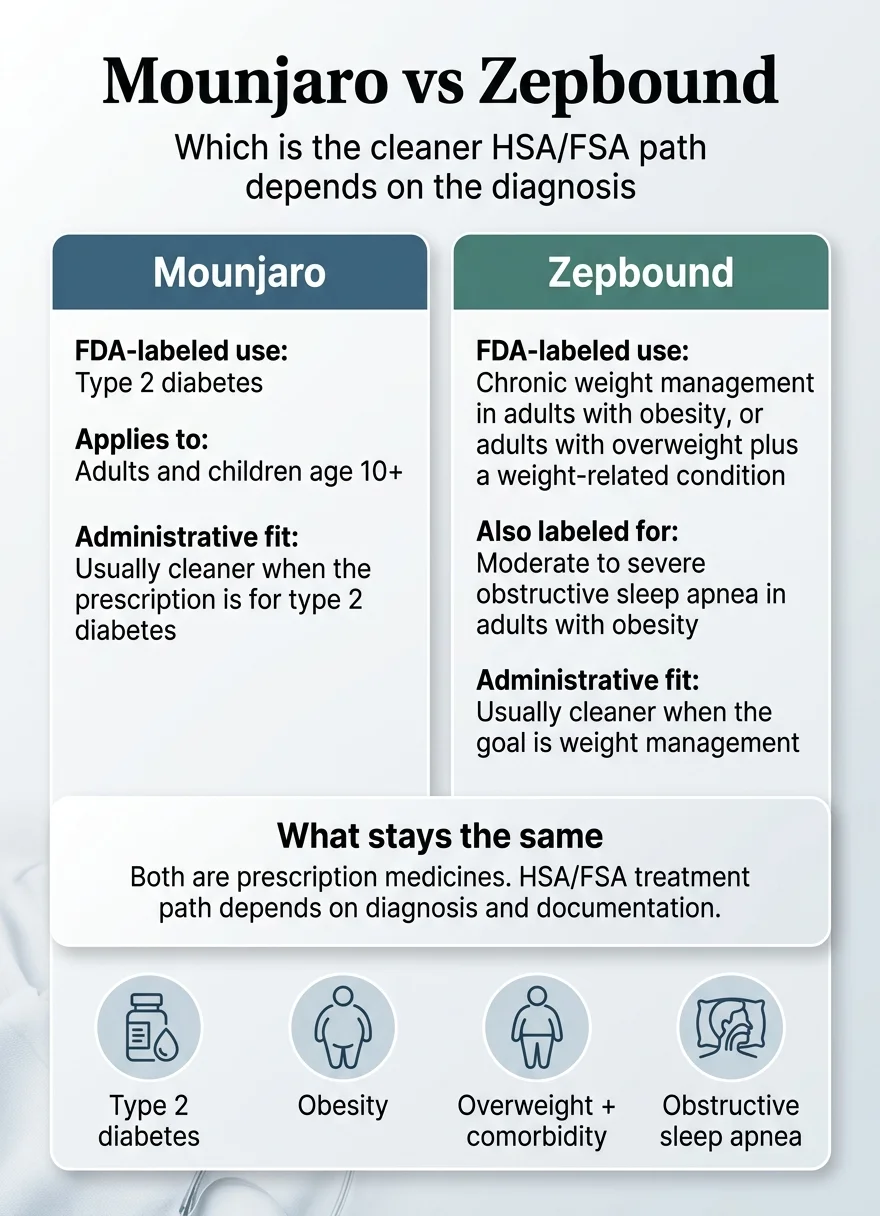
From the IRS’s perspective, Mounjaro and Zepbound are treated identically — both are prescribed tirzepatide products, both qualify as HSA/FSA eligible when treating a diagnosed condition. The practical differences sit at the insurance, savings-card, cash-pay, and labeling level.
| Factor | Mounjaro | Zepbound |
|---|---|---|
| FDA-approved use | Type 2 diabetes (adults + pediatric 10+) | Weight management + OSA in adults |
| On-label HSA/FSA friction | Minimal for diabetes | Minimal for weight management |
| Off-label friction (weight loss) | Moderate — LMN typically recommended | N/A — weight loss is on-label |
| Manufacturer savings card | Mounjaro Savings Card (two tiers) | Zepbound Savings Card (separate program) |
| Direct-pay cash option | None currently from manufacturer | LillyDirect vials from $349–$499/month |
| HSA/FSA eligibility | Yes, for qualifying condition | Yes, for qualifying condition |
Mounjaro is cleaner when:
- You have a type 2 diabetes diagnosis (on-label)
- Your formulary covers Mounjaro but not Zepbound
- The $25 Savings Card tier applies to your plan
Zepbound is cleaner when:
- Your goal is weight loss without a diabetes diagnosis
- You want FDA-labeled use aligning with your savings program
- You’re paying cash — LillyDirect vials $349–$499/month
- Your FSA administrator is strict about off-label claims
Related guides: Is Zepbound HSA/FSA Eligible? (2026 Rules) · Is Compounded Tirzepatide HSA/FSA Eligible?
Frequently Asked Questions
Is Mounjaro HSA eligible?▾
Usually yes. Mounjaro is HSA-eligible because the IRS treats prescribed medicines as qualified medical expenses when they treat a diagnosed medical condition. The practical answer can shift based on checkout acceptance, off-label documentation requirements, and Savings Card rules.
Is Mounjaro FSA eligible?▾
Yes, under the same rules. FSA administrators often request more documentation than HSAs — including a Letter of Medical Necessity for off-label weight-loss prescriptions — because FSAs are employer-sponsored and subject to stricter substantiation.
Can I use my HSA/FSA card at the pharmacy for Mounjaro?▾
Often yes at IIAS-certified pharmacies like Amazon Pharmacy and Rite Aid, which list Mounjaro as HSA/FSA eligible. Smaller independent pharmacies and some telehealth checkouts may require you to pay another way and submit for reimbursement instead.
Do I need a Letter of Medical Necessity for Mounjaro?▾
For type 2 diabetes use, an LMN is rarely requested at checkout or in reimbursement. For off-label weight-loss use, FSA administrators commonly request one, and HSA holders should keep one on file as audit defense. Request it from your prescriber at your initial visit — it’s faster to get upfront than after a denial.
Can I use the Mounjaro Savings Card and still reimburse myself from HSA/FSA?▾
Not for the savings amount. Lilly’s terms prohibit seeking reimbursement from HSA, FSA, or similar healthcare accounts for any amount of savings received through the card. You can use the card to lower your out-of-pocket and pay the remaining balance with your HSA/FSA — but you cannot reimburse yourself for the discount itself.
How much does the Mounjaro Savings Card actually save me?▾
Two tiers. If your commercial insurance covers Mounjaro, you may pay as little as $25 for up to a 3-month prescription. If your commercial insurance doesn’t cover Mounjaro, you may pay as low as $499 for a 1-month single-dose pen prescription. Both tiers expire 12/31/2026 and require a prescription consistent with FDA-approved labeling (type 2 diabetes). Government program beneficiaries and uninsured patients aren’t eligible.
What’s the difference between Mounjaro and Zepbound for HSA/FSA purposes?▾
From the IRS’s perspective, there’s no difference — both are prescribed tirzepatide products and both qualify when treating a diagnosed condition. The practical differences: Zepbound is FDA-approved for weight loss (cleaner off-label documentation) and has a LillyDirect cash-pay option through single-dose vials ($349–$499/month), which Mounjaro does not. Mounjaro is FDA-approved for type 2 diabetes in adults and pediatric patients 10+.
Can I pay for my Mounjaro telehealth visit with HSA/FSA?▾
Yes. Telehealth visits for evaluating and managing a diagnosed condition are qualified medical expenses under IRS Section 213. Whether you can swipe your HSA/FSA card at the telehealth checkout depends on the provider — some do, some don’t. If they don’t, pay with a personal card and submit for reimbursement.
What if I’m on Medicare and want to use my HSA for Mounjaro?▾
You can spend existing HSA balances on Mounjaro for a qualifying condition — the HSA doesn’t evaporate when you enroll in Medicare. You just can’t contribute new money to the HSA while on Medicare. The Mounjaro Savings Card is not available to Medicare patients.
How long should I keep my Mounjaro receipts and LMN?▾
At minimum, through the IRS period of limitations for the tax return the expense is reflected on — commonly at least three years from the filing date. Digital copies are acceptable. Organize by tax year for easy retrieval if anything is ever questioned.
What counts as a qualifying condition for off-label Mounjaro weight-loss use?▾
Obesity (BMI 30+), overweight (BMI 27+) with at least one weight-related comorbidity (hypertension, type 2 diabetes, dyslipidemia, cardiovascular disease), and obstructive sleep apnea are the most common qualifying conditions. Your prescriber documents the specific condition in your chart and LMN — the condition must be genuine and diagnosed, not assumed.
Does GoodRx stack with HSA/FSA for Mounjaro?▾
GoodRx is a discount program, not a reimbursement account. You can use a GoodRx coupon to lower your cash price at the pharmacy, then pay the reduced amount with HSA/FSA. GoodRx savings on brand Mounjaro have been modest relative to the Mounjaro Savings Card’s deeper discount for eligible commercially insured patients — so if you qualify for the Savings Card, that’s typically the stronger lever.
What We Actually Verified for This Page
All factual claims on this page were checked against primary sources on April 18, 2026.
- ✓IRS Publication 502 (qualified medical expenses framework) — current edition, April 2026
- ✓IRS Publication 969 (HSA, FSA, HRA rules) — current edition, April 2026
- ✓IRS Section 213(d) — statutory definition of medical care
- ✓IRS Revenue Ruling 2002-19 — ruling recognizing obesity as a disease for medical expense purposes
- ✓Mounjaro FDA prescribing information — current label for adults and pediatric patients 10+ with type 2 diabetes
- ✓Zepbound FDA prescribing information — current label for weight management (2023) and moderate-to-severe OSA in adults with obesity (2024)
- ✓Eli Lilly Mounjaro Savings Card official terms — both tiers ($25 covered / $499 non-covered), expiration 12/31/2026, verified April 2026
- ✓Eli Lilly Mounjaro list price — approximately $1,094 per monthly fill at publish, verified April 2026
- ✓2026 Health FSA contribution limit ($3,400) — IRS inflation-adjustment announcement
- ✓2026 HSA contribution limits ($4,400 self-only, $8,750 family) — IRS Revenue Procedure
- ✓Embody, SHED, Ro public payment information pages — verified 2026
Bottom Line
Is Mounjaro HSA/FSA eligible? Yes — with a prescription that treats a diagnosed medical condition. For type 2 diabetes, the path is clean. For off-label weight-loss use, it’s still eligible when tied to a qualifying condition — with a Letter of Medical Necessity as your documentation trail. Your HSA/FSA card will usually work at IIAS-certified pharmacies. The Mounjaro Savings Card has two tiers ($25 with coverage, $499 without), both expiring 12/31/2026, and you cannot reimburse yourself from HSA/FSA for the savings portion.
If you need a prescriber to evaluate you for tirzepatide, document medical necessity, and hand you the itemized receipt your administrator needs:
Check eligibility for tirzepatide on Ro → (sponsored affiliate link, opens in a new tab)$39 first month · As low as $74/month with annual plan · Itemized receipts for HSA/FSA · Reimbursement-only workflow
Still sorting out which path fits you — Mounjaro, Zepbound, LillyDirect, or another option:
Take the free 60-second matching quiz →Three questions. No account required. Routes you to the right provider and product path.
Related Guides
Not tax, medical, or legal advice
HSA/FSA rules are based on current IRS guidance and may change. For your specific situation, consult a qualified tax or benefits professional. Always confirm current eligibility with your plan administrator before making a purchase. Mounjaro is a prescription medication; only a licensed clinician can determine whether it is appropriate for you. Mounjaro is a registered trademark of Eli Lilly and Company. This page is an independent resource and is not sponsored by, affiliated with, or endorsed by Eli Lilly.
About The RX Index
The RX Index is a pricing intelligence and comparison resource for GLP-1 telehealth providers. We verify pricing, coverage, documentation behavior, and savings program terms across the market. We are not a pharmacy, a telehealth provider, or a licensed medical practice.
© 2026 The RX Index. All rights reserved. Last comprehensive review: April 2026. Verified April 18, 2026.