
Is Compounded Tirzepatide HSA/FSA Eligible? (2026 Rules + Provider Proof)
Published:
By The RX Index Editorial Team • Last verified: April 17, 2026 • Published April 17, 2026
The RX Index is a pricing intelligence and comparison resource for GLP-1 telehealth providers.
Not medical or tax advice. Consult your prescribing clinician and plan administrator for your specific situation.
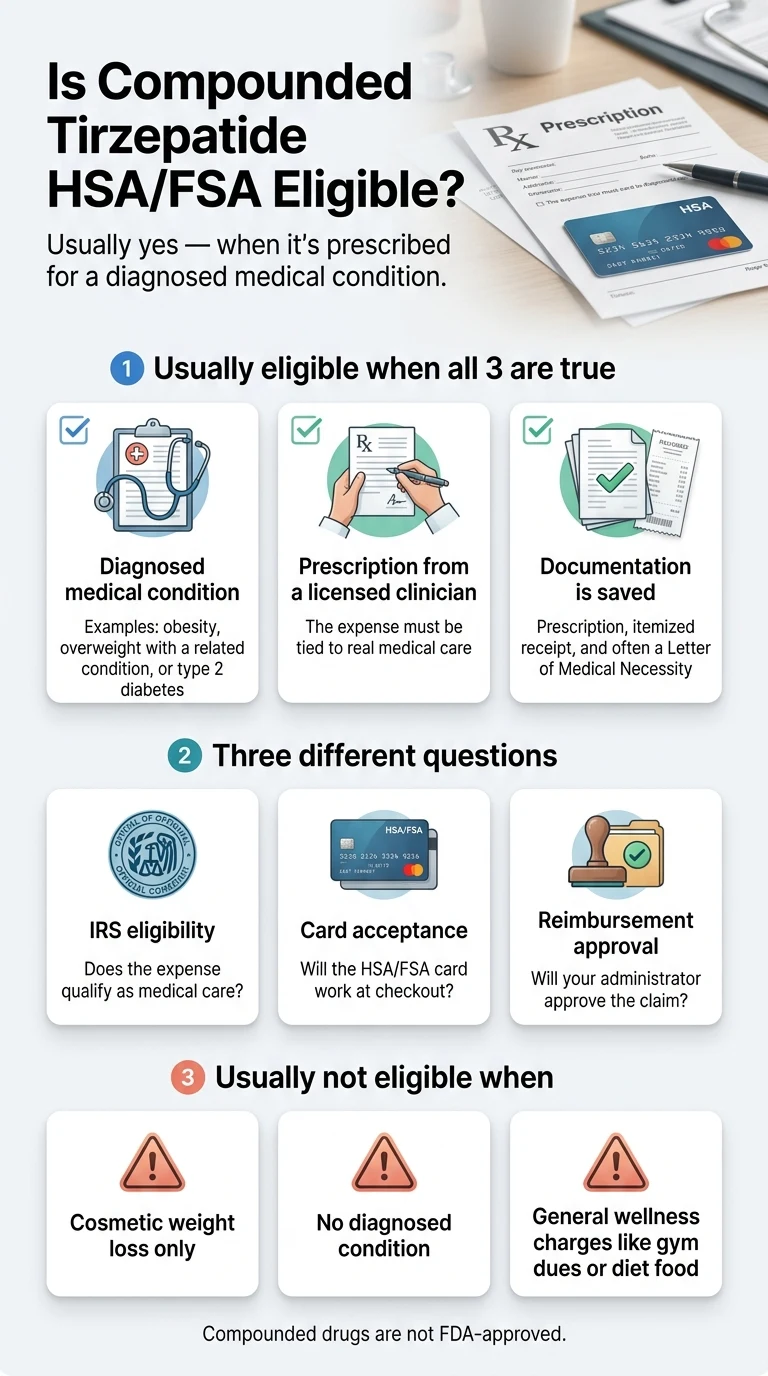
Is compounded tirzepatide HSA/FSA eligible? Yes — in most cases. Compounded tirzepatide is HSA and FSA eligible when a licensed clinician prescribes it to treat a diagnosed medical condition like obesity, overweight with a comorbidity, or type 2 diabetes. IRS Publication 502 covers prescribed medicines and disease-based weight-loss treatment, and it does not make FDA-approval status a condition of qualification.
Here’s the part every other page skips: eligibility, card acceptance at checkout, and reimbursement approval are three completely different questions. You can have a 100% eligible expense and still get your card declined. You can have card acceptance and still get flagged for documentation. You can nail both and still lose reimbursement if your provider bundles medication with non-medical fees on a single line item.
Two conditions change the yes:
- If compounded tirzepatide is prescribed purely for cosmetic weight loss — no diagnosis, no chart note — it is not HSA/FSA eligible under IRS rules.
- The separate FDA question — whether a pharmacy can legally compound tirzepatide for you at all in 2026 — is narrower than it was in 2024. FDA transition periods for compounding tirzepatide ended February 18, 2025 (503A) and March 19, 2025 (503B). Your IRS eligibility didn’t change. Access did.
Quick facts
- Usually eligible? Yes — when prescribed for a diagnosed condition (IRS Publication 502).
- Will every HSA/FSA card work at checkout? No. Acceptance is set at the provider’s merchant processor, not by the IRS.
- Best documentation to keep? Prescription + itemized receipt + Letter of Medical Necessity.
- Biggest caveat in 2026? FDA transition periods for tirzepatide compounding ended Feb/March 2025. Eligibility rules didn’t change. Access did.
- Typical tax savings on $329/mo at 24% federal bracket? Roughly $79/month in federal income tax — more with FICA and state stacked on top.
What we actually verified for this page
This is a YMYL topic, so we want you to see our work. As of April 17, 2026, we verified:
- The IRS rule for prescribed medicines and disease-based weight-loss treatment via IRS Publication 502 (2025), IRS Topic 502, and the IRS FAQ on nutrition, wellness, and general health (2023).
- The 2026 HSA and FSA contribution limits via IRS Revenue Procedure 2025-19.
- The current FDA regulatory status of tirzepatide compounding via the FDA’s compounding policy update (“FDA clarifies policies for compounders as national GLP-1 supply begins to stabilize”).
- The FSAFEDS Letter of Medical Necessity form and FSAFEDS guidance on weight-loss expense documentation.
- Current public pricing and HSA/FSA payment language for MEDVi, Embody, SkinnyRx, SHED, Yucca (sponsored affiliate link, opens in a new tab), Sesame Care, Ro, and Hers (sponsored affiliate link, opens in a new tab) by visiting each provider’s live pricing/payment page on the date listed.
Where a claim could not be independently verified from the provider’s public pages, we mark it “provider-stated” or “not publicly verified” in the proof matrix. This is not medical advice or tax advice. It’s research you can check.
Is compounded tirzepatide HSA/FSA eligible? The three-question answer
Yes, compounded tirzepatide is generally HSA and FSA eligible when a licensed clinician prescribes it for a diagnosed medical condition. Eligibility under IRS rules, HSA/FSA card acceptance at a telehealth checkout, and successful reimbursement from your plan administrator are three separate questions with three separate answers. You need all three to go your way for the full path to work.
Most pages collapse all three into one vague “HSA/FSA eligible” badge. That’s how readers end up with declined cards, denied claims, or surprise tax penalties.
Question 1 — Is the expense eligible under IRS rules?
Federal rule. Under IRS §213 and Publication 502, a qualified medical expense is one paid primarily to alleviate or prevent a physical or mental defect or illness. Prescribed medicines and disease-based weight-loss treatment both qualify. Cosmetic weight loss does not. Publication 502 does not draw a line between FDA-approved drugs and compounded drugs — medical necessity is the test.
Question 2 — Will the provider’s checkout accept your HSA/FSA card?
This is a merchant-processing question, not an IRS question. Some telehealth providers — MEDVi, SkinnyRx, and SHED among them — are set up with merchant category codes that let HSA/FSA cards run directly at checkout. Others (Ro, Hers) make you pay with a personal card and submit for reimbursement. Card acceptance is a vendor choice. It has nothing to do with whether the IRS thinks your expense is eligible.
Question 3 — Will your plan administrator reimburse the full charge?
This is the reimbursement question, and it’s where most headaches happen. If your provider bundles medication + membership + visits + coaching onto a single line item and can’t itemize them, your administrator may reimburse the medication portion and deny the rest. FSAs also tend to flag weight-management claims for documentation review, which is where the Letter of Medical Necessity comes in.
Practical read: you need all three to line up. We show you how.
What the IRS actually says about prescribed tirzepatide
Two IRS publications matter here, and neither needs a law degree to read.
IRS Publication 502 is the main one. It explicitly includes “amounts you pay for prescribed medicines and drugs” and “amounts paid to participate in a weight-loss program for a specific disease or diseases, including obesity, diagnosed by a physician.”
That second sentence matters for tirzepatide. If a licensed clinician has diagnosed you with obesity (BMI ≥30), overweight (BMI ≥27) with a weight-related comorbidity like type 2 diabetes, hypertension, sleep apnea, or cardiovascular disease, or with type 2 diabetes itself, the medication falls inside the rule.
What the IRS does not say:
- It does not exclude compounded medications.
- It does not make FDA-approved status a condition of eligibility.
- It does not carve tirzepatide out in any form.
The FDA regulates drug manufacturing and compounding. The IRS regulates tax. Two different agencies making two different calls.
What else qualifies as part of the broader program: telehealth consultations for prescription management, lab work ordered by the prescribing clinician, and medical visits that document the diagnosis. General wellness, gym dues, diet food, and lifestyle coaching not tied to a specific diagnosed disease do not qualify.
The IRS mechanism in one line:
Prescription + diagnosis + itemized receipt = eligible. Miss any of the three and you have a problem.
Sources: IRS Publication 502 (2025 edition); IRS Topic 502; IRS FAQ on nutrition, wellness, and general health (2023).
FDA regulatory reality check (April 2026)
Honest damaging admission
This is a narrower landscape than it was in 2024, and anyone telling you otherwise is reading from a 2024 playbook. If you want zero regulatory ambiguity with your HSA/FSA dollars, FDA-approved Zepbound is the cleaner path. We show you how to access it further down this page.
The timeline, plain
| Date | What changed |
|---|---|
| December 2022 | FDA adds tirzepatide to its drug shortage list as demand explodes after Mounjaro approval. |
| October 2, 2024 | FDA declares the tirzepatide shortage resolved. Eli Lilly confirms manufacturing can meet national demand. |
| February 18, 2025 | Transition period ends for 503A state-licensed pharmacies. |
| March 19, 2025 | Transition period ends for 503B outsourcing facilities. |
| April 2026 (now) | Under FDA guidance, 503A compounding of drugs that are essentially copies of FDA-approved products is generally prohibited unless the prescriber documents a significant difference for the identified patient. |
“Significant difference for the identified patient” in plain language: a documented clinical reason the FDA-approved version doesn’t work for a specific patient — a documented allergy or intolerance to an inactive ingredient, or a required dose or formulation that isn’t commercially available. Cost and convenience, on their own, don’t meet the standard.
What this means for your HSA/FSA dollars: if a telehealth provider is still selling you compounded tirzepatide in April 2026, the prescriber should have real, documented clinical justification for choosing compounded over FDA-approved Zepbound. Not a checkbox. A chart note.
503A vs 503B: A 503A pharmacy is a state-licensed compounding pharmacy that fills individual patient-specific prescriptions. A 503B outsourcing facility is FDA-registered and can compound in bulk. When a provider tells you they “partner with a licensed pharmacy,” it’s fair to ask which 503A pharmacy they use and whether your prescription is patient-specific.
Source: FDA, “FDA clarifies policies for compounders as national GLP-1 supply begins to stabilize.”
HSA vs FSA — why the distinction matters for this expense
HSA and FSA funds are both eligible for compounded tirzepatide under identical IRS rules. The practical difference is how strictly the plan administrator verifies the expense.
HSA in one minute
A pre-tax account tied to a high-deductible health plan. Funds roll over every year and can be invested. You keep the records; they don’t usually ask at point of sale. 2026 limits: $4,400 (individual) and $8,750 (family), plus $1,000 catch-up (age 55+) per IRS Rev. Proc. 2025-19.
FSA in one minute
A pre-tax account funded through payroll. Generally “use it or lose it,” though some plans offer a grace period (up to 2.5 months) or carryover. 2026 FSA contribution limit: $3,400. If your FSA deadline is approaching, compounded tirzepatide is an eligible use when properly documented.
| HSA | FSA | |
|---|---|---|
| IRS eligibility rule | Identical | Identical |
| Card decline risk | Lower | Higher |
| LMN required for reimbursement | Not usually at point of sale | Often yes |
| Documentation retention | You keep it | Administrator verifies |
| Funds roll over | Yes | Depends on employer plan |
| Year-end urgency | No | Depends on plan's grace/carryover rules |
Practical implication: if you’re on an FSA, assume you’ll need a Letter of Medical Necessity. If you’re on an HSA, request one anyway — it’s the single best audit-protection document you can have.
Sources: IRS Revenue Procedure 2025-19; IRS Publication 969.
Do you need a Letter of Medical Necessity for compounded tirzepatide?
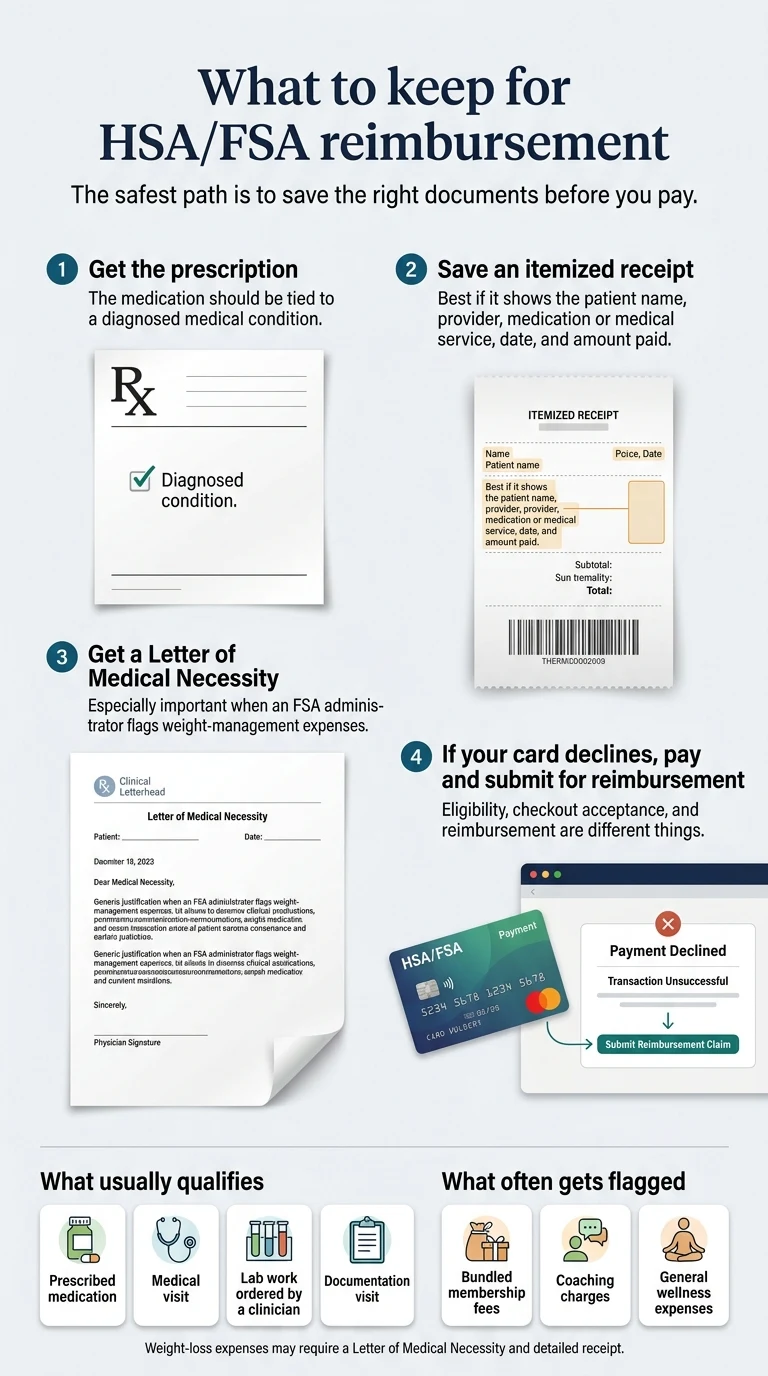
If you’re paying with an FSA, plan for a yes — most FSA administrators flag weight-management prescriptions for documentation review, and an LMN is the fastest way to clear it. If you’re paying with an HSA, an LMN isn’t usually required at the point of sale, but you should request one anyway and file it with your records.
What a legitimate LMN should include at minimum
- Patient name
- Medical condition or diagnosis being treated
- Prescribed medication (compounded tirzepatide, specific dose)
- Duration of treatment
- Prescribing clinician’s signature and date
Helpful but not universally required: specific ICD-10 code, National Provider Identifier (NPI), and clinical rationale. Ask your specific plan administrator which fields they want before you request the letter.
How to request one — copy-paste message to your provider’s support
Subject: LMN and itemized receipt request for HSA/FSA
Hi — I’m paying with HSA/FSA funds and need documentation for my administrator. Could you send:
- A Letter of Medical Necessity on your letterhead that includes my name, the medical condition being treated, the prescribed medication and dose, the duration of treatment, and the prescribing clinician’s signature and date.
- An itemized receipt for my order that separates the medication cost from any membership, consultation, or coaching fees.
Thanks — I need this for reimbursement substantiation.
What a good LMN is not
- A generic “your prescription is covered” email
- A receipt that just says “weight management program”
- A coupon code that doesn’t reference a diagnosis
“For FSA/HSA, you want to be more concerned with which companies will provide a Letter of Medical Necessity for it since many of them require it.” — r/tirzepatidecompound
Source: FSAFEDS Letter of Medical Necessity form.
Which parts of your tirzepatide program qualify — and which trip people up
The medication itself and bona fide medical visits are the cleanest HSA/FSA claims. The real danger zone is bundled monthly access fees — when a provider wraps medication, membership, visits, and coaching into a single line item and can’t itemize them, your administrator may reimburse only the medication portion or deny the charge entirely.
| Charge type | HSA/FSA treatment | What to do |
|---|---|---|
| Prescribed compounded tirzepatide (medication) | ✅ Usually eligible | Save Rx + itemized receipt |
| Telehealth medical consultation | ✅ Usually eligible | Save itemized bill |
| Initial intake with clinician | ✅ Usually eligible | Save itemized bill |
| Documentation visit or LMN fee | ✅ Usually eligible if medical | Save itemized bill |
| Follow-up dose adjustment visit | ✅ Usually eligible | Save itemized bill |
| Lab work ordered by prescribing clinician | ✅ Usually eligible | Save lab receipt |
| Prescription shipping / handling | ✅ Usually eligible as part of medication cost | Save receipt |
| Bundled "membership" access fee | ⚠️ Depends — often needs itemization | Request itemization first |
| Weight-loss coaching (tied to diagnosis) | ⚠️ May qualify with LMN | Get LMN + detailed receipt |
| Weight-loss coaching (no diagnosis) | ❌ Not eligible | Don't charge to HSA/FSA |
| Gym membership | ❌ Not eligible | Don't charge to HSA/FSA |
| Diet food or meal replacements | ❌ Not eligible | Don't charge to HSA/FSA |
| Cosmetic weight-loss goals (no diagnosis) | ❌ Not eligible | Don't charge to HSA/FSA |
The bundled-fee trap
If a monthly charge shows up on a receipt as “monthly program fee: $349” with no itemization, your FSA administrator has every reason to flag it. Request a corrected receipt that separates medication cost, consultation/visit fees, and any membership or access fees as separate line items.
Copy-paste itemization request:
“Hi — could you issue a corrected monthly receipt that itemizes my charges? I need medication cost, consultation/visit fees, and any membership or access fees listed as separate line items for my HSA/FSA reimbursement. Thanks.”
The RX Index Compounded Tirzepatide HSA/FSA Proof Matrix
We checked eight telehealth providers on the same public criteria: does the provider currently offer compounded tirzepatide, does their public site state HSA/FSA acceptance, which payment path do they support (direct card at checkout vs reimbursement), do their public pages address Letters of Medical Necessity or itemized receipts, and what’s the current public starting price. Last verified April 17, 2026.
| Provider | Compounded tirz. available (Apr 2026) | HSA/FSA at checkout | LMN / documentation support | Itemized receipt | Starting price |
|---|---|---|---|---|---|
| Embody | Yes (compounded injection + needle-free gum) | ✅ Provider-stated: advertised "HSA/FSA eligible" | ⚠️ Not publicly verified — contact support | ⚠️ Not publicly verified — request one | $149 first month / $399/mo after (injection) |
| SkinnyRx | Yes | ✅ Provider-stated: FAQ confirms FSA/HSA card accepted | ⚠️ Not publicly verified — contact support | ⚠️ Not publicly verified — request one | As low as $299/mo |
| MEDVi | Yes | ✅ Provider-stated: "HSA/FSA Approved" | ⚠️ Not publicly verified — contact support | ⚠️ Not publicly verified — request one | Injection $349 / tablets $279 |
| SHED | Yes | ✅ Provider-stated | ⚠️ Contact support if your plan requires one | ✅ Provider-stated: receipts available | Verify at checkout |
| Yucca Health | Yes | ⚠️ Depends on plan | ❌ Yucca FAQ: does not provide LMNs | ❌ Yucca FAQ: does not provide itemized receipts | Verify at checkout |
| Sesame Care | ❌ No compounded; FDA-approved Zepbound + Mounjaro | ✅ Provider-stated | ⚠️ Not publicly verified — contact support | ✅ Provider-stated: itemized bills available | Varies by clinician |
| Ro | ❌ No compounded; FDA-approved Zepbound / Foundayo | ❌ Pay with personal card, submit for reimbursement | ⚠️ Not publicly verified — contact support | ✅ Detailed receipts provided | $39 first month; Zepbound $299 first month, $399–$449 at later doses |
| Hers | ❌ No publicly verified compounded tirzepatide route (Apr 2026) | Pay normally, submit for reimbursement; some HSA/FSA card use may require extra steps | ⚠️ Not publicly verified — contact support | ✅ Downloadable receipts available | Varies |
Legend:
- ✅ Provider-stated: the provider’s own public page says it
- ⚠️ Not publicly verified: we didn’t find public support; request it via support before relying on it
- ❌ Confirmed negative: provider’s own page or policy says they don’t do this, or the option isn’t offered
A note on Yucca: Yucca’s own FAQ states that many patients use HSA or FSA funds, but that Yucca does not provide Letters of Medical Necessity or itemized receipts. If your plan administrator requires either document, Yucca is not the right fit regardless of card acceptance. Readers who need documentation support should look at SkinnyRx, MEDVi, or SHED.
See our GLP-1 providers that accept FSA cards for a broader comparison.
Best route by situation — how to pick
There’s no universal winner because this is a payment-mechanics decision, not just a medication decision. The right provider depends on whether you want the cleanest national default, the strongest direct-card acceptance, the broadest menu of formats, or an FDA-approved alternative with no compounding uncertainty.
Best low-cost cash-pay starter: Embody
Low-Cost StarterEmbody is our pick for the lowest-friction cash-pay start because it publishes clear compounded tirzepatide pricing (injection $149 first month, then $399/month), advertises HSA/FSA eligibility, charges no separate membership fee, and — unusually — offers a needle-free GLP-1 gum ($199 first month / $449/month) for patients who don’t want weekly injections. Embody does not sell or ship branded Zepbound; everything shipped is compounded.
- Compounded tirzepatide injection at $149 first month / $399/month after; needle-free tirzepatide gum at $199 first month / $449/month
- Cash-pay (no insurance required), no membership fee, 24/7 messaging support, fast online intake reviewed by a licensed provider (often within 24 hours, if approved)
- Advertised as HSA/FSA eligible — confirm acceptance with your plan; Embody is clear that compounded medications are not FDA-approved finished drugs
Embody’s shipped compounded GLP-1 options are not FDA-approved finished drugs. A licensed provider determines whether treatment is medically appropriate. Prices, pharmacy availability, shipping timelines, and state eligibility can change and should be confirmed during intake. Check availability in your state during intake. Last verified June 11, 2026.
Cash-pay · $149 first month, $399/mo after (injection) · Check availability in your state during intake
Send the LMN + itemized-receipt request message from the paperwork section to Embody support before or right after you pay.
Best for direct HSA/FSA card use at checkout: SkinnyRx
SkinnyRx is the strongest direct-card option because its FAQ explicitly states the platform accepts FSA/HSA cards, and its compounded tirzepatide product pages are labeled FSA/HSA eligible. Starting price is “as low as $299/month.”
Honest trade-off: SkinnyRx’s public “as low as” pricing is plan-dependent — confirm your exact dose and plan before checkout. For a reader who cares most about the card working the first time, that friction is usually worth it.
“A very positive experience with Customer Service today with Andi. 5 stars!” — Rachel Weinstein, Trustpilot (verified April 15, 2026) · Service/support quote only.
HSA/FSA card accepted · As low as $299/mo · Verified April 2026
Best for readers who want format options: MEDVi
MEDVi is the strongest pick for readers who want a broad menu of tirzepatide formats — injection at $349/month and tablets at $279/month — with direct HSA/FSA card acceptance and no membership or hidden fees.
Honest trade-off: MEDVi does not bill insurance or process prior authorizations. The cancellation policy is stricter than some competitors — refunds are generally not offered outside of medical disqualification. Budget at the ongoing refill rate before you commit.
Review MEDVi tirzepatide pricing and HSA/FSA details → (sponsored affiliate link, opens in a new tab)HSA/FSA accepted · Injection $349 / tablets $279 · Verified April 2026
See also: MEDVi HSA/FSA acceptance verified →
SHED — receipts available, FSA-friendly
SHED publicly states HSA/FSA card acceptance and provides receipts on request. It’s a solid choice if you want a provider that publishes both card acceptance and receipt availability — two of the three most important columns in the proof matrix.
See SHED pricing → (sponsored affiliate link, opens in a new tab)HSA/FSA accepted · Receipts available · Verified April 2026
If you want an FDA-approved alternative (no compounding uncertainty)
If the 2026 FDA narrowing around compounded tirzepatide bothers you, FDA-approved Zepbound is unambiguously HSA/FSA eligible and has three reliable paths: LillyDirect’s self-pay Zepbound option, Sesame Care’s FDA-approved marketplace (which includes both Zepbound and Mounjaro), or Ro for readers who want a full insurance-and-prior-authorization route.
Sesame Care is a clean FDA-approved lane. No compounded uncertainty. FDA-approved GLP-1 access through platform clinicians, HSA/FSA-friendly payment. Pricing varies by the specific clinician you book through.
Sesame Care: brand-name Wegovy and Zepbound, HSA/FSA accepted · Ro: get started $39, Zepbound from $299/mo · Both verified April 2026
Note: Ro does not accept HSA/FSA cards at checkout — you pay with a personal card and submit the itemized receipt for reimbursement. The expense is still fully IRS-eligible; it’s a mechanics difference.
If your HSA or FSA card gets declined at checkout
A declined HSA or FSA card almost never means your expense is ineligible. Common causes are insufficient balance, a daily card-level spending limit, and a merchant category code (MCC) mismatch between the telehealth pharmacy and your administrator’s system. In every case, you can pay with a personal card and submit the itemized receipt for reimbursement. The expense is still fully IRS-eligible.
- Check your HSA or FSA balance. Most common cause, easiest fix.
- Check your card for a daily spending limit. HSA/FSA cards sometimes have per-transaction or daily caps that trigger on larger medication charges.
- If balance is fine and no daily cap, the issue is likely the merchant category code — a routing problem, not an eligibility problem.
- Pay with a personal credit or debit card.
- Download the itemized receipt from the provider. It must show:
- Provider name, patient name, medication (compounded tirzepatide + dose)
- Prescription reference, date of service or shipment, amount paid
- Submit the receipt through your HSA or FSA administrator’s portal or mobile app. If FSA, attach your LMN to the submission.
- Save the receipt, prescription, and LMN for at least three years from the date you filed the tax return covering that expense.
“I’ve used my FSA for reimbursement on compounded Tirzepatide. Make sure you get a receipt with your name, date of service, service type and prescription.” — r/tirzepatidecompound
A declined card is an inconvenience. It’s not a verdict on whether your expense qualifies.
What you actually save with HSA/FSA on compounded tirzepatide
At a typical ongoing compounded tirzepatide price of around $329/month, an HSA or FSA user in the 24% federal bracket saves roughly $79/month and $948/year in federal income tax alone. That number increases when you add FICA (for payroll-funded accounts) and state income tax.
Federal-only savings at $329/month
| Marginal federal bracket | Monthly savings (federal only) | Annual savings (federal only) |
|---|---|---|
| 12% | $39 | $474 |
| 22% | $72 | $869 |
| 24% | $79 | $948 |
| 32% | $105 | $1,263 |
| 37% | $122 | $1,461 |
Add-ons that increase those numbers:
- FICA (+7.65%) if your HSA is payroll-funded or you’re using an FSA. On $329/month, that’s an additional ~$25/month, ~$302/year.
- State income tax varies from 0% to around 13%. On $329/month at a 5% state rate, that’s an additional ~$16/month, ~$197/year.
Example total: at 24% federal bracket, payroll-funded HSA, 5% state: roughly $79 + $25 + $16 = ~$120/month, ~$1,447/year. That’s the equivalent of roughly four free months of medication per year at typical compounded pricing.
Estimates are illustrative. Actual savings depend on your bracket, state, filing status, and funding method. Not tax advice.
Start a low-cost cash-pay compounded tirzepatide plan.
Check current pricing on Embody → (sponsored affiliate link, opens in a new tab)Embody is cash-pay and advertised as HSA/FSA eligible — confirm acceptance with your plan. Request your LMN and itemized receipt from support using the copy-paste message above.
Compounded tirzepatide vs FDA-approved Zepbound — which is easier for HSA/FSA?
For IRS eligibility rules, both are treated identically — they’re prescribed medications for a diagnosed condition. For real-world reimbursement friction, FDA-approved Zepbound is often easier to explain to an administrator. For out-of-pocket cost, compounded tirzepatide is often lower — though the price gap has narrowed.
| Factor | Compounded tirzepatide | FDA-approved Zepbound |
|---|---|---|
| IRS eligibility | Eligible with Rx + diagnosis | Eligible with Rx + diagnosis |
| FDA status | Not FDA-approved | FDA-approved for chronic weight management |
| 2026 regulatory landscape | Narrower since FDA transition periods ended Feb/March 2025 | Stable |
| Typical cash price | ~$249–$399/month via telehealth | ~$299–$449/month via Lilly's self-pay program or telehealth |
| HSA/FSA documentation friction | Moderate (LMN often required for FSA) | Lower (recognized brand) |
| Insurance coverage | Almost never covered | Sometimes covered with prior authorization |
| Dose flexibility | Can sometimes be customized | Fixed commercial doses |
| Supply reliability | Depends on provider's clinical documentation under 503A | High |
When compounded still makes sense
- Your cash price at Embody or SkinnyRx is meaningfully lower than brand pricing at your dose
- Your provider has documented clinical justification on file
- You want dose titration flexibility beyond commercial presentations
When FDA-approved Zepbound is the cleaner call
- Your FSA administrator is historically strict
- You want zero regulatory ambiguity
- Your insurance offers a prior authorization path
- You’re approaching an end-of-year FSA deadline
If your HSA/FSA reimbursement claim gets denied
Many reimbursement denials on compounded tirzepatide claims are paperwork denials rather than true eligibility denials. The fix is usually better documentation, clearer itemization, or separating medical charges from bundled program charges.
The five-step denial fix
- Read the denial reason. Administrators are required to tell you why. Common reasons include “documentation required,” “expense not eligible” (often misclassified), or “itemization missing.”
- Add the Letter of Medical Necessity. If you didn’t submit one the first time, this is the most effective resubmission addition. Request it using the copy-paste message above.
- Request a corrected itemized receipt. Ask your provider for a receipt that clearly separates medication cost from any membership or access fees.
- Separate medical from non-medical charges. Submit only the medication and medical portions, not a bundled coaching/gym component.
- Reimburse yourself from your HSA even if the FSA claim fails. If you paid with a personal card and your FSA denies reimbursement, you can still reimburse yourself from your HSA for the eligible portion. HSA reimbursement has no deadline as long as the expense was incurred after the account was established.
“If you have a prescription, has anyone used and verified it is ok to use FSA/HSA? I am assuming so but the list of allowable purchases is kind of vague.” — r/tirzepatidecompound
The answer: yes, and the way you verify it is by keeping the prescription + itemized receipt + LMN. If your claim is denied with those three documents attached, escalate to your administrator’s appeal process.
Frequently asked questions
Is compounded tirzepatide HSA eligible?
Yes, when a licensed clinician prescribes it for a diagnosed medical condition such as obesity, overweight with a comorbidity, or type 2 diabetes. IRS Publication 502 covers prescribed medicines and disease-based weight-loss treatment and does not make FDA-approval status a condition of qualification.
Is compounded tirzepatide FSA eligible?
Yes, under the same IRS rule that applies to HSA. Most FSA administrators request a Letter of Medical Necessity before reimbursement clears, so request one from your provider before or shortly after you pay.
Do I need a Letter of Medical Necessity for compounded tirzepatide?
For FSAs, plan on yes — most administrators flag weight-management prescriptions for documentation. For HSAs, an LMN is not usually required at the point of sale, but you should keep one on file for audit protection.
Is compounded tirzepatide still legal in 2026?
Compounding is available where the prescriber can document a significant difference for the identified patient that the FDA-approved product does not meet — for example, a documented allergy or intolerance to an inactive ingredient, or a required formulation or dose not commercially available. Compounding strictly for cost savings or patient preference does not satisfy the 503A standard under current FDA guidance.
Why did my HSA or FSA card get declined at a telehealth pharmacy?
Usually a merchant category code mismatch, a balance issue, or a card-level spending limit — not an eligibility issue. Pay with a personal card and submit the itemized receipt for reimbursement through your administrator’s portal.
Is Zepbound HSA/FSA eligible?
Yes, Zepbound (FDA-approved tirzepatide) is HSA and FSA eligible when prescribed for chronic weight management at a BMI of 30 or higher, or a BMI of 27 or higher with a weight-related comorbidity.
Can I use my HSA for compounded semaglutide?
Yes, under the same IRS rule — prescribed for a diagnosed condition. The FDA regulatory framework for compounded semaglutide differs from tirzepatide’s, so check the current FDA status before buying.
How long do I need to keep HSA/FSA receipts for compounded tirzepatide?
At least three years from the date you filed the tax return covering that expense. Holding digital copies longer is a best practice.
Does the IRS treat compounded tirzepatide differently from Zepbound for tax purposes?
No. IRS Publication 502 and §213 do not distinguish between compounded and FDA-approved medications. Medical necessity tied to a diagnosed condition is the test.
What happens in an audit if I used my HSA for compounded tirzepatide?
If you can produce the prescription, the itemized receipt, and ideally a Letter of Medical Necessity tied to a diagnosis, the expense stands. If you can’t, the IRS reclassifies the withdrawal as non-qualified and adds income tax plus a 20% penalty.
Still not sure which GLP-1 program is right for you?
Whether compounded tirzepatide is the right fit depends on your diagnosis, your state, your budget, your insurance, and how strict your FSA administrator is. Get your personalized action plan — the best payment path, the best-fit provider, and the exact paperwork to save.
Take our free 60-second GLP-1 matching quiz →About this guide
Written by The RX Index editorial team. This guide draws on IRS guidance (Publication 502, Publication 969, Topic 502, and the IRS FAQ on nutrition and wellness), current FDA compounding policy, the FSAFEDS LMN form, and direct verification of each provider’s public pricing and payment language as of April 17, 2026.
Not medical advice. Not tax advice. Eligibility of specific expenses under your HSA or FSA depends on your plan administrator’s substantiation rules and your individual diagnosis. Consult your prescribing clinician and your plan administrator before making financial decisions.
Last verified: April 17, 2026. Next scheduled re-verification: May 17, 2026.
Your situation changes the answer
Find My GLP-1 Path
The right GLP-1 provider isn't the same for everyone. It depends on whether you'll use insurance or pay cash, whether you want an FDA-approved or compounded medication, your preferred route (injection or oral), and your budget. Answer a few questions in The RX Index's Find My GLP-1 Path tool to see a suggested provider route and pricing to review before you choose. It does not check your plan's coverage or copay; confirm those in your insurer's member portal or with the pharmacy-benefits number on your card.
- What it asks: your goals, how you plan to pay, and your treatment preferences
- What you get: a suggested provider route and pricing information to review
- Cost: free · about 2 minutes · no signup