
GLP-1 Weight Loss Plateau: Why It Happens, When to Worry, and How to Break It
By The RX Index Editorial Team
Published: · Last reviewed:
Last verified:
A GLP-1 weight loss plateau is a multi-week stall in your weight and measurements while you're still taking your medication on schedule. It's common, and it almost never means the medication has stopped working. The first move is not a new dose or a new provider — it's 14 days of clean data. Run the reset below, and by day 15 you'll know whether your stall is behavioral, hormonal, dose-driven, or biological.
⚠ Stop and contact a clinician now if you have any of these:
Severe stomach pain · repeated vomiting · dehydration · fainting · allergic symptoms (rash, swelling, trouble breathing) · low-blood-sugar symptoms. These are not a plateau. They are medical issues. Do not troubleshoot weight while these are present.
If you've been stuck for more than 8 weeks at your maximum tolerated dose, skip to the provider triage section. For everyone else — here's the playbook in 6 minutes.
At-a-Glance: What's Happening — and What to Do First
Find your row.
| What's happening right now | Real plateau? | What it usually means | First move |
|---|---|---|---|
| Scale stuck less than 2 weeks | No | Normal day-to-day water, sodium, hormones, digestion | Track weekly average — don't react |
| Scale stuck 3 weeks but waist or clothes are changing | No | Body recomposition — losing fat, holding muscle | Track measurements, not just weight |
| Scale stuck 4–8 weeks, no other changes | Probably yes | True plateau — likely behavior, sleep, or muscle-loss driven | Run the 14-day reset below |
| Stuck 8+ weeks at max tolerated dose | Yes | Time for a clinical conversation | Bring data to your provider |
| Hunger came back early between doses | Possible dose issue | Dose may need review | Don't self-increase — message your provider |
| You missed doses from cost or supply gaps | Access issue, not biology | Treatment was inconsistent | Fix access first |
| Severe stomach pain, repeated vomiting, dehydration, fainting, or low-blood-sugar symptoms | This is NOT a plateau | Possible medical issue | Contact a clinician now — do not troubleshoot weight |
Get Your Personalized 14-Day Plateau Plan
6 quick questions about your medication, dose, weeks plateaued, side effects, and access situation — we return a personalized 4-week plan and the right provider lane.
Take the Free 60-Second Quiz →No commitment. No medication purchased. Just clarity on your next move.
What This Page Does (That Other Plateau Pages Don't)
We're not going to repeat what 30 other pages already said. We're doing four things they don't:
- Show you the exact week your medication tends to plateau based on real trial data — not vibes.
- Give you the 14-Day Plateau Reset — a day-by-day protocol you can run yourself before assuming anything went wrong.
- Compare which GLP-1 telehealth providers actually handle plateau cases well — who switches medications without restarting, who runs labs, who has a clean regulatory record.
- Tell you the honest thing the rest of the internet won't: not every stall is a plateau, and not every plateau is a treatment failure.
Is This Even a Real Plateau? (The 4-Point Test)
A real GLP-1 plateau is a trend, not a bad weigh-in. The scale moves 2–4 pounds a day from water, sodium, food volume, hormones, and sleep. Before you change anything, run this test.
You probably have a real plateau if all four are true:
- Your weekly average weight has not moved for at least 4 weeks.
- Your waist, measurements, or clothing fit have not changed either.
- You have not missed doses or moved your injection day around.
- Your food, activity, sleep, and stress have been roughly steady.
If any one of those is off, you probably don't have a true plateau. Here are the four most common decoys:
Recomposition.
You're losing fat and holding (or building) muscle. The scale lies; the tape measure tells the truth. This is a win, not a plateau.
Constipation.
GLP-1 medications slow your stomach down. It can pack 1–3 pounds of stool that masks fat loss for a week or two. If it's painful, persistent, or severe, message your provider.
Hormonal cycle (women).
Premenstrual water retention can hold 3–5 pounds for 5–10 days. Compare same-cycle-phase weeks, not random weeks.
Recent strength training start.
New resistance training pulls glycogen and water into the muscle. Expect a 1–3 pound bump for 2–3 weeks. Push through it.
When Does a GLP-1 Plateau Usually Happen? (Trial Timing Data)
Plateau timing depends on the medication, the dose, your starting BMI, and how plateau is defined. Most plateau pages give you vague “around 6 months” answers. Here's the actual data, pulled from the original published trial sources.
| Medication | Trial source | When plateau hits | What it tells you |
|---|---|---|---|
| Semaglutide 2.4 mg (Wegovy) | STEP trial program | Plateau signal in prior STEP analyses around week 60. STEP-5 showed −15.2% mean body weight change at week 104. | Weight loss can slow while the medication still supports long-term maintenance. |
| Tirzepatide 10–15 mg (Zepbound) | SURMOUNT-1, Horn et al. 2025 post-hoc | Median time to plateau: 24.3, 26.0, 36.1, and 36.1 weeks across BMI categories. By week 72, 87.6%–90.2% of participants had reached a plateau interval. | Higher starting BMI = later plateau. |
| Tirzepatide vs Semaglutide | SURMOUNT-5 head-to-head, 72 weeks | Tirzepatide: −20.2% body weight vs semaglutide −13.7% — about 6.5 percentage points more. | The gap is real and meaningful for plateaued patients considering a switch. |
| Tirzepatide withdrawal (SURMOUNT-4) | SURMOUNT-4 | After 36 weeks of treatment | Many participants who stopped tirzepatide regained at least 25% of the weight they had lost within one year. Continued treatment maintained or augmented weight reduction. |
| Wegovy HD (semaglutide 7.2 mg) | STEP UP, 72 weeks | 20.7% mean weight loss at week 72 | FDA-approved March 2026 for adults who have tolerated 2.4 mg for at least 4 weeks. |
| Wegovy pill (semaglutide 25 mg, oral) | OASIS 4 | 16.6% mean weight loss at week 64 with full adherence | FDA-approved December 2025 — first oral GLP-1 for weight management. |
| Foundayo (orforglipron, oral) | ATTAIN program (Phase 3) | Plateau timing still emerging | FDA-approved April 1, 2026. A new oral GLP-1 lane — not a proven plateau-rescue switch after injectable failure. |
What this means for you:
If you're on semaglutide and you stalled at week 12, that's almost certainly not the trial-defined plateau. The plateau signal in STEP analyses arrived much later. A week-12 stall is more likely titration timing, food drift, or recomposition.
If you're on tirzepatide and you stalled before week 24, same logic. Median time to plateau ranged from 24 to 36 weeks in SURMOUNT-1.
If you're at the maximum tolerated dose, past your medication's trial-defined plateau window, and still have weight to lose — that's when the conversation shifts to escalation or switch.
Source citations verified May 4, 2026: Wilding JPH et al., NEJM 2021 (STEP-1) · Garvey et al., Nature Medicine 2022 (STEP-5) · Jastreboff AM et al., NEJM 2022 (SURMOUNT-1) · Aronne LJ et al., JAMA 2024 (SURMOUNT-4) · NEJM 2025 (SURMOUNT-5) · Horn et al., Clinical Obesity 2025 · Hall KD, Obesity 2024 · Wharton et al., Lancet Diabetes Endocrinol 2025 (STEP UP) · FDA press releases (Wegovy HD March 2026; Foundayo April 2026; Wegovy pill December 2025).
What if I Plateaued on Wegovy, Ozempic, Zepbound, Mounjaro, or Foundayo?
The plateau checklist is similar across medications, but the lane matters — because not all GLP-1s are FDA-approved for weight loss.
| Medication | FDA approval | Plateau implication |
|---|---|---|
| Wegovy / Wegovy HD / Wegovy pill | ✅ FDA-approved for chronic weight management | Covered dose escalation path exists (standard → 2.4 mg → HD 7.2 mg) |
| Zepbound (tirzepatide) | ✅ FDA-approved for chronic weight management | Insurance may cover escalation; switch from semaglutide is documented in SURMOUNT-5 |
| Foundayo (orforglipron) | ✅ FDA-approved for chronic weight management (April 1, 2026) | New oral GLP-1 lane; plateau-rescue data after injectable failure still emerging |
| Ozempic (semaglutide) | ⚠️ FDA-approved for type 2 diabetes — off-label for weight loss | Insurance less likely to cover dose increase for weight-loss plateau; ask about switching to Wegovy |
| Mounjaro (tirzepatide) | ⚠️ FDA-approved for type 2 diabetes — off-label for weight loss | Insurance less likely to cover weight-loss-plateau escalation; ask about switching to Zepbound |
If you're stalled on a diabetes-indicated brand prescribed off-label for weight loss, ask your provider whether a switch to the weight-management-indicated equivalent is appropriate for your case.
Why GLP-1 Plateaus Happen (5 Real Causes)
A plateau is your body actively defending its new weight. It's not the medication breaking. It's biology pushing back. Five real causes — each needs a different fix.
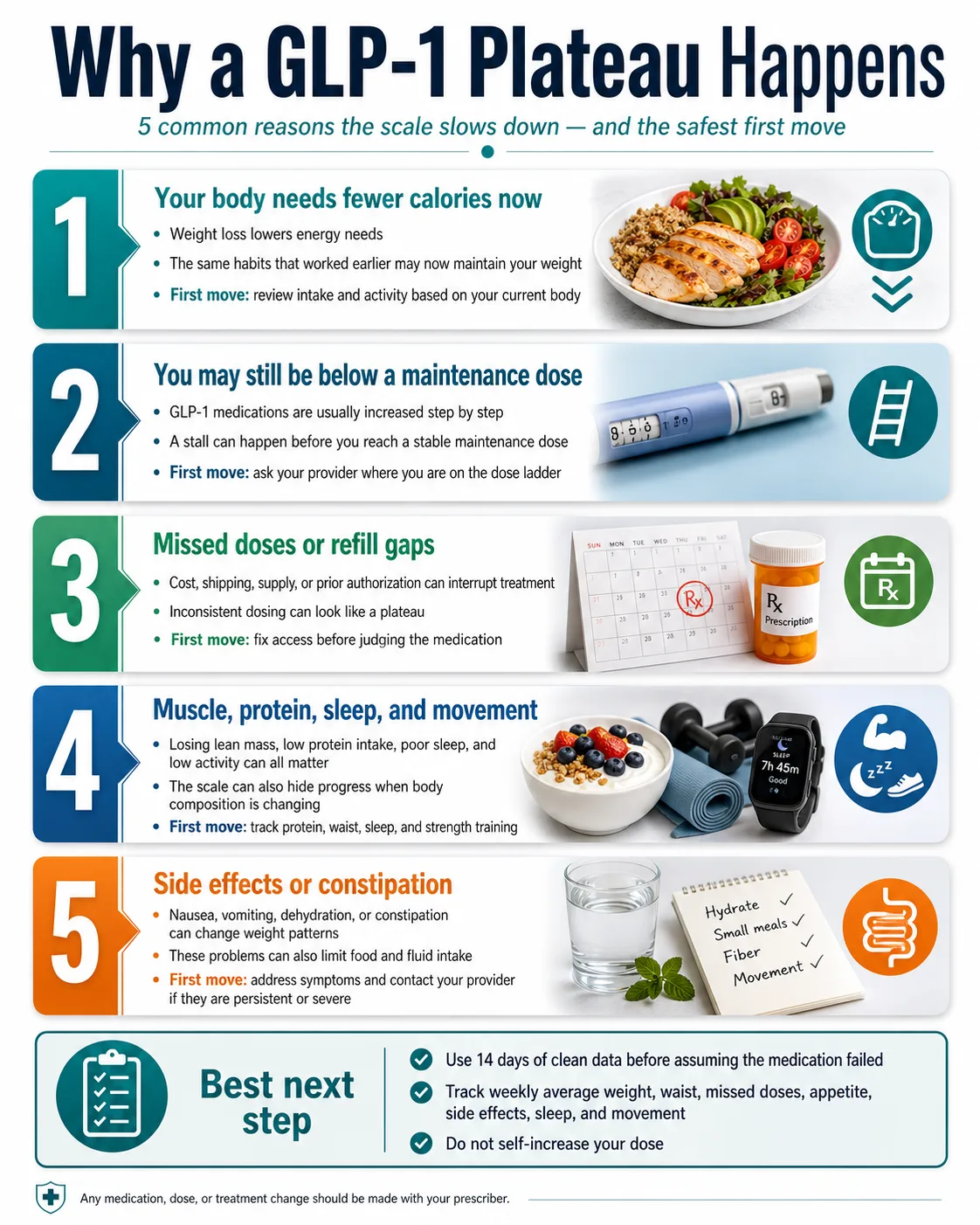
1. Your smaller body burns fewer calories
When you lose weight, your resting metabolic rate drops 10 to 25%. Same medication, same food, same activity now equals “maintenance” — not “weight loss.” This is called adaptive thermogenesis — a 200-pound person burns about 1,800 calories at rest; the same person at 170 pounds burns about 1,500.
2. Your hunger hormones recalibrate
Over 6 to 12 months, your body partially fights back. Ghrelin (the hunger hormone) creeps up. Leptin (the fullness hormone) creeps down. The medication is still working at the receptor — but your appetite system has adapted around it. Documented across the STEP and SURMOUNT trials, and in Sumithran et al., NEJM 2011: hormonal hunger drivers stay elevated for at least a year after weight loss, even with treatment.
3. You may still be below the studied maintenance dose
GLP-1 medications use a titration ladder — 0.25 → 0.5 → 1.0 → 1.7 → 2.4 mg for Wegovy (with 7.2 mg HD now available), and 2.5 → 5 → 7.5 → 10 → 12.5 → 15 mg for Zepbound. If you're stuck below the labeled maintenance dose, the stall may be titration-driven, not biology-driven. See our semaglutide and tirzepatide dosing comparison for dose-by-dose specifics.
4. You may be losing muscle without realizing it
GLP-1 medications work so well at suppressing appetite that some people end up eating below what's needed to support muscle. When intake drops that low, your body starts burning muscle alongside fat — and muscle is what keeps your metabolic rate up. A 2024 narrative review concluded that protein intake and resistance training are the two biggest levers for protecting muscle on GLP-1s (Hoertel et al. 2021 showed resistance training combined with adequate protein preserves lean mass during caloric deficit).
5. Your body is defending a new “set point”
Hall's 2024 mathematical model in Obesity shows GLP-1 medications shift your body's defended weight downward but don't abolish the appetite feedback circuit. Eventually, your body settles at the new set point and the scale stops dropping.
When you've been at your medication's max tolerated dose, run a clean reset, ruled out obvious causes, and you're still stalled — you've hit the biology floor. The next conversation is whether to escalate (Wegovy HD, Zepbound), switch medications, or accept maintenance.
How Long Does a GLP-1 Plateau Last?
It depends on the cause. A 1–2 week stall is usually scale noise, not a plateau. If your weight and measurements haven't moved for about 4 weeks, run the 14-day reset below. If there's still no movement after 8+ weeks at a stable maintenance or max-tolerated dose, bring the data to your provider.
| Cause | Typical duration |
|---|---|
| Water or constipation stalls | Days to 1 week |
| Behavior or muscle-loss plateaus | 1–4 weeks after the reset |
| Dose-driven plateaus | Often responds after the next labeled titration step (give it 4 weeks) |
| Set-point plateaus | May not break without escalation, medication switch, or accepting maintenance |
The 14-Day GLP-1 Plateau Reset (RX Index Protocol)
Run this for 14 days before assuming the medication failed. Three stages: track, tighten, decide. By day 15, you'll know whether your plateau is behavioral, hormonal, dose-driven, or biological — and you'll have the data your provider needs to move forward.
Day 1 — Rule out red flags first
Stop and contact a clinician now if you have any of:
- Severe or persistent stomach pain (especially radiating to the back)
- Repeated vomiting
- Signs of dehydration (dry mouth, dark urine, dizziness, weakness)
- Allergic symptoms (rash, swelling, trouble breathing)
- Low-blood-sugar symptoms (shaking, sweating, confusion) — especially if you also take insulin or sulfonylureas
- Fainting or severe weakness
- Pregnancy or suspected pregnancy
Wegovy and Zepbound carry FDA-required warnings including a boxed warning for risk of thyroid C-cell tumors, and contraindications for personal or family history of medullary thyroid carcinoma or MEN2. These are medical issues, not weight-loss problems.
Days 1–3 — Get clean baseline data
Track honestly for three days. Don't change anything yet. The point is to see what's actually happening, not what you think is happening.
Track:
- Every meal and snack (rough portions are fine)
- Total protein each day (estimate in grams)
- Liquid calories (creamers, smoothies, alcohol, juice)
- Water intake
- Sleep hours
- Daily steps
- Resistance training sessions
- Weight (daily — but trust the weekly average, not single days)
- Last dose date and any missed doses
Days 4–7 — Lock protein and resistance training
If week 1 didn't fix it, the next most likely cause is muscle loss compounded by under-eating.
Protein
Use the protein target your prescriber or registered dietitian gave you. If you don't have one, track your current intake and ask your clinician what target fits your body size, goal, kidney history, and training plan. Individual targets matter more than generic guidance if kidney disease or other conditions apply.
Resistance training
2 sessions this week. Compound movements only — squat (or sit-to-stand), deadlift (or hip hinge), push, pull, carry. 30 minutes max. The CDC recommends adults get muscle-strengthening activity at least two days per week. You don't need a gym.
Days 8–11 — Fix the recovery side
If protein and resistance training didn't break it, the next culprits are sleep, stress, NEAT (non-exercise activity thermogenesis), and constipation.
- Sleep 7–8 hours for at least 5 of the next 7 nights. Poor sleep raises ghrelin (hunger) and cortisol (which promotes fat storage).
- Pull liquid calories — coffee creamer, smoothies, juice, alcohol. Liquid calories don't trigger fullness on a GLP-1 the way solid food does.
- Add 2,000–4,000 steps to your daily baseline. NEAT is one of the most underrated levers in obesity medicine.
- Manage constipation — hydration, fiber, walking. If it's painful or persistent, message your provider for a clinician-approved plan.
Days 12–14 — Decide your next path
| What happened over 14 days | Your next move |
|---|---|
| Weight or measurements moved | The reset worked. Continue and reassess in 2–4 weeks |
| Hunger is returning between doses | Message your provider about dose timing or the next titration step |
| Side effects are limiting food or fluids | Message your provider before any dose increase |
| No movement, no obvious cause | Bring the data to your provider. Ask about a dose increase, medication switch, or labs |
| Cost or supply gaps caused missed doses | Fix access first — see below |
Should I Increase My GLP-1 Dose if I Plateau?
Sometimes — but only with your provider, and only after at least 4 weeks at your current dose with manageable side effects. Most GLP-1 manufacturers recommend at least 4 weeks between dose increases — this timing is built into the FDA labels for both Wegovy and Zepbound.
A dose conversation makes sense when:
- Hunger is coming back before your next dose
- You've been on the same dose 4+ weeks
- Side effects are tolerable
- Weight and measurements have not moved for several weeks
- You haven't missed doses
- Your current dose is below the labeled maintenance dose
Don't push for an increase if:
- You're already nauseous, vomiting, dehydrated, or constipated
- You're using insulin or other glucose-lowering medications
- You missed doses recently and haven't stabilized
- You're close to your goal — you may be in maintenance
- You're trying to rush because of cost anxiety
What to actually say to your provider
Copy and paste. Fill in the blanks. Bring it to your next visit or send through your portal:
GLP-1 plateau review — [Your name], [Date]

CURRENT MEDICATION:
- Medication: [e.g. Wegovy / Zepbound / compounded semaglutide]
- Current dose: [e.g. 1.0 mg/wk]
- On this dose since: [date]
- Last dose increase: [date]

PROGRESS:
- Starting weight: [lb]
- Current weight: [lb]
- Total loss: [lb / %]
- Weight stable since: [date — at least 3 weeks back]
- Waist measurement change: [lost X inches / no change]

WHAT I'VE TRIED (last 14 days):
- Hit protein target on at least 5 of 7 days/week: [yes/no]
- Resistance training 2+ days/week: [yes/no]
- Sleep average: [hours]
- Daily steps average: [number]
- Liquid calories minimized: [yes/no]
- Side effects on current dose: [describe]

WHAT I'M ASKING ABOUT:
□ Increase dose to [next level]
□ Switch from [current] to [next medication]
□ Run labs to rule out thyroid, insulin resistance, PCOS
□ Confirm I'm at maintenance — shift focus to body composition

MY GOAL:
[e.g. Lose another 25 lb, transition to maintenance, get labs and reassess in 6 weeks]
Your provider will respect this. It cuts the back-and-forth in half and gets you to a decision faster.
Should I Switch from Semaglutide to Tirzepatide?
It's worth discussing if you've had a full, adherent trial of semaglutide at the maximum tolerated dose for 8+ weeks and you're still stalled. The clinical case is real: the SURMOUNT-5 head-to-head trial (NEJM 2025) showed tirzepatide produced −20.2% body weight vs −13.7% on semaglutide at 72 weeks — about 6.5 percentage points more loss. For a 250-pound person, that's roughly 16 extra pounds.
Most providers restart you at low-dose tirzepatide (2.5 or 5 mg) and titrate up — even if you were on a high semaglutide dose — to manage side effects. See our step-by-step guide to switching from semaglutide to tirzepatide for the full protocol.
Switching makes sense if:
- You've completed a real trial of semaglutide
- You're at max tolerated semaglutide dose and stalled 8+ weeks
- Hunger has returned and lifestyle variables are stable
- Insurance or cash-pay pricing makes tirzepatide realistic
- Your provider agrees the benefit outweighs the risk
Switching probably won't help if:
- You're missing semaglutide doses because of cost
- You're still in the titration phase
- Side effects are already limiting food or fluids
- You haven't tried the 14-day reset yet
What about Wegovy HD 7.2 mg?
Wegovy HD (semaglutide 7.2 mg) was FDA-approved March 19, 2026 and demonstrated 20.7% mean weight loss in STEP UP at 72 weeks. It's indicated for adults who have tolerated the 2.4 mg dose for at least 4 weeks and need additional weight reduction. If you're plateaued on standard-dose Wegovy and tolerating it well, Wegovy HD belongs in the same plateau-escalation conversation as Zepbound and Foundayo. Note: about 22% of patients on the 7.2 mg dose in STEP UP reported dysesthesia (altered skin sensation — sensitivity, pain, or burning) versus 6% on 2.4 mg. The FDA is investigating this side effect further.
Already on tirzepatide and stalled?
That's normal too. By week 72, the majority of SURMOUNT-1 participants had reached a plateau interval. The next conversations:
- Dose review — confirm you're at the studied maintenance dose
- Foundayo (orforglipron) — new oral GLP-1, FDA-approved April 1, 2026 — for readers who want oral dosing
- Maintenance acceptance with body composition focus
- Investigational pipeline — retatrutide reported 28.7% average weight loss at 68 weeks in TRIUMPH-4. CagriSema submitted to FDA December 2025. Both remain investigational. Don't wait if you have a working option now.
When the Plateau Is Really an Access Problem
If you missed doses because of cost, prior auth delays, shipping gaps, or supply issues, the medication didn't stop working — your access broke. SURMOUNT-4 demonstrated that withdrawing tirzepatide led to many participants regaining at least 25% of the weight they had lost within 12 months. If your “plateau” lines up with a 2-week refill gap, that's not a treatment failure. That's a supply chain issue with predictable consequences.
| Your access problem | Best path | Why |
|---|---|---|
| Need FDA-approved medication + insurance coverage | Ro (sponsored affiliate link, opens in a new tab) | Free GLP-1 Insurance Coverage Checker, insurance concierge for prior authorization, FDA-approved formulary including Zepbound and Foundayo |
| Want a low-cost cash-pay compounded restart or a needle-free GLP-1 gum | Embody (sponsored affiliate link, opens in a new tab) | Compounded semaglutide/tirzepatide as weekly injections or a needle-free GLP-1 gum, from $99 first month (sema injection), then $299–$449/mo by medication and form, cash-pay, HSA/FSA flagged (confirm with plan). Compounded options are not FDA-approved finished drugs. |
| Want lab-included plateau support | Enhance MD | Repeat metabolic lab testing, multiple GLP-1 program tiers, same-pricing-all-doses |
For a deeper insurance breakdown, see our guide to the best Zepbound providers that accept insurance.
Check your GLP-1 insurance coverage with Ro — free, no commitment
Ro Body membership is $39 for the first month, then as low as $74/month with annual prepay, or $149/month on a monthly plan. GLP-1 medication cost is billed separately and depends on medication, insurance, and cash-pay path. Verify current pricing on Ro's site before you commit.
Compounded GLP-1s and Plateaus: What to Verify
On April 30, 2026, the FDA proposed to exclude semaglutide, tirzepatide, and liraglutide from the 503B bulks list, finding no clinical need for outsourcing facilities to compound these drugs from bulk substances. This regulatory change is ongoing and may affect compounded availability or pricing. Verify current status before starting with any compounded provider.
Before you start with any compounded provider, verify:
- Real medical intake: Is there an actual licensed clinician reviewing your case, not just a checkbox form?
- Prescription is for you specifically: Compounded medications must be prescribed for an individual patient. "Bulk" or "research-only" products are a red flag.
- Pharmacy is disclosed and licensed: Is it a 503A pharmacy (individual patients) or a 503B outsourcing facility (stricter FDA rules)?
- Pricing is clear after the intro month: Many compounded providers advertise a low intro price then jump to a much higher monthly cost.
- Side effect support exists: Who do you call at 9 PM when nausea hits?
- Cancellation is straightforward: Can you cancel through the dashboard, or do you have to call and convince someone?
For the full risk breakdown, see compounded vs FDA-approved GLP-1s.
Best GLP-1 Telehealth Providers for Plateau Response (2026)
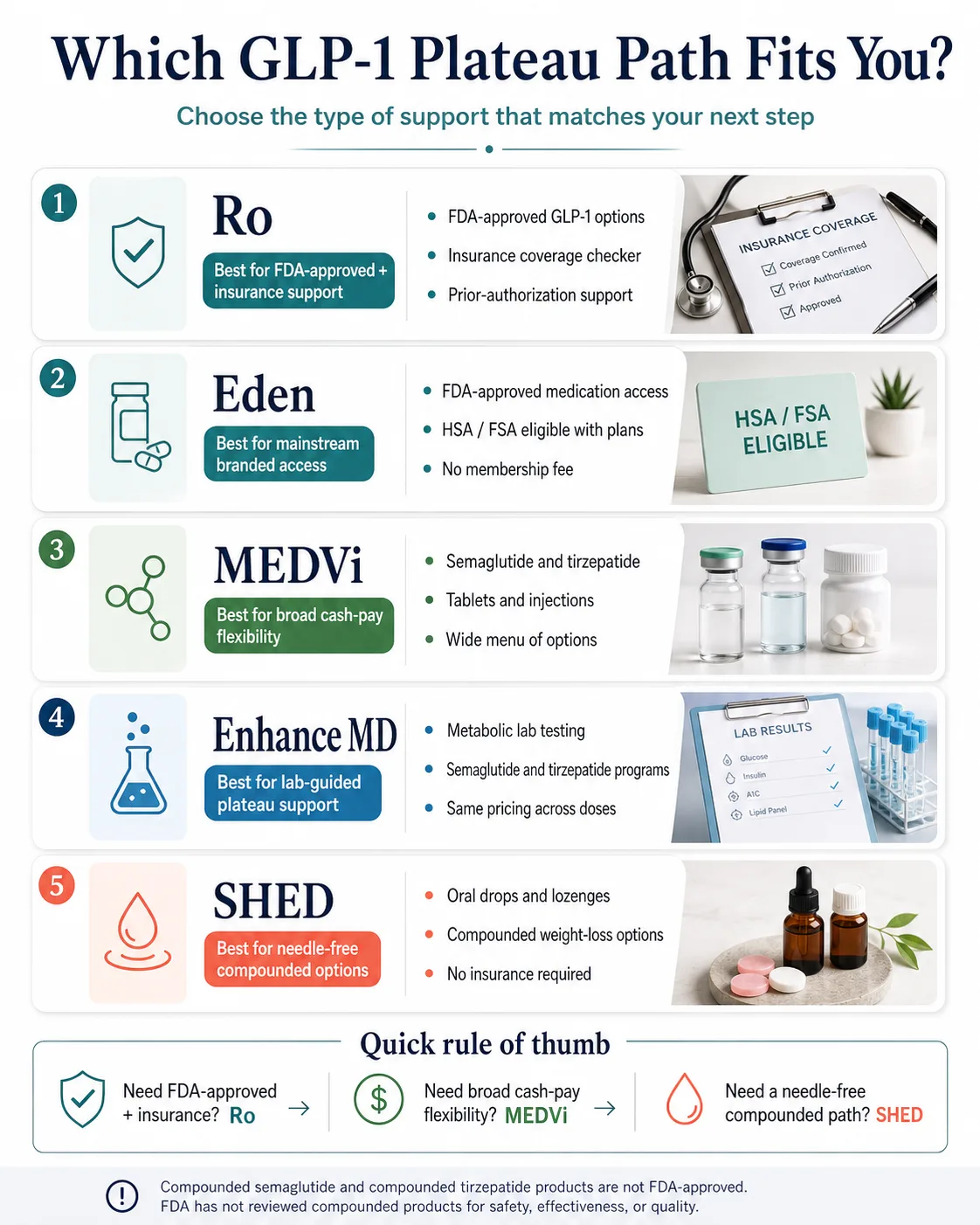
Not every GLP-1 telehealth provider is set up for plateau cases. Some only prescribe one medication. Some don't titrate aggressively. Most don't run labs. And some have material regulatory caveats you deserve to know about before you click. Here's the comparison matrix — verified on each provider's site as of May 4, 2026.
 (sponsored affiliate link, opens in a new tab)
| Provider | FDA-approved + compounded? | Switch sema → tirz? | Lab testing | Same price across doses? | Material caveat |
|---|---|---|---|---|---|
| Embody | Compounded only — sema & tirz injection plus a needle-free GLP-1 gum (no branded) | ✅ Yes | ⚠️ Limited — provider-led | No — from $99 first month (sema injection), then $299–$449/mo by med & form | Cash-pay only; compounded options are not FDA-approved finished drugs; not available in every state (excl. MS & LA) |
| Ro | FDA-approved only — Zepbound, Foundayo | ✅ Yes (FDA-approved lane) | ✅ Insurance Coverage Checker | Membership tiered ($39/$149/$74); medication cost separate | Compounded readers will need a different provider |
| Enhance MD | Compounded focus | ✅ Yes — multiple program tiers | ✅ Metabolic lab testing | ✅ Same-pricing-all-doses on listed pages (verify in checkout) | Compounded products are not FDA-approved; combination programs require provider review |
| MEDVi | Compounded focus | ✅ Yes — wide menu | ⚠️ Not verified | ⚠️ Not verified — verify in checkout | Feb 2026 FDA warning letter — see disclosure below |
| SHED | Compounded oral / lozenge / sublingual | Limited | ⚠️ Not verified | ⚠️ Public pages show starting prices only | Compounded products are not FDA-approved |
Verified May 4, 2026 against provider public websites. Pricing can change — re-check before committing. Where a field is marked "not verified," we did not find that information on the provider's public pages.
Embody — low-cost cash-pay restart for the compounded laneTop cash-pay pick
We highlight Embody for plateau readers in the cash-pay, compounded lane because it solves a common plateau problem affordably: you may need to change something — dose or format — and you don't want to restart at a high price.
Embody offers compounded semaglutide and compounded tirzepatide as weekly injections, plus a needle-free GLP-1 gum if injections have worn thin. Pricing starts low: compounded semaglutide injection from $99 the first month, then $299/month; tirzepatide and the gum run higher (up to $449/month depending on medication and form). No separate membership fee, HSA/FSA eligible (confirm with your plan), no insurance required. Compounded options are not FDA-approved finished drugs; Embody is cash-pay only and is not available in every state — check availability in your state during intake.
Ro — FDA-approved + insurance lane
Ro is the right lane when your plateau response is to step up onto an FDA-approved brand-name medication — Zepbound (tirzepatide) or Foundayo (orforglipron, the new oral GLP-1 approved April 1, 2026). Ro publicly offers both, has an insurance concierge that handles prior authorization paperwork, and offers a free GLP-1 Insurance Coverage Checker.
Enhance MD — premium clinical with labs
Enhance MD is the strongest fit when your plateau requires a deeper clinical look — labs to rule out thyroid issues, PCOS, or insulin resistance, plus structured GLP-1 program tiers. The platform publicly lists a Core semaglutide tier, an Advanced tirzepatide tier, and an Elite combination tier (semaglutide + tirzepatide), with metabolic lab testing included and same-pricing-all-doses language.
MEDVi — widest cash-pay menu, with a regulatory caveat
MEDVi has the widest medication menu in our plateau matrix — compounded semaglutide injections, compounded tirzepatide, GLP-1 oral tablets — at competitive cash-pay pricing.
⚠ Material regulatory caveat (accurate and proportional):
On February 20, 2026, the FDA issued a warning letter to MEDVi (Letter #721455) identifying misbranding violations on the company's website. The FDA cited language that “falsely implied” MEDVi was the compounder of the semaglutide and tirzepatide products it sold, plus claims like “Same active ingredient as Wegovy® and Ozempic®” that the FDA stated implied FDA approval or evaluation of compounded products. The letter addressed marketing and labeling — not medication safety. It was part of a broader enforcement action that hit more than 30 telehealth companies, and warning letters are advisory, not findings of guilt. MEDVi has publicly attributed the cited domain (medvi.io) to an affiliate rather than its primary domain.
What this means for you: If a clean regulatory record is your top priority, Ro (FDA-approved lane) is the cleanest fit; for the compounded cash-pay lane, Embody is an alternative. Source: FDA warning letter #721455.
SHED — needle-free compounded option
SHED offers compounded GLP-1 options in oral drop, lozenge, and sublingual formats — a legitimate lane for readers who prefer or require needle-free dosing. Compounded semaglutide and compounded tirzepatide products from SHED are not FDA-approved, and the FDA has not reviewed these products for safety, effectiveness, or quality.
See SHED's Needle-Free GLP-1 Options → (sponsored affiliate link, opens in a new tab)What real customer reviews show
Consistent themes across public review platforms (Trustpilot, ConsumerAffairs) as of May 2026. These are public-platform themes, not endorsements of clinical outcomes. Patient experiences vary; results are not typical.
| Provider | Positives | Negatives |
|---|---|---|
| Ro | Shipping, prior auth support, program structure | Slower customer service response on some Trustpilot threads |
| Enhance MD | Customer service responsiveness, structured clinical support | Smaller review volume than Ro or MEDVi |
| MEDVi | Medication flexibility | Public review experience is mixed and overlaid with the FDA warning letter context above. Read the FDA letter directly before deciding. |
When a Plateau Means It's Time for a Different Conversation
Some patients have a suboptimal response to GLP-1s. One commonly used threshold is less than 5% body weight loss after 12 weeks at a therapeutic dose, with the protocol followed. Don't label yourself a true non-responder until your provider confirms dose, adherence, timing, side effects, and medical factors.
Before that label, rule out the conditions that mimic non-response:
- Hypothyroidism — undiagnosed or undertreated thyroid disease blunts almost every weight-loss intervention
- PCOS (polycystic ovary syndrome) — affects insulin sensitivity and weight regulation
- Insulin resistance even without a diabetes diagnosis
- Sleep apnea — disrupts cortisol and growth hormone, both critical for fat loss
- Medications that promote weight gain — corticosteroids, some antidepressants, antipsychotics, beta-blockers, certain insulin regimens
Your provider can run the labs to check most of these. If you're a true non-responder after ruling those out, the conversation shifts to bariatric surgery (different category, longer-duration outcome data), combination pharmacotherapy under medical supervision, or investigational pipeline (retatrutide and CagriSema remain investigational — don't wait for them if you have a working option now). This isn't failure. It's a redirect.
GLP-1 Weight Loss Plateau FAQ
Is it normal to plateau on a GLP-1?+
How long does a GLP-1 weight loss plateau last?+
Should I increase my GLP-1 dose if I plateau?+
Should I switch from semaglutide to tirzepatide for a plateau?+
Why am I losing inches but not pounds on GLP-1?+
Does GLP-1 medication stop working over time?+
Can I take a break from my GLP-1 to reset?+
What about Wegovy HD 7.2 mg?+
Are compounded GLP-1s FDA-approved?+
How do I know if I'm a true GLP-1 non-responder?+
When should I contact my provider about a GLP-1 plateau?+
Still Not Sure What to Do Next?
The 14-day reset and the provider matrix above will give most readers a clear path. If you're still uncertain — about whether to track, run the reset, message your provider, or switch lanes — the quiz pulls everything together and gives you a personalized recommendation in 60 seconds.
You'll get: whether your stall is likely behavioral, hormonal, dose-driven, or biological · a personalized 4-week action plan · the provider lane that fits your specific situation.
What We Actually Verified for This Page
| What we verified | Source | Status |
|---|---|---|
| Wegovy indication, dosing ladder, contraindications, boxed warning | DailyMed / FDA label | ✅ Verified May 4, 2026 |
| Wegovy HD (7.2 mg) FDA approval, 20.7% mean weight loss in STEP UP | FDA press release March 19, 2026 | ✅ Verified May 4, 2026 |
| Wegovy pill (semaglutide 25 mg, oral) FDA approval, 16.6% mean weight loss in OASIS 4 | FDA approval December 2025 | ✅ Verified May 4, 2026 |
| Zepbound indication, dosing ladder, GLP-1 coadministration warning | DailyMed / FDA label | ✅ Verified May 4, 2026 |
| Foundayo (orforglipron) FDA approval date (April 1, 2026) | FDA / Eli Lilly press release | ✅ Verified May 4, 2026 |
| STEP-5 (semaglutide) −15.2% mean change at week 104 | PubMed (Garvey 2022) | ✅ Verified May 4, 2026 |
| SURMOUNT-1 plateau timing (24.3, 26.0, 36.1, 36.1 weeks median by BMI) | PubMed (Horn 2025, Clinical Obesity) | ✅ Verified May 4, 2026 |
| SURMOUNT-1 plateau interval reach by week 72 (87.6%–90.2% across BMI) | Same source | ✅ Verified May 4, 2026 |
| SURMOUNT-4 withdrawal regain of ≥25% of weight previously lost | PubMed (Aronne 2024, JAMA) | ✅ Verified May 4, 2026 |
| SURMOUNT-5 (tirzepatide −20.2% vs semaglutide −13.7% at 72 weeks) | NEJM 2025 | ✅ Verified May 4, 2026 |
| Hall 2024 plateau model | Obesity (peer-reviewed) | ✅ Verified May 4, 2026 |
| Retatrutide TRIUMPH-4 (28.7% average weight loss at 68 weeks) | Eli Lilly investor release | ✅ Verified May 4, 2026 |
| CagriSema FDA submission (December 2025) | Novo Nordisk press release | ✅ Verified May 4, 2026 |
| FDA compounded GLP-1 caution and 503B bulks list proposal (April 30, 2026) | FDA.gov | ✅ Verified May 4, 2026 |
| MEDVi FDA warning letter #721455 (February 20, 2026) | FDA.gov primary source | ✅ Verified May 4, 2026 |
| MEDVi public pricing structure | home.medvi.org | ⚠️ Re-verify before publish |
| Embody public pricing (compounded sema/tirz injection + needle-free GLP-1 gum) | joinem.co | ⚠️ Re-verify before publish |
| Ro pricing ($39 / $149 / $74 annual; medication cost separate) | ro.co/weight-loss | ⚠️ Re-verify before publish |
| Enhance MD program tiers and lab inclusion | enhance.md | ⚠️ Re-verify before publish |
How We Built This Guide (Methodology)
The RX Index is a pricing intelligence and comparison resource for GLP-1 telehealth providers. Our editorial team built this page on three rules:
- Safety first. Red flags and FDA label warnings appear before any provider recommendation.
- FDA-approved and compounded are never blurred. Brand-name and compounded medication paths are labeled separately throughout.
- Provider recommendations are conditional. No provider “breaks plateaus” for everyone. Providers are routed by problem type — access situation, medication preference, need for labs, tolerance for regulatory caveats.
Clinical sources used: STEP-1, STEP-5, STEP UP, SURMOUNT-1, SURMOUNT-4, SURMOUNT-5, OASIS 4, TRIUMPH-4, Hall 2024 (Obesity), Horn 2025 (Clinical Obesity), Sumithran 2011 (NEJM), Hoertel 2021, Wilding 2021 (NEJM).
Regulatory sources: FDA labels for Wegovy, Wegovy HD, Wegovy pill, Zepbound, Ozempic, Mounjaro, and Foundayo. FDA compounded-drug guidance. FDA warning letter #721455 (MEDVi, February 20, 2026). FDA 503B bulks list proposal (April 30, 2026).
Commercial: Direct site verification of Embody, Ro, Enhance MD, MEDVi, and SHED as of May 4, 2026.
Conflicts of interest: The RX Index earns affiliate commissions from some telehealth providers featured on this page. Provider order is determined by fit-to-intent first. We disclose material limitations even when it costs us a click — including the MEDVi FDA warning letter and Enhance MD's combination-program compliance context.
Related guides
- →Semaglutide vs Tirzepatide Dosage Chart 2026
- →How to Switch from Semaglutide to Zepbound
- →Best Zepbound Providers That Accept Insurance
- →Compounded vs FDA-Approved GLP-1s
- →Best Foundayo (Orforglipron) Providers
- →Best GLP-1 Providers That Accept Insurance
- →Does Insurance Cover Foundayo?
- →GLP-1 Providers With No Membership Fee
Your situation changes the answer
Find My GLP-1 Path
The right GLP-1 provider isn't the same for everyone. It depends on your state, your insurance and formulary, whether you want an FDA-approved or compounded medication, your preferred route (injection or oral), and your budget. Because a general answer can't resolve those for you, use The RX Index's Find My GLP-1 Path tool to get a personalized provider match with source-verified pricing before you choose.
- What it asks: your state, insurance situation, medication preference, budget, and support needs
- What you get: a personalized shortlist of GLP-1 providers matched to your situation, with verified pricing and the right questions to ask
- Cost: free · about 2 minutes · no signup