
Best GLP-1 Pill for Diabetes: Ozempic® Pill vs Rybelsus® (2026)
Published: · Last reviewed:
By The RX Index Editorial Team · FDA labels checked · All pricing verified
The short answer (read this first)
The best GLP-1 pill for diabetes in 2026 is FDA-approved oral semaglutide. That means Ozempic® tablets (the new oral semaglutide tablet formulation now listed on the FDA label) or Rybelsus® (the established oral semaglutide tablet). Both are made by Novo Nordisk. Both treat Type 2 diabetes. Both are once-daily tablets — no needles.
They share the same active ingredient (semaglutide), but they are not interchangeable on a milligram-to-milligram basis, so the exact product name and dose matter.
Real pricing right now: as little as $25/month for eligible commercially insured patients with the Novo Nordisk savings program, or $149 / $199 / $299 per month by tablet dose through NovoCare® Pharmacy self-pay. Government program beneficiaries are excluded from these offers.
What We Actually Verified for This Page
We re-verify every commercial fact on this page once a month. The Last verified date at the top updates each time. If a price changes or a label updates, this page changes with it.
| What we checked | Source |
|---|---|
| Rybelsus and Ozempic tablets are both FDA-labeled for Type 2 diabetes; not substitutable mg-for-mg | DailyMed (set ID 27f15fac…), May 11, 2026 |
| Switching guidance: Rybelsus 7 mg → Ozempic tablet 4 mg; Rybelsus 14 mg → Ozempic tablet 9 mg (do not switch during 30-day initiation) | DailyMed, May 11, 2026 |
| Ozempic pill cash-pay prices: $149 / $199 / $299 per month by dose | Novo Nordisk press release May 1, 2026; NovoCare Pharmacy |
| Ozempic tablets list price: $1,027.51 | NovoCare Ozempic list-price page, May 11, 2026 |
| Rybelsus list price: $997.58 per package | NovoCare Rybelsus list-price page |
| Eligible commercial savings: as little as $25/month; government beneficiaries excluded | NovoCare Pharmacy / Novo Nordisk savings terms |
| Foundayo FDA approval: April 1, 2026 for chronic weight management; T2D filing planned end of Q2 2026 | Eli Lilly press releases (April 1 and April 16, 2026); Drugs.com |
| Wegovy pill FDA approval: December 2025 for chronic weight management and CV risk in obesity; doses 1.5 / 4 / 9 / 25 mg | FDA approval letter; AJMC reporting |
| Sesame Care prescribes Rybelsus through Everyday Rx; assists with prior authorization | sesamecare.com/medication/rybelsus, May 11, 2026 |
Which Oral GLP-1 Pills Are FDA-Approved for Diabetes — and Which Are Not?
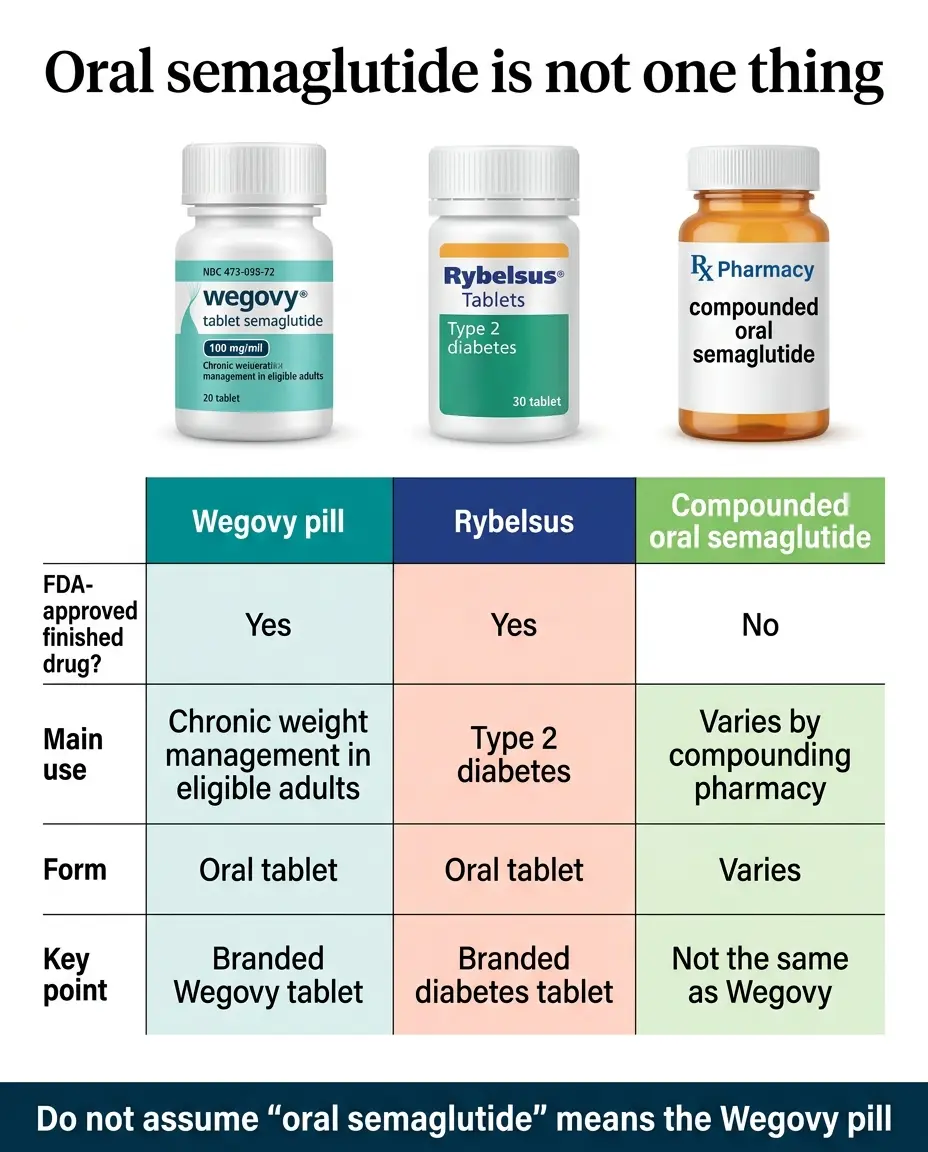
Only oral semaglutide tablets — sold as Ozempic® tablets and Rybelsus® — are FDA-approved for Type 2 diabetes. The Wegovy® pill and Foundayo™ are FDA-approved oral GLP-1s, but for chronic weight management, not for treating diabetes. Compounded oral GLP-1 products are not FDA-approved finished drugs and should not be treated as equivalent to either.
| Product | FDA-approved for T2D? | Tablet strengths | Morning fasting rule? | Verified self-pay signal | Eligible savings |
|---|---|---|---|---|---|
| Ozempic® tablets (oral semaglutide tablet formulation) | Yes — and also approved to reduce major cardiovascular events in T2D adults at high CV risk | 1.5 mg, 4 mg, 9 mg | Yes — empty stomach, ≤4 oz plain water, wait 30 min | $149 / $199 / $299 per month (NovoCare self-pay) | As little as $25/month for eligible commercially insured patients |
| Rybelsus® (established oral semaglutide tablet) | Yes | 3 mg, 7 mg, 14 mg | Yes — same routine | $997.58 per package (NovoCare list-price page) | As little as $25/month for eligible commercially insured patients |
| Wegovy® pill | No — approved for chronic weight management and CV risk in obesity | 1.5 mg, 4 mg, 9 mg, 25 mg | Yes (same as oral semaglutide) | $149/month for 1.5 mg and 4 mg (4 mg offer ends Aug 31, 2026; then $199/month) | Coverage varies |
| Foundayo™ (orforglipron) | No — approved for chronic weight management; Lilly plans to file for T2D by end of Q2 2026 | 0.8, 2.5, 5.5, 9, 14.5, 17.2 mg | No — can be taken any time, with or without food or water | Ro publishes Foundayo self-pay pricing by dose | Coverage varies |
| Compounded oral GLP-1 (drops, lozenges, sublinguals) | No — not FDA-approved as finished drug products | n/a | n/a | Varies | Not covered as a diabetes medication by default |
Ozempic tablets and Rybelsus are the diabetes pills. Wegovy pill and Foundayo are weight-loss pills with valid uses, but not for diabetes. Compounded oral GLP-1s are not FDA-approved and should not be presented as equivalent to either.
Ozempic® Tablets vs Rybelsus® — What Actually Changed in May 2026
DailyMed now lists both Rybelsus® tablets and Ozempic® tablets as oral semaglutide tablet products for adults with Type 2 diabetes. The practical change is a new Ozempic® tablet formulation with different dose strengths — not a milligram-for-milligram name swap. Your prescriber has to handle any switch the right way.
Dose-switching cheat sheet
If you're currently on Rybelsus and your doctor wants to switch you to Ozempic tablets, here's how the switching guidance works per the current FDA label:
| If you take Rybelsus® | Your equivalent on Ozempic® tablets |
|---|---|
| 3 mg starter phase | Do not switch during Days 1–30. The starter dose is not effective for glycemic control. |
| 7 mg | 4 mg |
| 14 mg | 9 mg |
A useful conversation starter at your next appointment: “I've been taking Rybelsus [X mg]. Should I switch to Ozempic tablets, and if so, what dose?”
Both products remain FDA-approved. If your insurance plan currently covers Rybelsus, you're not losing access — you're choosing between two FDA-approved versions of the same medication.
Why Foundayo™ and the Wegovy® Pill Are Not the Answer If You Have Diabetes
Both are real, FDA-approved GLP-1 pills. Neither is approved for Type 2 diabetes — yet. They're approved for chronic weight management. That means coverage is far harder to get for diabetes use, and prescribing either one for blood sugar control would be off-label.
Foundayo (orforglipron), explained
Foundayo is an Eli Lilly product. The FDA approved it on April 1, 2026 for chronic weight management in adults with obesity (BMI ≥30) or overweight (BMI ≥27) with a weight-related condition. It comes in tablet strengths of 0.8 mg, 2.5 mg, 5.5 mg, 9 mg, 14.5 mg, and 17.2 mg.
Wegovy pill, explained
The Wegovy pill is oral semaglutide at higher doses than the Ozempic tablet line. It comes in 1.5 mg, 4 mg, 9 mg, and 25 mg strengths. The FDA approved it in December 2025 for chronic weight management and to reduce cardiovascular events in adults with overweight or obesity who have established cardiovascular disease. Not for diabetes.
You'll see Wegovy pill and Ozempic tablets compared a lot. Same active ingredient (semaglutide). Same maker (Novo Nordisk). Different doses. Different approved use. The current verified Wegovy cash offer is $149/month for the 1.5 mg and 4 mg starter doses, with the 4 mg offer ending August 31, 2026 (it becomes $199/month after that).
If your search was really about losing weight without a diabetes diagnosis, the Wegovy pill or Foundayo is your category — not this page. Read our Wegovy pill vs Foundayo comparison →
Why this label distinction matters for your wallet
Off-label use is not a covered indication by default. Plans can deny it, and most will require the FDA-approved indication, the right diagnosis code, and prior authorization before they pay.
| Prescription path | Coverage likelihood |
|---|---|
| Ozempic tablets / Rybelsus for Type 2 diabetes (FDA-approved indication) | Most commercial plans, Medicare Part D, many Medicaid programs — usually with prior auth |
| Wegovy pill / Foundayo for diabetes use (off-label) | Very difficult — most plans deny off-label use; not the path with the best coverage or savings |
This is why the “right pill for your situation” answer hinges on whether you have a Type 2 diabetes diagnosis. If you do, the diabetes pill (Ozempic tablets / Rybelsus) is the path with the best coverage and savings options. If you don't, you're shopping in a different aisle.
How Well Does Oral Semaglutide Actually Work for Type 2 Diabetes?
It works. It significantly lowers A1C. It produces weight loss as a secondary benefit. Under the current FDA label, it's the oral GLP-1 with labeling for reducing major adverse cardiovascular events in Type 2 diabetes adults at high cardiovascular risk. In a 6-month head-to-head trial against Januvia (sitagliptin 100 mg), Rybelsus 7 mg lowered A1C by 1.0% and 14 mg lowered A1C by 1.3% — beating Januvia's 0.8%.
What the PIONEER trials showed
| Trial / source | Dose | Comparator | A1C result | What this means |
|---|---|---|---|---|
| PIONEER 7 (head-to-head, 6 months, 1,864 adults with T2D on metformin ± SU) | Rybelsus 7 mg | Januvia 100 mg | −1.0% | Beats Januvia at the same step |
| PIONEER 7 | Rybelsus 14 mg | Januvia 100 mg | −1.3% | Stronger A1C drop than Januvia |
| PIONEER 7 | Januvia 100 mg | — | −0.8% | Reference comparison |
| SOUL (9,650 adults with T2D + established CV disease and/or CKD) | Oral semaglutide 14 mg | Placebo | CV label added | Label includes reduction of MACE in adults with T2D at high CV risk |
What it can and cannot do
| Can | Cannot |
|---|---|
| ✓ Lower A1C significantly | ✗ Replace metformin (often used together) |
| ✓ Reduce risk of major cardiovascular events in T2D adults at high CV risk (per current label) | ✗ Treat Type 1 diabetes |
| ✓ Help with weight loss as a secondary benefit | ✗ Be taken with food, coffee, or other meds in the morning |
| ✓ Be taken as a daily pill | ✗ Be split, crushed, or chewed |
If your A1C is high (above 9%) and your doctor wants to bring it down fast, an injectable GLP-1 or GLP-1/GIP (like Ozempic injection or Mounjaro) often produces a larger A1C drop than oral semaglutide at standard doses. We cover that decision honestly in the pill vs. injection section below.
How Much Does the Best GLP-1 Pill for Diabetes Cost in 2026?
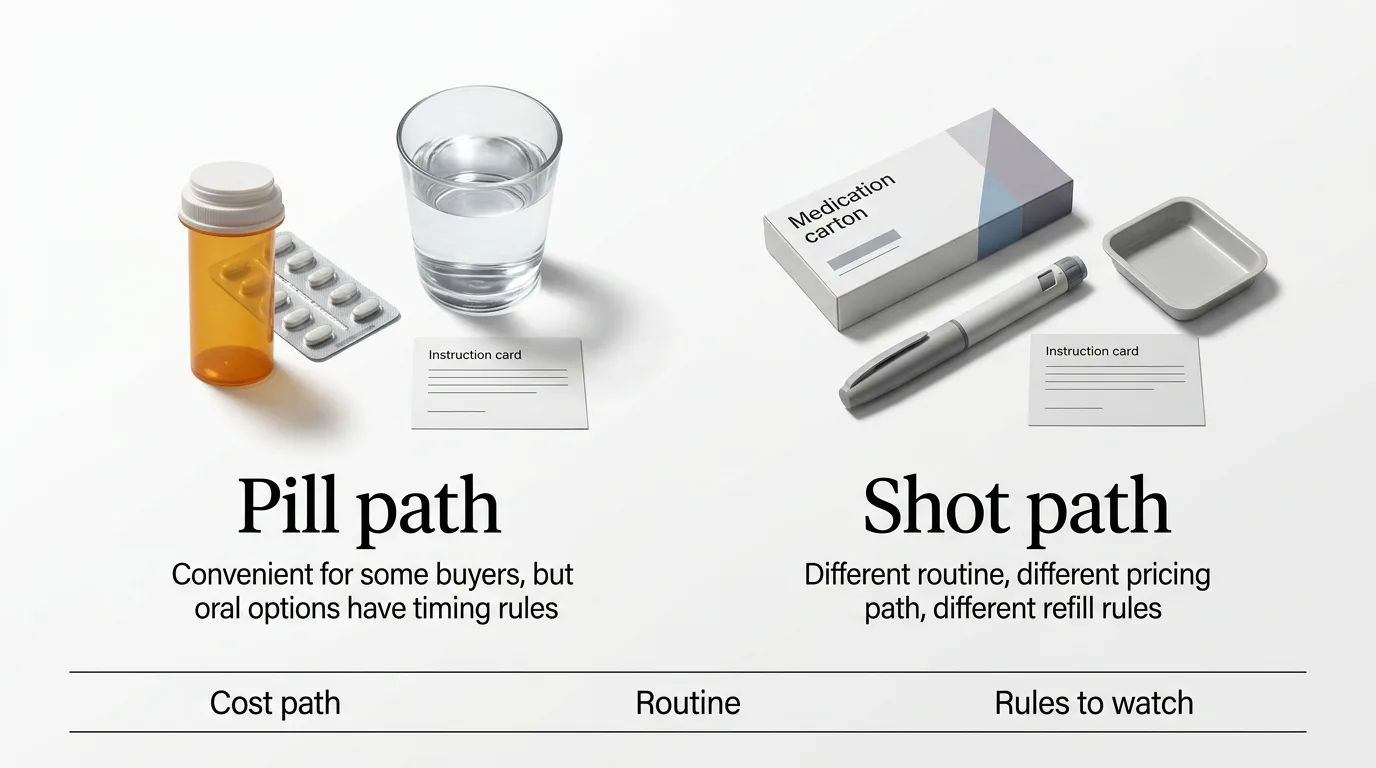
With commercial insurance and the Novo Nordisk savings program, eligible patients pay as little as $25 per month (subject to program limits — government beneficiaries are excluded). Without insurance, Ozempic tablets are $149, $199, or $299 per month depending on dose through NovoCare Pharmacy. The verified list-price signals are $997.58 per package for Rybelsus and $1,027.51 for Ozempic tablets on NovoCare's list-price page.
| Situation | Path | Verified monthly cost signal |
|---|---|---|
| Eligible commercial insurance + Type 2 diabetes diagnosis | Insurance covers oral semaglutide; savings card lowers copay | As low as $25/month |
| No insurance, paying cash | NovoCare Pharmacy direct self-pay | $149 (1.5 mg) / $199 (4 mg) / $299 (9 mg) per month |
| Rybelsus, no insurance | Retail pharmacy or NovoCare | $997.58 per package list price; commercial savings may apply |
| Medicare Part D | Plan-specific coverage with prior authorization possible | Savings cards generally exclude Medicare; copay varies by plan |
| Medicaid | State-specific coverage, step therapy and PA rules | Varies by state; manufacturer savings programs generally exclude Medicaid |
| High-deductible plan | Compare cash path vs. insurance run through deductible | Depends — check both |
If you've never checked whether your specific insurance plan covers oral semaglutide for diabetes, check it before you assume the cash price is your only option.
Will Insurance Cover a GLP-1 Pill for Diabetes?
For Type 2 diabetes, oral semaglutide (Rybelsus and Ozempic tablets) is covered by most commercial insurance plans, often with prior authorization. Medicare Part D plans typically cover it with copay rules that vary by plan. State Medicaid programs vary widely. Coverage for off-label use (Wegovy pill or Foundayo prescribed for diabetes) is much harder to get.
What coverage actually depends on
Insurance for GLP-1 medications is not a yes-or-no question. Your real out-of-pocket cost depends on at least five things:
- Your specific plan's formulary — whether oral semaglutide is on the covered drug list at all
- The diagnosis code on your prescription — Type 2 diabetes (E11.x codes) opens coverage; obesity codes usually don't, for the diabetes pill
- Prior authorization requirements — most plans require your doctor to submit paperwork before approving the medication
- Step therapy rules — many plans require you to try metformin (and sometimes other diabetes drugs) first
- Whether you're eligible for the Novo Nordisk savings card — commercial insurance only; government program beneficiaries are excluded
The realistic path for each plan type
| Plan type | What to expect |
|---|---|
| Commercial insurance (employer or marketplace) | Most plans cover oral semaglutide for T2D. Prior authorization is common. Savings card can bring you to as little as $25/month if eligible. |
| Medicare Part D | Typically covered for T2D; copay or coinsurance varies by plan; prior authorization may apply. Manufacturer savings cards generally exclude Medicare. |
| Medicaid | Coverage varies by state. Step therapy (try metformin first) is common. Prior authorization is common. Manufacturer savings programs generally exclude Medicaid. |
| TRICARE / VA | Both have GLP-1 coverage frameworks for T2D with prior authorization. Check your specific benefits. |
| Uninsured | NovoCare Pharmacy self-pay at $149 / $199 / $299 per month is the most direct path; you'll need a prescription from any licensed clinician. |
The fastest way to find out is a free insurance coverage check. Ro's free GLP-1 coverage tool contacts your plan and sends a personalized report. You don't have to start a treatment plan to use it. The slower way is to call the member services number on your insurance card and ask for the prior authorization criteria for oral semaglutide (Rybelsus or Ozempic tablets) for Type 2 diabetes.
How to Actually Get Ozempic® Tablets or Rybelsus® — Three Real Paths
You have three legitimate paths in 2026. We'll show you all three, including the one that doesn't pay us a commission, because the right path depends on your situation — not on what's most profitable for us.
Path 1: Your own doctor → retail pharmacy
THE MOST COMMON PATH
Your primary care doctor or endocrinologist writes the prescription. You fill it at CVS, Walgreens, Costco, your local independent pharmacy, or by mail order through your insurance.
| With insurance | As low as $25/month for eligible commercially insured patients with Novo Nordisk savings card |
| Without insurance | Close to retail list price unless you negotiate or use a manufacturer program |
| Best for | Anyone with an established primary care relationship and commercial insurance, Medicare, or Medicaid coverage |
Path 2: Sesame Care — pick your own clinician online
GOOD IF YOU DON'T HAVE AN EXISTING DOCTOR
Sesame Care is a legitimate option if you don't have an established doctor or want to skip the wait. Their Rybelsus page says you can get a Rybelsus prescription online through Sesame's Everyday Rx program if a licensed provider decides it's appropriate, and that the provider can assist with prior authorization paperwork.
| Program cost | Verify the current Everyday Rx price at checkout — Sesame publishes their price on the platform during signup |
| What you get | Same-day video visit possibility, provider choice, prescription, PA assistance |
| Best for | Anyone without an existing doctor, anyone who wants to pick their clinician, anyone who needs a fast prescription option |
Path 3: NovoCare® Pharmacy — manufacturer-direct cash pay
WE EARN NOTHING HERE — INCLUDED BECAUSE IT'S REAL
NovoCare is Novo Nordisk's direct-to-patient pharmacy. If you already have a prescription, you can fill it through NovoCare at $149/month for 1.5 mg, $199 for 4 mg, $299 for 9 mg. No subscription. No membership. No telehealth visit.
| Cost | $149 / $199 / $299 per month by dose |
| What you need | A valid prescription from a licensed clinician |
| Important | Government insurance beneficiaries are typically excluded. Self-pay fills don't count toward your deductible. |
| Best for | Cash-pay patients who already have a doctor willing to write the script |
Quick path comparison
| Path | Program/visit cost | Medication cost | PA help? | Best for |
|---|---|---|---|---|
| Your own doctor + retail pharmacy | Your normal copay | $25/mo with insurance + savings card | Your doctor handles | Most insured patients |
| Sesame Care Everyday Rx | Verify at checkout | Same as retail + savings card; or list price without coverage | Provider can assist | No regular doctor; want provider choice |
| NovoCare Pharmacy direct | $0 | $149 / $199 / $299/mo | None — cash pay | Cash-pay with existing Rx |
We don't recommend pages that sell “no-prescription oral GLP-1” or “generic Ozempic” drops, sprays, or lozenges. Those products are not FDA-approved finished drug products.
How to Take Ozempic® Tablets or Rybelsus® So They Actually Work
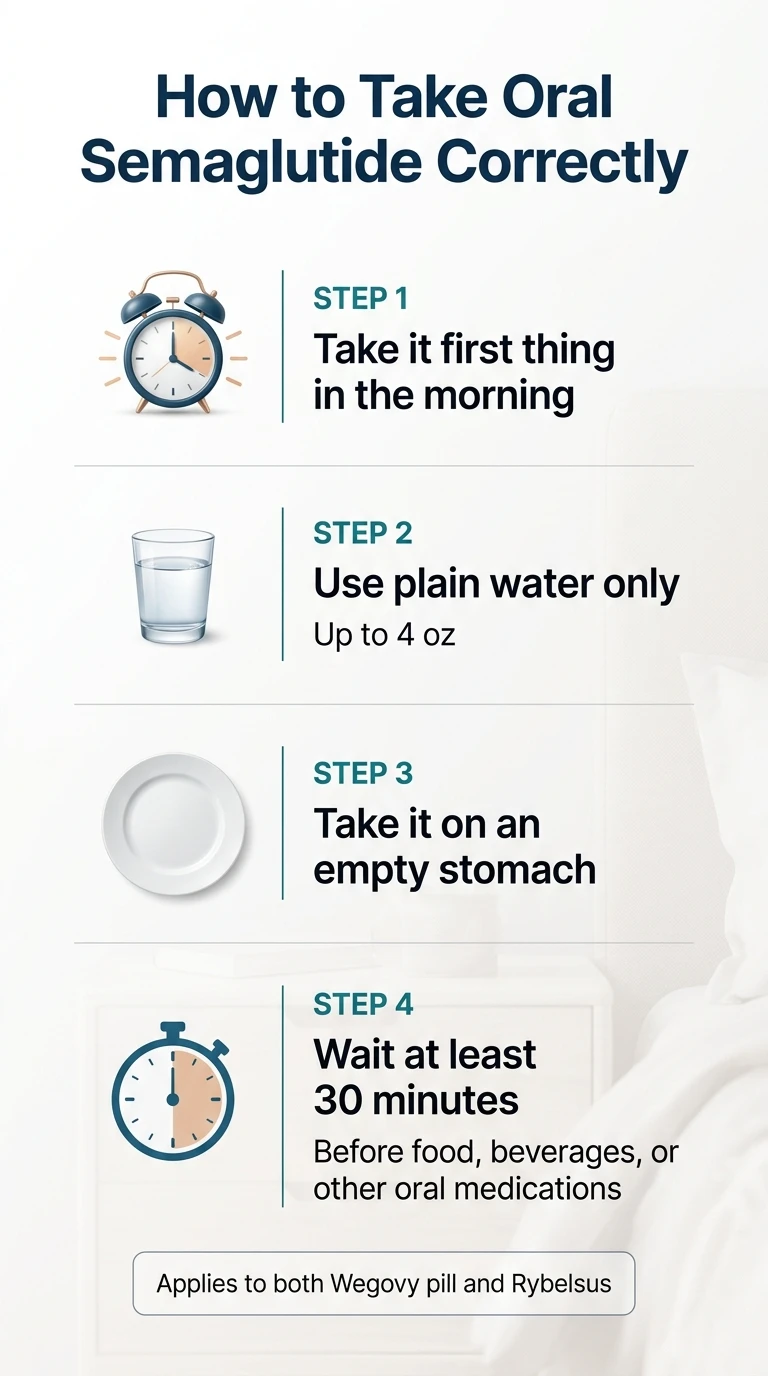
Take one tablet with no more than 4 ounces of plain water, first thing in the morning, on an empty stomach. Then wait at least 30 minutes before eating, drinking anything other than water, or taking any other oral medication. Swallow it whole — don't split, crush, or chew.
Why the 30-minute rule exists
Semaglutide is a peptide — a protein-based molecule. Your stomach is built to break down proteins. Without help, semaglutide would be digested before it could enter your bloodstream. The tablet uses an absorption enhancer (SNAC) that opens a brief window for the drug to cross the stomach lining. That window closes fast. The FDA label requires the 30-minute window because food, drinks other than water, and other oral medications can interfere with the dosing routine the tablet is designed for. This isn't a polite suggestion. It's how the drug works.
The morning routine that actually works
Here's what successful oral semaglutide patients do, based on the FDA label:
- Set an alarm 30 minutes earlier than your usual morning routine
- Keep the pill on your nightstand or next to the coffee maker (somewhere you'll see it)
- Take it with no more than 4 oz of plain water — about half a regular glass
- Walk away. Don't sit and stare at the clock. Shower, get dressed, walk the dog
- Coffee, breakfast, and other meds come after the 30-minute mark
- Same time every morning if possible
Can you actually do this? A quick honesty check
If you answer “no” to two or more of these, the pill may not be the right fit:
| Question | Honest answer |
|---|---|
| Do I have a stable morning routine at least 5 days a week? | yes / no |
| Can I wait 30 minutes before my first cup of coffee? | yes / no |
| Do I take other morning medications I'd have to time around this? | yes / no |
| Am I in and out of different time zones often? (a daily oral GLP-1 is harder on the road than a weekly injection) | yes / no |
| Do I sometimes forget pills? (a weekly injection forgives forgetfulness better) | yes / no |
Side Effects, Warnings, and Who Should Never Take Oral Semaglutide
The most common side effects are stomach issues — nausea, vomiting, diarrhea, constipation, stomach pain, lower appetite. They tend to ease over weeks as your body adjusts and as your dose is stepped up slowly. The serious risks are less common but more important: a boxed warning for thyroid C-cell tumors, plus risks for pancreatitis, kidney injury, low blood sugar, worsening of diabetic eye disease, and gallbladder problems.
Common side effects
| Side effect | How common | What to do |
|---|---|---|
| Nausea | Very common | Ask your prescriber or pharmacist about management; contact your prescriber if persistent or severe |
| Vomiting | Common | Stay hydrated; contact your prescriber if persistent or severe |
| Diarrhea | Common | Stay hydrated; contact your prescriber if severe |
| Constipation | Common | Ask your prescriber or pharmacist for guidance |
| Lower appetite | Very common | Watch for inadequate nutrition; discuss with your prescriber |
| Stomach pain | Common | If severe or unusual, call your doctor — could be a sign of pancreatitis |
For most patients, side effects peak in weeks 2–6 and improve after. The slow dose escalation (start at 1.5 mg or 3 mg, step up after 30 days) is specifically designed to give your gut time to adjust.
Serious risks you need to understand
These are pulled directly from the FDA prescribing information. They're not warnings to skip — they're the ones that change whether you should take the medication:
Thyroid C-cell tumors (boxed warning)
In animal studies, semaglutide caused thyroid tumors. It's unknown whether it causes them in humans. If you have a personal or family history of medullary thyroid carcinoma (MTC) or Multiple Endocrine Neoplasia syndrome type 2 (MEN 2), you cannot take this medication.
Acute pancreatitis
Severe stomach pain that may radiate to your back, with or without vomiting, is a warning sign. Stop the medication and call your doctor immediately.
Acute kidney injury
Usually from dehydration caused by vomiting or diarrhea. Stay hydrated.
Hypoglycemia (low blood sugar)
Much higher risk if you take insulin or a sulfonylurea. Your prescriber may need to lower the dose of those medications when you start semaglutide.
Diabetic retinopathy complications
If you have eye disease from diabetes, your doctor should monitor you. Rapid improvement in blood sugar can temporarily worsen retinopathy.
Acute gallbladder disease
Rapid weight loss raises gallbladder risk. Symptoms include upper-right belly pain, fever, jaundice.
Serious allergic reactions
Rare but possible. Stop and get emergency help if you have trouble breathing, swelling of face/lips/tongue, or severe rash.
Pulmonary aspiration during general anesthesia or deep sedation
Tell your anesthesia team you're on a GLP-1 before any procedure with sedation.
Who should never take oral semaglutide (contraindications)
Do not take Rybelsus or Ozempic tablets if any of these apply:
- You or a family member has had medullary thyroid carcinoma (MTC)
- You have Multiple Endocrine Neoplasia syndrome type 2 (MEN 2)
- You've had a serious allergic reaction to semaglutide before
Not labeled for use
Talk to your doctor before taking it if you have
- A history of pancreatitis
- Diabetic retinopathy
- Kidney problems or a history of severe dehydration
- Severe gastrointestinal disease, including gastroparesis (delayed stomach emptying)
- Gallbladder disease
- You're pregnant or planning to become pregnant (stop at least 2 months before conception)
- You're breastfeeding
- Upcoming surgery or anesthesia
This list isn't a reason to panic. It's a list of conversations to have with a clinician before starting. The medication is widely prescribed and most patients tolerate it. Your medical decision is yours to make with your doctor, not with a website.
When a GLP-1 Injection Might Be the Better Choice Than a Pill
Oral semaglutide is not automatically the best GLP-1 for every adult with Type 2 diabetes. If your priority is maximum A1C reduction and you can tolerate a needle, an injectable — Ozempic injection or Mounjaro — is worth a real comparison with your clinician. The pill wins when needles are the actual barrier. The injection wins when needles aren't a barrier and you want maximum efficacy with less daily friction.
Where the pill wins
- ✓ No needles — this is the single most important reason most patients prefer the pill
- ✓ Tablet storage is simpler — no refrigeration rules
- ✓ No injection-site soreness or bruising
- ✓ Daily routine can create better adherence for some patients
- ✓ A daily tablet gives your clinician a daily dosing point to hold if side effects arise
Where the injection wins
- ✓ Larger A1C reduction — ask your clinician to compare for your specific A1C
- ✓ Larger weight loss as a secondary benefit at maintenance doses
- ✓ Once-weekly dosing vs. 30 mornings of the 30-minute rule
- ✓ No empty-stomach requirement — take it whenever you want
- ✓ Mounjaro adds GIP receptor activity — even larger weight and A1C reductions
| Your situation | Likely better fit |
|---|---|
| Needle fear has kept you off GLP-1s entirely | Oral semaglutide (Ozempic tablets / Rybelsus) |
| You can do weekly injections and want maximum A1C drop | Injectable Ozempic or Mounjaro |
| Your A1C is high and your doctor wants aggressive control | Injectable — discuss Mounjaro specifically |
| You travel constantly and pill timing is hard | Weekly injection — more forgiving |
| You're already on Rybelsus and tolerating it well | Stay or switch to Ozempic tablets — don't change to injection without a reason |
| You're already on Ozempic injection and it's working | Stay — don't switch to the pill just because it's new |
Are Compounded Oral GLP-1 Drops, Lozenges, or “Generic Ozempic” Pills the Same Thing?
No. For Type 2 diabetes treatment, compounded oral GLP-1 products should not be considered equivalent to FDA-approved Ozempic tablets or Rybelsus. The FDA has stated it cannot verify the quality, safety, or efficacy of non-FDA-approved compounded GLP-1 products, and the agency has objected to marketing that frames compounded products as “generic,” “the same active ingredient,” or “clinically proven” equivalents.
The FDA's April 2026 compounding policy notes that semaglutide and tirzepatide are not currently on the FDA drug shortage list or the 503B bulks list, and that compounders must meet federal conditions including avoiding routine “essentially copy” compounding of commercially available drugs.
Red flags to watch for
Be cautious of any page that uses these phrases:
- "No prescription required" (for a GLP-1)
- "Generic Ozempic" (no FDA-approved generic exists)
- "Same as Ozempic" (for a compounded product)
- "Same active ingredient" (used to imply equivalence between a compounded product and an FDA-approved drug)
- "FDA-approved compounded GLP-1" (not a thing)
- "Clinically proven" (for a compounded oral product)
- "Guaranteed results"
- "No side effects"
If you see those phrases, close the tab.
What to Ask Your Doctor — the Actual Checklist
Bring your A1C history, your current medication list, your insurance details, and an honest read on whether you can do the morning routine. The goal isn't to demand a specific drug — it's to help your clinician decide whether Ozempic tablets, Rybelsus, an injectable GLP-1, or a different diabetes medication is actually the safest fit for your situation.
- What's my most recent A1C, and what's my target? This sets the urgency of the treatment escalation.
- Am I on insulin or a sulfonylurea? These raise hypoglycemia risk with GLP-1s; your doctor may need to lower their dose.
- Do I have any of these — diabetic retinopathy, pancreatitis history, gallbladder disease, kidney problems, severe gastroparesis or other GI disease, MTC/MEN 2 history, pregnancy plans, upcoming surgery?
- Can I realistically take a pill first thing in the morning, every morning, and wait 30 minutes before food, coffee, or other meds?
- What does my insurance cover for oral semaglutide? Bring your insurance card and a coverage checker result if you've already run it.
- Should I start with Rybelsus or Ozempic tablets — and what's the dose plan?
- Would a weekly injection (Ozempic injection or Mounjaro) be a better fit for my situation?
- What should I watch for and report — and what's a sign to stop the medication and call you?
- When do we check my A1C again to see if the medication is working?
How We Verified Everything on This Page
Every commercial claim on this page was checked against a primary source on May 11, 2026. We re-verify monthly. Where we couldn't fully verify a claim, we flagged it. Where a source is from the manufacturer or the FDA, we say so.
| Factor | Weight | Why |
|---|---|---|
| FDA-approved for Type 2 diabetes | 40% | This is a diabetes-pill query. An option not approved for diabetes can't win it. |
| Current cost and access transparency | 20% | Searchers need realistic, current prices to make a decision. |
| Practicality of the daily routine | 15% | The 30-minute rule is the #1 reason patients quit oral semaglutide. |
| Insurance and savings pathway | 15% | Most readers can't pay list price. |
| Risk and confusion reduction | 10% | The page has to prevent wrong-intent and compounded-equivalence mistakes. |
If you spot an error or a price has changed, email us at hello@therxindex.com. We aim to update within 72 hours.
Frequently Asked Questions
Is there a GLP-1 pill approved for Type 2 diabetes?
Yes. Oral semaglutide tablets are FDA-approved for adults with Type 2 diabetes as an adjunct to diet and exercise to improve blood sugar control. The current label includes Rybelsus (3 mg, 7 mg, 14 mg) and Ozempic tablets (1.5 mg, 4 mg, 9 mg).
Is the Ozempic pill the same as Rybelsus?
Same active ingredient (semaglutide), same diabetes indication, same maker (Novo Nordisk). Different formulations at different doses. They are not interchangeable on a milligram-to-milligram basis. Continue Rybelsus as prescribed and talk to your healthcare professional before switching.
Is Foundayo approved for diabetes?
Not yet. Foundayo (orforglipron) was FDA-approved on April 1, 2026 for chronic weight management. On April 16, 2026, Lilly said it plans to submit Foundayo for Type 2 diabetes to the FDA by the end of Q2 2026.
Is the Wegovy pill for diabetes?
No. The Wegovy pill is FDA-approved for chronic weight management and to reduce cardiovascular events in adults with overweight or obesity. It comes in 1.5, 4, 9, and 25 mg tablets. Same active ingredient as Ozempic tablets (semaglutide), different doses, different approved use.
How much does the Ozempic pill cost without insurance?
Through NovoCare Pharmacy direct self-pay: $149/month for 1.5 mg, $199/month for 4 mg, and $299/month for 9 mg. The NovoCare list-price page currently displays Ozempic tablets at $1,027.51 for the listed strengths.
How much does Rybelsus cost without insurance?
Rybelsus shows a list price of $997.58 per package (30 tablets). Eligible commercially insured patients can pay as little as $25/month with the Novo Nordisk savings card.
Can I get the Ozempic pill or Rybelsus prescribed online?
Yes. Sesame Care prescribes Rybelsus through their Everyday Rx program. Some primary-care telehealth services can prescribe oral semaglutide for Type 2 diabetes. Before starting any service, run your insurance coverage through a free checker so you know your real out-of-pocket cost.
Does insurance cover the Ozempic pill?
Coverage is far more likely under the FDA-approved diabetes indication, but your formulary, diagnosis code, prior authorization rules, savings eligibility, and plan type decide the actual out-of-pocket cost. With the Novo Nordisk savings card, eligible commercially insured patients can pay as little as $25/month. Medicare and Medicaid coverage varies by plan and state; manufacturer savings programs generally exclude government beneficiaries.
Is the Ozempic pill safer than the injection?
They share the same active ingredient and many of the same serious warnings, but they are different dosage forms with different routines. The pill avoids injection-site issues but adds the 30-minute morning fasting routine. The injection skips the daily fast but adds a weekly needle. Neither is universally safer — they're the same drug delivered different ways.
Will the Ozempic pill help me lose weight?
It's not FDA-approved for weight loss. Many patients with Type 2 diabetes do lose weight while taking it, but weight loss is a secondary observation, not the labeled indication. If your primary goal is weight management without a T2D diagnosis, the Wegovy pill or Foundayo are the FDA-approved oral options for that purpose.
How long does the Ozempic pill take to work?
You'll see some effect on blood sugar within a few weeks, but A1C reflects average blood sugar over the prior 2–3 months, so the full picture takes 8–12 weeks. Doses are escalated stepwise — typically 1.5 mg for 30 days, then 4 mg, then 9 mg if more glycemic control is needed.
Are compounded oral GLP-1 drops the same as Ozempic pill or Rybelsus?
No. Compounded oral GLP-1 products are not FDA-approved finished drug products and cannot be legally marketed as equivalent to FDA-approved Rybelsus or Ozempic tablets. For Type 2 diabetes treatment, the FDA-approved oral semaglutide products are the only oral GLP-1s with a diabetes indication. The FDA has issued statements objecting to marketing that calls compounded GLP-1 products generic, same active ingredient, or clinically proven equivalents.
Can I take an oral GLP-1 if I have Type 1 diabetes?
Rybelsus and Ozempic tablets are not for use in people with Type 1 diabetes. Talk to your endocrinologist about appropriate T1D treatments.
Still Not Sure Which Path Is Right for You?
If you're still uncertain — maybe you're between a pill and an injection, you don't know how your insurance handles GLP-1s, or you're trying to decide whether to switch from Rybelsus to Ozempic tablets — we built a 60-second matching quiz to give you a personalized answer.
The quiz asks 6 questions about your diagnosis, A1C, insurance, daily routine, and goals. It outputs a specific recommendation with the next step (which provider, which medication, which checker to use). We update the logic as the GLP-1 landscape changes.
Get your personalized GLP-1 recommendation
60 seconds. 6 questions. One specific next step — whether that's the pill, the injection, or just knowing your insurance situation first.
Ro coverage check is free, no prescription or signup required. Quiz is free, no signup required.
Ozempic tablets and Rybelsus are on this page because they're the only FDA-approved oral peptide GLP-1s for Type 2 diabetes, and you asked which pill is best for diabetes. NovoCare Pharmacy is on this page even though we don't earn from it, because it's the cleanest cash-pay path and you should know it exists. We tell you the injection might be better for your specific situation, even though that routes you away from the page's primary intent.
We make the page worth reading first. The commission is what we get for delivering a useful answer. If the answer isn't useful, we don't deserve the commission. That's the deal.
The RX Index is a pricing intelligence and comparison resource for GLP-1 telehealth providers. Last verified: May 11, 2026.
This article is for general information only and is not medical advice. Talk to a licensed clinician before starting, switching, or stopping any prescription medication. Individual results vary. The medications discussed have serious warnings; review the FDA prescribing information and discuss your medical history with a healthcare professional before beginning treatment.
Your situation changes the answer
Find My GLP-1 Path
The right GLP-1 provider isn't the same for everyone. It depends on your state, your insurance and formulary, whether you want an FDA-approved or compounded medication, your preferred route (injection or oral), and your budget. Because a general answer can't resolve those for you, use The RX Index's Find My GLP-1 Path tool to get a personalized provider match with source-verified pricing before you choose.
- What it asks: your state, insurance situation, medication preference, budget, and support needs
- What you get: a personalized shortlist of GLP-1 providers matched to your situation, with verified pricing and the right questions to ask
- Cost: free · about 2 minutes · no signup