
Does Insurance Cover Rybelsus in 2026?
This is a U.S. coverage guide, not medical advice. Your exact plan, your prescriber, and your insurer decide what’s actually covered and what’s right for your care.
If you’re asking does insurance cover Rybelsus, here’s the honest bottom line, right up front. Coverage may be there if you have type 2 diabetes — but it isn’t automatic. Rybelsus is FDA-approved for type 2 diabetes, and plans commonly cover it for that use. Your plan may still require prior authorization (its sign-off before it pays), clinical records, step therapy (trying a cheaper drug first), or a quantity limit. If you want Rybelsus for weight loss only, coverage is unlikely, because Rybelsus isn’t FDA-approved for weight loss. No insurance? The manufacturer list price is $997.58 per package before any discounts.
And here’s the twist most pages haven’t caught: in 2026, Novo Nordisk started moving U.S. patients from Rybelsus to a newer pill called the Ozempic tablet. Switching needs a new prescription with a new dose and product code — so a mid-transition mix-up might be why a refill just bounced. We’ll show you how to tell, and exactly what to do next.
Read this if:
- • You (or someone you love) were prescribed Rybelsus for type 2 diabetes and want to know whether your plan covers it.
- • Your refill was rejected and you suspect the 2026 product switch may be the reason.
- • You want to understand cost, prior auth, and denial fixes in plain language.
This probably isn’t your page if:
- • You want an oral GLP-1 for weight loss. The FDA-approved oral options for that are the Wegovy pill and Foundayo — separate medicines with their own rules.
- • You need a doctor to decide whether Rybelsus is right for you medically.
Your situation, one straight answer, one first move
| Where you’re at | The straight answer | Your first move |
|---|---|---|
| You have type 2 diabetes and Rybelsus is on your plan’s drug list | Coverage may be available — but being listed isn’t the same as approved | Check for prior authorization, your tier, and your deductible |
| You have type 2 diabetes but the pharmacy said “not covered” | This may be fixable, depending on the reason | Get the exact rejection code from the pharmacy |
| You want it for weight loss, no diabetes | Coverage is unlikely under today’s rules | Ask about an FDA-approved weight-loss option instead |
| You already take Rybelsus and your refill just failed | The 2026 switch to the Ozempic tablet may be the cause | Call your prescriber before your current supply runs out |
| You’re on Medicare | Your regular Part D plan handles diabetes drugs — not the new weight-loss “Bridge” | Check your Part D formulary for both Rybelsus and Ozempic tablets |
Not sure which row is you?
In about a minute, Find My GLP-1 Path helps you narrow down where your obstacle actually is -- your diagnosis, your plan's drug list, prior auth, cost, or the 2026 switch.
Find My GLP-1 Path →✓ What we actually verified — July 2026
We checked the current FDA prescribing information for Rybelsus and Ozempic tablets; Novo Nordisk’s own transition, list-price, savings-card, and patient-assistance pages; current CMS and Medicare Part D 2026 figures and the Medicare GLP-1 Bridge drug list; published 2026 policy examples from Cigna, UnitedHealthcare, CVS Caremark, and Illinois Medicaid; and current Ro and Sesame provider pages. Every figure below is dated and sourced.
First, the one honest thing we owe you
Rybelsus can have a real insurance path — but only for the right reason. If you have type 2 diabetes and want a pill option, there may be a genuine coverage path, and the steps to test it are well worn. We’ll walk you through them. But if you’re chasing Rybelsus purely for weight loss, a plan that flat-out excludes that use won’t suddenly pay just because the same paperwork gets resubmitted. That’s not a paperwork problem you can talk your way around; it’s how the benefit is built.
So if weight loss is your only goal, the honest better path isn’t a losing fight over a diabetes drug — it’s an FDA-approved weight-management option. The current oral choices are the Wegovy pill and Foundayo (a different medicine, orforglipron), each with its own coverage rules. See how they compare → But if you have type 2 diabetes and want a pill, stay with us. Now let’s find your path.
Does insurance cover Rybelsus for type 2 diabetes?
Here’s the piece that trips people up: a prescription, a drug-list listing, and a paid pharmacy claim are three different things.
- • Your doctor decides whether to prescribe it.
- • Your plan’s drug list (the formulary) decides whether there’s a path to coverage at all.
- • The pharmacy claim goes through under the diagnosis, authorization, step-therapy, quantity, and network rules.
So “covered” can mean five different things:
- Listed and easy — on your drug list, no strings.
- Listed, but needs prior authorization — your doctor has to send proof first.
- Listed, but step therapy first — you have to try a preferred drug (often metformin) before they’ll pay for Rybelsus.
- Listed, but pricey right now — you haven’t met your deductible, or it’s on a high tier.
- Not covered at all — your specific plan excludes it, even though the insurer covers it on other plans.
How common is diabetes coverage? Common enough that it’s usually worth pursuing. Novo Nordisk reports roughly 98% commercial and 95% Medicare Part D formulary access for Rybelsus — but “access” means the drug is on a formulary, with or without restrictions, not a promise your claim sails through. Ro’s own insurance-checker data points the same direction: among people who used its checker between August 2024 and April 2025, nearly all had coverage for a GLP-1 for type 2 diabetes, versus about 43% for weight loss, and about half of covered users had a copay of $50 a month or less. Those figures cover GLP-1s in general — but the pattern is clear: diabetes is the lane where these drugs get paid for.
The frustration isn’t that you don’t understand the system. It’s that the system makes you prove the same thing three times. That’s normal, and it’s fixable.
Is Rybelsus being discontinued — and could that be why my claim was denied?
Here’s the timeline, plainly:
- • Early 2026: The FDA approved the “Ozempic tablet” name for the updated oral semaglutide.
- • May 4, 2026: The Ozempic tablet launched in the U.S., and Novo began moving patients over.
- • The older Rybelsus (3 mg / 7 mg / 14 mg) has not been pulled — it remains available during the transition.
How the strengths line up
According to Novo Nordisk. These versions are not interchangeable milligram-for-milligram — your prescriber maps the dose. Do not use this as a self-switching guide.
| Older Rybelsus strength | Newer Ozempic tablet strength |
|---|---|
| 3 mg (starter dose) | 1.5 mg |
| 7 mg | 4 mg |
| 14 mg | 9 mg |
Why this can bounce your refill
Every medicine has an ID number the pharmacy bills under, called an NDC (National Drug Code). Because the Ozempic tablet uses a new name, dose, and NDC, your plan or pharmacy may need a new prescription and product-specific approval. A July 2026 rejection might not mean your plan dropped the drug — it might mean the claim is caught in the changeover. Ask the pharmacy for the exact rejection code before you assume the transition is the cause.
- • That the pharmacy can swap you to the new pill on its own. (You need a new prescription.)
- • That the strengths convert one-for-one. (They’re not interchangeable; your prescriber maps it.)
- • That an approval you already have automatically carries over. (Sometimes yes, sometimes no — it’s plan-specific.)
- • That “out of stock” means “not covered.” (Those are two different problems.)
Your refill-transition checklist
- Check how many tablets you have left.
- Call your prescriber before the last one — not after.
- Ask whether it’s time to switch you to an Ozempic tablet prescription.
- Ask your insurer whether the new tablet needs its own prior authorization.
- Confirm your pharmacy can actually order the tablet your doctor prescribes.
- Never change your dose, switch versions, or stop treatment on your own.
Processing time varies, so start before your current supply runs out. Don’t wait for your last tablet to discover a paperwork snag.
Does insurance cover Rybelsus for weight loss?
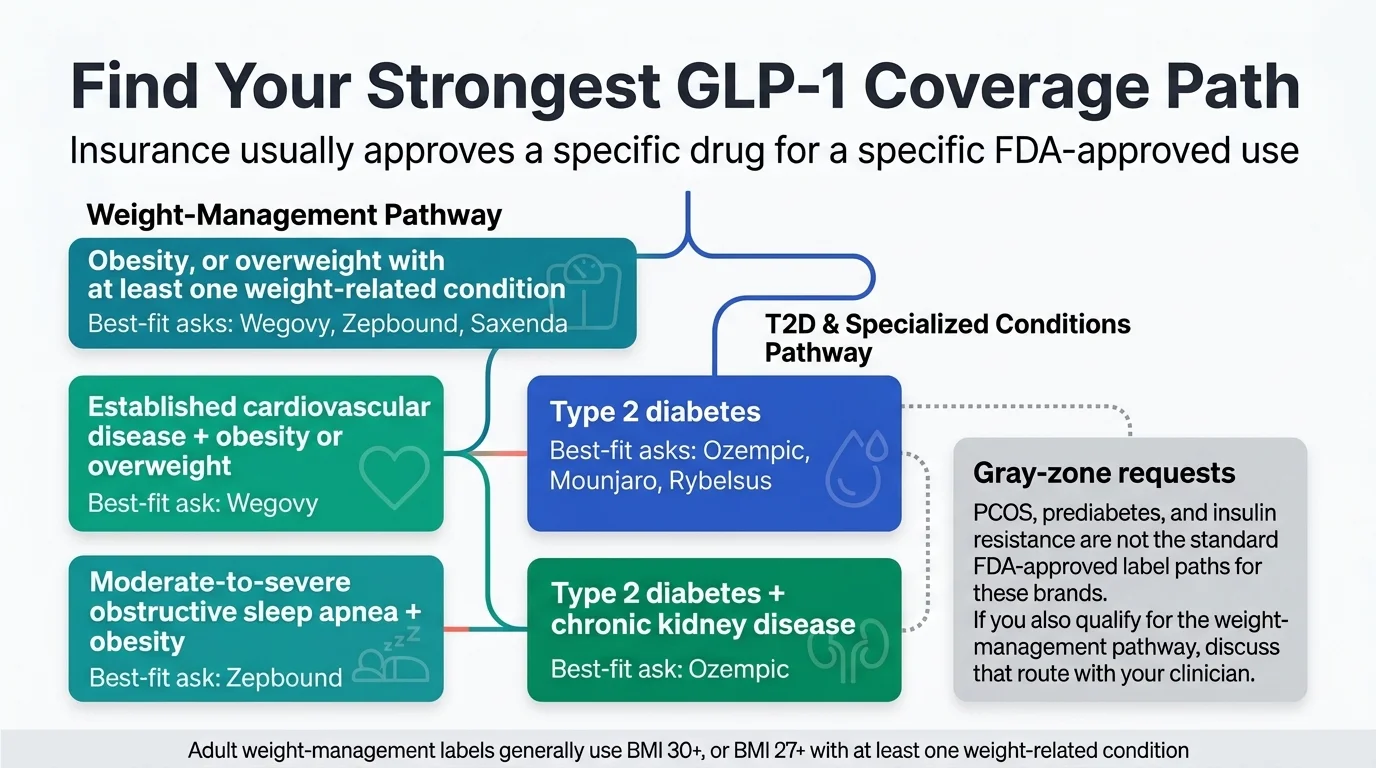
Coverage follows the FDA-approved use. Rybelsus’s approved uses are blood sugar control in adults with type 2 diabetes, and lowering the risk of major cardiovascular events in adults with type 2 diabetes who are at high risk. Weight loss isn’t on that label — so most plans won’t pay for it as a weight-loss drug.
Don’t try to “code around” an exclusion. The diagnosis on your prescription has to be accurate. Don’t ask a provider to submit an inaccurate diagnosis to get past an exclusion — claims and records must be truthful, and inaccurate coding can lead to denials and serious legal or compliance trouble. The honest move is a different question: does my plan cover any FDA-approved weight-loss medication?
If that’s you, don’t burn weeks on a losing battle. See our guide to oral GLP-1 options → It’s the right lane for your goal, and a much better use of your time.
What do major 2026 insurance policies actually require for Rybelsus?
Rybelsus Coverage Reality Matrix — checked July 2026
| Source & date | What it says | The catch | Your move |
|---|---|---|---|
| FDA prescribing information (2026) | Rybelsus and Ozempic tablets are approved for type 2 diabetes and for reducing major cardiovascular events in high-risk adults with type 2 diabetes | Prescription and clinician evaluation required; not approved for weight loss | Make sure your prescription matches an approved use |
| Novo Nordisk transition materials (2026) | Older Rybelsus (3/7/14 mg) stays available; patients are being moved to Ozempic tablets (1.5/4/9 mg) | Switching needs a new prescription and NDC; the two aren’t mg-for-mg interchangeable | Ask which product and NDC your plan wants billed |
| Cigna national formulary PA policy (reviewed June 2026) | Includes Rybelsus and Ozempic tablets for type 2 diabetes, with prior authorization | Treats weight-loss use as outside the covered criteria; your specific benefit still controls | Confirm whether an existing approval carries to the new product |
| UnitedHealthcare commercial policy (effective July 2026) | Includes Rybelsus in its diabetes GLP-1 prior-authorization program | Requires chart notes confirming type 2 diabetes; newer diagnoses may need lab records | Have your prescriber send the exact records the policy lists |
| CVS Caremark PA & quantity template | Names Rybelsus and Ozempic tablets, with prior authorization and quantity limits | It’s a template — the plan CVS Caremark administers for you may differ | Ask for your plan’s specific criteria and quantity rules |
| Illinois Medicaid notice (May 2026) | Lists Rybelsus and Ozempic tablets as preferred, with prior authorization | Patients are not auto-switched; a new Rx and a new PA are required for the transition | If you’re on Illinois Medicaid, start the new Rx/PA before your supply runs out |
| CMS Medicare (2026) | A diabetes prescription runs through your regular Part D plan | Rybelsus is not on the separate Medicare GLP-1 Bridge weight-loss list | Check your regular Part D formulary, not the Bridge |
A “national product fact” (what the FDA label says) is different from “one insurer’s policy,” which is different from “the exact plan you’re enrolled in,” which is different from “one state’s Medicaid rule.” When in doubt, your own plan’s current documents win.
Why was my Rybelsus claim denied if it’s on my plan’s drug list?
The Rybelsus Denial Decoder
| What you’re told at the pharmacy | What it usually means | Your exact next step | Who has to act |
|---|---|---|---|
| “Prior authorization required” | No approved PA is on file yet | Get the written criteria; have your prescriber send records | Prescriber + insurer |
| “PA denied” | Criteria weren’t met, or paperwork was incomplete | Ask for the denial letter; compare it line-by-line to what was sent | Prescriber (you can request records) |
| “Not covered for this diagnosis” | Your requested use is outside the plan’s rules | Confirm the diagnosis is right; if it’s weight loss, ask about a covered option | Prescriber |
| “Step therapy required” | You must try a preferred drug first (often metformin) | Ask for the preferred-drug list, or document a medical reason you can’t use it | Prescriber + insurer |
| “Quantity limit exceeded” | Your day-supply or tablet count is over the cap | Fix the quantity, or request a quantity-limit exception | Prescriber / pharmacy |
| “Non-formulary” | It’s excluded or non-preferred on your plan | Ask for the exception process and covered alternatives | Insurer + prescriber |
| “Refill too soon” | You’re refilling before the plan allows | Ask the pharmacy for the next payable date | Pharmacy |
| “Product/NDC not recognized” | Your plan may now want the Ozempic tablet or a current code | Ask which product/NDC is payable and whether you need a new prescription | Insurer, pharmacy, prescriber |
| “Drug unavailable” | The pharmacy may have an inventory problem — not necessarily a coverage one | Ask whether another in-network pharmacy has it; check coverage separately | Pharmacy |
| “Covered, but still expensive” | You’re in your deductible, or it’s a high tier | Ask for the negotiated price, your remaining deductible, and savings-card eligibility | Insurer / pharmacy |
What deadline applies to my appeal?
Your denial notice sets the clock. It states your filing deadline, the appeal level, how to submit, what evidence to include, and whether an expedited review is available. Write those details down the moment you get the letter, and don’t assume there’s one national deadline — it varies by plan and plan type. Appeals are time-sensitive, so this is the one thing not to sit on.
What does a Rybelsus prior authorization usually require?
The prior-authorization document checklist
Hand this to your prescriber’s office so nothing gets missed:
- • The exact medication and current product (Rybelsus or Ozempic tablet)
- • The strength being requested
- • A documented type 2 diabetes diagnosis
- • Recent chart notes (and an A1C, if the plan wants one)
- • Any earlier diabetes medications you’ve tried (for step-therapy plans)
- • A note about any drug you can’t take, if you’re asking for an exception
- • For renewals: proof your blood sugar improved or stayed stable
- • Correct prescriber and pharmacy details
Don’t want to run the paperwork gauntlet yourself? Take the checklist above to your own doctor’s office first — it’s free and it’s often all you need. If your prescriber won’t handle the back-and-forth, a telehealth clinician can evaluate you and, if appropriate, help with the request:
A visit doesn’t guarantee prescribing or coverage.
How much does Rybelsus cost — with and without insurance?
| Your situation | What to expect | Notes |
|---|---|---|
| Covered by commercial insurance | Plan-specific | Ask for the negotiated price, your tier, your deductible status, copay vs. coinsurance, and any pharmacy-network rule |
| Commercial insurance + savings card | As little as $25 | Commercial insurance only — not Medicare/Medicaid/cash; savings caps apply by strength and supply |
| Medicare + Extra Help (low-income subsidy) | Up to about $12.65 per covered brand-name prescription in 2026 | Some who qualify pay less |
| No insurance — manufacturer list price | $997.58 per package before discounts | Same for all Rybelsus doses; the pharmacy cash price can differ |
The savings card, by strength:
- • Rybelsus 3 mg: limited to a one-month prescription, with maximum savings of $100.
- • Rybelsus 7 mg or 14 mg: maximum savings of $100 for one month, $200 for two months, or $300 for three months.
- • The offer is for eligible commercially insured patients with Rybelsus coverage — it excludes cash-pay patients and anyone on Medicare, Medicaid, VA, DoD, or TRICARE.
Still stuck on the number? A quick, free coverage check can estimate your cost before you ever hand over a card:
New Ro accounts currently receive a $50 credit. It contacts your insurer and returns a personalized report with any available copay estimates. It checks GLP-1s like Ozempic, Wegovy, and Zepbound — treat it as a plan-specific coverage read, not a Rybelsus-only quote.
Does Medicare cover Rybelsus?
Regular Part D vs. the new GLP-1 Bridge
| Regular Part D | Medicare GLP-1 Bridge |
|---|---|
| Covers diabetes drugs like Rybelsus (if on your plan’s list) | Covers specific weight-loss drugs for eligible members |
| Your plan’s drug list and prior-auth rules apply | Central Bridge rules and prior auth apply |
| Rybelsus may be covered here | Rybelsus is not on the Bridge list |
| Deductible, copay, or coinsurance may apply | Flat $50-a-month copay |
The Bridge began July 1, 2026 and is scheduled to run through December 31, 2027. It covers weight-loss medicines like Wegovy, the Zepbound KwikPen, and Foundayo — not Rybelsus or the Ozempic tablet. So if you’re on Medicare and want Rybelsus for diabetes, look at your regular Part D formulary, not the Bridge. Learn more about the Medicare GLP-1 Bridge →
Your 2026 Medicare cost context
- • The most a Part D plan can charge as a deductible in 2026 is $615 (some plans charge less, or none).
- • In 2026, Medicare Part D caps your out-of-pocket drug spending at $2,100 a year. Once you hit it, you pay $0 for covered drugs for the rest of the year.
- • If you qualify for Extra Help, a covered brand-name prescription costs up to about $12.65 at a participating pharmacy in 2026.
Does Medicaid cover Rybelsus?
A real example of why the transition matters: Illinois Medicaid, in a May 2026 notice, listed both Rybelsus and the Ozempic tablet as preferred with prior authorization — but said patients are not automatically switched, and a new prescription and a new prior authorization are required. That’s Illinois. It does not mean every state works the same way — which is exactly why you check yours.
Your Medicaid lookup, step by step
- Note your state and whether you’re in fee-for-service or a managed-care plan.
- Open your state’s current preferred drug list.
- Search for both “Rybelsus” and “Ozempic tablets.”
- Open the current prior-authorization form.
- Ask specifically about transition rules.
- Write down the date you checked (these change).
What if my insurance won’t cover Rybelsus?
The seven-step resolution path
- Ask the pharmacy for the exact rejection code (use the decoder above).
- Confirm the diagnosis on the claim is right.
- Pull the plan’s written coverage rules.
- Complete any prior authorization, step therapy, or quantity requirements.
- Ask whether your plan now wants the Ozempic tablet instead.
- File a formulary exception or appeal if the facts support it (mind the deadline on your denial letter).
- If it’s truly excluded, ask about a covered FDA-approved alternative — don’t just quit.
Your options, and where they fit
If you still want Rybelsus specifically and your own doctor won’t handle the paperwork: you can book a visit with a telehealth clinician who can evaluate you and, if appropriate, prescribe and assist with the prior-authorization paperwork. Sesame lets you book a one-off visit with no monthly membership, which some people prefer.
A visit doesn’t guarantee prescribing or coverage.
If you’re open to a broader FDA-approved GLP-1 path and want coverage help: this is where Ro is genuinely useful. Ro focuses on FDA-approved brand-name GLP-1s and pairs them with an insurance concierge that verifies benefits, submits prior authorizations, and appeals on your behalf. Ro’s pricing is $39 for the first month, then $149/month — or as low as $74/month with an annual plan paid upfront — with medication billed separately.
Ro’s reviews are about 3.8 out of 5 on Trustpilot across 4,489 reviews, checked July 2026. Most often flag its two-part pricing (membership fee + medication) and cancellation. Medicaid members generally aren’t eligible; government-plan members should confirm current eligibility.
Which Rybelsus coverage path fits your situation?
| Your situation | Your best first move |
|---|---|
| Type 2 diabetes, brand-new prescription | Check your drug list, the current product, and PA rules |
| Type 2 diabetes, claim was rejected | Get the rejection code and the written criteria |
| Already on Rybelsus, got a switch notice | Get a new Ozempic-tablet prescription; confirm if a new PA is needed |
| Want it for weight loss, no diabetes | Ask about an FDA-approved weight-loss option instead |
| On Medicare | Use your regular Part D plan for a diabetes prescription |
| On Medicaid | Check your state’s current preferred drug list |
| Covered, but the price is high | Check your deductible, tier, pharmacy, and savings-card eligibility |
| Truly excluded, final answer | Ask about an exception or a covered FDA-approved alternative |
Still holding two or three of these in your head at once?
Answer a few questions about your insurance, diagnosis, treatment preference, and budget -- we'll match you to a personalized GLP-1 path with source-verified pricing.
Find My GLP-1 Path →Rybelsus vs. Ozempic tablets vs. the Wegovy pill vs. Foundayo — which is which?
| Product | Active ingredient | FDA-approved for | Interchangeable? | Coverage lane |
|---|---|---|---|---|
| Rybelsus (older tablets, still available) | Semaglutide | Type 2 diabetes + heart-risk reduction in high-risk diabetes | Not mg-for-mg with Ozempic tablets | Diabetes — often covered with prior auth; rarely for weight loss |
| Ozempic tablet (updated version, launched May 2026) | Semaglutide (reformulated) | Type 2 diabetes + heart-risk reduction in high-risk diabetes | Not mg-for-mg with Rybelsus | Same diabetes lane — ask about the tablet specifically |
| Wegovy pill | Semaglutide, 25 mg | Weight loss | No | Weight-loss lane — tougher, patchier coverage |
| Foundayo | Orforglipron (non-semaglutide) | Weight loss | No | Weight-loss lane — separate coverage rules |
Products can be covered or denied differently because their FDA-approved uses, formulations, product codes, and plan criteria differ. Getting the product and diagnosis right is half the battle.
Safety facts to know before you chase coverage
- • Boxed warning: risk of thyroid tumors (seen in rodents; unknown in people). Tell your doctor about any neck lump, swelling, hoarseness, or trouble swallowing.
- • Do not use if you have a personal or family history of MTC or MEN 2, or if you’ve had a serious allergic reaction to semaglutide.
- • Talk to your prescriber about your pancreas, kidneys, gallbladder, vision, pregnancy or breastfeeding plans, any surgery, and every other medicine you take.
- • How it’s taken: Rybelsus is taken in the morning on an empty stomach with no more than 4 ounces of plain water, then you wait at least 30 minutes before food, other drinks, or other pills.
- • Don’t stop, switch versions, or change your dose on your own — especially during the 2026 transition.
For the complete details, read the current Rybelsus prescribing information and talk with your doctor.
How we verified this page
Who wrote this: The RX Index Editorial Team. We’re an independent GLP-1 decision resource — we don’t sell medicine, and we’re not owned by a telehealth company. When we link to a provider and earn a commission, we label it, and it never changes our facts.
How we made it: we reviewed the current FDA prescribing information for Rybelsus and Ozempic tablets; Novo Nordisk’s transition, list-price, savings-card, and patient-assistance pages; current CMS and Medicare Part D 2026 figures and the Medicare GLP-1 Bridge drug list; published 2026 policy examples from Cigna, UnitedHealthcare, CVS Caremark, and Illinois Medicaid; and current Ro and Sesame pages.
Update log
| Date | What changed |
|---|---|
| July 2026 | Added the 2026 Rybelsus-to-Ozempic-tablet transition, a source-dated payer matrix, the Medicare GLP-1 Bridge distinction, 2026 Part D and Extra Help figures, and the January 2027 list-price change |
Frequently asked questions
Does Blue Cross Blue Shield cover Rybelsus?
Does UnitedHealthcare cover Rybelsus?
Does Cigna cover Rybelsus?
Does CVS Caremark cover Rybelsus?
Does Aetna cover Rybelsus?
Does Medicare Part D cover Rybelsus?
Does Medicaid cover Rybelsus?
Why was my Rybelsus prior authorization denied?
Can I use the Rybelsus savings card with Medicare or Medicaid?
How can insured patients pay as little as $25 for Rybelsus?
Do I need a new prescription for the Ozempic tablet?
Will I need a new prior authorization when I switch to the Ozempic tablet?
What if the pharmacy says Rybelsus is out of stock?
Should I stop Rybelsus if my insurance stops covering it?
Still not sure which GLP-1 program is right for you?
You’ve got the facts. If you’re still weighing your diagnosis, your plan, and your budget, answer a few quick questions and we’ll match you to the treatment path — and the source-verified pricing — that fits your situation.
Get my personalized GLP-1 path →References
All figures checked July 2026. Prices, policies, and program rules change — re-verify before relying on them.
- U.S. FDA — Rybelsus and Ozempic tablets prescribing information. accessdata.fda.gov; novo-pi.com/rybelsus.pdf
- Novo Nordisk / NovoMedLink — Rybelsus-to-Ozempic-tablet transition (new prescription/NDC; strengths). novomedlink.com
- Novo Nordisk / NovoCare — Rybelsus list price ($997.58/package, all doses). novocare.com
- Novo Nordisk / NovoCare — Rybelsus savings-card terms (as little as $25; caps by strength; commercial insurance only). novocare.com
- Novo Nordisk — U.S. list-price reduction to $675 effective January 1, 2027 (announced Feb 24, 2026). prnewswire.com
- FDA / Pharmacy Times — reformulated oral semaglutide approved Dec 2024; “Ozempic tablet” name in early 2026; U.S. launch May 4, 2026.
- CMS / Medicare.gov — 2026 Part D maximum deductible ($615), out-of-pocket cap ($2,100), and Extra Help brand copay (up to ~$12.65). medicare.gov
- CMS — Medicare GLP-1 Bridge (July 1, 2026–Dec 31, 2027; covers Wegovy, Zepbound KwikPen, Foundayo; excludes Rybelsus). cms.gov
- FDA / Eli Lilly — Foundayo (orforglipron) approved for chronic weight management April 1, 2026.
- Cigna national formulary GLP-1 PA policy (reviewed June 2026); UnitedHealthcare commercial diabetes GLP-1 PA policy (effective July 2026); CVS Caremark GLP-1 PA/quantity template; Illinois Medicaid transition notice (May 21, 2026).
- Ro — GLP-1 Insurance Coverage Checker, insurance/pricing pages, and coverage-checker report (paid-partner testimonial). ro.co/weight-loss/
- Sesame — Rybelsus medication page (visit + prior-authorization assistance). sesamecare.com/medication/rybelsus
Your situation changes the answer
Find My GLP-1 Path
The right GLP-1 provider isn't the same for everyone. It depends on whether you'll use insurance or pay cash, whether you want an FDA-approved or compounded medication, your preferred route (injection or oral), and your budget. Answer a few questions in The RX Index's Find My GLP-1 Path tool to see a suggested provider route and pricing to review before you choose. It does not check your plan's coverage or copay; confirm those in your insurer's member portal or with the pharmacy-benefits number on your card.
- What it asks: your goals, how you plan to pay, and your treatment preferences
- What you get: a suggested provider route and pricing information to review
- Cost: free · about 2 minutes · no signup