
Does Kaiser Cover Zepbound? 2026 Coverage Rules, Prior Authorization, and Next Steps
 (sponsored affiliate link, opens in a new tab)
Coverage guide — does Kaiser cover Zepbound in 2026?
By The RX Index Editorial Team — a pricing intelligence and comparison resource for GLP-1 telehealth providers
·
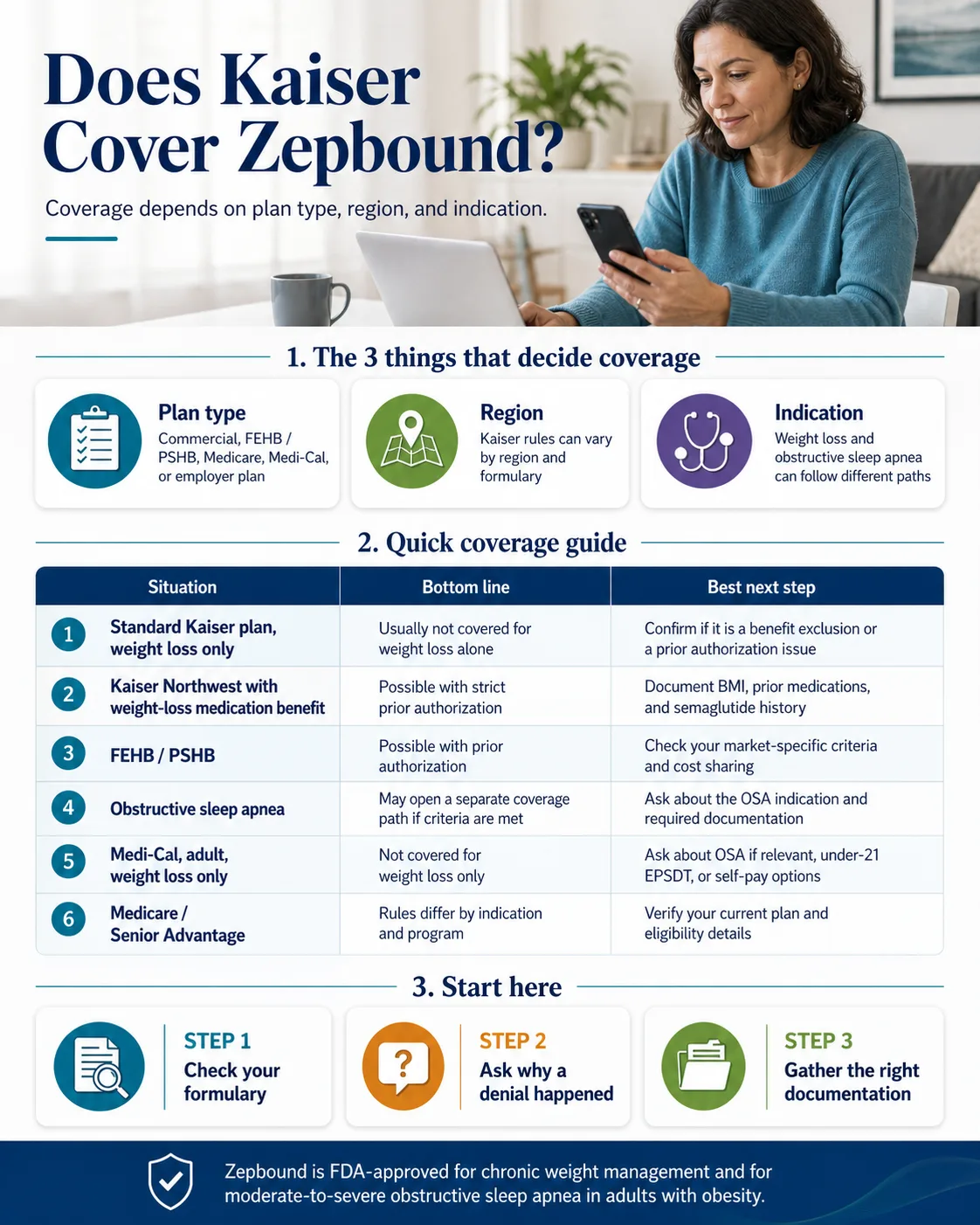
The honest answer to does Kaiser cover Zepbound: most standard Kaiser Permanente plans don’t cover Zepbound for weight loss alone in 2026 — but coverage is real for some Kaiser members, and there are legitimate pathways to check before you give up. Coverage hinges on three things: your Kaiser region (California, Northwest, Washington, Colorado, Mid-Atlantic, Georgia, or Hawaii), your plan type (standard HMO, FEHB/PSHB, Senior Advantage, Medi-Cal, or employer plan), and your indication (weight loss vs. obstructive sleep apnea).
There’s one piece of this that most pages won’t tell you. We’ll get to it in a minute. First, the table you came for.
Does Kaiser cover Zepbound in 2026? Quick answer at a glance
Coverage depends on your plan, not just the Kaiser logo. Use the table below to find your situation, then read the section it points to. Most Kaiser members fall into one of these six buckets.
| Your Kaiser situation | Bottom line in 2026 | Your best next step |
|---|---|---|
| Standard Kaiser HMO, weight loss only | Usually not covered for weight loss alone | Confirm whether it’s a benefit exclusion or a PA gap before chasing paperwork |
| Kaiser Northwest with weight-loss medication benefit | Possible, with strict criteria | Document BMI, prior meds, and your semaglutide trial |
| Kaiser FEHB / PSHB (federal employees) | Possible — Kaiser materials show GLP-1 access at 50% coinsurance with PA | Confirm your market’s PA rules; Ro says FEHB members can access its insurance concierge |
| Kaiser plan + obstructive sleep apnea diagnosis | Often a separate, cleaner PA path | Ask about Zepbound under the OSA indication |
| Kaiser Medi-Cal, adult, weight loss only | Excluded as of January 1, 2026 | OSA path, EPSDT under 21, or self-pay |
| Kaiser Senior Advantage (Medicare) | Part D historically excludes weight-loss-only use | Medicare GLP-1 Bridge ($50/mo for Zepbound KwikPen) runs July 1, 2026 – December 31, 2027 |
Not sure which row applies to you?
Use our free Kaiser GLP-1 Path Finder to get a personalized 60-second answer based on your region, plan, and BMI.
Take the 60-second Kaiser GLP-1 path quiz →The single biggest mistake Kaiser members make
A Kaiser Zepbound denial can mean two completely different things. One is fixable. The other isn’t fixable with paperwork. Knowing which one you’re facing is the difference between getting Zepbound in three weeks and wasting three months.
Here’s what most pages won’t tell you straight.
When Kaiser tells you “Zepbound isn’t covered,” the words almost always mean one of two things:
1. Benefit exclusion
Your Kaiser plan doesn’t include weight-loss medications. Period. The drug isn’t on your formulary because the benefit isn’t in your plan design.
More PA paperwork won’t save you. You can’t get authorization for a benefit your plan doesn’t have.
2. Medical-necessity denial
Your plan does include weight-loss meds — but the prior authorization didn’t show enough evidence to approve it.
This is the type worth fixing because the facts in the record can change. The criteria are knowable. The form is fillable.
The fastest way to find out which one you’re facing:
Call the number on your Kaiser card and ask: “Is Zepbound a covered benefit under my pharmacy plan, or is it covered with prior authorization?” If they say it’s a benefit exclusion, write that down. That answer changes your next 90 days.
Already have your insurance details ready? You can also run a free GLP-1 coverage check before starting another PA cycle.
See if you qualify for the OSA pathway, FEHB, or another Kaiser route →The Kaiser Zepbound Coverage Matrix (verified April 2026)
Kaiser Permanente isn’t one insurer — it’s seven regional health plans, plus separate federal (FEHB), Medicare (Senior Advantage), and Medicaid (Medi-Cal) products. Each one treats Zepbound differently.
This is the part of the page we built for you. Nowhere else on the internet combines Kaiser regional formularies, the KPMAS prior authorization form, FEHB cost-sharing, the Medi-Cal Rx January 2026 exclusion, and the upcoming July 2026 Medicare GLP-1 Bridge into a single matrix. Open 12 tabs, read 6 PDFs, or read this:
| Plan / Region | Drug listed as | Tier / PA / QL | Indication notes | What this does NOT prove |
|---|---|---|---|---|
| Kaiser California — standard commercial / IFP | Not a text match in 2026 CA Commercial HMO Formulary | N/A in document | Per public SFHSS materials, Kaiser stopped covering GLP-1s for weight loss under the base benefit for BMI <40 effective 1/1/2025; employer riders, OSA path, and BMI ≥40 exception may still apply | Does not mean all CA Kaiser plans exclude Zepbound — EOC governs |
| Kaiser Medi-Cal (CA Medicaid via Medi-Cal Rx) | Zepbound | No coverage for weight loss or weight-loss-related indications as of 1/1/2026 | All previously approved weight-loss PAs expired 12/31/2025; OSA may still be reviewable; EPSDT case-by-case PA may apply for members under 21 | Does not affect Kaiser commercial or employer-sponsored plans |
| Kaiser Northwest (Oregon + SW Washington) | Zepbound — non-formulary, requires clinical review | PA + QL | Covered for weight loss only for members whose plan includes weight-loss medication coverage; criteria require BMI ≥30 (or ≥27 with comorbidity), prior trial of 2+ older AOMs, and 6-month semaglutide trial OR contraindication | Does not apply to Medicare Part D patients |
| Kaiser Washington Core/Access PPO + Large Employer 3-Tier | Zepbound + Zepbound KwikPen | PA + QL listed | Listed in formulary text; member benefit details apply | Does not prove every WA Kaiser plan covers Zepbound |
| Kaiser Colorado marketplace | Not a text match in document | N/A in document | Member EOC governs final benefit | Does not prove all CO plans exclude Zepbound |
| Kaiser Mid-Atlantic (KPMAS — DC/MD/VA) | Zepbound | Reviewed via PA form for Commercial, Exchange, and FEHB plans | Form covers weight management, MASH, cardiovascular-risk reduction, OSA, and continuation criteria; auth length 12 months for MASH and 6 months for other indications | Form proves a review pathway, not coverage for every member |
| Kaiser Georgia FEHB | Zepbound | PA + QL | Federal employee plan | Does not prove non-FEHB GA plans cover Zepbound |
| Kaiser Hawaii / KPIC Added Choice | Zepbound subcutaneous pen injector listed under weight loss | Tier listed; PA marker | Plan-dependent; OSA-specific criteria not verified in this document | OSA pathway not confirmed in this PDF |
| Kaiser FEHB / PSHB (all regions) | Zepbound | PA; some regional FEHB formularies show PA + QL | GLP-1 and oral anti-obesity meds available at 50% coinsurance of Plan allowance with PA; PA rules “may vary by market” per Kaiser | Does not promise approval for any individual member |
| Kaiser Senior Advantage (Medicare) | Not a text match for Zepbound weight-loss coverage in Part D formulary | Part D historically excludes weight-loss-only use | Zepbound may be Part D-coverable for OSA if plan criteria met; Medicare GLP-1 Bridge runs outside Part D from 7/1/2026 – 12/31/2027 at $50/mo for KwikPen only | Bridge is not standard Part D coverage |
A few things this matrix tells you that no other page does cleanly:
- Plan type matters more than region. Two Kaiser members in the same zip code with different employers can have completely different Zepbound benefits.
- Some Kaiser commercial public formularies don’t list Zepbound at all. That doesn’t always mean denied — your specific Evidence of Coverage governs the final answer — but it’s a strong signal you need to verify.
- The OSA pathway is real and underused. Zepbound is FDA-approved for moderate-to-severe obstructive sleep apnea in adults with obesity. That created a separate coverage door for some Kaiser members.
- January 2026 changed things for Kaiser Medi-Cal members. Medi-Cal Rx removed Zepbound, Wegovy, and Saxenda from coverage when prescribed for weight loss. All previously approved weight-loss PAs expired December 31, 2025.
Not sure which row applies to you? Take the 60-second Kaiser GLP-1 path quiz — we’ll match your plan, region, and indication to the right next step.
Take the 60-second quiz →Coverage by Kaiser plan type — the rules that change everything
Kaiser sells under one name but operates through several distinct product lines. Federal employees, Medicare beneficiaries, Medi-Cal members, and standard commercial members each follow a different rulebook. Find your plan type below before you read your region.
Kaiser FEHB / PSHB
This is the most coverage-friendly Kaiser product for weight-loss medications. Kaiser’s 2026 FEHB public materials show GLP-1 and oral anti-obesity medications available at 50% coinsurance of the Plan allowance with prior authorization, with PA guidelines that may vary by market. Some regional FEHB formularies (Georgia is one) explicitly list Zepbound with PA and quantity limits.
Why this matters: Ro says FEHB members can join Ro Body and access its insurance concierge. That’s significant because most consumer telehealth services don’t coordinate with Kaiser at all. If you’re a federal employee on Kaiser, this is one of the rare combinations where outside telehealth may help run prior authorization. Verify with Ro and your specific Kaiser FEHB region before assuming the workflow applies to your plan.
Kaiser Senior Advantage
Medicare Part D historically excludes drugs when used for weight loss alone — that’s federal statute, not Kaiser’s choice. Your Kaiser Senior Advantage plan can’t override it.
But two specific paths exist:
Path 1: OSA indication under regular Part D
Zepbound is FDA-approved for moderate-to-severe obstructive sleep apnea in adults with obesity. If your plan covers Zepbound for OSA, that is a separate Part D coverage question and does not qualify under the Medicare GLP-1 Bridge weight-loss pathway.
Path 2: Medicare GLP-1 Bridge (July 1, 2026)
Runs outside normal Part D from July 1, 2026 through December 31, 2027. Eligible Part D beneficiaries get Zepbound for $50/month \u2014 KwikPen only. Single-dose vials and single-dose pens are not included.
Deep dive: Medicare GLP-1 Bridge Program Explained — eligibility, prior-authorization process, and how the $50 copay does not count toward your Part D out-of-pocket cap.
Kaiser Medi-Cal
Medi-Cal Rx says GLP-1 drugs including Zepbound are no longer eligible for coverage for weight loss or weight-loss-related indications effective January 1, 2026. Wegovy, Zepbound, and Saxenda were removed from the Contract Drugs List. Ozempic, Mounjaro, and Rybelsus are restricted to type 2 diabetes only. All previously approved weight-loss prior authorizations expired December 31, 2025. There was no transition period.
Two important nuances:
- Continuation rights. Medi-Cal members who were taking a GLP-1 on or before January 1, 2026 and who receive a Notice of Adverse Action can request a State Hearing within 10 days. Coverage may continue pending the hearing decision until the earlier of the end of the current PA period, the hearing decision, or withdrawal/closure of the hearing.
- Under-21 EPSDT. Members under 21 may still qualify for case-by-case prior authorization under the federal EPSDT benefit.
For OSA specifically, prior authorization for Zepbound may still be reviewable as a non-weight-loss FDA-approved indication. Talk to your Kaiser clinician about the OSA path if you have a documented sleep apnea diagnosis.
Kaiser commercial HMO and individual/family plans
This is where things get plan-specific. Public SFHSS materials quoting Kaiser say Kaiser stopped covering GLP-1s and other anti-obesity medications for weight loss under the base benefit for members with BMI under 40 starting January 1, 2025. Kaiser’s 2024 business-plan flyer also told employer groups that beginning January 2025, certain weight-loss medications would no longer be covered for the sole purpose of weight loss on covered business plans. GLP-1s could still be covered when prescribed as part of disease management for conditions like diabetes — but not when the only indication is weight loss.
The single most important question for commercial members:
Did your employer add a “weight-loss medication rider” to the base Kaiser benefit? Some employers did. Some didn’t. Two coworkers can have different answers. Call HR.
Kaiser regional notes — what’s actually different
Kaiser California
The 2026 KFHP California Commercial HMO Formulary we pulled did not show Zepbound as a text match. That isn’t a final denial — your Evidence of Coverage governs the actual benefit — but combined with the 1/1/2025 base-benefit restriction for BMI <40, it’s a strong signal you’ll need a verified pathway (employer rider, OSA indication, or appeal) rather than a routine PA.
Kaiser Northwest
Kaiser Northwest’s tirzepatide (Zepbound) coverage criteria PDF is the clearest publicly documented Zepbound pathway in the Kaiser system. If you’re in Oregon or southwest Washington, this is your starting point. The criteria require a qualifying weight-loss medication benefit, BMI documentation, lifestyle intervention, prior trials of 2+ older anti-obesity medications, and a 6-month semaglutide trial unless you have a documented contraindication.
Kaiser Washington
Kaiser Washington state plans show Zepbound and Zepbound KwikPen on multiple public formularies (Core/Access PPO, large employer 3-tier) with PA and quantity limits.
Kaiser Colorado
The 2026 marketplace formulary we pulled didn’t show a Zepbound text match. Member EOC governs.
Kaiser Mid-Atlantic (KPMAS)
Publishes the most detailed PA form. If you’re in DC, Maryland, or Virginia, the KPMAS Weight Management Agents PA Form is the one your prescriber will fill out. It’s used for Commercial, Exchange, and FEHB plans.
Kaiser Georgia FEHB
Lists Zepbound on its 2026 federal formulary with PA + QL.
Kaiser Hawaii
A KPIC Added Choice formulary lists Zepbound subcutaneous pen injector under weight loss with PA. OSA-specific criteria weren’t in that document — verify against your specific plan.
Does Kaiser cover Zepbound in California specifically?
Usually not for weight loss alone on standard commercial or marketplace Kaiser California plans. Employer riders, OSA documentation, and your specific Evidence of Coverage are the three places where coverage may still exist.
Three pathways are worth checking before you assume no:
- Did your employer add a weight-loss medication rider to your Kaiser plan? Call HR. Two coworkers in California can have different benefits.
- Do you have documented moderate-to-severe OSA? Zepbound’s FDA-approved OSA indication is a separate PA path that the BMI <40 base-benefit restriction doesn’t address.
- Are you on Kaiser Medi-Cal? As of January 1, 2026, weight-loss-only GLP-1s are excluded — but OSA review and EPSDT under-21 case-by-case PA may still apply.
If none of those apply and your goal is FDA-approved Zepbound, the practical next step is a verified self-pay path through LillyDirect or a telehealth provider.
Kaiser’s actual prior authorization criteria — what your prescriber will be asked
Where Kaiser does cover Zepbound, the approval bar is high. Different Kaiser regions use different criteria. Here’s what KPMAS (Mid-Atlantic) and Kaiser Northwest publicly document — the two regions with the most detailed publicly available criteria.
What KPMAS asks (Mid-Atlantic)
The Kaiser Permanente Mid-Atlantic States Weight Management Agents Prior Authorization Form is used for Wegovy, Saxenda, and Zepbound across Commercial, Exchange, and FEHB plans. It covers a numbered criteria checklist across weight management, MASH, cardiovascular-risk reduction, OSA, and continuation criteria.
For weight management indication, the form asks:
- Are you enrolled in the KPMAS Clinical Pharmacy Weight Management Service, or is your prescriber a bariatric/obesity-medicine specialist?
- What’s your diagnosis? Documented obesity (E66.x ICD-10 codes) or a qualifying secondary indication.
- What’s your current BMI? Generally ≥30, OR ≥27 with at least one comorbidity (hypertension, type 2 diabetes, dyslipidemia, OSA, cardiovascular disease).
- Are you actively participating in lifestyle modifications? Diet, physical activity, behavioral support, or community-based program — and planning to continue while on Zepbound.
- Documented intolerance, contraindication, or 5% failure on a 3-month trial of: Qsymia (phentermine/topiramate), phentermine + topiramate, Contrave, or alternative anti-obesity medications. This is step therapy.
- Are you optimized on standard-of-care for cardiovascular risk? Statin, antihypertensive, etc., as applicable.
- No personal or family history of medullary thyroid carcinoma or MEN2. Hard exclusion.
- Not currently using another GLP-1 or GIP/GLP-1 agonist. No overlapping medications.
For the OSA indication, KPMAS asks: moderate OSA is AHI 15–29 by polysomnography within the past one year, severe OSA is AHI ≥30, BMI must be ≥35, and the patient must be unable to use PAP therapy or have used PAP for at least 3 months and plan to continue.
What Kaiser Northwest asks
- BMI ≥30, OR ≥27 with comorbidity
- Prior trial of 2+ older anti-obesity medications (phentermine, diethylpropion, Qsymia, Contrave, etc.)
- 6-month semaglutide trial (Wegovy or Ozempic) followed by bariatric medicine chart review, unless documented allergy, intolerance, contraindication, or clinical inappropriateness
- For OSA: severe sleep apnea with AHI ≥30, sleep study within the last 3 years, BMI ≥30
- Continuation: every 12 months, requires updated weight/BMI plus achieving and maintaining at least 5% weight loss
Kaiser regional criteria at a glance
| Kaiser region | Prior oral AOM requirement | Semaglutide requirement | OSA sleep study window | BMI threshold | Authorization length |
|---|---|---|---|---|---|
| KPMAS (Mid-Atlantic) | 3-month trial of Qsymia, Contrave, or alternative AOM | Step-therapy via listed AOMs (semaglutide trial not the same as Northwest’s 6-month rule) | Within past 1 year (polysomnography) | ≥30 (or ≥27 with comorbidity) for weight management; ≥35 for OSA | 12 months MASH; 6 months other indications |
| Kaiser Northwest | Trial of 2+ older AOMs | 6-month semaglutide trial OR contraindication | Within last 3 years | ≥30 (or ≥27 with comorbidity) | 12 months continuation |
The single most common reason a Kaiser PA gets rejected
It’s the step-therapy box. Specifically, the Kaiser Northwest criteria require a 6-month semaglutide trial before Zepbound — unless you have a documented allergy, intolerance, contraindication, or clinical reason semaglutide isn’t appropriate. If you’ve already tried Wegovy or Ozempic and it didn’t work, document it thoroughly. That’s the evidence that unlocks the next step.
The PA evidence checklist
Bring this to your Kaiser appointment:
| What Kaiser will ask for | What your chart needs to show |
|---|---|
| Current weight + BMI | Date-stamped height, weight, BMI |
| Diagnosis | E66.x for obesity, G47.33 for OSA, or both |
| Comorbidity | HTN, T2D, dyslipidemia, OSA, CVD with ICD-10 codes |
| Lifestyle intervention | Specific diet, exercise, or program participation |
| Prior medication trials | Drug, dose, duration, outcome, side effects |
| Semaglutide trial (Northwest) | Start/end dates, response, intolerance, or reason inappropriate |
| OSA documentation | Sleep study date, AHI, severity, BMI, PAP history |
| Safety screening | MTC/MEN2 history, pancreatitis, severe gastroparesis |
| Denial letter (if reapplying) | Specific reason code from previous denial |
Does Kaiser cover Zepbound for sleep apnea? It can be the cleaner path when the documentation is real
Zepbound is FDA-approved for moderate-to-severe obstructive sleep apnea in adults with obesity. For some Kaiser members, the OSA indication is a separate PA path — but Kaiser still applies plan-specific PA criteria, and “approved for OSA” is not automatic.
OSA has clear diagnostic criteria. It has objective measurements (AHI from a sleep study). PAP therapy is the standard first-line treatment, and “PAP failure or intolerance” has well-established documentation requirements. The OSA framework gives your prescriber objective documentation to work with — AHI, sleep-study date, BMI, and PAP history — but Kaiser still applies plan-specific PA criteria.
What Kaiser typically requires for OSA approval (varies by region):
- KPMAS: AHI ≥15 (moderate) by polysomnography within the past one year, or AHI ≥30 (severe). BMI ≥35. PAP intolerance, or documented PAP trial of at least 3 months with intent to continue.
- Kaiser Northwest: AHI ≥30 (severe). Sleep study within the last 3 years. BMI ≥30. Plus the listed step-therapy and semaglutide criteria.
- Other regions: verify against your specific plan’s PA form.
- All regions: no personal or family history of MTC/MEN2.
A real-world note:
If you suspect you have undiagnosed sleep apnea — loud snoring, witnessed breathing pauses, daytime sleepiness despite a full night’s sleep — ask your Kaiser PCP for a sleep-study referral before you submit a Zepbound PA. A documented sleep apnea diagnosis can open a separate PA path — but only if the symptoms and sleep-study results are real. We’re not telling you to fake symptoms. We’re telling you that if you genuinely have OSA, this is a legitimate path most Kaiser members never explore.
Have OSA symptoms and Kaiser? See whether the OSA pathway is your strongest play.
Take the quiz →Mounjaro vs. Zepbound under Kaiser — same active ingredient, different FDA products and coverage rules
Zepbound and Mounjaro contain the same active ingredient: tirzepatide. They are different FDA-approved products with different labeling and indications. Some Kaiser plans may list Mounjaro for type 2 diabetes when they don’t cover Zepbound for weight loss.
Insurers — including Kaiser — evaluate each medication based on its FDA-approved indication, not its molecule. Some Kaiser formularies may list Mounjaro for type 2 diabetes management; do not assume Zepbound and Mounjaro share coverage rules. Verify your specific plan formulary and diagnosis requirements.
How to check your specific Kaiser plan in 5 minutes
Three steps confirm your actual coverage faster than waiting for your next PCP appointment.
Step 1: The 90-second formulary check at kp.org
- Log in to kp.org
- Click Pharmacy → Drug Formulary
- Search “Zepbound” or “tirzepatide”
- Look for: tier number, “PA” flag (prior authorization required), “QL” flag (quantity limit), and any indication restrictions
If Zepbound doesn’t appear at all: it’s likely not on your formulary, but call Member Services to confirm — some Kaiser plans have separate non-formulary processes that aren’t visible in the public PDF.
Step 2: The Member Services call script
Call the number on the back of your Kaiser card and read this:
Write down the rep’s name and call reference number. Both matter if you appeal later.
Step 3: The HR question that actually matters
If you get Kaiser through your employer, send this to your HR or benefits team:
Subject: Pharmacy benefit question — FDA-approved anti-obesity medications
Hi [Benefits team],
I’m trying to understand our Kaiser pharmacy benefit. Does our plan cover FDA-approved anti-obesity medications such as Zepbound when medical necessity criteria are met and prior authorization is approved? If those medications are excluded from the pharmacy benefit, is there an employer rider or plan option that can be added during the next renewal period?
Thanks,
[Your name]
What to do if Kaiser denies your Zepbound request
A first denial isn’t the end. Kaiser has a structured grievance and appeals process, and California members have one of the strongest external appeal rights in the country.
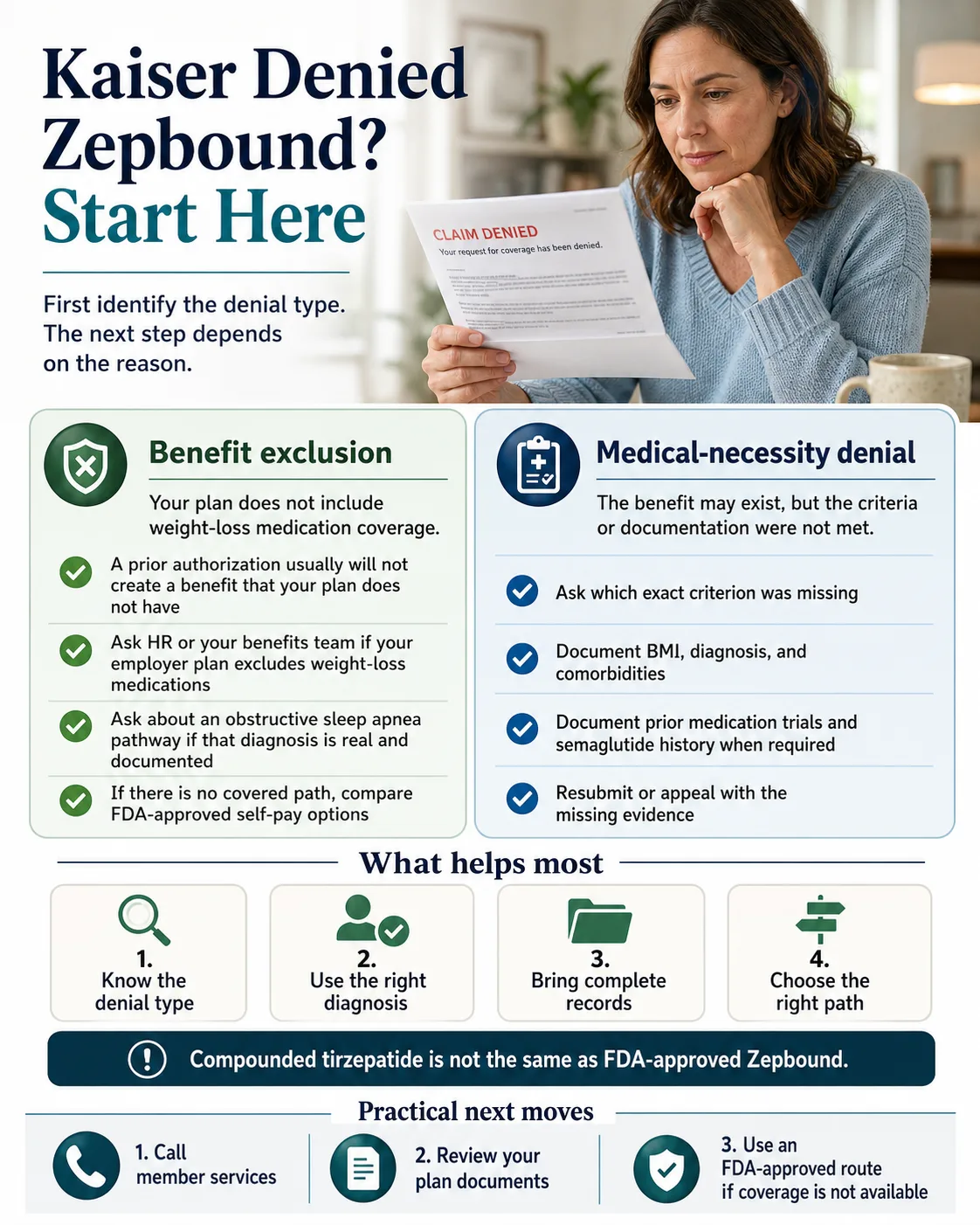
Kaiser Zepbound denial guide — classify first, then act
First, classify the denial
Pull out your Kaiser denial letter. Find the reason. Then match it to this table:
| Denial wording | What it usually means | Your move |
|---|---|---|
| “Not a covered benefit” | Benefit exclusion — the plan doesn’t cover weight-loss meds | Ask HR about a rider; pursue OSA pathway if applicable; consider self-pay |
| “Prior authorization denied — criteria not met” | Medical-necessity denial — fixable | Ask which criterion wasn’t met and resubmit with documentation |
| “Step therapy required” | Kaiser wants other meds tried first | Document prior trials; semaglutide trial often required |
| “Formulary exception denied” | Non-formulary request rejected | Ask for formal appeal rights and alternative covered medications |
| “Quantity limit” | Dosing/fill limit issue | Have prescriber clarify dosing on the form |
Move 1: Resubmit with stronger documentation
A missing-evidence denial is the denial type most worth resubmitting because the facts in the record can change. Common gaps:
- Specific ICD-10 codes for comorbidities
- Documented dates of prior medication trials
- The semaglutide trial documentation (this is the most common gap in Kaiser regions that require it)
- Lifestyle program enrollment proof
Move 2: Pivot to the OSA indication if it applies
If you have severe sleep apnea symptoms and haven’t pursued a sleep study, ask for a referral. A documented OSA diagnosis with the qualifying AHI opens a separate coverage door at most Kaiser plans.
Move 3: File a formal grievance / Kaiser internal appeal
A formulary exception is a clinical request to your plan. A grievance is a regulatory process challenging an adverse coverage decision after it’s been made. They’re different. Standard timelines are 30 days for routine appeals and 72 hours for urgent ones.
Move 4: California members — the DMHC Independent Medical Review
This is one of the strongest external appeal rights in the country. If Kaiser denies your internal appeal, you can request an Independent Medical Review through the California Department of Managed Health Care (DMHC). It’s free. No lawyer needed. Submitted at dmhc.ca.gov.
Per DMHC’s published FAQ, in approximately 73% of IMR cases the health plan’s denial was reversed by the plan or overturned by the Independent Medical Review Organization, and the enrollee received authorization for the requested service or treatment. That is a striking number, and most California Kaiser members never use IMR because they’ve never heard of it.
Now the part most pages won’t tell you
If your Kaiser plan flat-out excludes weight-loss medications as a benefit, no amount of prior-authorization paperwork will make Zepbound covered. PAs prove medical necessity. They can’t create a benefit that doesn’t exist in your plan design. We’ve seen Kaiser members spend three months chasing PA cycles when the original answer (“not a covered benefit”) meant the same thing in week one as it did in week twelve.
But here’s the pivot: some Kaiser denials are not benefit exclusions. Missing-evidence denials, step-therapy denials, and wrong-indication denials are the ones worth fixing because they can change when the record changes. If your denial is a benefit exclusion and there’s no OSA pathway, no employer rider, and no way to pivot, you still have FDA-approved cash-pay options. Cash isn’t a fallback to be ashamed of — Lilly’s Self-Pay Journey purchase offer starts at $299/month for the 2.5 mg starting dose.
Got a Kaiser denial letter? We’ll help you classify the denial type and route you to the right move.
Take the 60-second quiz →Zepbound cost with Kaiser — and without
If your Kaiser plan covers Zepbound, expect specialty-tier pricing. If your plan doesn’t cover Zepbound at all, Lilly’s manufacturer self-pay path currently starts at $299/month for the 2.5 mg starting dose direct from LillyDirect.
What you’ll actually pay if Kaiser covers it
| Plan type | Likely monthly cost | Notes |
|---|---|---|
| Kaiser commercial HMO with weight-loss benefit + Zepbound on formulary | Specialty-tier copay or coinsurance — varies by plan | Stack the Lilly Savings Card if eligible |
| Kaiser FEHB / PSHB | 50% coinsurance of Plan allowance with PA per Kaiser’s 2026 FEHB materials | Market-specific PA rules apply |
| Kaiser Senior Advantage (Medicare) for OSA | Standard Part D copay — confirm with your plan | Check your formulary |
| Kaiser Senior Advantage (Medicare) for weight loss | $50/mo via Medicare GLP-1 Bridge starting 7/1/2026 — KwikPen only | Bridge PA goes to a CMS central processor, not your plan |
| Kaiser Medi-Cal | Not covered for adult weight loss as of 1/1/2026 | OSA path or self-pay |
| Kaiser plan with no Zepbound coverage | Cash-pay only | $299–$449 via LillyDirect under purchase-offer terms |
LillyDirect Self-Pay Journey — verified April 2026
| Dose | Self-Pay Journey purchase-offer price | Regular price if offer doesn’t apply |
|---|---|---|
| 2.5 mg* | $299 | $299 |
| 5 mg | $399 | $399 |
| 7.5 mg | $449 | $499 |
| 10 mg | $449 | $699 |
| 12.5 mg | $449 | $699 |
| 15 mg | $449 | $699 |
*2.5 mg is a starting dose and is not approved as a maintenance dose.
The Zepbound Savings Card
Eli Lilly’s commercial savings card may bring eligible patients to as low as $25/month for the Zepbound single-dose pen if their plan covers Zepbound. Eligibility requires:
- Commercial drug insurance covering the Zepbound single-dose pen
- Valid prescription for an FDA-approved indication
- 18 or older
- US or Puerto Rico resident
What to do if Kaiser won’t cover Zepbound — verified 2026 paths
Three legitimate FDA-approved paths exist when Kaiser says no. LillyDirect runs $299–$449/month direct from Lilly under purchase-offer terms. Ro adds telehealth, included Quest Diagnostics labs, and an insurance concierge for FEHB members. Sesame Care offers brand-name access at flat-rate visit pricing.
Provider-stated vs. what we verified
| Path | Provider-stated price | What RX Index verified | Device / formulation | Insurance support | Gov-plan limitation | Date checked |
|---|---|---|---|---|---|---|
| LillyDirect Self-Pay Journey | $299 / $399 / $449 (offer) | Verified on lilly.com Self-Pay terms | Single-dose vials and KwikPen | None — cash pay | Does not bill insurance | April 2026 |
| Ro Body | Membership $39 first month, $149/mo monthly; Zepbound KwikPen $299/$399/$449 cash | Verified on ro.co/weight-loss/pricing and ro.co/weight-loss/zepbound | Zepbound KwikPen (cash); Zepbound pen via insurance check | Insurance concierge for commercial + FEHB | Cannot coordinate GLP-1 coverage for government insurance plans; Medicare/TRICARE cash pay possible; Medicaid cannot use Ro for GLP-1 cash pay | April 2026 |
| Sesame Care | Per-visit pricing; Success by Sesame bundles available | Verified on sesamecare.com | FDA-approved brand-name access via prescriber | None of the centralized PA concierge that Ro offers | Per Sesame’s site at time of check | April 2026 |
| Kaiser internal route | Plan copay/coinsurance | Per Kaiser regional formularies + PA criteria | All FDA-approved formulations Kaiser stocks | Kaiser PCP submits PA | Kaiser-specific | April 2026 |
Option 1: Ro — the right call for FEHB Kaiser members and most cash-pay paths
Ro says FEHB members can join Ro Body and access its insurance concierge — most consumer telehealth services don’t coordinate with Kaiser at all. If you’re a federal employee on Kaiser, this is one of the rare combinations where outside telehealth may help run prior authorization. Verify the workflow applies to your specific Kaiser FEHB region and plan before relying on it.
For cash-pay, Ro lists Zepbound KwikPen at $299 for 2.5 mg, $399 for 5 mg, and $449 for 7.5–15 mg with the manufacturer offer. Ro Body membership is $39 for the first month, then as low as $74/month with annual plan paid upfront, or $149/month on monthly billing. Membership and medication are billed separately. Membership includes Quest Diagnostics labs when ordered by your provider, telehealth visits, and ongoing care.
Ro says it cannot coordinate GLP-1 coverage for government insurance plans. Medicare and TRICARE members may still join and pay cash for certain options. Medicaid members and members of other government-funded plans cannot use Ro for GLP-1 cash pay per Ro’s current published policy.
Check Zepbound cash-pay pricing on Ro - KwikPen, included labs, telehealth (sponsored affiliate link, opens in a new tab)Membership and medication billed separately. Ro says FEHB members can access its insurance concierge; standard Kaiser commercial HMO coordination is not verified here.
Option 2: LillyDirect Self-Pay — direct from the manufacturer
If you already have a Zepbound prescription from any prescriber (Kaiser or otherwise) and just want the lowest manufacturer-direct price without joining a telehealth program, LillyDirect Self-Pay Pharmacy Solutions is the most direct path. Vials and KwikPen at $299/$399/$449 under the purchase-offer terms above. No telehealth provider, no membership, no labs included — it’s a pure dispensing channel.
Option 3: Sesame Care — flat-rate visit pricing and provider choice
Sesame Care operates differently from Ro’s membership model. You pay per visit. Sesame’s “Success by Sesame” program offers GLP-1-specific bundles. This is a fit for readers who want provider choice and don’t want a monthly membership.
See Sesame Care GLP-1 options (sponsored affiliate link, opens in a new tab)Option 4: Compare GLP-1 providers for Kaiser members
For a broader comparison of telehealth options for Kaiser members specifically, see our GLP-1 Providers That Accept Kaiser guide.
What we won’t recommend on this page
We won’t blur compounded tirzepatide with FDA-approved Zepbound. They’re not the same product. The FDA has stated that compounded drugs are not FDA-approved and aren’t reviewed by FDA for safety, effectiveness, or quality before they’re marketed. If a Kaiser denial pushes you toward an alternative, the cleanest paths are FDA-approved cash-pay (LillyDirect, Ro, Sesame) — not switching to a different category of medication and pretending it’s the same thing.
What if you’re already taking Zepbound through Kaiser?
Don’t assume next year’s coverage matches this year’s. Continuation criteria, employer benefit changes, formulary updates, and PA renewal rules all shift annually.
- When does my current authorization end? KPMAS authorizes 12 months for MASH and 6 months for other indications; Kaiser Northwest renews on a 12-month cycle.
- What weight/BMI documentation is needed for renewal? Kaiser Northwest’s continuation criteria require updated weight/BMI plus achieving and maintaining at least 5% weight loss.
- What response threshold must I meet? Confirm against your specific region’s criteria.
- Will my plan cover the same dose next year? Quantity limits and tier placement can change.
- Does my employer’s plan change January 1? Open enrollment is when employers add or remove the weight-loss medication rider.
What real Kaiser members are saying
Member anecdotes show the friction — they don’t prove coverage rules. Use them to recognize the shape of the problem, not as evidence for your specific plan.
In r/Zepbound threads, Kaiser members have described experiences like having to try metformin or an older oral medication first, a Kaiser physician declining to discuss Zepbound before going to telehealth, and the year-over-year shift in Kaiser policy where one year was a hard no and the next year was incremental progress.
These are anecdotes, not benefit summaries. Your Kaiser plan’s actual rules are in your Evidence of Coverage, your formulary, and Kaiser’s PA criteria — not on Reddit. But the frustration is real, and you’re not imagining the inconsistency. Kaiser members in Oregon really do have access that Kaiser members in California don’t, in some plan designs. That isn’t a glitch — it’s how the regional structure works.
What we actually verified (and what’s still moving)
A YMYL coverage page should be transparent about what’s been verified and what couldn’t be. Here’s exactly what we pulled, and from where, as of April 2026.
Verified and current (April 2026)
| Item | Source | Verification method | Next refresh |
|---|---|---|---|
| Kaiser Northwest Zepbound coverage criteria (BMI thresholds, step therapy, semaglutide trial requirement, continuation criteria) | KP Northwest tirzepatide criteria PDF | Direct PDF download + text match | Quarterly |
| KPMAS Weight Management Agents Prior Authorization Form (Wegovy/Saxenda/Zepbound) | KPMAS PA Form | Direct PDF download + criteria extraction | Quarterly |
| 2026 Kaiser FEHB Formularies (Colorado, Northwest, Washington, Georgia) | KP regional FEHB PDFs | PDF download + Zepbound text match | Quarterly + annual brochure update |
| Kaiser Washington Core/Access PPO and Large Employer 3-tier formulary listings | WA Core/Access PPO + WA Large Employer 3-Tier PDFs | PDF text match for Zepbound + Zepbound KwikPen | Quarterly |
| KP business-plan 2025 weight-loss medication coverage flyer | KP business-plan flyer PDF | Direct PDF | Annual |
| California public commercial HMO / marketplace formulary text-match check for Zepbound | KFHP CA Commercial HMO Formulary PDF | PDF text search (no Zepbound text match in document) | Quarterly |
| Colorado marketplace formulary text-match check | KP CO Marketplace Formulary PDF | PDF text search (no Zepbound text match in document) | Quarterly |
| Kaiser Permanente 2026 Medicare Part D Comprehensive Formulary | KP Medicare PDF | PDF text search | Quarterly |
| KPIC Hawaii Added Choice Formulary | KPIC HI Formulary PDF | PDF text match | Quarterly |
| Medi-Cal Rx 1/1/2026 GLP-1 weight-loss exclusion | Medi-Cal Rx GLP-1 Changes notice + State Budget Policy FAQ | Direct notice + FAQ | Quarterly |
| Medicare GLP-1 Bridge details (July 1, 2026 launch, runs outside Part D, Zepbound KwikPen at $50/mo, single-dose vials and pens not included, FAQ updated 4/6/2026) | CMS Medicare GLP-1 Bridge FAQ | Direct CMS page | Monthly until launch |
| LillyDirect Zepbound vial + KwikPen pricing under Self-Pay Journey purchase offer | LillyDirect Zepbound + Lilly Self-Pay Journey terms + Lilly investor release 12/1/2025 | Direct manufacturer pages + terms | Monthly |
| Zepbound Savings Card $25 commercial tier eligibility and government-insurance exclusion | zepbound.lilly.com/savings | Direct savings page + terms | Monthly |
| FDA Zepbound indications — chronic weight management + moderate-to-severe OSA; MTC/MEN2 contraindication; boxed warning | Zepbound Prescribing Information (FDA) | FDA-hosted label PDF | Quarterly + on label updates |
| DMHC Independent Medical Review outcome statistic (~73% reversed by plan or overturned by IMR) | DMHC FAQ | Direct DMHC FAQ | Annual |
| Ro insurance concierge scope (FEHB supported; cannot coordinate GLP-1 coverage for government insurance plans; Medicare/TRICARE cash pay; Medicaid restrictions) | ro.co/weight-loss/insurance/ + ro.co/weight-loss/pricing/ + ro.co/weight-loss/zepbound/ | Direct Ro pages | Monthly |
| FDA position on compounded GLP-1s | FDA press release on compounded GLP-1 marketing | FDA press release | Quarterly |
Still in motion — recheck before publishing decisions
- BALANCE Model Part D plan participation for 2027 (CMS announces ~September 2026)
- Kaiser regional formulary mid-year P&T committee changes
- Employer-specific weight-loss benefit decisions for 2027 plan year (announcements typically September–November 2026)
- Future Lilly pricing adjustments
Refresh schedule for this page
| Element | Cadence |
|---|---|
| LillyDirect pricing | Monthly |
| Ro pricing + insurance scope | Monthly |
| Kaiser regional formularies | Quarterly (or after each P&T cycle) |
| FEHB/PSHB rules | Quarterly + annual brochure update |
| Medi-Cal Rx | Quarterly |
| CMS Medicare GLP-1 Bridge | Monthly until stable post-launch |
Frequently asked questions
Does Kaiser Permanente cover Zepbound for weight loss in 2026?
Some Kaiser plans cover Zepbound for weight loss, but most standard commercial HMO plans do not — coverage depends on your region, plan type, and whether your employer added a weight-loss medication rider. Kaiser FEHB plans show GLP-1 access at 50% coinsurance with prior authorization in Kaiser’s 2026 federal materials. Kaiser Northwest covers it with strict criteria for members whose plan includes weight-loss medication coverage.
Does Kaiser cover Zepbound in California?
Usually not for weight loss alone on standard commercial or marketplace Kaiser California plans. Public SFHSS materials quoting Kaiser say Kaiser stopped covering GLP-1s and other anti-obesity medications for weight loss under the base benefit for BMI under 40 effective January 1, 2025. Employer riders, OSA documentation, and your specific Evidence of Coverage are the three places where coverage may still exist. Kaiser Medi-Cal members also have a separate January 1, 2026 weight-loss exclusion.
Does Kaiser cover Zepbound for sleep apnea?
It can — as a separate PA path. Zepbound is FDA-approved for moderate-to-severe obstructive sleep apnea in adults with obesity, and KPMAS and Kaiser Northwest both have OSA criteria in their PA forms. KPMAS requires AHI ≥15 (moderate) or ≥30 (severe) by polysomnography within the past one year, BMI ≥35, and PAP intolerance or a documented PAP trial. Kaiser Northwest requires AHI ≥30, sleep study within the last 3 years, and BMI ≥30, plus the listed step-therapy criteria.
Did Kaiser stop covering Zepbound in 2025?
Public SFHSS materials quoting Kaiser say Kaiser stopped covering GLP-1 and other anti-obesity medications for weight loss under the base benefit for members with BMI under 40 effective January 1, 2025. Members with BMI ≥40 may still qualify via medical-necessity exception. Other Kaiser regions tightened criteria but didn’t make the identical change. Medi-Cal Rx fully excluded GLP-1s for adult weight loss effective January 1, 2026.
How much does Zepbound cost with Kaiser FEHB?
Kaiser’s 2026 FEHB public materials describe GLP-1 and oral anti-obesity medications at 50% coinsurance of the Plan allowance with prior authorization, with weight-management program participation often required. Some regional FEHB formularies (Georgia, Northwest, Washington) explicitly list Zepbound with PA and quantity limits. Confirm your specific brochure for exact cost-sharing.
How do I appeal a Kaiser Zepbound denial?
First classify the denial — benefit exclusion vs. medical-necessity. For medical-necessity denials, resubmit with stronger documentation (step-therapy proof, comorbidity ICD-10 codes, semaglutide trial history). If denied again, file an internal grievance. California members can escalate to the DMHC Independent Medical Review, which per DMHC’s published FAQ results in the plan reversing or the IMR overturning the denial in approximately 73% of cases.
Will Kaiser cover Mounjaro instead of Zepbound?
Some Kaiser formularies may list Mounjaro for type 2 diabetes when they don’t cover Zepbound for weight loss — they have the same active ingredient (tirzepatide) but are different FDA-approved products with different indications. Mounjaro is appropriate only if you actually have type 2 diabetes; off-label use for weight loss alone is rarely covered. Verify your specific plan formulary and diagnosis requirements.
Can I get Zepbound cheaper if Kaiser denies me?
Yes. Eli Lilly’s LillyDirect Self-Pay Journey purchase offer prices Zepbound vials and KwikPen at $299/month for 2.5 mg, $399/month for 5 mg, and $449/month for 7.5–15 mg, with the higher-dose price requiring refills within 45 days. Ro lists the same purchase-offer pricing with telehealth, included Quest Diagnostics labs, and a prescriber through Ro Body membership (membership and medication billed separately). Sesame Care offers per-visit pricing.
Does Kaiser Senior Advantage cover Zepbound?
Medicare Part D historically excludes drugs when used for weight loss alone — that’s federal statute. Zepbound may be Part D-coverable for another medically accepted indication such as OSA if the plan criteria are met. Separately, the Medicare GLP-1 Bridge runs outside the Part D benefit’s normal coverage/payment flow from July 1, 2026 through December 31, 2027 and offers Zepbound KwikPen at $50/month for eligible Part D beneficiaries — but only the KwikPen formulation, not single-dose vials or single-dose pens.
Can Ro help me get Zepbound covered through Kaiser?
Ro says FEHB members can join Ro Body and access its insurance concierge — that includes Kaiser FEHB. Ro also says it cannot coordinate GLP-1 coverage for government insurance plans, with Medicare and TRICARE members able to join and pay cash for certain options. We did not verify a Ro-published carveout that specifically addresses Kaiser commercial HMO coordination, so if your Kaiser plan is a standard commercial HMO (not FEHB), confirm with Ro’s support before assuming insurance coordination is available.
Is compounded tirzepatide the same as Zepbound?
No. The FDA has stated that compounded drugs are not FDA-approved and are not reviewed by FDA for safety, effectiveness, or quality before they’re marketed. If your goal is FDA-approved Zepbound, the cleanest paths if Kaiser denies you are LillyDirect, Ro, or Sesame Care — not compounded alternatives.
What’s the difference between a Kaiser formulary exception and an appeal?
A formulary exception is a clinical request asking Kaiser to cover a non-formulary drug or waive criteria, typically initiated by your prescriber. An appeal (Kaiser uses “grievance”) is a regulatory process challenging an adverse coverage decision after it’s been made. Most Kaiser denials need both — try the exception first, escalate to grievance if it’s denied.
How we built this guide
The RX Index is a pricing intelligence and comparison resource for GLP-1 telehealth providers. We don’t sell insurance and we don’t work for Kaiser. This page assembled every Kaiser regional formulary we could find publicly, the KPMAS PA form, the Kaiser Northwest tirzepatide criteria, the 2026 FEHB cost-sharing materials, the Medi-Cal Rx 1/1/2026 exclusion notice, the 7/1/2026 Medicare GLP-1 Bridge FAQ, current LillyDirect pricing, FDA labeling, and Ro’s published insurance scope into a single coverage matrix you can act on.
Source hierarchy we used:
- Kaiser-published documents (regional formularies, PA forms, federal-plan summaries, business-plan flyers)
- Federal sources (FDA, CMS, DMHC)
- State sources (Medi-Cal Rx)
- Manufacturer sources (Eli Lilly, LillyDirect)
- Provider published sources (Ro, Sesame)
- Reddit and member forums — only for emotional language and friction recognition, never for coverage facts
Important medical context:
Zepbound’s FDA-approved label includes a boxed warning for thyroid C-cell tumors and is contraindicated in people with personal or family history of medullary thyroid carcinoma or MEN2. The label covers chronic weight management in adults and moderate-to-severe OSA in adults with obesity. This is not a complete list of warnings, contraindications, side effects, or drug interactions; use the current Zepbound Prescribing Information and Medication Guide with your clinician. This page is informational, not medical advice. Always work with a licensed clinician before starting, stopping, or switching any medication.
Still not sure which path is yours?
You came here with one question: does Kaiser cover Zepbound?
The honest answer depends on six things: your region, your plan type, your indication, your BMI, your prior medication history, and your sleep apnea status. Our free Kaiser GLP-1 Path Finder asks you those six questions and gives you a tailored coverage estimate, your real next steps, your most likely copay range if covered, and the verified cash-pay range if not.
Take our free 60-second GLP-1 matching quiz →It’s the fastest way to stop guessing and start moving.
Sources cited inline above: Kaiser Permanente regional formularies (Northwest, Washington, Colorado, Mid-Atlantic, Georgia, California, Hawaii); Kaiser FEHB / PSHB 2026 formularies; KPMAS Weight Management Agents Prior Authorization Form; KP business-plan 2025 weight-loss medication coverage flyer; SFHSS public materials referencing Kaiser policy; Medi-Cal Rx GLP-1 Drug Coverage Changes notice and State Budget Policy FAQ; CMS Medicare GLP-1 Bridge FAQ; FDA Zepbound Prescribing Information; FDA press releases on Foundayo approval and on compounded GLP-1 marketing; Eli Lilly LillyDirect Zepbound pages and Self-Pay Journey purchase-offer terms; Zepbound Savings Card terms; Ro Body membership, insurance, pricing, and Zepbound pages; Sesame Care pricing pages; California Department of Managed Health Care FAQ. All verified April 2026.
This article was written by The RX Index Editorial Team. We’re an independent research team covering GLP-1 medication access, pricing, and insurance coverage. Some links on this page are affiliate links.
Your situation changes the answer
Find My GLP-1 Path
The right GLP-1 provider isn't the same for everyone. It depends on your state, your insurance and formulary, whether you want an FDA-approved or compounded medication, your preferred route (injection or oral), and your budget. Because a general answer can't resolve those for you, use The RX Index's Find My GLP-1 Path tool to get a personalized provider match with source-verified pricing before you choose.
- What it asks: your state, insurance situation, medication preference, budget, and support needs
- What you get: a personalized shortlist of GLP-1 providers matched to your situation, with verified pricing and the right questions to ask
- Cost: free · about 2 minutes · no signup