
Researched and written by The RX Index Editorial Team · Last verified: · Next scheduled re-verification: · Sources: CMS, Medicare.gov, FDA labeling via DailyMed, Eli Lilly pricing pages, White House MFN deal documents · Editorial standards
MEDICARE & MOUNJARO — 2026 COVERAGE GUIDE
Does Medicare Cover Mounjaro for Weight Loss? 2026 Rules
Published: · Last updated:
The honest bottom line, up front.
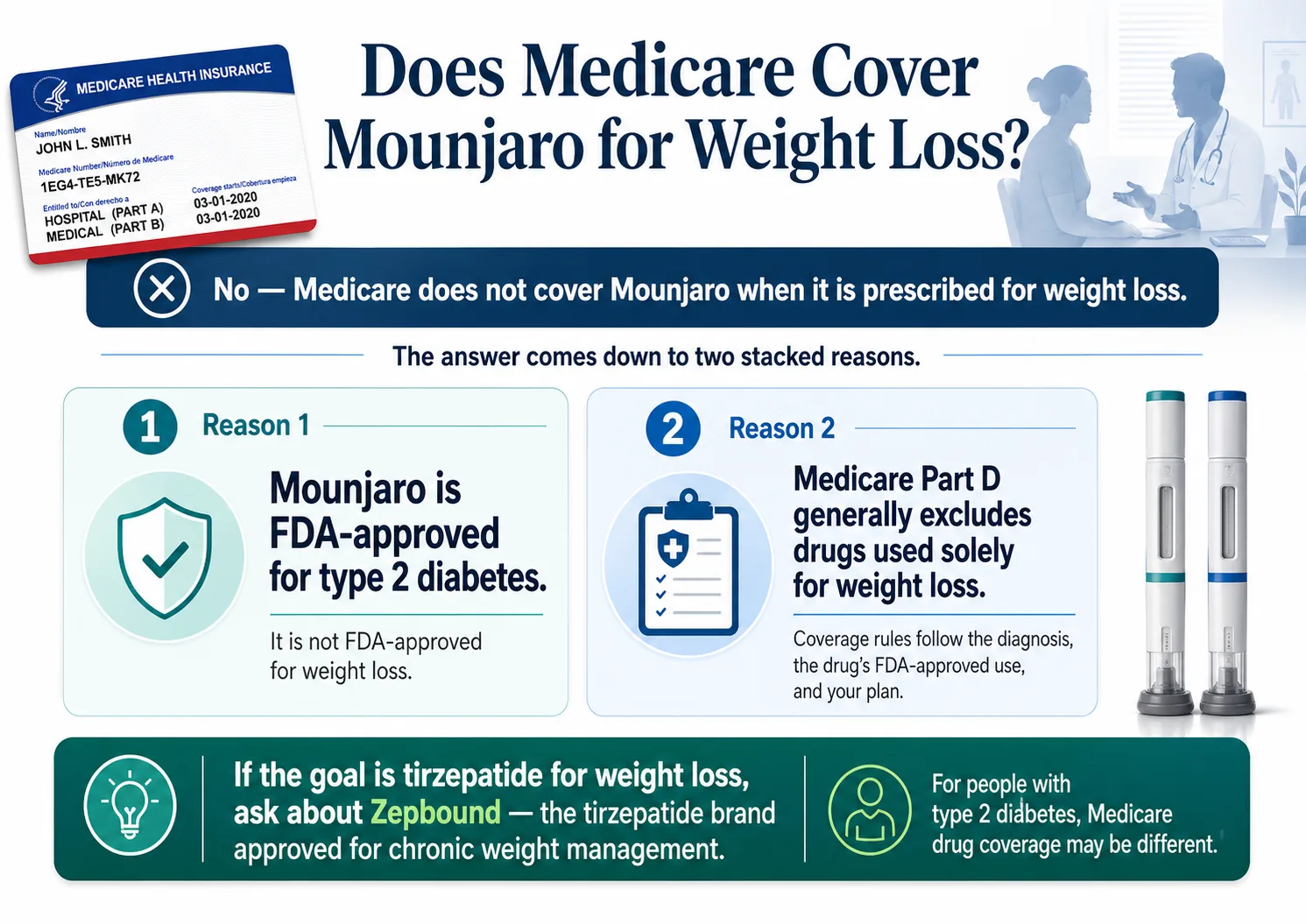
Medicare doesn't cover Mounjaro for weight loss in 2026. Two stacked reasons: federal law excludes drugs prescribed solely for weight loss from Medicare Part D under Social Security Act §1860D-2(e)(2)(A), and Mounjaro itself is FDA-approved only for Type 2 diabetes — there is no weight-loss indication on its label. Both barriers must clear before Medicare can pay. For most readers, the right answer isn't about Mounjaro at all — it's about Zepbound, the tirzepatide brand FDA-approved for chronic weight management, and the new $50/month Medicare GLP-1 Bridge launching July 1, 2026.
The rest of this guide shows you exactly which of the five real Medicare tirzepatide paths fits your situation, what each one actually costs in 2026, the scripts to use when you call your plan or prescriber, and what to do if you've already been denied. We built an 8-path decision matrix from CMS Bridge documentation, Part D rules, FDA labeling, and current Lilly pricing — the kind of thing you'd otherwise need five tabs and a spreadsheet to put together.
The RX Index is a pricing intelligence and comparison resource for GLP-1 telehealth providers. This guide is information, not medical, legal, or insurance advice. Coverage rules and pricing can change; verify against the linked primary sources before relying on any specific figure for a coverage decision.
Quick decision at a glance
Find your situation in the left column; your Medicare answer is in the right.
| Your situation | Medicare answer in 2026 |
|---|---|
| Mounjaro for weight loss only | Not covered. Federal law + FDA labeling both block it. |
| Mounjaro for Type 2 diabetes | Likely covered through Part D — Lilly says about 8 in 10 Medicare Part D patients pay $0–$50/month for Mounjaro |
| Tirzepatide for weight loss | Switch the question to Zepbound KwikPen and use the Medicare GLP-1 Bridge starting July 1, 2026 |
| Zepbound for moderate-to-severe sleep apnea + obesity | May be covered through Part D for the OSA indication (sleep study required, formulary varies by plan) |
| Wegovy for established cardiovascular disease + overweight | May be covered through Part D for CV risk reduction |
| Need it now and willing to pay cash | LillyDirect Zepbound vials $299–$449/mo with the offer (regular $299/$399/$499/$699); TrumpRx publicly displays Zepbound at $299/mo |
What we actually verified — June 11, 2026
We checked Mounjaro's FDA labeling (Type 2 diabetes only, adults and children 10+); the statutory weight-loss exclusion under Social Security Act §1860D-2(e)(2)(A); the CMS Medicare GLP-1 Bridge drug list (Foundayo, Wegovy injection and tablets, and Zepbound KwikPen — Mounjaro is not on it); the Bridge's $50 flat copay; the April 21, 2026 CMS announcement that the BALANCE Model will not launch in Medicare Part D in 2027 (Bridge extended through Dec 31, 2027 instead); Mounjaro list price $1,112.16/month effective Jan 1, 2026; LillyDirect Zepbound Self Pay Journey pricing of $299–$449/month with 45-day refill; and TrumpRx public listings showing Zepbound at approximately $299/month.
What we did NOT verify: your specific Part D plan formulary, your prior authorization decision, your state Medicaid status, your individual diagnosis or eligibility, your pharmacy's actual cash price on a given day, or current TrumpRx pricing for Mounjaro specifically. Those have to be confirmed with your plan, your prescriber, your pharmacy, the TrumpRx site, or your state Medicaid office.
Why this question feels so confusing right now
Real Medicare beneficiaries describe the same friction in plain language. One Reddit user on r/medicare said they were paying $449/month for Zepbound on Original Medicare and that it was “way too costly.” Another said their spouse's Part D plan covered Zepbound only because the prescription was written for obstructive sleep apnea, not weight loss. A third summed it up: “It is not covered solely for weight loss.”
Those quotes aren't medical or coverage evidence — we use them only to show the friction. But they capture exactly why this question generates so much frustration. Headlines from November 2025 said Medicare and Eli Lilly struck a deal. CMS announced the BALANCE Model in December. The Medicare GLP-1 Bridge launches July 2026. Your pharmacy still quotes $1,000+. Savings cards don't work for Medicare patients. Two drugs (Mounjaro and Zepbound) contain the exact same tirzepatide molecule but Medicare treats them differently.
You're not crazy. You're asking a reasonable question. You just need to ask it in the way Medicare's coverage rules are actually structured — and that means understanding the two stacked reasons “no” exists in the first place.
Does Medicare cover Mounjaro for weight loss in 2026?
No. Medicare doesn't cover Mounjaro for weight loss in 2026 because of two stacked barriers: Mounjaro's FDA label only covers Type 2 diabetes (not weight loss), and federal law excludes drugs used “for weight loss” from Medicare Part D coverage. Even the new Medicare GLP-1 Bridge — which does provide weight-loss GLP-1 access starting July 1, 2026 — does not include Mounjaro on its eligible drug list. The Bridge covers Foundayo, Wegovy, and Zepbound KwikPen for weight loss; Mounjaro stays a Type 2 diabetes coverage question on Medicare.
That's the verdict. Below are the two barriers explained, then the five real paths to tirzepatide coverage on Medicare.
Reason 1: Mounjaro's FDA label doesn't include weight loss
The FDA approved Mounjaro in 2022 for blood-sugar control in adults and children 10+ with Type 2 diabetes, used together with diet and exercise. Eli Lilly's own Mounjaro page says it directly: “Mounjaro is not a weight loss drug.”
Yes, weight loss is a documented effect — Lilly's consumer materials describe adult weight loss in studies ranging from about 12 to 25 pounds depending on dose, and a head-to-head trial against Ozempic showed Mounjaro produced more weight loss. But “documented effect” and “FDA approval” are not the same thing. The FDA-approved version of tirzepatide for chronic weight management is Zepbound — also Eli Lilly, also tirzepatide, also a list price near $1,086/month, just with a different brand name and a different FDA indication.
Medicare Part D plans pay for drugs based on FDA-approved indications. Off-label prescribing happens all the time in clinical practice, but Part D plans almost never cover off-label use of a brand-name drug when an on-label alternative exists. For tirzepatide and weight loss, the on-label alternative is Zepbound.
Reason 2: Federal law excludes weight-loss drugs from Medicare Part D
The Medicare Modernization Act of 2003, codified in Social Security Act §1860D-2(e)(2)(A), specifically excludes from Part D coverage any drug used “for the treatment of anorexia, weight loss, or weight gain.” This exclusion has been in place since Part D launched in 2006.
This is why even FDA-approved weight-loss drugs like Wegovy, Zepbound, and Saxenda are not covered under standard Part D when prescribed for weight loss alone — they're only covered when prescribed for an additional FDA-approved indication (cardiovascular risk reduction for Wegovy, obstructive sleep apnea for Zepbound). The Biden administration proposed reinterpreting this exclusion in November 2024; the Trump administration removed that proposal from the CY 2026 Final Rule in April 2025. The exclusion stands as enacted.
Why this stacked block matters for your next step
Most pages that rank for this query mention only one barrier. The reality is both. Even when the Bridge launches July 1, 2026, and even if (or when) the BALANCE Model eventually rolls into Medicare Part D, the statute's intent is preserved by routing weight-loss coverage outside Part D, not by overruling the exclusion.
Practical translation: your $50 Bridge copay won't count toward your $2,100 Part D out-of-pocket cap on covered drugs, Extra Help (the federal Low-Income Subsidy) doesn't apply to Bridge prescriptions, and Mounjaro can't be added to the Bridge for weight loss without first getting an FDA weight-loss label — which Eli Lilly hasn't sought, because Zepbound already has it.
The Mounjaro / tirzepatide Medicare access matrix (June 2026)
The short answer: If you're on Medicare and want tirzepatide (Mounjaro or Zepbound), you have eight realistic paths in 2026. Five involve some form of Medicare or its programs. Three are cash-pay options. Path 1 is the only Mounjaro-specific coverage path (Type 2 diabetes via Part D). Every other path involves switching to Zepbound or paying cash. Every figure below has been verified against CMS, FDA, or manufacturer sources as of June 11, 2026.
| # | Path | Drug | Your monthly cost | Who qualifies | Counts toward $2,100 Part D cap? | Available |
|---|---|---|---|---|---|---|
| 1 | Part D for T2D | Mounjaro | Lilly says ~8 in 10 Medicare Part D patients pay $0–$50; the remaining ~2 in 10 pay around $262 on average | Type 2 diabetes diagnosis; usually requires prior authorization | Yes | Now |
| 2 | Part D for OSA | Zepbound | Plan tier copay; varies by plan formulary | Moderate-to-severe OSA in adults with obesity (sleep study required); plan-specific PA | Yes | Now |
| 3 | Part D for CV risk | Wegovy (not Mounjaro/Zepbound) | Plan tier copay; varies | Established cardiovascular disease + overweight or obese | Yes | Now |
| 4 | Medicare GLP-1 Bridge | Wegovy, Zepbound KwikPen, Foundayo (NOT Mounjaro) | $50 flat copay | BMI ≥35 alone (at GLP-1 therapy initiation); OR ≥30 + qualifying condition; OR ≥27 + qualifying condition | No — runs outside Part D | July 1, 2026 |
| 5 | LillyDirect Zepbound vials (Self Pay Journey) | Zepbound (single-dose vials) | Offer: $299 (2.5mg) / $399 (5mg) / $449 (7.5–15mg). Regular: $299 / $399 / $499 / $699 | Anyone with a valid Rx; 45-day refill required to keep offer pricing | No | Now |
| 6 | LillyDirect Zepbound KwikPen self-pay | Zepbound KwikPen | Offer: $299 / $399 / $449 by dose | Anyone with a valid Rx; 45-day refill required for offer | No | Now |
| 7 | TrumpRx (cash-pay direct-to-consumer) | Wegovy pill, Wegovy pen, Ozempic, and Zepbound publicly listed | Wegovy pill ~$149/mo; Wegovy pen ~$199/mo; Ozempic ~$199/mo; Zepbound ~$299/mo (Mounjaro pricing not currently displayed; verify on TrumpRx.gov) | Anyone | No | Launched February 5, 2026 |
| 8 | Mounjaro at retail pharmacy | Mounjaro | $1,112.16/month list price (updated Jan 1, 2026, all doses); $995–$1,300 at typical pharmacies with discount cards like GoodRx | Anyone with a valid Rx | Depends on whether billed through Part D | Now |
Critical note for path 8: Medicare beneficiaries cannot use the Eli Lilly Mounjaro Savings Card (the one that drops commercial-insurance copays to as low as $25/month). Federal law — specifically the Anti-Kickback Statute — prohibits drug manufacturers from offering copay assistance to anyone enrolled in Medicare, Medicaid, TRICARE, or VA. Lilly's own Mounjaro Savings Program terms state this exclusion plainly.
Coming soon: Eli Lilly announced in November 2025 that Mounjaro will be added to LillyDirect for self-pay patients with pricing 50–60% off list. As of June 2026, that program had not yet been verified live for Mounjaro the way Zepbound's Self Pay Journey already operates. Verify directly on LillyDirect before relying on it as your path.
We re-verify this matrix at minimum once per quarter. The most likely changes in the next six months: Bridge eligibility refinements, the late-2026 Open Enrollment cycle for 2027 plans, the Mounjaro LillyDirect launch, and any further pricing adjustments from the November 2025 Lilly–Novo most-favored-nation deals.
Path 1: Can Medicare cover Mounjaro if you have Type 2 diabetes?
Yes — and for most Medicare Part D patients prescribed Mounjaro for Type 2 diabetes, the cost is manageable. Eli Lilly's own data says about 8 out of 10 Medicare Part D patients pay between $0 and $50 per month for Mounjaro. The remaining roughly 2 in 10 pay closer to $262 on average. Most Part D plans require prior authorization documenting the Type 2 diabetes diagnosis. Your out-of-pocket cost depends on plan tier, deductible, and benefit phase, with a 2026 Part D out-of-pocket cap of $2,100 on covered drugs.
If you have a confirmed Type 2 diabetes diagnosis and your prescriber writes the prescription for diabetes management, Medicare almost certainly works for you — you just have to confirm your specific plan's rules.
How to verify Mounjaro is on your plan's formulary
Three ways:
- Medicare.gov Plan Finder — go to medicare.gov/plan-compare, log in, and search “Mounjaro” against your plan.
- Your plan's online portal — most have a drug-lookup tool.
- Call the number on the back of your card — ask the rep specifically: “Is Mounjaro on the formulary for Type 2 diabetes? What tier? Is prior authorization required? Is step therapy required?”
Write down the rep's name and any reference number. Verbal confirmations aren't binding, but documentation helps if there's a later dispute.
What prior authorization actually involves
Your prescriber submits a prior authorization (PA) request to your plan. They'll typically need to include your Type 2 diabetes diagnosis (the ICD-10 code), recent labs, what diabetes medications you've already tried (often metformin first — that's “step therapy”), and a clinical justification for Mounjaro specifically. Standard PA turnaround is 72 hours; expedited is 24 hours.
If denied, ask the plan for the specific reason in writing. Most denials at this stage can be resolved by your prescriber's office submitting the missing information — but that depends entirely on what was missing.
What you'll actually pay for Mounjaro on Part D for T2D
Lilly's own Mounjaro FAQ reports that approximately 8 in 10 Medicare Part D patients pay $0 to $50 per month for Mounjaro, with the remaining patients paying about $262 on average. Your specific cost depends on:
- Your plan's deductible (max $615 in 2026 for most Part D plans)
- Your tier and whether you're in the deductible, initial coverage, or catastrophic phase
- Whether you qualify for Extra Help (the federal Low-Income Subsidy) — which can drop Part D copays significantly for income-eligible beneficiaries
Medicare.gov sets the 2026 Part D out-of-pocket cap at $2,100 for covered Part D drugs. Once your spending on covered drugs hits that cap, you pay $0 for the rest of the year.
One honest tradeoff: you cannot stack the Eli Lilly Mounjaro Savings Card on top of your Part D coverage. Federal law prohibits combining manufacturer copay assistance with Medicare. So your effective cost is whatever your plan charges, not the $25/month figure you might see in Lilly's marketing.
✅ Decision Resolution Point
If you have a Type 2 diabetes diagnosis and want to confirm Mounjaro's coverage on your specific plan, the fastest free path is the Medicare.gov Plan Finder — about 10 minutes. For step-by-step PA help, our step-therapy bypass guide walks through what your prescriber should submit.
Path 2: Can Medicare cover Zepbound for sleep apnea (if you have obesity)?
Yes, possibly. Zepbound is FDA-approved for moderate-to-severe obstructive sleep apnea in adults with obesity, used with reduced-calorie diet and increased physical activity. Many Medicare Part D plans now consider Zepbound for the OSA indication, but formulary status and prior authorization rules are plan-specific. The prescription must be written for OSA, not weight loss, and a sleep study is typically required. Mounjaro does not have an OSA indication — Zepbound is the tirzepatide brand for this path.
This pathway didn't exist 18 months ago. The FDA approved Zepbound for OSA in December 2024.
What plans typically require
- Confirmed sleep study showing moderate-to-severe OSA (in-lab polysomnography or a home sleep apnea test)
- Diagnosis of obesity consistent with the FDA-approved indication
- Prior authorization with the OSA ICD-10 code on the prescription
- Some plans may require documentation of a CPAP trial first — this varies by plan
The prescription has to be written for OSA specifically. You can't “convert” a weight-loss prescription into an OSA prescription without a real OSA diagnosis — and you shouldn't try, because the prior authorization paperwork requires the sleep study attestation and your prescriber's professional judgment.
Comparing the OSA Part D path to the Bridge
If you qualify for Zepbound under Part D for OSA, you'll want to compare it directly to the Bridge before committing:
- Part D for OSA: Your costs count toward the $2,100 annual Part D out-of-pocket cap on covered drugs. Extra Help can apply if you qualify. Plan formulary status determines tier and copay.
- Medicare GLP-1 Bridge (starting July 2026): Flat $50/month copay regardless of dose. Does NOT count toward the $2,100 Part D cap. Extra Help does not apply.
Which is cheaper depends on your specific plan's cost-sharing for Zepbound and whether you qualify for Extra Help. For some patients, the Part D OSA pathway is the better deal because of the cap and Extra Help. For others paying higher Part D cost-sharing, the Bridge's flat $50 wins. Run both numbers before you decide. CMS specifically notes that prescriptions written for OSA go through your standard Part D plan, not the Bridge processor.
For the deeper breakdown of how the OSA pathway interacts with the Bridge, including formulary patterns and utilization management, see our Medicare GLP-1 Bridge eligibility guide.
What if your plan denies it for OSA?
The standard Part D appeals process applies. A successful appeal typically requires complete documentation: the sleep study results, the obesity diagnosis, and a clear medical-necessity letter from your prescriber. If your plan simply doesn't include Zepbound on its formulary at all, a formulary exception request is the right tool. Outcomes vary by plan and circumstance — your plan's specific rules govern.
Path 3: If you have cardiovascular disease, is Wegovy a better Medicare path than Mounjaro?
For many readers in this situation, yes — but the right drug is Wegovy, not Mounjaro or Zepbound. Wegovy (semaglutide, made by Novo Nordisk) is FDA-approved for cardiovascular risk reduction in adults with established cardiovascular disease who are overweight or obese. Medicare Part D may cover Wegovy for that indication. Mounjaro and Zepbound do not currently have an FDA-approved cardiovascular indication. If your real motivation is weight loss but you also have CV disease, a Wegovy conversation with your prescriber may unlock Part D coverage that tirzepatide can't reach today.
When this path applies
Specifically: established cardiovascular disease (prior MI, prior stroke, or symptomatic peripheral artery disease) plus overweight or obesity. The clinical evidence for the CV indication came from the SELECT trial.
Why Mounjaro can't cover this gap
Eli Lilly initially pursued an FDA cardiovascular indication for tirzepatide based on the SUMMIT trial in heart failure with preserved ejection fraction (HFpEF). Lilly withdrew that application in May 2025. Tirzepatide may eventually earn a CV indication through other trials, but it doesn't have one now. Until it does, Wegovy is the only FDA-approved GLP-1 for the CV-via-Part-D pathway. Our Wegovy heart disease prior authorization guide walks through exactly what the PA paperwork should look like.
How to bring this up with your doctor
“I have [your CV condition]. I know Wegovy has an FDA-approved indication for cardiovascular risk reduction in patients like me, and Medicare Part D may cover it for that. Would Wegovy be appropriate for my situation?”
This isn't a prescription request — it's a conversation about whether the FDA indication that exists matches a clinical situation you're already in.
Path 4: How does the Medicare GLP-1 Bridge work — and why isn't Mounjaro on it?
The Medicare GLP-1 Bridge is a CMS demonstration program launching July 1, 2026, running through December 31, 2027. It's the first Medicare program ever to cover GLP-1 drugs for weight loss. Eligibility is based on BMI at the time of GLP-1 therapy initiation plus comorbidities. The copay is $50/month flat, regardless of dose. Mounjaro is NOT on the Bridge drug list. The Bridge covers Wegovy (injection and tablets), Zepbound KwikPen formulation only, and Foundayo. To use the Bridge for tirzepatide, you switch to Zepbound KwikPen.
This is the single biggest 2026 development in Medicare GLP-1 access — and the one most articles still get wrong because they were written before CMS published the detailed FAQ on March 3, 2026 and updated the drug list on April 6, 2026.
Bridge eligibility — three tiers
You qualify for Bridge weight-loss coverage if you meet any one of these three CMS-defined criteria. Note that BMI is measured at the time of GLP-1 therapy initiation — CMS gives an example where someone who initiated therapy at BMI 37 and later has BMI 34 can still meet the BMI ≥35 criterion.
Tier A — BMI alone:
- BMI ≥ 35 at GLP-1 therapy initiation
Tier B — BMI ≥30 plus one qualifying condition:
- Heart failure with preserved ejection fraction (HFpEF), OR
- Uncontrolled hypertension (systolic >140 mmHg or diastolic >90 mmHg despite concurrent treatment with two antihypertensive medications), OR
- Chronic kidney disease stage 3a or above
Tier C — BMI ≥27 plus one qualifying condition:
- Prediabetes (per American Diabetes Association definition), OR
- Prior myocardial infarction, OR
- Prior stroke, OR
- Symptomatic peripheral artery disease
You also need to be enrolled in a Part D PDP or MA-PD plan in 2026. Your prescriber attests to lifestyle modification per FDA labeling.
Source: CMS Medicare GLP-1 Bridge FAQ, published March 3, 2026, updated April 6, 2026.
Why Mounjaro isn't on the Bridge
The Bridge can only cover GLP-1 drugs when prescribed for weight reduction — and Mounjaro doesn't have an FDA weight-loss indication. So even though Eli Lilly makes both Mounjaro and Zepbound, only Zepbound qualifies for Bridge weight-loss coverage. (If you have Type 2 diabetes, Mounjaro is covered through your regular Part D — not the Bridge — under Path 1 above.)
CMS specifically lists the Zepbound KwikPen formulation only. Single-dose vials and single-dose pens of Zepbound are not on the Bridge. If your prescriber writes for the wrong Zepbound device, the claim will reject.
How the Bridge actually works
- Submitted to a CMS central processor (Humana, via the LI NET infrastructure) — not your Part D plan
- $50 flat copay collected at the pharmacy
- Does NOT count toward your $2,100 Part D out-of-pocket cap
- Extra Help / Low-Income Subsidy does NOT apply
- Runs July 1, 2026 through December 31, 2027 (extended in April 2026)
- Pharmacies use a specific BIN/PCN to route the claim
What to do right now to be ready for July 1
You can't enroll early — there's no enrollment period for the Bridge. Access opens automatically through any qualified prescriber on July 1, 2026. But three things you can do before then:
- Confirm your Part D enrollment for 2026. If you're not in a qualifying plan type, you can't use the Bridge.
- Get your BMI documented in your medical record at a recent visit. Remember: CMS uses BMI at GLP-1 therapy initiation, so getting this on the chart now matters.
- Get your qualifying condition documented — especially if you're relying on prediabetes or any of the Tier B/C conditions, your prescriber needs that on file.
For the deepest dive on Bridge eligibility nuances, dual-eligibility rules, and what happens if your plan doesn't participate in the BALANCE Model in 2027, read our Medicare GLP-1 Bridge eligibility guide and Bridge application process walkthrough.
✅ Decision Resolution Point
If the Bridge looks like your path, the highest-leverage thing you can do today is get your BMI and qualifying condition documented in writing by your provider before July 1. For the full eligibility checklist with every CMS criterion, see how to qualify for the Medicare GLP-1 Bridge.
Path 5: What are your cash-pay tirzepatide options on Medicare?
If you can't wait until July 2026 for the Bridge, can't qualify for it, or specifically want Mounjaro, your remaining option is cash-pay. The cheapest verified cash-pay tirzepatide today is Zepbound vials through LillyDirect at $299–$449/month with the Self Pay Journey offer (45-day refill required to keep offer pricing). TrumpRx publicly displays Zepbound at approximately $299/month, alongside Wegovy and Ozempic. For Mounjaro specifically, Eli Lilly announced in November 2025 that Mounjaro will be added to LillyDirect with pricing 50–60% off list, but verify directly on LillyDirect before relying on it. You cannot use the Eli Lilly Mounjaro Savings Card or the Zepbound Savings Card on Medicare — federal law excludes Medicare beneficiaries.
Coverage facts on this page are not a Medicare coverage guarantee, and treatment decisions require a licensed clinician.
TrumpRx (launched February 5, 2026)
TrumpRx is the federal direct-to-consumer prescription portal that resulted from the November 2025 most-favored-nation deals between the Trump administration and Eli Lilly + Novo Nordisk. It connects users to manufacturer discount channels for a curated set of drugs.
Currently displayed pricing on TrumpRx (verify before purchase):
- Wegovy pill: approximately $149/month
- Wegovy pen: approximately $199/month
- Ozempic: approximately $199/month
- Zepbound: approximately $299/month
Mounjaro pricing is not currently displayed in the visible TrumpRx examples — check TrumpRx.gov directly for current Mounjaro availability if that's your target. You pay the manufacturer directly. The transaction doesn't go through your Part D plan, so it doesn't count toward your annual out-of-pocket cap. There's no clinical service attached — you need a separate valid prescription from a US-licensed prescriber.
LillyDirect Self Pay Journey Program (Zepbound today; Mounjaro coming)
Eli Lilly's direct-to-consumer pricing for Zepbound through the Self Pay Journey Program. The offer pricing requires you to refill within 45 days; miss that window and the price reverts to higher non-program rates.
| Dose | Self Pay Journey offer (45-day refill) | Regular monthly price |
|---|---|---|
| 2.5mg | $299/month | $299/month |
| 5mg | $399/month | $399/month |
| 7.5mg | $449/month | $499/month |
| 10mg, 12.5mg, 15mg | $449/month | $699/month |
For Mounjaro: Lilly announced in November 2025 that Mounjaro will be added to LillyDirect for self-pay patients with pricing 50–60% off list. Translation: that would land roughly in the $445–$556/month range if implemented at the announced discount on the current $1,112.16 list price. As of June 2026, the Mounjaro program was not yet verified live in the way Zepbound's Self Pay Journey is. Check LillyDirect directly before assuming a specific Mounjaro cash-pay price.
Telehealth cash-pay coordination
This is where dedicated telehealth providers can add value for Medicare patients — but only honestly.
Honest tradeoff (and why it actually works in your favor): Ro currently does NOT coordinate GLP-1 coverage for government insurance plans like Medicare (with a narrow FEHB exception). If your priority is getting Medicare itself to cover your prescription, Ro can't help with that — your Part D plan and your prescriber's office handle Medicare prior authorization. But because Ro skips the Medicare PA work, they can offer a streamlined cash-pay tirzepatide path with full clinical support: the same FDA-approved Zepbound, plus monthly check-ins with US board-certified providers, dose titration help, side-effect coordination, and unlimited messaging — which is exactly what most Medicare patients need after they've confirmed Medicare won't cover their case.
If you've already determined Medicare won't pay for your situation and you want clinical support to go with your cash-pay tirzepatide, Ro is the cleanest path. If you have a stable prescription and just want the lowest possible cash price with no clinical service attached, going directly to LillyDirect or TrumpRx is cheaper.
Ro pricing (verified June 2026): Get started for $39 for the first month, then as low as $74/month with annual plan paid upfront, or $149/month standard. Medication is billed separately based on your treatment plan. Ro carries Zepbound (FDA-approved tirzepatide) and Foundayo (FDA-approved orforglipron).
CASH-PAY DECISION POINT
Pick the cash-pay route that fits.
Want clinical support with your tirzepatide? Ro pairs Zepbound with monthly provider check-ins, titration, and side-effect coordination. Already have a stable Rx and just want the cheapest price? Go straight to LillyDirect for Zepbound vials at $299–$449/mo. Want the broadest branded formulary? Sesame Care lists Wegovy pill and Zepbound KwikPen with provider choice.
For more cash-pay angles, our cheapest tirzepatide online without insurance guide tracks current prices across providers, and the switching from Mounjaro to Zepbound guide covers the clinical side of changing brands.
Mounjaro vs Zepbound on Medicare: why the brand name decides your coverage
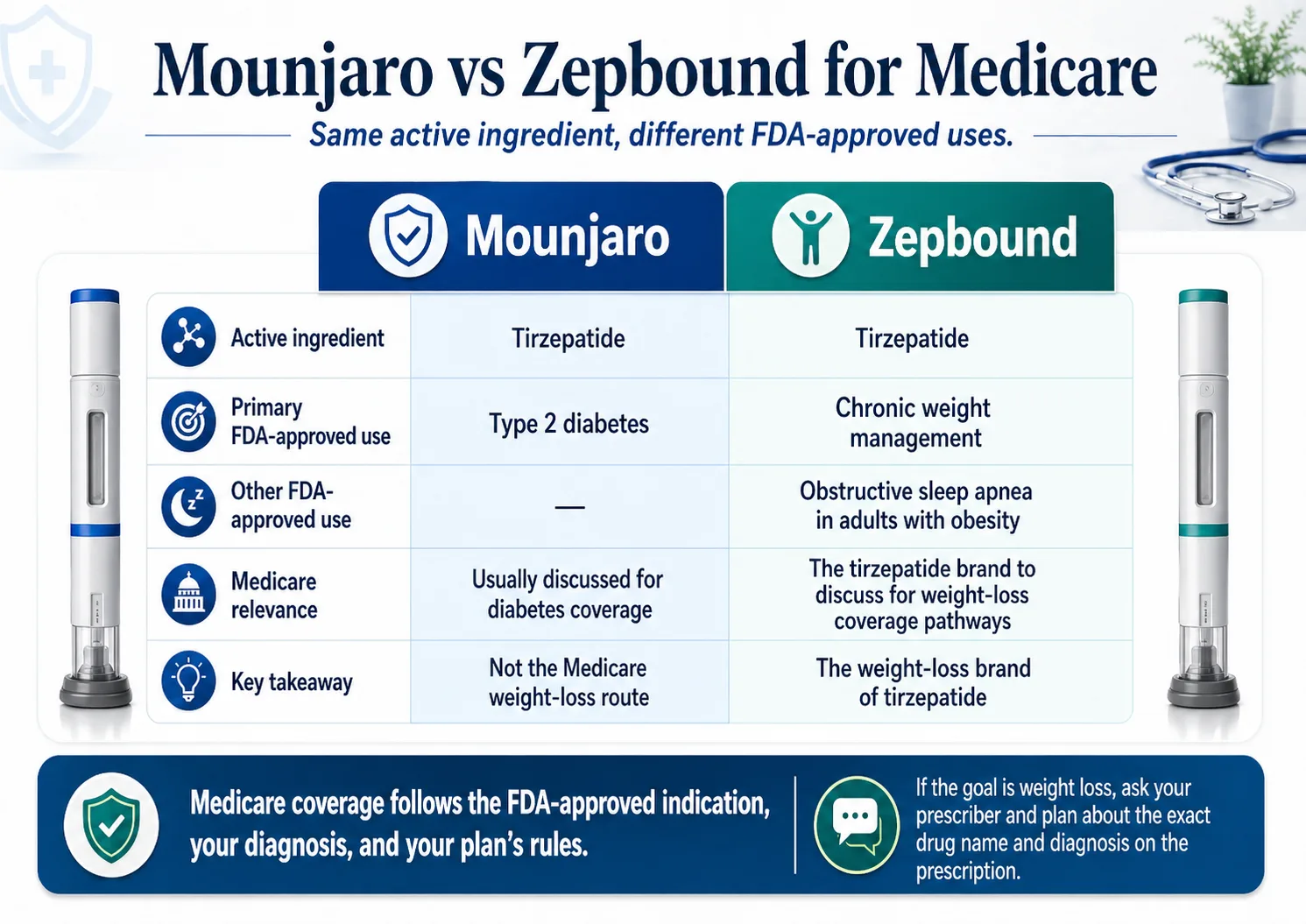
Mounjaro and Zepbound contain the same active ingredient (tirzepatide), at the same doses, made by the same manufacturer (Eli Lilly). What's different — and what decides Medicare coverage — is the FDA-approved indication, the diagnosis on the prescription, and your plan's formulary. Mounjaro is approved for Type 2 diabetes. Zepbound is approved for chronic weight management and for moderate-to-severe OSA in adults with obesity. The same molecule, prescribed under different brand names with different diagnosis codes, can be covered or not covered depending entirely on which combination is on the prescription.
| Mounjaro | Zepbound | |
|---|---|---|
| Active ingredient | Tirzepatide | Tirzepatide |
| Manufacturer | Eli Lilly | Eli Lilly |
| FDA indications | Type 2 diabetes (adults and children 10+) | Chronic weight management; moderate-to-severe OSA in adults with obesity |
| Medicare Part D for T2D | ✅ Yes — Lilly says ~8 in 10 Part D patients pay $0–$50 | ❌ No — not approved for T2D |
| Medicare Part D for weight loss | ❌ No (statutory exclusion + no FDA label) | ❌ No (statutory exclusion) |
| Medicare Part D for OSA | ❌ No — not approved for OSA | ✅ Yes (plan-dependent, sleep study required) |
| Medicare GLP-1 Bridge for weight loss (July 2026) | ❌ No — not on the Bridge drug list | ✅ Yes — KwikPen formulation only |
| LillyDirect self-pay vials | ⏳ Coming (announced Nov 2025, 50–60% off list) | ✅ Yes ($299–$449/mo offer) |
| TrumpRx cash-pay | Not currently displayed; verify | ~$299/month |
| List price | $1,112.16/month (any dose, updated Jan 1, 2026) | ~$1,086/month (any dose) |
The plain-English version: if your goal is weight loss and you're on Medicare, the path almost always resolves to switching from Mounjaro to Zepbound. Same molecule, same dose, same manufacturer — different brand label, different Medicare answer. Talk to your prescriber about whether the switch makes clinical sense for your situation. The mechanics of switching are walked through in our switching from Mounjaro to Zepbound guide.
What should you do if Medicare denied your Mounjaro prescription?
First, find out exactly why it was denied. The five common denial reasons each have a different fix — and one of them (weight-loss exclusion) doesn't have a fix at all because it's grounded in federal statute. Don't waste time appealing what can't be won; route to the right alternative path instead.
Step 1 — Get the actual denial reason
Call your Part D plan or look at the denial letter. Use this script:
“I received a denial for my Mounjaro prescription. Can you tell me whether the denial reason is: prior authorization missing, step therapy required, my diagnosis doesn't match coverage criteria, the drug is not on my formulary, or this was treated as weight-loss-only use?”
The denial reason determines everything that follows.
Step 2 — Match the denial to the right next step
| Denial reason | What it usually means | Your next step |
|---|---|---|
| Prior authorization missing | Plan needs documentation it didn't get | Ask prescriber to submit (or resubmit) PA |
| Step therapy required | Plan wants you to try metformin first | Ask exactly which drug and what documentation is needed |
| Diagnosis mismatch | Plan doesn't see Type 2 diabetes on file | Confirm diagnosis with prescriber and resubmit |
| Weight-loss exclusion | Mounjaro was treated as weight-loss-only | Don't appeal — switch the question to Zepbound + Bridge |
| Not on formulary | Plan doesn't cover Mounjaro | Request a formulary exception OR switch plans at next Open Enrollment |
| Cost too high despite coverage | You're in deductible or coinsurance phase | Apply for Extra Help; consider the Medicare Prescription Payment Plan |
Step 3 — Don't misstate your diagnosis
Do not ask a clinician to code weight loss as Type 2 diabetes if you don't have Type 2 diabetes. It's ethically and legally risky for your prescriber, it can send you down the wrong medication and coverage path, and it can create complications down the line. The right answer when Medicare won't cover Mounjaro for weight loss isn't to fake a diabetes diagnosis — it's to switch the prescription to Zepbound (which is FDA-approved for weight loss) and use the right Medicare path for that drug.
Step 4 — Pick the alternative path that actually fits
Based on the denial reason, your next move is usually one of these:
- Weight-loss-only denial → Switch to Zepbound + Bridge (July 2026) or Zepbound for OSA via Part D if applicable
- Diabetes denial for missing PA → Resubmit with proper documentation
- Diabetes denial for step therapy → Try the required first-line drug, then re-apply
- Formulary denial → Request formulary exception or change plans at Open Enrollment (Oct 15–Dec 7)
- Cost denial → Apply for Extra Help; enroll in the Medicare Prescription Payment Plan (M3P), which spreads covered Part D drug costs across the calendar year
For a deeper appeals walkthrough, our how to appeal a GLP-1 denial guide covers the redetermination, IRE, and ALJ steps.
Why your Mounjaro Savings Card doesn't work on Medicare
The Eli Lilly Mounjaro Savings Card — which can drop commercial-insurance copays to as low as $25/month — cannot be used by Medicare beneficiaries. This is federal law, not Lilly policy. The Anti-Kickback Statute prohibits drug manufacturers from offering copay assistance to anyone enrolled in any government insurance program: Medicare, Medicaid, TRICARE, VA, and IHS are all excluded. The same rule applies to the Zepbound Savings Card, the Wegovy Savings Card, and every other manufacturer copay coupon.
What you actually have access to on Medicare:
- Extra Help / Low-Income Subsidy — federal program that reduces Part D premiums, deductibles, and copays for income-eligible beneficiaries
- Medicare Prescription Payment Plan (M3P) — spreads your covered Part D drug costs across the calendar year (doesn't reduce total cost or lower drug prices, but smooths cash flow)
- State pharmaceutical assistance programs (SPAPs) — varies by state
- Medicare GLP-1 Bridge — starts July 1, 2026 for eligible Zepbound KwikPen / Wegovy / Foundayo prescriptions at $50/month flat copay
The most common workaround people try — buying with a GoodRx or SingleCare discount card while on Medicare — does work mechanically (you bypass your insurance and pay the discount price). But it doesn't combine with Medicare, and the spending doesn't count toward your $2,100 Part D out-of-pocket cap. So if you're going to spend cash anyway, TrumpRx and LillyDirect are usually cheaper than discount-card pricing for the drugs they cover.
The 2026–2027 Medicare GLP-1 timeline (and the BALANCE postponement nobody's talking about)
Three Medicare GLP-1 events shape the next 24 months: (1) the Medicare GLP-1 Bridge launches July 1, 2026 covering Wegovy, Zepbound KwikPen, and Foundayo for eligible Part D beneficiaries at $50/month; (2) on April 21, 2026, CMS announced the BALANCE Model will NOT launch in Medicare Part D in 2027 as originally planned, and the Bridge has been extended through December 31, 2027 instead; (3) the BALANCE Model continues in state Medicaid programs that opt in, with state participation able to begin as early as May 2026.
Here's the timeline in one place:
| Date | Event | What it means for you |
|---|---|---|
| Nov 6, 2025 | Trump administration announces most-favored-nation pricing deals with Eli Lilly and Novo Nordisk | Sets the stage for TrumpRx.gov launch and lower cash-pay prices |
| Dec 23, 2025 | CMS announces the BALANCE Model and the Medicare GLP-1 Bridge demonstration | First-ever Medicare path to weight-loss GLP-1 coverage takes shape |
| Feb 5, 2026 | TrumpRx.gov launches per the official White House fact sheet | Cash-pay path opens for Wegovy, Ozempic, and Zepbound |
| Mar 3, 2026 | CMS publishes detailed Bridge FAQ with eligibility tiers and drug list | Eligibility criteria become operationally clear |
| Apr 6, 2026 | CMS adds Foundayo to the Bridge drug list, clarifies Zepbound KwikPen-only | Confirms which formulations the Bridge will pay for |
| Apr 21, 2026 | CMS announces BALANCE will NOT launch in Medicare Part D in 2027; Bridge extended through Dec 31, 2027 | Bridge becomes the only confirmed Medicare weight-loss path through 2027 |
| May 2026 | Earliest date state Medicaid programs can begin participating in BALANCE | State-by-state expansion begins for Medicaid-eligible populations |
| Jul 1, 2026 | Medicare GLP-1 Bridge goes live for eligible Part D beneficiaries | $50/mo Zepbound KwikPen / Wegovy / Foundayo for qualifying enrollees |
| Dec 31, 2027 | Current Bridge end date (subject to further extension) | Watch for renewal or replacement program announcements in 2027 |
What the BALANCE postponement means for you
If you were planning to count on the BALANCE Model in 2027 for a broader Medicare GLP-1 drug list (which would have included Mounjaro for the Medicare program), that's now uncertain.
The Bridge is the only confirmed weight-loss tirzepatide coverage path for Medicare beneficiaries through the end of 2027. BALANCE will not launch for Medicare Part D in 2027 — CMS extended the Bridge instead. Watch the Open Enrollment window in October–December 2027 for plan-level announcements about potential BALANCE 2028 participation.
Medicaid coverage of Mounjaro (and dual-eligible beneficiaries)
Medicaid coverage of Mounjaro varies dramatically by state. Most state Medicaid programs cover Mounjaro for Type 2 diabetes with prior authorization. Coverage for weight loss specifically is rarer. The BALANCE Model can begin in state Medicaid programs as early as May 2026, which may expand access depending on whether your state opts in.
If you're dually eligible for both Medicare and Medicaid:
- For Mounjaro for Type 2 diabetes: your Part D plan handles the prescription; Medicaid may cover cost-sharing
- For weight-loss tirzepatide: you're eligible for the Medicare GLP-1 Bridge starting July 2026 at $50/month if you meet the BMI/comorbidity criteria
- For state-specific weight-loss coverage: check with your state Medicaid office
The KFF GLP-1 coverage tracker maintains a state-by-state list. Your state Medicaid office is the authoritative source for your specific situation. For state-by-state details, see our Medicaid GLP-1 coverage by state guide.
What to actually say when you call your plan, prescriber, or pharmacy
These scripts save more time than anything else on this page. Save them, print them, or screenshot them before your next call.
Calling your Part D plan
“I'm checking coverage for Mounjaro. Is it on my formulary? What tier? Does it require prior authorization, step therapy, or quantity limits? My diagnosis is [Type 2 diabetes / weight management]. If my prescription is for weight management, is it excluded under the Part D weight-loss exclusion? Is there a formulary exception process available?”
Asking about the Bridge starting July 1, 2026
“I'm asking about the Medicare GLP-1 Bridge. Does my plan type qualify for Bridge processing? My BMI at GLP-1 therapy initiation is [X] and I have [qualifying condition]. Does my prescriber need to submit prior authorization to the Bridge central processor or to your plan?”
Talking to your prescriber
“I want to make sure my prescription matches the right Medicare coverage path. Can you confirm whether my prescription will be written for Type 2 diabetes, chronic weight management, obstructive sleep apnea, cardiovascular risk reduction, or another indication? I want the drug name and the diagnosis code to match the Medicare path that actually covers my situation.”
Asking the pharmacy after a denial
“Can you tell me the exact rejection code on this claim and which payer rejected it? Was this billed through my Part D plan, the Medicare GLP-1 Bridge processor, or as cash pay? Is there a different way you can run this prescription?”
Frequently asked questions
Most Medicare-Mounjaro questions come down to the same distinction: Mounjaro is the diabetes brand of tirzepatide, Zepbound is the weight-loss brand. Medicare follows the FDA indication on each label, the diagnosis on your prescription, and your plan's formulary. If your goal is weight loss on Medicare, the right question is almost always “Does Medicare cover Zepbound?” not “Does Medicare cover Mounjaro?”
Does Medicare cover Mounjaro for weight loss in 2026?▾
Does Medicare cover Mounjaro for Type 2 diabetes?▾
Will Medicare cover Mounjaro for weight loss in 2027?▾
Is Mounjaro included in the Medicare GLP-1 Bridge?▾
How much does Mounjaro cost without Medicare coverage?▾
Can I use the Eli Lilly Mounjaro Savings Card on Medicare?▾
What's the difference between Mounjaro and Zepbound for Medicare?▾
Does Medicare cover Zepbound for weight loss?▾
Does Medicare cover Zepbound for sleep apnea?▾
What if my doctor prescribes Mounjaro off-label for weight loss on Medicare?▾
Does Medicare Advantage cover Mounjaro?▾
Can I switch from Mounjaro to Zepbound on Medicare?▾
What if I have prediabetes but not Type 2 diabetes?▾
When does the Medicare GLP-1 Bridge program start?▾
Methodology — what we built this guide from
This page was built between April 27 and April 30, 2026 from primary sources: CMS rulemaking and FAQ documents, FDA labeling, Eli Lilly's official pricing pages, and the November 2025 White House MFN deal documents. We separate verified commercial facts (pricing, availability) from medical/regulatory facts (FDA status, statutory exclusion) from editorial judgments (which path fits which reader).
Source hierarchy:
- CMS and Medicare.gov — for Medicare coverage rules, Bridge details, Part D mechanics
- FDA and Eli Lilly labeling — for drug indications and dosing
- White House and Lilly press releases — for the November 2025 MFN deals and pricing changes
- Provider public pricing pages — for Ro, Sesame, LillyDirect, and TrumpRx current prices
- Reddit and patient forums — for voice-of-customer language only, never as medical or regulatory evidence
What we don't claim to know:
- Your specific Part D plan formulary
- Whether your prior authorization will be approved
- Your state Medicaid program's current rules
- Your individual eligibility for the Bridge
- Your pharmacy's actual cash price on a given day
- TrumpRx live pricing for Mounjaro specifically (verify on TrumpRx.gov)
- Provider pricing beyond what's on their public pages at the time of verification
Update cadence: quarterly minimum, plus immediate updates after major CMS announcements, FDA approvals, or Lilly pricing changes. The “Last verified” date at the top of this page reflects the most recent full audit.
Last verified:
Next scheduled re-verification: (or sooner if any CMS/FDA/Lilly announcement materially changes the matrix)
A final word
Medicare GLP-1 coverage in 2026 is genuinely complicated because the rules are changing in real time. The single most important thing to internalize: the drug name, the FDA indication, the diagnosis on your prescription, and your plan's formulary all combine to decide coverage. Mounjaro for diabetes is one situation; Mounjaro for weight loss is a completely different situation under Medicare — even though it's the same molecule. And tirzepatide for weight loss on Medicare is almost always a Zepbound question, not a Mounjaro question.
If you're not sure which path fits you, the next step is usually to confirm your plan's formulary on Medicare.gov and bring the right script to your prescriber. The provider CTAs below route to the cash-pay paths most readers in this situation actually need.
YOUR NEXT STEP
Decided cash-pay tirzepatide is your path?
If you want clinical wraparound (provider check-ins, dose titration, side-effect coordination), Ro is the cleanest fit at $39 first month. If you have a stable Zepbound prescription and just want the lowest cash price, LillyDirect at $299–$449/month is the bottom line. Both are FDA-approved Zepbound (tirzepatide), the weight-loss-indicated brand.
Related guides on The RX Index
- → Medicare GLP-1 Bridge Program Eligibility 2026
- → Does Medicare Cover Zepbound? 3 Paths in 2026
- → How to Switch From Mounjaro to Zepbound (2026)
- → Wegovy Heart Disease Prior Authorization (2026)
- → How to Qualify for the Medicare GLP-1 Bridge
- → Medicare GLP-1 Bridge Application Process
- → Cheapest Tirzepatide Online Without Insurance
- → How to Appeal a GLP-1 Denial
The RX Index is a pricing intelligence and comparison resource for GLP-1 telehealth providers. This guide is not medical, legal, tax, or insurance advice. Coverage rules and pricing can change; verify against the linked primary sources before relying on any specific figure for a coverage decision. Talk to your healthcare provider before starting, stopping, or changing any medication. We earn affiliate commissions when readers connect with some of the providers we cover; this never changes our editorial recommendations. Read our Affiliate Disclosure.
Author: The RX Index Editorial Team · Last updated: · More Medicare & GLP-1 guides →
Your situation changes the answer
Find My GLP-1 Path
The right GLP-1 provider isn't the same for everyone. It depends on your state, your insurance and formulary, whether you want an FDA-approved or compounded medication, your preferred route (injection or oral), and your budget. Because a general answer can't resolve those for you, use The RX Index's Find My GLP-1 Path tool to get a personalized provider match with source-verified pricing before you choose.
- What it asks: your state, insurance situation, medication preference, budget, and support needs
- What you get: a personalized shortlist of GLP-1 providers matched to your situation, with verified pricing and the right questions to ask
- Cost: free · about 2 minutes · no signup