
Bottom line up front
The Medicare GLP-1 Bridge Program application process does not start with a patient application form—and your doctor should not send the prior authorization first.
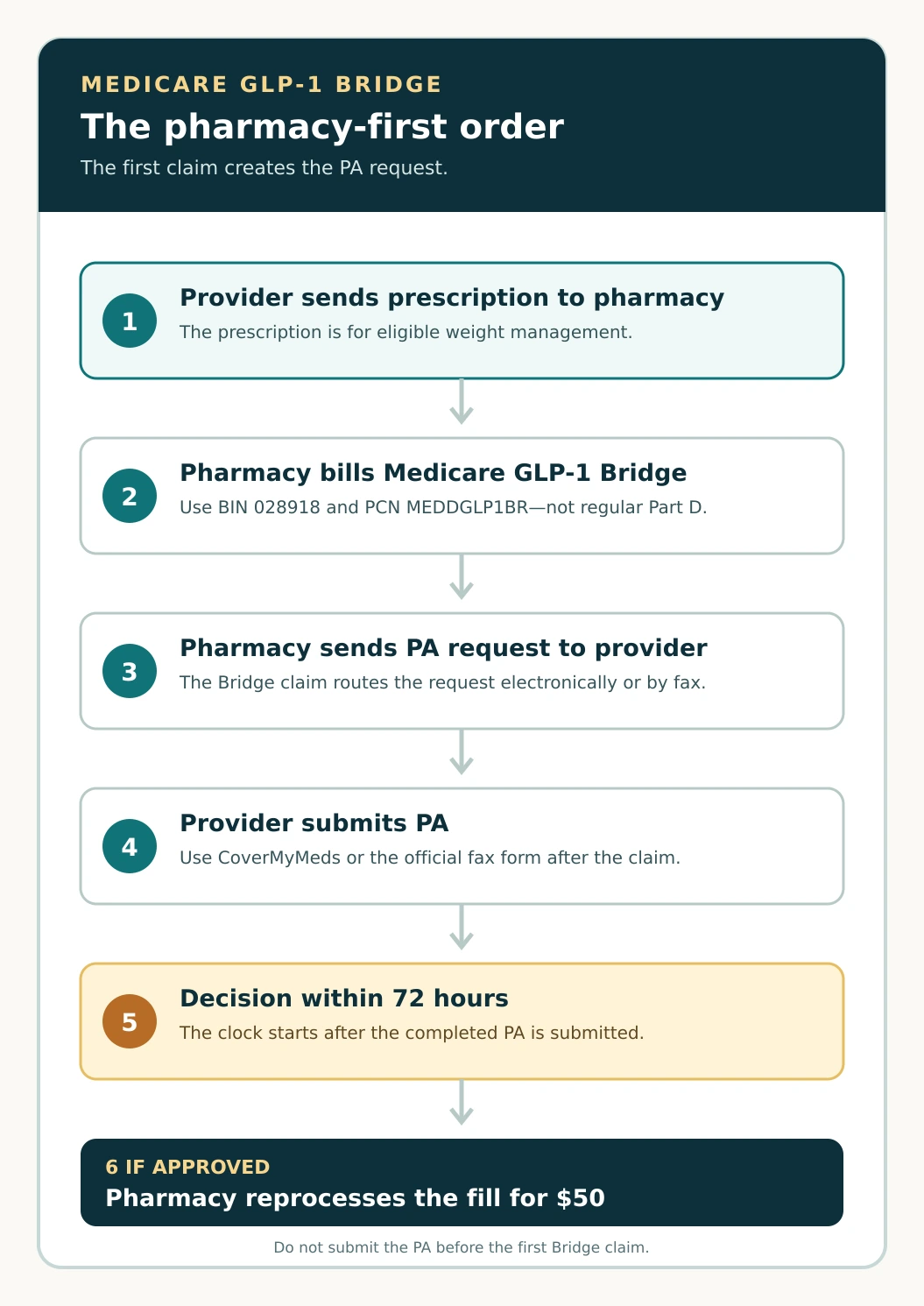
The correct order is:
- Your medical provider sends an eligible prescription to your pharmacy.
- The pharmacy submits the first claim to the Medicare GLP-1 Bridge.
- That claim triggers the prior-authorization request back to your provider.
- Your provider completes the Bridge prior authorization electronically or by fax.
- CMS’s central processor sends a decision within 72 hours after the completed request is submitted.
- If approved, the pharmacy reprocesses the prescription and you pay $50 for a 28- or 30-day supply.
Do not have the prior authorization sent before the pharmacy submits the first Bridge claim. CMS says doing that can produce a “patient not found” error.
The Bridge is live nationwide and runs from July 1, 2026 through December 31, 2027. It covers Foundayo tablets, Wegovy injections and tablets, and Zepbound KwikPen for eligible Medicare Part D beneficiaries when the drug is prescribed for weight reduction and maintenance—not for an indication already coverable under standard Part D.
Not sure which step applies to you? Check my Medicare GLP-1 path → Free · about 60 seconds · no email required. The tool puts the $50 Bridge first when it fits and shows a provider option only when that solves the obstacle you selected.
The RX Index is an independent GLP-1 pricing and access resource. We are not affiliated with CMS, Medicare, Humana, Novo Nordisk, Eli Lilly, or any Medicare Part D plan. Results may include sponsored providers. A provider and CMS—not this website—determine clinical eligibility, prescribing, and coverage.
Choose the help you need
| Your situation | Best next step |
|---|---|
| I want to know whether I likely qualify | Run the Medicare Bridge self-check |
| I think I qualify, but my doctor will not handle the process | Show me what to do when my doctor will not handle it |
| My prescription or prior authorization is stuck | Jump to the troubleshooting checklist |
| My condition may already be covered by Part D | Check the Bridge-versus-Part-D lane finder |
| I do not qualify for the Bridge | Compare the remaining legitimate routes |
Medicare GLP-1 Bridge Program application process: the exact order
This sequence matters. The first pharmacy claim is what establishes the beneficiary in the Bridge system and creates the prior-authorization request.
| Step | What happens | Who does it | Typical timing |
|---|---|---|---|
| 1 | Confirm you have an eligible Medicare Part D plan type and appear to meet a clinical tier | You and your provider | Before prescribing |
| 2 | Send a covered GLP-1 prescription to your chosen pharmacy | Your provider | Day 0 |
| 3 | Submit the claim to the Bridge—not the regular Part D plan—using the Bridge billing route | Pharmacy | Day 0–1 |
| 4 | Receive the prior-authorization request electronically or by fax | Your provider | Usually within 24–72 hours after the pharmacy claim |
| 5 | Complete and submit the Bridge prior authorization through CoverMyMeds or fax | Your provider | As soon as the request arrives |
| 6 | Receive an approval or denial | You and your provider | Within 72 hours after PA submission |
| 7 | Reprocess and fill the prescription if approved | Pharmacy | After approval |
| 8 | Refill every 28 or 30 days | You and the pharmacy | Through December 31, 2027, while eligible |
The one mistake most likely to stop the process
Your provider cannot successfully initiate the Bridge PA before a pharmacy claim has been submitted to the Bridge. The provider should send the prescription first, then wait for the pharmacy-generated PA request. If no request arrives within 72 hours, the provider can download the official fax form and submit it.
The prescription does not legally require a diagnosis code or routing annotation, but CMS recommends adding an obesity diagnosis code from the E66 family and the note “SEND TO BRIDGE FOR WEIGHT MANAGEMENT” so the pharmacy is less likely to bill your regular Part D plan by mistake.
You think you qualify, but your current office is unwilling or confused? Do not abandon a possible $50 benefit or jump straight to a cash-pay program. Use the provider-change checklist first: the official CMS instructions to hand your office, the exact pharmacy-first sequence, and what to look for if you need another prescriber. Show me what to do if my doctor will not handle it → Free · no signup. The tool keeps the Bridge first when it fits and does not invent a paid provider recommendation.
There is no patient application form
Patients do not enroll through a CMS portal and do not submit the Bridge prior-authorization form themselves. Your role is to make sure you are in the right coverage lane, bring the records your provider needs, and follow the prescription through the pharmacy-first process.
| What you do | What your provider does | What the pharmacy does |
|---|---|---|
| Bring your Medicare card, Part D information, BMI history, and relevant diagnoses | Decides whether the prescription is medically appropriate and whether a Bridge tier appears to fit | Sends the initial claim to the Bridge processor |
| Confirm the prescription is for weight management rather than a Part D-covered indication | Sends the prescription to the pharmacy first | Sends the PA request back to the provider after the Bridge claim rejects for PA |
| Follow up if nothing happens within 72 hours | Completes the ePA or fax form after the pharmacy claim exists | Reprocesses the prescription after approval |
| Pay the $50 copay if approved | Submits a new PA only if the covered GLP-1 drug changes | Uses your Medicare Beneficiary Identifier and Bridge BIN/PCN |
Is my Medicare Part D plan eligible for the Bridge?
You must have Medicare Part D drug coverage through an eligible plan type. The Bridge operates outside your plan’s normal payment flow, but Part D enrollment is still required.
| Plan type | Bridge eligible? | What to do |
|---|---|---|
| Standalone Prescription Drug Plan (PDP) | Yes | Continue to the clinical criteria |
| Medicare Advantage HMO, HMO-POS, Local PPO, or Regional PPO with drug coverage (MA-PD) | Yes | Continue to the clinical criteria |
| Special Needs Plan (SNP) with Part D | Yes | Continue to the clinical criteria |
| Employer/Union Group Waiver Plan (EGWP) | Yes | Continue to the clinical criteria |
| LI NET | Yes | Continue to the clinical criteria |
| Dual-eligible Medicare and Medicaid beneficiary in an eligible Part D plan | Yes | Continue; Extra Help does not reduce the $50 Bridge copay |
| Private Fee-for-Service plan without a standalone PDP | No | Ask Medicare or SHIP about future plan choices |
| Section 1876 cost contract plan without a standalone PDP | No | Ask Medicare or SHIP about future plan choices |
| Section 1833 health care prepayment plan without a standalone PDP | No | Ask Medicare or SHIP about future plan choices |
| PACE | No | Contact the PACE organization before making any plan change |
| Fallback plan | No | Ask Medicare or SHIP about future plan choices |
| Religious fraternal benefit plan without a standalone PDP | No | Ask Medicare or SHIP about future plan choices |
| Original Medicare with no Part D coverage | No | Part D enrollment is required |
Important warning for PACE participants
Do not enroll in a separate drug plan merely to reach the Bridge without first speaking to your PACE organization. Joining another Medicare drug plan can end PACE enrollment. Call the PACE organization, a local SHIP counselor, or 1-800-MEDICARE (1-800-633-4227) before changing anything.
How to verify your plan type
Look for “PDP,” “MA-PD,” or “SNP” on your card, sign in to Medicare.gov and view your current plan, or call 1-800-MEDICARE and ask whether your current plan type is eligible for the Medicare GLP-1 Bridge.
Not sure what your plan means? Check my route →
Do I qualify clinically? The three eligibility tiers
You need to meet one tier. The BMI is measured at the time you first initiated GLP-1 therapy. If you have never used a GLP-1, that generally means the BMI at treatment initiation now. If you already started one and later lost weight, the earlier BMI may be the relevant number.

| Tier | BMI at GLP-1 therapy initiation | Required condition |
|---|---|---|
| Tier 1 | 35 or higher | No additional listed condition |
| Tier 2 | 30 or higher | At least one: heart failure with preserved ejection fraction; uncontrolled hypertension despite two blood-pressure medicines; chronic kidney disease stage 3a or above |
| Tier 3 | 27 or higher | At least one: prediabetes under ADA criteria; previous myocardial infarction; previous stroke; symptomatic peripheral artery disease |
All tiers also require that the beneficiary is at least 18 and that the drug is prescribed to reduce excess body weight and maintain weight reduction in combination with current and ongoing lifestyle modification, including structured nutrition and physical activity consistent with the applicable FDA-approved label.
Historical BMI can be decisive
A person who began GLP-1 therapy with a BMI of 37 and now has a BMI of 34 may still meet Tier 1 because CMS instructs the provider to use the BMI at therapy initiation. Bring the earliest visit note, weight record, or prior prescription documentation you can obtain.
What “uncontrolled hypertension” means in this program
For Tier 2, CMS defines it as systolic blood pressure above 140 mm Hg or diastolic blood pressure above 90 mm Hg despite concurrent treatment with two antihypertensive medications. A high reading by itself does not automatically satisfy that definition.
What “prediabetes” means
The prior-authorization form uses prediabetes as defined by American Diabetes Association guidelines. Bring a recent A1C, fasting glucose, oral glucose tolerance test result, or the clinical record where the diagnosis was made. Your provider—not this page—decides whether the record supports the attestation.
Likely eligible and ready to act? Build my personalized doctor-and-pharmacy plan → You will get the correct order, the records to gather, the exact pharmacy billing details, and the next step when your current provider will not submit the request.
Medicare GLP-1 Bridge or standard Part D?
The correct lane depends on why the medication is being prescribed, not merely the drug name.
| Situation | Correct coverage lane | Where the PA goes | Cost structure |
|---|---|---|---|
| Foundayo, Wegovy, or Zepbound KwikPen for weight reduction and maintenance, with a Bridge tier met | Medicare GLP-1 Bridge | CMS central processor after the pharmacy-triggered request | $50 per 28- or 30-day fill; does not count toward Part D TrOOP |
| GLP-1 for type 2 diabetes | Standard Part D | Your Part D plan | Plan-specific; covered spending may count toward the Part D out-of-pocket limit |
| Zepbound for moderate-to-severe obstructive sleep apnea | Standard Part D | Your Part D plan | Plan-specific |
| A qualifying GLP-1 for noncirrhotic MASH with moderate-to-advanced fibrosis | Standard Part D | Your Part D plan | Plan-specific |
| Wegovy prescribed to reduce major cardiovascular-event risk in an adult with established cardiovascular disease | Standard Part D | Your Part D plan | Plan-specific |
| Compounded semaglutide or tirzepatide | Neither Bridge nor Part D | Not applicable | Self-pay only; compounded products are not Bridge-covered |
A Part D denial is not required before a pharmacy sends a weight-management claim to the Bridge. If your prescription belongs in the Bridge lane, the provider can direct the pharmacy to bill the Bridge first.
What does the Medicare GLP-1 Bridge cost?
The beneficiary copay is $50 for each 28- or 30-day fill.
| Cost question | Answer |
|---|---|
| Monthly copay | $50 |
| Does the Part D deductible apply? | No |
| Does the $50 count toward Part D TrOOP or the annual out-of-pocket limit? | No |
| Does Extra Help reduce the $50? | No |
| Can a manufacturer coupon or discount card reduce it? | No |
| Are 60- or 90-day fills available? | No |
| Are partial fills available? | No |
| Are Zepbound KwikPen needles included? | No; pen needles are purchased separately |
The Bridge is a separate CMS demonstration rather than ordinary Part D coverage. That is why the copay stays $50 but does not receive Part D deductible, TrOOP, Extra Help, coupon, or Medicare Prescription Payment Plan treatment.
Which medications are covered?
| Medication and formulation | Bridge-covered? | Important detail |
|---|---|---|
| Foundayo tablets | Yes | Covered for eligible weight-management use |
| Wegovy injection | Yes | All Bridge-listed injection NDCs |
| Wegovy tablets | Yes | Covered for eligible weight-management use |
| Zepbound KwikPen | Yes | KwikPen only; needles are not included |
| Zepbound single-dose pen | No | Not in the Bridge product list |
| Zepbound single-dose vial | No | Not in the Bridge product list |
| Ozempic | No | May be a Part D drug for a covered indication such as type 2 diabetes |
| Mounjaro | No | May be a Part D drug for a covered indication such as type 2 diabetes |
| Rybelsus | No | May be a Part D drug for a covered indication |
| Compounded GLP-1 products | No | Bridge claims do not cover compounds |
The product list and NDCs can change. Confirm the current list on CMS before the prescription is sent.
What documentation should I gather?
Bring the shortest packet that proves the facts your provider must attest to:
- Medicare card with your Medicare Beneficiary Identifier (MBI). The pharmacy needs the MBI to submit the Bridge claim.
- Current Part D or MA-PD information. Bring the prescription-drug card even if it is separate from your Medicare card.
- BMI evidence from GLP-1 initiation. If you have used a GLP-1 before, obtain the original visit note, weight, height, or prescription record. If you have not, your provider will document the initiation BMI.
- Tier-supporting records. Examples include a cardiology note, blood-pressure readings and medication list, eGFR or nephrology record, A1C or glucose result, hospital record for prior MI or stroke, or a vascular note for symptomatic PAD.
- Current medication list. This helps the provider identify a Part D-covered indication or a medication conflict.
- Any 2026 Part D GLP-1 coverage records. A GLP-1 fill through Part D can place you in the Part D lane. After a Bridge approval, a later Part D GLP-1 fill makes the next Bridge refill reject, so bring any coverage and fill records to your provider.
- Your preferred pharmacy. Ask whether it can receive e-prescriptions and prior-authorization requests electronically.
Create my Bridge appointment checklist →
What should I say to my doctor?
Use this script and hand the office the official CMS prescriber instructions:
“I would like to be evaluated for the Medicare GLP-1 Bridge for weight management. I believe I may meet Tier [1, 2, or 3] based on my BMI at GLP-1 initiation and [qualifying condition, if required]. CMS says the prescription must go to the pharmacy first. Please add the note ‘SEND TO BRIDGE FOR WEIGHT MANAGEMENT.’ After the pharmacy submits the Bridge claim, it should send your office the prior-authorization request. Please do not submit the PA before that pharmacy claim, because the Bridge can return ‘patient not found.’”
The office can submit the PA electronically through CoverMyMeds or fax the official form to 1-800-530-2404 after the pharmacy claim exists.
Provider help
Prescribers can call the Medicare GLP-1 Bridge Call Center at 855-273-0102, Monday through Friday, 8 a.m.–7 p.m. Eastern, for PA-process questions or status help.
What if my doctor will not handle the Bridge?
This is the highest-friction point in the entire process—and the place where changing providers can create a real win rather than pushing you into a more expensive medication route.
First, show the office the official CMS prescriber fact sheet and explain the pharmacy-first sequence. A provider does not have to be enrolled in Medicare to prescribe or submit the Bridge PA, but the provider cannot be on the CMS Preclusion List.
If the office still refuses, look for an obesity-medicine clinic that:
- accepts Medicare for clinical visits or clearly discloses any separate self-pay fee;
- publicly confirms that it handles Medicare GLP-1 Bridge prescriptions and prior authorizations;
- sends the prescription to the pharmacy before submitting the PA;
- works in your state;
- provides ongoing follow-up rather than only writing a one-time prescription; and
- never promises approval.
Need another prescriber because your current office will not handle the Bridge? Get the provider-change checklist → The tool shows what to hand a new office, the questions to ask before booking, and the exact Bridge workflow they need to support. Until The RX Index has an approved Medicare-compatible provider partnership, this result should remain informational rather than inserting an unrelated affiliate.
Medicare GLP-1 Bridge troubleshooting checklist
Problem 1: The provider submitted the PA first and received “patient not found”
Fix: Send the prescription to the pharmacy. Have the pharmacy submit a claim to Bridge BIN 028918 and PCN MEDDGLP1BR. The provider should submit the PA only after that claim establishes the patient in the Bridge system.
Problem 2: The pharmacy billed the regular Part D plan
Fix: Ask the pharmacy to route the weight-management claim to the Medicare GLP-1 Bridge, not the Part D plan. The prescription can include the E66 obesity diagnosis family and the annotation “SEND TO BRIDGE FOR WEIGHT MANAGEMENT” to reduce routing mistakes.
Problem 3: The pharmacy says it cannot find you
Fix: Bring your Medicare card. The pharmacy needs your Medicare Beneficiary Identifier. If you do not have the card, the pharmacy may use the last four digits of your Social Security number to look up the MBI through its normal eligibility transaction.
Problem 4: The provider has not received the PA request
Fix: Allow 24–72 hours after the pharmacy submits the Bridge claim. If no electronic or fax request arrives after 72 hours, the provider can download the official CMS fax form and submit it to 1-800-530-2404.
Problem 5: The PA was submitted, but no one knows the decision
Fix: CMS says the approval or denial is sent to the provider electronically or by fax and mailed to the patient within 72 hours after submission. The provider can call 855-273-0102 for direct PA-status help. Patients can call 1-800-MEDICARE for general Bridge information, but the prescriber channel is the direct status route.
Problem 6: The PA was denied
There is no formal Bridge appeal process. The provider can resubmit the form if information was entered incorrectly or if updated or additional supporting information is available.
Problem 7: A refill suddenly rejects
A Bridge approval generally lasts through December 31, 2027, and refills do not require a new PA unless you switch to a different covered GLP-1. A later rejection can occur if you fill a GLP-1 through Part D or move into an ineligible plan type. Ask the pharmacy for the exact rejection reason before changing the prescription.
Pharmacy billing card
| Field | Bridge value |
|---|---|
| Plan / group | GLP1Bridge |
| BIN | 028918 |
| PCN | MEDDGLP1BR |
| Cardholder ID | Medicare Beneficiary Identifier (MBI) |
| Processor | SS&C Health, routed through RelayHealth |
| Pharmacy help desk | 844-673-0910 |
| Fill quantity | One 28- or 30-day supply |
| Paper claims | Not accepted |
| Compounds | Not covered |
Still stuck after checking the list? Tell me where the process stopped → The tool will route you to the pharmacy fix, current-provider fix, new-clinician route, Part D route, or non-Bridge alternatives.
What if I do not qualify?
Do not jump straight from “not Bridge eligible” to an expensive cash-pay program. Check the remaining routes in this order.
1. Standard Part D for a coverable indication
Type 2 diabetes, moderate-to-severe obstructive sleep apnea, noncirrhotic MASH with moderate-to-advanced fibrosis, and cardiovascular-event risk reduction in the applicable population belong in the standard Part D lane. Your plan’s formulary, prior-authorization, exception, and cost-sharing rules apply.
2. Correct the Part D plan-type problem
If the only obstacle is an ineligible plan type, discuss the next enrollment opportunity with Medicare.gov, 1-800-MEDICARE, or a free SHIP counselor. Do not make a PACE change without speaking to the PACE organization first.
3. Find a clinician who will evaluate and handle the correct lane
A provider who understands both Bridge and Part D can determine whether the issue is clinical eligibility, routing, documentation, or simply an office that will not engage.
4. Consider self-pay only after the coverage routes are ruled out
Self-pay telehealth may be appropriate for someone who cannot use Bridge or Part D and knowingly chooses to pay out of pocket. Do not hard-code a provider on this Medicare page. Send this visitor through Find My GLP-1 Path first so the router can apply the provider's current insurance, government-coverage, state, medication, and payment rules before showing an affiliate offer.
Compare the routes that actually fit me →
Frequently asked questions
How do I apply for the Medicare GLP-1 Bridge Program?
You do not submit a patient application. A provider sends an eligible prescription to your pharmacy. The pharmacy submits the first Bridge claim and returns a prior-authorization request to the provider. The provider then submits the PA electronically or by fax.
Is there a Medicare GLP-1 Bridge application form?
There is an official prescriber prior-authorization form, but it is not a patient application. The form says a denied pharmacy claim must be submitted to the Bridge BIN and PCN before the prescriber sends the PA.
Can my doctor send the prescription and prior authorization at the same time?
No. CMS says the prescription should go to the pharmacy first. Sending the PA before the pharmacy claim can return “patient not found.”
How long does a decision take?
CMS says the approval or denial is communicated within 72 hours after the completed PA is submitted.
How long is approval valid?
Bridge PA approvals are valid through December 31, 2027. A new PA is generally required only when the patient switches from one covered GLP-1 drug to another, assuming the patient remains eligible.
Is there an appeal if the Bridge PA is denied?
No formal Bridge appeal process exists. A provider may resubmit corrected, updated, or additional information.
Does my provider have to accept Medicare?
The provider does not have to be enrolled in Medicare to write the prescription or submit the Bridge PA. The provider must not be on the CMS Preclusion List. The provider’s visit billing is separate from the $50 medication copay, so ask how visits are covered before scheduling.
Does my pharmacy need to join the program?
No. Pharmacies do not need to opt in, but the pharmacy must submit the claim using the correct Bridge billing route and your MBI.
Does the Bridge cover Ozempic or Mounjaro?
No. Those drugs are not in the Bridge product list. They may be covered under standard Part D for an FDA-approved Part D-covered indication, subject to the plan’s rules.
Can I use a coupon, GoodRx, or Extra Help with the $50 copay?
No. Coupons and discount programs cannot be applied to Bridge claims, and the Low-Income Subsidy does not reduce the $50.
Does the $50 count toward my Part D out-of-pocket limit?
No. Bridge fills operate outside Part D payment and do not count toward TrOOP.
Can I receive 60 or 90 days at once?
No. The Bridge allows one 28- or 30-day supply per fill.
Are Zepbound KwikPen needles covered?
No. CMS says pen needles are not covered by the Bridge or the patient’s Part D plan for this purpose and must be purchased separately.
What we verified for this update
| Fact | Primary source | Status as of August 31, 2026 |
|---|---|---|
| Bridge dates: July 1, 2026–December 31, 2027 | CMS Bridge overview | Verified |
| Correct pharmacy-first PA sequence | CMS provider FAQ and prescriber fact sheet | Verified |
| “Patient not found” when PA is sent too early | CMS provider FAQ | Verified |
| PA request normally reaches provider in 24–72 hours | CMS provider FAQ | Verified |
| Decision within 72 hours after PA submission | CMS provider and pharmacy FAQs | Verified |
| No formal Bridge appeal; corrected information may be resubmitted | CMS provider FAQ | Verified |
| Approval lasts through December 31, 2027 unless the drug changes | CMS pharmacy FAQ | Verified |
| Covered drugs and formulations | CMS provider FAQ | Verified |
| $50 copay; no TrOOP, LIS, or coupon treatment | CMS overview and pharmacy FAQ | Verified |
| BIN 028918 / PCN MEDDGLP1BR / MBI required | CMS pharmacy FAQ and payer sheet | Verified |
| CoverMyMeds or fax 1-800-530-2404 | Official CMS PA form | Verified |
| Prescriber call center 855-273-0102 | CMS provider page | Verified |
| Pharmacy help desk 844-673-0910 | CMS pharmacy page and payer sheet | Verified |
Primary sources
- CMS Medicare GLP-1 Bridge overview
- CMS information for providers
- CMS information for pharmacies
- CMS Medicare GLP-1 Bridge prior-authorization form
- CMS Medicare GLP-1 Bridge payer sheet
- Medicare.gov weight-loss drug coverage
Still not sure what to do next?
Your answer depends on four things: your Part D plan type, why the medication is being prescribed, your BMI at GLP-1 initiation, and whether you already have a provider willing to complete the pharmacy-first Bridge process.
Find My GLP-1 Path — Medicare Bridge route →
Free · about 60 seconds · no signup. The tool should keep the $50 Bridge or standard Part D first when either fits, and only enter the existing commercial self-pay router after those routes have been screened out or the visitor explicitly chooses self-pay.