Will Cigna cover your Ozempic? Find your row
Cigna's published Ozempic policies support coverage for type 2 diabetes, not weight loss alone or prediabetes. Your benefit must also include the drug. Find the row that sounds like you, then jump to that section. 1 2 3
Will Cigna cover your Ozempic? Find your row| Your situation | What the published rules mean | Your next step |
|---|
| You have type 2 diabetes and Ozempic is on your drug list | The policies allow a 1-year approval when their criteria and your benefit requirements are met | Use the PA packet with your prescriber |
| The pharmacy says "prior authorization required" | There is no usable approval on that claim; the message alone does not tell you whether a request was sent or denied | Ask the office whether it was sent, get the case number, and check for a written decision |
| You got a denial letter | Depends on the reason printed on it | Match it in the denial table |
| You want Ozempic for weight loss and don't have type 2 diabetes | Not covered under these Ozempic policies | Ask your clinician about weight-management treatment — see the weight-loss path |
| Prediabetes, or metabolic syndrome without type 2 diabetes | Not covered under these Ozempic policies | Talk with your clinician; see prediabetes coverage |
| Type 1 diabetes | Not covered under these Ozempic policies | Your diabetes team decides your treatment |
| Already taking Mounjaro, Wegovy, or Zepbound | These policies do not cover using Ozempic together with another GLP-1 | Your prescriber decides any treatment change; don't switch on your own |
| Under 18 | The National Formulary rule requires age 18+; the label says it isn't known to be safe in children | Talk with your child's doctor |
| Your approval expired or you changed plans | A new review may be needed | See renewing or switching |
| Medicare or Medicaid | Use your actual program and plan rules, not this commercial-policy table | See Medicare, Medicaid, or no insurance |
| You do not know your plan type or pharmacy benefit | Your plan's requirements still need to be checked | Use myCigna or the number on your card to ask which policy applies |
If your row ends in "not covered," start with the reason and your clinician. A different drug or a new provider does not erase a plan exclusion. Children and people with type 1 diabetes need their own care team, not a provider-shopping quiz.
What does Cigna Ozempic prior authorization require?
The three Cigna diabetes GLP-1 policies reviewed here allow a one-year Ozempic approval for type 2 diabetes, subject to the applicable criteria and benefit. The National Formulary version also expressly requires age 18 or older. 1 2 3
Think of prior authorization as a permission slip from your insurer. For Ozempic, Cigna's slip has one main box: type 2 diabetes. A request can get stuck when that diagnosis is missing from the records sent to the plan, or when the request is for a use the policy does not cover. 1 2 3 6
Cigna's Ozempic rules, side by side (read September 24, 2026)
What does Cigna Ozempic prior authorization require?| Cigna document | Which plans | Ozempic forms listed | What Cigna checks | Approval lasts | Date on the document |
|---|
| Diabetes – GLP-1 Agonists PA Policy (CNF 360) | Plans using the Cigna National Formulary | Pen (injection) and tablets | Type 2 diabetes; age 18 or older | 1 year | Reviewed June 3, 2026 |
| Diabetes – GLP-1 Agonists for Employer Plans (IP0701) | Employer plans on the Standard/Performance, Value/Advantage, Legacy, or Total Savings drug lists | Pen and tablets | A documented type 2 diabetes diagnosis | 1 year | Effective June 15, 2026 |
| Diabetes – GLP-1 Agonists for Individual and Family Plans (IP0702) | Cigna individual and family plans | Tablets and injection on the cover; the tablet availability note conflicts with that listing | A documented type 2 diabetes diagnosis | 1 year | Effective June 15, 2026 |
| Standard 3-Tier Prescription Drug List | Standard-list example, not every Cigna plan | Ozempic | Tier 2, prior authorization, quantity limit; not marked specialty | — | July 1, 2026 coverage edition, visually checked |
"Documented" means proof in your records. Cigna says that can include chart notes, lab tests, claims records, or prescription receipts. 2 3
What the three clinical policies do not require in their Ozempic criteria: a numeric A1C cutoff, a metformin trial, or a BMI threshold. A1C is a blood test that helps your clinician assess blood sugar over time. Pharmacy-network rules are a separate check. 1 2 3
Uses the three policies list as not covered: weight loss without type 2 diabetes, type 1 diabetes, prediabetes, metabolic syndrome without type 2 diabetes, and taking Ozempic together with another GLP-1. 1 2 3
Which version is yours? The individual and family policy is the starting point for a Cigna plan you bought yourself. For work coverage, check the employer policy's named drug lists or the National Formulary policy. Ask myCigna support or the number on your card to confirm the document attached to your benefit. A formulary is your plan's covered-drug list. The packet below is still useful before you know the policy number.
Two small print notes. The National Formulary policy calls prior authorization "recommended," while the employer and individual versions say "required." If a pharmacy claim says approval is needed, have the office confirm the requirement and any existing authorization. Your plan documents control the benefit, subject to applicable law: Cigna's policies say a plan can differ from the standard policy, for example by excluding a drug. 1 2 3
What about heart or kidney protection? Ozempic injection also has FDA-approved uses for certain heart and kidney risks in adults who have type 2 diabetes. The heart indication is for adults with established heart disease; the kidney indication is for adults with chronic kidney disease. These uses do not remove the type 2 diabetes requirement in the policies above. The tablet has a separate heart-risk indication and does not share the injection's kidney indication. 12 13
Not under the three published Ozempic criteria reviewed here. None lists an A1C cutoff or a metformin trial for Ozempic, and the individual and family policy's own history says Cigna removed its metformin requirement for all products in that policy starting April 1, 2025. 1 2 3
You may have read that Cigna wants an A1C of 7% or three months of metformin. That doesn't match Cigna's 2026 documents. The only "try this first" rules in the employer policy apply to brand-name Byetta and Victoza, which ask patients to try the generic versions first. They don't apply to Ozempic.
If a request comes back citing a drug trial or a lab number, ask which policy and which line says so. Your plan may have its own rule, and then you'll know exactly what to answer. Please don't start, stop, or change a medicine to fit a rule you read online — that's your clinician's call.
What tier is Ozempic on Cigna?
In the July 1, 2026 edition of Cigna's Standard 3-Tier drug list checked here, Ozempic is Tier 2 — a preferred brand — with prior authorization and a quantity limit. Other Cigna drug lists can place it differently, so check yours in myCigna. Use the list for your coverage date; a 2027 list does not establish today's benefit. 4
What tier is Ozempic on Cigna?| On your drug list | What Cigna says it means | Ozempic on the Standard list |
|---|
| Tier 2 | Preferred brand; a middle cost-share | Yes |
| PA (prior authorization) | Cigna must approve it before your plan covers it | Yes |
| QL (quantity limit) | Your plan covers a set amount per fill | Yes — the list doesn't print the number |
| ST (step therapy) | You try a lower-cost option first | Not shown for Ozempic |
| SP (specialty) | A specialty medicine, sometimes with pharmacy limits | Not marked for Ozempic |
Ozempic is not marked "SP" in this Standard-list example. That does not settle every pharmacy rule on your plan. Before filling, ask which pharmacies are in network and whether the plan requires a particular pharmacy or home delivery. Don't assume Accredo is required just because your card says Express Scripts. 4
Does the same approval cover Ozempic tablets?
Not automatically. Ozempic now comes as a daily tablet as well as a weekly pen. Check the tablet's coverage and approval requirements separately.
The FDA approved the name change from the R2 formulation of Rybelsus to Ozempic tablets on January 30, 2026. The tablet strengths are 1.5 mg, 4 mg, and 9 mg. This did not rename every Rybelsus strength. 13 20
All three policy covers list Ozempic tablets. But the individual and family policy still says the tablet "is not currently available," even though Novo Nordisk now sells Ozempic tablets through NovoCare Pharmacy. Its Ozempic criterion does not clearly resolve that mismatch. Neither the stale sentence nor the cover listing proves your plan's tablet coverage. 1 2 3
So if you're on a plan you bought yourself and want the pill, ask Cigna before your prescriber sends the request. Pen approval doesn't prove pill coverage. More on the pill: how to get the Ozempic pill online.
Your Cigna Ozempic PA packet
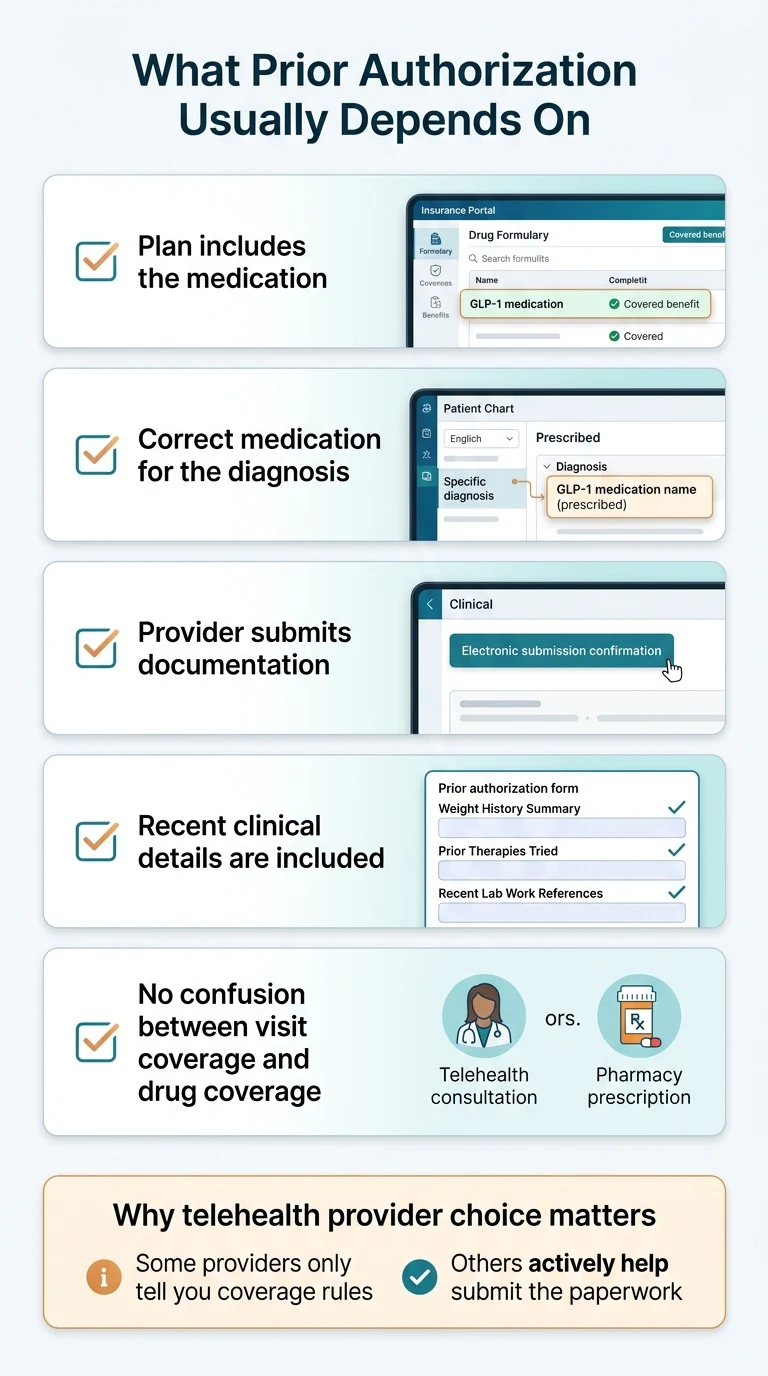
A complete request avoids a preventable missing-information problem. Your prescriber sends the medical part. Your job is to get the right insurance details and the exact pharmacy message or letter to their office.
We built this packet from Cigna's own medication prior authorization form and its current Ozempic policies. Nothing here asks for your health information. It's a checklist and a message you take to your own doctor's secure portal.
Your Cigna Ozempic PA packet| Have this ready | Who supplies it | Why it matters |
|---|
| Your Cigna ID card | You | Cigna's form requires your Cigna ID and date of birth |
| The exact message or letter, word for word | You or your pharmacy | "PA required," "more information needed," and "denied" each need a different next step |
| The exact prescription: pen or tablet, strength, directions, quantity | Your prescriber | Cigna's form asks for the name, strength, dosing schedule, quantity, and length of therapy, and quantity limits apply |
| Your type 2 diabetes diagnosis, documented | Your prescriber | It is the main diagnosis requirement, not a lab cutoff. The form has boxes for the diagnosis and its ICD-10 code, the code used to record a diagnosis |
| Diabetes medicines you've tried, with dates and results, if applicable | Your prescriber | The general form asks about other treatments tried. That field does not create a metformin-first rule for Ozempic |
| Anything the plan specifically asked for | Your prescriber | Answer exactly what was asked, truthfully |
| An "urgent" box, only when it's true | Your prescriber | Cigna's form reserves urgent review for when a standard wait could seriously jeopardize your life, health, or ability to regain maximum function |
The diagnosis on the request has to be your real one. These are preparation categories, not a demand that every patient supply every test or treatment history. If you don't have type 2 diabetes, ask your clinician which treatment and coverage process fits the condition being treated. For weight management, see the weight-loss path.
A message you can send your doctor's office
You don't have to write a medical argument to get things moving. Copy this into your doctor's secure patient portal, fill in the brackets, and send it.
Subject: Help with my Cigna Ozempic coverage request

My pharmacy or plan says: [copy the exact message]. The prescription is for [Ozempic pen or Ozempic tablets, and the strength on the label].

Could your prior authorization team confirm whether a request has already been sent to Cigna? If it has, please share the case number, the status, and anything Cigna still needs.

If it hasn't been sent, what do you need from me so you can submit it? Please use my actual records and the rules for my plan.

If there's a denial, could you tell me whether the next step is a corrected request, an appeal, or a different process — and the deadline in the notice?

I can send my insurance card and any letter through this portal. I'm not sure of [my plan type / my pharmacy benefit / anything else you don't know].
Here's how that plays out. Say you're 54, on your employer's Cigna plan, with type 2 diabetes, and the pharmacy texts "prior authorization required." You send the message on Monday. The office writes back that they submitted it through CoverMyMeds and gives you a case number. Now you have a request to track. Ask whether it is pending, needs more records, or has a decision — and tell your prescriber if you are about to run out.
Cigna asks prescribers to send medication requests electronically, through CoverMyMeds or Surescripts in their records system. If that isn't possible, Cigna offers a phone line and a general medication form.
Where is the Cigna Ozempic prior authorization form?| Route | Details | Source |
|---|
| Electronic (Cigna's preferred route) | CoverMyMeds Cigna forms or Surescripts in the office's records system | Cigna PA forms page |
| Phone | 1-800-882-4462 (1-800-88-CIGNA) for a spoken request when electronic isn't possible, and for urgent requests | Same page; general form |
| Fax, when electronic and phone submission are not possible | The general Medication Prior Authorization Form (version v061025) prints fax (855) 840-1678; the office should confirm the correct form and destination | General form |
| State forms | Some states require or suggest their own form | Cigna's state-specific forms |
These routes are for your prescriber's office. You can call Cigna, share your insurance details, and ask for status — but the medical part comes from the prescriber. As Express Scripts puts it in its coverage-review FAQ, only your doctor can provide the information a review needs.
If your prescriber's office asks for a paper form, share this one — and ask them to confirm it's the right form for your plan and state before they fax it.
Open Cigna's medication PA form
How long does Cigna take — and how do you check?
Cigna's prescriber form says most pharmacy prior authorizations are done within two business days unless more information is needed. Its member drug-list FAQ says a review can take up to five business days. These are published turnaround estimates, not a guaranteed approval date. Ask when your request was received, what is missing, and which deadline applies. 4 5
How long does Cigna take — and how do you check?| Who says it | What it says |
|---|
| Cigna medication PA form (v061025) | Most pharmacy prior authorizations are completed within two business days, unless more information is needed. Call if urgent |
| Cigna Standard drug list FAQ (read September 24, 2026) | A review can take up to five business days; you can track it in myCigna |
| Express Scripts coverage-review FAQ | Nearly all reviews finish within two days of complete information; electronic requests can get answers within minutes |
How to check status: Look in myCigna, which shows where your medication is in the review. If your pharmacy benefit runs through Express Scripts, log in there and go to Prescriptions → Prior Authorizations. Or ask the office for the case number.
While you wait: If you fill outside your plan without required approval, Cigna's drug-list FAQ says you'll pay the pharmacy price and the spending will not count toward your deductible or out-of-pocket maximum. Ask your plan before paying whether any later claim review is available. Express Scripts suggests asking a pharmacist about a small supply, but that general advice does not guarantee an Ozempic pen can be split. Ask your prescriber and pharmacist what is possible for your prescription. If the delay is a real medical problem, your prescriber can ask for faster review. 4 5 7
If your blood sugar is dangerously high or you feel very sick, don't wait on insurance — call your doctor or get urgent care.
One more common snag. Say the pharmacy still says "PA required," but your doctor's office says they sent it. Ask for the case number and whether Cigna needs another document before anyone starts a second request.
After approval: Ask the pharmacist to run the claim again for the exact approved product and confirm your price. If it still rejects, check the authorization dates, product, strength, quantity, and pharmacy with the office and plan. Keep the approval notice for your next refill. 4 7
Why was Ozempic denied — and what should you do next?
The words on the notice decide the next step. A request for more information, a medical-necessity denial, a drug that isn't on your list, and a plan exclusion are different problems with different fixes.
Why was Ozempic denied — and what should you do next?| What the message says | What it usually means | What to do next |
|---|
| "Prior authorization required" | No usable approval is attached to this claim; the PA decision is not established by this message alone | Ask the office whether it was sent; get the case number and any written decision |
| "More information needed" | Cigna is missing a record | Ask which record, and have the office answer through the same channel. Cigna says it will review again |
| Not medically necessary: weight loss | The plan treated the request as a use excluded by its Ozempic policy | Check that the diagnosis and reason are accurate. Ask your clinician about a correction or appeal when warranted, or the weight-loss path when that is the treatment goal |
| Not medically necessary: another reason | A specific criterion wasn't met | Find the criterion in the letter, review it with your clinician, and use the appeal route printed on the notice |
| Prediabetes, metabolic syndrome, or type 1 diabetes | Not covered under Cigna's policy | Talk with your clinician about other options |
| Taking another GLP-1 | Concurrent GLP-1 use is excluded by these policies | Ask your prescriber to clarify current treatment and any planned change |
| Not on your drug list | The exact drug or form is not listed as covered | Ask whether a formulary exception is available |
| Your plan excludes it | Benefit design | Ask for the benefit language and your review rights; see plan exclusion vs. prior authorization |
| Quantity limit | The submitted quantity or days' supply does not match the claim limit | Ask the pharmacist and prescriber to check the quantity and days' supply. Don't change how you take it on your own |
| A drug trial or lab cutoff is cited | The request is being reviewed under a particular rule | Ask for the exact policy and drug entry. Don't assume another medicine's criteria apply to Ozempic |
| Approval expired or you changed plans | A new review may be needed | See renewing or switching |
These labels are plain-English groupings, not Cigna's official rejection codes. If your pharmacy gave you a code, see pharmacy claim rejection codes explained.
Correct it, appeal it, or ask for an exception?
Match the fix to the reason. Missing information can often be fixed by the office sending more; a medical-necessity denial you disagree with can go to appeal; a drug that isn't on your list may have an exception process. Ask the office which route addresses the written reason. 4 8
For plans through work, Cigna's appeals page says to start an appeal within 180 calendar days of the denial notice. Its member appeals guide says pre-service medical-necessity appeals are decided within 30 calendar days, faster when urgent. After the internal appeal, an independent external review may be available for disputes about medical judgment, and Cigna says that decision is binding on Cigna and the plan.
Your notice has your real deadlines, and they can differ by plan and state. Keep it where you can find it. A corrected request doesn't necessarily pause the appeal clock, so write your deadline down even while the office fixes paperwork.
When an appeal is the right process, our GLP-1 appeal letter template helps you organize the facts. If the internal appeal fails, see how external review works.
What will Ozempic cost after Cigna decides?
A prior authorization addresses a coverage requirement; it does not set your pharmacy price or guarantee payment of every claim. Your price still depends on your plan's tier, your deductible, and any savings program, so get a quote for your exact prescription before you fill. A copay is a fixed amount; coinsurance is a share of the cost. 1 4
Ozempic price paths (checked September 24, 2026)
What will Ozempic cost after Cigna decides?| Your situation | What you'd pay | The fine print |
|---|
| Cigna approves, and you are eligible for its individual/family Patient Assurance Program | No more than $25 for a 30-day supply, or $75 for 90 days. Cigna says your deductible doesn't apply | Ozempic is on the 2026 individual and family list. Confirm the exact covered prescription and your program eligibility |
| Cigna approves, regular benefit | Your plan's copay or coinsurance — we can't see your number | Check Price a Medication in myCigna. Your deductible may apply; Tier 2 is only the Standard-list example |
| Cigna covers the prescription, and you qualify for Novo Nordisk's Ozempic Savings Offer | As little as $25 per eligible prescription, with maximum savings of $100 for one month, $200 for two, or $300 for three | The offer defines an injection month as 28 days and a tablet month as 30 days. You need commercial coverage for Ozempic and a prescription for an FDA-approved use. Medicare, Medicaid, TRICARE, and VA members are excluded; ACA Marketplace, FEHB, and state employee coverage is not excluded on that basis. Accumulator/maximizer restrictions and other terms apply. Activation is for up to 48 months; terms may change. Full terms |
| You elect self-pay: NovoCare Pharmacy pen, new-patient offer | $199 each for your first two 28-day fills of the 0.25 mg/0.5 mg pen | "New" means you've never filled an Ozempic injection through NovoCare or NovoCare Pharmacy. The prescription must be written and received by December 31, 2026, and shipped by January 31, 2027. The third fill is the standard price |
| NovoCare Pharmacy pen, standard price | $349 per offer-defined 28-day fill (0.25 mg/0.5 mg or 1 mg pen); $499 per offer-defined 28-day fill (2 mg pen) | Outside insurance, with a valid prescription for an FDA-approved use. You agree not to seek reimbursement from any insurer. Do not count it as spending under your insurance benefit. Full terms |
| NovoCare Pharmacy tablets | $149 (1.5 mg), $199 (4 mg), or $299 (9 mg) per 30 tablets | A 30-day supply of a different product, under the same pharmacy self-pay eligibility terms. Not a dose conversion from the pen |
| Doctor visits, labs, or other fees | Not priced by these medication-only rows | Ask. An unknown fee isn't a $0 fee |
Through work? The separate Express Scripts Patient Assurance program describes a $25 cap per 34-day prescription for participating products and plans. Ask your benefit team whether your exact Ozempic prescription is included now. The individual/family flyer does not prove your employer's participation. 24
A 28-day fill is not a calendar month. Say you stay on a strength priced at $349 for 13 offer-defined 28-day fills, with no introductory discount or price change. That's $4,537 for 364 days — 52 weeks — of medicine alone, not an exact calendar-year quote. The starting pen can contain a different number of doses, so use the pharmacy's actual days' supply when budgeting. Your dose is your prescriber's decision, not the price table's. 11 12
If Cigna won't cover Ozempic and you still want the brand-name drug, the manufacturer's own pharmacy is a direct cash-pay option. NovoCare accepts people with or without insurance who choose to pay cash, as long as they have a valid prescription for an FDA-approved use. See NovoCare Pharmacy's terms and prices. HSA or FSA questions? See using HSA or FSA for Ozempic.
Lost insurance and can't afford those prices? Novo Nordisk's separate Patient Assistance Program provides Ozempic pen at no cost to eligible uninsured patients with household income at or below 200% of the federal poverty level, subject to its residency and government-program rules. Commercially insured patients are not eligible just because their plan denies Ozempic; Medicare patients with prescription coverage are also excluded for Ozempic. Ask your prescriber's office to help with the application. This is not Cigna's Patient Assurance Program or NovoCare's cash pharmacy. 21
Why "as little as $25" may not mean $25 for you
The savings card has a floor and a ceiling. For an eligible one-month injection prescription, it can bring your cost down to $25, but it pays at most $100. The injection offer uses a 28-day month. 10
Say your approved, eligible one-month injection claim leaves you a $250 copay. The card takes off its $100 maximum, so you'd pay $150 — not $25. If your copay were $80, the card could bring it down to $25. These are hypothetical calculations, not a quote for your plan.
One more wrinkle. Novo's terms say its card can't be combined with a program from your plan or pharmacy benefit manager that changes what you pay, like a copay cap. Don't stack the card with Patient Assurance or assume you can opt out of a plan program and still qualify. Ask your pharmacist and the savings program which rules apply to your claim. 10
Renewing, switching plans, or not taking it for diabetes?
Not every request is a first request. Start with what changed, then ask your plan and your prescriber what that means for this prescription.
You already take Ozempic, or your A1C has improved
All three policies reviewed here specify a one-year approval period for Ozempic. Express Scripts says a new review can be needed because an approval expired or a plan changed. 1 2 3 7
Give the office your prior approval and your treatment history. None of the three Ozempic criteria reviewed here sets a minimum current A1C for approval. The office still needs to document your diagnosis and meet the rules for your plan. Never stop a medicine or try to make a lab result worse to fit a rule you read somewhere. More on renewals: initial request vs. renewal. 1 2 3
You got a new job or a new Cigna plan
A new plan can mean a new drug list and a new review. Ask Cigna whether your Ozempic needs a new request under the plan you have now. What Cigna checks is your diagnosis, not just the fact that you're already taking it.
You want it for weight loss, but don't have type 2 diabetes
Cigna's published Ozempic policies do not cover weight loss alone. Wegovy also contains semaglutide but is a different product with weight-management indications; Cigna reviews it under a separate policy. Your clinician chooses the treatment — these are not interchangeable prescriptions. 1 2 3
The hitch is coverage. In the July 2026 Standard-list example, Wegovy, Zepbound pen, and Foundayo carry the letters "OC," for optional coverage. Cigna says these medicines are not usually covered, although some plans include them. So the real question is whether your actual benefit includes the drug for the condition being treated. 4
Start here: Cigna Wegovy prior authorization, does Cigna cover Wegovy, Cigna Zepbound prior authorization, and Ozempic vs. Wegovy.
For adults with commercial insurance who are exploring a different weight-management treatment, Ro's free GLP-1 Insurance Coverage Checker contacts your plan and emails you a report on the Ozempic, Wegovy, and Zepbound pens. It's a coverage report — not treatment or a prior authorization submission — and new Ro accounts get a $50 credit. It does not replace your current prescriber's request. Ro says it can't coordinate GLP-1 coverage for government plans like Medicare or Medicaid; FEHB is an exception it supports. 18 19
If your plan does cover Wegovy or Zepbound and you want a new prescriber, Ro says its insurance team handles prior authorization paperwork for eligible treatment through its program. That is separate from the free checker. Ro's membership is a separate cost: get started for $39, then as low as $74/month with annual plan paid upfront ($888), or $149 on the monthly plan, with medication billed separately. You do not need a paid Ro membership to get the free coverage report. 17 18 19
Check your Cigna Wegovy and Zepbound coverage with Ro
Medicare, Medicaid, or no insurance
Cigna's commercial rules on this page don't apply to Medicare or Medicaid. Use the rules for the coverage you actually have.
- Medicare: The Cigna Group sold its Medicare Advantage and Part D businesses to Health Care Service Corporation (HCSC) on March 19, 2025. Those plans now operate as HealthSpring. Follow your Medicare plan's drug list and its coverage steps. Novo's savings card can't be used with Medicare. In 2026, the Part D out-of-pocket threshold is $2,100 for covered Part D drugs, not cash purchases outside the benefit or a promise that any particular drug is covered. See does Medicare cover Ozempic and Medicare's cost explanation.
- Medicaid: Your state's and managed-care plan's rules apply, not Cigna's commercial policies. Use the number on your Medicaid card or find your state Medicaid agency.
- No insurance: There's no Cigna approval to get, so the question is price. NovoCare Pharmacy's cash prices and the separate income-based assistance option are above; see also GLP-1 cost without insurance.
Coverage isn't medical clearance
A coverage approval is not medical clearance or a guarantee of payment. It doesn't mean Ozempic is right for you — that's a conversation with your prescriber. 1 12 13
Ozempic's label says not to use it if you or anyone in your family has had medullary thyroid carcinoma (MTC), a type of thyroid cancer; if you have multiple endocrine neoplasia syndrome type 2 (MEN 2), an inherited condition linked to certain tumors; or if you've had a serious allergic reaction to semaglutide or its ingredients. For a planned pregnancy, the labels call for stopping at least 2 months beforehand; arrange that plan with your prescriber. Safety and effectiveness in children have not been established. Review the prescribing information with your prescriber, including for the tablets.
Common side effects include nausea, vomiting, diarrhea, stomach pain, and constipation. Important warnings include pancreatitis, gallbladder problems, dehydration-related kidney injury, worsening diabetic eye disease, and low blood sugar when used with insulin or certain other diabetes medicines. Get medical help for severe or persistent symptoms, and emergency help for trouble breathing or swelling of the face or throat. These are not all the warnings in the label. 12 13
What we actually verified
Last verified September 2026 — source checks completed September 24: Cigna's CNF 360 policy (reviewed June 3, 2026), IP0701 and IP0702 (effective June 15, 2026); the Standard-list example identified above; the medication PA form (v061025), submission and state-form instructions, and member appeals guide; the 2026 individual/family Patient Assurance flyer and the separate Express Scripts program description; the Express Scripts coverage-review FAQ; Novo Nordisk's savings, cash-pharmacy and patient-assistance terms; injection and tablet prescribing information; the FDA tablet-name-change letter and compounded-drug guidance; Ro's pricing, Ozempic and checker pages; the Medicare-sale filing, HealthSpring description, and Medicare's 2026 cost guidance. An important mismatch: Cigna's individual and family policy lists Ozempic tablets on its cover but still says they are unavailable in its overview. Novo Nordisk sells the tablets. Check the exact tablet benefit with your plan. Provider-stated, not independently tested: Ro's description of its insurance team and checker. What we can't see: your plan's own add-ons or exclusions, your copay, whether your employer includes Ozempic in Patient Assurance, your quantity limit, and the status of your request.
How we checked
We read Cigna's policy documents, forms, and drug list on the date above, lined them up, and wrote down what each one says — and what it doesn't. We did the same with the manufacturer's savings and pharmacy terms. We didn't submit a request, call Cigna as a member, or see anyone's private plan.
The RX Index is the independent GLP-1 decision resource that scores telehealth providers and treatment paths on clinical legitimacy, care quality, transparency, access, and cost, so readers can choose the path that fits their situation.
Read our research methodology.
Cigna Ozempic prior authorization FAQs
Is it worth appealing a Cigna Ozempic denial?
Start with the reason printed on your decision, not a generic appeal. If Cigna says a record was missing or a criterion wasn't met and your clinician disagrees, ask whether to correct the request or use the appeal route on your notice. If the denial calls it a weight-loss request, first check that the diagnosis and reason are accurate. When weight management is the actual goal, ask about a suitable treatment and its separate coverage rules. 1 2 3 8
Are there alternatives if Cigna won't cover Ozempic?
Yes, but a different GLP-1 isn't automatically covered just because Ozempic was denied. The same diabetes policies include Mounjaro and Trulicity, each with its own criteria. Weight-management treatment follows separate coverage rules. See what GLP-1 Cigna covers and talk with your clinician. 1 2 3 4
Does "PA required" mean Cigna denied my prescription?
Not by itself. It means that pharmacy claim does not have a usable approval. Ask your prescriber's office whether a complete request was sent and check for a written decision; the pharmacy message alone does not tell you whether the request is pending or denied. 4 7
How long does Cigna take to approve Ozempic?
Cigna's prescriber form says most pharmacy prior authorizations are done within two business days, unless more information is needed. Its drug-list FAQ says a review can take up to five business days. Ask for your receipt date, case status, and applicable deadline; these estimates do not guarantee approval. 4 5
Not under the three Ozempic policies reviewed here. None lists a metformin trial for Ozempic, and the individual and family policy removed that requirement for products in that policy starting April 1, 2025. If your request cites one, ask Cigna which plan rule it comes from. 1 2 3
Can I send the prior authorization to Cigna myself?
You can call Cigna, give your insurance details, and ask for status. The medical part has to come from your prescriber, usually electronically through CoverMyMeds or Surescripts. The message above helps you get the office started.
Does Cigna cover Mounjaro instead?
The same diabetes policies include Mounjaro for type 2 diabetes with a one-year approval period when its criteria and your plan's benefit requirements are met. In the July 2026 Standard-list example, Mounjaro is Tier 2 with prior authorization and a quantity limit. Whether it fits you better than Ozempic is your prescriber's call; see does Cigna cover Mounjaro. 1 2 3 4
Will approval make Ozempic cost $25?
Not necessarily. Your price depends on your plan and program eligibility. Patient Assurance is a cost cap for eligible participants; Novo's savings card is a discount with a maximum benefit. For an eligible one-month injection prescription, that discount is at most $100, and the card cannot be stacked with a plan copay-cap program. 9 10 24
What happens if I lose my Cigna coverage mid-treatment?
Losing insurance changes how you pay, but check that you still have a valid prescription and refills. NovoCare Pharmacy's standard self-pay price is $349 or $499 per offer-defined 28-day injection fill, depending on strength, with an FDA-approved-use prescription and the other program terms. Eligible uninsured patients can also check the separate Patient Assistance Program. If you get new insurance, ask whether it needs its own review. 7 11 21
What if my prescription card says Express Scripts?
Cigna uses Express Scripts for many pharmacy benefits, and Express Scripts, Accredo, and Cigna are all part of The Cigna Group. You can check review status in your Express Scripts account under Prescriptions → Prior Authorizations. For the Express Scripts side of coverage, see does Express Scripts cover Ozempic.
Is compounded semaglutide the same as Ozempic for insurance?
No. Compounded semaglutide isn't Ozempic, and the FDA says compounded drugs aren't FDA-approved, so it doesn't review them for safety, effectiveness, or quality before they're marketed. An Ozempic authorization does not establish coverage for a compounded product. More on the difference: compounded vs. brand-name GLP-1s.
Sources
Source checks completed September 24, 2026. Policy, label, program, and coverage-edition dates are shown separately.
- Cigna, Diabetes – GLP-1 Agonists Prior Authorization Policy (CNF 360), reviewed June 3, 2026.
- Cigna, Diabetes – GLP-1 Agonists for Employer Plans (IP0701), effective June 15, 2026.
- Cigna, Diabetes – GLP-1 Agonists for Individual and Family Plans (IP0702), effective June 15, 2026.
- Cigna, Standard 3-Tier Prescription Drug List. Tier and formulary examples use the inspected edition headed “Coverage starting July 1, 2026”; member benefits and later editions must be checked separately.
- Cigna, Medication Prior Authorization Form, version v061025.
- Cigna, Commercial drug prior authorization forms.
- Express Scripts, Coverage reviews (prior authorization) FAQ.
- Cigna, Member appeals and grievances guide.
- Cigna, 2026 individual/family Patient Assurance Program flyer, dated November 2025.
- Novo Nordisk, Diabetes Savings Offer terms.
- Novo Nordisk, NovoCare Pharmacy terms and prices; the injection introductory offer has a December 31, 2026 prescription-written/received deadline and January 31, 2027 shipping deadline.
- Novo Nordisk, Ozempic injection prescribing information, revised May 2026.
- Novo Nordisk, Ozempic tablets and Rybelsus prescribing information, revised January 2026.
- FDA, Concerns with unapproved GLP-1 drugs used for weight loss.
- The Cigna Group, Completion of Medicare business sale to HCSC, March 19, 2025.
- HealthSpring, About us.
- Ro, Weight-loss program pricing.
- Ro, GLP-1 Insurance Coverage Checker.
- Ro, Ozempic program description and insurance FAQ.
- FDA, NDA 213051/S-030 supplement approval letter, signed January 30, 2026; Rybelsus formulation R2 renamed Ozempic tablets.
- Novo Nordisk, 2026 Patient Assistance Program eligibility and application.
- Medicare, How much Medicare drug coverage costs, including the separately labeled 2026 Part D threshold.
- Medicaid.gov, State Medicaid and CHIP contact directory.
- Evernorth, Express Scripts Patient Assurance program; participating products and plans, with a 34-day prescription unit.
- Cigna, State-specific drug prior authorization forms.