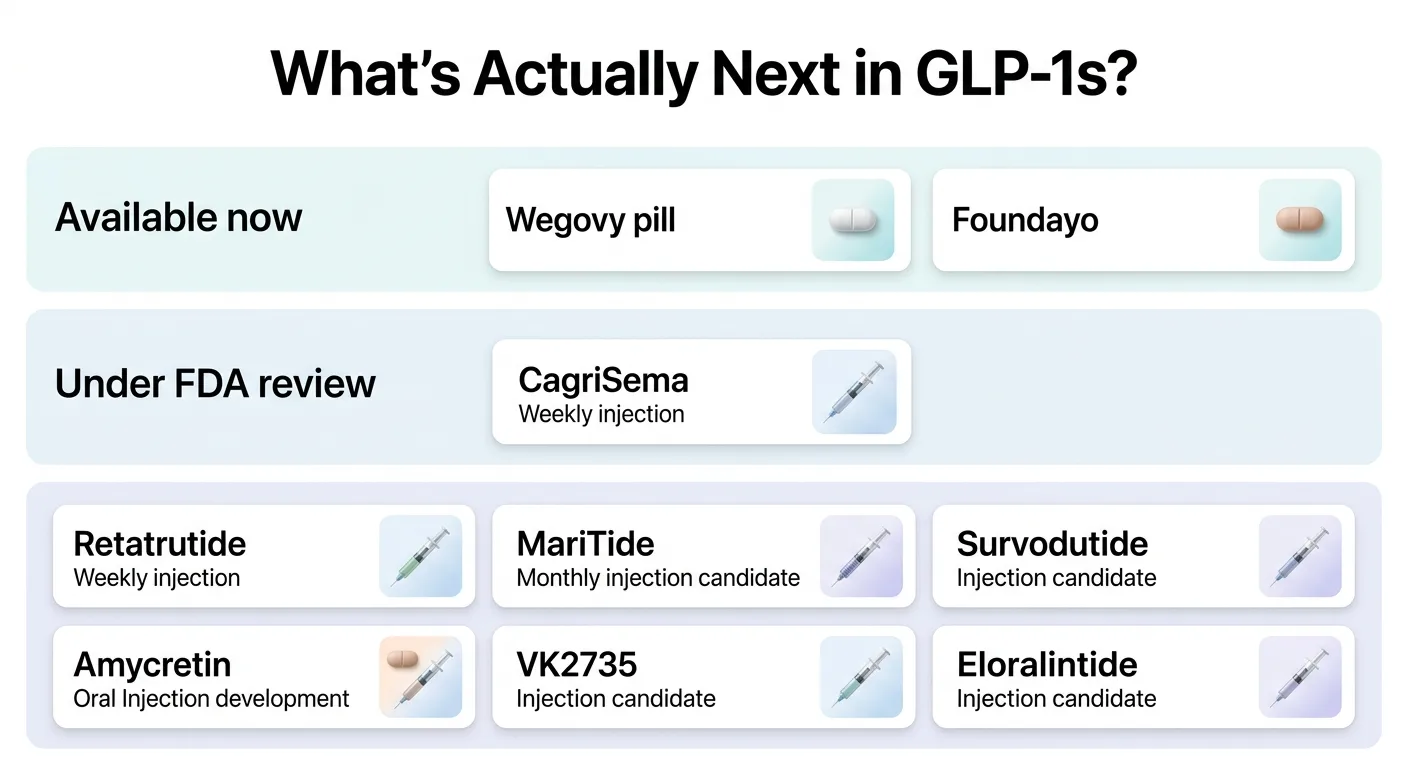
Obesity Drug Pipeline 2026-2027: What’s Coming, and When You Can Really Get It
Here’s the honest version of the obesity drug pipeline 2026-2027. As of , just one major new obesity drug — CagriSema — is under FDA review, and Novo Nordisk expects a U.S. decision in Q4 2026. Retatrutide has jaw-dropping trial numbers but no announced filing date yet. Most of the drugs you’ll hear called “coming in 2027” are really 2027 trial results — not launches. And three FDA-approved options, including two pills and a new higher-dose shot, are already available.
The 30-second verdict
| Closest to a decision | Where it really stands | What that date means |
|---|---|---|
| CagriSema | Filed Dec 2025; Novo Nordisk expects a U.S. decision in Q4 2026 | A company forecast -- not an official FDA date |
| Retatrutide | Strong Phase 3 results in; no announced U.S. filing or FDA decision date | A trial result, not an approval date |
| Survodutide | Strong Phase 3 results in; maker says program may support a 2026 filing | A company plan, not an approval date |
Everything else is further back. Open the full pipeline tracker below ↓
Read on if you:
- • Want the full, dated map of what’s coming — without the hype
- • Are trying to tell a real FDA decision apart from a rumored “release date”
- • Are weighing whether to start something now or hold out for the next big thing
Skip to the tool if you:
- • Already know which available drug you want and just need a provider
- • Are looking for a place to buy an investigational drug (this isn’t it, and you shouldn’t)
The right GLP-1 provider isn't the same for everyone.
Get a personalized match with source-verified pricing -- based on your state, insurance, form preference, and budget.
Find My GLP-1 Path →What Do “Phase 3,” “Estimand,” and the Other Terms Mean?
Quick answer: A drug in the “pipeline” is still in testing and not approved to sell. “Phase 3” is usually the big final testing stage. An “estimand” is just how a trial measures its result — the same trial can report two different weight-loss numbers, and we always show both.
- Pipeline (on this page)
- Obesity drugs still in clinical testing and not FDA-approved for everyday prescribing.
- Investigational
- Same idea. It's in trials. You can't get it from a regular pharmacy.
- Phase 2 / Phase 3
- Stages of human testing. Phase 3 is usually the large final stage. Finishing Phase 3 does not guarantee a company will file or that the FDA will approve.
- NDA
- A company formally asking the FDA to approve a drug. Filing is not the same as approval.
- FDA action date
- A public target date for the FDA's decision, when one exists. Most pipeline drugs don't have a public one.
- Estimand
- Trials report results two ways. "Stuck-with-it" counts people who stayed on the drug; "counting everyone" counts all participants, including those who quit early. Neither is the "real" number -- they answer different questions. We show both.
What Does the Obesity Drug Pipeline 2026-2027 Look Like Right Now?
Quick answer: We track 13 major investigational obesity drugs, from “filed with the FDA” to “years away,” plus three recently approved options shown separately. For each one we label how sure the date is — an actual FDA fact, a company’s own forecast, or just a trial estimate. A drug in the 2027 column means a trial or filing is expected then. It does not mean it’ll be in pharmacies in 2027.
How to read the “how we know” label
The FDA itself approved the drug or set the rule. As solid as it gets.
The maker expects to file or get a decision in a window. Forward-looking, not a promise.
Big final-stage data is in and looked good -- but there's no FDA decision date yet.
A ClinicalTrials.gov completion date. It can move, and it's not an approval date.
A planned trial start or readout. It can slip.
We looked and couldn't find a reliable date. We won't invent one.
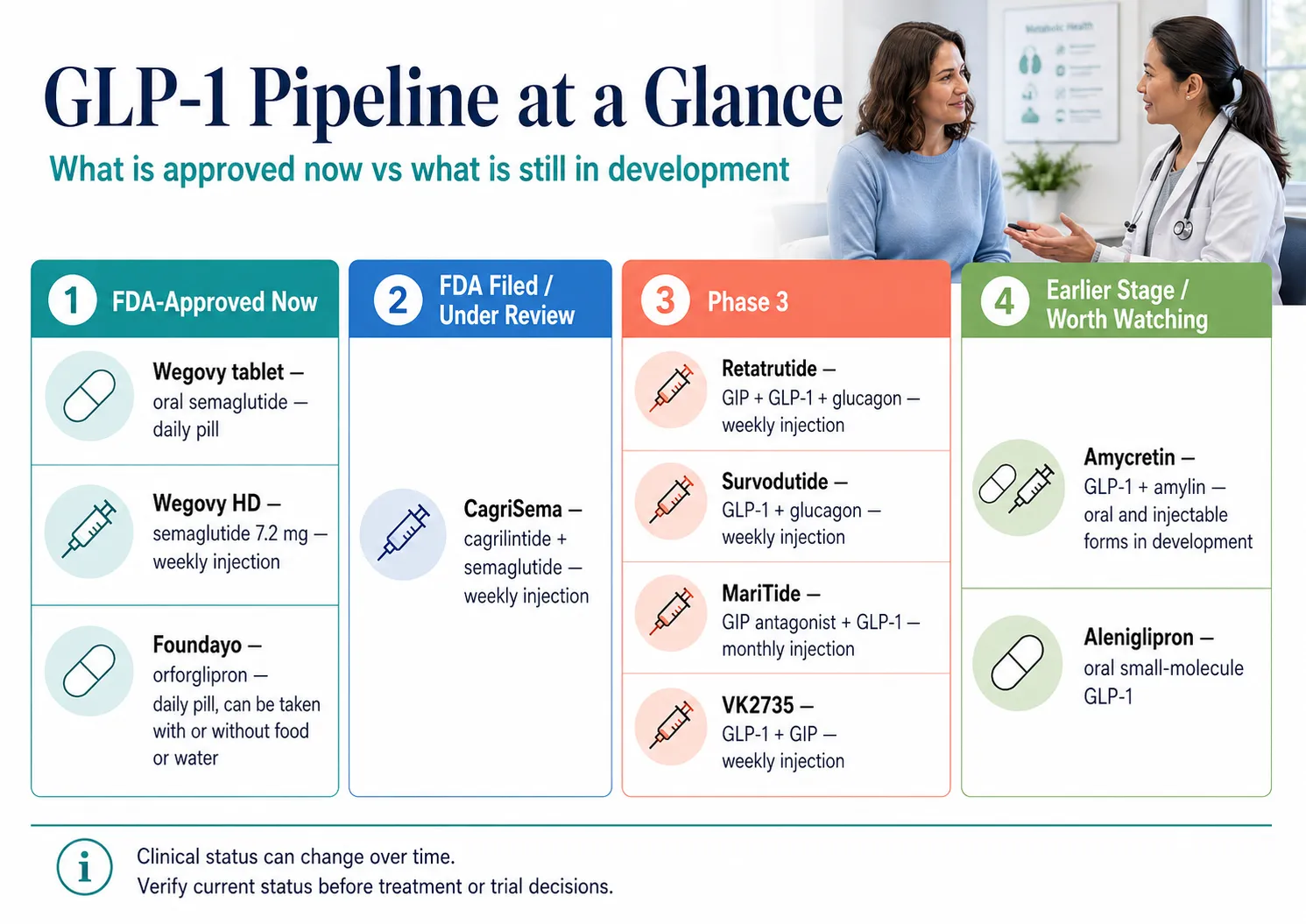
Already approved — you can get these now
These have graduated out of the pipeline. We include them because “what’s coming” is useless if you don’t know what’s already here.
| Drug (brand) | Maker | How it works | Form | Best trial result | Status |
|---|---|---|---|---|---|
| Wegovy pill (oral sema 25 mg) | Novo Nordisk | GLP-1 | Daily pill | 13.6% counting everyone / 16.6% stuck-with-it, 64 wk (OASIS 4) | FDA-approved Dec 22, 2025FDA fact |
| Foundayo (orforglipron) | Eli Lilly | GLP-1 (small molecule) | Daily pill, any time, no food rules | 11.1% counting everyone / 12.4% stuck-with-it, 72 wk (ATTAIN-1) | FDA-approved Apr 1, 2026FDA fact |
| Wegovy HD (sema 7.2 mg) | Novo Nordisk | GLP-1 | Weekly shot (higher dose) | 18.8% counting everyone / 20.7% stuck-with-it, 72 wk (STEP UP) | FDA-approved Mar 19, 2026FDA fact |
Under FDA review — the only near-term decision
| Drug (brand) | Maker | How it works | Form | Best trial result | Status |
|---|---|---|---|---|---|
| CagriSema (cagrilintide + sema) | Novo Nordisk | GLP-1 + amylin | Weekly shot | 20.4% counting everyone / 22.7% stuck-with-it, 68 wk (REDEFINE 1) | Filed Dec 2025; Novo expects U.S. decision Q4 2026Company forecast |
Phase 3 data is in — but no FDA date yet
| Drug (brand) | Maker | How it works | Form | Best trial result | Status |
|---|---|---|---|---|---|
| Retatrutide | Eli Lilly | GIP + GLP-1 + glucagon (triple) | Weekly shot | 28.3% stuck-with-it / 25.0% counting everyone, 80 wk, 12 mg (TRIUMPH-1) | Positive Phase 3; no announced U.S. filing or FDA datePositive Phase 3 |
| Survodutide | Boehringer Ingelheim / Zealand | glucagon + GLP-1 | Weekly shot | Up to 16.6% stuck-with-it, 76 wk (SYNCHRONIZE-1) | Positive Phase 3; maker says program may support 2026 filingCompany target |
Phase 3 running — mostly 2027+ readouts
| Drug (brand) | Maker | How it works | Form | Best trial result | Status |
|---|---|---|---|---|---|
| MariTide (maridebart cafraglutide) | Amgen | GLP-1 on, GIP off | Monthly shot | 19.9% stuck-with-it / 16.2% counting everyone, 52 wk (Phase 2) | Phase 3 into 2027Trial estimate |
| VK2735 | Viking Therapeutics | GLP-1 + GIP | Weekly shot + pill (separate) | Up to 14.7%, 13 wk (shot, Phase 2) | Shot Phase 3 completion expected 2027; oral to Phase 3 H2 2026Company forecast |
| Zenagamtide (formerly amycretin) | Novo Nordisk | GLP-1 + amylin (one molecule) | Pill and shot | Up to 24.3%, 36 wk (shot, Phase 1b/2a) | Phase 3 started 2026Trial estimate |
| Eloralintide | Eli Lilly | amylin (selective) | Weekly shot | Up to ~20%, 48 wk (Phase 2) | Phase 3 underway (runs to ~2030)No public date |
| Berobenatide (formerly MET-097i) | Pfizer | GLP-1 (long-acting) | Weekly + monthly maintenance | 15.9%, 60 wk (Phase 2, 2.4 mg weekly) | Phase 3 starting 2026; Pfizer goal ~2028Company target |
| Enicepatide (formerly CT-388) | Roche | GLP-1 + GIP | Weekly shot | ~22.5% placebo-adjusted, 48 wk, 24 mg (Phase 2) | Phase 3 (ENITH1, ENITH2) started Q1 2026Trial estimate |
| Cagrilintide (standalone) | Novo Nordisk | amylin | Weekly shot | ~11.8%, 68 wk (REDEFINE 1 arm) | Phase 3 program underwayTrial estimate |
Phase 2 or earlier — realistically 2028+
| Drug (brand) | Maker | How it works | Form | Best trial result | Status |
|---|---|---|---|---|---|
| Aleniglipron (GSBR-1290) | Structure Therapeutics | GLP-1 (small molecule) | Daily pill | Up to 16.3%, 44 wk (Phase 2) | Phase 3 planned Q3 2026Company target |
| Petrelintide | Zealand / Roche | amylin | Weekly shot | Met Phase 2 primary goal (ZUPREME-1, 2026) | Phase 3 planned H2 2026Company target |
| UBT251 | Novo Nordisk / United Biotechnology | GIP + GLP-1 + glucagon (triple) | Weekly shot | Up to 19.7%, 24 wk China Phase 2 | Global Phase 1b/2a running; data expected 2027Company target |
Ready to stop refreshing news and see your real options?
The map can't tell you what fits your state, insurance, and budget -- but our tool can.
Find My GLP-1 Path →What’s Already Approved and Available Right Now?
Quick answer: Three FDA-approved options arrived in the last seven months: the Wegovy pill (oral semaglutide, December 2025), Foundayo (orforglipron, April 2026), and Wegovy HD (a higher-dose 7.2 mg semaglutide shot, March 2026).
Here’s why this matters more than any 2027 rumor: some people put off treatment waiting for the “perfect” future drug — and the milestones many were waiting on already landed.
The Wegovy pill (oral semaglutide 25 mg)
The first GLP-1 pill approved for weight loss, from Novo Nordisk. In its main trial (OASIS 4), people lost about 13.6% counting everyone, or 16.6% among those who stuck with it, over 64 weeks. The catch: you take it on an empty stomach with a small sip of water and wait 30 minutes before eating or drinking. That timing trips some people up.
Foundayo (orforglipron)
Eli Lilly’s answer, approved April 1, 2026. It’s the first GLP-1 pill you can take any time of day, with or without food — no timing rules. At its highest dose (17.2 mg), people lost about 11.1% counting everyone, or 12.4% among those who stuck with it, over 72 weeks. Self-pay pricing started around $149/month for the 0.8 mg dose. Eligible patients whose commercial insurance covers Foundayo may pay as little as $25/month, and eligible Medicare Part D patients may pay $50/month. Confirm current pricing and eligibility before you commit.
Wegovy HD (semaglutide 7.2 mg)
Approved March 19, 2026, this is a higher dose of the familiar Wegovy shot. In the STEP UP trial, people lost about 18.8% counting everyone, or 20.7% among those who stuck with it, over 72 weeks. One thing to know: altered skin sensation (tingling, sensitivity, or burning — called dysesthesia) was reported more often at the higher dose (about 22%) than at 2.4 mg (about 6%).
Sponsored — FDA-approved options only
Ro is one telehealth option that offers FDA-approved Zepbound® (tirzepatide) and Foundayo™ (orforglipron). Ro Body membership runs $39 for the first month, then $149/month — or as low as $74/month on an annual plan paid upfront — and the medication itself is billed separately. Confirm current pricing before you sign up.
See FDA-approved options on Ro → (sponsored affiliate link, opens in a new tab)If a pill or a proven shot fits your situation, you don't have to wait years.
See which approved treatment path matches your state, budget, and preferences.
Find My GLP-1 Path →Which Obesity Drug Is Closest to FDA Approval?
Quick answer: CagriSema is closest, because it’s the only drug here whose U.S. application is already filed and under review. Retatrutide and survodutide have positive final-stage data, but neither has an announced U.S. filing or FDA decision date.
CagriSema — filed, and the only near-term decision
CagriSema is an investigational once-weekly shot combining semaglutide (the GLP-1 in Wegovy) plus the investigational amylin drug cagrilintide. Novo Nordisk filed its application with the FDA in December 2025 and expects a U.S. decision in Q4 2026. In REDEFINE 1, people lost about 20.4% counting everyone, or 22.7% among those who stuck with it, over 68 weeks. The honest part: in the REDEFINE 4 head-to-head trial, CagriSema produced 23% weight loss at 84 weeks versus 25.5% for tirzepatide (the medicine in Zepbound) — and it did not meet its goal of proving it wasn’t inferior to tirzepatide. Strong drug, genuinely close to approval — but not the unchallenged leader.
→ Full CagriSema availability guide · CagriSema vs. Zepbound · CagriSema side effects
Retatrutide — the data is stunning, the date isn’t set
Retatrutide hits GLP-1, GIP, and glucagon (triple). In the pivotal TRIUMPH-1 trial, people lost an average of 28.3% among those who stuck with it (or 25.0% counting everyone) over 80 weeks at the top 12 mg dose. A prespecified extension showed 30.3% at 104 weeks among those with a starting BMI of 35 or higher. Reality check: as of now, Lilly has not announced a U.S. filing date or an FDA decision date. Anyone telling you “retatrutide launches in 2027” is guessing.
Survodutide — positive data, plus a benefit for the liver
Survodutide (Boehringer Ingelheim / Zealand Pharma) hits GLP-1 and glucagon. In SYNCHRONIZE-1, people lost up to 16.6% among those who stuck with it over 76 weeks, with strong fat- and liver-related results. The maker has said the program may support a 2026 filing — but there’s no announced FDA decision date.
| Drug | Under FDA review? | Positive Phase 3 for obesity? | Public FDA decision date? | Best way to describe it |
|---|---|---|---|---|
| CagriSema | Yes | Yes | Company expects Q4 2026 | Closest to a decision |
| Retatrutide | Not filed publicly | Yes | No | Best data, filing still ahead |
| Survodutide | Not filed publicly | Yes | No | Strong data, possible 2026 filing |
Which “2027 Drugs” Are Really Just Trial Readouts?
Quick answer: MariTide and VK2735 have meaningful 2027 trial-completion windows, and several other drugs are moving through Phase 3. Those milestones could eventually lead to FDA filings, but none is a confirmed 2027 U.S. launch.
MariTide — the investigational monthly shot
Amgen’s MariTide stands out for convenience: designed as a shot you take once a month, or even less often, instead of weekly. In Phase 2, people lost up to 19.9% among those who stuck with it (or 16.2% counting everyone) over a year. Its big Phase 3 program (MARITIME) runs into 2027. So it’s a genuinely exciting 2027 data story — not a 2027 pharmacy story.
VK2735 — a shot and a pill from a smaller player
Viking Therapeutics’ VK2735 hits GLP-1 and GIP. The weekly shot is in Phase 3 (VANQUISH trials), which Viking expects to complete in 2027. The pill is a separate, earlier program heading to Phase 3 in H2 2026. Early Phase 2 numbers for the shot looked promising (up to 14.7% in just 13 weeks), but a 13-week number can’t be stretched to predict a final result.
The rest of the Phase 3 field
- Zenagamtide (Novo’s drug formerly called amycretin) — GLP-1/amylin in pill and shot form. Up to 24.3% at 36 weeks (early data). Phase 3 started 2026.
- Eloralintide (Eli Lilly) — selective amylin weekly shot, up to ~20% in Phase 2. Phase 3 runs to around 2030 — a reminder that “in Phase 3” doesn’t always mean “coming soon.”
- Berobenatide (Pfizer, formerly MET-097i) — long-acting GLP-1 weekly shot with a monthly-maintenance study. Phase 3 starting 2026; Pfizer has stated a goal of a first approval around 2028.
- Enicepatide (Roche, formerly CT-388) — GLP-1/GIP weekly shot. ~22.5% placebo-adjusted in Phase 2; Phase 3 (ENITH1/ENITH2) started Q1 2026.
- Cagrilintide on its own — the amylin half of CagriSema, also in standalone Phase 3 with ~11.8% in the REDEFINE 1 monotherapy arm.
| Drug | What 2027 likely brings | What is NOT settled |
|---|---|---|
| MariTide | Big Phase 3 trial completes / reports | FDA approval |
| VK2735 | Shot Phase 3 completes | FDA approval |
| Zenagamtide | Phase 3 progresses | FDA decision |
| Eloralintide | Long Phase 3 continues | Anything near-term |
| Berobenatide | Phase 3 underway | FDA approval |
| UBT251 | Global early-stage data | A completed U.S. trial |
What Oral (Pill) Obesity Drugs Are Coming?
Quick answer: Beyond the two pills already approved, the notable investigational oral drugs are aleniglipron, an oral version of VK2735, and oral zenagamtide. They’re at different stages, and none is an approved shortcut yet.
The needle-free crowd is the reason pills matter so much — a lot of people simply won’t do a weekly injection.
- Aleniglipron (Structure Therapeutics) — once-daily GLP-1 pill. Up to 16.3% at 44 weeks (Phase 2). Phase 3 expected Q3 2026.
- Oral VK2735 (Viking) — the pill version of VK2735, heading to Phase 3 in H2 2026.
- Oral zenagamtide (Novo) — GLP-1/amylin pill form, Phase 3 but on a longer timeline.
| Oral drug | Status | FDA-approved for weight loss? |
|---|---|---|
| Foundayo | Approved and for sale | Yes |
| Wegovy pill | Approved and for sale | Yes |
| Aleniglipron | Heading to Phase 3 | No |
| Oral VK2735 | Heading to Phase 3 | No |
| Oral zenagamtide | Phase 3, longer timeline | No |
How Do GLP-1, GIP, Glucagon, and Amylin Pipeline Drugs Differ?
Quick answer: These drugs target different appetite, fullness, blood-sugar, and energy pathways, and many hit more than one at once. Hitting more targets does not automatically make a drug safer or better.
| Drug | Simple mechanism | Form in development |
|---|---|---|
| CagriSema | GLP-1 + amylin combination | Weekly shot |
| Retatrutide | GIP + GLP-1 + glucagon (triple) | Weekly shot |
| Survodutide | GLP-1 + glucagon | Weekly shot |
| MariTide | GLP-1 on, GIP off | Monthly shot |
| VK2735 | GLP-1 + GIP | Shot and pill |
| Enicepatide | GLP-1 + GIP | Weekly shot |
| Zenagamtide | GLP-1 + amylin (one molecule) | Shot and pill |
| Eloralintide | amylin (selective) | Weekly shot |
| Cagrilintide | amylin | Weekly shot |
| Petrelintide | amylin | Weekly shot |
| UBT251 | GIP + GLP-1 + glucagon (triple) | Weekly shot |
| Aleniglipron | GLP-1 (small molecule) | Daily pill |
| Berobenatide | GLP-1 (long-acting) | Weekly, monthly maintenance |
Which Investigational Drug Shows the Most Weight Loss?
Quick answer: By the raw headline, retatrutide leads at 28.3% over 80 weeks among people who stuck with it (25.0% counting everyone). But no trial compared all these drugs head-to-head under the same rules, so the biggest number is not automatically the “best” drug for you.
Why you can’t just rank by percentage: a Phase 2 number isn’t the same as a Phase 3 number; a 13-week result can’t be compared to a 68- or 80-week one; trials that include people with diabetes often show smaller averages; and the estimand matters.
| Drug | Headline result | Stage / length | Which measure | Keep in mind |
|---|---|---|---|---|
| Retatrutide | 28.3% (25.0%) | Phase 3, 80 wk | Stuck-with-it (and counting-everyone) | Biggest number; both measures shown |
| CagriSema | 22.7% (20.4%) | Phase 3, 68 wk | Stuck-with-it (and counting-everyone) | Missed non-inferiority vs. tirzepatide head-to-head |
| Survodutide | Up to 16.6% | Phase 3, 76 wk | Stuck-with-it | Also strong on fat and liver measures |
| MariTide | 19.9% (16.2%) | Phase 2, 52 wk | Stuck-with-it (and counting-everyone) | Earlier and shorter than Phase 3 studies |
| Zenagamtide | Up to 24.3% | Phase 1b/2a, 36 wk | Early study | Exciting, but early evidence |
| Enicepatide | ~22.5% | Phase 2, 48 wk | Placebo-adjusted | Now in Phase 3 |
| Eloralintide | Up to ~20% | Phase 2, 48 wk | Reported | Amylin-only mechanism |
| UBT251 | Up to 19.7% | Phase 2, 24 wk | Stuck-with-it | China study; global data due 2027 |
| Aleniglipron | Up to 16.3% | Phase 2, 44 wk | Placebo-adjusted | Highest oral GLP-1 at the time, per Structure |
These are not head-to-head results. Different trials, lengths, doses, and patient groups. Treat this as a map of the landscape — not a leaderboard.
Are Monthly Shots or Fewer Injections Really Coming?
Quick answer: MariTide and berobenatide are the clearest programs testing monthly or less-frequent dosing, and VK2735 is studying maintenance schedules. All of it is still investigational.
A monthly schedule would cut scheduled injections from 52 a year down to 12. That’s a real difference — but whether it actually improves adherence hasn’t been established for these investigational programs yet. MariTide is furthest along on the monthly idea. Berobenatide is testing a weekly start with a monthly-maintenance study. VK2735 is exploring maintenance dosing too. Promising — but “being studied” is not “proven,” so hold the excitement until the results and the FDA label are in.
What Are the Biggest Risks and Unknowns?
Quick answer: Every investigational drug still faces real uncertainty — approval isn’t guaranteed, the final label can change, and long-term safety, side effects, price, and insurance coverage are unknown until launch.
A 'topline result' is not the full story
A company's first data release may come before peer-reviewed publication. The FDA reviews the full application dataset. Early numbers can look better than the complete picture.
Side effects are real
GLP-1-type drugs commonly cause nausea, vomiting, diarrhea, and constipation, especially early. With retatrutide's higher doses, GI side effects were dose-related, and there was a reported signal of altered skin sensation. Wait for the full published results before trusting a headline.
Long-term data lags
Big weight-loss numbers come first. Answers about heart health, keeping the weight off, weight regain after stopping, and rare risks take longer.
Price and coverage are a mystery until launch
Anyone quoting a price for an unapproved drug is making it up. We won't.
The names keep changing
Amycretin is now zenagamtide. MET-097i is now berobenatide. CT-388 is now enicepatide. Same drugs, new names -- which is exactly how confusion (and scams) spread.
Can I Buy Retatrutide, CagriSema, or These Other Drugs Now?
Quick answer: No. None of these investigational drugs is an FDA-approved product you can get through normal prescribing. Legitimate access is a real clinical trial. And the FDA has stated plainly that retatrutide and cagrilintide cannot be used in compounding under federal law — they are not part of any approved drug.
Know the four different categories:
| Category | Reviewed by the FDA before selling? | Normal prescription availability? |
|---|---|---|
| FDA-approved medicine | Yes -- for safety, effectiveness, and quality | Yes, with a prescription |
| Lawfully compounded medicine | No | Only under specific rules, with a valid prescription |
| Investigational trial drug | Not approved to sell | Only inside a qualifying study |
| Online "research peptide" | No | Not a legitimate treatment -- avoid |
We keep FDA-approved and compounded options strictly separate: they are different things. If you want treatment now, your legitimate choices are an FDA-approved medicine or a real, registered clinical trial.
How Do I Find or Join a Clinical Trial?
Quick answer: Search ClinicalTrials.gov by the drug’s current name and its study name, filter to “recruiting,” and check that a study has a location you can reach and a real contact. Joining is voluntary, you might not qualify, and you might get a placebo.
Search the name AND the old name. Try "retatrutide," "zenagamtide" AND "amycretin," "enicepatide" AND "CT-388," "berobenatide" AND "MET-097i." Also search trial program names: TRIUMPH (retatrutide), REDEFINE (CagriSema/cagrilintide), SYNCHRONIZE (survodutide), MARITIME (MariTide), VANQUISH (VK2735), VESPER (berobenatide), AMAZE (zenagamtide), ENLIGHTEN (eloralintide), ENITH (enicepatide), ACCESS (aleniglipron), ZUPREME (petrelintide).
Filter to "Recruiting." That means they're taking new participants now. Status changes often.
Read who qualifies before you contact anyone. Age, BMI, diabetes status, past medications, and location all matter.
Ask the practical questions: Is there a placebo group? Can I keep my current medication? Who pays for travel and tests? How many in-person visits? What happens when the study ends?
Verify the contact. If a social-media recruiter can't be matched to the official study listing, walk away.
Curious whether a legitimate trial exists for a drug you’re watching?
Search real, registered studies for free — then bring what you find to a clinician.
Search legitimate trials on ClinicalTrials.gov →Should I Wait for a 2027 Drug — or Start Now?
Quick answer: A future release date, by itself, is not a good reason to delay care you may need today. The smart choice depends on your health, whether an approved option fits, your access and budget, whether you’d qualify for a trial, and your clinician’s advice.
Starting now may make sense if:
- • Your weight is affecting your health and waiting has a real cost
- • A good, approved option fits you
- • You can access or afford it
- • The “better” drug’s timing is honestly a guess
Exploring a trial may make sense if:
- • The study is legitimately registered
- • You seem to qualify
- • You can handle the visits and possible placebo
- • Your clinician thinks it’s reasonable
Waiting may be reasonable if:
- • There’s no urgency for you
- • Current options don’t fit
- • A specific, near-term milestone genuinely changes your plan
Five questions to settle it:
- 1. Do I need treatment now for my health?
- 2. Is an approved option appropriate and within reach?
- 3. Is that future date an actual FDA date -- or just a trial estimate?
- 4. Would I truly qualify for the trial?
- 5. Am I okay if the drug gets delayed, changed, or never approved?
Want a real plan instead of a forecast?
Answer a few quick questions and we'll match you to a treatment path that fits your state, insurance, and preferences -- with source-verified pricing.
Find My GLP-1 Path →How Did The RX Index Verify the Obesity Drug Pipeline 2026-2027?
Quick answer: We rank FDA records, ClinicalTrials.gov, peer-reviewed studies, and dated company announcements above everything else, and we label each date by how we know it. We leave analyst guesses and unsourced “release dates” out of the verified columns.
Our source order: (1) the FDA’s own approvals and safety notices, (2) ClinicalTrials.gov, (3) peer-reviewed journal results, (4) official company and investor announcements, (5) major medical and payer organizations for context. Forums and social media? Only to understand how people talk about this — never as proof.
We update this page monthly, and after any major FDA, company, or trial news, and we update the “Last verified” date when we do.
What Could Change This Tracker Next?
Quick answer: The biggest update triggers are an FDA decision on CagriSema, a retatrutide or survodutide filing, new Phase 3 results, changes to trial dates, and drug name changes. We update this page when a source changes a real fact — not to fake freshness.
Watch for: the FDA accepting or acting on an application; a company announcing it filed; new trial results; a trial’s completion date moving; or a program getting paused. After a drug is approved, we’ll add the brand name, dose, price, and coverage. Until then, we won’t pretend to know those.
Want a plan for right now while the pipeline keeps moving?
We'll match you to a treatment path that fits your situation today.
Find My GLP-1 Path →Frequently Asked Questions
Verified against FDA records, ClinicalTrials.gov, and company announcements as of .
- When will retatrutide be FDA approved?
- As of July 15, 2026, there's no announced U.S. filing date or FDA decision date. Eli Lilly has strong Phase 3 results (TRIUMPH-1), but no reliable access year can be stated until it files, the FDA accepts the application, and a review timeline becomes public.
- Is CagriSema FDA approved?
- No. It's under FDA review. Novo Nordisk filed in December 2025 and expects a U.S. decision in Q4 2026. That's the company's forecast, not an official FDA decision date.
- What obesity drug could be approved in 2026?
- CagriSema is the clearest candidate, because its application is already under review with a Q4 2026 decision expected. Approval is never guaranteed until the FDA acts.
- Is survodutide available yet?
- No. It's still investigational. Its Phase 3 trial showed up to 16.6% weight loss and strong results for fat and liver measures, but it isn't an approved product you can get through a normal prescription.
- Is MariTide a monthly injection?
- Yes -- it's being developed as a once-monthly (or less frequent) shot, and it's in Phase 3. That schedule is still investigational and the final approved dosing could differ.
- Is VK2735 a pill or a shot?
- Both are being developed, but the weekly shot is further along (Phase 3). Results and timing for one form don't automatically apply to the other.
- What is zenagamtide?
- The current name for the Novo Nordisk drug formerly called amycretin -- a single molecule that hits GLP-1 and amylin, being developed as both a pill and a shot.
- What is berobenatide?
- The current name for Pfizer's drug formerly called MET-097i -- a long-acting GLP-1 being developed as a weekly shot with a separate monthly-maintenance study, now entering Phase 3.
- Are trial completion dates the same as FDA approval dates?
- No. A trial finishing is followed by data analysis, a possible FDA filing, FDA review, and only then a possible approval. Each step can add many months.
- Which pipeline drug shows the most weight loss?
- Retatrutide has the biggest raw headline (28.3% stuck-with-it, 25.0% counting everyone), but that's not a head-to-head win over every other drug, and the number depends on how it's measured.
- Can retatrutide or cagrilintide be compounded?
- No. The FDA states that retatrutide and cagrilintide cannot be used in compounding under federal law and have not been found safe and effective for any use.
- Can I buy these drugs from a "research peptide" website?
- You shouldn't. A vial labeled with a drug's name isn't proof of what's inside, how it was made, or its strength. The FDA warns these unapproved products can be harmful. Use an FDA-approved medicine or a real, registered clinical trial instead.
- How often is this page updated?
- We do a full source check monthly, plus updates whenever the FDA, a drug company, or a trial registry changes a real milestone.
- Should I wait for a future drug?
- That depends on your health needs, whether approved options fit, your access, trial eligibility, and your clinician's advice. A forecasted date alone isn't a good reason to delay care.
Still not sure which GLP-1 program is right for you?
Take our free 60-second matching quiz. We’ll match you to a treatment path that fits your state, insurance, budget, and whether you want a pill or a shot — with source-verified pricing, and zero pressure.
Get your personalized action plan →By The RX Index Editorial Team. This page was written and is maintained by The RX Index Editorial Team. We compile it from FDA approval documents, ClinicalTrials.gov, peer-reviewed studies, and dated company announcements, and we label every milestone by how we know it. Last verified: .
Sources (Primary and Authoritative)
- •FDA -- FDA's Concerns with Unapproved GLP-1 Drugs Used for Weight Loss (retatrutide/cagrilintide compounding prohibition)
- •FDA -- Wegovy HD (sema 7.2 mg) approval announcement, March 19, 2026
- •Novo Nordisk -- Wegovy pill (oral sema 25 mg) FDA approval, Dec 22, 2025 (OASIS 4)
- •Eli Lilly -- Foundayo (orforglipron) approval, April 1, 2026 (ATTAIN-1)
- •Novo Nordisk -- CagriSema NDA filed Dec 2025; REDEFINE 1 and REDEFINE 4 results
- •Eli Lilly -- Retatrutide TRIUMPH-1 Phase 3 results (28.3%/25.0%), May 21, 2026
- •Boehringer Ingelheim / Zealand Pharma -- Survodutide SYNCHRONIZE-1 and SYNCHRONIZE-MASLD (Nature Medicine)
- •Amgen -- MariTide Phase 2 (19.9%/16.2%); MARITIME Phase 3 (NEJM, Jastreboff et al., 2025)
- •Viking Therapeutics -- VK2735 VANQUISH Phase 3; oral to Phase 3 H2 2026
- •Novo Nordisk -- Zenagamtide (formerly amycretin) Phase 3 AMAZE; ADA 2026 data (24.3%)
- •Pfizer -- Berobenatide (formerly MET-097i) Phase 2b VESPER; Phase 3; ~2028 goal
- •Roche -- Enicepatide (formerly CT-388) Phase 2 (~22.5%); Phase 3 ENITH1/ENITH2 (ClinicalTrials.gov NCT06525935)
- •Structure Therapeutics -- Aleniglipron Phase 2 ACCESS II (16.3%); Phase 3 Q3 2026
- •Zealand Pharma / Roche -- Petrelintide ZUPREME-1 Phase 2
- •Novo Nordisk / United Biotechnology -- UBT251 China Phase 2 (19.7%); global Phase 1b/2a (ClinicalTrials.gov NCT07177469)