GLP-1 Non-Responders: Rates by Drug, Dose and Study (23 Groups)
By Kaden Coziar, Founder & Managing Editor · The RX Index Research · Updated September 2026
Estimated GLP-1 non-responder rates were 9.1% on Zepbound 15 mg at 72 weeks and 16.5% on Wegovy 2.4 mg at 68 weeks, in trials without diabetes. Below-5% weight loss was more common in all 9 same-drug, same-dose diabetes-trial comparisons The RX Index reviewed in September 2026. Slow starters are another story. Sources: FDA labels and comparison table.
Key GLP-1 non-responder statistics
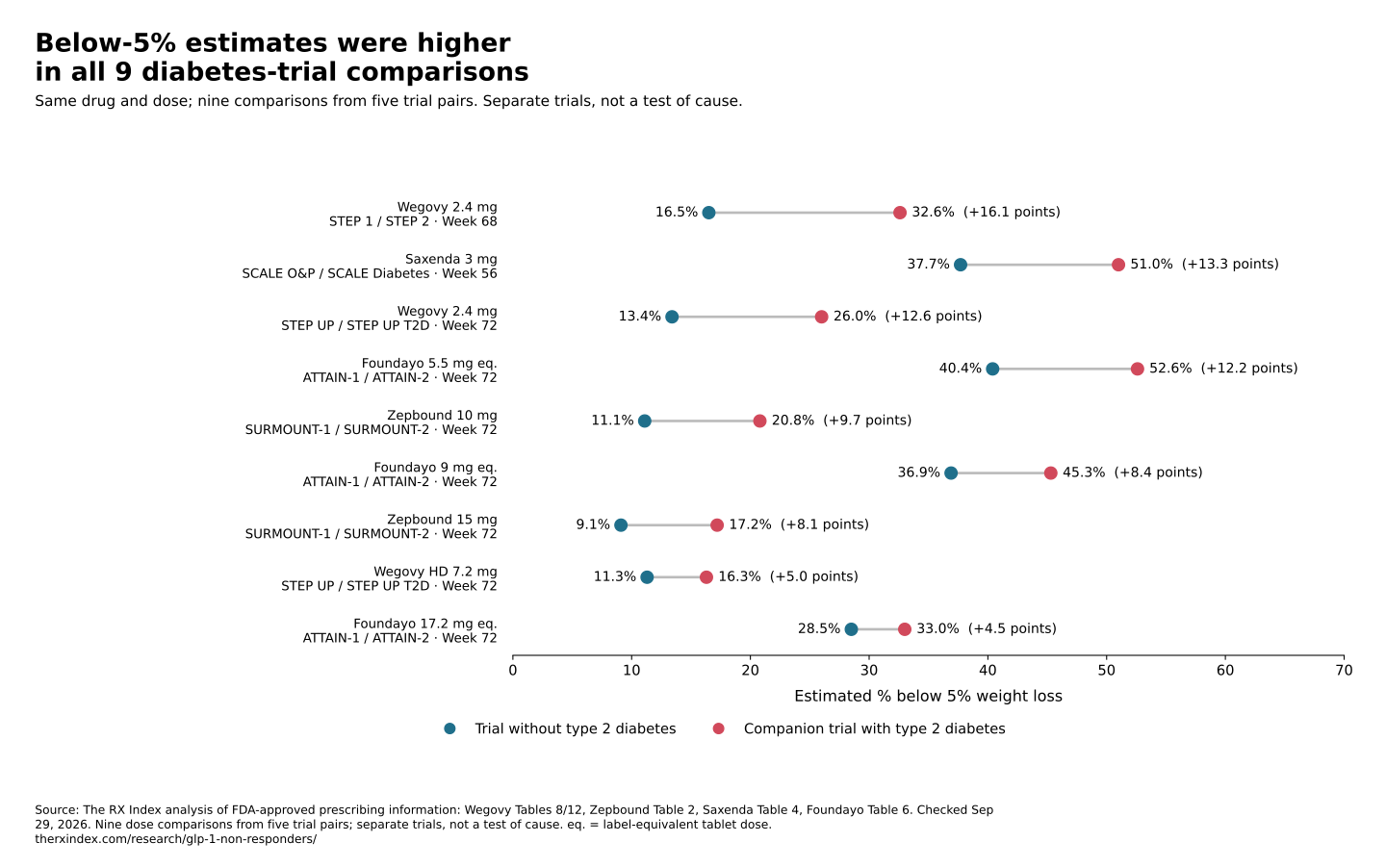
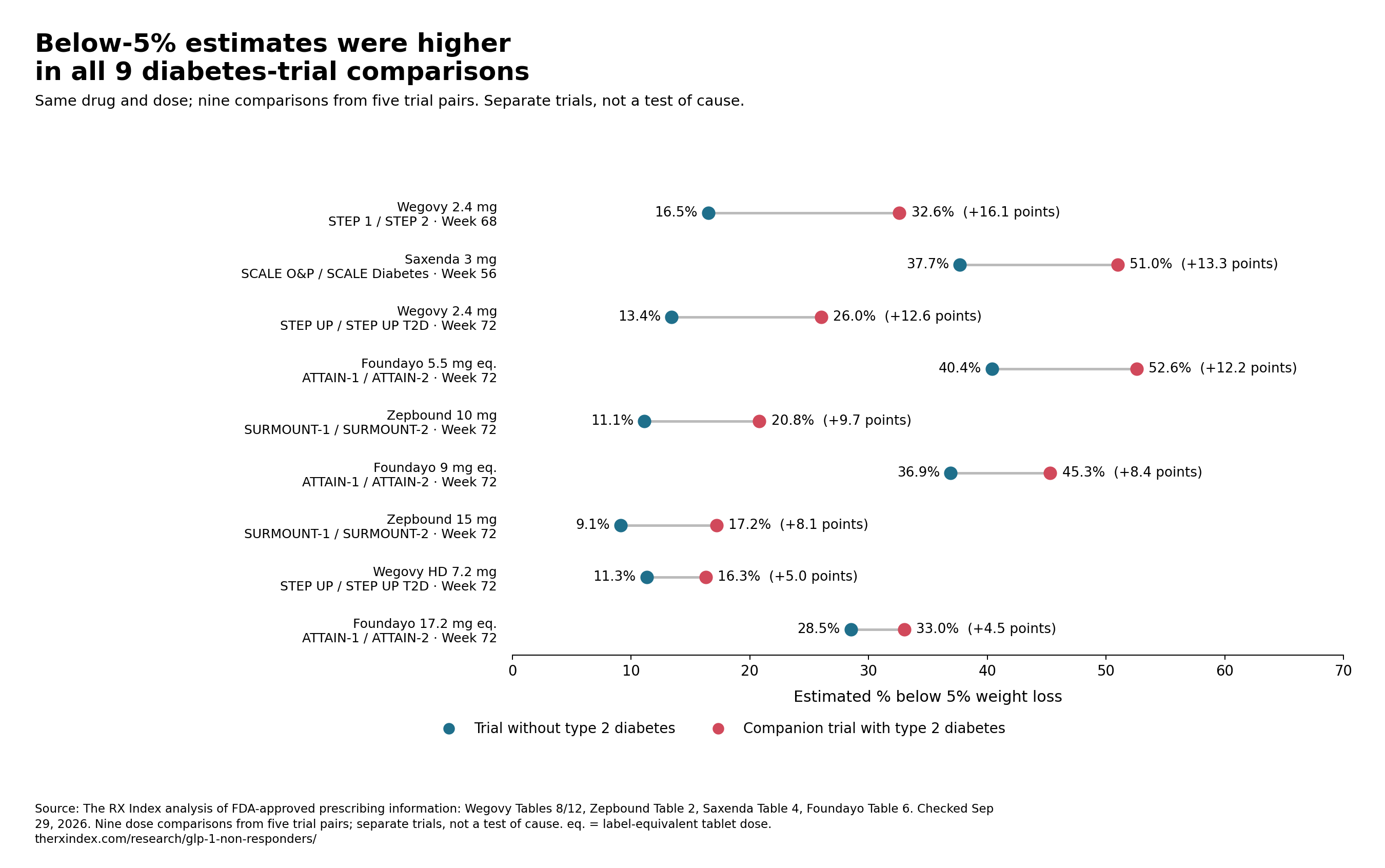
- All 9 of 9: In every same-drug, same-dose companion-trial comparison The RX Index reviewed, the estimated share losing less than 5% was higher in the trial with type 2 diabetes, by 4.5 to 16.1 percentage points. These are nine dose comparisons from five trial pairs, not nine independent trials (The RX Index analysis of four FDA labels, September 2026).
- 16.5% vs 32.6%: On Wegovy 2.4 mg, the estimated share below 5% weight loss at 68 weeks was 16.5% in adults without diabetes (STEP 1, N=1,306) and 32.6% in adults with type 2 diabetes (STEP 2, N=404) (Wegovy FDA label, June 2026, Table 8).
- 9.1% vs 17.2%: On Zepbound 15 mg, the estimated share below 5% weight loss at 72 weeks was 9.1% in adults without diabetes (SURMOUNT-1, N=630) and 17.2% in adults with type 2 diabetes (SURMOUNT-2, N=311) (Zepbound FDA label, August 2026, Table 2).
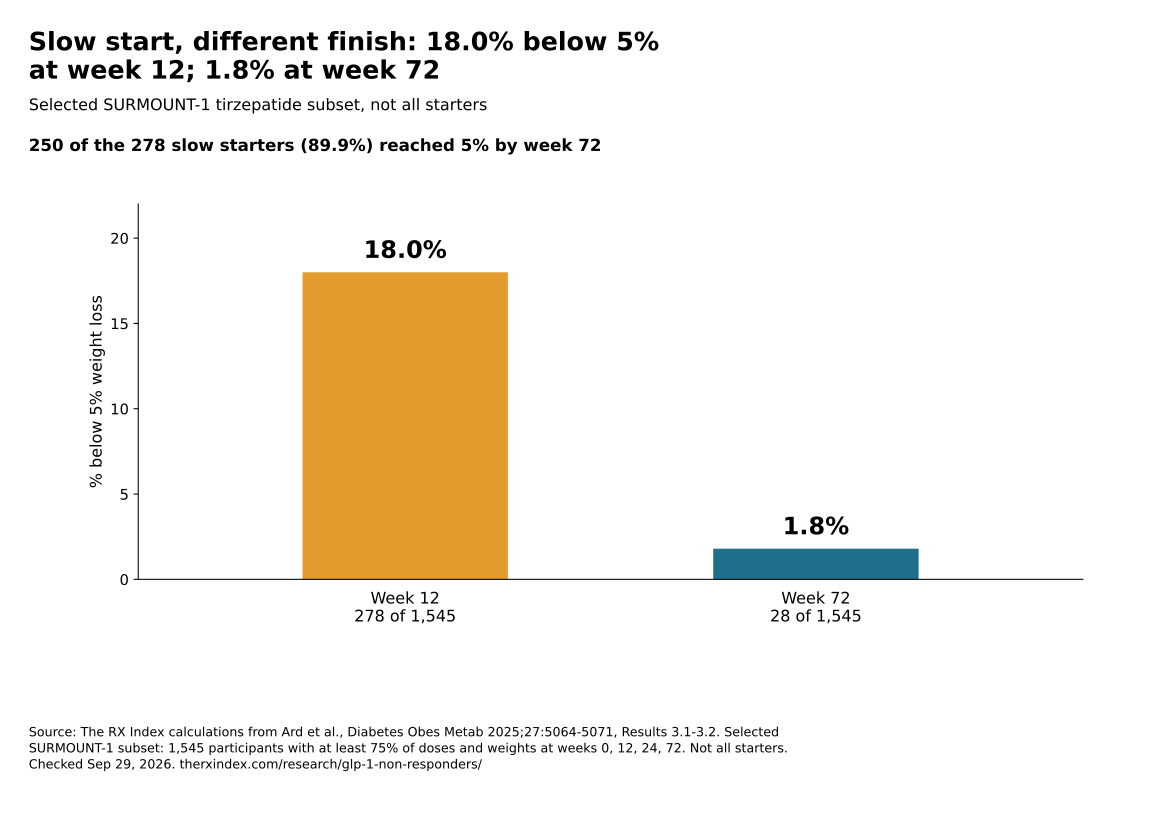
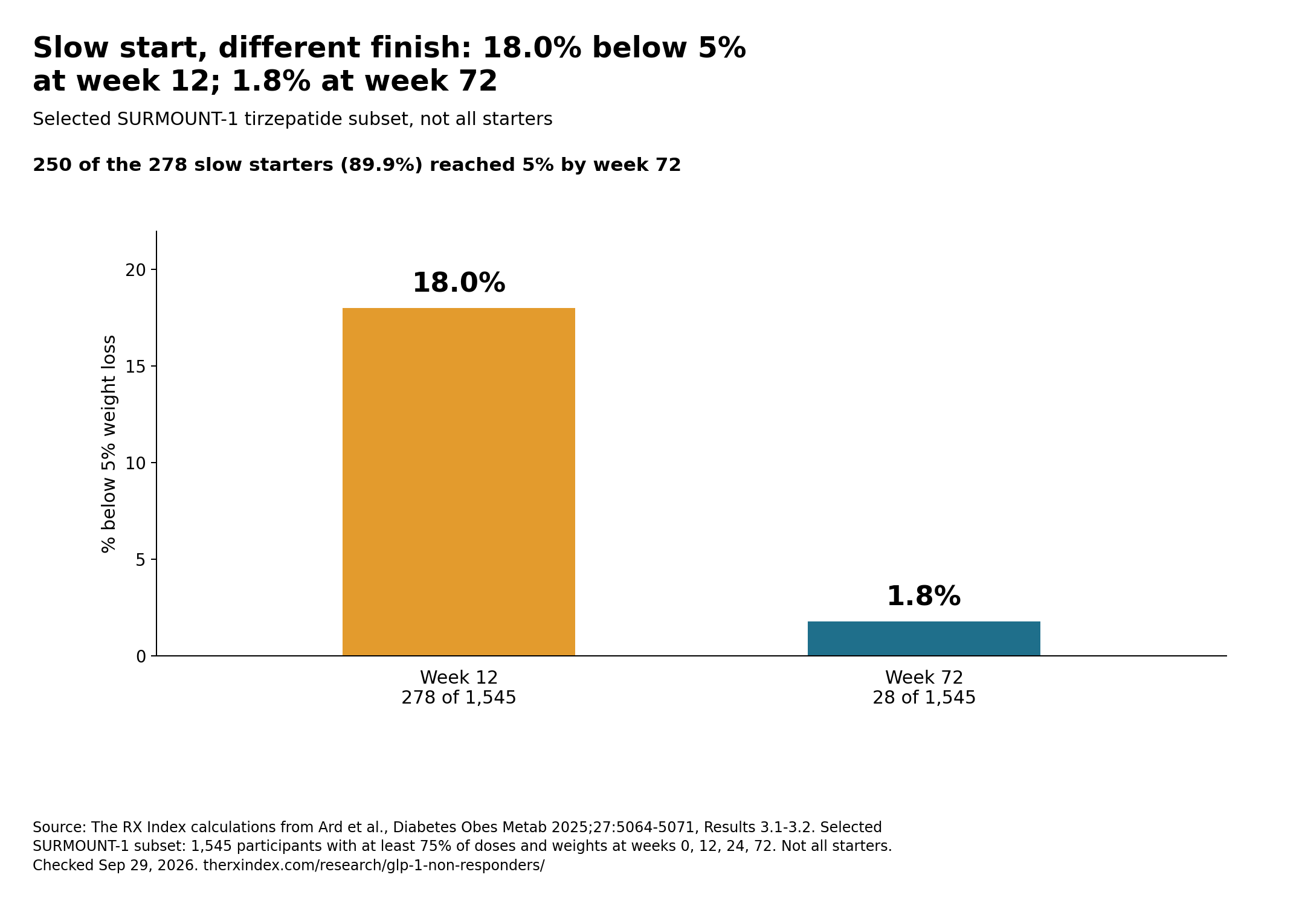
- 18.0% to 1.8%: Among 1,545 selected SURMOUNT-1 participants who took at least 75% of assigned tirzepatide doses and had weights at weeks 0, 12, 24 and 72, 278 (18.0%) were below 5% weight loss at week 12; 28 (1.8%) were below it at week 72 (Ard et al., Diabetes, Obesity and Metabolism, 2025).
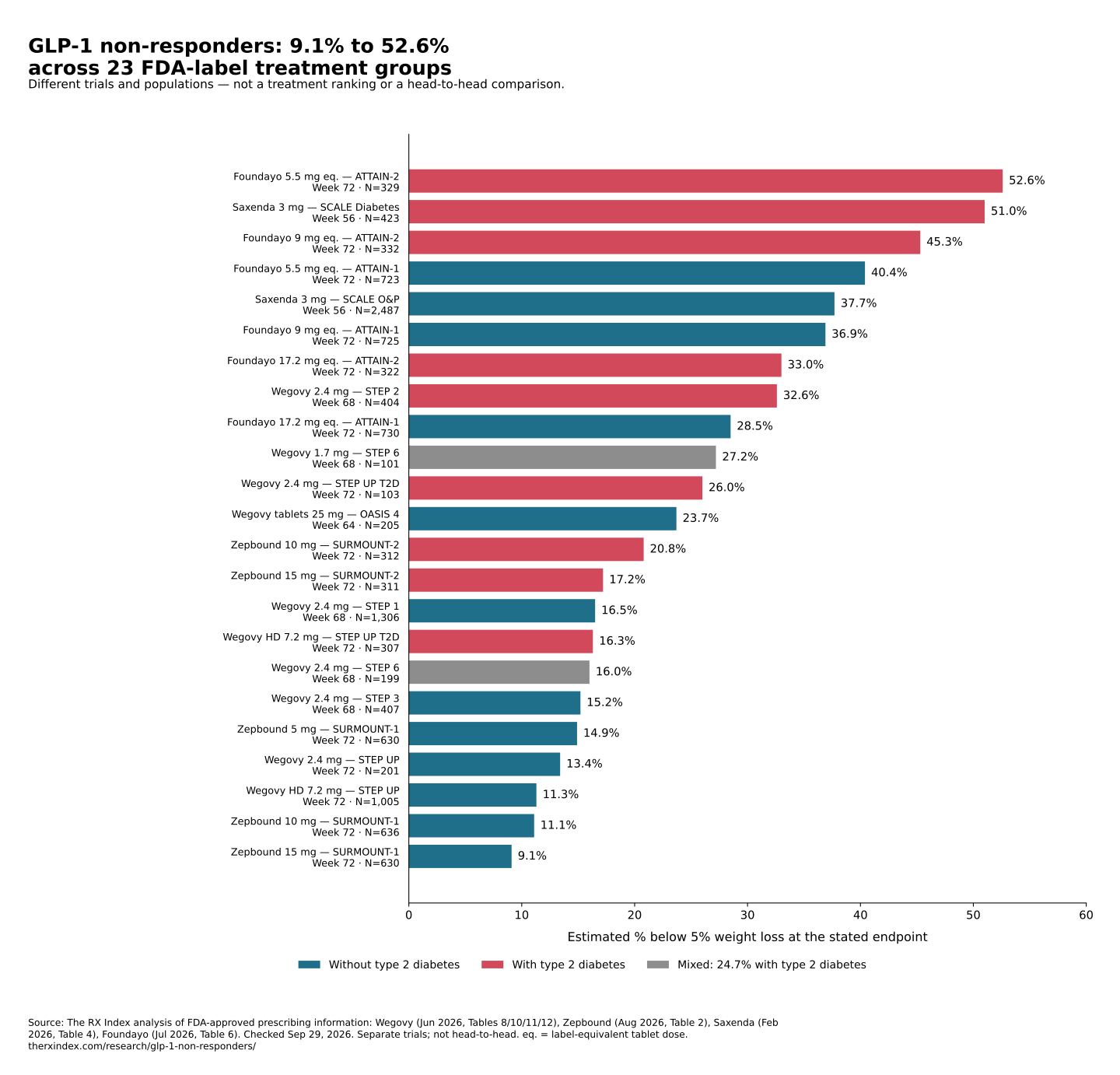
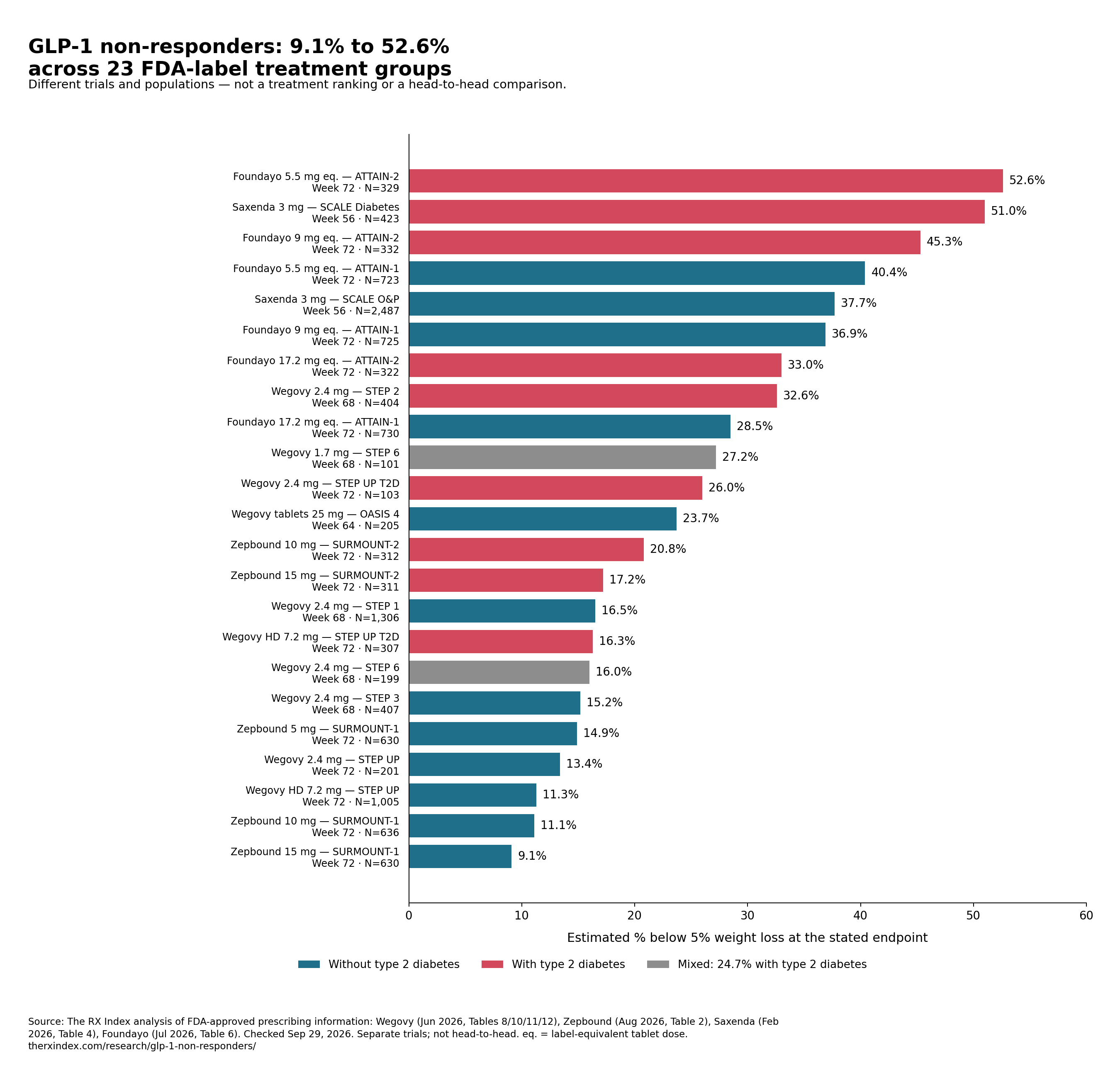
- 9.1% to 52.6%: Across 23 treatment groups in four FDA labels, the below-5% estimate ranged from 9.1% on Zepbound 15 mg in adults without diabetes (SURMOUNT-1, week 72) to 52.6% at Foundayo's 5.5 mg label-equivalent dose in adults with type 2 diabetes (ATTAIN-2, week 72) (The RX Index analysis, September 2026).
- 23.7%: On Wegovy tablets 25 mg, an estimated 23.7% of adults without diabetes lost less than 5% at 64 weeks in OASIS 4 (N=205; Wegovy FDA label, June 2026, Table 11).
- 28.5% to 40.4%: At Foundayo's label-equivalent tablet doses, the below-5% estimate ranged from 28.5% at 17.2 mg (N=730) to 40.4% at 5.5 mg (N=723) in adults without diabetes at 72 weeks in ATTAIN-1 (Foundayo FDA label, July 2026, Table 6).
- 37.7%: On Saxenda 3 mg, an estimated 37.7% of adults without diabetes lost less than 5% at 56 weeks in SCALE Obesity and Prediabetes (analysis N=2,487; Saxenda FDA label, February 2026, Table 4).
- 13.6% and 16.5%: Both describe semaglutide 2.4 mg at week 68 in STEP 1. The paper's observed-weight summary counted 1,212 people (13.6% below 5%); the FDA-label estimate used all 1,306 assigned the drug and accounted for missing weights (16.5%) (NEJM 2021; Wegovy label).
- 7 of 7: In every trial with more than one active dose in this label review, the highest dose had the smallest below-5% estimate. In SURMOUNT-1 at 72 weeks, it was 14.9% at 5 mg versus 9.1% at 15 mg of tirzepatide (The RX Index analysis of FDA labels).
- 52.2% to 73.2%: In all seven no-diabetes placebo groups in this reference, more than half were estimated to fall below 5% weight loss at 56–72 weeks. The lowest estimate was STEP 3's 52.2%, with intensive lifestyle therapy; the highest was ATTAIN-1's 73.2% (FDA-label table).
- The "1 in 10" headline: Stanford Medicine describes roughly 10% of people as carrying PAM gene variants studied for GLP-1 response. That carrier estimate is not a weight-loss non-responder rate. The primary paper found no significant weight-loss difference in its limited weight dataset (Stanford Medicine, April 2026; Genome Medicine, 2026).
On this page: Rates by drug and dose · What counts · Type 2 diabetes · Slow responders · 13.6% vs 16.5% · Higher doses · Pills · "1 in 10" · Real-world studies · Limits · Method · Cite · Data · FAQ · Sources
What percentage of people are GLP-1 non-responders?
There isn't one number. Across 23 treatment groups in four FDA labels, the estimated share who lost less than 5% of their weight by the end of the trial ranged from 9.1% (Zepbound 15 mg, SURMOUNT-1, no diabetes) to 52.6% (Foundayo's 5.5 mg label-equivalent dose, ATTAIN-2, with type 2 diabetes). Both endpoints were at 72 weeks. Each figure belongs to one trial, one dose and one group of people.
That's a wide spread. It's like asking how long a commute takes. It depends on where you start and how you travel. So pick the row that matches the drug, the dose and the trial population. These are study estimates, not a test of your own response.
*Foundayo doses are the label-equivalent doses of the approved tablet. The trials used an investigational capsule: the 6 mg, 12 mg and 36 mg capsule results correspond to 5.5 mg, 9 mg and 17.2 mg of the approved tablet (label, Table 6; VA monograph, page 1). This explains the study results; it is not a dosing conversion.
Source: The RX Index, from the at-least-5% weight-loss rows in the FDA-approved prescribing information for Wegovy (June 2026, Tables 8, 10, 11 and 12), Zepbound (August 2026, Table 2), Saxenda (February 2026, Table 4) and Foundayo (July 2026, Table 6). Estimated below 5% = 100 minus the reported percentage reaching at least 5%. N is the analysis-arm size: all randomized participants, except Saxenda requires a baseline weight. It is not the number weighed at the final visit. The labels account for missing weights, but their methods differ. Checked September 29, 2026.
Want a specific study row? Use the lookup below. It filters the same table. It doesn't guess.
Find an FDA-label treatment group
Choose any combination of filters. Results use the treatment rows in the trial-arm CSV; placebo rows remain separate comparisons.
23 treatment rows
| Treatment group | Trial and population | Endpoint | Reached at least 5% | Estimated below 5% | Placebo below 5% | Analysis N | Population and method | Source |
|---|---|---|---|---|---|---|---|---|
| semaglutide (Wegovy) 2.4 mg Jump to Table 1 row | STEP 1 Type 2 diabetes: No | Week 68 | 83.5% | 16.5% | 68.9% | 1,306 | Show source population and missing-data methodAll randomized participants; missing final weights imputed Missing endpoint weight: 7.2% — As reported in the cited table footnotes Retrieved-dropout multiple imputation using retrieved participants from the same treatment arm; logistic regression for threshold outcomes | Wegovy (semaglutide) US prescribing information, Novo Nordisk, Table 8, p. 10 Checked 2026-09-29 |
| semaglutide (Wegovy) 2.4 mg Jump to Table 1 row | STEP 2 Type 2 diabetes: Yes | Week 68 | 67.4% | 32.6% | 69.8% | 404 | Show source population and missing-data methodAll randomized participants; missing final weights imputed Missing endpoint weight: 4.0% — As reported in the cited table footnotes Retrieved-dropout multiple imputation using retrieved participants from the same treatment arm; logistic regression for threshold outcomes | Wegovy (semaglutide) US prescribing information, Novo Nordisk, Table 8, p. 10 Checked 2026-09-29 |
| semaglutide (Wegovy) 2.4 mg (with intensive lifestyle therapy and an initial 8-week low-calorie diet) Jump to Table 1 row | STEP 3 Type 2 diabetes: No | Week 68 | 84.8% | 15.2% | 52.2% | 407 | Show source population and missing-data methodAll randomized participants; missing final weights imputed Missing endpoint weight: 8.4% — As reported in the cited table footnotes Retrieved-dropout multiple imputation using retrieved participants from the same treatment arm; logistic regression for threshold outcomes | Wegovy (semaglutide) US prescribing information, Novo Nordisk, Table 8, p. 10 Checked 2026-09-29 |
| semaglutide (Wegovy) 1.7 mg (East Asian trial (Japan, South Korea)) Jump to Table 1 row | STEP 6 Type 2 diabetes: mixed (24.7% had T2D) | Week 68 | 72.8% | 27.2% | 80.6% | 101 | Show source population and missing-data methodAll randomized participants; missing final weights imputed Missing endpoint weight: 3.0% — As reported in the cited table footnotes Retrieved-dropout multiple imputation using retrieved participants from the same treatment arm; logistic regression for threshold outcomes | Wegovy (semaglutide) US prescribing information, Novo Nordisk, Table 10, p. 11 Checked 2026-09-29 |
| semaglutide (Wegovy) 2.4 mg (East Asian trial (Japan, South Korea)) Jump to Table 1 row | STEP 6 Type 2 diabetes: mixed (24.7% had T2D) | Week 68 | 84.0% | 16.0% | 80.6% | 199 | Show source population and missing-data methodAll randomized participants; missing final weights imputed Missing endpoint weight: 3.0% — As reported in the cited table footnotes Retrieved-dropout multiple imputation using retrieved participants from the same treatment arm; logistic regression for threshold outcomes | Wegovy (semaglutide) US prescribing information, Novo Nordisk, Table 10, p. 11 Checked 2026-09-29 |
| semaglutide (Wegovy tablets) 25 mg (endpoint is week 64) Jump to Table 1 row | OASIS 4 Type 2 diabetes: No | Week 64 | 76.3% | 23.7% | 68.7% | 205 | Show source population and missing-data methodAll randomized participants; missing final weights imputed Missing endpoint weight: 6.3% — As reported in the cited table footnotes Retrieved-dropout multiple imputation using retrieved participants from the same treatment arm; logistic regression for threshold outcomes | Wegovy (semaglutide) US prescribing information, Novo Nordisk, Table 11, p. 11 Checked 2026-09-29 |
| semaglutide (Wegovy) 2.4 mg Jump to Table 1 row | STEP UP Type 2 diabetes: No | Week 72 | 86.6% | 13.4% | 61.7% | 201 | Show source population and missing-data methodAll randomized participants; missing final weights imputed Missing endpoint weight: 6.0% — As reported in the cited table footnotes Retrieved-dropout multiple imputation using retrieved participants from the same treatment arm; logistic regression for threshold outcomes | Wegovy (semaglutide) US prescribing information, Novo Nordisk, Table 12, p. 11 Checked 2026-09-29 |
| semaglutide (Wegovy HD) 7.2 mg Jump to Table 1 row | STEP UP Type 2 diabetes: No | Week 72 | 88.7% | 11.3% | 61.7% | 1,005 | Show source population and missing-data methodAll randomized participants; missing final weights imputed Missing endpoint weight: 5.5% — As reported in the cited table footnotes Retrieved-dropout multiple imputation using retrieved participants from the same treatment arm; logistic regression for threshold outcomes | Wegovy (semaglutide) US prescribing information, Novo Nordisk, Table 12, p. 11 Checked 2026-09-29 |
| semaglutide (Wegovy) 2.4 mg Jump to Table 1 row | STEP UP T2D Type 2 diabetes: Yes | Week 72 | 74.0% | 26.0% | 66.0% | 103 | Show source population and missing-data methodAll randomized participants; missing final weights imputed Missing endpoint weight: Not reported — Not reported in the cited table footnotes Retrieved-dropout multiple imputation using retrieved participants pooled across all treatment arms; logistic regression for threshold outcomes | Wegovy (semaglutide) US prescribing information, Novo Nordisk, Table 12, p. 11 Checked 2026-09-29 |
| semaglutide (Wegovy HD) 7.2 mg Jump to Table 1 row | STEP UP T2D Type 2 diabetes: Yes | Week 72 | 83.7% | 16.3% | 66.0% | 307 | Show source population and missing-data methodAll randomized participants; missing final weights imputed Missing endpoint weight: 5.2% — As reported in the cited table footnotes Retrieved-dropout multiple imputation using retrieved participants pooled across all treatment arms; logistic regression for threshold outcomes | Wegovy (semaglutide) US prescribing information, Novo Nordisk, Table 12, p. 11 Checked 2026-09-29 |
| tirzepatide (Zepbound) 5 mg Jump to Table 1 row | SURMOUNT-1 Type 2 diabetes: No | Week 72 | 85.1% | 14.9% | 65.5% | 630 | Show source population and missing-data methodAll randomized participants; outcomes include treatment discontinuation Missing endpoint weight: 10.2% — As reported in the cited table footnotes Hybrid multiple imputation: same-arm retrieved-dropout imputation except missingness solely due to COVID-19, which used missing-at-random imputation; logistic regression for threshold outcomes | Zepbound (tirzepatide) US prescribing information, Eli Lilly and Company, Table 2, p. 15-16 Checked 2026-09-29 |
| tirzepatide (Zepbound) 10 mg Jump to Table 1 row | SURMOUNT-1 Type 2 diabetes: No | Week 72 | 88.9% | 11.1% | 65.5% | 636 | Show source population and missing-data methodAll randomized participants; outcomes include treatment discontinuation Missing endpoint weight: 10.5% — As reported in the cited table footnotes Hybrid multiple imputation: same-arm retrieved-dropout imputation except missingness solely due to COVID-19, which used missing-at-random imputation; logistic regression for threshold outcomes | Zepbound (tirzepatide) US prescribing information, Eli Lilly and Company, Table 2, p. 15-16 Checked 2026-09-29 |
| tirzepatide (Zepbound) 15 mg Jump to Table 1 row | SURMOUNT-1 Type 2 diabetes: No | Week 72 | 90.9% | 9.1% | 65.5% | 630 | Show source population and missing-data methodAll randomized participants; outcomes include treatment discontinuation Missing endpoint weight: 9.4% — As reported in the cited table footnotes Hybrid multiple imputation: same-arm retrieved-dropout imputation except missingness solely due to COVID-19, which used missing-at-random imputation; logistic regression for threshold outcomes | Zepbound (tirzepatide) US prescribing information, Eli Lilly and Company, Table 2, p. 15-16 Checked 2026-09-29 |
| tirzepatide (Zepbound) 10 mg (Mounjaro is the same drug) Jump to Table 1 row | SURMOUNT-2 Type 2 diabetes: Yes | Week 72 | 79.2% | 20.8% | 67.5% | 312 | Show source population and missing-data methodAll randomized participants; outcomes include treatment discontinuation Missing endpoint weight: 4.8% — As reported in the cited table footnotes Hybrid multiple imputation: same-arm retrieved-dropout imputation except missingness solely due to COVID-19, which used missing-at-random imputation; logistic regression for threshold outcomes | Zepbound (tirzepatide) US prescribing information, Eli Lilly and Company, Table 2, p. 15-16 Checked 2026-09-29 |
| tirzepatide (Zepbound) 15 mg (Mounjaro is the same drug) Jump to Table 1 row | SURMOUNT-2 Type 2 diabetes: Yes | Week 72 | 82.8% | 17.2% | 67.5% | 311 | Show source population and missing-data methodAll randomized participants; outcomes include treatment discontinuation Missing endpoint weight: 8.4% — As reported in the cited table footnotes Hybrid multiple imputation: same-arm retrieved-dropout imputation except missingness solely due to COVID-19, which used missing-at-random imputation; logistic regression for threshold outcomes | Zepbound (tirzepatide) US prescribing information, Eli Lilly and Company, Table 2, p. 15-16 Checked 2026-09-29 |
| liraglutide (Saxenda) 3 mg (label Study 1) Jump to Table 1 row | SCALE Obesity and Prediabetes Type 2 diabetes: No | Week 56 | 62.3% | 37.7% | 65.6% | 2,487 | Show source population and missing-data methodRandomized participants with a baseline weight measurement Missing endpoint weight: Not reported — Not reported in the cited table footnotes Multiple imputation of missing week-56 body weights; randomized participants with baseline weight | Saxenda (liraglutide) prescribing information, FDA, Table 4, p. 20-21 Checked 2026-09-29 |
| liraglutide (Saxenda) 3 mg (label Study 2) Jump to Table 1 row | SCALE Diabetes Type 2 diabetes: Yes | Week 56 | 49.0% | 51.0% | 83.6% | 423 | Show source population and missing-data methodRandomized participants with a baseline weight measurement Missing endpoint weight: Not reported — Not reported in the cited table footnotes Multiple imputation of missing week-56 body weights; randomized participants with baseline weight | Saxenda (liraglutide) prescribing information, FDA, Table 4, p. 20-21 Checked 2026-09-29 |
| orforglipron (Foundayo) 5.5 mg (Label-equivalent dose of the approved tablet; the trial used an investigational capsule (6, 12, 36 mg); trial capsule 6 mg) Jump to Table 1 row | ATTAIN-1 Type 2 diabetes: No | Week 72 | 59.6% | 40.4% | 73.2% | 723 | Show source population and missing-data methodAll randomized participants; outcomes include treatment discontinuation Missing endpoint weight: 16.0% — As reported in the cited table footnotes Modified multiple imputation: same-arm retrieved participants for missingness potentially related to treatment; observed same-arm data for other missingness; logistic regression with baseline and stratification factors | Foundayo (orforglipron) prescribing information, Eli Lilly, Table 6, p. 15-16 Checked 2026-09-29 |
| orforglipron (Foundayo) 9 mg (Label-equivalent dose of the approved tablet; the trial used an investigational capsule (6, 12, 36 mg); trial capsule 12 mg) Jump to Table 1 row | ATTAIN-1 Type 2 diabetes: No | Week 72 | 63.1% | 36.9% | 73.2% | 725 | Show source population and missing-data methodAll randomized participants; outcomes include treatment discontinuation Missing endpoint weight: 14.0% — As reported in the cited table footnotes Modified multiple imputation: same-arm retrieved participants for missingness potentially related to treatment; observed same-arm data for other missingness; logistic regression with baseline and stratification factors | Foundayo (orforglipron) prescribing information, Eli Lilly, Table 6, p. 15-16 Checked 2026-09-29 |
| orforglipron (Foundayo) 17.2 mg (Label-equivalent dose of the approved tablet; the trial used an investigational capsule (6, 12, 36 mg); trial capsule 36 mg) Jump to Table 1 row | ATTAIN-1 Type 2 diabetes: No | Week 72 | 71.5% | 28.5% | 73.2% | 730 | Show source population and missing-data methodAll randomized participants; outcomes include treatment discontinuation Missing endpoint weight: 15.0% — As reported in the cited table footnotes Modified multiple imputation: same-arm retrieved participants for missingness potentially related to treatment; observed same-arm data for other missingness; logistic regression with baseline and stratification factors | Foundayo (orforglipron) prescribing information, Eli Lilly, Table 6, p. 15-16 Checked 2026-09-29 |
| orforglipron (Foundayo) 5.5 mg (Label-equivalent dose of the approved tablet; the trial used an investigational capsule (6, 12, 36 mg); trial capsule 6 mg) Jump to Table 1 row | ATTAIN-2 Type 2 diabetes: Yes | Week 72 | 47.4% | 52.6% | 73.2% | 329 | Show source population and missing-data methodAll randomized participants; outcomes include treatment discontinuation Missing endpoint weight: 13.0% — As reported in the cited table footnotes Modified multiple imputation: same-arm retrieved participants for missingness potentially related to treatment; observed same-arm data for other missingness; logistic regression with baseline and stratification factors | Foundayo (orforglipron) prescribing information, Eli Lilly, Table 6, p. 15-16 Checked 2026-09-29 |
| orforglipron (Foundayo) 9 mg (Label-equivalent dose of the approved tablet; the trial used an investigational capsule (6, 12, 36 mg); trial capsule 12 mg) Jump to Table 1 row | ATTAIN-2 Type 2 diabetes: Yes | Week 72 | 54.7% | 45.3% | 73.2% | 332 | Show source population and missing-data methodAll randomized participants; outcomes include treatment discontinuation Missing endpoint weight: 10.0% — As reported in the cited table footnotes Modified multiple imputation: same-arm retrieved participants for missingness potentially related to treatment; observed same-arm data for other missingness; logistic regression with baseline and stratification factors | Foundayo (orforglipron) prescribing information, Eli Lilly, Table 6, p. 15-16 Checked 2026-09-29 |
| orforglipron (Foundayo) 17.2 mg (Label-equivalent dose of the approved tablet; the trial used an investigational capsule (6, 12, 36 mg); trial capsule 36 mg) Jump to Table 1 row | ATTAIN-2 Type 2 diabetes: Yes | Week 72 | 67.0% | 33.0% | 73.2% | 322 | Show source population and missing-data methodAll randomized participants; outcomes include treatment discontinuation Missing endpoint weight: 7.0% — As reported in the cited table footnotes Modified multiple imputation: same-arm retrieved participants for missingness potentially related to treatment; observed same-arm data for other missingness; logistic regression with baseline and stratification factors | Foundayo (orforglipron) prescribing information, Eli Lilly, Table 6, p. 15-16 Checked 2026-09-29 |
- In STEP 1, an estimated 16.5% of adults without type 2 diabetes assigned Wegovy 2.4 mg lost less than 5% at week 68 (analysis N=1,306; Wegovy (semaglutide) US prescribing information, Novo Nordisk, Table 8).
- In STEP 2, an estimated 32.6% of adults with type 2 diabetes assigned Wegovy 2.4 mg lost less than 5% at week 68 (analysis N=404; Wegovy (semaglutide) US prescribing information, Novo Nordisk, Table 8).
- In STEP 3, an estimated 15.2% of adults without type 2 diabetes assigned Wegovy 2.4 mg (with intensive lifestyle therapy and an initial 8-week low-calorie diet) lost less than 5% at week 68 (analysis N=407; Wegovy (semaglutide) US prescribing information, Novo Nordisk, Table 8).
- In STEP 6, an estimated 27.2% of participants in the mixed-population trial assigned Wegovy 1.7 mg (East Asian trial (Japan, South Korea)) lost less than 5% at week 68 (analysis N=101; Wegovy (semaglutide) US prescribing information, Novo Nordisk, Table 10).
- In STEP 6, an estimated 16.0% of participants in the mixed-population trial assigned Wegovy 2.4 mg (East Asian trial (Japan, South Korea)) lost less than 5% at week 68 (analysis N=199; Wegovy (semaglutide) US prescribing information, Novo Nordisk, Table 10).
- In OASIS 4, an estimated 23.7% of adults without type 2 diabetes assigned Wegovy tablets 25 mg (endpoint is week 64) lost less than 5% at week 64 (analysis N=205; Wegovy (semaglutide) US prescribing information, Novo Nordisk, Table 11).
- In STEP UP, an estimated 13.4% of adults without type 2 diabetes assigned Wegovy 2.4 mg lost less than 5% at week 72 (analysis N=201; Wegovy (semaglutide) US prescribing information, Novo Nordisk, Table 12).
- In STEP UP, an estimated 11.3% of adults without type 2 diabetes assigned Wegovy HD 7.2 mg lost less than 5% at week 72 (analysis N=1,005; Wegovy (semaglutide) US prescribing information, Novo Nordisk, Table 12).
- In STEP UP T2D, an estimated 26.0% of adults with type 2 diabetes assigned Wegovy 2.4 mg lost less than 5% at week 72 (analysis N=103; Wegovy (semaglutide) US prescribing information, Novo Nordisk, Table 12).
- In STEP UP T2D, an estimated 16.3% of adults with type 2 diabetes assigned Wegovy HD 7.2 mg lost less than 5% at week 72 (analysis N=307; Wegovy (semaglutide) US prescribing information, Novo Nordisk, Table 12).
- In SURMOUNT-1, an estimated 14.9% of adults without type 2 diabetes assigned Zepbound 5 mg lost less than 5% at week 72 (analysis N=630; Zepbound (tirzepatide) US prescribing information, Eli Lilly and Company, Table 2).
- In SURMOUNT-1, an estimated 11.1% of adults without type 2 diabetes assigned Zepbound 10 mg lost less than 5% at week 72 (analysis N=636; Zepbound (tirzepatide) US prescribing information, Eli Lilly and Company, Table 2).
- In SURMOUNT-1, an estimated 9.1% of adults without type 2 diabetes assigned Zepbound 15 mg lost less than 5% at week 72 (analysis N=630; Zepbound (tirzepatide) US prescribing information, Eli Lilly and Company, Table 2).
- In SURMOUNT-2, an estimated 20.8% of adults with type 2 diabetes assigned Zepbound 10 mg (Mounjaro is the same drug) lost less than 5% at week 72 (analysis N=312; Zepbound (tirzepatide) US prescribing information, Eli Lilly and Company, Table 2).
- In SURMOUNT-2, an estimated 17.2% of adults with type 2 diabetes assigned Zepbound 15 mg (Mounjaro is the same drug) lost less than 5% at week 72 (analysis N=311; Zepbound (tirzepatide) US prescribing information, Eli Lilly and Company, Table 2).
- In SCALE Obesity and Prediabetes, an estimated 37.7% of adults without type 2 diabetes assigned Saxenda 3 mg (label Study 1) lost less than 5% at week 56 (analysis N=2,487; Saxenda (liraglutide) prescribing information, FDA, Table 4).
- In SCALE Diabetes, an estimated 51.0% of adults with type 2 diabetes assigned Saxenda 3 mg (label Study 2) lost less than 5% at week 56 (analysis N=423; Saxenda (liraglutide) prescribing information, FDA, Table 4).
- In ATTAIN-1, an estimated 40.4% of adults without type 2 diabetes assigned Foundayo 5.5 mg (Label-equivalent dose of the approved tablet; the trial used an investigational capsule (6, 12, 36 mg); trial capsule 6 mg) lost less than 5% at week 72 (analysis N=723; Foundayo (orforglipron) prescribing information, Eli Lilly, Table 6).
- In ATTAIN-1, an estimated 36.9% of adults without type 2 diabetes assigned Foundayo 9 mg (Label-equivalent dose of the approved tablet; the trial used an investigational capsule (6, 12, 36 mg); trial capsule 12 mg) lost less than 5% at week 72 (analysis N=725; Foundayo (orforglipron) prescribing information, Eli Lilly, Table 6).
- In ATTAIN-1, an estimated 28.5% of adults without type 2 diabetes assigned Foundayo 17.2 mg (Label-equivalent dose of the approved tablet; the trial used an investigational capsule (6, 12, 36 mg); trial capsule 36 mg) lost less than 5% at week 72 (analysis N=730; Foundayo (orforglipron) prescribing information, Eli Lilly, Table 6).
- In ATTAIN-2, an estimated 52.6% of adults with type 2 diabetes assigned Foundayo 5.5 mg (Label-equivalent dose of the approved tablet; the trial used an investigational capsule (6, 12, 36 mg); trial capsule 6 mg) lost less than 5% at week 72 (analysis N=329; Foundayo (orforglipron) prescribing information, Eli Lilly, Table 6).
- In ATTAIN-2, an estimated 45.3% of adults with type 2 diabetes assigned Foundayo 9 mg (Label-equivalent dose of the approved tablet; the trial used an investigational capsule (6, 12, 36 mg); trial capsule 12 mg) lost less than 5% at week 72 (analysis N=332; Foundayo (orforglipron) prescribing information, Eli Lilly, Table 6).
- In ATTAIN-2, an estimated 33.0% of adults with type 2 diabetes assigned Foundayo 17.2 mg (Label-equivalent dose of the approved tablet; the trial used an investigational capsule (6, 12, 36 mg); trial capsule 36 mg) lost less than 5% at week 72 (analysis N=322; Foundayo (orforglipron) prescribing information, Eli Lilly, Table 6).
How many people on placebo fell short?
On placebo plus the trial's lifestyle support, an estimated 52.2% to 73.2% of adults without diabetes lost less than 5% in the seven trials below. STEP 3, which used intensive lifestyle therapy, had the lowest placebo estimate. For a like-for-like example, SURMOUNT-1 estimated 65.5% below 5% on placebo versus 9.1% on Zepbound 15 mg at 72 weeks — about 2 in 3 versus 1 in 11 (Zepbound label, Table 2).
Source: Wegovy (June 2026, Tables 8, 11, 12), Zepbound (August 2026, Table 2), Saxenda (February 2026, Table 4) and Foundayo (July 2026, Table 6). This includes every no-diabetes placebo group in the dataset; the other six placebo groups are in the CSV. Checked September 29, 2026.
What counts as a GLP-1 non-responder?
This reference uses a 5% line: a non-responder loses less than 5% of their starting weight at the stated endpoint. That is a research threshold, not a diagnosis of permanent drug resistance. For a 200-pound person, 5% is 10 pounds. The week that gets checked differs — week 16 (with a 4% line) on Saxenda's FDA label, 6 months in UK guidance, and weeks 56 to 72 at the end of the trials in Table 1.
Losing less than 5% isn't the same as losing nothing. Drop 8 pounds from 200 and you've lost 4%. In these tables, that still counts as falling short.
| Who sets it | The rule | When it's checked |
|---|---|---|
| FDA, Saxenda label (February 2026) | Stop if an adult hasn't lost at least 4% of starting weight | 16 weeks after starting |
| NICE, TA875 (semaglutide, NICE/NHS guidance) | Consider stopping if less than 5% of starting weight is lost | After 6 months |
| NICE, TA1026 (tirzepatide, NICE/NHS guidance) | If less than 5% is lost, decide whether to continue based on benefits and risks | After 6 months on the highest tolerated dose |
| Trials in Table 1 | Reports the share reaching at least 5% | End of trial: weeks 56 to 72 (64 for OASIS 4) |
| SURMOUNT-1 early-response analysis | Under 5% = "late responder" | Week 12 |
Source: FDA Saxenda label (February 2026, section 2.2); NICE TA875 and TA1026, recommendation 1.2 in each; Ard et al., Diabetes, Obesity and Metabolism (2025). These are descriptions of the source rules, not instructions to change your medicine. Checked September 29, 2026.
An insurance renewal rule is a different question from a trial result. We break those down in how GLP-1 renewal rules differ by plan.
Do people with type 2 diabetes respond less to GLP-1s?
In the FDA-label data, a bigger estimated share fell short. In all 9 same-drug, same-dose comparisons between a trial without type 2 diabetes and its companion trial with it, the below-5% estimate was higher in the diabetes trial — by 4.5 to 16.1 percentage points. For Wegovy 2.4 mg in STEP 2 versus STEP 1 at 68 weeks, it was 32.6% vs 16.5%, nearly double.
Picture the STEP 1 and STEP 2 estimates as groups of 100: about 17 below 5% without diabetes and about 33 with type 2 diabetes. This restates the two trial estimates; it does not predict what will happen to 100 new patients.
*Label-equivalent tablet dose.
Source: The RX Index analysis of Wegovy (June 2026, Tables 8 and 12), Saxenda (February 2026, Table 4), Zepbound (August 2026, Table 2) and Foundayo (July 2026, Table 6). Gap = with minus without; ratio = with divided by without, rounded to two decimals. Nine dose comparisons from five trial pairs. Endpoints: STEP 1/2, 68 weeks; SCALE, 56 weeks; all other pairs, 72 weeks. These are separate trials, not a test of cause. Checked September 29, 2026.
The Wegovy label says the same thing in plain words: people with type 2 diabetes lost less weight on the injection than people without it (Wegovy label, section 8.6).
Now the careful part. These are separate trials, not one trial split in two. The people differed in more ways than diabetes. In STEP 2, the average age was 55; in STEP 1 it was 46 (Wegovy label, section 14.2). And the nine rows come from five trial pairs, so they aren't nine independent tests. Missing-weight methods also differ: STEP UP used retrieved participants from the same treatment arm; STEP UP T2D pooled them across all arms (Wegovy label, Table 12). What the table shows is a pattern that held every single time in these comparisons. It doesn't prove diabetes is the cause.
One more thing for pill-shoppers: the Wegovy label says the tablets haven't been studied for weight loss in adults with type 2 diabetes. There's no diabetes row for them because no such trial is in the label (section 8.6).
What is a slow responder, and do slow starters catch up?
In a SURMOUNT-1 analysis of 1,545 selected people who took at least 75% of assigned tirzepatide doses and had weights at weeks 0, 12, 24 and 72, 278 (18.0%) had lost less than 5% by week 12. By week 72, 250 of those 278 (89.9%) had reached 5%, leaving 28 people — 1.8% of the group — still under the line.
Researchers called that week-12 group "late responders." Most of them weren't non-responders at all. They were just early.
| Checkpoint | What was counted | Number | Share |
|---|---|---|---|
| Week 12 | Under 5% weight loss | 278 of 1,545 | 18.0% |
| Week 24 | Slow starters who had reached 5% | 194 of 278 | 69.8% |
| Week 72 | Slow starters who had reached 5% | 250 of 278 | 89.9% |
| Week 72 | Selected participants still under 5% | 28 of 1,545 | 1.8% |
Source: Ard et al., Diabetes, Obesity and Metabolism (2025), Methods 2.1 and Results 3.1–3.2. The study was funded by Eli Lilly and Company. Group = SURMOUNT-1 tirzepatide users who took at least 75% of doses and had weights at weeks 0, 12, 24 and 72 (82% of those treated). Shares calculated by The RX Index. Checked September 29, 2026.
Why can week 12 be too early to judge? The dose climbs in steps. In SURMOUNT-1, the 15 mg group reached its target dose at week 20; the lower-dose groups reached theirs earlier (trial methods). On the standard schedule, Wegovy's injection reaches 2.4 mg in week 17 (Wegovy label, Table 1). Judging at week 12 is like grading a race at the first turn.
Semaglutide shows a similar pattern. In a STEP 4 conference abstract, 12.0% of the 535 people assigned to continue semaglutide were below 5% loss at week 20. Among those early nonresponders, the reported analysis implies 57.1% reached 5% by week 68: 100 minus the reported 42.9% negative predictive value. They had first reached and tolerated 2.4 mg during a run-in; this was a trial-product analysis of on-treatment data, not all starters (Journal of the Endocrine Society, 2021).
Two honest limits. First, the tirzepatide group was picked for taking most of their doses and showing up to weigh-ins. Second, this is trial history, not a promise about any one person. When to keep going or stop is a call for you and your prescriber. If you're past the ramp-up and still stuck, here are options people compare when Zepbound isn't working.
Why do sources say both 13.6% and 16.5% for Wegovy?
Because these summaries handle missing weights differently. The original STEP 1 paper's observed-weight summary counted 1,212 people on semaglutide weighed at week 68: 165 of them (13.6%) lost less than 5%. The FDA-label analysis used all 1,306 assigned the drug and estimated missing weights: an estimated 16.5% lost less than 5%. The original paper also reports modeled analyses; 13.6% refers specifically to its observed-weight summary.
| Summary | Who is counted | Lost less than 5% | Math |
|---|---|---|---|
| Original paper's observed-weight summary, NEJM 2021 | 1,212 people with a week-68 weight | 13.6% | 1,212 − 1,047 = 165; 165 ÷ 1,212 × 100 = 13.6% (rounded) |
| FDA label, Table 8 | All 1,306 assigned the drug; missing weights (7.2%) estimated | 16.5% | 100 − 83.5 = 16.5% |
Source: Wilding et al., NEJM (2021); Wegovy FDA label (June 2026). Difference: 16.5 − 13.6 = 2.9 percentage points. Checked September 29, 2026.
Think of grading a class. You can count only the kids who turned in the final. Or you can count everyone enrolled and estimate the missing papers. Both are honest. They answer different questions.
If you're quoting one, say which. Our guide on what to try when Wegovy isn't working uses the 13.6% figure. That's right for what it counts. This page uses the label's 16.5% so every main-table result comes from prescribing information. That keeps the source type consistent, not the exact statistical method. Each method is recorded in the CSV.
Do higher doses mean fewer GLP-1 non-responders?
The estimates followed that pattern. In all 7 trials with more than one active dose in this label review, the highest dose had the smallest below-5% estimate. On Zepbound in SURMOUNT-1 at 72 weeks, it was 14.9% at 5 mg versus 9.1% at 15 mg — a 5.8-percentage-point difference.
| Trial | Lower dose | Middle dose | Highest dose |
|---|---|---|---|
| SURMOUNT-1 (Zepbound, no diabetes) | 5 mg: 14.9% | 10 mg: 11.1% | 15 mg: 9.1% |
| SURMOUNT-2 (Zepbound, type 2 diabetes) | 10 mg: 20.8% | — | 15 mg: 17.2% |
| STEP 6 (Wegovy, Japan and South Korea) | 1.7 mg: 27.2% | — | 2.4 mg: 16.0% |
| STEP UP (Wegovy, no diabetes) | 2.4 mg: 13.4% | — | 7.2 mg: 11.3% |
| STEP UP T2D (Wegovy, type 2 diabetes) | 2.4 mg: 26.0% | — | 7.2 mg: 16.3% |
| ATTAIN-1 (Foundayo, no diabetes) | 5.5 mg*: 40.4% | 9 mg*: 36.9% | 17.2 mg*: 28.5% |
| ATTAIN-2 (Foundayo, type 2 diabetes) | 5.5 mg*: 52.6% | 9 mg*: 45.3% | 17.2 mg*: 33.0% |
*Label-equivalent tablet dose.
Source: The RX Index analysis of Zepbound (August 2026, Table 2), Wegovy (June 2026, Tables 10 and 12) and Foundayo (July 2026, Table 6). STEP 6 ended at 68 weeks; the other six trials at 72 weeks. The STEP UP 5% comparisons were not part of the hierarchical testing procedure. These descriptive estimates do not establish a statistically significant dose difference in every trial. Checked September 29, 2026.
These within-trial comparisons avoid many differences between separate studies. Random assignment helps balance the dose groups; it does not make them identical. It's still not dosing advice. Higher doses can bring more side effects, and your dose is your prescriber's call (Wegovy label, sections 2 and 6).
Are GLP-1 pills more likely to leave people as non-responders?
In these separate trials without diabetes, the pill estimates were 23.7% below 5% on Wegovy tablets 25 mg at 64 weeks and 28.5% to 40.4% at Foundayo's label-equivalent doses at 72 weeks. For comparison, SURMOUNT-1 estimated 9.1% on Zepbound 15 mg at 72 weeks, and STEP 1 estimated 16.5% on Wegovy 2.4 mg at 68 weeks. These are different drugs or formulations, doses, populations and study designs — not a test of whether pills cause more nonresponse (Tables 1 and 4).
A few details matter here. The Wegovy tablet trial ran 64 weeks, not 68 or 72. Foundayo's trials used a capsule, and the label converts those doses to the approved tablets. And the Wegovy tablets haven't been studied for weight loss in type 2 diabetes. The label also reports lower average semaglutide blood levels from 25 mg tablets than from the 2.4 mg injection in adults with type 2 diabetes (Wegovy label, section 8.6).
If you're weighing a pill against a shot for other reasons too — price, needles, daily routine — you can compare GLP-1 treatment options side by side.
Where does the "1 in 10 GLP-1 non-responders" number come from?
From at least four places, and they do not measure the same thing. Stanford Medicine describes roughly 10% of people as carrying gene variants studied for GLP-1 response. A Yale Medicine doctor estimated about 10% see little to no weight loss. A company's cost model used in a NICE appraisal assumed 10% would stop semaglutide for nonresponse, based on expert opinion. The Conversation cites a broader 10%–30% range.
| Source | What the number is | A weight-loss non-responder rate? |
|---|---|---|
| Stanford Medicine (April 2026), on a Genome Medicine study | Its report describes roughly 10% as carrying PAM variants studied for GLP-1 response | No — this is a carrier estimate; the primary paper found no significant weight-loss difference in its limited weight data |
| Yale Medicine | A doctor's estimate that about 10% see little to no weight loss across trials | A clinician summary, not a pooled rate; the article links the original STEP 1 and SURMOUNT-1 studies |
| NICE TA1026 draft guidance | A company's model assumed 10% would stop semaglutide at 6 months for non-response, based on clinical expert opinion | An assumption, not a measurement |
| The Conversation (June 2026) | Says research suggests 10% to 30% are non-responders | The article links Squire et al., whose introduction summarizes prior studies; that paper's own clinic cohort found 17.8% |
| FDA labels (Table 1 on this page) | Share who lost less than 5% at trial end | Study-specific estimates: 9.1% to 16.5% in the listed Zepbound and Wegovy 2.4 mg groups without diabetes; up to 52.6% across all 23 groups |
Source: the pages linked in each row were checked as examples of how the numbers are used, not substitutes for clinical evidence. Original outcome sources are the PAM study, STEP 1, SURMOUNT-1, Squire cohort and the four labels. The NICE figure was a historical company-model assumption questioned during appraisal, not a current stopping rule. Checked September 29, 2026.
So is "1 in 10" wrong? It is a rough description of SURMOUNT-1's 9.1% estimate at 15 mg and 72 weeks without diabetes. It is below every listed estimate for Wegovy 2.4 mg, the pills, Saxenda and the type 2 diabetes trial groups. And the genetics version is not a weight-loss nonresponse rate: the PAM paper did examine weight, but its limited data found no significant difference. That does not rule out all genetic effects on treatment response.
What do real-world studies show?
Two clinic studies reported 12.7% and 17.8%, but counted different things. At Mayo Clinic, 13 of 102 adults with six-month semaglutide weight data (12.7%) had lost less than 5%. Doses varied; this was not a group taking only 1.7 or 2.4 mg (Ghusn et al., 2022).
In one Vancouver clinic, 86 of 483 adults (17.8%) never reached 5% in their recorded follow-up. That BMJ Open study, published in 2025, used each person's greatest recorded weight loss, not one shared final-visit weight. Mean follow-up was 520 days, or 17.3 months. The records covered November 2018 to April 2021; 86% were prescribed semaglutide and 14% liraglutide, and 1 mg weekly was the most frequent semaglutide dose (Squire et al.).
These are useful, but small. Each comes from a single health system or clinic and needs recorded follow-up. In the Mayo study, most people without six-month data had simply not reached six months by the data cutoff — not necessarily left care. The Vancouver study required at least six months of follow-up. They aren't national rates, and they don't belong in the same table as the fixed-endpoint trials. Sources: Ghusn et al., JAMA Network Open (2022); Squire et al., BMJ Open (2025).
For more on why real life and trials drift apart, see GLP-1 real-world results vs clinical trials and GLP-1 trial dropout rates.
What can these numbers tell you, and what can't they?
They give the label's estimated share below 5% for a specific drug, dose, population and endpoint. That makes them useful for finding the right study result and checking a claim you've read. Sharing a 5% threshold does not make separate trials like-for-like.
Stopping treatment and staying below 5% weight loss are different outcomes. A person can stop for reasons other than limited weight loss; see GLP-1 adherence and stopping statistics.
They can't tell you your own odds. They don't explain why any one person falls short. They don't cover compounded products, which weren't part of these trials. They don't cover Ozempic or Mounjaro diabetes-treatment trial results. Some doses overlap with weight-management products; that does not make their trial populations or endpoints the same. And trials pick their people carefully — see who was in GLP-1 trials and who they left out.
Why do these numbers matter now?
Three new options were FDA-approved within 100 days: Wegovy tablets on December 22, 2025, Wegovy HD 7.2 mg on March 19, 2026 and Foundayo on April 1, 2026. Each comes with its own trial numbers. A single "GLP-1 non-responder rate" hides the differences people are now choosing between.
If you're weighing your next step after reading these numbers, Find My GLP-1 Path asks a few questions about your goals, insurance and budget and shows the options that fit. It's free; the site estimates about 2 minutes. Your clinician — not a table — decides whether a treatment is working for you.
How we built this
What we collected. We collected the adult, baseline-to-endpoint weight-management comparisons in Wegovy Tables 8, 10, 11 and 12; Zepbound Table 2; Saxenda Table 4, Studies 1 and 2; and Foundayo Table 6. Each reports a percentage reaching at least 5% weight loss. The reference contains 23 active-treatment and 13 placebo groups across 13 trial comparisons. We recorded the trial, dose, schedule, week, analysis N, diabetes population and method for missing weights. This is our compilation and analysis, not a new clinical study or patient survey.
Where and when. Wegovy label revised June 2026, Zepbound August 2026, Saxenda February 2026 and Foundayo July 2026. All were checked September 29, 2026. We read the four original prescribing-information documents and their table footnotes, and checked the numerical tables visually. All 36 main-dataset rows were checked directly, including STEP UP, STEP UP T2D and Foundayo Table 6. The exact capsule-to-tablet dose correspondence is from the VA monograph; the response rates come from the label, not the monograph's trial summary. Label revision dates are not trial observation dates.
How we processed it. Estimated below 5% = 100 minus the label's reported percentage reaching at least 5%, displayed to one decimal. We did not turn imputed percentages into observed patient counts. For Table 4, we used the five companion pairs STEP 1/STEP 2, STEP UP/STEP UP T2D, SURMOUNT-1/SURMOUNT-2, SCALE Obesity and Prediabetes/SCALE Diabetes, and ATTAIN-1/ATTAIN-2. Every common active dose in those pairs is included, giving nine comparisons. Gap = with minus without, in percentage points; ratio = with divided by without, rounded to two decimals. We did not pair every unrelated trial with every other trial.
The dose table includes all seven trials with multiple active doses in this label dataset. The placebo table includes all seven no-diabetes placebo groups. The CSV also keeps the five diabetes placebo groups and STEP 6's mixed-population placebo. Context rows stay separate: observed weights, selected early-response groups, clinic cohorts, guidance and media/model claims do not share a denominator.
What we left out, and why. Trials that selected people after a run-in were kept out of the main table: STEP 4 selected people who reached and tolerated semaglutide 2.4 mg, while Saxenda's Study 3 selected people after initial weight loss. Those are not the same selection rule. We also excluded pediatric-only, heart-outcome, liver-disease and sleep-apnea trials, withdrawal/maintenance comparisons and later extension endpoints. STEP UP T2D is included. The scope is these four labels' specified weight-management tables, not every GLP-1 study ever published.
How to reproduce it. Download the CSVs below. Each main row has the source link, table, PDF page, revision and check date. Re-open the table, subtract the "at least 5%" figure from 100, and you'll get our number. Comparison rows identify both underlying arm records. Blank fields mean not reported or not applicable, never zero. Our general standards are in the research methodology.
How to cite this page
Kaden Coziar. "GLP-1 Non-Responders: Rates by Drug, Dose and Study (23 Groups)." The RX Index Research. Data checked September 29, 2026. https://therxindex.com/research/glp-1-non-responders/
For a single number, keep its trial, dose, population and week with it — for example: "In SURMOUNT-2, an estimated 17.2% of adults with type 2 diabetes assigned tirzepatide 15 mg lost less than 5% at 72 weeks (analysis N=311; Zepbound FDA label, August 2026, Table 2, via The RX Index)."
Reuse: You're welcome to reuse The RX Index's original compilation, calculations and charts with credit to The RX Index for that contribution. Keep the underlying source attribution and terms; this permission does not cover third-party text, tables or figures. No link is required.
Download the data
Three free CSV files, no sign-up. Each row carries its source link and check date.
1. Trial arms — 36 rows: 23 treatment groups and 13 placebo groups from four FDA labels.
2. Type 2 diabetes comparisons — 9 rows, same drug and dose across five companion-trial pairs.
Download the diabetes-comparison CSV.
3. Context — 17 rows: the STEP 1 method comparison, slow-responder follow-up, real-world studies, stopping rules and the four "10%" source claims, labeled by what they actually measure.
Frequently asked questions
What percent of GLP-1 users are non-responders? No single number fits everyone. Across the 23 FDA-label treatment groups in this reference, the below-5% estimate ranged from 9.1% (Zepbound 15 mg, SURMOUNT-1, without diabetes) to 52.6% (Foundayo 5.5 mg label-equivalent dose, ATTAIN-2, with type 2 diabetes), both at 72 weeks. For Wegovy 2.4 mg in STEP 1 without diabetes, it was 16.5% at 68 weeks. Pick the row that matches the drug, dose, population and endpoint (Table 1).
What is considered a non-responder to tirzepatide? This reference uses less than 5% weight loss at the stated endpoint. On tirzepatide (Zepbound), the below-5% estimates were 9.1% to 14.9% without diabetes in SURMOUNT-1, depending on dose, and 17.2% to 20.8% with type 2 diabetes in SURMOUNT-2; both were 72-week trials (Zepbound label, Table 2). Mounjaro also contains tirzepatide, but a weight-management trial result is not a diabetes-treatment response rate (NIDDK).
What is considered a slow responder on GLP-1? In the cited tirzepatide analysis, a "late responder" had lost less than 5% at week 12. That was 278 of 1,545 selected participants (18.0%) with at least 75% of doses and the required weight records; 250 of those 278 (89.9%) reached 5% by week 72. The 15 mg group was still in dose escalation at week 12 (Ard et al., 2025).
Why are some people non-responders to GLP-1? These tables show patterns, not causes. The below-5% estimate was higher in the diabetes trial in all nine companion-dose comparisons, and smallest at the highest included dose in all seven multi-dose trials (Tables 4 and 7). A 2026 PAM study found blood-sugar-response associations in some analyses, but no significant weight-loss difference in its limited weight data; it did not establish a population weight-loss nonresponse rate (primary study).
Does losing less than 5% mean the drug did nothing? No. Losing 8 pounds from 200 is 4% — less than 5%, but not zero. "Non-responder" here means below a set line at a set week, not no change at all.
Do these rates apply to Ozempic or compounded semaglutide? Not directly. Each main-table row is a specified product/formulation, dose and weight-management trial. Some semaglutide doses overlap with diabetes treatment, and the original STEP 2 trial included a 1 mg arm not shown in this label table; a shared ingredient or dose does not make the populations and endpoints the same (STEP 2; Wegovy label). Compounded products were not studied in these trials.
How long should you give a GLP-1 before deciding it isn't working? The timing differs by medicine and source. The adult Saxenda label uses a 4% stopping threshold at 16 weeks; NICE semaglutide guidance considers stopping below 5% after six months of treatment, while NICE tirzepatide guidance calls for a benefits-and-risks decision below 5% after six months on the highest tolerated dose. Most selected SURMOUNT-1 week-12 late responders reached 5% later (Ard et al.). Talk with your prescriber before stopping or switching; report side effects without waiting for a response checkpoint.
Sources
- Wegovy (semaglutide) US prescribing information, revised June 2026, Tables 1, 8, 10, 11 and 12; sections 8.6 and 14.2. Novo Nordisk's FDA-approved label. Numerical tables checked on PDF pages 10–11 — checked September 29, 2026.
- Zepbound (tirzepatide) US prescribing information, revised August 2026, Table 2 and footnotes, PDF pages 15–16. Eli Lilly and Company's FDA-approved label — checked September 29, 2026.
- Saxenda (liraglutide) prescribing information, revised February 2026, section 2.2 and Table 4, PDF pages 20–21. U.S. Food and Drug Administration — checked September 29, 2026.
- Foundayo (orforglipron) US prescribing information, revised July 2026, Table 6 and footnotes, PDF pages 15–16. Eli Lilly and Company's FDA-approved label — checked September 29, 2026.
- Orforglipron (Foundayo) National Drug Monograph, May 2026, page 1, capsule-to-tablet dose correspondence only. U.S. Department of Veterans Affairs. The main response percentages come from the prescribing information, not this monograph's study summary — checked September 29, 2026.
- Wilding JPH, et al. Once-Weekly Semaglutide in Adults with Overweight or Obesity (STEP 1). N Engl J Med 2021;384:989–1002. Observed week-68 results and Figure 1/Table 2 denominator notes — checked September 29, 2026.
- Ard J, et al. Weight reduction over time in tirzepatide-treated participants by early weight loss response: post hoc analysis in SURMOUNT-1. Diabetes Obes Metab 2025;27(9):5064–5071. Methods 2.1, Results 3.1–3.2 and study funding — checked September 29, 2026.
- Mosenzon O, et al. Clinically-Relevant Weight Loss is Achieved Independently of Early Weight Loss Response to Once-Weekly Subcutaneous Semaglutide 2.4 MG (STEP 4). J Endocr Soc 2021;5(Suppl 1):A7. Conference abstract; selected continuation group and trial-product analysis — checked September 29, 2026.
- Ghusn W, et al. Weight Loss Outcomes Associated With Semaglutide Treatment for Patients With Overweight or Obesity. JAMA Netw Open 2022;5(9):e2231982. Six-month outcome counts, dose groups and missing follow-up reasons — checked September 29, 2026.
- Squire P, et al. Factors associated with weight loss response to GLP-1 analogues for obesity treatment: a retrospective cohort analysis. BMJ Open 2025;15:e089477. Outcome definition, study dates, treatment mix and Table 1 — checked September 29, 2026.
- NICE. Semaglutide for managing overweight and obesity (TA875), recommendation 1.2 — checked September 29, 2026.
- NICE. Tirzepatide for managing overweight and obesity (TA1026), recommendation 1.2 — checked September 29, 2026.
- NICE. Tirzepatide for managing overweight and obesity (TA1026), consultation draft. Historical company-model 10% assumption and committee discussion, not a current treatment rule — checked September 29, 2026.
- Type 2 diabetes risk alleles in peptidyl-glycine alpha-amidating monooxygenase influence GLP-1 levels and response to GLP-1 receptor agonists. Genome Medicine, April 10, 2026. Original PAM study, including its limited weight-loss analysis — checked September 29, 2026.
- Stanford Medicine. One in 10 people may have resistance to GLP-1 diabetes drugs, April 10, 2026. Audited for what its carrier estimate refers to; clinical findings checked against source 14 — checked September 29, 2026.
- Yale Medicine. Are You a GLP-1 Nonresponder?, June 12, 2026. Audited for its clinician estimate and original-trial links, not used to calculate Table 1 — checked September 29, 2026.
- The Conversation. Why weight-loss drugs don't work for some people, June 17, 2026. Audited for its 10%–30% wording and link to Squire et al., not treated as a population prevalence estimate — checked September 29, 2026.
- Novo Nordisk. Wegovy pill approved in the US as first oral GLP-1 for weight management, December 22, 2025 — checked September 29, 2026.
- U.S. Food and Drug Administration. Higher-dose semaglutide approval, March 19, 2026 — checked September 29, 2026.
- U.S. Food and Drug Administration. First new molecular entity approved under the national priority voucher program: Foundayo, April 1, 2026 — checked September 29, 2026.
- Davies M, et al. Semaglutide 2.4 mg once a week in adults with overweight or obesity, and type 2 diabetes (STEP 2). Lancet, 2021. Trial included 2.4 mg, 1 mg and placebo; this reference uses the weight-management label's 2.4 mg result — checked September 29, 2026.
- NIDDK. Prescription Medications to Treat Overweight & Obesity. Product names and different treatment uses — checked September 29, 2026.
- ClinicalTrials.gov. Trial registry identities were checked against the named records linked in each main CSV row — checked September 29, 2026.
The RX Index Research is the research and reference section of therxindex.com.