
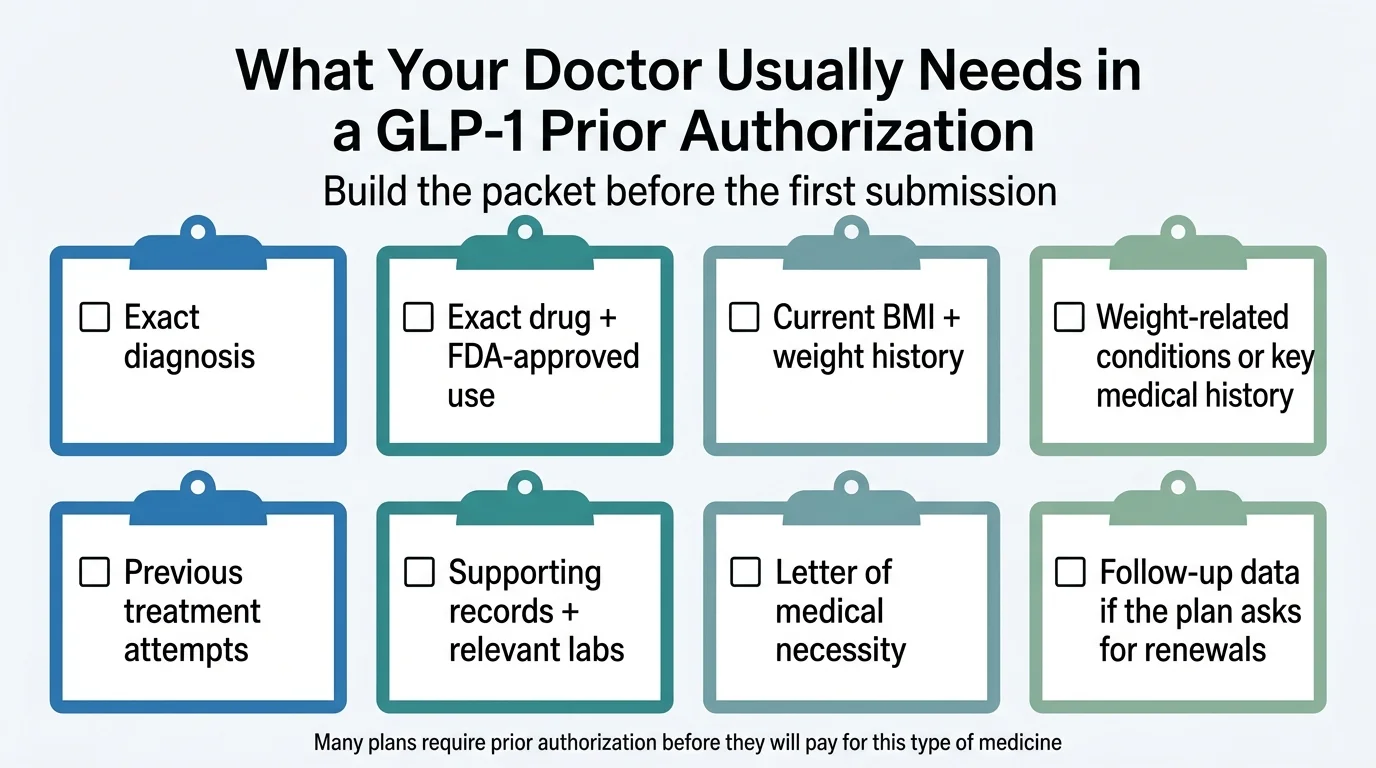
An initial GLP-1 prior authorization request asks your plan to start coverage. A renewal asks it to continue coverage under its renewal rules. Several adult weight-management policies below require at least 5% weight loss or maintenance of that loss. The starting weight, treatment history, and approval period depend on the exact policy. 1, 2, 3, 4
Affiliate disclosure: Some provider links are affiliate links, marked “sponsored affiliate link.” If you enroll through one, we may earn a commission at no extra cost to you.
This page is for you if: you're preparing an initial request · your approval ends in the next few months · your job or plan changed · your renewal was just denied and you want to know why.
Need a different answer? A “not a covered benefit” rejection needs a plan-exclusion check. For the Medicare Bridge specifically, use the Bridge refill guide and the exception below.
GLP-1 prior authorization: initial request vs renewal at a glance
| What changes | Initial request | Renewal, reauthorization, or continuation |
|---|---|---|
| What the plan checks | Whether you meet its rules to start coverage | Whether you meet its rules to continue coverage |
| The main evidence | The covered diagnosis, relevant starting measurements, and any required treatment history | The required treatment response, current treatment details, and any continuing eligibility rules |
| Which weight counts | The baseline defined by that policy | The policy's required baseline and current record—not automatically today's weight as a new starting point |
| Lifestyle proof | Some policies require a program before treatment | Some require proof that participation continues |
| Dose rule | Depends on the requested product and criteria | Some policies require time at a stable maintenance dose |
| How long it lasts | The named examples below range from 4 to 12 months | Many examples allow 12 months; some use shorter periods |
| What can change the request | Previous treatment does not always qualify as continuation | A treatment gap, a different drug, a new plan, or changed benefits can affect the review |
| Who needs to act | Confirm who will submit the request and records | Confirm who will submit again and track the expiration date; the Medicare Bridge is a separate exception |
This is a preparation guide, not a universal coverage test. The dated policy tables below show which rules belong to which plans. 1, 2, 3, 4, 5, 6, 7, 8, 9, 10, 11, 12, 13
Here's the part that matters: the renewal is not just “the same form again.” Your starting records can still matter, three separate timing checks can affect your coverage, and your plan may not use the rules you were approved under. The comparison below puts the requirements, dates, and next questions in one place.
A complete packet can still be denied. This page helps you send the right evidence. It cannot create a covered benefit or promise approval. 14
Start with one small step: find your approval's end date. Then use the Renewal Readiness Check to find the missing records before your office submits. No email address or account is needed to read, copy, or print it.
The RX Index is the independent GLP-1 decision resource that scores telehealth providers and treatment paths on clinical legitimacy, care quality, transparency, access, and cost, so readers can choose the path that fits their situation.
Need a provider, too? The right GLP-1 provider isn't the same for everyone — it depends on your state, your insurance and formulary, the medication and form your clinician recommends, and your budget. Because a general answer can't resolve those for you, use The RX Index's Find My GLP-1 Path tool to explore a provider match before you choose. Confirm current prices and insurance support with the provider. You do not need to change providers just to use the paperwork checklist.
Jump to: The difference · What renewal must prove · Approval lengths · Which weight counts · Below the weight threshold · The three timing checks · Old rules or new rules · Medicare · What your doctor sends · Denials · Avoiding a gap · FAQ
What's the difference between an initial GLP-1 prior authorization and a renewal?
An initial prior authorization request answers one question: does this person meet the plan's rules to start coverage? A GLP-1 renewal asks whether they meet the rules to continue. Results and treatment history can matter at renewal, but the plan can also check that other coverage requirements still apply. 1, 3, 4
Forms use words such as renewal, reauthorization, and continuation of therapy. If your notice says “continuation” and this page says “renewal,” you're in the right place.
The forms themselves split the two requests. Maryland Physicians Care's June 2026 GLP-1 form sends initial and continuation requests through different questions. The current TRICARE form asks about prior TRICARE approval and recent treatment before its renewal questions. Caremark's general form has a separate continuation section. 7, 10, 12
The plan decides which box you're in — and, as you'll see in the clocks section, “I'm already taking it” does not automatically put you in the renewal box.
One more thing people assume wrong: renewal is not automatic. TRICARE's current form, for example, explicitly requires annual renewal. Ask your prescriber's office who tracks the end date, who files the request, and how you'll know it was received. Do not wait for a reminder. 7
What should I gather for an initial request?
Start with the policy for your exact drug, formulation, and reason for treatment. Ask the office which diagnosis records, dated measurements, prior medicine trials, and lifestyle-program records it needs. Do not start new tests or repeat old treatment just because another plan required it.
For example, the Aetna BMI-35 variant below requires a six-month program before starting weight-management treatment. Cigna's named Wegovy injection policy uses a three-month lifestyle requirement. Those are different requirements—not a single national rule. 2, 3
Use How to Get Insurance to Cover a GLP-1 for the full first-request process. The rest of this page shows what changes when coverage needs to continue.
What does a GLP-1 prior authorization renewal have to prove? Is the rule always 5%?
No. Several adult weight-management policies require at least 5% loss from baseline, or maintenance of that initial loss. Other covered uses have different tests. A sleep-apnea policy can require a 10% loss plus other evidence—or use a clinical-response test with no stated weight-loss percentage. 1, 4, 6
Here is the renewal test from the named documents. These are selected requirements, not complete approval criteria. “No stated percentage” does not mean “no requirements.” Sleep-apnea criteria apply only when that is the actual diagnosed and covered use.
| Named policy and covered use | Renewal weight test | Other evidence that changes the packet |
|---|---|---|
| CVS Caremark 6192-C, P08-2025 — Zepbound for weight management 1 | At least 5% lost, or the initial 5% loss maintained | At least three months at a stable maintenance dose |
| CVS Caremark 6192-C — Zepbound for obstructive sleep apnea 1 | No stated weight-loss percentage | Established qualifying sleep-apnea diagnosis, positive clinical response, and a maintenance dose; the policy does not explicitly require a new sleep study at renewal |
| Aetna 6450-C, P08-2025 v8 — adult weight-management injection criteria, BMI-35 variant 2 | At least 5% lost, or the initial 5% loss maintained | At least three months at a stable maintenance dose; the named baseline-BMI requirement still matters |
| Cigna IP0814 — Wegovy injection; effective September 1, 2026 3 | At least 5% from baseline | Continuation branch follows at least eight months of treatment with Wegovy formulations; use the policy's treatment-history wording |
| Cigna IP0816 — Zepbound; effective September 1, 2026 4 | Weight management: at least 5%. Sleep apnea: at least 10% | Weight-management continuation follows at least eight months of Zepbound; sleep-apnea continuation follows at least one year, with prescriber-confirmed symptom stability |
| UnitedHealthcare 2026 P 1114-22 — weight management; effective September 1, 2026 5 | Wegovy and Zepbound: at least 5%. Saxenda: at least 4%. Qsymia: at least 3% | Continued lifestyle changes and the other drug-specific criteria. Qsymia is included for comparison; it is not a GLP-1 |
| UnitedHealthcare 2026 P 1475-3 — Zepbound for sleep apnea; effective September 1, 2026 6 | At least 10% | The breathing-evidence branch depends on treatment duration and use of positive airway pressure, such as CPAP |
| FEP Blue 5.99.030 and 5.99.031 — adult weight management; effective July 1, 2026 8, 9 | Wegovy and Zepbound: at least 5% lost, or that initial loss maintained | Ongoing weight-management program and other renewal criteria. Zepbound retains preferred-product or medical-exception requirements |
| TRICARE — Wegovy/Zepbound form dated March 12, 2026 7 | Weight management: at least 5% for adults; at least 4% for ages 12–17 on Wegovy, after titration. Zepbound sleep-apnea renewal uses symptom improvement instead | Prior authorization and treatment history determine the correct branch; adult and pediatric rules are not interchangeable |
| Optum Rx for Indiana Medicaid — Zepbound for sleep apnea; October 1, 2025 criteria 11 | At least 5% | At least 84 days of treatment in the past 112 days, plus either reduced sleep-study AHI or documented PAP use throughout the approval period; other criteria apply |
AHI is the number of breathing pauses or reductions per hour of sleep. PAP means positive airway pressure, such as CPAP. 1, 11
Three things jump out of that table:
- The test is not always “5%.” Caremark's sleep-apnea pathway has no stated weight percentage. Cigna's named sleep-apnea policy requires 10%. Neither is a reason to change the diagnosis on a request.
- Weight is not the only evidence. Caremark and Aetna name time at a stable maintenance dose. Indiana names recent treatment history. A weight result alone does not answer those questions.
- Dose history needs dates. If your clinician changes treatment, have the office document the change and check the applicable renewal rule. These documents do not establish that every dose change automatically restarts a three-month clock. Clinical care comes first. 1, 2, 11
How long does a GLP-1 prior authorization last — initial vs renewal?
The named examples below have initial periods from 4 to 12 months. Many allow 12-month renewals, but that is not universal. UnitedHealthcare's sleep-apnea policy uses six- or twelve-month renewals based on treatment duration. Your actual approval notice gives your end date. 5, 6, 7
This ledger puts the periods beside the detail you need to check. Bookmark it; it's the one thing you'll come back to.
| Rulebook and scope | Initial approval | Renewal approval | Check this before using the number |
|---|---|---|---|
| CVS Caremark 6192-C — Zepbound, weight management 1 | 8 months | 12 months | These are the clinical criteria, not proof that your benefit covers Zepbound |
| CVS Caremark 6192-C — Zepbound, sleep apnea 1 | 6 months | 12 months | Use the sleep-apnea branch only for that covered use |
| Aetna 6450-C v8 — adult Wegovy injection or Zepbound, weight management 2 | 8 months | 12 months | This is the BMI-35 variant, not every Aetna plan |
| Aetna 6450-C v8 — Zepbound, sleep apnea 2 | 6 months | 12 months | Separate from its weight-management branch |
| Cigna IP0814 — adult Wegovy injection, weight management 3 | 8 months | 12 months | Do not substitute the old combined GLP-1 policy for this September 2026 policy |
| Cigna IP0816 — adult Zepbound, weight management 4 | 8 months | 12 months | Confirm that IP0816 is the policy assigned to your plan |
| Cigna IP0816 — Zepbound, sleep apnea 4 | 12 months | 12 months | Different treatment-duration and response requirements |
| UnitedHealthcare 1114-22 — weight management 5 | Wegovy: 5 months; Zepbound: 6; Saxenda: 4; Qsymia: 4 | 12 months | Drug-specific periods within one document |
| UnitedHealthcare 1475-3 — Zepbound, sleep apnea 6 | 6 months | 6 months with under 52 weeks of treatment; 12 months with at least 52 weeks | Not an automatic one-year renewal |
| FEP Blue 5.99.030 / 5.99.031 — adult Wegovy or Zepbound, weight management 8, 9 | 6 months | 12 months | FEP rules do not establish coverage for every Blue Cross plan |
| TRICARE — March 12, 2026 form 7 | 12 months | 12 months | Annual renewal is expressly required; benefit eligibility is separate |
| Indiana Medicaid — Zepbound, sleep apnea 11 | 12 months | Up to 12 months | The document's general reauthorization rule is up to one year—not a six-month default |
| TennCare — weight-management authorization 13, 15 | Up to 1 year under its January 2026 notice | The linked form does not state a renewal period | Use the actual approval notice rather than borrowing another Optum Rx plan's period |
| Medicare GLP-1 Bridge 16, 17 | Approved fills continue through December 31, 2027 | No routine repeat PA during that period unless the covered GLP-1 drug changes | A separate program, not ordinary Part D coverage |
Two details deserve a second look.
Illinois has statutory protections, not a separate GLP-1 approval chart. For plans governed by the Illinois Prior Authorization Reform Act, Section 65 addresses approved maintenance medication for a chronic or long-term condition: the authorization lasts for the lesser of 12 months or the treatment length. Ask whether your plan and request fall under the Act. Living in Illinois alone does not answer that question, and this provision does not turn an excluded drug into a covered benefit. 18
UnitedHealthcare's four windows tell you something. Wegovy 5 months, Zepbound 6, Saxenda 4, Qsymia 4 — inside one document. Do not use another drug's approval period to work out your deadline. 5
Know your rulebook and your window? Put them into the Renewal Readiness Check. It gives you a place to record the dates and a next action for each missing item. Check my renewal paperwork →
Renewal Readiness Check
Use this as a worksheet on paper or in your own notes. It does not calculate eligibility or submit anything to your plan.
| Check | Write down or confirm | If you do not have it yet |
|---|---|---|
| 1. The right request | Drug, formulation, covered use, and whether the plan calls this initial or continuation | Ask member services which request type and policy apply |
| 2. The real deadline | Approval number, expiration date, and earliest accepted renewal date | Find the notice or request a copy; ask the office when it will submit |
| 3. The right baseline | The policy's baseline definition, required measurement, date, and record source | Ask the original treating office for the dated record |
| 4. Current evidence | The updated weight, treatment response, dose history, or other findings the policy requests | Ask the prescriber which items need an updated visit or note |
| 5. Any treatment gap or plan change | Last fill, days supplied, any interruption, and the date new coverage began | Ask how those facts change the review; do not assign yourself a new-start label |
| 6. The handoff | Who submits, how receipt is confirmed, and when you will check status | Use the message in the renewal packet |
Your next step is the first blank—not another provider signup. Fill that blank, then hand the packet to the office that will submit it.
Which weight are you measured from at renewal? Will a lower BMI hurt me?
Use the baseline your policy names. Some criteria look back to before any GLP-1 treatment; others refer to treatment with the requested drug or do not define the starting date. A lower current BMI is not, by itself, proof that you no longer qualify under a weight-loss-maintenance rule. 1, 2, 3, 4, 11
This cuts both ways: the original record can show your response, but the wrong starting date can produce the wrong calculation.
| Source | What its baseline wording actually tells you | What to ask the office for |
|---|---|---|
| Cigna IP0814 / IP0816 3, 4 | Baseline refers to before any GLP-1 or GLP-1/GIP treatment | The dated pre-treatment record, including treatment before a switch |
| Caremark 6192-C and Aetna 6450-C 1, 2 | Their switching language refers to baseline BMI at the start of any drug therapy for weight loss | The original weight and BMI record; ask which weight the plan uses for the percentage calculation |
| UnitedHealthcare 1114-22 5 | Uses baseline body weight without defining a specific starting date | Written confirmation of the weight and date the reviewer will use |
| Indiana Medicaid Zepbound sleep-apnea criteria 11 | Initial documentation includes weight before Zepbound, obtained within the prior three months | That dated Zepbound starting record, not an assumed universal “before any GLP-1” record |
| Maryland Physicians Care Wegovy form, February 2026 19 | Its cardiovascular branch asks for a BMI record within 90 days and routes both initial and continuation requests through that branch | The current evidence required for that covered use—not a generic obesity-renewal packet |
It helps switchers and successful patients. Under Cigna's named policies, starting another GLP-1 does not mean you should erase the earlier baseline. A lower current number can be evidence that treatment worked. It is not a coverage guarantee. 3, 4
A pause needs its own question. Do not assume a restart weight replaces the original baseline—or that every plan keeps the same baseline after every gap. Ask which record applies before the office files.
The one action this section asks of you: get the dated starting record your policy requires into your current chart now. If your first GLP-1 came from a different office or a telehealth program that closed, request that record this week. Do not make the new office guess.
A quick arithmetic example so the percentage isn't abstract: 200 pounds at baseline, 186 today. 14 ÷ 200 = 7% lost. That clears a 5% bar and misses a 7.5% or 10% bar. The math never establishes coverage by itself — the plan also checks the other applicable criteria — but it shows why the starting number matters. These are sample numbers, not a weight goal.
What happens if you didn't lose 5%?
Whether a renewal can continue below a weight threshold depends on the applicable policy and review process. A documented exception, a different response measure, or an appeal may be relevant. Missing a coverage threshold is not a reason to change your dose or your eating on your own.
| Your situation | What to check | The next useful action |
|---|---|---|
| The policy allows maintaining an earlier 5% loss 1, 2, 8, 9 | Whether the records show that initial loss is still maintained | Show both dated weights; do not assume you must lose another 5% at every renewal |
| The approved use is sleep apnea under Caremark 6192-C 1 | Its clinical-response and maintenance-dose requirements; it has no stated renewal weight percentage | Have the prescriber address the actual sleep-apnea criteria |
| The approved use is sleep apnea under Indiana Medicaid's cited criteria 11 | Both the 5% weight response and the required breathing/PAP evidence | Address both; meeting only one does not satisfy the listed criteria |
| The request uses TennCare's weight-management form 15 | It says an additional month may be approved when renewal requirements are not met | Ask the prescriber and plan whether that provision applies; it is not a guaranteed extra month or a taper instruction from this page |
| The policy's weight threshold is not met and no exception is stated 14 | Whether the decision is correct and which exception or appeal process is available | Request the exact reason and have the prescriber address it with accurate records |
We will not give you a target weight, a diet, a calorie number, or a dose trick on this page. If you're under the bar, the next steps belong with your prescriber and the plan's review process. A cash-pay option is a separate decision—not a fix for a missing clinical requirement.
Use What if your renewal is denied for the paperwork response and How to avoid a gap for the access discussion.
Which three timing checks can affect my renewal?
Check when your approval ends, whether treatment has been interrupted, and whether your plan or benefits changed. These can affect access or the type of request. They do not mean that every expired approval, missed fill, or new plan year automatically turns you into a new patient. 7, 10, 12
Clock 1 — the approval window
The date on your approval letter is the starting point. A fill after that date may need a new authorization. Look at your letter today and write the date down. Ask when the plan accepts renewals and when your office will submit yours.
Do not confuse the approval's expiration with a “refill too soon” rejection, an exhausted prescription, or a pharmacy stock problem. Ask the pharmacy for the exact rejection or status before starting more paperwork.
Clock 2 — the treatment-history window
The forms ask different questions. Here they are side by side:
| Rulebook | What it asks | What you should not infer |
|---|---|---|
| Caremark Global PA form, 106-37207A 10 | Whether the patient received the requested drug within the last 120 days, plus prior approval and response questions | The question alone does not establish an automatic 120-day reset, or a requirement to repeat six months of a program |
| TRICARE, March 12, 2026 form 7 | Prior TRICARE approval, treatment within the last six months, and whether treatment was interrupted | A six-month number is not a safe amount of time to stop treatment; follow the form's branch and the clinician's instructions |
| Indiana Medicaid Zepbound sleep-apnea criteria 11 | At least 84 days of treatment within the past 112 days, shown by claims or chart records | This is a treatment-history requirement, not a universal maximum-gap rule |
| Maryland Physicians Care's June 2026 GLP-1 form 12 | Current treatment, samples, prior approval with the current plan, and at least three months established on therapy | This form covers the products and uses it lists; its rules do not automatically apply to the separate Wegovy form |
If you're already off the drug because of a price problem, record the dates and tell your prescriber. That history helps the office determine which request to send. Do not stretch doses or restart treatment based on a paperwork calculation.
Clock 3 — the plan-change clock
New insurer, new plan year, new criteria. This is the clock that catches people who did everything right.
Your old approval may not be enough on a new plan. Maryland Physicians Care's cited GLP-1 form sends a continuation request without a prior approval on the current plan through initial-therapy review. Keep the old approval anyway: a transition provision may make it useful. 12
An approval letter does not necessarily override changed benefits. In Michigan DIFS external review 244942-001-SF, dated March 25, 2026, Optum Rx had approved a member's Zepbound through November 10, 2026. Her state-employee plan ended the relevant weight-loss and sleep-apnea coverage at the end of 2025. The Director upheld that plan's denial. This was a specific benefit exclusion, not a finding that every plan can disregard any approval. Verify any approval that crosses a plan year during open enrollment, not after. 20
A transition promise is not proof of coverage. The industry pledge announced by HHS in June 2025 included honoring existing authorizations during insurance transitions. It was a voluntary commitment. Ask your new plan whether a transition applies to your exact pharmacy benefit and drug; do not assume the announcement makes an excluded drug covered. 21
Illinois has a separate 90-day provision. Section 70 of its Prior Authorization Reform Act requires plans subject to that law to honor qualifying prior approvals for an initial 90-day transition, with conditions. The same section says the Act does not require an otherwise excluded benefit, apart from a medical-exception process. Ask the plan or Illinois insurance regulator whether your coverage falls under it. This is separate from Section 65's maintenance-medication duration rule. 18, 22
Know which timing issue needs attention? Put it in the renewal packet. Include the dates and ask the office which rule applies rather than guessing that you have to start over. Get my renewal packet →
Does a renewal use the old rules or the new rules?
Check your plan's current notice, applicable rules, and any protection for existing approvals. Plans have treated existing users differently. Virginia's state-employee plan and the Michigan decision below show why a previous approval alone does not tell you what will happen next. 20, 23
Virginia's August 12, 2026 bulletin says members using GLP-1 weight-loss medication under an active approval who remain continuously compliant can renew under the previous BMI criteria: 30, or 27 with a related condition. New requests on or after July 1, 2026 face a BMI threshold of 35, with other criteria still applying. 23
Two words matter there: active and continuously. The bulletin does not define every possible short lapse. Ask how your actual approval and treatment history fit its rule rather than assuming any brief delay automatically makes you a new user.
Michigan DIFS 244942 is the opposite outcome from a different plan: same year, existing approval, no grandfathering for the excluded benefit, coverage gone January 1. 20
You can't predict which way your plan goes. You can ask. Send this to the member-services address on your card and keep the reply:
“I have an active prior authorization for [drug and formulation] that ends on [date]. Please confirm in writing: (1) Will my renewal be reviewed under the criteria in force when I was first approved, or under current criteria? (2) What is the criteria document number and effective date that will apply to my renewal? (3) Will my approval carry into the next plan year, or does it end at the plan-year turn? (4) Does any transition or existing-patient protection apply to me?”
The answer to question 2 tells your office which rulebook to use—even when it is not one of the examples on this page.
Does Medicare make you renew a GLP-1 prior authorization?
Under the Medicare GLP-1 Bridge, approved later fills do not need another prior authorization through December 31, 2027, unless the patient switches to a different covered GLP-1. Ordinary Part D coverage is different: use that plan's applicable authorization and renewal criteria. 16, 17
Three Bridge details that trip people up:
- A drug switch needs a new prior authorization, even mid-year.
- Only 28- or 30-day fills are covered. Do not assume a 90-day prescription can be filled through the Bridge.
- The Bridge's PA decision window is up to 72 hours after the request is submitted. That is not a promise of medication in hand within 72 hours. The program uses a central processor rather than your Part D plan to make its Bridge coverage decision. 16, 17
The treatment purpose matters. CMS says people with type 2 diabetes, qualifying obstructive sleep apnea, or qualifying MASH are not eligible for Bridge coverage and should work through Part D as applicable. MASH is a form of liver disease. Cardiovascular disease alone does not automatically rule someone out of the Bridge, but a prescription for cardiovascular risk reduction belongs with Part D. Do not apply the weight-management table above to every one of those requests. 17
Know this before you appeal: the Bridge has no appeal process. CMS allows a new request with corrected or additional information. That is different from the Part D and commercial-plan appeals described later. 17
Full program rules, including eligibility and refill handling, are in our Medicare GLP-1 Bridge refill rules guide.
For Medicare or Medicaid insurance paperwork, start with your treating office and plan—not a commercial coverage checker. Ro's government-plan limits are spelled out in the provider section.
What does your prescriber have to send for a GLP-1 renewal?
Send the records that answer the policy's continuation questions. For a weight-management renewal, that often means a dated baseline, a current result, and the required treatment history. Other covered uses may need different evidence. Match the packet to the rule rather than sending a generic stack of pages. 1, 2, 3, 4, 11, 19
| What the office checks or sends | Why it matters | Named example |
|---|---|---|
| The required baseline record, with its date | Establishes the correct starting point | Cigna defines it before any GLP-1; Indiana's Zepbound criteria name the pre-Zepbound record 3, 4, 11 |
| The required current findings, with dates | Shows response under the right covered use | Weight response under FEP; a recent BMI under Maryland Physicians Care's Wegovy cardiovascular branch 8, 9, 19 |
| Dose history | Answers any maintenance-dose and duration questions | Caremark and Aetna name at least three months at a stable maintenance dose for the cited weight-management renewals 1, 2 |
| Treatment and fill history | Documents continued treatment or a gap | TRICARE and Indiana use different treatment-history questions 7, 11 |
| Lifestyle-program note, when required | Addresses continued participation | FEP's adult weight-management renewal criteria 8, 9 |
| Sleep-study findings or PAP documentation, when required | Addresses the actual sleep-apnea branch | Indiana accepts specified sleep-study improvement or PAP-use documentation, alongside its other requirements 11 |
| Previous approval and current policy | Helps identify the correct request, end date, and criteria | A practical packet item; not a claim that every form mandates both documents |
| Submission receipt or reference number | Gives you a way to confirm the request reached the reviewer | Keep the portal or fax confirmation and follow the plan's status process 14 |
What the denial notice should tell you. ERISA is the federal law that covers most private-employer health plans. For claims under its rules, a denial notice must give specific reasons, identify the plan provisions used, and explain missing information when that is the problem. If the notice is unclear, ask for the exact criterion and the records used in the decision. You do not have to guess. 14
Caremark's 2025 Indiana utilization report shows why a broad category is not enough to diagnose your request: its aggregate table groups 14,114 denials under “does not meet clinical criteria.” That does not prove the individual denial letters lacked detail, or that those were all GLP-1 renewals. The useful move is to get your own notice and criterion. 24
When should the office submit?
Our planning suggestion is to start gathering records about 60 days before expiration. Ask whether the plan accepts submission 45 days before the end date; if not, agree on the earliest accepted date. These are preparation targets, not legal deadlines or a guarantee that every plan opens renewals that early.
| Coverage or request type | Decision timing to check | Important limit |
|---|---|---|
| ERISA-governed health-plan pre-service claim 14 | As soon as appropriate, no later than 15 calendar days; a qualifying extension can add up to 15 days | Missing-information procedures can affect the clock; this is not a universal rule for every health plan |
| Urgent claim under those rules 14 | As soon as the medical need requires, generally within 72 hours | Tell the prescriber when you'll run out and ask whether the clinical situation meets the urgent standard |
| Medicare Part D benefit determination 25 | Standard: 72 hours. Expedited: 24 hours | For exception requests, the clock starts when the plan receives the prescriber's supporting statement |
| Medicare GLP-1 Bridge PA 16, 17 | Up to 72 hours after submission | Separate from Part D; not a shipping or total onboarding deadline |
Caremark's Indiana report also lists decision times, but an aggregate average cannot tell you where your delay is happening. Check three stages separately: records gathered → request received → decision issued. Then ask the pharmacy about filling the prescription. 24
Your printable renewal packet
Copy or print this section. Keep completed health information in your own records or your prescriber's secure portal.
Request details
- Medicine and formulation: __________
- Reason it was prescribed: __________
- Plan and prescription-benefit administrator: __________
- Initial request or continuation, as confirmed by the plan: __________
- Policy title, document number, and effective date: __________
- Existing approval number and expiration date: __________
- Earliest accepted submission date: __________
Records the office says are required
- Baseline record and date: __________
- Current measurement or other response evidence and date: __________
- Dose and treatment history: __________
- Fill history or explanation of any gap: __________
- Lifestyle-program or condition-specific records: __________
- Other missing item: __________
Submission plan
- Person or team submitting: __________
- Planned submission date: __________
- Receipt or reference number: __________
- Next status-check date: __________
Ready to hand this to your prescriber? Copy the renewal message. It asks the office to confirm your request type, required starting record, treatment history, and who's submitting — and it leaves a blank for your end date. “I'm preparing for my GLP-1 prior authorization renewal. My current approval ends on [date]. Can you confirm: (1) whether the plan will treat this as a continuation or an initial request; (2) which dated baseline record and current findings are required; (3) whether my dose and fill history meet the applicable documentation rules; (4) which criteria document you'll use; and (5) who is submitting it and how I can check status? If anything is missing, tell me what to get. I expect to run out on [date], so please let me know whether a visit or a separate treatment plan is needed.”
What if your GLP-1 renewal is denied?
Start with the written reason and the appeal deadline on your notice. For ERISA health-plan claims, you generally have at least 180 days to request an internal appeal. That is not a universal deadline for Medicare, Medicaid, or every other program—and the Medicare Bridge has no appeal process. 14, 17, 26
A denial is not proof that you did something wrong. It is a decision to check against the plan and the record.
Two documented outcomes, both public record:
- NY DFS external appeal 202208-152420, decided in 2022 — CVS Caremark, self-funded plan, Wegovy continuation. Baseline 174 pounds, current 141 pounds. The reviewer found the roughly 19% loss met that plan's continuation criteria and overturned the denial. This is one historical medical-necessity decision, not an approval guarantee for another patient. 27
- Caremark's 2025 Indiana report — 14,114 denials; 1,430 appeals; 841 appeals approved, 577 denied, and 12 pending. 841 ÷ 1,430 = 58.8% of the listed appeals approved. These are aggregate request counts across medications, not unique patients or a GLP-1 renewal success rate. 24
Before you appeal, sort the notice into one of three buckets, because they need different responses:
| The notice says | What to establish | Next move |
|---|---|---|
| More information needed | Is the request still pending, or has a formal denial been issued? Which exact record is missing? | Send the requested item through the correct process. A request to resubmit does not erase an existing appeal deadline |
| Does not meet clinical criteria | Which criterion failed: response, dose history, treatment history, diagnosis, or another requirement? | Address that criterion with accurate records and the prescriber's explanation |
| Not a covered benefit / excluded | Does the plan truly exclude this drug for this use, or was the wrong rule applied? | Read Plan Exclusion vs Prior Authorization. Use the benefit dispute or exception process that actually applies |
For an ERISA plan with one internal pre-service appeal level, the review generally must finish within 30 days. If two internal levels are required, each generally has a 15-day limit. Eligible final denials may go to independent external review. Follow your notice rather than applying those numbers to every program. 14, 26
Was coverage cut off before the existing approval ended? Tell the office that date too. Early termination of an approved course and refusal to renew after expiration are not automatically the same situation. The appeal guide separates those paths.
Know why it was denied? Use the appeal letter template. Choose the continuation or renewal situation, add the actual criterion and dated evidence, and follow your notice's filing deadline. Open the GLP-1 appeal letter template →
What if coverage ends anyway — how do you avoid a gap?
Tell your prescriber when you expect to run out, before the decision arrives. Ask about the review process, pharmacy availability, and a safe treatment plan. An FDA-approved cash-pay option can be part of that discussion, but no provider can promise same-day prescribing, delivery, or uninterrupted treatment. 28, 29
Here’s the honest ladder: check the path that adds the fewest new costs for the help you actually need.
1. Check the manufacturer option when you already have a prescriber
LillyDirect offers access to medicines including Zepbound and Foundayo through its pharmacy services. NovoCare Pharmacy lists Wegovy self-pay options. A valid prescription and the program's eligibility rules still apply. Foundayo is an FDA-approved oral medicine; FDA approved it on April 1, 2026. 29, 30, 31
If you already have a prescriber who'll write the script and manage the dose, check these options before paying for another care membership. We earn nothing from the direct manufacturer links in this paragraph. We're telling you anyway.
Do not compare a starting-dose promotion with your maintenance-dose bill. Compare the same drug, formulation, dose, days supplied, shipping or supply costs, and any care fee. That is the useful cash-pay comparison—not the lowest number in an ad.
Use Cheapest Zepbound Without Insurance for the dose-by-dose Zepbound guide, or NovoCare's current Wegovy pricing for your prescribed form and dose. NovoCare's self-pay terms say those purchases cannot be submitted to insurance for reimbursement and do not count toward deductibles or out-of-pocket limits. 30, 32
2. Ro — when you also need a prescriber and insurance support
Ro Body membership is $39 for the first month, then $149/month on monthly billing, or as low as $74/month with an annual plan paid upfront. Medication is billed separately. Ro's public pricing was checked September 22, 2026. 33
Ro advertises manufacturer-matched cash prices and also offers some multi-month medication discounts. That does not make every total bill identical: compare the exact prescription, payment term, and membership fee. 33
Now the part we'd rather say than have you find out later. Ro's insurance support is narrower than its cash-pay medication menu. Its insurance page names the Wegovy pen, Zepbound autoinjector pen, and Ozempic. It does not establish insurance support for every pill or pen Ro can prescribe. 28
Government-plan limits matter. Ro says Medicaid and some other government-plan members are not eligible for treatment. Medicare, Medicare supplement, and TRICARE members may qualify for certain cash-pay care, not insurance coordination through those plans. FEHB is an exception: Ro says its concierge supports Federal Employee Health Benefits plans. 28
Ro also can't make your plan say yes; no one can. What it offers is help with covered-product paperwork and access to cash-pay treatment options when clinically appropriate. Your current prescriber can also send a cash-pay prescription; this is not a capability exclusive to Ro.
Before buying a membership for an expiring approval, ask: “Will you handle this exact reauthorization, what records do you need from my old office, and can you work within my deadline?” The public pages reviewed do not establish automatic renewal-date tracking or guaranteed completion before your current approval ends.
Provider-stated vs. verified: what the next click actually gets you
“Verified” here means checked on the provider's public page—not tested by enrolling or submitting a real insurance request.
| Offer or claim | What the public source supports | What it does not establish |
|---|---|---|
| Ro's free coverage checker 34 | A coverage check for its supported branded injection products, without a paid treatment membership | A prescription, a completed PA, a final approval, or a same-day result |
| Ro Body pricing 33 | $39 introductory month; $149 monthly billing or $74/month equivalent with annual prepayment; medicine extra | A $74 cancel-any-month plan or medication included in that fee |
| Ro insurance support 28 | Benefits checks and PA help for eligible members and supported prescriptions | Support for every government plan, every formulation, or every outside prescriber's renewal |
| Success by Sesame 35 | Its Zepbound page says providers can help with PA paperwork; subscriptions start at $99/month, with medication separate and provider prices varying | That every standalone Sesame visit includes renewal support or that insurance will approve treatment |
Does this sound like your situation — you need a clearer coverage answer before paying for care? Ro's free checker is a first step, not an application for treatment. Check supported GLP-1 coverage with Ro → (sponsored affiliate link; opens in a new tab) The checker is free. Paid Ro Body care starts at $39 for the first month; ongoing membership and medication costs are separate. 33, 34
3. Sesame Care — another option when you need to choose a clinician
Sesame's Success by Sesame program is a separate paid-care option. Its current Zepbound page says participating providers assist with insurance pre-authorization. The listed starting subscription is $99/month, medication extra; some providers charge more. 35
Ask the clinician whether your selected program includes this renewal, the records review, and any follow-up after denial. Do not assume a general appointment includes the same support as the weight-loss subscription. See Sesame Care's costs and care options →
Who this section is not for: if you're on Medicare, check the Bridge and Part D distinction before paying cash. If your plan excludes the drug rather than denying a clinical renewal, the exclusion decoder is the page you need. If price is the whole question, the direct price resources above may be more useful than another provider.
Compounded GLP-1s are not an interchangeable fallback. Compounded drugs are not FDA-approved; FDA does not review their safety, effectiveness, or quality before marketing. The branded-product policies above do not establish coverage for a compounded product. This page does not recommend switching to one to bypass a denial. 36
What did we actually verify, and how should you use this comparison?
We checked the linked public policy documents, program guidance, appeal records, and provider pages on September 22, 2026. We lined up the named criteria, treatment-history questions, and approval periods. We did not check your individual benefits, submit a PA, enroll in a provider program, or test an approval outcome.
How we organized the evidence: the baseline map, treatment-history comparison, and readiness worksheet pair each policy rule with the record or question it creates.
How to read the dates: a policy's effective date is not the date we checked it. A dated historical appeal shows what happened in that case; it is not a current coverage rule for everyone. A form that does not print an approval period does not prove there is no limit.
What we did not carry into the current rule tables: numerical requirements that could not be verified against the cited primary document, older policy versions presented as current, and historical Medicaid appeal criteria presented as today's benefit. Ask your plan for its assigned policy when it is not listed here.
A licensed clinician — not this page — decides whether a medication is right for you. The next useful action is still the same: get the exact policy, find the required records, and confirm who is sending them.
GLP-1 prior authorization renewal: frequently asked questions
The answer changes with the policy and covered use, not just the drug name. Use these short answers to choose your next step, then use the named document or ask the plan for the criteria assigned to your coverage.
Is GLP-1 prior authorization renewal automatic?
Do not assume it is. Confirm who submits and tracks the deadline; TRICARE's current form explicitly requires annual renewal. The Medicare GLP-1 Bridge is a separate exception, with approved later fills through December 31, 2027 unless the covered GLP-1 changes. 7, 16
How much weight do I have to lose to renew Wegovy or Zepbound?
Several adult weight-management policies in the table use 5% loss from baseline, or maintenance of that loss. That is not every policy or every covered use. Check the renewal-test table rather than applying a weight-management rule to a sleep-apnea or other request. 1, 2, 3, 4, 8, 9
5% of which weight?
The baseline your policy names. Cigna's cited policies look back to before any GLP-1 treatment; Indiana's cited Zepbound criteria specify a pre-Zepbound record. Ask your plan to identify the weight and date when the wording is unclear. 3, 4, 11
How long is a Zepbound prior authorization good for?
In the named weight-management examples: 8 months initially under Caremark, the Aetna BMI-35 variant, and Cigna; 6 under UnitedHealthcare and FEP. TRICARE's form uses 12 months. Sleep-apnea periods differ. The approval-length ledger separates those uses and renewal periods. 1, 2, 4, 5, 7, 9
How long is a Wegovy prior authorization good for?
For the adult weight-management injection examples: 5 months initially under UnitedHealthcare, 6 under FEP, and 8 under Cigna and the Aetna BMI-35 variant. These examples allow 12-month renewals if the criteria are met. Do not transfer those numbers to another formulation or covered use. 2, 3, 5, 8
What happens if I stop for a few months and want to restart?
Give the prescriber and plan the exact dates. Caremark's general form asks about use within 120 days; TRICARE and Indiana ask different treatment-history questions. Those numbers are not interchangeable rules for restarting medication. Use the timing-check table. 7, 10, 11
I changed insurance — does my old approval count?
Keep it and ask. The new plan may require its own review, but a transition rule can matter. Ask whether your exact drug remains covered, which policy will apply, and whether an existing-approval protection covers your situation. 12, 22
Does the Medicare GLP-1 Bridge require reauthorization?
Not for approved later fills through December 31, 2027, unless you change to a different covered GLP-1. A new drug needs a new request. This is not the rule for ordinary Part D coverage. 16, 17
Can a plan change the rules on me at renewal?
Criteria and benefits can change, subject to the plan and applicable protections. Virginia's bulletin protects certain existing, continuously compliant users; the cited Michigan case involved a benefit that ended despite an existing approval. Ask which criteria and protections apply to you. 20, 23
Is renewing my prescription the same as renewing my prior authorization?
No. A prescription comes from your prescriber. A prior authorization is a plan decision about coverage, and it can have its own end date. A valid prescription does not, by itself, prove there is a valid authorization or covered benefit. 12, 25
What should I do 60 days before my approval ends?
Use that as a planning target: confirm the end date, request the required dated records, ask which criteria apply, and agree on a submission date the plan accepts. The Renewal Readiness Check walks through all four. Sixty days is our preparation suggestion, not a plan rule.
Is it harder to get renewed than approved the first time?
The reviewed documents do not establish that one is generally easier. They ask different questions. A renewal can be simpler when the required records are ready—or fail if a continuation requirement is not met. An insurer's average decision time does not measure how hard your request will be. 1, 4, 24
Do compounded GLP-1s use these prior authorization renewal rules?
These are branded-product criteria, not coverage rules for a compounded prescription. Compounded drugs are not FDA-approved. Do not assume a Wegovy or Zepbound authorization covers a compounded product; ask the plan about the exact prescription. 1, 2, 36
Still not sure which GLP-1 program is right for you? Take our free matching quiz — Find My GLP-1 Path.
Related guides: How to Get Insurance to Cover a GLP-1 · GLP-1 Providers That Help With Prior Authorization · Plan Exclusion vs Prior Authorization · CVS Caremark Zepbound Prior Authorization · OptumRx Zepbound Prior Authorization · Express Scripts Zepbound Prior Authorization · GLP-1 BMI Eligibility Chart · Medicare GLP-1 Bridge Refill Rules
Sources
All sources below were checked September 22, 2026. Policy versions and historical case dates are identified where relevant.
- CVS Caremark — Zepbound PA with Limit, 6192-C, P08-2025.
- Aetna — Weight Loss BMI-35 variant, 6450-C, P08-2025 v8. Page dated April 10, 2026.
- Cigna — Wegovy injection, IP0814. Effective September 1, 2026.
- Cigna — Zepbound, IP0816. Effective September 1, 2026.
- UnitedHealthcare — Weight Loss/Appetite Suppression Medication Coverage, 1114-22. Effective September 1, 2026.
- UnitedHealthcare — Zepbound sleep-apnea program, 1475-3. Effective September 1, 2026.
- Express Scripts/TRICARE — Wegovy and Zepbound prior authorization form. Dated March 12, 2026.
- FEP Blue — Saxenda/Wegovy, policy 5.99.030. Effective July 1, 2026.
- FEP Blue — Zepbound, policy 5.99.031. Effective July 1, 2026.
- CVS Caremark — Global Prior Authorization Form, 106-37207A.
- Optum Rx — Indiana Medicaid GLP-1 Receptor Agonists and Combinations criteria. October 1, 2025; approval-duration statement on page 1 and Zepbound criteria on pages 6–7.
- Maryland Physicians Care — GLP-1 Products form, version June 2026.
- TennCare/Optum Rx — January 1, 2026 provider notice. Weight-management approval-duration notice.
- U.S. Department of Labor — Filing a Claim for Your Health Benefits. ERISA scope, notices, claims, and appeals.
- TennCare/Optum Rx — Weight Management Agents prior authorization form.
- CMS — Medicare GLP-1 Bridge: Information for Prescribers.
- CMS — Medicare GLP-1 Bridge: Information for Providers.
- Illinois Prior Authorization Reform Act — 215 ILCS 200/65.
- Maryland Physicians Care — Wegovy form, version February 2026.
- Michigan DIFS — External review order 244942-001-SF. March 25, 2026.
- HHS — Industry prior-authorization pledge announcement. June 23, 2025; a voluntary commitment, not an individual coverage determination.
- Illinois Prior Authorization Reform Act — 215 ILCS 200/70.
- Virginia DHRM — Updated Weight Loss GLP-1 Prior Authorization Criteria. August 12, 2026.
- CVS Caremark — 2025 Indiana Annual Utilization Review Report. Aggregate data, not a GLP-1 renewal cohort.
- CMS — Medicare Part D Coverage Determinations.
- HealthCare.gov — Internal Appeals.
- New York DFS — External appeal 202208-152420. Historical 2022 decision.
- Ro — Weight Loss Program and Insurance.
- Lilly — LillyDirect pharmacy services.
- NovoCare — Wegovy pharmacy options and prices.
- FDA — Foundayo approval announcement. April 1, 2026.
- NovoCare Pharmacy — Eligibility and terms.
- Ro — Weight Loss Program Pricing.
- Ro — Free GLP-1 Insurance Coverage Checker.
- Sesame — Zepbound and Success by Sesame program details.
- FDA — Compounding and the FDA: Questions and Answers.
This article is education about insurance rules, not medical or legal advice. It does not verify your individual benefits. A licensed clinician decides whether any medication is right for you.