
Affiliate disclosure: Some links on this page are affiliate links, marked "sponsored." If you use them, we may earn a commission at no extra cost to you. It never changes what we write. How we make money →
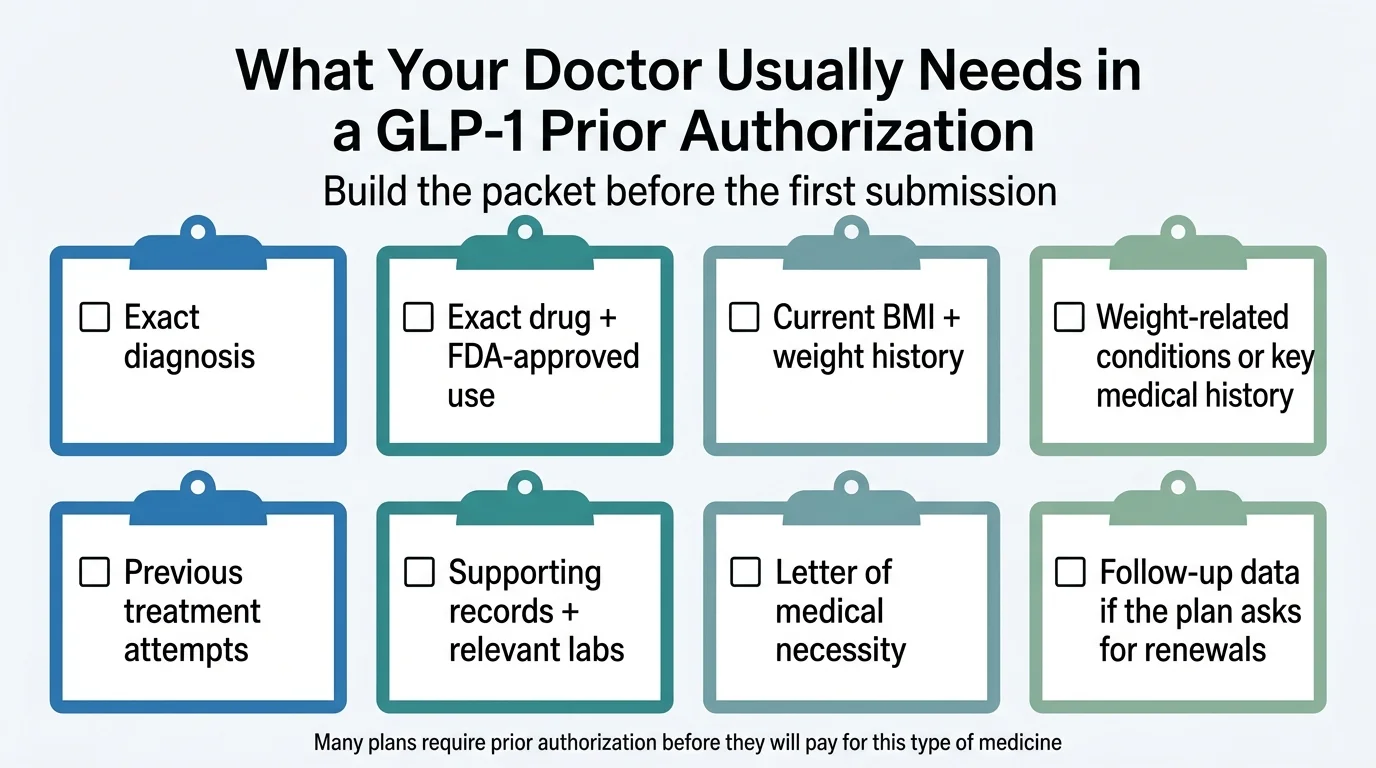
Most GLP-1 prior authorization packets need the plan's current form or electronic request, member and prescriber details, the exact drug and form, chart notes that support the covered use, and any plan-specific proof—such as a starting BMI, prior treatment, labs, a sleep study, or proof of response at renewal. Your prescriber usually submits it; you help gather the records.
The exact list changes with your plan, your medicine, and whether this is your first request or a renewal. And a complete packet can't make a plan cover a drug it leaves out on purpose.
One more thing before you start gathering. One number shows up again and again in the current forms: your weight or BMI before you started GLP-1 treatment. If treatment has already lowered your weight, today's number may not tell the plan where you started. We'll show you how to protect both numbers.
This page is for you if:
- Your pharmacy said "prior authorization required."
- Your doctor's office asked you for records.
- Your plan said information is missing.
- Your approval runs out soon and you need to renew.
- You want to know what to gather before your next appointment.
This page isn't enough by itself if:
- Your plan leaves the requested use or drug category out completely. Jump to what to do if your plan says no.
- You are not billing the prescription to insurance. An insurer's prior authorization usually is not part of a cash-pay path. See GLP-1s without prior authorization.
- You need medical advice about whether a drug is right for you.
- You are trying to choose or change a diagnosis code. Your prescriber must use the diagnosis that is true and supported by your chart.
- You are asking about a compounded GLP-1. Compounded drugs are not FDA-approved, and many compounded treatment paths are self-pay. This brand-and-formulary checklist may not fit that process. The FDA says compounded drugs are not reviewed for safety, effectiveness, or quality before marketing. Read the FDA's explanation →
The RX Index is an independent GLP-1 decision resource that compares telehealth providers and treatment paths using its published methodology, so readers can choose the path that fits their situation.
Who does what: you gather, your prescriber sends, your plan decides
| You gather | Your prescriber submits | Your plan decides |
|---|---|---|
| Both sides of your insurance card, including pharmacy-benefit details | The current plan form or electronic request | Whether the drug and requested use are covered |
| Your medication history and any past approval or denial | The exact drug, form, strength, quantity, and directions | Whether your records meet the current rules |
| Your starting and current measurements, when the plan asks for them | Accurate diagnosis and chart notes | Whether step therapy or a quantity limit applies |
| Outside records such as a sleep study, heart record, liver test, or lab result when relevant | Any required tests, treatment history, and clinical reason | How long approval lasts and what renewal requires |
| The exact wording of any missing-information notice | A signature or attestation that the submitted facts are accurate | Whether more information is needed |
Build your GLP-1 prior authorization packet
Pick your medicine, the documented reason it was prescribed, your type of insurance, and whether this is a first request, a renewal, or a missing-information fix. You'll get:
- A checklist of what you gather
- A checklist of what your prescriber sends
- A list of what must be checked with your plan
- A copy-and-paste message for your doctor's office
- The right next page for your situation
No email. No names, member IDs, birth dates, or case numbers. About 30 seconds.
No email. No names, member IDs, birth dates, or case numbers. About 30 seconds.
FREE, PRIVATE, IN-BROWSER
GLP-1 PA Packet Builder
Choose broad categories only. This tool does not ask for names, dates of birth, member IDs, case numbers, diagnoses in free text, or uploaded records.
Choose all four options to build your packet.
What documents are needed for GLP-1 prior authorization?
Answer: The documents needed for GLP-1 prior authorization usually include the plan's current form or electronic request, member and prescriber information, the exact prescription, chart notes that support the covered use, and any extra proof named in the plan's rules. Starting BMI, diet-program records, labs, sleep studies, and prior drug trials are common in some policies, but they are not one national checklist.
Prior authorization, or PA, means the plan wants approval before it will cover the prescription under the benefit. Approval still does not promise a specific copay or final payment.
1. The plan's current PA form or electronic request
This is the form your prescriber's office completes. It must match:
- Your exact plan
- The exact drug
- The exact form, such as a pen, vial, KwikPen, injection, or tablet
- The reason the drug was prescribed
- Whether this is a first request or continuation
A carrier's general policy may not control your exact employer plan. One current Cigna National Formulary Foundayo policy says the member's own benefit document wins when it conflicts with the standard policy. That is why "I have Cigna" or "I have Aetna" is not enough by itself. See Cigna Policy CNF1007 →
2. Member, prescriber, and pharmacy details
Current forms commonly ask for:
- Member name and insurance ID
- Date of birth
- Prescriber name, NPI, specialty, phone, and fax
- Pharmacy name or NPI
- Standard or expedited review
- Office contact handling the request
You do not need to enter these private details into The RX Index's tools. Give them only to your plan, prescriber, pharmacy, or another party that is allowed to handle them.
3. The exact prescription
"Semaglutide" or "tirzepatide" may not be specific enough. A form can ask for:
- Brand name
- Dosage form
- Strength
- Route
- Quantity
- Days supply
- Directions
- Expected length of treatment
The form matters. The 2026 Medicare GLP-1 Bridge includes all Foundayo and Wegovy formulations but only the Zepbound KwikPen—not the Zepbound single-dose vial or single-dose pen. One current Aetna policy does the opposite for its normal pharmacy benefit: it excludes Zepbound vials and KwikPens from that policy because those forms are handled through LillyDirect. "Zepbound" alone does not tell you which process applies. See the CMS Bridge provider FAQ → See the Aetna policy example →
4. Chart notes that support the real reason for treatment
Chart notes are the notes your clinician writes after a visit. They may need to show:
- The diagnosis or covered use
- Height, weight, and BMI with dates
- Relevant health conditions
- Prior treatment
- Current treatment and response
- Why a preferred drug did not work, was not tolerated, or is not appropriate—only when that is true and documented
- A test or lab result tied to the requested use
Your prescriber picks the diagnosis code. The code must match the actual record. For the code families, see our guide to obesity ICD-10 codes for GLP-1 prior authorization.
5. The extra proof your plan asks for
This is where plans split apart.
One policy may ask for three months of diet and behavior work. Another may ask for six months in a full program. Another may ask only whether counseling happened. A diabetes form may focus on lab results and oral diabetes drugs instead. An obstructive-sleep-apnea request may live or die on the sleep-study report.
Do not build a giant folder just because a website says every plan needs the same proof. Get the current rule for your exact drug, form, use, and plan.
Sometimes helpful: a letter of medical necessity
A letter of medical necessity is a short letter from the clinician explaining why the requested treatment is needed. It can help when the plan asks for clinical reasoning, an exception, or an appeal.
It does not replace the required form. It does not create coverage when a benefit is excluded. And it should never add a diagnosis, side effect, failed treatment, or measurement that is not in the record.
See who writes GLP-1 medical-necessity letters.
What extra proof does my reason for the GLP-1 need?
Answer: The requested use decides which extra proof matters. A weight-management request may need a starting BMI and treatment history. A Zepbound sleep-apnea request may need a sleep study. A Wegovy heart-risk request may need records of established cardiovascular disease. A Wegovy MASH request may need proof of F2–F3 liver fibrosis. A diabetes request may need diabetes chart notes, labs, or prior medication history.
Insurance does not review "GLP-1s" as one thing. It reviews one exact product, in one exact form, for one documented use.
| Reason on the request | Examples of FDA-approved products for that use | Proof a plan may ask for |
|---|---|---|
| Long-term weight management | Foundayo, Wegovy, Zepbound, Saxenda | Starting BMI, dated weight, a related condition when the policy uses a lower BMI path, lifestyle or prior-treatment history |
| Moderate-to-severe obstructive sleep apnea in an adult with obesity | Zepbound | Full sleep-study report, AHI or REI, obesity measurement, PAP or CPAP history when the plan asks for it |
| Lowering major cardiovascular-event risk in adults with established cardiovascular disease and overweight or obesity | Wegovy injection | Records of prior heart attack, stroke, symptomatic peripheral artery disease, or another qualifying record under the plan |
| Noncirrhotic MASH with F2–F3 fibrosis in adults | Wegovy injection | Liver biopsy, elastography, MR elastography, or another accepted fibrosis record under the plan |
| Type 2 diabetes | Ozempic, Mounjaro, and other diabetes GLP-1 medicines | Diabetes chart notes or labs, plus prior diabetes treatment when the plan requires it |
| Renewal | The same product already approved | Starting record, current record, response, adherence, dose, and prior approval |
Weight management: Foundayo, Wegovy, Zepbound, or Saxenda
The FDA-approved adult weight-management labels generally use obesity, or overweight with at least one weight-related condition. But the insurance rule can be stricter than the FDA label.
For example:
- One current Cigna National Formulary Foundayo policy uses a baseline BMI of at least 30, or at least 27 with one of 11 listed conditions, plus at least three months of behavioral and dietary work.
- One current Aetna non-Medicare policy uses a starting BMI of at least 35 for its adult weight-management path and asks for six months in a comprehensive program.
- Mississippi Medicaid's current anti-obesity criteria use their own diagnosis, counseling, treatment-plan, and renewal rules.
These are examples, not national rules. Get your own plan's written criteria before you decide you qualify or do not qualify.
Sleep apnea: Zepbound
Zepbound is FDA-approved to treat moderate-to-severe obstructive sleep apnea in adults with obesity. See the FDA approval →
Plans often want the full sleep-study report, not a one-line diagnosis. AHI, or apnea-hypopnea index, counts how many times breathing stops or slows each hour.
Current plan examples show how different the proof can be:
- West Virginia Medicaid asks for a sleep study from the past 12 months with an AHI of at least 15, a BMI of at least 30 measured within the past three months, CPAP counseling, and ongoing weight-management counseling.
- Kaiser Permanente Mid-Atlantic's current tirzepatide form has a narrower OSA path with its own AHI, BMI, PAP, and prior-treatment requirements.
- Aetna's policy example uses an AHI of at least 15 and separate continuation rules.
Your plan may use a different cutoff, test window, or PAP requirement.
Heart risk: Wegovy injection
Wegovy injection is FDA-approved to lower the risk of cardiovascular death, heart attack, and stroke in adults with cardiovascular disease and either obesity or overweight. See the FDA approval →
A plan may ask for records of:
- A prior heart attack
- A prior stroke
- Symptomatic peripheral artery disease
- A qualifying heart or artery procedure
- Current cardiovascular treatment
- A dated BMI
One Aetna policy counts specific past events and asks for documentation of guideline-directed heart treatment or a clinical reason it is not being used. That is one plan design, not a rule for every Wegovy request.
Fatty liver disease: Wegovy injection for MASH
MASH is a serious form of fatty liver disease. Wegovy injection is FDA-approved for adults with noncirrhotic MASH and moderate-to-advanced fibrosis, meaning F2–F3 scarring. This indication received accelerated approval, so continued FDA approval may depend on a confirmatory trial. See the FDA's approval explanation →
Current policy examples may accept:
- A recent liver biopsy
- Ultrasound-based elastography
- MR elastography
- An accepted blood-based fibrosis test
- Specialist records
The allowed test, score, and lookback period are plan-specific. Do not assume a fatty-liver diagnosis by itself is enough.
Type 2 diabetes: Ozempic and Mounjaro
Ozempic and Mounjaro are FDA-approved for type 2 diabetes, not weight loss. A diabetes request may ask for chart notes or labs that confirm type 2 diabetes and, in some plans, prior oral diabetes treatment.
The 2026 Community Health Choice GLP-1 form is a clear example. It asks whether the member has type 2 diabetes, allows chart notes or lab results as proof, and asks whether an oral antidiabetic drug was ineffective, contraindicated, or not tolerated. It does not use a weight-loss BMI checklist. See the form →
Asking for Ozempic or Mounjaro for weight loss alone can lead to a denial because that use is not on those FDA labels. A clinician may legally prescribe a drug off-label when appropriate, but an insurance plan does not have to cover that use. See why Mounjaro is not FDA-approved for weight loss.
Teens
Wegovy and Saxenda have FDA-approved weight-management uses for certain patients age 12 and older. Pediatric rules use age- and sex-specific BMI percentiles rather than only the adult BMI cutoffs. A plan can add its own coverage rules.
See Wegovy coverage for teens.
The right GLP-1 provider isn't the same for everyone. It depends on your state, your insurance and formulary, whether you want an FDA-approved or compounded medication, your preferred form (injection or oral), and your budget. Because a general answer can't resolve those for you, use The RX Index's Find My GLP-1 Path tool to get a personalized provider match with source-verified pricing before you choose.
What do real GLP-1 prior authorization forms actually ask for?
Answer: We compared eight official forms, policies, and program documents that were current when checked on September 22, 2026. Seven explicitly ask for a weight or BMI measurement somewhere in the process, but the diabetes-only form does not. Seven separate initial treatment from continuation evidence, while the Medicare Bridge uses a different approval model. The documents agree on basic administrative facts and split sharply on the medical proof.
Most checklists online collapse several plan rules into one. We opened the actual documents and put the same fields side by side.
Please read this first: this is not one national rule. These are real examples, so you can see how much plans differ. Your own plan's current form, benefit document, formulary, and policy are what count.
The RX Index GLP-1 PA Field Census — 8 official examples
| Official example | What it covers | Starting or current measurement | Prior treatment or lifestyle proof | Condition-specific proof | Continuation evidence | Approval length |
|---|---|---|---|---|---|---|
| CMS Medicare GLP-1 Bridge provider FAQ and form, last modified Aug. 6, 2026 | Foundayo, all Wegovy forms, and Zepbound KwikPen for weight management only | BMI when GLP-1 therapy first began; three eligibility paths start at 35, 30, or 27 with named conditions | Ongoing structured nutrition and physical-activity program | Part D-covered uses such as type 2 diabetes, moderate-to-severe OSA, and noncirrhotic MASH go through Part D instead | No routine renewal under the Bridge; a new PA is required when switching covered drugs | Approval runs through Dec. 31, 2027 unless the covered drug changes |
| Cigna CNF1007, Foundayo, reviewed June 17, 2026 | Adult weight management with Foundayo | Baseline BMI before any GLP-1 or GLP-1/GIP drug: 30+, or 27+ with a listed condition | At least three months of behavioral change and dietary restriction; continue with behavior change and a reduced-calorie diet | The related condition must be documented for the 27+ path | At least 5% loss from baseline | Eight months initially; one year for continuation |
| Aetna 6450-C, one 2026 non-Medicare plan design | Several weight-management GLP-1s plus covered Wegovy and Zepbound uses | Adult weight path uses starting BMI 35+ in this policy; other uses have their own measurements | Six months in a comprehensive program for the adult weight path | Separate evidence for OSA, cardiovascular risk, and MASH | Weight path generally asks for response after a stable dose; indication-specific paths use their own response rules | Four to eight months for many initial weight paths; one year for many continuation or condition-specific paths |
| Kaiser Permanente Mid-Atlantic tirzepatide form, effective Aug. 4, 2026 | Commercial, Exchange, and FEHB tirzepatide requests | Dated measurements vary by treatment path | The weight path includes a 90-day lifestyle program and product-step requirements; diabetes and OSA use different rules | Diabetes labs and prior drugs; OSA testing, PAP history, and other criteria | Weight or OSA response depends on the treatment path | Six months initially; three to six months for weight continuation and six months for other indications |
| Community Health Choice GLP-1 form, 2026 | Type 2 diabetes GLP-1 drugs | No BMI requirement stated in the public form | Trial of an oral diabetes medicine unless ineffective, contraindicated, or not tolerated | Type 2 diabetes supported by chart notes or lab results | Prior approval plus a positive clinical response | One year |
| Mississippi Medicaid anti-obesity packet, effective July 1, 2026 | Select anti-obesity drugs | Height, weight, BMI, and dates; both starting and current values can matter | Counseling and a treatment plan; product-specific criteria also apply | Diagnosis and related-condition evidence when required | Adult renewal includes baseline-to-current response, adherence, dose, and ongoing plan | One year initially and one year at reauthorization under the stated criteria |
| West Virginia Medicaid Wegovy criteria, effective Jan. 1, 2026 | Covered Wegovy use for cardiovascular-event reduction or MASH; weight loss alone is generally excluded | BMI and dated measurements depend on the covered use | Reduced-calorie diet and activity; additional counseling or monitoring depends on the use | Cardiovascular records or F2–F3 MASH evidence | Ongoing response and compliance under the indication-specific criteria | Ninety days initially; continuation length depends on the covered use |
| West Virginia Medicaid Zepbound OSA criteria, effective July 1, 2025 and checked Sept. 22, 2026 | Zepbound for moderate-to-severe OSA in adults with obesity; weight loss alone is excluded | BMI 30+ measured within the past three months | CPAP counseling and chronic weight-management counseling; a diabetes-drug trial applies when the member has type 2 diabetes | Sleep study from the past 12 months with AHI 15+ | OSA improvement, weight response, tolerated dose, and continued counseling | 150 days initially; six months for continuation |
"Not stated" is not the same as "not required." A public policy may leave some instructions to the member's benefit document, formulary, electronic question set, or a separate form.
Sources for every row are linked in the source list.
What the census tells us
1. Your starting line matters—but not in every request. Seven of the eight official examples ask for a weight or BMI measurement somewhere in the process. The diabetes-only Community Health Choice form does not. CMS, Cigna, Aetna, and Mississippi each show why a starting record can matter after treatment has already lowered today's number.
2. "Diet and exercise proof" is not one rule. The current examples range from ongoing counseling and a treatment plan to 90 days, three months, or six months of documented work. The diabetes form asks a different set of questions. Ask for your plan's exact rule before you delay treatment or build paperwork it never asked for.
3. The reason for treatment changes the packet. A sleep-apnea request may need the sleep study. A cardiovascular request may need event records. A MASH request may need fibrosis evidence. A diabetes request may need labs and prior diabetes treatment. One generic "GLP-1 checklist" cannot safely replace those branches.
4. Renewal is its own application. Seven of the eight examples separate first-use proof from continuation proof. A starting value, current value, response, adherence, dose, and prior approval can all matter. The Medicare Bridge is the exception in this set: approval runs through the end of the program unless the person switches covered drugs.
5. The drug form matters. CMS includes only the Zepbound KwikPen under the Bridge. Aetna's cited policy sends Zepbound vials and KwikPens through a different manufacturer route. Kaiser lists Zepbound KwikPen as preferred over other tirzepatide forms in its current form. The same brand name can lead to a different path.
6. A submitted PA is not a promise of payment. Mississippi's form says submission or approval does not guarantee Medicaid payment or the amount paid. Other plans make the same practical distinction through benefit, eligibility, formulary, deductible, and pharmacy-processing rules.
Why do GLP-1 prior authorizations get delayed or denied for paperwork?
Answer: The paperwork problems shown by current forms are simple but costly: the wrong form or processor, missing exact prescription details, an unsupported diagnosis, missing baseline or current measurements, a missing condition-specific report, or answers that do not match the attached chart. A second group of denials is not paperwork at all: the requested use fails a criterion or the benefit is excluded.
| Problem | What it looks like | What fixes it |
|---|---|---|
| Wrong form or wrong processor | The office uses a carrier's generic form, but the member's PBM, program, product form, or employer plan uses another path | Get the current form and submission route for the exact plan and drug form |
| Incomplete prescription | The request says only "Zepbound" or "semaglutide" without the form, strength, quantity, or directions | Submit the full prescription details |
| Starting and current numbers do not match | The PA form, chart note, and renewal record show different dates or weights | Use dated records and make every field match the chart |
| Missing condition in the chart | The form names a related condition, but the attached note does not support it | Attach the real chart record; never add a condition that is not documented |
| Missing report | The request names OSA, MASH, heart disease, or diabetes but leaves out the sleep study, fibrosis record, heart record, or lab result the policy asks for | Attach the exact report named in the policy |
| Initial and renewal questions are mixed | A renewal is sent with only today's weight, or a first request is sent without the initial evidence | Use the correct branch and keep both starting and current records |
| Criterion is not met | The records are complete, but they do not satisfy the current policy | Check for an exception or appeal only when the record supports it |
| Benefit is excluded | The plan does not cover the drug or requested use | An ordinary PA usually cannot create the benefit; verify the exclusion and use the plan's proper exception, appeal, employer, enrollment, alternative-treatment, or cash-pay path |
A paperwork problem is not a "no" on your health. It is a "no" on the folder. That's actually hopeful, because a folder can be fixed.
But be honest with yourself about the other kind of "no." Some "no"s are plan rules. Paper can't fix those. If your job-based plan leaves weight-loss drugs out completely, a perfect packet will not turn that exclusion into ordinary coverage.
Call the pharmacy-benefit number on your card and ask:
"Is [exact drug and form] excluded from my plan for [documented reason], or does it need prior authorization?"
If it is excluded, jump to what to do if your plan says no.
Who fills out a GLP-1 prior authorization: me or my doctor?
Answer: Your prescriber's office usually fills out and sends the prior authorization, and the prescriber signs or attests to the clinical facts. Your job is to gather accurate records, make sure the office has the current plan instructions, and follow up for the submission date and case or reference number.
You're not expected to know how an insurance company works inside. You're the one person who can gather records from every doctor you've seen. That makes you the most useful person on the team.
What your prescriber's office does
- Picks the right form or electronic request for the plan, drug, form, and use
- Enters the exact prescription
- Answers the clinical questions from the chart
- Attaches notes, measurements, test results, and treatment history
- Signs or attests that the facts are accurate
- Sends the request and answers follow-up questions
The Medicare Bridge form is a strong example: the prescriber—not the patient—attests to the clinical information. A patient should never guess at medical facts or fill in a clinician's attestation.
What you can do to speed it up
- Call your plan first. Ask whether the exact drug and form are excluded or need a PA, and which form applies.
- Find your starting record. Keep your weight or BMI from before GLP-1 treatment, with the date and place it was measured, when your plan asks for it.
- Keep today's record too. A renewal can need both the starting line and the current result.
- Collect outside records. Sleep studies, heart records, liver tests, diabetes labs, or program records may live in another office.
- Keep old decisions. Save approval letters, denial letters, expiration dates, and case numbers.
- Request your own records if needed. Under HIPAA, a covered provider generally must act on an access request within 30 calendar days. It may take one extra 30-day extension if it gives you a written reason and completion date within the first 30 days. See HHS guidance →
- Send your office one clear message.
- Get the submission date and case number. Write them down.
Never add a diagnosis, a failed drug, a side effect, or a weight that isn't in your real records. It can get your request denied and can put your prescriber at legal risk.
Copy-and-paste message for your doctor's office
Hi, my plan says my [exact medicine and form, such as "Zepbound KwikPen"] needs prior authorization. I've gathered both sides of my insurance card, my starting record ([weight or BMI] on [date] at [place]), my current record, and [any sleep study, heart, liver, diabetes, or program records]. Could your PA team confirm that you're using my plan's current form, tell me if anything else is needed, and send me the submission date and case number once it is filed? Thank you.
The PA Packet Builder can fill the non-private parts of this message. Add private details only when you send it directly to your prescriber's office.
How do I find my plan's exact GLP-1 prior authorization rules?
Answer: Call the pharmacy-benefit number on your insurance card and ask about the exact drug, exact form, documented use, and request type. Ask for the current written policy and form. The carrier name on the card does not tell you which benefit rules your employer, Medicare plan, Medicaid program, or other sponsor chose.
Two coworkers can both have "Cigna" and get different answers. Cigna's own policy says the member's benefit document controls when it conflicts with the standard policy.
Know these five things before you call
- Your exact plan name
- Your pharmacy benefit manager, or PBM
- The exact drug
- The exact form: pen, vial, KwikPen, injection, or tablet
- The documented reason for treatment
Also know whether this is:
- A first request
- A renewal
- A correction to missing information
- A step-therapy exception
- A formulary exception
- An appeal after a denial
Learn the letters on your drug list
- PA: prior authorization
- ST: step therapy
- QL: quantity limit
- NF: non-formulary, when the plan uses that code
- Excluded: the benefit does not cover the drug or requested use under ordinary rules
- Reauthorization: a continuation review
The call script
"Is [exact drug and form] covered under my specific plan when prescribed for [documented reason]?" "Is the drug or requested use excluded, or does it need prior authorization?" "What are the current prior authorization, step-therapy, quantity, and renewal rules?" "Can you send me the current policy and required form?" "What is the policy's effective date?" "Where does my prescriber send the request?" "What is the standard review time, and what makes a request eligible for an expedited review?" "Can I have a reference number for this call?"
Write down:
- Date and time
- Representative's name or ID
- Reference number
- Policy title and effective date
- Form version
- Submission route
- What the representative said
- What still needs written confirmation
NO MEMBER DETAILS NEEDED
Insurer Call Script Generator
Pick the branch you need. The generated script leaves private details as blanks for you to handle directly with the plan.
Choose all three options to generate the call script.
For a wider explanation of exclusions, formularies, appeals, Medicare, and Medicaid, see how to get insurance to cover a GLP-1.
What documents are needed to renew a GLP-1 prior authorization?
Answer: A renewal often needs the record that supported the first approval plus current proof that treatment should continue. Save the original approval, starting measurement, current measurement, dose, treatment dates, follow-up notes, response, adherence, and expiration date. The exact response rule is plan-specific.
Here's where people who are doing great still get denied. They lose the weight, but nobody saved the starting number. Or the number on the form doesn't match the chart.
Your renewal folder
| First request | Renewal |
|---|---|
| Show why the initial criteria were met | Show the starting record and the current record |
| Put the diagnosis or covered use in the chart | Confirm the covered use and continuation criteria |
| Supply required prior-treatment or lifestyle proof | Show ongoing treatment, adherence, or follow-up when required |
| Attach the first condition-specific test | Attach an updated test only when the current policy asks for it |
| Start the approval period | Include the prior approval and expiration date |
| Enter the starting dose plan | Enter the current dose and time on it |
| Establish the starting line | Show the response from that starting line |
The 5% math, done for you
Some current policies use a 5% loss from baseline for weight-management continuation. Cigna's Foundayo policy and the cited Aetna and Mississippi criteria are examples. Five percent is not a national renewal rule. Use the calculator only after confirming that your plan uses it.
Renewal Weight Calculator
Enter the weight your plan recognizes as baseline. The calculator shows:
- Five percent of that starting weight
- The weight equal to a 5% reduction
- A reminder to check the plan's exact rule
- A printable starting-versus-current record
Example: You started at 240 pounds. Five percent of 240 is 12 pounds. A 5% reduction is 228 pounds. That does not prove you qualify; it only does the math for a policy that uses a 5% threshold.
MATH ONLY · NOTHING IS STORED
Renewal Weight Calculator
Enter pounds or kilograms consistently. The result is a simple change from the starting record to today; it is not an eligibility test, medical advice, or a prediction of approval.
Enter both measurements to see the percentage change.
Set three reminders today
Put these in your phone the day you're approved: 60 days, 30 days, and 14 days before your approval ends. These aren't insurance deadlines. They're your cushion, so a slow office doesn't leave you without medicine.
What does Medicare need for GLP-1 prior authorization?
Answer: For weight management, the Medicare GLP-1 Bridge uses a CMS process after the pharmacy runs the prescription claim. Eligible Part D beneficiaries can receive covered Foundayo and Wegovy forms or Zepbound KwikPen for a $50 monthly copay from July 1, 2026, through December 31, 2027. A prescriber submits the PA, and CMS says a decision is made within 72 hours of a complete submission.
The Medicare GLP-1 Bridge is a short-term CMS demonstration. It sits outside the normal Part D payment flow, so the order of steps matters. It is not available to every person with Medicare, every plan type, every GLP-1, or every reason for treatment.
Read the current CMS provider FAQ →
Which medicines and uses go through the Bridge?
The Bridge currently includes:
- Foundayo, all covered formulations
- Wegovy injection and tablets
- Zepbound KwikPen
The Bridge does not include the Zepbound single-dose vial or single-dose pen.
The Bridge is for reducing excess body weight or maintaining weight reduction. When a GLP-1 is prescribed for a use that is eligible for ordinary Part D coverage—such as type 2 diabetes, moderate-to-severe OSA, or noncirrhotic MASH—the request goes through the Part D plan instead. Wegovy prescribed for its FDA-approved cardiovascular-risk indication also belongs in the normal Part D coverage path, not the weight-management Bridge.
Who can meet the Bridge clinical criteria?
The prescriber attests to the patient's BMI when GLP-1 treatment first began, even if that was before Medicare or before the Bridge started.
The form uses three paths:
- Starting BMI of 35 or more
- Starting BMI of 30 or more plus a named condition such as heart failure with preserved ejection fraction, uncontrolled high blood pressure as defined by CMS, or stage 3a-or-higher chronic kidney disease
- Starting BMI of 27 or more plus prediabetes, a prior heart attack, a prior stroke, or symptomatic peripheral artery disease
The member also must meet the program's plan-type and other eligibility rules and use treatment with an ongoing structured nutrition and physical-activity program.
How the Bridge process runs
- Your prescriber sends the prescription to the pharmacy.
- The pharmacy runs the claim through the Bridge processor.
- If a PA is needed, the processor sends the request to the prescriber, generally within 24 to 72 hours.
- The prescriber completes the Bridge form and sends it through the accepted electronic path or by fax.
- CMS says the decision goes to the beneficiary by mail and to the prescriber within 72 hours after submission.
If the prescriber tries to send the PA before the pharmacy claim creates the Bridge record, CMS says the request can fail with a "patient not found" error.
What the Bridge form asks
| Bridge question | What the prescriber needs |
|---|---|
| What was the BMI when GLP-1 therapy first started? | The qualifying starting BMI and date, not only today's lower BMI |
| Does one of the three clinical paths apply? | The named condition and supporting record for the 30+ or 27+ path |
| Is the medicine being used for a Part D-covered indication? | If yes, the request belongs with the Part D plan, not the Bridge |
| Is treatment paired with ongoing nutrition and activity work? | Prescriber attestation |
| Is the information accurate? | Prescriber signature under the form's attestation |
Two things surprise people. First, there is no formal appeal under the Bridge. If the prescriber entered something wrong or has new information, the form can be corrected and resubmitted. Second, an approval stays in place through December 31, 2027, unless the beneficiary switches to another Bridge-covered drug, which requires a new PA.
The Bridge call center for prescribers is 855-273-0102, Monday through Friday, 8 a.m. to 7 p.m. Eastern.
Go deeper: Medicare GLP-1 Bridge overview · How to apply · Doctor won't submit it? · Check your PA status
What if my GLP-1 prior authorization is denied, or my plan won't cover it?
Answer: Read the full denial notice and identify the exact reason before you act. Missing information or an incomplete form can often be corrected. "Criteria not met" may call for an exception or appeal when the record supports it. A true benefit exclusion usually cannot be fixed by resending the same PA, so the next step is a plan-specific exception, appeal, employer or enrollment question, covered alternative, or cash-pay path.
Don't keep resending the same folder until you know which kind of "no" you have.
| What the notice says | Can better papers fix it? | Your next move |
|---|---|---|
| Missing information | Often | Get the exact missing item, send it, and confirm receipt |
| Form incomplete or unreadable | Often | Have the prescriber correct and resend it |
| Wrong form or processor | Often | Use the current form and correct submission route |
| Criteria not met | Sometimes | Compare the chart with each criterion; appeal only if the record supports it |
| Step therapy required | Sometimes | Show the true prior treatment or ask the prescriber about an exception |
| Non-formulary | Sometimes | Ask about a formulary exception or a covered alternative |
| Quantity limit | Sometimes | Check the prescription and the plan's exception process |
| Wrong drug form | Often | Correct the form only when it is medically appropriate and covered |
| Benefit or use excluded | Usually not through an ordinary PA | Verify the exclusion, then use the correct exception, appeal, employer, enrollment, alternative-treatment, or self-pay path |
If the plan says something is missing
Treat it as a to-do, not a final answer. Ask:
- What exact item is missing?
- Which question or rule does it answer?
- Is the case still open?
- Can the office add the item to the existing case?
- What is the deadline?
- What is the case or reference number?
- Where should the office send it?
Then send one short note:
"The plan says my request is missing [exact item] under case [number]. They said the case is [open/closed] and they need it by [date]. Could you send that item and let me know when the plan accepts it?"
PLACEHOLDER-BASED · NO CASE NUMBERS
Missing-Information Message Generator
Select the kind of item named in the notice. Keep case numbers, member IDs, and other identifiers out of this tool.
Choose all three options to generate a message.
If the plan says "criteria not met"
Compare the real chart with the current written policy, line by line.
- If a required fact was true but missing, send the missing record through the plan's correction or appeal path.
- If the form contains an error, ask the prescriber to correct it.
- If the plan applied the wrong policy, point to the current controlling document.
- If the record does not meet the criterion, do not invent a fact. Ask the prescriber about covered alternatives or a clinically appropriate exception path.
Use our free GLP-1 appeal letter template after you have the full written reason and supporting records.
If your plan excludes the requested GLP-1 use
A perfect packet cannot create an ordinary benefit the plan did not include.
You can still ask:
- Is the exclusion for the whole drug, only weight management, or only one form?
- Is there a formulary or medical exception?
- Is there an internal appeal right?
- Can an employer benefits team change the benefit at renewal?
- Is another FDA-approved treatment covered for the documented use?
- Is a manufacturer or cash-pay path available?
FDA-approved GLP-1s now have several self-pay paths that do not use insurance PA. See the cheapest GLP-1s without insurance for current verified prices.
Not sure which branch fits? Get your personalized action plan →
Want someone else to handle the paperwork?
Answer: Some telehealth programs have insurance teams that check benefits, submit prior-authorization paperwork, and follow up with the plan for certain FDA-approved medicines. They charge for ongoing care, and the medicine is usually billed separately. This helps most when your current doctor's office will not submit the PA or you do not have time to chase the process.
If your doctor already files PAs and tracks your renewals, you don't need anyone else. Stay put.
But if your office won't do PAs, keeps losing the fax, or you've spent three lunch breaks on hold, it's fair to hand this off.
Ro's insurance team can handle the PA for certain medicines
Ro says its insurance workflow can check coverage and handle PA paperwork when a Ro provider prescribes one of the medicines currently supported through insurance: Wegovy pen, Zepbound single-dose autoinjector pen, or Ozempic.
That scope matters. Ro's broader cash-pay menu includes other FDA-approved choices, but its free insurance checker and insurance-concierge path do not currently cover every product or form.
Ro-stated facts, verified September 22, 2026
| Claim | What Ro currently states | What that means before you click |
|---|---|---|
| Membership price | $39 for the first month, then as low as $74/month with an annual plan paid upfront, or $149 month to month | The medication is not included in the membership fee |
| Insurance-supported medicines | Wegovy pen, Zepbound autoinjector pen, and Ozempic | Do not assume Foundayo, Wegovy tablets, or Zepbound KwikPen use the same concierge path |
| Free coverage checker | Checks plan coverage for Ozempic pen, Wegovy pen, and Zepbound pen | It checks coverage; it does not prescribe, submit a PA, or guarantee approval |
| PA support | Ro says its insurance concierge can handle required paperwork and work with the insurer when an eligible medicine is prescribed | You still need a Ro provider to decide whether treatment is appropriate |
| Timing | Ro says insurance review often takes about one to two weeks and the full process commonly takes about two to three weeks | This is Ro's stated workflow estimate, not an insurer deadline or approval promise |
| Medication type | The offer described here uses FDA-approved brand medicines | It is not a compounded GLP-1 path |
The Ro offer described here is built around FDA-approved brand medicines, not a compounded GLP-1 path. If the lowest possible cash price is your top priority, our cheapest GLP-1s without insurance page is the better place to look. But because Ro's insurance workflow is built around covered brand products, it can fit a reader whose real problem is PA paperwork.
One step before you commit: see what your plan covers first. Ro's free GLP-1 Insurance Coverage Checker can check the Ozempic pen, Wegovy pen, or Zepbound pen and show whether the selected plan appears to cover it and whether a PA may be required.
Check my GLP-1 coverage free → (sponsored)
If the checker shows a workable insurance path and you want Ro to manage the next steps:
See current Ro Body pricing and insurance support → (sponsored)
Government coverage has separate limits. Ro says people with Medicare, a Medicare supplement plan, or TRICARE may still be eligible for certain cash-pay treatment options. Ro says FEHB members can use its insurance concierge. It currently says people with Medicaid and some other government-funded plans are not eligible for treatment through Ro. Verify your plan type before paying for a membership.
Comparing who handles PAs? See our full comparison of GLP-1 providers that help with prior authorization.
How long does GLP-1 prior authorization take?
Answer: There is no single GLP-1 prior-authorization timeline. Medicare Part D must decide an initial standard coverage request within 72 hours after receiving it, or an expedited request within 24 hours. The Medicare GLP-1 Bridge says it decides within 72 hours after submission. Employer and private-plan timelines vary, and a request for more information can add another round.
| Path | Current stated decision or workflow time |
|---|---|
| Medicare Part D initial coverage determination | 72 hours standard; 24 hours expedited |
| Medicare GLP-1 Bridge | Within 72 hours after the prescriber's PA submission |
| Employer or private plan | Varies by plan, state, request type, and whether more information is needed |
| Ro insurance workflow | Ro states about one to two weeks for insurance review and roughly two to three weeks for the full workflow |
An expedited request is not simply a way to skip the line. The plan applies its urgency standard, usually based on whether the normal time could seriously harm the person's life, health, or ability to regain maximum function.
Heads up on a rumor. CMS-0057-F created prior-authorization process rules for certain medical items and services, but CMS says those provisions do not apply to drugs of any type that could be covered under a payer's pharmacy benefit. It did not turn every GLP-1 drug PA into a 72-hour commercial-plan decision. See the CMS fact sheet →
The fastest thing you control? A complete folder. When the plan asks for more, the review can pause or restart under the plan's rules.
If the pharmacy shows a reject code, see what GLP-1 pharmacy rejection codes mean.
How we built this checklist
Answer: We read official forms, plan policies, FDA pages, and federal program instructions instead of copying a general checklist. We separated the fields that repeat across documents from rules that belong to only one plan, product, form, use, or request type. Every plan example is labeled with its scope and verification date.
What we actually verified on September 22, 2026
- Read eight official PA forms, coverage policies, or program documents from CMS, Cigna, Aetna, Kaiser Permanente Mid-Atlantic, Community Health Choice, Mississippi Medicaid, and West Virginia Medicaid
- Compared initial-use and continuation fields
- Recorded which documents asked for BMI or weight, lifestyle history, prior treatment, condition-specific tests, response, and approval length
- Checked current FDA pages for Foundayo, Wegovy cardiovascular risk, Wegovy MASH, and Zepbound OSA
- Checked the federal HIPAA access timeline, Medicare Part D timing, and CMS-0057-F scope
- Checked Ro's pricing, supported insurance medicines, coverage-checker scope, insurance workflow, and timing statements
What we did not do: submit a PA, test Ro's checker with a real insurance card, decide whether any reader medically qualifies, predict approval, or verify a person's private benefit. Nothing on this page guarantees coverage, payment, a copay, or a medical result.
How we treated plan-specific facts
We did not turn one policy into a national rule.
- "Cigna requires three months" means the cited Cigna Foundayo policy says that.
- "Aetna requires six months" means the cited Aetna 6450-C plan design says that.
- "West Virginia asks for a sleep study within 12 months" means the cited West Virginia Medicaid Zepbound OSA criteria say that.
- It does not mean every Cigna, Aetna, employer, Medicaid, Medicare, or commercial plan uses the same rule.
Why this page exists
A generic checklist tells you what might matter. It does not tell you who owns each item, which proof changes by use, why the starting record matters, or when the problem is no longer paperwork.
This page exists to turn that confusion into three clear jobs:
- You gather accurate records.
- Your prescriber submits the clinical request.
- Your plan applies the current benefit and policy.
We use the RX Index Score framework described in our published methodology. Read our methodology → · Corrections policy →
Next scheduled review: December 2026, or sooner if CMS, FDA, a cited plan, or Ro changes a material rule.
Frequently asked questions
Do I send anything to my insurance company myself?
Usually, the prescriber's office submits the drug PA. You gather records, ask the plan for its rules, and follow up. Some plans may accept member-supplied material or have a different exception process, so ask before sending private records anywhere.
What BMI do I need for a GLP-1 prior authorization?
There is no one insurance BMI rule. FDA weight-management labels commonly use obesity, or overweight with a related condition, but plans can be stricter. The cited Cigna Foundayo policy uses baseline BMI 30, or 27 with a listed condition. The cited Aetna adult weight path uses 35. The Medicare Bridge has three separate starting-BMI paths. Your current plan document controls.
Does my BMI need to be recent?
A plan may want a recent current BMI, the BMI from before treatment started, or both. West Virginia Medicaid's cited Zepbound OSA criteria ask for BMI measured within three months. CMS and several commercial policies use the BMI from when GLP-1 therapy first began for their baseline rule.
My BMI went down on the medicine. Do I still qualify?
A lower current BMI does not automatically erase the starting record. Several current policies judge an initial or renewal requirement from the baseline before treatment. Keep the dated starting measurement and today's measurement, then let the prescriber and plan apply the current rule.
What if I started a GLP-1 before I had this insurance?
Find the record from before the first GLP-1 dose when the policy uses a pre-treatment baseline. CMS says its Bridge baseline rule can apply even when treatment began before the person joined Part D or before the Bridge opened.
Are labs always required?
No. A type 2 diabetes request may use chart notes or lab results. A weight-management request may focus on BMI and treatment history. An OSA request may focus on a sleep study. Follow the current rule for the exact product, use, plan, and request type.
Do I always need three or six months of diet and exercise records?
No. The eight official examples did not use one period. The cited Cigna Foundayo policy uses at least three months. One Aetna policy uses six months. Kaiser uses a 90-day program in a weight-management branch. Mississippi and West Virginia use their own counseling or plan requirements. Some diabetes requests use a different type of evidence.
Does prior authorization approval mean my GLP-1 will be cheap?
No. PA approval is only one part of coverage. Eligibility, benefit exclusions, formulary tier, deductible, copay or coinsurance, pharmacy network, dosage form, claim processing, and manufacturer-program rules can still change the amount paid.
How long is a GLP-1 prior authorization good for?
It varies. The official examples on this page range from a few months to one year, while the Medicare Bridge approval can run through December 31, 2027 unless the covered drug changes. Read the approval letter and set reminders from its actual end date.
Can my pharmacist start the prior authorization?
A pharmacy claim often alerts the prescriber's office or electronic PA system that approval is needed. The clinical request and attestation usually come from the prescriber. The Medicare Bridge specifically requires the pharmacy claim first, then the prescriber PA.
Does an old approval carry over to a new plan?
Do not count on it. Ask the new plan whether it honors the old approval temporarily or requires a new request. Keep the old approval, original baseline record, treatment history, and current response.
Can a telehealth provider submit my prior authorization?
A licensed telehealth prescriber and its PA team may be able to submit one when the plan and program accept that provider. Before paying, verify what is included. Benefit checks, first submission, missing-information follow-up, peer-to-peer review, and appeals are different services.
Can I get a GLP-1 without prior authorization?
Yes, when a medically appropriate prescription is paid outside insurance through an available cash-pay path. FDA-approved cash programs and telehealth programs have different medicine prices, care fees, eligibility rules, and forms. See GLP-1s without prior authorization.
Are compounded GLP-1 drugs FDA-approved?
No. The FDA says compounded drugs are not FDA-approved and are not reviewed for safety, effectiveness, or quality before marketing. FDA also warns telehealth marketers not to call compounded products generic versions, the same as FDA-approved drugs, or clinically proven to produce the same result. A compounded prescription can serve a patient-specific medical need in some situations, but it should never be blurred with an FDA-approved brand. See the FDA's 2026 guidance →
Still not sure which GLP-1 program is right for you? Take our free 60-second matching quiz.
Start The RX Index's Find My GLP-1 Path tool →
Sources checked September 22, 2026
- CMS — Medicare GLP-1 Bridge: Information for Providers
- CMS — Medicare GLP-1 Bridge overview
- Cigna — National Formulary Policy CNF1007: Foundayo, reviewed June 17, 2026
- Aetna — Non-Medicare Policy 6450-C, 2026
- Kaiser Permanente Mid-Atlantic — Tirzepatide Products PA Form, effective Aug. 4, 2026
- Community Health Choice — GLP-1 Prior Authorization Form, 2026
- Mississippi Medicaid — Anti-obesity Select Agents PA Criteria, effective July 1, 2026
- West Virginia Medicaid — Wegovy PA Criteria, effective Jan. 1, 2026
- West Virginia Medicaid — Zepbound PA Criteria, effective July 1, 2025
- FDA — Foundayo approval, April 1, 2026
- FDA — Zepbound approval for obstructive sleep apnea
- FDA — Wegovy approval for cardiovascular-risk reduction
- FDA — Wegovy approval for MASH
- FDA — Concerns with unapproved GLP-1 drugs used for weight loss
- FDA — What telehealth companies should know when promoting compounded drugs
- HHS — Individuals' right under HIPAA to access health information
- CMS — Medicare Part D coverage determinations
- CMS — Interoperability and Prior Authorization Final Rule CMS-0057-F fact sheet
- Ro — Weight Loss Program Pricing
- Ro — How the Weight Loss Program Works
- Ro — GLP-1 Insurance Coverage Checker
- TRICARE — Pharmacy prior authorization FAQ
This page is for general information and is not medical, insurance, or legal advice. Talk with your prescriber about treatment and with your plan about coverage.