
Disclosure: Some links on this page are affiliate links. If you use one, we may earn a commission at no extra cost to you. It does not change which Kaiser documents we read, what we found in them, or the order we present them.
Independent guide. Not affiliated with Kaiser Permanente. Kaiser does not pay us.
FORMULARY EVIDENCE GUIDE · 23 DATED PLAN AND CRITERIA FILES OPENED · Last verified August 24, 2026
The best GLP-1 on Kaiser formulary is Wegovy injection if you're treating weight and your plan includes weight-loss drug coverage, and Ozempic injection if you're treating type 2 diabetes. In Mid-Atlantic, Kaiser also names Zepbound KwikPen as its preferred tirzepatide product.
That's not our opinion. Kaiser Permanente's own 2026 prior authorization forms use the word preferred for those exact drugs and forms.
Three things can change the answer: your Kaiser region, whether your plan actually bought a weight-loss drug benefit, and what your doctor is treating.
And there's a catch in Kaiser's paperwork that almost nobody has read. There is no one national Kaiser formulary. Northwest even calls some semaglutide forms formulary while it sends Zepbound, Mounjaro, and Foundayo through non-formulary review. We'll show you the documents.
Is this page for you?
Yes, if:
- You have a Kaiser card and you want to know which drug to ask for
- You have an appointment coming up and want to walk in prepared
- You already got denied and can't tell if it was the drug, the paperwork, or your plan
- You're picking a plan at open enrollment and this matters to you
No, if:
- You want us to promise what your exact plan will pay. Nobody can do that from outside. We'll show you why in about two minutes.
- You want to know which GLP-1 works best medically. That's a different question, and it's your clinician's call.
- You're shopping for compounded semaglutide. We found no compounded coverage path in the Kaiser documents we read, and we keep FDA-approved and compounded medications strictly separate.
The RX Index is the independent GLP-1 decision resource that compares treatment paths on clinical legitimacy, care quality, transparency, access, and cost, so readers can choose the path that fits their situation.
The 30-second answer
| Your situation | Ask about this first | What can change it |
|---|---|---|
| Treating weight, and your plan covers weight-loss drugs | Wegovy injection | Region, BMI and health conditions, past medications, exact form, and prior authorization rules |
| Type 2 diabetes | Ozempic injection | Past diabetes medications, lab results, diagnosis rules, and your plan's list |
| You want tirzepatide in Mid-Atlantic | Zepbound KwikPen | Kaiser may require semaglutide and other weight-management steps first |
| Moderate-to-severe obstructive sleep apnea | Ask about Zepbound's separate OSA path | The public Kaiser forms we found are narrower than the FDA indication and may require severe OSA, PAP history, or other criteria |
| Georgia plan | Confirm the exact four-tier or five-tier formulary | Six named weight and diabetes brands appear, but all sit on the highest-numbered tier in those files and carry restrictions |
| Northwest plan | Check both the formulary and the drug's criteria PDF | Wegovy and Ozempic forms are formulary; Zepbound, Mounjaro, and Foundayo use non-formulary review |
| You don't know if your plan covers weight-loss drugs | Check the benefit first | Picking a drug cannot fix a benefit that is not there |
Read this before you use that table. "Best on the formulary" means best fit with Kaiser's paperwork. It does not mean best for your body. If your clinician thinks a different medication is right for you, that's a real conversation to have — and there's a formal way to ask for it, which we cover below.
What is the best GLP-1 on Kaiser formulary in 2026?
Answer capsule: Kaiser Permanente Mid-Atlantic's 2026 prior authorization forms, effective August 4, 2026, name Ozempic injection as the preferred semaglutide product for diabetes and Wegovy injection as the preferred semaglutide product for the form's other listed indications. The same form lists Ozempic tablets, Rybelsus, and Wegovy tablets as nonpreferred. A separate form names Zepbound KwikPen as the preferred tirzepatide product. Preference is a plan designation, not a coverage guarantee.
Here's the thing most guides miss.
Kaiser didn't leave "best" up to us. On its own forms, Kaiser sorts these drugs into two columns: preferred and nonpreferred. That's the closest thing to an official answer that exists.
We read the Mid-Atlantic forms — the ones covering Kaiser's HMO, Exchange, and federal employee plans in Maryland, Virginia, and Washington, D.C. Here's how Kaiser sorted them:
Kaiser Mid-Atlantic's own preferred column
| Drug family and use | Kaiser calls this preferred | Kaiser calls these nonpreferred |
|---|---|---|
| Semaglutide, diabetes | Ozempic injection | — |
| Semaglutide, the form's other listed indications | Wegovy injection | Ozempic tablets, Rybelsus, Wegovy tablets |
| Tirzepatide | Zepbound KwikPen | Mounjaro, Zepbound autoinjector, Zepbound solution |
Look at what that column is actually telling you.
The shots are preferred. The pills are not — in this Mid-Atlantic form. Every oral semaglutide product in that form sits in the nonpreferred column. If you were hoping to skip the needle, that's worth knowing before your appointment, not after.
The device matters. Kaiser doesn't just prefer tirzepatide. It prefers one specific pen. Zepbound comes in more than one form, and Kaiser named the KwikPen. Ask for "Zepbound" and you might get handed the version your plan treats as nonpreferred.
That's the level of detail that decides whether your request sails through or bounces. And it's sitting in a public PDF.
Two definitions, so the rest of this page makes sense:
- Preferred means Kaiser's form points to this product or form first for that use. Prior authorization, benefit rules, and your own cost can still apply.
- Nonpreferred means the form favors a different product or form. Your prescriber may need to explain why the preferred option will not work.
### Find your exact row before you call Region, plan type, diagnosis, and form all matter. Jump to the Kaiser GLP-1 Evidence Matrix, save the exact document name, and use that name when you call Member Services.
Primary source: Kaiser Permanente Mid-Atlantic Community Provider Pharmacy portal — open the current Semaglutide Products and Tirzepatide Products prior authorization forms.
Why doesn't one Kaiser formulary answer fit every plan?
Answer capsule: Kaiser publishes separate formularies and criteria by region, plan type, drug, and sometimes form. In Northwest's current criteria, Wegovy injection, Wegovy tablets, Ozempic injection, and Ozempic tablets are formulary. Zepbound, Mounjaro, and Foundayo are non-formulary review paths. A separate Northwest formulary effective September 17, 2026 is already posted, but it is not current as of August 24, 2026.
This is the single strangest thing we found, and it flips the whole question.
Kaiser Northwest publishes its rules as public PDFs, one per drug or form. We read them. They do not all open the same way:
- Formulary semaglutide: Wegovy injection and Wegovy HD
- Formulary semaglutide: Wegovy tablets
- Formulary semaglutide: Ozempic injection and Ozempic tablets
- Non-formulary tirzepatide: Zepbound — requires clinical review
- Non-formulary tirzepatide: Mounjaro
- Non-formulary orforglipron: Foundayo
So if you're a Kaiser Northwest member asking "which GLP-1 is on the Kaiser formulary?" the honest answer is not "all" or "none." The answer changes by brand, form, use, and the date of the document.
The next Northwest Commercial formulary is already online with an effective date of September 17, 2026. It places the named Ozempic and Wegovy forms under Preferred Brand with prior authorization. That date has not arrived yet. Until it does, do not treat that future-effective tier table as your current benefit.
That's not Kaiser being sneaky. It's a moving set of documents. But it explains why members get whiplash: you check one list, don't find your medication, assume you're out of luck, and give up. Meanwhile there's a criteria document, an exception route, or a later-dated formulary that nobody told you about.
The rule that matters more than any drug list
There are really two separate questions hiding inside "does Kaiser cover this," and people lose months by answering the wrong one.
A list problem means the drug or form is not preferred or is non-formulary, but your plan has a process for clinical review or an exception.
A benefit problem means your plan never bought weight-loss drug coverage at all. No amount of paperwork creates a benefit that isn't there.
Kaiser Washington puts this in writing. Its 2026 individual, family, and small-employer drug list says near the front that most plans exclude drugs for weight loss.
And here's the proof it's two questions: that same document lists Zepbound and Zepbound KwikPen at Tier 3 with prior authorization and quantity limits. The drug is on the list. The document also says most plans don't buy the category. Both facts live in one PDF.
Kaiser Washington says it plainly elsewhere too — not every medication in its formulary is covered under every member agreement, and the member's own coverage agreement controls.
If you take one thing from this page: before you fight over a drug, find out whether you're fighting a list problem or a benefit problem. On a denial letter they can look identical. They are not the same. A list problem may have an exception route. A true benefit exclusion usually does not.
The right GLP-1 provider isn't the same for everyone — it depends on your state, your insurance and formulary, whether you want an FDA-approved or compounded medication, your preferred form, and your budget. Because a general answer can't resolve those for you, use The RX Index's Find My GLP-1 Path tool to compare the broader insurance-first and cash-pay paths before you choose.
Primary sources: Kaiser Northwest drug formulary and criteria hub and Kaiser Washington formulary information.
Best GLP-1 on Kaiser for weight loss: why Wegovy injection goes first
Answer capsule: Wegovy injection is the strongest first request for Kaiser members whose plan includes weight-loss drug coverage. Kaiser Mid-Atlantic names it the preferred semaglutide product for non-diabetes indications on its form. Northern California, Southern California, and California Marketplace formularies effective August 4, 2026 place Wegovy injection at Tier 2. Kaiser Northwest's current criteria call Wegovy injection and Wegovy tablets formulary, while Zepbound and Foundayo remain non-formulary paths with added steps.
Three separate parts of Kaiser point the same direction.
One — Mid-Atlantic says so out loud. Wegovy injection is the preferred semaglutide product for the form's listed non-diabetes indications.
Two — California lists it low. The Northern California and Southern California Commercial HMO formularies, effective August 4, 2026, place Wegovy injection and Wegovy HD at Tier 2. The California Commercial Marketplace formulary places Wegovy at Tier 2 too. If you've read an older guide saying Kaiser California never lists Wegovy, that guide is out of date.
Three — tirzepatide can sit behind more steps. This is the part that can save you months, so let's slow down.
The RX Index Kaiser weight-lane ladder
These rows are not one national rule. They are the current Mid-Atlantic and Northwest rules placed side by side so you can see the order each region built.
| Region and path | What the current public rule asks for | Why it matters |
|---|---|---|
| Northwest — benefit check | The member must have a prescription benefit that covers weight-loss medication | A clinical score cannot fix a category exclusion |
| Northwest — Wegovy injection, Wegovy HD, or Wegovy tablet | Adult BMI of at least 30, or at least 27 with a listed weight-related condition; a recent weight/BMI; current diet and activity work; and adequate trials of at least two listed oral weight-management agents or combinations | Wegovy is formulary, but it is not automatic |
| Northwest — Zepbound | The oral-medication steps, a minimum six-month semaglutide trial unless an exception applies, and a bariatric-medicine chart review | Zepbound is non-formulary and carries a deeper review |
| Northwest — Foundayo | The oral-medication steps plus a semaglutide trial, intolerance, or contraindication | Foundayo is non-formulary even though it is FDA-approved |
| Mid-Atlantic — Wegovy injection | The form uses different BMI bands, lifestyle documentation, and oral weight-medication steps; the exact requirement changes with BMI and health conditions | A single "Kaiser BMI rule" is not real |
| Mid-Atlantic — Wegovy or Ozempic tablets | The semaglutide form treats the oral products as nonpreferred and asks for a reason the preferred injection cannot be used, including documented trypanophobia in the applicable path | The route of administration can decide the paperwork |
| Mid-Atlantic — Zepbound KwikPen | The form asks about semaglutide intolerance, contraindication, or failure to lose and maintain at least 5% after a three-month trial at the maximum tolerated dose | The preferred tirzepatide form can still sit behind semaglutide |
Kaiser Northwest defines an adequate trial of the named oral weight medications as three months. That does not mean every step in every drug's path is three months. The Northwest Zepbound path uses a minimum six-month semaglutide trial. Mid-Atlantic uses a three-month semaglutide step in the weight-management tirzepatide path.
That's the difference between a useful rule and a dangerous half-rule.
The sentence buried in those PDFs that decides real cases
Kaiser Northwest says expected, mild reactions that resolve and do not require stopping the drug may not count as intolerance.
In plain English: expected, mild nausea that goes away may not count as failing the drug.
Read that again if you've ever stopped a GLP-1 because it made you queasy. In Kaiser Northwest's rulebook, a mild expected reaction may not satisfy the next step. Which means when you ask for the next drug up the ladder, you may be told you never completed the first rung.
We're not saying that's fair. We're saying it's written down, and knowing it now is worth a lot more than learning it in a denial letter later.
Do not keep taking a medicine just to satisfy a rule. Call your clinician if side effects are severe, persistent, or worrying. If side effects are why you stopped, ask what should go in the chart before the next request is sent.
What else those documents say
- Kaiser Northwest says the weight-management path applies only when the member has a benefit that covers weight-loss medication. Others may face the member cash price.
- Quantity limits apply.
- Northwest's initial adult weight approvals generally run 12 months. Mid-Atlantic's current form uses six months for an initial weight-management approval. Do not copy one region's duration into another.
- Renewal can require documented progress. Several paths use maintaining at least 5% weight loss as a continuation test.
- Northwest publishes a teen path for ages 12 to 17 with Tanner stage and class 2 or class 3 obesity requirements.
- Wegovy's cardiovascular and MASH paths are separate from weight loss alone.
When Zepbound can be the better first conversation
Two situations can flip the order:
You have moderate-to-severe obstructive sleep apnea and obesity. Zepbound has an FDA-approved OSA indication. But the current Kaiser public criteria we found are narrower. Northwest and Mid-Atlantic use severe-OSA thresholds in their published paths, and Mid-Atlantic asks for added facts such as PAP history and a very high BMI in the applicable pathway. Ask for the OSA criteria by name instead of sending a weight-only request.
You're in Mid-Atlantic and already completed the semaglutide step. Then ask specifically about the Zepbound KwikPen — the form Kaiser named as preferred.
### Turn this into something your doctor can use Jump to the Kaiser appointment checklist. It is built into this page, so there is no download gate and no email form.
Primary sources: Kaiser Mid-Atlantic pharmacy portal, Kaiser Northwest formulary and criteria hub, Northern California formulary page, and Southern California formulary page.
Best GLP-1 on Kaiser for type 2 diabetes: Ozempic injection
Answer capsule: Ozempic injection is the strongest first request for type 2 diabetes across the Kaiser documents reviewed. Kaiser Mid-Atlantic names it the preferred semaglutide product for diabetes. Ozempic also appeared in every one of the 11 regional or plan paths in the evidence matrix below — as a listed drug, a formulary drug, or a preferred product.
If you have type 2 diabetes, you're in a different lane with different rules.
Ozempic showed up in all 11 Kaiser plan paths we checked. Nothing else did.
| Kaiser plan path | Where Ozempic sits in the dated public evidence |
|---|---|
| Northern California Commercial HMO, effective Aug. 4, 2026 | Tier 2 |
| Southern California Commercial HMO, effective Aug. 4, 2026 | Tier 2 |
| California Commercial Marketplace, effective Aug. 4, 2026 | Tier 2 |
| Washington individual, family, and small employer, effective Aug. 1, 2026 | Tier 2, prior authorization and quantity limit |
| Colorado Commercial HMO, revised July 21, 2026 | Tier 3, prior authorization and days-supply rule |
| Colorado Marketplace | Tier 3, prior authorization and designated-supply restriction |
| Hawaii Marketplace, effective Aug. 1, 2026 | Tier 3 |
| Georgia Four-Tier Benefit, current July 8, 2026 | Tier 4, prior authorization and quantity limit |
| Georgia Five-Tier Benefit, current July 8, 2026 | Tier 5, prior authorization and quantity limit |
| Mid-Atlantic PA form, effective Aug. 4, 2026 | Named preferred for diabetes |
| Northwest current criteria | Called formulary; the future Sept. 17 formulary labels it Preferred Brand with prior authorization |
One finding worth raising with your doctor. On Kaiser Washington's individual and small-group list, Ozempic is Tier 2 and Mounjaro is Tier 3 — same broad treatment lane, same document, different tier. If both are clinically reasonable for you, that gap is worth a conversation.
What Kaiser may ask for on the diabetes side. Mid-Atlantic's current semaglutide form asks for documented trials, intolerance, or contraindication to metformin, an SGLT2 inhibitor, and liraglutide. The form defines an adequate trial as three months. Its tirzepatide form adds a semaglutide step. Kaiser Northwest's Mounjaro criteria use a different and more complex diabetes pathway.
That is a material change from older Kaiser forms. Do not walk into an August 2026 appointment with a step list copied from a 2024 or 2025 article.
One thing to be careful about, because it's a common and costly mistake. Ozempic and Mounjaro are diabetes brands. They are not FDA-approved for chronic weight management. A request sent only with an obesity diagnosis can be denied under a plan's diagnosis rules. Don't ask for a diabetes brand just because its formulary listing looks easier — match the drug to what's actually being treated.
Better question to ask than "will Kaiser cover Ozempic":
"Is Ozempic injection the preferred GLP-1 for my type 2 diabetes under my exact plan, and which past medications and lab results need to be documented?"
What GLP-1 does Kaiser cover in my region?
Answer capsule: Kaiser Permanente publishes a separate drug list for each region and plan type, so there is no single national Kaiser formulary. The same drug can sit at a different tier, be called preferred, be called non-formulary, or not appear in the exact public file depending on which document applies to you. The table below reports what 11 specific regional or plan paths said when checked on August 24, 2026.
There is no "the Kaiser formulary." There are at least 11 relevant plan paths in this comparison alone.
How to read this table. We use seven labels because Kaiser documents genuinely say seven different things:
- Preferred — Kaiser's own form calls this drug or form preferred
- Formulary — Kaiser's criteria document uses that word
- Listed — the drug appears in the dated public drug list
- Non-formulary — Kaiser's criteria document uses that word and describes a review or exception path
- Not yet in effect — Kaiser published it, but the effective date has not arrived
- Not located — we searched that exact dated document and did not find the brand. This is not the same as "not covered."
- Benefit-dependent — the document says coverage still depends on what your plan bought
One more rule: tiers don't compare across regions. Tier 2 in California and Tier 2 in Washington are set by different plans with different cost structures. A lower number somewhere else does not prove a lower price for you.
The RX Index Kaiser GLP-1 Evidence Matrix — verified August 24, 2026
| Kaiser region and dated path | Weight-management lane | Diabetes lane | Tirzepatide and the unresolved check |
|---|---|---|---|
| Northern California — Commercial HMO (effective Aug. 4, 2026) | Wegovy injection and Wegovy HD listed, Tier 2 | Ozempic listed, Tier 2 | Zepbound and Mounjaro not located in that exact file. Your Evidence of Coverage controls exclusions and cost sharing. |
| Southern California — Commercial HMO (effective Aug. 4, 2026) | Wegovy injection and Wegovy HD listed, Tier 2 | Ozempic listed, Tier 2 | Zepbound and Mounjaro not located in that exact file. Your Evidence of Coverage controls. |
| California — Commercial Marketplace (effective Aug. 4, 2026) | Wegovy listed, Tier 2 | Ozempic listed, Tier 2 | Zepbound and Mounjaro not located. Confirm that the Marketplace file, not the large-group file, applies to you. |
| Colorado — Commercial HMO (revised July 21, 2026) | Wegovy not located in that exact file | Generic liraglutide Tier 2 with PA; Ozempic Tier 3 with PA and a days-supply rule | Zepbound and Mounjaro not located. Ask whether a different Colorado plan document applies. |
| Colorado — Marketplace | Wegovy not located | Generic liraglutide Tier 2 with PA; Ozempic Tier 3 with PA and a designated-supply rule | Zepbound and Mounjaro not located. Your EOC and exception process still control. |
| Georgia — Five-Tier Benefit (current July 8, 2026) | Wegovy, Zepbound, and Saxenda listed at Tier 5 with PA and QL | Ozempic, Mounjaro, and Trulicity listed at Tier 5 with PA and QL | Broadest named brand set we found, but on the highest-numbered tier in this file. That does not tell you the dollar cost. |
| Georgia — Four-Tier Benefit (current July 8, 2026) | Wegovy, Zepbound, and Saxenda listed at Tier 4 with PA and QL | Ozempic, Mounjaro, and Trulicity listed at Tier 4 with PA and QL | Same six named brands, but a different tier structure. Confirm which Georgia benefit you have. |
| Hawaii — Marketplace (effective Aug. 1, 2026) | Wegovy, Saxenda, and Zepbound not located in that exact file | Liraglutide/Victoza Tier 2; Ozempic Tier 3 | Mounjaro not located. Hawaii's public evidence did not support a weight-lane winner. |
| Mid-Atlantic — HMO, Exchange, and federal employee PA criteria/forms (effective Aug. 4, 2026) | Wegovy injection preferred on the semaglutide form; oral semaglutide forms nonpreferred | Ozempic injection preferred for diabetes | Zepbound KwikPen preferred; Mounjaro and other Zepbound forms nonpreferred. The clinical steps still apply. |
| Northwest — current drug-specific criteria | Wegovy injection, Wegovy HD, and Wegovy tablets formulary; benefit and clinical criteria still apply | Ozempic injection and tablets formulary | Zepbound, Mounjaro, and Foundayo non-formulary with published review paths. A separate commercial formulary effective Sept. 17, 2026 is not yet in effect. |
| Washington — individual, family, and small employer (effective Aug. 1, 2026) | Zepbound and Zepbound KwikPen Tier 3 with PA and QL; Wegovy and Saxenda not located | Ozempic Tier 2 with PA and QL; Mounjaro, Rybelsus, Trulicity, and Victoza Tier 3 | Benefit-dependent: the same file says most plans exclude drugs for weight loss. The member agreement controls. |
Four things jump out
California is friendlier than its old reputation. Three current California commercial files place Wegovy at Tier 2. That is real formulary evidence, but it still does not prove that every California member has the weight-loss benefit.
Georgia has the broadest named brand list we found. Six weight and diabetes brands appear across the current four-tier and five-tier files. They also sit on the highest-numbered tier in those files and carry restrictions. That tells you where the plan placed them, not what you will pay.
Washington proves why you need two questions. Zepbound can be on the list while your plan still excludes the reason you want it.
Northwest proves why the document date matters. Current drug criteria already call the semaglutide forms formulary, while the tiered Commercial formulary posted for September 17 is still future-effective on August 24.
What this matrix cannot tell you
It cannot tell you your copay. It also cannot tell you whether your employer bought a weight-loss drug benefit. Those answers live in your Evidence of Coverage, Summary Plan Description, or member agreement.
### Find your row before you call Save the exact document name and date from the left column. Then ask Member Services to confirm that this is the file tied to your member ID before you ask about price or prior authorization.
Regional source hubs: Northern California · Southern California · Colorado · Georgia · Hawaii · Mid-Atlantic · Northwest · Washington
What BMI does Kaiser require for Wegovy or Zepbound?
Answer capsule: There is no one Kaiser BMI rule. Kaiser Northwest's adult Wegovy criteria use BMI 30 or higher, or BMI 27 or higher with at least one listed weight-related condition. Mid-Atlantic uses separate BMI bands with different lifestyle and medication steps. If your plan excludes weight-loss drugs, no BMI number creates coverage.
You may have seen BMI 27, 30, 35, or 40 attached to a Kaiser approval claim. The number by itself is almost useless.
Here's why.
| Public Kaiser path | BMI rule | What else changes the answer |
|---|---|---|
| Northwest adult Wegovy injection, HD, or tablets | BMI at least 30, or at least 27 with a listed weight-related condition | Current weight/BMI within 30 days, lifestyle work, drug benefit, and oral medication steps |
| Mid-Atlantic BMI 27 to under 30 | A weight-related condition is required | The form also asks for documented lifestyle work and the applicable oral medication step |
| Mid-Atlantic BMI 30 to under 35 | Obesity threshold is met | The form still asks for documented lifestyle work and the applicable medication step |
| Mid-Atlantic BMI 35 to under 40 | Higher BMI band | The current form still asks for documented lifestyle work |
| Mid-Atlantic BMI 40 or higher | Highest adult band | The form allows the lifestyle program to begin at or before medication starts rather than using one blanket 90-day rule for everyone |
| Northwest ages 12 to 17 | Class 2 or class 3 obesity under the plan's pediatric definitions | Tanner stage and specialist or clinical documentation rules apply |
The sentence that should follow every Kaiser BMI number is:
"Under which region, plan, diagnosis, date, and benefit?"
Without those five facts, the number is not an answer.
And if your plan excludes weight-loss drugs as a benefit, no BMI qualifies. That's the part a BMI-only answer hides.
What does Kaiser want documented before it says yes?
Answer capsule: The exact list changes by region and drug, but Kaiser's current public forms repeatedly ask for the same core records: the treated diagnosis, the exact plan and drug form, a recent weight and BMI for weight-management requests, lifestyle work where required, prior medication names and dates, the reason each medication stopped, and the labs or condition details tied to the requested indication.
The prescription is one line. The chart behind it is the case.
Mid-Atlantic's current adult weight forms use 90 days of documented lifestyle work in several BMI bands, but not every band. Northwest asks for a current weight and BMI within 30 days and says the member must be following a diet and activity plan. On the diabetes side, current Mid-Atlantic forms use the metformin, SGLT2 inhibitor, and liraglutide steps described above.
Kaiser appointment checklist
- [ ] My exact Kaiser region and plan type
- [ ] The name and effective date of the formulary or criteria file that applies
- [ ] The diagnosis being treated — not just the drug I want
- [ ] The exact product and form: injection, tablet, autoinjector, vial, or KwikPen
- [ ] Current weight and BMI, with the measurement date
- [ ] Weight-related conditions, if the path requires one
- [ ] Lifestyle program dates and what the chart shows
- [ ] Every prior medication, start date, stop date, and highest tolerated dose
- [ ] What happened on each medication: not enough response, contraindication, or a side effect that required stopping
- [ ] A1c, GMI, kidney, cardiovascular, liver, sleep-study, or PAP details when the requested indication uses them
- [ ] The denial letter or rejection code, if one already exists
| What Kaiser may need | What weak documentation looks like | What useful documentation looks like |
|---|---|---|
| Plan and benefit | "Patient has Kaiser" | Exact region, plan name, employer or market source, and whether weight-loss medication is included |
| Diagnosis | "Weight issue" | Accurate diagnosis and the condition-specific path being requested |
| Current measurement | A number with no date | Weight, height, BMI, and date measured |
| Lifestyle work | "Tried diet and exercise" | Program or counseling dates, follow-up, and the plan-specific duration |
| Past medication trial | "Tried it" | Drug, dose, start date, stop date, response, and reason it ended |
| Intolerance | "Felt sick" | The reaction, severity, whether treatment stopped, and what the clinician did |
| Diabetes path | "Sugar high" | Diagnosis, A1c or GMI, current medicines, and prior step history |
| OSA path | "Has sleep apnea" | Sleep-study severity, AHI, PAP history, obesity status, and the exact Kaiser OSA criteria |
| Drug form | "Zepbound" | Zepbound KwikPen, autoinjector, or solution — whichever the request and plan actually use |
A script for your visit:
"I want to use the current Kaiser criteria for this exact drug and form. Can we confirm the diagnosis path, my current BMI or labs, the past medication steps, and what the chart needs before the request is sent?"
That's not telling your doctor what to prescribe. It's making sure the form and the chart agree.
What we will not publish as a Kaiser rule
- A national Kaiser BMI cutoff
- A Kaiser-wide GLP-1 approval percentage
- A universal Kaiser copay
- A claim that every plan requires the same lifestyle program
- A claim that mild nausea always counts as an intolerance
- A promise that a formulary listing means your employer bought the benefit
Those claims sound clean. The documents are not clean enough to support them.
Save this checklist to your phone or print this section before your visit. It is the promised visit sheet, on the page, with no email gate and no dead download link.
Which Kaiser plan do you have? The five doors that change the answer
Answer capsule: A Kaiser card can sit on top of five different benefit systems: an employer plan, an individual or Marketplace plan, Medicaid, Medicare, or a federal/postal employee plan. The formulary is only one layer. The document that controls your benefit changes with the door you entered through.
| How you got Kaiser | What usually controls | The question that ends the confusion |
|---|---|---|
| Through a private job | Employer plan design plus the Kaiser regional formulary | Did the employer buy the weight-loss medication benefit? |
| Bought it yourself or through a Marketplace | The exact individual or Marketplace EOC and drug list | Which dated Marketplace formulary and EOC apply to my member ID? |
| Medicaid or Medi-Cal | State pharmacy rules plus managed-care rules that still apply | Is the pharmacy benefit run by Kaiser or the state, and is this diagnosis still covered? |
| Medicare | Part D law, the Kaiser Part D formulary, and the separate CMS Bridge | Is this a Part D-covered indication, a Bridge weight-management request, or an excluded use? |
| Federal or postal job | The OPM brochure plus the Kaiser market's rules | What does my exact 2026 brochure say about anti-obesity drugs, GLP-1s, PA, and cost share? |
If your plan came from your job
Your employer picked whether weight-loss drugs are in the benefit. Kaiser built the plan; your employer chose the options.
Call HR and ask this exactly:
"Does our Kaiser plan include coverage for weight-loss medications? Not diabetes drugs — weight-loss drugs, like Wegovy or Zepbound."
Draw that line clearly or you'll get a confident wrong answer, because "we cover GLP-1s" often means only the diabetes path.
Open enrollment is the main window where this answer can change. If your employer offers more than one plan, the drug list and the weight-loss benefit are real deciding factors — and almost nobody compares both.
If you bought your Kaiser plan yourself
Use the individual or Marketplace drug list for your region, not a large-employer HMO file you found in search.
Ask Member Services to give you the exact title and effective date of both:
- Your drug formulary
- Your Evidence of Coverage or member agreement
Then ask whether weight-management medication is included, excluded, or subject to a separate rider. A screenshot of a Tier 2 drug from a different plan is not evidence for yours.
If you have Kaiser through Medi-Cal
Kaiser may not be the one deciding. California runs the pharmacy benefit through Medi-Cal Rx.
On January 1, 2026, Medi-Cal Rx stopped covering GLP-1 drugs when used for weight loss or weight-loss-related indications. The state's own materials name drugs across the class, including Wegovy, Zepbound, Saxenda, Ozempic, Rybelsus, Mounjaro, Victoza, Byetta, Bydureon, and Trulicity when the requested use is weight loss.
That does not mean every GLP-1 use ended. Subject to the state's utilization controls and medical-necessity rules, Medi-Cal Rx can still cover GLP-1 drugs for FDA-approved non-weight-loss indications. Current public instructions include diabetes, cardiovascular, kidney, MASH, and OSA paths depending on the drug and diagnosis.
The rejection code can matter:
- The January exclusion materials describe Reject 70 — Product/Service Not Covered for excluded weight-loss products or uses.
- A later Wegovy update added a diagnosis-code restriction effective April 1, 2026, so some Wegovy claims can return Reject 80 — Diagnosis Code Does Not Meet Criteria instead.
- Diabetes products still carry diagnosis restrictions. A weight-only claim on a diabetes brand can reject under those rules.
A temporary rule is still running. Medi-Cal Rx allows certain members under 21 a Wegovy continuation override through September 30, 2026 when the claim history and date conditions are met. From October 1, an active authorization or the required diagnosis code is needed.
And the 10-day rule almost nobody knows. California's notice says members generally have 90 days to ask for a State Hearing. For a member who was taking the medication before the change, asking within 10 days of the Notice of Action may allow continued medication while the dispute is pending, if the notice and eligibility rules apply.
Different deadlines. The short one is the one that matters.
That's free, it's in California's own notice, and if you just got cut off it may be the most valuable paragraph on this page.
State source: Medi-Cal Rx State Budget Updates for members.
If you have Kaiser through Medicare
Federal Part D rules exclude drugs used only for weight loss. That's federal law, not Kaiser being strict. What can still run through Part D: type 2 diabetes and other Part D-covered indications tied to the product and diagnosis.
There's also a separate federal program. CMS launched the Medicare GLP-1 Bridge on July 1, 2026, and it is scheduled through December 31, 2027. Eligible members pay $50 for a monthly supply. The Bridge sits outside normal Part D payment, so the deductible does not apply and the $50 does not count toward true out-of-pocket costs.
Form matters here more than anywhere else. CMS lists:
- Foundayo tablets
- Wegovy injections and tablets
- Zepbound KwikPen only
The Zepbound single-dose pen and single-dose vial are not included.
Three ways adults can qualify for the Bridge's weight-management path:
| One way to qualify | The clinical rule |
|---|---|
| BMI 35 or higher | Age 18 or older, prescribed for weight reduction with ongoing nutrition and activity work |
| BMI 30 or higher | Plus heart failure with preserved ejection fraction, uncontrolled high blood pressure despite two blood-pressure medicines, or stage 3a-or-higher chronic kidney disease |
| BMI 27 or higher | Plus prediabetes, a prior heart attack, a prior stroke, or symptomatic peripheral artery disease |
One trap before you apply: CMS says a Part D-paid GLP-1 claim during 2026 can make a beneficiary ineligible for the Bridge during 2026.
We'll say the quiet part out loud. If you qualify, $50 beats every cash price in the comparison table further down this page. Read our Medicare GLP-1 Bridge guide before you read the cash-pay section.
Federal source: CMS Medicare GLP-1 Bridge.
If you have Kaiser through a federal or postal job
You may have a published weight-management path, but do not borrow the rules from a different Kaiser market.
The 2026 Kaiser Permanente Northwest FEHB brochure places GLP-1 drugs and oral anti-obesity medications prescribed for weight management at 50% of the plan allowance, with prior authorization and program rules.
That Northwest brochure also describes an approved weight-management program with 26 or more contact hours over 3 to 12 months, including a high-intensity component.
That is not a national Kaiser promise. It is one market's plan-brochure rule. Open your exact OPM brochure and use its disputed-claims section if the plan applies a rule that is not in the brochure.
Federal-plan source: OPM's 2026 Kaiser Permanente Northwest brochure.
What will a GLP-1 cost me with Kaiser?
Answer capsule: There is no universal Kaiser GLP-1 price. A formulary tier shows where a drug sits on a list, but your Evidence of Coverage, deductible, copay or coinsurance, pharmacy rules, exact drug form, and approved diagnosis determine what you actually pay. Any single "typical Kaiser copay" figure is a guess.
You'll see pages quoting one clean range for a Kaiser GLP-1. We checked. Those ranges do not come from one national Kaiser benefit because no such benefit exists.
We're not going to add another made-up range. Here's how to get your real number in one call.
Seven questions for Kaiser Member Services:
- Which formulary applies to my exact member ID?
- Which Evidence of Coverage or member agreement controls?
- Is weight-management medication included or excluded?
- Is this exact drug covered for this diagnosis?
- What tier and restrictions apply to this exact form — injection, tablet, autoinjector, vial, or KwikPen?
- What would I owe before my deductible, and after?
- If it is non-formulary, what is the exception route and what preferred alternative is listed?
Write the answers down. This becomes your appeal file if you need one.
| Question | What they said | Rep name, date, and reference number |
|---|---|---|
| Which formulary applies? | ||
| Which EOC or agreement controls? | ||
| Drug and exact form | ||
| Covered for my diagnosis? | ||
| PA, step, or quantity rule | ||
| What would I owe? | ||
| Weight-loss benefit included? | ||
| Exception process |
What are my real odds of getting approved?
Answer capsule: No public dataset reports Kaiser Permanente's GLP-1 prior authorization approval rate. The federal CMS-0057-F reporting rule required the first public metrics by March 31, 2026, but the finalized reporting requirement covers medical items and services and excludes prescription drugs. Any specific Kaiser GLP-1 approval percentage is not traceable to that public dataset.
This section exists because we went looking for a number and couldn't find one — and then found out why.
You'll see pages publishing things like "Kaiser approves 34% of Zepbound requests" or "approval rates dropped from 68% to 41%," sometimes attributed to internal pharmacy data.
Here's the problem with that.
The federal CMS-0057-F rule requires certain payers to post annual prior authorization metrics. The first reports, covering calendar year 2025, were due March 31, 2026. The finalized rule excludes prescription drugs from those required metrics.
So there is no published Kaiser GLP-1 approval rate we can trace to Kaiser or CMS.
We'd rather tell you that than invent a number. If a page hands you a percentage for this, ask where it came from.
What you can look up: real Kaiser denial reviews in California
Here's something better than a made-up percentage — actual cases.
California's Department of Managed Health Care runs a free Independent Medical Review program. When a DMHC-regulated California plan denies something as not medically necessary, outside reviewers can examine the case. If the decision is overturned, the plan must follow the result.
The public database includes IMR decisions since January 1, 2001. Search the plan name plus the drug. You can see the diagnosis, treatment requested, result, and reviewer reasoning.
- Searchable database: DMHC Independent Medical Review decisions
- Program page: DMHC Independent Medical Review and complaint reports
California members should also know: DMHC generally asks you to file a grievance with your plan first, though urgent cases can move faster. Confirm that DMHC regulates your exact plan before relying on this path.
Federal source: CMS-0057-F fact sheet.
What to do if Kaiser says no
Answer capsule: A GLP-1 denial from Kaiser usually falls into one of six categories, and each requires a different response. Before filing anything, read the denial notice and identify whether the problem was missing information, an unmet clinical criterion, an incomplete step requirement, non-formulary status, a preferred alternative, or a benefit exclusion.
Do not resubmit the same request. Find out which of these you're looking at.
| What the denial says | What it usually means | Your next move |
|---|---|---|
| Missing information | The request was incomplete | Ask exactly which record was missing. Have your prescriber address that one item. |
| Clinical criterion not met | You did not meet a specific rule | Get the exact criterion, document title, and effective date. Ask what evidence would satisfy it. |
| Step therapy not met | A required earlier medication is not documented | Check the duration and definition. A trial may mean three months, six months, or a named dose path. Expected, mild side effects may not count as intolerance. |
| Non-formulary | The product or form is outside the current formulary | Ask about an exception, the preferred alternative, or a different form of the same drug. |
| Preferred alternative exists | The plan wants another product first | Ask what the preferred product is and what would justify skipping it. |
| Benefit exclusion | Your plan does not cover the category | More paperwork will not create a benefit that isn't there. This becomes an employer, open-enrollment, Medicare Bridge, or cash-pay decision. |
Your appeal path depends on your door:
| Your plan | Where to start |
|---|---|
| Job or individual plan | Kaiser internal grievance or appeal, then the state external review that applies |
| Medi-Cal | State Hearing and Medi-Cal Rx processes — and check the 10-day continued-medication window if the notice applies |
| Medicare | Coverage determination, then the Medicare appeal levels; Bridge requests use the separate CMS process |
| Federal or postal | Plan appeal, then OPM review under the brochure's disputed-claims section |
One fact can change the whole route: a separate covered diagnosis. Wegovy has cardiovascular and MASH indications. Zepbound has an OSA indication. Those are not the same request as weight loss alone.
If you already have one of those conditions, make sure the accurate diagnosis and supporting record are in the request. We're talking about conditions you already have — never about seeking or adding a diagnosis you do not.
### Match your denial to the right fix Our free appeal letter template covers common denial types and gives you a structure to fill with your own dates, rule, and documents. → Open the GLP-1 appeal letter template
What if my Kaiser plan doesn't cover weight-loss drugs at all?
Answer capsule: If a Kaiser plan excludes weight-loss medications as a benefit category, an appeal cannot create coverage. The remaining paths are a covered non-weight-loss indication, open enrollment, the Medicare GLP-1 Bridge for eligible members, manufacturer-direct cash pricing, or a cash-pay clinical program — generally in that order of cost.
This is the one problem paperwork can't solve. So let's rank the options honestly, which means putting the paths we cannot earn from ahead of the paths we can.
| Order | Path | Who it fits |
|---|---|---|
| 1 | Your Kaiser benefit | Anyone whose exact plan covers the product for the real diagnosis. Often the lowest-cost path, but your benefit decides. |
| 2 | A covered non-weight-loss indication | A member who actually has a qualifying FDA-approved non-weight indication, such as type 2 diabetes, established cardiovascular disease, MASH, or OSA, depending on the drug, and meets the plan's rules. |
| 3 | Medicare GLP-1 Bridge | Eligible Medicare members using a covered product and form. $50 per monthly supply. |
| 4 | Open enrollment or employer benefit change | Someone who can wait and has another plan option with a real weight-management drug benefit. |
| 5 | Manufacturer direct | No usable benefit, wants an FDA-approved brand, and can pay the manufacturer's published self-pay price. |
| 6 | Cash-pay telehealth | Wants a prescriber, monitoring, and support, and accepts a membership fee plus medication cost. |
If you're in rows 1 through 4, stop reading this section and work that path first. We'd rather lose the click than send you somewhere worse.
Still here? Then your plan genuinely may not give you a usable path. Let's talk about what's actually available.
Cash prices we checked on August 24, 2026
| Path | Published price checked Aug. 24, 2026 | What that number does not include |
|---|---|---|
| Medicare GLP-1 Bridge | $50 per monthly supply for eligible members | Named products and forms only; prior authorization; outside Part D |
| NovoCare — Wegovy tablets | $149/month for 1.5 mg, $199/month for 4 mg, and $299/month for 9 mg and 25 mg | Eligibility and offer terms; price changes by dose |
| NovoCare — Wegovy pens | New patients can pay $199 for each of the first two 0.25 mg or 0.5 mg fills through Dec. 31, 2026; then $349/month for standard pen doses or $399/month for Wegovy HD | Eligibility, dose, and offer terms |
| LillyDirect — Zepbound | $299/month for 2.5 mg, $399 for 5 mg, and $449 for listed higher doses | The higher-dose price depends on the self-pay program and timely refills; needles may be separate for KwikPen |
| LillyDirect — Foundayo | $149/month for 0.8 mg, $199 for 2.5 mg, $299 for 5.5 mg and 9 mg, and $299 for 14.5 mg and 17.2 mg when refilled within 45 days | Eligibility and terms; the regular price for the top two doses is $349 if the refill misses the 45-day window |
| Ro Body membership | $39 first month, then $149 month to month or as low as $74/month with an annual plan paid upfront | Medication is billed separately |
| Success by Sesame | $59/month with an annual subscription | Medication is billed separately |
NovoCare and LillyDirect are the manufacturers' own access channels. We do not earn anything from either one, and we're naming them before the affiliate programs because they may be the lowest published FDA-approved cash route for a reader who already has a prescriber.
Provider-stated versus independently checked
| Item | What the source states | What we independently confirmed | What remains unknown until you act |
|---|---|---|---|
| Manufacturer cash price | Dose-specific monthly prices and offer terms | The official pricing page was live and showed the number on Aug. 24, 2026 | Your eligibility, prescription, taxes, stock, and checkout total |
| Ro membership | $39 first month; $74 to $149 ongoing depending on plan | The official Ro pricing page showed those membership numbers | Whether you qualify for treatment, which drug is prescribed, and medication cost |
| Ro insurance checker | Checks Ozempic pen, Wegovy pen, and Zepbound pen | The official checker named those three forms and said it cannot check KwikPen, Foundayo, or Wegovy tablets | Whether Kaiser returns usable coverage for your member ID |
| Sesame membership | Starts at $59/month with an annual subscription | The official Sesame page stated the price and that medication is separate | Provider availability, clinical eligibility, prescription, and medication price |
That distinction matters. A provider-stated price is real evidence of what the provider published. It is not proof of what you will pay after eligibility, dose, shipping, taxes, insurance, or a medication decision.
If you want a prescriber and support, here's the honest version of Ro
Ro is a telehealth program that can prescribe FDA-approved GLP-1 medications when clinically appropriate. The Body membership is $39 for the first month, then $74 to $149 per month depending on the plan. Medication costs extra.
Ro also has a free insurance checker. Its published page names only the Ozempic pen, Wegovy pen, and Zepbound pen. It says it cannot check insurance coverage for Zepbound KwikPen, Foundayo, or Wegovy tablets at this time.
That matters on a Kaiser page because the exact form can decide the route. Mid-Atlantic prefers the Zepbound KwikPen. Ro's cash program may offer it, but Ro's published insurance checker is not a promise that it can test your Kaiser benefit for that form.
A cash route can remove the benefit-exclusion fight. It does not guarantee a prescription, stock, or a start date.
If your benefit is truly excluded and you want clinician support, this is the point where comparing cash-pay care makes sense — not before.
Read our full Ro insurance and weight-loss guide →
A lower membership price: Sesame
Success by Sesame starts at $59 per month with an annual subscription. The medication is separate. Its published program includes clinician visits, messaging, and other support described on the provider's page.
That can make Sesame the lower membership-fee comparison. It does not make the total cheaper until you know the medication and pharmacy price.
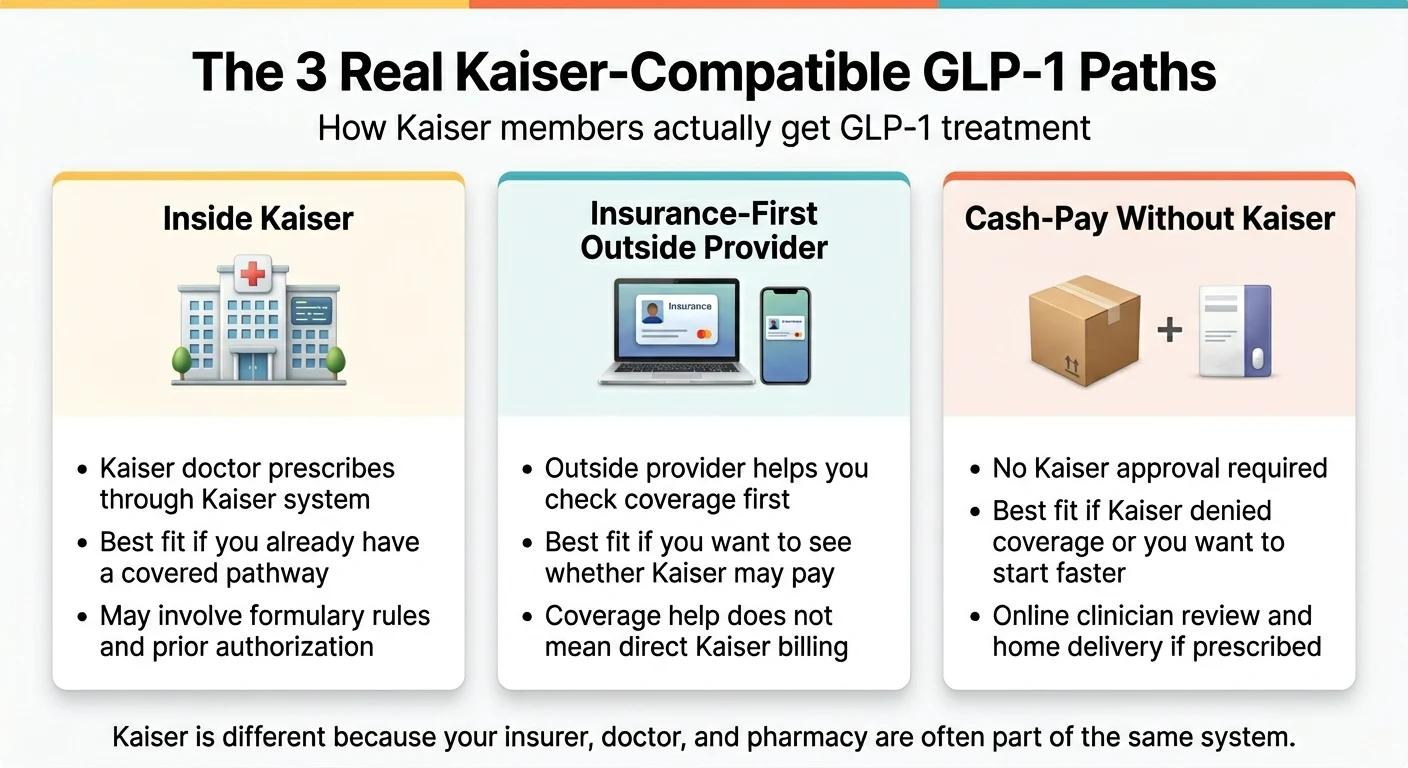
Can an outside provider use my Kaiser benefit?
Do not assume it can.
Kaiser is an integrated system, and many plan documents require plan providers, plan pharmacies, or plan authorization for covered care. The exact rule belongs to your EOC and region. An outside telehealth service may be useful for cash pay, but it may not be able to prescribe through your Kaiser benefit or complete Kaiser's internal chart steps.
Ask this before paying a membership fee:
"Can an outside prescriber use this exact Kaiser pharmacy benefit, and can the prescription be filled at the required plan pharmacy?"
Get the answer from Kaiser, not the telehealth sales page.
What about compounded semaglutide or tirzepatide?
We found no compounded-medication coverage path in the Kaiser documents reviewed.
Compounded drugs are not FDA-approved. FDA does not review them before marketing for safety, effectiveness, or quality. They must not be described as the same product as FDA-approved Wegovy, Ozempic, Zepbound, Mounjaro, or Foundayo.
This page does not rank compounded products against the FDA-approved products in Kaiser's documents. They are different regulatory categories and different insurance questions.
Pricing sources: NovoCare Pharmacy · LillyDirect Zepbound · LillyDirect Foundayo · Ro Body pricing · Ro GLP-1 Insurance Coverage Checker · Sesame weight-loss program
What changed in 2026?
Answer capsule: This page cannot be updated by changing one drug name. In 2026, Kaiser added new oral products and device-specific preferences, Northwest published a future formulary, FDA approved Foundayo and Wegovy HD, Medicare launched the GLP-1 Bridge, Medi-Cal removed weight-loss use from its pharmacy benefit, and California's proposed obesity-coverage mandate died.
1. Mid-Atlantic started naming exact preferred forms
The August 4 forms do not merely say "semaglutide" or "tirzepatide." They separate injection from tablet, and KwikPen from other Zepbound forms.
That makes old advice like "ask for Zepbound" too vague. The form can care which Zepbound.
2. Northwest's current criteria and future formulary now have to be read together
Current criteria call Wegovy and Ozempic forms formulary while sending Zepbound, Mounjaro, and Foundayo through non-formulary review. A separate Commercial formulary effective September 17, 2026 places the named Ozempic and Wegovy forms under Preferred Brand with prior authorization.
As of August 24, that later tier table is not yet current.
3. FDA approved Foundayo and Wegovy HD
FDA approved Foundayo (orforglipron) on April 1, 2026 for chronic weight management in qualifying adults. FDA approved Wegovy HD, the 7.2 mg semaglutide injection, on March 19, 2026 for certain adults.
Those approvals explain why brand-new names now appear in 2026 Kaiser files. Approval does not force a plan to cover a product.
4. Medicare opened a separate $50 route
The Medicare GLP-1 Bridge began July 1, 2026. It did not turn every weight-loss GLP-1 into a normal Part D benefit. It created a separate demonstration with its own drugs, forms, criteria, processor, and $50 monthly copay.
5. Medi-Cal moved the other direction
Medi-Cal Rx stopped covering GLP-1 drugs for weight-loss and weight-loss-related uses on January 1, 2026, while retaining case-by-case coverage for FDA-approved non-weight-loss indications under state rules.
6. California's proposed mandate did not become law
AB 575, the proposed Obesity Prevention Treatment Parity Act, would have changed coverage duties. It died on January 31, 2026 and was filed with the Chief Clerk on February 2.
There is no AB 575 coverage mandate to cite in an appeal.
Regulatory sources: FDA Foundayo approval · FDA Wegovy HD approval · CMS Medicare GLP-1 Bridge · California AB 575 history
How we built this page
Answer capsule: We checked 23 dated Kaiser plan, formulary, criteria, Medicare, and federal-benefit files, then separated what the document says from what a member still has to verify. We did not treat a drug-list appearance as proof of benefit coverage, a tier as a dollar price, or a provider-stated price as a checkout guarantee.
What we opened
| Evidence group | Files or paths checked | Original value added here |
|---|---|---|
| California commercial | 3 | Put Northern California, Southern California, and Marketplace findings in one same-date comparison |
| Colorado commercial | 2 | Separated HMO and Marketplace restrictions instead of merging them |
| Georgia commercial | 2 | Counted six named weight and diabetes brands across the four-tier and five-tier files |
| Hawaii Marketplace | 1 | Kept "not located" separate from "not covered" |
| Mid-Atlantic PA criteria | 4 | Built a preferred-product/form table and corrected the 2026 medication steps |
| Northwest criteria and future formulary | 8 | Put current formulary status, non-formulary review paths, and the future Sept. 17 tier table on one timeline |
| Washington commercial | 1 | Showed the list-versus-benefit contradiction inside one file |
| Kaiser Medicare and federal-plan evidence | 2 | Kept Part D, the CMS Bridge, and FEHB/PSHB rules in separate lanes |
| Total | 23 | One diagnosis-by-region-by-form decision layer |
What we verified directly
- Drug or form named in the exact dated document
- Preferred, nonpreferred, formulary, non-formulary, tier, PA, QL, and future-effective labels
- Published medication steps and review durations in Mid-Atlantic and Northwest
- FDA approval status and indication boundaries
- CMS Bridge products, forms, dates, and $50 copay structure
- Medi-Cal's 2026 weight-loss-use exclusion and state-hearing timing language
- Provider and manufacturer prices shown on official pages on August 24, 2026
What we did not verify — and will not pretend we did
- Your exact Kaiser benefit or copay
- A national Kaiser GLP-1 approval rate
- An employer-by-employer weight-loss benefit list
- A claim that a drug missing from one public file is definitely excluded from every plan
- A checkout, prescription, stock, or start-date guarantee from a telehealth provider
- Member anecdotes as proof of coverage
No named medical reviewer, because no clinician reviewed this page and we will not invent one. This is an insurance-document analysis, not medical advice. Clinical decisions belong to you and your clinician.
Our verification rule
A claim only made the matrix if we could tie it to a named document, plan path, and date. When we could not find a brand in the exact file, we wrote not located — not "not covered." When a later-dated file had not taken effect, we wrote not yet in effect.
That sounds fussy until it is your prescription.
Frequently asked questions
What is the best GLP-1 on the Kaiser formulary?
For weight, Wegovy injection is the strongest first request when your plan includes the benefit. Kaiser Mid-Atlantic names it preferred for the form's non-diabetes indications, and current California commercial files place it at Tier 2. For type 2 diabetes, Ozempic injection is the strongest first request; it is preferred in Mid-Atlantic and appeared in all 11 regional or plan paths reviewed. Your plan, diagnosis, and exact form still decide.
Does Kaiser make you try Wegovy before Zepbound?
In Northwest, the current Zepbound criteria use a minimum six-month semaglutide trial unless an exception applies, plus other steps and a chart review. Mid-Atlantic's weight-management tirzepatide form asks about failure to lose and maintain at least 5% after a three-month semaglutide trial at the maximum tolerated dose. Do not assume either rule applies in every region.
Does nausea count as failing a GLP-1 at Kaiser?
Kaiser Northwest says expected, mild reactions that resolve and do not require stopping may not count as intolerance. So mild expected nausea may not satisfy a step requirement. Do not keep taking a medicine just to satisfy a rule. Ask your clinician what should be documented and get help for severe or persistent symptoms.
How long is Kaiser's weight-management program requirement?
It varies. Northwest asks for current diet and activity work and prior oral medication trials in its adult weight paths. Mid-Atlantic uses 90 days of documented lifestyle work in several BMI bands, but not one blanket rule for everyone. The Northwest FEHB brochure describes an approved program with 26 or more contact hours over 3 to 12 months. There is no single national number.
What BMI does Kaiser require?
There is no one Kaiser BMI rule. Northwest's adult Wegovy criteria use BMI 30 or higher, or BMI 27 or higher with a listed weight-related condition, plus other requirements. Mid-Atlantic uses separate BMI bands. If your plan excludes weight-loss drugs, no BMI creates coverage.
Does Kaiser cover Wegovy in California?
The Northern California and Southern California Commercial HMO formularies and the California Commercial Marketplace formulary, all effective August 4, 2026, list Wegovy at Tier 2. That applies to those exact documents, not every California plan. Your Evidence of Coverage still decides whether the benefit is included and what you pay.
Does being on the Kaiser formulary mean it is covered for me?
No. A formulary shows where a drug sits on a plan list. Your benefit says whether the category and use are covered. Kaiser Washington's file lists Zepbound at Tier 3 and separately says most plans exclude drugs for weight loss.
Is my Kaiser GLP-1 approval rate published anywhere?
No public source reports a Kaiser GLP-1 drug approval rate. CMS-0057-F required the first public prior authorization metrics by March 31, 2026, but the finalized metrics exclude prescription drugs.
Does Kaiser cover Ozempic for weight loss?
Ozempic is an FDA-approved diabetes brand, not an FDA-approved chronic weight-management brand. A plan can deny a request sent only for obesity under its diagnosis rules. Wegovy is the semaglutide brand with chronic weight-management indications.
Can my employer plan have different Kaiser coverage than my neighbor's?
Yes. Employers can buy different pharmacy and weight-management benefits. Two members in the same city can get opposite answers while both answers are correct for their own plans.
Does Kaiser Medicare cover GLP-1 drugs?
Part D can cover GLP-1 drugs for Part D-covered indications, but it excludes drugs used only for weight loss. Eligible members may qualify for the separate Medicare GLP-1 Bridge at $50 per monthly supply through December 31, 2027.
Which GLP-1 forms are in the Medicare GLP-1 Bridge?
CMS currently includes Foundayo tablets, Wegovy injections and tablets, and Zepbound KwikPen. Zepbound single-dose pens and single-dose vials are not included.
Does Kaiser cover compounded semaglutide?
We found no compounded-medication coverage path in the Kaiser documents reviewed. Compounded drugs are not FDA-approved, and they must not be described as the same product as an FDA-approved drug.
Can I use an outside telehealth service and still use my Kaiser benefit?
Sometimes plan rules block that. Many Kaiser plans use plan providers, plan pharmacies, or internal authorization. Ask Kaiser whether an outside prescriber can use your exact pharmacy benefit before paying a membership fee.
What do PA, QL, and ST mean on a Kaiser drug list?
PA is prior authorization — the plan reviews the request first. QL is a quantity limit. ST is step therapy — another treatment must be tried or documented first. They mark controls, not automatic denials.
Still not sure which GLP-1 path is right for you?
Take the free Find My GLP-1 Path quiz →
It compares the broader insurance-first and cash-pay paths with source-checked pricing. It does not replace Kaiser's own member-level benefit check.
Sources
Kaiser regional formularies and criteria
- Kaiser Permanente drug formulary directory
- Northern California formulary page — 2026 Commercial HMO formulary
- Southern California formulary page — 2026 Commercial HMO and Commercial Marketplace formularies
- Colorado formulary page — 2026 Commercial HMO and Marketplace formularies
- Georgia formulary page — 2026 Four-Tier and Five-Tier Benefit formularies
- Hawaii formulary page — 2026 Marketplace formulary
- Mid-Atlantic Community Provider Pharmacy portal — current Semaglutide Products, Tirzepatide Products, Foundayo, and Liraglutide prior authorization forms
- Northwest formulary and criteria page — current Wegovy, Ozempic, Zepbound, Mounjaro, and Foundayo criteria
- Northwest Commercial formulary effective September 17, 2026
- Washington formulary information — individual, family, and small-employer formulary rules
- Kaiser 2026 Medicare Part D formulary portal
- OPM 2026 Kaiser Permanente Northwest brochure
Government and regulatory
- CMS Medicare GLP-1 Bridge
- CMS Bridge information for Part D plans
- CMS-0057-F prior authorization fact sheet
- Medi-Cal Rx State Budget Updates
- California DMHC Independent Medical Review reports
- California AB 575 bill history
- FDA Foundayo approval
- FDA Wegovy HD approval
- FDA Zepbound OSA approval
- FDA Wegovy MASH approval
- FDA compounding questions and answers
Prices checked August 24, 2026
- NovoCare Pharmacy
- NovoCare Wegovy Savings Offer
- LillyDirect Zepbound
- LillyDirect Foundayo
- Ro Body pricing
- Ro GLP-1 Insurance Coverage Checker
- Success by Sesame
Disclaimer
This page is independent research about insurance coverage. It is not medical advice and it is not a guarantee of coverage. Coverage decisions belong to your plan. Clinical decisions belong to you and your clinician. Drug names are trademarks of their respective owners. The RX Index is not affiliated with, endorsed by, or sponsored by Kaiser Permanente or any pharmaceutical manufacturer.
Related Kaiser guides: Kaiser Zepbound Prior Authorization · Kaiser Mounjaro Prior Authorization · GLP-1 Providers That Accept Kaiser · Kaiser and the Medicare GLP-1 Bridge