
Does FEHB Cover GLP-1? 2026 Plan Rules + What to Do If You’re Denied
Primary sources: OPM Carrier Letter 2023-01 · OPM 2026 Open Season Highlights · 2027 FEHB Call Letter · plus plan brochures and formularies for BCBS FEP, GEHA, Kaiser, MHBP, and FSBP.
Does FEHB cover GLP-1 medications? Yes — every FEHB plan must cover at least one GLP-1 for weight loss in 2026 plus at least two oral anti-obesity medications. That’s an OPM mandate, not a plan choice. Now here’s the part nobody tells you up front: which GLP-1, what tier, what prior authorization paperwork, what cost-share, and even which weight-management program you have to be enrolled in to keep your prescription — all of that varies wildly by plan.
Some 2026 changes hit hard. Kaiser raised member coinsurance to 50% for GLP-1s. GEHA moved Wegovy and Saxenda to non-preferred on most plans, and Zepbound is non-formulary entirely on every GEHA plan (Formulary Exception path only). BCBS FEP places Wegovy at Tier 3 with PA on Standard and Basic, with Zepbound on the excluded list. MHBP now requires CVS Weight Management Program enrollment to get anti-obesity meds at all. FSBP requires four weigh-ins and four Teladoc app engagements every 30 days.
The short version: does FEHB cover GLP-1? Yes, by mandate. Will Wegovy or Zepbound be cheap or easy? Not always. Will paperwork be involved? Almost certainly. Is there a path forward if you’re denied? Three of them.
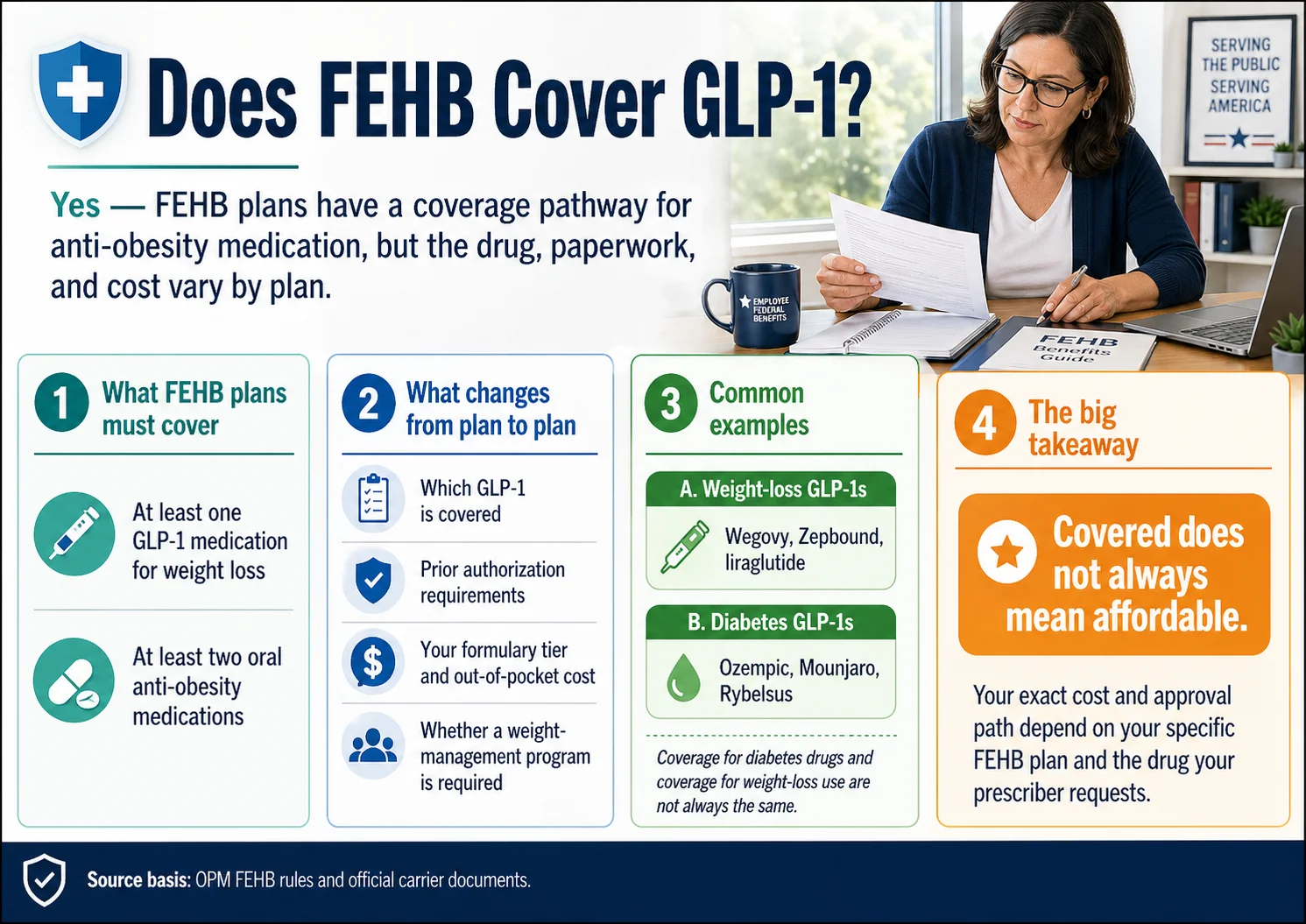
At-a-glance: verified coverage examples for the most-asked drugs
| Drug | Mandated by FEHB? | What 2026 looks like (verified examples) |
|---|---|---|
| Wegovy (semaglutide) | Yes — coverage pathway required on every plan | Tier 3 with PA on BCBS FEP Standard/Basic; NC (not on standard formulary) on FEP Blue Focus; non-preferred on most GEHA plans (preferred on GEHA Elevate); 50% coinsurance on Kaiser; CVS Weight Management Program enrollment required on MHBP; EncircleRx/Teladoc engagement required on FSBP |
| Zepbound (tirzepatide) | Conditionally — coverage path varies | Excluded list on BCBS FEP Standard/Basic (Formulary Exception path only); not on FEP Blue Focus standard formulary; non-formulary on every GEHA plan (Formulary Exception path) |
| Saxenda (liraglutide injection) | Yes — covered with PA | Tier 3 with PA on BCBS FEP Standard/Basic; non-preferred on most GEHA plans; preferred on GEHA Elevate |
| Generic liraglutide | Yes — covered with PA | Tier 1 with PA on BCBS FEP Standard/Basic — the cheapest GLP-1 path on FEP |
| Ozempic / Mounjaro / Rybelsus | Yes — as type 2 diabetes drugs | On FEP Blue Standard and Basic, listed as Tier 2 covered T2D drugs; off-label use for weight loss commonly hits step therapy or denial |
| Foundayo (orforglipron) | Coverage emerging — verify per plan | FDA-approved April 1, 2026 for chronic weight management. Plans are still updating formularies; check yours directly. |
Personalized action plan
Want a personalized walkthrough for your specific plan and drug?
Get your free FEHB GLP-1 action plan in 60 seconds →Pick your plan, your drug, and your situation — we hand you the exact next step.
What we actually verified for this page
We pulled coverage rules directly from primary documents, not summaries of summaries. Sources checked include:
- OPM Carrier Letter 2023-01 and the 2026 Open Season Highlights for the program-level mandate.
- BCBS FEP’s 2026 Abbreviated Formulary, Pharmacy FAQ, and medical policies 5.99.027, 5.99.029, and 5.99.030.
- GEHA’s December 2025 GLP-1 Pharmacy Coverage FAQ.
- Kaiser Permanente’s 2026 FEHB GLP-1 Requirements document.
- MHBP 2026 Consumer Option brochure.
- FSBP 2026 brochure and AFSPA’s EncircleRx update.
- CMS Medicare GLP-1 Bridge page and the April 21, 2026 BALANCE delay announcement.
Where we could not verify a specific cost-share number or PA criterion, we say so directly. We’d rather flag a gap than give you a confident answer that turns out to be wrong on your plan.
What every FEHB plan is legally required to cover
Every FEHB carrier must cover at least one FDA-approved GLP-1 prescribed for weight loss and at least two additional oral anti-obesity medications in 2026. This requirement comes from OPM Carrier Letter 2023-01 and is reaffirmed in OPM’s 2026 Open Season Highlights. It applies to BCBS FEP, GEHA, Kaiser, MHBP, FSBP, and every other FEHB and PSHB plan.
“At least one GLP-1” is the floor, not a guarantee that your specific drug is covered. A plan can satisfy the OPM mandate by covering generic liraglutide while putting Wegovy on a non-preferred tier, or by listing Saxenda as preferred while requiring a Formulary Exception for Zepbound. All of those compliance paths satisfy the rule. None of them tell you whether your prescription is covered without paperwork.
OPM doesn’t set the prior authorization criteria. Each carrier writes its own. That’s why BCBS FEP requires documented weight-management program participation plus a 5% weight-loss benchmark for renewal; Kaiser requires documented failure of other anti-obesity medications first; MHBP requires CVS Weight Management Program enrollment as a precondition; and FSBP requires four weigh-ins and four Teladoc app engagements every 30 days.
The 2027 OPM Call Letter pushes plans further toward structured obesity management. OPM is asking carriers to incorporate intensive behavioral therapy (IBT) — BMI screening, dietary assessment, and counseling — both before and during anti-obesity medication coverage. MHBP and FSBP are already there for 2026.
What FEHB plans CAN still restrict (within the mandate)
| Restriction | What it means in practice |
|---|---|
| Prior authorization (PA) | Your prescriber submits clinical documentation; the plan reviews and approves before the pharmacy fills. |
| Formulary tier | Drug is covered, but at non-preferred or specialty cost-share — you pay more. |
| Formulary Exception | Drug isn’t on your plan’s standard formulary at all; prescriber must justify why no formulary alternative will work. Higher bar than PA. |
| Step therapy | Plan requires you to try a different (usually cheaper) drug first. |
| Quantity limit | Caps how much can be dispensed per fill or per period. |
| Weight-management program enrollment | Plan requires structured lifestyle, dietitian, or IBT participation for AOM coverage. |
| 5% weight-loss requirement for renewal | After the initial 3–6 month approval window, plan expects measurable progress. |
The 2026 FEHB GLP-1 Coverage Matrix
Pulled from each plan’s primary documents. Every row cites a source. Last verified: .
Nationwide PPO and major FEHB options
| Plan | Wegovy 2026 | Zepbound 2026 | Saxenda / Liraglutide 2026 | Approval gate | Big 2026 change | Source |
|---|---|---|---|---|---|---|
| BCBS FEP Standard | Tier 3 — PA required | Excluded list — Formulary Exception required | Saxenda Tier 3 PA; generic liraglutide Tier 1 PA (cheapest FEP path) | PA for on-formulary weight-loss drugs; Formulary Exception for excluded drugs | Saxenda/Wegovy moved to medical policy 5.99.030; behavior-modification participation now required | FEP 2026 Standard Formulary |
| BCBS FEP Basic | Tier 3 — PA required | Managed Not Covered — Formulary Exception required | Saxenda Tier 3 PA; generic liraglutide Tier 1 PA | Same PA criteria as FEP Standard | Same as Standard | FEP 2026 Basic Formulary |
| BCBS FEP Focus | NC — Non-Formulary Exception (NFE) required; Tier 2 Preferred if approved | NC — NFE required; Tier 2 Preferred if approved | Per closed formulary; NFE for off-formulary drugs | Closed formulary; NFE needed for any drug not on the list | Approved exception puts Wegovy and Zepbound at Tier 2 Preferred — but you must clear the exception bar first | FEP Pharmacy FAQ |
| GEHA High | Non-preferred — PA required (changed 1/1/2026) | Non-formulary — Formulary Exception required | Generic liraglutide PA; Saxenda non-preferred PA | PA for Wegovy/Saxenda/liraglutide; Formulary Exception for Zepbound | Wegovy and Saxenda moved from preferred to non-preferred; Zepbound moved off formulary | GEHA GLP-1 FAQ |
| GEHA Standard | Non-preferred — PA required | Non-formulary — Formulary Exception required | Same as GEHA High | Same as High | Same shift | GEHA GLP-1 FAQ |
| GEHA HDHP | Non-preferred — PA required; deductible applies first | Non-formulary — Formulary Exception required | Same as GEHA High | Deductible first, then PA | Same shift | GEHA GLP-1 FAQ |
| GEHA Elevate | Preferred (kept) — PA required | Non-formulary — Formulary Exception required | Saxenda preferred PA | PA for preferred drugs; Formulary Exception for Zepbound | Elevate did NOT move Wegovy/Saxenda to non-preferred | GEHA GLP-1 FAQ |
| GEHA Elevate Plus | Non-preferred — PA required | Non-formulary — Formulary Exception required | Same as GEHA High | Same as High/Standard/HDHP | Same shift | GEHA GLP-1 FAQ |
| MHBP (Standard / Value / Consumer) | Covered — PA required + CVS Weight Management Program enrollment required | Verify per plan brochure | Per formulary | Program enrollment is a precondition for AOM coverage | New for 2026: program enrollment is now required to receive AOMs | MHBP 2026 Consumer Option Brochure |
| FSBP (Foreign Service) | Covered via EncircleRx; 4 weigh-ins + 4 app engagements per 30 days required (U.S. fills) | Per formulary; EncircleRx applies | Per formulary | EncircleRx through Express Scripts/Teladoc; PA via EviCore; overseas members exempt | EncircleRx program added for 2026; requirements resumed March 1, 2026 after brief suspension | FSBP 2026 Brochure; AFSPA EncircleRx update |
HMO / regional examples
| Plan | Wegovy / Zepbound / Saxenda 2026 | Approval gate | Big 2026 change | Source |
|---|---|---|---|---|
| Kaiser Permanente FEHB (all regions) | Covered with PA at 50% coinsurance of plan allowance | Kaiser lifestyle program enrollment; BMI ≥ 27 with comorbidity; documented failure to lose ≥ 5% with other weight-management medications after 3-month trial; monthly in-office exams | Member cost share increased to 50% for GLP-1s prescribed for weight loss in 2026 | Kaiser FEHB GLP-1 Requirements |
Plans dropping or in transition for 2026
| Plan | Status |
|---|---|
| NALC Health Benefit Plan (CDHP and Standard); Health Alliance HMO; AvMed (HDHP and Standard); Independent Health High; Blue Care Network of Michigan High; Priority Health High | Discontinued for 2026. The FEHB default plan for members who didn’t actively re-enroll is GEHA High Option. The PSHB default is FEP Blue Focus. If you were affected, your current 2026 GLP-1 coverage now follows whichever default you were routed to — worth checking immediately. |
Plans we did not independently verify
| Plan | Status |
|---|---|
| SAMBA, Compass Rose, APWU, CareFirst regional plans, smaller local HMOs | [Needs verification] — We will not publish a coverage claim for these plans without reading the official 2026 brochure and pharmacy formulary directly. The OPM mandate floor still applies. The 5-minute verification framework below gets you to a definitive answer. |
Free coverage check
Not sure what your specific FEHB plan will pay for your specific drug?
Ro’s free GLP-1 Insurance Coverage Checker contacts your insurer and sends a personalized coverage report including PA requirements and cost estimates. No payment required.
Run Ro’s free GLP-1 Insurance Coverage Checker → (sponsored affiliate link, opens in a new tab)How to verify your specific plan in 5 minutes
The Coverage Matrix is the starting point. Here’s how to confirm whatyour plan actually covers right now — because formulary listings can have errors, and plans can update mid-year.
- 1Find your exact plan option. “BCBS FEP” isn’t one plan; it’s three (Standard, Basic, Focus). Same for GEHA (High, Standard, HDHP, Elevate, Elevate Plus) and MHBP (Standard, Value, Consumer Option). Coverage and cost-share differ by option.
- 2Pull your plan’s 2026 brochure. Every FEHB plan posts a brochure on opm.gov plan information. Section 2 (“Changes for 2026”) lists what’s new. Section 5(f) (“Prescription Drug Benefits”) spells out tiers, copays, coinsurance, deductibles, and program requirements.
- 3Use your carrier’s drug-cost transparency tool. OPM required carriers to offer real-time benefit tools for 2026. Search the exact brand name (Wegovy, Zepbound, Saxenda). Note the tier, your copay or coinsurance after deductible, PA status, and any quantity limits.
- 4Decode the symbols.
PA= prior approval;ST= step therapy;QL= quantity limit;NC= not covered;Tier 1/2/3/4/5= cost-share level. - 5Call the PBM. For BCBS FEP, GEHA, and MHBP, that’s CVS Caremark (1-844-443-4279 for GEHA’s GLP-1 questions). For Kaiser, it’s their integrated pharmacy. For FSBP, it’s Express Scripts. Ask: “Is [drug] covered under my [plan + option] for [weight loss / type 2 diabetes] in 2026? Is prior authorization required? Is there a weight management program requirement? What’s the estimated out-of-pocket cost? Can I get a call reference number?”
The reference number matters. If you ever appeal, that call is documentation.
Plan-by-plan deep dives
BCBS FEP Standard, Basic, and Focus — 2026
BCBS FEP places Wegovy at Tier 3 with prior authorization on FEP Blue Standard and FEP Blue Basic for 2026 (source). Saxenda is also Tier 3 with PA. Generic liraglutide is Tier 1 with PA — the cheapest FEP path to a covered weight-loss GLP-1. Zepbound is on the excluded drug list for Standard and the Managed Not Covered list for Basic, meaning a Formulary Exception is required (source: FEP Pharmacy FAQ). FEP Blue Focus is a closed formulary, so any drug not on its standard list requires a Non-Formulary Exception (NFE). All weight-loss GLP-1s require prior authorization under BCBS FEP Medical Policies 5.99.027 and 5.99.030 (effective January 1, 2026).
An important nuance on the FEP FAQ language. FEP states that if a Formulary Exception is approved, Zepbound on Standard/Basic would be at Tier 3 non-preferred, and both Wegovy and Zepbound on Focus would be at Tier 2 Preferred. That’s the post-exception tier — not a guarantee of approval. You can’t request a tier exception on top of an approved Formulary Exception; the cost-share is fixed at the post-approval tier.
What changed for 2026. FEP placed Saxenda and Wegovy on their own medical policy (5.99.030) effective January 1, 2026. A behavior-modification participation requirement was added to both initiation and renewal criteria. Renewal now requires adults to have lost at least 5% of baseline body weight; pediatric patients need clinically significant weight loss.
The actual PA criteria for adults (18+):
- BMI ≥ 30, OR
- BMI ≥ 27 with established cardiovascular disease (prior MI, stroke, coronary artery disease, peripheral artery disease), OR
- BMI ≥ 27 with at least one weight-related comorbidity (type 2 diabetes, dyslipidemia, hypertension)
- Participation in a comprehensive weight-management program (Teladoc cited as an accepted example)
- No dual therapy with another PA-required weight-loss medication
For pediatric patients (12–17): BMI at or above the 95th percentile for age. Initial approval: 6 months. Renewal: 12 months.
The cheapest legal FEP path to a GLP-1 in 2026: Generic liraglutide at Tier 1 with PA is the lowest-cost-share covered option satisfying the OPM mandate. Talk to your prescriber about whether liraglutide is clinically appropriate before pursuing the more expensive branded options.
GEHA — High, Standard, HDHP, Elevate, and Elevate Plus
GEHA covers Wegovy and Saxenda for weight loss on every plan in 2026, but moved both to non-preferred status on the High, Standard, HDHP, and Elevate Plus plans starting January 1, 2026. GEHA Elevate kept Wegovy and Saxenda preferred. Zepbound is non-formulary on every GEHA plan for 2026 — coverage requires a Formulary Exception (source: GEHA GLP-1 FAQ).
| Drug | High / Standard / HDHP / Elevate Plus | Elevate |
|---|---|---|
| Wegovy | Non-preferred (was preferred) — PA required | Preferred (unchanged) — PA required |
| Saxenda | Non-preferred (was preferred) — PA required | Preferred (unchanged) — PA required |
| Liraglutide (generic) | PA required | PA required |
| Zepbound | Non-formulary — Formulary Exception required | Non-formulary — Formulary Exception required |
What to do if you’re a GEHA member on Wegovy or Zepbound:
- Call CVS Caremark at 1-844-443-4279 to confirm your drug’s status and projected 2026 cost.
- If you’re on Zepbound and want to keep it: ask your provider to start the Formulary Exception process.
- If cost-share on non-preferred Wegovy is unworkable, the next Open Season is your switching window. GEHA Elevate kept Wegovy preferred.
- If you need help with Formulary Exception paperwork, an FDA-approved telehealth provider with insurance-coordination support is one path.
Kaiser Permanente FEHB — all regions
Kaiser Permanente’s FEHB plans cover GLP-1 drugs and oral anti-obesity medications at 50% coinsurance of the plan allowance in 2026 — an increase from prior years (source). The PA gate is among the most structured in the FEHB program.
The Kaiser PA gate:
- Enrollment in a Kaiser lifestyle intervention and guided intensive behavioral program
- Baseline BMI ≥ 27 with a weight-related comorbidity
- Documented intolerance or failure to lose and maintain at least 5% body weight after a 3-month trial of other weight-management medications
- Monthly (every 4 weeks) in-office exams with weight monitoring
- Member must attest to a reduced-calorie diet and increased physical activity
- Initial approval: 3 months → reassessed → up to 6 additional months
What 50% coinsurance means in practice. Kaiser bases coinsurance on the plan allowance, which can differ from list price. Many Kaiser FEHB members are evaluating whether the insured path or an FDA-approved cash-pay path nets out cheaper — we cover that math below. Verify your specific dollar exposure with your regional Kaiser FEHB brochure.
MHBP — the program-enrollment plan
MHBP (Mail Handlers Benefit Plan) added a new 2026 requirement: members must participate in the CVS Weight Management Program to receive anti-obesity medications (source: MHBP 2026 Consumer Option brochure, Section 2: Changes for 2026). The plan language is unambiguous: “We now require participation in the CVS Weight Management Program to receive anti-obesity medications.”
The CVS Weight Management Program provides one-on-one virtual support from a registered dietitian, a personalized nutrition plan, the CVS Weight Management app, and connected scale/devices. There’s no member cost to participate. Your prescription alone isn’t enough on MHBP for 2026 — program enrollment is the gate.
Action items for MHBP members: Confirm program enrollment status before your next refill. If you’re new to MHBP this year, enroll in the CVS Weight Management Program now — don’t wait for a denial letter. Document your participation; CVS tracks engagement through the app, but keep your own records.
FSBP — the EncircleRx plan
FSBP (Foreign Service Benefit Plan) added the EncircleRx GLP-1 Utilization Program through Express Scripts and Teladoc Health for 2026. The participation requirement was temporarily suspended during early 2026 rollout but resumed March 1, 2026.
What FSBP members must do for refills (U.S. fills):
- Complete at least four (4) weigh-ins per rolling 30-day period using the Teladoc-provided scale
- Engage with the Teladoc app at least four (4) times per rolling 30-day period
- Have an updated prior authorization on file via EviCore (online or 800-417-1764), submitted by the prescribing provider
The overseas exemption. Per AFSPA’s GLP-1 FAQs, FSBP members living overseas who obtain GLP-1 medications from overseas retail pharmacies are exempt from the EncircleRx participation requirement. If you return to the U.S. and fill there, the requirement applies.
This is the most engagement-intensive FEHB GLP-1 path we found for U.S.-based fills. Four weigh-ins and four app engagements every 30 days is an ongoing requirement — miss the thresholds and you risk a refill interruption.
What you’ll need for prior authorization (every plan)
Most FEHB plans gate GLP-1 weight-loss coverage through prior authorization, and the structure is consistent across plans. Four gates show up across BCBS FEP, GEHA, Kaiser, MHBP, FSBP, and most smaller carriers: a BMI threshold, a comorbidity or higher-BMI requirement, participation in a comprehensive weight-management program, and a 5% weight-loss benchmark for renewal. Document all four and your odds of approval are dramatically higher.
The four PA gates
- 1. The BMI gate. Adults: BMI ≥ 30, OR BMI ≥ 27 with at least one weight-related comorbidity (type 2 diabetes, hypertension, dyslipidemia, established cardiovascular disease). Pediatric patients (12–17): BMI at or above the 95th percentile for age.
- 2. The lifestyle program gate. A documented comprehensive weight-management program — diet, exercise, behavioral modification. Teladoc (BCBS FEP, FSBP), CVS Weight Management Program (MHBP), Kaiser’s integrated lifestyle programs, in-person dietitian visits, and supervised group programs all qualify on the plans that accept them.
- 3. The step therapy or trial gate (some plans). Kaiser explicitly requires documented intolerance or failure of other anti-obesity medications first. Your formulary symbols (“ST”) flag this on other plans.
- 4. The renewal gate. ≥ 5% weight loss from baseline (or maintenance of initial 5% loss) within the first 3–6 months. Documented at BCBS FEP renewal and effectively at every other major plan.
What to bring to your PA appointment
- Current weight, height, and calculated BMI (recent — within the last 30 days)
- ICD-10 codes for any qualifying comorbidities (type 2 diabetes, hypertension, hyperlipidemia, OSA, established CVD)
- Documentation of any prior weight-loss medication trials (drug name, dates, outcomes)
- Documentation of structured weight-loss program participation (program name, dates, format, facilitator name)
- Recent lab work supporting comorbidities (A1C, lipid panel, blood pressure readings)
What “covered” actually costs you
Damaging admission, on the record:
FEHB coverage of a GLP-1 does not mean you’ll get it cheaply. “Covered” means your plan must offer a coverage pathway for at least one GLP-1. It does not mean your preferred brand will be cheap. It does not mean prior authorization will be smooth. It does not mean program enrollment won’t be required. It does not mean your tier won’t move next plan year. A federal employee on Reddit summarized it perfectly: “Just remember that something being ‘covered’ is not necessarily the same as something being ‘affordable.’”
Real out-of-pocket costs on FEHB GLP-1 coverage in 2026 range from a low Tier 1 copay on generic liraglutide on FEP, to several hundred dollars per month on a non-preferred tier or Kaiser’s 50% coinsurance, to full retail price if your plan denies you and you don’t pursue an alternative. The single biggest variable is your formulary tier. The single biggest unforced error is assuming “covered” automatically means “affordable.”
Free download
Want a one-page printable PA Documentation Checklist for your specific plan?
Get your free FEHB GLP-1 action plan →Includes the PA documentation checklist, appeal letter template, and 5-minute verification checklist — built from the actual 2026 carrier policies. No spam, just the resources, plus our quarterly update when carriers change formularies.
Type 2 diabetes coverage — Ozempic, Mounjaro, Rybelsus
Verified FEHB formulary examples list Ozempic, Mounjaro, and Rybelsus as covered type 2 diabetes medications, generally on lower formulary tiers than weight-loss-only GLP-1s. On BCBS FEP Standard and Basic 2026 formularies, Ozempic and Mounjaro are listed as covered diabetes drugs at Tier 2.
- Ozempic (semaglutide for T2D) sits on most major FEHB formularies as a covered T2D drug. Off-label use for weight loss commonly hits step therapy — plans want you to use Wegovy (the on-label weight-loss equivalent) first.
- Mounjaro (tirzepatide for T2D) is on most major FEHB formularies as a T2D drug. Off-label weight-loss use hits step therapy or denial in favor of the on-label equivalent (Zepbound).
- Rybelsus (oral semaglutide for T2D) is on FEHB formularies as a T2D drug for patients who can’t or won’t inject.
A note on diagnosis coding. If you don’t have type 2 diabetes, asking your doctor to code Ozempic as a T2D treatment isn’t a workaround — it’s a diagnosis-coding problem with real consequences. The on-label path for weight loss (Wegovy or Zepbound, or generic liraglutide) is almost always faster and your doctor’s office handles the coding correctly.
Cardiovascular risk reduction. Wegovy is FDA-approved to reduce the risk of major cardiovascular events in adults with established cardiovascular disease and obesity or overweight. This indication can sometimes unlock coverage on plans that are tighter on weight-loss-only use. Talk to your prescriber about whether your medical history qualifies.
Foundayo — what FEHB members should know about the new oral GLP-1
Foundayo (orforglipron) was FDA-approved on April 1, 2026 for adults with obesity, or some adults with overweight who also have weight-related medical problems, used alongside a reduced-calorie diet and increased physical activity. It’s a once-daily small-molecule oral GLP-1 that can be taken any time of day without food or water restrictions — a meaningful access difference from oral semaglutide.
FEHB coverage status for Foundayo. Plans are still updating formularies for 2026/2027. Per OPM’s standing requirement, FEHB carriers must annually evaluate their GLP-1 coverage as new drugs receive FDA approval. Check your plan’s pharmacy tool directly, and expect formulary placement to be in flux through the rest of 2026.
See also: Does insurance cover Foundayo? · Foundayo savings card
PSHB — postal workers
The Postal Service Health Benefits (PSHB) program — which replaced FEHB for most USPS employees and annuitants in 2025 — applies the same OPM mandate: every PSHB plan must cover at least one GLP-1 for weight loss. Coverage tiers and PA criteria mirror each carrier’s FEHB plan structure.
- PSHB is a parallel program under the same OPM oversight; rules on AOM coverage are the same.
- PSHB plan brochures are separate documents from FEHB brochures.
- 2026 PSHB enrollee premiums increased an average of 11.3%, slightly less than FEHB’s 12.3%.
- GEHA Elevate and GEHA Elevate Plus dropped from PSHB for 2026 (plan codes 58A–58F).
- The PSHB default plan for members who didn’t actively re-enroll in 2026 is FEP Blue Focus — important if your prior plan dropped.
Find your PSHB plan’s GLP-1 coverage at opm.gov/healthcare-insurance/pshb, locate your specific 2026 PSHB brochure, and read Section 5(f) for prescription drug benefits.
Annuitants and Medicare integration
FEHB annuitants and Medicare integration is plan-specific. FEHB-affiliated Employer Group Waiver Plans (EGWPs) and the FEP Medicare Prescription Drug Program (MPDP) can enhance Medicare Part D to retain coverage of GLP-1s for weight loss. Standard Medicare Part D is statutorily prohibited from covering weight-loss drugs. So the FEHB-EGWP integration is the structural protection — but only if you’re enrolled in the right FEHB option.
Important detail many readers miss:
The FEP Medicare Prescription Drug Program (MPDP) is not available to FEHB FEP Blue Focus members. MPDP is offered to FEP Blue Standard and FEP Blue Basic Medicare-eligible members only. If you’re on FEP Blue Focus and become Medicare-eligible, verify your specific coverage path with FEP directly. Dropping FEHB for Medicare Part D-only is what creates the coverage gap.
The Medicare GLP-1 Bridge
CMS launched the Medicare GLP-1 Bridge — a short-term demonstration running July 1, 2026 through December 31, 2027. The Bridge provides eligible Medicare Part D beneficiaries with coverage of Wegovy (injectable and tablet) and Zepbound for weight management at a $50 monthly copay (which does not count toward Part D out-of-pocket maximums). Eligibility: BMI ≥ 35 alone, or BMI ≥ 27 with clinical criteria.
The BALANCE Model status. CMS originally announced the BALANCE Model would launch in Medicare Part D January 1, 2027. On April 21, 2026, CMS delayed the Medicare Part D portion of BALANCE pending further evaluation. The Bridge was extended through December 31, 2027 to fill the gap.
Why this matters for FEHB annuitants: If your FEHB plan retains GLP-1 coverage through its EGWP, you’re already covered — you don’t need the Bridge. Don’t drop FEHB for Medicare Part D-only without understanding what you’d be giving up.
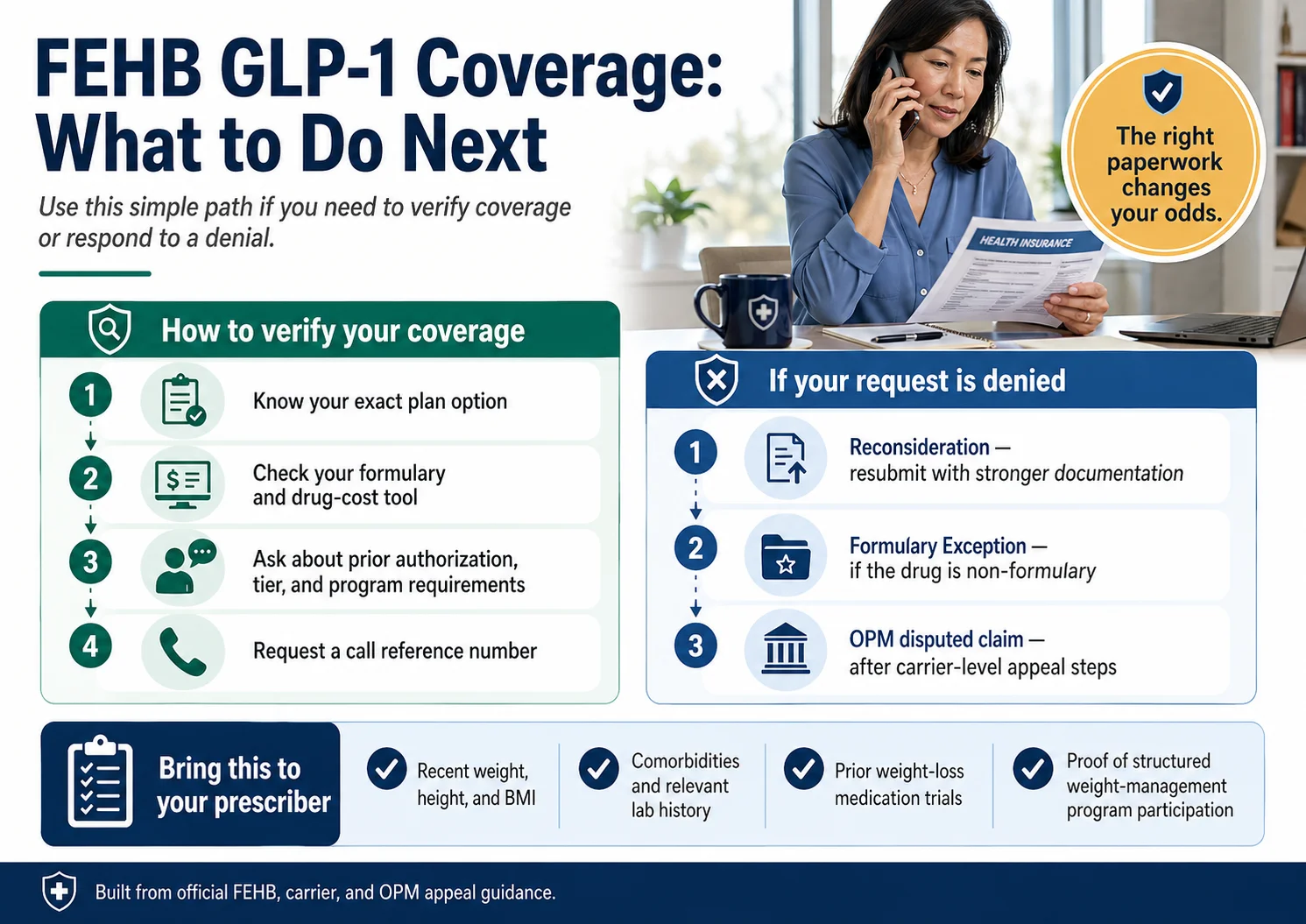
What to do if your FEHB plan denies your GLP-1
A denial letter is not the end of the road. You have a clear three-step escalation path: ask your prescriber to submit a reconsideration request with stronger documentation; pursue a Formulary Exception if the drug is non-formulary; and if still denied, file a disputed claim with OPM. Plan-level reconsideration with stronger documentation often addresses the most common denial reasons.
Step 1 — Carrier-level reconsideration
Your prescriber submits a formal reconsideration request with additional clinical documentation. This is the first step and the highest-success-rate intervention. Common missing pieces addressed at reconsideration:
- More complete comorbidity documentation (lab values supporting hyperlipidemia or diabetes)
- Documentation of structured weight-loss program participation if it wasn’t included originally
- Documentation of prior medication trials and outcomes
- Updated BMI if borderline
BCBS FEP: Provider can call 1-877-727-3784 (Traditional FEHB & PSHB) or 1-855-344-0930 (MPDP). GEHA: Provider works through CVS Caremark at 1-844-443-4279. FSBP: EviCore at 800-417-1764 for prior authorization.
Step 2 — Formulary Exception (if the drug is non-formulary)
A Formulary Exception applies when the drug isn’t on your plan’s standard list at all — like Zepbound on every GEHA 2026 plan. The clinical bar is higher: your prescriber must demonstrate that no formulary alternative will work clinically.
BCBS FEP: FEP Traditional Formulary Exception Form (downloadable from fepblue.org). GEHA: Formulary Exception/Prior Authorization Request Form via Caremark.
Step 3 — OPM Disputed Claims Process
This is the federal-employee superpower most people don’t know about. After exhausting carrier reconsideration, you can escalate to OPM. OPM reviews and can overturn carrier denials independently. By January 1, 2026, all FEHB carriers were required to publish a clear, mobile-friendly fact sheet on the disputed claims process with deadlines, forms, and procedures. Look for it on your carrier’s site.
Common denial reasons and how to address each
| Denial reason | What it usually means | Best next step |
|---|---|---|
| Medical necessity not established | Missing comorbidity or BMI documentation | Strengthen documentation; resubmit with lab values |
| No prior lifestyle program documented | Program participation wasn’t in the file | Document any structured weight-loss program participation; enroll if you haven’t |
| Step therapy required | Plan wants you to try a different drug first | Either complete the step therapy or formally request a step-therapy exception |
| Drug not on formulary | Non-formulary status | Switch to Formulary Exception path, or consider an alternative drug that IS on your formulary |
| Diagnosis mismatch | Drug/use not covered for the submitted indication | Confirm the accurate indication with your prescriber |
| Quantity limit exceeded | Plan has fill-amount caps | Verify the limit; titration approval may be needed |
Just received a denial?
Download our free FEHB GLP-1 Appeal Letter Template
Find your next step in 60 seconds →Walks you through exactly what to include — built from the actual PA criteria in BCBS FEP, GEHA, and Kaiser policy documents.
When FDA-approved cash-pay makes more sense than fighting your FEHB plan
For some FEHB members — particularly those on plans with 50% coinsurance, those on non-preferred tiers, those whose drug is non-formulary, or those denied on appeal — FDA-approved cash-pay paths can be cheaper, faster, and less administrative than the insurance route. We’re not telling you to abandon insurance. We’re telling you to do the math on your specific situation.
The honest tradeoff:
- Cash-pay does NOT count toward your FEHB deductible or out-of-pocket maximum. If you’re already going to hit your OOP max because of other healthcare costs, your insurance path is much better than it looks.
- Cash-pay does NOT include the broader benefits of medical supervision tied to your existing plan — though FDA-approved telehealth providers include their own clinical oversight.
- If your plan covers Wegovy at preferred tier (or generic liraglutide at Tier 1 on FEP), insurance is almost always cheaper. Don’t abandon a working insurance path.
When FDA-approved cash-pay actually wins:
- You have GEHA High/Standard/HDHP/Elevate Plus and your Wegovy moved to non-preferred (or Zepbound is non-formulary)
- You have Kaiser and 50% coinsurance is unworkable
- You’ve been denied on appeal
- You don’t expect to hit your annual OOP max
- You want a single-vendor experience without PA paperwork or pharmacy delays
Ro Body — the strongest fit for FEHB members specifically
FDA-approved telehealth · Insurance concierge available
Ro is the most-aligned FDA-approved telehealth provider for FEHB members for one specific reason: Ro publicly states that FEHB members can join Ro Body and use Ro’s insurance concierge (sponsored affiliate link, opens in a new tab). That’s a verifiable product fit, not a generic recommendation. Ro separates FEHB from most other government plans, where insurance coordination is generally not supported.
Ro carries a broad FDA-approved GLP-1 menu in cash-pay telehealth — Foundayo (orforglipron), Wegovy pen, Wegovy pill, Zepbound pen, and Zepbound KwikPen. Ro states that its FDA-approved GLP-1 cash-pay prices match LillyDirect, NovoCare, and TrumpRx (Ro pricing page (sponsored affiliate link, opens in a new tab)). It offers a free GLP-1 Insurance Coverage Checker (sponsored affiliate link, opens in a new tab) that contacts your plan and sends a personalized coverage report, and an Insurance Concierge that handles prior authorization paperwork.
Ro Body pricing (current at ro.co):
- $39 for the first month
- Then $149/month month-to-month
- As low as $74/month with annual prepay
Medication cost is separate from membership.
Where Ro doesn’t fit: If your insurance is working and a clinician is handling your PA paperwork, Ro adds cost without adding value. If you want everything billed through insurance with zero membership fees, the FEHB-direct path is your move. If you’re looking for compounded GLP-1s, Ro is a brand-name FDA-approved provider — that’s a different lane entirely.
Sesame Care — the broad-formulary alternative
Sesame Care is the secondary FDA-approved cash-pay pick. Sesame’s current online weight-loss program lists Wegovy pill, Wegovy pen, Zepbound pen, Zepbound KwikPen, Zepbound vial, Foundayo, and Ozempic (source: sesamecare.com (sponsored affiliate link, opens in a new tab)). Sesame also offers Costco-member pricing on certain branded GLP-1s — Wegovy pill starting at $149/month for Costco members.
Sesame is a more transactional, less concierge-style experience than Ro — better when you want provider choice or when Costco-member pricing is the deciding factor.
Compare branded GLP-1 cash-pay pricing on Sesame Care → (sponsored affiliate link, opens in a new tab)Whether you pursue your FEHB benefit or pivot to cash-pay, know exactly what your plan covers first.
Run Ro’s free GLP-1 Insurance Coverage Checker → (sponsored affiliate link, opens in a new tab)Contacts your plan, confirms what’s covered, and reports PA requirements and cost estimates. No payment required.
Open Season strategy — choosing an FEHB plan for GLP-1 coverage
For 2026 — and looking forward to Open Season for plan year 2027 — the FEHB plans that give the most-aligned combination of GLP-1 coverage and cost-share, based on what we verified:
- BCBS FEP Standard or Basic — Generic liraglutide at Tier 1 with PA is the lowest-cost-share covered option satisfying the OPM mandate. Wegovy and Saxenda are Tier 3 with PA. Nationwide network. Strong PA infrastructure.
- GEHA Elevate — Only GEHA option that retained Wegovy and Saxenda as preferred for 2026. Zepbound still requires Formulary Exception.
Plans to scrutinize before relying on them
- GEHA High, Standard, HDHP, Elevate Plus — Non-preferred Wegovy/Saxenda; non-formulary Zepbound for 2026.
- Kaiser Permanente — 50% coinsurance on GLP-1s for 2026 (verify your specific Kaiser region).
- MHBP — Program enrollment required for AOMs; don’t skip enrollment.
- FSBP — EncircleRx four-weigh-in/four-engagement requirement is ongoing, not a one-time gate.
What to do during Open Season if GLP-1 coverage is your priority
- Check the 2026 brochure for every plan you’re considering. Section 5(f) is prescription drug benefits; Section 2 is changes for the new plan year.
- Use the carrier’s drug-cost transparency tool for your specific drug.
- Call the carrier directly to confirm tier and PA criteria — formulary listings can have errors.
- Consider total cost of care, not just GLP-1 cost-share. A slightly higher GLP-1 cost on a plan with much lower premium can net out cheaper.
- Confirm the plan accepts the maximum government contribution (75% for some plans).
When the next Open Season is: For plan year 2027, Open Season is expected to run approximately mid-November through early December 2026 (verify exact OPM dates closer to the date). Coverage changes lock in until the next Open Season unless you experience a Qualifying Life Event.
Frequently asked questions
Are GLP-1 drugs covered by federal employee insurance?
Does FEHB cover Wegovy in 2026?
Does FEHB cover Zepbound in 2026?
Does FEP Blue cover Wegovy?
Does FEP Blue cover Zepbound?
Does GEHA cover Wegovy in 2026?
Does GEHA cover Zepbound in 2026?
Does MHBP require CVS Weight Management for GLP-1s?
Does FSBP require EncircleRx or Teladoc for GLP-1s?
What if my FEHB plan denies my GLP-1?
Can I use a manufacturer coupon with FEHB?
Does FEHB cover compounded semaglutide or tirzepatide?
Does PSHB cover GLP-1 drugs?
Will I lose GLP-1 coverage when I retire and go on Medicare?
What is the Medicare GLP-1 Bridge?
Is Foundayo covered by FEHB plans?
Can Ro help FEHB members with GLP-1 insurance?
How we built and verified this page
We followed a strict source hierarchy:
- OPM carrier letters and Open Season documents — for the program-level mandate.
- Official FEHB plan brochures and formularies — for plan-specific coverage status.
- Plan/PBM GLP-1 FAQs and medical policies — for tier placement and PA criteria.
- FDA pages — for regulatory and approval status.
- Provider official pages — for cash-pay program details and pricing.
- Reddit and forum threads — used only to capture voice-of-customer language. Never used as coverage evidence.
Editorial recommendations are explicitly framed as editorial conclusions based on the verified facts above.
What we could not verify in time for this publish:
- Complete 2026 coverage detail for every FEHB plan, including SAMBA, Compass Rose, APWU, and several regional HMOs.
- Exact 2026 member cost-share dollar amounts for every plan/drug/region — verify against your plan’s Section 5(f).
- Manufacturer savings card eligibility for every reader — verify directly with the manufacturer’s current program terms.
- Individual medical eligibility for any specific drug — that’s between you and your prescriber.
Last verified: . Next scheduled verification: . We refresh this page quarterly and after every Open Season; if a plan changes its formulary or PA criteria mid-year, we update within 30 days.
Your next step
Still not sure which GLP-1 program is right for you?
It accounts for your FEHB plan, prior authorization status, drug preference, and budget — and gives you a personalized action plan in under a minute. Whether the answer is “stay with your plan and submit PA,” “start a Formulary Exception,” “switch plans next Open Season,” or “evaluate FDA-approved cash-pay,” we’ll route you to the exact next move.
Take our free 60-second matching quiz →You’re not stuck. You just need the right map.