
GLP-1 Muscle Preservation · Verified May 2, 2026
GLP-1 Muscle Loss: What’s Real, Who’s at Risk, and How to Prevent It
Published: · Last reviewed:
Sources: STEP-1, SURMOUNT-1, SURMOUNT-5 (NEJM 2025), SUSTAIN-8, BELIEVE Phase 2 (Heymsfield et al., Nature Medicine 2026), Cell Reports Medicine March 2026 (Langer et al.), 2025 University of Hong Kong Mendelian-randomization study, 2026 BMJ meta-analysis on weight regain, 2025 ENDO meeting (Haines et al.), 2024 Diabetes, Obesity and Metabolism (Neeland et al.), 2025 Acta Diabetologica, FDA labels for Wegovy/Zepbound/Saxenda/Foundayo/Ozempic/Mounjaro, FDA Drug Safety Communications, FDA warning letter to MEDVi LLC (Feb 20, 2026), UC Davis Health (Baar commentary), Mayo Clinic, Mass General Advances in Motion.
The bottom line
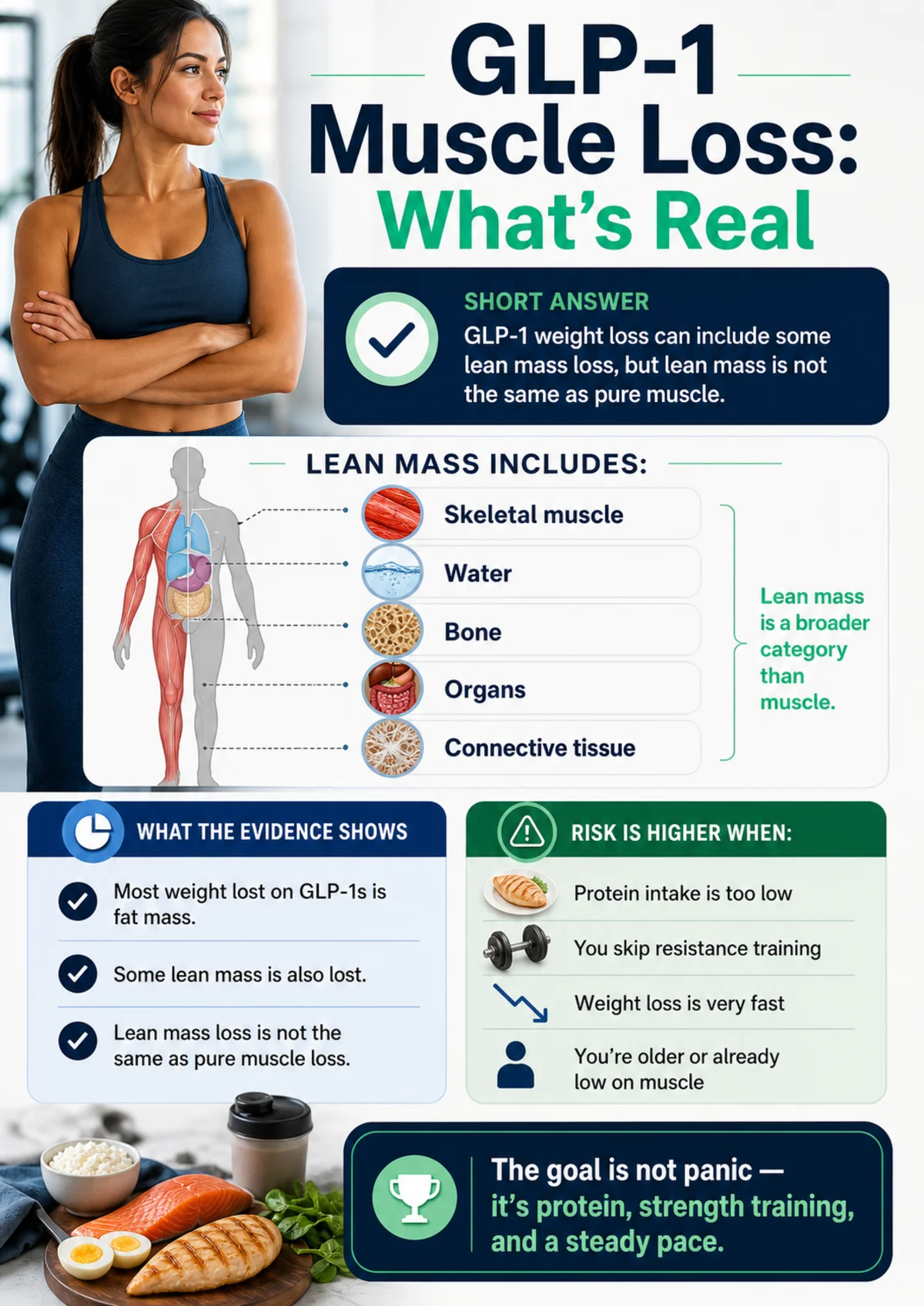
GLP-1 muscle loss is a real concern, but the famous “40% of weight loss is muscle” headline overstates the story. That number is lean body mass — which includes the liver, body water, organs, and connective tissue, not just muscle. UC Davis Health frames the rapid-weight-loss range at roughly 15–25% lean muscle mass loss, and a 2026 paper in Cell Reports Medicine found that liver mass loss often exceeds change in muscle mass during GLP-1 weight loss.
Most of what you lose is fat. With three levers — enough protein, strength training a few times a week, and a steady (not crash) rate of loss — you give yourself the best shot at preserving the muscle you need to feel strong, stay independent, and keep the weight off after stopping. Your risk goes up if you’re over 65, postmenopausal, sedentary, or already low on muscle. For most people, this is a manageable problem with a clear plan.
Take the 60-second GLP-1 Match Quiz →We factor in your age, baseline activity, risk score, insurance, and budget — no email required to see results.
What we actually verified for this guide
- Lean mass data from STEP-1, SURMOUNT-1 (pooled tirzepatide DXA substudy), SURMOUNT-5, SUSTAIN-8 substudy, and the BELIEVE Phase 2 trial
- The 2026 Cell Reports Medicine paper showing liver mass loss can exceed muscle mass change
- 2025 University of Hong Kong Mendelian-randomization study (n=800,000+ European participants)
- FDA labels for Wegovy, Zepbound, Saxenda, Foundayo, Ozempic, and Mounjaro (with weight-management vs diabetes indications separated)
- 2026 FDA warning letter to MEDVi (disclosed in the provider directory below)
- Current 2026 muscle-preservation drug pipeline (bimagrumab, trevogrumab, enobosarm, apitegromab)
Last verified:
Quick-look answers — for people in a hurry
| Question | Bottom-line answer |
|---|---|
| Does GLP-1 cause muscle loss? | Some lean mass drops on a GLP-1, but most of what you lose is fat. “Lean mass” includes muscle plus water, organs, and connective tissue — so the famous 40% figure overstates pure muscle loss. |
| How much is actually muscle? | Hard to pin down precisely. UC Davis Health puts the rapid-weight-loss range at roughly 15–25% lean muscle mass loss. DXA scans can’t perfectly separate skeletal muscle from water and other tissue. |
| Which drug loses the least muscle? | SURMOUNT-1’s tirzepatide substudy showed a favorable ~75/25 fat-to-lean split. SURMOUNT-5 head-to-head efficacy data is settled, but head-to-head body-composition data is still maturing. Liraglutide (Saxenda) shows higher proportional lean-mass loss in older trial reviews. |
| Who’s at highest risk? | Adults 65+, postmenopausal women, sedentary people, those with low baseline muscle, and anyone losing weight faster than 1% of bodyweight per week. |
| What works to prevent it? | Protein (1.2–1.6 g per kg of bodyweight, distributed across meals), strength training 2–4 times a week, and a steady weight loss rate of 0.5–1% per week. |
| When should I call my doctor? | Persistent weakness, falls, trouble standing from a chair, severe fatigue, severe nausea or vomiting, dehydration, or a sudden drop in your usual lifts. |
Why we wrote this guide
Most pages on this topic do one of two things. They panic — waving the 40% figure around like the drug is melting your muscles. Or they shrug — “just eat protein and lift weights.” Neither helps the real reader, who’s already on a GLP-1 (or about to be), wants the weight loss, and is trying to figure out how to do this without ending up frail or skinny-fat.
So this is the guide we wish existed when we started reading the research.
We pulled lean mass data from named clinical trials. We separated lean body mass from skeletal muscle (it’s the most important distinction on this whole topic). We built a risk score so you can see where you actually fall. We added a clinician message template so you don’t have to wing it if you need to call. And we kept the provider talk to the end of the page — because picking a GLP-1 program isn’t the first thing a worried reader needs.
If you remove every link to a provider on this page, it should still be the best guide on the internet for this topic. That’s the bar we set.
Does GLP-1 cause muscle loss? The “40% muscle loss” headline isn’t quite what it sounds like
Standalone answer: GLP-1 weight loss can include lean mass loss, but the evidence does not support a simple “GLP-1 destroys muscle” story. When researchers say up to 40% of weight loss comes from “lean mass,” they mean lean body mass — a body composition term that includes the liver, body water, organs, bones, and connective tissue, not just skeletal muscle. UC Davis Health expert commentary puts the rapid-weight-loss range at roughly 15–25% lean muscle mass loss, and a 2026 Cell Reports Medicine study found that liver mass loss can exceed change in muscle mass during GLP-1 treatment.
Here’s the part nobody explains in plain English. Your body weight comes in two big buckets:
- Fat mass (the stuff you mostly want to lose)
- Lean body mass, sometimes called fat-free mass (everything else)
The “lean mass” bucket gets confusing because it’s not just muscle. It includes:
- Skeletal muscle (the part you train at the gym)
- Liver, kidneys, and other organs
- Bones
- Body water (intracellular and extracellular)
- Connective tissue (tendons, fascia)
When obese patients lose 15–20% of their bodyweight, their liver shrinks dramatically. Fatty liver disease is common in obesity, and as fat clears from the liver, the organ itself loses meaningful volume. That liver volume drop shows up as “lean mass loss” on a DXA scan — but it’s not muscle. It’s fat clearing out of an organ that shouldn’t have had it in the first place.
UC Davis Health quoted exercise physiologist Keith Baar in late 2025 saying “we are losing around 20% of muscle mass, but that is not different from diets that restrict calorie intake. Much of the reported 40% lean mass loss with GLP-1 use is coming from the liver.”
A 2026 study in Cell Reports Medicine (Langer et al.) supported the same core distinction in mice and humans: GLP-1 weight loss did not show a disproportionate loss of muscle mass or function, and loss of liver mass exceeded change in muscle mass in their analyses.
The takeaway for you: the “40% muscle loss” figure isn’t wrong, exactly. It’s just imprecise. The number you actually care about — pure skeletal muscle loss — is meaningfully smaller, but harder to pin down precisely because DXA can’t fully separate muscle from water, organs, and connective tissue.
That doesn’t mean you can ignore the issue. It means you can stop catastrophizing it and start dealing with it.
How much muscle do you actually lose? (The drug-by-drug data)
Standalone answer: Across published clinical trials, lean body mass drops by 25–45% of total weight lost on semaglutide and about 25% on tirzepatide. Liraglutide (Saxenda) has shown higher proportional lean loss in some published reviews. The 2026 BELIEVE Phase 2 trial of bimagrumab plus semaglutide reported substantial weight loss with lean mass largely preserved, but bimagrumab is not yet FDA-approved.
We pulled the numbers directly from the trials. Most pages cite one figure and move on. Here’s what each major drug’s published data actually shows.
Lean mass loss in major GLP-1 trials
| Trial | Drug | Total weight loss | Lean mass loss | Lean as % of weight lost | Source |
|---|---|---|---|---|---|
| STEP-1 DXA substudy | Semaglutide 2.4 mg | −15.0% body weight | −9.7% lean mass | ~40–45% | Published DXA substudy of STEP-1 |
| SUSTAIN-8 substudy | Semaglutide (T2D) | −6.0% body weight | −4.5% lean mass | ~43% (lean-to-fat ratio still improved) | Published substudy |
| SURMOUNT-1 DXA substudy | Tirzepatide, pooled 5/10/15 mg | −21.3% body weight | −33.9% fat mass; −10.9% lean mass | ~75% fat / ~25% lean | Published DXA substudy |
| SURMOUNT-5 (head-to-head) | Tirzepatide vs semaglutide | Greater total weight and waist reduction with tirzepatide | Body-composition data still maturing | — | NEJM 2025 efficacy trial |
| Mendelian-randomization (UHK 2025) | Genetically proxied GLP1R agonism, n=800,000+ | — | Reductions in both fat and lean/muscle; fat reduction exceeded muscle reduction | — | Genetic analysis (not a user trial) |
| BELIEVE Phase 2 (2026) | Bimagrumab + semaglutide | Substantial loss over 72 weeks | Lean mass largely preserved | <10% (combo arm) | Heymsfield et al., Nature Medicine 2026 |
A few things jump out when you look at this side by side.
Semaglutide’s STEP-1 substudy showed roughly 40–45% of total weight lost as lean mass. That’s the source of the famous high numbers you’ve seen in news headlines.
Tirzepatide’s SURMOUNT-1 DXA substudy showed a more favorable split — roughly 75% of weight lost as fat mass and 25% as lean mass, in the pooled tirzepatide groups. That looks better than semaglutide’s STEP-1 substudy on paper.
But head-to-head body-composition data is still settling. SURMOUNT-5 confirmed that tirzepatide produced greater total weight and waist reduction than semaglutide. The body-composition substudy data from that head-to-head is still being analyzed and reviewed. Some 2026 pre-peer-review presentations have suggested greater absolute lean mass decline with tirzepatide than semaglutide — likely because tirzepatide drives more total weight loss. The point: don’t decide your medication based on a “tirzepatide is gentler on muscle” claim. The head-to-head answer isn’t fully settled yet.
Liraglutide (Saxenda) has shown higher proportional lean-mass loss in some published reviews — up to 60% of weight lost as lean mass in older analyses. It’s also less effective for total weight loss than newer obesity medications, so it’s not the main comparator most readers are choosing today.
The 2025 University of Hong Kong Mendelian-randomization study used genetic data from over 800,000 European participants to model the effects of GLP1R agonism. It found that genetically proxied GLP1R agonism was associated with reductions in both fat mass and lean/muscle mass, with fat reduction exceeding muscle reduction. This isn’t a user trial, but it’s one of the largest genetic analyses ever done on this question, and the direction it points is clear.
The plan to protect your muscle is the same regardless of which GLP-1 you take. We’ll get there in a minute.
Is GLP-1 muscle loss worse than dieting or bariatric surgery?
Standalone answer: No — across rapid weight loss methods (bariatric surgery, very-low-calorie diets, and GLP-1 medications), about 20–30% of total weight loss generally comes from lean mass. The 2025 University of Hong Kong Mendelian-randomization study confirmed that GLP1R agonism is associated with reductions in both fat and lean/muscle mass, with fat reduction exceeding muscle reduction, but did not directly compare GLP-1 users to bariatric surgery or dieting.
This is the one fact that should change how you think about this whole topic.
Any time someone loses a meaningful amount of weight quickly — by any method — some lean mass goes with it. Here’s what comparative reviews have generally reported:
- Caloric restriction (dieting): lean mass typically accounts for 20–30% of weight lost
- Bariatric surgery: similar 25–30% lean mass range
- GLP-1 medications: 25–45% lean body mass depending on the trial and drug
- Older weight loss drugs (phentermine, etc.): comparable patterns
In other words: GLP-1 medications aren’t doing something unique to your muscles. They’re doing what every effective weight loss tool does — creating a calorie deficit. Your body, being efficient, breaks down both fat and a little muscle when you eat less than you burn. That’s biology, not a side effect of the drug.
If anything, GLP-1s might be a touch better than dieting for body composition. The 2026 Cell Reports Medicine paper found that mice and humans on GLP-1 medications had improved relative muscle mass — meaning the muscle that remained worked better. STEP-1 and SUSTAIN-8 both showed lean-to-fat ratios actually improving on semaglutide, even with absolute lean mass declining.
So why does GLP-1 muscle loss get more attention than diet-induced muscle loss?
Two reasons. First, the magnitude of weight loss is bigger. A diet might shed 5–10 pounds. A GLP-1 might shed 30–50. Even at the same proportional rate, the absolute pounds of lean mass lost is larger. That feels different.
Second, the speed in the first 3–6 months is faster than most non-surgical methods. Faster loss means less time for your body to adapt. This is exactly why the rate-of-loss question (which we cover below) matters so much.
Damaging admission, served straight: the average GLP-1 user in the real world doesn’t lift weights and doesn’t hit their protein target. The trial data above came from medication-plus-lifestyle-intervention settings, not from medication-only, protein-ignored, no-exercise real-world use. If you take the medication, eat 30 grams of protein a day, and never resistance train, your real-world muscle loss will be worse than the trial averages. We can sugarcoat this or we can tell you the truth: the drug isn’t your problem, your habits are. The good news? Your habits are also exactly what fixes it.
Who’s at the highest risk for GLP-1 muscle loss?
Standalone answer: Adults 65 and older, postmenopausal women, sedentary individuals, people with already low baseline muscle (sarcopenic obesity), and anyone losing weight faster than 1% of bodyweight per week are at the highest risk for muscle loss on a GLP-1. A 2025 study presented at the Endocrine Society’s annual meeting reported that women and older adults on semaglutide tended to lose proportionally more muscle than younger men.
Risk isn’t equal for everyone. Here’s our quick-and-honest scoring system to help you figure out where you fall.
The RX Index Muscle-Loss Risk Score
This is an editorial risk-screening framework, not a diagnostic tool. Add up your points across all that apply.
| Risk factor | Points | Why it matters |
|---|---|---|
| Age 60+ | +2 | Older muscle has less reserve and rebuilds more slowly |
| Postmenopausal woman (any age 45+) | +2 | Lower estrogen reduces muscle protein synthesis response |
| Already low muscle / sarcopenic obesity / can’t easily stand from a chair | +3 | Less muscle to start with means a smaller margin for loss |
| Currently sedentary (no resistance training) | +2 | No “use it or lose it” signal during weight loss |
| Losing more than 1% of bodyweight per week, week after week | +2 | Faster loss is harder for the body to keep up with |
| Eating less than 60g of protein per day, or skipping meals often | +2 | Protein is the raw material your body uses to keep muscle |
| Severe nausea, vomiting, or barely eating most days | +3 | Crosses from “doable problem” into “needs medical input” |
| Persistent weakness, recent falls, trouble climbing stairs | +4 | This is a red flag, not a planning factor |
Interpret your score:
| Score | Risk band | What to do |
|---|---|---|
| 0–2 points | Lower risk | Use the prevention plan below. You’re set. |
| 3–5 points | Moderate risk | Use the plan, add structure (calendar your lifts), and consider talking to your prescriber about a dietitian referral. |
| 6–8 points | Higher risk | Don’t treat this as a self-coaching project. Loop in your prescriber, consider lab work, and pick a GLP-1 program with real clinical follow-up. |
| 9+ or any red flag (weakness/falls/severe GI symptoms) | Call your clinician this week | These symptoms aren’t muscle-loss-prevention territory anymore. They’re medical. |
A note on women specifically: A 2025 ENDO meeting presentation from Massachusetts General Hospital (Dr. Melanie Haines) reported that women and older adults on semaglutide lost a higher proportion of lean mass than younger men. The fix wasn’t the drug — it was higher protein intake. Women who hit their protein target preserved more lean mass than women who didn’t. This is fixable.
A note on older adults: If you’re 70 or older, especially if you already have signs of sarcopenia (slow walk, weak grip, trouble standing without using your arms), please don’t treat a GLP-1 like a consumer product. Get this conversation into your primary care doctor’s office before you sign up for any telehealth platform. The right plan can still work — it just needs to be built around your starting point. (For more on senior-specific considerations, see our best GLP-1 programs for seniors breakdown.)
You now know your risk band.
That changes which kind of GLP-1 program is the right fit for you. Lower-risk readers can use almost any reputable provider. Higher-risk readers benefit from clinical support.
Take our 60-second quiz to see which program fits your risk profile →No email required to see your results.
The three levers that protect muscle during GLP-1 weight loss
Standalone answer: Three interventions consistently support lean mass preservation during weight loss in published research: 1.2–1.6 grams of protein per kilogram of bodyweight per day, resistance training 2–4 times per week with progressive overload, and a steady weight loss rate of 0.5–1% of bodyweight per week. A 2025 University of Milan review of GLP-1 muscle preservation strategies named these three as the primary mitigation tools.
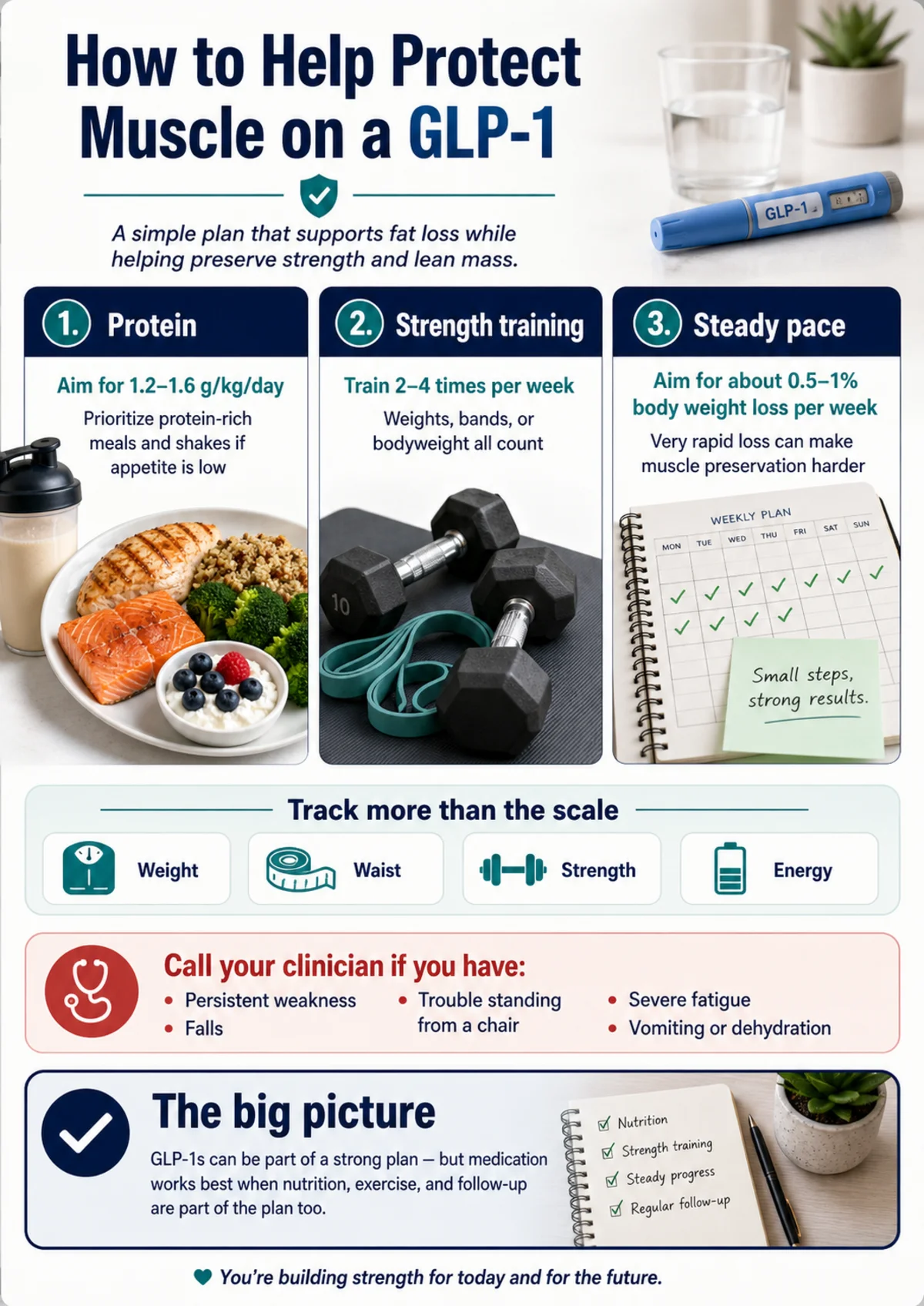
The big myth about muscle preservation is that it requires some complicated supplement stack or a personal trainer. It doesn’t. Three levers do almost all the work. Pull them and you give yourself the best shot at keeping the muscle you’ve got.
We’ll go deep on each one in the next three sections. Here’s the overview:
- Protein: 1.2–1.6 grams per kilogram of bodyweight per day, spread across 3–4 meals. (We’ll convert that to actual grams below.)
- Resistance training: 2–4 days a week. Bodyweight, bands, or weights — your choice. The signal matters more than the equipment.
- Slow rate of loss: Aim for 0.5–1% of bodyweight per week. Not faster. The medication will get you there; you don’t need to white-knuckle it.
A 2025 case series followed three patients (two women, one man) on either semaglutide or tirzepatide who built their entire program around these three levers. They trained 4–7 days a week (resistance training 3–5 of those days), hit protein targets, and lost weight at a sustainable pace. Result: they preserved lean soft tissue while losing significant fat mass. Three patients isn’t a randomized trial — it’s a proof-of-concept that the framework can work, not a guarantee every reader will see the same result.
A McMaster University proof-of-principle trial (Longland et al.) found that higher protein plus intense exercise during a marked calorie deficit helped preserve and even increase lean body mass. It wasn’t a GLP-1 trial, but it supports the same physiology: calorie deficit + adequate protein + resistance training preserves muscle that would otherwise be lost.
You don’t need to be perfect at all three. You don’t even need to be great. You need to be consistent at all three.
Lever 1: Protein — your real target in actual grams
Standalone answer: Most expert patient guides recommend 1.2–1.6 grams of protein per kilogram of bodyweight per day during active GLP-1 weight loss, distributed across 3–4 meals at 25–40 grams per meal. For a 180-pound person, that’s roughly 98–131 grams of protein per day. Some protocols use goal weight, current weight, or adjusted weight depending on body size and clinical context — work with your clinician or dietitian for a personalized target.
The 1.2–1.6 g/kg recommendation appears in basically every credible source on this topic — Mayo Clinic, the Endocrine Society, the Obesity Medicine Association, and the 2025 Acta Diabetologica review. The reason it’s higher than the standard “0.8 g/kg” daily recommendation: when you’re in a calorie deficit, your body needs more protein to protect muscle than when your weight is stable.
The catch is that 1.2–1.6 g/kg means nothing to most people. Let’s convert it to grams.
Protein targets by bodyweight (starting estimates)
| Bodyweight (lb) | Bodyweight (kg) | Lower target (1.2 g/kg) | Higher target (1.6 g/kg) |
|---|---|---|---|
| 130 lb | 59 kg | 71 g/day | 95 g/day |
| 150 lb | 68 kg | 82 g/day | 109 g/day |
| 170 lb | 77 kg | 92 g/day | 123 g/day |
| 180 lb | 82 kg | 98 g/day | 131 g/day |
| 200 lb | 91 kg | 109 g/day | 146 g/day |
| 230 lb | 104 kg | 125 g/day | 166 g/day |
| 260 lb | 118 kg | 142 g/day | 189 g/day |
About which weight to use: the simplest starting point is your current bodyweight. Some clinicians use goal weight or adjusted weight depending on body size, kidney function, and overall health. If you have a higher bodyweight, kidney disease, diabetes complications, frailty, or a clinician-set nutrition plan, use your clinician or dietitian’s target instead of the table above.
Spread it across meals. Your body uses protein for muscle protein synthesis most efficiently in 25–40 gram doses. A huge dinner serving isn’t “wasted” — you’ll still digest and use it — but spreading protein across 3–4 meals is the more practical strategy for most people, especially when GLP-1 appetite suppression makes eating one large meal hard.
How to actually hit your target on a GLP-1 (when your appetite is gone)
This is where most people fall apart. Your appetite is suppressed. Eating 100+ grams of protein a day feels like a chore. Here’s what works:
- Front-load breakfast. Your hunger is usually highest in the morning. Eat protein first when food sounds tolerable.
- Pick high-protein, lower-volume foods. Greek yogurt (15–20g per cup), cottage cheese (25g per cup), eggs (6g each), whey protein shakes (20–30g per scoop), chicken breast (25g per 3 oz), fish (20g per 3 oz), tofu (10g per ½ cup), edamame (8g per ½ cup).
- Use protein supplements when needed. A scoop of whey or pea protein in water is 20–30 grams in about 4 ounces. If solid food isn’t working that day, this saves your target.
- Keep “always-tolerable” options ready. Most GLP-1 users have one or two foods that always work even when nothing else does. Stock those.
- Eat protein first at each meal. Because your stomach empties slowly, you’ll fill up before finishing. Make sure protein is what your stomach actually receives.
A 2025 study presented at ENDO (Massachusetts General Hospital, Dr. Melanie Haines) reported that patients who hit their protein target preserved meaningfully more lean mass than those who didn’t — and the protective effect was strongest in women and older adults, who are otherwise the highest-risk groups.
A real warning: if you have kidney disease (CKD stage 3 or higher), do not increase protein on your own. Talk to your nephrologist or primary care doctor first. Higher protein is mostly safe for healthy kidneys, but it’s a real consideration for damaged ones.
Lever 2: Strength training — what actually works
Standalone answer: Resistance training 2–4 days per week using compound movements (squats, hinges, presses, rows) with progressive overload supports muscle preservation during GLP-1 weight loss. Bodyweight, resistance bands, or weights all work; the muscle-preservation signal comes from loading the muscle, not from any specific equipment.
You don’t need a gym. You don’t need a personal trainer. You don’t need a fancy program. You need to lift things, ideally heavy-feeling things, two to four times a week, and you need to make those things gradually harder over time.
The minimum effective dose: a beginner full-body plan
Pick one move from each category. Do 2–3 sets of 8–12 reps. Rest 60–90 seconds between sets. Total time: 25–40 minutes.
1. Squat-pattern (legs)
- Bodyweight squat → goblet squat → barbell squat
- Or: chair sit-to-stand (great for older adults)
2. Hinge-pattern (posterior chain)
- Glute bridge → Romanian deadlift with bands → kettlebell deadlift
- Or: hip thrust
3. Push-pattern (chest/shoulders)
- Wall push-up → knee push-up → standard push-up → dumbbell press
4. Pull-pattern (back)
- Resistance band row → dumbbell row → pull-up assistance machine
5. Carry or core
- Farmer carry with grocery bags → suitcase carry with one weight
- Or: dead bug, plank, bird-dog
That’s it. Five movements, three sets each, two to four days a week.
What “progressive overload” really means
Progressive overload is the engine of muscle preservation. It just means: your body adapts to whatever load you give it, so you have to gradually give it more. Otherwise the same routine becomes too easy and stops giving the muscle a reason to stay.
Add overload via one of three knobs:
- More weight. If 10 reps at 15 lb feels easy, go to 20 lb.
- More reps. If you got 8 reps last week, aim for 10 this week.
- More sets. Add a third set after a few weeks of two.
You don’t need to overload every workout. Once a week is plenty. If you can’t add weight or reps, you’re holding the muscle. That’s still a win during weight loss.
The frequency question: 2 days vs 4 days
If you’re new to lifting, start with 2 days a week. Two full-body sessions on, say, Tuesday and Saturday. That’s enough to send a strong “we still need this muscle” signal.
If you’ve been lifting for a while or you’re a higher-risk reader, go to 3–4 days. You can do upper-body / lower-body splits, or alternate full-body days. It doesn’t matter much — what matters is that you show up.
What about cardio?
Cardio is great for your heart, your blood sugar, and your overall health. It’s a poor substitute for resistance training when it comes to muscle preservation. The 2025 University of Milan review was clear: cardio alone does not preserve muscle in a calorie deficit. Resistance training does. Do cardio if you enjoy it. Don’t skip lifting because you went on a long walk.
Real talk about GI symptoms and tired weeks
Your first month on a GLP-1 (or your first week after a dose increase) often comes with nausea, fatigue, and a low appetite for food and exercise. Don’t try to hit four heavy sessions a week during a rough patch. Drop to two short sessions. Skip a week if you genuinely need to. The goal is consistency over months, not heroics in week 3.
Can you build muscle while taking a GLP-1?
Standalone answer: Yes — some people can preserve or even build strength while taking a GLP-1, especially beginners or detrained adults who add resistance training and adequate protein for the first time. Building visible muscle mass during a meaningful calorie deficit is harder than preserving what you have, but it’s possible. The framework is the same: progressive resistance training, 1.2–1.6 g/kg protein, and a steady rate of weight loss.
The page’s main goal is preserving the muscle you have during weight loss, but here’s the honest answer to the question that hides behind it: untrained beginners can absolutely gain strength and even some muscle on a GLP-1. The phenomenon is sometimes called “newbie gains” — your body responds to its first experience with progressive resistance training even in a calorie deficit, especially if your protein is high.
If you’ve trained for years and you’re carrying lots of muscle already, you’re more likely to maintain than gain during weight loss. That’s still a win: holding muscle through a 30–50 pound weight drop is a strong outcome.
The variables that make muscle-building (or strong preservation) more likely:
- Higher protein intake (toward the top of the 1.2–1.6 g/kg range)
- Resistance training 3–4 days a week with progressive overload
- A slower rate of weight loss (0.5% per week range)
- Adequate sleep
- Lower-stress life (cortisol fights this)
- Younger age and pre-existing training experience help, but aren’t required
The variables that make it less likely: rapid weight loss, sedentary baseline, low protein, high stress, frailty, and chronic illness.
If your lifts are going up week over week as your bodyweight drops, you’re succeeding. The scale isn’t the only score.
Lever 3: Slow your rate of loss
Standalone answer: A weight loss rate of 0.5–1% of bodyweight per week generally supports more muscle preservation than rapid loss. Faster than 1% per week is associated with greater proportional lean mass loss in dieting and GLP-1 studies. If you’re losing weight very fast, talk to your prescriber about staying at your current dose rather than escalating.
Faster isn’t better when it comes to muscle. Here’s the math you should know:
Healthy loss-rate targets by bodyweight
| Current weight | 0.5% per week (steady) | 1.0% per week (fast end of safe) |
|---|---|---|
| 160 lb | 0.8 lb / week | 1.6 lb / week |
| 200 lb | 1.0 lb / week | 2.0 lb / week |
| 250 lb | 1.25 lb / week | 2.5 lb / week |
| 300 lb | 1.5 lb / week | 3.0 lb / week |
Why this matters: when you push past 1% per week consistently, your body has less time to adapt. More of the loss comes from non-fat tissue (including muscle). The 2024 review of GLP-1-based therapies in Diabetes, Obesity and Metabolism (Neeland et al.) noted that the greatest reduction in lean body mass happens during the initial rapid weight loss phase — typically the first 3–6 months. That’s when you’re most aggressive with titration. Slowing it down protects you.
Practical advice on titration
Most GLP-1 prescribers default to a standard titration: dose increase every 4 weeks. If you’re losing weight steadily on a lower dose, ask your prescriber whether holding your current dose makes sense for you. There’s no medal for reaching 2.4 mg of semaglutide or 15 mg of tirzepatide if 1.0 mg or 7.5 mg is already working. The lowest effective dose:
- Reduces side effects (nausea, fatigue)
- Slows your loss rate to a healthier zone
- Protects more muscle
Cost effects vary by program — some platforms charge dose-based prices, others charge flat program-based prices. Ask before you assume staying lower will save you money.
The “I want to lose it all in 3 months” problem
We get it. You’ve been carrying this weight for years and now there’s a tool that actually works. The temptation to push the gas pedal is real. Here’s the honest tradeoff: you’ll lose the same amount of total weight in 9–12 months at a steady pace as you would in 4–6 months at a rapid pace. The slower path keeps more of your muscle. The faster path doesn’t.
If your goal is permanent weight loss with a body that still works, slower wins.
Got the plan? Make it executable.
We’re putting the protein targets, full strength program, weekly check-ins, and grocery list into a printable 4-week protocol PDF.
4-Week GLP-1 Muscle Preservation Protocol — coming soon.
What about supplements? (The honest version)
Standalone answer: Supplements are optional support tools, not the plan. Protein powder helps when appetite is suppressed. Creatine monohydrate has strong general evidence for supporting strength and muscle adaptations during resistance training. HMB and vitamin D are clinician-discussion items, especially for older adults or anyone with deficiency risk. None of these replace adequate dietary protein, resistance training, and medical follow-up.
Supplements are the most over-marketed part of this conversation. Most don’t help. A few may. Here’s the short, honest version.
Worth considering (after you’ve nailed the basics)
- Whey protein powder (or plant-based equivalents): the most useful “supplement” for most GLP-1 users, because it makes hitting your protein target easier when food sounds awful. 20–30g per scoop. Plant-based options (pea, soy) work for vegetarians.
- Creatine monohydrate (3–5 g/day): the most-studied supplement for strength and muscle outcomes during resistance training. The general evidence base is large; the evidence specifically for GLP-1 users is less direct. Cheap (about $0.20 per day) and safe in healthy adults. Talk to your doctor first if you have kidney disease.
- HMB (β-hydroxy-β-methylbutyrate, 3 g/day): some evidence for reducing muscle breakdown in older adults during caloric deficit. More expensive than creatine. The 2025 Acta Diabetologica review listed HMB among supplements with reasonable evidence in sarcopenia contexts. Discuss with your clinician.
- Vitamin D: GLP-1 nutrition data show vitamin D deficiency can develop during treatment. Test your level first. Don’t supplement high-dose vitamin D blindly. Work with your clinician on whether and how much to supplement based on your blood level and overall health.
- Omega-3 (EPA + DHA, 2–3g/day): mild anti-inflammatory effects that may reduce exercise-induced muscle soreness. General health benefit. Not a muscle preserver on its own.
Probably not worth it
- BCAAs (branched-chain amino acids): redundant if you’re hitting your protein target. Whole protein sources contain all the amino acids you need.
- Pre-workout supplements: mostly caffeine plus marketing. If caffeine helps you train, drink coffee.
- “GLP-1 muscle support” branded blends: most are repackaged creatine, HMB, and protein at 3–5x the cost. Buy the individual ingredients if you want them.
Ask your prescriber first if you have any of the following
- Kidney disease (creatine and high-dose protein both deserve a conversation)
- Heart conditions
- Diabetes (some supplements interact with diabetes medications)
- Pregnancy or breastfeeding
- Eating disorder history
How to track real progress (not just the scale)
Standalone answer: No single home metric perfectly separates fat, muscle, water, and glycogen changes. The most reliable home tracking combines weekly weight, monthly waist measurement, weekly strength performance, and energy/function check-ins. DXA scans estimate lean mass but don’t directly measure skeletal muscle the way MRI or CT can; they’re still the most accessible body-composition tool for most readers.
The scale lies. Or rather, the scale tells the truth, but only one part of the truth. You can lose 5 pounds of muscle and gain 5 pounds of fat in a year and the scale won’t move. You can also lose 5 pounds of water in a day and feel like you’ve lost weight when nothing real changed.
Here’s how to actually know what’s happening.
Tracking methods compared
| Method | Best for | Limitation |
|---|---|---|
| Scale weight | Tracking trend | Doesn't show body composition |
| Waist measurement | Tracking fat loss direction | Doesn't show muscle |
| Strength log | Measuring functional muscle | Requires consistent training |
| Chair-rise / stair count | Daily function | Subjective but useful |
| DXA (DEXA) scan | Better body-composition trend than home tools | Estimates lean mass; doesn't directly measure skeletal muscle. Cost and access vary by city — verify local cash price before booking |
| InBody / bioimpedance | Trend if used consistently | Sensitive to hydration |
| MRI / CT | Most direct skeletal muscle measurement | Cost and access make this impractical for routine tracking |
| Smart scale (home BIA) | Casual home tracking | Less accurate; one-day swings can be misleading |
Our recommended tracking stack
Weekly:
- Weight (same time of day, same conditions — usually morning, after bathroom, before food)
- One main lift performance (e.g., how many push-ups in one set, or the weight you used on goblet squats)
Monthly:
- Waist measurement (at the navel, relaxed, with a tape measure)
- Energy and mood check-in
- Optional: chair-rise test (how many times you can sit-stand from a chair without using your hands in 30 seconds)
Every 6 months (if budget and access allow):
- DXA scan
- Or InBody scan at a gym or weight loss clinic
The “smart scale” trap
A lot of GLP-1 users buy a smart scale that estimates body fat and muscle mass. These can be useful for trends — but they’re notoriously inaccurate for single readings. Bioelectrical impedance (the technology in most smart scales) shifts with hydration. Drink a glass of water and your “muscle mass” reading might jump 1–2 pounds. Don’t make decisions off one reading. Track weekly trends over 4–8 weeks.
If you see “lean mass dropped 4 pounds!” on your smart scale this week, breathe. That’s almost certainly water and glycogen, not muscle. Muscle doesn’t disappear in seven days.
When to call your doctor (and exactly what to say)
Standalone answer: Call your prescribing clinician promptly for any of the following: persistent weakness, recent falls, severe fatigue lasting multiple days, trouble standing from a chair without using arms, trouble climbing stairs, severe nausea or vomiting, dehydration symptoms, or a rapid drop in strength performance. Discuss with your clinician before significantly increasing protein if you have kidney disease, or before any dose change.
This is where guides like ours typically wave at “talk to your doctor” and move on. Let’s actually be useful.
The red flags that warrant a call this week
- Weakness that won’t go away. You feel weak after a workout — fine. You feel weak walking up the stairs to bed — call.
- Recent falls. Even one fall is a real signal. Two is urgent.
- Trouble standing from a chair without using your arms. If you used to be able to do this and now you can’t, that’s a measurable strength loss.
- Severe fatigue lasting multiple days. Not “tired after a long week.” Genuinely can’t function.
- Severe nausea or vomiting more than 2–3 days in a row. This is a nutrition problem now, not just a side effect.
- Signs of dehydration: dry mouth, dark urine, dizziness when standing, headache.
- Rapid drop in your usual lifts. If your normal squat weight feels twice as heavy this week, something’s off.
A clinician message template you can copy
Most people don’t call because they don’t know what to say. Here’s a template that works for a portal message, an email, or a phone callback request:
“Hi Dr. [Name], I’m taking [medication name] at [dose] for [duration]. I’ve lost about [X] pounds over the past [Y] weeks, which is about [rate per week]% of my bodyweight per week.
I’m worried about [specific symptom: weakness, fatigue, trouble standing, falls, severe GI symptoms, etc.]. My current protein intake is around [grams/day]. I’m strength training [times/week, or ‘not at all’].
Could we discuss whether I should slow my titration, hold my current dose, get any lab work, or check body composition? I want to keep losing weight, but I want to do it without losing strength.”
If your prescriber doesn’t take this conversation seriously, that’s information about your prescriber. A good GLP-1 program treats body composition as part of the goal, not an inconvenience. We talk about which programs do this well at the bottom of this page.
The kidney disease conversation
Higher protein is mostly safe for healthy kidneys. It can be a problem for damaged ones. If you have CKD (chronic kidney disease), diabetes-related kidney damage, or have ever been told your kidney function is borderline, talk to your nephrologist or primary care doctor before pushing protein above the standard 0.8 g/kg recommendation. They may still approve a higher target — it just needs to be a deliberate decision, not a default.
Compounded vs FDA-approved: does it change anything for muscle?
Standalone answer: The muscle-preservation strategies (protein, resistance training, rate of loss) apply the same way for compounded and FDA-approved GLP-1 medications, because the risk is driven mainly by appetite suppression, calorie intake, protein intake, training, and rate of weight loss. That does not make compounded products FDA-approved or supported by the same trial evidence as branded medications. The FDA has issued specific warnings about unapproved GLP-1 products, dosing errors, adverse events, and salt-form variants.
The muscle-loss conversation doesn’t really change between compounded and FDA-approved GLP-1s. The same practical levers protect lean mass either way. What does change is the safety profile around the medication itself.
What FDA-approved means
FDA-approved obesity medications include Wegovy, Zepbound, Saxenda, and Foundayo (orforglipron, FDA-approved April 2026). These have been through clinical trials specifically for chronic weight management. Ozempic and Mounjaro are FDA-approved for type 2 diabetes; they’re sometimes discussed in weight-loss contexts, but they’re not approved for chronic weight management on their own labels. Manufacturing is regulated. Dosing is standardized.
What compounded means
Compounded medications are made by licensed pharmacies for individual patients under federal and state compounding rules. During the FDA-declared shortage that began in 2022, compounded versions of semaglutide and tirzepatide expanded access. The FDA later determined that the tirzepatide shortage resolved in late 2024 and the semaglutide shortage resolved in February 2025. Enforcement timing and legal challenges affected how quickly copycat production wound down. Compounding may still be lawful only when federal and state conditions are met and a licensed clinician prescribes the product for an individual patient. The FDA does not approve compounded GLP-1 drugs.
The FDA has issued specific warnings about compounded GLP-1 medications, including:
- Dosing errors leading to overdoses
- Adverse event reports
- Fraudulent products being sold online
- Salt-form variants (semaglutide sodium, semaglutide acetate) that haven’t been studied for safety
This isn’t a reason to avoid compounded GLP-1s if your clinician prescribes one and you’re working with a licensed pharmacy. It’s a reason to:
- Verify which licensed pharmacy is filling your prescription
- Ask the prescriber and pharmacy to identify the exact compounded formulation, concentration, and dosage unit
- Take dosing seriously and ask exactly how to measure
- Have a clear plan for what to do if you experience severe nausea, vomiting, dehydration, or weakness
We won’t tell you compounded medications are clinically equivalent to FDA-approved branded products. They’re not — that’s an FDA-flagged claim and we won’t make it. We will tell you that the muscle-preservation plan in this guide works regardless of medication source, because the underlying physiology is the same. (For more on the legal status of compounded GLP-1s, see our compounded tirzepatide HSA/FSA explainer.)
“Ozempic face,” “skinny fat,” and the cosmetic side
Standalone answer: “Ozempic face” describes the gauntness, hollow cheeks, and looser skin that follow rapid weight loss; it’s caused by facial fat reduction outpacing skin elasticity recovery, not by muscle loss. “Skinny fat” describes weight loss without muscle preservation, leaving a body that’s thinner but disproportionally low-muscle. Both are addressed by the 3-lever plan: protein and resistance training maintain visible muscle tone, and a slower rate of loss gives skin more time to adapt.
“Ozempic face” is a real thing, but it’s not what you think.
When you lose facial fat quickly — especially in the cheeks and temples — your skin can’t always retract fast enough. The result looks gaunt and aged. This is fat loss, not muscle loss. No amount of resistance training will prevent it, because facial muscles aren’t really the issue.
What does help:
- Slower rate of weight loss. Skin retraction takes time. Faster loss = more lag.
- Hydration. Dehydration makes the effect worse.
- Protein. Skin is mostly collagen, and collagen synthesis needs amino acids.
- Patience. Some of the gauntness reverses 6–12 months after weight stabilizes as skin adapts.
For severe cases, plastic surgeons offer volume-restoration treatments (fillers, fat grafting). That’s a personal decision, not a medical necessity.
“Skinny fat” is the bigger concern, and it’s preventable
“Skinny fat” describes a body that’s lost weight but kept the same body fat percentage — because muscle loss and fat loss happened in proportion. The scale shows progress. The mirror doesn’t.
This happens when someone loses weight without resistance training and without adequate protein. It’s exactly the problem the 3-lever plan prevents. If you’re following the plan, you’ll come out of weight loss leaner and more muscular by proportion, even if total muscle pounds dropped slightly.
The clearest sign you’re avoiding skinny-fat: your strength is holding or improving as your weight drops. If you used to bench-press a certain weight and you still can at 40 pounds lighter, your muscle is fine. If your same lifts feel twice as heavy, you’ve lost meaningful muscle and need to course-correct.
What if you stop the medication?
Standalone answer: People who stop GLP-1 medications regain on average about 0.8 kg per month, with many users regaining close to 10 kg within the first year, according to a 2026 BMJ meta-analysis of 37 studies. Regained weight tends to skew toward fat, while lost muscle does not fully come back automatically. This is why maintaining the 3-lever plan during and after cessation matters, and why repeated stop-restart cycles may push some users toward sarcopenic obesity (low muscle, high fat).
Most GLP-1 users will eventually stop the medication — for cost, for life changes, for a doctor’s decision, or because they hit their goal. What happens next is one of the most important parts of this conversation.
The cessation data
A 2026 BMJ meta-analysis of 37 studies of weight regain after stopping newer obesity medications (including semaglutide and tirzepatide) reported that users regained an average of about 0.8 kg per month, with many regaining close to 10 kg within the first year after stopping.
But the regain isn’t equal across tissue types. A 5-year follow-up of semaglutide users (referenced in a 2025 mini-review in PMC12391595) found something concerning: those who regained weight added visceral fat, subcutaneous fat, and intermuscular fat — but their muscle area stayed roughly flat. They got worse off. Not just back to baseline.
The pattern researchers worry about is called sarcopenic obesity — low muscle plus high fat. It’s the worst metabolic phenotype, associated with higher all-cause mortality. Repeated stop-restart cycles on GLP-1s could push some users toward this profile over time.
How to protect yourself if you stop
- Don’t stop, restart, taper, or change dose without your prescriber. Ask about a maintenance, taper, or transition plan before you stop.
- Keep training. This is the single most important variable. Resistance training is what protects muscle, with or without the drug.
- Hold your protein target. Don’t drop back to 0.8 g/kg the moment you stop the medication. Keep the higher target through cessation and the 6 months after.
- Address the lifestyle drivers BEFORE restarting. If you regained weight because of stress eating or inactivity, fix that first. Restarting the medication on top of unaddressed habits sets you up for more cycles.
- Talk to your prescriber about maintenance strategies instead of full cessation, if it fits your situation.
Bariatric surgery comparison
Patterns of muscle loss and regain after bariatric surgery are similar. The same 3-lever plan applies. If you’re weighing surgery vs GLP-1 specifically because of muscle concerns, the body composition outcomes are roughly comparable when both groups follow the protein + resistance training plan.
Coming soon: bimagrumab and the muscle-saving drug pipeline
Standalone answer: A new class of medications designed to preserve muscle during weight loss is in clinical development. The 2026 BELIEVE Phase 2 trial (Heymsfield et al., Nature Medicine) showed that combining bimagrumab with semaglutide preserved lean mass while delivering substantial weight loss over 72 weeks. Other candidates include trevogrumab (Regeneron), enobosarm (Veru), and apitegromab (Scholar Rock). None of these muscle-preservation add-on drugs are FDA-approved for this use as of May 2, 2026.
This is the part of the conversation almost no other ranking page covers, and it’s worth knowing about.
Pharmaceutical companies have noticed the muscle-loss problem. Several are developing drugs designed to be added to GLP-1 therapy specifically to preserve lean mass.
Bimagrumab + semaglutide: the BELIEVE Phase 2 trial
In March 2026, Nature Medicine published results from the BELIEVE Phase 2 trial. The trial tested bimagrumab — an antibody that blocks activin/myostatin signaling — alone or combined with semaglutide. Bimagrumab was originally developed for muscle-wasting diseases. Eli Lilly acquired the program when it bought Versanis Bio in 2023.
Results from the combination arm: substantial weight loss over 72 weeks, with lean mass largely preserved compared to semaglutide alone. The BELIEVE study marked the clearest proof-of-concept yet that you can decouple weight loss from lean mass loss with the right add-on drug. Lilly also terminated one separate bimagrumab obesity trial in September 2025, per BioPharma Dive reporting — a reminder that drug development is messy.
Other candidates in the pipeline
- Trevogrumab (Regeneron): an anti-myostatin antibody being tested with semaglutide.
- Enobosarm (Veru): a selective androgen receptor modulator (SARM) being tested in sarcopenic obese elderly patients on GLP-1s.
- Apitegromab (Scholar Rock): another anti-myostatin candidate in development.
- Pemvidutide: a triple agonist designed to lose less lean mass by design.
What this means for you today
None of these are FDA-approved for muscle preservation alongside GLP-1 therapy. Availability depends on Phase 3 results, regulatory review, and approval — which is multi-year work even when trials succeed.
So what do you do with this information now? Don’t wait. The 3-lever plan is the part you can execute today. Future drugs may help, but they won’t replace protein, resistance training, and medical follow-up.
Your 4-week starter plan (the “just tell me what to do this week” version)
Standalone answer: A practical 4-week starting protocol for GLP-1 muscle preservation: Week 1 establish baseline measurements and protein habit; Week 2 add two strength sessions; Week 3 add overload progression and weekly weight-loss-rate check; Week 4 review and adjust. This builds gradually from current habits without overwhelming a new GLP-1 user dealing with appetite changes and side effects.
Reading 8,000 words doesn’t help if you don’t know what to do Tuesday morning. Here’s the version you actually use.
Week 1: Baseline
Goal: Stop drifting. Measure where you are.
- Weigh yourself (same time, same conditions, write it down)
- Measure your waist at the navel (write it down)
- Note your average daily protein for 3 days (just observe; no changes yet)
- Pick 5 strength exercises (one each: squat, hinge, push, pull, carry) — write them down
- Set up a simple tracker: phone notes, a notebook, or a spreadsheet
Week 2: Consistency
Goal: Two strength sessions and a protein habit.
- Two full-body strength sessions (e.g., Tuesday + Saturday). 2 sets of 8–12 reps per exercise.
- Hit your protein target at breakfast. If you do nothing else with protein, just nail breakfast. 25–40g.
- Hydrate — half your bodyweight in ounces is a starting point
- Continue weighing once a week, same conditions
Week 3: Progression
Goal: Add a tiny bit of difficulty.
- Add one more set to one exercise (e.g., squat goes from 2 sets to 3)
- Or add 2 more reps to one exercise
- Or add a small amount of weight to one exercise
- Add one more meal with 25–40g protein (lunch becomes the next anchor)
- Calculate this week’s weight loss rate: (last week’s weight − this week’s weight) ÷ last week’s weight × 100. If you’re consistently over 1% per week, or any week is over 2% with poor intake, vomiting, dehydration, weakness, or severe fatigue, message your prescriber.
Week 4: Review
Goal: See what worked, adjust honestly.
- Compare week 1 vs week 4: weight, waist, strength, energy, appetite, GI tolerance
- If you missed strength sessions: drop the bar lower next month, not higher
- If you crushed the plan: add a third weekly session
- If you had any red-flag symptoms (weakness, falls, severe GI issues), use the clinician message template above
- Decide: continue solo, get a dietitian referral, or switch GLP-1 programs to one with more support
After week 4, the plan becomes: keep doing it. The first month is the hardest. Once the protein habit and the lifting habit are real, the next 11 months mostly take care of themselves.
Want this in a printable format you can stick on your fridge?
Our 4-Week GLP-1 Muscle Preservation Protocol PDF will expand on every section above with day-by-day protein gram targets, the full progressive lifting program, a GLP-1-friendly grocery list, the supplement stack with dosing, and a weekly self-check-in scorecard.
4-Week Muscle Preservation Protocol PDF — coming soon.
How to choose a GLP-1 program that takes muscle preservation seriously
Standalone answer: Most consumer GLP-1 telehealth programs hand patients a prescription with no specific muscle-preservation support. The programs worth paying for include at least one of: clinician follow-up cadence, nutrition or dietitian access, body composition tracking, dose flexibility (option to stay at a lower dose), and clear pharmacy verification. Higher-risk readers should prioritize clinical-feel programs over the cheapest option; lower-risk readers can use broader cash-pay programs as long as they execute the 3-lever plan independently.
If you’ve made it this far, you have the plan. The remaining question is: which GLP-1 program supports the plan best for you?
What to ask any GLP-1 program before you sign up
| Question | Why it matters |
|---|---|
| Do you offer a protein target or nutrition guidance? | Appetite suppression silently drops protein. A good program addresses this. |
| Do you monitor my weekly weight loss rate? | Loss faster than 1% per week is when muscle preservation gets harder. |
| What happens if I get severe nausea or weakness? | This should trigger a clinician conversation, not a generic FAQ link. |
| Can I stay at a lower dose if it's working? | Some programs push max-dose protocols regardless of patient need. |
| Do you offer body composition tracking? | InBody, DXA, or even a structured handgrip test signals real care. |
| Do you distinguish FDA-approved and compounded clearly? | Programs that blur the line aren't programs you should trust. |
| Which licensed pharmacy fills my prescription? | Especially important for compounded medications. |
| What are your real prices after the intro month? | Intro pricing is marketing. Month 2+ is your actual cost. |
Some provider links below may be affiliate links. We disclose material limitations including pricing, medication-source caveats, and any regulatory issues.
Provider directory — where to start, by reader type
Last verified May 2, 2026. Pricing and policies change — check the provider site before signing up.
If you want broad cash-pay with a deep menu
MEDVi advertises compounded semaglutide programs starting at $179 for the first month with $299 refills that the program lists as including physician review, plan, guidance, report, medication, and shipping. The pricing model is no contract, no membership fee on that page.
Material disclosure
On February 20, 2026, the FDA issued a warning letter to MEDVi LLC stating that representations on its website suggested MEDVi was the compounder when it was not, and flagging “same active ingredient” claims as appearing on the site. The FDA characterized the representations as false or misleading and the products as misbranded. If you’re considering MEDVi, verify the current pharmacy, formulation, pricing, and whether the cited website issues have been corrected before enrolling. We cover the full context, including the warning letter, on our review page.
Read our full MEDVi review (including the FDA warning letter context) →
If you want a low-cost cash-pay compounded option
Embody offers cash-pay compounded semaglutide and tirzepatide as weekly injections, plus a needle-free GLP-1 gum. Pricing starts at $99 for the first month on compounded semaglutide injection, then $299/month; tirzepatide and the gum run higher (up to $449/month depending on medication and form). No separate membership fee, no insurance required, HSA/FSA eligible (confirm with your plan). Compounded options are not FDA-approved finished drugs, and Embody isn’t available in every state (excludes MS & LA). Good fit for readers who want an affordable cash-pay start or a needle-free GLP-1 option.
Check Embody Eligibility → (sponsored affiliate link, opens in a new tab)
If you want FDA-approved and want help with insurance
Ro publicly lists FDA-approved GLP-1 options including Foundayo, Wegovy, Zepbound, and Saxenda pathways. Their insurance concierge handles prior authorization paperwork, and they offer a free GLP-1 Insurance Coverage Checker. Ro Body membership pricing: $39 for the first month, then $149/month on a monthly plan or as low as $74/month with annual prepay. GLP-1 medication cost is not included in the membership cost. Foundayo on Ro starts at $149/month for the lowest dose, with higher doses listed at $199–$299/month with manufacturer-offer conditions; Ro states additional membership fees apply on top of medication.
The trade-off worth knowing: Ro is a more structured, branded-medication-focused experience. If you’re set on compounded oral formulations or want the cheapest possible cash-pay path, the broader cash-pay programs above will serve you better.
Check insurance coverage with Ro’s free checker → (sponsored affiliate link, opens in a new tab)
If you’re a higher-risk reader (older, postmenopausal, low baseline muscle, kidney concerns)
We’d encourage you to start at your primary care doctor, not a telehealth platform. A telehealth program can be a fine fit after your PCP signs off on the plan and helps you set up baseline labs and any monitoring you need. The 3-lever plan still applies — but the support around the medication should be more clinical for higher-risk readers.
If you’re not sure which fits
That’s what the quiz is for. Two minutes, and we’ll point you to the program that actually matches your risk tier, budget, insurance status, and medication preference.
No email required to see your match.
Frequently asked questions
Is GLP-1 muscle loss permanent?▾
How much muscle do you lose on Ozempic specifically?▾
Do you lose muscle on tirzepatide (Mounjaro/Zepbound)?▾
How much protein do I need on a GLP-1?▾
Should I take creatine on a GLP-1?▾
Can I avoid muscle loss with cardio instead of weights?▾
Is GLP-1 safe for older adults at risk of sarcopenia?▾
What's "Ozempic face" and how do I prevent it?▾
Will I gain the weight back as fat if I stop?▾
Are compounded GLP-1s more dangerous for muscle loss?▾
Do I need a DXA scan before starting a GLP-1?▾
Should I stop or lower my GLP-1 dose if I'm worried about muscle loss?▾
Can you build muscle while taking a GLP-1?▾
What should I look for in a GLP-1 program if I care about muscle preservation?▾
Methodology — what we actually verified for this guide
We separated three kinds of claims in this guide:
Medical and regulatory facts were verified against primary clinical journals (Nature Medicine, Cell Reports Medicine, Diabetes, Obesity and Metabolism, NEJM, Acta Diabetologica, BMJ), FDA-approved prescribing information for Wegovy, Zepbound, Saxenda, Foundayo (orforglipron, FDA-approved April 2026), Ozempic, and Mounjaro (with weight-management vs diabetes indications separated where relevant), and FDA Drug Safety Communications, including the February 2026 warning letter to MEDVi.
Body composition data comes from named clinical trials: STEP-1 (semaglutide 2.4 mg, DXA substudy), SURMOUNT-1 (tirzepatide, pooled DXA substudy), SURMOUNT-5 (head-to-head efficacy trial, NEJM 2025), SUSTAIN-8 substudy, and the 2026 BELIEVE Phase 2 trial of bimagrumab plus semaglutide (Heymsfield et al., Nature Medicine).
Editorial conclusions about which GLP-1 programs fit which readers are explicitly framed as editorial recommendations, not medical claims. Provider features (pricing, formulary, support, regulatory disclosures) were checked against provider websites and FDA enforcement records as of the last-verified date at the top of this guide.
We did not verify individual reader outcomes from any specific provider for this page. Provider-specific reviews live on dedicated pages (linked above where applicable) with their own verification dates. Any claim that could not be verified was removed from the published page or held for a future update.
Voice-of-customer language
Phrases like “Ozempic face,” “skinny fat,” “I look gaunt,” and “I’m scared of losing muscle” are language references pulled from public discussions on Reddit and other forums. We use these to understand what readers actually feel and search for. We don’t cite forum posts as medical or outcome evidence, and we don’t quote individual users without verification.
Affiliate disclosure
The RX Index is a pricing intelligence and comparison resource for GLP-1 telehealth providers. Some links to providers in this guide are affiliate links — we earn a commission if you sign up, at no additional cost to you.
Medical disclaimer
This guide is informational and is not medical advice. GLP-1 medications are prescription drugs with risks. Talk to a licensed prescriber about whether they’re right for you. The strategies above (protein intake, resistance training, supplements) should also be discussed with your clinician, especially if you have kidney issues, cardiovascular conditions, an eating disorder history, or take other medications.
The honest close
Most weight loss content panics or shrugs. We tried to do something different here.
The reality is that GLP-1 medications work — they work better than anything we’ve had before for obesity. They also cause some lean mass loss, like every effective weight loss tool does. Lean mass loss isn’t a reason to skip them. It’s a reason to build a real plan around them.
The plan is boring: enough protein, lift weights a few times a week, don’t crash-diet. The plan is also unglamorous: most people who fail at it fail because they don’t follow it consistently, not because they didn’t know what to do.
If this is the page that ends your search and gets you to actually start, that’s the win we wanted. If you still need help picking a provider, the quiz is right below. If you want the printable plan, it’s free.
You’ve got this.
Still not sure which GLP-1 program is right for you?
We factor in your age, baseline activity, risk score, insurance status, and budget — and recommend the program that actually fits. Two-minute quiz, free.
Take the GLP-1 Match Quiz →If you’re already on a GLP-1 (or starting next week):
Save the 4-week starter plan above — it covers what to do in week 1, week 2, week 3, and week 4.
A printable 4-Week Muscle Preservation Protocol PDF is coming soon.
Sources
- Heymsfield SB et al. Bimagrumab plus semaglutide alone or in combination for the treatment of obesity: a randomized phase 2 trial. Nature Medicine, March 2026.
- Langer HT et al. Weight loss with GLP-1 medicines does not result in a disproportionate loss of muscle mass or function in obese mice and humans. Cell Reports Medicine, March 2026.
- Neeland IJ et al. Changes in lean body mass with glucagon-like peptide-1-based therapies and mitigation strategies. Diabetes, Obesity and Metabolism, 2024.
- Wilding JPH et al. Once-Weekly Semaglutide in Adults with Overweight or Obesity (STEP-1). New England Journal of Medicine, 2021.
- Jastreboff AM et al. Tirzepatide Once Weekly for the Treatment of Obesity (SURMOUNT-1). New England Journal of Medicine, 2022.
- SURMOUNT-1 DXA substudy: Body composition changes during weight reduction with tirzepatide in SURMOUNT-1. Pooled tirzepatide DXA analysis.
- SURMOUNT-5: Tirzepatide vs Semaglutide head-to-head efficacy trial, NEJM 2025.
- Haines M et al. Higher protein intake protects against muscle loss with semaglutide. ENDO 2025, Endocrine Society annual meeting.
- UC Davis Health (Baar K commentary). Systemic impact of GLP-1–based therapies. December 2025.
- Stamati A et al. Glucagon-like peptide-1 receptor agonists and muscle mass effects. ScienceDirect, August 2025.
- Aimelet et al. Pharmacological intervention: Challenges and promising outcomes for fat loss and preservation of lean body mass. Diabetes, Obesity and Metabolism, 2026.
- Mini-review on sarcopenic obesity post-GLP-1 cessation. PMC12391595.
- Muscle loss and GLP-1R agonists use. Acta Diabetologica, November 2025.
- Longland TM et al. Higher compared with lower dietary protein during an energy deficit combined with intense exercise promotes greater lean mass gain and fat mass loss. American Journal of Clinical Nutrition, 2016 (McMaster proof-of-principle trial).
- 2025 University of Milan review on resistance training + protein during GLP-1 therapy.
- Mendelian-randomization study, University of Hong Kong (n=800,000+ European participants), 2025.
- 2026 BMJ meta-analysis of 37 studies on weight regain after stopping newer obesity medications.
- Lilly bimagrumab obesity trial termination announcement, BioPharma Dive, September 2025.
- FDA prescribing information: Wegovy, Zepbound, Saxenda, Foundayo (weight-management indications); Ozempic, Mounjaro (type 2 diabetes indications).
- FDA Drug Safety Communications on compounded GLP-1 medications (unapproved GLP-1 drugs concerns page).
- FDA warning letter to MEDVi LLC, February 20, 2026.
- Mass General Advances in Motion: Preserving Lean Body Mass in Patients Taking GLP-1 for Weight Loss.
- Mayo Clinic Store: GLP-1 Medications and Muscle Loss: What to Know About Nutrition and Supplements.
Your situation changes the answer
Find My GLP-1 Path
The right GLP-1 provider isn't the same for everyone. It depends on your state, your insurance and formulary, whether you want an FDA-approved or compounded medication, your preferred route (injection or oral), and your budget. Because a general answer can't resolve those for you, use The RX Index's Find My GLP-1 Path tool to get a personalized provider match with source-verified pricing before you choose.
- What it asks: your state, insurance situation, medication preference, budget, and support needs
- What you get: a personalized shortlist of GLP-1 providers matched to your situation, with verified pricing and the right questions to ask
- Cost: free · about 2 minutes · no signup